



Everything SD
Digging San Diego: Secrets Under The Sediment
Read article

Wildly San Diego columnist Lili Kim goes behind the scenes at the Nat's paleo department to explore the coolest fossil discoveries around the city
My Ocean Beach backyard is half concrete and half red tile, faded by the sun into a sort of decomposing salmon shade. Under the tile is probably some combination of fill, gravel, sand, and dirt, and an archaeological junk drawer of human habitation: a shard of glass, a rusty nail, the cigarette butt from the night a Grateful Dead cover band played down the street. The layer where people have been building, renovating, losing, and finding things for decades.
Deeper down is a different record. San Diego’s sedimentary layers were here before the apartments, before the roads, before anybody decided to give this city a name. They formed while the coastline moved, rivers changed course, and now-extinct animals came and went.
It’s typically pretty quiet down there, but sometimes there’s something tucked into the earth. A tooth, a jaw bone. Occasionally an entire skeleton of an animal we never knew existed. As I dove into San Diego’s fossil records, I realized they aren’t in some faraway desert waiting for a Harrison Ford type to unearth them with a single brushstroke.
The bones are right beneath us.
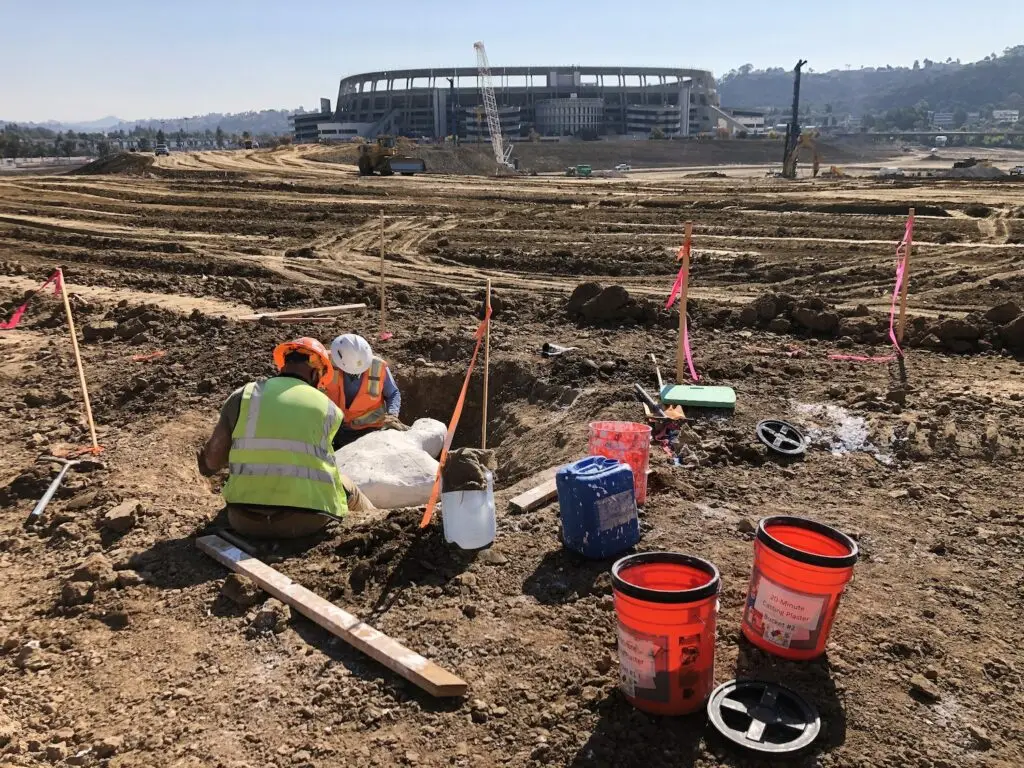
In 1994, mastodon remains turned up during construction of a Walmart in Oceanside. In 2001, a Columbian mammoth surfaced at Oceanside’s Old Grove Marketplace. In 2009, mammoth and whale remains were found during construction for the Thomas Jefferson School of Law’s downtown campus in different sediment layers. And in 2020, construction crews near Snapdragon Stadium uncovered a 120,000-year-old bison. The bison was excavated, but a few years later, San Diegans would be tailgating over where it had spent 120 millennia underground.
And then there’s my favorite discovery: the mastodon beneath the 54.
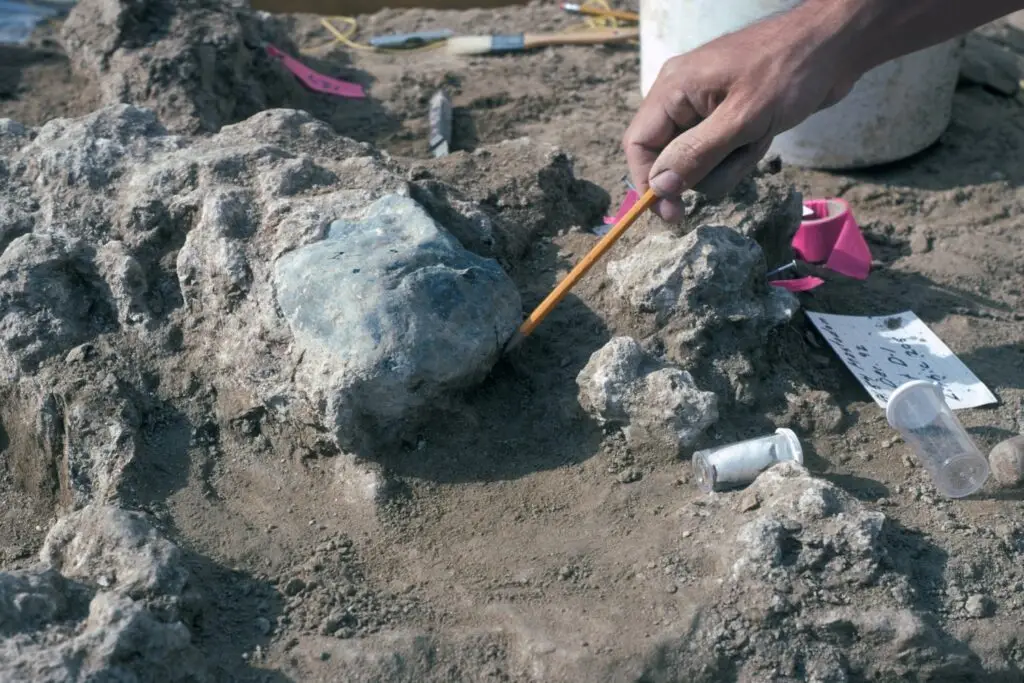
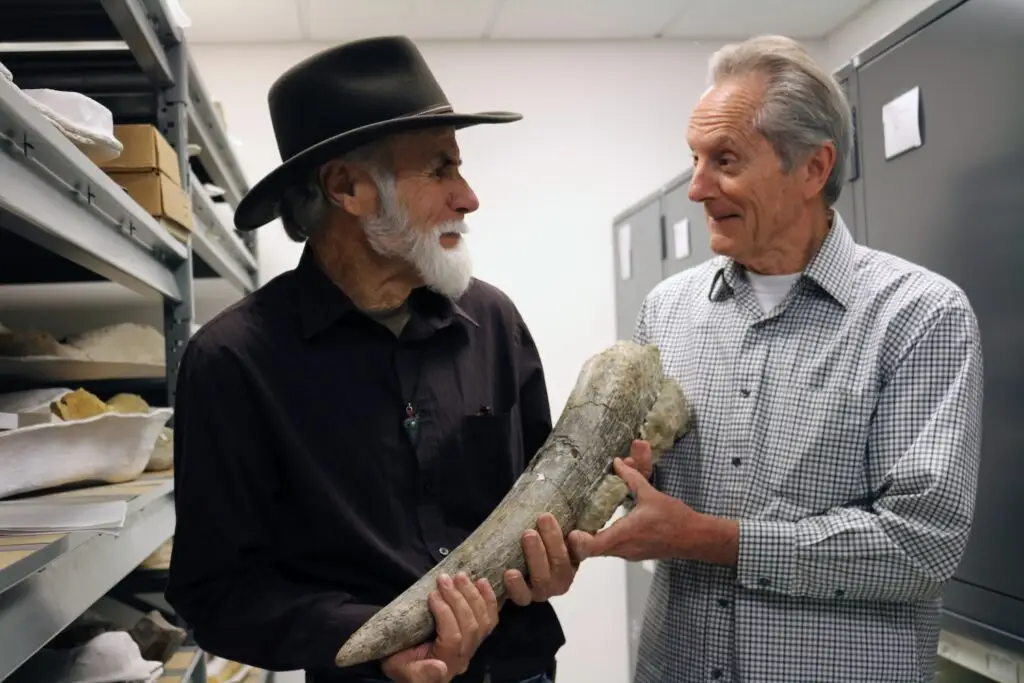
Caltrans was expanding the highway in 1992 when Richard Cerutti, a then-field paleontologist with the San Diego Natural History Museum, spotted bones and pieces of a tusk. He and his colleagues, including Dr. Tom Deméré, now the museum’s curator of paleontology and director of PaleoServices, excavated the site over the next five months.
Some bones were sharply fractured; others were intact. Large stones sat among the remains, and one section of tusk stood vertically in the ground. Had someone tampered with the carcass?
At the time, the oldest, widely accepted evidence of humans in North America was roughly 14,000 years old. The Cerutti Mastodon site was eventually dated to about 130,000 years ago, give or take 10,000, and unique bone fractures revealed signs of human activity: Experiments showed that striking fresh elephant bones with rocks can produce similar fractures. In 2017, Deméré and his colleagues argued in Nature that humans had deliberately broken the bones. If correct, that would push human presence in North America back by more than 100,000 years. Critics have challenged the interpretation; no human remains were found.
Today, there’s a system for trying to recover fossils before construction destroys them. For projects subject to the 1970 California Environmental Quality Act (anything that needs discretionary approval from a state or local government agency and could physically change the environment), agencies must assess potentially significant impacts on paleontological resources. In San Diego, that can mean requiring monitoring in deposits with moderate or high fossil potential. If something turns up, grading in that area can stop while a qualified paleontologist examines and, if necessary, recovers the find.
For paleontologists, though, the work is often a waiting game. Katie McComas, the Nat’s assistant director of PaleoServices and senior paleontologist, recalls an analogy from her former colleague, Pat Sena: “He described it as being like fishing. It’s a lot of nothing for a long time … but it’s punctuated with moments of excitement.”
The trick is knowing what to catch. To me, the left mandible of a baleen whale looks like rotting driftwood. Its vertebrae look like dusty rocks a kid might bring home and paint into ladybugs. There’s no neon sign flashing: “Get Your Fossils Here!” But put those bones in a display case, and you suddenly notice the porous texture and the repeating shapes of a skeleton.
So where do you look for bones in the first place? It all starts with the geology. “Fossils are found in sedimentary rocks, not granite,” Deméré says. Sedimentary rocks form as layers of sediment accumulate and are buried over time, creating conditions where organisms can be preserved. Granite forms when molten rock cools and crystallizes deep underground—far too hot for organic remains to fossilize. “If you look at a map of San Diego, the coastal plain is sedimentary rocks, like you’d see at Torrey Pines. Inland, it’s pretty much granitic rock. No fossils. Then once you get out to the desert, it’s sedimentary again.”
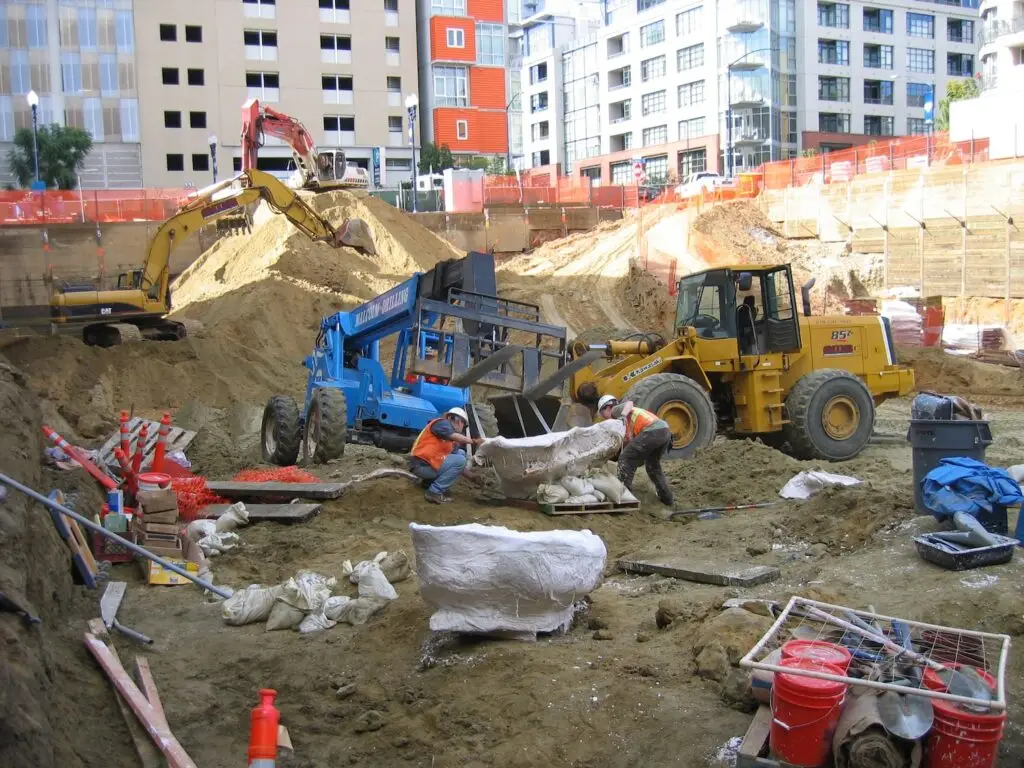
Finding a tidy skeleton of animals is rare. Deméré says they’re “lucky” if all or most of it turns up at once: “Picture a floating carcass of decomposing whale, dropping pieces as it drifts. The lower jaw might drop and the flippers fall away. Currents can scatter the bones before they’re buried.”
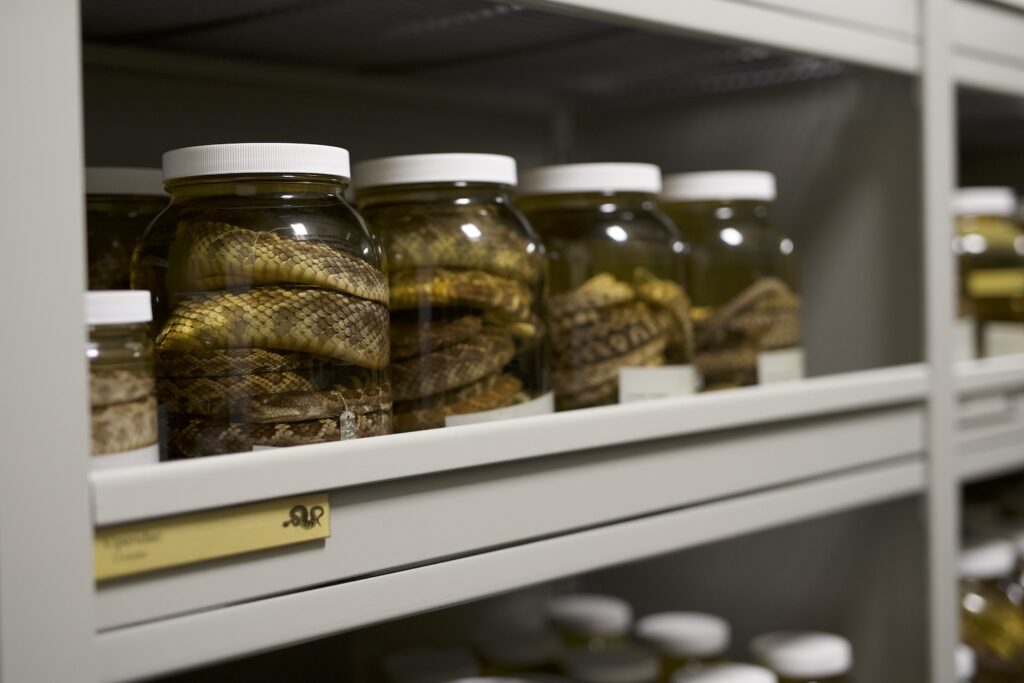
Back at the lab, the detective work continues. Fossils have to be cleaned, prepared, identified, cataloged, and studied. At the Nat, the bones wait in crank-apart shelving units for research into how our city used to look.
“Even when you expect to find fossils, you can still be surprised by what you find,” McComas says. “You just never know what’s beneath us until you start digging.”

Lili Kim is a content coordinator and writer for San Diego Magazine, with experience highlighting local businesses and communities. When not writing or shooting film, she is likely brewing her seventh cup of tea of the day or strolling along Sunset Cliffs.
