Featured articles
Food & Drink
Food & Drink
Food & Drink
Featured articles
Everything SD
Everything SD
Everything SD
Featured articles
Things to Do
Things to Do
Everything SD
Featured articles
podcast-ep
podcast-ep

podcast-ep
Featured articles

Everything SD
Everything SD
Everything SD
Featured articles
Partner content
Everything SD
Everything SD
Ready to know more about San Diego?
SubscribeReady to know more about San Diego?
The Harbor Island resort debuts the Garden Terrace as the final piece of a $123 million renovation
If you’re anything like me, you’ve probably been planning your wedding your entire life. The impromptu daydreaming usually comes at the most inconvenient times: during a meeting or right as you’re falling asleep after watching too many episodes of TLC’s Four Weddings.
In those imagined scenes, there is always a sunset. Usually some kind of impossible garden that feels like Alice in Wonderland meets The Secret Garden. There are soft pinks and climbing greens, florals that look like they grew a little too perfectly on purpose, and somewhere in the distance, water that catches the light. It’s dramatic in the best way.
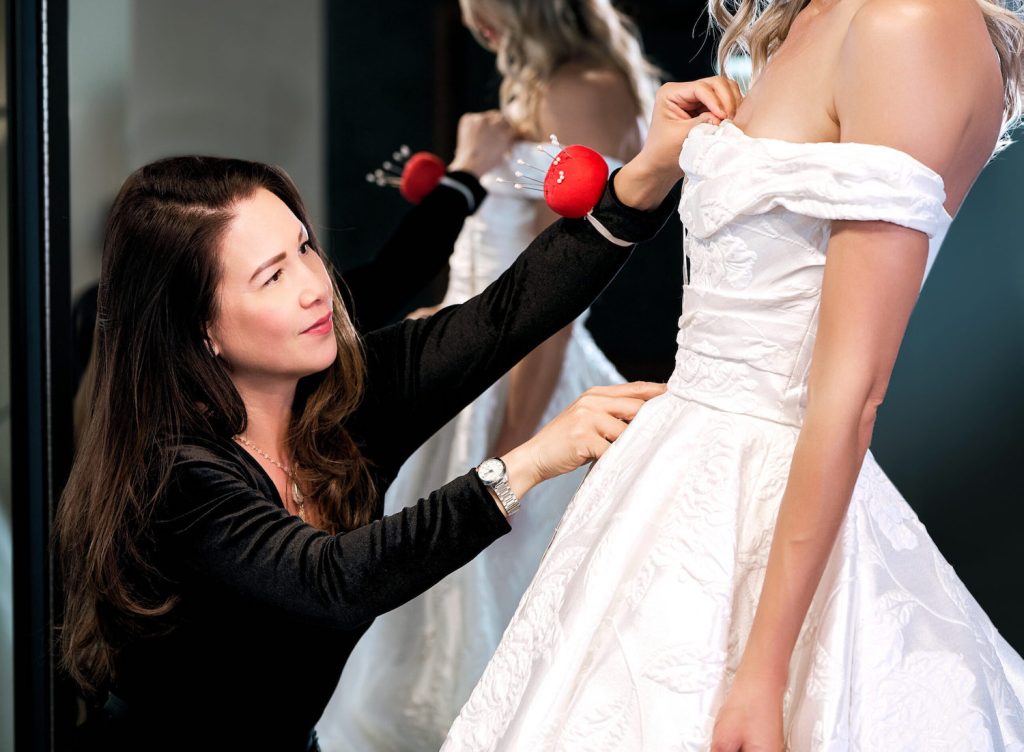
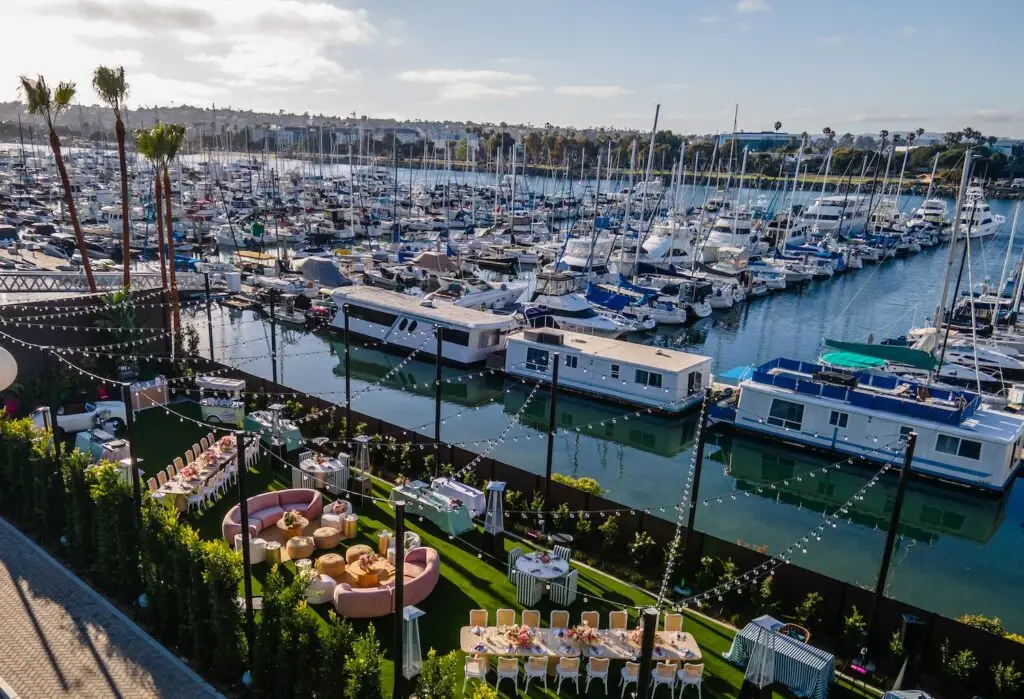
Perched on Harbor Island, Sheraton San Diego Resort feels like a tucked-away bayside escape. But the real centerpiece of its $123 million transformation is the new Garden Terrace, a private green oasis that feels like it was designed specifically for the dream wedding replaying in my head. This is what I had been imagining all those years. White tea roses, lavender, gardenia, jasmine, and magnolia trees line the space, creating a fragrance that feels like it’s part of the architecture.
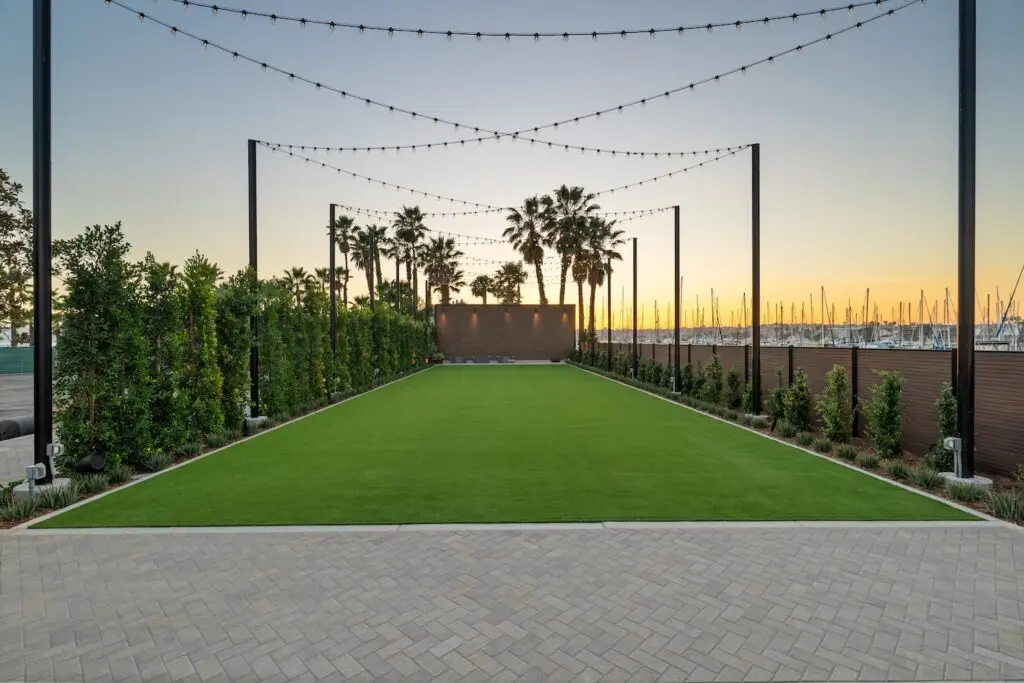
Sheraton San Diego Resort has always had the advantage of its location, but what stands out now is how intentionally the indoor and outdoor spaces coexist. Panoramic harbor views stretch across the property, shifting from soft blue mornings to golden-hour glow and a nighttime skyline that feels almost cinematic. Of course, there are other ceremony and event spaces across the resort, too—including the Lanai Lawn, Harbor Vista Lawn, and Eventide Gardens—each offering its own variation of open-air beauty. But the Garden Terrace is the one that feels like it was made for vows.
I arrived on a Tuesday afternoon with a suitcase slightly overpacked, the result of not knowing what to fully expect from a resort doubling as a wedding venue. I tried to cover every possible version of the trip: a handful of summer dresses, a few breezy pants, marina-esque tank tops, sandals for everything, and accessories meant to sparkle in the sun (seven different earring and necklace options was probably unnecessary, though).

I did, however, underestimate the swimsuits, especially once I saw the paddleboards, endless water activities you’d want to try at least once, and pools and jacuzzis practically whispering your name. Business casual never made it out of the suitcase, replaced instead with easy cover-ups, pinks and greens, and airy button-ups that felt more in tune with the setting than structured jackets ever could.
The resort has been reimagined across rooms, dining areas, and outdoor spaces, with thoughtfully layered tile textures, lighting that shifts with the time of day, warm-toned palettes in the dining rooms, and fresh blues in the bedrooms that complement the views pouring in through the windows. The foyer feels expansive, framed by floor-to-ceiling windows and designed to bring a little bit of San Diego inside with you, rather than shut it out.
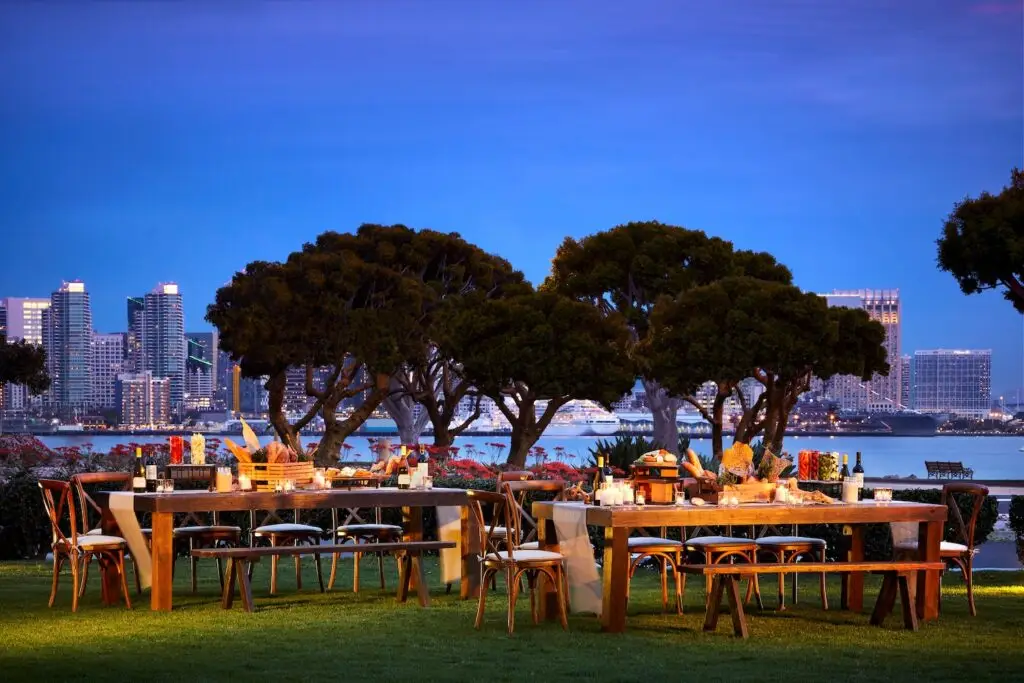
By late afternoon, I was sitting by the marina watching the water shift colors in real time, the kind of view that makes everything feel slower without trying. Dinner at Rumorosa brought the first real taste of the resort’s Cali-Baja identity, starting with a trio of margaritas—passion fruit, spicy watermelon, and creamy coconut—that made it impossible to pick a favorite and slightly dangerous to have them all in front of you at once.
The table opened with guacamole layered with spicy cotija, radish, pomegranate seeds, candied serranos, cilantro, limes, duritos, and warm tortilla chips, followed by Mexican street corn with sweet kernels, spiced aioli, cotija, and more candied serranos that hit just enough heat to keep you absolutely addicted.
For my main, I went with the roasted organic chicken breast with buttered jasmine rice, mole negro, and roasted cauliflower, which felt familiar in structure but elevated in small details like the cilantro and pickled onions. And then the Carajillo tres leches cake, a vanilla sponge layered with coffee and Licor 43 mousse, praline, and caramel sauce, arrived and disappeared faster than it probably should have.
What made it feel so curated wasn’t just the menu, but how intentional everything felt without ever feeling fussy: bright flavors balanced against rich ones, heat against sweetness, and plates that arrived right as the light over the marina started to soften. The next morning carried that same energy. Breakfast could unfold at your own pace, whether that meant taking a Zoom call in your room, heading downstairs for a sit-down meal with friends at Rumorosa, or grabbing something quick from Strada Italian Market. I opted for a vanilla latte from La Colombe at Strada before heading out for the morning.
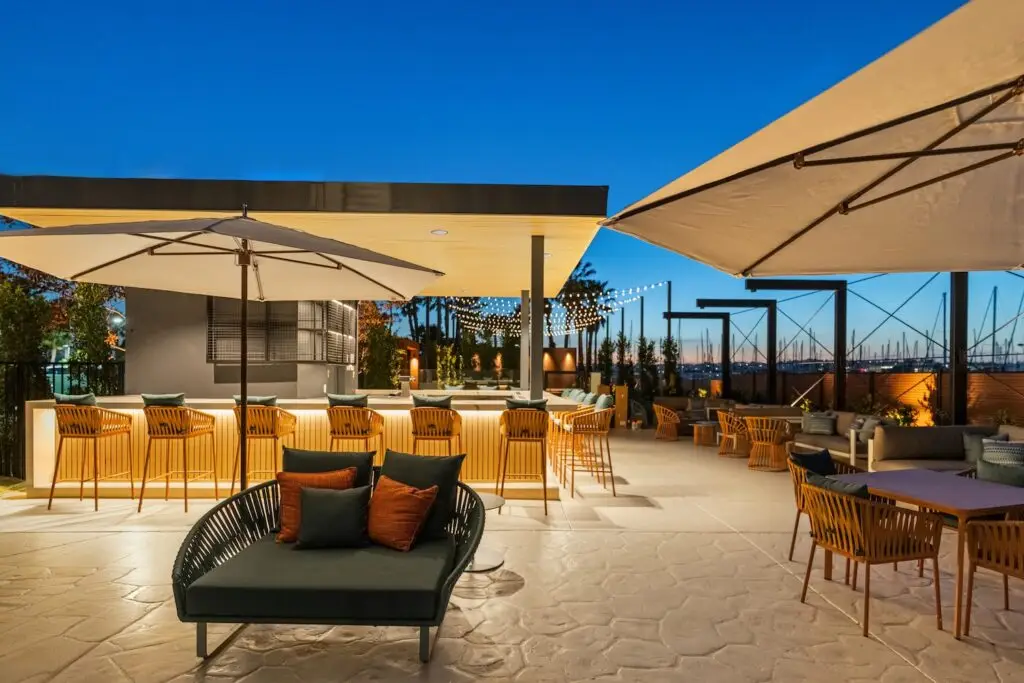
I made it just in time for the resort’s complimentary morning yoga on the lawn, boats just visible beyond the stretch of green. The Sheraton offers it daily as part of the stay, a low-pressure option for anyone looking for an easy reset rather than a full workout, which I wasn’t expecting to take part in on this trip but ended up glad I did. The class itself was beginner-friendly, with slow flows and a few optional deeper stretches for anyone who wanted to push into more advanced poses.
Afterward, stand-up paddleboarding shifted everything into a different perspective. My small group launched from the resort’s private dock, boards wobbling slightly as we found our balance, then drifted out into the marina where the water opened up in every direction. We paddled past rows of docked boats, slipped alongside houseboats with their shaded decks and string lights, and followed the gentle curve of the harbor as it widened and narrowed again.
The afternoon transitioned into poolside lounging at Sunglow Cabana Bar, where cabanas, cold drinks, and a poolside lunch had me so relaxed I didn’t even realize my phone had died. Sunglow is open to the public, so if you’re looking for a quick day getaway, you can dock and settle in for SoCal-style shareables and frozen drinks.
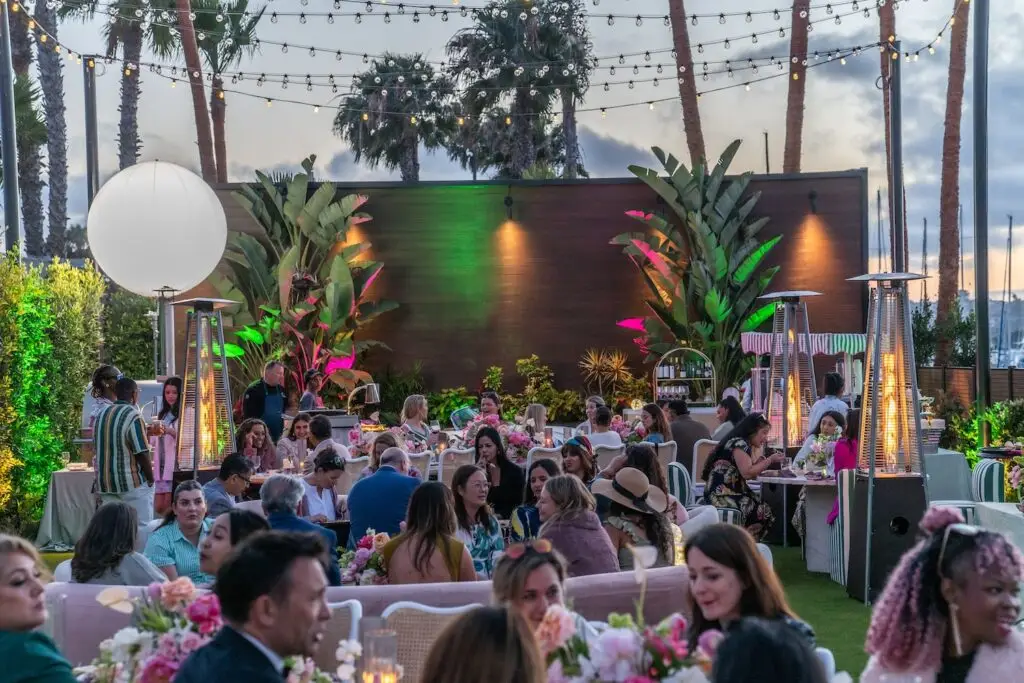
Dinner at the Garden Terrace kind of shifted everything for me. In the daytime it just feels like a nice open space, but at night it becomes something else entirely: more intentional, more “put together” in a way I didn’t really clock at first. As the sun went down over the marina, everything turned warm and the garden lit up in this soft glow that was staged under fairy lights. It was as if you were meant to experience it in this very certain way.
It was easy to picture it then: the quiet before guests arrive, the moment someone steps forward, the pause right before “I do.” There’s often a specific kind of silence right before a ceremony begins. And, at the Garden Terrace, that feeling is built into the space itself. You are standing in a garden wrapped in white blooms and soft greenery, with the harbor stretched out just beyond it. The sun is low enough to turn everything gold. Someone is standing across from you, close enough that everything else fades into background noise.
At 3,600 square feet, the Garden Terrace can host up to 300 guests, with the wider property offering over 132,000 square feet of flexible event space. The transformation even earned a Northstar Stella Award Gold Medal for Best Renovation in the Far West Region in 2024.
That evolution, according to Sean Clancy, Vice President and General Manager of Sheraton San Diego Resort, has been years in the making. He describes the property as having been “completely transformed,” from the rooms to the restaurants and everything in between, with new spaces like the Garden Terrace designed to highlight the marina backdrop in a way that feels “naturally stunning” and “magical,” not just scenic.
By the time I checked out on Thursday, watching the sun rise over the marina, empty in the early light, I understood why someone would choose this exact spot to say something they mean forever.

Isabella Dallas is a freelance writer for San Diego Magazine and the Arts and Culture Editor at The Daily Aztec in her final year at San Diego State University. She previously worked as an editorial intern for SDM, but when she’s not writing, you can find her trying the best coffee spots in SD, devouring the latest rom-coms, and indulging in anything and everything pop culture.
From handmade goods to one-of-a-kind finds, these local shops prove the best souvenirs are the ones with a story
Almost everything in this Oceanside shop is made by local artists and independent weirdos, and almost none of it requires a gallerist’s budget. Goblin Shark Emporium rotates a new featured artist every month between the vinyl crates, blacklight posters, and hilariously specific stickers, so you can walk out with original work and a tarot reading to contemplate as you sip your Banana Dang Coffee from a couple storefronts down.
Tucked within the potting tables and ferns of Mission Hills Nursery, the oldest nursery in Southern California and a Kate Sessions original, sits Through the Fold, the sweet indie bookstore that mother-daughter team Gail Levine and Jennifer Medeiros hand-built and opened in late April. Two retired educators and lifelong bibliophiles run it like a neighborhood living room: three book clubs, toddler story time, and a summer camp for the 7-to-12 set. It’s the rare retail run that smells like soil and new paperbacks, which is to say, like a very specific kind of heaven.
Open since 1993 under the unbeatable tagline “Books of Martians, Murder, Magic, and Mayhem,” this Rosecrans Street institution is the city’s portal for anyone who would rather be on a different planet. Load up on sci-fi, horror, and fantasy, then stick around for the weekly Dungeons & Dragons campaign, because the only thing better than reading about another universe is rolling a d20 inside one.
On the ground floor of the downtown Central Library, tucked into the Joan and Irwin Jacobs Common, sits the Library Shop, a tightly curated gift store stocked with presents and trinkets you didn’t know you needed: wind-up kitchen timers, specialty pencils, felt coasters in colors cheerful enough to overcome the first half of the Padres’ season—you get it. Every dollar funds the San Diego Public Library system, which makes the shop’s official “Guilt-Free Shopping” motto the rare slogan that holds up. Come for a paperback, leave having formed a genuine emotional attachment to a $4 pencil.
The window at this North Park shop is alive: a front-of-house catio where adoptable rescue cats audition for your heart while you pretend to be just browsing. From there, a literal catwalk runs along the ceiling to a back resting room (because existing around inferior beings is exhausting for cats). Owner Vera Blatchley of Purrgatory stocks the full cat-lover arsenal, plus a wall of gifts for the feline who already has nine of everything. Fan favorite: a retro-style, bubblegum-pink Kit-Cat Clock.
Surf art’s everywhere, but it’s somehow always a little kooky. Painter Andy Davis’ style captured that elemental soul, making him one of the most successful surf artists of the last few decades (check his giant mural at Town and Country Resort). His tiny Encinitas storefront, Club Paradise, is a gallery-slash-gift shop that stocks his paintings and prints—and he’s using the space as a culture club for local and touring creatives.
Tulux is the Pacific Beach swimwear label out of Cass Street, where designer Yamhed Torres turns the whole Tulum fantasy into bold, limited-run bikinis. This year, Vogue México y Latinoamérica named her one of just 10 emerging designers to watch, so each suit comes with the kind of credentials that practically books its own sunset getaway. Everything is one and done: When a piece sells, it’s gone for good, which is either smart scarcity or the universe telling you to commit.
Free lotto tickets at crystal shops? Yes, please. Pacific Beads owner Shlomo Gruer greets you at the door of this Clairemont Mesa warehouse of crystals, geodes, and beads by the bin. He presses a lotto ticket into your hand, sometimes with the stipulation that if you hit it big, you can throw his staff a party. You come for cheap amethyst and sterling findings; you leave holding a fistful of healing stones and a statistically remote shot at early retirement.
El Cajon’s Parkway Plaza could look radically different in the near future, as city officials are hatching plans to reinvent the one-time community and commercial center. Inflection points of iconic structures are always compelling times to visit and tabulate your own urban-planning daydreams. As you do, hit the first NAMA-certified automatic cotton candy vending machine in the country. Push a button, and 123 Sweetsss spins you a fresh cloud of childhood in under a minute. No carnival, no county fair admission, no sweaty teenager in a paper hat required.
From getting your sweat on at hip-hop class to celebrating with a zero-proof cocktail, here are San Diego's top fitness and wellness spots
For thousands of years, the Kumeyaay who lived in this area called a mountain south of Julian Cush-pii, meaning “sharp peak.” Then, after the Civil War, Confederate sympathizers saw that same mountain and decided to rename it Stonewall Peak—after General Stonewall Jackson. The name stuck for nearly a century and a half, until Cuyamaca Rancho State Park announced earlier this year that the name will return to its original, Cush-pii. Hike to the summit for expansive views of the Coronado Islands to the west and Mexico to the south.

In 1993, Angie Bunch gathered a group of hip-hop dancers—called Culture Shock Dance Troupe—and gave them a space to practice and perform. As hip hop grew through the ’90s, so did Culture Shock. It has since become a nonprofit, a space for young and old, beginner and expert dancers. Culture Shock has also expanded to Los Angeles, Oakland, Las Vegas, Chicago, Atlanta, New York City, and Washington, D.C., as well as Ottawa and Toronto, Canada.
In 2019, Amanda Leach created the Yoga Box method, which takes high-energy flows and adds strength-building poses in heated, vibey, lava-lamp-lit studios. What started on Grand Avenue in Pacific Beach has spread to 15 locations across the county, with even more trickling into Denver, Chicago, and Brooklyn. The best part? Mindfulness newbies who can’t touch their toes and six-packed contortionists can hang in the same class. You can customize each session based on your ability and fitness level.

A gym taking over a historic beachfront pool sounds like the setup for a new season of Love Island, but Fit Mission Beach operating the nearly 100-year-old Plunge at Belmont Park is real. The independent fitness brand has spent the past several years building a loyal following through group fitness classes, community events, and a members’ social club overlooking the ocean. Upstairs, members can work remotely, meet friends, or hang out long after their workout ends. Between the Plunge, the coworking-style lounge, and a packed calendar of events, Fit has evolved into something bigger than a gym. It’s a clubhouse for San Diego’s fitness crowd.
The wellness world is finally transitioning away from HIIT workouts and cult-like spin classes, where your heart rate hits Zone 5 within minutes and stays there until cooldown. Good. At Breathe Degrees, wellness takes the form of zenned-out communal breathing sessions or vagus nerve–activating cold plunges. Breathwork is said to boost your mood in the short term and improve your heart health in the long term, and maybe that’s why everyone’s coming back for more. You can’t run into someone in Carlsbad who hasn’t dropped into at least one breathwork session, and now the studio has opened a second location in Liberty Station.

Pilates wasn’t just popular this year; it was practically a requirement for maintaining your San Diego residency. New studios seemed to appear weekly across San Diego, each promising stronger cores and better posture, but Soul Pilates and Care found a way to stand out by addressing a challenge many parents know well: finding time to exercise at all. Fitness doesn’t have to compete with parenting responsibilities. Parents can drop their kids off with trained caregivers while they head into reformer classes, eliminating one of the biggest barriers to working out. The studio has earned strong reviews for both its instruction and family-friendly approach.
The Hotel del Coronado’s sweeping $550 million restoration touched nearly every corner of the historic resort, but one of the most anticipated unveilils was the debut of its redesigned spa. The oceanfront wellness destination now features 21 treatment rooms, a relaxation lounge, a sauna, steam room, and a treatment menu inspired by the coastal environment just steps away. The redesign blends the Del’s Victorian legacy with a cleaner, more contemporary aesthetic, creating a space that feels distinctly SoCal rather than generic luxury hotel. For locals who don’t have time for a vacation, it’s the next best thing.
As non-alcoholic beverages continue their meteoric rise, Good News Bar has become one of San Diego’s most compelling arguments for a booze-free evening. The University Heights hotspot serves a menu of carefully crafted zero-proof cocktails that borrow techniques and ingredients from traditional cocktail programs (it’s not just fancy juices and soda water), minus the hangover. The space also hosts regular community events and has quickly become a gathering place for everyone from sober San Diegans to the merely sober-curious. In a nightlife industry built around alcohol sales, Good News proved there’s plenty of demand for connection without the buzz.
From elephant encounters to escape rooms, these are the adventures that kept San Diego families busy all year long
If you can’t quite swing the cost of a trip to the African outback, the Safari Park’s new Elephant Valley is a pretty convincing Plan B. The 13-acre immersive habitat—the largest project in the San Diego Zoo Wildlife Alliance’s 109-year history—is home to eight African elephants, but it’s the thoughtful details that steal the show. Keep your eyes open for intricate Kenyan-inspired artwork, native landscaping, and stop by the Mkutano House, where you can grab lunch with a front-row view of the herd.
Pepper Park became the emotional anchor of the bayfront overhaul when the National City park reopened this March with a 2.5-acre expansion. Hopefully that’s just the start. The California Coastal Commission also approved the city’s ambitious waterfront plan, clearing the way for a long-envisioned 77-acre bayfront makeover with more green space, better bike paths, and improved waterfront access. Money still has to be raised, but head to Pepper Park, sit on a brand-new bench, and gaze out at the future of the South Bay.
Not every family destination comes with roller coasters—sometimes, they have paint rollers. The Willie Henderson Sports Complex in southeast San Diego recently received a new paint job and major facelift (courtesy of San Diego FC, the Prebys Foundation, and community advocates), giving thousands of kids a safer, smoother, and more colorful place to play basketball or soccer. If your weekends revolve around sports gear, folding chairs, and orange slices, you’ll definitely appreciate the upgrade.
Parents come for the pizza. Kids come for the games. Sci-fi nerds come for it all. Killer Pizza From Mars is an Oceanside mainstay for families who love arcades, vintage Star Wars memorabilia, and piled-high pizzas with outrageously silly names like the “Mars”gherita pizza. Order a basket of Killer Fries, sink your teeth into a Martian Melt sandwich, and don’t be surprised if your kids clamor for a return mission.
After what must have felt like an eternity for Pacific Beach families, Fanuel Street Park’s playground is finally back. The old play structure got the heave-ho nearly two years ago, but this spring, the community raised enough donations to replace it with modern climbing structures, new swings, and better accessibility. It’s finally back to being a low-key locals spot perfect for picnicking, splashing around, and letting the kids burn off some energy.

If screen time has obliterated your attention span, try giving your brain a workout at an escape room. Lara’s Labyrinth provides a few options ranging from kid-friendly to “try not to pee your pants in fright,” where participants can attempt to escape an enchanted forest or decipher clues left by Leonardo da Vinci. (Some rooms have G, PG-13, and R-rated versions for your family’s comfort level, but maybe save the “Cannibal” room for an adults-only excursion.)
Birch Aquarium has always made a splash, but the $18.7 million Living Seas exhibit is a tidal wave of awesome. The immersive exhibit features different marine ecosystems throughout the Pacific Ocean, from the warm aqua waters of tropical zones to the frigid (but nourishing) Pacific Northwest. Bigger is better here: There are areas designated for the gigantic sunflower sea star and giant Pacific octopus, so prepare for oceanic marvels to wow you.
Forget “don’t touch the art.” At Artopia, touching, building, climbing, experimenting, and making a colorful mess are all exactly the point. Created by the museum’s in-house Creative Studios team, the interactive space invites kids to become artists through hands-on projects like weekend ceramics workshops and after-school programs. When creativity gets a little chaotic is when it’s at its most fun.
The Fairmont Grand Del Mar used to feel like someplace you admired from afar. Grand Social changed that. Three levels of outdoor space are now home to a bar and grill, bocce courts, and other lawn games, as well as a summertime concert series and other family-friendly events that welcome locals just as much as overnight guests. It’s proof that one of San Diego’s fanciest addresses also knows how to have a little fun.
You don’t need a cage to come face-to-face with sharks anymore. SeaWorld’s revamped Shark Encounter lets you get startlingly close to species like reef sharks, massive sand tigers, and endangered Australian leopard sharks, all inside newly redesigned habitats. It’s equal parts adrenaline and education, and a good reminder that these misunderstood predators are closer to Bruce in Finding Nemo than Jaws in… well, Jaws.

Houston, we have a new reason to visit LEGOLAND California. LEGO Galaxy is the plastic-brick haven’s biggest in-park investment ever, including the first new roller coaster in 20 years. Between the customizable Galacticoaster experience, build-your-own spacecraft stations, and interactive space adventures, aspiring astronauts can easily spend hours exploring this brick-built universe.
This month, the 2026 San Diego Business Impact Awards recognized local businesses making an impact in clean energy, biotech, hospitality, and beyond
Renewable energy companies building hundreds of power plants. Biotech startups using artificial intelligence to create personalized medicine for children with rare diseases. Hospitality companies quietly powering thousands of local events. Consumer brands growing from beach-town startups into national businesses. These are the kinds of companies driving San Diego’s economy today, and the businesses recognized at this year’s San Diego Business Impact Awards offer a snapshot of where the region is headed.
Hosted July 23 by San Diego Regional Economic Development Corporation (EDC) and JPMorganChase, the second annual awards event honored four local companies for innovation, growth, and economic impact. More than 100 nominations from San Diego’s middle-market businesses were reviewed by a 10-person judging committee, with winners selected across four categories: startup, early-stage innovator, rising star, and established heavyweight.
Two-time honoree Jimbo Someck, founder of Jimbo’s organic grocery stores, also joined the event for a fireside chat on buying local, supporting emerging brands, and giving back to the community.
“San Diego’s strength comes from its makers and builders—the resilient people who endure great risks and overcome obstacles to build and scale a company,” says Aaron Ryan, San Diego Region Manager and Middle Market Banking at JPMorganChase & Co. “These awards aren’t just recognition; they spotlight the talent, grit, and innovation shaping our region’s future. By celebrating those who create and build, we foster connections and fuel the growth that keeps San Diego thriving.”

Heavyweight honoree SOLV Energy has grown alongside the country’s rapid investment in renewable power. “It’s an exciting time for SOLV Energy as we are experiencing significant growth,” says CEO George Hershman. “The business has doubled over the last year and has almost double-digit growth since its inception.”
The Rancho Bernardo-based company designs, builds, operates, and maintains utility-scale solar and energy storage facilities. Since its founding in 2008, SOLV Energy has built more than 500 power plants.
Growth has translated directly into hiring. About 200 employees work from the company’s local headquarters, including roughly 20 interns. “Our intern program is a big part of the way that we grow our workforce,” Hershman says. “Last year, 43 percent of our interns became full-time employees. We believe San Diego is a great community to build and grow a high-tech infrastructure and technology company because of the incredible workforce—the ability to attract top talent and draw from world-class universities.”

Startup honoree La Jolla Labs is tackling one of medicine’s biggest challenges by developing personalized RNA therapeutics for patients with rare diseases—many of them children with neurological disorders like ALS. Using proprietary artificial intelligence and machine learning tools, the biotech company develops treatments tailored to each patient’s specific genetic mutation.
CEO Tamar Grossman says the recognition reflects how far the company has come despite limited resources. “We’re honored to be recognized for our ability to change and save patients’ lives and turn our lean startup into a clinical company with very minimal resources,” she says.
Grossman credits San Diego’s concentration of research institutions—including UC San Diego, the Salk Institute, and Scripps Research—with creating a pipeline of talent and collaboration. “San Diego is one of the world-leading centers for technology, genomics, and RNA therapeutics,” she says. “We have over 30 RNA therapeutics companies here, and we support each other and help with anything related to drug discovery.”
She says that collaborative spirit extends beyond formal partnerships. “You can walk around Torrey Pines, go into a café, and find colleagues from the industry and have an ad hoc conversation,” Grossman says. “That’s something very unique to San Diego.”

While Snake Oil Venue Company may not be a household name, chances are many San Diegans have attended one of its events. The early-stage innovator honoree has expanded from beverage catering and mixology consulting into venue management, operating Julep Venue in Mission Hills, Bramble Bay Venue in Imperial Beach, Vesper Venue, the Chapel at Liberty Station, and five outdoor venues throughout Liberty Station—more than 500,000 square feet of event space altogether.
“We do a lot of launch parties for corporations and new products,” says CEO Mike Esposito. “I really like working on the entrepreneur side of things, where new businesses are entering the San Diego market and looking to make a splash.”
Snake Oil has executed more than 16,000 events, employed more than 1,000 people, and partnered with more than 900 local vendors, including caterers, florists, photographers, entertainers, and other hospitality businesses. The company also works with many of San Diego’s nonprofits, museums, and cultural institutions. “We get to celebrate people’s most important moments,” Esposito says. “Whether that’s a wedding, celebration of life, or quinceañera, we’re fortunate to be involved in the community in so many different ways.”

Rising star honoree ALOHA Collection is proof that a simple idea can grow into a thriving company. Founded by two roommates who wanted a better way to carry wet swimsuits after a day at the beach, the lifestyle brand has grown into a business while maintaining strong year-over-year growth.
Now headquartered in Carlsbad, ALOHA Collection employs more than 100 people and operates its California flagship store in Encinitas, which is slated for a remodel. With roots in Hawaii, the company is known for its lightweight, splash-proof travel bags that have become a familiar sight on beaches in San Diego and beyond.
“‘Aloha’ is part of our name, but it’s also how we move through the world,” says CEO Lynna Barnard. “It’s how we show up for people, the way we travel, the way we give back.” Since day one, the company has maintained a 5 percent giveback to Hawaii conservation efforts, contributing millions of dollars over the years.
“I think what’s so inspiring about ALOHA Collection, and the founders in particular, is when you dream big, those dreams can come true when you work hard and trust in the universe,” Barnard says. “It’s inspiring to be a role model for other people wanting to start businesses from humble beginnings. Start small and watch it grow.”
Together, businesses like these form a cornerstone of San Diego’s economy—not only through the jobs and revenue they generate—but through the local workers they hire, vendors they support, and investments they make in the region. Their growth doesn’t happen in isolation; it ripples outward, strengthening the broader business community and the people who call San Diego home.

Whether you love theater, music, dance, or public art, these are the cultural experiences that stood out this year
Arts District Liberty Station officially became one of the state’s designated cultural districts, joining a list reserved for places with thriving creative communities. Considering the campus is home to more than 100 galleries, artist studios, museums, and arts organizations—not to mention The Joan, the 42,000-square-foot performance center housing Cygnet Theatre—it was only a matter of time until the district got its flowers.
If you can’t beat ’em, join ’em. The National City Public Works building has been a target of graffiti artists for years, only to be constantly painted over (and the cycle restarts). Now, it’s working with the local artists from Vision Culture Foundation to create intentional public murals. A win-win in our book.
One of the biggest questions this year is who will show up for San Diego arts and culture—so a Best Of nod goes to a nonprofit that’s been doing it for years. Founded by longtime arts advocate Susanna Peredo Swap, Vanguard Culture has staged events for creatives, told their stories, and just created an SD ARTS Pass—a single ticket that gets you access to 39 creative spots.

Ballet’s already got a sort of otherworldly thing going for it, with people morphing into 90-degree angles and defying gravity with each pirouette. The Rosin Box Project feels like a raw, creative new force in the classic art form, though—especially with its annual Ghost Light Masquerade. It’s a dance of eerie spirits that makes you second-guess what’s real and what’s not.
Once upon a time, Gallagher Square was just a grassy knoll behind the outfield wall at Petco Park. Now, it’s a concert venue, playground, play ball field, dog park, and unofficial home for those who prefer the vibe of baseball more than the actual game. Big-time performers are showing up: Ms. Lauryn Hill, Cypress Hill, and Peach Pit.
Casa Casillas has filled a long-standing gap in Chula Vista’s art scene. Open since last August, the space gives local artists a dedicated venue to display their work and visitors a chance to explore the neighborhood’s vibrant art. Two rotating resident artists always keep the space moving, so it rarely looks the same twice.

El Cajon translates to “the box” in Spanish—a nod to the city’s surrounding hills—but Alley Cat Art Fest (previously called Artivál) doesn’t stay inside it. As the first arts festival in East County, it celebrates local galleries, sculpture, live music, and food trucks—the whole nine.
Every second Saturday, Barrio Logan turns into a choose-your-own-adventure with the Barrio Art Crawl, a free self-guided art tour through galleries, museums, and murals, with street food and music filling in the gaps. Barrio is one of the city’s most thriving arts neighborhoods, and it’s worth getting a bit lost in.
MCASD is showcasing two powerhouse exhibits—Giants: Art from the Dean Collection of Swizz Beatz and Alicia Keys and The Dean Collection Presents: Hometown Heroes. The pop music titans are highlighting local artists, with an intentional focus on diverse experiences. It was one of the biggest (and coolest) art openings of the year, and it closes August 9. So get on it.
Leave it to The Old Globe to give the local theater scene some Hollywood glamour. Katie Holmes led the premiere of Henrik Ibsen’s Hedda Gabler this past spring, turning the classic Norwegian play into one of the most buzzed-about theater productions of the year.
Fresh openings, inventive pours, and can't-stop-thinking-about-it dishes—here's what has defined our food scene this year
Most San Diego spots serve phở bò—the dark-brothed, beef-boned Southern Vietnamese specialty, loaded with the loud spices (star anise, cloves, cardamom, etc.). But Kim Pham, one of the sisters behind Crab Hut and perennial best-restaurants list-maker Kingfisher, is doing her mom’s phở gà.
The Northern Vietnamese original has a lighter, cleaner broth, using runner chickens (free-range diet and action means more flavor), the garlic from Gilroy’s famed Christopher Ranch (intense garlic-garlic), organic ginger, and housemade noodles. For condiments, Phở Gà Go uses Red Boat (the gold standard, barrel-aged 12 months). It’s essentially the same broth made at Kingfisher, served casual in Mira Mesa.
This issue isn’t about shame, but let’s add a touch for emotional tension. We live on the water, but only about 10 percent of seafood eaten in San Diego is caught locally. Meanwhile, the local fishing industry that once employed 40,000 people is down to about 130 commercial fishers. Local fishing families are a crucial (my words, and they feel right) but endangered species. And three groups have joined forces for one pretty killer event that does a lot about it.
Puffer Malarkey Group (operator Chris Puffer and celeb chef Brian Malarkey) joined with Tuna Harbor Dockside Market—the spot where local boats drop their catch every weekend, a waterline treasure. Each year, Dockside Night Market gathers live musicians and the city’s top chefs who cook with local boat fish on the water. Even better: 100 percent of the profits go to the San Diego Working Fishermen’s Group (the third group—the actual fishers). Make it a quarterly/monthly thing, for chrissakes.
Hard to find a more special place to eat lunch than Make Cafe. Finally with a permanent address, Make is where refugee women new to life in the US cook recipes from their various home countries: like mandazis (East African fry bread, like a beignet), koftas, congees (Asian ginger-rice bowls), lemongrass soda waters, and clean-eating creations. Exec chef Ashley McBrady (who helped turn Cellar Hand into a farm-obsessive hit) oversees the operation and teaches the women everything she’s learned.
Make Projects (which includes a farm and a training center) is a nonprofit that director Anchi Mei spun off from the International Rescue Committee—and now includes the cafe, a farm, and a training center. The idea is to help women refugees—often those who’ve worked fields and didn’t get great access to education—develop job, language, and cultural skills to adjust to this radically new and disorienting life. Even if you’re immune to an emotional backstory: Normal Heights has a charming new 5,000-square-foot bistro with a talented chef.

The slander of SPAM is part of its allure. Those who have either been raised in the musubi arts or converted to the minor food religion tend to exude a higher-than-expected life happiness. This Musubi Love, a Leucadia musubi speakeasy (you heard that right), focuses exclusively on the Hawaiian/Asian tradition of SPAM “sushi.” It’s a MEHKO (Micro Enterprise Home Kitchen Operation) from founder Roger Post, serving classics and riffs like the Cordon Bleu-Subi made with panko-fried SPAM, shredded rotisserie chicken, Swiss cheese, and Bachan’s Japanese BBQ sauce. Or try the Dawn Patrol with SPAM, egg, bacon, cheddar cheese, and spicy mayo.
How many of your favorite bands don’t have a talented lead singer? Due respect to Charles Mingus, but kinda hard to get emotional without someone expressing a story in a compelling way. The same is true for restaurants: a likable storyteller who deeply knows their stuff and can translate the stories of the food, drink, people, and place is both key and exceedingly, exceedingly rare. Well—found one.
Valentina General Manager Todd Henderson is a likable certified sommelier who can wax on about the history of the breed of pigs used to create the famed jamón (Cinco Jotas), trace each Spanish pintxo back to its origin tale, or orate the Ken Burns doc of 20 different types of Champagne. Valentina had the design charm and the roots (Leucadia locals wanted better restaurants, so they built them). But with Henderson and chef Enrique Ñol (who trained under Davin Waite at Wrench & Rodent), Leucadia’s date-night bistro feels like it pulled up a rung.
Some local legends engrave so deep that it’d feel wrong if even their original locations they outgrew became, like, some chain lamp store. Kiku Room feels like a rightful heir to the Casbah’s first throne. Kurt Cobain played in this tiny box on Kettner, dammit. Kiku’s a minimalist steel-concrete-and-punky-wheatpaste box, loaded with enough red lights to summon some beanie diehards and chill demons. One “bar” is a DJ deck (dark disco, Balearic house, everything), and the other is proper craft cocktails. They even brought back Midori Sours. The room is small and the line is not, so plan ahead or amiably accept fate.
Some locals would prefer if Coronado’s historic charms were flash-frozen and preserved. Others feel that Elisha Babcock and Hampton Story (the 19th-century developers who modernized the “island” and birthed the Hotel del) were radical change agents, and that spirit should be renewed. Undoubtedly, Baby Grand is a renewal. The newest hotel from CH Projects (Lafayette Hotel) turned an old, meh motor lodge (La Avenida Inn) into a freshly feral cocktail lagoon with Greek food and statues and plus-sized plant life, a tuckaway bar (Fallen Empire), and rooms with clamshell beds and obscenely giant bathrooms. All due respect to our hearts’ desire to embalm old magic—this feels like a grand Coronado win.
Two local dreamers truly understood the emotional voltage of Captain Keno’s, Leucadia’s affordable family restaurant/dive bar (a real hospitality mullet). When owner Gerry Sova closed it after 54 years, they basically battled it out to buy Keno’s beloved bones—knickknacks, plucky furniture, signage—and memorialized that old meatloaf-and-vodka-cranberry voodoo in their own places. The first is Encinitas’ tuckaway bar, the highly designed, Tarot-fied Anigma (from the DIY industry vets who own The Roxy). Second is Breakers, the Hawaiian-inspired hang from pro surfer Benji Weatherley, who grew up between Encinitas and Oahu. Long live Cap.

When it opened in 2014, Ironside Fish & Oyster hit all the right notes. A giant fish house and craft cocktail spot dedicated to local fishing lore—created by locals. They put in the area’s first oyster bar at the time. It didn’t make the rapid evolution of Little Italy feel like a cheap land grab, and filled holes rather than piling more glitter on already-filled holes. A key part of that magic was opening chef Jason McLeod, who was in charge of Ria in Chicago when it earned two Michelin stars. Twelve years later, after bouncing between big projects, he came back this year and set down permanent roots in a landmark kitchen.
SeaWorld dazzles with a drone show, big-name entertainers, new animal adventures and more
Nights are heating up at SeaWorld San Diego. The quintessential summertime staple on Mission Bay is transforming into a destination for unforgettable day-to-night adventures, bringing back some of its most popular Summer Nights programming and introducing exciting new experiences sure to delight both kids and adults alike.

The 2026 Summer Day to Night at SeaWorld San Diego is the park’s most ambitious season yet. SeaWorld has planned a highly anticipated entertainment lineup that features nine weeks of throwback concerts featuring R&B and hip‑hop favorites from the ‘90s and early 2000s, including Jordin Sparks, Too $hort and Warren G, Ashanti, and an array of boy band heartthrobs performing together as part of the Pop 2000 Tour.
New this season is perhaps the park’s most visible update: a nightly drone show, Ocean of Dreams, which illuminates the sky with hundreds of synchronized sparklers. Drones form sea otters, sharks, dolphins, and a majestic orca that tell a breathtaking 12-minute story of marine life and underwater ecosystems. The show culminates with a spectacular electric neon finale celebrating hope, wonder, and ocean stewardship.
Nighttime visitors are also in store for animal adventures that fuse education with high-energy fun and the dreamy ambiance of nighttime. The park has launched two all-new animal presentations: Shamu’s Celebration: Light Up the Night and Dolphins: Touch the Sky. Shamu’s Celebration: Light Up the Night features vibrant lighting, music, and dynamic choreography that celebrates the power and beauty of killer whales. Dolphins: Touch the Sky showcases playful bottlenose dolphins and the special connection between humans and the natural world. And back by popular demand is fan-favorite Sea Lions Tonite. See the charming pinnipeds splash, play, and parody pop culture in this refreshed crowd-pleaser.

More must-sees: a newly reimagined Shark Encounter, one of the country’s more immersive exhibits highlighting 11 different species up close, SeaWorld’s beloved BMX Blast! stunt show, and high-seas escapade, Pirates Ahoy! The Battle for Mermaid Cove. And don’t miss the park’s all-new Deep Sea Disco, which encourages guests to dance the night away under the glow of the SkyTower, and vibrant closing time laser light display Laser Reef Summer Spectacular.
Amp up the nighttime vibe with local craft beers, curated cocktails, and nostalgic theme park treats with $1 beer all summer long. SeaWorld is the place for day to night summer fun. When the sun goes down, SeaWorld lights up, and inspires guests of all ages to embrace their inner whimsy and see why generations of San Diegans head to SeaWorld to make memories they’ll never forget.