Featured articles
Food & Drink
Food & Drink
Food & Drink
Featured articles

Things to Do
Features
Things to Do
Featured articles
Things to Do
Things to Do

Things to Do
Featured articles

podcast-ep

podcast-ep

podcast-ep
Featured articles

Features

Features

Food & Drink
Featured articles
Food & Drink
Food & Drink
Ready to know more about San Diego?
SubscribeReady to know more about San Diego?
Coola founder Chris Birchby and his wife Adrienne give us a peek into their vibrant two-story full of natural materials and art
It began at Nobu, downtown San Diego, 2012. A blind date—though nothing felt blind about it. Chris was the founder of Coola, a luxury skincare line built around high-end sun protection. Adrienne—whose friends and family call her AJ—worked in advertising and produced lifestyle events for Sandow Media, often showcasing beauty products like Coola. He surfed in the early mornings and had a fine arts degree. She grew up in the Caribbean, the daughter of a restaurateur dad and an artistic mom who met when she hitched a ride on his sailboat.
The Birchbys married the following year and started a family. In 2019, after Chris sold a majority stake in Coola to SC Johnson (he sold the rest in 2024), they purchased a home a block from the ocean in Solana Beach and eventually embarked on a major renovation.
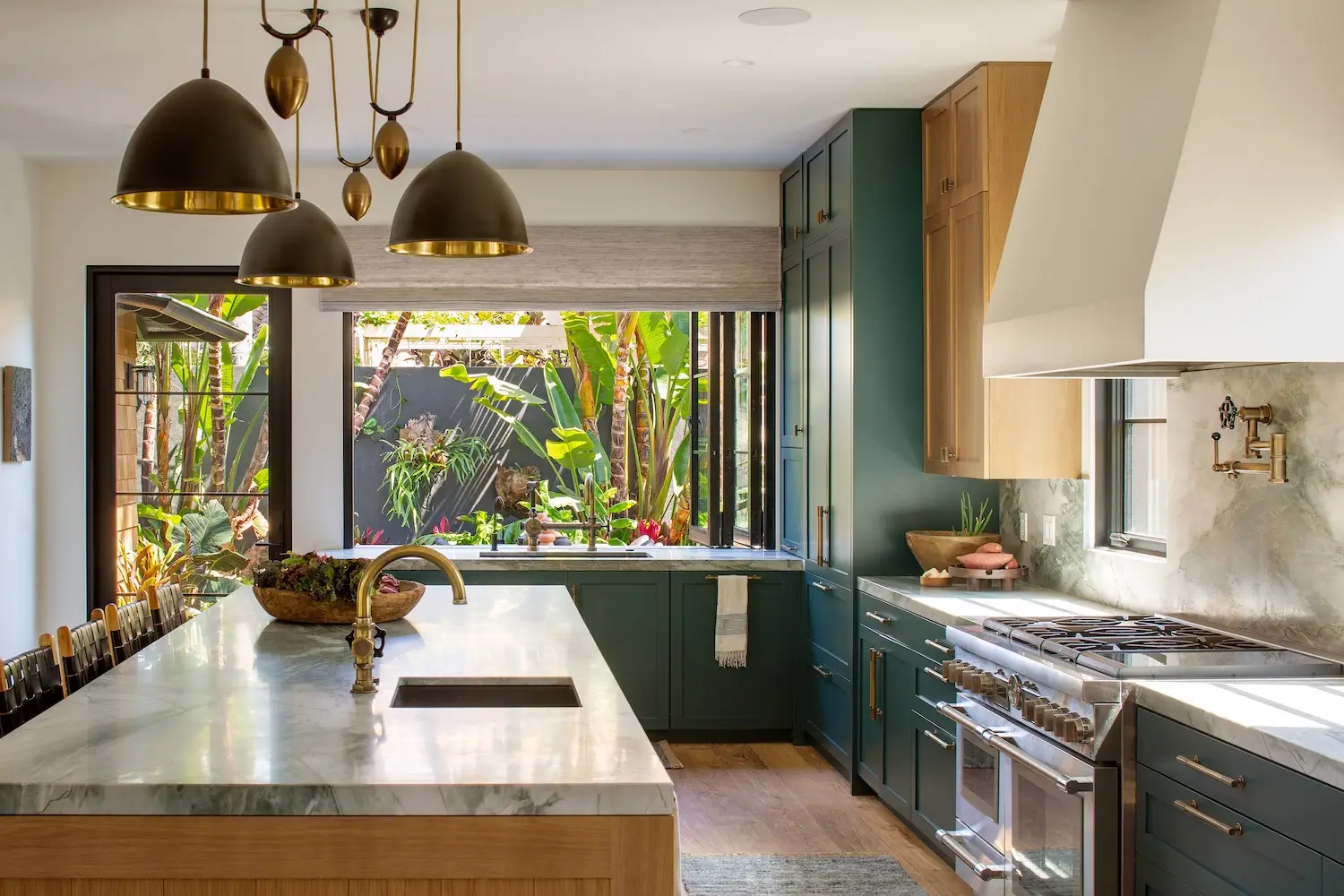
While pregnant with their first child, AJ did a deep dive into potentially toxic materials and learned that most homes are full of them—in everything from upholstery to paint and polyester. “We wanted our home to be exotic, tropical, and eco-friendly,” she says. They also envisioned a casual and elegant place, durable enough for four children, and they needed plenty of white wall space for Chris’ collection of edgy art.
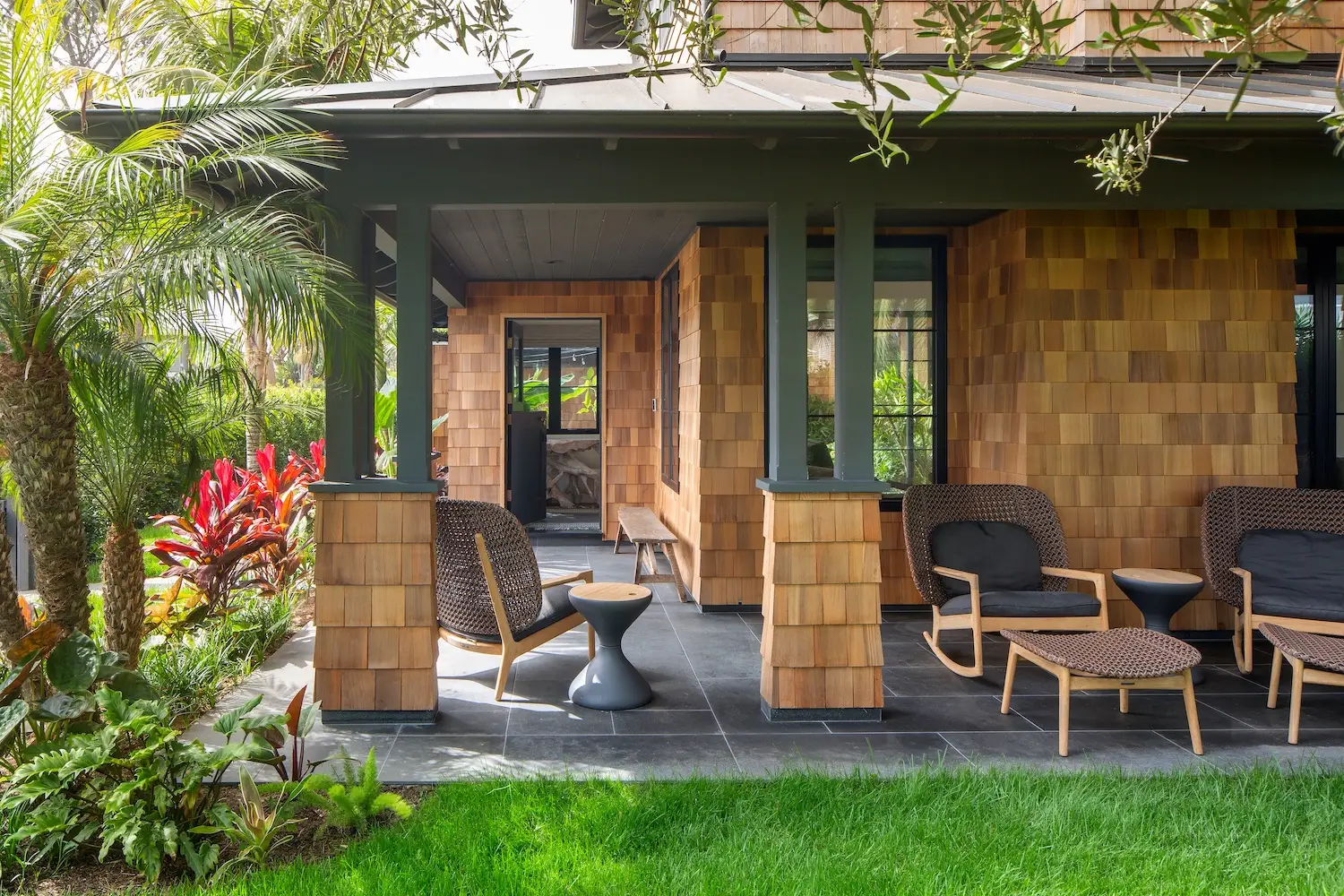
When AJ found Solana Beach architectural and interior designer Christie May’s designs online, she was taken with her “outside-the-box” style. The renovation, May says, was a “full gut.” May replaced the worn exterior with fresh cedar shingles, adding charcoal-colored board-and-batten siding on the upper level for contrast. The new standing-seam metal roof picks up the horizontal lines of the battens.
May’s plans opened up the home, knocking out interior walls to turn cramped, dark spaces into expansive ones; removing false ceiling beams to take full advantage of the 10-foot ceilings; and replacing small, square windows with much larger ones.
Landscape architect Chris Brown designed the tropical gardens. In front of the house, he planted kentia palms and plumeria. A low wooden gate leads through a hedge of bay laurel into the front garden. The Birchbys can lounge on the long front porch while the kids play on the grass amid a garden of wild ginger, red-flowering lobster claw, angel’s trumpet, and philodendron. The porch leads to the front door and a small foyer with an acacia-root table that AJ bought years ago.
At the heart of the home is a square courtyard with the living room at one end. A hallway along the back leads to the kitchen, dining, and family area at the other.
May added large new sliding glass doors and windows on all three sides of the courtyard to connect the indoor and outdoor spaces and provide views of Brown’s dense, fragrant landscape.
AJ believes that a healthy interior must be free of harmful particles that may be released by foams, adhesives, finishes, and synthetic fabrics. May created custom furniture that utilizes non-toxic adhesives, brought in upholstery and rugs made from natural wool and cotton, and chose paints and wood finishes considered low- or no-VOC (volatile organic compound)—chemicals that can cause headaches, scratchy throats, even cancer. She selected window coverings handwoven from renewable natural fibers such as bamboo and jute.
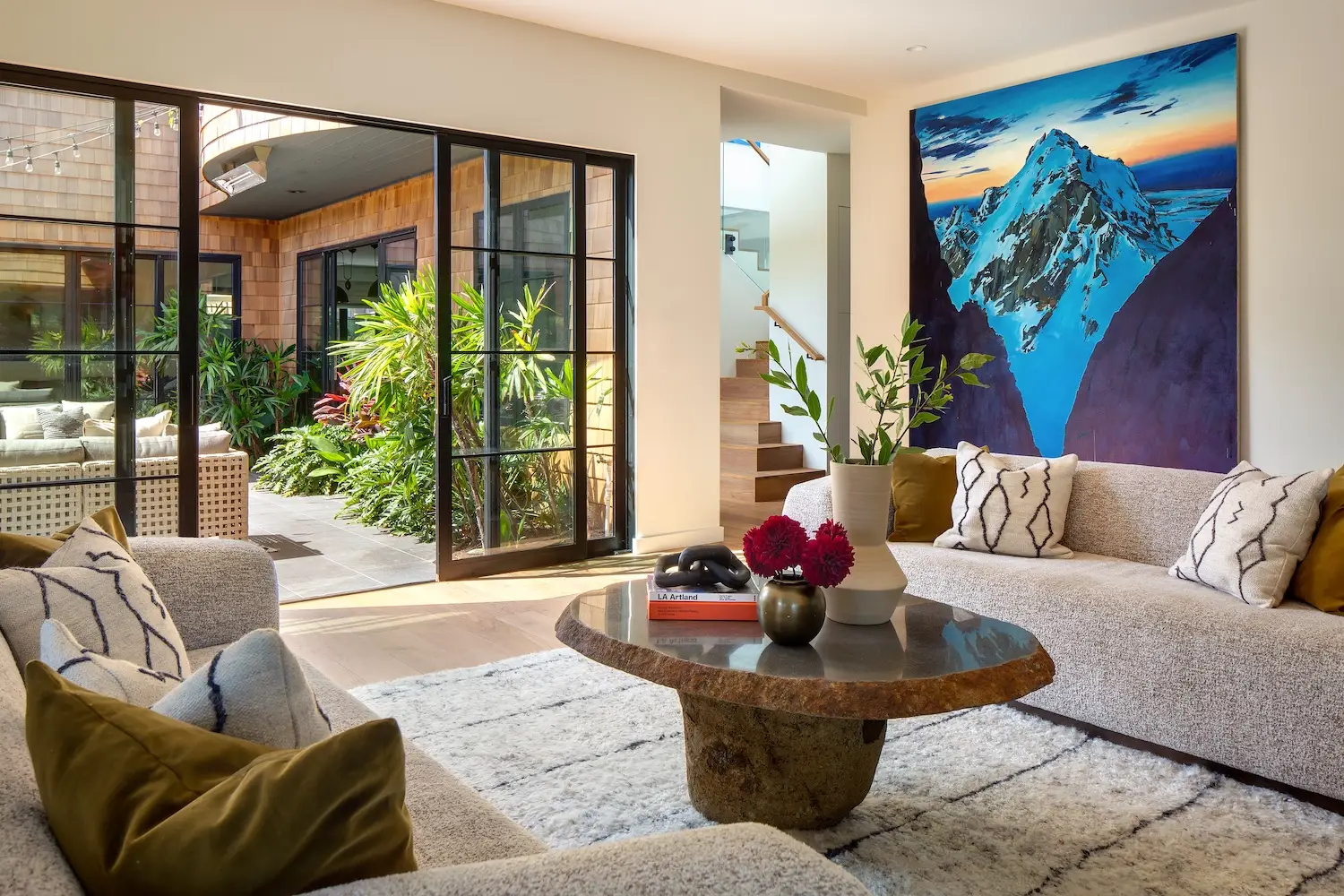
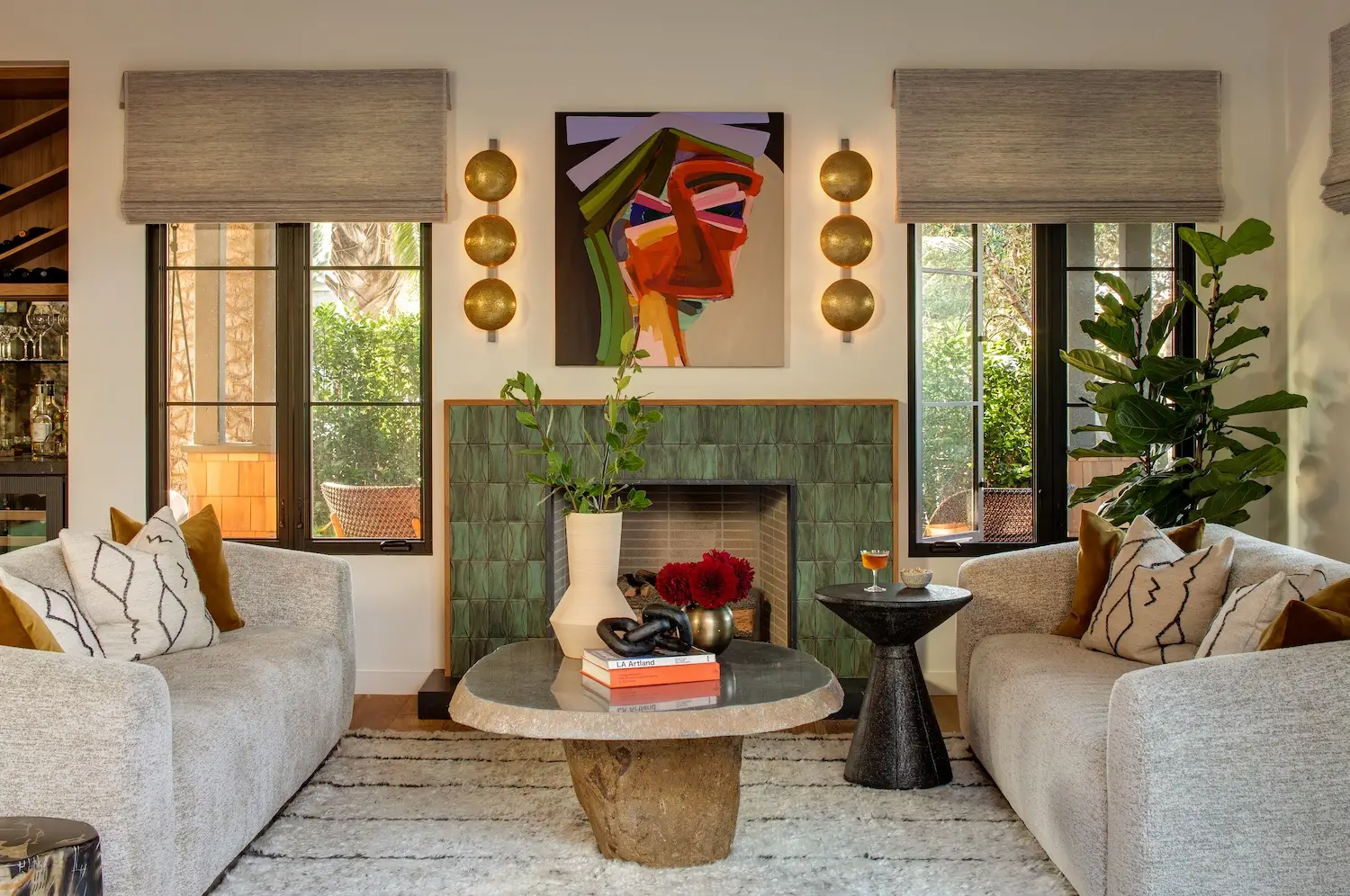
In the living room, matching sofas designed by May flank a round stone coffee table in front of a green-tiled fireplace with a teak mantel and black marble hearth. The flecked, cream-colored wool rug is accented with thin black lines. Girl with Lilac Bow, a painting by artist John Millei (one of Chris’ teachers at the ArtCenter College of Design in Pasadena, where he obtained his MFA), hangs above the fireplace. “John is a southern California native, also a big surfer,” Chris says. “He’s really creative with paints, themes, materials, and the energy he brings to a brushstroke.”
On another wall is The Middle Teton by Sam McKinniss, evocative of the spectacular Wyoming mountain range. “His brushwork is very confident, and he’s a magician,” Chris adds.
“His paintings work well from a distance, and, up close, they provide little moments of surprise.”
Down the hallway by the courtyard, past a guest bathroom and laundry room, stairs lead up to the second level, where you’ll find the primary suite, three kids’ bedrooms, and two bathrooms. During construction, May loved the way daylight came between the studs lining the stairwell. She decided to glass the opening instead of drywalling it so the kitchen and dining area gets some bonus natural light.
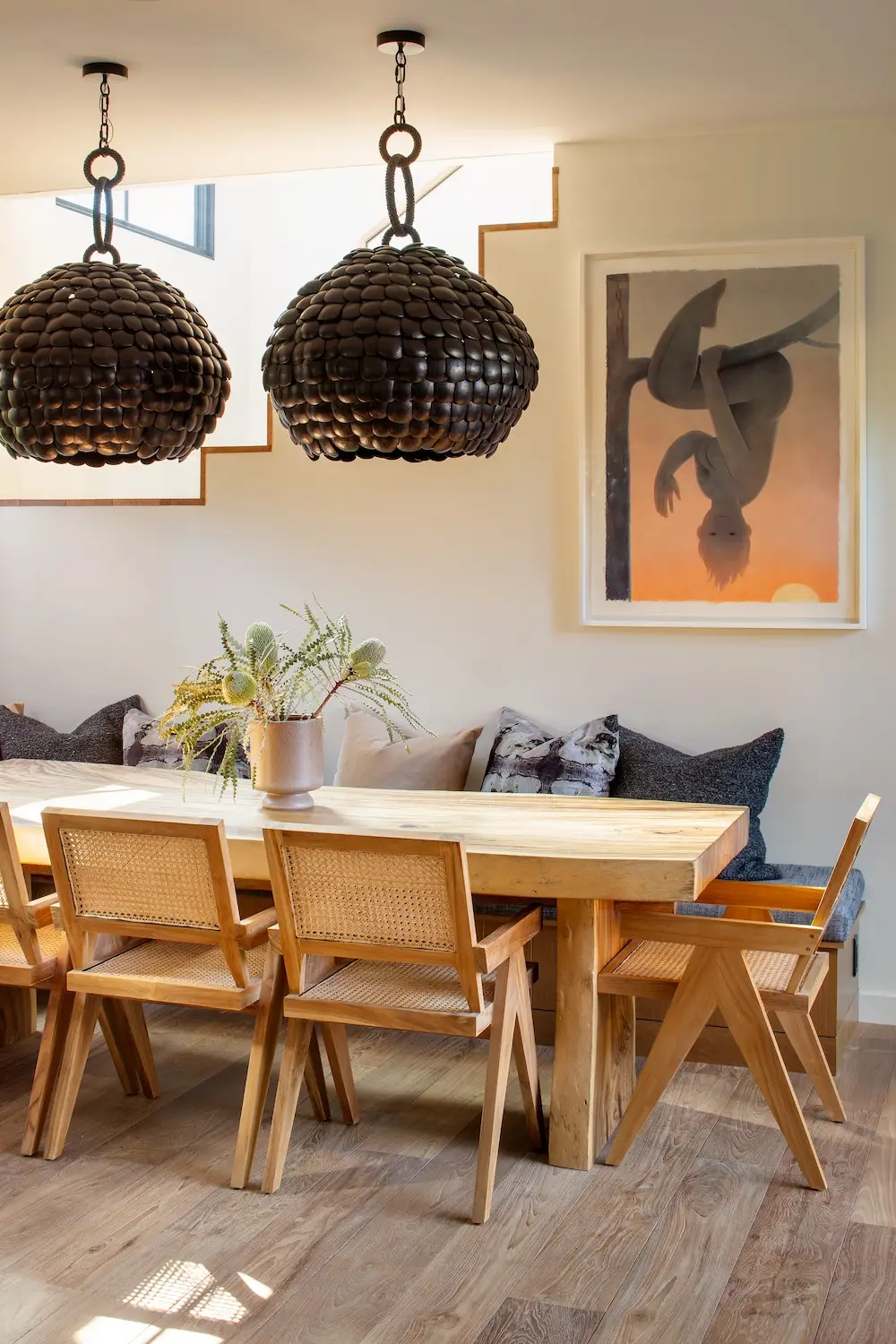
Floors throughout the house are reclaimed teak from Indonesia. Interior doors are solid teak; other wood details are oak, stained to match. At the edge of the kitchen sits an eight-foot-long solid teak dining table the couple bought on their honeymoon in Ubud, Bali. Pendant lights made from coconut shells dangle above it. Behind the table hangs Troll, a pastel by artist Robin F. Williams. “I grew up in a house full of brothers, and I love being a girl dad,” Chris says. “Most of our pieces are by women artists. I like this piece because it reminds me of our daughter Beaux.”
The kitchen counters are natural quartzite. Brass pendant lights hang above the island, while antique brass fixtures and hardware lend steampunky accents. Bi-folding windows open the kitchen to the outdoor patio and dining area. The kitchen sink faces the garden, and the counter extends beyond the windows to become an outdoor bar and counter.
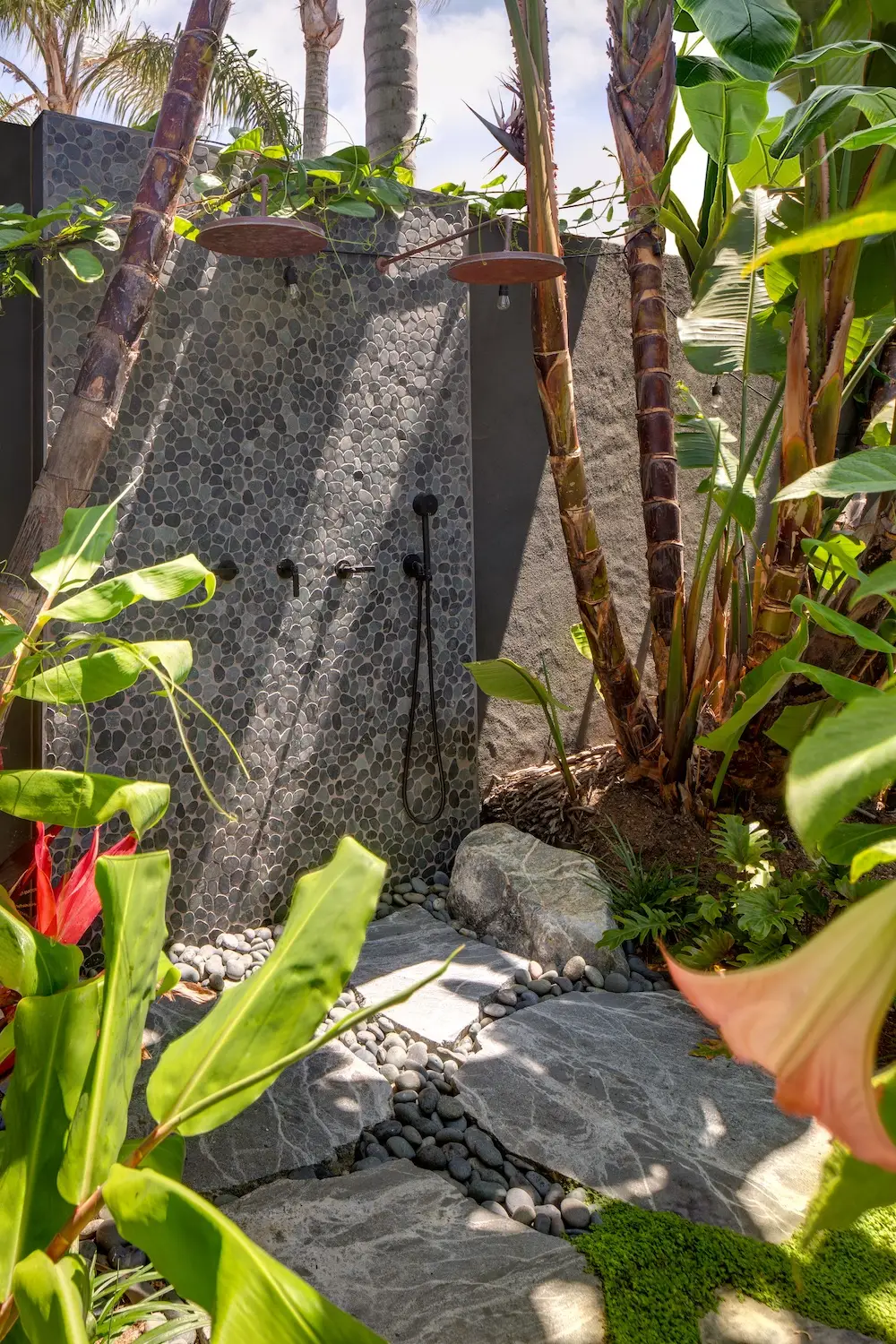
In the surrounding backyard, Brown kept several giant birds of paradise that came with the house. Beneath and around them grow reddish ti plants, asparagus ferns, and strappy-leaved liriope. At the edge of the garden, you’ll find an outdoor shower with stone pavers and a beachstone backsplash. Nearby, water bubbles through a fountain made of cored boulders. There are also a surfboard shed and a playhouse, both with cedar shingles and standing-seam metal roofs that match the house.
Next to the kitchen, the family room features a tiled fireplace flanked by window seats and tall, narrow windows. May designed the L-shaped sofa and covered all the furniture with natural fabrics. On the wall above the sofa is artist Friedrich Kunath’s A Better Place, an island landscape with a family of four running through.
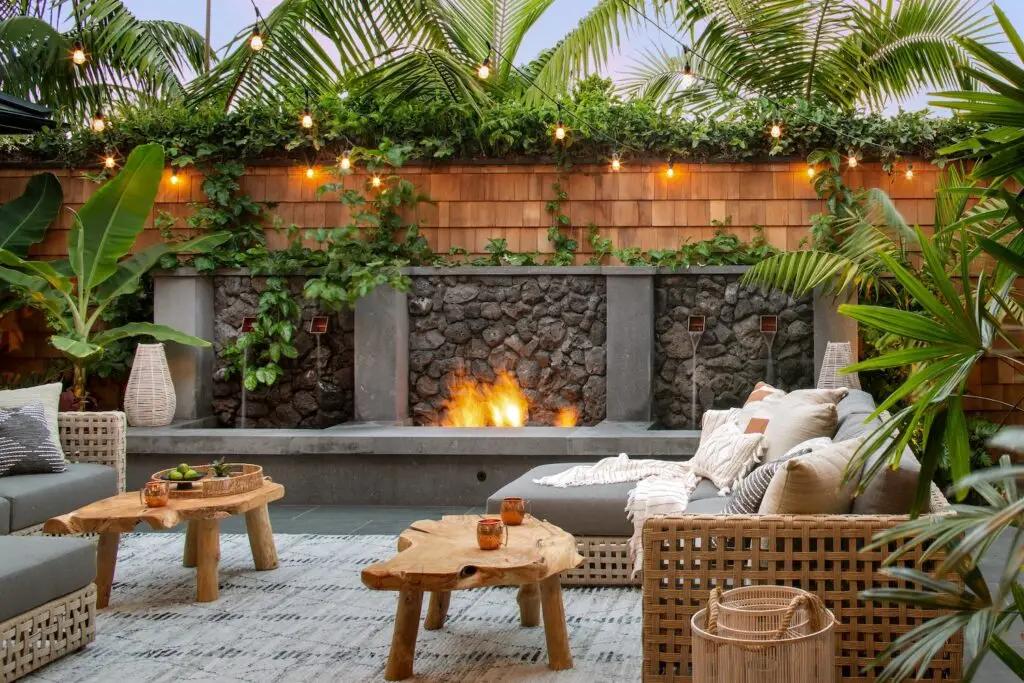
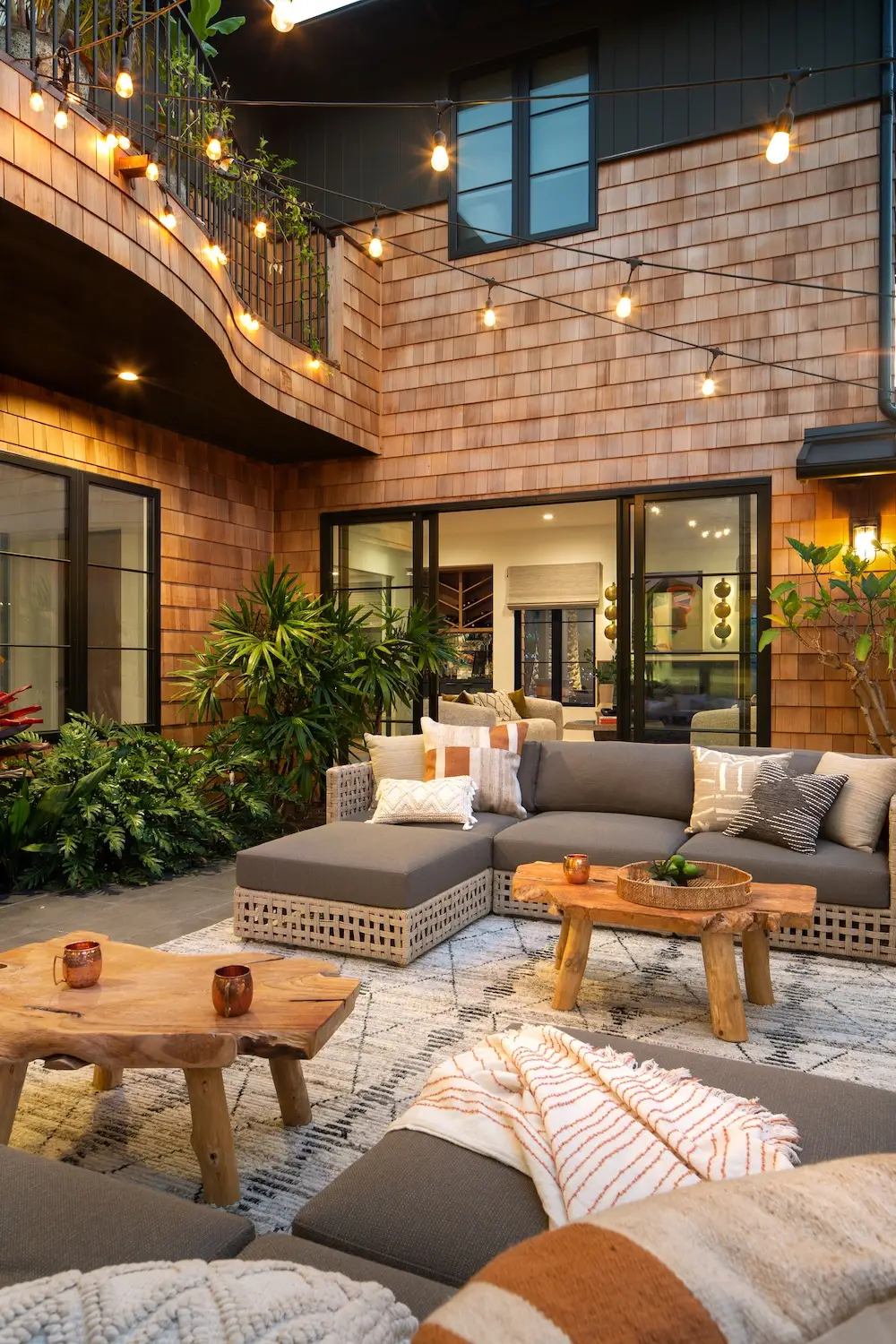
“We’re going to have him add two more kids,” AJ says. Beyond new steel-and-glass sliders, the courtyard is a furnished outdoor room surfaced with basalt tiles. Along the edge of the courtyard, slabs of basalt frame rectangular reflecting pools against a wall of lava rock. Water trickles into the pools from copper scuppers that flank a gas firepit at the center of the wall. Brown’s landscape includes passion fruit vines, banana trees, monstera, and elephant ear. Madagascar jasmine and cordyline grow in containers on the new curved balcony. It’s a verdant oasis that easily accommodates a dozen.

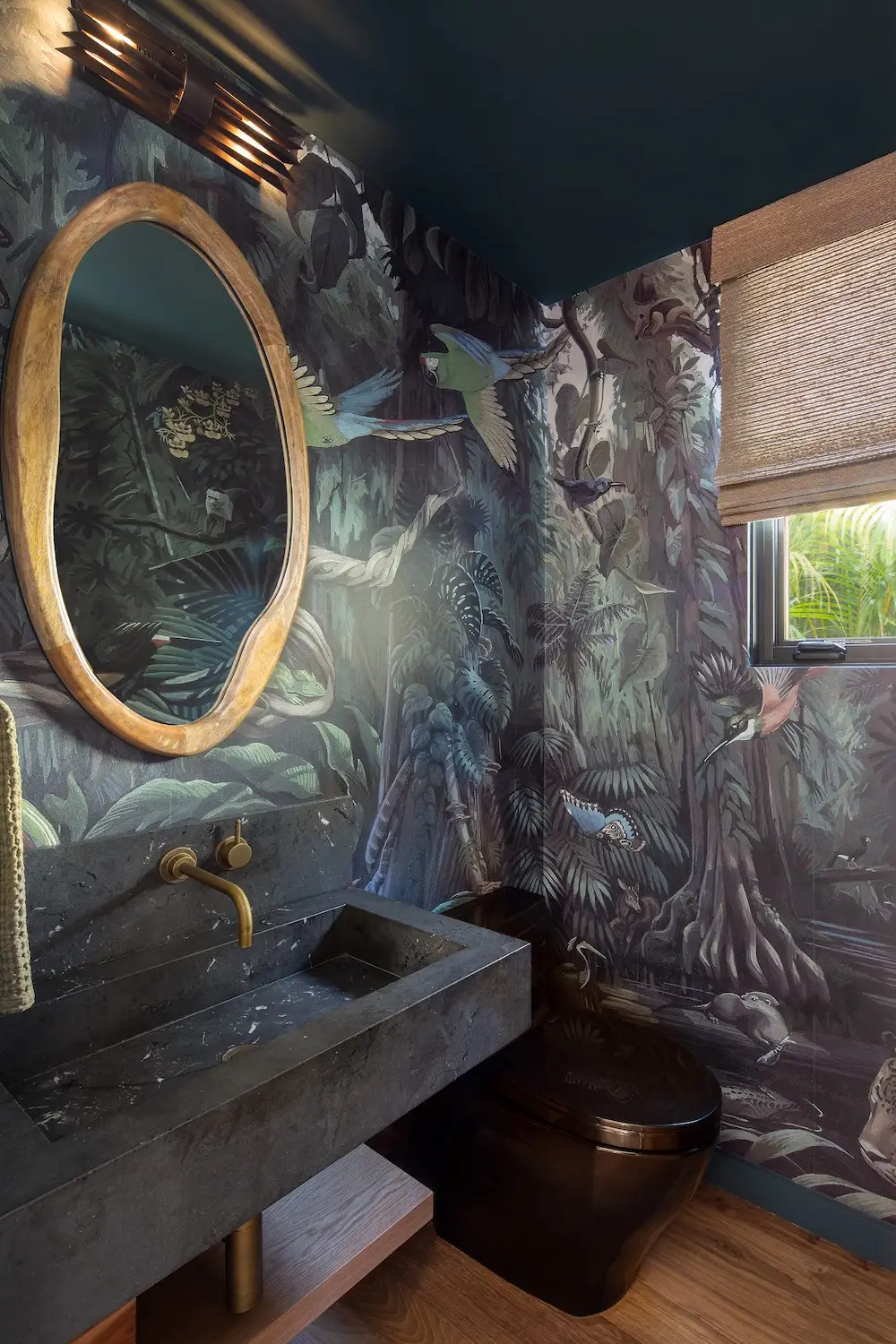
Upstairs, the children’s bedrooms have built-in oak desks and cabinets, plus an array of eco-friendly furniture, finishes, and textiles. Their bathrooms are appointed with quartzite counters, ceramic tiles, brass fixtures, and fine-art wallpaper from Eskayel, a company founded by San Diegan Shanan Campanaro.

The primary suite is a cozy retreat. May dreamed up a custom bed with flecked, charcoal-gray fabric; even the mattress is made from natural materials. At its foot perches a teak bench covered with a sheephide rug. Beside the bed, there’s a seating area with bamboo chairs, a concrete microtop drum table, and Encinitas artist Emma Webster’s Ungrounded, a brooding landscape with touches of fluorescent color. May added built-in seats below new and enlarged windows. On the floor lies a shag wool rug from Morocco.
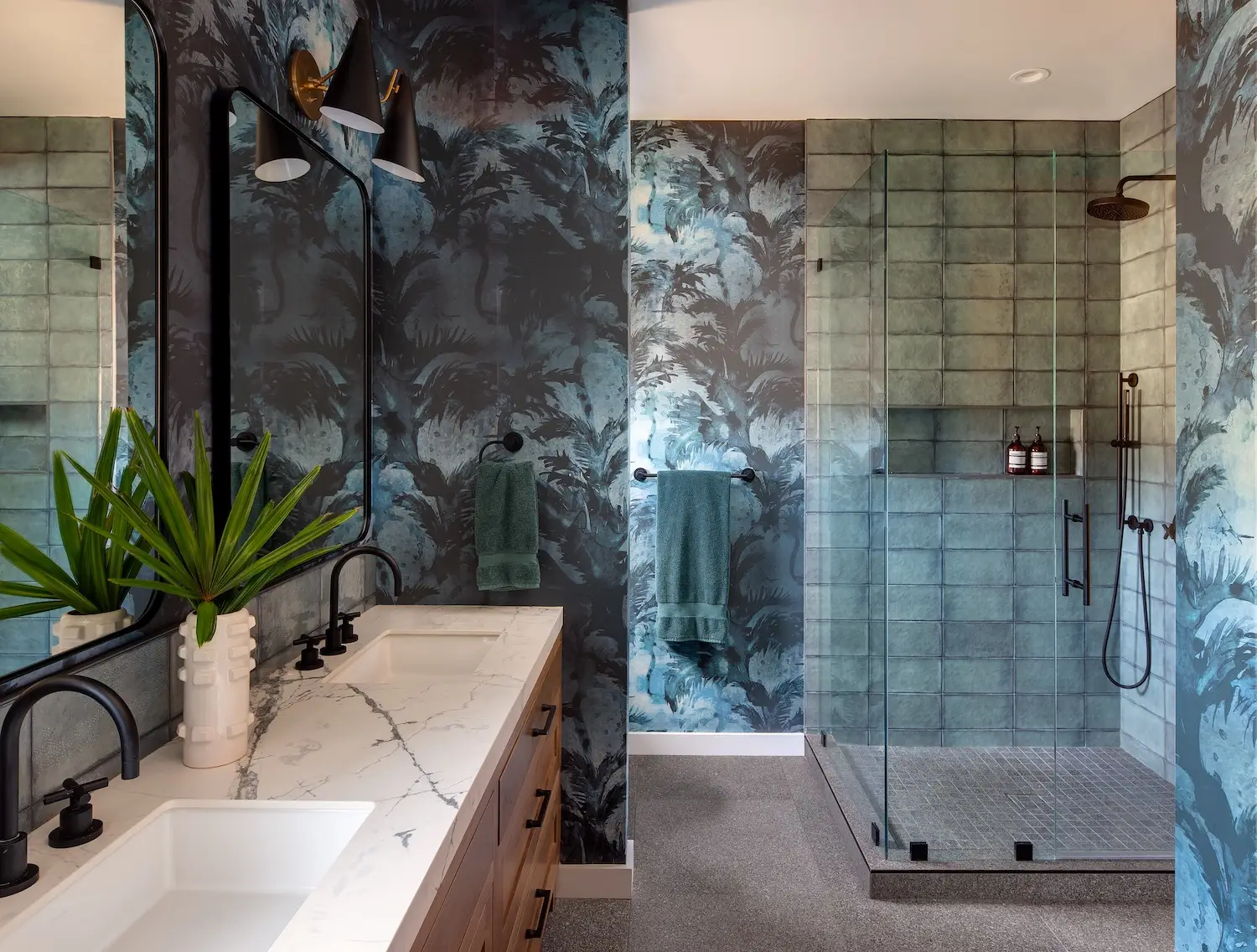
The floors in the primary bath are dark limestone, the counters are natural quartzite, and the cabinets have reeded doors. The shower features greenish gray porcelain tiles and a slate mosaic basin. Waterworks made the solid brass bathroom fixtures and faucets.
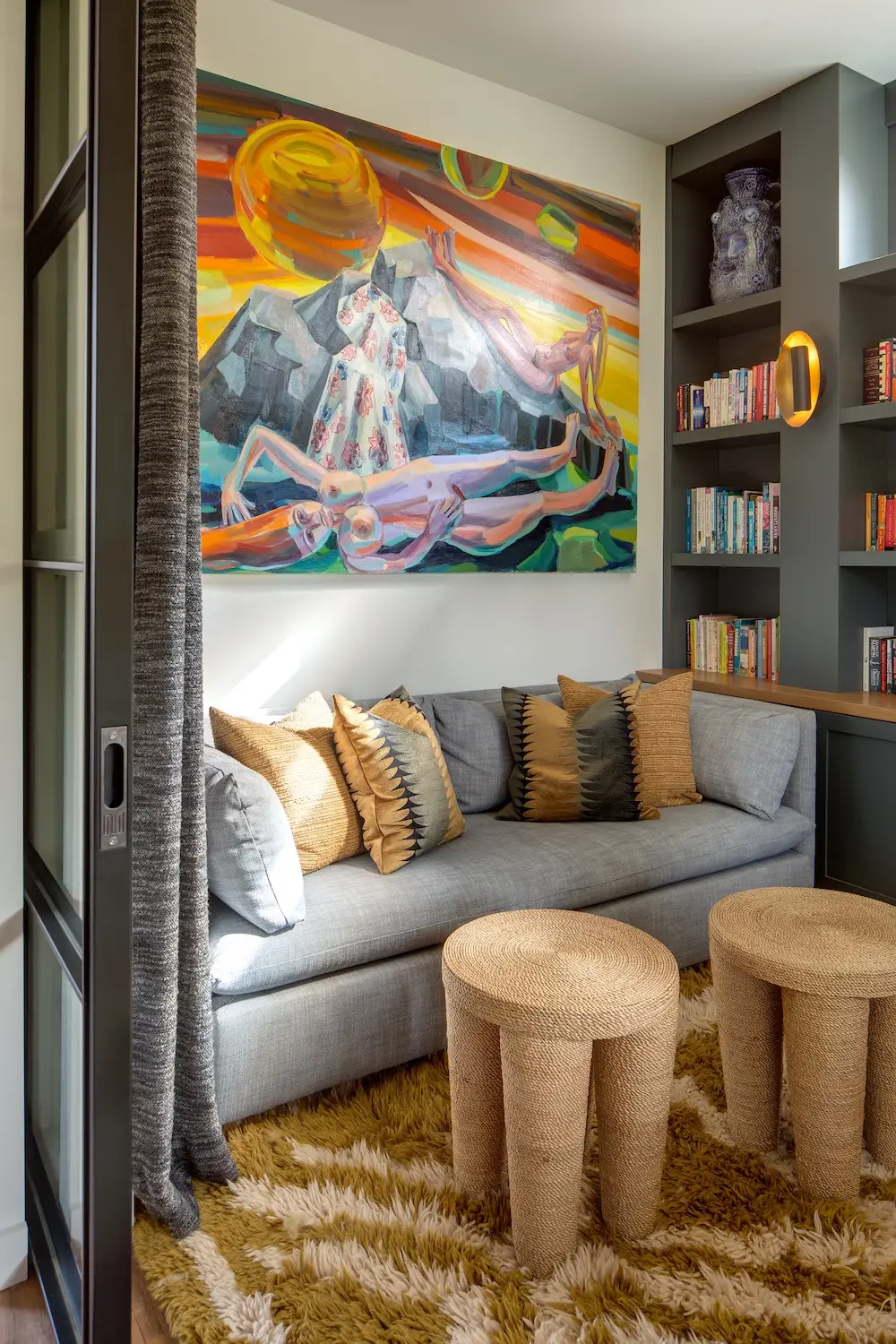
May’s design of many tones, forms, and textures is in constant conversation with the Birchbys’ ever-changing art collection. They own many more pieces than they can display, and the works are in perpetual rotation. Since the children have grown up around art, they appreciate it, and there’ve been no surprise attacks by Magic Marker, though the Birchbys encourage them to create and display works of their own. Chris lights up when he talks about art, both making it and collecting it. He uses words like “poetic” and “vibrancy” and “harmony”—words that apply equally to family life by the beach in this Pacific hideaway.
Dirk Sutro has written about architecture and design for a variety of publications. He is the author of architectural guidebooks to San Diego and UC San Diego and contributes a monthly column called CityScape to Times of San Diego online.
Dance to the American Rhythm, shop after-hours at the Summer Sera, and catch the Big Bay Boom fireworks show
Before, during, and after the Fourth of July, San Diegans can commemorate America’s 250th anniversary with an abundance of stars, stripes and local celebrations. America The Beautiful: 250 at The Rady Shell and Lamb’s Players Theatre’s revival of American Rhythm will look back at the many songs which define our country. Liberty Station’s Anchored in Freedom celebration and the Independence Day Carnival offer community-centered fun and loads of family-friendly activities. And who can possibly forget the Big Bay Boom, which will resume its reign over San Diego Bay as the state’s biggest fireworks show. Outside of the holiday festivities, this week brings the yearly return of Little Italy’s Summer Sera and the Athenaeum Summer Festival, as well as a slate of championship matches for All Elite Wrestling.
Food & Drink | Concerts & Festivals | Theater & Art Exhibits | More Fun Things to Do

Sip on refreshing beverages and savor a panoramic rooftop view this Friday from 6-8 p.m. during the 21-plus Sunset & Spritz at Margaritaville Hotel San Diego Gaslamp Quarter’s 5 O’Clock Somewhere Bar. There will be a live DJ (until 9 p.m.), appetizers, pool and cabana access, a photo booth, and a cash bar (until 11 p.m.). To accentuate the summer theme, guests are invited to dress in white, pink, and orange attire. Tickets are $29 and come with a welcome aperol spritz.
616 J Street, Gaslamp
Bring a patriotic palette to the Fairmont Grand Del Mar for The 250 Grand Tasting Menu at Amaya this Friday and Saturday from 5-8:30 p.m. Patrons will be treated to a five-course tasting menu, curated to exhibit a selection of standout regional flavors and culinary concepts that have shaped our country’s distinct food heritage. The meal will also include beverage pairings with each course, such as wine, cocktails, and artisanal drinks. Reservations are $330 per person (with tax and 20% gratuity) on OpenTable.
5300 Grand Del Mar Court, Del Mar
Don Toliver thrives at being the life of the party (and the “After Party”). His fifth album Octane, released in February, is indicative of his thrill-seeking nature. As with his earlier releases, Octane sees Toliver operating in the space between hip-hop and R&B, with warbling vocals and blaring beats that are best heard at a high volume. This Tuesday at 7:30 p.m., Toliver will play at Pechanga Arena, with rappers SoFaygo, Chase B and SahBabii—who had a guest verse on Octane standout “K9”—as special guests. Tickets start at $156 for this concert.
3500 Sports Arena Boulevard, Midway
What makes musicals like Wicked, Cats, Chicago, and Jersey Boys so timeless is the legion of excellent songs that makes fans out of those who’ve never even watched the show. This Friday at 7:30 p.m. during Blockbuster Broadway! at The Rady Shell, conductor Evan Roider, the San Diego Symphony Orchestra, and veteran vocalists Alex Getlin, Jessica Hendy, Scott Coulter, and John Boswell (also on piano) will perform an all-star theater soundtrack. In addition to the shows named above, audiences can expect songs from A Chorus Line, The Phantom of the Opera, Annie, and more. Tickets range from $57 to $129 for this concert.
222 Marina Park Way, Embarcadero
One night after recognizing the brilliance of Broadway, The Rady Shell will ring in the United States’ landmark anniversary with America The Beautiful: 250 this Saturday at 7:30 p.m. Conductor Byron Stripling, joined by a five-performer ensemble and the San Diego Symphony Orchestra, will lead a night of ballads that best resemble the red, white, and blue, including songs sourced from the Great American Songbook. After the show, concertgoers are invited to watch the nearby Big Bay Boom from their seats. Tickets range from $71 to $139 for this concert.
222 Marina Park Way, Embarcadero
Ryan Hardison is a freelance arts and entertainment writer and recent graduate of San Diego State. When he's not staring at his laptop, he's likely eating an adobada burrito or getting sunburnt at the beach.
Eighteen seconds, one unforgettable mistake, and a Fourth of July story that somehow gets better with age
There’s a famous video.
“This is insane!” the guy filming it seems to proclaim. “It’s the best fireworks show ever!” a companion confirms, inspiring a debate lasting over a decade.
All told, 7,000 fireworks exploded in the span of 25 seconds over San Diego Bay on July 4, 2012. A Michael Bay amount of unison. $125,000 worth of shells, cakes, Roman candles, and skyrockets had been placed on a barge—enough for 17 minutes of decorative sky flares—and…
Boom.
The sky looked like someone had set a giant Rorschach test on fire. Or as if whatever we all see in our Rorschachs—butterflies, clowns, tongue kissing, dads—was being electrocuted and lifted heavenward, amen. It was shocking how bright it was, how much it sizzled the local cosmos. Could’ve been one of those sci-fi films where a hole is ripped open between warring universes. But angstier, more metal—the work of some methy creator in a sleeveless concert tee.
The sound?
Lou Reed once released an entire album that contained 64 minutes of mindflaying guitar screeches and machine noises. No regular songs, just a fascinating amount of ear distress. His record label reps no doubt heard the melodic outro of their careers, but everyone else was in pain and stumped. That album still sounded better than the bay did that night. The bay sounded like a god who struggled with emotional regulation had blown his speakers and was working through the anger stage of AV grief.
In the left frame of the video, a middle-aged woman is attempting to drag her husband off by the hand. In no way does he want to go, possibly because he had missed the time Roseanne Barr sung the national anthem at a Padres game, simultaneously disemboweling and amusing America through the power of song. He would not willingly abandon an equally worthy San Diego trainwreck.
Another woman in the video appears to have just filled her beer, rushing to sit down for the show. She pauses mid-sit and returns to the full and upright position to properly bear witness. What was supposed to be prolonged entertainment has been so radically shortened that she will have to find another reason to drink. Lucky for her, drinking will be the only way to adequately process.
Locals remember the conspiracy theories. People wondered if the fuses had been tripped by a saboteur who was sympathetic to dogs, fish, or the growing suspicion that late-stage capitalism is a gorgeously branded but impossible dream sustained by remarkably efficient top-tier wealth retention and the soft compliance of fireworks-watchers who can no longer afford a house, a beer, or the personal impacts of human reproduction.
Speaking of being terrified of babies, babies were terrified. The children who witnessed it probably still can’t go near a candle store. But those kids will be tougher, perfectly scarred kids. They’ll write better songs.
That night helped us absolutely dominate the national news cycle. For a hot minute, we became America’s water-skiing squirrel. Now, years later, when you Google “fireworks gone wrong,” San Diego is always a top contender, along with that poor Nebraska family who nearly wiped out a couple generations in their front yard, their minivan somehow turning into a howitzer of recreational TNT.
There is still debate as to whether Big Bay Boom 2012 is the worst or greatest fireworks show of all time. But the advanced parts of civilization arrived at the truth as quickly as the women in the video did. It was undeniably amazing.
First of all, the point of Fourth of July fireworks isn’t “the intricate choreography of sky fire over a guaranteed amount of show time.” It’s about creating a vivid memory shared with some people you like, love, or would like to love.
BBB2012 used large-scale chemical fire to create the ultimate memory.
Sure, some people who iron their jeans subjected their family to a sermon about how San Diego managed to botch America’s birthday like a Disney princess-for-hire who smelled of quite a few Sauvignons.
The rest of us saw how perfectly it nailed the actual feeling of being an American. Because only a miniscule percentage of us bake postcard apple pies where every inch of crust is perfectly laminated like the wood in an Irish bar. Very few of us can paint on par with Picasso. The rest of us—despite truly believing in our America-activated abilities to achieve greatness in almost any field of our choosing—burn pies. We try to paint only to realize it looks like our fine motor skills have entered active death.
That’s why BBB2012 was the most perfectly American fireworks show ever: A wildly ambitious idea galvanized thousands upon thousands of people to both work on it and come to hold a beer and gawk at it, only to have it fail in the most glorious TMZ-level spectacle.
America isn’t about immaculate, storyless wins. It’s about how the framework of a country is solid enough that we can accidentally detonate our entire lives—a few times—and still probably be OK.
No one has America’d quite like San Diego did on that day. It was performance art. Lou Reed’s heart slow-clapped. Any brief municipal embarrassment quickly became a pride of our people. I can only hope the same for the Nebraskan yard family whose Dodge Aerostar became a hyperactive Death Star.
P.S. Local writer Maya Kroth compiled a quite great oral history of that night for Thrillist. The bottom lines for me were—it took nine months to prepare, no one was hurt, and even though the pyrotechnics company tried to zero out the bill, Big Bay Boom founder H. P. “Sandy” Purdon refused and paid them in full. This year will mark the 25th Anniversary of the yearly Big Bay Boom.
Troy Johnson is the magazine’s award-winning food writer and humorist, and a long-standing expert on Food Network. His work has been featured on NatGeo, Travel Channel, NPR, and in Food Matters, a textbook of the best American food writing.
From surprise revivals to changing dining habits, these are the shifts redefining the local culinary landscape
If absence makes hearts (and stomachs) grow fonder, then shuttered restaurants quickly become the hottest tickets in town—something a number of iconic institutions found out after taking very public hiatuses after historically long runs. For instance, following a lengthy (and extremely flip-floppy) closing process after 92 years in business, Las Cuatro Milpas reopened two blocks away in Mercado del Barrio. Similarly, Carlsbad butcher shop Tip Top Meats reopened in the same location (albeit a smaller space) after the death of founder Joachim “Big John” Haedrich in 2023. Finally, after a whopping decade out of business, Sami Ladeki and chef Alfie Szeprethy brought back Roppongi to its original Prospect Street space, where it was the talk of the town in the late ’90s. All came back under the same proprietors, so they weren’t third-party nostalgia-licensing deals. The algorithm may have ravaged our attention spans away from all but the newest and shiniest, but this proves there’s still hope for our collective prefrontal cortex.
Other local eateries honored their pasts by bringing in new perspectives. The Lion’s Share in Embarcadero, Milton’s Deli in Del Mar, Dudley’s Bakery in Santa Ysabel, and J-K’s Greek Cafe in La Mesa handed over the keys to new owners willing to take on a big task: maintain the soul of icons through particularly rough economic circumstances for restaurants, navigate big feelings from longtime regulars (who often don’t take kindly to change), and make some necessary changes to keep going for another few decades. Taking over a project in process can be a lot harder than starting from scratch. But building that feel-good nostalgia doesn’t happen overnight, so it sure helps to have a well-established playbook of success passed down from those who came before.

It wasn’t just restaurant groups from Los Angeles that decided to put down roots en masse, although San Diego saw plenty of LA transplants recently (Sugarfish, Mr. Charlie’s, For the Win, Katsuya Ko, Bacari). Global brands like Chef Fei, Zuma, and Pepper Lunch have locations of their own on the way, and upscale Canadian eatery Joey joined to the inescapable gravitational pull of Westfield UTC’s culinary cosmos for its first spot in America’s Finest City. Good to see the rest of the world is catching up with what we’ve been seeing the last few years—San Diego is a dining destination already on the rise.
Between the never-ending news cycle of doom and perimenopause brain fog, I’m at the stage in life where I’m more than happy to let someone else make a decision for me, especially when it comes to what’s for dinner. And based on the way a lot of menus look right now, I’m not alone. It seems like half the places I visit offer some version of a prix fixe, omakase, or tasting menu. Restaurants are embracing the curated experience to solve the problem of affordability (a fixed menu reduces food and labor costs, guarantees an acceptable check average, etc.) and critical thinking in one fell swoop. Omakase (meaning “I leave it up to you”) is far from a new concept in high-end Japanese sushi culture, but now that it’s popping up everywhere from coffee experiences to grab-and-go sushi and sandwiches, it’s gone from somewhat niche to nearly omnipresent.

The world got an up-close look at San Diego’s coffee industry when we hosted the premier specialty coffee expo World of Coffee for the first time this April. San Diego’s long and rich coffee history stretches back to the late 19th century. Things percolated fairly quietly for around a century before really picking up steam. Today, there are nearly 200 specialty roasters and cafes across the county, with many earning national accolades like the Good Food Award (Steady State Roasting, 2020; Bird Rock Coffee Roasters, 2023, 2021, 2019, 2017, 2016), Roaster of the Year by Roast Magazine (Mostra Coffee, 2020; Bird Rock Coffee Roasters, 2012), and the Specialty Coffee Association Coffee Design Award for packaging (Rikka Fika, 2026). Now that we’ve moved past the comically insufferable coffee snob era of the early 2000s, even java newbies can feel comfortable walking into pretty much any coffee shop in San Diego, asking questions, trying a few things, and feeling confident they’re going to get great service and a great beverage.
Beth Demmon is an award-winning writer and podcaster whose work regularly appears in national outlets and San Diego Magazine. Her first book, The Beer Lover's Guide to Cider, is now available. Find out more on bethdemmon.com.
KQ Aesthetic Society goes beyond cosmetic to provide comprehensive care and transformative results
Kelly H. Harfouche, founder of KQ Aesthetic Society, knows firsthand that cosmetic treatments like fillers, neurotoxins, and microneedling, can not only enhance a person’s appearance and restore confidence, they have the power to truly change a person’s life. An expert injector has the ability to tailor treatments to each individual patient’s anatomy and goals for personalized results. Harfouche, a board-certified nurse practitioner, has spent nearly a decade perfecting her craft as an aesthetic injector and integrating her multifaceted artistic skills with precision patient care. Her commitment to continual education and training, plus a passion for helping people look—and feel—their best, set KQ Aesthetic Society apart in a sea of local medspas.
For many people considering nonsurgical treatments, the intent is to look refreshed and refined. KQ Aesthetic Society’s philosophy eschews a cookie cutter approach that bases treatments around units, instead working to understand each person’s unique goals, then curating a treatment plan to fit that vision. Harfouche focuses on “inclusive luxury,” the belief that everyone deserves access to aesthetic treatments, respective of budget restrictions. She develops long-standing trusted relationships with her patients, and works with each one to achieve their aesthetic objectives and address the underlying causes of their concerns.
“For me, forming an honest and open relationship with every patient who walks through the door is essential. This means understanding them on a deeper level and meeting them where they are to define and achieve their individual goals,” she says.

Drawing on her artistic background, which inspired her transition into medical aesthetics, Harfouche sees each client as a “unique canvas.” Rather than relying on standardized procedures, the practitioner’s distinctive approach combines her profound understanding of the physiological and anatomical changes associated with aging with an unwavering commitment to ongoing education about the newest products and their mechanisms of action. Her goal is to make each patient feel beautiful in their own skin and to embrace their individuality.
She has also pioneered a way to combine her talent for aesthetic artistry with her philanthropic nature. Harfouche is one of only a handful of providers using dermal fillers to treat patients with lip asymmetry and scarring resulting from cleft lip surgery. Patients travel from around the country for this transformative treatment, noting increased confidence and a restored identity. She hopes to eventually launch a training program to help fill the void in this space.

“My passion has always been connecting with people and giving back in any capacity that I can,” she says. In the rapidly advancing landscape of aesthetic medicine, you can place your confidence in Harfouche and KQ Aesthetic Society to deliver exceptional care. To learn more or book a consultation, please visit kqaestheticsociety.com.
See Rosalía in concert, stroll through Little Italy for Summer Sera, and dress up for Comic-Con
Summer has officially kicked off, and San Diego is celebrating the sunny season with a myriad of fun events. From San Diego Pride week and a fairytale performance at Civic Theatre to a Santigold concert and Comic-Con, there are dozens of opportunities to make memories worth adding to your scrapbook. Here are all the best things to do in San Diego this July:
Concerts & Festivals | Theater & Art Exhibits | More Fun Things to Do
Divine inspirations, operatic ballads, and symphonic pop production elevate Rosalía’s Lux to heavenly levels. Hear angelic vocals ascend—in up to 13 languages—during her performance at Pechanga Arena.
Enjoy a night of feel-good indie rock and sing-along anthems at the Cal Coast Credit Union Open Air Theatre courtesy of Young the Giant and special guest Cold War Kids.
Santigold collects genres like gold stars: musical accouterments that brighten her uniquely alternative sound. See her live in concert with dancehall producer Troy Baker Sound at Humphreys Concerts by the Bay.

Be the Civic Theatre’s guest for “Beauty and the Beast” and discover that a fairytale love sometimes lies beneath the surface.
Two male government workers pursue a secret romance amid the Lavender Scare in the San Diego Opera’s production of “Fellow Travelers” at the Balboa Theatre.
The deep blue sea is home to countless ecological treasures, including the remarkable marine organisms documented by Oriana Poindexter. Study her educational and experimental imagery at The Photographer’s Eye via Field Notes.
Audrey Hepburn. Marlon Brando. Salvador Dalí. What do these icons have in common? Each was the enigmatic focus of a Cecil Beaton portrait. Step inside Cecil Beaton’s Fashionable World, an alluring showcase of 20th-century style at San Diego Museum of Art.

The Little Italy Mercato will trade morning rays for golden-hour glow through its free Summer Sera, an expansion of the neighborhood’s farmers market with live music, artisanal finds, and a fetching amount of pet activities.
San Diego Pride week starts with a Dyke March and ends with the two-day “Pride Shines On” festival. The days in between? Run a 5K, march in the parade, visit the rainbow-lit St. Paul’s Episcopal Cathedral, and more.
Dress up for a Mediterranean-themed tea time at the Estancia La Jolla, a laid-back yet refined afternoon planned for the resort’s monthly Tea in the Garden series.
Nerd culture’s biggest gathering returns to the Convention Center. San Diego Comic-Con welcomes fans of everything from comic book cinema to ultra-rare collectibles for panels, exhibits, sneak peeks, and much more.
Ryan Hardison is a freelance arts and entertainment writer and recent graduate of San Diego State. When he's not staring at his laptop, he's likely eating an adobada burrito or getting sunburnt at the beach.
A massive $1.3 billion construction project is slated to improve the border-crossing process—will it live up to its expectations?
You’re coasting home after a weekend in Rosarito Beach—still riding the high of vitamin D and Baja Med—and then comes a slap back into reality: brakelights and gridlock exhaust.
Small wonder, given that San Ysidro is the busiest land border crossing in the western hemisphere (fourth-busiest in the world). Otay Mesa’s no breeze either; it’s the busiest commercial port in California and second-busiest across the entire southern border. Smart Border Coalition says that each day last year, 41,800 vehicles crossed into the US at San Ysidro; 17,800 crossed at Otay Mesa, along with 1,023,000 commercial trucks.
Diana Pazos, a San Diego resident and adolescent psychiatrist working in Tijuana, says the northbound border wait at the San Ysidro crossing is often three to five hours Saturday through Monday—delays that modern humans and multinational maquiladoras alike aren’t built to endure. At the current Otay crossing, “commercial trucks may be in line for six hours or longer,” she says.
Needing to bake a couple hours of commute into the States doesn’t just affect vacations; tens of thousands of people cross the border each day for doctor’s appointments, work, school, you name it. The clog has personal and commercial ramifications.
But change is coming. Construction has begun on a new border crossing in Otay Mesa, which is expected to significantly reduce wait times across all San Diego border crossings, bolster binational trade, and improve the air pollution levels in the area.
Nikki Tiongco, an 18-year Caltrans veteran who oversees the Otay Mesa East project (aka Otay 2) for the agency, says the new border crossing will also be among the most high-tech, efficient, and secure border crossings in the nation.
“We have already completed the roadway network within the Otay Mesa East region,” says Tiongco. Part of this project included building State Route 11, an extension of SR 905, which has been open to the public since August and will feed traffic to the new entry port. Otay 2 comes with a 21st century upgrade, too. Miles of fiber-optic cables have been installed underground, which gives the port the brainpower to efficiently sort and streamline traffic as cars approach the border. (Unlike the San Ysidro border, where lanes get organized by vehicle type, Otay 2’s lanes will be interchangeable. For example, if the system indicates that a high number of commercial trucks is heading to the border, passenger lanes could be converted to cargo lanes in real time.)
Otay 2, driven by a binational collaboration among government agencies (Caltrans, SANDAG, General Services Administration, and U.S. Customs and Border Protection), receives both federal and state funding, plus hefty contributions from Mexico. So far, funds from the $1.3 billion project have helped build new bridges and roadway interchanges that will guide traffic to the crossing. At this stage in the process, Caltrans is “laser-focused on building the facility itself,” Tiongco says.
Now, to the juicy part: the prospect of a “20-to-30-minute border wait time” at Otay 2, according to Tiongco. Currently, there are three standard ways to cross the border at San Ysidro: Ready Lanes, General Lanes, or SENTRI Lanes. Most travelers use either the Ready or General lanes. SENTRI Lanes require a form of pre-approval from the US federal government plus an additional fee. According to CBP, the average wait time in 2025 at the San Ysidro crossing, was as little as 15 minutes in the SENTRI Lanes, 45 minutes in the Ready Lanes, and 1.5 to 2 hours in the General Lanes. Those are best-case scenarios that vary based on lane type and time of day.
Otay 2 is about 12 miles east of the San Ysidro crossing and 2.5 miles east of Otay 1. Those not wanting to spend that much extra time on the road to drive to the new border crossing, despite the allure of an under-30-minute wait, are still expected to see some benefits. Tiongco says Otay 2 will “provide a relief valve” overall by spreading the burden across the three border crossings. As a result, SANDAG says, wait times at San Ysidro and Otay 1 could be cut in half.
It’s not just your time waiting at the border that matters. Multinational corporations that relocated their manufacturing plants (maquiladoras) to Northern Baja have claimed for years that the long delays at Otay 1 eat away at their profits. More than 600 maquiladoras, used by companies such as Samsung and Panasonic, currently use Otay 1 to transport products to US and international markets. Ambassador Alicia G. Kerber-Palma, the consul general of Mexico in San Diego, says the project will facilitate more than $60 billion in cross-border trade annually.
Previous reports say that Otay 2 also has the capacity for around 12,000 passenger cars and 1,500 commercial trucks daily. A shiny, new element to this port: Commercial and personal vehicles that choose to cross will pay a dynamic toll on both sides of the border. The fee will increase during busy hours and decrease during slower periods, Tiongco says. Caltrans estimates that the toll could range from $4 to $30 for passenger vehicles and higher for commercial trucks. Drivers will be able to see current rates before they reach the actual border crossing.
And, with these changes, there are environmental benefits, too. “With shorter wait times at all three ports, there’s less idling and congestion, which should significantly reduce air pollution on both sides of the border,” says Kerber-Palma. The main factor driving improved air quality would be decreasing dirty emissions from idling diesel trucks. This county’s air could use some sprucing up, anyway. A 2026 report from the American Lung Association named San Diego as the fifth-most particle-polluted county in the US. The bulk of that dirty air comes from the heavy-duty trucks and ships that pass through the area.
Otay 2 is not only expected to curb the acceleration of air pollution in San Diego; if the state’s legislature passes California Senate Bill 10, the border crossing could also restore local water quality. This bill would use a portion of Otay 2 toll revenues to fund ongoing maintenance of the South Bay International Wastewater Treatment Plant. Current media reports say, however, that it’s increasingly unlikely that SB 10 will become law.
Otay 2 has been in the works for over two decades and is finally nearing the finish line. Construction estimates show that it should be up and running in 2029. Tiongco says this border crossing is “a good example of how the state, federal and local governments are working together and with Mexico to advance our mutual goals in the region.”
Adam is a longtime San Diego journalist and communications pro. He covers everything from politics and culture to surfing and business.
A look at San Diego's top designers creating unique environments that combine creativity and function


AVRP Studios’ tradition for Design Excellence and Innovation began in 1976 with Doug Austin, FAIA, in Solana Beach, California. The firm has since grown to complete major projects throughout the United States and Canada. We think of ourselves as a family and we care deeply about people. We want to inspire, help make their lives richer and more complete through our efforts. We believe that architecture is one of the most important art forms because of the impact it can have on the lives of those it touches. We’re delighted to have been recognized with over 150 awards for design excellence.
703 16th Street, Suite 200, San Diego, California 92101 | 619-704-2700 | avrpstudios.com