Featured articles
Food & Drink
Food & Drink
Food & Drink
Featured articles

Everything SD

Everything SD
Everything SD
Featured articles
Charitable SD
Things to Do
Things to Do
Featured articles

podcast-ep

podcast-ep

video
Featured articles
Everything SD
Everything SD
Everything SD
Featured articles
Charitable SD
Partner content
Food & Drink
Ready to know more about San Diego?
SubscribeReady to know more about San Diego?
We asked 12 golf pros from across the county to choose the city's top holes to create the "Dream 18"

At the top of a golf swing, the world settles into a hush. Anyone within 50 yards kindly shuts up in reverence. Steady heartbeats tuck inside the sound of the wind. Time stands still.
Or—panic sets in, a thousand warnings from coaches and YouTube tutorials prattle through your brainpan. You wonder if a good walk prepares to be ruined.
On descent, the club rearranges air particles as it slices on a perfect or unwise line toward an earth so green, it seems like AI. The iron face meets the ball, and the satisfying or unsettling thwack echoes across the fairway like a nonviolent gunshot or a cry for help. Breath catches, curse words load in the prefrontal cortex. Eyes squint to follow the hard-to-see projectile zip majestically through the air or bounce lamely along the ground like a failed hurdler.
Sometimes it goes a couple hundred yards in the right direction, other times a couple yards into uncaring swamps. Golf’s beautiful and hard as hell.
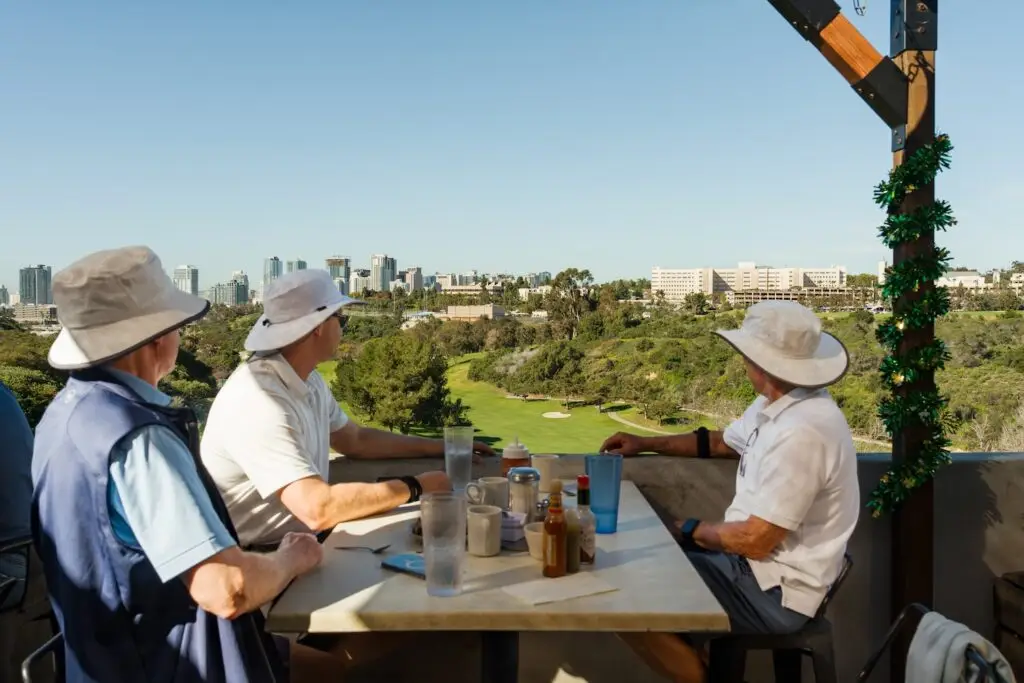
Mindfulness and stillness reign over speed and might—which goes against most basal American instincts regarding sport. Its quiet, serene mocking of our human abilities is what brings so many of us to the life-long process of sharpening the skill. Because who hasn’t stared at the most beautiful parks and lawns in the world and said, “How can I turn this into a game and win it?”
Luckily, San Diego has an abundance of courses to improve and curate self-doubt. The county is home to over 70 courses that attract the top golfers in the country. Some of the biggest names in the sport—Callaway, TaylorMade, Cobra, Titleist, Odyssey, Honma—are based here. Perfect weather never hurts. But San Diego golf courses also promise a smorgasbord of terrains: rocky canyons, hot deserts, and lush greens overlooking the expanse of the Pacific Ocean.
If you could take the 1,300-ish holes around San Diego and pick the very best ones to create your ultimate course, which would they be? We asked some of the top golf pros in the county to do just that. The result? San Diego’s Dream 18. Think fantasy football but for golf.
Just like any great course, our Dream 18 includes four par 3s, 10 par 4s, and four par 5s—everything from tricky dog legs and psychological tee shots to just pretty, pretty views. Once we had our list, we either asked the head golf pro what makes a hole so special, or other pros spoke on its behalf. Go ahead, tell us what we missed.

“One of the most iconic par 3s on the West Coast. The cliffside setting above the Pacific and the constant ocean breeze make it both beautiful and demanding.”
—Anthony Valverde, Director of Golf, The Crosby Club at Rancho Santa Fe
“It’s a downhill par 3 over water with a great view from the tee down to the green. It’s surrounded by bunkers as well, so it almost feels like an island green even though it’s not. What’s really cool is once you drive to the next hole, if you look back on No. 14, it’s a great view as well. One of the signature holes [at Santaluz].”
—Josh Rider, Head Golf Pro, The Santaluz Club
Hole 15
“Hole 15 is widely considered one of the best and most memorable holes on the course. At about 250 yards, it’s a long downhill with multiple tiers and panoramic views into the valley. It looks intimidating at first, but there are lots of recovery contours and the green is fairly large.”
—Editor’s Choice
“Sitting high above the green with views of the Pacific Ocean, this dramatically downhill par 3 requires the perfect club selection.”
—Mike Mulford, Director of Golf, Omni La Costa

“While it’s beautiful with the backdrop of the Batiquitos Lagoon and the Pacific Ocean, this finishing hole demands both precision and nerve. The water guarding the right side and fairway bunkers ahead create a visually striking, strategic tee shot, while the expansive green rewards a confident, well-placed approach. If you can make a par on this hole, you’ve played it very well.”
—Renny Brown, Director of Golf, Aviara Golf Club
“The 18th hole at Del Mar CC is a demanding par 4 with an elevated tee box. Water guards the right side of the green, and a player must hit a precise shot into this green.”
—Renny Brown, Director of Golf, Aviara Golf Club
“It’s a difficult 428-yard par 4 playing into the predominant west wind. The hole is post-renovation and the vegetation was trimmed back, so now it exposes a penalty on the right. It’s uncomfy at the tee but a good challenge. Plus, it’s the No. 1 handicap for [all players].”
—Chris Lungo, Head Golf Pro, Rancho Santa Fe Golf Club
“Some argue it’s our signature hole. A short par 4 with an elevated tee shot over a canyon. Beautiful views looking over the property. A good tee shot leaves you with a short second into a challenging green complex. Left drops off into a canyon, long as well. Right of the green is a challenging bunker complex, all of which makes a difficult up and down if you miss.”
—Brian Andrews, Head Golf Pro, The Bridges at Rancho Santa Fe
“The first 12 holes, you’re working toward the mountainside away from the ocean. When you get to No. 13, all of the sudden, you’re looking directly at the Pacific Ocean for the first time all day. You know you’re playing in a really special place, but you kind of forget that the Pacific Ocean is so close. It’s also a really challenging hole: On the right side, you have the canyon, where it’s easy to lose a golf ball. There’s room on the left, but there are some trees over there you have to maneuver around.”
—Jack Allen, Head Golf Pro, The Farms Golf Club

“I smile every time I think of that hole. Growing up in San Diego, that’s where I played most of my golf. We’d put our name in the starter hut, and while we would wait, we’d sit in the atrium with [floor-to-ceiling] windows and watch people tee off here for hours. From that angle, you can see the downtown skyline, the Coronado bridge, and the topography and undulation of the land the course is built on. It’s a classic.”
—Matt Loflen, Tournament Sales Director, Rancho Bernardo Inn
“A great long par 4 on the new Gil Hanse design. Elevated tee shot to a narrow fairway with long rough on both sides. The green is long front to back and very narrow, with large mounds protecting both sides making up and downs very challenging.”
—Brian Andrews, Head Golf Pro, The Bridges at Rancho Santa Fe

“I can’t think of many holes in San Diego where you’re that close to the water and sailboats. It’s basically where surf meets turf when it comes to golf. You can see the boats in the harbor, all while you’re maneuvering your drive off the tee. Not only is it a great setting, but it’s a spectacular hole.”
—Matt Loflen, Tournament Sales Director, Rancho Bernardo Inn
“No. 4 was redone within the last two years, with some new brick work, a fountain, a brand new tee box, and it’s all over water. It’s just a really good hole.”
—Rick Lindemann, Director of Golf, Singing Hills Golf Club
“A championship-length par 4, regardless of the selected tees being played, hole 18 at San Diego Country Club requires four solid golf shots to make par. Beginning with the day’s final tee shot, played from an elevated tee on the highest point of the property, eloquently overlooking the entire golf course. Additionally, [players get] stunning views of the Pacific Ocean less than two miles away to the west, as well as a scenic view of the not-too-distant famous Coronado Bridge and city skyline, [all of which] make for a tremendous closing hole.”
—Jason Brustad, Director of Golf, San Diego Country Club

“It’s a really good hole because it requires shot-making every step of the way. Your tee shot is demanding, with trouble on both sides of a narrow fairway. You have the option to go for it in two, and if you choose to go for it, you have to hit a precise approach shot, because the green’s guarded by water on the right, and there’s mounding on the left. It’s a hole that’s very, very challenging, rewards good shot making, and unique in that it can be played in different ways.”
—Jack Allen, Head Golf Pro, The Farms Golf Club
“The water features that run all the way down the left side of the hole make it quite picturesque. It is not, however, overly penal and is scoreable for even intermediate golfers if you play smart. For more advanced golfers, it is reachable in two but not without risk.” —James Cassidy, 1st Assistant Golf Pro, Maderas Golf Club
“I think it’s one of the best finishing holes in San Diego. It takes three really good shots, with your second shot being the most important. There’s water in play, a three-tier terrain, and match-deciding potential. You can have a great round, but you can’t take your foot off the gas. It’s where a lot of good scores have gone out to pasture.”
—Matt Loflen, Tournament Sales Director, Rancho Bernardo Inn
“This is a par 5 requiring an accurate tee shot with water and bunkers guarding both sides. It’s beautiful: Mountains and the clubhouse frame the hole, and it takes three strong shots to make birdie.”
—Bob Gelesko, Head Golf Pro, Rams Hill Golf Club

Lili Kim is a content coordinator and writer for San Diego Magazine, with experience highlighting local businesses and communities. When not writing or shooting film, she is likely brewing her seventh cup of tea of the day or strolling along Sunset Cliffs.
The Ely Callaway Performance Center is where tour-level fittings, cutting-edge technology, and golf equipment you can’t buy yet all come together
“Come test something.”
Those are quite possibly my three favorite words in the English language—all due respect to “I love you” or the highly underrated “you were right.”
I’ve been a PGA Golf Professional since 1994, and yes, full bias disclosure, a Callaway Golf Ambassador for 18 years. One of the bonuses that comes with that combo is access to the Ely Callaway Performance Center—a place so exclusive it gives “velvet rope” vibes.
Originally opened in 2006 as a highly functional (yet not exactly breathtaking) test facility, the ECPC got a serious glow-up in 2018 when Gil Hanse (along with partner Geoff Shackelford) turned it into what can only be described as a fully engineered golf playground. Hanse is no stranger to golf course renovations. In 2024, he completed an extensive redesign of the Omni La Costa North Course in Carlsbad, so it could host the NCAA Division 1 Golf Championships. He also worked on acclaimed courses like Winged Foot, Merion Golf Club, and Oakmont Country Club.
In just two months, it went from a standard test center and R&D lab to a fully dialed-in golf playground.

What was once purely practical is now intentionally designed to be both precise and inspiring. The targets are staggered with purpose—forcing creative shot-making while also calling you out on your actual distances (no more “that’s my 150-yard club … ish”).
Add a massive hitting area, bunkers and greens that mimic real on-course conditions, a “Himalayas” putting green (named for its roller-coaster undulations), an upgraded indoor putting lab, and a 120-decibel sound system blasting a very golf-appropriate playlist, and suddenly it’s a rare blend of high-performance testing facility and “don’t mind if I stay here all day” energy. Since this isn’t exactly open to the public, SDM asked me to take you behind the curtain.
As the iron gates part, it feels less like arriving at a practice facility and more like being granted backstage access at a rock concert—if the bandmembers were made entirely of launch monitors and perfectly manicured turf.
There are no mats. No guessing. No “I think that one felt good?” Just conditions that mirror exactly what tour players see in competition. Because when you’re testing equipment at this level, accuracy isn’t a bonus—it’s the whole point.
Even the sand matters. Different textures. Different densities. Because bunkers have personalities, too, and they are often unfriendly. And the golf balls? Brand. New. Not the usual “these have seen some things” range balls. New balls mean consistent spin, truer trajectory, and no surprises. The older a golf ball gets—and the more it’s been baked in the sun, scuffed, or generally lived a full and complicated life—the less reliable it becomes. Think of it like this: fresh ball, predictable performance; old range ball, slight chaos with a side of mystery.
I’m escorted to my personal hitting bay—basically a pop-up shaded oasis stocked with enough equipment to make a gear junkie weak in the knees. Shafts in every weight and profile imaginable. Heads lined up like they’re waiting to be drafted by their favorite team.

Toptracer technology was patiently waiting to track every one of my swings, each shot instantly delivering ball speed, launch, spin, carry distance, and dispersion (a polite way of saying consistency, or lack thereof), so there’s no guessing—just data telling the truth, whether I like it or not.
We start with irons. Different heads, different feels, different results. When I miss a shot, the ball tends to leak right, so we check lie angle. A quick adjustment—2 degrees upright—and suddenly the clubface is consistently square at impact like it remembered its job. Effort level: down. Ball flight: improved. Confidence: creeping back.
Next we look at the different shaft options—because nothing says “fun afternoon” like realizing a higher kick point can change your entire golf identity. Shaft flex (how much the shaft bends during your swing) helps determine whether you get more height and distance or more control, while kick point (where the shaft bends the most) influences your ball flight—lower kick point for higher launch, higher kick point for a flatter, more penetrating shot. In other words, one small tweak and suddenly you’re hitting shots you’d normally only describe later, slightly exaggerated, over a glass of wine.
Then we move through the bag: hybrids, fairway woods, drivers, wedges. It’s a full rotation of “try this,” “now try this,” and “okay wait … THAT one.”
And yes—the new Quantum driver and fairway woods made an appearance. Without getting too deep in the weeds, they’re faster, more forgiving, and smarter (thanks to AI face mapping) than previous models. Translation: Even your mishits are now slightly less embarrassing. And they were not the only things getting tested. My patience was under attack because the driver and woods would not be available to the public for a good three months.

Watching the fitting team work is like watching a Formula 1 pit crew. Clubs are swapped in seconds. Shafts tightened, adjusted, replaced. One minute you’re swinging something that seems “fine,” and the next, you’re holding a club that feels like it is a part of your DNA.
Then there’s the putter fitting. Drivers are physics. Putters are therapy. Inside the putting lab, sensors track everything—tempo, face angle, path—things you didn’t even know could be measured. Within minutes, my data politely informs me that my putter face is slightly closed at impact. Not shocking, but also not ideal.
A few quick adjustments—different head (with a bit more weight at the toe to discourage the face swinging closed at impact), shorter shaft (so I feel more over the ball, which helps my eyeline)—and suddenly the ball starts rolling exactly where I’m aimed.
Same stroke. Same golfer. Completely different outcome. If only the rest of life worked like that.
And then there’s the part that feels slightly classified. The ECPC isn’t “just” a performance center—it’s also where future equipment lives before the public even knows it exists. I’ve been there when certain clubs were basically under surveillance. Not “don’t touch,” but more “please keep phones in your pocket.”
It’s golf’s version of Area 51. Except instead of aliens, it’s drivers that won’t hit shelves for another year—and like I mentioned, waiting is not my strong suit.
Getting to test the newest equipment isn’t just a perk—it’s part of the job. It’s what allows me to stand in front of students and say, “I’ve tried it. I know what works and what doesn’t. And more importantly, I know why.” And if I happen to sprint to my car every time the phone rings and someone says, “Come test something” … well, that’s just professional courtesy.
Callaway isn’t the only place to get your swing analyzed and clubs fitted. You can stroll into big retail spots like The Golf Mart or Golf Galaxy, book a next-level session at a dedicated studio like Club Champion or True Spec Golf, test brand-specific gear at various manufacturing companies (many located in Carlsbad), or even combine a lesson and a fitting at GOLFTEC. And let’s not forget your local golf course, where fittings happen on actual turf, on a driving range you have some history with—many times with the golf professional who is familiar with your swing so they can give you valuable input. With this many options, there’s really no excuse, other than pride, to keep blaming your clubs.
The county that helped push skating into the mainstream is now nurturing the competitors, communities, and culture shaping its future
It was the summer of 1999. MTV, The Matrix, and first-generation PlayStation glowed on tube TV sets all over America. What a time to be alive. Smartphones weren’t yet stealing people from the moment. Cultural was a shared reality. During the last few minutes of the monoculture, Tony Hawk executed the first-ever 900 at X Games V in San Francisco. That’s two and a half aerial rotations with a side of the dizzies.
The time had run out on the Vert Best Trick competition long before the 11th attempt when he pulled off the fateful feat. Nobody cared. Not the judges, not the competition, and certainly not the crowd. “Let that bird fly,” they said. Once the trick was landed, they partied like it was 1999 … because it was.
That was the tipping point when the skateboarding world exploded, going from counterculture to a national phenomenon. Shortly after that, “Tony Hawk’s Pro Skater” video game came out, introducing millions of kids to what skate culture looked like. Oh, the game had a killer punk soundtrack, too.
We can all thank Hawk for the globalization of skateboarding. But we can also recognize his local influence and how San Diego County continues to be a hub for skateboarders young and old, for competitors and street skaters. To see it all, go to Park De La Cruz in City Heights—or, heck, any other skatepark in the county—which, at 19,000 square feet, is about twice the size of the average skatepark and has signature features like an M-shaped transition ramp. The amount of talent that continues to evolve in this county is a testament to deep-rooted skate culture and world-class athletes supporting the next generation.

I’m a little early for a skate lesson with pro skater Mike Owen when I get to Linda Vista Skatepark. In the 2010s, Owen ranked as one of the world’s top bowl riders. He’s the founder of San Diego Skateboarding and has “helped thousands of kids, teens, and adults learn to skate safely, confidently, and with style,” the company’s site says. And now it’s my turn. We start the lesson on the nearby tennis courts, getting my basic foot mechanics down. Safety before style.
In terms of street plaza features, the massive Linda Vista Skatepark is loaded with rails, stairs, manuals, and ledges. There are more bowls than you can get from Cava: a flow bowl, backyard-style pool, and vert bowl. The main feature is a full pipe for advanced line riders. It’s a hell of a park, even if somebody just wants to watch the action from the 100-foot-long pedestrian skybridge overhead.
Right now, San Diego has over 50 public skateparks scattered throughout the county. “There are now more [skateparks], more resources for them, and more terrain,” Owen tells me. “Now, they’re offering different competitive style skateparks that help for competitions. The best parks have a variety of different terrain where you have things for beginners and bigger transitions. Not every town has that.”
San Diego, luckily, does. But despite the bounty, Owen believes there should still be more—public skateparks are safe spaces for all to learn and develop on-board skills. Without them, a huge portion of San Diego’s culture withers. Encinitas could be the next city to add a skatepark to the county’s roster: In early July, the Encinitas City Council appointed 12 local skaters and community members for the newly established Skate Feature Committee. In partnership with two councilmembers, the committee’s purpose is to design a working skatepark or feature for the city.
But like any big project, Owen says, it’s a long process to add another skatepark to the community.
“I wish it were easier,” he says. “When there are different contractors for different things, [there’s only] a certain amount of time to build. It gets tricky.”
Then there’s the matter of funding the actual construction and development of the skatepark. That usually comes from grants, fundraisers, and donations. For reference, Linda Vista Skatepark was built on a $4.46 million grant from the California Department of Housing and Community Development in 2014. With an additional $40,000 donated by the Tony Hawk Foundation, the park opened in 2018 and is the largest in San Diego’s Parks and Recreation system. The best way to get a skatepark in your neighborhood, Owen says, is to start a petition and reach out to your city.

Jordan Thrower’s first street skate sesh at San Diego City College in 2003 ended with a police chase. The campus was swarming with skaters riding rails, jumping stairs, and grinding tricks on benches, curbs, and ledges. When the cops got on their loudspeaker telling them not to run, everyone obviously ran. Back then, cops would give tickets and confiscate boards. The vibe has loosened since. “Now, the police don’t really care,” Thrower says. “They just make you leave. It’s not anything crazy.”
Street skating is when riders use real-world urban obstacles, rather than pristinely designed bowls or ramps—such as in college campuses, downtown areas, corporate buildings, and malls. Abandoned mini-golf courses and construction sites do the trick, too.
Thrower says the street skating hub here isn’t as huge as it once was. Thanks to modern technology and social media, skaters aren’t tied to any certain place to create skate videos. You know, those videos that could have been taken this year but have the low-fi vibe of 2004, where skaters carve down stairwells into parking lots, over mailboxes, or across park benches. The silver lining: Even though there are fewer street skaters than there once was, those who stayed in San Diego are still tight.
“Everyone skates with each other and knows each other here,” Thrower says. “In LA, it’s not really like that. It’s small there, but not everybody knows each other, and they don’t really skate with each other too much. They just have a lot of little crews.”
Back in 2015, Thrower started his own street team and brand that sells boards and shirts called Tantrum. The Tantrum team is split between San Diego and San Francisco. It doesn’t take much to be a part of a skate team. You just have to be a good hang.
“The way I pick people [for the team] is if I can get along with them,” he says. “It doesn’t even really matter if they’re that good. If you’re likable and funny, you can pretty much be on the team.”

Running it up to North County, a Vista-based nonprofit organization called Exposure Skate has been shaping up the youth since 2012. Its mission is to give more opportunities to otherwise underrepresented women, girls, and non-binary individuals by offering classes and camps. This, to build up confidence and community. We could all use a little bit of that, eh?
Thanks to Exposure Skate, 13-year-old Joey Yarbrough has found herself competing in the LA Olympic trials. (Her first time on a skateboard came at just 18 months old at an Exposure Skate Rising event.)
While competing for Team USA in Rome in June of this year, she finished 13th at the first Olympic qualifier for LA28. Currently ranked 21st in the world and 5th among American women, the young prodigy is blooming. And she’s in good company and mentorship from her biggest influence, Bryce Wettstein.
“She taught me at the first Exposure Skate Rising when I was little,” Yarbrough recalls. “I compete and skate with her all the time now, and it’s super fun. [At Exposure,] it feels so good to have someone there to help me whenever I need it. They’re like my family, always encouraging me and always there for me.”
Yarbrough will be just 15 years old when the Olympics go down in LA. She’s following the Olympic torch carried by other locals such as Wettstein, Ruby Lilley, Jordyn Barratt, and Exposure Skate’s Amelia Brodka.
“I’m working my hardest to get there,” she says. “I’ll also work my hardest to go higher in the Olympics, maybe on podium. That’s just my dream. So, hopefully it’ll come true.”
Jake Peterson is a San Diego-based journalist and culture writer. His work explores the city’s music scene, sports, local characters, and the offbeat corners of San Diego’s subcultures.
No gatekeepers, no creative rules, no perfect definition—the city’s DIY publishing scene makes room for anyone with something to say.
If magazines are like the adultier eldest daughters who know exactly how much anarchy they can get away with, zines are the far less predictable younger siblings going on whim and instinct. Those who draw on the walls around the house, DIY their own piercings, and experiment with different emo/straight-edge/back to emo phases (or not-phases). Boundaries and routines are what zines were created to rail against.
Walk into Verbatim Books’ zine corner, and this rebellion is immediately clear. Zines have no singular form, no clean category or definition. Vintage magazine scraps are collaged into new meaning alongside mini fandom zines. Single sheets of plain white printer paper are covered in nothing but black ballpoint pen. Repurposed hardback book covers are folded into something entirely new. Some are duct-taped together, others stapled. Some glossy, others matte. There are guides to anything and everything, comic panels, photography, hand-drawn cartoons, poetry, recipes, diaries, and ramblings that only make sense to the person who made them—and that’s on purpose.
Zines are creative magic. And with no rules, they’re incredibly accessible. Anyone can zine and have a voice, regardless of artistic training or work life experience.
You are your own Anna Wintour, Graydon Carter, Ruth Whitney.
San Diego–based zine creator Lyssette Williams specializes in mini zines—often limited to eight pages, they’re meditations in abbreviation. Outlining, thumbnailing, and revision all move quickly from idea to page. Larger projects, including Williams’ long-form graphic novel thesis, move at a slower pace. For those, she often returns to pen and ink, a choice that resists the over-editability of digital work.
Raised by a single mother and navigating mixed-race identity in a predominantly white town, she finds a home for processing it all in zines. Her work deals in identity, belonging, self-definition, and punk-rock childhood. But it isn’t always heavy; Williams creates a mini duck-themed zine called Backyard Duck Propaganda that’s hard not to love. “When I create, I think about what would have helped me find the words back then, what my younger self would’ve needed,” Williams says. “[Zines] put the tools in your hands and democratize art. They’re translations of memories and identities.”

For Williams, a big reason she keeps creating is being surrounded by other creatives—a scene that extends across the border. She points to Verbatim and Comicbook Artists of San Diego, plus events like Zine Fest (October 17–18 this year at Woo in Barrio Logan) and Black Comix Day at the WorldBeat Cultural Center.
Zines have always been a road for subcultures. During the Harlem Renaissance, Black creatives like Langston Hughes and Zora Neale Hurston self-published one issue of Fire!!, which inspired other Black authors. In the 1930s, zines (then called fanzines) were hubs for sci-fi nerds to write fanfiction, address the fandom, and create new characters. Superman actually made his public debut in a fanzine called Science Fiction (he was originally cast as a villain with a fully receded hairline). A couple decades later, zines about feminism and riot grrrl became subculture de rigueur.
The internet nearly killed zines, of course. But now, people tired of the algorithm’s firehose are finding comfort and renewed inspiration in analog. Zines, a salve for digital fatigue.

A giant figure in San Diego zine culture is Burn All Books. Founded by Amanda and Nick Bernal, BAB started as a risograph (digital screen printing) studio and turned into one of those places that keeps expanding the whole scene around it, even forming its own archive group, SCANNNERS. Since opening in January 2023, it has published over 35 works and collaborated with more than 100 artists, writers, and zinesters.
For Duophobia, the pseudonym for local twin sisters Alora and Kiani Dotson (affectionately known as the “possum twins”), zines make room for experimentation and play that doesn’t fit anywhere else. Room for eclectic cartoons and dirty jokes. For sticker-covered sketchbooks.
It’s that same brand of nostalgia you might feel when, say, you walk past the carcass of an abandoned mall and see a faded cartoon mural. Their work lives somewhere between childhood and adulthood, where being unserious is taken very, very seriously.
“We’re born and raised in San Diego, and the community of artists here is a main reason we started publishing,” Kiani Dotson says. “There are people here like Trixxie Land who run open art gatherings. Show up, and you’re part of it.”
Land, a zinester herself (she made 250 single-page zines during 2020’s lockdown), is all about storytelling over hierarchy. Art shouldn’t be about gatekeeping or intimidation, she says. So she holds open-invite arts shows at Subterranean Coffee.

Duophobia regularly share their work at local galleries like Subterranean, filling that lowbrow space with pieces that answer: “What would’ve made us laugh as kids?” Children are often the first to pick up their zines, unfolding them in every direction while parents briefly panic at the impulsive destruction. The twins always step in. “No, no, it’s okay,” they say, before showing how one sheet of paper folds into an entire little book. “It’s like magic.” More often than not, the kids leave with a tiny zine tucked under a tiny arm, future San Diego zinesters in the making.
When asked what a zine really is, Alora Dotson’s response was simple: “It’s anything. Literally anything. The more genuine you are, the more people are going to hear what you have to say. Your voice matters, even if it’s just a silly joke or story. People want to hear about it.”
Not a perfect definition? Exactly. Zines inherently resist categories. Want to turn a single playing card into a storybook? Do it. What about your favorite graffiti artist’s signature tag at Prince Memorial Skatepark? Turn it into a zine.
Everything’s a zine.
Isabella Dallas is a freelance writer for San Diego Magazine and the Arts and Culture Editor at The Daily Aztec in her final year at San Diego State University. She previously worked as an editorial intern for SDM, but when she’s not writing, you can find her trying the best coffee spots in SD, devouring the latest rom-coms, and indulging in anything and everything pop culture.
KQ Aesthetic Society goes beyond cosmetic to provide comprehensive care and transformative results
Kelly H. Harfouche, founder of KQ Aesthetic Society, knows firsthand that cosmetic treatments like fillers, neurotoxins, and microneedling, can not only enhance a person’s appearance and restore confidence, they have the power to truly change a person’s life. An expert injector has the ability to tailor treatments to each individual patient’s anatomy and goals for personalized results. Harfouche, a board-certified nurse practitioner, has spent nearly a decade perfecting her craft as an aesthetic injector and integrating her multifaceted artistic skills with precision patient care. Her commitment to continual education and training, plus a passion for helping people look—and feel—their best, set KQ Aesthetic Society apart in a sea of local medspas.
For many people considering nonsurgical treatments, the intent is to look refreshed and refined. KQ Aesthetic Society’s philosophy eschews a cookie cutter approach that bases treatments around units, instead working to understand each person’s unique goals, then curating a treatment plan to fit that vision. Harfouche focuses on “inclusive luxury,” the belief that everyone deserves access to aesthetic treatments, respective of budget restrictions. She develops long-standing trusted relationships with her patients, and works with each one to achieve their aesthetic objectives and address the underlying causes of their concerns.
“For me, forming an honest and open relationship with every patient who walks through the door is essential. This means understanding them on a deeper level and meeting them where they are to define and achieve their individual goals,” she says.

Drawing on her artistic background, which inspired her transition into medical aesthetics, Harfouche sees each client as a “unique canvas.” Rather than relying on standardized procedures, the practitioner’s distinctive approach combines her profound understanding of the physiological and anatomical changes associated with aging with an unwavering commitment to ongoing education about the newest products and their mechanisms of action. Her goal is to make each patient feel beautiful in their own skin and to embrace their individuality.
She has also pioneered a way to combine her talent for aesthetic artistry with her philanthropic nature. Harfouche is one of only a handful of providers using dermal fillers to treat patients with lip asymmetry and scarring resulting from cleft lip surgery. Patients travel from around the country for this transformative treatment, noting increased confidence and a restored identity. She hopes to eventually launch a training program to help fill the void in this space.

“My passion has always been connecting with people and giving back in any capacity that I can,” she says. In the rapidly advancing landscape of aesthetic medicine, you can place your confidence in Harfouche and KQ Aesthetic Society to deliver exceptional care. To learn more or book a consultation, please visit kqaestheticsociety.com.
From celebrity pickleball tournaments to intimate dinner parties with your favorite Food Network chefs, here are all of the can’t-miss events going on Sept 30–Oct 4
Play is underrated. Somewhere along the way, someone decided it was something we should outgrow. That you A good song comes on, and they dance. A game appears, and they’re in. Someone hands them a melting ice cream cone, and somehow it’s the best part of the day.
Adults tend to need a reason. Or maybe just the right setting.
That’s part of what makes the Del Mar Wine & Food Festival feel different. Yes, the week revolves around food and wine, with celebrated chefs, winemakers, and restaurants drawing crowds from across the region. But what lingers afterward is the conversations that stretch a little longer than expected, the strangers who become dinner companions, the live music that pulls people out of their seats, and the rare chance to spend a few hours simply enjoying yourself without much of an agenda.
The Grand Tasting is the festival’s centerpiece, bringing thousands of guests together over two days for hundreds of bites and pours. But some of the week’s most memorable experiences happen on a smaller scale. In the days leading up to the main event, intimate dinners, chef collaborations, and guided tastings create opportunities for guests to interact more closely with the people behind the food and wine and with each other.
Here’s your guide to the 2026 Del Mar Wine & Food Festival happening September 30–October 4.

Start festival week the San Diego way: ocean views, Baja-inspired bites, and a drink in hand as the sun goes down. The Signature San Diego Opening Night Party at Monarch Ocean Pub sets the tone for the week ahead with a walk-around tasting experience celebrating the flavors that make this city impossible to replicate. It’s an evening of fresh coastal cuisine, bold Mexican flavors, Baja seafood, and plenty of local favorites—all served against one of Del Mar’s most iconic backdrops. Consider it your first official toast to the weekend ahead…

Wine and competition make an unexpectedly perfect pair. You can join Drew Brees and celebrity players at Barnes Tennis Center for a pickleball tournament benefiting Feeding San Diego, where the sidelines are just as exciting as the court. Grab a paddle, cheer from the sidelines, or simply enjoy a glass of wine while the action unfolds. The day blends friendly competition with an all-inclusive tasting experience.
Since year one, Del Mar Wine & Food Festival has partnered with Feeding San Diego to raise $100,000 in support of the organization’s mission to fight hunger across the region. Every serve, sip, and bite helps give back to the community that makes this festival possible.
Remember that pickleball paddle you swore you’d use? Time to put it to work.

This is essentially a passport to Spain with no airport required. Set among the lush grounds of Rancho Valencia, Rioja Uncorked celebrates one of Spain’s most iconic wine regions with an evening of exceptional pours and thoughtfully paired bites. Guests will sip their way through Rioja wines while enjoying a menu featuring everything from Hiramasa crudo and uni toast to duck rillette, birria mini tacos, Cardiff Crack tri-tip sandwiches, and a sweet finale from Karen Krasne of Extraordinary Desserts (date night plans, solved).

Justin Wine Dinner sounds simple: three chefs, one unforgettable table. But chefs Kaitlyn Weber (Estancia La Jolla), Buddha Lo (Top Chef), and Jackson Kalb (Top Chef) are taking you on a one-night-only culinary ride where three styles collide over a multi-course menu paired with exceptional pours from Justin Vineyards & Winery. Set in Estancia’s coastal estate, the evening unfolds course by course with pairings from Justin wines as each chef brings their own style to a menu focused on craft, connection, and a bit of friendly culinary overlap. It’s the kind of culinary conversation that only happens when very, very talented people cook together.

Isabella Dallas is a freelance writer for San Diego Magazine and the Arts and Culture Editor at The Daily Aztec in her final year at San Diego State University. She previously worked as an editorial intern for SDM, but when she’s not writing, you can find her trying the best coffee spots in SD, devouring the latest rom-coms, and indulging in anything and everything pop culture.
From handmade goods to one-of-a-kind finds, these local shops prove the best souvenirs are the ones with a story
Almost everything in this Oceanside shop is made by local artists and independent weirdos, and almost none of it requires a gallerist’s budget. Goblin Shark Emporium rotates a new featured artist every month between the vinyl crates, blacklight posters, and hilariously specific stickers, so you can walk out with original work and a tarot reading to contemplate as you sip your Banana Dang Coffee from a couple storefronts down.
Tucked within the potting tables and ferns of Mission Hills Nursery, the oldest nursery in Southern California and a Kate Sessions original, sits Through the Fold, the sweet indie bookstore that mother-daughter team Gail Levine and Jennifer Medeiros hand-built and opened in late April. Two retired educators and lifelong bibliophiles run it like a neighborhood living room: three book clubs, toddler story time, and a summer camp for the 7-to-12 set. It’s the rare retail run that smells like soil and new paperbacks, which is to say, like a very specific kind of heaven.
Open since 1993 under the unbeatable tagline “Books of Martians, Murder, Magic, and Mayhem,” this Rosecrans Street institution is the city’s portal for anyone who would rather be on a different planet. Load up on sci-fi, horror, and fantasy, then stick around for the weekly Dungeons & Dragons campaign, because the only thing better than reading about another universe is rolling a d20 inside one.
On the ground floor of the downtown Central Library, tucked into the Joan and Irwin Jacobs Common, sits the Library Shop, a tightly curated gift store stocked with presents and trinkets you didn’t know you needed: wind-up kitchen timers, specialty pencils, felt coasters in colors cheerful enough to overcome the first half of the Padres’ season—you get it. Every dollar funds the San Diego Public Library system, which makes the shop’s official “Guilt-Free Shopping” motto the rare slogan that holds up. Come for a paperback, leave having formed a genuine emotional attachment to a $4 pencil.
The window at this North Park shop is alive: a front-of-house catio where adoptable rescue cats audition for your heart while you pretend to be just browsing. From there, a literal catwalk runs along the ceiling to a back resting room (because existing around inferior beings is exhausting for cats). Owner Vera Blatchley of Purrgatory stocks the full cat-lover arsenal, plus a wall of gifts for the feline who already has nine of everything. Fan favorite: a retro-style, bubblegum-pink Kit-Cat Clock.
Surf art’s everywhere, but it’s somehow always a little kooky. Painter Andy Davis’ style captured that elemental soul, making him one of the most successful surf artists of the last few decades (check his giant mural at Town and Country Resort). His tiny Encinitas storefront, Club Paradise, is a gallery-slash-gift shop that stocks his paintings and prints—and he’s using the space as a culture club for local and touring creatives.
Tulux is the Pacific Beach swimwear label out of Cass Street, where designer Yamhed Torres turns the whole Tulum fantasy into bold, limited-run bikinis. This year, Vogue México y Latinoamérica named her one of just 10 emerging designers to watch, so each suit comes with the kind of credentials that practically books its own sunset getaway. Everything is one and done: When a piece sells, it’s gone for good, which is either smart scarcity or the universe telling you to commit.
Free lotto tickets at crystal shops? Yes, please. Pacific Beads owner Shlomo Gruer greets you at the door of this Clairemont Mesa warehouse with 4,000 square feet of crystals, geodes, and beads by the bin. You come for wholesale amethyst and sterling findings; you leave holding a fistful of healing stones and a statistically remote shot at early retirement. Need another reason to visit? Owner Gruer has his own line of jewelry, and Pacific Beads also hosts jewelry-making classes.
El Cajon’s Parkway Plaza could look radically different in the near future, as city officials are hatching plans to reinvent the one-time community and commercial center. Inflection points of iconic structures are always compelling times to visit and tabulate your own urban-planning daydreams. As you do, hit the first NAMA-certified automatic cotton candy vending machine in the country. Push a button, and 123 Sweetsss spins you a fresh cloud of childhood in under a minute. No carnival, no county fair admission, no sweaty teenager in a paper hat required.
SeaWorld dazzles with a drone show, big-name entertainers, new animal adventures and more
Nights are heating up at SeaWorld San Diego. The quintessential summertime staple on Mission Bay is transforming into a destination for unforgettable day-to-night adventures, bringing back some of its most popular Summer Nights programming and introducing exciting new experiences sure to delight both kids and adults alike.

The 2026 Summer Day to Night at SeaWorld San Diego is the park’s most ambitious season yet. SeaWorld has planned a highly anticipated entertainment lineup that features nine weeks of throwback concerts featuring R&B and hip‑hop favorites from the ‘90s and early 2000s, including Jordin Sparks, Too $hort and Warren G, Ashanti, and an array of boy band heartthrobs performing together as part of the Pop 2000 Tour.
New this season is perhaps the park’s most visible update: a nightly drone show, Ocean of Dreams, which illuminates the sky with hundreds of synchronized sparklers. Drones form sea otters, sharks, dolphins, and a majestic orca that tell a breathtaking 12-minute story of marine life and underwater ecosystems. The show culminates with a spectacular electric neon finale celebrating hope, wonder, and ocean stewardship.
Nighttime visitors are also in store for animal adventures that fuse education with high-energy fun and the dreamy ambiance of nighttime. The park has launched two all-new animal presentations: Shamu’s Celebration: Light Up the Night and Dolphins: Touch the Sky. Shamu’s Celebration: Light Up the Night features vibrant lighting, music, and dynamic choreography that celebrates the power and beauty of killer whales. Dolphins: Touch the Sky showcases playful bottlenose dolphins and the special connection between humans and the natural world. And back by popular demand is fan-favorite Sea Lions Tonite. See the charming pinnipeds splash, play, and parody pop culture in this refreshed crowd-pleaser.

More must-sees: a newly reimagined Shark Encounter, one of the country’s more immersive exhibits highlighting 11 different species up close, SeaWorld’s beloved BMX Blast! stunt show, and high-seas escapade, Pirates Ahoy! The Battle for Mermaid Cove. And don’t miss the park’s all-new Deep Sea Disco, which encourages guests to dance the night away under the glow of the SkyTower, and vibrant closing time laser light display Laser Reef Summer Spectacular.
Amp up the nighttime vibe with local craft beers, curated cocktails, and nostalgic theme park treats with $1 beer all summer long. SeaWorld is the place for day to night summer fun. When the sun goes down, SeaWorld lights up, and inspires guests of all ages to embrace their inner whimsy and see why generations of San Diegans head to SeaWorld to make memories they’ll never forget.