Features AUGUST 26, 2022

The Novel Idea Behind Holotropic Breathwork

This trippy wellness technique focuses on working through emotional trauma and healing physical pain
The Novel Idea Behind Holotropic Breathwork
Leah Lipson
Holotropic Breathwork SD

Drug-free healing trips at Holotropic Breathwork San Diego

Leah Lipson

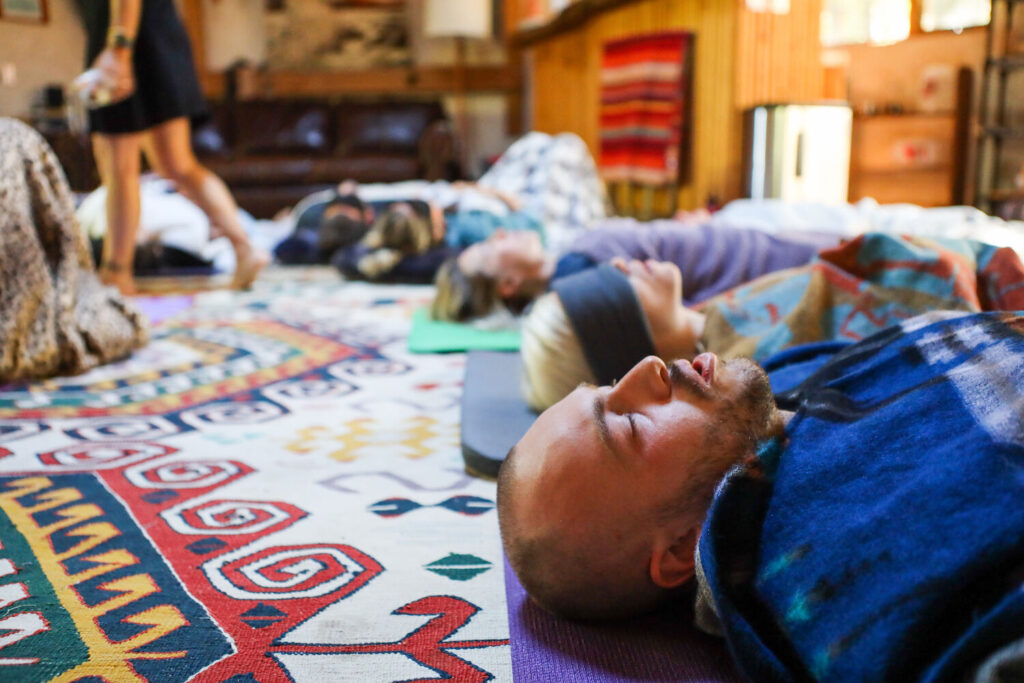
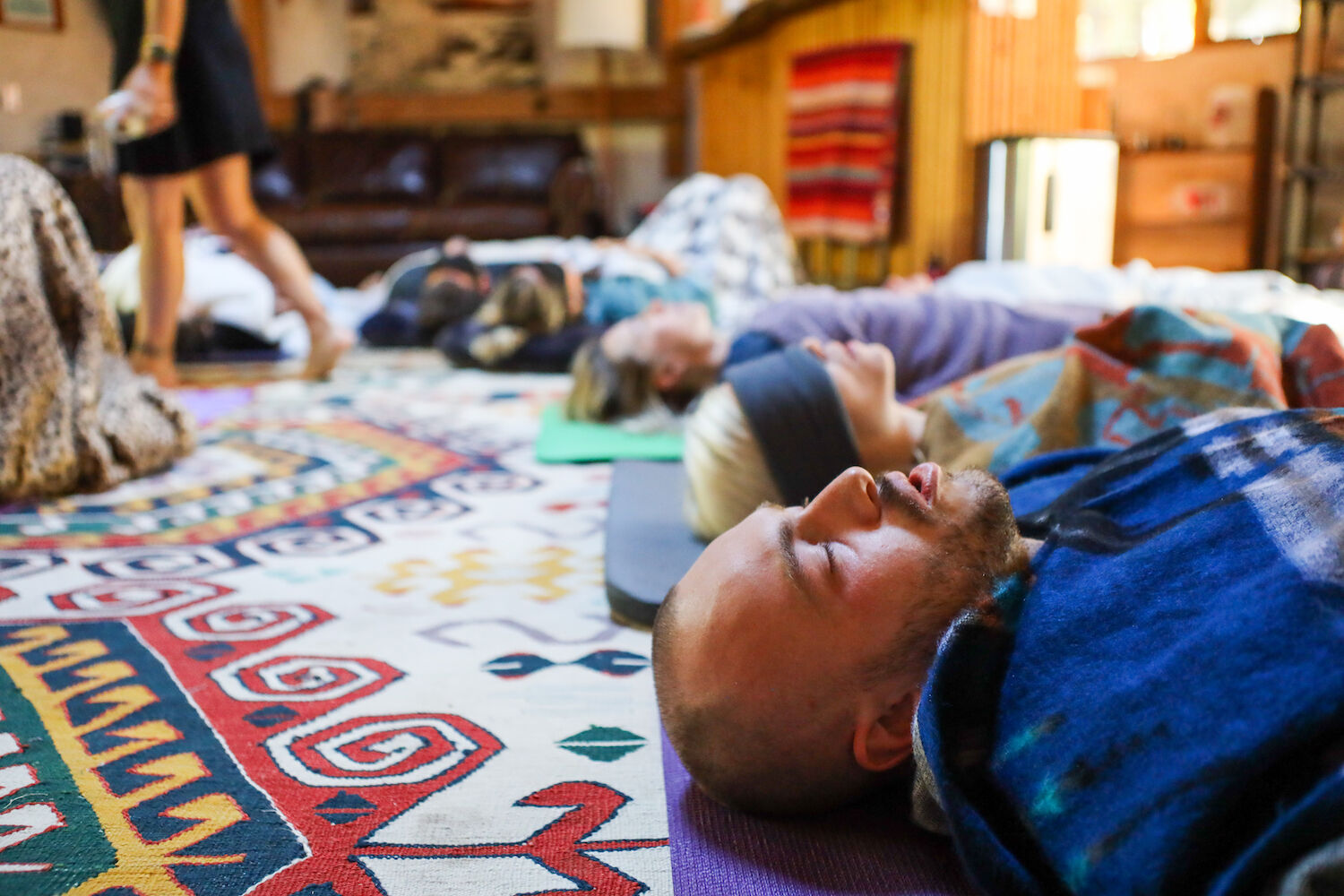
There’s breathing to get through your day, and then there’s breathing to leave your day entirely. At Holotropic Breathwork San Diego, practitioners go through three hour sessions using breathing techniques to enter an altered state of consciousness.

The goal is to get the emotional release or therapeutic benefits some people associate with psychedelic drugs, but without the actual ingesting drugs part, says Lori Camp, a facilitator who’s been practicing the technique for more than 17 years.

“When you’re in the height of feeling your emotions, you’ll become aware of certain feelings that are stuck,” she says. “And when you become aware of them, you can process them by breathing through them.”

Her work is based on the theories of Dr. Stan Grof, a Czech psychiatrist who studied the effects of LSD on the psyche and developed a process to achieve similar results without taking hallucinogens. For the first hour, practitioners do very fast breathing—not quite hyperventilating, but nearly—while listening to very intense music. “Like African tribal drumming,” Camp says.
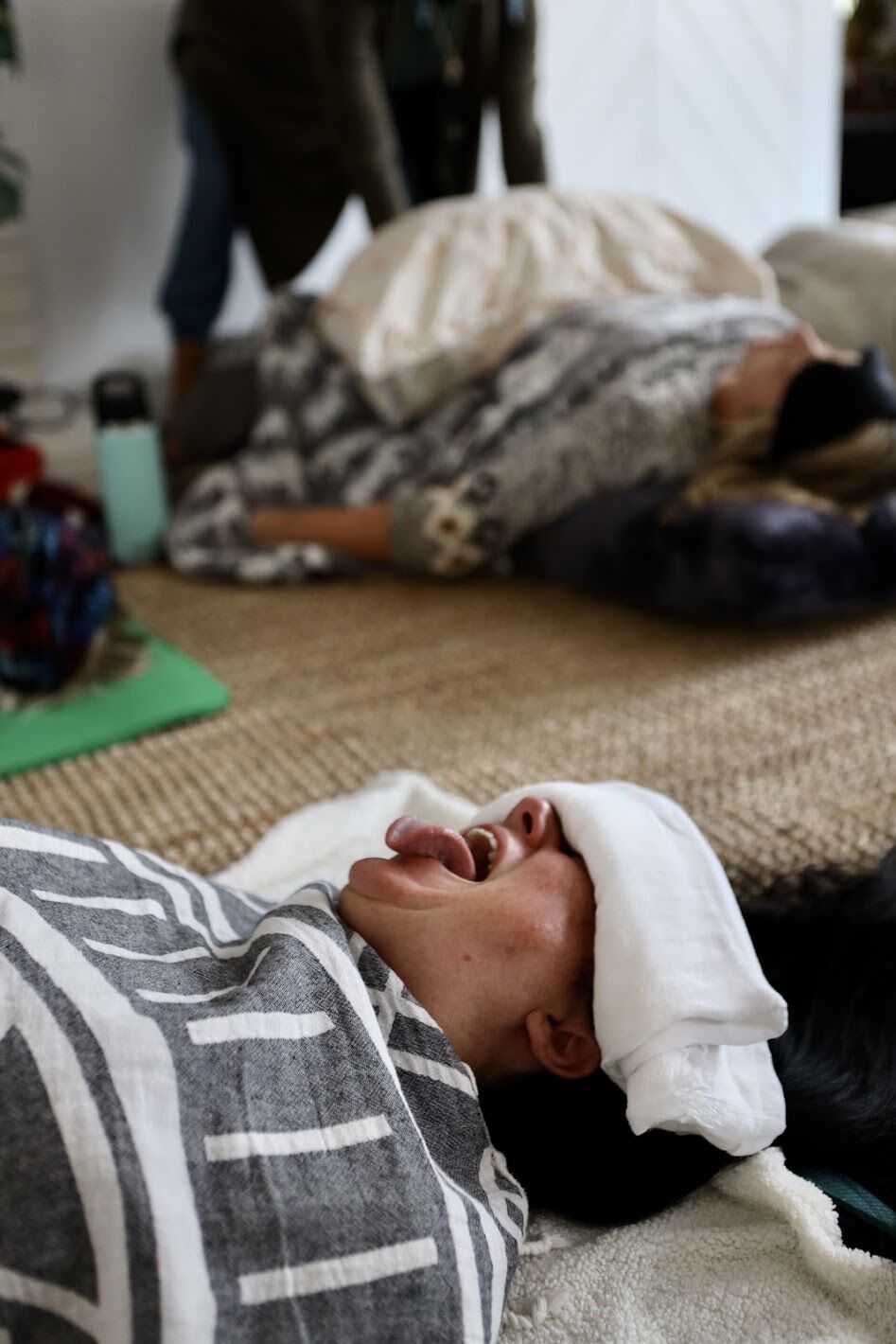
Holotropic Breathwork, cow tongue

Holotropic Breathwork, cow tongue

Leah Lipson

The second hour is emotional music. At this point, breathing slows and “the music is guiding you on the journey to a place where you’re at the height of feeling your emotions,” she says.

The third hour is calming music where you come back to your current reality and make an art mandala (an object of meditation). The intent of the mandala is to remind you of what you worked through and help you integrate back into your waking life.

The practice is like taking a deep breath but to an extreme level. Facilitators like Camp guide participants, teaching them to use breathing to navigate emotional traumas that might have left a small anchor in their bodies, causing them pain. Holotropic Breathwork allows participants to work through those negative moments.
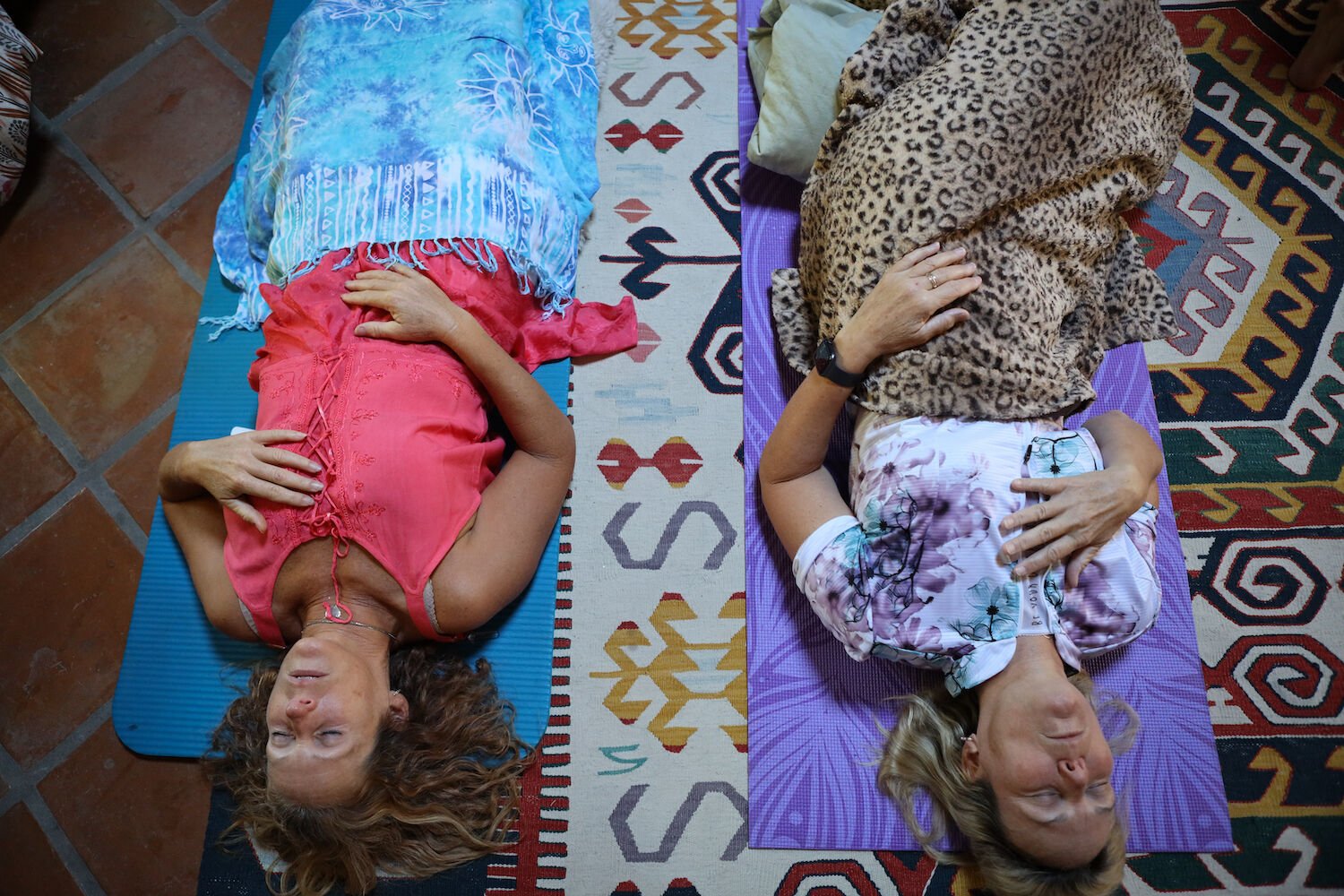
Holotropic Breathwork, mats

Holotropic Breathwork, mats

Leah Lipson

“Sometimes, someone’s doing their breath work and, all of a sudden, they freeze up and stop breathing because there’s some kind of emotional block that’s been anchored in their body somewhere,” Camp says. “So, if they make a conscious effort with the guidance of the person who’s sitting with them—the encouragement is to keep breathing, keep breathing, and then you breathe through that. You might cry, or some people might even scream. But it’s part of the process of letting go of that particular anchored emotion.”

Camp offers five- to six-hour private sessions, or larger group sessions. She says people who have been through sessions claim it’s helped them with developing healthier habits, weight loss, or working on a challenging relationship.

“I have a soundproof room built in my living room because if somebody starts screaming, I want to be ready,” Camp says, who offers sessions in her home. “Plus, the music is rather loud because you don’t want to get distracted by the ambulances or the jackhammer or the birds.”

Claire Trageser has been writing for San Diego Magazine for 10 years. She also is a reporter at KPBS and writes for The New York Times, National Geographic, Marie Claire, Elle and Runner's World.

Subscribe to our newsletters

Select Options

By subscribing you confirm that you agree with our Terms and Conditions and Privacy Policy.

Everything SD JULY 31, 2026

The Best of San Diego 2026: Health & Outdoors

From getting your sweat on at hip-hop class to celebrating with a zero-proof cocktail, here are San Diego's top fitness and wellness spots

The Best of San Diego 2026: Health & Outdoors
Photo Credit: Brett Butterstein

Best We Named It What for Why Oh Dear

Cush-pii

For thousands of years, the Kumeyaay who lived in this area called a mountain south of Julian Cush-pii, meaning “sharp peak.” Then, after the Civil War, Confederate sympathizers saw that same mountain and decided to rename it Stonewall Peak—after General Stonewall Jackson. The name stuck for nearly a century and a half, until Cuyamaca Rancho State Park announced earlier this year that the name will return to its original, Cush-pii. Hike to the summit for expansive views of the Coronado Islands to the west and Mexico to the south.

Courtesy of Culture Shock San Diego

Best Pop and Lock Spot

Culture Shock

In 1993, Angie Bunch gathered a group of hip-hop dancers—called Culture Shock Dance Troupe—and gave them a space to practice and perform. As hip hop grew through the ’90s, so did Culture Shock. It has since become a nonprofit, a space for young and old, beginner and expert dancers. Culture Shock has also expanded to Los Angeles, Oakland, Las Vegas, Chicago, Atlanta, New York City, and Washington, D.C., as well as Ottawa and Toronto, Canada.

Best Way to Sweat on a Lava Lamp

Yoga Box

In 2019, Amanda Leach created the Yoga Box method, which takes high-energy flows and adds strength-building poses in heated, vibey, lava-lamp-lit studios. What started on Grand Avenue in Pacific Beach has spread to 15 locations across the county, with even more trickling into Denver, Chicago, and Brooklyn. The best part? Mindfulness newbies who can’t touch their toes and six-packed contortionists can hang in the same class. You can customize each session based on your ability and fitness level.

Courtesy of Fit Athletic Club

Best Leg Day Turned Social Hour

Fit Mission Beach

A gym taking over a historic beachfront pool sounds like the setup for a new season of Love Island, but Fit Mission Beach operating the nearly 100-year-old Plunge at Belmont Park is real. The independent fitness brand has spent the past several years building a loyal following through group fitness classes, community events, and a members’ social club overlooking the ocean. Upstairs, members can work remotely, meet friends, or hang out long after their workout ends. Between the Plunge, the coworking-style lounge, and a packed calendar of events, Fit has evolved into something bigger than a gym. It’s a clubhouse for San Diego’s fitness crowd.

Best Place to Learn What a Vagus Is

Breathe Degrees

The wellness world is finally transitioning away from HIIT workouts and cult-like spin classes, where your heart rate hits Zone 5 within minutes and stays there until cooldown. Good. At Breathe Degrees, wellness takes the form of zenned-out communal breathing sessions or vagus nerve–activating cold plunges. Breathwork is said to boost your mood in the short term and improve your heart health in the long term, and maybe that’s why everyone’s coming back for more. You can’t run into someone in Carlsbad who hasn’t dropped into at least one breathwork session, and now the studio has opened a second location in Liberty Station.

Photo Credit: Shot On Us

Best Pilates Studio for People With Tiny Roommates

Soul Pilates and Care

Pilates wasn’t just popular this year; it was practically a requirement for maintaining your San Diego residency. New studios seemed to appear weekly across San Diego, each promising stronger cores and better posture, but Soul Pilates and Care found a way to stand out by addressing a challenge many parents know well: finding time to exercise at all. Fitness doesn’t have to compete with parenting responsibilities. Parents can drop their kids off with trained caregivers while they head into reformer classes, eliminating one of the biggest barriers to working out. The studio has earned strong reviews for both its instruction and family-friendly approach.

Best Million-Dollar Massage

Spa at The Del

The Hotel del Coronado’s sweeping $550 million restoration touched nearly every corner of the historic resort, but one of the most anticipated unveilils was the debut of its redesigned spa. The oceanfront wellness destination now features 21 treatment rooms, a relaxation lounge, a sauna, steam room, and a treatment menu inspired by the coastal environment just steps away. The redesign blends the Del’s Victorian legacy with a cleaner, more contemporary aesthetic, creating a space that feels distinctly SoCal rather than generic luxury hotel. For locals who don’t have time for a vacation, it’s the next best thing.

Best Cheers Without Beers

Good News Bar

As non-alcoholic beverages continue their meteoric rise, Good News Bar has become one of San Diego’s most compelling arguments for a booze-free evening. The University Heights hotspot serves a menu of carefully crafted zero-proof cocktails that borrow techniques and ingredients from traditional cocktail programs (it’s not just fancy juices and soda water), minus the hangover. The space also hosts regular community events and has quickly become a gathering place for everyone from sober San Diegans to the merely sober-curious. In a nightlife industry built around alcohol sales, Good News proved there’s plenty of demand for connection without the buzz.

Everything SD NOVEMBER 11, 2025

San Diego Doctors Share Their Best Advice on Women’s Hormone Health

OB-GYNs Dr. Meredith McMullen and Dr. Ashlee Schlesier and hormone coach Bridget Walton weigh in on how to support healthy hormones

San Diego Doctors Share Their Best Advice on Women’s Hormone Health
Collage by Casiel Sanchez

Everybody’s talking about hormones. Celebrities like Michelle Obama, Sex and the City’s Kim Cattrall, Oprah Winfrey, and the irrepressible Gwyneth Paltrow are waxing poetic on menopause, and, according to industry publication BeautyMatter, the market for products related to that particular life stage will hit $24.4 billion by 2030. There are more than 225,000 TikTok posts under the hashtag #hormonehealth, many of them focusing on “balancing” out-of-whack levels of estrogen, progesterone, testosterone, and more. Those often-mysterious little chemical messengers are having a moment.

According to Dr. Ashlee Schelsier, a Sharp Community Medical Group board-certified OB-GYN, “hormonal imbalance” isn’t a clinical diagnosis in and of itself, since “our hormones as women vary hour to hour, day to day, and by what part of the cycle we’re in, so it is normal to have big fluctuations.”

However, she adds, “we do have clinical diagnoses that result in changes in our hormones that are a symptom of a disease.” And with age comes the palpable shifts of menopause.

San Diego doctor, hormone expert, and OBGYN  Dr. Ashlee Schlesier of Sharp Community Medical Group
 Dr. Ashlee Schlesier
Courtesy of West Coast OBGYN

The associated symptoms—annoying at best and debilitating at worst—frequently leave ovary-havers scrambling for solutions, from medications and supplements to foods said to help our hormones achieve equilibrium. “It’s really important to partner with a medical team and a physician that is willing to sit and listen and understand your experience,” says Dr. Meredith McMullen, a San Diego OB-GYN with Kaiser Permanente. “In the past, there has been a tendency to underplay or dismiss these symptoms, both on the patient and provider side. But you don’t have to suffer in silence.”

The first step is working to understand exactly what’s going on. Per the World Health Organization, polycystic ovary syndrome, or PCOS, affects approximately six to 13 percent of reproductive-aged women globally. Doctors typically diagnose PCOS if you have some combination of irregular or absent periods; the titular cysts on your ovaries; and signs of elevated androgenic hormones like testosterone, including acne and excessive hair growth. People with the condition might also experience insulin resistance, chronic inflammation, issues regulating cholesterol, and even depression and anxiety.

“The syndrome itself actually runs with things like Type 2 diabetes … and obesity,” McMullen explains. “That’s why we call it a syndrome, because we see the effects across multiple body systems. This disorder is really specific to women who are still menstruating.”

San Diego doctor, hormone expert, and OBGYN  Dr. Meredith McMullen of Kaiser Permanente
Courtesy of Dr. Meredith McMullen

Others experience the lesser-known premenstrual dysphoric disorder (PMDD), “defined as recurrent, severe, and distressing symptoms that occur during the luteal phase, which is the week or two before menstruation, and significantly improve within a few days after the onset of menstruation,” McMullen says. Symptoms include anxiety, depression, headaches, and severe fatigue, all more extreme than your garden-variety PMS.

Perimenopause (the period of transition just before your cycle stops permanently) and menopause (which you’ll have officially reached once you’ve gone 12 months without a period) are different—they’re normal, age-related stages, but they can come with uncomfortable symptoms and side effects. “What menopause really signifies is the end of the ovaries producing consistent levels of estrogen and progesterone,” McMullen adds. “But instead of the ovaries stopping like a light switch, what we see is that the light switch ‘flickers.’ It’s that flickering time frame that corresponds to the perimenopausal phase where you’re getting irregular secretion of estrogen from the ovaries. That’s why you see these perimenopausal symptoms”— things like night sweats, hot flashes, fatigue, weight gain, even joint pain—“start to become more prevalent.”

A continuous glucose monitor from San Diego company Dexcom featuring their new product Stelo

But because the symptoms people experience can be so diverse and far-reaching, it can be difficult to tell whether what you’re dealing with is truly a hormone issue. For example, “there are a lot of things that mimic PCOS, like androgen disorders [or] thyroid disease,” Schlesier explains. Clinicians use tools like physical exams, patient history, blood tests, and ultrasounds to diagnose conditions such as PCOS and PMDD.

While many hormonal diseases are not curable, there are plenty of routes to treat them. “There’s a supplement that is helpful with PCOS called inositol,” Schlesier says. “The main treatment for PCOS is going to be an oral contraceptive pill. It increases something called your sex hormone–binding globulin, which binds up those excess androgens. It also regulates your cycle. It is important to have four cycles a year … to protect your uterus against potential pre-cancer and cancer.”

Amelia Rodriguez is a writer and journalist and winner of the San Diego Press Club's 2023 Rising Star Award and 2024 Best of Show Award, she’s also covered music, food, arts and culture, fashion, and design for Rolling Stone, Palm Springs Life, and other national and regional publications. After work, you can find her hunting down San Diego’s best pastries and maintaining her five-year Duolingo streak.

Everything SD SEPTEMBER 4, 2025

Can BrainEcho Technology Help Treat Insomnia?

Hoping to catch some Zs after two decades of sleep troubles, editor Nicolle Monico tries listening to the sounds in her own head

Can BrainEcho Technology Help Treat Insomnia?
Collage by Casiel Sanchez

As I walk into Cereset in Encinitas, I wonder if tonight will finally be the night I get the kind of sleep I remember from my childhood: fully knocked out, vivid dreams, pillow lines on my face. As I get situated in a La-Z-Boy chair, head tech coach Madolyn Dolce places electroencephalogram (EEG) sensors around the crown of my head and on my ear lobes to track my brain’s at-rest activity. I sit with my eyes closed in a dark room for several minutes at a time as headphones relay a symphony of the sounds firing off in my skull.

“Those sensors read a signal, and then the technology translates them into musical tones that you listen to in your ear buds. You’re basically hearing your brain back to you,” Dolce says. “It’s completely non-invasive.”

It had been nearly five years since I had slept without any type of assistance. I’ve struggled with irregular sleep patterns and insomnia for almost two decades, and, eventually, shuteye was only possible if I took prescription sleep aids or 12.5 milligrams worth of cannabis gummies. Without them, I was sleeping about two to three hours non-consecutively.

At the start of this year, I learned about Cereset, a wellness company that claims to use sound to help the brain relax and rebalance, ultimately promoting restorative sleep. Founded in Arizona in 2000 by Lee Gerdes, it’s reportedly aided more than 150,000 people with its BrainEcho technology.

Today, it has over 60 franchise locations in the United States and abroad, including San Diego County. According to the company, Cereset’s neurotechnology employs sensors to observe brain activity and then assigns an auditory tone to dominant brain frequencies. The idea is to hold up an “acoustic mirror” to your brain to help it find balance. While these sounds are incoherent to the human ear, the brain understands them, then self-corrects, Cereset argues.

Since the late 19th and early 20th centuries, research has shown that changes in brain wave patterns can indicate various mental health conditions. Recent studies in journals such as NeuroImage, Basic and Clinical Neuroscience, and Frontiers in Human Neuroscience have also looked at the brain’s ability to self-regulate and correct itself by monitoring its own electrical activity, especially through the use of EEGs. Some research argues that the use of feedback mechanisms (like sound mirroring) can potentially help alleviate symptoms of certain disorders. Though the data is not significant, I’m still hopeful. I’d try almost anything for a full night’s sleep.

Some doctors see promise in this alternative therapy’s potential to enact lasting change. “It’s totally legitimate to take brain activity and reflect it back to kind of help affect the behavior or the function of your brain. We’ve known about it ever since [Russian physiologist Ivan] Pavlov,” says Scripps neurologist Dr. James Grisolia.

He reminds me of Pavlov’s work focusing on classical conditioning. You know the one—dogs, a bell, kibble. His goal was to elicit a learned response, and soon, his dogs began to salivate any time a bell rang, knowing that their food would soon appear.

“You’re conditioning a response. Biofeedback, [what Cereset is doing with its program], is like that, too,” Grisolia says. Enough researchers are curious enough about the power of biofeedback that the technique became its own field of study in the 1960s.

“These types of mechanisms absolutely can work,” Grisolia adds. “[But they aren’t] used very much by regular MDs because, ordinarily, insurance doesn’t really cover them.”

For neuropsychologist Dr. Marian Rissenberg, though, the research isn’t sufficient. “The process and the rationale for [Cereset’s program] did not really make sense to me from a neurological perspective,” Rissenberg says. “[Cereset’s studies] showed a lack of significant effectiveness.”

San Diego custom probiotics company Floré featuring their gut health supplements

While Rissenberg can’t back Cereset’s methods, she’s quick to add that she believes in individuals pursuing all avenues to cure their chronic illnesses and physical or mental health conditions.

“If there is no risk to the treatment and … there are no negative psychological or physiological side effects, then I think that there’s nothing wrong with trying something when you’ve run out of options,” she says. “We know that there is a placebo effect and that it does work. Belief seems to play a part in the healing of our immune system.”

After my own research and a quick phone call with Cereset Encinitas’ co-owner Jason Prall, I found myself in an office park listening to the melodies in my head.

Before the first session, Prall asked that I go three weeks without any sleep aids, so I had to say goodbye to my security blankets. It was tough, but I stepped into that initial appointment free of sleep meds for the first time in years.

Nicolle Monico is an award-winning writer and the director of creative projects, digital editor for San Diego Magazine with more than 19 years of experience in media including Outside Run, JustLuxe and The San Francisco Chronicle.

Studio S AUGUST 10, 2026

The Secret to a Home That Feels Just Right

Behind every beautiful space is a thoughtful process, and ASID San Diego is helping homeowners understand the value of professional design.

The Secret to a Home That Feels Just Right
Courtesy of ASID

A perfectly designed home rarely happens by accident. Those kitchens that feel effortless and rooms that seem to tell a story the second you walk in? They’re usually the work of someone who knows exactly what they’re doing.

It’s knowing which ideas will actually work, which materials will hold up over time, and how to turn a collection of choices into a space that feels intentional. That’s where a professional interior designer comes in.

For the American Society of Interior Designers (ASID) California San Diego Chapter, the goal is to help people see interior design as more than just the finished look. Behind every well-designed space is a process built on technical expertise. Designers are educated in everything from professional software and construction details to building codes, space planning, materials, and functionality.

Courtesy of ASID

“People don’t always realize how much goes on behind the scenes,” Kirsten Recce , current president of the ASID California San Diego Chapter, says. “Our designers are not just doing furniture placement and color selection and picking out new fluffy pillows. That’s not what they’re trained for.”

ASID members bring formal education, continued learning, and industry knowledge to their projects, helping create spaces that are not only beautiful, but designed to work. A paint color that changes completely depending on the lighting. A material that looks beautiful in a showroom but doesn’t make sense for everyday life. A layout that photographs well but doesn’t function for the people living there. These are the details where professional guidance can make all the difference.

Still, one of the biggest misconceptions about hiring an interior designer is that it’s reserved for massive renovations, luxury homes, or people who already know exactly what they want. The process can feel intimidating. Where do you begin? Is a designer worth the investment? What if you only need help with one room?

ASID’s answer: start with one hour.

ASID’s Spruce Up events break down one of the biggest barriers between homeowners and professional design: knowing where to begin. Held twice a year, the community program gives homeowners the chance to work directly with an ASID designer through a one-hour, $125 consultation in their own home. Whether you’re looking for advice on furniture placement, window treatments, kitchen and bath updates, remodeling ideas, vacation rentals, color selections or something else entirely, the upcoming September 2026 event offers an approachable way to get expert guidance before committing to a full project. Signups are open through Sept. 7, with consultations taking place Sept. 21 through Oct. 31. Proceeds benefit ASID San Diego’s educational and community programs. Register here!

Courtesy of ASID

“It’s a great opportunity for people who are in that exploratory phase,” Recce says. “Maybe they’re not sure they want to hire an interior designer yet, or they think it sounds daunting or expensive. This gives them a chance to discover what working with a designer is actually like.”

Design is personal. A good designer isn’t just creating a beautiful room; they’re helping create a space that fits the way someone lives.

“We’re a resource to all of San Diego County,” Recce says. “It doesn’t cost anything to pick up the phone and call and ask. We’ll answer.”

Follow ASID San Diego on Instagram, LinkedIn, and Facebook for updates on upcoming events, or connect with the chapter directly at [email protected] or 619-548-8847.

Partner Content
Everything SD AUGUST 15, 2025

At Women-Focused RAGEher, Anger Is What It’s All About

The pop-up experience was founded as a way to help people express what can be an intimidating emotion in a healthy, collective way

At Women-Focused RAGEher, Anger Is What It’s All About
Photo Credit: Amy Boyle

I’m on all fours in a dark room, throat tight, body heaving, panting like an animal. My hair sticks to my sweat-soaked face, covering my eyes. All around me, like a scene from some ancient pagan ritual, women howl, curse, bawl, their bodies shaking in feral agitation. This is RAGEher, and we’re only halfway through the evening.

RAGEher is the brainchild of Kristina “Krissie” McMenamin, whose background in transformational leadership and somatic experiential coaching led her to navigate her own relationship with anger. She found few resources, especially for women to explore their rage, so she started hosting women-focused pop-up experiences as a way to help people express what can be an intimidating emotion in a healthy, collective way and channel it into joy, community, and relief. The event is modeled after a wild “girls’ night out”—the word “rager” is the loose basis for RAGEher.

People seeking spaces to vent anger seems to be an ever-increasing phenomenon. “Rage rooms” where participants can safely smash plates or old electronics with shameless abandon are a growing trend. And advertisements for men’s retreats in the woods—part fight club, part campfire Kumbaya— populate many an algorithm.

Monima Wellness Center in San Diego offering mental health services and recovery

Are we becoming an angrier society? Or is anger a healthy emotion we’re finally learning how to confront and integrate into our daily lives? A combination of both? Recent personal experiences and the constant churn of the global news cycle left me grappling with how to handle anger in my own life with few tools in my toolbox, particularly since, as a woman, I grew up being taught not to express it publicly. RAGEher looked like a beacon to explore this forbidden flame.

Tonight’s session takes place at Gold Meditation and Wellness Center in Encinitas. The evening is divided into three stages. Part one is dubbed “Tempest Tavern.” It’s the nervous “entering the bar” stage of not knowing who might be there or how the night might progress. When I arrive, I’m asked to leave my given name at the door and choose a “rageling” name, a moniker intended to help me embody the spirit of my anger or the state I’m trying to manifest through this experience.

Encinitas-based RAGEher therapy class program utilizing elements of rage rooms into anger management and therapy
Courtesy of RAGEher
Rage doulas teach participants how to scream from their bellies—or offer full body embraces to those in need.

The names other participants choose are telling and honest—some political; some visceral, alluding to flesh and bone, female anatomy, or totems of personal strength. I am first in line, panic, and choose something bird of prey–related. Next, I’m invited to write the first word that comes to mind when I think of anger on a large easel-bound white board. The board quickly fills up, words like “hurt,” “fear,” “power,” “release,” “violence,” “f**k” (multiple times), and “destruction” scrawled in red.

I’m drawn from the main reception area at Gold down several steps into the meditation room. It’s a dark bunker of a space, sparse except for the expected mats, pillows, yoga bolsters, and… rubber baseball bats? I take note of them and find a place on the floor. I’m handed two questions on strips of paper, and, soon, I’m surrounded by fellow ragelings, maybe 20 in all. We break into small groups and awkwardly introduce ourselves, diving straight into questions we may have never been asked: “What are you allowed to be angry about? In what situations or with what people do you stop yourself from showing anger?”

Many of the participants have come to tonight’s session with a sense that their anger is unwelcome within their family networks, that they have taken up people-pleasing as a means of self-protection. One rageling says she has made herself small or silent to avoid disrupting the status-quo. Another confesses that her willingness to express anger has damaged her relationships—it’s seen as “too much” in her community.

New luxury San Diego wellness club and medical spa LIVV Cardiff featuring founder Jason Phan

I hear of childhood trauma, abusive partnerships, the feeling of powerlessness over climate change or the war in Gaza. I feel pain, heaviness, resentment, and regret in their stories. But I also see a hopefulness, the desire to grow and explore, a deep need to connect with other women, the longing for space to feel held and accepted. I realize how much we seem to have in common despite our range of ages and backgrounds, and my initial nervousness fades.

Everything SD JULY 30, 2025

The Best of San Diego 2025: Health & Outdoors

From infrared Pilates to canyon spas and booze-fueled pickleball, here’s where San Diego does fitness and wellness best

The Best of San Diego 2025: Health & Outdoors
Courtesy of FIT Athletic

Best Place for Athletes to Go Clubbing

Club House Encinitas

Need to baby your muscles after a marathon or sweat out the bad decisions you’ve made in the last decade? Club House is your spot. A 50-minute session at this wellness destination in Encinitas gets you access to tools like red light therapy, compression technology, vibration plates, an infrared sauna, and cold plunges (for the really hardcore types unafraid of freezing). The space also offers rotating workout classes from Pilates to HIIT, plus a lounge to continue your recovery with tequila and shopping.

Interior of the renovated Fairmont Grand Del Mar Spa in San Diego

Best Jet-Fueled Spa Treatment

The Fairmont Spa

Fairmont Grand Del Mar’s spa has been refreshed with cutting-edge wellness technology and a design inspired by the natural beauty of Los Peñasquitos Canyon Preserve. The result is a space that feels both luxurious and grounding. It’s the only spa currently offering the Zestós Dryfloat Therapy experience—a weightless, warm-water treatment that combines vibroacoustic sound (Google it) with jet-powered massage.

San Diego spa wellness treatments featuring Omni La Costa Resort & Spa in Carlsbad

Best Power Move in Pediatrics

Rady Children’s Hospital & Children’s Health of Orange County Merger

California’s attorney general just gave the green light to a historic merger between Rady Children’s Hospital and Children’s Health of Orange County. The two pediatric giants will unite under one nonprofit health system, making it the largest children’s care network on the West Coast. For San Diego, it’s a huge medical and financial milestone, expanding access to specialized care and resources for families across Southern California. The deal positions San Diego as a national leader in pediatric innovation and collaboration.

Best of San Diego 2025 Health & Outdoors featuring an exercise class at Saltvault gym
Courtesy of Saltvault

Best Way to Microwave Your Muscles

Saltvault

Saltvault’s name merely sounds like a fun rhyme until you find yourself sweating bullets in the confines of a massive, low-lit sauna-slash-studio, bridge-lifting like your life depends on it. Betsy Blumenfeld founded San Diego’s only infrared mat Pilates studio in 2019, and it has since expanded to four locations across the county. Soundtracked by clubby beats, the fast-paced classes are punishingly hot, supremely challenging, and, yes, strangely addictive.

Best Chance to Spot an Orange-Crowned Warbler

Mission Trails Regional Park

Many San Diegans regularly hit Mission Trails Regional Park for a heart-pumping hike. But few know that volunteers offer weekly free guided walks, each highlighting a different educational aspect of the 8,000-acre space. Learn to differentiate between avian calls on a guided bird walk, or see what critters creep out as night falls on a twilight stroll. All ages are welcome, and binoculars are always encouraged.

Best of San Diego 2025 Health & Outdoors featuring interior of Happy Does Bar in the Gaslamp Quarter
Courtesy of Happy Does Bar

Best Excuse to Dink With a Drink

Happy Does Bar

Yes, there’s really a pickleball court inside a bar. But downtown’s Happy Does Bar is less country club, more backyard party with paddles. With outdoor games, karaoke, and casual American bites, somehow, it’s pulled off the impossible: making working out actually fun. Whether you’re rallying on the court or holding a drink and yelling, “Good volley,” it’s the most fun you’ll have burning off questionable calories. Say hello to cardio with cocktails.

Best Incoming Biotech Boom

Novartis

Swiss pharmaceutical giant Novartis recently unveiled plans for a $1.1 billion expansion in Carlsbad, marking its second major research facility in the US. The project is part of a broader five-year strategy to grow its American footprint—and it’s a big win for San Diego. Anticipated to open in 2028 or 2029, the cutting-edge campus is expected to create around 4,000 new jobs and further cement the region’s reputation as a global hub for biomedical research and innovation.

Best Way to Support a Friend in Need

Solace

Solace founders Ashlee Davis, midwife Allison Tartari, and holistic nutritionist Torie Borrelli Hall drew upon their own experiences with pregnancy loss and fertility struggles to curate their company’s namesake Solace Box, a kind, thoughtful gift for a friend or family member who has recently undergone a miscarriage. It contains 12 comforting, organic products, including soothing herbal teas and tinctures, a cotton cold or heat pack, and belly-cradling underwear.

Best of San Diego 2025 Health & Outdoors featuring pole dancing classes at SVX San Diego
Courtesy of SVX

Best Reason to Trade Grip Socks for Platform Heels

Maybe it’s because Anora—Sean Baker’s 2024 film about a stripper—won five Oscars. Maybe it’s the fact that Pilates’ popularity has made scoring a reformer reservation a sport in itself. Whatever is driving people to pole, the sultry style of dance has gone mainstream, drawing bachelorette parties and fitness buffs alike. Here are four San Diego spots where you can give it a try.

The Dollhouse Fitness

With locations in Encinitas and Oceanside, this pole-only studio has been teaching women how to spin, split, and more since 2009.

Pole Buzz at Queen Bee’s

Queen Bee’s Art and Cultural Center in North Park hosts gender-inclusive group and private classes every day except Sunday.

AK Pole Studio

Founded by a ballerina-turned-pole-dancer, this beginner-friendly Pacific Beach studio also offers classes with aerial hoops and chains and “flying poles,” which are attached to the ceiling only.

Vertica Fitness

Your initial class is free at this nationwide franchise with a location in Grantville. Vertica prides itself upon providing options for all bodies and ability levels.

Partner Content OCTOBER 2, 2025

Pioneers in Shoulder Care

Scripps leads the way in advanced orthopedic treatment and technology

Pioneers in Shoulder Care

In 2004, Scripps orthopedic surgeons made history when they implanted the world’s first electronic prosthetic knee, replacing a patient’s failing joint and subsequently collecting valuable data on how everyday activities impact the knee. Now, research at Scripps is applying the same approach to the shoulder. Scripps Clinic researchers have secured grant funding to develop a prototype of a rechargeable “smart shoulder”—a Wi-Fi- and sensor-equipped device that will track shoulder usage and provide new insight into the joint’s inner workings. Click here for more about the smart shoulder and other innovative research taking place at the Shiley Center for Orthopaedic Research and Education (SCORE) at Scripps Clinic.

For more nutrition, wellness, and healthy living tips, sign up for the San Diego Health
newsletter here.

Thousands of savvy locals already get it.

San Diego's best restaurants, experiences, and events—handpicked and delivered to your inbox weekly. You in?

Close the CTA

Contact Us

1230 Columbia Street, Suite 800,

San Diego, CA