


Food & Drink
Copper Cowboy Is Bringing Western Flair to the Gaslamp Quart...
Read article

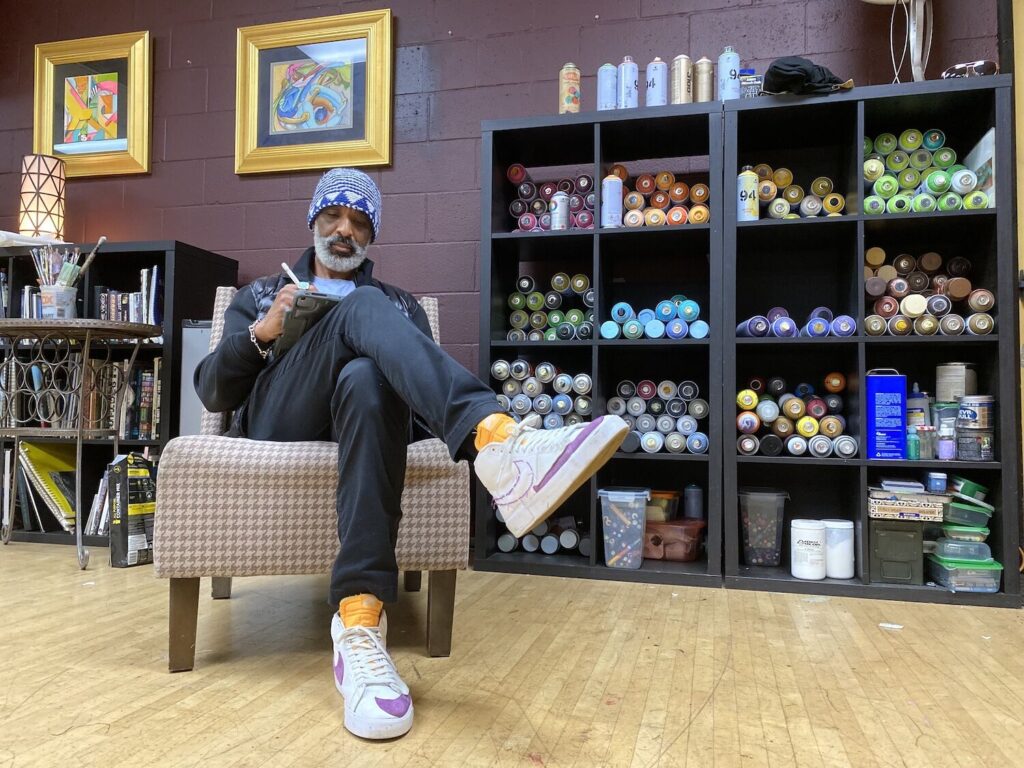
Inside muralist Maxx Moses’ studio, an old dance space in the Encanto neighborhood

maxx-moses-sdm-0223.jpg
Photo Credit: Mateo Hoke
Drawing on walls is human nature. The earliest known art dates back nearly 44,000 years—found scrawled in a cave in Indonesia. So today’s graffiti artists arguably continue a timeless tradition. Surely, if our cave-dwelling ancestors had had spray paint, they would have used it. Every color they could get.
“Art is energy,” Daniel Hopkins says. “I utilize my expression to add energy to a place.”
Hopkins, 60, has been bombing walls for more than 40 years. Growing up in Yonkers in the ’70s meant being surrounded by graffiti on New York subway cars. “Those cars were demolished inside,” he says. He was inspired. He took the name Pose2 and started writing graffiti.
“There’s this KRS-One lyric that goes, ‘[R]eal bad boys move in silence.’ We were bad boys. We moved in silence,” he says. These days, Pose2 is known as Maxx Moses. “Pose2 was the original graffiti name. Maxx Moses is the evolution of the artist,” he says.
We’re in his studio in the Encanto neighborhood, an old dance space complete with a full wall of mirrors and a cube shelf loaded with spray paint. In the closet, a bucket of 1,000 fine line caps for the paint cans. “A gift to myself,” he says. Sure, spray cans come with nozzles, but the pros use their own.
The studio is as much outside as it is inside. Big, ambitious art wraps around the building’s exterior, including Maxx Moses collaborations displaying his signature graffiti style—faces interwoven with thematic elements. His murals can be found all over the globe: Japan, Dubai, and here at home in Chicano Park as well as a 200-ft. mural at the Massachusetts Avenue Station in Lemon Grove.
In addition to painting, he hosts a graffiti class here for a dozen students from a nearby charter school. Teaching is another way of continuing the culture. “Self expression is the most important human thing there is,” he says. “Everyone wants to be seen and heard.”

Mateo Hoke is a journalist and author. His books include Six by Ten: Stories from Solitary, and Palestine Speaks: Narratives of Life Under Occupation.
