Featured articles
Food & Drink
Things to Do
Food & Drink
Featured articles
Everything SD
Things to Do
Everything SD
Featured articles
Things to Do
Things to Do
Things to Do
Featured articles
podcast-ep
video
podcast-ep
Featured articles
Everything SD
Everything SD
Everything SD
Featured articles
Partner content
Food & Drink
Everything SD
Ready to know more about San Diego?
SubscribeReady to know more about San Diego?
Bang Bang in downtown San Diego
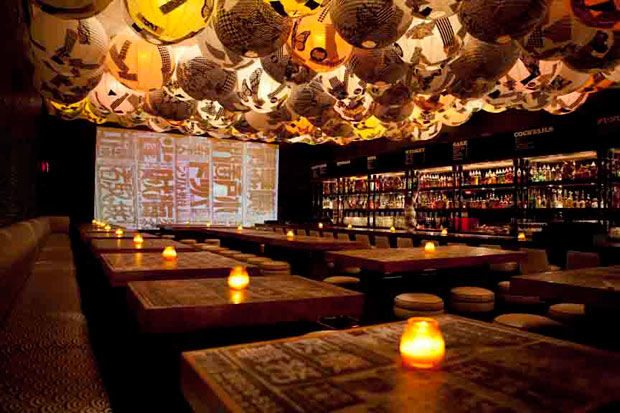
Its bathrooms are national news, thanks to photos of Ryan Gosling leering sadly, sexily all over a women’s stall. But Bang Bang is also a subway tunnel (the entryway stairs), a disco (largest ball on the West Coast, reportedly), a sushi joint (from a chef who worked under James Beard nominee Carl Schroeder), a cocktail haven (punch bowls of Moscow Mules), and Japanese lantern emporium (covering the entire ceiling). It’s the second collaboration between promoter Johnny Shockey and designer Mauricio Couturier (Super El Camino). Downtown club Voyeur was their first. This new spot is a total scene. The food? Respectable. The eye candy? Complimentary. 526 Market Street, downtown
Bang Bang
We speak with the city's top food and drink makers in this exclusive video series hosted by food critic and Food Network judge Troy Johnson
Welcome to SDM’s Guide to San Diego Food + Drink, our new video series dedicated to our favorite food and drink in the city. At the end of the summer, we’re bring many of these restaurants to the Del Mar Wine + Food Festival for a massive party. You should come. San Diego restaurants, local wineries, Food Network chefs… it’s our big dream for the city.
Check back each week to catch our newest video:
Troy Johnson is the magazine’s award-winning food writer and humorist, and a long-standing expert on Food Network. His work has been featured on NatGeo, Travel Channel, NPR, and in Food Matters, a textbook of the best American food writing.
Orexi set to debut inside of the Courtyard by Marriott San Diego Downtown Little Italy—taps local talent from Trust Restaurant Group, Rancho Valencia
This November, Little Italy is adding one more destination to my lodging-and-libations list when Orexi, a Mediterranean-California fusion restaurant, opens inside the Courtyard by Marriott San Diego Downtown Little Italy (formerly The Little Italy Hotel). The name comes from the Greek word for “appetite” or “desire” (I like that the two seem synonymous, but I digress), and the menu will blend coastal ingredients from both California and the Mediterranean via from-scratch seasonal plates and shareables.
Orexi will be open for breakfast and dinner, the former featuring the usual suspects—omelettes, pastries, and so on—but also shakshuk and an egg bowl that comes with a tahini vinaigrette. Dinner starts with dips like whipped feta and garlic hummus; small plates like beef kofte sliders with cumin spiced meatballs, tomato sauce, and feta; and burrata Mediterránea with heirloom cherry tomatoes, marinated artichoke hearts, Kalamata olives and roasted red peppers. Entrees run the gamut from fairly light (seared Pacific salmon) to hearty (grilled butcher’s steak), and I’ve really got my eye on the desserts. Olive oil and chocolate chip cookies or sweet honey donuts? Yes, please.
On the drinks side, expect local beer from breweries like Societe Brewing Co., AleSmith Brewing Co., and Harland Brewing Co., plus wine, mocktails, and cocktails like the Hotel California with Patron Silver tequila, Illegal mezcal, chile-infused Aperol, lime, pineapple, and Fever Tree club soda. Design-wise, Orexi leans fully toward San Diego’s sandy beaches and greenery. Premier Design + Build Group used neutral tones and natural textures inspired by both coasts and added lots of hanging plants, and the space seats 89 guests at a time.
Food and beverage director James Yata comes from both a hotel and local restaurant background as the former F&B manager at Rancho Valencia Resort & Spa and general manager for Trust Restaurant Group, and it runs in the family. “My dad was a chef, so I grew up knowing that nothing brings people together like a good meal,” he says. “That’s what got me into this industry… Little Italy has such an incredible food scene, and I feel really lucky to be joining it with a fresh concept that mixes Mediterranean flavors with coastal ingredients.”
Orexi opens at the Courtyard by Marriott San Diego Downtown Little Italy (1646 Front Street) late November. Daily hours run 6:30 a.m. to 10:30 a.m. for breakfast, and happy hour and dinner from 4 p.m. to 10 p.m.
Cayuse Vineyards’ head winemaker Christophe Baron made a name for himself by planting vineyards in a weird, stony plot of land in a little town called Walla Walla, Washington nearly 30 years ago. Today, it’s one of the United States’ top wine regions (largely thanks to Baron’s gamble) and now wine collectors can’t always get their hands on bottles of Cayuse Vineyards coveted wines. But you can for one night—Thursday, November 13, at Juniper & Ivy, during a four-course wine pairing guided by J&I’s sommelier Daniel Cools. Grab a ticket before they’re gone.
Listen Now: The Latest in San Diego’s Food and Drink Scene
Have breaking news, exciting scoops, or great stories about new San Diego restaurants or the city’s food scene? Send your pitches to [email protected].
Beth Demmon is an award-winning writer and podcaster whose work regularly appears in national outlets and San Diego Magazine. Her first book, The Beer Lover's Guide to Cider, is now available. Find out more on bethdemmon.com.
Food critic Troy Johnson shares his favorite spots for visitors and locals heading to the city center this July
Over 18 years of eating through the city as a food writer—a profession that feels like it needs an “ahem” attached to it—I’ve kept a list of the dishes and drinks and places that floored me. The ones I yammer on about to strangers, or share with people I love who don’t owe me money. For Comic-Con, I picked through that list to share 50 of my favorites within striking distance of the comic core: Gaslamp, Barrio Logan, Little Italy, Mission Hills, Coronado (one simple ferry ride away), Golden Hill, and a wild place in North Park. Remember, even if you just ate and you’re a little full, the week is about role playing. Role play still being hungry.
Here are the best restaurants, and what to order, near downtown San Diego.

Callie will bring home San Diego’s next Michelin star, or I will lose all faith in the system. The fermented and pickled carrots with dukkah. The Aleppo chicken. The everything. Chef Travis Swikard is on another level.
1195 Island Ave, East Village
This place is so charming it hurts. If an alpaca were a restaurant. Like you’re dining in an ADU built for someone who is loved. Wolf in the Woods is a passion project for Johnny Rivera (Hash House A Go Go) and chef Carmine Lopez, and you can feel that passion. It snuggles you with Spanish wine. The sweet corn and piñon soup might be the best bowl of hot liquid in the city.
1920 Fort Stockton Dr Suite C, Mission Hills

This is where you want to go for a Vietnamese-centric but pan-Asian exploration of fish sauce. Get the beef tartare, the whole fried rockfish in ginger sweet-and-sour sauce, and the congee with wild mushrooms.
2469 Broadway, Golden Hill
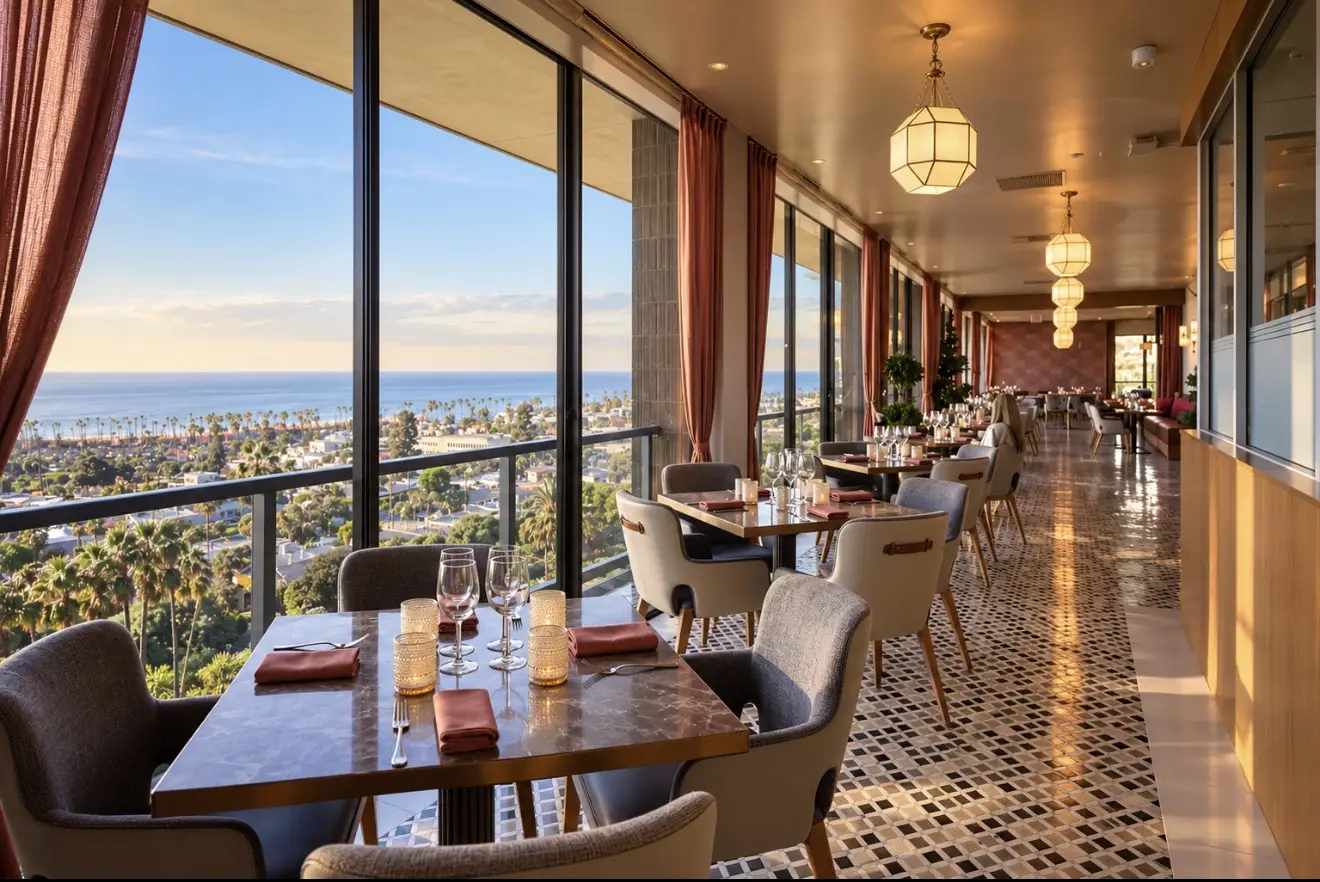
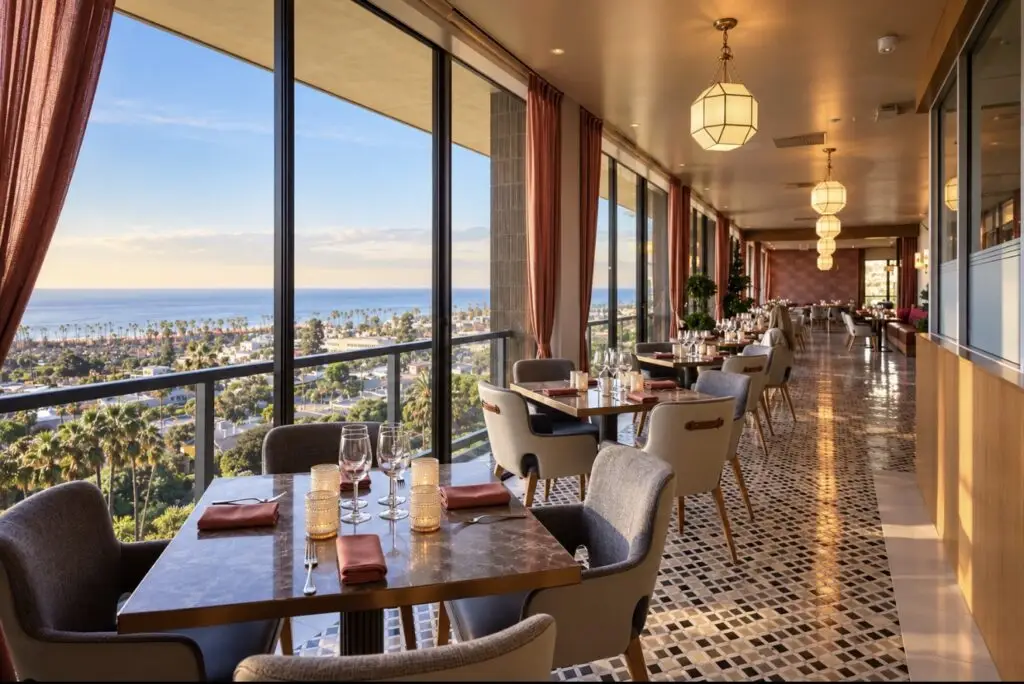
It’s the view from the top and edge of our world—a glass box of emotion, 40 floors up, looking down on all that water and sunset. Pick a cocktail, any cocktail.
1 Market Pl, Embarcadero

Mister A’s started as a Scorsese-type place where people enjoyed the fruits of some gray-area capitalism with a holy **** view of the entire urban core. Wave at planes as they land at eye-level and the sun sets over the watery cliff in the distance. Two years ago, longtime owner Bertrand Hug handed the reins to longtime GM (and damn good human) Ryan Thorsen. He’s breathed new life into the place with some key renovations. It’s a bucket worthy of the list. The duck with huckleberry gastrique is chef Stephane Voitzwinkler’s specialty.
2550 Fifth Ave 12th floor, Bankers Hill
An F.-Scott-Fitzgerald-meets-Busta-Rhymes steakhouse from the weirdos of CH Projects. A magic room that feels both alive and haunted. Bone marrow’s a pretty fantastic fat, but it needs flavor. B&R serves it with Burgundy escargot on toasted bread, and the garlic is fantastic.
1909 India St, Little Italy

A hell of a patio in Old Town, run by Pietro Busalacchi, one of the better drinks people in San Diego. The elote is fantastic—half a corn cob grilled; soaked in veggie broth; and seasoned with mayo, melted butter, chili powder, cumin, smoked paprika, a touch of sugar, garlic and onion powder, Cotija cheese, and chives. Every drink here is good.
2836 Juan St, Old Town
There are three main names when it comes to the best Japanese Wagyu. Most people who love the melting beef know two of them (Kobe and Matsusaka). The third type is omi gyu, the original Wagyu that was served to shoguns 400-plus years ago. Compared to the other two, it’s still got that high fat content that makes the Wagyu magic, but it’s lighter, more delicate, cleaner tasting. And Cowboy Star—the beloved local steakhouse run by chef/partner Victor Jimenez—is the only place I know of in San Diego that serves it. You’re not coming to Comic-Con looking for small experiences.
640 Tenth Ave, East Village

Yes, there are designer-ier tacos. But this family’s been serving homemade tacos with fried-before-your-eyes tortillas since the dawn of time. Cash only.
1857 Logan Ave, Barrio Logan
Troy Johnson is the magazine’s award-winning food writer and humorist, and a long-standing expert on Food Network. His work has been featured on NatGeo, Travel Channel, NPR, and in Food Matters, a textbook of the best American food writing.
This month, the 2026 San Diego Business Impact Awards recognized local businesses making an impact in clean energy, biotech, hospitality, and beyond
Renewable energy companies building hundreds of power plants. Biotech startups using artificial intelligence to create personalized medicine for children with rare diseases. Hospitality companies quietly powering thousands of local events. Consumer brands growing from beach-town startups into national businesses. These are the kinds of companies driving San Diego’s economy today, and the businesses recognized at this year’s San Diego Business Impact Awards offer a snapshot of where the region is headed.
Hosted July 23 by San Diego Regional Economic Development Corporation (EDC) and JPMorganChase, the second annual awards event honored four local companies for innovation, growth, and economic impact. More than 100 nominations from San Diego’s middle-market businesses were reviewed by a 10-person judging committee, with winners selected across four categories: startup, early-stage innovator, rising star, and established heavyweight.
Two-time honoree Jimbo Someck, founder of Jimbo’s organic grocery stores, also joined the event for a fireside chat on buying local, supporting emerging brands, and giving back to the community.
“San Diego’s strength comes from its makers and builders—the resilient people who endure great risks and overcome obstacles to build and scale a company,” says Aaron Ryan, San Diego Region Manager and Middle Market Banking at JPMorganChase & Co. “These awards aren’t just recognition; they spotlight the talent, grit, and innovation shaping our region’s future. By celebrating those who create and build, we foster connections and fuel the growth that keeps San Diego thriving.”

Heavyweight honoree SOLV Energy has grown alongside the country’s rapid investment in renewable power. “It’s an exciting time for SOLV Energy as we are experiencing significant growth,” says CEO George Hershman. “The business has doubled over the last year and has almost double-digit growth since its inception.”
The Rancho Bernardo-based company designs, builds, operates, and maintains utility-scale solar and energy storage facilities. Since its founding in 2008, SOLV Energy has built more than 500 power plants.
Growth has translated directly into hiring. About 200 employees work from the company’s local headquarters, including roughly 20 interns. “Our intern program is a big part of the way that we grow our workforce,” Hershman says. “Last year, 43 percent of our interns became full-time employees. We believe San Diego is a great community to build and grow a high-tech infrastructure and technology company because of the incredible workforce—the ability to attract top talent and draw from world-class universities.”

Startup honoree La Jolla Labs is tackling one of medicine’s biggest challenges by developing personalized RNA therapeutics for patients with rare diseases—many of them children with neurological disorders like ALS. Using proprietary artificial intelligence and machine learning tools, the biotech company develops treatments tailored to each patient’s specific genetic mutation.
CEO Tamar Grossman says the recognition reflects how far the company has come despite limited resources. “We’re honored to be recognized for our ability to change and save patients’ lives and turn our lean startup into a clinical company with very minimal resources,” she says.
Grossman credits San Diego’s concentration of research institutions—including UC San Diego, the Salk Institute, and Scripps Research—with creating a pipeline of talent and collaboration. “San Diego is one of the world-leading centers for technology, genomics, and RNA therapeutics,” she says. “We have over 30 RNA therapeutics companies here, and we support each other and help with anything related to drug discovery.”
She says that collaborative spirit extends beyond formal partnerships. “You can walk around Torrey Pines, go into a café, and find colleagues from the industry and have an ad hoc conversation,” Grossman says. “That’s something very unique to San Diego.”

While Snake Oil Venue Company may not be a household name, chances are many San Diegans have attended one of its events. The early-stage innovator honoree has expanded from beverage catering and mixology consulting into venue management, operating Julep Venue in Mission Hills, Bramble Bay Venue in Imperial Beach, Vesper Venue, the Chapel at Liberty Station, and five outdoor venues throughout Liberty Station—more than 500,000 square feet of event space altogether.
“We do a lot of launch parties for corporations and new products,” says CEO Mike Esposito. “I really like working on the entrepreneur side of things, where new businesses are entering the San Diego market and looking to make a splash.”
Snake Oil has executed more than 16,000 events, employed more than 1,000 people, and partnered with more than 900 local vendors, including caterers, florists, photographers, entertainers, and other hospitality businesses. The company also works with many of San Diego’s nonprofits, museums, and cultural institutions. “We get to celebrate people’s most important moments,” Esposito says. “Whether that’s a wedding, celebration of life, or quinceañera, we’re fortunate to be involved in the community in so many different ways.”

Rising star honoree ALOHA Collection is proof that a simple idea can grow into a thriving company. Founded by two roommates who wanted a better way to carry wet swimsuits after a day at the beach, the lifestyle brand has grown into a business while maintaining strong year-over-year growth.
Now headquartered in Carlsbad, ALOHA Collection employs more than 100 people and operates its California flagship store in Encinitas, which is slated for a remodel. With roots in Hawaii, the company is known for its lightweight, splash-proof travel bags that have become a familiar sight on beaches in San Diego and beyond.
“‘Aloha’ is part of our name, but it’s also how we move through the world,” says CEO Lynna Barnard. “It’s how we show up for people, the way we travel, the way we give back.” Since day one, the company has maintained a 5 percent giveback to Hawaii conservation efforts, contributing millions of dollars over the years.
“I think what’s so inspiring about ALOHA Collection, and the founders in particular, is when you dream big, those dreams can come true when you work hard and trust in the universe,” Barnard says. “It’s inspiring to be a role model for other people wanting to start businesses from humble beginnings. Start small and watch it grow.”
Together, businesses like these form a cornerstone of San Diego’s economy—not only through the jobs and revenue they generate—but through the local workers they hire, vendors they support, and investments they make in the region. Their growth doesn’t happen in isolation; it ripples outward, strengthening the broader business community and the people who call San Diego home.

The two brothers and their business partner, Darius Yasiejko, are now majority owners of the iconic Marina District bar and restaurant
Once upon a time (13 years ago, to be precise), a restaurant inspired by New York City’s world-class cocktail scene opened on a once-desolate corner of Kettner Boulevard. Sandwiched between the tourist-heavy Seaport Village, the Top Gun barbecue restaurant, and trolley tracks for the Green MTS line, the location made absolutely no sense.
And yet. Over the years, The Lion’s Share didn’t just survive. It reshaped San Diego’s drinking and dining culture in perpetuity, alongside other iconic industry bars like Starlite, Noble Experiment, and Turf Supper Club. It’s no exaggeration to say that if the brick-covered building had become a retail store, real estate office, or the most likely alternative, a dispensary, San Diego’s cocktail scene would look much different today.
Now, The Lion’s Share has a new future. Ultra-talented local industry vets and culinary innovators Danny and his brother Dante Romero (who also happens to be the restaurant’s executive chef), and their business partner Darius Yasiejko acquired the restaurant from operating partners Carlos Valente and Roy Ledo, effective July 2025.
Danny says a few changes are inevitable, but it’ll be more of an evolution than anything else.
“It would be unwise of us to make any major changes when it comes to what The Lion’s Share is,” the new owner explains. “We really want to keep what it is—it’s a local favorite.” General manager Joshua “JB” Becker and bar director John Gibian are both staying on (as well as the whole staff, Danny hopes).
It’s the first time the brothers have co-owned a brick-and-mortar together. Before Danny helped launch Service Animals, the hospitality group behind Ponyboy at the Pearl Hotel, with another industry superstar Ian Ward, both Ward and Danny worked at three Michelin–starred Addison by William Bradley (Danny as chef de partie, Ward as bar director).
In the past, the Romeros’ launched pop-up concepts like Tortoise and Two Ducks, the latter of which operated out of The Lion’s Share’s upstairs loft as a fine-dining tasting menu with a third partner, Darius Yasiejko. It was actually that search for a permanent home for Two Ducks earlier this year is what eventually led them to taking over The Lion’s Share.

“We were just kind of shopping locations, trying to see what we were going to do next with our pop up, and in that process, Roy from The Lion’s Share reached out to us and said, ‘Why don’t you guys just buy this?’” Danny explains. “We were like, ‘Okay, yeah!’ It’s kind of switching gears for us, but it’s a good thing—this is exactly the space we want to be in eventually, so it just felt natural.”
One future change Danny does hope to eventually implement is transforming that loft space into a permanent home for Two Ducks. (There’s no timeframe for that—just a dream.) During the initial transition, Two Ducks’ pop-up series will be on a temporary hiatus as they get their ducks in a row (c’mon, that pun is unavoidable!), but the game-heavy, cocktail-driven bar and dining room menus will remain generally intact, still largely catering to San Diego’s industry crowd and locals. Over the next six months, Service Animals will work with the restaurant’s current management company The Sporting Fraternity before taking over operations.
PARTNER CONTENT
Danny knows taking over a legacy project like this can spark big feelings. But he’s confident this new beginning will be a happily ever after. “That’s a big thing that we want to make sure that we don’t lose out on—the neighborhood,” he promises. “One of the things we learned from Addison is when something’s right and when something’s wrong. And I think that the bulk of what’s going on here at The Lion’s Share is pretty right.”
Listen Now: The Latest in San Diego’s Food and Drink Scene
Have breaking news, exciting scoops, or great stories about new San Diego restaurants or the city’s food scene? Send your pitches to [email protected].
Beth Demmon is an award-winning writer and podcaster whose work regularly appears in national outlets and San Diego Magazine. Her first book, The Beer Lover's Guide to Cider, is now available. Find out more on bethdemmon.com.
We break down the best bites from the restaurant's new Bounty of the Seven Seas menu on offer this month
The Gaslamp is the kind of place where anything goes. A country bar with a mechanical bull (Double Deuce) and a hookah lounge serving Russian food (Pushkin) share a block with a hip-hop nightclub (F6ix) and an ’80s arcade bar with boozy Capri Suns (Coin-Op).
Tourists stroll by in flip flops and shorts during the winter while locals walk over in SoCal’s version of business attire for a quick drink after work. Late night, college students don sneakers and clubwear to stalk their favorite DJs. In downtown, restaurants and shops tend to disappear as quickly as they arrive. But STK has lasted 14 years as the show pony restaurant in the Andaz hotel.

Back in 2018, you’d find me on the Rooftop by STK (long heels, short dress) to pregame while overlooking the city we were about to conquer. The original STK launched in New York City in 2006 with celebrity chef Stephen Hopcraft—a modern steakhouse idea that caught fire and expanded to Las Vegas, Miami, Atlanta, and Nashville.
It earned its reputation as a sexy haven for those who liked eating quality ribeyes in a place that felt right for girl’s night rather than 60th anniversaries: white booths and chairs, dim lights, pink LEDs that cast a neon blush over white flowers in oversized vases that damn near touch the ceiling.
The night I’m here, a bachelorette party breaks out in the private room upstairs. Cheers ring out any time a bridesmaid walks up the stairs. In other words, it’s not the hushed and highbrow steakhouse model, by design.
I’m here to try a mix of STK hits from executive chef Bobby Borja Jr. (hailing from the former Prep Kitchen and Break Point), plus new material from its Bounty of the Seven Seas menu. Because to last as long as STK has, you can’t just play old songs. Future preserves the past.
Here are the dishes that won over our table, should you feel the mood for a sexier surf and turf night downtown:

Cooked perfectly, slightly sweet (the charm of octopus) and tender, meaty but not chewy. Comes with fingerling potatoes, olives, paprika aioli, and sala verde.
Between each course, I found myself reaching for the warm pull-apart bread offered with bleu cheese butter and chive off its everyday menu. That melty warm slightly blue cheese-funked butter, smothered on a brioche roll—heaven call me home, I’m ready.
Made with yellowtail, pickled fresno chiles and unagi sauce, this dish comes with five rice cakes. It was so good we ended up ordering another round almost as quickly as it was dropped off at the table.
If you’re a pasta lover, get this dish, which is also available on STK’s regular menu. Pecorino cheese, braised mushrooms, tagliatelle pasta and shaved black truffle, it’s just the right amount of rich mixed with a little bit of earthiness from the mushrooms.
Of course, since you’re at a steakhouse, don’t skip the goods. All cuts come paired with a sauce of your choosing: STK, STK Bold, au poivre, béarnaise, horseradish, chimichurri, and red wine. The obvious answer is to order all of them and have your own sauce tasting menu.
Nicolle Monico is an award-winning writer and the director of creative projects, digital editor for San Diego Magazine with more than 19 years of experience in media including Outside Run, JustLuxe and The San Francisco Chronicle.
Biotechnology is one of the most dynamic and rapidly evolving fields in modern science.
From advancements in cellular biology and molecular research to innovations that deepen our understanding of complex biological systems, biotechnology continues to influence how researchers explore some of science’s most important questions.
While major discoveries often capture headlines, the process behind those breakthroughs receives far less attention. Scientific progress depends on a vast network of researchers, laboratories, manufacturers, and specialized organizations working together to support ongoing investigation and discovery.
The Growing Importance of Biotechnology
In recent years, biotechnology has moved beyond the walls of research institutions and into mainstream conversation. Increased access to scientific information, educational content, and expert commentary has sparked growing public interest in the biological sciences.
Topics once discussed primarily within academic circles are now reaching broader audiences through podcasts, documentaries, digital media, and online communities. As a result, more people are developing an appreciation for the research, experimentation, and innovation that drive scientific advancement.
This growing visibility has transformed biotechnology from a largely specialized field into a subject of interest for educators, innovators, investors, and curious observers alike.
The Hidden Infrastructure Behind Discovery
Scientific breakthroughs often capture public attention, but the infrastructure that makes those breakthroughs possible rarely receives the same recognition. Behind every new discovery are years of investigation, testing, analysis, and refinement.
Behind nearly every research project is a network of laboratories, suppliers, technical specialists, and research-focused organizations working together to support scientific exploration. Laboratory infrastructure, specialized materials, quality standards, and reliable methodologies all contribute to the integrity of the research process.
When these foundational elements are in place, researchers can focus on generating insights, exploring new ideas, and building upon existing knowledge. Although much of this work occurs behind the scenes, it plays a critical role in helping science move forward.
Why Discovery Depends on More Than Researchers Alone
As biotechnology continues to evolve, research-focused organizations have become increasingly important contributors to the broader scientific ecosystem.
Among them is NewBioRx, a company operating within the biotechnology and life sciences sector. Like many organizations operating within the broader research ecosystem, NewBioRx contributes to the network of suppliers, laboratories, and scientific stakeholders that help support ongoing research efforts.
As scientific research becomes increasingly sophisticated, organizations that help support the research environment contribute to a culture where innovation can continue to thrive. Their work may not always be visible to the public, but it forms part of the foundation that enables scientific progress.
Why Science Is Reaching Wider Audiences
One of the most notable developments in recent years has been the growing public fascination with science and human biology.
Scientific concepts that were once primarily discussed within research settings are now reaching wider audiences through educational content, podcasts, digital media, and online communities. People are becoming increasingly interested not only in scientific outcomes, but also in the process of discovery itself.
The growing visibility of science has also created new connections between scientific communities and broader audiences. Individuals who operate across multiple worlds—including fitness, media, and life sciences—have helped introduce scientific topics to audiences that may not have engaged with them previously.
One example is Sam Sulek, co-founder of NewBioRx, whose involvement across fitness culture and the life sciences sector reflects the growing intersection between public curiosity and scientific exploration.
As co-founder of NewBioRx, he has helped champion a research-focused approach to scientific inquiry while supporting broader conversations around scientific literacy and discovery.
As scientific discovery becomes increasingly collaborative, public attention is beginning to extend beyond individual breakthroughs and toward the broader ecosystem that makes those breakthroughs possible. From researchers and laboratories to the organizations that support them, scientific progress remains a collective effort built on curiosity, expertise, and long-term commitment.