Featured articles
Food & Drink
Things to Do
Food & Drink
Featured articles
Everything SD
Things to Do
Everything SD
Featured articles
Things to Do
Things to Do
Things to Do
Featured articles
podcast-ep
video
podcast-ep
Featured articles
Everything SD
Everything SD
Everything SD
Featured articles
Partner content
Food & Drink
Everything SD
Ready to know more about San Diego?
SubscribeReady to know more about San Diego?
Squeezed out of downtown, Croce's has never looked more alive
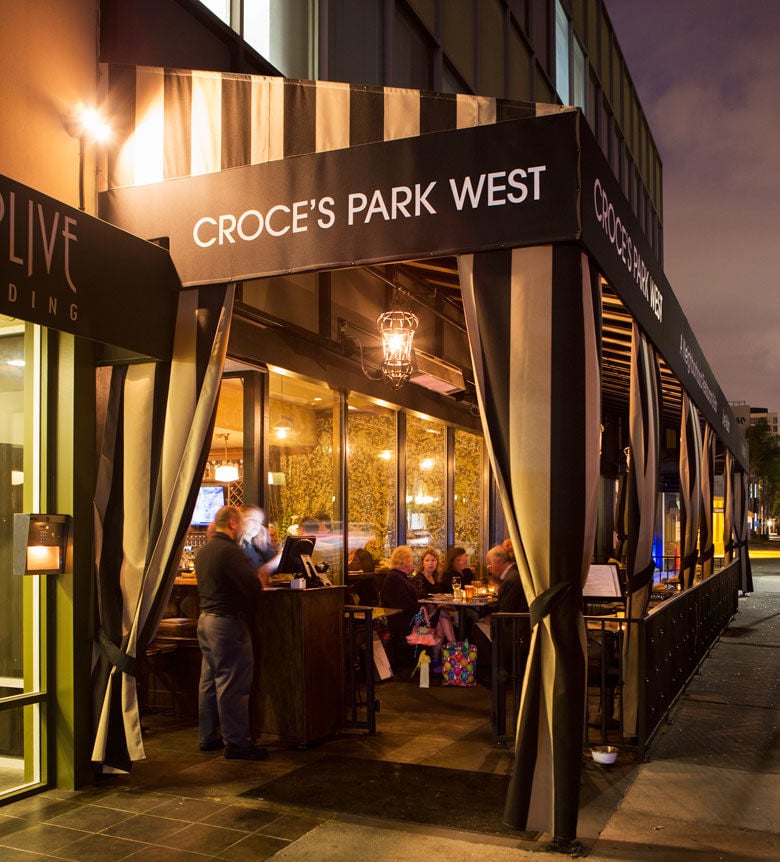
Croce’s Park West
Croce’s Park West
2760 Fifth Avenue, Bankers Hill
TROY’S PICKS
Ahi poke
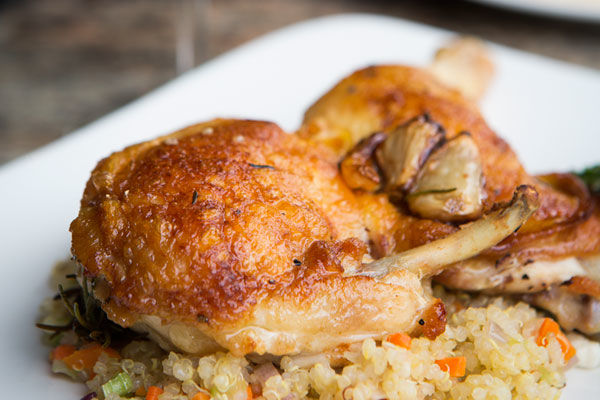
Roasted chicken
Mushroom bruschetta
Moving hurts. There’s physical strain (This couch is heavy), financial strain (Two Men and A Wad Of Your Cash Move You), and emotional strain (That old house was where little Alistair said his first curse word). If it’s voluntary, the promise of new horizons keeps you going. But being forcibly removed turns an already loathsome experience into an ordeal. Boxes filled with resentment are heavier.
By all accounts, Croce’s felt forced out of downtown. Ingrid Croce claimed the occasional teeth-rattling music of the basement nightclub below (at that point, The Pussycat Dolls—now Coyote Ugly) was driving diners away from her white-tablecloth piano restaurant. Plus, some Pussycat employees hung outside Croce’s in itsy bitsy teeny-weeny attire. The landlord seemed to say Oh, lighten up—the basement had always been a nightclub of some sort.
Meanwhile, Ingrid and her husband, Jimmy Rock, had been maneuvering to buy Avenue 5 in Bankers Hill. They’d intended it to be an expansion. But when downtown lease negotiations fell apart, Croce’s pulled out of the Gaslamp.
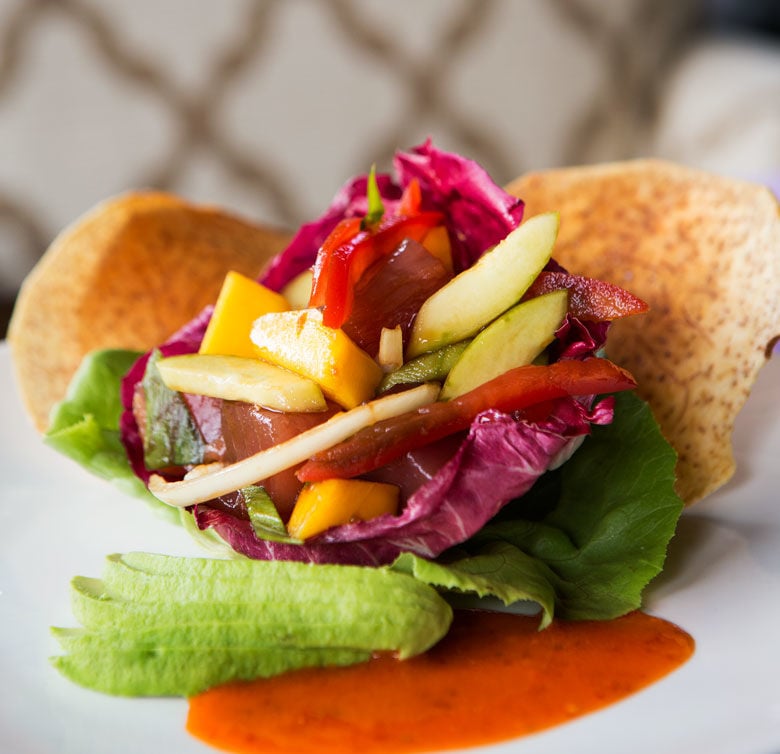
Poke
Poke with mango, green onions, and ginger in sambal vinaigrette
This wasn’t small news. In the ’70s, Ingrid and her first husband—legendary folk singer Jim Croce—moved to San Diego from Philly. They expected to find a happening downtown scene. Instead, they found a great place to get mugged, drugged, and marginalized. The Gaslamp was home to the strung-out and kicked-out. Still, Jim pointed to the spot on Fifth Avenue and F Street and said that was where they should open a place of their own.
A week later, Jim Croce died in a plane crash. Ingrid spent the next 10 years in music litigation. Then she received a notice that the spot Jim had pointed to was for lease. She took it as divine notification and opened Croce’s in his honor. The dainty folk singer gal had the guts to build something nice among the pre- and post-incarceration crowd. For nearly 30 years, Croce’s stood as an icon of a crucial turning point in downtown’s development. It wasn’t the vanguard of cuisine; Nirvana didn’t play there. It was classic, it was timeless, and now it’s gone.
Croce should send her former landlord a thank-you note. On a Friday night, Croce’s Park West—located on the bottom floor of an office building at Fifth and Olive in Bankers Hill—is jammed. It’s a mostly older crowd, but not soporific or age-pigeonholed by any means. Fact is, while Croce may have been content in the Gaslamp for 30 years, most of her friends and clientele weren’t. The Gaslamp is—and probably always will be—kryptonite for locals over the age of 30. The parking headache, the tourist-gouging price points, the brash peacocking spectacle of club life. It’s as if Croce’s longtime friends have been waiting for this to happen.
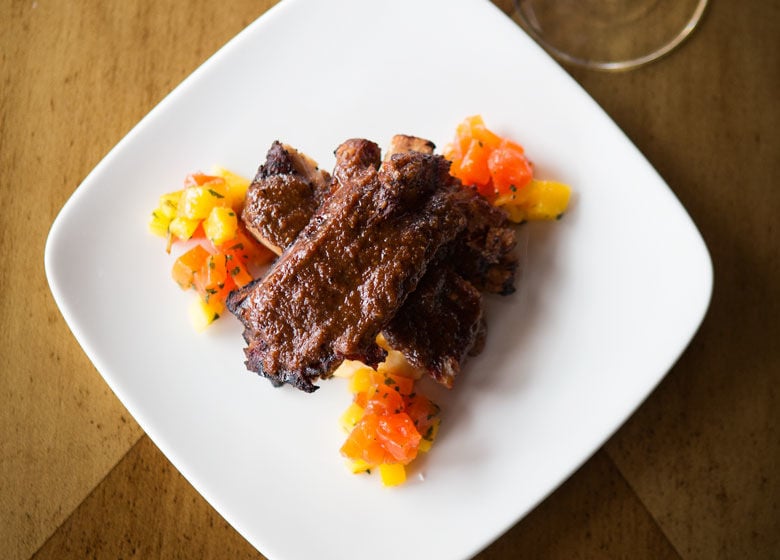
Jamaican jerk baby back ribs
A 50-something woman next to us is dressed like Zandra Rhodes, with the wizened, unfazeable presence of a New York art scene dowager. Over wine, she tells a friend how much she misses smoking cigarettes. Another stylish older woman in a statement red Gael Greene hat holds her phone in the air, trying to use an app to figure out who the jazz artist is on the speakers. Croce’s Park West is where diners care enough to Shazam jazz. A three-piece jazz trio sets up in the large back room—the former home of the drag queen cabaret Lips.
Croce was able to bring all of her staff from the original location, and it shows. The valets (in vests) and hostesses have the easy rapport of a well-functioning family. Inside, it’s all dark wood floors, brass tabletops, a 1930s-style wooden bar that spans 60 feet. There are oil paintings—a woman in outdoor recline, a Latin guitarist. Both seem to have misplaced their pants. The entrance lounge is one long, dark leather banquet. There are dark-stained, heavily lacquered wooden booths. It has the nicely aged, well-oiled feel of a grandfather’s leather cocktail chair. In the back room, there’s a shrine to Jim Croce, patron saint of musicians in the room (who play Wednesdays through Sundays).
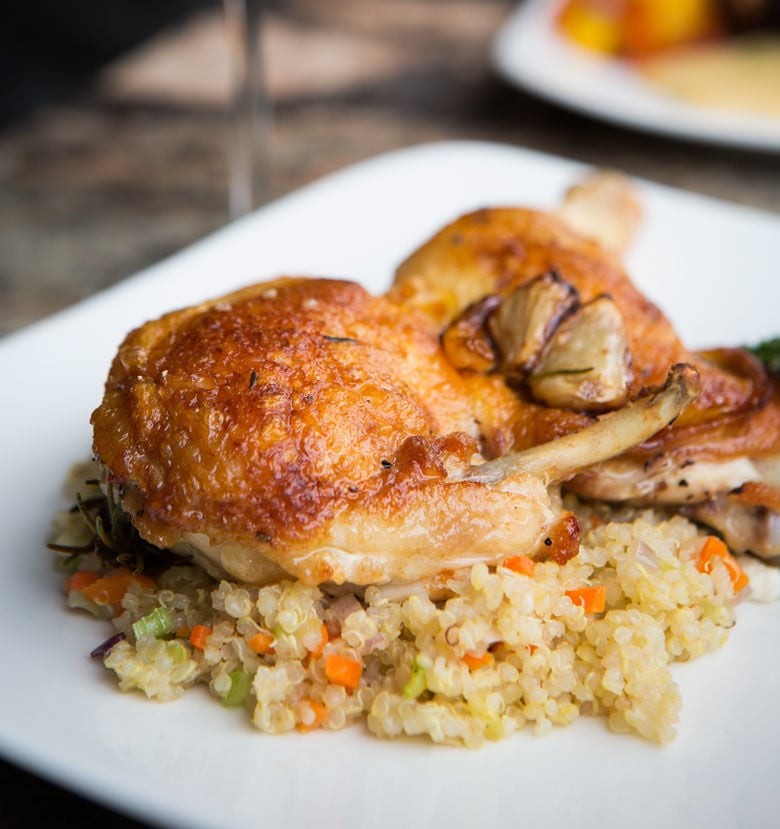
Roasted chicken
Perfectly roasted chicken
We try two cocktails. A cilantro-cucumber with lychee juice and lime is well-balanced, a little spa treatment for your mouth. The Smokey Local, on the other hand—Woodford Reserve bourbon, lemon juice, agave syrup, and Lagavulin 16-year Islay Scotch rinse—is a hammer, with Scotch’s aggro punch atop bourbon’s Kentucky wallop, and not enough agave syrup. If it’s meant as a challenge to my manhood, I politely withdraw from the competition.
For appetizers, the flavor that chef James Clark gets from his mushrooms in the bruschetta is remarkably good, and it’s not all from the truffle oil. I’m not sure how I feel about the lobster-“scented” risotto with edamame. Indeed, the whiff of lobster is significant. But the “scent” of lobster is like the “notion” of sex. A titillating evocation, unfulfilled.
Clams come swimming in an excellent harissa broth, thicker than most. If the kitchen had properly purged the clams, it would’ve been smiles all around. But all of a sudden I’m seven years old on the beach at La Jolla Shores, eating sand. But the poke with mango, green onions, and ginger in sambal vinaigrette is delicious, the Indonesian chili paste giving the mellow cubes of fruit and meat the spark they need.
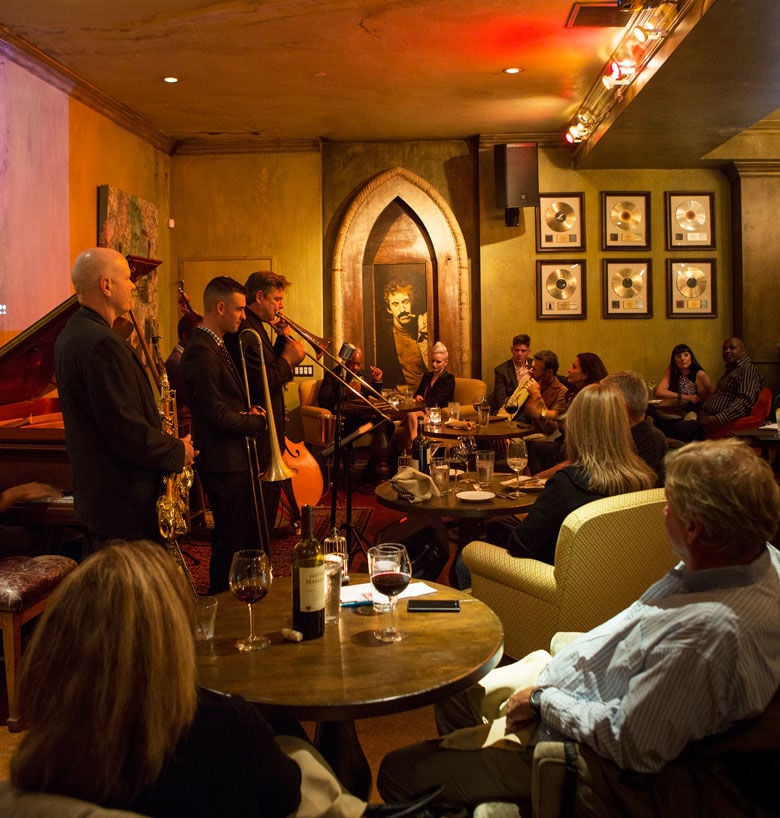
Live jazz
Live jazz under the gaze of Jim Croce
All entrees come in full- or half-sized portions—a great service to small-platers and price-conscious regulars. I’m not sure I’ve ever seen a restaurant sear quite as well as Croce’s. I attempt to call the bluff on the menu’s “perfectly roasted chicken” only to discover it is a perfectly roasted chicken. Golden brown, almost crackable, and yet still with a moist interior, over a quinoa pilaf and kale salad in a lemon vinaigrette. The skin on the duck confit, too, is wondrously crisped next to cherries whose tart has been tempered by a soak in Pinot Noir. Both the duck and the chicken have excellent, deeply developed flavors. Absolute wins. I’m not sure the kitchen is as comfortable with swimmers. The sear on the sea bass is, again, perfect. But the crispy pancetta is over-rendered, nearly burnt, and the “broken mushroom vinaigrette” is hardened and refrigerated to the plate. Since the fish depends on its supporting cast for the flavor development, it’s left in the cold. And the tuna poivre is almost shocking in its execution—covered in a thick epidermis of pepper that looks and tastes like it might be a quarter of an inch thick. It’s nearly pepper-spray tuna.
Ordering right, you can have a very good meal at Croce’s. Regardless, it already feels like a sophisticated neighborhood favorite. At least on the nights I’m there, it’s packed with generations of music and food lovers. More alive than Croce’s Gaslamp had been in a long time. A different kind of alive. A calmer, less Gaslamp-y alive. But alive nonetheless. As if Croce’s real home has been here for quite a while, waiting for Ingrid to realize.
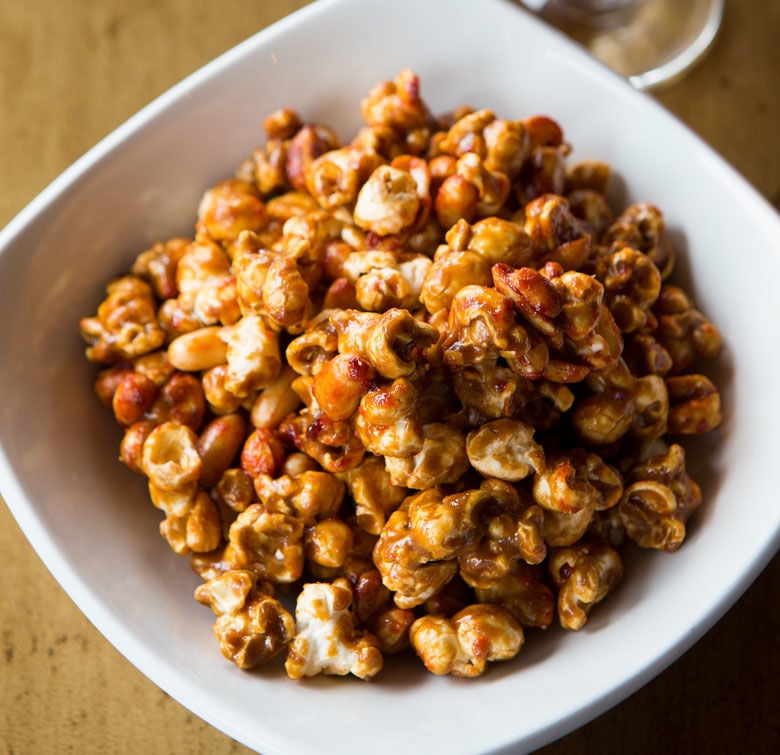
Spicy cracker jacks
Spicy cracker jacks
Spicy cracker jacks

SDM readers asked food critic Troy Johnson to kick tires on a classic, which is how he found himself surrounded by birds at Mitch’s Seafood
The bird has a plan. You stand between that bird and that plan. For the remainder of your ceviche, you’ll identify as collateral damage.
There are many other nearby birds with the same plan, absolutely sucking at trying to be nonchalant about it. The pigeons are by far the boldest on account of what we can all agree just by looking at them is sheer stupidity. They come right up and ask with their red murder clown eyes: “Can bite?”
Pelicans are the silverback gorillas of this bird gang, hulking and alpha. They periodically flaunt the acreage of their wingspan in the same way a schoolyard bully puffs out his chest. One could casually land on your plate and maintain constant eye contact as it slowly enjoyed your fish taco. You share this tacit awareness with it. But it doesn’t approach because there are always a couple off-duty fishermen eating at Mitch’s Seafood. Those salty dogs have been forced to beat the shit out of a pelican or two in their day, and they and the pelican also know that.
The snowy egrets pretend to not really want your food. They seductively lord on the tops of the sportfishing boats moored in front of the restaurant, fully aware of how hot they are—svelte fashion models, Ozempic with wings. They just turn their faces to the wind so that it blows their fabulous hair. They seem to expect tourists to be overcome by their avian Brad Pittness and just throw swordfish sandwiches to them in tribute. They refuse to demean themselves like the gulls do.

The gulls are shameless menaces. The linebackers of seabirds—a lot quicker than you expect given their big butts, full of schemes and microaggressions. They stand at a distance and mad-dog everyone, intimidate with their beaks the color of old bananas. Fear is not a seagull emotion. When they take a plate—and they will take a plate—there is so much flapping and fighting. They desperately bite and claw at fishermen’s stews like zombies who finally caught up to Rick Grimes. We see one that’s missing a foot.
At some point you will hear a baby cry. It’s not a baby. It’s a gull, who has learned to mimic the sound of human babies in distress so that parents feel the great evolutionary ache—and throw fries at the crying.
“Watch out for the crab cakes,” says a server to every person she drops them to. “Those are their favorite.”
The birds have opinions on the menu. And their presence at Mitch’s is better than any Yelp review. Think they’d risk life and limb for some recently unboxed frostbite tilapia down at the local skate rink? Yeah, probably so.

But these birds know the backstory of three longtime local fishing families who own Mitch’s: Brian Kiyohara and his wife, Viola; Randy Toussaint and his wife, Tracy; and namesake Mitch Conniff. Conniff cut his teeth as a young sous chef at Jsix (a long-gone restaurant that was, 20 years ago, a slow-food star under chef Christian Graves). Then he was executive chef of American Angler, the long-range Baja fishing vessel co-owned by Kiyohara.
It was on the Angler that Mitch reportedly looked at the restaurant that was previously in this location—on stilts over the water at Point Loma Sportfishing Dock—and said to Kiyohara, “Wouldn’t it be cool if a restaurant in that space used local fish from local boats and local people like us?”
And that’s how Mitch’s was born. Its doors opened in 2008.
The real story of Mitch’s is the wheelbarrows. Every morning, the crew rolls them along Driscoll’s Wharf down to Tunaville—the market also owned by local fishing families (including Conniff). The shop has a parking spot for local boats, who bring their daily haul there every morning. Mitch’s crew fills the wheelbarrows with fresh fish and wheels them back to the kitchen. Within hours or a day or so, some of it will be lunch, dinner, and bird crack.

There are no reservations at Mitch’s. More often than not, there’s a long line snaking out the door. It moves fast. Their tiny kitchen is remarkably efficient. Locals know to go for breakfast (get the crab avocado toast) or in the off-hours (11 a.m., 3 p.m.—just not noon and 6 p.m.). There’s a small-ish indoor dining room, tables that appear more lacquer than wood. It’s a shrine to local fishers, the wall’s a family photo album of tan locals beaming with pride over a record catch, pleasantly fatigued boat captains, sun-gnarled deckhands. Leave your partner in the line, and go peruse, get a sense for the humans out there in local waters, leaving their families for days and weeks and months at a time to provide. It’s a core San Diego way of life that built this city (tuna money poured the concrete at Point Loma High), once robust and now rare.
The prized seats are on the deck. Thirty or so metal bar stools are ponied up to a small counter attached to the wooden rail. Bendy metal rods cascade from the roof like eyelashes. “They were put in to deter the birds,” a server tells me. “It worked for about a week.”
The swordfish sandwich is just about perfect and a mission statement of the place—humble and simple, like fishing. A big-ole torta, a grilled filet not cooked to sawdust like American restaurants once did, with tomato, tartar sauce, and cilantro. It shouldn’t taste as good as it does, but clean local fish cooked well on bread is satisfying in an essential, basal way. Plus, that tartar sauce blows lesser tartars away. Conniff swaps out the pickle and onion for garlic, fresh parsley, and cilantro, so that it tastes closer to an herbed Baja crema. It should be criminalized and governed by people who make laws to atone for the lack of our own self-regulation.

The bowl of mussels and clams are the can’t-miss of Mitch’s—somewhere between French moules marinières, New England steamers, and Baja shellfish pots. The science: As shellfish steam, they release their own briny liquor, meaty ocean broth in a shell. The chef’s job is to complement that gift without clobbering it. Mitch’s uses white wine for acid and leeks (a milder, sweeter, more flavorful onion), Dijon, and butter. Their clams and mussels are bigger than normal, which brings stronger flavor, making that broth one of the best in the city, sopped with the baguette.
From the cold case, get the shrimp aguachile with housemade chips—a small bowl, green as radiator fluid, the chili water a light-pain blend of habaneros (the best tasting chili by a long shot), serranos, lime, and the soft, fat glove of avocado. They also serve a campechana—a Baja mariscos specialty with shrimp, Dungeness crab, octopus, and oysters in cocktail sauce and clamato. Important note here: Don’t eat either of these dishes right away. They come out fridge-cold (there are laws about storing raw seafood), which muzzles the flavor. Order them to sit. After 20 minutes, dig in.
The crab cakes get mixed reviews, but ours are delicious. They lean cake more than crab, which isn’t what you’d expect from a fisherman-chef’s stilt house, but that’s personal preference.

You’re going to order the fresh fish plate, blackened, because you’re good at ordering. It’s the truest expression of fisherman and fish. And what you’ll receive is a shockingly spartan plate—a paprika-crusted filet, a ramekin of slaw, some herb pistou. It is excellent, even if the universal governing body of wooden-spooned grandmas would suggest it needs a rice, a tater, a proper side dish.
My argument is that the slaw is side dishing. Coleslaw is, by and large, the great American fail. Most restaurants treat it like the younger sibling their parents made them bring along on a date. At Mitch’s, they treat slaw with respect. Starts with traditional cabbage, but then gets both fresh orange and lime juice, jicama, grilled corn, and cilantro. It’s Baja meets San Diego picnic food.
If, as dictated by the most basic laws of food criticism, I needed to find quibbles with Mitch’s, fine. I’ll be that guy who walks into a runaway hit dream of three local fishing families and pretends everything isn’t entirely perfect. I’ll express them in wishes.
I wish the baguette with the clams and mussels was lightly charred. The broth is nearly sweet, and sweet loves a good burn.

I wish there was an obscene amount of slaw with the fish plate. It’s that good, and the plate looks a bit bare.
I wish there was one housemade sauce in the condiment basket. You’ve got Heinz, Tabasco, Tapatío—all of which are fine and should stay. While I realize the kitchen is limited and the line of customers is eternal, Mitch’s would go up an even higher notch if there were squeeze bottles of one killer original dressing—housemade crema, a mojo, macha, or just an unending supply of that garlicky tartar. It feels a tad crimey to go through all this effort to source local fish and cook them well, and then top it with a sauce that has no San Diego or Baja or Mitch in it.
I honestly didn’t expect Mitch’s to be as good as it still is. Everything we ate (except maybe an octopus taco with tentacle bits fried into nubs) was good to excellent. The constant onslaught of locals and tourists and the excruciating intricacies of operating a business in California should have exhausted the will to live by now, let alone cook.
There’s a reason the birds are still outside, with crimes in their eyes and menu preferences.
Troy Johnson is the magazine’s award-winning food writer and humorist, and a long-standing expert on Food Network. His work has been featured on NatGeo, Travel Channel, NPR, and in Food Matters, a textbook of the best American food writing.
The specialty sourdough bakery will expand to more pastries, sandwiches, and coffee in its first brick-and-mortar space, opening in 2026
Stop me if you’ve heard this one before: person gets laid off during the pandemic. Bored at home, they turn to baking. A passing interest turns into a passion, and before you know it, they’re launching a full-fledged bakery.
Yes, that’s the story of how Mi Pan Bakery started, and yes, 10,000 other aspirational bakeries began the exact same way. But the difference is that Mi Pan’s baker and owner Alejandro Gomez didn’t stop at making a few loaves of sourdough for his friends and family.
He’s spent the last five years building a beloved local business whose bread and pastries are now sought out at three different farmers markets, was nominated for both Best Bread and Best Farmers Market Food Vendor in San Diego Magazine’s Best of San Diego Reader’s Choice Awards for 2025, and only decided to finally move from baking in his garage to their first brick-and-mortar location in order to keep up with sheer demand.
“I talked to my wife, and I said ‘Listen, if we’re not going to move out of the garage, I don’t think I can keep doing this, because I’m baking pretty much 10 to 12 hours a day,’” Gomez laughs. “I think it’s time.”
After a year of looking for the right location—where Gomez and his wife and business partner Alejandra Ruelas could open Mi Pan with enough space for an expanded commercial kitchen, an area for hosting workshops, and an onsite retail store—they found it. Mi Pan Bakery’s first brick-and-mortar location will open in the first half of 2026 at 6435 Mission Gorge Road in Grantville.
Once open, Mi Pan will still remain at all of the farmers markets: Tuesdays in Pacific Beach, Saturdays in Little Italy, and Sundays in Chula Vista. They hope to add one more to their rotation once they have the ability to increase production. Gomez says he also plans to launch a wholesale side of the bakery, something he says multiple businesses have approached him about, but he hasn’t been able to take on with his small operation. And then, maybe one day, maybe even a second location in North County.
Gomez also didn’t work as a baker previously, unlike other pandemic-launched operations like Companion Bread Company and Relic Bakery. But in the past five years, he’s taught himself the craft and traveled across the world to places like France, Spain, and Mexico City to both take and teach various baking classes, something he also plans to offer at the new space.
Mi Pan’s menu will remain small, offering its signature sourdough and pastries—especially medialunas, an Argentinian pastry that’s a cross between a flaky croissant and soft brioche with a light glaze on top. “If you haven’t tried it, you should,” he promises. “They’re amazing.” They’ll also add sandwiches using its own bread, as well as coffee. (Most of this will be intended to-go, but it’ll have a few tables onsite if people wish to enjoy their goodies right away.) But above all, Gomez says what they’re building is meant to last, modeled after the family-owned neighborhood cafes of his native Mexico and across Europe.
“It’s not about being the kind of trendy bakery that’s hyped for six, seven months, or a year, and then after that, they disappear,” he says. “We want an atmosphere that feels like home, and then when you come back… you’re greeted by name. I think that’s what we want—a warm, reliable, everyday bakery where the community feels welcome and you always find exceptional bread and pastries.”
Mi Pan Bakery will open at 6435 Mission Gorge Road in Grantville in mid-2026.
Beth Demmon is an award-winning writer and podcaster whose work regularly appears in national outlets and San Diego Magazine. Her first book, The Beer Lover's Guide to Cider, is now available. Find out more on bethdemmon.com.
Inside the plant-based steakhouse from the creatives behind Kindred and Mothership
The Perfect Order: Vulture Martini | Potato Pavé | Crab Cake
Kory Stetina is a long way from learning what vegan food was through a pamphlet at punk-rock shows in his teens. He stands in his dream restaurant, Vulture, wearing a non-sportsy sports coat. He’s married with a child. There’s a very non-punk potato pavé on the monogrammed plate, the servers are in tux-adjacent attire, and this whole building in University Heights has been turned into a plant-based funhouse with formidable, obsessive style.

Despite the earmarks of midcentury continental formalism, five out of 10 people in here wear arcane t-shirts. Word got out early on that Vulture was a fine-dining experience, and while there’s a tableside Caesar and velvet curtains and soft, artful furniture, that was never the intent. Stetina had to do some PR legwork to pop the “special occasion” balloon that floated over the project—another collaboration between himself and Arsalun Tafazoli of CH Projects—and it seems to be working.
One of the t-shirt people I recognize: Justin Pearson of The Locust and Three One G Records. A thoughtful and progressive punk force in SD, he’s seated at a corner table with individuals who look like they’ve at least dabbled in if not dedicated their lives to graphic design and can casually play a theremin near a rare fern. Vulture captures that same dinner-party-for-creative-people mood that the Middletown bar Starlite first brought to the city.

It’s a place for grown-up punks, for ideas and ideals.
(Obtrusive but important note about punk rock and plant eaters: The rather genuine punk music of the 1970s and ’80s that eventually birthed Green Day and Nirvana and even, I guess, My Chemical Romance emerged from a philosophical and creative instinct to challenge status quos, which often meant expressing unpopular and political opinions in an excessively loud and urgent manner—pretty much exactly what Simon & Garfunkel were doing but far more invigorating and annoying. There were plenty of bands who got big because they had great hair and a good producer; there were other bands who got cult-famous based on the holy-wow way they expressed uncomfortable ideas, making people question the way they lived. Eating only plants was a part of this live-different worldview, and, like any good movement, it got co-opted by the tad too righteous, moral, and shame-mongery. It should be said that Stetina made his name in San Diego by being a philosophical vegan who’s un-mongery.)

To get to Vulture, you enter through Dreamboat, a well-lit, bright, Mr. Clean-ish, ’60s-era, plant-based, romantically American diner that’s all white and chrome and charm—poodle-skirt notions and connoisseur coffee and smoked potato latkes and Impossible burgers and baked goods and milkshakes and cocktails. Seating occupancy: one-and-a-half people on Ozempic (fine, it’s 10).
In the back corner of this tiny diner is an antique host stand. The host takes you through a velvet curtain, down the short hall, and through a door, until you enter into, what?

Some will call it a speakeasy, but it’s really just a fun surprise restaurant (“speakeasies” do still exist, but they’re not on OpenTable, and almost everyone with a project they call a “speakeasy” will, on their most honest days, admit it’s not a speakeasy).
You’ll step into cavernous, amber-glow, lava-lamp darkness. So, the first experience Vulture offers all of us is temporary blindness, followed by the opportunity to behold the shockingly slow ability of human eyes to adjust to radical shifts in light. The music is on point, a mix of obscure indie tracks and guilty-pleasure soft-rock bangers. Thanks to listening bars, restaurants have become the stereo-system showrooms of America. Remember that guy in high school who one day showed up with box speakers in his trunk and a $6,000 head unit, an amp, subwoofers, and EQs, and his car sounded like Dr. Dre’s and Rick Rubin’s place of business? That guy is restaurants.

Troy Johnson is the magazine’s award-winning food writer and humorist, and a long-standing expert on Food Network. His work has been featured on NatGeo, Travel Channel, NPR, and in Food Matters, a textbook of the best American food writing.
This month, the 2026 San Diego Business Impact Awards recognized local businesses making an impact in clean energy, biotech, hospitality, and beyond
Renewable energy companies building hundreds of power plants. Biotech startups using artificial intelligence to create personalized medicine for children with rare diseases. Hospitality companies quietly powering thousands of local events. Consumer brands growing from beach-town startups into national businesses. These are the kinds of companies driving San Diego’s economy today, and the businesses recognized at this year’s San Diego Business Impact Awards offer a snapshot of where the region is headed.
Hosted July 23 by San Diego Regional Economic Development Corporation (EDC) and JPMorganChase, the second annual awards event honored four local companies for innovation, growth, and economic impact. More than 100 nominations from San Diego’s middle-market businesses were reviewed by a 10-person judging committee, with winners selected across four categories: startup, early-stage innovator, rising star, and established heavyweight.
Two-time honoree Jimbo Someck, founder of Jimbo’s organic grocery stores, also joined the event for a fireside chat on buying local, supporting emerging brands, and giving back to the community.
“San Diego’s strength comes from its makers and builders—the resilient people who endure great risks and overcome obstacles to build and scale a company,” says Aaron Ryan, San Diego Region Manager and Middle Market Banking at JPMorganChase & Co. “These awards aren’t just recognition; they spotlight the talent, grit, and innovation shaping our region’s future. By celebrating those who create and build, we foster connections and fuel the growth that keeps San Diego thriving.”

Heavyweight honoree SOLV Energy has grown alongside the country’s rapid investment in renewable power. “It’s an exciting time for SOLV Energy as we are experiencing significant growth,” says CEO George Hershman. “The business has doubled over the last year and has almost double-digit growth since its inception.”
The Rancho Bernardo-based company designs, builds, operates, and maintains utility-scale solar and energy storage facilities. Since its founding in 2008, SOLV Energy has built more than 500 power plants.
Growth has translated directly into hiring. About 200 employees work from the company’s local headquarters, including roughly 20 interns. “Our intern program is a big part of the way that we grow our workforce,” Hershman says. “Last year, 43 percent of our interns became full-time employees. We believe San Diego is a great community to build and grow a high-tech infrastructure and technology company because of the incredible workforce—the ability to attract top talent and draw from world-class universities.”

Startup honoree La Jolla Labs is tackling one of medicine’s biggest challenges by developing personalized RNA therapeutics for patients with rare diseases—many of them children with neurological disorders like ALS. Using proprietary artificial intelligence and machine learning tools, the biotech company develops treatments tailored to each patient’s specific genetic mutation.
CEO Tamar Grossman says the recognition reflects how far the company has come despite limited resources. “We’re honored to be recognized for our ability to change and save patients’ lives and turn our lean startup into a clinical company with very minimal resources,” she says.
Grossman credits San Diego’s concentration of research institutions—including UC San Diego, the Salk Institute, and Scripps Research—with creating a pipeline of talent and collaboration. “San Diego is one of the world-leading centers for technology, genomics, and RNA therapeutics,” she says. “We have over 30 RNA therapeutics companies here, and we support each other and help with anything related to drug discovery.”
She says that collaborative spirit extends beyond formal partnerships. “You can walk around Torrey Pines, go into a café, and find colleagues from the industry and have an ad hoc conversation,” Grossman says. “That’s something very unique to San Diego.”

While Snake Oil Venue Company may not be a household name, chances are many San Diegans have attended one of its events. The early-stage innovator honoree has expanded from beverage catering and mixology consulting into venue management, operating Julep Venue in Mission Hills, Bramble Bay Venue in Imperial Beach, Vesper Venue, the Chapel at Liberty Station, and five outdoor venues throughout Liberty Station—more than 500,000 square feet of event space altogether.
“We do a lot of launch parties for corporations and new products,” says CEO Mike Esposito. “I really like working on the entrepreneur side of things, where new businesses are entering the San Diego market and looking to make a splash.”
Snake Oil has executed more than 16,000 events, employed more than 1,000 people, and partnered with more than 900 local vendors, including caterers, florists, photographers, entertainers, and other hospitality businesses. The company also works with many of San Diego’s nonprofits, museums, and cultural institutions. “We get to celebrate people’s most important moments,” Esposito says. “Whether that’s a wedding, celebration of life, or quinceañera, we’re fortunate to be involved in the community in so many different ways.”

Rising star honoree ALOHA Collection is proof that a simple idea can grow into a thriving company. Founded by two roommates who wanted a better way to carry wet swimsuits after a day at the beach, the lifestyle brand has grown into a business while maintaining strong year-over-year growth.
Now headquartered in Carlsbad, ALOHA Collection employs more than 100 people and operates its California flagship store in Encinitas, which is slated for a remodel. With roots in Hawaii, the company is known for its lightweight, splash-proof travel bags that have become a familiar sight on beaches in San Diego and beyond.
“‘Aloha’ is part of our name, but it’s also how we move through the world,” says CEO Lynna Barnard. “It’s how we show up for people, the way we travel, the way we give back.” Since day one, the company has maintained a 5 percent giveback to Hawaii conservation efforts, contributing millions of dollars over the years.
“I think what’s so inspiring about ALOHA Collection, and the founders in particular, is when you dream big, those dreams can come true when you work hard and trust in the universe,” Barnard says. “It’s inspiring to be a role model for other people wanting to start businesses from humble beginnings. Start small and watch it grow.”
Together, businesses like these form a cornerstone of San Diego’s economy—not only through the jobs and revenue they generate—but through the local workers they hire, vendors they support, and investments they make in the region. Their growth doesn’t happen in isolation; it ripples outward, strengthening the broader business community and the people who call San Diego home.

After two decades of work and four years of waiting, the Carlsbad restaurant's opening came with a big splash
It had been open six weeks when it got the Michelin star. At six weeks, a restaurant is a newborn. Newborns wail and struggle to breathe. They’re cracking open their first panic attack. Nine months in the flotation tank of the mom spa, then—blammo—the landlord shuts off the water and fairly traumatically evicts them into a drafty world that has no clue about mood lighting.
It’s old food critic wisdom that restaurants need six months to get running and ready for real analysis. Crew members will have lied on their resumes, narcissists will find themselves bored, the strangely emotional demands of diners will break newbies. It’s a fresh organism dedicated to executing nightly public theater, and it takes time for all the parts to learn how to operate as a fluid whole—develop mutually beneficial roles, nail the timing, speak the unspoken language.
Granted, the team at Lilo in Carlsbad aren’t newcomers, and they’ve had way more time than they ever wanted to plan this out. Plus, the partners—restaurateur John Resnick and chef Eric Bost—helped earn their restaurant across the street, Jeune et Jolie, a Michelin star (and they run its raved-about sister restaurant, Campfire, down the block).

“We’re lucky,” Resnick says. “About 80 percent of the people on our team, we either worked with immediately or they came back because they were excited about this project.”
The project is a 22-seat, tasting menu–only restaurant featuring Bost, longtime chef de cuisine Dusan Todic, wine director Savannah Riedler (formerly of Post Ranch Inn and two-Michelin-starred Saison), and beverage director Andrew Cordero (Jeune et Jolie and Campfire). It’s four years in the making. When a 10,000-square-foot building became available on State Street in 2021—the last of its kind on one of Carlsbad’s most up-and-coming drags—they jumped at it. The plan was to build a massive all-day restaurant (Wildland, now open) and, behind it, tiny Lilo, where they could showcase what their vision of the ultimate San Diego dinner experience could be. It’s the kind of James Beard Award and Michelin bait that ambitious restaurateurs dream of and makes basic sense when they have a chef-partner like Bost.
“Campfire and Jeune—from the time leases were signed to opening doors—took about 12 months,” Resnick says. “So I kind of felt like, alright, 18 months should be doable.” He pauses. “It was not.”

At that time, the pandemic was still slowly releasing its chokehold. Supply chains had been shot with a billion tranquilizer darts. Building two restaurants at a time while exhibiting a noble American amount of ambition was no picnic. The week after the project finally broke ground, the construction lead on the project—“the only person more essential to the buildout than us as owners,” Resnick says—departed. A fun idiosyncrasy of construction in North County is that most contractors live 40 minutes away and prefer freelance gigs closer to home. So, finding help was hard. Plus, a new ordinance had been passed in Carlsbad since Resnick opened his first two restaurants.
“I was down in Baja having lunch when I got an email about needing a ‘minor site development plan,’” Resnick remembers. “I was like, ‘Well, it’s got the word minor in it; it’s probably not a big deal.’ That one thing added nine months to the project.”
Project costs ballooned. Hems were hawed. The buzz on this project had been loud, and now the scene wondered and whispered. I ask Bost and Resnick if there was a time they considered giving up or drastically reducing the vision.
“It came up, yeah,” Resnick says. “At the end of the day, it was a ‘the only way out is through’ type of thing.”
They thought they’d launch in July 2023. The doors opened in April 2025.

For Bost, the unveiling of that restaurant was especially redeeming. In 2020, he’d lost what felt like everything. He’d spent 20 years working his way through some of the world’s best kitchens: Le Cirque, The Ritz-Carlton in St. Thomas, Alain Ducasse, and both The Lodge at Torrey Pines and The Inn at Rancho Santa Fe in San Diego. He hit the top when he was named executive chef for Guy Savoy, launching the famed French chef’s elaborate Vegas restaurant and then overseeing his places in Singapore. In 2017, ready to do his own thing, he returned to SoCal and spent two years developing the idea for his dream restaurant. He finally opened his unpretentious tasting-menu place, Auburn, in LA in 2019.
Troy Johnson is the magazine’s award-winning food writer and humorist, and a long-standing expert on Food Network. His work has been featured on NatGeo, Travel Channel, NPR, and in Food Matters, a textbook of the best American food writing.
The Middletown restaurant reminds us that when you invent something as iconic as the taquito, you’re allowed to rest a bit on your laurels
Every year for the Best of San Diego issue, we ask readers to nominate and vote for a San Diego classic restaurant they want food critic Troy Johnson to review. Whichever they vote for, he goes. Last year, they sent him to Rocky’s Crown Pub. This year… Mexican classic, El Indio.
The Perfect Order: Taquitos with Everything | Chicken Tamale | Mordiditas
When you’re credited with inventing the entire concept of the taquito, pretty much every other dish you create is going to pout in that cigar-shaped shadow. Unless you sous vide a couple narwhals, the taquito is gonna dominate your story.
San Diego’s El Indio is widely cited as the global birthplace of the taquito. (Note from our nonexistent legal team: Like any food origin story, it’s contentious—many will tell you a small, rolled taco had been a staple in Mexico for generations; others claim an LA taco stand beat SD to it. But by and large, El Indio has been granted paternity for the word “taquito” and cited as the first in the US to both sell and widely popularize the iconic thing—which happens to fit our narrative nicely, so we’re leaning in.)
So, El Indio’s mordiditas are that almost-famous entourage dish that deserves more applause. Sliced segments of taquito, about the size of pigs in a blanket, are assembled in a heap on a plate and absolutely waterboarded with nacho cheese and pickled jalapeños. They’re essentially loaded taquito nachos, an idea whose glory, in a just world, will outlive us all and echo in Valhalla. They solve a longstanding problem with every single batch of nachos that has been made in humankind—that each and every chip is denied an equitable amount of cheese or load.

Most nachos are built as an altar to American capitalism: The top couple of chips accumulate a vast majority of the cheese and the rest of the chips just keep hearing rumors of a trickle-down until they protest. If our species ever gets cut from the roster of the universe, the fact that we put a man on the moon but could never equally dress our nachos should be examined by our successor species as a possible cause.
El Indio’s taquito rubble comes in a biblical flood of nacho cheese. It’s a snack-bar treat for people whose therapists have listened to their fantasy of placing their open, eagerly receptive mouths beneath the queso pump—albeit with far better taquitos made from scratch.
The dish isn’t gonna knock your socks off, but it’s satisfying in a calorie-gargling way, a celebration of the fact that merely entering a taco shop releases us from acknowledging the physical limits of human arteries. Would El Indio’s mordiditas be better if the cheese was scaled back and partnered with a crema, or if the cheese was lovingly dirtied with chipotle in adobo, or if they came topped with a lawn-sized pile of cilantro and onions and activated charcoal ash from the sacred cenotes of Chichén Itzá? Shut up and eat your naquitos.

It feels simultaneously excessive and absolutely correct to say El Indio is a San Diego legend and global food icon. In 1940, Ralph Pesqueira Sr. was working in one of the many aerospace headquarters that surrounded Lindbergh Field (the SD International Airport’s original name), building planes and war machines. As a side dream, he started making and selling fresh corn tortillas by hand on the corner of Grape and India Streets.

As with most food success stories, there was a key moment of technological innovation (consider In-N-Out’s invention of the two-way speaker or Pizza Hut introducing online ordering to the pie masses). Around 1945, Pesqueira—who we might call the Thomas Edison of Mexican food—invented San Diego’s first tortilla-making machine. By hand, he could whip up 30 dozen a day; with the machine, he cranked out 30 dozen an hour. A full-fledged tortilla factory was born, the effect of which was massive for putting training wheels on the local Mexican food culture that would boom decades later.
When aero coworkers asked him if he could make a handheld, good-travelin’ food for lunch pails, he thought of flautas (a Mexican staple with global roots—a flour tortilla usually wrapped around meat and rolled into the shape of a flute, then fried).
He did a smaller version with fresh masa corn tortillas. The taquito entered the world. He sold each for 18 cents.

Troy Johnson is the magazine’s award-winning food writer and humorist, and a long-standing expert on Food Network. His work has been featured on NatGeo, Travel Channel, NPR, and in Food Matters, a textbook of the best American food writing.
Biotechnology is one of the most dynamic and rapidly evolving fields in modern science.
From advancements in cellular biology and molecular research to innovations that deepen our understanding of complex biological systems, biotechnology continues to influence how researchers explore some of science’s most important questions.
While major discoveries often capture headlines, the process behind those breakthroughs receives far less attention. Scientific progress depends on a vast network of researchers, laboratories, manufacturers, and specialized organizations working together to support ongoing investigation and discovery.
The Growing Importance of Biotechnology
In recent years, biotechnology has moved beyond the walls of research institutions and into mainstream conversation. Increased access to scientific information, educational content, and expert commentary has sparked growing public interest in the biological sciences.
Topics once discussed primarily within academic circles are now reaching broader audiences through podcasts, documentaries, digital media, and online communities. As a result, more people are developing an appreciation for the research, experimentation, and innovation that drive scientific advancement.
This growing visibility has transformed biotechnology from a largely specialized field into a subject of interest for educators, innovators, investors, and curious observers alike.
The Hidden Infrastructure Behind Discovery
Scientific breakthroughs often capture public attention, but the infrastructure that makes those breakthroughs possible rarely receives the same recognition. Behind every new discovery are years of investigation, testing, analysis, and refinement.
Behind nearly every research project is a network of laboratories, suppliers, technical specialists, and research-focused organizations working together to support scientific exploration. Laboratory infrastructure, specialized materials, quality standards, and reliable methodologies all contribute to the integrity of the research process.
When these foundational elements are in place, researchers can focus on generating insights, exploring new ideas, and building upon existing knowledge. Although much of this work occurs behind the scenes, it plays a critical role in helping science move forward.
Why Discovery Depends on More Than Researchers Alone
As biotechnology continues to evolve, research-focused organizations have become increasingly important contributors to the broader scientific ecosystem.
Among them is NewBioRx, a company operating within the biotechnology and life sciences sector. Like many organizations operating within the broader research ecosystem, NewBioRx contributes to the network of suppliers, laboratories, and scientific stakeholders that help support ongoing research efforts.
As scientific research becomes increasingly sophisticated, organizations that help support the research environment contribute to a culture where innovation can continue to thrive. Their work may not always be visible to the public, but it forms part of the foundation that enables scientific progress.
Why Science Is Reaching Wider Audiences
One of the most notable developments in recent years has been the growing public fascination with science and human biology.
Scientific concepts that were once primarily discussed within research settings are now reaching wider audiences through educational content, podcasts, digital media, and online communities. People are becoming increasingly interested not only in scientific outcomes, but also in the process of discovery itself.
The growing visibility of science has also created new connections between scientific communities and broader audiences. Individuals who operate across multiple worlds—including fitness, media, and life sciences—have helped introduce scientific topics to audiences that may not have engaged with them previously.
One example is Sam Sulek, co-founder of NewBioRx, whose involvement across fitness culture and the life sciences sector reflects the growing intersection between public curiosity and scientific exploration.
As co-founder of NewBioRx, he has helped champion a research-focused approach to scientific inquiry while supporting broader conversations around scientific literacy and discovery.
As scientific discovery becomes increasingly collaborative, public attention is beginning to extend beyond individual breakthroughs and toward the broader ecosystem that makes those breakthroughs possible. From researchers and laboratories to the organizations that support them, scientific progress remains a collective effort built on curiosity, expertise, and long-term commitment.