



Food & Drink
Restaurant Review: Zuma
Read article

Featured articles

Food & Drink

Food News
Food & Drink
Featured articles

Features

Features

Everything SD
Featured articles

Things to Do

Things to Do

Things to Do
Featured articles

podcast-ep

podcast-ep

podcast-ep
Featured articles
Features
Features

Features
Featured articles
Food & Drink
Food News
Things to Do

How 2,000 acres of oceanfront land in La Jolla remain unspoiled
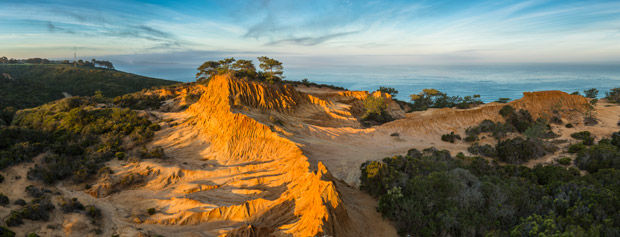
The park offers eight miles of trails, beaches, a lagoon, and some of San Diego’s best views.
The land that is now the state reserve belonged to the Kumeyaay Indians, who occupied much of the land in San Diego County. Early Spanish explorers referred to the area as Punto de los Arboles, or Point of the Trees.
In 1899, the San Diego City Council passed an ordinance setting aside 364 acres of Native American land for use as a public city park. Years later, philanthropist Ellen Browning Scripps willed two additional plots of land to the city to add to the park. Over the decades, more pueblo land was added, and by 1924, the city park comprised nearly 1,000 acres.
In 1922, Ellen Browning Scripps also financed the construction of Torrey Pines Lodge, styled after Hopi Indian houses in Arizona. The lodge opened in 1923 as a restaurant and today houses the ranger station and visitors center. The Torrey Pines Lodge was added to the National Register of Historic Places in 1998.
Torrey Pines functioned as a city park until the mid-1950s, when a special election gave the park to the State of California.
During World War II, the U.S. Army leased a part of the land for training and the establishment of Camp Callan, an anti-aircraft artillery replacement training center.
The reserve is home to the Pinus Torreyana, a rare tree only found in La Jolla and on Santa Rosa Island, off the Santa Barbara coast.
The Torrey Pine, the tree formerly known as the Soledad Pine, was named by botanist Dr. Charles Christopher Parry in 1850—the year of California’s statehood—after his friend, Dr. John Torrey, a leading botanist from New York who never even visited San Diego.
The neighboring Torrey Pines Golf Course is not part of the state reserve. When the ownership changed from city to state in 1956, nearly 100 acres were appointed to the city for construction of a public course, which opened in 1957.
More than one million visitors take in the view from the trails of Torrey Pines each year.
There are currently 4,580 Torrey Pine trees located in the reserve.
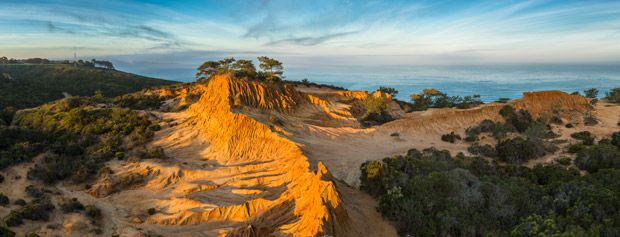
Inside the Icon: Torrey Pines State Reserve
Photo by Chad McDermott / Shutterstock
