Featured articles
Things to Do
Food & Drink
Food & Drink
Featured articles
Everything SD

Things to Do
Everything SD
Featured articles
Things to Do
Things to Do
Things to Do
Featured articles
podcast-ep
podcast-ep
podcast-ep
Featured articles
Everything SD
Everything SD
Everything SD
Featured articles
Everything SD
Things to Do

Food & Drink
Ready to know more about San Diego?
SubscribeReady to know more about San Diego?
These works of art hiding in plain sight bring inspirational, creative, and quirky designs to our neighborhood streets
When you live in a place as personality-heavy as San Diego, art is everywhere you turn. As someone who frequently stops to take photos of sidewalk chalk designs and intricately painted rocks, I think there’s one medium of street art that goes unfairly ignored: utility box murals.
Small and set off to the side, these mini murals don’t get near the attention as their larger, building-sized counterparts. No one is posing for photos or hashtagging them on Instagram. And yet, when you take a moment to view them up close—as opposed to outside the window of a moving car—you’ll be amazed at how much artistry these formerly mundane city fixtures contain.
While I’m sure a few boxes are the result of artistic vigilantism, most are commissioned by neighborhood groups, businesses, and even residents. Muralist Isabel Garcia is the proud owner of two utility box designs, one on the corner of 30th Street and El Cajon Boulevard in North Park and another on Palm Avenue in Chula Vista. Her goal in painting them was simple: give people something pretty to look at.
“It’s a form of beautification that also gives space to street art,” she said. “Honestly, I just wanted to make something cool and visually engaging.”
Mission accomplished.
If you want to pay homage to the micro-murals of San Diego, below are six streets lined with inspirational, creative, and quirky designs that every public art connoisseur can appreciate.
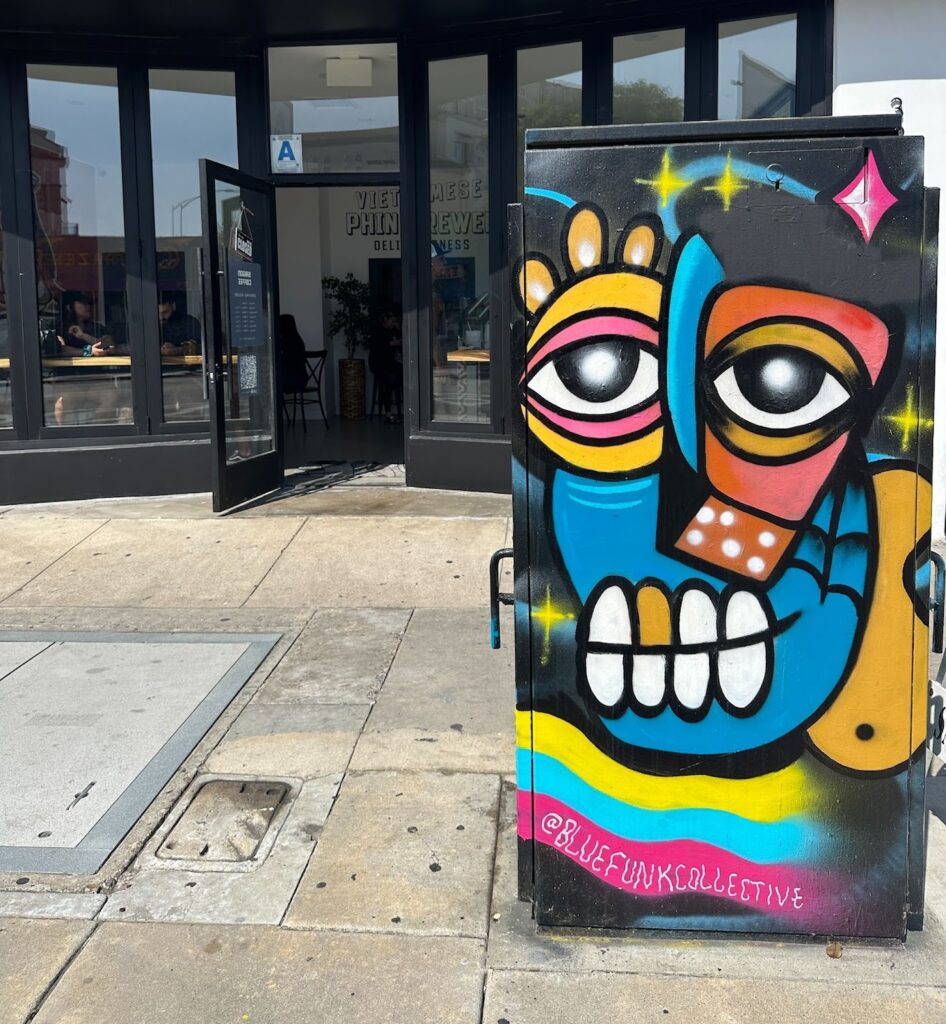
If there was one neighborhood where utility box murals were guaranteed, it’s North Park. This ultra-hip, ultra-artsy community is home to dozens of these miniature masterpieces, including three by artist Collin Vowels, who goes by the name Blue Funk. His bold palette and signature eyes that appear across most of his work are unmistakable, even on a small scale.
“I’m partially colorblind, so I like using vibrant colors that are easy for me to see,” he said. “I like to paint stuff without a full-on idea and just let creativity take over and see what comes out of it.”
To see pieces by Blue Funk and other local creatives, head down to 30th Street. Between Gunn Street and El Cajon Boulevard, you’ll find a mix of alien-like creatures, abstract shapes, and positive messages. You can also veer off down University Avenue in either direction to hunt for more eye-catching designs.
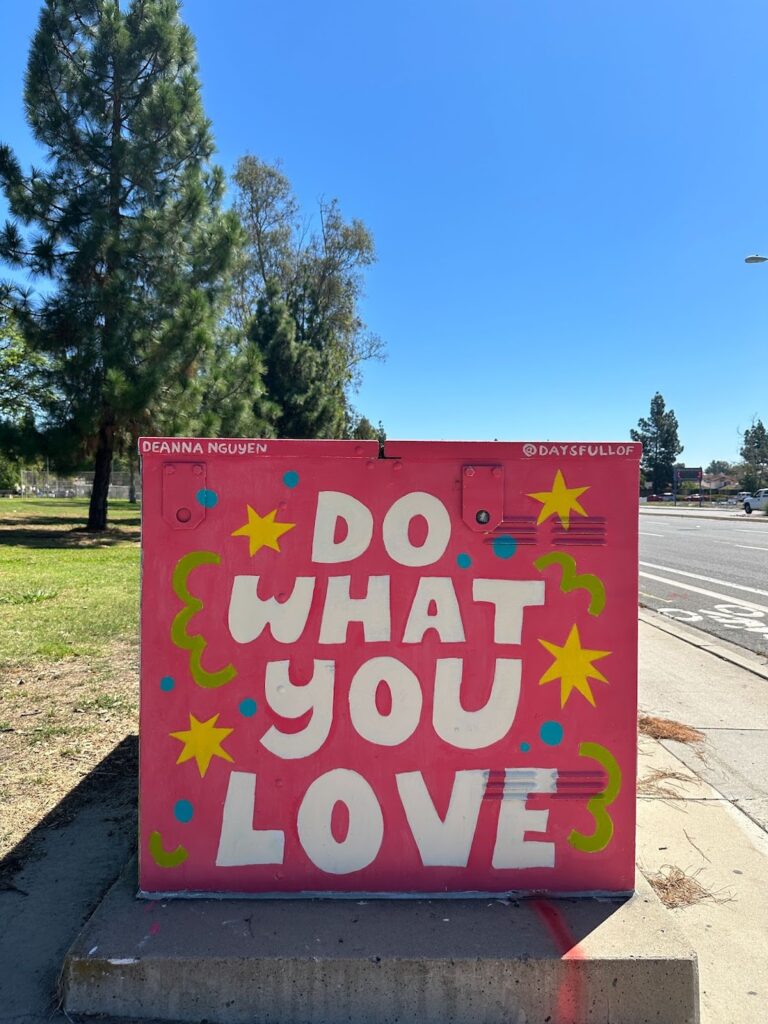
Drive a little further inland, and you’ll find a substantial collection surrounding Mira Mesa Community Park. Walking the loop from Mira Mesa Boulevard to Camino Ruiz puts you on the path of many whimsical designs. The above piece created by artist Deanna Nguyen was her first-ever foray into mural painting, making me an even bigger fan.
“When I was younger, I used to really love doing crafts and being creative,” she said. “I think when you grow up, there’s not a lot of space for that. Over the past few years, I’ve been trying to reconnect with that sense of play.”
So, she set a New Year’s Resolution in 2023 to do one public art piece. That goal just so happened to coincide with local art teacher Leo Angelo Reyes’ ongoing effort to beautify local streets via the Public Art Committee of the Mira Mesa Town Council. He’s responsible for both organizing these roadside museums and painting some one-of-a-kind utility boxes himself. His little library across the street from the actual Mira Mesa Library is my personal favorite.
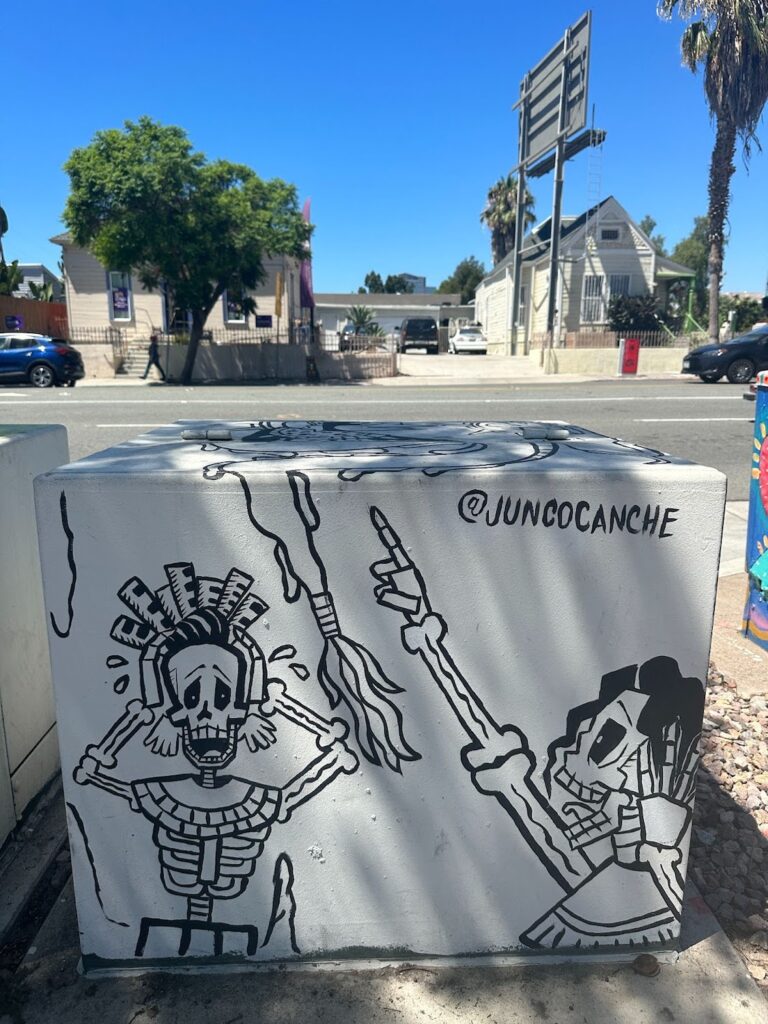
We can’t have a conversation about street art without mentioning Barrio Logan. While you’ll definitely subject yourself to multiple sky-high murals in this mecca of public self-expression, keep your eye out for those smaller gems—especially considering the big names behind them.
Amongst the mini sidewalk gallery that lies at the intersection of Cesar E. Chavez Parkway and Newton Avenue, you’ll find the above black and white piece by political cartoonist Joaquin Junco Jr., A.K.A., Junco Canché. His heavy-hitting statements on current events, history, and contemporary pop culture were a mainstay of the now-defunct San Diego Free Press and the Latino news satire magazine Pocho.
While he’s been somewhat off the grid for the past couple of years, his Twitter account says that he still works as an assistant cartoonist for Lalo Alcaraz. Alcaraz is an award-winning editorial cartoonist from San Diego who created the syndicated daily comic strip “La Cucaracha.”
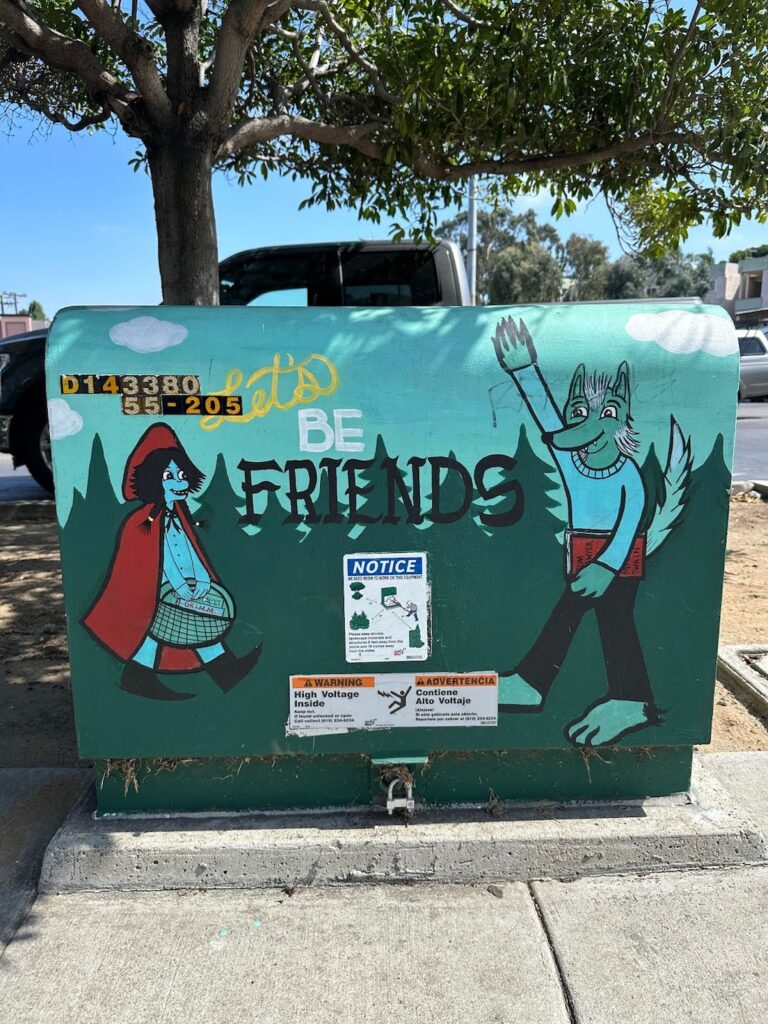
There are quite a few parrot- and sunset-themed utility boxes dotting the blocks down this bustling road, which is to be expected when you’re in OB. But as you make your way past the unofficial Point Loma neighborhood line (which I personally believe to be Nimitz Boulevard), the themes become more and more whimsical. Artist Mackie Mason’s reimagined fairytale is one standout example.
Commissioned by the Point Loma Association—which is responsible for funding 50 transformer box murals in the neighborhood—the goal of her piece was to align with the Point Loma/Hervey Library across the street. So she took the classic, slightly morbid tale of Little Red Riding Hood and gave it a new ending: Little Red and the Wolf bond over books, share the cookies, and become best friends.
“I wanted to include a positive message for all the kids in the neighborhood since a ton of kids walk past this box on their way to and from school,” Mason said. That message? “Despite their differences in the story, these two [characters] could still be friends.”
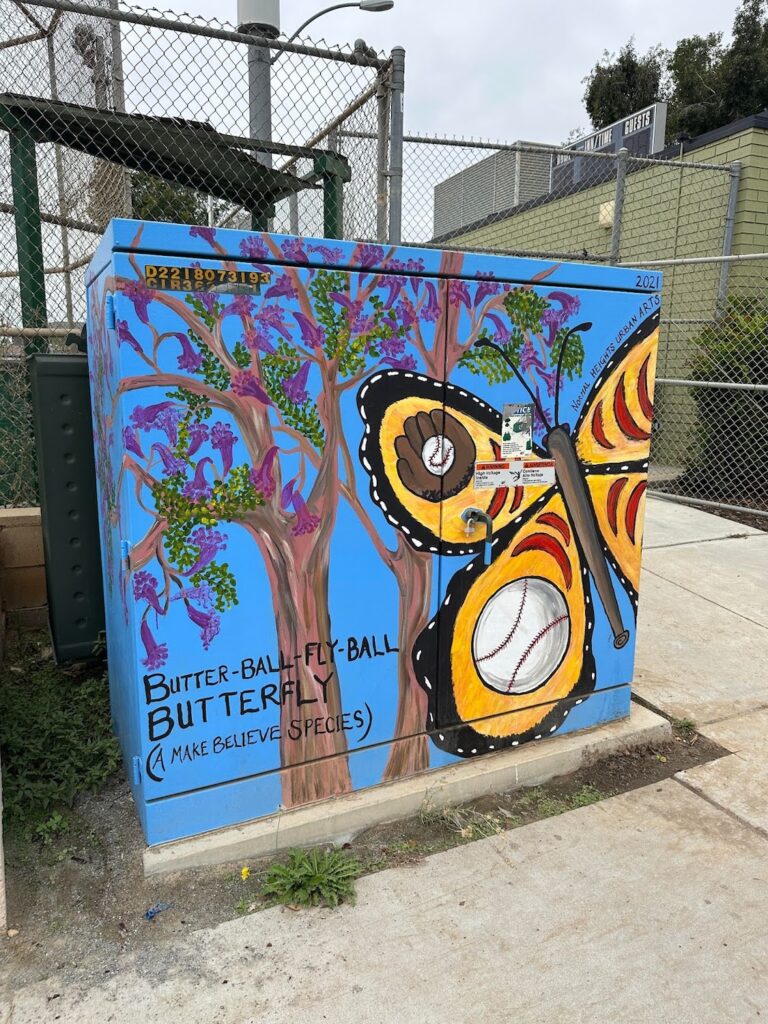
Anyone who’s walked down Adams Avenue has likely stumbled across at least one utility box-turned-canvas. From the intersection at Marlborough Drive in Kensington all the way until the road dead-ends in University Heights, you’re bound to find multiple murals that embody the unique personality of whichever neighborhood you’re in. But you’ll find an especially large flurry of eye-catching pieces in the center of it all: Normal Heights.
Not every San Diego community is fortunate enough to have a fervent group of people dedicated to creating and maintaining public art. But Normal Heights does—and it shows. Normal Heights Urban Arts is a volunteer organization that’s been bringing together local artists to literally paint the town red (amongst other colors) since 2016.
This collective is responsible for projects like the utility box butterfly garden that surrounds the Adams Recreation Center, as well as many others throughout the neighborhood. They’re currently expanding the project by installing a mosaic mural titled “Kaleidoscope of Butterflies” on one of the center’s exterior walls, which should be completed this year.
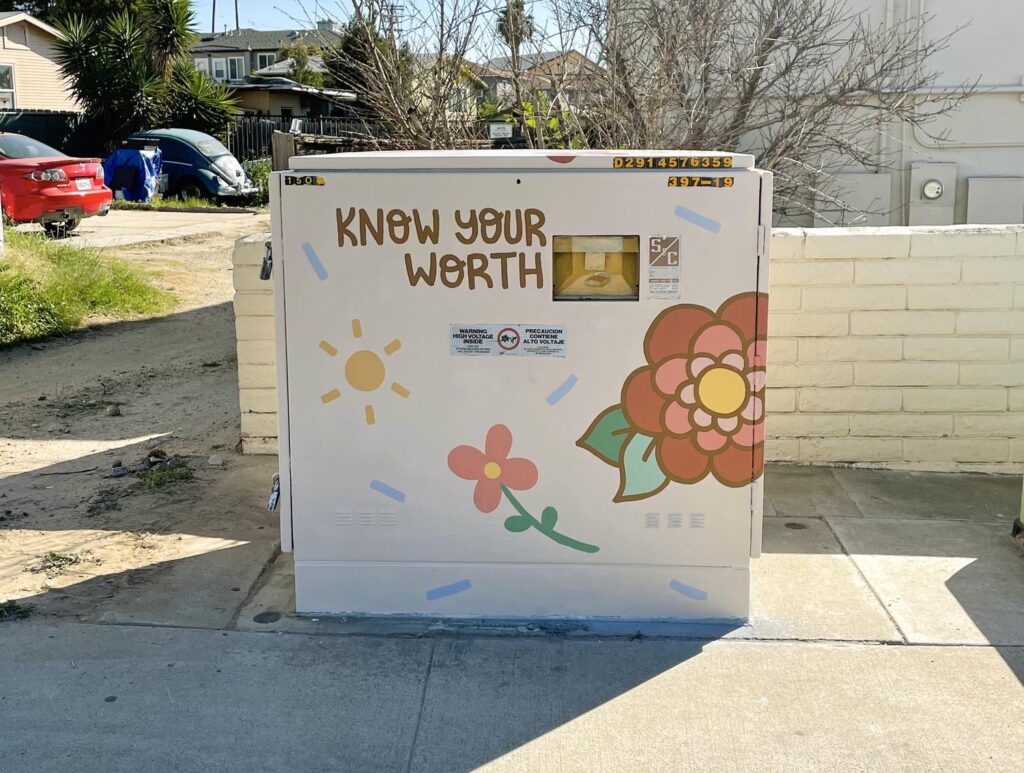
Aptly nicknamed the “jewel of the hills,” La Mesa is unsurprisingly home to many utility box gems. They’re a little more spread out than other neighborhoods, but they seem to be strategically placed on University Avenue as a way to brighten the day (and the commute) of anyone who passes by. At least that’s the case with artist Becca Dwyer’s trio of floral-themed pep talks that sit in front of La Mesa Lumber & Hardware.
“I wanted it to be short so people could kind of glance over while they were driving,” she said, adding that the mural was inspired by a sticker she designed. She even handed out a few to people who walked by while she was painting.
Though Dwyer has always been artistic, it wasn’t until she got laid off from her job during the COVID-19 pandemic that she got into mural painting. She used her first utility box in Vista as a way to get comfortable with the uncomfortable practice of putting yourself out there—and it worked. “When I was painting, I got several ‘good jobs’ or ‘I love it’ as people were driving by,” she said. “It was like an immediate positive impact.”
For as many utility box murals as I came across, there were just as many blank canvases awaiting their transformation. If you have an idea in mind for one of these mini-murals, look into your neighborhood’s business improvement organization.
These groups are responsible for taking care of the maintenance, beautification, and growth of certain commercial corridors. If you want to commission a piece or get involved in their murals program, they’re the ones to contact first.
Outside of neighborhood approval, Dwyer says the only other person you need to give permission to is yourself. “If you see an ugly utility box in your town, you can paint it,” said Dwyer, who has a step-by-step guide on her blog. “You don’t have to be a renowned artist. You just have to fill out an application.”

Emily Blackwood is a freelance journalist based in San Diego, CA. She covers entertainment, wellness, travel, home, food, culture—all the things that make life interesting, tantalizing, and just the right amount of weird. Her work has been published in SELF, HuffPost, and YourTango. You can learn more at emily-blackwood.com.
Whether you love theater, music, dance, or public art, these are the cultural experiences that stood out this year
Arts District Liberty Station officially became one of the state’s designated cultural districts, joining a list reserved for places with thriving creative communities. Considering the campus is home to more than 100 galleries, artist studios, museums, and arts organizations—not to mention The Joan, the 42,000-square-foot performance center housing Cygnet Theatre—it was only a matter of time until the district got its flowers.
If you can’t beat ’em, join ’em. The National City Public Works building has been a target of graffiti artists for years, only to be constantly painted over (and the cycle restarts). Now, it’s working with the local artists from Vision Culture Foundation to create intentional public murals. A win-win in our book.
One of the biggest questions this year is who will show up for San Diego arts and culture—so a Best Of nod goes to a nonprofit that’s been doing it for years. Founded by longtime arts advocate Susanna Peredo Swap, Vanguard Culture has staged events for creatives, told their stories, and just created an SD ARTS Pass—a single ticket that gets you access to 39 creative spots.

Ballet’s already got a sort of otherworldly thing going for it, with people morphing into 90-degree angles and defying gravity with each pirouette. The Rosin Box Project feels like a raw, creative new force in the classic art form, though—especially with its annual Ghost Light Masquerade. It’s a dance of eerie spirits that makes you second-guess what’s real and what’s not.
Once upon a time, Gallagher Square was just a grassy knoll behind the outfield wall at Petco Park. Now, it’s a concert venue, playground, play ball field, dog park, and unofficial home for those who prefer the vibe of baseball more than the actual game. Big-time performers are showing up: Ms. Lauryn Hill, Cypress Hill, and Peach Pit.
Casa Casillas has filled a long-standing gap in Chula Vista’s art scene. Open since last August, the space gives local artists a dedicated venue to display their work and visitors a chance to explore the neighborhood’s vibrant art. Two rotating resident artists always keep the space moving, so it rarely looks the same twice.

El Cajon translates to “the box” in Spanish—a nod to the city’s surrounding hills—but Alley Cat Art Fest (previously called Artivál) doesn’t stay inside it. As the first arts festival in East County, it celebrates local galleries, sculpture, live music, and food trucks—the whole nine.
Every second Saturday, Barrio Logan turns into a choose-your-own-adventure with the Barrio Art Crawl, a free self-guided art tour through galleries, museums, and murals, with street food and music filling in the gaps. Barrio is one of the city’s most thriving arts neighborhoods, and it’s worth getting a bit lost in.
MCASD is showcasing two powerhouse exhibits—Giants: Art from the Dean Collection of Swizz Beatz and Alicia Keys and The Dean Collection Presents: Hometown Heroes. The pop music titans are highlighting local artists, with an intentional focus on diverse experiences. It was one of the biggest (and coolest) art openings of the year, and it closes August 9. So get on it.
Leave it to The Old Globe to give the local theater scene some Hollywood glamour. Katie Holmes led the premiere of Henrik Ibsen’s Hedda Gabler this past spring, turning the classic Norwegian play into one of the most buzzed-about theater productions of the year.
We the Commas are mixing surf, soul, alternative rock, and sibling chemistry into one unmistakable sound
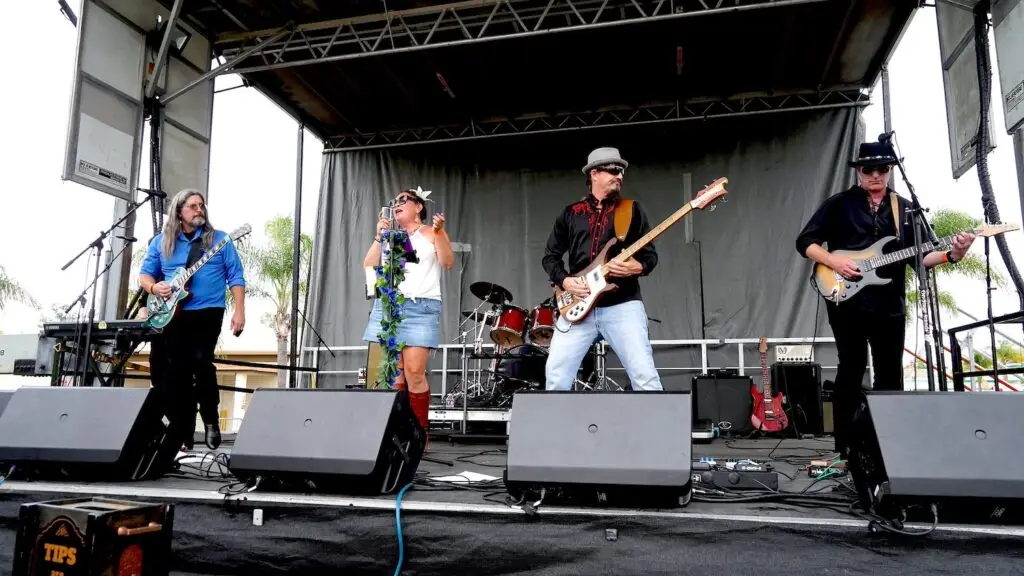
Siblings make better music. That’s the hot take, and there’s some logic and science behind it. The Bee Gees, Jackson 5, Billie Eilish and Finneas, AC/DC, Van Halen, The Allman Brothers—heck, even the Hanson brothers, why not? Beyond just a shared sense of taste and nonverbal communication developed over decades of living and evolving together, there’s a thing called “blood harmony.” The genetically similar throat cavities, vocal cords, speech patterns, and resonant bone structures all blend each unique voice into a more homophonic sound than what comes out of two non-related singers.
Those throat cavities are working wonders for emerging San Diego band We the Commas—three brothers (from oldest to youngest) Lenny, Jordon, and Cam Comma.
Raised in Vista and Carlsbad, the family opted out of cable TV (video games got a pass). Without binge-watching to fill bored hours, the trio turned to music. Guitar Hero led to GarageBand and finally to live instruments—guitars for Lenny and Cam, drum set for Jordon. In their sound, the influence of Stevie Wonder, Erykah Badu, The Who, and Dave Matthews Band is obvious, and so is surf culture, specifically that laid-back chill of North County surf culture.
“We’re like the Black Beach Boys,” Cam says. (Note: Three of the five founding members of the Beach Boys were siblings—the theory gets stronger.)
Their debut EP pretty clearly lays out how they see their sound—titled SARB, an acronym for Surf Alternative R&B. That resonates in the song “Sherry,” with its easy-listening, windows-down-on-the-101 vibe. It also works in the louder, surf-punkier “Pissed Off.” Despite some advances in reducing core stereotyping tendencies, people still tend to autofill Black musicians into rap and R&B. The Comma brothers immediately circumvent that by declaring themselves out the gates.
“SARB makes it so [listeners are] open to all of the things that we want to do,” Lenny says. “From there, you can put a label on whatever you think it sounds like.”

People—and musicians further up the stream—are taking note. In 2023, they co-wrote the song “I Keep Fallin’” with Eric Cannata, guitarist for multi-platinum SoCal band Young the Giant. In early 2024, they were tapped to open the national tour of Brooklyn’s jazz-pop heroes, Sammy Rae & The Friends. Comedian Gabriel “Fluffy” Iglesias invited them to warm up his show at Pechanga a couple months later.
“We really believe genuinely, with our whole hearts, minds and souls, that this is going to work the way that we think it’s going to,” Cam says, grinning ear to ear.
Currently, the Commas live together in Vista, and the dream, wholeheartedly, is more alive than ever. They’ve put out two dozen singles and a trio of EPs: SARB (2020), Old School Love (2021), and Aeroplane (2024); this year alone brought the release of three new singles, including “Let Me,” a silky-smooth entry in their growing collection of love songs.
“We fully realized the magic is in all of us together,” Lenny says. “We know that this doesn’t happen without each person, and we have respect for each other because we need each other.”
As they grow as brothers and as a band, the Commas try to always remember what unified them in the first place.
“Music has always been a glue,” Jordon says.
Ryan Hardison is a freelance arts and entertainment writer and recent graduate of San Diego State. When he's not staring at his laptop, he's likely eating an adobada burrito or getting sunburnt at the beach.
The San Diego designer has created more than 3,000 concert posters over nearly 40 years for artists including the Rolling Stones and the Red Hot Chili Peppers
Let’s start with his name.
No, not his birth name, Craig McKenzie Haskett.
Scrojo.
When he was in high school, he and his friends were trying to come up with the perfect name for their punk band that would encapsulate all their personas. Nicaragua. The Freds.
One of his friends said he was going to go by Jimmy Stacks and called it “the perfect rock and roll name.” Their names changed so much that Haskett erupted: “Fine, I’m f—ing Scrotum Joe, the true defender of the Open West.”
Their response: Wow, that’s a great name.
As a teenager, he drew chalkboards for Del Mar’s Pannikin coffee shop and would design T-shirts for surf/skate brand Life’s a Beach. He signed the shirts with his moniker, but even in punk rebellion, who wants a shirt with the words Scrotum Joe on it? “They just cut out the ‘t-u-m,’ and the next thing you know, a client referred to me as that, and it stuck,” he says.

Scrojo could have been part of a band as iconic as The Misfits—had he been able to learn the famously cumbersome bassline to The Kingsmen’s “Louie Louie.” Becoming one of the most renowned concert poster designers—someone who quite literally designed the cover of Art of Modern Rock: The Poster Explosion—is a pretty good Plan B.
“To my knowledge, he’s done more rock posters than anybody else alive,” says Dennis King, whose D. King Gallery in Berkeley, California, serves as one of the largest private rock poster collections in the world. “He’s the hardest-working guy in the poster business.”
King not only co-authored the sequel to music historian Paul Grushkin’s The Art of Rock, but he also handles distribution and sales for all of Scrojo’s work. That’s more than 3,000 different posters over nearly 40 years. (That’s over one poster each week. For four decades straight.)
For anything from boxing matches to rodeos, posters have long been used as promotional items. Toulouse-Lautrec’s famous lithographs advertised Moulin Rouge in the late 1800s. Around the same time, Hatch Show Print in Nashville was making handbills for the Grand Ole Opry.
“I propose this: Cave paintings are the first poster art,” Scrojo says.

Rock and roll posters took off in the 1960s, when the hippie counterculture era replaced conformity and suburbia. Artists like Jimi Hendrix and the Grateful Dead used their vibrant, psychedelic prints as a form of rebellion from the mainstream. Posters were promotional, commemorative, collectible, and especially expressive.
If the name Scrojo is any indication, he doesn’t shy away from imagery that toes the line of being too provocative. He focused more on what inspired him instead of trying to be offensive for the sake of getting attention.
“Didn’t want to show it to my grandmother, but my parents were fine with it,” Scrojo says with a laugh.
“We’ve had to ask him to put a Band-Aid over a nipple every now and then,” says Chris Goldsmith, president of Belly Up Tavern in Solana Beach, where Scrojo started out and hundreds of his posters currently line the walls.
Scrojo spent six weeks at Otis College of Art and Design for a summer semester before drugs, alcohol, and a self-described lack of discipline prevented him from enrolling full time. Still, he taught himself concepts like text hierarchy and later found his niche at the Belly Up and in the surfing and skating world, working with brands like Quiksilver, Rip Curl, Scorpion Bay, and DGK.
His first concert poster was for North County band Borracho y Loco, of which Goldsmith was bass guitarist. Scrojo drew an abstract version of the Belly Up’s iconic shark with colorful calypso and tiki themes.
Early on, he would craft using a pencil, pen, non-reproduction blue pencil, X-Acto knife, rubber knife, and proportion scale to create each poster, and the finished product could take a week or even longer.

“I recommend every artist coming up to do that for like six weeks,” Scrojo says. “It forces you to think about every design decision as you’re going along.”
He has since mastered vector imagery through Adobe Illustrator to the point where, depending on the level of detail needed, he could finish two projects in a day. Still, he fills sketchbook after sketchbook to blueprint.
“I liked his line in particular, and he knows how to draw, which a lot of people don’t really know how to do these days,” King says.
Scrojo would research what each musician’s merchandise looks like to get a feel for each artist’s tone and voice. Once he has his central image in mind, he focuses on what and where to place the text.
He doesn’t have one specific style, ranging his talents from art deco to psychedelic and everything in between (and outside the lines). Want a pop surrealist comic book cartoon devil with splattered paint textures, halftone dot patterns, and pure chaos? Red Hot Chili Peppers, February 1986. Want a minimalist graphic portrait with bold strokes and graffiti text? P!nk, October 2023. Want a carnival sideshow style piece with a tasteful caricature of Jeff Bridges? The Big Lebowski, August 2011.
Scrojo calls himself a jack of all trades because he can create posters for all music genres. King calls him a chameleon for his ability to adapt his voice to new eras.

“The variety of his skillset makes it possible for us to put 50 of his posters on a wall next to each other and have it look compelling, not just a bunch of the same thing over and over,” Goldsmith says.
Some of Scrojo’s favorite posters are when he feels a personal connection to the artist or the album. He has a vivid memory as a child of being trapped in a closet filled with marijuana leaves while playing hide and seek and staring at Jimmy Cliff’s “The Harder They Come” LP. “For whatever reason, as a kid, that sparked a desire to do graphic design,” Scrojo says.
Fast forward to February 2012, Cliff is performing at Belly Up. Scrojo decided to modify Cliff’s original album cover from rainbow gradient fills to classic reggae psychedelia while preserving Cliff’s striped pants and bold hat. Cliff’s manager called him and said they wanted to use it for the rest of their tour.
“We always get artists requesting that he does their posters,” Goldsmith says. “A lot of artists don’t want venues to go all rogue because they want to control how they’re being presented. With him, they’re like, ‘Let him go nuts.’”
Matt Eisenberg is an award-winning writer and photographer based in San Diego. A former ESPN editor, his work has also been published by CNN, Bleacher Report and the New York Daily News.
This month, the 2026 San Diego Business Impact Awards recognized local businesses making an impact in clean energy, biotech, hospitality, and beyond
Renewable energy companies building hundreds of power plants. Biotech startups using artificial intelligence to create personalized medicine for children with rare diseases. Hospitality companies quietly powering thousands of local events. Consumer brands growing from beach-town startups into national businesses. These are the kinds of companies driving San Diego’s economy today, and the businesses recognized at this year’s San Diego Business Impact Awards offer a snapshot of where the region is headed.
Hosted July 23 by San Diego Regional Economic Development Corporation (EDC) and JPMorganChase, the second annual awards event honored four local companies for innovation, growth, and economic impact. More than 100 nominations from San Diego’s middle-market businesses were reviewed by a 10-person judging committee, with winners selected across four categories: startup, early-stage innovator, rising star, and established heavyweight.
Two-time honoree Jimbo Someck, founder of Jimbo’s organic grocery stores, also joined the event for a fireside chat on buying local, supporting emerging brands, and giving back to the community.
“San Diego’s strength comes from its makers and builders—the resilient people who endure great risks and overcome obstacles to build and scale a company,” says Aaron Ryan, San Diego Region Manager and Middle Market Banking at JPMorganChase & Co. “These awards aren’t just recognition; they spotlight the talent, grit, and innovation shaping our region’s future. By celebrating those who create and build, we foster connections and fuel the growth that keeps San Diego thriving.”

Heavyweight honoree SOLV Energy has grown alongside the country’s rapid investment in renewable power. “It’s an exciting time for SOLV Energy as we are experiencing significant growth,” says CEO George Hershman. “The business has doubled over the last year and has almost double-digit growth since its inception.”
The Rancho Bernardo-based company designs, builds, operates, and maintains utility-scale solar and energy storage facilities. Since its founding in 2008, SOLV Energy has built more than 500 power plants.
Growth has translated directly into hiring. About 200 employees work from the company’s local headquarters, including roughly 20 interns. “Our intern program is a big part of the way that we grow our workforce,” Hershman says. “Last year, 43 percent of our interns became full-time employees. We believe San Diego is a great community to build and grow a high-tech infrastructure and technology company because of the incredible workforce—the ability to attract top talent and draw from world-class universities.”

Startup honoree La Jolla Labs is tackling one of medicine’s biggest challenges by developing personalized RNA therapeutics for patients with rare diseases—many of them children with neurological disorders like ALS. Using proprietary artificial intelligence and machine learning tools, the biotech company develops treatments tailored to each patient’s specific genetic mutation.
CEO Tamar Grossman says the recognition reflects how far the company has come despite limited resources. “We’re honored to be recognized for our ability to change and save patients’ lives and turn our lean startup into a clinical company with very minimal resources,” she says.
Grossman credits San Diego’s concentration of research institutions—including UC San Diego, the Salk Institute, and Scripps Research—with creating a pipeline of talent and collaboration. “San Diego is one of the world-leading centers for technology, genomics, and RNA therapeutics,” she says. “We have over 30 RNA therapeutics companies here, and we support each other and help with anything related to drug discovery.”
She says that collaborative spirit extends beyond formal partnerships. “You can walk around Torrey Pines, go into a café, and find colleagues from the industry and have an ad hoc conversation,” Grossman says. “That’s something very unique to San Diego.”

While Snake Oil Venue Company may not be a household name, chances are many San Diegans have attended one of its events. The early-stage innovator honoree has expanded from beverage catering and mixology consulting into venue management, operating Julep Venue in Mission Hills, Bramble Bay Venue in Imperial Beach, Vesper Venue, the Chapel at Liberty Station, and five outdoor venues throughout Liberty Station—more than 500,000 square feet of event space altogether.
“We do a lot of launch parties for corporations and new products,” says CEO Mike Esposito. “I really like working on the entrepreneur side of things, where new businesses are entering the San Diego market and looking to make a splash.”
Snake Oil has executed more than 16,000 events, employed more than 1,000 people, and partnered with more than 900 local vendors, including caterers, florists, photographers, entertainers, and other hospitality businesses. The company also works with many of San Diego’s nonprofits, museums, and cultural institutions. “We get to celebrate people’s most important moments,” Esposito says. “Whether that’s a wedding, celebration of life, or quinceañera, we’re fortunate to be involved in the community in so many different ways.”

Rising star honoree ALOHA Collection is proof that a simple idea can grow into a thriving company. Founded by two roommates who wanted a better way to carry wet swimsuits after a day at the beach, the lifestyle brand has grown into a business while maintaining strong year-over-year growth.
Now headquartered in Carlsbad, ALOHA Collection employs more than 100 people and operates its California flagship store in Encinitas, which is slated for a remodel. With roots in Hawaii, the company is known for its lightweight, splash-proof travel bags that have become a familiar sight on beaches in San Diego and beyond.
“‘Aloha’ is part of our name, but it’s also how we move through the world,” says CEO Lynna Barnard. “It’s how we show up for people, the way we travel, the way we give back.” Since day one, the company has maintained a 5 percent giveback to Hawaii conservation efforts, contributing millions of dollars over the years.
“I think what’s so inspiring about ALOHA Collection, and the founders in particular, is when you dream big, those dreams can come true when you work hard and trust in the universe,” Barnard says. “It’s inspiring to be a role model for other people wanting to start businesses from humble beginnings. Start small and watch it grow.”
Together, businesses like these form a cornerstone of San Diego’s economy—not only through the jobs and revenue they generate—but through the local workers they hire, vendors they support, and investments they make in the region. Their growth doesn’t happen in isolation; it ripples outward, strengthening the broader business community and the people who call San Diego home.

See Rosalía in concert, stroll through Little Italy for Summer Sera, and dress up for Comic-Con
Summer has officially kicked off, and San Diego is celebrating the sunny season with a myriad of fun events. From San Diego Pride week and a fairytale performance at Civic Theatre to a Santigold concert and Comic-Con, there are dozens of opportunities to make memories worth adding to your scrapbook. Here are all the best things to do in San Diego this July:
Concerts & Festivals | Theater & Art Exhibits | More Fun Things to Do
Divine inspirations, operatic ballads, and symphonic pop production elevate Rosalía’s Lux to heavenly levels. Hear angelic vocals ascend—in up to 13 languages—during her performance at Pechanga Arena.
Enjoy a night of feel-good indie rock and sing-along anthems at the Cal Coast Credit Union Open Air Theatre courtesy of Young the Giant and special guest Cold War Kids.
Santigold collects genres like gold stars: musical accouterments that brighten her uniquely alternative sound. See her live in concert with dancehall producer Troy Baker Sound at Humphreys Concerts by the Bay.

Be the Civic Theatre’s guest for “Beauty and the Beast” and discover that a fairytale love sometimes lies beneath the surface.
Two male government workers pursue a secret romance amid the Lavender Scare in the San Diego Opera’s production of “Fellow Travelers” at the Balboa Theatre.
The deep blue sea is home to countless ecological treasures, including the remarkable marine organisms documented by Oriana Poindexter. Study her educational and experimental imagery at The Photographer’s Eye via Field Notes.
Audrey Hepburn. Marlon Brando. Salvador Dalí. What do these icons have in common? Each was the enigmatic focus of a Cecil Beaton portrait. Step inside Cecil Beaton’s Fashionable World, an alluring showcase of 20th-century style at San Diego Museum of Art.

The Little Italy Mercato will trade morning rays for golden-hour glow through its free Summer Sera, an expansion of the neighborhood’s farmers market with live music, artisanal finds, and a fetching amount of pet activities.
San Diego Pride week starts with a Dyke March and ends with the two-day “Pride Shines On” festival. The days in between? Run a 5K, march in the parade, visit the rainbow-lit St. Paul’s Episcopal Cathedral, and more.
Dress up for a Mediterranean-themed tea time at the Estancia La Jolla, a laid-back yet refined afternoon planned for the resort’s monthly Tea in the Garden series.
Nerd culture’s biggest gathering returns to the Convention Center. San Diego Comic-Con welcomes fans of everything from comic book cinema to ultra-rare collectibles for panels, exhibits, sneak peeks, and much more.
Ryan Hardison is a freelance arts and entertainment writer and recent graduate of San Diego State. When he's not staring at his laptop, he's likely eating an adobada burrito or getting sunburnt at the beach.
That's the question at the center of a new collaborative arts initiative launching this September, celebrating the artists, performers, designers, and makers shaping the region
You may not know his name, but if you were one of the millions of people who traveled in and out of Terminal 2 at San Diego International Airport in 2024, you’ve seen his work. David Mont Virgen was born and raised in Tijuana. He earned a degree in international business and studied interior design in Madrid. In early 2020 during the global pandemic, he made one of life’s impactful pivots and decided to pursue art full time.
David works between San Diego and Tijuana, in the cross-border corridor that is, depending on who you ask, either one of the most complicated places to build a life or one of the most generative creative regions in the country. He makes minimalist work—paintings, sculpture, objects. To do minimalism well, you have to be very good, because there is nowhere to hide. That airport piece? It’s officially entered the permanent collection of the San Diego Museum of Art. David is very good.
While his work was gaining real traction in San Diego, his marriage ended. When that relationship dissolved, the legal and physical ground beneath his feet shook: The future of his citizenship was now in limbo. David looked at his options and chose yet another life pivot.
An accomplished working artist with a piece in a museum’s permanent collection enlisted in the U.S. Army, at a time when this country is at war. David describes this period of his life with grace, as “…an opportunity to choose myself and move forward with greater clarity and intention. For the love of self.”
That phrase, “For the Love of Self,” became the title of his show, which opened at the Guild Hotel in January 2026 with support from Oram Hotels and the Consulate General of Mexico in San Diego. Jennifer Findley of JFin Collective led the curation. Within weeks of the show’s debut, David shipped off to train with the army. It would be easy to read his enlistment as purely practical, and citizenship was part of his calculus, but he is precise about his reasons: He wants to continue building a future in this country and building a future for this country. Because service, he says, feels connected to art. “Both are rooted in the belief that we are responsible for contributing something larger than ourselves.”
David is one creator out of many whose story hasn’t yet been told, but whose path reflects the world we live in. The truth he represents is that the artists in this city are creating under increasingly challenging constraints even as their work actively shapes the world we move through—the places we gather, the neighborhoods we love and live in—whether we know their names or not.
It’s time their stories are told.
This fall, we’ll be publishing an ambitious arts and culture issue made possible by the support of two organizations who are underwriting an expanded freelance budget with one question at its center: Who makes San Diego, San Diego?
The Art & Design District—a Prebys-supported initiative to develop and shape a dedicated area of the city for creative work, led by Jonathan Glus—has joined as co-publisher of our September issue. SDFC Playmakers led by Sebastian Morúa, the MLS team’s program dedicated to showcasing San Diego’s creative community, has also joined as digital co-publisher for the next six months.
With their support, our freelance budget has tripled. In the spirit of radical transparency, and because our readers deserve to know how our work is funded, our typical monthly print freelance budget is about $6,000. That supports writing, photography, and design across more than 100 pages. Our monthly digital budget is $2,500.
With the support of our co-publishers, we’ve brought on Aaryn Belfer, one of San Diego’s most respected editorial voices, as the issue’s special editor. Alongside Troy Johnson, content chief; and Emma Veidt, editor; she is helping shape the editorial vision of the issue.
With an expanded team, we’ll soon bring on a digital producer and an additional art designer. We’ll produce an expansive portrait of the artists, makers, performers, and institutions defining this region’s creative life, commission original photography, and create a comprehensive fall arts and culture calendar. The issue will anchor a six-month editorial program that will extend across digital, social media, video, podcast, and newsletters through early next year.
We have been doing this for 78 years, and we have learned how to do it well with limited resources. But the conversation happening in San Diego right now—about the role arts and culture play in shaping a city and the role a city plays in shaping arts and culture—is one that demands more than what our standard monthly budget can produce. Until now.
This partnership model is new to us but the challenges that precede it are not new to media, particularly on the local level. And yet, this collaboration serves as real proof that civic organizations and local media can work together to document and preserve the story of a place and the people who make it, for the record.
David told me that San Diego gave him a sense of belonging. That he felt supported and encouraged to keep growing. Not because life got easier, but because he learned to trust himself through uncertainty.
Today, he’s somewhere in basic training. But he is still an artist and he will keep making work. The artists in this city are almost never just one thing. They are painters and soldiers, sculptors and teachers, dancers and mathematicians. David is a minimalist artist and a U.S. Army recruit. He is Tijuana and San Diego. He is, in the most literal sense, still becoming.
A great city knows its makers. I want San Diego to be that city.
September is on newsstands soon.
Hypertension is the leading cause of cardiovascular disease and premature death in women
It’s estimated that 44% of women in the U.S. have high blood pressure, also known as hypertension, but many don’t know it. The disease often has no symptoms, and when symptoms do present, they can appear similar to many other conditions. High blood pressure increases the risk for heart disease and stroke, so it’s critical that it’s detected and treated early. And for women at risk of developing high blood pressure, prevention is key. Click here for the basics of high blood pressure and how Scripps physicians at Scripps use screenings not just as a diagnostic tool, but as part of routine preventive care.
For more nutrition, wellness, and healthy living tips, sign up for the San Diego Health newsletter here.