Featured articles
Food & Drink
Food & Drink
Food & Drink
Featured articles
Everything SD
Everything SD
Features
Featured articles
Things to Do
Things to Do
Everything SD
Featured articles
podcast-ep
podcast-ep
podcast-ep
Featured articles
Features
Features
Features
Featured articles
Things to Do
Things to Do
Charitable SD
Ready to know more about San Diego?
SubscribeReady to know more about San Diego?
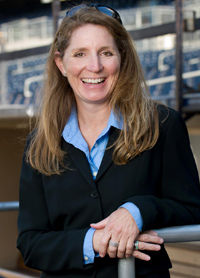
Senior Vice President, Public Affairs San Diego Padres
Sarah Farnsworth
Barney & Barney G.R.O.W. logo
geneenm
How did you make the leap from Washington, D.C., to the Padres in San Diego? Tom Garfinkel, CEO of the Padres, asked me if I would consider working for a baseball team. I thought it was a joke. I didn’t know anything about baseball. After 19 years in D.C. I wanted the opportunity to become a part of a community, and that is what I saw in San Diego. It’s an opportunity for me to give back.
You are engaged to marry a retired Marine, and you have a young daughter. What role did they play in your decision to join the Padres? It was a family decision. We decided together. I was working in a job that really wasn’t a career. With the Padres I have a career where I can be challenged, and I am part of a civic asset. Since my fiancé is retired, he plays a big role in my daughter’s care when I have work demands.
How did you get involved in politics? I was living in New York when the Democratic National Convention was held there; 22 years old and just out of college, I volunteered at the convention. From there I was assigned to do advance for Hillary Clinton during Bill’s first run for president. That was 1992. When Bill won the presidency, I was asked to work on the inauguration in 1993. From there I went to work on the First Lady’s staff in the East Wing. I was responsible for planning all events in the Rose Garden, the South Lawn, and basically anything in the White House. And the Clintons were very active, with many events going on!
Tell me about your time in the White House. I worked seven and a half years and left to marry, but returned for the last six months at the end of the Clinton term. I celebrated my 30th birthday at the second Clinton inauguration.
Where did you work when you left the White House? I was chief of staff at the USO and traveled frequently to Afghanistan and Iraq. I was working in the world headquarters for then-General Jim Jones, who later became President Obama’s national security advisor. President Obama asked me to become senior advisor to the national security advisor, so that put me working in the West Wing of the White House. When General Jones resigned in 2010, I was asked to work in the Pentagon.
You spent so much time working for presidents in both wings of the White House. How did you keep your feet on the ground? I never thought of it as politics, but as being part of an historical institution. There was a plaque on the wall in the White House that I passed by every day. The bottom line was “one day you will be on the other side of the iron gate.” That puts it in perspective.
What challenges have you faced? After being to Iraq and Afghanistan, challenges take on a different meaning. As long as my family is healthy, I don’t have any bad days.
What adjustments did you have to make when you joined the Padres? I have had to earn trust and credibility in a whole new profession, I had to learn baseball, and I have had to earn trust in the community.
What is in your future? I’m here with the San Diego Padres as long as they will keep me.
.
This month, the 2026 San Diego Business Impact Awards recognized local businesses making an impact in clean energy, biotech, hospitality, and beyond
Renewable energy companies building hundreds of power plants. Biotech startups using artificial intelligence to create personalized medicine for children with rare diseases. Hospitality companies quietly powering thousands of local events. Consumer brands growing from beach-town startups into national businesses. These are the kinds of companies driving San Diego’s economy today, and the businesses recognized at this year’s San Diego Business Impact Awards offer a snapshot of where the region is headed.
Hosted July 23 by San Diego Regional Economic Development Corporation (EDC) and JPMorganChase, the second annual awards event honored four local companies for innovation, growth, and economic impact. More than 100 nominations from San Diego’s middle-market businesses were reviewed by a 10-person judging committee, with winners selected across four categories: startup, early-stage innovator, rising star, and established heavyweight.
Two-time honoree Jimbo Someck, founder of Jimbo’s organic grocery stores, also joined the event for a fireside chat on buying local, supporting emerging brands, and giving back to the community.
“San Diego’s strength comes from its makers and builders—the resilient people who endure great risks and overcome obstacles to build and scale a company,” says Aaron Ryan, San Diego Region Manager and Middle Market Banking at JPMorganChase & Co. “These awards aren’t just recognition; they spotlight the talent, grit, and innovation shaping our region’s future. By celebrating those who create and build, we foster connections and fuel the growth that keeps San Diego thriving.”

Heavyweight honoree SOLV Energy has grown alongside the country’s rapid investment in renewable power. “It’s an exciting time for SOLV Energy as we are experiencing significant growth,” says CEO George Hershman. “The business has doubled over the last year and has almost double-digit growth since its inception.”
The Rancho Bernardo-based company designs, builds, operates, and maintains utility-scale solar and energy storage facilities. Since its founding in 2008, SOLV Energy has built more than 500 power plants.
Growth has translated directly into hiring. About 200 employees work from the company’s local headquarters, including roughly 20 interns. “Our intern program is a big part of the way that we grow our workforce,” Hershman says. “Last year, 43 percent of our interns became full-time employees. We believe San Diego is a great community to build and grow a high-tech infrastructure and technology company because of the incredible workforce—the ability to attract top talent and draw from world-class universities.”

Startup honoree La Jolla Labs is tackling one of medicine’s biggest challenges by developing personalized RNA therapeutics for patients with rare diseases—many of them children with neurological disorders like ALS. Using proprietary artificial intelligence and machine learning tools, the biotech company develops treatments tailored to each patient’s specific genetic mutation.
CEO Tamar Grossman says the recognition reflects how far the company has come despite limited resources. “We’re honored to be recognized for our ability to change and save patients’ lives and turn our lean startup into a clinical company with very minimal resources,” she says.
Grossman credits San Diego’s concentration of research institutions—including UC San Diego, the Salk Institute, and Scripps Research—with creating a pipeline of talent and collaboration. “San Diego is one of the world-leading centers for technology, genomics, and RNA therapeutics,” she says. “We have over 30 RNA therapeutics companies here, and we support each other and help with anything related to drug discovery.”
She says that collaborative spirit extends beyond formal partnerships. “You can walk around Torrey Pines, go into a café, and find colleagues from the industry and have an ad hoc conversation,” Grossman says. “That’s something very unique to San Diego.”

While Snake Oil Venue Company may not be a household name, chances are many San Diegans have attended one of its events. The early-stage innovator honoree has expanded from beverage catering and mixology consulting into venue management, operating Julep Venue in Mission Hills, Bramble Bay Venue in Imperial Beach, Vesper Venue, the Chapel at Liberty Station, and five outdoor venues throughout Liberty Station—more than 500,000 square feet of event space altogether.
“We do a lot of launch parties for corporations and new products,” says CEO Mike Esposito. “I really like working on the entrepreneur side of things, where new businesses are entering the San Diego market and looking to make a splash.”
Snake Oil has executed more than 16,000 events, employed more than 1,000 people, and partnered with more than 900 local vendors, including caterers, florists, photographers, entertainers, and other hospitality businesses. The company also works with many of San Diego’s nonprofits, museums, and cultural institutions. “We get to celebrate people’s most important moments,” Esposito says. “Whether that’s a wedding, celebration of life, or quinceañera, we’re fortunate to be involved in the community in so many different ways.”

Rising star honoree ALOHA Collection is proof that a simple idea can grow into a thriving company. Founded by two roommates who wanted a better way to carry wet swimsuits after a day at the beach, the lifestyle brand has grown into a business while maintaining strong year-over-year growth.
Now headquartered in Carlsbad, ALOHA Collection employs more than 100 people and operates its California flagship store in Encinitas, which is slated for a remodel. With roots in Hawaii, the company is known for its lightweight, splash-proof travel bags that have become a familiar sight on beaches in San Diego and beyond.
“‘Aloha’ is part of our name, but it’s also how we move through the world,” says CEO Lynna Barnard. “It’s how we show up for people, the way we travel, the way we give back.” Since day one, the company has maintained a 5 percent giveback to Hawaii conservation efforts, contributing millions of dollars over the years.
“I think what’s so inspiring about ALOHA Collection, and the founders in particular, is when you dream big, those dreams can come true when you work hard and trust in the universe,” Barnard says. “It’s inspiring to be a role model for other people wanting to start businesses from humble beginnings. Start small and watch it grow.”
Together, businesses like these form a cornerstone of San Diego’s economy—not only through the jobs and revenue they generate—but through the local workers they hire, vendors they support, and investments they make in the region. Their growth doesn’t happen in isolation; it ripples outward, strengthening the broader business community and the people who call San Diego home.

At Petco Park, there are charms beyond the outfield wall that no other seat can muster
First, the upfront: This is a paid partnership with the Padres. Second, that’s not going to stop me from reliving one of my favorite kid memories.
I was 11 years old when the Padres played the Chicago Cubs in the playoffs. The Padres were a large part of my world. My mom, a baseball nut, taught me how to keep score in an official book that year. We had season tickets, which meant we were able to get seats for the playoff games. Padres lost the first two games, came back to San Diego on the ropes.
Mom and I were sitting in the left field bleachers when Kevin McReynolds hit a towering fly ball in our direction. The ball got bigger and bigger and bigger. The Cubs’ left-fielder ran toward us, ran fast until he ran out of room. The ball landed, and the stadium exploded. It landed right… HERE. It landed at US.
Up until that moment, I’d always envied the other, closer seats.
Three days later, I was sitting in the upper deck when Craig Nettles threw the ball to Alan Wiggins and the team rioted into a human pile of happy in the center of the field. The Pads’ first trip to the World Series.
The bleachers are where us fans harvest homers. Send us your dingers, your dongers, goners, taters, oppo tacos, no-doubters, moon shots, your grand salamis, and your Machados. Slam Diego isn’t a fictional place. It’s a seat. And that seat… is right here. It’s a tad louder in the bleachers because, well, joy and happiness aren’t quiet. Welcome to the party at the end of the home run rainbow.
The Padres are now playing their final stretch of games. All of them at Petco. I split season tickets this year with a friend specifically for this reason. To have a chance to get those seats again, relive that McReynolds moment, that Garvey time.
It’s down to the wire, the biting of nails. Machado and Soto and Joe and Yu and Snellzilla and all the players with great hair could use locals at the finish line. Get a seat. Any seat. All have their unique charms. And should you decide to become a member (partial or whole season tickets for 2023), the list of perks is pretty impressive, including:
—priority access to Postseason tickets (and, baseball gods be willing, World Series)
—before each game, it’s happy hour (more than half-off select beer, wine, and cocktails)
—invitation to watch batting practice to catch homers (if you get a ball with gold-stitching, you get a free Pads jersey of your choice)
—10% off all schwag (City Connect calling your name)
Go Pads.
Matt Thomas/San Diego Padres

President and CEO Jewish Community Foundation San Diego and Miriam and Jerome Katzin Presidential Chair
Marjory Kaplan
Marjory Kaplan
What is your background? I was in the corporate world in banking, both in human resources and investments. When I moved to San Diego from San Francisco, I spent some time in banking with Wells Fargo and also with Scripps Foundation. I joined the Jewish Community Foundation San Diego 20 years ago, and three years ago the chair was endowed by Miriam and Jerome Katzin.
Jewish Community Foundation San Diego is the largest grant maker in San Diego. Why is that? The Jewish community is very generous, although not all members are Jewish. People choose our foundation because we build trust through good service, and we manage their donor-advised funds well. In 2012 we gave away $98 million. Since its inception in 1967, the foundation has given $859 million, and we want to reach our billion-dollar goal within the next couple of years.
What is the advantage of a foundation? It is a convenient way and a community-minded way to give. There are some tax benefits. It is more focused giving and more strategic.
How many researchers do you have? Our total staff is 16. They are all very dedicated, hardworking and skilled in what they do. We have longevity with our staff. Sometimes I have to remind them when it is time to go home.
What drives you? This is such a great position for a person with my background to be able to serve the community. Corporate human resources and investments—one is knowing about people and management, and the other is knowing about the financial world.
What is your life away from work? Work is very life-giving, but everyone needs to get away. I go back to San Francisco. I love to read, so I frequent my favorite bookstores in San Francisco. I enjoy hiking. I have great friends and a wonderful husband. This is such a joyful position. I have been teaching Positive Board Cultures at the USD Governance Symposium for the past three years.
How do you mentor? There are a lot of ways to mentor. Look around your world. It is just being the person you are. It’s a generosity of spirit that we all need to show each other. We need to share the glory and give credit to others. I am interested in mentoring on the management side. We need more positive managers who will really encourage and develop people.
How do you support the community? I work with many organizations including the Grantmakers, Association of Fundraising Professionals, University of San Diego, and others.
What is your advice to others? The most important thing is to take care of yourself. Figure out what you need to do and then do it. You can be really good at what you do, but you have to show kindness and gratitude to make it work. People can excel through discipline, competence and gratitude.
Which of your accomplishments are you most proud of? Building an organization that has so much trust in the community and one that passes on to generations of families. One of my most gratifying roles is helping people plan their charitable legacies. It often feels like a sacred moment to be the one carrying out their wishes after a lifetime of involvement.
What would you be doing if you were not with the foundation? I would continue working in the community, teaching, mentoring. Our city is large enough to be interesting and small enough to be friendly.
President and CEO Jewish Community Foundation San Diego and Miriam and Jerome Katzin Presidential Chair
Marjory Kaplan
Marjory Kaplan
What is your background? I was in the corporate world in banking, both in human resources and investments. When I moved to San Diego from San Francisco, I spent some time in banking with Wells Fargo and also with Scripps Foundation. I joined the Jewish Community Foundation San Diego 20 years ago, and three years ago the chair was endowed by Miriam and Jerome Katzin.
Jewish Community Foundation San Diego is the largest grant maker in San Diego. Why is that? The Jewish community is very generous, although not all members are Jewish. People choose our foundation because we build trust through good service, and we manage their donor-advised funds well. In 2012 we gave away $98 million. Since its inception in 1967, the foundation has given $859 million, and we want to reach our billion-dollar goal within the next couple of years.
What is the advantage of a foundation? It is a convenient way and a community-minded way to give. There are some tax benefits. It is more focused giving and more strategic.
How many researchers do you have? Our total staff is 16. They are all very dedicated, hardworking and skilled in what they do. We have longevity with our staff. Sometimes I have to remind them when it is time to go home.
What drives you? This is such a great position for a person with my background to be able to serve the community. Corporate human resources and investments—one is knowing about people and management, and the other is knowing about the financial world.
What is your life away from work? Work is very life-giving, but everyone needs to get away. I go back to San Francisco. I love to read, so I frequent my favorite bookstores in San Francisco. I enjoy hiking. I have great friends and a wonderful husband. This is such a joyful position. I have been teaching Positive Board Cultures at the USD Governance Symposium for the past three years.
How do you mentor? There are a lot of ways to mentor. Look around your world. It is just being the person you are. It’s a generosity of spirit that we all need to show each other. We need to share the glory and give credit to others. I am interested in mentoring on the management side. We need more positive managers who will really encourage and develop people.
How do you support the community? I work with many organizations including the Grantmakers, Association of Fundraising Professionals, University of San Diego, and others.
What is your advice to others? The most important thing is to take care of yourself. Figure out what you need to do and then do it. You can be really good at what you do, but you have to show kindness and gratitude to make it work. People can excel through discipline, competence and gratitude.
Which of your accomplishments are you most proud of? Building an organization that has so much trust in the community and one that passes on to generations of families. One of my most gratifying roles is helping people plan their charitable legacies. It often feels like a sacred moment to be the one carrying out their wishes after a lifetime of involvement.
What would you be doing if you were not with the foundation? I would continue working in the community, teaching, mentoring. Our city is large enough to be interesting and small enough to be friendly.
Neyenesch Printing Chief Executive Officer
Carol Neyenesch Bentley
What is the history of your company? The company was founded by my grandfather in 1899 and has been in the family ever since. I am the third-generation member of the family, and now both of my children are in the business, so we are fourth-generation family-owned. My son Mike has been in the business for more than 20 years. Our president is not a family member.
Have you always been involved in the business? I grew up in the business but became fully involved in the early ’80s at the time that older relatives were retiring. I started at the bottom and worked my way up. I became the CEO in 1998. In 1996 my cousin Cliff Neyenesch and his wife, Candy, and I bought relatives out because they were considering selling and we didn’t want to sell. Candy is chief financial officer. We all work together along with our 69 employees.
You are a Certified Women-Owned Business. What does that mean? The most essential requirement is majority control. That means women must own 51 percent of the business. There is more to it than that, though. Women must also hold the highest positions in the company and be active in daily management and the strategic direction of the company. With me as CEO and Candy as CFO, we are the active managers and the visionaries leading the company, including planning the present and the future.
What is the average length of employment at Neyenesch? The second-longest tenure is 36 years. We have people who have been here 30 years and more. Our turnover rate is extremely low. Our employees are part of the family, and they stay in their positions.
Are there women within the company? Several. We have five women account reps, plus several women in other positions.
How do you handle family commitments for employees? If an employee has a need with a member of his or her family, we work around those issues. We would never want a mother or father to miss an important event in a child’s life. At times we may have a child on the premises.
What is the biggest challenge you have faced in the business? Gaining the respect from people in a man’s world.
Who are your customers? Jenny Craig is our largest client. We also have ResMed and Biocom. We deal with a lot of major corporations, but we are not limited to them. We have a very diverse customer base, which also includes nonprofits.
How do you give back to the community? We give first consideration to charities that our customers are involved with. Cystic fibrosis is one that we are very committed to because a family member lost someone to that disease. We also do a lot of in-kind work for organizations.
How have you survived with all of the changes in the industry? Two years ago was our best year ever; last year we showed slight gains, and we are on the way to another good year. We have a state-of-the-art digital press that is used for short-run color projects. I would say we have not been severely impacted by the economy or by changes in the industry.
How do you see the future? I am very confident. It’s a changing business, and we are keeping up with the changes. We are constantly looking at ways to improve our business for our existing clients and, of course, always looking to serve others who have needs. We have a management team that works well together. None of us could do it alone, and our employees are a major part of the team.
Chief Financial Officer TaylorMade Golf Company
Melissa Claassen
Photographer: Graham Blair
Barney & Barney G.R.O.W. logo
geneenm
Where are you from? I was born in Australia, but I have lived in several countries. I started my adidas career in Australia and moved up through the ranks working in China, Hong Kong, Taiwan, and, most recently, Germany. My parents were first-generation immigrants from Holland. I grew up speaking Dutch, but now my German is better than my Dutch after spending three years working at adidas headquarters in Germany. English is my third language.
How long have you been in San Diego? I moved here 10 months ago when I was promoted to my current position. Fortunately, my husband, Edo Fuijkschot, is an illustration artist, so he can live and work anywhere. We have a five-year-old daughter, Lana.
How did you advance your career? It was not a planned path for me. It was really being flexible and recognizing opportunities. When I was in Australia, I realized the CFO was going to be there for a while so I decided to look beyond adidas. He suggested that I stay with adidas and look beyond Australia to explore other opportunities. My next move was with adidas global.
Who was your role model? The managing director of adidas group greater China. He encouraged me to learn the marketing side of the business, and then I began to think about how to activate the brand to get some commercial sensibilities. I believe that the “new CFO” is a business partner and copilot, rather than the “numbers cruncher” of the past. As a financial professional I interact with the marketing, product, sales, and retail teams. I see every facet of the business through the numbers.
What obstacles have you had to overcome as a woman? Sports is a male-dominated industry, but I never defined myself as a woman. I am, however, the first woman board member in TaylorMade Golf Company. I think they were more afraid than I was.
What do you consider to be your greatest accomplishment? In 2011 I was named one of the Top 50 Australian women leaders at the 50 For The Future, Advance Women’s Leadership Summit. The Honorable Julia Gillard, Australian Prime Minister, addressed the summit. Then in 2012 I was honored with the “Best People Leader,” voted by financial people from around the adidas group.
What else should we know about you? I believe in the financial world it’s all about transparencies. We should present the best information possible. I have been with the company for 18 years. I have to feel the company that I am working for is doing a good thing in supporting their community. Since I moved to San Diego I have joined the EDC board and the YMCA board, plus participating in team-sponsored events.
At the young age of 40, you were promoted to worldwide CFO. Where to from here? My career was built around innovation and challenging the status quo. I am all about moving out of your comfort zone. I have no future plan, just open to all opportunities.