Ready to know more about San Diego?

Subscribe
Archive DECEMBER 10, 2015

That’s What SHE Said: Let’s Conquer Walkability

The rumors, events, people, and stories keeping the Mesa interesting

That’s What SHE Said: Let’s Conquer Walkability
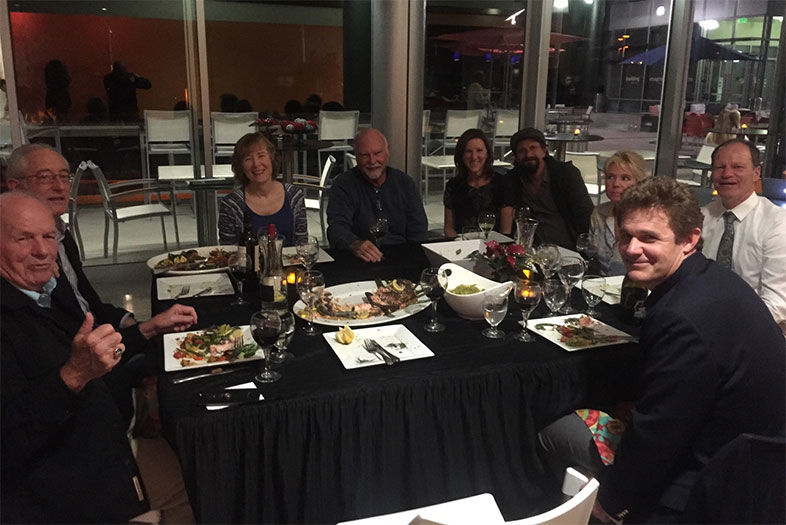
Great minds Venter, Goldstein, Brenner, Jamieson and co. celebrating a great man, Mr. Denny Sanford. The common denominator? Why, food and wine, of course.

Food for thought…

Picture it: You are an expert from General Atomics and need to get to a meeting on campus at UC San Diego. Instead of skipping the meeting because, as we all know, parking on campus sucks, you walk out of your building to the shared bike station, punch in your membership code, hop on a bike and head to campus. Or you are a scientist at the Consortium who commutes back and forth to the VA. You rush out of the lab, hop on a bike, and drop it off on campus near the Gilman Transit Plaza. Oh wait, you work up at Pfizer and want to head to the other side of the 5 for lunch at Green Acre with friends from Ilumina. Over lunch you will solve world hunger and peace while simultaneously sharing ideas on how to cure cancer. You then grab another bike from the station and head to an afternoon meeting at Human Longevity Inc. on Executive Drive before making your way back along Torrey Pines to catch a killer sunset up at Salk. Are you getting the picture? We may not have “walkability” but we can sure as hell create a culture that has “bikeability.”

According to the latest “Technology Office Outlook” report by Jones Lang La Salle, which analyzes 37 metro areas, San Diego ranked number 18. (San Francisco was numero uno. Boston and Portland beat out San Diego. We did rank higher than Silicon Valley and LA.) In market “dynamism” we scored a 3 out of 14. Why so low? A lack of transit, walkability and “creative clusters” were partly to blame. With more construction on the horizon with the Mid Coast Trolley, the already horrendous traffic on the Mesa, Genesee Ave. for example, will just get worse. So let’s get away from cars. Let’s look at other modes of transport. Let’s conquer walkability. San Francisco, Boston, even LA ranked higher. Why is this so important? Because innovation occurs more frequently when people interact and share ideas! We need our brilliant minds out and about discussing, debating and collaborating. If they can’t walk to the nearest coffee shop, restaurant, pub, campus, office, lab or collaboratory to do that, they can certainly bike there.

We could easily contract an existing shared bike company that has a proven success record in other metro areas around the country or around the world. I remember seeing a ton of businessmen and women cruising on these bikes down the Paseo de La Reforma en el D.F. Mexico City. Other cities like Milan, Paris, Barcelona, Santiago, Rio, Blumenau in Southern Brazil—hey, I used to live there—already have such programs in place. I also remember my Swiss students talking about their public bicycle system. Why in the world do we not have this up on the Mesa?

We’ve got a company, DecoBike, in downtown so this is very possible, people. I shared my idea with a frequent customer and he took it one step further. “We are in the epicenter of innovation, and we are looked at as being on the other side of the horizon. So let’s make the Mesa the most talked about place to be in the city and on the globe. Let’s innovate, we are the Tomorrowland and our shared bikes can be sleek—like the Jetsons.” Now, this is a guy who played a part in doling out funds to Sir Richard Branson for Virgin Galactic. We can do this.

Time to get together, hash it out and create a map of where we put these shared bike/George Jetson people movers. Let’s get our friends on the Mesa pedaling their way to success. MTS? SANDAG? You down to help?

Just Mesa’n around…

I was always taught that if you want to be successful, surround yourself with successful people. Don’t think it gets any better than last night’s dinner. The world’s oldest living teenager, Denny Sanford, doctors Craig Venter, David Brenner, Tatiana Kisseleva, Catriona Jamieson, Sheldon Morris, Larry Goldstein, and Connie Holm joined my Swiss-Italiano Nico and me at the BellaV. God, the brain power at this dinner table. We had gathered to toast Denny Sanford’s upcoming birthday and celebrate friendship. Hilarious stories of an infamous trip to Rio for Carnival last year were divulged over some great Pinot. Venter shared the latest in the world of genomics and California cabs. We then got to some great discussions on the current healthcare system, Denny’s work with education and how to move our society forward by creating a more philanthropic culture. Brain power! I do believe in osmosis. I do believe in osmosis. I do believe in osmosis.

Other great events I hit up this past week? QI’s 15th anniversary celebration Monday evening. Who doesn’t love a shameless photo op with former Governor Gray Davis, Irwin Jacobs, Paul Jacobs, Larry Smarr, Ramesh Rao and Al Pisano? At the welcome reception, Larry Smarr introduced the Pacific Research Platform, a regional end-to-end science driven “Big Data Freeway System” that will interconnect campuses up and down the coast. This $5 million dollar NSF funded joint project between Calit2 and Citrus up at UC Berkeley, will allow remote collaboration between campuses. The ability to share big data in a safe and fast way will ultimately lead to big-science innovation.

Chancellor Pradeep Khosla broke it down, providing a bit of history about Qualcomm Institute, praising QI as the birthplace of great ideas at UC San Diego. Former Governor Gray Davis gave a shout-out to Dr Lerner from TSRI for planting the seed for what would later be called Calit2. He also gave it up to former Chancellor and then President of the UC system Dick Atkinson for his visionary leadership and support, as well on the UC Gray Davis Institutes for Science and Innovation. According to former Governor Davis, there were 13 proposals in the running and in the end 3 campuses were chosen for the project. Berkeley was added later. We ain’t hatin’. I’m from the Bay. He also claimed that 15 researchers from MIT jumped ship to UCB following the announcement of these three Davis Institutes in California. The UC Gray Davis Institutes are genius and QI has been a major magnet for talent here up on the Mesa. We should give some mad props to Ramesh Rao and Larry Smarr for steering the motha-ship and for Irwin Jacobs for throwing down the cash to match the $100 million dollar grant and then some. Highlight for me at that event? Taking a magic carpet ride through 20th century Chinese landscape paintings while transfixed by Composer in Residence Lei Liang’s latest scores. Powerful, soulful, trippy.

Lunch Wednesday was at Johnson & Johnson’s JLabs for their fireside chat on the evolution versus revolution of healthcare. Man my head hurt trying to cram all the expert insight Noah Rosenberg, Partner at BakerHostetler fired off. Rosenberg illustrated the complex picture of our current healthcare system which is “just shy of a hot mess” (okay, I added the word “hot”). He then gave a forecast of what to expect in the next five to ten years.

In a nutshell, Noah Rosenberg and many in the audience agreed that the best solution to our inefficient health care system is to have it controlled by a singular group. No shit! France is good for one thing, their health care. Okay, well, maybe two… and then there’s…. hmmm okay, three things. Right, the French are good for three. As another audience member, Stephane Richard of CureMatch, so eloquently put it, healthcare should be treated like a utility, not a commodity.

Diego Miralles, Head of Johnson & Johnson Innovation, pointed out that in 1948, under the Truman administration, the government was very close to passing a national health system. It was only after 3 months of hardcore lobbying and a national campaign that they somehow swayed public opinion and the vote came up short. And we are all too familiar with the more recent, yet unsuccessful, attempts of then First Lady Hilary Clinton and current President Barack Obama. Miralles urged the audience to pick up a copy of The Social Transformation of American Medicine. He also touched on his three years in Belgium, making the salient point that in those three years abroad, not once was “healthcare” an issue or concern that came up. Seriously, people. Let’s not reinvent the wheel here.

So… will I get smarter hanging around all these brilliant minds with their intellectual talks and insightful lectures? I sure hope so. How about you leave that office or lab, hop on a bike and join me. And then send me your cliff notes.

Upcoming Events (I’ll be at the fun table…)

Due to the fact that my other two sections were hella long and I still have to decide what to wear to the San Diego Regional Chamber’s Holiday event at the Hotel Del Coronado tonight, I will just simply list this week’s events. We all work better under pressure, right? Get on out there, people, and enjoy this week’s upcoming events on and around the Mesa.
That’s What SHE Said: Let’s Conquer Walkability

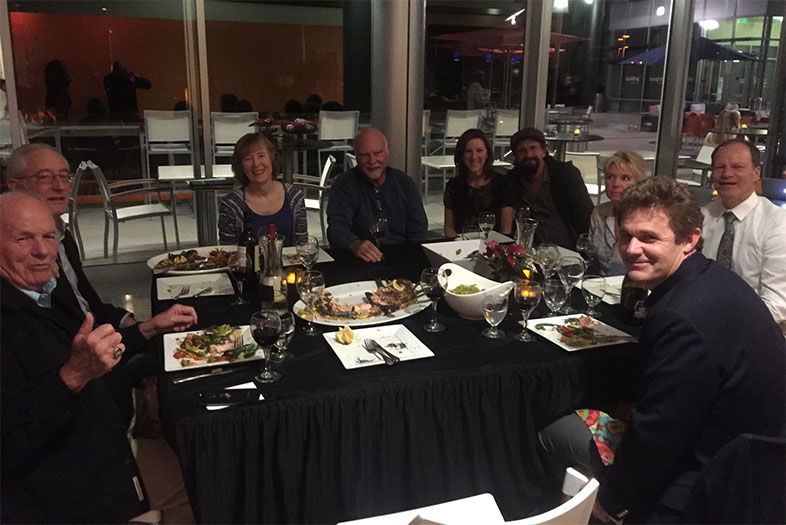
Great minds Venter, Goldstein, Brenner, Jamieson and co. celebrating a great man, Mr. Denny Sanford. The common denominator? Why, food and wine, of course.

Subscribe to our newsletters

Select Options

By subscribing you confirm that you agree with our Terms and Conditions and Privacy Policy.

Archive OCTOBER 23, 2023

The Problem With Bright Red Tuna

Many Americans still think bright red tuna means it's fresher (it's not)

The Problem With Bright Red Tuna

You know the tuna I’m talking about. It’s easy to mistake for a cube of watermelon. It’s the color of a Lyft logo. Appears to be glowing a vibrant, tantalizing purity. Tuna that bright red or pink means it’s… what, extremely fresh? Bursting with nutrients?

Nope. It means it’s got carbon monoxide.

I thought this was widely known, but a chef recently told me very few of his staff members were aware of this, and almost none of his customers. So, especially with the recent proliferation of poke joints, I thought I’d be helpful with this PSA of sorts.

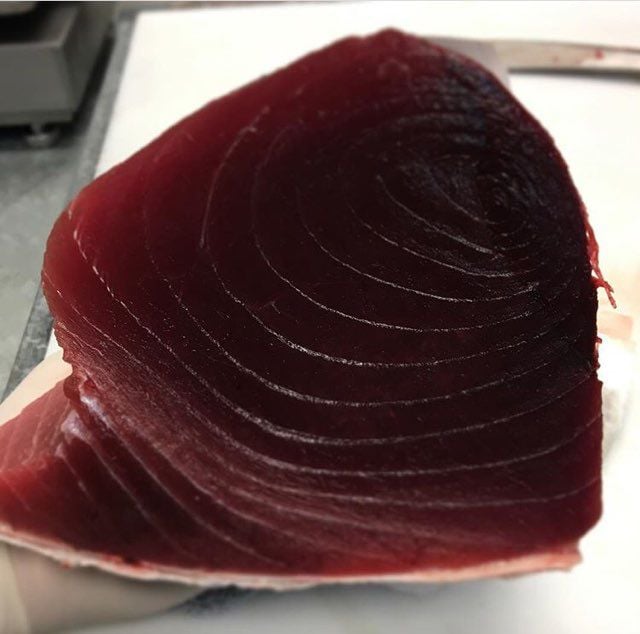
Bright red or pink tuna means it has been gassed. In its natural state, fresh tuna is dark red, almost maroon, sometimes even chocolatey-looking.

Don’t worry, you most likely will have no ill effects from eating gassed tuna, according to the FDA. They have deemed carbon monoxided tuna as GRAS (Generally Regarded As Safe), though the practice is banned in Japan, Canada, and the EU. Plus, there is carbon monoxide in barbecue (given off by wood smoke).

But here’s why I personally tend to back away when I see bright red or pink tuna: 

1. IT’S MUCH HARDER TO TELL IF IT’S FRESH OR NOT.

It can be left out for days and it will not turn brown. In one study, the University of Florida found that carbon monoxided tuna kept its bright red color for 11 days in the fridge. “The carbon monoxide actually hides the quality of a fish,” says Tommy Gomes, fifth-generation San Diego fisherman, host of The Fishmonger on Outdoor Channel, and owner of seafood shop Tunaville in Point Loma. “It’ll make a poor-quality fish pretty like a rose. I’ve seen them take an old piece of brown tuna [and] put the gas on it, and it comes out looking like cherry lemonade.” The gas also masks the smell of old tuna (which is one way you can tell if tuna’s getting past its eat-by stage). “Since there’s no smell, it falsifies the freshness,” Gomes explains.

2. I TRUST GOVERNMENT HEALTH ORGANIZATIONS, BUT ALSO RECOGNIZE THEY’RE NOT PERFECT.

The 1992 USDA food pyramid suggested carbs should be the bulk of our diet (they corrected that in 2005 and 2011). The government approved the fat substitute Olestra, which gave people all sorts of tummy issues. Margarine and other trans fats were also approved, then banned in May 2019. There are some smart humans in the government, but even geniuses make mistakes. So I tend to go with my gut: tuna in its natural state, or tuna treated with carbon monoxide? Easy choice.

So why gas tuna at all? Because of us. Consumers don’t like brownish fish. Tuna oxidizes quickly. It’s difficult for tuna fishermen and women to get it to market quick enough before it turns that brownish or chocolatey color. Customers erroneously think all brownish-looking fish is old or bad and will pay more for “fresher-looking” fish. So in the 1990s, the FDA allowed companies to gas the tuna and keep it artificially bright red for long stretches at a time. 

“There’s nothing wrong with a hot chocolate–looking tuna loin,” says Gomes. “But, here in America, we want [it] seared on the outside, rosy pink on the inside.” 

The Problem With Bright Red Tuna
What fresh tuna should look like

Gassed tuna is also often imported and less inexpensive than fresh, un-gassed tuna, says Gomes. “So, to be fair and honest,” Gomes acknowledges, “for families on a budget, gassed tuna is one of the best alternatives out there for frozen seafood.”

In the New York Times article cited above, a sushi restaurant owner reported his sales of tuna tripled when he started using gassed tuna. So that’s obviously good for the small business owner, as well as grocery stores. Food waste is a massive epidemic—the US throws out about half of edible seafood. If gassed tuna gets Americans to eat perfectly edible tuna they otherwise might throw out, that’s a step in a good direction.

But it’d be better if we as consumers knew that fresh, non-gassed tuna is supposed to be dark red or maroon—not bright red or watermelon pink, like a majority of the tuna I’ve seen at local poke shops. Ideally, we would look at a piece of bright red/pink tuna and think “Oh, hey there, carbon monoxide.” 

The most important things about buying tuna is to trust the source (whether grocery store, fishmonger, or sushi joint). It also should be shiny and somewhat translucent, and not have slime or an off-smell. 

Long live maroon tuna.

Troy Johnson

About Troy Johnson

Troy Johnson is the magazine’s award-winning food writer and humorist, and a long-standing expert on Food Network. His work has been featured on NatGeo, Travel Channel, NPR, and in Food Matters, a textbook of the best American food writing.

Tuna
Archive AUGUST 1, 2023

September 2023

September 2023

Archive JUNE 1, 2023

July 2023

July 2023

Studio S AUGUST 10, 2026

The Secret to a Home That Feels Just Right

Behind every beautiful space is a thoughtful process, and ASID San Diego is helping homeowners understand the value of professional design.

The Secret to a Home That Feels Just Right
Courtesy of ASID

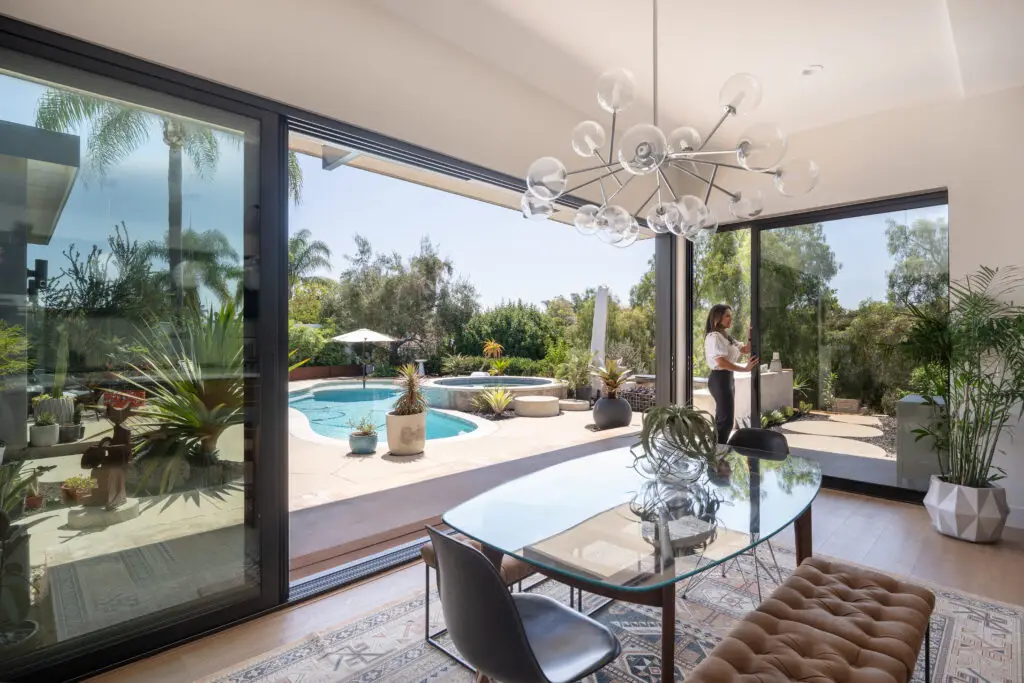
A perfectly designed home rarely happens by accident. Those kitchens that feel effortless and rooms that seem to tell a story the second you walk in? They’re usually the work of someone who knows exactly what they’re doing.

It’s knowing which ideas will actually work, which materials will hold up over time, and how to turn a collection of choices into a space that feels intentional. That’s where a professional interior designer comes in.

For the American Society of Interior Designers (ASID) California San Diego Chapter, the goal is to help people see interior design as more than just the finished look. Behind every well-designed space is a process built on technical expertise. Designers are educated in everything from professional software and construction details to building codes, space planning, materials, and functionality.

Courtesy of ASID

“People don’t always realize how much goes on behind the scenes,” Kirsten Recce , current president of the ASID California San Diego Chapter, says. “Our designers are not just doing furniture placement and color selection and picking out new fluffy pillows. That’s not what they’re trained for.”

ASID members bring formal education, continued learning, and industry knowledge to their projects, helping create spaces that are not only beautiful, but designed to work. A paint color that changes completely depending on the lighting. A material that looks beautiful in a showroom but doesn’t make sense for everyday life. A layout that photographs well but doesn’t function for the people living there. These are the details where professional guidance can make all the difference.

Still, one of the biggest misconceptions about hiring an interior designer is that it’s reserved for massive renovations, luxury homes, or people who already know exactly what they want. The process can feel intimidating. Where do you begin? Is a designer worth the investment? What if you only need help with one room?

ASID’s answer: start with one hour.

ASID’s Spruce Up events break down one of the biggest barriers between homeowners and professional design: knowing where to begin. Held twice a year, the community program gives homeowners the chance to work directly with an ASID designer through a one-hour, $125 consultation in their own home. Whether you’re looking for advice on furniture placement, window treatments, kitchen and bath updates, remodeling ideas, vacation rentals, color selections or something else entirely, the upcoming September 2026 event offers an approachable way to get expert guidance before committing to a full project. Signups are open through Sept. 7, with consultations taking place Sept. 21 through Oct. 31. Proceeds benefit ASID San Diego’s educational and community programs. Register here!

Courtesy of ASID

“It’s a great opportunity for people who are in that exploratory phase,” Recce says. “Maybe they’re not sure they want to hire an interior designer yet, or they think it sounds daunting or expensive. This gives them a chance to discover what working with a designer is actually like.”

Design is personal. A good designer isn’t just creating a beautiful room; they’re helping create a space that fits the way someone lives.

“We’re a resource to all of San Diego County,” Recce says. “It doesn’t cost anything to pick up the phone and call and ask. We’ll answer.”

Follow ASID San Diego on Instagram, LinkedIn, and Facebook for updates on upcoming events, or connect with the chapter directly at [email protected] or 619-548-8847.

Partner Content
Archive MAY 1, 2023

June 2023

June 2023

Archive APRIL 1, 2023

May 2023

May 2023

Partner Content AUGUST 21, 2026

This Scripps Clinic Physician is Serving Up Care

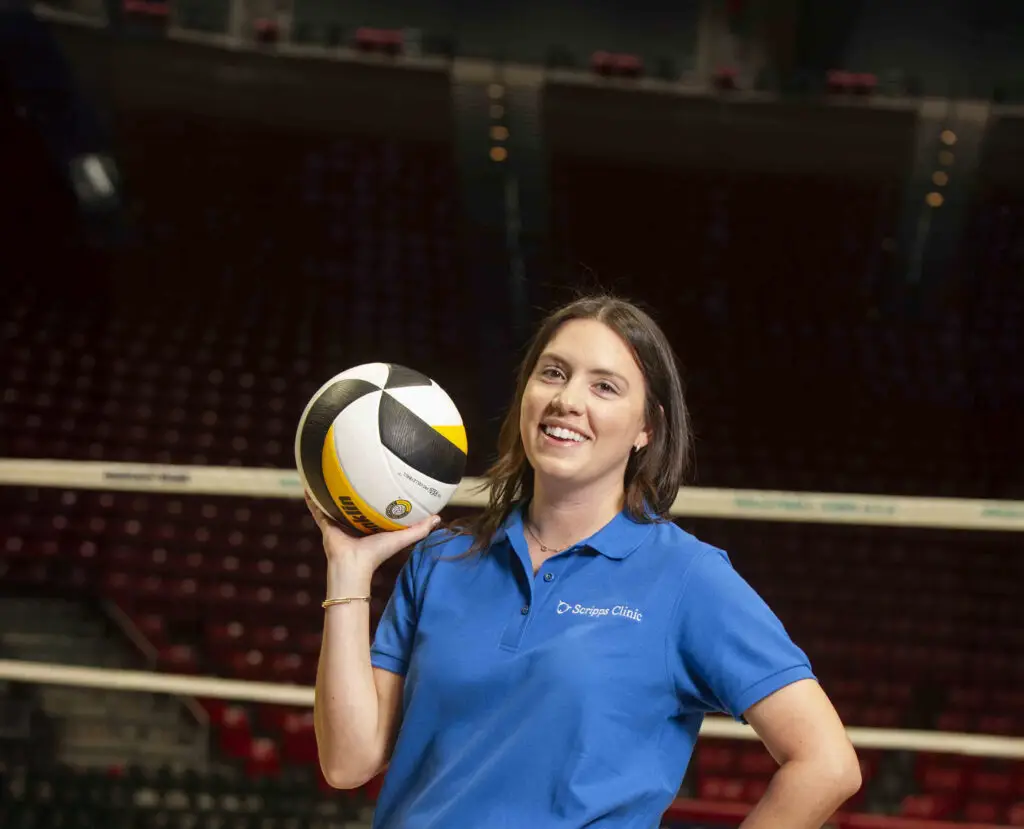
Laika Nur, MD, takes her love of volleyball from the court to the clinic as team physician for the San Diego Mojo

This Scripps Clinic Physician is Serving Up Care
Courtesy of Scripps Health

Growing up, Laika Nur, MD, Scripps Clinic sports medicine specialist, loved watching beach volleyball when the Association of Volleyball Professionals tour came to her hometown of Chicago. A talented volleyball player herself, she remembers sitting in the stands all day, and once, even got a couple autographs. Years later, Dr. Nur was attending a professional event focused on women’s sports, and the discussion turned to a new professional women’s volleyball league. The general manager and coaching staff  for San Diego’s team, the Mojo, happened to be in attendance, and Dr. Nur took the opportunity to ask them if they needed a team doctor. Flash forward to the Mojo’s inaugural 2024 season, when Dr. Nur officially became the team physician. Click here to read more about Dr. Nur and how she incorporates lessons she learned on the court into her practice. 

For more nutrition, wellness, and healthy living tips, sign up for the San Diego Health newsletter here.

Partner Content

Thousands of savvy locals already get it.

San Diego's best restaurants, experiences, and events—handpicked and delivered to your inbox weekly. You in?

Close the CTA

Contact Us

1230 Columbia Street, Suite 800,

San Diego, CA