That’s What SHE Said: I’d Put My Money on Garret Hoff
The rumors, events, people, and stories keeping the Mesa interesting
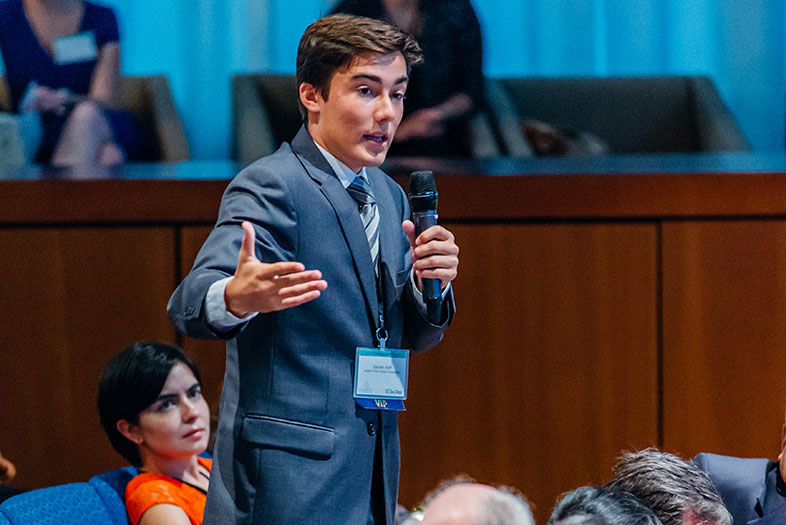
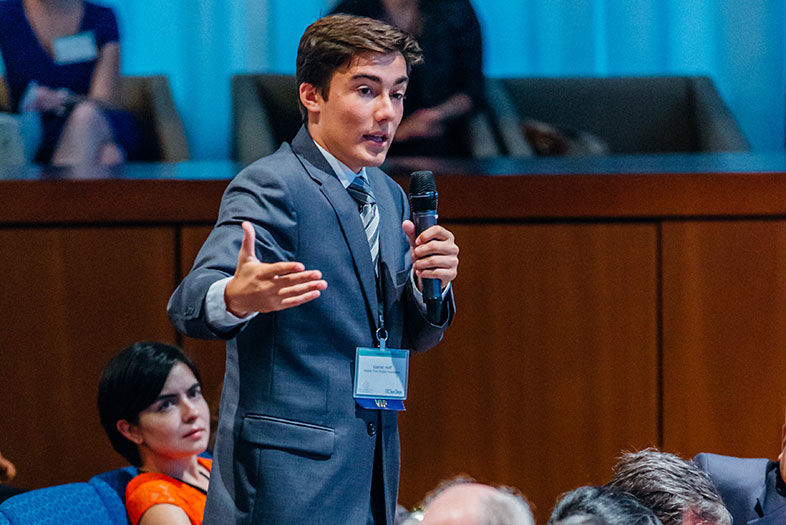
Youth leader Garret Hoff engages and impresses Peter Salk, Huma Ahmed-Ghosh, Anita Raj, Jay Silverman and several other thought-leaders who attended the A4E Global Empowerment Summit. | Photo by Calit2
Hmm… where to host the first ever World Beach games—San Diego, Dubai or Sochi? Are you kidding me? I guess they had to make it look fair by allowing other countries the chance to compete. In a unanimous vote last Friday, the Association of National Olympic Committees chose our city to host the 2017 Inaugural ANOC World Beach games. Damn straight. San Diego is the perfect city to host this event for so many reasons. We celebrate an active outdoors lifestyle, have the world’s best beaches and a booming multi-cultural population to welcome guests from around the world. Why am I stoked? Just want to host the ultimate welcome reception on the Mesa for these World Beach games. Classy soiree for Black’s Beach, dress code… “optional.” Seriously though. This is another great opportunity, like the Kyoto Prize event, to bring global awareness to our region. Will be conducting a “formal,” well, we know that word doesn’t exist in my vocabulary, but interview nonetheless with the very person instrumental in helping get these games to San Diego—Feben Yohannes. More to come… In the meantime, just noodle on this exciting announcement. Our region is about to come up in a major way!
Today I sat on a panel that was not only created, but also moderated by a fifteen-year-old student from Francis Parker High School. Capturing and holding the attention of 500 high school teenagers is a miracle in and of itself. To have a captive audience of youngsters listen to a panel whose subject is community awareness and engagement? Seriously? Can we get this kid a trophy please? You could hear a pin drop. (Well, maybe it was a cell phone that fell all the way down the bleachers). Garret Hoff, an accomplished public speaker, stood poised in front of his peers while leading the discussion. Speaking in front of your entire high school student body would seem a daunting task. Garret was a master behind that podium. Why is this newsworthy? Because this brave young soul is a high functioning teenage boy living with autism. And he is kickin’ ass and takin’ names.
Garret, diagnosed at the age of 3, has had a long and inspiring journey in overcoming his diagnosis. The Hoff family sold their home in order to enroll Garret in Lovaas 40 hours per week. This program had a proven track record, and helped Garret become kindergarten ready with an aide. Garret was yanked out of class to attend his mandated therapy sessions but any parent or guardian who has a child with an IEP knows that these sessions are disruptive to the child’s school day and too often sub-par. Mind you, it is by no fault of the specialists, but rather the system that has speech and occupational therapists seeing upwards of 60 kids a day. But without the sessions, the child cannot have an aide in the classroom. So in addition to regular class and therapy sessions at school, he also had another round of speech, occupational, and music therapy at home all the way through 4th grade.
Fast forward to the present. Garret, currently a sophomore, serves as the ASB Community Director at Francis Parker. He has been involved in community service since he was only 7, volunteering at Autism Tree Project Foundation (ATPF). Other volunteer gigs have included the Faulkner Mayoral campaign as well as the recent A4E Global Empowerment summit. Garret not only razzle-dazzled our VIPs at the summit, but engaged in the Q&A. Jaws dropped when I mentioned his age. No one had any idea he was also a kid thriving with autism. Mature beyond his years, Garret is destined to be a politician. Future leader? Garret already is a leader. Gamblin’ ain’t my thang, but I’d put my money on this kiddo.
You can see Garret rock the mic at ATPF’s Inaugural Neuroscience Conference November 5th! He will be joined by other ATPF young leaders as they discuss what it is like “Living with Autism.” Fellow panelists are high school junior Derek Matlock, nine-year-old Daniel Soto and Savine Cogar, 18, who serves as the ATPF Girls Mentor Program spokesperson and co-directs the Teen Time Program with Derek. I’d also make a point to attend the one-on-one with Joel Anderson. Joel, autistic, is an artist, author and speaker whose work is absolutely moving.
The entire conference brings together the best researchers in the biz to learn and share. As Dayna Hoff, mother of Garret and co-founder of the foundation, explains, “our goal in creating this Inaugural ATPF Neuroscience Conference is to create a heart connection between the families we serve every day and the world class neuroscience community, right here on the Mesa, right here in San Diego.” No question where this little rock star gets it. But that’s another post… See you at the panel. We can cheers to these amazing kids at the reception.
Upcoming Events (I’ll be at the fun table…)
Adventures in Oceanography Monday night the Birch Aquarium presents “Adventures in Oceanography” as part of their Perspective Lecture series. Scripps oceanographer Dr. Dale Stokes will guide you through a collection of dramatic images both underwater and topside. These images span more than a decade of work and also include unusual vessels and research instruments. Sounds like the perfect learning getaway. Nov 9, 7-8 p.m., Birch Aquarium
The Science of the Magical Elixirs, oracles, spells, and gateways to underworlds… The Arthur C. Clarke Center for Human Imagination will host science correspondent and author Matt Kaplan as he brings the audience on a journey to explore “The Science of the Magical.” Wicked! Nov 10, 6:30 p.m., Arthur C. Clarke Center for Human Imagination, Atkinson Auditorium at Qualcomm Institute
Analytics in the Wild The Rady Technology Club is hosting “Analytics in the Wild.” You had me at Wild… For the rest of you, yes, it is an event on what’s on everyone’s mind… BIG DATA. Their second annual conference aims to demonstrate how leading technology companies leverage big data for “bigger impact.” The day starts with two keynote speakers, a panel, Q&A, my favorite. Oh wait, then a catered networking mixer. Okay, mixer first, Q&A second. Be sure to check out the link as this has an impressive list of speakers from Google, Cisco, Qualcomm, Acccenture… Nov 13, 2-7 p.m., Rady School of Management
Always,
Amanda
That’s What SHE Said: I’d Put My Money on Garret Hoff
Youth leader Garret Hoff engages and impresses Peter Salk, Huma Ahmed-Ghosh, Anita Raj, Jay Silverman and several other thought-leaders who attended the A4E Global Empowerment Summit. | Photo by Calit2
Archive
OCTOBER 23, 2023
The Problem With Bright Red Tuna
Many Americans still think bright red tuna means it's fresher (it's not)
You know the tuna I’m talking about. It’s easy to mistake for a cube of watermelon. It’s the color of a Lyft logo. Appears to be glowing a vibrant, tantalizing purity. Tuna that bright red or pink means it’s… what, extremely fresh? Bursting with nutrients?
I thought this was widely known, but a chef recently told me very few of his staff members were aware of this, and almost none of his customers. So, especially with the recent proliferation of poke joints, I thought I’d be helpful with this PSA of sorts.
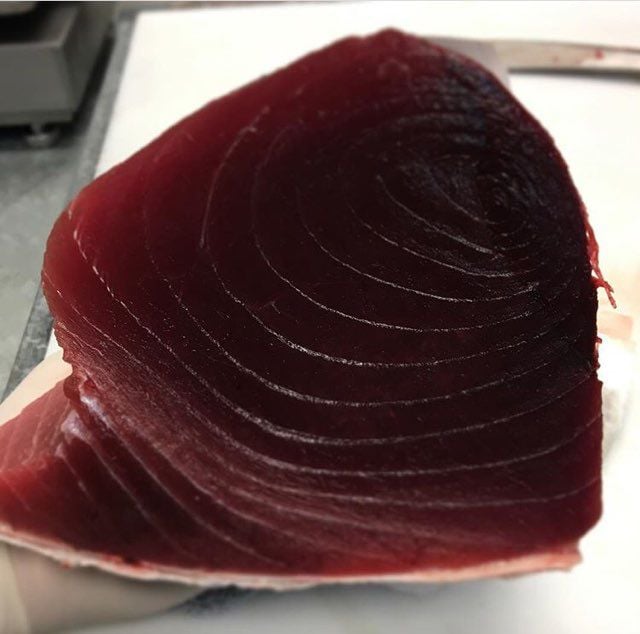
Bright red or pink tuna means it has been gassed. In its natural state, fresh tuna is dark red, almost maroon, sometimes even chocolatey-looking.
But here’s why I personally tend to back away when I see bright red or pink tuna:
1. IT’S MUCH HARDER TO TELL IF IT’S FRESH OR NOT.
It can be left out for days and it will not turn brown. In one study, the University of Florida found that carbon monoxided tuna kept its bright red color for 11 days in the fridge. “The carbon monoxide actually hides the quality of a fish,” says Tommy Gomes, fifth-generation San Diego fisherman, host of The Fishmonger on Outdoor Channel, and owner of seafood shop Tunaville in Point Loma. “It’ll make a poor-quality fish pretty like a rose. I’ve seen them take an old piece of brown tuna [and] put the gas on it, and it comes out looking like cherry lemonade.” The gas also masks the smell of old tuna (which is one way you can tell if tuna’s getting past its eat-by stage). “Since there’s no smell, it falsifies the freshness,” Gomes explains.
2. I TRUST GOVERNMENT HEALTH ORGANIZATIONS, BUT ALSO RECOGNIZE THEY’RE NOT PERFECT.
The 1992 USDA food pyramid suggested carbs should be the bulk of our diet (they corrected that in 2005 and 2011). The government approved the fat substitute Olestra, which gave people all sorts of tummy issues. Margarine and other trans fats were also approved, then banned in May 2019. There are some smart humans in the government, but even geniuses make mistakes. So I tend to go with my gut: tuna in its natural state, or tuna treated with carbon monoxide? Easy choice.
So why gas tuna at all? Because of us. Consumers don’t like brownish fish. Tuna oxidizes quickly. It’s difficult for tuna fishermen and women to get it to market quick enough before it turns that brownish or chocolatey color. Customers erroneously think all brownish-looking fish is old or bad and will pay more for “fresher-looking” fish. So in the 1990s, the FDA allowed companies to gas the tuna and keep it artificially bright red for long stretches at a time.
“There’s nothing wrong with a hot chocolate–looking tuna loin,” says Gomes. “But, here in America, we want [it] seared on the outside, rosy pink on the inside.”
What fresh tuna should look like
Gassed tuna is also often imported and less inexpensive than fresh, un-gassed tuna, says Gomes. “So, to be fair and honest,” Gomes acknowledges, “for families on a budget, gassed tuna is one of the best alternatives out there for frozen seafood.”
In theNew York Times article cited above, a sushi restaurant owner reported his sales of tuna tripled when he started using gassed tuna. So that’s obviously good for the small business owner, as well as grocery stores. Food waste is a massive epidemic—the US throws out about half of edible seafood. If gassed tuna gets Americans to eat perfectly edible tuna they otherwise might throw out, that’s a step in a good direction.
But it’d be better if we as consumers knew that fresh, non-gassed tuna is supposed to be dark red or maroon—not bright red or watermelon pink, like a majority of the tuna I’ve seen at local poke shops. Ideally, we would look at a piece of bright red/pink tuna and think “Oh, hey there, carbon monoxide.”
The most important things about buying tuna is to trust the source (whether grocery store, fishmonger, or sushi joint). It also should be shiny and somewhat translucent, and not have slime or an off-smell.
Troy Johnson is the magazine’s award-winning food writer and humorist, and a long-standing expert on Food Network. His work has been featured on NatGeo, Travel Channel, NPR, and in Food Matters, a textbook of the best American food writing.
Today’s seniors are more connected than ever, with a renewed focus on retirement as a time of discovery and enriching experiences. The ultimate reward for a retirement well-earned is the wisdom to appreciate it all, and what better place to enjoy that unique perspective than Vi at La Jolla Village, in the heart of San Diego.
All-access pass to good living.
As a Continuing Care Retirement Community (CCRC), Vi provides access to a connected and fulfilling community while making it easy to plan for future care, should the need ever arise. With a care plan in place, residents enjoy greater financial predictability and long-term value, freeing them to focus on making the most out of retirement.
Resort-style amenities at the epicenter of a cultural hub like San Diego offer a retirement experience unlike any other. Paired with exceptional dining, spacious accommodations and dedicated staff, the best of maintenance-free living is all around. And with the introduction of Vista 360 Well-Being, Vi’s panoramic approach to wellness, there are more ways than ever for residents to access it all.
The harmony of mind, body and community.
Courtesy of Vi at La Jolla Village
The key to longevity is striking the right balance in maintaining an active lifestyle with an active mind in a fulfilling community. With newly renovated community spaces and restaurants, Vista brings a variety of opportunities for residents to elevate their well-being through Vi-exclusive “Signature Experiences.”
Vista Enrich takes an evidence-based approach to brain vitality, keeping residents at the forefront of cognitive health through exergaming (exercising + gaming), nutritional plans and informative workshops. It is also home to The Brain Vitality Studio, an innovative facility dedicated to cognitive fitness that has garnered national recognition.
Vista Discover invites residents into stimulating educational experiences, from chef-led cooking demos and guided wine tastings to lectures at local universities and intimate lectures following cultural outings.
While Vista Enrich focuses on brain health and Vista Discover engages residents intellectually, Vista Explore cultivates a sense of adventure through curated travel and local excursions. But broadening one’s horizons doesn’t always require a plane ticket. One recent event brought a taste of the world right to the community: an onsite “jazz cruise” featuring live music and global cuisine served at a series of themed “ports” all within the community’s own ballroom.
“Location, location, location”
Courtesy of Vi at La Jolla Village
One of the biggest perks of life at Vi at La Jolla Village is its proximity to just about everything. With easy access to transportation and local attractions just steps away, residents can explore and engage with their community at their own pace.
“There are trolley and bus stops within a 5-minute walk that will get you to the beach, UCSD Campus, medical appointments, downtown La Jolla or San Diego, et cetera. We rarely use our car,” said resident Tom Yager.
With the best of San Diego just steps away, residents don’t just live in the city, they live within reach of everything that makes it special.
The best of all worlds.
Courtesy of Vi at La Jolla Village
At Vi at La Jolla Village, retirement isn’t a chapter to slow down; it’s an invitation to discover more. Tailored community experiences created by Vista, paired with the vibrant pulse of San Diego just outside the door, mean that residents don’t have to choose between security and adventure, connection and independence. They get all of it.
This is what an all-access pass to good living looks like: the comforts of an elevated lifestyle, a community built for growth and a city made for discovery – all in one place.
To learn more about Vi at La Jolla Village or for details on available floor plans, visit ViatLaJollaVillage.com/SDM.
NewBridge School is San Diego’s only school dedicated to the education of students with dyslexia and related learning profiles. For 30 years we have successfully served students with dyslexia, dysgraphia, dyscalculia, receptive/expressive language disorders, ADHD, executive functioning and memory deficits. Students transition successfully into academically rigorous high schools and colleges across the country. Why NewBridge? Training, training, training (plus intensive individualization, and comprehensive program design). All teachers are trained and retrained biennially in Orton-Gillingham, the only approach proven to remediate dyslexia based on Science of Reading research, and complete a year-long training program. Every aspect of our program is designed around our students’ learning styles and needs. Every class is taught by a highly-trained expert, and our Speech/Language and Occupational Therapy teams embed throughout the day. Our multisensory, multi-tiered math program has been developed in conjunction with sister schools and experts across the country. Don’t wait—early intervention is magic!