



Food & Drink
Este Tea Opens At The Woo In Barrio Logan
Read article

Featured articles
Food & Drink

Food & Drink

Food & Drink
Featured articles

Features

Features

Everything SD
Featured articles

Things to Do

Things to Do

Things to Do
Featured articles

podcast-ep

podcast-ep

podcast-ep
Featured articles
Features
Features

Features
Featured articles
Food & Drink
Features

Partner content

What led a couple to rip out their yard and replace it with drought-tolerant foliage, plus San Diego rebates to save on water
water-wise landscaping
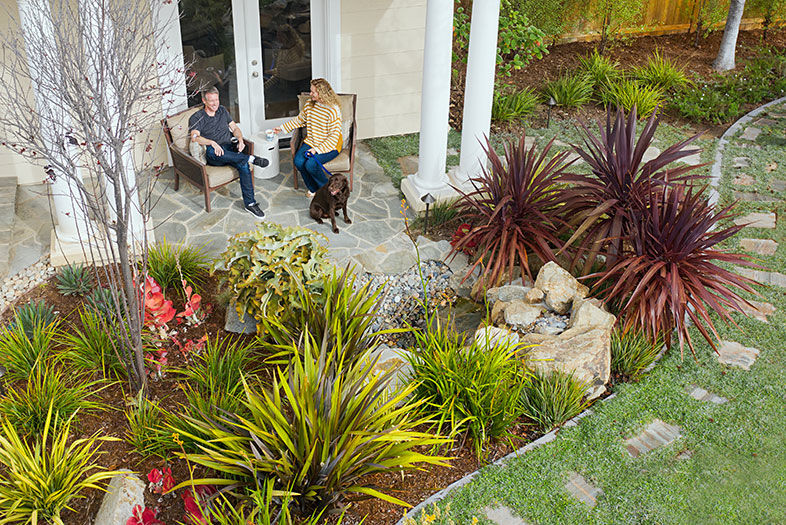
Chris and Katy Heineken, with their dog Jed, in their Carlsbad front yard
After years of ripping out her hair trying to keep her family’s front lawn alive during the drought, Carlsbad resident Katy Heineken called on Belle Terre Landscapes to rip the lawn out instead. (It’s not as gory as it seems.) “We were tired of it all: the large water bills, not being eco-friendly—plus, it felt dated,” Heineken says. “We wanted to put things in that were colorful, wild, and free-flowing, butterfly- and bird-friendly.”
Belle Terre Landscapes owner Janet Pozzuoli-Vallin explains that the project “reinvented everything” about the three-quarter acre property, with the exception of two trees they kept. Her team carefully cut off the top layer of turf, recycled it at Evergreen Nursery, and let the yard lie unturned for a while so as to not activate any remaining grass roots.
Then they put in all drought-tolerant foliage, including some kinds that go dormant in the winter and need even less water—”think about it,” Pozzuoli-Vallin says, “When you’re sleeping, do you eat?”
There’s also drip irrigation to get moisture right to the plants’ root balls, and a layer of mulch to top it all off. “I had no attachment to the yard we used to have,” Heineken says. “Now, when I look at my new yard, I love it. It really does make me happy—and it’s less worry, because it’s less maintenance.”
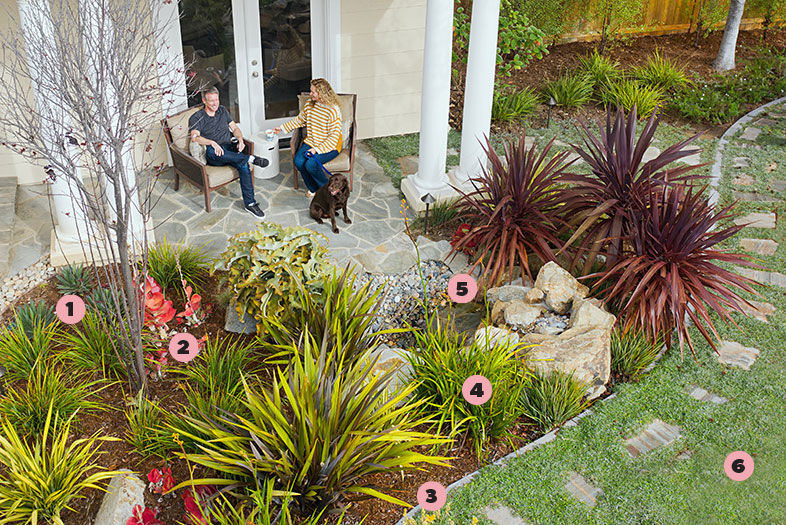
Pozzuoli-Vallin favors agave for the aesthetics. “It draws your eye,” she says. “There’s so many varieties, some petite, medium, and bigger.”
“Kalanchoe Lucia is a great accent in any succulent or low-water-use garden. Its colorful paddle leaves show off hues of yellow, orange, red, and green.”
“Your goal is to always mulch, so your water stays in the dirt and doesn’t dry up as fast. I like gorilla hair, because it lasts. It stays down, doesn’t float away in the wind, or run away when it rains.”
This tall plant is the homeowners’ favorite for its colors that range from reds to yellows and oranges. From a practical standpoint, Pozzuoli-Vallin adds, “they’re great in mass plantings,” and, of course, drought-tolerant.
What used to be a stagnant pond with little to no use is now the Heinekens’ favorite part of their front yard. The water now rests in a belowground basin and recirculates over the pebbles on the surface, similar to a fountain.
An alternative to grass, this ground cover stays green all year and is hefty enough to withstand foot traffic, like in gaps between stepping stones. “It’s like carpet,” Pozzuoli-Vallin says. “I wouldn’t encourage playing football on it, but it’s super cushy on bare feet.”
Considering some water-wise tweaks to your landscape? The San Diego County Water Authority probably has a rebate for that. Here are five ways you can get paid to save water.
The mainframe for your irrigation system, WBICs automatically adjust your watering depending on weather forecasts and have been shown to save up to 13,500 gallons of water per year. Rebates start at $80 per controller for a one-acre property.
These gadgets are a hygrometer for your soil: They measure the moisture and then communicate their readings to your WBIC to help it adjust your watering accordingly. Rebates start at $80 per sensor for a one-acre property.
These spigots shoot water directly where you want it to go—the plants—preventing runoff and using up to 20 percent less water than other spray heads. Rebates start at $2 a nozzle for a minimum of 30 nozzles.
Since rainwater is free of minerals and fluoride—unlike the H2O coming out of our taps—it’s actually your landscape’s drink of choice. Rebates start at $35 per barrel or $250–$350 for a cistern. Homemade containers do not qualify.
It’s definitely the most costly solution, but ripping out your lawn and replacing it with drought-tolerant foliage can reduce your water use by up to 60 percent. Rebates begin at $1 per square foot converted for a minimum of 250 square feet, but may vary per residential project.
*The city of San Diego’s water rates are consistently rising—2.16 percent last August, 7 percent more this July—reducing water use doesn’t always mean you’ll see savings on your bill.
Learn more about pet-friendly landscaping.
