
Ready to know more about San Diego?

Subscribe
Features AUGUST 31, 2022

House of Herman

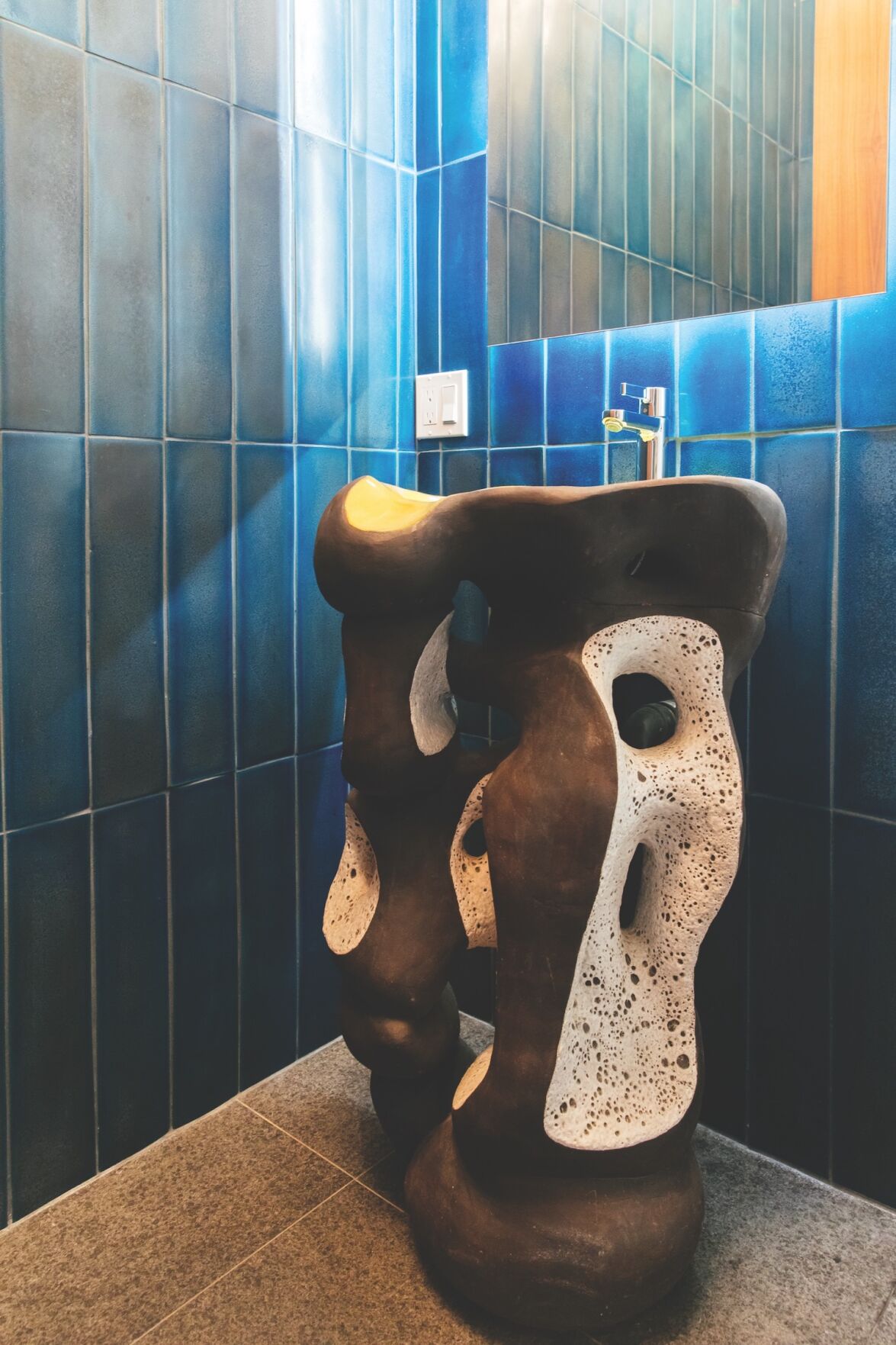
From the biomorphic bathroom sink to volcanic glazed fireplace, the renowned ceramicist is very much in residence
House of Herman
Photo Credit: Tomoko Matsubayashi
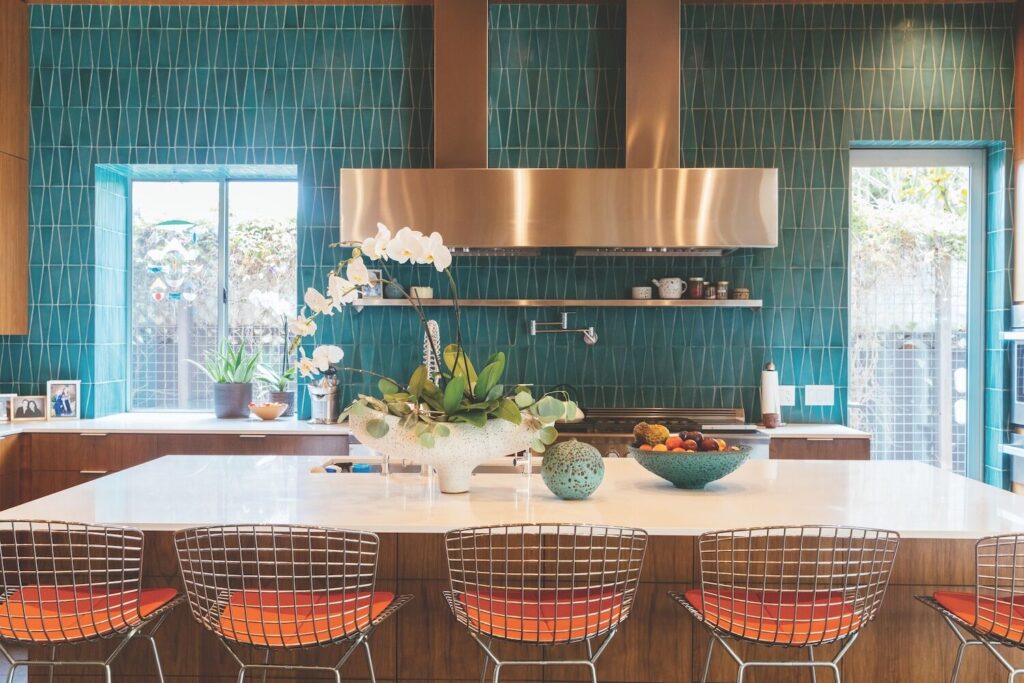
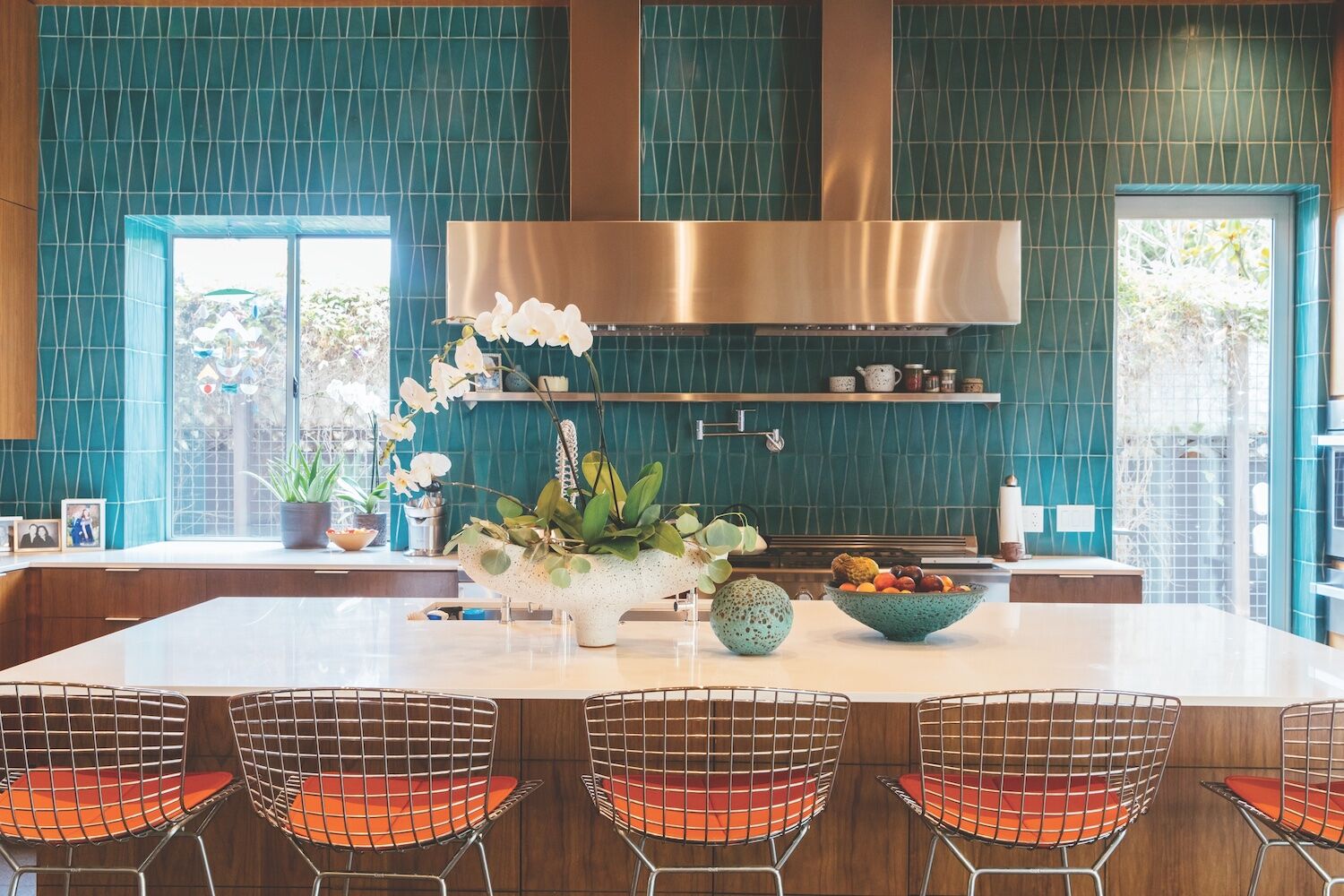
Josh Herman, kitchen

Photo Credit: Tomoko Matsubayashi

Acclaimed ceramicist Josh Herman was toying with glazes when he stumbled upon green hues for the tabletops at Paradisaea, the hotly anticipated Bird Rock restaurant set to open this fall. Herman’s tiles play a starring role in the tropical-modern project, from the onyx-and-gold foyer awash in his signature volcanic glaze to the tactile, oversized pieces framed in the wood dining tables. Paradisaea will be just about the only place in the world people can see the artist’s tiles, with the exception being down the street at the Herman family home.

Herman, whose amorphous sculptural pieces turn up in collections of celebrities too A-list to namedrop, isn’t a tile-maker by trade. But when he and his wife (and studio coordinator) Rachel were shopping backsplash options for their low-slung ranch house, they had an epiphany: What better way to showcase their midcentury-inflected aesthetic and taste for saturated colors and texture?
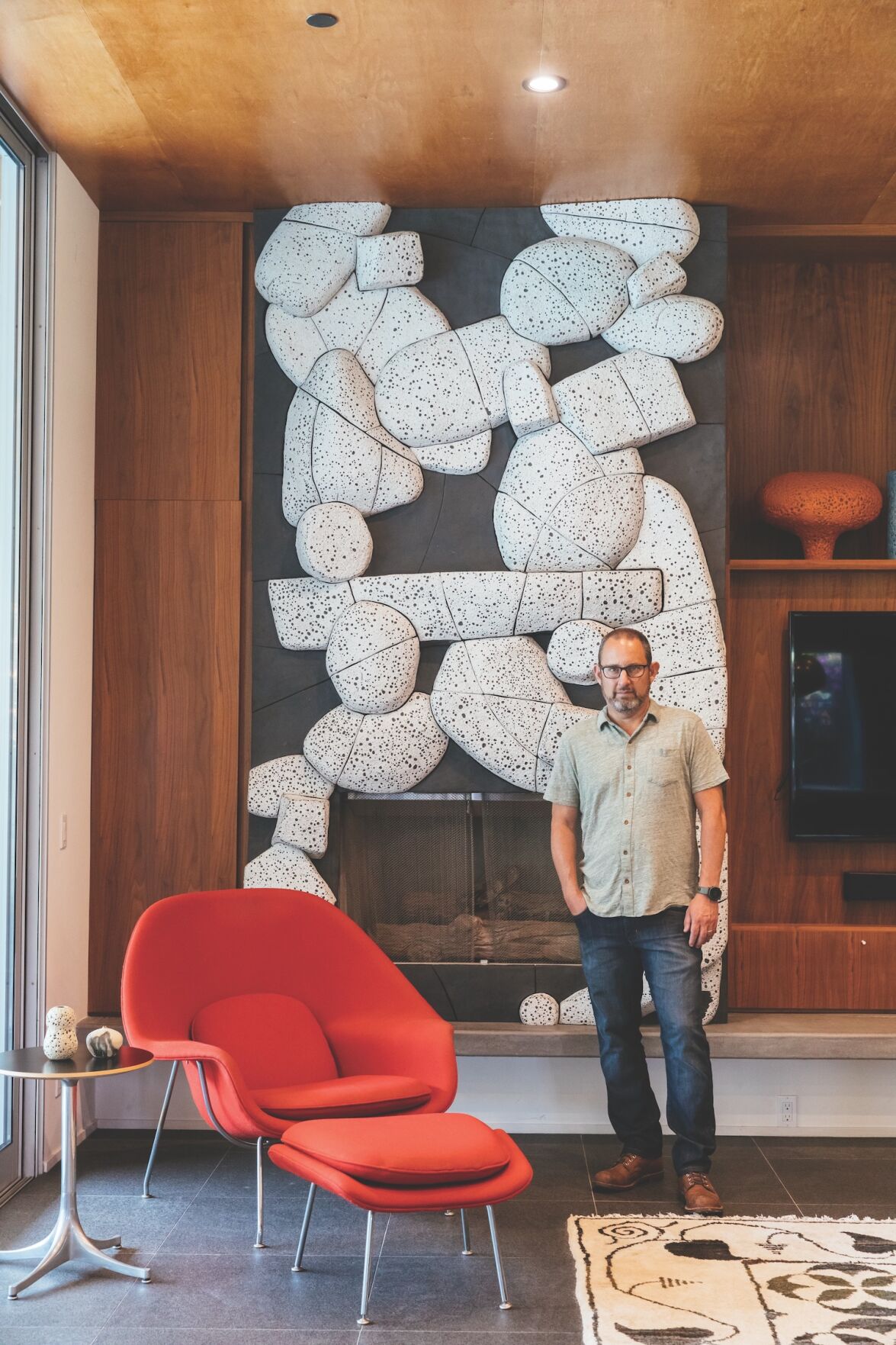
Josh Herman, portrait

Photo Credit: Tomoko Matsubayashi

“When we started, it was not my intention to do a house full of Josh Herman ceramics,” he says. “But I don’t always know where things are going to go. It’s organicity, natural, and unfolding. It’s a principle I subscribe to in my life and my ceramics, and it carried over into the house.”

The first step: Find the area’s top talent. The Hermans collaborated closely with Cheryl Carnation of Carnation Construction, who elevated classic ranch stylings with contemporary amenities, including a state-of-the-art kitchen and an 11-foot glass slider. David Skelley, owner of Little Italy’s Boomerang Modern—which carries Herman’s work—was enlisted to curate art and furnishings. Outside, landscape architect JC Miller of Palm Springs-based Miller Studio created a modernist Shangri-La.
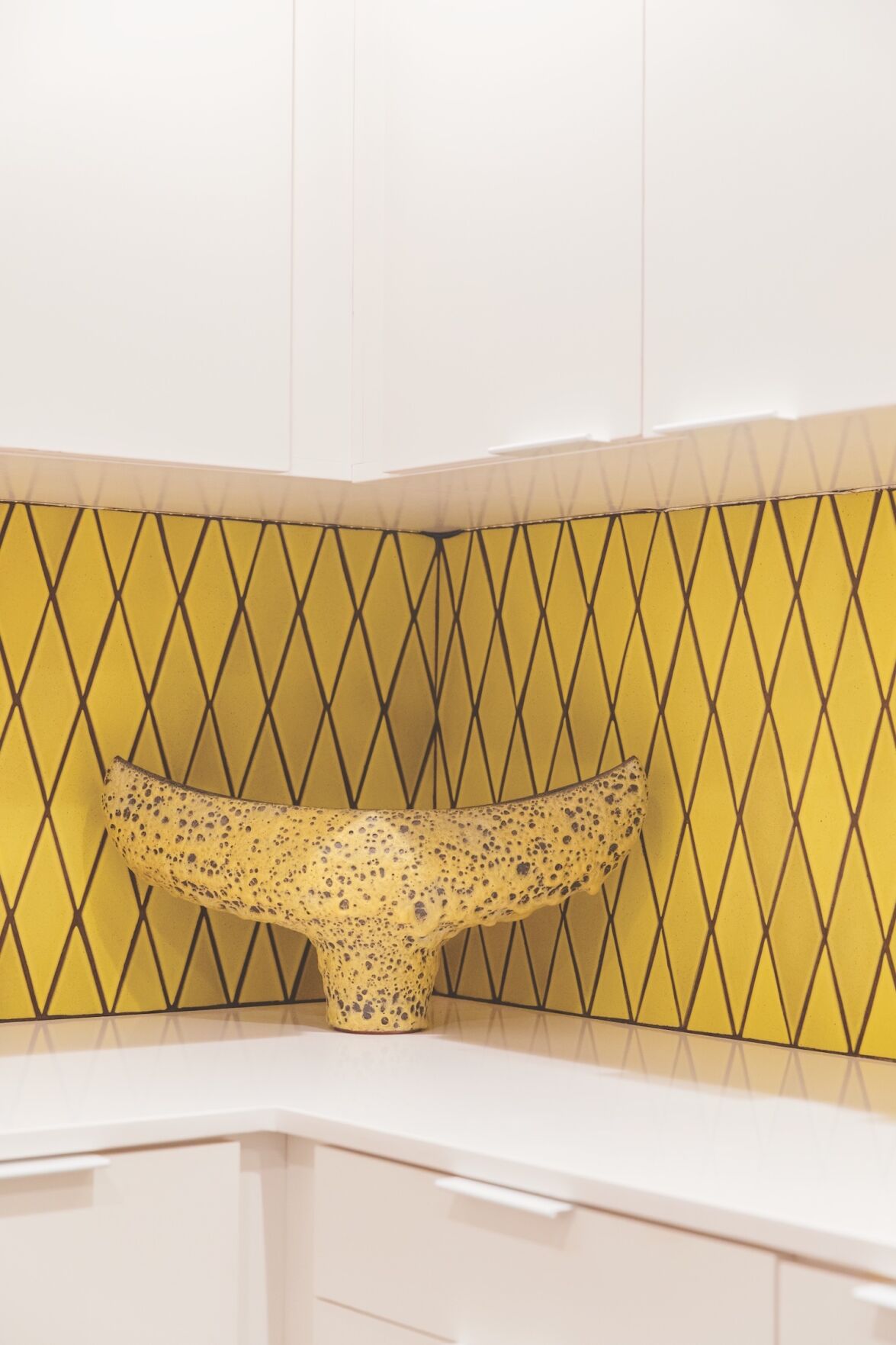
Josh Herman, whale

The laundry room is punctuated with custom tiles and volcanic-glazed vessels

Photo Credit: Tomoko Matsubayashi
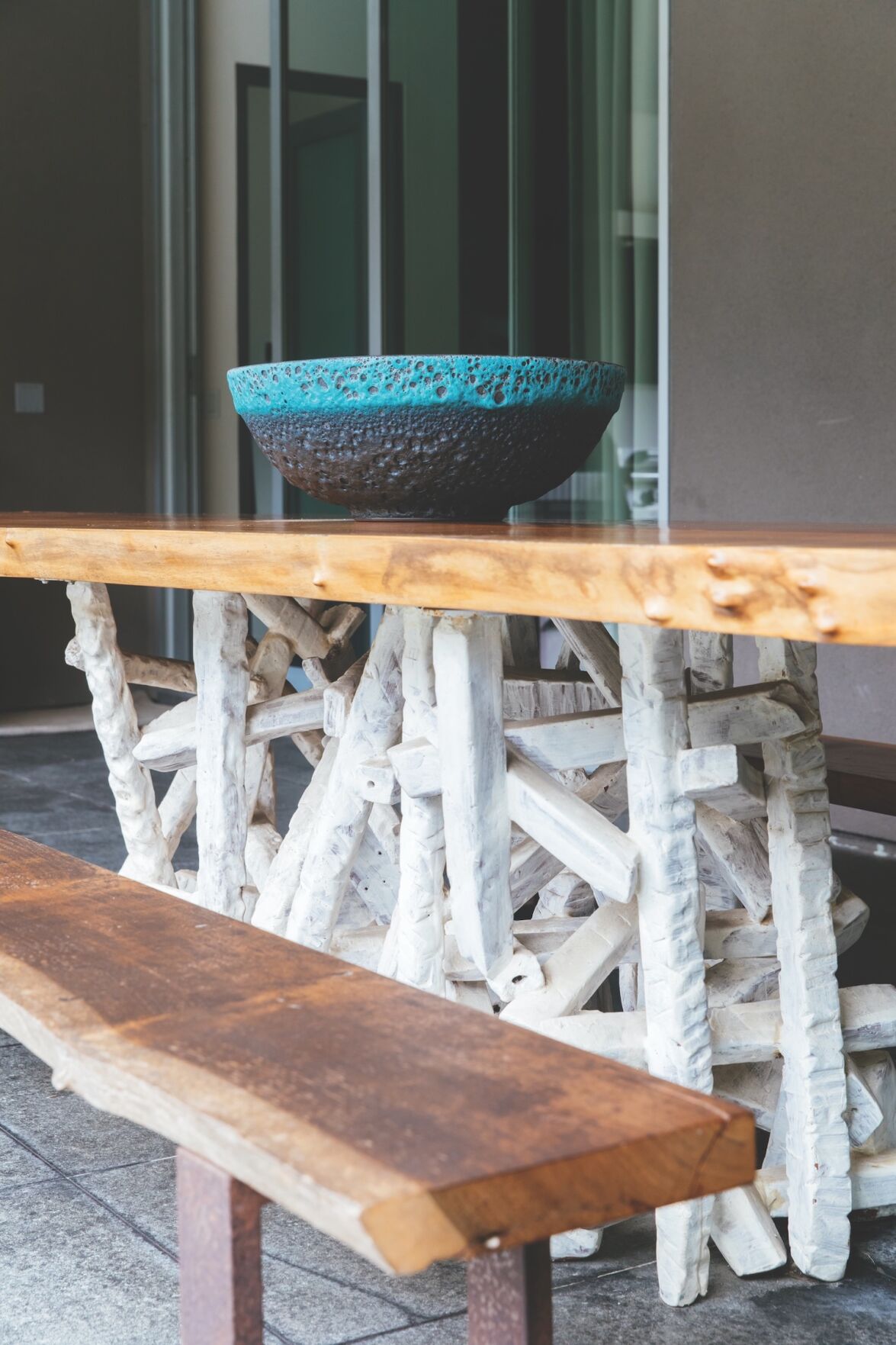
Josh Herman table

A Herman collaboration with Made Lumber

Photo Credit: Tomoko Matsubayashi

Herman’s tile-making experiment started in the kitchen—the couple’s favorite place to hang out with their two teenage kids. The geometric tiles, fired in a turquoise glaze with a painterly quality, are paired with walnut cabinetry and a wood-clad ceiling. The tiles were such a hit that he turned his Barrio Logan studio into a full-time Herman-home production factory for the next eight months.

Creatively charged, Herman got bold with shapes, finishes, and colors, from punchy primary classics to dramatic inky shades. In the laundry room, a swath of yellow energizes a minimalist white workspace. A sexy guest bathroom features a dark navy design with an infinity sign, and even the pool and outdoor areas are covered with one-of-a-kind tiles.

The home’s pièce de résistance surrounds the living room fireplace, a three-dimensional, large-scale “mural” of white organic forms speckled with black lava glaze. Along with walnut built-ins and a paprika Saarinen womb chair and ottoman, the space looks so midcentury-chic it could land the cover of an Architectural Digest circa the late ’60s if it weren’t for the flatscreen TV.
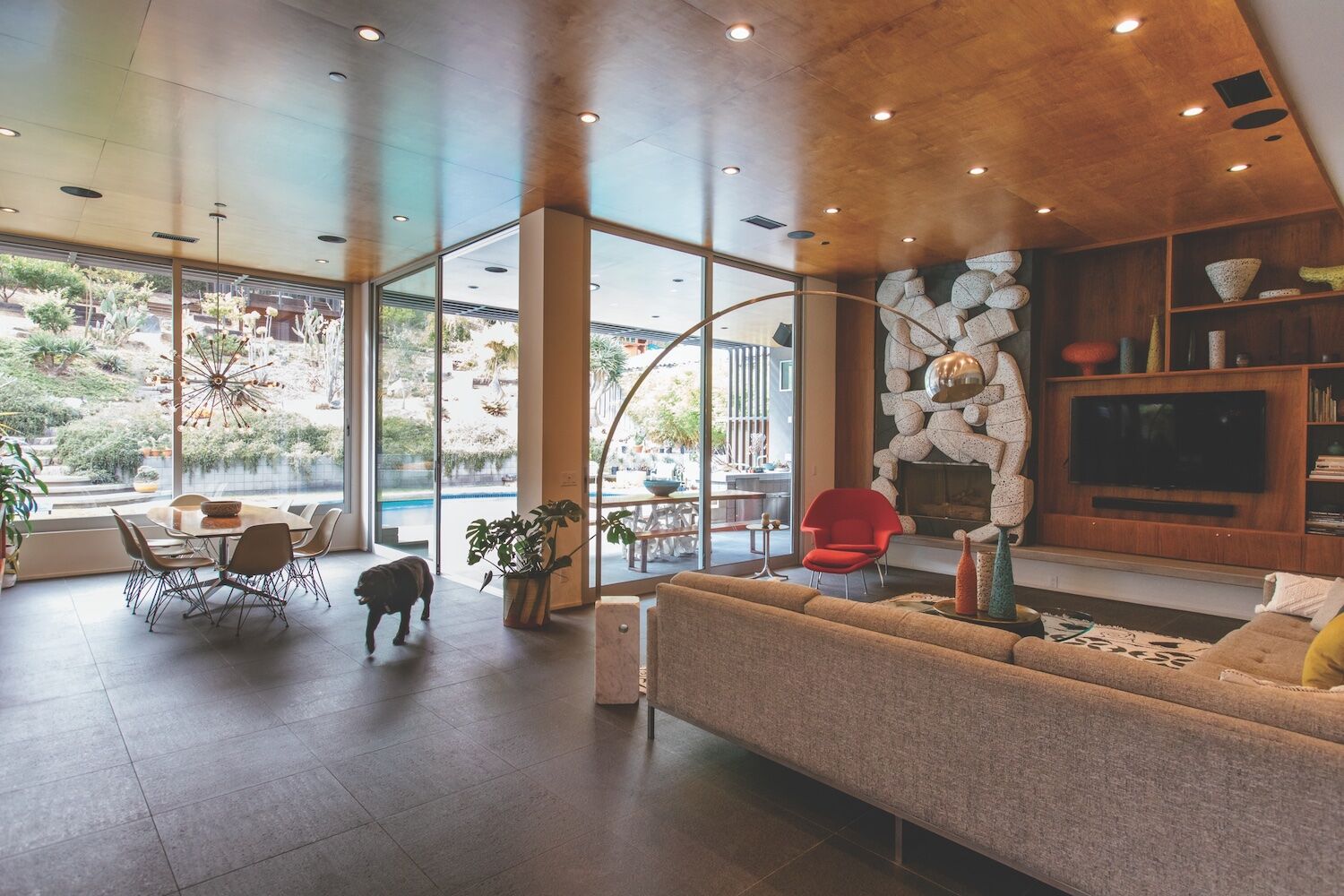
Josh Herman, living room

The floor plan of the main living space features maple ceilings and big-picture windows on the hillside where Herman is a constant gardener

Photo Credit: Tomoko Matsubayashi

Framed by a wall of windows, the half-acre backyard rivals destination botanical gardens.

Miller’s poured concrete steps and curved planters filled with greenery and petite trees define the outdoor living spaces, while an eclectic mix of San Diego-friendly exotic plants dot the landscape. At the top of the hillside, Herman planted 25 fruit trees, all pruned with his meticulous artist’s eye. He also collects bonsai and crested succulents (the mutated plants resemble his own sculptures).

“When you come into the living room and look at the hill, it’s like a painting,” says Herman. “In spring, the fruit trees bloom and in winter, the succulents are flowering. It’s constantly developing and changing.”
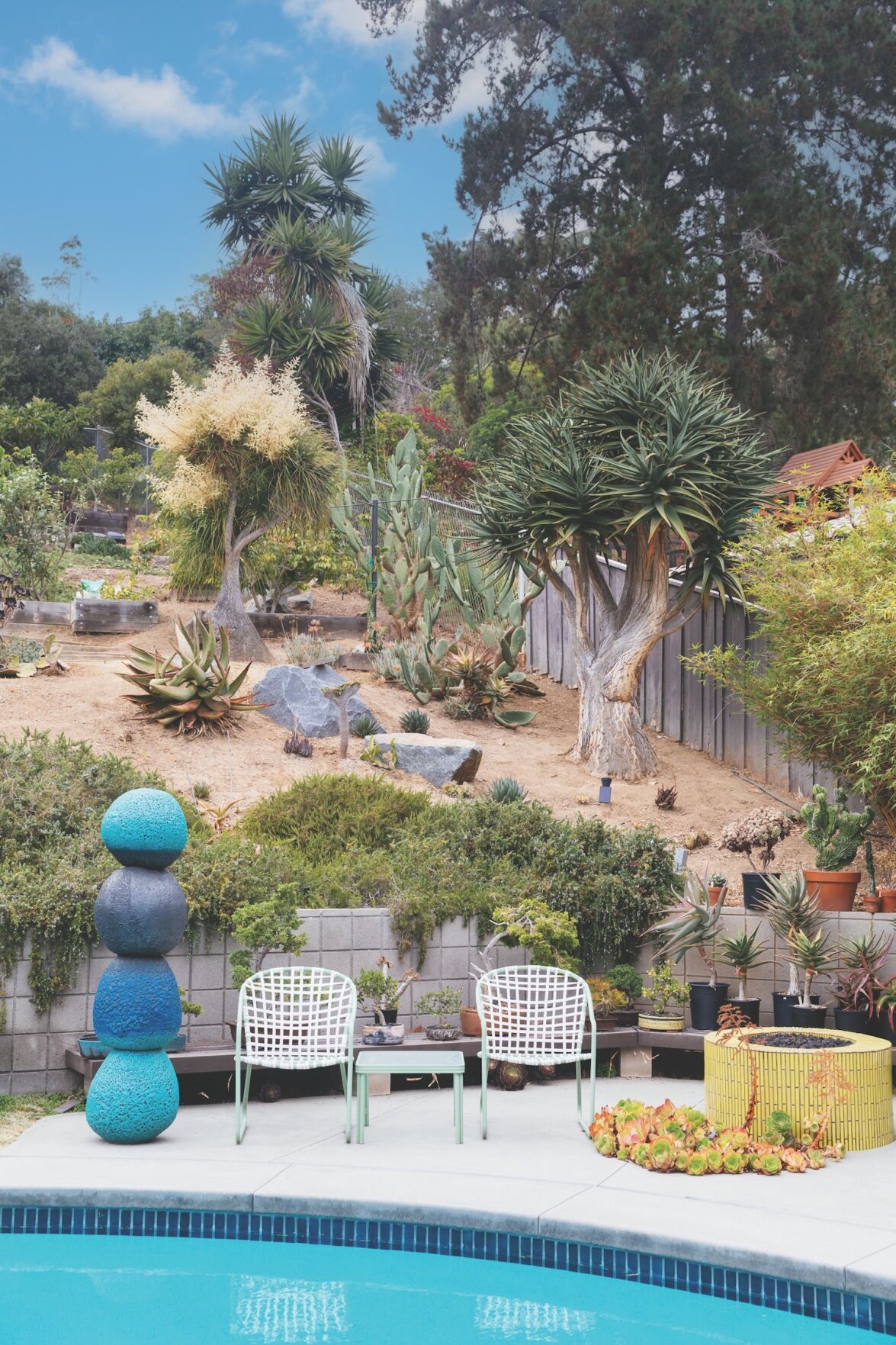
Josh Herman, pool

Josh Herman, pool

Photo Credit: Tomoko Matsubayashi

A favorite compliment from Herman’s mother-in-law: “When people are over, the house just works.” Filled with art, high-end but easygoing, it accommodates any situation comfortably, from teens chilling poolside to a hundred guests mingling.

Herman credits collaboration with a dream team for the results. Call it another win for San Diego’s design scene, just like Paradisaea, a group effort helmed by world-class interior designer and part-time La Jollan William T. Georgis. Housed in a glamorous historic Art Deco building, the restaurant feels more Beverly Hills than Bird Rock, thanks in part to Herman’s work.

“One thing that Bill wanted was to have Southern California and local artisans be an integral part of the design,” says Herman. “I am continually amazed by the caliber of the artists and craftspeople that I meet on design projects here.”
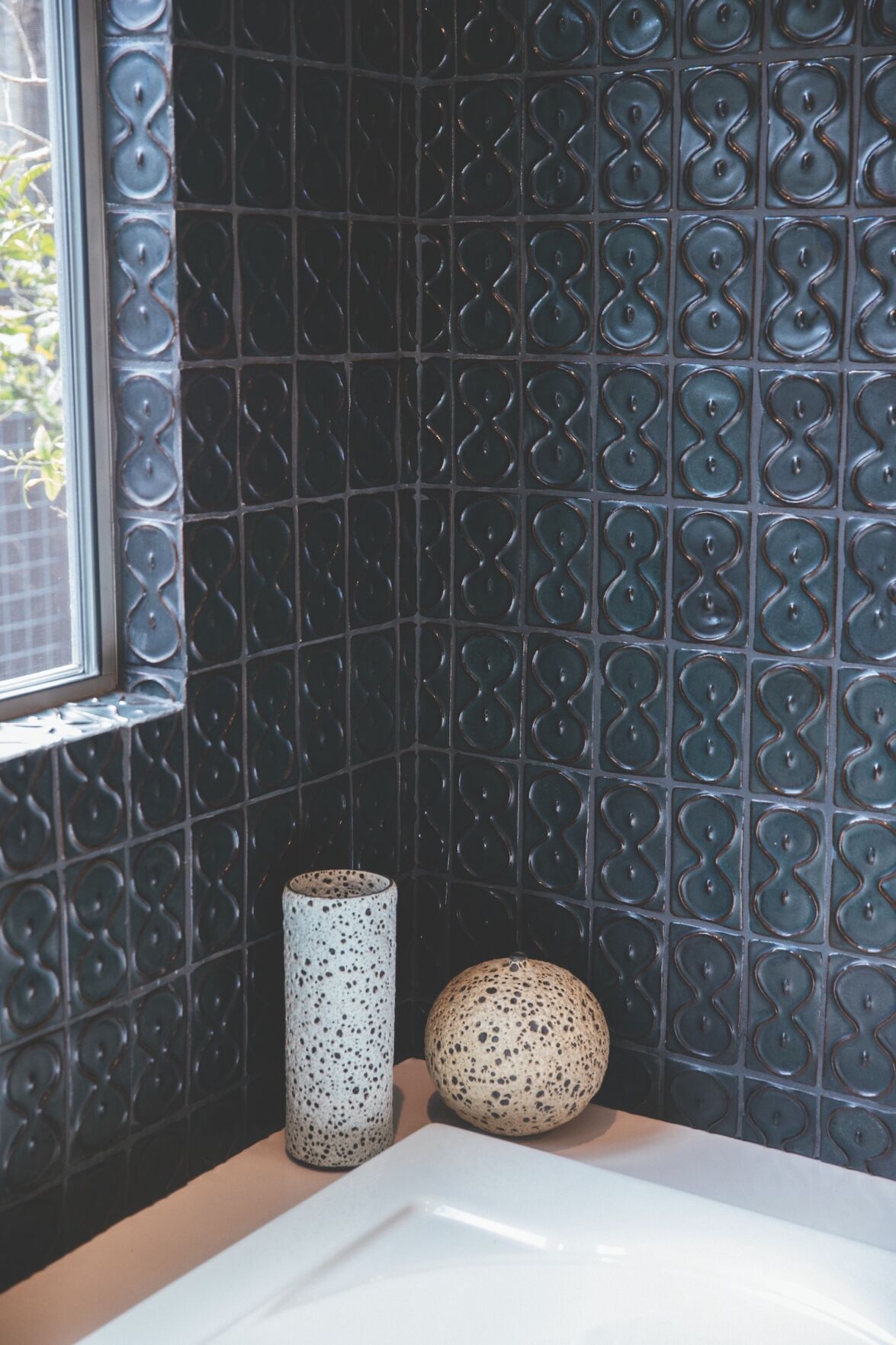
Josh Herman, bathroom 1

Photo Credit: Tomoko Matsubayashi

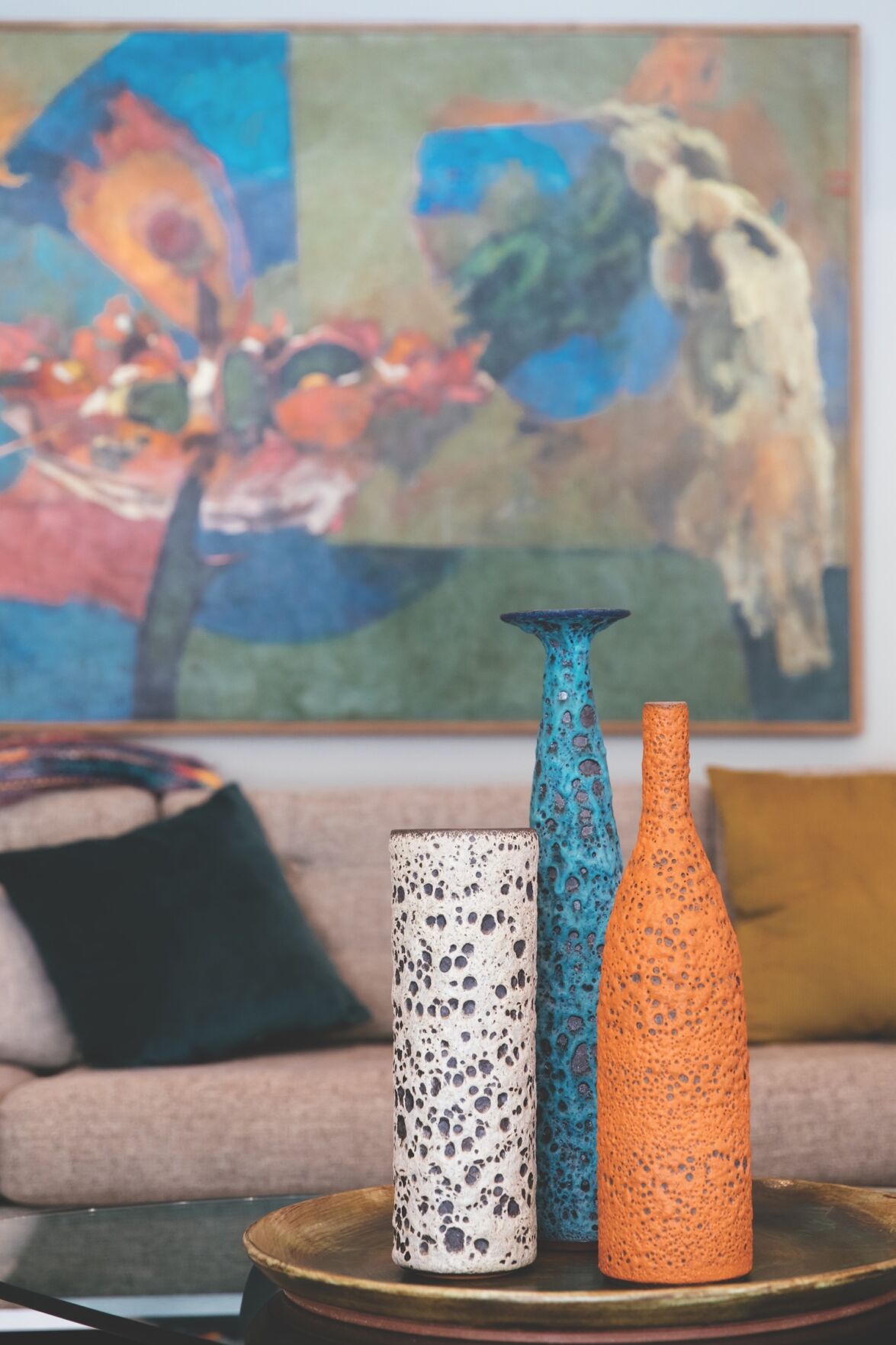
Josh Herman, vases

Photo Credit: Tomoko Matsubayashi

Josh Herman, bathroom

Photo Credit: Tomoko Matsubayashi

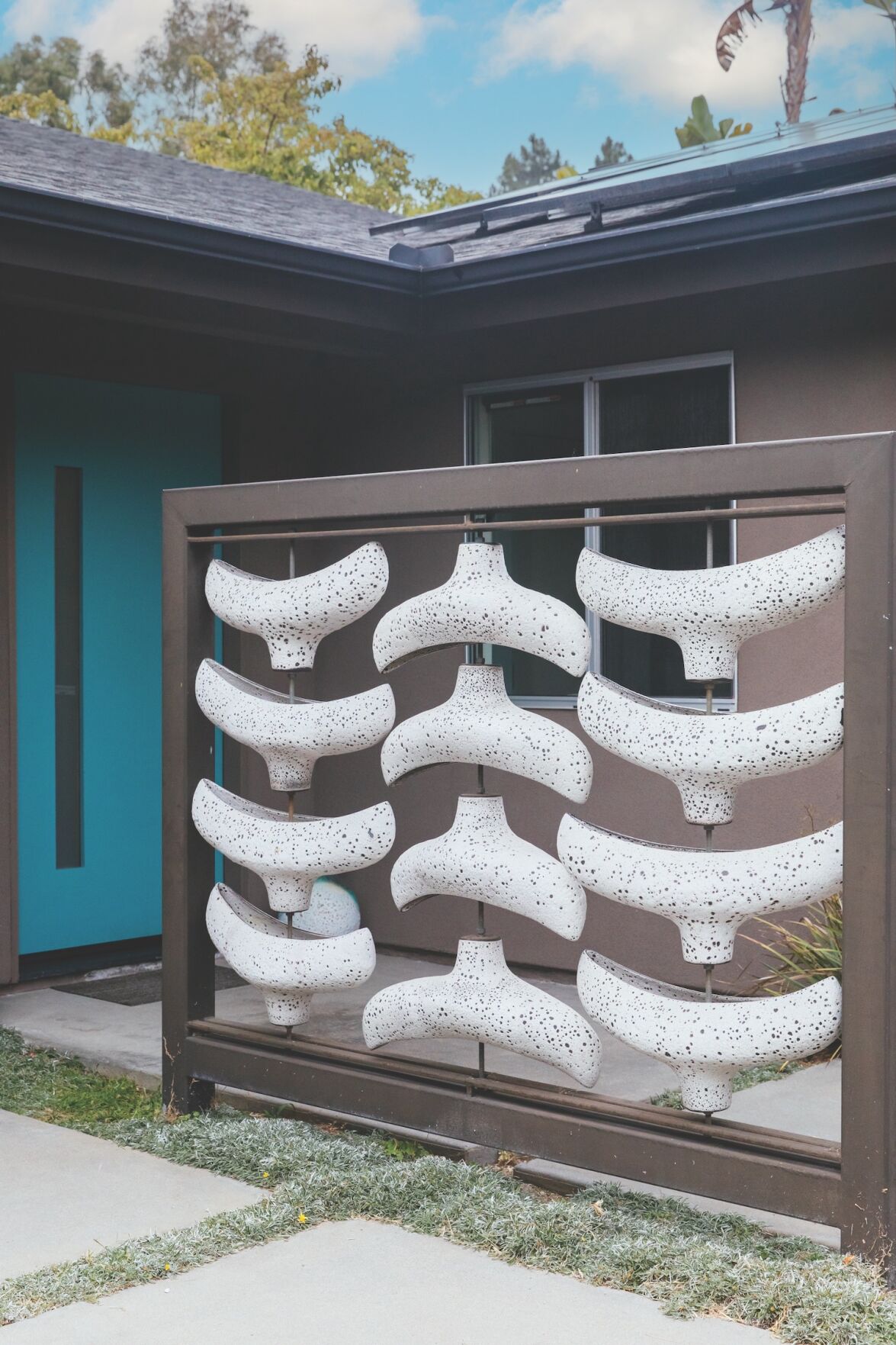
Josh Herman, patio

Photo Credit: Tomoko Matsubayashi

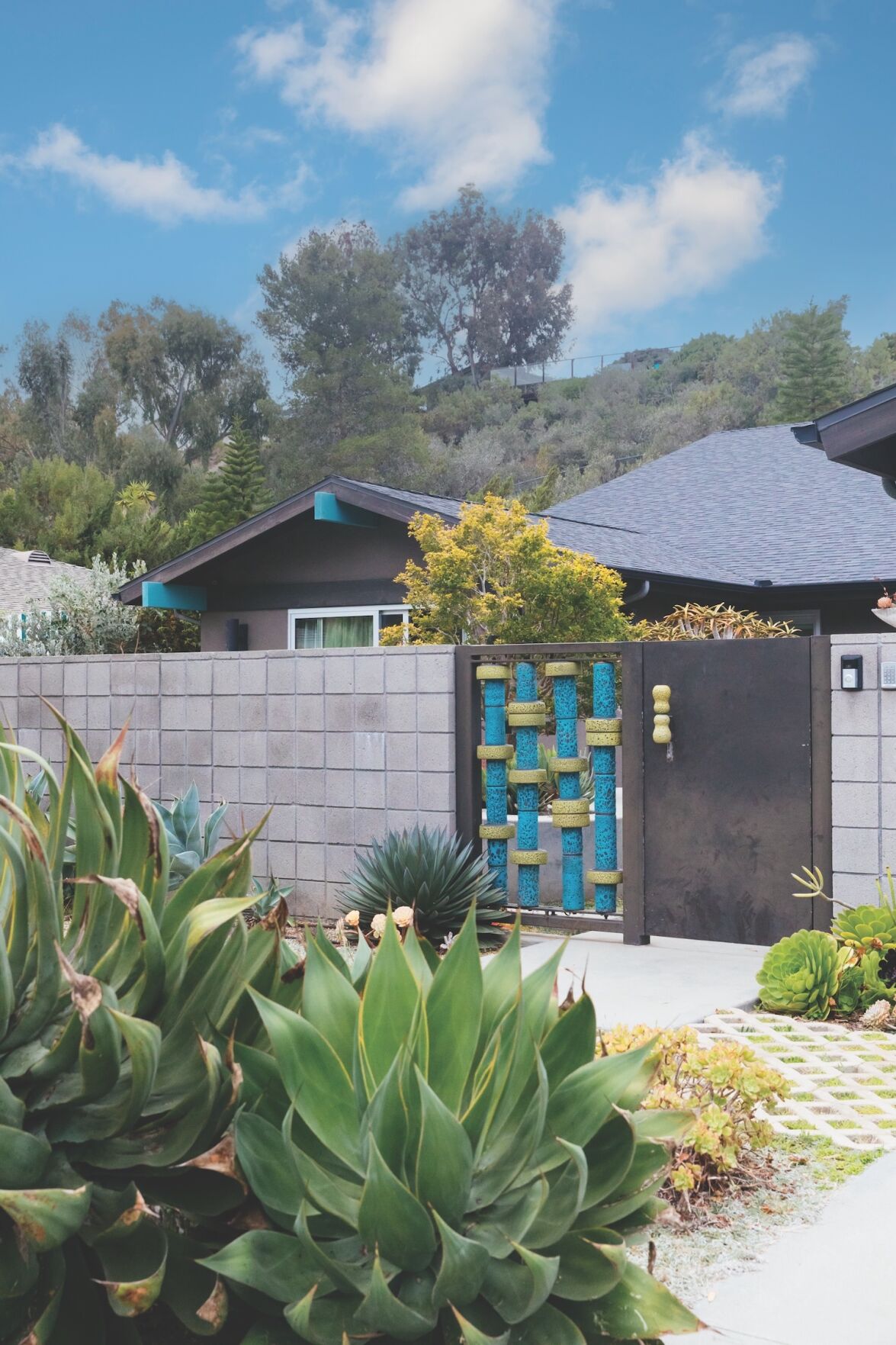
Josh Herman, exterior

Photo Credit: Tomoko Matsubayashi

Josh Herman

Subscribe to our newsletters

Select Options

By subscribing you confirm that you agree with our Terms and Conditions and Privacy Policy.

Features JUNE 29, 2026

5 San Diego Food Trends to Know About

From surprise revivals to changing dining habits, these are the shifts redefining the local culinary landscape

5 San Diego Food Trends to Know About
Photo Credit: Arlene Ibarra

Comebacks Are the New Kickoffs

If absence makes hearts (and stomachs) grow fonder, then shuttered restaurants quickly become the hottest tickets in town—something a number of iconic institutions found out after taking very public hiatuses after historically long runs. For instance, following a lengthy (and extremely flip-floppy) closing process after 92 years in business, Las Cuatro Milpas reopened two blocks away in Mercado del Barrio. Similarly, Carlsbad butcher shop Tip Top Meats reopened in the same location (albeit a smaller space) after the death of founder Joachim “Big John” Haedrich in 2023. Finally, after a whopping decade out of business, Sami Ladeki and chef Alfie Szeprethy brought back Roppongi to its original Prospect Street space, where it was the talk of the town in the late ’90s. All came back under the same proprietors, so they weren’t third-party nostalgia-licensing deals. The algorithm may have ravaged our attention spans away from all but the newest and shiniest, but this proves there’s still hope for our collective prefrontal cortex.

New Generations Take the Reins

Other local eateries honored their pasts by bringing in new perspectives. The Lion’s Share in Embarcadero, Milton’s Deli in Del Mar, Dudley’s Bakery in Santa Ysabel, and J-K’s Greek Cafe in La Mesa handed over the keys to new owners willing to take on a big task: maintain the soul of icons through particularly rough economic circumstances for restaurants, navigate big feelings from longtime regulars (who often don’t take kindly to change), and make some necessary changes to keep going for another few decades. Taking over a project in process can be a lot harder than starting from scratch. But building that feel-good nostalgia doesn’t happen overnight, so it sure helps to have a well-established playbook of success passed down from those who came before.

Courtesy of Sugarfish

The Expansion Class Arrives

It wasn’t just restaurant groups from Los Angeles that decided to put down roots en masse, although San Diego saw plenty of LA transplants recently (Sugarfish, Mr. Charlie’s, For the Win, Katsuya Ko, Bacari). Global brands like Chef Fei, Zuma, and Pepper Lunch have locations of their own on the way, and upscale Canadian eatery Joey joined to the inescapable gravitational pull of Westfield UTC’s culinary cosmos for its first spot in America’s Finest City. Good to see the rest of the world is catching up with what we’ve been seeing the last few years—San Diego is a dining destination already on the rise.

Choosing To Not Choose

Between the never-ending news cycle of doom and perimenopause brain fog, I’m at the stage in life where I’m more than happy to let someone else make a decision for me, especially when it comes to what’s for dinner. And based on the way a lot of menus look right now, I’m not alone. It seems like half the places I visit offer some version of a prix fixe, omakase, or tasting menu. Restaurants are embracing the curated experience to solve the problem of affordability (a fixed menu reduces food and labor costs, guarantees an acceptable check average, etc.) and critical thinking in one fell swoop. Omakase (meaning “I leave it up to you”) is far from a new concept in high-end Japanese sushi culture, but now that it’s popping up everywhere from coffee experiences to grab-and-go sushi and sandwiches, it’s gone from somewhat niche to nearly omnipresent.

Courtesy of Rikka Fika

Local Coffee Hit the World Stage

The world got an up-close look at San Diego’s coffee industry when we hosted the premier specialty coffee expo World of Coffee for the first time this April. San Diego’s long and rich coffee history stretches back to the late 19th century. Things percolated fairly quietly for around a century before really picking up steam. Today, there are nearly 200 specialty roasters and cafes across the county, with many earning national accolades like the Good Food Award (Steady State Roasting, 2020; Bird Rock Coffee Roasters, 2023, 2021, 2019, 2017, 2016), Roaster of the Year by Roast Magazine (Mostra Coffee, 2020; Bird Rock Coffee Roasters, 2012), and the Specialty Coffee Association Coffee Design Award for packaging (Rikka Fika, 2026). Now that we’ve moved past the comically insufferable coffee snob era of the early 2000s, even java newbies can feel comfortable walking into pretty much any coffee shop in San Diego, asking questions, trying a few things, and feeling confident they’re going to get great service and a great beverage.

Beth Demmon

About Beth Demmon

Beth Demmon is an award-winning writer and podcaster whose work regularly appears in national outlets and San Diego Magazine. Her first book, The Beer Lover's Guide to Cider, is now available. Find out more on bethdemmon.com.

Everything SD JUNE 25, 2026

The Former Comedian Who Became the Internet’s Bee Guy

Jeff Russell traded dreams of SNL for bee rescues, building a social media following of more than 4 million people along the way

The Former Comedian Who Became the Internet’s Bee Guy
Courtesy of Mr. & Mrs. Bee Rescue

The Groundlings improv theater has churned out world-famous comedic talents like Will Ferrell and Maya Rudolph. And in San Diego, a former Groundling has used that training to campaign for a higher power. The power to protect bees.

“The goal was to try and get on SNL,” says Jeff Russell of his time in the improv troupe. “[But now], I have an audience, and I get to crack jokes and be silly and entertain and educate.”

That audience? The over 4 million people who follow Mr. and Mrs. Bee Rescue in the socialmediaverse. Jeff and his wife, Julie, operate the business, which means they remove unwelcome bees without harming them and rehome them to apiaries throughout the county. Their social media is a hub of videos of Jeff peeling open car trunks, flooring, barbecues—any cozy spot for a bee to set up shop—and using smoke to coax them out of the hive (sometimes working sans gloves or protective gear).

Bees in a hive will follow their queen, so finding and moving her helps speed along the relocation process. It’s “a really hard game of Where’s Waldo,” Julie says. But there’s a secret to it: “If the bees start running completely in some random opposite direction in a hurry, then we know that the queen is probably that direction,” says Jeff. Their social videos document this process in a way that turns a reasonable nightmare (being swarmed by bees) into a form of entertainment and advocacy. The Russells spread the apian gospel, sharing why relocating bees is the only option to consider.

Since the 1960s, bee populations across the US have shrunk drastically for a slew of reasons—habitat loss (postwar industrialization led to fewer farms and crops), climate change (petulant temps affect blooming schedules), and pesticides (when used improperly, they can be toxic for bees).

Bees are also responsible for up to 75 percent of all flowering plants; 35 percent of food crops rely on animal pollinators to reproduce. So, basically, we’d be living in a flowerless world fueled by a diet of wind-pollinated oats and Red Dye 40 without them.

Jeff and Julie met on Tinder in 2016. “It would have been more appropriate if we met on Bumble,” Julie says. A photographer and graphic designer, she had no experience in a swarm of stingers before 2018. When Jeff broke his back surfing, she had no choice but to step in. Later, when she was laid off from her job in 2020, she focused on growing Mr. and Mrs. Bee Removal’s social media accounts. That’s when their business took off. These videos work. People are learning.

“Quite a lot of my customers were [initially] like, ‘Why don’t we just kill?’” Jeff says. “Now, the vast majority are like, ‘You take them alive, don’t you?’”

Emma Veidt

About Emma Veidt

Emma Veidt is an editor at San Diego Magazine. She earned her bachelor's and master's degrees from the Missouri School of Journalism. She loves running, hiking, and rock climbing, but really, she mostly loves encounters with the street cats around North Park.

Everything SD JUNE 25, 2026

The Ancient Idea Behind One of San Diego’s Biggest Tech Success Stories

Jordan Glazier's Wildfire Systems is reinventing loyalty rewards for some of the world's biggest brands

The Ancient Idea Behind One of San Diego’s Biggest Tech Success Stories
Photo Credit: Matt Furman

You visit your favorite ancient Egyptian merchant, and as you’re buying some papyrus to hieroglyph your way to the 3000 B.C. version of a Pulitzer, he slips you a special token as a thank you for being so loyal. It’s the least he can do for keeping him in business, and you can use that reward to barter for anything you want—like beer.

A few thousand years later, those tokens would evolve to copper coins that American retailers handed out so you could spend. The Sperry & Hutchinson company introduced its groundbreaking “Green Stamps” program in the late 1800s. Today, your sandwich shop’s loyalty card is one hole punch away from giving you a free sub. And you’ve surely justified some extravagant purchases in the name of airline miles.

Point is: Free stuff has always been a compelling way to earn human loyalty. And with his Solana Beach–based company Wildfire Systems, Jordan Glazier has built one of the city’s biggest tech companies by modernizing that simple, ancient idea.

“Being able to save money when you shop is nice to have when times are good,” Glazier says. “When you have periods of inflation or financial stress, that nice-to-have becomes a must-have.”

He launched Wildfire in 2017. It’s essentially a white-label platform that builds and operates programs for enterprise brands across most industries—from banking (Visa, Citi) to travel (TravelArrow) to fintech (Sezzle, Acorns), to rewards (Shop Your Way, KashKick), you name it. Customers of, say, RBC (also a client), can install a browser extension or enable a feature on a mobile app that activates savings and cashback offers. Wildfire has now spent three straight years on Inc. 5000’s list of the fastest-growing private companies.

Glazier’s no stranger to scaling new ideas. As one of the early executives at eBay, he built and ran the consumer electronics, computer, and industrial equipment verticals. Later he turned San Diego tech company Eventful into the world’s largest online calendar and events discovery platform (CBS acquired it in 2014).

“Part of being an entrepreneur is building things and solving for things that haven’t been solved before,” he says.

It’s a lesson he learned early on. His grandparents started a women’s clothing manufacturing company in Chicago in the 1910s, and it remained a family business for over seven decades. Preteen Glazier would punch in as a stock boy and sit with the sales team making phone calls.

“That was my very first paycheck,” he says with a smile.

Now he and his own team of 70 have grown Wildfire’s revenue 721 percent over the past three years.

“I want to make sure we are building a business that’s built to last,” he says. “We are eight years in, and I feel like we’re just getting started.”

Glazier named the company because of how people recommend products and services to each other. Great shirt, where’d you get it? Anyone know of a good sushi spot? “Word of mouth,” he says, “spreads like wildfire.”

San Diego’s tech industry seems to come and go. There were predictions that the post-pandemic, remote work world would see all luminous brains migrating south to our famous clime, but that has been only partially the case. As tides turn, big names like Glazier’s hold anchor.

“San Diego is such a great place to live and to build a business,” he says. “I always feel sorry for people who don’t live here.”

Matt Eisenberg is an award-winning writer and photographer based in San Diego. A former ESPN editor, his work has also been published by CNN, Bleacher Report and the New York Daily News.

Studio S JUNE 15, 2026

A Modern Take on Steak

Stake Chophouse & Bar brings contemporary classics and old-school service to the heart of Coronado

A Modern Take on Steak
Courtesy of Stake Chophouse

Stake Chophouse & Bar isn’t your average steakhouse. Blue Bridge Hospitality’s Coronado outpost is a modern interpretation of a big-city steakhouse nestled in the heart of the small coastal community. The team at Stake has reimagined the whole steakhouse experience. By prioritizing a seasonal farm-to-table sourcing philosophy, a personalized guest experience, and unique service touches, like a formal steak presentation and a bespoke knife selection process, Stake distinguishes itself in a sea of steakhouses.

Exceptional steaks, including Wagyu from Japan, Australia, and the U.S., and fresh seafood flown in daily form the core of Stake’s culinary identity. The menu features a five-course omakase-style steak experience highlighting house favorites, plus an array of cuts, and classic steakhouse staples—think a wedge salad, baked potato, or pasta carbonara—refined for a contemporary palate without losing their traditional appeal. Stake focuses on seasonal sourcing from the region’s best family farms and specialty purveyors, and incorporates intentionally unexpected touches to create something truly unique.

“I challenge our chefs and myself to take it a step further in sourcing,” says Chef Ronnie Schwandt. “It’s important to us to highlight different farms, unique one-off farms—whether it’s cattle, strawberries, a local fisherman or from anywhere in the United States, we’re always trying to find that niche.”

Beyond the menu, Stake emphasizes outstanding service, says Vinny Spatafore, Director of Hospitality Operations. Staff maintains detailed notes, allowing them to remember guests by name, recall previous orders such as a favorite martini (also memorable for the customer since it’s served in an extra tall, distinctly-shaped glass), and celebrate special occasions like birthdays and anniversaries.

“When you have those points of topic that you remember about a guest, they appreciate that,” he says. “Our servers are really good with that—we have a couple servers who have been here since the beginning and they’ll remember somebody from years ago, their name, their kids’ names, where they live. I’m really thankful to have a great front of house staff.”

Award-winning wines, rare whiskeys, special events, and a complementary black car service that provides transportation for guests throughout Coronado add to Stake’s appeal.

Schwandt stresses that Stake offers more than a meal; they aim to give patrons something unforgettable.

“It starts when you walk up the stairs and are greeted by the hostess—that sets the tone for the night. Then you’re greeted by a server, who may know you by name, and can guide you through the menu and curate as they get to know you,” says Schwandt. “Most people leave kind of blown away; they leave feeling like they just had an experience. That’s the goal, right? Whether you’re serving smash burgers or high-end steak, you want somebody to leave thinking, Wow, that was awesome.”

Partner Content
Everything SD JUNE 24, 2026

Before She Died, Edna Harper Asked for One Thing

The creator of Mission Hills' iconic topiary garden hoped future owners would preserve the living artwork she spent decades cultivating

Before She Died, Edna Harper Asked for One Thing
Photo Credit: Casiel Sanchez

Edna Harper asked for one thing before she died: that the next owner of her iconic Mission Hills home keep the street-facing “garden.” Which is essentially asking the future residents to be curators of a whimsical and obsessive, delightful and strange, classic, cartoony and slightly unhinged sculpture museum. Harper, who died in January at the age of 87, poured her heart into this topiary bonanza, and it’s right there for everyone to see.

Like thousands (or millions, there’s no formal estimation) of others, I had scrolled through the photos of this topiary fantasia before I ever stood in front of it. As of this writing, Harper’s Topiary Garden is No. 227 of 2,686 Things to Do in San Diego on Tripadvisor, making it a popular tourist stop between fish tacos, a day at the beach, and a stroll in nearby Presidio Park. But crowdsourced photos quickly snapped in direct overhead sunlight tend to flatten the shapes that, while meticulously manicured, refuse to behave. In person, Harper’s figures seem to be in motion and, given that they’re sculpted out of bushes, they literally are. (I’d love to see a maintenance timelapse.)

Animals emerge out of shrubs as if they have impish ideas. A fanciful whale, a man in a sombrero, a random spiral twisting skyward, otherworldly creatures that defy categorization—all of these exist together in a neatly trimmed cascade pouring down the steep front slope of the property.

You don’t accidentally end up with a yard like this. You decide to create it and choose to cultivate it, and then you keep deciding and cultivating—for decades.

Although a consistent parade of looky-loos have visited over the years, most have never been inside the home, which is on the market for the first time since Harper and her husband, Alex (who died in 2020), bought it in 1969.

Courtesy of Christopher Delgado

“It was and is a landmark,” says Christopher Delgado, Harper’s cousin and trustee of her estate. “She specialized in Chinese brush art and Japanese art called ‘sumi-e,’ a form of Zen art. She was a creator … she was very, very talented.”

I can’t stop thinking about Harper, sitting at the kitchen window, looking down at her masterpiece and the watchers watching it. The image of Harper enjoying the joy the public took from her handiwork makes me want to understand the woman behind the work. Because topiary, as an art form, has always been a little… loaded.

Topiary has always had a bit of an identity crisis—and that’s part of its charm.

When I think of topiary, I immediately think: Fancy. French bourgeoisie. Palace of Versailles. Mais non! Topiary has its origins in Rome. According to the Center for Architecture, the word “topiary” has its origins in late 16th century English, which combines the Greek word “topos” for place and the Latin word “topiarius” for ornamental gardner.

Photo Credit: Casiel Sanchez

Topiary started as a flex, really. A Julius-Caesar-adjacent pastime for the most ancient one-percenters; an expression accessible only to those with land, labor (or, put more plainly, enslaved people), and spare time. In its earliest form, topiary was about control: bending nature into submission. It’s where symmetry and precision signaled order, taste, and money.

But with the collapse of the Roman Empire and the Dark Ages that followed, the topiary almost preceded the Dodo Bird in extinction. Monks quietly kept the art alive by growing herbs and manicuring the gardens and hedges within the courtyards of their monasteries.

It wasn’t until the Renaissance nine centuries later when topiary saw a resurgence—ah, Versailles!—and this form of pleasure gardening went into overdrive. Nature became architecture. The French pruned their foliage into iconic cones and obelisks, walls to keep out the riffraff, and ornamentation designed to impress. The Dutch got a little freaky, as they do, and sculpted complicated figures, animals, and even furniture.

Inevitably, the pendulum swung again, and topiary fell out of favor once it became viewed as excessive and even absurd. Even so, it never really disappeared. It just migrated to exist in a completely different paradigm. It was less Versailles and more, “What if this bush were a mouse?”

Children at the New Children's museum clay workshop

Fast forward to Disneyland in 1963. That year, the park opened a topiary garden in Fantasyland with verdant sculptures of giraffes, camels, elephants, and hippos all inspired by Denmark’s Tivoli Gardens.

Disney’s interpretation of topiary—which is still a fixture of park decor today—falls more into the realm of imagination and possibility than restrained aristocratic performance.

That’s one of the stranger throughlines of topiary: It moves from elite to everyday, from stiff and formal to playful and silly, from symbol of control to something steeped in personal expression.

Which is what makes a place like Harper’s Topiary Garden so compelling and the woman behind it utterly intriguing.

Courtesy of Christopher Delgado

Born in 1938, Edna Harper was something of a Renaissance woman. She worked for two decades as a dental assistant, and she later became a notable painter, calligrapher, and stained glass artist (the house itself is adorned with her work). But she was also savvy in other ways.

“She graduated [with a degree in dental assisting] from San Diego City College and wanted to have her own money and her independence,” says Delgado. “Most people didn’t know that she was such a great businessperson, and for many years, she managed all of [the couple’s] properties on her own. She was great at building relationships … she touched a lot of people’s lives.”

Her friend and fellow artist Julie Roth attributes her artistry to her relationship with Harper. The pair met two decades ago at an art class at Oasis in Mission Valley.

“She was just the most encouraging person,” Roth says. “I didn’t know I could paint, but apparently I can. She was a tremendous person.”

I asked Roth what she’d want people to know about her friend.

“Her empathy and diplomacy,” she says. “[She had] a sharp eye for other talent. She spotted me, but I’m not the only one she encouraged.”

That sharp eye suggests attention, the same kind it takes to look at a bush and also see a whale. Or a spiral. Or something that doesn’t exist yet, but could.

Photo Credit: Casiel Sanchez

Nothing about Harper’s life suggests someone chasing attention. And yet, she ended up creating something that demanded hers, and she took great pleasure in seeing people enjoy her creations.

The garden didn’t happen all at once. It grew out of years of travel, observation, and collaboration. Harper often traveled without her husband, always returning from trips to Japan, Thailand, and other parts of Asia with ideas and impressions captured through sketches in a notebook.

“She would get creative ideas from her travels … she’d come back with ideas and pictures, and they’d go about cutting that topiary bush into shape,” Delgado says.

For the past 25 years, she had the help of her gardener, Pedro Duran—who’s still employed by the trust and has maintained the garden since Harper’s passing.

In the early topiary years, Harper worked closely with Duran in what Delgado describes as a kind of shared “labor of love.” She would share her sketches and together the pair would shape the bushes into something deliberate.

Photo Credit: Casiel Sanchez

“As she got older, she would increasingly draw her ideas and [Duran] would [carry them out],” Delgado says.

That collaboration reinforces that her garden was not an act of control, but one of creative collaboration and translation. From memory to sketch. From sketch to shrub. From something seen, somewhere else in the world, to something rooted in the soil of a steep hillside in Mission Hills.

Harper also made sure that the lawn’s boisterous energy made its way into the house on Union Street. Apparently, she threw legendary parties.

“Fairly regularly, in the late ’70s and ’80s, she would host Super Bowl parties with 200 people. She had TVs everywhere,” Delgado says.

It’s not hard to square that image with the stillness of the garden which, despite the careful pruning and intentional design, is voluminous and nearly vibrating.

And, damnit, I wish I’d watched some sportsball on her shocking number of TVs and wandered out front to the topiary—slightly wine-drunk with an orange smear of wing sauce on the corner of my mouth—to marvel at the leafy hippo and this woman’s elaborately creative life.

Photo Credit: Casiel Sanchez

I can hear Delgado smiling as we talk on the phone. He’s going back to his childhood, when he talks about being one of the cousins Harper doted on when he visited.

“The adults were inside, and we’d be out in the camper,” he says, “and [Harper] would come check on us, make sure we were okay. She always had gifts for us. If it was Easter, there were chocolate eggs. If it was Christmas, stockings. We were the beneficiaries of them not having kids because they showered us with all their love.”

Knowing this and taking a look at her garden again, you can see it’s not the work of a shut-away curmudgeon. It’s wondrous, inviting, and the right kind of weird.

“Ultimately, she did it for herself and family, first and foremost,” Delgado says of Harper’s Topiary Garden.

Harper’s one request of whomever buys her home may seem like a focus on basic maintenance, about hedges and upkeep and preserving something visually striking. But it’s really about attention. And maybe, too, about legacy. Not hers, per se, but the legacy of community, relationships, art, creativity, possibility, adventure, culture, dedication, and love.

For now, it’s there for anyone to see, and its future is in the hands of whomever comes next.

Features JUNE 18, 2026

The Perfect Shot with SD’s Top Food Photographers

We ask the city's best food photographers to choose their favorite pics and share their secrets to capturing a drool-worthy pic

The Perfect Shot with SD’s Top Food Photographers
Photo Credit: Luciana McIntosh

Food is a notorious diva to photograph. The wrong lighting can make José Andrés’ paella look like a jaundiced grain bowl. You could be staring at the best sandwich of your life, but shoot it from above and—hey, congrats on that abandoned piece of lettuce bread. A cottage meme industry has been built around the hilariously bad photos on review sites that make Michelin-star food look like Michelin tires.

Especially in a visual modern media world, food culture depends on great photographers capturing the painstaking work in equally deserving ways. We asked four of San Diego’s top food photographers for their favorite shot from another year of documenting what we eat.

Photo Credit: Kimberly Motos

Kimberly Motos

Birdman Sandwich at Chick & Hawk

Getting this kind of shot takes a bit of yoga. Asana yourself into the corner, hold your breath, pray that a chef on the move doesn’t back into your light stand.

“You’re stepping into someone’s workspace during their busiest moments, so it’s a balance of being present to get the shot and being invisible to not slow anything down,” Kimberly Motos says.

The subject here is the Birdman sandwich from Chick & Hawk—hot fried chicken thigh, tangy slaw, kimchi comeback sauce, sweet and spicy pickles, potato brioche bun—getting a hearty dousing of its difference-maker seasoning. Motos captures the parts of the process that diners don’t usually see: the chaos behind something that looks so simple.

Photo Credit: Lucianna McIntosh

Lucianna McIntosh

Oysters + Jewel of the Sea Martini at The Fishery

“I love this image because it feels like a moment you want to step into,” says Lucianna McIntosh. A warm, sunny day at The Fishery in PB with oysters, caviar, and martinis. Yes, please.

The little details—the glass sweating a little, the direct afternoon light creating stark shadows, the oyster glistening on the tray—are the main characters. Instead of trying to overly control the setup, McIntosh “followed the light and lines that draw you in more,” she says. “This was one of those moments where everything lined up on its own for a second. I love it when the shadows end up being just as important as the food itself.”

Photo Credit: Eric Wolfinger

Eric Wolfinger

Herb-Roasted Golden Chicken at Fleurette

La Jolla native Eric Wolfinger—who won a James Beard Award for Tartine Bread, one of the most stunning bread books of all time—says he doesn’t have a signature style. His style is a conduit.

“I see my job is to translate the chef’s point of view into something you can feel,” he says.

For this shot, Fleurette chef Travis Swikard had one directive: cuisine du soleil (“cuisine of the sun”). With a spread of leeks vinaigrette, herb-roasted golden chicken, and beets, Wolfinger wanted to create a scene that felt straight out of the French Riviera, relaying the light, bright style of Swikard’s new spot.

Some bonus additions here: Extra lights—to add lots of warmth—and a clipping from an olive tree.

Photo Credit: Dee Sandoval

Dee Sandoval

Espresso Ice Cream at Lucien

Timing and light are everything in food photography. In Lucien—La Jolla’s tasting-menu-only restaurant with moody ambiance—a single strobe flash creates the ideal spotlight.

Dee Sandoval says she uses the “natural, just-plated energy” of the dish to “create a portrait of moment and craft.” That’s why this Mostra Ghost Bear espresso ice cream—with San José dark chocolate mousse, soy-miso caramel, and koji shoyu chocolate sauce—looks like it might dissolve halfway to your mouth.

Emma Veidt

About Emma Veidt

Emma Veidt is an editor at San Diego Magazine. She earned her bachelor's and master's degrees from the Missouri School of Journalism. She loves running, hiking, and rock climbing, but really, she mostly loves encounters with the street cats around North Park.

Partner Content JUNE 25, 2026

Summer Nights at SeaWorld San Diego

SeaWorld dazzles with a drone show, big-name entertainers, new animal adventures and more 

Summer Nights at SeaWorld San Diego

Nights are heating up at SeaWorld San Diego. The quintessential summertime staple on Mission Bay is transforming into a destination for unforgettable day-to-night adventures, bringing back some of its most popular Summer Nights programming and introducing exciting new experiences sure to delight both kids and adults alike. 

The 2026 Summer Day to Night at SeaWorld San Diego is the park’s most ambitious season yet. SeaWorld has planned a highly anticipated entertainment lineup that features nine weeks of throwback concerts featuring R&B and hip‑hop favorites from the ‘90s and early 2000s, including Jordin Sparks, Too $hort and Warren G, Ashanti, and an array of boy band heartthrobs performing together as part of the Pop 2000 Tour. 

New this season is perhaps the park’s most visible update: a nightly drone show, Ocean of Dreams, which illuminates the sky with hundreds of synchronized sparklers. Drones form sea otters, sharks, dolphins, and a majestic orca that tell a breathtaking 12-minute story of marine life and underwater ecosystems. The show culminates with a spectacular electric neon finale celebrating hope, wonder, and ocean stewardship.

Nighttime visitors are also in store for animal adventures that fuse education with high-energy fun and the dreamy ambiance of nighttime. The park has launched two all-new animal presentations: Shamu’s Celebration: Light Up the Night and Dolphins: Touch the Sky. Shamu’s Celebration: Light Up the Night features vibrant lighting, music, and dynamic choreography that celebrates the power and beauty of killer whales. Dolphins: Touch the Sky showcases playful bottlenose dolphins and the special connection between humans and the natural world. And back by popular demand is fan-favorite Sea Lions Tonite. See the charming pinnipeds splash, play, and parody pop culture in this refreshed crowd-pleaser. 

More must-sees: a newly reimagined Shark Encounter, one of the country’s more immersive exhibits highlighting 11 different species up close, SeaWorld’s beloved BMX Blast! stunt show, and high-seas escapade, Pirates Ahoy! The Battle for Mermaid Cove. And don’t miss the park’s all-new Deep Sea Disco, which encourages guests to dance the night away under the glow of the SkyTower, and vibrant closing time laser light display Laser Reef Summer Spectacular. 

Amp up the nighttime vibe with local craft beers, curated cocktails, and nostalgic theme park treats with $1 beer all summer long. SeaWorld is the place for day to night summer fun. When the sun goes down, SeaWorld lights up, and inspires guests of all ages to embrace their inner whimsy and see why generations of San Diegans head to SeaWorld to make memories they’ll never forget. 

Thousands of savvy locals already get it.

San Diego's best restaurants, experiences, and events—handpicked and delivered to your inbox weekly. You in?

Close the CTA

Contact Us

1230 Columbia Street, Suite 800,

San Diego, CA