Ready to know more about San Diego?

Subscribe
Living & Design AUGUST 16, 2013

Modern Family

Happy place between old and new in Point Loma
Modern Family
Modern Family

stone wall covered in ivy

Earth Tones

The living room is the first space you see upon entering the McQueen house in Point Loma. Elegant and inviting, it’s a study in transitional style, the blending of modern and traditional décor. “We built the room around these chairs that we loved,” homeowner Natalie McQueen says of her two camel-colored wingback chairs, which are family heirlooms. “I liked the traditional aspects but wanted to add modern elements.” She enlisted Timothy Ruiz and Lauren Manas of Pacific Interiors. They stuck with earth tones to complement the chairs, added marble to the fireplace, and, because the room gets so much light, chose a richer color for the walls, Valley Forge Tan by Benjamin Moore. The J. Redmond sofa and armchairs with Kravet fabric were custom-made to fit the space. Tall plants accentuate the room’s dramatic ceilings. Other modern accents include a coffee table from Williams-Sonoma Home and area rug by Calvin Klein.

Historical Roots

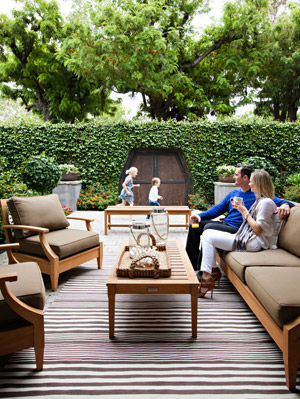
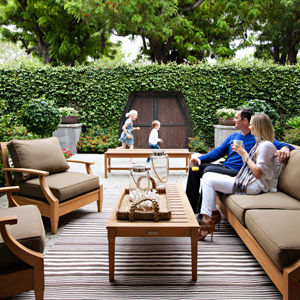
At the perimeter of this outdoor entertaining space lies a storybook stone wall. Covered with fig ivy, the wall was once part of the historic Rosecroft mansion’s begonia gardens. In the 1960s the gardens were closed and replaced by houses, but the wall remains as a historical landmark. Above: Homeowners Tim and Natalie McQueen watch daughter Bridget (8) and son Mitch (4) play. (Furniture by Restoration Hardware, accessories by Pottery Barn, area rug from Scout at Quarters D in Liberty Station)

Flipping Out

Its owners sought to preserve the original character of the house, which was built in 1989. “I wanted the outside to look as traditional as possible,” Natalie McQueen says. Her design team repainted the exterior and added flower boxes and Belgard pavers to the front yard. And yes, that’s eight-year-old Bridget doing a perfect back handspring on the grass. Stick it! (Landscaping by Pedro Ortega; floral arrangements by Erik Schumann)

Heart of the Home

The McQueens worked with contractor Robert McCarron to completely gut the original kitchen. They kept most of the existing layout, while extending the island and building an overhang with opposing pot racks. Stainless steel appliances give the space an industrial feel. Lava stone countertops and beveled subway tile create a crisp black-and-white aesthetic. For extra warmth and interest, designer Timothy Ruiz suggested adding a section of walnut cabinetry. Although the darker wood is built in, it’s meant to look like a hutch, or stand-alone piece of furniture. “I think it’s one of the best kitchens I’ve ever done,” Ruiz says of the space’s function and style. In the foreground, a whimsical chalkboard wall serves as a place to write messages and notes.

Clean and Simple

In keeping with the transitional style, designer Timothy Ruiz mixed ultra-modern chrome and white leather dining chairs by Bontempi with a classic dining table (another inherited antique). “When you pare everything down, and keep it real clean and simple, that’s how you keep your traditional pieces looking more modern,” Ruiz says. (Photographic painting by local artist Monica Hoover, purchased at Mixture in Little Italy; large seashell centerpiece from Z Gallerie)

Boyish Charm

When four-year-old Mitch outgrew his nursery, his mom and her designers turned his bedroom into a nautical-themed play zone. One essential? Custom built-ins to maximize toy storage. They chose moss-green paint because it was “a little different than the traditional boy colors.” Starfish pulls from San Diego Hardware add a fun seaside touch. The shelves are lined with beloved bedtime books and gifts from friends, like the spotted ukulele. Another gift—an old fishing rod—stands in the corner. “He loves to fish and loves boats,” mom Natalie explains. (Bedding from Serena & Lily, bed and dresser by Stanley Furniture Co.’s Young America)

European Influence

The lone bit of pattern, courtesy of paisley wallpaper and a European area rug, is in the master bedroom sitting area. Here, traditional elements like wicker chairs blend with modern throw pillows from Mixture and an abstract painting. The antique European chest is another family heirloom. “We lived in London when we were young, and my parents brought a lot of stuff back,” Natalie says. “They’ve slowly passed it down to me.” (Chair cushions covered in Robert Allen fabric, wallpaper from Sterling Interiors/Design)

Photos Point Loma

Subscribe to our newsletters

Select Options

By subscribing you confirm that you agree with our Terms and Conditions and Privacy Policy.

Everything SD AUGUST 18, 2025

What to Know About the Multibillion-Dollar Midway Rising Project

The massive, 48-acre concept—complete with a new 16,000-seat stadium—is slated to transform the Point Loma district if approved

What to Know About the Multibillion-Dollar Midway Rising Project
Rendering Courtesy of Midway Rising

When the filmmaker Cameron Crowe needed a stadium to look like it was from the 1970s for his 2000 movie Almost Famous, he turned to his hometown. He filmed the scene in which protagonist William Miller meets the rock band Stillwater for the first time at Sports Arena Stadium (now called Pechanga Arena).

Twenty-five years after the release of Almost Famous, the 1966 stadium still looks much the same—but maybe not for long. Now the site is slated for a massive revamp dubbed “Midway Rising.” The plan is to replace the original Pechanga Arena (which currently seats about 14,000) with a new 16,000-seat stadium, along with 2,000 affordable apartments, 2,250 market-rate apartments, 130,000 square feet of shops and restaurants, and 14.5 acres of parks and public space.

Elvis Presley concert at Sports Arena in San Diego's Midway District
Courtesy of Pechanga Arena

The team behind the project includes Chelsea Investment Corporation, sports venue developer Legends, and market-rate housing developer Zephyr. It’s funded by real estate investment firm The Kroenke Group.

“I think it’s the opportunity to bring a world-class, modernized entertainment center to the city,” says Zephyr CEO Brad Termini. “Having a new arena at the Midway has been a goal of the city for as long as I’ve lived here, and it feels like we’re really close to delivering that vision, a facility that could attract the globe’s best talent and shows for San Diego.”

The redevelopment began in September 2022, when the San Diego City Council formally selected the Midway Rising team to take on the project. This spring, the draft environmental impact report (EIR) for the project was released, and the team is holding a series of meetings to collect community feedback. The goal is for it to go to the City Council this fall for approval.

Rendering of new San Diego's new Midway Rising project to redevelop the Midway District near Point Loma and build a new stadium to replace Pechanga Arena
Rendering Courtesy of Safdie Rbaines Architects

The Kroenke Group are the majority funders of the project, but Termini says they aren’t ready to state publicly how much it will cost. “It’s evolving. With the crazy construction markets we find ourselves in today, it’s very difficult to peg that, so we’re not releasing any public budget numbers at this time,” he adds.

However, those figures have the potential to be massive. According to the City of San Diego, the project’s affordable housing developer, Chelsea Investment Corporation, led 65 projects in San Diego County and more than 120 throughout Southern California at a total cost of over $3 billion. Meanwhile, Zephyr has headed more than $1 billion in mixed-use developments.

Whatever the final investment, Pechanga Arena will be completely transformed. Termini tells us that the current iteration is too old and outdated to attract big-name concerts. Its loading dock, lighting, and sound aren’t up to current standards.

Historical photo of snack bar at Sports Arena in San Diego's Midway District
Courtesy of Pechanga Arena

“It’s kind of like a dive bar—when the lights are low and it’s full, it can still be a fun place,” he says. “But when the lights go up, you really see what’s there. It’s really lacking.”

That rings true for local sports fan Zack Tembi, who regularly attends San Diego Seals lacrosse games at the old stadium. “It’s just stale,” he says. “San Diego isn’t known for being a sports city, right? So, if we have something that can attract good events and talent, I’m all about that.”

Aerial view of San Diego's Belmont Park located in Mission Beach which celebrates its 100th anniversary in 2025

Ideally, Tembi adds, the vision would expand beyond the stadium.

“I think they should make more of a community center, like what you see with most of the modern stadiums,” he continues. “Things that are accessible around the stadium—whether it’s parks or shops or restaurants—that bring people in even when there’s no event. I’d also love to see things around the stadium that you can go to without needing a ticket. Stuff that’s fun, like a restaurant with golf simulators or interactive experiences. Just more ways people in the community can use the space all the time, not just when there’s a concert or a game.”

Dolly Parton concert at Sports Arena in San Diego's Midway District
Courtesy of Pechanga Arena

While there’s no promise of golf simulators just yet, developers do intend to include lots of retail and restaurant space, along with public parks. Termini says his team predicts it will have a massive economic impact—perhaps equivalent to the three largest events the San Diego Convention Center hosts every year, including Comic-Con.

Christina Bibler, director of economic development for the City of San Diego, is excited about the project’s potential effects. “Just the sheer magnitude and size of a 48-acre parcel that is going to [have a ton of housing units and create many] jobs—it will be legacy-leaving for Midway,” she says. “[We’re looking at] more amenities, increased revenue, and the revitalization of a site that hasn’t really been revitalized since the mid-1960s.”

The project is a major priority for her team, she explains, because of the affordable housing it will bring and because it will help make better use of the land owned by the city. “Its [value depreciates] when you don’t reinvest,” she says. “This is about revitalizing and catalyzing the Midway area in a way that will have a lasting impact for future generations.”

Rendering of new San Diego's new Midway Rising project to redevelop the Midway District near Point Loma and build a new stadium to replace Pechanga Arena
Rendering Courtesy of Safdie Rbaines Architects

But the surrounding community has concerns. The biggest one for the Peninsula Community Planning Board, which advises the city on developments in that area, is the traffic a bigger stadium will bring.

“Rosecrans Street is already congested, and this project doesn’t fully mitigate that,” says Javier Saunders, head of the group’s long-range planning committee. “We just feel we’re going to be saddled with additional traffic that’s not going to be addressed properly.”

According to Saunders, the project’s current suggested traffic alleviation techniques are laughable. “What they’re proposing is a shuttle bus—one shuttle bus,” he notes. “And then they’re giving their employees public transit passes for the entertainment center as mitigation. I think it’s a slap in the face to the city.”

Historical photo of Muhammad Ali boxing match at Sports Arena in San Diego's Midway District
Courtesy of Pechanga Arena

Saunders says his group would like to see more—particularly a street extension on Greenwood Street and a pedestrian and bike overcrossing at Camino del Rio West—to help manage traffic. The Greenwood Street extension was in the community plan, he says, but it was removed to make more room for development.

The influx of new residences in the area may also increase traffic, but developers are exempt from having to explain how they intend to mitigate those concerns in the impact report because they plan to include affordable housing.

“The next step is to go to the City Council and present our issues,” he adds. “The council can say the benefits outweigh the impacts and approve it as is, or it can say, ‘We’re not going to approve this now. We want you to go back and address some issues.’ [The latter is] what we’re hoping for.”

Rendering Courtesy of Safdie Rbaines Architects

Others in the community bring apprehensions, too, including Clifford Weiler, an attorney who filed a letter in response to the project’s environmental impact report. He says the ground in the area is sinking. In 50 years, he believes, people will move into Midway apartments “and [be unable to] shut their doors. The foundations [will be] cracked or the water pipes [will be] cracked. Even though I’m going to be dead—and you can print that—I want it to be done right so nobody gets stuck with a catastrophe that might happen and the expense of trying to correct it decades from now.”

Jim Royle, the environmental review committee chair for the San Diego County Archaeological Society, also feels the project has not done enough to check for and protect potential archaeological relics, including Native American artifacts, where construction will happen. “The bottom line is that there would have been an expectation for archaeological monitoring for the excavations in the area of the site. And [the developers] don’t even call for monitoring,” he says. “I was surprised, given that they basically acknowledged in the EIR that they don’t know what’s there—because no prior evaluation has been conducted.”

Courtesy of Wikipedia

Zephyr CEO Termini, however, argues that those worries will be addressed in time. “Before we can build anything, there’s a tremendous amount of onsite and off-site infrastructure we need to invest in,” he adds. “That infrastructure won’t just benefit the project—it will benefit the entire Midway community, with traffic improvements, bike lanes, public spaces, and more.”

Plus, he says, the project will be the largest affordable housing project in the history of California, “and those units will be intermixed with market-rate, luxury units, all in a walkable, environmentally friendly community. We plan on delivering housing for all—San Diegans from all walks of life and income levels.”

The success of that goal remains to be seen. After all, the Midway Rising team is still holding public meetings with the goal of getting full approval by the City Council. According to Termini, the soonest we’ll see them break ground is the end of 2026—so Almost Famous fans have a little more time to check out the set where it all began.

Claire Trageser has been writing for San Diego Magazine for 10 years. She also is a reporter at KPBS and writes for The New York Times, National Geographic, Marie Claire, Elle and Runner's World.

Living & Design MARCH 3, 2020

How to Make an ADU Work in San Diego

One family takes advantage of new laws that make it easier to build and live on the same property

How to Make an ADU Work in San Diego
Madison Parker

A new spin on an old idea has emerged as a possible answer to San Diego’s affordable housing issues: building more accessory dwelling units. Also called granny flats, casitas, or companion units, ADUs are a second small home or apartment on an existing single-family lot separate from the main house. Nationally, ADUs have been touted as a fast and affordable way to increase the housing stock in cities, but for many years it wasn’t easy to build one in San Diego. New state and local laws enacted in 2016 radically changed this, and in 2018, the city of San Diego rolled out permit-ready blueprint guidelines for homeowners to build an ADU on their property, and drastically reduced the fees to do so.

“Depending on the size and type of construction, and permitting and inspection costs, recovery fees can be as low as $2,000 per application. Previously, the cost was between $20,000 and $30,000,” says Gary Geiler, deputy director of San Diego’s Development Services Department.

The building trend is catching on. In 2016, the city received only 19 applications from homeowners wanting to build an ADU. In 2019, nearly 600 came in. Geiler says this boom has been happening citywide, and they anticipate issuing 400 to 500 more permits this year.

Future of Housing – ADU / Houses

On the right stands Stephanie and Don’s original house with Tatiana and Steven’s recently constructed ADU to the left.

Photo Credit: Madison Parker

The Starks family in Point Loma took advantage of the new laws and is now a model for how the ADU living situation can work. Steven and his wife, Tatiana, and their three-year-old daughter, Elizabeth, live in a small two-story home that was built on Steven’s parents’ lot.

Steven and Tatiana met when they both lived in Guangzhou, China, working in the Chimelong Circus—he as a springboard diver, she as an aerial gymnast. They got married, and when Elizabeth was about a year old, they moved in with Steven’s parents, Don and Stephanie.

As the couple searched the county for a home to buy, they had found a townhouse in La Mesa that was within their budget. But Steven says when he looked into getting a loan and started crunching the numbers, the townhouse would’ve been costly in other ways: a long commute, childcare, taxes, HOA fees. And since the Starks are a literal family circus, they had a unique requirement for their new home: a backyard that could accommodate a 13-foot-tall aerial rig that Tatiana uses to practice (without a safety net) when she’s not coaching at the San Diego Circus Center. “You know how HOAs are; they’re not going to let anyone have that in their backyard!” Stephanie jokes.

Future of Housing – ADU / Interior

Photo Credit: Madison Parker

Steven says the inspiration to build an ADU happened during a moment of frustration, when he thought, I’ll just live in the garage. He started doing research and found news articles about the city eliminating the development fees to build an ADU. When he fell down that rabbit hole, he discovered that demolishing the garage in his parents’ backyard and building a self-sufficient, two-story home in its place would cost just 30 percent as much as purchasing the La Mesa townhouse.

It required a construction and remodel loan—significantly less than a loan for a $400,000 home. “At first, I didn’t want it to make sense, and I didn’t want to do it,” Steven admits. “But this was the best option to avoid being house poor in San Diego.”

Future of Housing – ADU / Backyard

Photo Credit: Madison Parker

Gregg Cantor of Murray Lampert, a design-build firm that specializes in building ADUs from the ground up, demoed the garage and designed a 956-square-foot home for the young family. “There’s no shared kitchen and no shared laundry. We already did that for two years,” Stephanie laughs. The home has its own entrance, and there’s a gate dividing Steven and Tatiana’s front door from their parents’ patio. “Sometimes I won’t see them for a few days at a time,” Stephanie says. And since they built up, there’s still plenty of room in the backyard for the aerial rig.

After more than six months of construction, Steven and Tatiana moved into their new home in September 2019. He says he’s happy with his decision and thinks it was the right one. “I guess I just had to go big, to go home.”

Living & Design JUNE 11, 2019

The Glass House on Point Loma

How a minimalist couple put the modern back into their midcentury Point Loma home, built by Lloyd Ruocco

The Glass House on Point Loma
From the front yard, there are views of the bay, North Island, and beyond Zuñiga Point, the Pacific Ocean.
The Glass House on Point Loma

The Glass House on Point Loma

Laila Knight and George Khouli with their dogs, Syria and Rico, styled by Gabriel Feitosa.

It’s four o’clock on a Monday and George Khouli and Laila Knight are right in their happy place: behind the bar.

“What do you want? Open that tequila. We’re having tequila,” Khouli instructs his better half. “Cheers!” Slamming a shot glass on the bar, he declares, “In our house, it’s always happy hour, because it’s a happy home.” It’s also a Lloyd Ruocco home, Knight clarifies. Like Khouli, she’s a bit of an architecture buff. Both immigrants—she from Puerto Rico and he from Syria—the homeowners met over a quarter century ago in San Diego and now own Payless Car Rental together.

Considering the now-open layout and contemporary design, it’s almost inconceivable that their Point Loma stunner was in fact built in 1948 by Ruocco, renowned as one of San Diego’s pioneers of modern architecture. “It gives me chills to think about the mentality of Ruocco back then,” Knight says. “He went way out of the mainstream versus what other architects were doing in San Diego.”

Walnut accent walls, clean lines, and a narrow layout all harken to the era when Ruocco built the 4,500-square-foot home. But it was his choice to wrap the house in glass—every single exterior wall is clear from floor to ceiling—that went against the grain, all in the interest of the real selling point: the view. Khouli stands in the kitchen and gestures out. “No matter how you look, the sun won’t hit you. This is my downtown view here, my ocean view here, my bridge view here. I see cruise ships and I wave.”

The Glass House on Point Loma

Point Loma glass house

Symmetric as can be, the living room is anchored by two Axel leather sofas from Montis, PK22 wicker chairs from Fritz Hansen, and a Circulos Wool Rug by Gandia Blasco.

By the time he stumbled on the three bedroom, four bath in 2015, the view was about the only thing to its credit. “This house was like a diamond in the rough,” he says, noting it was merely a rental property at the time. “I saw the potential, the way the lot was situated, the architecture, that indoor-outdoor feel. It had the bones.”

The Glass House on Point Loma

The Glass House on Point Loma

In the backyard, Khouli pulls back a few shades, installed originally to tone down glare from the white tiling.

He and Knight interviewed what seemed like countless architects throughout Southern California until they landed on their dream team in Jesper Pedersen, a Danish architect and founder of DNA Design Group, and Richard Risner, principal landscape architect at Grounded Modern Landscape Architecture. Over three years, they put the modern back into the midcentury home while maintaining the integrity of Ruocco’s original structure.

The Glass House on Point Loma

The Glass House on Point Loma

Powder-blue egg chairs in the kitchen offer another spot to soak up the view.

Pederson used such a subtly diverse palette that he coined the project “50 Shades of White” and focused on simplicity in the details and accents. That attention can be seen in elements like recessed lighting, a 3D accent wall, dotted tiling in the guest bathroom, and even a TV that pops up from the floor in the living room.

Structurally, opening the layout was his first order of business. He started in the kitchen, ripping out an unassuming cooking area. He replaced it with a 22-foot-long island and installed sleek cabinetry and appliances behind it.

The Glass House on Point Loma

The Glass House on Point Loma

The kitchen’s open layout, including a stark white island and cabinetry balanced out by black bar stools and a dining table and chairs, all by Bonaldo.

On the opposite wing of the house—”This place keeps us young, because we’re in shape from running from one room to the next,” Knight jokes—and through a living room that bridges the backyard and front yard, the master bedroom also got an open-layout overhaul. What was once a “dinky room,” as Knight puts it, now has sliding glass doors instead of walls, and a mere partition separating the bedroom and the master bathroom. The bathroom too has clear exterior walls, and blackout curtains for privacy.

The Glass House on Point Loma

The Glass House on Point Loma

Panoramic views continue in the master bedroom, where three Blu Dot Bumper Ottomans from Hold It lend a pop of color to the space.

“Don’t get me wrong, you can feel like a fishbowl on display,” Knight admits. “In reality, we have a lot of privacy.” That’s thanks to the property’s location 30 feet above street level—further supporting that gorgeous view—and a perimeter of bamboo Risner installed for additional seclusion.

The Glass House on Point Loma

The Glass House on Point Loma

The master bathroom teems with textured tiles.

From the start, he and Pederson worked hand-in-hand to ensure the interior and exterior were as identical and modern as possible. They replaced several of those glass walls with sliding glass doors for an open flow, and they used the exact same Pietro Bianco tile inside and out. There’s a more textured version for safety around the infinity-edge pool, which runs right up to clear fencing for an uninterrupted view.

Risner also ensured the outdoor areas were an extension of the indoors by adding a barbecue off of the kitchen, a terrace and fire pit near the dining area, and seating aplenty in the backyard right by the family room where the bar is. “It’s basically creating a house on the outside of your house,” he explains.

The Glass House on Point Loma

Point Loma glass house

The homeowners enjoy a game of fetch with their pups on the artificial front lawn.

As for the interior design, the homeowners trusted only themselves with seeing through their minimalist-meets-modern aesthetic, which meant that one element would be stripped entirely—artwork. There’s not a lick of it in the house. “When you have this kind of gift,” Khouli says, “you want to minimize the interior as much as possible, because you don’t want it to take away from the outside elements.”

Paraphrasing Ruocco’s own philosophy, Knight adds, “This is your artwork: your landscape, your view.”

The Glass House on Point Loma

Point Loma glass house

An exterior view of the master bedroom.

The Glass House on Point Loma

From the front yard, there are views of the bay, North Island, and beyond Zuñiga Point, the Pacific Ocean.

Studio S JUNE 15, 2026

A Modern Take on Steak

Stake Chophouse & Bar brings contemporary classics and old-school service to the heart of Coronado

A Modern Take on Steak
Courtesy of Stake Chophouse

Stake Chophouse & Bar isn’t your average steakhouse. Blue Bridge Hospitality’s Coronado outpost is a modern interpretation of a big-city steakhouse nestled in the heart of the small coastal community. The team at Stake has reimagined the whole steakhouse experience. By prioritizing a seasonal farm-to-table sourcing philosophy, a personalized guest experience, and unique service touches, like a formal steak presentation and a bespoke knife selection process, Stake distinguishes itself in a sea of steakhouses.

Exceptional steaks, including Wagyu from Japan, Australia, and the U.S., and fresh seafood flown in daily form the core of Stake’s culinary identity. The menu features a five-course omakase-style steak experience highlighting house favorites, plus an array of cuts, and classic steakhouse staples—think a wedge salad, baked potato, or pasta carbonara—refined for a contemporary palate without losing their traditional appeal. Stake focuses on seasonal sourcing from the region’s best family farms and specialty purveyors, and incorporates intentionally unexpected touches to create something truly unique.

“I challenge our chefs and myself to take it a step further in sourcing,” says Chef Ronnie Schwandt. “It’s important to us to highlight different farms, unique one-off farms—whether it’s cattle, strawberries, a local fisherman or from anywhere in the United States, we’re always trying to find that niche.”

Beyond the menu, Stake emphasizes outstanding service, says Vinny Spatafore, Director of Hospitality Operations. Staff maintains detailed notes, allowing them to remember guests by name, recall previous orders such as a favorite martini (also memorable for the customer since it’s served in an extra tall, distinctly-shaped glass), and celebrate special occasions like birthdays and anniversaries.

“When you have those points of topic that you remember about a guest, they appreciate that,” he says. “Our servers are really good with that—we have a couple servers who have been here since the beginning and they’ll remember somebody from years ago, their name, their kids’ names, where they live. I’m really thankful to have a great front of house staff.”

Award-winning wines, rare whiskeys, special events, and a complementary black car service that provides transportation for guests throughout Coronado add to Stake’s appeal.

Schwandt stresses that Stake offers more than a meal; they aim to give patrons something unforgettable.

“It starts when you walk up the stairs and are greeted by the hostess—that sets the tone for the night. Then you’re greeted by a server, who may know you by name, and can guide you through the menu and curate as they get to know you,” says Schwandt. “Most people leave kind of blown away; they leave feeling like they just had an experience. That’s the goal, right? Whether you’re serving smash burgers or high-end steak, you want somebody to leave thinking, Wow, that was awesome.”

Partner Content
Guides APRIL 17, 2014

Behind the Photo Shoot

A few photos from our recent home shoot in Mission Hills.

Behind the Photo Shoot

For April’s home story, we had the privilege of photographing artist Concetta Antico’s home in Mission Hills. Kimberly Cunningham (Senior Editor), Becca Teal Batista (photographer), Jenny Siegwart (photographer) and myself (Associate Art Director) spent half a day with Concetta and her family at their home, which boasts Craftsman details, a gazebo, antique finds, and other design treasures. Here, a few behind-the-scenes photos from our shoot:

Behind the Photo Shoot

Concetta Antico’s home

Jenny grabs the first shot of the day. The light was working in our favor for this charming outdoor vignette.

Behind the Photo Shoot

Concetta Antico’s home

Concetta’s cats were the most eager models of the day.

Behind the Photo Shoot

Concetta Antico’s home

Even the water was artful. We loved these pretty milk glasses!

Behind the Photo Shoot

Concetta Antico’s home

Becca perfects the styling of the dining table. The final photo of this room is my favorite from the story!

Behind the Photo Shoot

Concetta Antico’s home

We all gushed over this rug. There may or may not have been a few Instagrams.

Behind the Photo Shoot

Concetta Antico’s home

Becca shows Concetta how she’ll be posing for her “lifestyle” shot.

Behind the Photo Shoot

Concetta Antico’s home

Good light is a photo shoot’s best friend, and this one had lots of it! Doesn’t this look like the perfect place to sit on a spring day in San Diego?

Behind the Photo Shoot

Earthly Delights

Want to see Concetta’s artwork in person? Her next show, Earthly Delights, opens Saturday, April 26 in Mission Hills. For more details, check out Concetta’s gallery.

Living & Design APRIL 11, 2014

Picture-Perfect: A City Scene

The night light downtown

SHOOT IT, SEND IT

Submit your best San Diego shots
to [email protected].

Location: Downtown looking north at Petco Park from the Harbor Drive Pedestrian Bridge

Camera: Nikon D600, shot at focal length 14 with a 14mm wide-angle lens

Evgeny Yorobe, a healthcare IT professional and fine art/wedding photographer from Tierrasanta, was drawn to the movement, lines, and lights of this downtown scene. “I knew I wanted the bridge and Petco Park in a photograph, and all the movement and activity around the bridge made me decide on a nighttime long-exposure shot,” says Yorobe, a devoted Padres fan. The time of the day mandated a tripod, but he realized that a wall blocked the composition. In a pinch, Yorobe shortened the length of one tripod leg to lean it and the camera to the very edge. The result was a view of the city’s after-hours buzz—traffic, twinkling lamps, and light trails from the planes, trains, and automobiles.

Picture-Perfect: A City Scene

Looking north at Petco Park from the Harbor Drive Pedestrian Bridge

Partner Content JUNE 10, 2026

New Options for GLP-1 Users

Scripps study shows that some patients may be able to taper their dose and maintain results

New Options for GLP-1 Users
Courtesy of Scripps Health

While glucagon-like peptide-1 (GLP-1) receptor agents have been used to treat Type 2 diabetes for more than 20 years, their recent emergence as weight-loss wonder drugs marked a new frontier in medicine. But their effectiveness has left some patients wondering what to do once they’ve reached their goal. Stopping the medication could mean regaining some, if not all, of the weight. A Scripps Clinic internal medicine physician recently conducted a small study of whether GLP-1 patients who had reached their goal weight could maintain that weight by taking their regularly prescribed injection every other week instead of weekly. Spoiler alert: 30 of 34 patients did. Read more about the study here and what that may mean as pharmaceutical companies roll out oral GLP-1s.

For more nutrition, wellness, and healthy living tips, sign up for the San Diego Health newsletter here.

Partner Content

Thousands of savvy locals already get it.

San Diego's best restaurants, experiences, and events—handpicked and delivered to your inbox weekly. You in?

Close the CTA

Contact Us

1230 Columbia Street, Suite 800,

San Diego, CA