Ready to know more about San Diego?

Subscribe
Health & Fitness MARCH 15, 2014

The Prettiest 13.1 Miles You’ll Ever Run

The April 27 La Jolla Half Marathon

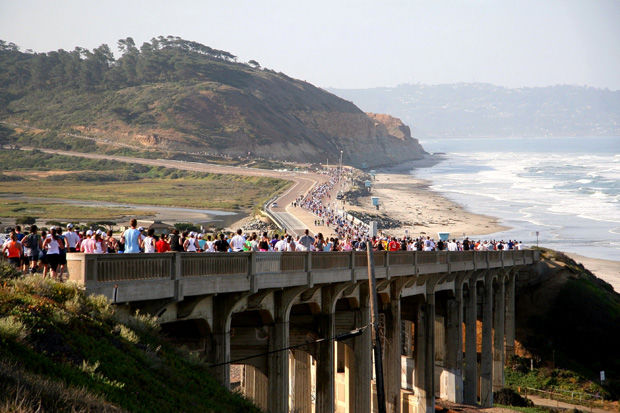
The April 27 La Jolla Half Marathon, a stunner for runners and spectators alike, explores the San Diego coastline starting at the Del Mar Fairgrounds and ending at La Jolla Cove’s Ellen Browning Scripps Park. (A great place to watch: the island in the middle of North Torrey Pines Road.) Net proceeds from the Half are donated to the La Jolla Kiwanis Foundation, which supports programs such as high school key clubs and youth sports, while a $1,000 cash prize awaits the first man and woman to break the course record—1:06:23.2 and 1:16:52, respectively. But everyone’s a winner: A live music festival and beer garden will be waiting for runners at the finish line. $90 for individual registration.
Subscribe to our newsletters

Select Options

By subscribing you confirm that you agree with our Terms and Conditions and Privacy Policy.

Everything SD MAY 6, 2026

This is San Diego’s Ultimate Golf Course

We asked 12 golf pros from across the county to choose the city's top holes to create the "Dream 18"

This is San Diego’s Ultimate Golf Course
Courtesy of The Lodge at Torrey Pines

At the top of a golf swing, the world settles into a hush. Anyone within 50 yards kindly shuts up in reverence. Steady heartbeats tuck inside the sound of the wind. Time stands still.

Or—panic sets in, a thousand warnings from coaches and YouTube tutorials prattle through your brainpan. You wonder if a good walk prepares to be ruined.

On descent, the club rearranges air particles as it slices on a perfect or unwise line toward an earth so green, it seems like AI. The iron face meets the ball, and the satisfying or unsettling thwack echoes across the fairway like a nonviolent gunshot or a cry for help. Breath catches, curse words load in the prefrontal cortex. Eyes squint to follow the hard-to-see projectile zip majestically through the air or bounce lamely along the ground like a failed hurdler.

Sometimes it goes a couple hundred yards in the right direction, other times a couple yards into uncaring swamps. Golf’s beautiful and hard as hell.

Mindfulness and stillness reign over speed and might—which goes against most basal American instincts regarding sport. Its quiet, serene mocking of our human abilities is what brings so many of us to the life-long process of sharpening the skill. Because who hasn’t stared at the most beautiful parks and lawns in the world and said, “How can I turn this into a game and win it?”

Luckily, San Diego has an abundance of courses to improve and curate self-doubt. The county is home to over 70 courses that attract the top golfers in the country. Some of the biggest names in the sport—Callaway, TaylorMade, Cobra, Titleist, Odyssey, Honma—are based here. Perfect weather never hurts. But San Diego golf courses also promise a smorgasbord of terrains: rocky canyons, hot deserts, and lush greens overlooking the expanse of the Pacific Ocean.

If you could take the 1,300-ish holes around San Diego and pick the very best ones to create your ultimate course, which would they be? We asked some of the top golf pros in the county to do just that. The result? San Diego’s Dream 18. Think fantasy football but for golf.

Just like any great course, our Dream 18 includes four par 3s, 10 par 4s, and four par 5s—everything from tricky dog legs and psychological tee shots to just pretty, pretty views. Once we had our list, we either asked the head golf pro what makes a hole so special, or other pros spoke on its behalf. Go ahead, tell us what we missed.

Courtesy of The Santaluz Club

Par 3s

Torrey Pines South

Hole 3

“One of the most iconic par 3s on the West Coast. The cliffside setting above the Pacific and the constant ocean breeze make it both beautiful and demanding.”

—Anthony Valverde, Director of Golf, The Crosby Club at Rancho Santa Fe

The Santaluz Club

Hole 14

“It’s a downhill par 3 over water with a great view from the tee down to the green. It’s surrounded by bunkers as well, so it almost feels like an island green even though it’s not. What’s really cool is once you drive to the next hole, if you look back on No. 14, it’s a great view as well. One of the signature holes [at Santaluz].”

—Josh Rider, Head Golf Pro, The Santaluz Club

Maderas Golf Club

Hole 15

“Hole 15 is widely considered one of the best and most memorable holes on the course. At about 250 yards, it’s a long downhill with multiple tiers and panoramic views into the valley. It looks intimidating at first, but there are lots of recovery contours and the green is fairly large.”

—Editor’s Choice

Torrey Pines North

Hole 15

“Sitting high above the green with views of the Pacific Ocean, this dramatically downhill par 3 requires the perfect club selection.”

—Mike Mulford, Director of Golf, Omni La Costa

Courtesy of Park Hyatt Aviara

Par 4s

Aviara Golf Club

Hole 18

“While it’s beautiful with the backdrop of the Batiquitos Lagoon and the Pacific Ocean, this finishing hole demands both precision and nerve. The water guarding the right side and fairway bunkers ahead create a visually striking, strategic tee shot, while the expansive green rewards a confident, well-placed approach. If you can make a par on this hole, you’ve played it very well.”

—Renny Brown, Director of Golf, Aviara Golf Club

Del Mar Country Club

Hole 18

“The 18th hole at Del Mar CC is a demanding par 4 with an elevated tee box. Water guards the right side of the green, and a player must hit a precise shot into this green.”

—Renny Brown, Director of Golf, Aviara Golf Club

San Diego golf company TaylorMade golf in Carlsbad featuring The Kingdom golf club fitting and production facility

Rancho Sante Fe Golf Club

Hole 5

“It’s a difficult 428-yard par 4 playing into the predominant west wind. The hole is post-renovation and the vegetation was trimmed back, so now it exposes a penalty on the right. It’s uncomfy at the tee but a good challenge. Plus, it’s the No. 1 handicap for [all players].”

—Chris Lungo, Head Golf Pro, Rancho Santa Fe Golf Club

The Bridges at Rancho Santa Fe

Hole 10

Lili Kim

About Lili Kim

Lili Kim is a content coordinator and writer for San Diego Magazine, with experience highlighting local businesses and communities. When not writing or shooting film, she is likely brewing her seventh cup of tea of the day or strolling along Sunset Cliffs.

Everything SD MAY 4, 2026

San Diego’s Sleep-Friendly Nightlife Is Here

With wellness-centered lifestyles on the rise, party culture is getting a 10 p.m. rebrand

San Diego’s Sleep-Friendly Nightlife Is Here
Photo Credit: Meagan Shuptar

A ’90s pop hit is blasting as I drive up to Solana Beach to go dancing. I’m dressed in the millennial nightlife uniform: black tee, cute jeans, heels. It is 6:30 p.m. on a Tuesday. The dance party starts soon. I’ll be home by 10 p.m. at the latest. I may even catch an episode of Summer House.

I am acutely aware of my age in this moment. I haven’t willingly chosen the club life since my 20s and early 30s. Yet here I am, transported back to 2014 with a few more wrinkles, a lot more ibuprofen, and a touch of “pandemic stole this from me” in my pocket.

A few days earlier, a friend texted to suggest we go to a concert the upcoming weekend. “I can’t, I’m already tired on Friday,” I replied. At 42, two glasses of cabernet bend my space-time equilibrium. A hard sneeze risks a sprained neck. Did I mention the perimenopausal night sweats yet?

I arrive at the Belly Up at 7 p.m. Wilson Phillips comes on the stereo, and I sing-shout the lyrics before stepping out of the car.

Someday, somebody’s gonna make you want to turn around and say goodbye | Until then, baby, are you gonna let ’em hold you down and make you cry?

Tonight’s event is billed as “the dance party that starts earlier.” Surprisingly, I’m not the oldest person in the room. A 60-something man shoulder bops to the DJ set. A Gen X woman shimmies by and snaps photos of the glow-stick-spinning raver on stage. Few are drinking.

Started by two North County locals, Amal Chandaria (32) and Max Gold (37), Earlier is a dance party for older adults who want a club experience without the sleep-deprived, hungover physical toll. Running 6:30 to 10 p.m., attendees get home at a reasonable hour for a full night’s sleep.

Courtesy of Earlier

Seems I’m not alone in my tired.

“[We’re in] a time where loneliness is high, people are craving connection,” says Chandaria. “One thing we were really intentional about is that you don’t need to go and have drinks to have fun. It’s about the music and getting the wiggles out.”

Early is part of a national trend: the green-juice-ifying of party culture. Americans aren’t going out as much as they used to. They’re drinking less, and 10 p.m. has become the new 2 a.m. Wellness as a lifestyle concept is old hat, and each generation manifests itself in different forms (fitness booms in the ’80s, organic food in the 2000s).

According to a 2024 survey by consulting firm McKinsey & Company, the US wellness market now exceeds $500 billion annually, up from roughly $300–$350 billion a decade ago. More striking than the spend: Wellness as a top priority has surged from about 42 percent in 2020 to more than 80 percent today.

The timing makes sense. Studies show Covid led to long-term shifts in lifestyle patterns. We all began to reassess our lives and made some existential changes—like 6 p.m. soberish dance parties. In a recent Gallup poll, only 54 percent of US adults reported drinking alcohol, the lowest level in about 30 years. Conversations around longevity turned “treat yourself” into “invest in yourself.”

The downer of any wellness trend, though, has been the “can’t” philosophy—can’t eat that cake, can’t sip that marg, can’t binge that show. What if we could do health stuff and still dance and not totally suck the joy out of life? That’s what people like Chandaria and Gold are banking on.

Last year when they attended Atomic Groove—a variety dance band from 5–8 p.m. most Fridays at Belly Up—it sparked an idea. “People want to be healthy and active, and they don’t want to compromise on that by not feeling rested,” says Gold. “I thought, ‘I bet if we’re feeling this way, other people are looking for something like this, too.’”

He was right. Nearly 200 people showed up to the pair’s first dance party last July. Tonight’s crowd is nearing that number again. Among them is Cardiff-by-the-Sea resident and second-time attendee Lauren Marley.

“If you do one thing for yourself—and it means that you don’t have to be completely exhausted and wrecked for all the stuff you have to do the next morning—it’s great,” she says.

Though EDM isn’t quite my thing (give me some stank-face hip-hop from the 2000s), it’s clear from the number of return attendees that Chandaria and Gold have filled a need, one that isn’t just in famously health-forward cities like San Diego.

In DC, Dancing on the Waterfront occurs every Saturday from 5–9 p.m. while Extended Play DC wraps up at 10 p.m. Philly has Matinee Dance Party (5–10 p.m.). New York City finally chooses to sleep, with Friday Feeling and Matinee Social Club both ending at 10 p.m. Last year, Day Shift, geared toward those over 30, debuted at Bloom Nightclub in San Diego.

In Chicago, Earlybirds Club was founded in 2023 by high school friends Laura Baginski and Susie Lee. About 100 people showed up to the sold-out “dance party for ladies who got shit to do in the morning.” Two years later, Earlybirds Club is now held in nearly 60 cities and regions across the US.

“It’s an outlet that [middle-aged women] don’t get in our everyday life,” says Baginski, who also recently appeared on the Kelly Clarkson Show to share their story. “It’s movement and dance. We’ve learned now that it’s really essential to being a happy person.”

Encinitas-based RAGEher therapy class program utilizing elements of rage rooms into anger management and therapy

Admittedly, it’s a bit harder to be happy when I walk into the Music Box for Earlybirds’ event in San Diego. War’s about to start, protests are the new social gathering, and the economy is gaslighting me into believing salads should cost $18.

But soon the club is a sea of 700 people wanting to dance their asses off. Any negative emotions quickly begin to disappear. Tonight’s music features hits from the ’80s, ’90s, and 2000s: Madonna, Britney, Christina, 50 Cent, Ludacris.

Shuffling past the bar to the already-crowded dance floor, my heartbeat quickens. Pure, unadulterated joy is oozing in this place.

“The whole club was women’s bathroom culture,” said returning attendee and San Marcos resident Beth Avant, 50. “[You get to] freely dance, not care about what you’re wearing, you’re not trying to really impress people.” Soon Whitney Houston’s golden pipes set the room on fire, arms raise, smile lines deepen, and for a few hours, nothing else matters.

Oh, I wanna dance with somebody / I wanna feel the heat of somebody

While Baginski continues to run the operation, Lee lost her battle with stage IV metastatic breast cancer in August of last year. Honoring her memory at each event are words from Lee herself: “Sing f**king loud, dance like nobody gives a shit, and remember who the f**k you are.”

And who we are are sleepy people. If this new wellness era really takes off, imagine the possibilities. Dinner dates at 5 p.m., the Super Bowl at 2 p.m. EST, Justin Bieber headlining Coachella at 7 p.m. Until then, you’ll find me in bed shooting down plans past 8 p.m.

Nicolle Monico is an award-winning writer and the director of creative projects, digital editor for San Diego Magazine with more than 16 years of experience in media including Outside Run, JustLuxe and The San Francisco Chronicle.

Everything SD APRIL 20, 2026

What’s New in San Diego Home Design

San Diego architects and designers spill on the trends, textures, and ideas shaping the city's homes today

What’s New in San Diego Home Design
Photo Credit: Auda & Auda Photography

Craftsmans and Spanish Revivalists and mid-century modernists—why does San Diego have so many different architectural styles? What makes a home distinctly San Diego? What are the trends shaping the look of the city’s neighborhoods for years to come? We asked the experts: architects and designers honoring the past, crafting the present, and radically altering the future of San Diego living. They opened their portfolios, shared points of view, and treated us to snapshots of their latest work that speaks to the ideas they’re playing with. The result? Six trends, design choices, and a proposal to make local homes unique. Grab a lemonade and get a little inspo for your own place.

Trend 1: Taming the Wild

Outdoor comfort goes to 11 with climate-controlled architecture

“Clients are now reaching for comfortable outdoor spaces that can be controlled for subtle shifts in the environment—heated covered porches, or patios with controlled louvered ceilings with integrated fans, lighting, heaters, and adjustable light.” –Mark Morris, Oasis Architecture & Design

“I think outdoor spaces in San Diego can be as useful or even more useful than indoor spaces. Relating to the site, view, [and] neighborhood can bring so much value and richness to a home.” –Bill Bocken, Bill Bocken Architecture & Interior Design

Photo Credit: Lauren Taylor Creative

Trend 2: End of the Farmhouse Era, Finally

The death of Little House on the Coast and the rise of warmth and organic materials

“After years of modern farmhouses—black windows, white houses, and gray walls and floors—natural tones are coming back. We are seeing a return to organic textures and more saturated color. Homes feel layered rather than stark.” –Susan Wintersteen, Savvy Interiors

“There’s a move toward homes that feel like every element has a purpose. I see a strong desire for warmth and natural stone, wood, organic textures with softer transitions, and materials that age well.” –Jen Pinto, Jackson Design & Remodeling

Trend 3: Respect Your Elders

Designers’ plea: Don’t ditch beautiful bones for trend whimsy

“I would like to see even more architectural integrity, fewer quick flips, and more thoughtful renovations that respect proportion, scale, and context. San Diego deserves homes that feel timeless, not transactional.” –Susan Wintersteen, Savvy Interiors

“We want to see people respecting the original character of their homes while re-imagining them for modern life, rather than erasing character in favor of quick transformations that look ‘cookie-cutter.’” –John Kavan, Jackson Design & Remodeling

Trend 4: We’re Designing to Stay Awhile

San Diego’s design market is maturing in place

“Homeowners are staying in their homes longer—some 15 or 20 years. That has shifted design away from trend-driven choices and toward architecturally driven spaces that are functional, cohesive, timeless, and designed to support daily life over decades.” –Jen Pinto, Jackson Design & Remodeling

Photo Credit: Brooke Brady

Trend 5: This Is Not Spicoli’s House

We probably don’t need a starfish next to our “Beach That Way” sign

“There’s a noticeable move away from literal ‘coastal themes’ and toward more layered, textural environments. San Diego homes today often feel cleaner, more architectural, and more personal.” Julie Crosby, designer

“Today, the aesthetic is more refined but still rooted in ease. It is coastal without being cliché and modern without being cold. The throughline is light, air, and a relaxed sophistication that reflects how people actually live here.” –Susan Wintersteen, Savvy Interiors

Trend 6: The House Outside Your House

Outdoor square footage as equally valuable as interior space

“When you can live outdoors most of the year, architecture and interiors must support that. Large format doors, layered patios, durable materials, and seamless flooring transitions all stem from lifestyle.” –Susan Wintersteen, Savvy Interiors

“Nearly everyone wants to take advantage of the constant sunshine, so we see a huge desire for indoor-outdoor living, light and airy fabrics, organic materials that bring the feeling of nature into the home, and a desire to incorporate a relaxed, coastal lifestyle into everyday living.” –Lilli Fish, LS Design Studio

Lili Kim

About Lili Kim

Lili Kim is a content coordinator and writer for San Diego Magazine, with experience highlighting local businesses and communities. When not writing or shooting film, she is likely brewing her seventh cup of tea of the day or strolling along Sunset Cliffs.

Studio S FEBRUARY 26, 2026

Chef Aidan Owens Thinks Your Fish is Boring

The 29-year-old culinary director at Herb & Sea is making seafood sexy (and approachable) again

Implementing a farm-to-table model hardly deserves acknowledgement these days. It’s not a stretch. It’s not innovative. “It’s the bare f**king minimum,” says Herb & Sea‘s executive chef Aidan Owens.  

When I arrive at the Encinitas restaurant, I’m ready to talk sustainability, farm-to-table stuff, with Owens. “Did you see the chin on that?” he says of the extra big jiggly chin on the sheephead that just arrived with the day’s fresh catch. I did. It was Jay Leno adjacent.

I learn quickly that he somehow oozes both charm and stone-cold honesty. Maybe he could construct a new dish with chin goo, like he did when he had a bunch of tuna scraps and voila’d it into a smooth and crowd-pleasing ‘nduja. “I want to know what’s in there,” he says.    

Courtesy of Herb & Sea

The instinct to look closer, to dig into what others might discard, says a lot about the chef’s approach. I guide him back to our topic, but he has something else on his mind. “We’re overcomplicating food—what happened to just cooking good food and having fun with it?”

Owens grew up on a farm in Byron Bay, Australia, where sustainability wasn’t a concept you chat about so much as a way of life. Think dirt roads, backyard chickens, pulling vegetables straight from the ground, and a mother who believed that if you couldn’t pronounce the ingredients on a package, you shouldn’t eat what was inside.

Food wasn’t precious or performative. Making it was what you did because you were hungry and that’s still what inspires Owens today. “I like to cook good food because I like to eat good food,” he says.

His approach to sustainability at Herb & Sea began so naturally that it felt just like instinct. “I was just like, ‘Let’s order food from the people who live and work here,’” he says.

Courtesy of Herb & Sea

And why wouldn’t he when lives in San Diego? Cities all over the world vie for our goods. Our tuna is sent overseas. Our spiny lobsters hit dinner plates in China and Japan. Not to mention California’s producing a third of the country’s vegetables and three-quarters of its fruits and nuts. 

“Why would we outsource when it’s all here?” Owens asks.

Sustainability, in this context, is about cooking what exists in abundance, nearby, right now. “I love the local fish here. It’s f**king delicious and San Diego citrus, I mean, it is so f**ing good,” he says.

Instead of importing ingredients, Owens also looks for nearby alternatives. “You can find really cool things in the local waters,” he says, pointing out that stingray cheeks taste similar to scallops.

Courtesy of Herb & Sea

Whatever he finds in that sheephead chin might just be the next substitute for marrow. But to make this work, it means getting diners amped up about the slightly unfamiliar. 

Tasting menus, where diners are completely in his hands, become an opportunity to gently push boundaries. “I’ll serve mackerel, because people think they hate it,” Owens says, noting that the abundant local fish can have some fishiness. “But when it’s fresh, it’s arguably one of the best fish in the ocean.”

He also tweaks the language on the menu so people might feel more compelled to give dishes a try without preconceived notions. He might use “lengua” instead of “tongue.” “Whelk” instead of “snail.” When he puts “stingray throat” on the menu, he disarmingly calls it “skate.” 

To reduce waste, scraps aren’t always discarded but rather turned into something new. Sometimes they’re smoked, cured or fermented. Apples going bad turn into apple ponzu. Lemons turn to marmalade, which stretches their usefulness far beyond peak season. “And it’s super tasty on our pizza,” he says.

What makes the food even richer, is the relationships he’s built with farmers. Though it didn’t always feel natural, Owens sought personal connection first. He recalls approaching a fisherman at the Tuna Harbor Dockside Market. “I was awkward,” he says. “I went up to him and said, ‘I like your fish.’”

Owen’s is now so close to his suppliers—like fishermen Ryan Sebo and Joe Daly—that he gets texted pictures of fresh catches right as they flop on the boat. The messages always ask if he wants first dibs. “I say yes to a lot of fish,” Owens says, noting that Herb & Sea can go through 2,000 pounds of seafood a week.

Courtesy of Herb & Sea

The next evolution of sustainability, in his view, will be chefs working directly with producers such as his alliance with Sebo, cutting out middlemen and purveyors where possible. “It will put more money in the pockets of the people doing the work,” he says.

It will mean that chefs can’t just know their local farmers and producers, but they’ll choose to work with the ones who have the best practices. Dining and sustainability will become much less about the final plate. “It will be more about the impact that plate has on the Earth,” he says.  

Ultimately, he believes sustainability doesn’t need to be loud. It doesn’t need hashtags. It just needs to be honest.

“We aren’t saving lives. We’re feeding people good food,” he says.

And yet, in feeding people well—simply, thoughtfully, responsibly—something meaningful happens. Guests leave satisfied. Ingredients are respected. Local ecosystems are supported and food returns to what it has always been at its core: nourishment, pleasure, and a quiet reflection of the place it comes from.

No buzzwords required.

Everything SD APRIL 14, 2026

Preserving San Diego’s Historical Properties

How "invisible architects" restore some of San Diego's most iconic buildings—despite financial and policy challenges

Preserving San Diego’s Historical Properties
Photo Credit: Sandé Lollis

San Diego’s most iconic architectural tower sat closed and vacant for over 80 years until the invisible architects came in.

A century ago, the dramatic structure we now know as the California Building greeted visitors to the 1915–16 Panama–California Exposition in Balboa Park. It was covered in ornate pilasters, colorful tiles shone on its domed roof, and an attached eight-story tower surveyed the expo below. The building resembled a church, yet attendees who stepped inside expecting a sermon instead encountered an exhibit called The Story of Man Through the Ages. The showcase would inspire the building’s longtime-permanent use as the Museum of Us (formerly the Museum of Man).

Its tower became famous but furtive. Shut to the public in 1935, it spent decades as an instantly recognizable but inaccessible landmark. Finally, the museum decided that the California Tower would reopen for tours by 2015 and be outfitted for earthquake safety by 2020.

The challenge was significant. In order to keep it secure during seismic shifts, the whole structure needed steel braces, concrete walls, and tension rods—major infrastructure that had to remain a secret; hidden so that it didn’t alter the tower’s legendary look.

The people who completed the work were secret, too. Sort of.

“We call ourselves ‘invisible architects,’” says David Marshall, principal architect at Heritage Architecture & Planning, the firm tasked with restoring the California Tower. “Most architects going through school, their dream is to create something that’s never been created before. That’s not what preservation architects do. We are following the footsteps of great designers, and we don’t want to leave our fingerprints on everything we work on.”

Courtesy of Heritage Architecture & Planning

Marshall has spent the last 35 years returning iconic San Diego structures to their original shine: Balboa Theatre, the Top Gun house, Hotel del Coronado, and the Western Metal Supply Co. building, to name a few. And those are just the well-known ones. San Diego has more than 1,000 buildings—from modest homes to multi-story civic structures—that qualify as historic for various reasons.

“Number one is age: It has to be over 30 years old,” says Cathy Herrick, who founded the development company San Diego Historic Properties with her father Leon in 1984. (Though that’s not a hard-and-fast rule—Marshall’s team was able to help top local architect Jonathan Segal designate three of his buildings constructed after 2000, since any structure proven to be architecturally significant is up for consideration.)

“Second, it has to have enough of its original fabric—like 90 percent,” Herrick continues. The preservationist’s ultimate goal is to gently repair and, if absolutely necessary, replace weakened or damaged portions of the building while making modern safety and accessibility upgrades.

Marshall and his team completed a $160 million renovation at the Hotel del Coronado last year, and even seemingly minor details required some creative problem-solving.

Courtesy of Heritage Architecture & Planning

“We were trying to bring back the historic handrails around the front porch,” he explains. “They were built in 1888, so they didn’t meet the current code—they were only 29 inches tall instead of 42 inches tall.” On top of their diminutive stature, the handrails had seven-inch gaps between their pickets, more than twice the current safety requirement of less than four inches. The Heritage Architecture team’s solution: build exact replicas of the original handrails, but add a frameless glass rail behind them that’s only visible up close.

At The Beau—Herrick’s $5 million restoration of an 1886 Gaslamp Quarter hotel said to have been a favorite haunt of Al Capone—“there was a section of redwood staircase banisters and posts that were deteriorated,” Herrick says. “We took the pieces that remained and sent them to Northern California to a guy who specializes in hand-tilling [creating a distressed appearance on the redwood]. He made new pieces to match the historic.”

Restoring an old building for a new purpose—which preservation architects call adaptive reuse—can become even trickier. “Standard number one is to find a new use that’s compatible with the historic use,” like turning an old hotel into apartments, Marshall says.

His team transformed the Western Metal Supply Co. building at Petco Park into suites and a team store for Padres fans. “Warehouses like that are the easiest to convert because they’re usually large, open spaces with very few columns and partitions,” he explains. Any additions can be torn out by future preservationists, returning the building to its original state.

All these efforts to preserve the past don’t come cheap. “At The Beau Hotel, we wanted to put back the original 140-year-old bay windows. There were only eight of them, but it would have cost me $750,000,” Herrick says. “You sometimes have to make the economic decision to go with something that looks like the original but really is new.”

Photo Credit: Ollie Paterson Photography

Another challenge is that skilled artisans capable of restoring and replicating historical designs and materials are becoming increasingly rare. Over her four-decade career, Herrick utilized craftspeople—some in their 80s—who specialize in unique skills like repointing historic brick or reworking century-old window sashes. “Those guys aren’t around anymore,” she says. “It’s a lost art.”

Historical preservation may also be under threat from a policy perspective. As of now, the City of San Diego automatically reviews any building that’s over 45 years old before it’s demolished or its exterior is altered. But with the city’s current focus on densification and increased housing, Marshall says, “there seems to be a lot of push for fewer restrictions on new construction in historic neighborhoods.”

A proposed amendment to the current Heritage Preservation program would alter that automatic review process because it is “a reactive and, overall, less efficient approach to historic preservation,” says Kelley Stanco, deputy director of Climate, Preservation & Public Spaces for the City Planning Department. “Of the roughly 3,500 properties reviewed every year, 85 to 90 percent are found to have no potential historic significance. In addition to creating unnecessary delays for project applicants, it is an ineffective use of city resources that could be more effectively spent proactively surveying and identifying what is significant and bringing those properties forward for designation.”

Photo credit: Sandé Lollis

Another suggested amendment would give the Historical Resources Board new recourse for overturning historical designations. “If a building owner wants to tear down these newly designated historic houses, they’re gonna go to the council and appeal and, depending if they have any leverage—financially or otherwise—the council could say, ‘It’s not historic anymore,’” Marshall says. He fears that the change would “open the door to nothing being able to stay designated historic and nothing being safe from demolition.”

Stanco argues that changes to the city’s Heritage Preservation program are intended “not to eliminate historic preservation, but rather to incorporate…other important factors” like housing, equity, and sustainability.

The Save Our Heritage Organization (SOHO), a nonprofit dedicated to preserving historical architecture in San Diego, recently sent a letter, signed by former members and staff of the San Diego Historical Resources Board, to Mayor Todd Gloria and the city council decrying delays in historic designation reviews and nominations, among other concerns.

Ultimately, “growth and preservation are compatible,” believes SOHO Executive Director Bruce Coons. “The fact of the matter is that even if all the eligible houses and buildings were designated, it would be one percent or less of the city’s entire housing stock.”

Photo Credit: Sandé Lollis

Coons considers many historic properties “naturally occurring affordable housing”: They already exist, for one, giving them a financial leg-up on costly new builds. They’re also typically smaller than contemporary homes, and San Diego’s Mills Act financially incentivizes homeowners to maintain their historic houses through property tax relief. A number of structures in older San Diego neighborhoods also added ADUs during the first and second World Wars, contributing to density.

And beyond the practical, these structures contribute an inimitable texture to the local landscape. San Diego is unique for its mix of architectural styles—the famous Spanish Revival buildings, of course, but also Victorian, Pueblo-style, Art Deco, Craftsman, ranch-style, and midcentury-modern structures, spread across popular neighborhoods like Hillcrest, Bankers Hill, North Park, Point Loma, La Jolla, Logan Heights, and more.

“Our built environment is really what makes San Diego what it is,” Coons says. “It’s difficult to get meaning from a stucco box. I think San Diegans want to feel like San Diegans, and [historical buildings] provide that context, meaning, depth, and character to our lives. We realize that when they’re gone.”

Amelia Rodriguez is a writer and journalist and winner of the San Diego Press Club's 2023 Rising Star Award and 2024 Best of Show Award, she’s also covered music, food, arts and culture, fashion, and design for Rolling Stone, Palm Springs Life, and other national and regional publications. After work, you can find her hunting down San Diego’s best pastries and maintaining her five-year Duolingo streak.

Everything SD MARCH 2, 2026

The Locals’ Guide to Visiting La Jolla, CA

Explore the ins-and-outs of this coastal beach town, including what to do, see, and eat

The Locals’ Guide to Visiting La Jolla, CA
Photo Credit: Ariana Drehsler

Need help deciding which of La Jolla’s seemingly endless beaches to lay your towel out at today? Each little sandy sliver between the neighborhood’s sea cliffs has its own name and character: the Cove for swimming, Children’s Pool for seal-watching, Wipeout Beach for skim-boarding. Head to La Jolla Shores for that wide, sandy, picnic-with-the-family feel, and if you know what you’re doing, go surfing at Windansea or Bird Rock (if you’re a beginner, opt instead for the Shores, where most of San Diego learned to surf).

Surfers at Blacks Beach San Diego

Of course, beachy isn’t La Jolla’s only vibe. The Village (locals don’t call it downtown anymore, says La Jolla resident and senior editor of lajolla.ca Elisabeth Frausto) is La Jolla’s most walkable area—highlighted by the main drag, Prospect Street—with a wide radius of shop-lined roads sloping down to the coast.

At long standing neighborhood staples like Warwick’s bookstore and Harry’s Coffee Shop, “old-timers still belly up to the counter and talk politics,” Frausto says. Art enthusiasts visit to peruse through its many galleries, including Quint and Joseph Bellows, and check out what’s on at the Museum of Contemporary Art San Diego (MCASD). Shoppers wander Girard Avenue, picking out activewear at Lululemon and Vuori and fancier digs at Thread + Seed and Sigi’s Boutique. Friends gossip and sip coffee at locally owned outposts like Flower Pot Cafe and Il Giardino Di Lilli.

Il Giardino Di Lilli
Courtesy of Il Giardino Di Lilli

Once isolated from the rest of San Diego, La Jolla became a popular resort destination when the San Diego, Pacific Beach, and La Jolla Railway arrived in the 1890s and made the area more accessible to visitors (who wanted to spend time there so badly they stayed in tents during the summer). Some of those tourists got creative, too.

“Our tradition of supporting the arts goes back to the days of the Green Dragon Artist Colony that was founded in 1894,” says Athenaeum Music & Arts Library Executive Director Christie Mitchell. Anna Held started the Green Dragon Colony to attract visiting artists to La Jolla for a weekend getaway; it quickly became a venue for ad-hoc performances and bohemian artists’ salons.

However, it was Ellen Browning Scripps more than anyone who shaped La Jolla into the neighborhood we know today, commissioning buildings like the structure that now houses MCASD. The arrival of the Scripps Institution of Oceanography in 1907 laid the foundation for the establishment of UC San Diego 53 years later at the longtime site of the military base Camp Matthews. All of these developments helped establish La Jolla’s layered identities: high-dollar beach town, arts magnet, academic research hub.

Athenaeum Music & Arts Library
Photo Credit: Ariana Drehsler

Facts About La Jolla, CA

  • Ellen Browning Scripps commissioned Irving Gill to design a building for the La Jolla Woman’s Club in 1914; it still meets today in the same building.
  • La Jolla’s scenic beauty is a backdrop for many movies, including Thor, Gattaca, Traffic, Mr. Jones, and Andy Warhol’s 1968 experimental film San Diego Surf.
  • Every summer, thousands of pregnant female leopard sharks gather in La Jolla’s Marine Protected Areas to incubate their pups.
  • Zillow reports the average home price in La Jolla is $2.3 million.
  • Old Hollywood film star and La Jolla native Gregory Peck was one of the founders of La Jolla Playhouse, which opened its doors in 1947.
Christie Mitchell
Photo Credit: Ariana Drehsler

Locals’ Guide to La Jolla, CA

Athenaeum Music & Arts Director Christie Mitchell is a bona fide La Jolla local, having grown up in the LJ neighborhood of Bird Rock. Her dad still surfs, and Mitchell met her own surfer husband at La Jolla High (their toddler has already tried surfing, too). Mitchell’s mom still lives in Bird Rock, and “it’s gotten a lot livelier and more pedestrian-friendly,” she says.

On weekends, she makes sure to hit Wayfarer Bread for “the gooiest, heaviest, stickiest cinnamon loaf—definitely preorder because there’s always a line,” she advises. Friday and Saturday are pizza night at Wayfarer, and the bakery’s industry collabs produce some unique pies. For coffee, head to Bird Rock Coffee Roasters, of course, where you can grab a cup and hang out in the open-air seating or stroll to La Jolla Hermosa Park for ocean views (and a skate park and bike paths for little ones to tire themselves out on).

One of Mitchell’s favorites for lunch with coworkers in the Village is Peruvian-inspired Pepino, owned by one of her high school classmates. “The sweet potato bowl is really good,” she says.

The Marine Room
Courtesy of The Marine Room

She also cherishes La Jolla institutions. The Ascot Shop, a longtime men’s clothing boutique, is a go-to for gifts; founded by a local fisherman, El Pescador Fish Market is the place for the freshest seafood and fish tacos; and The Marine Room is for special occasions, with on-point service against a backdrop of crashing waves. “And nothing says ‘La Jolla’ like George’s at the Cove,” Mitchell adds. “With the John Baldessari mural and the view, it’s a great mix of the arts and the ocean.”

There’s a surprising amount to do on the weekdays in La Jolla, Mitchell says, with free live music every Monday at the Athenaeum (and weekly ticketed events), late-night DJ sessions at Le Coq, acts at The Comedy Store, concerts at the The Conrad (home of La Jolla Music Society), and the monthly First Friday Art Walk.

Lucien La Jolla
Photo Credit: Kimberly Motos

What’s About to Happen

The biggest talk of the town for La Jollans? Possible secession from the city of San Diego, Frausto says. Proponents want to separate so La Jolla can maintain its own infrastructure and make decisions about development (critics say La Jolla should contribute taxes to the rest of the city). If the initiative advances, final say would come down to a city-wide vote.

Additionally, locals and visitors alike are witnessing a genuine culinary explosion. Restaurateur Sami Ladeki’s Roppongi, a Japanese fusion and sushi favorite that closed in 2015, reopened in December 2025 under returning chef Alfie Szeprethy. Michelin-starred chef Elijah Arizmendi launched tasting-menu-only restaurant Lucien last year, and chef Accursio Lota of North Park’s Cori Trattoria Pastifico opened his new spot Dora in November. Local designers Paul Basile and Jules Wilson are building Roseacre, 5,000 square feet of culinary concepts on Girard Avenue. And one of La Jolla’s favorite restaurant families is opening a completely new eatery near Torrey Pines Golf Course in summer 2026: From the guys behind Puesto and Marisi comes an Eastern Mediterranean spot called Ikaria.

Back in the Village, a new boutique hotel by Orli is landing in the old nurses’ quarters (now condos) next to the original 1924 Scripps hospital (the institution moved to Genesee Avenue in 1964). La Jolla is also getting in on the thrifting trend—Goodwill opened a shop on Herschel Avenue in early 2026.

Pedestrian-friendly changes are afoot in two of LJ’s walkable areas. At La Jolla Shores, look for enhancements to Avenida de la Playa from El Paseo Grande to Calle de la Plata, where the street has been closed to vehicles since 2020 for outdoor dining. The Village Streetscape Plan is coming to Girard Avenue between Silverado Street and Prospect Street, bringing expanded walking areas, corner parks, improved lighting, new seating, public art, and landscaping to create shade canopies and gathering spaces.

La Jolla
Photo Credit: Ariana Drehsler

Also look for beautification projects along the coast. The 1920s stairs leading down to the tide pools at Whale View Point are finally getting a redo; Ellen Browning Scripps Park will receive fresh sod and much-needed widened sidewalks. And ADA trail improvements and a new restroom facility are on their way at Torrey Pines State Natural Reserve, making the beloved natural area more accessible.

As for housing, Frausto says, affordable units are hard to come by, and that probably won’t change soon. Most new homes and apartments are geared toward the luxury market, like La Jolla’s first new gated community in 40 years, Foxhill, which broke ground in October 2025 on the site of a former golf course—with empty lots selling for more than $8 million.

Where to Eat in La Jolla

Le Coq

Marisi

Catania

Where to Shop in La Jolla

Mitch’s Surf Shop

Mood Indigo

Gracie James Co.

More Things to Do in La Jolla

Birch Aquarium

Torrey Pines Gliderport

La Jolla Kayak

Leorah Gavidor won her first essay contest at age 5. She writes features, news, and non-fiction in San Diego.

Partner Content FEBRUARY 16, 2026

Torch Heroes: Why San Diego’s Most Trusted Businesses Win by Doing the Right Thing

In a world overflowing with shortcuts, marketing fluff, and “good enough,” there are still companies that choose a different answer. And in San Diego, there are plenty of them.

Torch Heroes: Why San Diego’s Most Trusted Businesses Win by Doing the Right Thing
2025-Torch-SD-09131839 (2)

In a world overflowing with shortcuts, marketing fluff, and “good enough,” there are still companies that choose a different answer.

Integrity guides how they show up every day. They make hard decisions, hold themselves accountable, and build trust the old-fashioned way, one action at a time. At the Better Business Bureau, we call these businesses Torch Heroes: leaders who demonstrate that ethical leadership strengthens businesses and drives long-term success.

And in San Diego, there are plenty of them.

Take House Collective Marketing Solutions, a Carlsbad-based digital agency that won the 2025 Torch Award for Ethics for its people-first approach to marketing. Instead of pushing flashy campaigns, the team often takes a step back to make sure clients’ foundations are strong before going big. Their philosophy? Truth over transaction builds partnerships that last.

Or look at Young Black & N’ Business, where integrity shows up through community action. When a local school lost art funding, founder Roosevelt Williams III and his team stepped in with workshops, mentorship, and hands-on support to help restore creative opportunity. That kind of engagement reflects ethical leadership rooted in real impact.

And in Vista, Lotus Sustainables carried its commitment to ethics all the way to the product line. After discovering defects in a shipment of eco-friendly products, the company issued full refunds and redesigned its offerings at its own expense, a choice that shaped its identity and reinforced to customers that ethics guide every decision.

In North County, Greenway Landscape Design & Build brings integrity into everyday service. When a client’s glass was damaged, likely not by their crew, owner Scott Lawn chose responsibility over blame and covered the repair personally. For Greenway, doing the right thing serves as a north star, guiding every interaction through transparent pricing, accountable partnerships, proactive communication, and follow-through long after the job is done.

Other honorees include At Your Home Familycare, whose leadership turned down a lucrative state contract during the pandemic to protect vulnerable clients and staff, and Bill Howe Family of Companies, where hiring practices, training, and service centers around shared values, every day, on every call.

What connects these diverse businesses, from marketing to nonprofit support to home services, isn’t size, industry, or revenue. It’s something deeper: a commitment to trust as a business strategy.

In San Diego’s competitive marketplace, that trust gives companies an edge. Clients invest in relationships. They refer friends. They stay loyal when others fade.

As one Torch Award winner puts it, integrity isn’t a section in the employee handbook. It’s the operating system of the company,  the invisible code that determines every choice, every day.

And that’s exactly the point of the BBB Torch Awards for Ethics: to spotlight companies that dispel the myth that ethics and success are at odds. These businesses show that when leaders choose honesty, fairness, and accountability, especially when it’s hard, they build brands that matter.

At BBB, we see nominations come in from clients, employees, and business partners who have witnessed ethical leadership up close. These submissions aren’t polished promotions. They’re stories of moments when a company chose people over profit, clarity over confusion, and trust over convenience.

The nomination window for the 2026 Torch Awards for Ethics is open through March 31, 2026, and there are more Torch Heroes waiting to be recognized.

Who comes to mind in San Diego’s business community?

  • A vendor who always delivers — and always explains why.
  • A competitor who chooses the high road even when shortcuts tempt.
  • A team within your own company whose day-in, day-out choices reflect deep character.

And yes, businesses can nominate themselves. We encourage it. If you’ve built your business on principles rather than buzzwords, we want to hear your story.

Because in a world full of noise, integrity still deserves the spotlight, and San Diego is full of stories worth telling. Nominate your hero now

Thousands of savvy locals already get it.

San Diego's best restaurants, experiences, and events—handpicked and delivered to your inbox weekly. You in?

Close the CTA

Contact Us

1230 Columbia Street, Suite 800,

San Diego, CA