Featured articles
Featured articles
Things to Do
Guides
Things to Do
Featured articles
Things to Do
Things to Do
Things to Do
What's next
Featured articles
Featured articles
Featured articles
Things to Do
Things to Do
Guides
Ready to know more about San Diego?
SubscribeReady to know more about San Diego?
The couple that brought us Disney's megahit will debut a new musical at La Jolla Playhouse
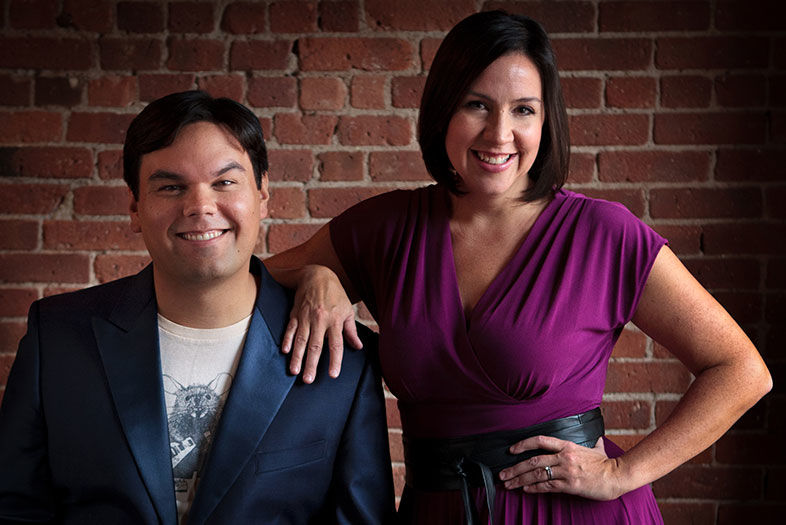
Frozen has captivated the country—with every four-year-old and her mother knowing the words to the film’s powerhouse Academy Award-winning ballad “Let It Go.” Now Robert Lopez and Kristen Anderson-Lopez, the husband-and-wife team behind this smash hit and others (Robert is the co-creator of Book of Mormon and Avenue Q!), are headed to La Jolla Playhouse to debut their new musical, Up Here, next summer. We chatted with them about Frozen fever, Oscar, and what San Diegans can expect from their newest project.
Does it trip you out to think that millions and millions of kids (and their parents) know all the words to your music?
K: This spring break we were hiking in the desert and in the middle of absolutely NOWHERE heard the tune drift over the wind and bumped into a family singing it in French. That’s when it started to hit us.
Do you have a favorite lyric from Frozen?
K: I love “Do You Wanna Build a Snowman” because my oldest daughter sings the first verse. And I love “By the way, I don’t see no ring” because that’s our youngest. At the end of the day, the proud mama is the strongest emotion.
What was the Oscar experience like?
K: Surreal. Humbling. Exhilarating. Illuminating. I had not anticipated how vulnerable I would feel to live out this uncertain thing on national television in front of everyone. Still, it was thrilling!
Robert, as the co-creator of Book of Mormon and Avenue Q, you’re known for being hilarious and irreverent. Did a Disney project ever feel too sweet for you?
R: What I love about the great Disney films is that they never feel too sugary. They are always emotional experiences. I grew up loving Disney movies, so when they came knocking, I was quick to say yes.
Kristen, is he as funny at home as he is at work?
K: His sense of humor and way of looking at the world is what I fell in love with. He is very, very sharp and funny—except when we are late for something and navigating unknown highways, and everyone has low blood sugar, and our kids are fighting. Then he is human like everyone else.
What are some of the challenges of working with your spouse?
K: I love working with my spouse because the same tools (communication, patience, compassion) we use in our marriage are the tools we need to be good writing partners.
R: I feel so lucky that we get to experience the high points together—the low points too, but that’s harder.
Walk us through a typical day of songwriting.
1. Wake up, drop kids at school. 2. Procrastinate and/or exercise for an hour or so. 3. Start talking about what the song needs. 4. Talk more. 5. Talk even more. 6. Eat something. 7. Scribble/noodle on piano. 8. See if things start to congeal into song snippets/lyrics/tune. 9. Repeat steps 3 through 8 until there is a song.
Looking ahead, what can we expect from Up Here, premiering at La Jolla Playhouse next summer?
K: We are trying to take everything we know about relationships, ourselves, and musical theater, and mash them all up in a fun, poignant, honest way.
The show is about a guy looking for love, who gets distracted by the little voices in his head. Should we anticipate any funny dream sequences, a la “Spooky Mormon Hell Dream”?
K: I think that’s fair to say.
Do you guys have any weird voices in your heads?
K: My head is full of weird voices, arguing and weighing in all of the time. The key is figuring out how to be in control of those voices instead of letting them control me. That’s what we explore in Up Here.
R: And with our therapists.
Tell us about the rest of the Up Here crew.
K: We are so excited to work with our director, Alex Timbers, and the choreographer, Josh Bergasse, who will bring our work to life with their unique, funny, smart take on everything.
Fall Arts: Frozen in SoCal
Talisman Brolin

San Diegans are finding connection in gardens, shared produce, neighborhood gatherings, and simply sitting outside
Front yards. They used to be the most controlled part of a home—or not. They could be tidy with manicured lawns, have raised vegetable beds with food for sharing, or act as an overflow of things that didn’t quite make it inside. Thank you, capitalism, and the American habit of endless consumption. In Lemon Grove, where I live, it’s not uncommon to see a mechanic running a business from his front yard or a family selling birria on Saturdays from theirs. The front-yard genre is broad.
But in communities across San Diego County, the most exposed part of a house—the strip between public and private life—is being turned into something eminently usable, visible, and hang-outable. At first glance, this may seem decorative, but in creating an intentional space, particularly one that’s visible to neighbors and passersby, it’s also the release of a pressure valve.
Let’s not gloss it over: American life has taken a hard right at high speed; two wheels have lifted off the pavement as we careen toward who-knows-what, and our nervous systems are making a sound best described as zoinks!
People are trying to (re)build connection in an increasingly isolated culture, (re)find beauty in the midst of endless anxiety, and (re)create a system friendly for critters. Many of us are remembering that, Oh yeah—we’re biological creatures.

Landscape designer Andrea Doonan, of Andrea Doonan Horticulture + Design, is a certified arborist with more than 20 years of experience collaborating with homeowners and renters. She rejects sterile, white picket fence designs and places a strong emphasis on edible gardens and usable outdoor spaces. When we speak, she mentions the unusually wide range of plant and animal life in the relatively small size of our region, making us a “biodiversity hotspot.” (San Diego is the most biodiverse county in the Lower 48.) Because of this, we have a unique system of endangered species that rely on plants to survive.
“More and more, people are introducing native landscapes to connect to nature and support birds, butterflies, and bees,” Doonan says. “I’m very passionate about getting people to unplug and ground.”
Whether it’s for a love of all creatures, our climate, or water conservation, Doonan describes a broader shift toward habitat-driven spaces that are both aesthetic and ecological. For her clients, this can mean replacing turf with native planting, adding seating areas, or even rethinking the front walk as an active, planted threshold rather than just a green lawn. “There’s this idea that people want to make a difference,” she says. “But they also want a place to entertain, recreate, and ground.”
At the center of this is a simple but increasingly urgent question: How can small design choices ripple outward into community life?

For Doonan’s client Lee Miller, that shift is fully expressed. After remodeling the interior of his Pacific Beach home, Miller focused on the backyard, thinking that would be the place for his soon-to-be-born daughter to eventually play. The front yard of his corner property was the last detail to be completed.
Miller said he wanted “a very full, very natural look versus having everything measured.” He knew what he liked when he saw it, but it was Doonan who translated his ideas and guided the creation of a wildlife-friendly space with full-grown orange, plum, and pluot trees. “We have lots of birds, lots of bees, lots of lizards,” Miller says. “There’s nothing better than walking outside and eating fruit off a tree.”
The front yard has become where Miller’s family spends time—often more than the backyard. He and his daughter, who’s now 5, explore the space together, checking what’s growing, learning about their little ecosystem, and chasing lizards. It’s where his daughter plays, where she’s built her own fairy garden, and where neighborhood parents and kids tend to gather at the end of the day.

For her own Normal Heights home, Doonan designed a front yard that includes a seed library, raised beds, native plants, and a sitting area where she and her husband spend time. “I’m meeting my neighbors because I put two chairs and some plants in the front yard,” she says. “I’m sharing produce with them.”
That exchange has become part of the landscape itself, and she points to small systems (like seed libraries) as ways of circulating plant material and knowledge directly between people. In real life. Person to person.
More and more, Doonan says, when we’re talking about solving the big problems, it’s important to remember that everything starts local. Even “guerilla gardening”—small acts of informal planting and care in overlooked sections of land, such as parking strips—makes a difference. Tossing some seeds and adding a bench to the sidewalk strip out front can create a “pocket park” or “a mini-mini park.” In that framing, the front yard stops being an ornamental backdrop and starts becoming an infrastructure for connection.
Landscape architect Bret Belyea frames this front-yard movement (my term, not his) as social repair. “It’s a handshake to your neighbors and passersby,” he says. “It says something about who you are.”
Of course, plant choices matter, but not only for ecological reasons. Native and climate-appropriate plantings become part of how neighborhoods re-establish contact with each other, even without formal planning. What he describes is an aesthetic, but it’s also relational in the way a yard can signal openness rather than withdrawal, invitation rather than separation, and connection rather than, “Get off my lawn, ya damn kids!”
Hanging out in the front yard rather than sequestering in the back is a signal to outsiders that they’re really not outsiders at all. Or, at least, they don’t have to remain so.

Not every front yard in this shift toward social spaces has a professional’s influence. Some are created through labor, trial and error, and nostalgia. For Grace Wanjiru, the memory of her childhood in Gitaru, Kenya, led her to beautifully DIY the hell out of the front part of her half-acre Encanto property. When she bought her home nearly two decades ago, it was essentially just a little house plunked down on a giant plot of dirt. She had a blank slate and plenty of memories from which to create something that would imbue the space with peace and hospitality.
The designer-led yards are often framed through an academic understanding of ecology, structure, and intentional planting strategies, and Wanjiru did much of the same thing through instinct. When she’d visit her mother, who lives just outside of Nairobi, she was reminded of the abundant beauty and vibrancy of a childhood spent running free, climbing trees, and being connected to nature. It was important to Wanjiru that her then-young daughters, both now in their early 20s, have that experience.

Wanjiru’s goal was to create the feeling of home, not as replication but as translation. “When you throw a seed in Kenya, something grows,” Wanjiru tells me. “Here, the dirt is horrible for plants. I still wanted green and color. I wanted nature—birds and insects. I grew up with nature, but here: No.”
With an understanding of what would and wouldn’t grow in San Diego, Wanjiru was able to achieve a sense of home with succulents and native plants she purchased at Walmart. She created a large courtyard with a fence built of wood and corrugated metal. Inside, she added a hammock and a bird bath, which Wanjiru settled on after gophers ate through seven different plants; a table with an open cookbook, a bottle of wine, three glasses; a weathered dresser—once in her daughter’s room—that now sits opposite the table and contains Wanjiru’s many seeds. And, of course, strung lights.
The space feels rustic, comforting, personal, emotional, and magical. It feels like love.
Wanjiru likes to host small groups of her friends and family, keeping it intimate but accessible. “This is the kind of house you just call: ‘What are you doing? Are you making your African tea? Can we just come over?’ Because this is what they do [in Kenya],” she tells me. “And so I always want to have that, because I think for foreigners living in America, that’s one of the things we struggle with. We don’t have that kind of community.”
Craving a communal feeling, Wanjiru built it herself. And her kids grew up climbing the jacaranda tree and playing in the garden.
“We still gather out there,” she says. “We read in the hammock, talk, connect.”

Perhaps the most important part of a front yard is a garden, whether it’s a space for entertaining and gathering, retreating and grounding, discovering and playing, resting and people-watching. The science backs up what gardeners have long known: Spending time around plants can be profoundly restorative. A 2024 review of dozens of studies found that gardening is consistently associated with better mental health, greater well-being, and improved quality of life, also linking interaction with plants and green spaces to better nervous system regulation.
For Doonan, this is part of why the conversation around gardens is bigger than aesthetics. “Gardens are for everyone,” she says. “I think it’s a right for all of us to have access to gardens.” “All of us” means homeowners and renters, people with sprawling yards and people with apartment balconies, people with large budgets and people growing herbs in containers from the discount rack at Home Depot.
In my conversation with Belyea, I tell him about a little house I passed in Oceanside this past spring. The owners set out free avocado clippings from their tree for anyone to take. “This is people’s way of putting an olive branch out,” he says. “And it just happens to be an avocado branch.” Maybe that’s what this front-yard shift is really about. Maybe it’s about trying to remember how to live alongside one another again. A hammock beneath string lights. Kids chasing lizards through native plants. Someone slowing to ask what’s growing. A neighbor stopping by and staying longer than they planned to. All of it, a pocket of softness in a culture that’s trying its damndest to make us harden.
Aaryn Belfer is a writer and editor specializing in nonfiction across art, architecture, and culture. Once upon a time, she wrote a provocative column for San Diego CityBeat (RIP). She was a runner up in the 2025 Matchbook Stories contest at the San Diego Central Library and is irrationally happy about it. Currently in her Soft Girl Era, Aaryn has expensive taste in (mostly flat) shoes and will choose a great art exhibit or live jazz concert over almost anything else. Except, possibly, Javier Bardem.
Enrique "Oz" Espinoza turned a high school tradition into a growing San Diego creative club built on collaboration
Back when Enrique Espinoza was a student at Southwest High and San Ysidro High, his mom couldn’t afford to buy him the school yearbook. So he made his own. Every spring, he brought a new marbled composition book to pass around, collecting signatures, photos, and messages from friends. By senior year, he was finally able to get his hands on the “real” yearbook, but at that point, he preferred the personal, collaborative project he’d started: a record of how people could come together to create something from nothing.
Espinoza—“Oz” to friends—got serious about photography a couple years later at Southwestern College, shooting for esport leagues and connecting with other artists all the while. Then in 2024, his childhood friend Charlie Knowles, cofounder of Bica Coffee Shop in Normal Heights, got in touch: He was looking to host meetups for creatives at the café, and he remembered how much people enjoyed contributing to Oz’s DIY yearbooks back in high school. Why not make more?
So Yearbook Creative Club launched on November 23, 2024, at Bica, with the goal to connect local artists, and ultimately make a book showcasing one another’s work. Since that first meeting, the club has become a social hub for creatives, also running art shows, galleries, a holiday toy drive, and a booth at the inaugural San Diego Bazaar winter marketplace. Yearbook also often collaborates with Camera Exposure, Southern California’s largest used camera store and photo studio, which has been a nexus for San Diego photographers in Normal Heights for nearly 40 years.
And though Oz provided the spark, he emphasizes that the club is, at its heart, a group endeavor: six photographers form the “Yearbook Committee”—including entrepreneur baker Samra Lovelady and Brian Eastman, chief experience designer of San Diego hospitality collective CH Projects—but everyone with an artistic eye is welcome. In Camera Exposure’s blog, Developing Stories, writer Austin Siragusa characterized Yearbook as “a community-first collective that deters gatekeeping and neutralizes imposter syndrome in favor of an open-door policy to foster trust and skill-sharing, regardless of follower count and portfolio length.”
The club published Yearbook Vol. 1—a limited-edition, entirely self-funded, 170-page glossy hardcover with the same spirit as Oz’s high school books—last April, celebrating with a launch party and gallery at the headquarters of Tribal Streetwear in San Diego’s East Village. About half of the 30 artists represented in the book are local; the rest are extended contacts from New York, Miami, and San Francisco. “Yearbook is San Diego-based,” Oz says. “San Diego is the home, but art is everywhere, and I want to be sure that San Diego is in that conversation of bringing artists together.”

The cover artist for Vol. 1, Gary Lockwood, gave a copy to Dante Rowley, manager of retail and visitor experience at the Museum of Contemporary Art San Diego (MCASD). Turns out, Rowley knew Oz from his days running the gallery and streetwear store Rosewood in the East Village, and he promptly reached out to see how MCASD and Yearbook could collaborate.
The museum began hosting a series of bimonthly photo walks around La Jolla in partnership with Yearbook.
Anyone interested in improving their camera skills is invited: Rowley says they always have a good mix of beginners and more experienced photographers, which leads to helpful conversations about how to get one’s aperture settings just right, or tips on how to compose the best shot.
The museum began hosting a series of bimonthly photo walks around La Jolla in partnership with Yearbook. Anyone interested in improving their camera skills is invited: Rowley says they always have a good mix of beginners and more experienced photographers, which leads to helpful conversations about how to get one’s aperture settings just right, or tips on how to compose the best shot. The walks are scheduled to end at the museum in time to segue into another event: March’s walk led into a live jazz band performance; May’s led into the museum’s entry-fee-free Second Sunday.
Yearbook Vol. 2 came out in late May 2026 with a release party of over 300 attendees and a partnership with 100 Thieves. This volume features a greater variety of media, including digital illustration, graffiti, and tattoo art. The club is also planning to publish an additional book in partnership with MCASD, composed exclusively of work taken during this year’s photo walks—anyone who participates is welcome to submit. Rowley says he hopes to celebrate that book’s launch with a community gallery, as part of an ongoing effort to show that art museums are not just reserved for the great, dead Old Masters. There’s space for you and me, too.

Yearbook meets several times a year at Bica, and Oz says there are always new faces and drop-ins from other local photography groups, such as Girls on Film and Beers and Cameras. Several lapsed amateurs have told him that simply showing up and feeling welcome has inspired them to pick up their camera again.
As more people seek a digital detox by turning back to screen- or AI-free art forms—Talker Research reported this January that 50 percent of adults are turning to a more analog life via paper books, vinyl records, and actual cameras (not the one in your phone)—Oz says that most people he knows still shoot on film, which has a relatively low barrier to entry. “A film camera is a lot friendlier on your wallet,” he says. “For, like, $150 you can get something comparable to a $900 digital camera.”
And though he admits he’s usually “a digital guy,” Oz notes that working with film is an antidote to digital fatigue and endless scrolling. “A lot of people like that process,” he says. “There’s a philosophy that comes with shooting on film that makes you want to slow down and appreciate the shot.”
The next Yearbook Creative Club photo walk is July 12 at 1 p.m. at MCASD in La Jolla, led by Enrique Espinoza and Brian Eastman.
Dan Letchworth is the copy chief of San Diego Magazine. His print column Dansplaining explores San Diego trivia, and his theater review blog Everyone’s a Critic was a finalist for best online column in the 2019 National City & Regional Magazine Awards.
Local musicians can audition for a chance to play before performances of Begin Again and at a free community showcase this summer
If you’ve ever wondered what it would feel like to perform on one of San Diego’s most iconic stages, here’s your shot. The Old Globe is looking for local singers, songwriters, and musicians to take the spotlight before performances of its upcoming musical Begin Again—and the gig comes with a chance to perform on the theater’s main stage and at a new community music event, Begin Again: San Diego Sessions.
Inspired by the opening scene of Begin Again, which makes its pre-Broadway premiere at The Old Globe this fall, the open mic–style performances celebrate local talent while giving audiences a taste of San Diego’s music scene before the curtain rises.
Solo artists and duets ages 18 and older can submit video entries here through Friday, July 10. Selected performers will be notified by July 14.
The public is also invited to Begin Again: San Diego Sessions, a free event on Monday, July 20, at 7 p.m. in the Globe’s Copley Plaza. Attendees can catch performances from top contest participants while enjoying discounted drinks from the theater’s pub.
“Begin Again is a story about hope and someone finding their light,” says Adena Varner, Director of Arts Engagement at The Old Globe. “The opening moment, which is what we’re excited about with this contest, is about an artist who’s unknown taking a chance at an open mic night—and then their life changes.”
“What I love about San Diego is it’s a space where hopes and dreams seem to actually be able to come true, and people get to find themselves, find their light and their voice, so I think the spirit of the show really resonates with who we are as San Diegans,” she says.
For director Lorin Latarro, the pre-show performances are a chance to weave San Diego into the production. While the musical has been developed in New York with New York–based musicians and actors, these performances create a direct connection between the show and the city’s local music community.
“One of the things Lorin is passionate about is wanting these performances to feel like San Diego, so we want them to be diverse,” Varner says. “We want these moments to look like us and all that that means… We have submissions from artists based in Tijuana, North County, and East County, so it’s geographically diverse, ethnically diverse, and we’re looking at age diversity as well.”
The Old Globe has hosted community engagement opportunities tied to past productions—including an art contest and walk-on performances—but nothing quite like this.
“We’ve also never had an open mic night on the plaza, so we’re excited, and we really want the music community to know that they’ve got a place at The Old Globe, too,” Varner says. “We’re getting in the practice of making sure our community feels connected to our shows and have an opportunity to contribute in a way that’s meaningful and impactful for them.”
Begin Again is based on the 2013 film starring Keira Knightley and Mark Ruffalo, with a book by Jenna Clark Embrey and Molly Beach Murphy and music and lyrics by Pat Monahan of Train. Performances run September 6 through October 11, with opening night on September 17.
At the time of publication, The Old Globe had received nearly 100 video submissions.
Kai Oliver-Kurtin is a San Diego-based writer who covers travel, dining, events, and culture. Her writing has been published in USA Today, Condé Nast Traveler, Fodor's Travel, Marie Claire, and HuffPost, among others.
A customized memory-filled explosion gift box is a creative way to show someone you care
Finding a gift that feels truly personal can be surprisingly difficult. In a sea of generic options — flowers, gift cards, candles, and the like — Xplosion Box offers something more lasting: a customized keepsake built around the photos, messages, and memories that matter most.
Founded by Southern California entrepreneur Jay Vijay, Xplosion Box LLC creates fully customized explosion gift boxes that arrive professionally designed, printed, assembled, and ready to gift. Each box opens layer by layer to reveal personal photos, heartfelt messages, pull-out albums, origami-style photo pockets, and hidden notes, turning a simple gift into an emotional reveal.

The brand was built for people who want to give something meaningful without spending hours printing photos, cutting paper, folding cardstock, or assembling a DIY project. Customers simply choose a box, upload their favorite photos, add personal messages, and the Xplosion Box team transforms those details into a polished keepsake that feels thoughtful, personal, and beautifully made.
Xplosion Box offers personalized gift boxes for birthdays, anniversaries, weddings, graduations, Mother’s Day, Father’s Day, Valentine’s Day, Christmas, proposals, bridesmaid gifts, long-distance relationships, and thoughtful “just because” moments.

Customers can choose from flexible customization options starting at $27. The Mini Surprise Box includes 10 photos, three message cards, and one hidden secret note, while the Mega Surprise Box offers a fuller keepsake experience with 40 photos, three message cards, and one hidden secret note.
What sets Xplosion Box apart is its high level of customization combined with convenience. Filled with personal photos, custom text, decorative details, and layered surprises, each box gives customers the freedom to create a gift that feels one-of-a-kind — without having to make it themselves.
At its core, Xplosion Box helps people turn favorite photos, stories, and words into something tangible: a keepsake that can be opened, revisited, and remembered long after the occasion has passed. asion has passed.
Check out the Candy Land Café debut, celebrate San Diego Black Pride and cheer on the San Diego Wave
The weekend forecast predicts mid-70s temperatures, lots of sun and a high likelihood of fun happening all over San Diego. Those looking to have a sporty outing can head to Petco Park to watch the Padres, support the Bombers arena football team in Oceanside or see the first-place San Diego Wave take on Angel City FC. Free receptions for The Studio Door’s annual PROUD+ exhibition, Oriana Poindexter: Field Notes at The Photographer’s Eye, and Best Practice Gallery’s …And love dares you to care for [a michelada with San Miguel] mean a myriad of ways to indulge in local artwork. As for the culinary scene, Trattoria Don Pietro has a stacked evening planned for its grand reopening and the Candy Land Café pop-up will begin its three-month run at Bayside Kitchen + Bar.
Food & Drink | Concerts & Festivals | Theater & Art Exhibits | More Fun Things to Do

Trattoria Don Pietro invites all—in the tradition of Joe Busalacchi—to dig in during the Old Town eatery’s grand reopening this Thursday from 6 p.m. to midnight. As with many spots in the local Busalacchi culinary empire, Trattoria Don Pietro pays gastronomic homage to Sicily, and it boasts both an updated space and a new menu premiering Thursday. Patrons can enjoy a DJ (beginning at 6:30 p.m.), a cocktail hour (6-7 p.m.), passed appetizers, a complimentary welcome cocktail or glass of champagne, and seated reservations (7-10 p.m.) To cap off the celebration, the restaurant will transition to party mode with a late night social (10 p.m. to midnight).
2415 San Diego Avenue, Old Town
In 1948, Eleanor Abbott, a hospitalized San Diego school teacher, created a candy-coated board game to entertain young polio victims. Candy Land’s local legacy will add another chapter with the opening of Candy Land Café pop-up at Bayside Kitchen + Bar on Thursday, where guests can decorate gingerbread cookies, share sweet treats and walk the colorful path of King Kandy in life-sized form. Tickets start at $25 and come with 90-minute seating, a $10 food credit and a $5 merchandise credit; kids younger than two years old don’t require a ticket.
2137 Pacific Highway, Little Italy
Indulge in smoked salmon and focaccia, wild boar chilaquiles or biscuits with sausage gravy with a side of rooftop views during this Sunday’s pop-up brunch atop the San Diego Natural History Museum. General seating is first-come, first-served from 10 a.m. to 2:30 p.m. with museum admission ($25 for adults and $17 for youth). The VIP experience ($144), open to 12 guests, comes with a tapas-style brunch, two beverages and a one-hour guided tour of The Nat’s most exclusive sections; VIP seatings are available at 10:15 a.m., 11:45 a.m. and 1:15 p.m.
1788 El Prado, Balboa Park
The 2010s revival of the ‘boy band’ sparked many acts, the most notable being One Direction, BTS and Australian pop-punk quartet 5 Seconds of Summer. Though it can be hard for groups to shake off that adolescent label, 5SOS have made a valiant effort with Everyone’s a Star!, their most fully-formed and, dare I say, grown-up album yet. This Thursday (8 p.m.) at Viejas Arena, hear the new 5SOS record and an opening set by indie rock group The Band CAMINO, who dropped their fourth album, NeverAlways (Vol. 2), in May. Tickets start at $42 for this concert.
5500 Canyon Crest Drive, Rolando
This Friday-Sunday, San Diego Black Pride returns “Unbound & Unlimited” with a ballroom event, a yacht party (sold out) and an all-day community celebration. The festivities will begin with the Mini Ball on Friday (8 p.m.) at Liberty Station’s Chapel and conclude Sunday from 1-9 p.m. with live performances, DJs and Black queer owned vendors at The Soap Factory during Sunday Service. Ticket options (18-plus) include admission to Sunday Service ($35-$50), the Mini Ball ($30-$60) and the Day & Night Pass ($50), which comes with entry to both events.
Citywide
Fresh off their 4th of July performance at the San Diego County Fair, Marine Band San Diego’s 35-piece ensemble will return to the Piazza della Famiglia for their free annual summer concert this Saturday at 7 p.m. During their performance, Marine Band San Diego will pay tribute to famed American composers like George Gershwin, John Williams and John Philip Sousa, whose catalog of military standards includes the official U.S. Marine Corps march, “Semper Fidelis.”
West Date Street between India Street & Columbia Street, Little Italy
Ryan Hardison is a freelance arts and entertainment writer and recent graduate of San Diego State. When he's not staring at his laptop, he's likely eating an adobada burrito or getting sunburnt at the beach.
We found a handful of inspiring people who live in, and truly know, these 'hoods and asked them how they’d spend their time out and about
Growing up in Carlsbad, I never quite understood why people vacationed there. What, so you want to check out the field where I have soccer practice? Pay my orthodontist a visit? Carlsbad just felt like a town by the beach, no better or worse than any other in the country. It took going to college out of state for me to actually understand just how rare a place like Carlsbad is.
Thanksgiving break my freshman year, my first time coming home after three months in the Midwest, my shoulders dropped. I rolled down the windows and drove to lifeguard tower 37—the hangout magnet for Carlsbad’s youths (and, in the summer, tourists)—and the smells of the ocean woke me right up like smelling salts do. I finally got it.
Carlsbad isn’t just a stopover town on your way to something better. It is the destination. Travel + Leisure named Carlsbad one of the top 50 places around the world to travel in 2026. From the whole globe, the travel magazine picked my home. Sure, we’ve got the Flower Fields and Legoland—but now it’s the smaller ships and indier dreams that are giving it street-level character.
It’s not just Carlsbad, either. People have talked about the “North County bubble” for decades—a force field that prevents its residents from traveling south of the 56. It’s often used derogatorily, and it’s a fairly accurate burn.
For decades, living up in North County meant giving up on culture, or at least culture within close proximity. But now, the main expansion of San Diego culture is happening up north. Central San Diego restaurants have started taking notice and are expanding into the area—spurred no doubt by Oceanside’s food boom and the Jeune et Jolie–Campfire–Wildland–Lilo constellation in Carlsbad. City Heights burger joint Key & Cleaver opened a new spot in Oceanside; the owners of Parc Bistro-Brasserie in Bankers Hill opened Parc Lounge in Rancho Santa Fe. Possibly the strongest market indicator is that Sam Fox—one of the most successful restaurateurs west of the Rockies—has started focusing on North County for his concepts. In 2025, he opened both The Henry in Carlsbad and Culinary Dropout in Del Mar.
For the ultimate insider guide, we found a handful of inspiring people who live and create and truly know six North County neighborhoods—San Marcos, Escondido, Oceanside, Leucadia, Rancho Santa Fe, and Vista—and asked them how they’d spend a dream day out and about in their town.

San Marcos is in full renaissance mode. The biggest story is that the grand North City vision is starting to peek through the scaffolding. It’s essentially the North County Downtown that’s been written in the tea leaves and discussed whenever someone gets stuck in traffic at the 5/805 merge: a 200-acre, pedestrian-friendly, mixed-use face-changer that’s slated for 2,600 homes, 350,000 square feet of retail and restaurants, 250 hotel rooms, and about a million square feet of offices and labs. Its most recent manifestation is 222 North City—a 12-story residential tower with over 450 residences, rooftop garden, pool cabanas, art installations, and almost 20,000 square feet of ground-floor retail (Necessity Coffee, Buona Forchetta, Draft Republic, Milonga Empanadas, and a grocery store anchor on its way).
Which means Restaurant Row is no longer burdened with being the primary caregiver for the hungry or the socially inclined. Patricia Prado-Olmos has watched the city morph during her nearly three-decade tenure at CSUSM, having spent the past six years as the school’s chief community engagement officer. She also just announced her forthcoming retirement at the end of the 2026–2027 school year, so she’ll have even more time to haunt local haunts.
Those in the know call the university “Cal State StairMaster” from the Sisyphean amount of stairs on the hillside campus. So, any day at or around CSUSM should start with a homestyle carbo-load (biscuits and gravy) from Mama Kat’s.

“There’s something about this breakfast spot that immediately puts me in a good mood,” she says. Mama Kat’s is also known for its pie (strawberry-rhubarb), which is breakfast if you change your perspective.
After a few hours on campus—with a break to pet the university’s official therapy goldendoodle, Frank, who helps ease finals tremors or apprehension of on-campus stairs—Prado-Olmos will wander into North City, just steps away. She says the almond croissant and coffee at Christophe Rull Patisserie rival Parisian cafés: “It feels like the kind of place you’d stumble across in a much bigger city.”
Rull, a Michelin-trained pastry chef who’s done stints on Netflix (Bake Squad) and Food Network (Super Mega Cakes, Halloween Wars), opened his patisserie last fall. The hype hasn’t cooled off yet: Get there early because the crowds do.
Emma Veidt is an editor at San Diego Magazine. She earned her bachelor's and master's degrees from the Missouri School of Journalism. She loves running, hiking, and rock climbing, but really, she mostly loves encounters with the street cats around North Park.
The Unconscious Moderation app is helping health-conscious professionals take an honest look at their drinking, without pressure, and without quitting as the only option.
San Diego runs on optimization. Early mornings, clean eating, training logs, sleep scores. The people here take their health seriously and the results usually show. Most of them also have two drinks most nights, not because anything is wrong, but because the day was long and the glass is right there and it has always been right there.
That routine doesn’t get the same scrutiny as the rest of the stack. It doesn’t feel like something to examine. It feels like a reward.
Which is exactly what your brain has decided it is. When something reliably moves you from one state to another, your brain files it under things to repeat. Do it consistently enough and the cue stops requiring a decision. It’s 6pm, the laptop is closed, and some part of your brain has already placed the order.
Most habit-change tools work on the number. They count drinks, set weekly targets, send check-in texts. That’s useful for seeing what the pattern looks like. It doesn’t tell you where the pattern came from, or change it at that level.
Unconscious Moderation works underneath the habit. The app uses guided hypnotherapy sessions, structured journaling, and daily movement to address the subconscious associations that make reaching for a drink feel like the obvious next thing. The journaling isn’t a diary. It’s built to surface what your brain is actually reaching for, so you can meet that need directly rather than through a substitute.
The program runs 90 days. At day 30, you choose your own direction: cut back, drink more intentionally, or stop altogether. The app treats both as equally valid outcomes. The point isn’t to follow a rule you set on a Sunday. It’s to understand the pattern well enough that whichever path you choose, you’re choosing it clearly.
The people who tend to get the most out of it are not in crisis. They’re the ones who have tried tracking apps and found the count drifting back up regardless. They know exactly how much they drink and why. The awareness just hasn’t moved the habit. At some point, the work needs to happen somewhere the count sheet can’t reach.
San Diego’s wellness culture already knows that surface numbers tell only part of the story. What you eat matters, but so does why. How much you sleep matters, but so does the quality. The same logic applies here.
Learn more at um.app, or download the Unconscious Moderation app on the App Store or Google Play.