
Featured articles
Featured articles
Things to Do
Guides
Things to Do
Featured articles
Things to Do
Things to Do
Things to Do
What's next
Featured articles
Featured articles
Featured articles
Things to Do
Things to Do
Guides
Ready to know more about San Diego?
SubscribeReady to know more about San Diego?
Take your workouts to new heights and lengths with our list of San Diego's best hikes, bike paths, and swims. Plus, a triathlon for beginners, beach yoga, and more. Get set to sweat!
Get Outside: 15 Outdoor Challenges
Jay Reilly
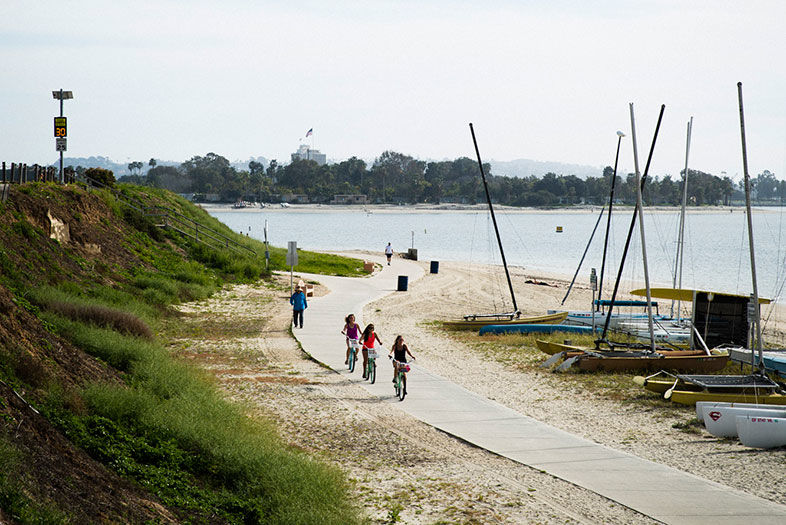
You may already use part of the Mission Bay path for a run, but have you challenged yourself to complete the full loop? It’s 11 miles of a wide path that hugs the water and is usually separate from traffic. You’ll get to take in all of San Diego’s beach activity—from boating to volleyball to rental house partying—as you run by.
Good to know: There’s usually ample parking in the lots on the eastern side of the bay.
East Mission Bay Drive and Clairemont Drive, Mission Bay
Level: Moderate
The 2,650-mile trail stretches from the Mexican border to the Canadian and was recently in the spotlight thanks to the New York Times best-seller and film Wild. You can share in a small part of the trail’s glory by hiking a segment that runs east of San Diego. The trail starts in Campo and winds its way by Lake Morena and over Mount Laguna.
Good to know: Check out the Pacific Crest Trail Association’s website for day hikes or shorter backpacking trips.
Level: Moderate
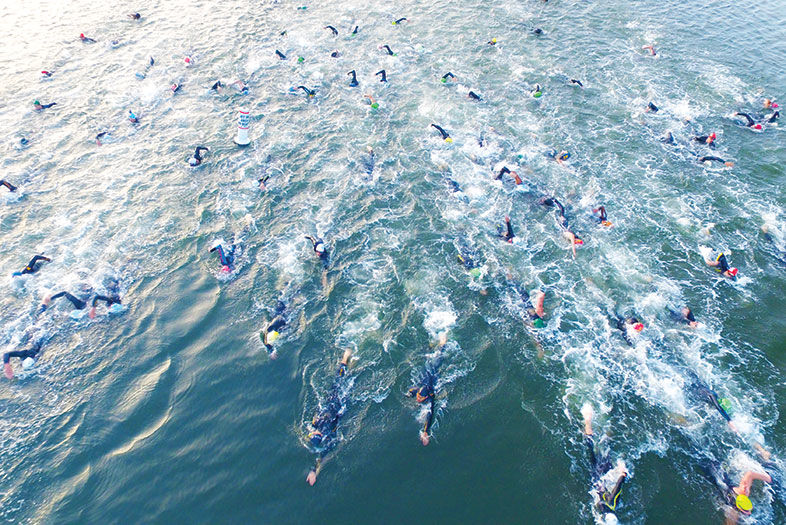
Get Outside: 15 Outdoor Challenges
When the first-ever modern triathlon was held in Mission Bay in 1974, its organizers thought it would be a fun one-time event. Now it’s an Olympic sport that attracts more than 2 million participants a year. If you’ve never competed in one before, San Diego is the perfect place to try it out, because of our mild summer temperatures, relatively warm ocean water, and calm, protected bays. Start with a sprint-distance tri (swim 0.5 mile, bike 12.4 miles, run 3.1 miles). If you already run and swim, challenge yourself to go a half-Ironman distance this month (April 2) at Oceanside’s Ironman 70.3 (swim 1.2 miles, bike 56 miles, run 13.1 miles).
Good to know: San Diego has several beginner-friendly triathlons, including the Mission Bay Triathlon in October. Check out the Triathlon Club of San Diego for group workouts and practice races.
Level: Difficult
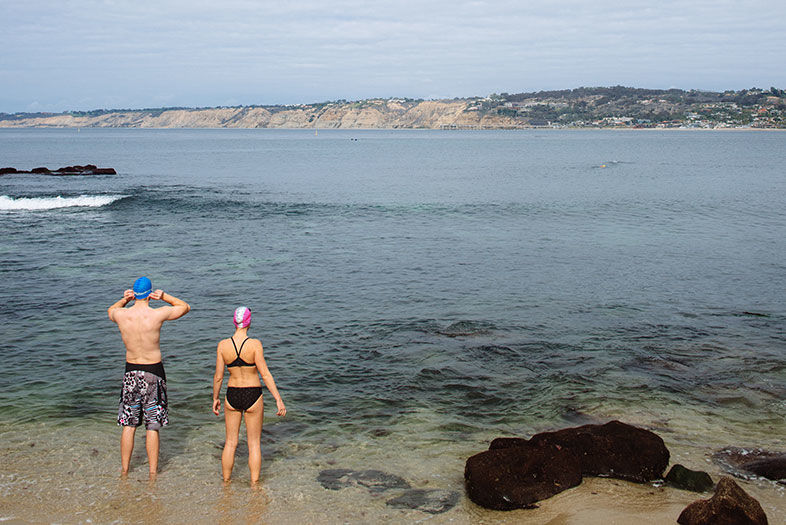
Get Outside: 15 Outdoor Challenges
Corey Jenkins
This challenge for local swimmers and triathletes covers just over a mile one way. On a clear day, see fish (and maybe some friendly sharks!) swimming beneath you. Buoys at a quarter- and half-mile out provide shorter options if you want to work up to the full distance.
Good to know: Don’t swim alone if it’s your first time. Search online for groups like Triathlon Club of San Diego that organize pack swims every week.
Coast Boulevard and Prospect Street, La Jolla
Level: Difficult
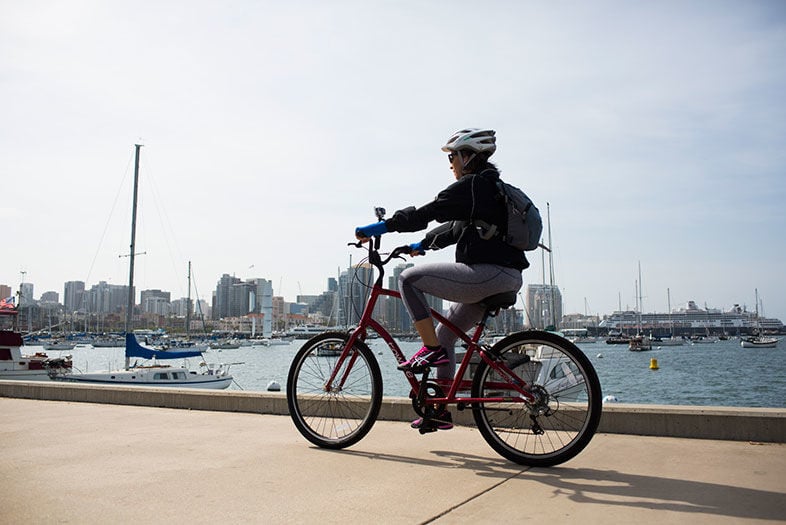
Get Outside: 15 Outdoor Challenges
Get your exercise while cutting carbon emissions and easing traffic. The county is slowly getting more bikeable, thanks to SANDAG’s Regional Bike Plan, and there are a few good routes already, such as the Ocean Beach and Highway 56 bike paths. Riding to work will make you feel good and allows you to see the city in a whole new way. Bike to Work Week is May 16–20, but, of course, you don’t have to wait until then to give it a whirl.
Good to know: Use bikesd.org to map out the most two-wheel-friendly route.
Level: Easy
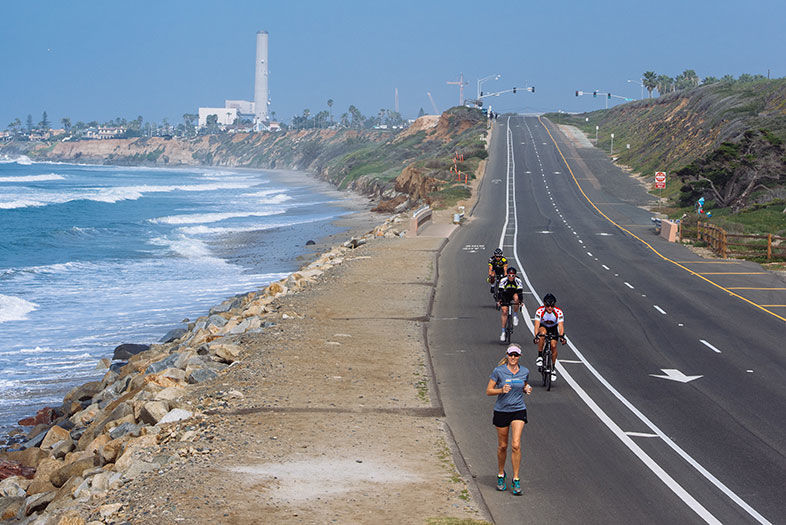
Get Outside: 15 Outdoor Challenges
COREY JENKINS
This picturesque path down the Coast Highway really shows what living in San Diego is all about. Take the Coaster from Solana Beach to Oceanside and log 16 miles while breathing in the ocean air. Stop at Swami’s Cafe along the way if you need to refuel (1163 South Coast Highway 101) or celebrate at the end with a big meal from Claire’s on Cedros (246 North Cedros Avenue).
Good to know: Park at the Solana Beach station and pay $4 to travel just one way north.
105 North Cedros Avenue, Solana Beach
Level: Difficult

Nature Calls!
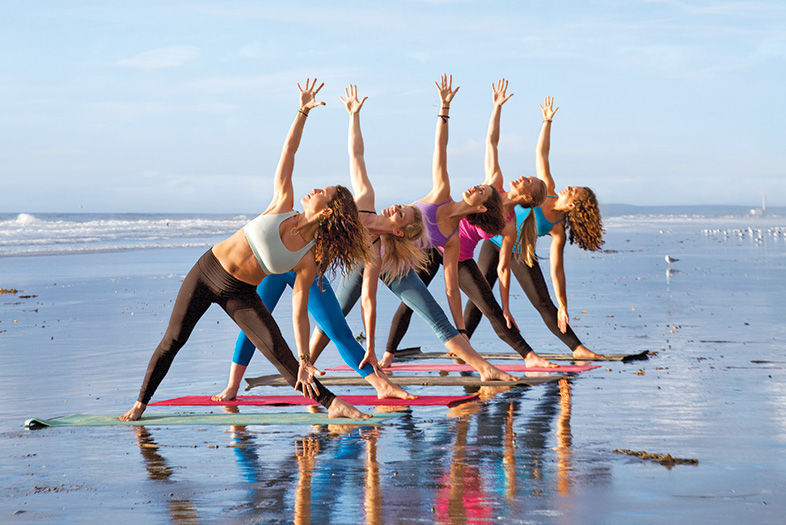
Nature Calls!
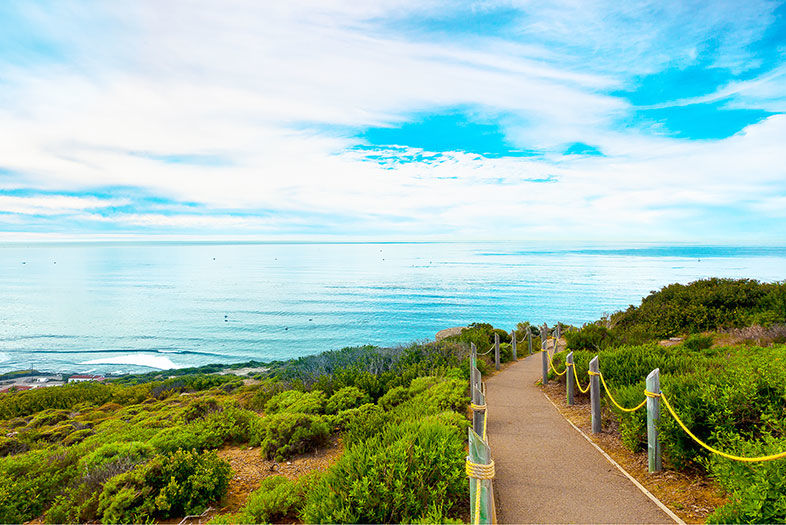
Things to Do Outside for Free
Break out of a running rut or challenge yourself to do something new by taking advantage of the region’s many offroad races. Runs through Lake Hodges and Mission Trails will take you to new places in the county and bring the exhilaration of trying something away from the pavement and sidewalks.
Good to know: San Diego Dirt Devils puts on a progressive trail run series each summer, so you can start with a 5K and end with a half marathon.
Level: Moderate
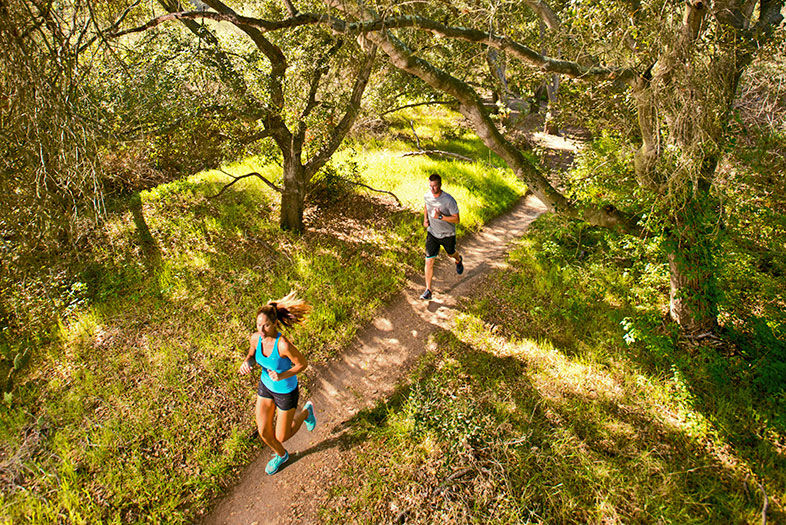
Get Outside: 15 Outdoor Challenges
This lush canyon boasts its own waterfall and miles of trails that make you feel like you’re in the middle of nowhere. While the dirt paths offer good options for shorter trail runs, try challenging yourself to do the full loop from one side to the other—about 12 miles total.
Good to know: In the summer months, bring plenty of water and start early. It can be hot, dry, and dusty.
12115 Black Mountain Road, Rancho Peñasquitos
Level: Easy
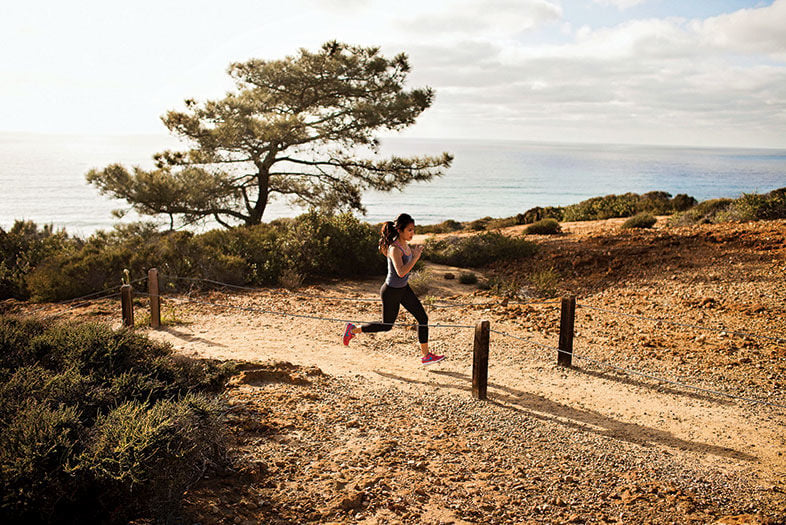
Get Outside: 15 Outdoor Challenges
This quintessential San Diego spot has the most gorgeous views of ocean bluffs that you can find. Make yourself earn that reward by parking at Torrey Pines State Beach and hoofing it up the road—a 500-foot climb over about 1.5 miles. Go past the state park on North Torrey Pines Road, and turn right at the Salk Institute at Torrey Pines Scenic Drive, which takes you to another iconic view at the Gliderport.
Good to know: Be prepared for pricey parking at the beach—$15 on the weekends, $12 on weekdays—or get lucky with street parking.
North Torrey Pines Road and Carmel Valley Road, La Jolla
Level: Easy
Get Outside: 15 Outdoor Challenges
COREY JENKINS
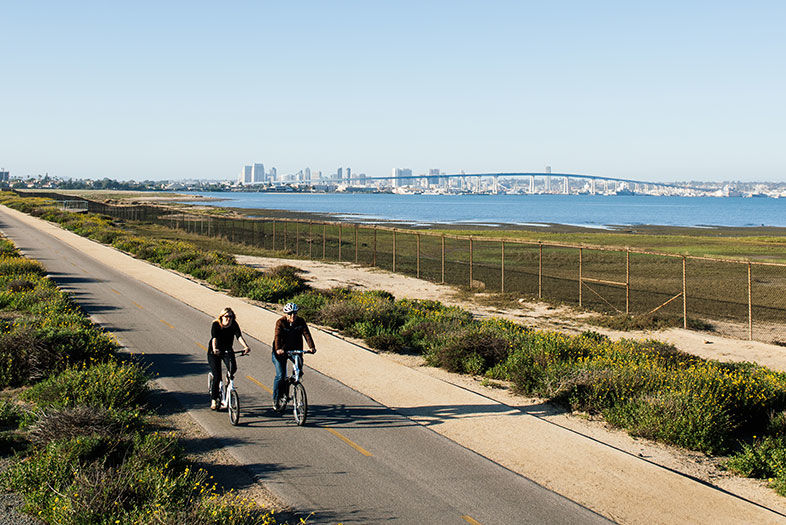
This 24-mile loop brings you across the bay on a ferry, down the beautiful Silver Strand, and back up through Chula Vista and downtown San Diego. Finishing it means passing through five cities and experiencing a big chunk of the local coastline.
Good to know: You have to take the Coronado Ferry to do the loop, so check departure schedules and bring $4.75 (bikes are free).
900 North Harbor Drive, Downtown
Level: Moderate
Launched late last year, this is San Diego’s mini version of the Colorado fourteeners (the challenge to hike all 53 mountains above 14,000 feet). Hike the five peaks in Mission Trails above 1,000 feet and snap a selfie at each summit to get an official certificate and pin.
Good to know: Follow #5peakchallenge on Twitter to get tips and connect with hiking buddies. For maps: mtrp.org
Level: Moderate
Get Outside: 15 Outdoor Challenges
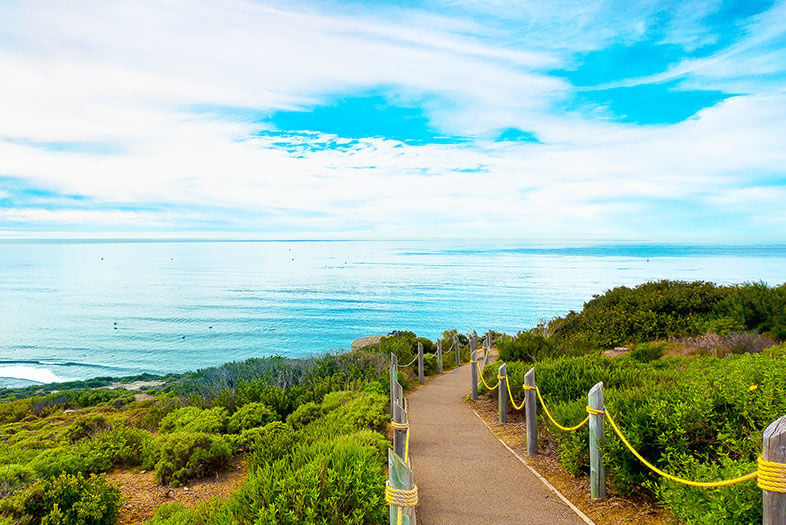
Climbing to the top of one of San Diego’s most iconic spots either by foot or by wheel is an achievement—and one that won’t take all day. The 12-mile out-and-back route from Spanish Landing Park to the top has rewarding views along its path, topped off with sweeping sights all the way to Mexico if you make it to the end.
Good to know: You can turn around at the park’s entrance, or pay $5 and go to the lighthouse or down to the tide pools on the western edge.
3900 North Harbor Drive, Point Loma
Level: Moderate
This is something every San Diegan should try at least once. Being close to the water and paddling on the glassy bay can put you in a Zen-like state. Challenging yourself to make it from Santa Clara Point to the eastern side makes it a workout.
Good to know: Be mindful of the wind, which can make paddling east feel like a breeze but coming back a lot harder.
1008 Santa Clara Place, Mission Bay
Level: Easy
Inarguably San Diego’s hardest hike, the trail to the peak goes up and up, then down, then up again. Plan to spend most of the day on the 11.2-mile round trip that will reward you with a deep sense of accomplishment and incredible views.
Good to know: Bring lots of water and start early in the morning. The trail is closed in August because of the heat.
Wildcat Canyon Road and Shenma Road, Lakeside
Level: Difficult
Get Outside: 15 Outdoor Challenges
MC1(AW/SW) Larry S. Carlson
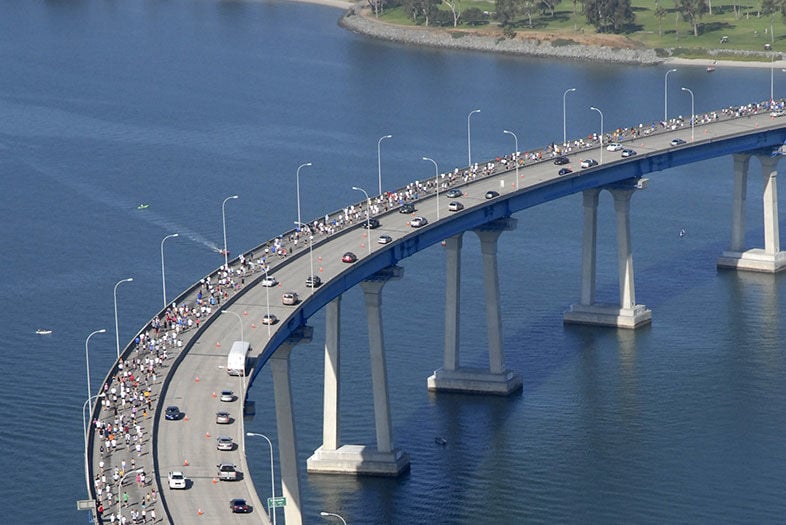
There are only two opportunities each year to cross the Coronado Bridge outside of a car, an experience everyone should have at least once. From the top, you’ll get views into the Navy base, Coronado, the harbor, and the ocean that you can’t fully take in when you’re driving.
Good to know: Run the bridge at the Navy’s Bay Bridge Run/Walk May 15, or bike it as part of the Bike the Bay ride August 28, 2016.
Level: Easy
New editor Emma Veidt gives an introduction and her ode to the once-sleepy, now slept-on North County
I am fairly sure they don’t let you graduate from Carlsbad High School without a W-2 from Legoland. Being a Legoland MC (Model Citizen, the employee’s moniker) is a rite of passage for all of us who grew up in North County. If you spent a day at the theme park in the 2010s, I probably pointed you toward the Granny Apple Fries or measured your height at a ride entrance.
And now we meet again. I can still point you to quality fries.
This is my first full issue as the new print editor for San Diego Magazine. But it’s not my first time here: I was an editorial intern for these pages back in 2018 (see photo). To be a part of a constant study of the city, its people, its culture, then finding the most compelling stories and bringing them to life—it was incredibly impactful and solidified my decision to pursue all of this (local, print magazine journalism) as a career. Since my internship, I’ve gotten my bachelor’s and master’s degrees from the Missouri School of Journalism and worked for nearly five years at Backpacker magazine. And I’m back at San Diego Magazine, baby. There’s a real magic to narrating the lives lived and dreams dreamt in the place that built me. I am excited to be a part of building the culture of where I’m from. And, born in Tri-City Medical Center and raised in Carlsbad, I can’t think of any other place than our North County issue for me to make my grand entrance as an editor.

To me, North County isn’t just where I’m from; it’s home. Throughout the years, I have run thousands of miles (I did the math) up and down the 101 between Oceanside and Cardiff. I’ve spent thousands of dollars (an estimation, too painful to do the actual math) on BRCs—beans, rice, and cheese burritos—from Lola’s, Juanita’s, and the late, great Pollos Maria.
The stretch of land between Camp Pendleton and the 56 is easy to love. We’re quieter and a little more zenned out than our lower-latitude neighbors, sure, but we’re neither sleepy nor boring.
Do you think Scrojo, the Belly Up’s punked-out poster artist featured on page 68, could last a day somewhere boring?
What I’ve always loved about North County is that the culture shifts every couple of miles as you reach a new town. For years, the media seemed to cast the realm above the merge as a two-toned monolith: sleepy surf towns to the west, suburbs and country living to the east. The nuance of each section seemed flattened or clumped. I think you’ll see the vastly different cultures of North County in this issue—but all distinctly San Diego. Which is to say a little mellower, fewer airs, come as you are.
It’s hard to imagine that the dusty trails and vibrant, muraled alleyways of Escondido are just miles from the barefoot surfers roaming Leucadia. Even though the SDM editorial staff is made up of two lifelong locals and other longtime residents, we don’t pretend to be the experts on every street. What a good city media company does is find the people who are experts, who have a unique hyper-local perspective—and give them the stage.
So we picked six North County neighborhoods—Oceanside, Vista, San Marcos, Leucadia, Rancho Santa Fe, and Escondido—and reached out to artists, community leaders, business owners, anyone making their neighborhood brighter, and we had them describe their perfect day out and favorite things that give their neighborhoods meaning and culture. These itinerary curators included San Marcos’ Patricia Prado-Olmos, Leucadia’s Jeff Schade, Oceanside’s Aaron Crossland, Escondido’s Suzanne Nicolaisen, Rancho Santa Fe’s Charo Garcia-Acevedo, and Vista’s Steve Glaudini. If there’s anyone who lives and breathes North County, it’s them. Check out their recommendations in our feature on page 56.
This month, we’re also going back in time almost 15 years to the Big Bay Boom. Yes, that meme-ified Fourth of July fireworks show where enough pyrotechnics for a 17-minute show went off at once over San Diego Bay. Content Chief Troy Johnson remembers the day and dug back through the story for a hilarious locals’ take on the big debate: Was it the worst fireworks show of all time, or the greatest? (Page 38.)
Before I leave you to our hard work, a sentimental note. When my parents moved from St. Louis to San Diego in the early ’90s, my mom subscribed to San Diego Magazine to learn about her new neighborhood. Now, over three decades later, I’m here—on this planet and in these pages. I thought about my parents a lot as we worked on this issue. Maybe there are a couple new San Diegans reading this magazine for the first time. Maybe that’s you.
Well then, to both of us, I say, “Welcome.” Let’s do this.
Emma Veidt is an editor at San Diego Magazine. She earned her bachelor's and master's degrees from the Missouri School of Journalism. She loves running, hiking, and rock climbing, but really, she mostly loves encounters with the street cats around North Park.
Eighteen seconds, one unforgettable mistake, and a Fourth of July story that somehow gets better with age
There’s a famous video.
“This is insane!” the guy filming it seems to proclaim. “It’s the best fireworks show ever!” a companion confirms, inspiring a debate lasting over a decade.
All told, 7,000 fireworks exploded in the span of 25 seconds over San Diego Bay on July 4, 2012. A Michael Bay amount of unison. $125,000 worth of shells, cakes, Roman candles, and skyrockets had been placed on a barge—enough for 17 minutes of decorative sky flares—and…
Boom.
The sky looked like someone had set a giant Rorschach test on fire. Or as if whatever we all see in our Rorschachs—butterflies, clowns, tongue kissing, dads—was being electrocuted and lifted heavenward, amen. It was shocking how bright it was, how much it sizzled the local cosmos. Could’ve been one of those sci-fi films where a hole is ripped open between warring universes. But angstier, more metal—the work of some methy creator in a sleeveless concert tee.
The sound?
Lou Reed once released an entire album that contained 64 minutes of mindflaying guitar screeches and machine noises. No regular songs, just a fascinating amount of ear distress. His record label reps no doubt heard the melodic outro of their careers, but everyone else was in pain and stumped. That album still sounded better than the bay did that night. The bay sounded like a god who struggled with emotional regulation had blown his speakers and was working through the anger stage of AV grief.
In the left frame of the video, a middle-aged woman is attempting to drag her husband off by the hand. In no way does he want to go, possibly because he had missed the time Roseanne Barr sung the national anthem at a Padres game, simultaneously disemboweling and amusing America through the power of song. He would not willingly abandon an equally worthy San Diego trainwreck.
Another woman in the video appears to have just filled her beer, rushing to sit down for the show. She pauses mid-sit and returns to the full and upright position to properly bear witness. What was supposed to be prolonged entertainment has been so radically shortened that she will have to find another reason to drink. Lucky for her, drinking will be the only way to adequately process.
Locals remember the conspiracy theories. People wondered if the fuses had been tripped by a saboteur who was sympathetic to dogs, fish, or the growing suspicion that late-stage capitalism is a gorgeously branded but impossible dream sustained by remarkably efficient top-tier wealth retention and the soft compliance of fireworks-watchers who can no longer afford a house, a beer, or the personal impacts of human reproduction.
Speaking of being terrified of babies, babies were terrified. The children who witnessed it probably still can’t go near a candle store. But those kids will be tougher, perfectly scarred kids. They’ll write better songs.
That night helped us absolutely dominate the national news cycle. For a hot minute, we became America’s water-skiing squirrel. Now, years later, when you Google “fireworks gone wrong,” San Diego is always a top contender, along with that poor Nebraska family who nearly wiped out a couple generations in their front yard, their minivan somehow turning into a howitzer of recreational TNT.
There is still debate as to whether Big Bay Boom 2012 is the worst or greatest fireworks show of all time. But the advanced parts of civilization arrived at the truth as quickly as the women in the video did. It was undeniably amazing.
First of all, the point of Fourth of July fireworks isn’t “the intricate choreography of sky fire over a guaranteed amount of show time.” It’s about creating a vivid memory shared with some people you like, love, or would like to love.
BBB2012 used large-scale chemical fire to create the ultimate memory.
Sure, some people who iron their jeans subjected their family to a sermon about how San Diego managed to botch America’s birthday like a Disney princess-for-hire who smelled of quite a few Sauvignons.
The rest of us saw how perfectly it nailed the actual feeling of being an American. Because only a miniscule percentage of us bake postcard apple pies where every inch of crust is perfectly laminated like the wood in an Irish bar. Very few of us can paint on par with Picasso. The rest of us—despite truly believing in our America-activated abilities to achieve greatness in almost any field of our choosing—burn pies. We try to paint only to realize it looks like our fine motor skills have entered active death.
That’s why BBB2012 was the most perfectly American fireworks show ever: A wildly ambitious idea galvanized thousands upon thousands of people to both work on it and come to hold a beer and gawk at it, only to have it fail in the most glorious TMZ-level spectacle.
America isn’t about immaculate, storyless wins. It’s about how the framework of a country is solid enough that we can accidentally detonate our entire lives—a few times—and still probably be OK.
No one has America’d quite like San Diego did on that day. It was performance art. Lou Reed’s heart slow-clapped. Any brief municipal embarrassment quickly became a pride of our people. I can only hope the same for the Nebraskan yard family whose Dodge Aerostar became a hyperactive Death Star.
P.S. Local writer Maya Kroth compiled a quite great oral history of that night for Thrillist. The bottom lines for me were—it took nine months to prepare, no one was hurt, and even though the pyrotechnics company tried to zero out the bill, Big Bay Boom founder H. P. “Sandy” Purdon refused and paid them in full. This year will mark the 25th Anniversary of the yearly Big Bay Boom.
Troy Johnson is the magazine’s award-winning food writer and humorist, and a long-standing expert on Food Network. His work has been featured on NatGeo, Travel Channel, NPR, and in Food Matters, a textbook of the best American food writing.
From surprise revivals to changing dining habits, these are the shifts redefining the local culinary landscape
If absence makes hearts (and stomachs) grow fonder, then shuttered restaurants quickly become the hottest tickets in town—something a number of iconic institutions found out after taking very public hiatuses after historically long runs. For instance, following a lengthy (and extremely flip-floppy) closing process after 92 years in business, Las Cuatro Milpas reopened two blocks away in Mercado del Barrio. Similarly, Carlsbad butcher shop Tip Top Meats reopened in the same location (albeit a smaller space) after the death of founder Joachim “Big John” Haedrich in 2023. Finally, after a whopping decade out of business, Sami Ladeki and chef Alfie Szeprethy brought back Roppongi to its original Prospect Street space, where it was the talk of the town in the late ’90s. All came back under the same proprietors, so they weren’t third-party nostalgia-licensing deals. The algorithm may have ravaged our attention spans away from all but the newest and shiniest, but this proves there’s still hope for our collective prefrontal cortex.
Other local eateries honored their pasts by bringing in new perspectives. The Lion’s Share in Embarcadero, Milton’s Deli in Del Mar, Dudley’s Bakery in Santa Ysabel, and J-K’s Greek Cafe in La Mesa handed over the keys to new owners willing to take on a big task: maintain the soul of icons through particularly rough economic circumstances for restaurants, navigate big feelings from longtime regulars (who often don’t take kindly to change), and make some necessary changes to keep going for another few decades. Taking over a project in process can be a lot harder than starting from scratch. But building that feel-good nostalgia doesn’t happen overnight, so it sure helps to have a well-established playbook of success passed down from those who came before.

It wasn’t just restaurant groups from Los Angeles that decided to put down roots en masse, although San Diego saw plenty of LA transplants recently (Sugarfish, Mr. Charlie’s, For the Win, Katsuya Ko, Bacari). Global brands like Chef Fei, Zuma, and Pepper Lunch have locations of their own on the way, and upscale Canadian eatery Joey joined to the inescapable gravitational pull of Westfield UTC’s culinary cosmos for its first spot in America’s Finest City. Good to see the rest of the world is catching up with what we’ve been seeing the last few years—San Diego is a dining destination already on the rise.
Between the never-ending news cycle of doom and perimenopause brain fog, I’m at the stage in life where I’m more than happy to let someone else make a decision for me, especially when it comes to what’s for dinner. And based on the way a lot of menus look right now, I’m not alone. It seems like half the places I visit offer some version of a prix fixe, omakase, or tasting menu. Restaurants are embracing the curated experience to solve the problem of affordability (a fixed menu reduces food and labor costs, guarantees an acceptable check average, etc.) and critical thinking in one fell swoop. Omakase (meaning “I leave it up to you”) is far from a new concept in high-end Japanese sushi culture, but now that it’s popping up everywhere from coffee experiences to grab-and-go sushi and sandwiches, it’s gone from somewhat niche to nearly omnipresent.

The world got an up-close look at San Diego’s coffee industry when we hosted the premier specialty coffee expo World of Coffee for the first time this April. San Diego’s long and rich coffee history stretches back to the late 19th century. Things percolated fairly quietly for around a century before really picking up steam. Today, there are nearly 200 specialty roasters and cafes across the county, with many earning national accolades like the Good Food Award (Steady State Roasting, 2020; Bird Rock Coffee Roasters, 2023, 2021, 2019, 2017, 2016), Roaster of the Year by Roast Magazine (Mostra Coffee, 2020; Bird Rock Coffee Roasters, 2012), and the Specialty Coffee Association Coffee Design Award for packaging (Rikka Fika, 2026). Now that we’ve moved past the comically insufferable coffee snob era of the early 2000s, even java newbies can feel comfortable walking into pretty much any coffee shop in San Diego, asking questions, trying a few things, and feeling confident they’re going to get great service and a great beverage.
Beth Demmon is an award-winning writer and podcaster whose work regularly appears in national outlets and San Diego Magazine. Her first book, The Beer Lover's Guide to Cider, is now available. Find out more on bethdemmon.com.
Tips from the trusted experts at Mauzy Cooling, Heating, Plumbing, and Electrical
San Diego summers can be brutal. But since the hottest period is typically late summer into early fall, San Diegans still have time to prepare. The pros at Mauzy Cooling, Heating, Plumbing, and Electrical are standing by to help homeowners fortify their homes against the elements and ensure their air conditioning is as frosty as the penguins that serve as the company’s mascots.
Many homeowners underestimate the load their AC system faces, especially in the inland valleys where temperatures regularly top 100 degrees. San Diego regularly sees multi-day heatwaves each summer, and a system that struggles on the first day will likely fail by the third. Longer run times, unusual sounds or smells, and uneven cooling from room to room are all signs that your system may not survive the next hot spell.
Systems typically last 12 to 17 years, but there are exceptions. If a system is approaching that, or is already there, a professional evaluation is recommended before summer really heats up. A good rule of thumb: If you can’t remember when your system was last serviced, it’s due.
“As technology changes, systems become smarter and smarter,” says Sean O’Connor, an install manager at Mauzy with 42 years of experience. “There are a lot of people out there who will say a system’s only good for 10 years. I don’t buy that—these systems are built to last as long as they’re taken care of.”
There are also a few steps homeowners can take between services to extend the life of their system. Regularly changing a dirty filter—especially if you have kids or pets—and keeping an outdoor unit clean can help head off problems in the future, says O’Connor.
Also, be realistic about whether it’s time to replace a unit. O’Connor likens pouring money into salvaging a faulty unit with patchwork repairs and replacement parts to “tripping over a dollar to pick up a dime.” When one part fails, others are sure to follow, and newer parts may not be compatible with older units. Mauzy recommends homeowners use the 50% rule: If a repair costs more than 50% of the system’s replacement value, and the equipment is over 10 years old, replacement is usually the better long-term value. And don’t forget the ducting. An older house that was built with heat and later had air conditioning added may not have sufficient airflow, regardless of how good the system is.
Last but not least, homeowners should know who to trust when it comes to their homes. Built on three generations of professional integrity, Mauzy has grown into not just a leader for cooling, heating, plumbing, and electrical services, but a leader in the community known for supporting local nonprofits across an array of causes. To ensure complete peace of mind, Mauzy stands behind a comprehensive 12-point guarantee that outlines its commitment to outstanding service, quality equipment, expert technicians who understand how the local microclimates affect HVAC performance, and no upsells or surprises on the bill.
“We go the extra mile. That’s what sets us apart,” O’Connor says. To get a free quote today, visit mauzy.com.

Jeff Russell traded dreams of SNL for bee rescues, building a social media following of more than 4 million people along the way
The Groundlings improv theater has churned out world-famous comedic talents like Will Ferrell and Maya Rudolph. And in San Diego, a former Groundling has used that training to campaign for a higher power. The power to protect bees.
“The goal was to try and get on SNL,” says Jeff Russell of his time in the improv troupe. “[But now], I have an audience, and I get to crack jokes and be silly and entertain and educate.”
That audience? The over 4 million people who follow Mr. and Mrs. Bee Rescue in the socialmediaverse. Jeff and his wife, Julie, operate the business, which means they remove unwelcome bees without harming them and rehome them to apiaries throughout the county. Their social media is a hub of videos of Jeff peeling open car trunks, flooring, barbecues—any cozy spot for a bee to set up shop—and using smoke to coax them out of the hive (sometimes working sans gloves or protective gear).
Bees in a hive will follow their queen, so finding and moving her helps speed along the relocation process. It’s “a really hard game of Where’s Waldo,” Julie says. But there’s a secret to it: “If the bees start running completely in some random opposite direction in a hurry, then we know that the queen is probably that direction,” says Jeff. Their social videos document this process in a way that turns a reasonable nightmare (being swarmed by bees) into a form of entertainment and advocacy. The Russells spread the apian gospel, sharing why relocating bees is the only option to consider.
Since the 1960s, bee populations across the US have shrunk drastically for a slew of reasons—habitat loss (postwar industrialization led to fewer farms and crops), climate change (petulant temps affect blooming schedules), and pesticides (when used improperly, they can be toxic for bees).
Bees are also responsible for up to 75 percent of all flowering plants; 35 percent of food crops rely on animal pollinators to reproduce. So, basically, we’d be living in a flowerless world fueled by a diet of wind-pollinated oats and Red Dye 40 without them.
Jeff and Julie met on Tinder in 2016. “It would have been more appropriate if we met on Bumble,” Julie says. A photographer and graphic designer, she had no experience in a swarm of stingers before 2018. When Jeff broke his back surfing, she had no choice but to step in. Later, when she was laid off from her job in 2020, she focused on growing Mr. and Mrs. Bee Removal’s social media accounts. That’s when their business took off. These videos work. People are learning.
“Quite a lot of my customers were [initially] like, ‘Why don’t we just kill?’” Jeff says. “Now, the vast majority are like, ‘You take them alive, don’t you?’”
Emma Veidt is an editor at San Diego Magazine. She earned her bachelor's and master's degrees from the Missouri School of Journalism. She loves running, hiking, and rock climbing, but really, she mostly loves encounters with the street cats around North Park.
The Carlsbad-based concept has exploded nationally by turning men’s health clinics into man caves
Rub some dirt on it. Walk it off. Be a man. The tropes and reasons for men ignoring their health and doing preventive care are many, reinforced by action heroes and generational norms. As a result, compared to American women, American men live an average of five years less, seek healthcare treatment half as often, and die by suicide nearly four times more often.
Many national campaigns have tried to change this. This year’s “Relax Your Tight End” ad from Novartis during the Super Bowl—in which NFL legends advocated for early prostate cancer screenings—was a high-profile example. Meanwhile, in San Diego, Evan Miller seems to have figured it out.
Miller founded Gameday Men’s Health in 2018 as a small clinic in Carlsbad. The idea was to create a space men would actually want to spend time in. So he built Gameday to feel more like a sports bar or a man cave—snacks, sports on oversized, high-def flat screens in the waiting room. He personalized the care for each client, made the experience more casual, and, above all, efficient. If the wait for payoff is too long, Miller says, men won’t show up for their health.
“We need to feel better quick,” he says. “So that’s where the real hook with Gameday is: It’s fast; it works quick.”
The idea has worked. Big time.
Gameday now has 430 locations spread across 46 US states and parts of Canada, with hundreds more set to open over the next three years.
Prior to Gameday, Miller—who has a Ph.D. in clinical psychology—ran Akua Mind Body, an addiction treatment center in Newport Beach. After selling the center, Miller says he searched for a new way to help his community.
He drew from his behavioral health training and dispiriting past experiences with “sketchy” men’s clinics, albeit with a slightly different concept at first.

“My original idea for Gameday, funny enough, was men’s group therapy,” Miller says. “I wanted to put it in this ‘man cave’ environment because I knew guys wouldn’t show up otherwise.”
Initially envisioned as safe spaces to encourage men to open up emotionally, Miller pivoted to a more clinical approach with an athletic design that personally appealed to him. Soon, it evolved into a one-stop shop of compounded medication treatments for weight loss plans, hair loss treatments, anti-aging injections, sexual wellness strategies, and testosterone replacement therapy. The hotly debated trend of peptides—mini amino acid proteins that the FDA has yet to approve—has become a popular feature.
New patients undergo in-clinic assessments for testosterone and prostate levels with the goal of producing test results in just a quarter of an hour. “Our philosophy with our treatments is we only do what the research supports,” Miller says.
An Orange County native, Miller found Carlsbad to be a natural headquarters. He found a much bigger market in coastal North County of men seeking a boost—both in their marriages and their overall livelihoods. The pandemic proved to be a watershed moment, with front-yard gyms and outdoor, highly visible exercise sparking a wave of self-care. According to Cleveland Clinic, after the pandemic, about 20 percent of men started to exercise more and eat healthier, with a quarter of men reporting they scheduled more sleep and spent more time with family.
“When Covid happened, [suddenly] everyone looked in the mirror and was like, ‘I need to take care of my health; I have to do everything possible to get in shape,’” Miller says.
Two years after Gameday first began, Miller opened a second clinic in Temecula, followed by locations in Laguna Beach and Newport. Demand kept coming, so they started franchising in 2023. They sold 1,000 licenses in the first year. By 2025, they had over 400 clinics across the country.
When asked about the rapid growth, Miller cites the feedback he received along the way: “People were so excited about men’s health, cash-pay medicine, and not having to wait for insurance. They understood the model. It was for guys; it felt like ESPN meets healthcare.”
Now Miller says Gameday is starting to map out a global expansion—to Europe, Latin America, and the Middle East. Since the company first cultivated a following, Miller says there have been persistent questions about whether Gameday would ever expand its focus to include women. Their answer: Her Way.
“We only offer a very narrow menu, almost like In-N-Out Burger, because we stay in our lane, we do it really, really well, and we gain trust that way,” Miller says. “So we created the Her Way model to do the same thing for women [that] we’ve done with men.”
Her Way Health & Hormones launched in 2024 in clinics with more neutral and calming décor. With locations in Carlsbad and Mission Valley, it will officially start franchising this summer. Miller seems incapable of thinking small and expects around 1,000 Her Way locations to open nationwide within a few years.
Ryan Hardison is a freelance arts and entertainment writer and recent graduate of San Diego State. When he's not staring at his laptop, he's likely eating an adobada burrito or getting sunburnt at the beach.
Discover San Diego’s Top Lawyers — the region’s most trusted legal professionals across diverse practice areas.
Daniel A. Kaplan is a founding partner of Panakos LLP with more than three decades of civil litigation experience in both state and federal courts. Mr. Kaplan pursues and defends legal claims on behalf of companies, entrepreneurs, and business owners in high-stakes disputes. He focuses on business disputes including breach of contract, unfair competition, trade secret theft, securities disputes, fraud/misrepresentations, and employment matters.
“The best advocacy combines preparation, perspective, and a client relationship built on trust and candor.” — Daniel A. Kaplan
His clients include real estate investors, private and public corporations, and individuals seeking sophisticated legal counsel. Known for practical judgment and strategic advocacy, he works closely with an experienced and diverse legal team to protect, enforce, and defend his clients’ interests.
555 W. Beech Street, Ste. 500, San Diego, California 92101
619-8000-LAW
Panakos.law