
Featured articles
Food & Drink
Food & Drink
Food & Drink
Featured articles
Things to Do
Features
Things to Do
Featured articles
Things to Do
Things to Do
Things to Do
Featured articles
podcast-ep
podcast-ep

podcast-ep
Featured articles

Features

Features

Food & Drink
Featured articles
Food & Drink
Food & Drink
Ready to know more about San Diego?
SubscribeReady to know more about San Diego?
We set out on a roadtrip through the Silver State in search of artifice among its weird, wild, and haunted roadside attractions
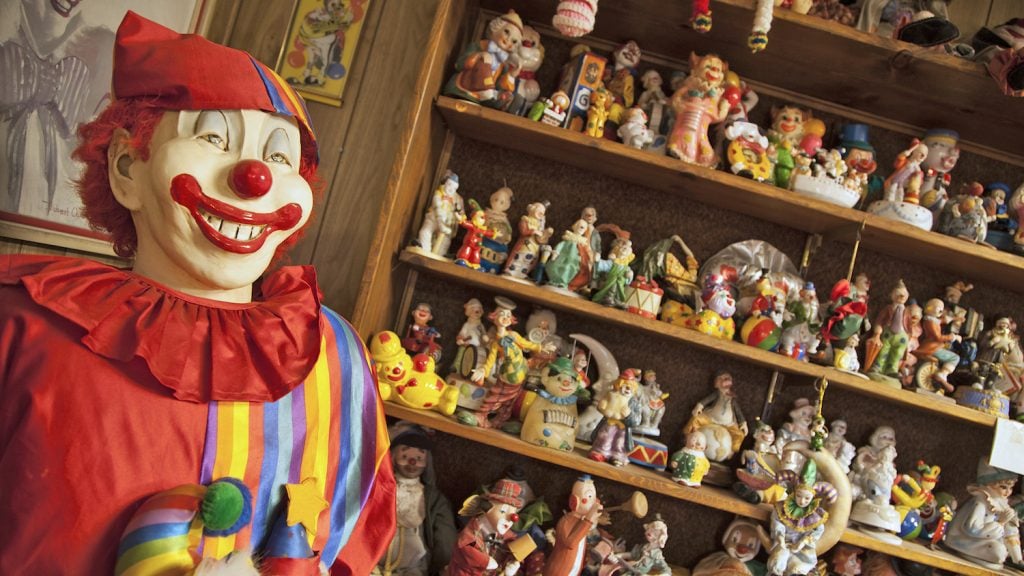
I probably look like one of the jesters, grinning maniacally as we approach the Clown Motel in Tonopah, Nevada, excited by its lurid exterior décor. Massive wooden clowns leer from the sides of the building. Its backlit sign appears to have been colored with Magic Markers. Themed rooms declare their horror movie affiliation: It, The Exorcist, Friday the 13th.
My girlfriend, Michaela, does not share my enthusiasm. Ensconced in the non-themed Room 103, beneath a painting of a red-nosed Freddie Mercury, I sleep soundly, dreaming, while Michaela lays rigid with terror, not even getting up to pee.
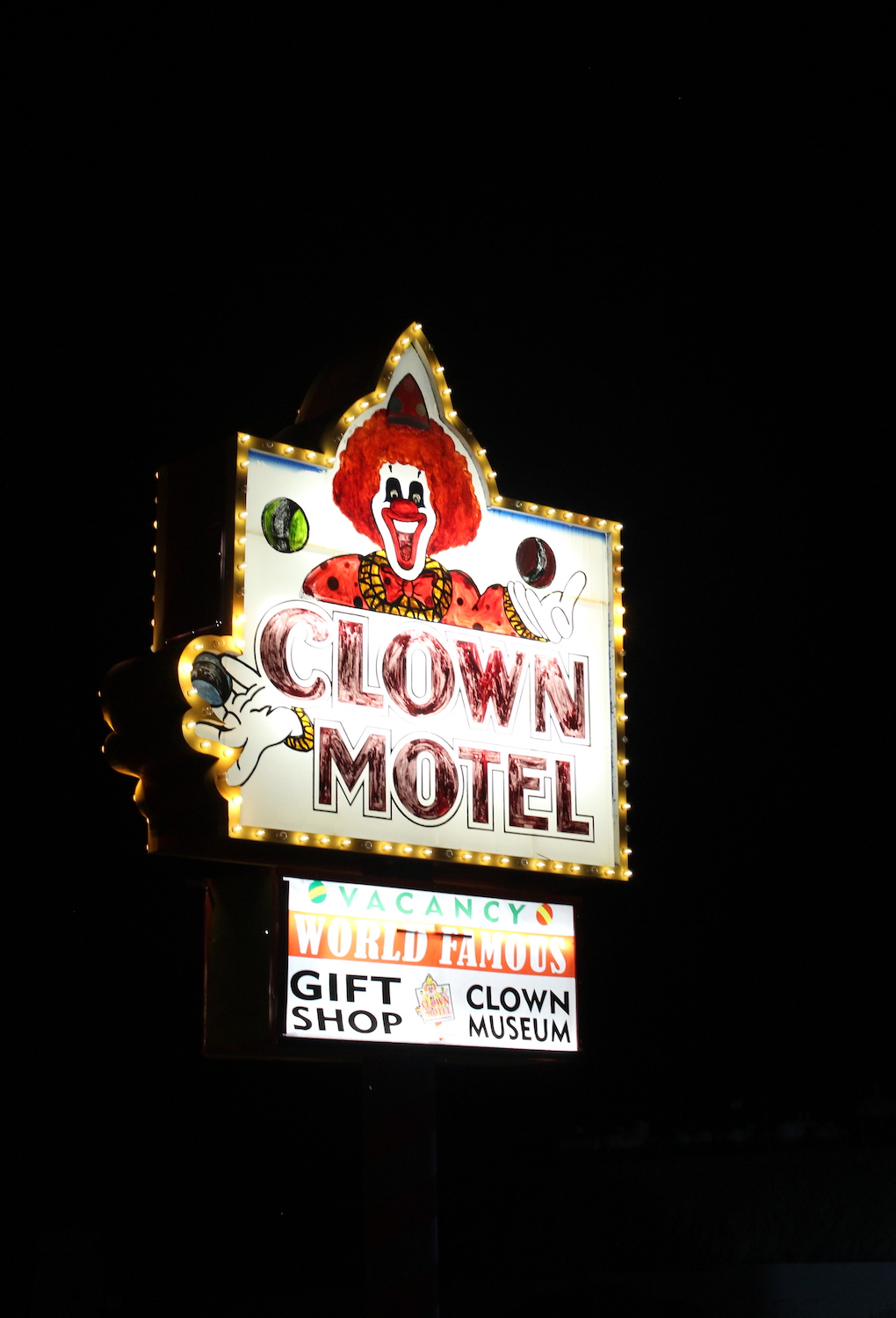
I’m here, paradoxically, in search of artifice. Visiting family as a kid, I was charmed by the raggedy roadside attractions on the drive from California to New Mexico—“trading posts,” a shriveled mummy—only to find out many were owned by the same corporate overlords. The American West, I decided pessimistically, is mostly an invention, a case of life imitating art.
The Clown Motel, for its part, certainly leans into its theme and trucks in rumors of its haunted history. But it was borne of a real-life clown obsession: Leona and Leroy David founded it in the 1980s, honoring their father, who’d died in a mine fire, by establishing his 150 collectable clowns as an onsite museum.
The motel was sold in 2019, but new CEO Hame Anand had been acquiring clowns since age 14. And, though the specters held their peace during my stay, the ghost stories check out. “At first, I didn’t believe in ghosts. I’m a science guy,” Anand says. “But after a year, I noticed that everybody’s details are the same.” People from all over the world have mentioned hearing someone unseen whisper, “Where’s my baby?”
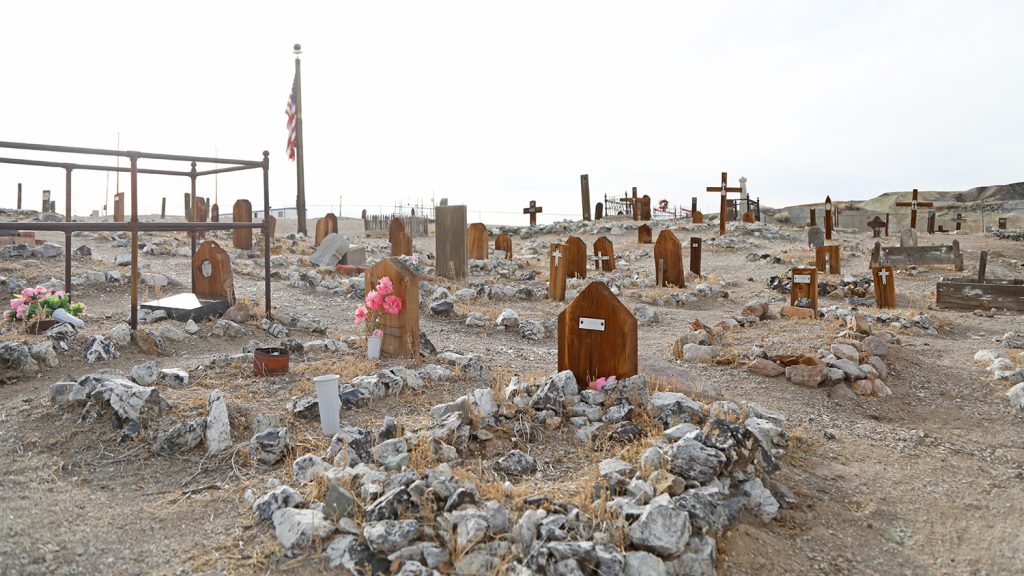
Next door sits a real cemetery, rock-lined graves and wooden headstones marking some of the town’s earliest deceased. A self-guided tour brochure at the boneyard’s entrance details tragic, almost cartoonish tales: Miner run over by ore cart. Sheriff shot by gambler. Gold-digging seductress who died on the lam.
The stories of horrific mining deaths are poor preparation for our next activity— hunting gems in Nevada’s rocky hills with Otteson Brothers Turquoise.
Owner Danny Otteson meets us in the parking lot of Giggle Springs convenience store. His hands are calloused from a lifetime of unearthing precious stones.
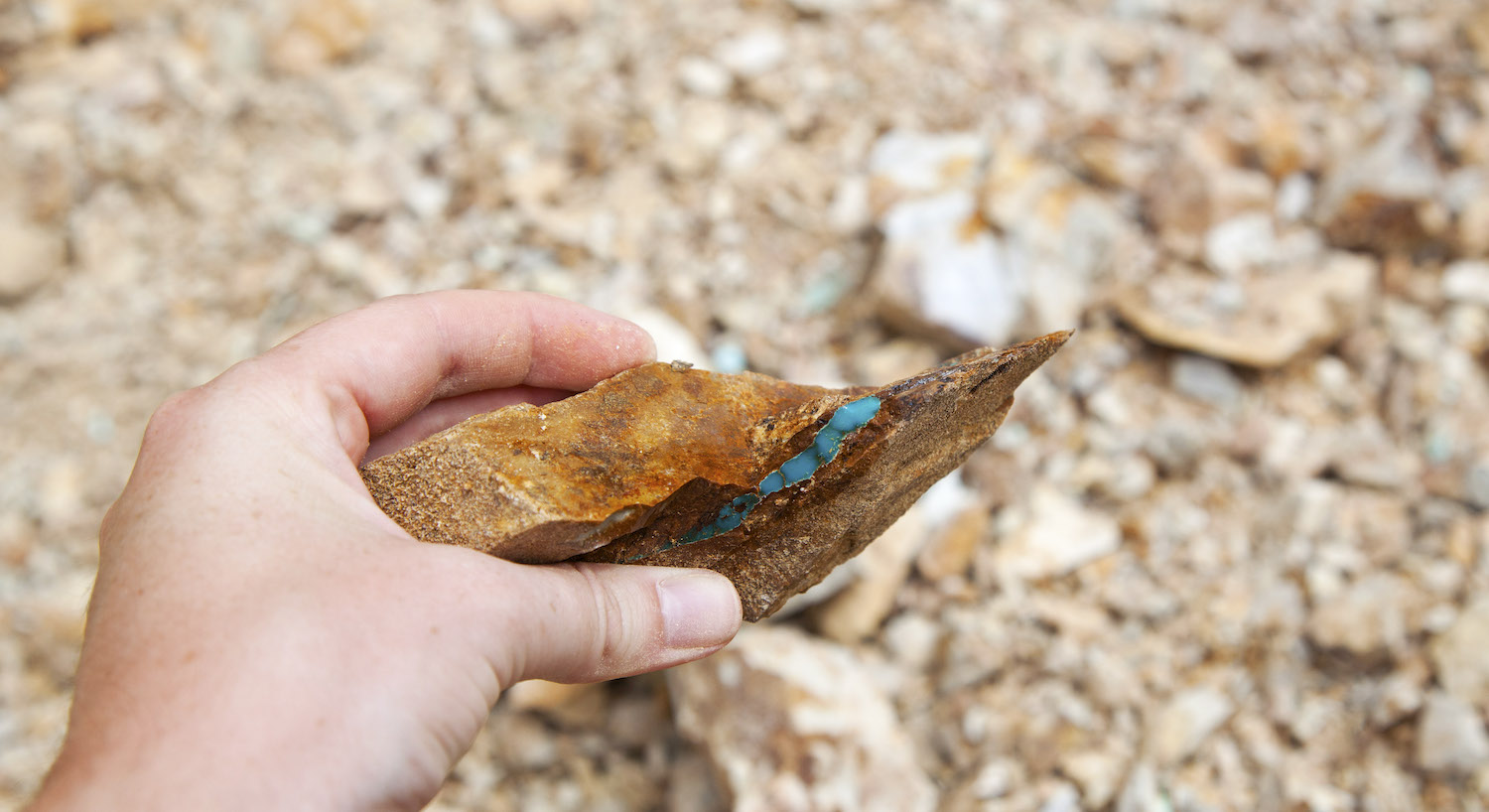
“I was the first Otteson born in Nevada,” he tells me with audible pride. His father started mining at 19 in Colorado, then made his way to the Silver State. The family now owns 30 turquoise mines across the state, and Danny raised his own kids out among the rocks. They sell the turquoise—raking in $350,000 a year in direct-to-consumer Instagram sales alone—and lead tours for those who like their acquisition more hands-on.
I picture a chilling plunge into a dimly lit cave, canary whistling by our side. But, though we’re asked to bring our own gear (pickaxe, bucket, gloves) and drive a half-hour down dirt roads, we remain above ground, on a mountainside fragmented by an excavator truck’s vast metal claw.
We root through granite hunks for flashes of blue as Danny tells us of a would-be turquoise thief chased from a mine by its steely owner. “He’s a guy you don’t want to mess with,” he says, like we’re in a movie.
A few hours later, we pass fields of cows with a sack of turquoise-threaded stone in the backseat, irrefutable proof that there’s still treasure in those hills.
After fried pickles, BBQ, and excellent beer at Tonopah Brewing Company, we meet night-sky photographer Russ Gartz at the Tonopah Star Gazing Park. It’s cloudy, but we peer at the moon through Gartz’s Dobsonian telescope, named after John Dobson, an amateur astronomer who used to set up his portable but powerful equipment on San Francisco‘s sidewalks, inviting passersby to peek. “We try to bring that same spirit to our star parties here in Tonopah,” Gartz says. “Anyone is welcome.”
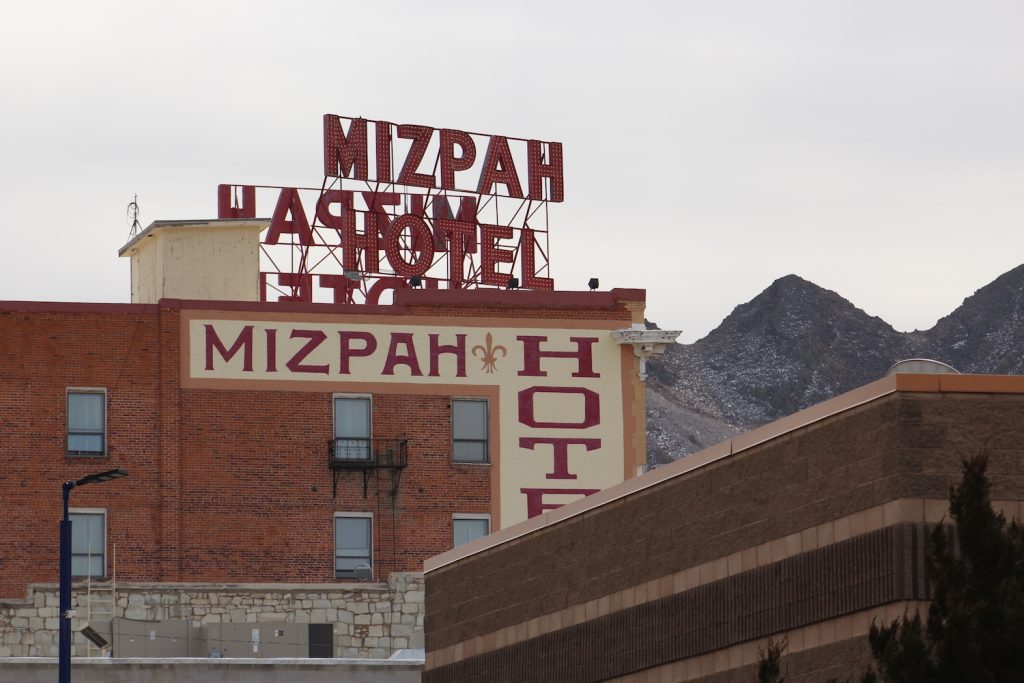
We stay that night at the Mizpah Hotel, a more luxurious but equally specter-plagued accommodation (Tonopah has plenty of ghosts to go around; another haunted hotel, the Belvada, sits across the street.)
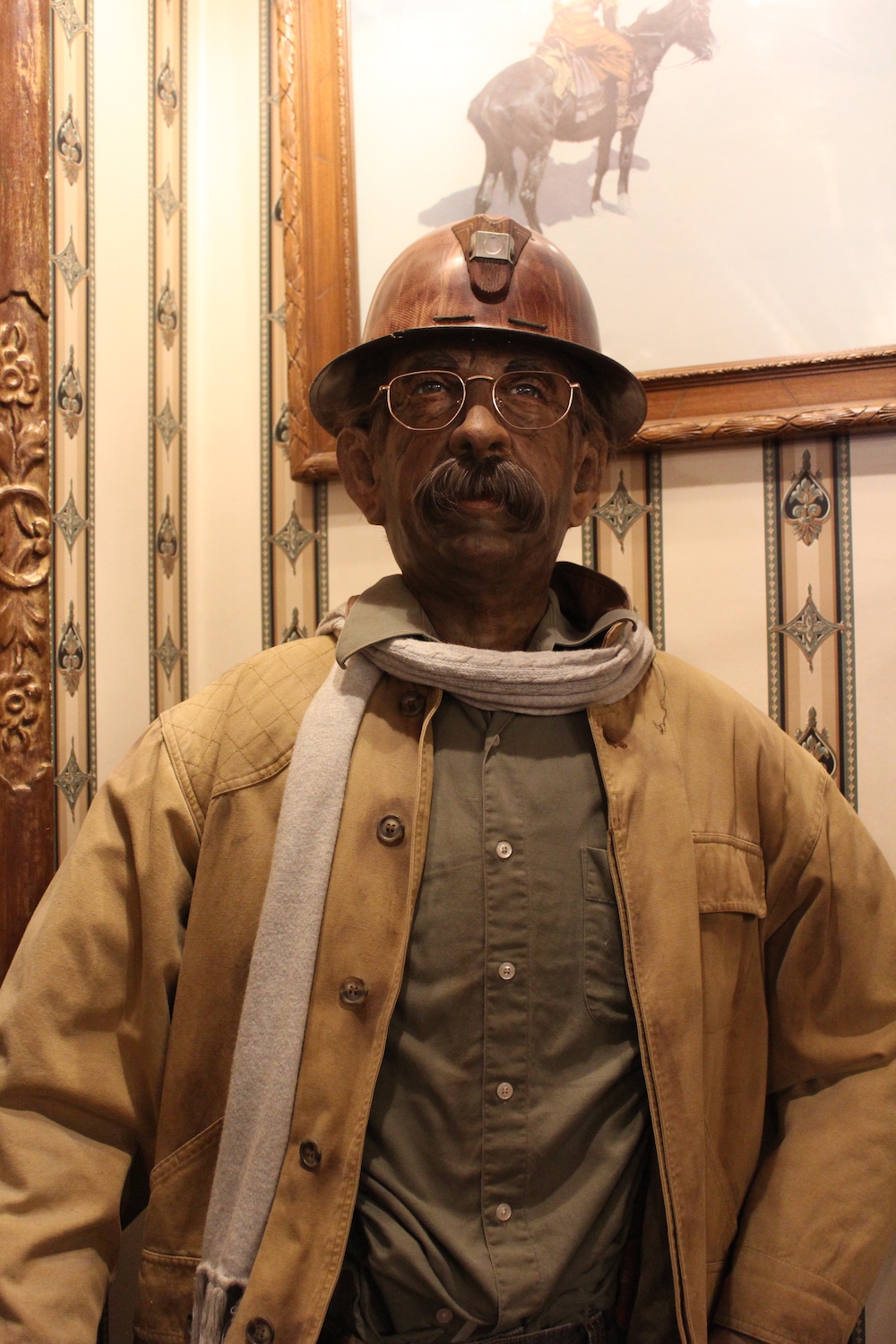
Founded in 1911, the Mizpah has a well-documented roster of permanent guests: A murder victim dubbed the Lady in Red. Two miners, shot by a companion in a money heist gone wrong. A pair of children, their cause of death too gruesome to repeat. “[Sometimes] I feel them hugging my legs,” says Jessalyn DiMaggio, who works the front desk.
DiMaggio offers to take us to the basement, an epicenter of ghostly activity. Michaela declines, but I ride the creaky elevator down with DiMaggio, where ordinary hotel infrastructure like a laundry room and an industrial kitchen abut creepy, unfinished brick walls and dirt floors. Someone has set up little scenes—a rusty kids’ bicycle, a dusty dinner table for two— probably for the benefit of the ghost tours that pass through.
Later, I wander the upper floors alone, hoping but failing to spot strange shadows or an unoccupied chair rocking. I head back to the room and crawl into bed beside Michaela. Her face is pale and frightened in the dark.
“You’re so brave,” I whisper.
“You’re so fearless,” she murmurs back.
How do I explain that, when she’s around, I find fear somehow perpetually absent, her steadying presence a lighthouse in the midst of any storm?
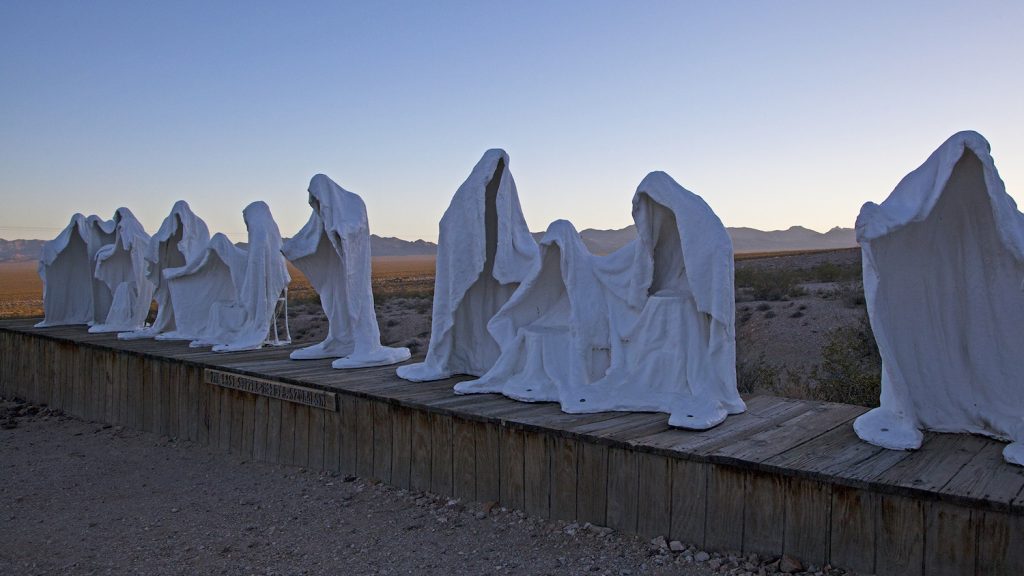
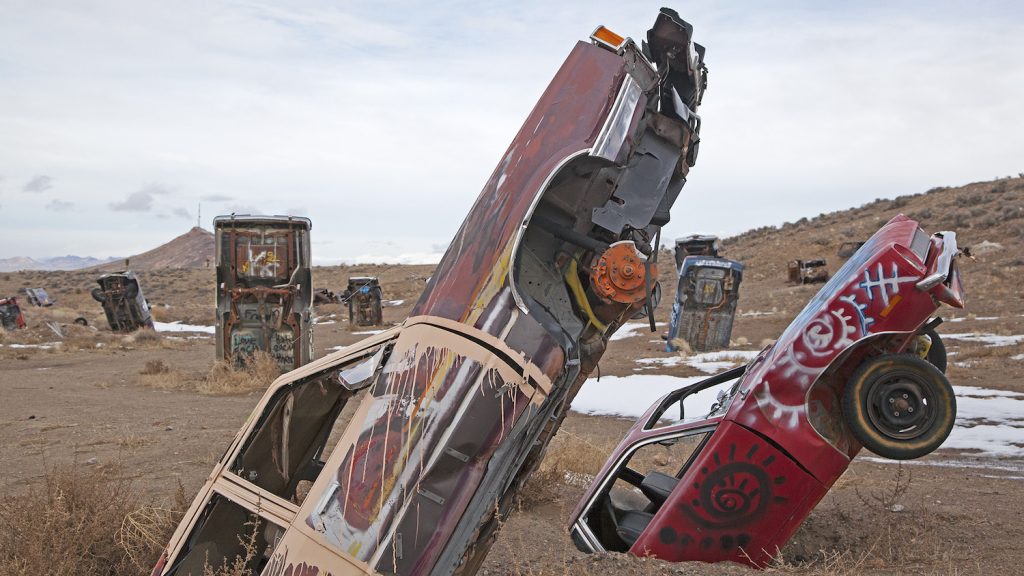
The next morning, we begin the first leg of our journey home. As we leave Tonopah’s poltergeists in the rearview mirror, I watch Michaela slowly unfurl. A few more ghosts remain ahead, but friendlier ones. In Goldfield, Nevada’s International Car Forest of the Last Church, a permanent outdoor exhibition, skeletal, spray-painted cars and buses rise like zombies from the dirt. At the Goldwell Open Air Museum, a field of sculptures outside of the eerily quiet Rhyolite Ghost Town, artist Charles Albert Szukalski installed white-sheeted phantoms in a composition matching da Vinci’s The Last Supper.
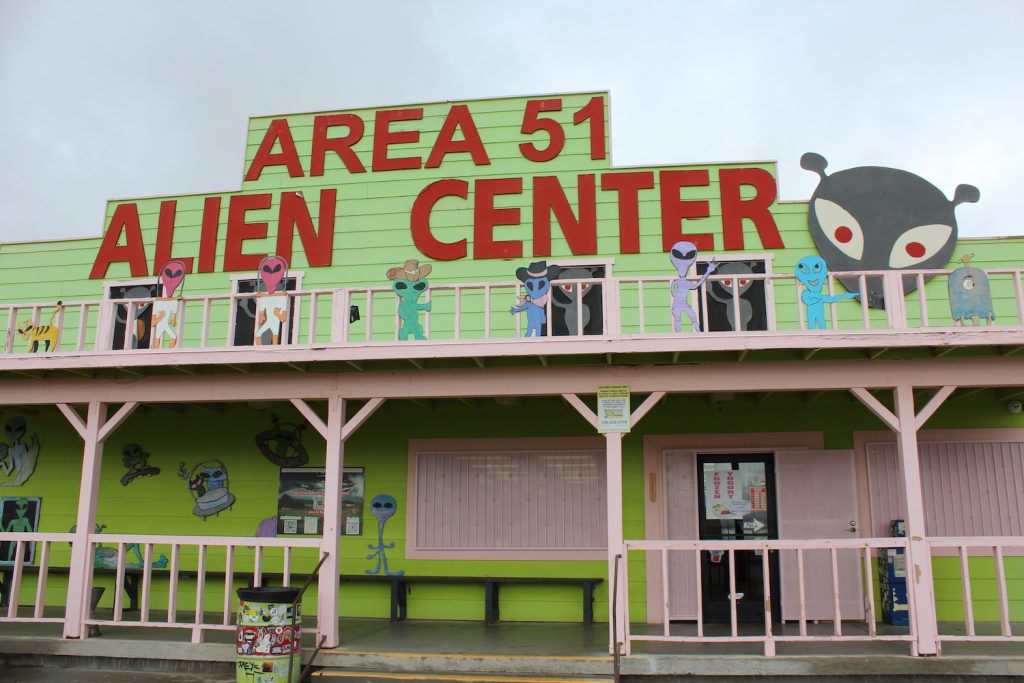
We pass falling-down roadside lodging, bordellos with a half-dozen cars parked outside before noon. Even the gas-station-slash-extraterrestrial-extravaganza that is the Area 51 Alien Center—an obvious tourist trap—has its touches of seediness in the form of the fully operational Alien Cathouse Brothel. Is the Wild West alive and well here in Nevada?
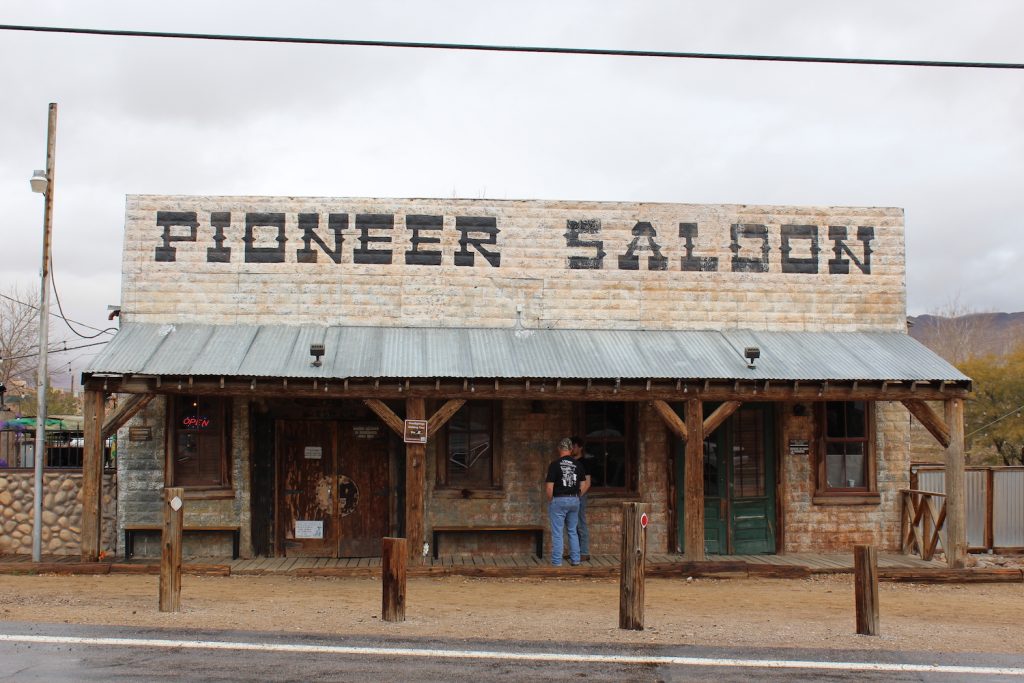
It feels like it at the Pioneer Saloon, founded 1913 in Goodsprings, Nevada, a desert community on the outskirts of Las Vegas that’s half crumbling ghost town, half thriving rural hamlet. The saloon sometimes serves as a movie set, but today it’s riotous with locals and travelers, live music amped to 11. My grilled chicken sandwich is bone-dry, my rocky road milkshake transcendent.
We forge onward to Buffalo Bill’s Resort & Casino in Primm, Nevada. Western-themed, it has Sin City’s uncanny unreality: cowtown façades and fake trees amid flashing slot machines. While losing $5 to a Bonnie and Clyde game, I remember a quote I read in the faux-newspaper-slash-brochure left on our bed at the Mizpah.
“Any of us can go to Vegas and enjoy the illusion of wealth, pleasure, and decadence, but authenticity is in short supply,” the hotel’s owner, Nancy Cline, told the Mizpah Review. “In Tonopah, you are closer to the land, closer to understanding that life can be hard and tough. But also closer to appreciating the simpler things in life.”
If artifice is a place trying hard to be exactly what I expect, I found it. But if authenticity is earnestness—or grit—I found that, too.
It’s like falling in love. At first, you’re doing everything you can to be the person you think they want. But being in love is coexisting as your truest self—while, sometimes, conceding to journeys you’d never take without your sweetheart leading you toward them.
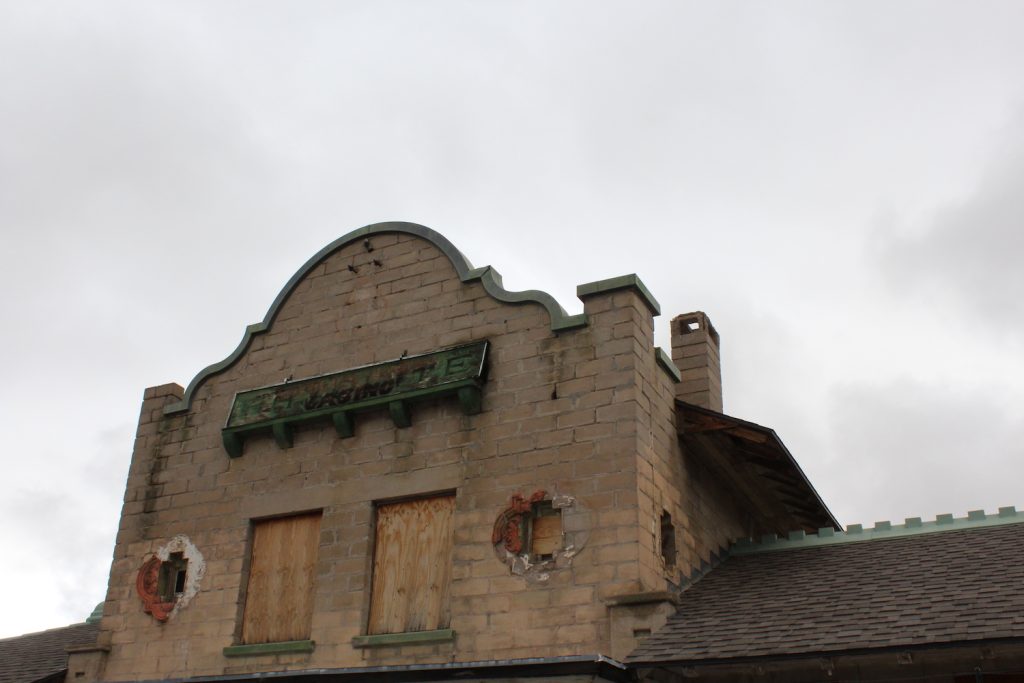
Miles from here, Tonopah’s ghosts prod or ignore a new set of seekers. There’s a ruggedness there that the plaster livery and Stetson-clad mannequins at Buffalo Bill’s can’t capture. Its people still work the perilous mines, serve eggs at its linoleum-floor diners, gather at its scant few bars. Everyone I met was a marvelous storyteller, weaving sad, strange, probably true tales. Maybe the false element was me, coming in to play at their daily existence.
Beside me, Michaela warily eyes an actual taxidermied bull suspended above an arcade. “Next time,” she declares, “we’re staying at the Bellagio.” Smiling, I take the hand of the girl who faced her fear of the dead to live this life with me. Maybe, in its own way, all of it is real.

Amelia Rodriguez is a writer and journalist and winner of the San Diego Press Club's 2023 Rising Star Award and 2024 Best of Show Award, she’s also covered music, food, arts and culture, fashion, and design for Rolling Stone, Palm Springs Life, and other national and regional publications. After work, you can find her hunting down San Diego’s best pastries and maintaining her five-year Duolingo streak.
Free and low-cost options for getting in on the pop culture action outside of the convention center’s walls
It’s happening, San Diego. The pre–Comic-Con excitement jitters begin to creep in as soon as July hits the calendar. But for those who forgot to set an alarm on registration day, whose batteries died or whose luck ran out in the virtual waiting room, or who simply prefer to soak up the fandom frenzy from the outside, we’ve got the best ways to experience Comic-Con weekend—no badge required.
Ain’t no party like an after-hours party, and XLE Productions’ Ready Party One is definitely one for comic book fans. Kick-start your convention weekend at Parq Nightclub and enjoy music by fan-favorite ’80s tribute band The Flux Capacitors, along with enough fandom fun, cosplay, retro gaming and pop-culture nostalgia to satisfy your inner geek. At least for the night.
Date & Time: Wednesday, July 22, 8 p.m.
Location: Parq Nightclub, 615 Broadway, San Diego, CA 92101
Price: Tickets start at $34
With more than a dozen activities and brand activations, Petco Park’s Interactive Zone is a badgeless fan’s playground, bringing together brands, games, celebrity appearances and immersive experiences all in one place. On Friday, July 24, Funko’s beloved annual party, hosted by Funko founder Mike Becker, returns to Gallagher Square. This year’s “Quest for the Grail” event will take guests on a journey to the sunken city of Atlantis. Expect themed décor, food, drinks, games and special guest appearances.
Date & Time: Thursday, July 23–Sunday, July 26 (times TBD)
Location: Lexus Premier Lot across from Petco Park
Price: Free; Funko Funday event is ticketed
Cartoon and art lovers can celebrate the work of Chuck Jones, creator of some of animation’s most iconic characters, including Bugs Bunny, Daffy Duck, Road Runner, Wile E. Coyote and Pepé Le Pew, at Seaport Village’s Chuck Jones Gallery. During Comic-Con weekend, the showroom will also host meet-and-greets with talented artists including Disney artist and seascape painter Steve Barton, The Simpsons animator Stephen Reis, and licensed Warner Bros., Hanna-Barbera and Disney fine artist Ben Olson.
Date & Time: Thursday, July 23–Saturday, July 25, 2026 (times TBD)
Location: Chuck Jones Gallery, 809 W. Harbor Drive, San Diego, CA
Price: Free
Get your pup’s—and your own—cosplay game ready because Helen Woodward Animal Center’s PAWmicon is back. Enjoy a Comic-Con-themed outing with the whole family while raising awareness for orphaned pets in San Diego. Divided into three categories—Flying Solo, Dynamic Duos & Trios & More, and Fantastic Floats—the event is a paw-fect way to jump-start the festivities.
Date & Time: Tuesday, July 21, 2026, 4:30–7 p.m.
Location: Presidents Way Lawn at Balboa Park
Price: Free
Why leave all the fun, mischief and mayhem to badge holders when you can join more than 300 partygoers and crawl through some of downtown San Diego’s top bars and nightclubs? Whether you’re called to save the universe or have an allegiance to the dark side, the annual Comic-Con Bar Crawl gives attendees exclusive access to more than 20 venues throughout the Gaslamp Quarter, with free welcome shots, exclusive drink discounts and complimentary entry along the way. This event for ages 21 and older is a fun way to celebrate your fandom outside the convention center.
Date & Time: Friday, July 24–Sunday, July 26, 2026, 8 p.m.–2 a.m.
Location: Check-in at Toro, 672 Fifth Ave., San Diego, CA 92101, from 8–9 p.m.
Price: $13–$30
Geek out over couture at the annual Her Universe Fashion Show at the Manchester Grand Hyatt. Hosted by founder and Star Wars: The Clone Wars actress Ashley Eckstein and presented by Warner Bros. Discovery Global Consumer Products, this year’s show will feature a selection of designers showcasing one-of-a-kind DC-inspired creations as they compete for a $2,000 cash prize.
Note: Wristbands are traditionally distributed the morning of the event on a first-come, first-served basis, but official details have not yet been announced.
Date & Time: Thursday, July 23, 6 p.m.
Location: Manchester Grand Hyatt, Seaport Ballroom, 1 Market Place, San Diego, CA 92101
Price: Free
A destination for all things fandom, Balboa Park’s Comic-Con Museum brings world-premiere and exclusive exhibits and events to the heart of San Diego, giving fans a place to geek out all year long. The museum is currently featuring the U.S. debut of Doctor Who Worlds of Wonder, showcasing 17 of the Doctor’s most iconic costumes, a full-size TARDIS and a collection of original sonic screwdrivers used on-screen. Visitors can also explore Sangre, Sudor y Mito: The Art and Tradition of Mexican Lucha Libre, featuring rare collectibles and authentic masks and costumes worn by legendary luchadores.
Date & Time: Open Thursday through Tuesday (closed Wednesdays), 10 a.m.–5 p.m.
Location: 2131 Pan American Plaza, San Diego, CA 92101
Price: $15–$30; free for children younger than 6
Browse an extensive collection of original drawings, paintings, jewelry and other whimsical creations from more than 100 professional and amateur artists at the Comic-Con Art Show. Many pieces will be available for purchase through the silent auction or Quick Sale, giving fans the chance to take home a one-of-a-kind Comic-Con souvenir while supporting talented artists.
Dates & Times:
Location: Manchester Grand Hyatt, Grand Hall CD, 1 Market Place, San Diego, CA 92101
Price: Free
Looking for a supercute way to fuel your Comic-Con adventures? Swing by the Hello Kitty Café Truck. This traveling pink café on wheels will be parked at Petco Park’s Interactive Zone, serving up tasty treats and exclusive merchandise. From limited-edition tote bags and hats to mugs and T-shirts, it’s the perfect stop to grab a snack and a little extra kawaii cuteness.
Date & Time:
Location: Petco Park Interactive Zone, 100 Park Blvd., San Diego, CA 92101
Price: Menu items vary
Get ready to fuel up and hype up. Whether you’re a plain-bagel purist or an everything-bagel fan, don’t miss your chance to grab breakfast or recharge at PopUp Bagels’ Volkswagen bus parked outside Pendry San Diego. Then satisfy your sweet tooth at Provisional with a rotating selection of character-themed doughnuts from Donut Bar. Both are available throughout the weekend beginning at 7 a.m. until sold out.
On Saturday, July 25, from noon to 3 p.m., head to Nason’s Beer Hall to celebrate Sony Pictures’ upcoming Spider-Man: Brand New Day. Guests can sample Tom Holland’s nonalcoholic beer brand, BERO, served in limited-edition themed cans available exclusively during the event.
Camila Ibarra Gallego is a CaliBaja native pursuing a master's degree in culinary journalism at the Basque Culinary Center. Shaped by the culturally rich, bicultural megaregion, she's passionate about sniffing out stories that connect people, territory and culture through food. When she's not tumbling down internet rabbit holes, you can find her pretending to be a wine connoisseur at a local wine bar or nose-deep in a good book.
Eighteen seconds, one unforgettable mistake, and a Fourth of July story that somehow gets better with age
There’s a famous video.
“This is insane!” the guy filming it seems to proclaim. “It’s the best fireworks show ever!” a companion confirms, inspiring a debate lasting over a decade.
All told, 7,000 fireworks exploded in the span of 25 seconds over San Diego Bay on July 4, 2012. A Michael Bay amount of unison. $125,000 worth of shells, cakes, Roman candles, and skyrockets had been placed on a barge—enough for 17 minutes of decorative sky flares—and…
Boom.
The sky looked like someone had set a giant Rorschach test on fire. Or as if whatever we all see in our Rorschachs—butterflies, clowns, tongue kissing, dads—was being electrocuted and lifted heavenward, amen. It was shocking how bright it was, how much it sizzled the local cosmos. Could’ve been one of those sci-fi films where a hole is ripped open between warring universes. But angstier, more metal—the work of some methy creator in a sleeveless concert tee.
The sound?
Lou Reed once released an entire album that contained 64 minutes of mindflaying guitar screeches and machine noises. No regular songs, just a fascinating amount of ear distress. His record label reps no doubt heard the melodic outro of their careers, but everyone else was in pain and stumped. That album still sounded better than the bay did that night. The bay sounded like a god who struggled with emotional regulation had blown his speakers and was working through the anger stage of AV grief.
In the left frame of the video, a middle-aged woman is attempting to drag her husband off by the hand. In no way does he want to go, possibly because he had missed the time Roseanne Barr sung the national anthem at a Padres game, simultaneously disemboweling and amusing America through the power of song. He would not willingly abandon an equally worthy San Diego trainwreck.
Another woman in the video appears to have just filled her beer, rushing to sit down for the show. She pauses mid-sit and returns to the full and upright position to properly bear witness. What was supposed to be prolonged entertainment has been so radically shortened that she will have to find another reason to drink. Lucky for her, drinking will be the only way to adequately process.
Locals remember the conspiracy theories. People wondered if the fuses had been tripped by a saboteur who was sympathetic to dogs, fish, or the growing suspicion that late-stage capitalism is a gorgeously branded but impossible dream sustained by remarkably efficient top-tier wealth retention and the soft compliance of fireworks-watchers who can no longer afford a house, a beer, or the personal impacts of human reproduction.
Speaking of being terrified of babies, babies were terrified. The children who witnessed it probably still can’t go near a candle store. But those kids will be tougher, perfectly scarred kids. They’ll write better songs.
That night helped us absolutely dominate the national news cycle. For a hot minute, we became America’s water-skiing squirrel. Now, years later, when you Google “fireworks gone wrong,” San Diego is always a top contender, along with that poor Nebraska family who nearly wiped out a couple generations in their front yard, their minivan somehow turning into a howitzer of recreational TNT.
There is still debate as to whether Big Bay Boom 2012 is the worst or greatest fireworks show of all time. But the advanced parts of civilization arrived at the truth as quickly as the women in the video did. It was undeniably amazing.
First of all, the point of Fourth of July fireworks isn’t “the intricate choreography of sky fire over a guaranteed amount of show time.” It’s about creating a vivid memory shared with some people you like, love, or would like to love.
BBB2012 used large-scale chemical fire to create the ultimate memory.
Sure, some people who iron their jeans subjected their family to a sermon about how San Diego managed to botch America’s birthday like a Disney princess-for-hire who smelled of quite a few Sauvignons.
The rest of us saw how perfectly it nailed the actual feeling of being an American. Because only a miniscule percentage of us bake postcard apple pies where every inch of crust is perfectly laminated like the wood in an Irish bar. Very few of us can paint on par with Picasso. The rest of us—despite truly believing in our America-activated abilities to achieve greatness in almost any field of our choosing—burn pies. We try to paint only to realize it looks like our fine motor skills have entered active death.
That’s why BBB2012 was the most perfectly American fireworks show ever: A wildly ambitious idea galvanized thousands upon thousands of people to both work on it and come to hold a beer and gawk at it, only to have it fail in the most glorious TMZ-level spectacle.
America isn’t about immaculate, storyless wins. It’s about how the framework of a country is solid enough that we can accidentally detonate our entire lives—a few times—and still probably be OK.
No one has America’d quite like San Diego did on that day. It was performance art. Lou Reed’s heart slow-clapped. Any brief municipal embarrassment quickly became a pride of our people. I can only hope the same for the Nebraskan yard family whose Dodge Aerostar became a hyperactive Death Star.
P.S. Local writer Maya Kroth compiled a quite great oral history of that night for Thrillist. The bottom lines for me were—it took nine months to prepare, no one was hurt, and even though the pyrotechnics company tried to zero out the bill, Big Bay Boom founder H. P. “Sandy” Purdon refused and paid them in full. This year will mark the 25th Anniversary of the yearly Big Bay Boom.
Troy Johnson is the magazine’s award-winning food writer and humorist, and a long-standing expert on Food Network. His work has been featured on NatGeo, Travel Channel, NPR, and in Food Matters, a textbook of the best American food writing.
From surprise revivals to changing dining habits, these are the shifts redefining the local culinary landscape
If absence makes hearts (and stomachs) grow fonder, then shuttered restaurants quickly become the hottest tickets in town—something a number of iconic institutions found out after taking very public hiatuses after historically long runs. For instance, following a lengthy (and extremely flip-floppy) closing process after 92 years in business, Las Cuatro Milpas reopened two blocks away in Mercado del Barrio. Similarly, Carlsbad butcher shop Tip Top Meats reopened in the same location (albeit a smaller space) after the death of founder Joachim “Big John” Haedrich in 2023. Finally, after a whopping decade out of business, Sami Ladeki and chef Alfie Szeprethy brought back Roppongi to its original Prospect Street space, where it was the talk of the town in the late ’90s. All came back under the same proprietors, so they weren’t third-party nostalgia-licensing deals. The algorithm may have ravaged our attention spans away from all but the newest and shiniest, but this proves there’s still hope for our collective prefrontal cortex.
Other local eateries honored their pasts by bringing in new perspectives. The Lion’s Share in Embarcadero, Milton’s Deli in Del Mar, Dudley’s Bakery in Santa Ysabel, and J-K’s Greek Cafe in La Mesa handed over the keys to new owners willing to take on a big task: maintain the soul of icons through particularly rough economic circumstances for restaurants, navigate big feelings from longtime regulars (who often don’t take kindly to change), and make some necessary changes to keep going for another few decades. Taking over a project in process can be a lot harder than starting from scratch. But building that feel-good nostalgia doesn’t happen overnight, so it sure helps to have a well-established playbook of success passed down from those who came before.

It wasn’t just restaurant groups from Los Angeles that decided to put down roots en masse, although San Diego saw plenty of LA transplants recently (Sugarfish, Mr. Charlie’s, For the Win, Katsuya Ko, Bacari). Global brands like Chef Fei, Zuma, and Pepper Lunch have locations of their own on the way, and upscale Canadian eatery Joey joined to the inescapable gravitational pull of Westfield UTC’s culinary cosmos for its first spot in America’s Finest City. Good to see the rest of the world is catching up with what we’ve been seeing the last few years—San Diego is a dining destination already on the rise.
Between the never-ending news cycle of doom and perimenopause brain fog, I’m at the stage in life where I’m more than happy to let someone else make a decision for me, especially when it comes to what’s for dinner. And based on the way a lot of menus look right now, I’m not alone. It seems like half the places I visit offer some version of a prix fixe, omakase, or tasting menu. Restaurants are embracing the curated experience to solve the problem of affordability (a fixed menu reduces food and labor costs, guarantees an acceptable check average, etc.) and critical thinking in one fell swoop. Omakase (meaning “I leave it up to you”) is far from a new concept in high-end Japanese sushi culture, but now that it’s popping up everywhere from coffee experiences to grab-and-go sushi and sandwiches, it’s gone from somewhat niche to nearly omnipresent.

The world got an up-close look at San Diego’s coffee industry when we hosted the premier specialty coffee expo World of Coffee for the first time this April. San Diego’s long and rich coffee history stretches back to the late 19th century. Things percolated fairly quietly for around a century before really picking up steam. Today, there are nearly 200 specialty roasters and cafes across the county, with many earning national accolades like the Good Food Award (Steady State Roasting, 2020; Bird Rock Coffee Roasters, 2023, 2021, 2019, 2017, 2016), Roaster of the Year by Roast Magazine (Mostra Coffee, 2020; Bird Rock Coffee Roasters, 2012), and the Specialty Coffee Association Coffee Design Award for packaging (Rikka Fika, 2026). Now that we’ve moved past the comically insufferable coffee snob era of the early 2000s, even java newbies can feel comfortable walking into pretty much any coffee shop in San Diego, asking questions, trying a few things, and feeling confident they’re going to get great service and a great beverage.
Beth Demmon is an award-winning writer and podcaster whose work regularly appears in national outlets and San Diego Magazine. Her first book, The Beer Lover's Guide to Cider, is now available. Find out more on bethdemmon.com.
A customized memory-filled explosion gift box is a creative way to show someone you care
Finding a gift that feels truly personal can be surprisingly difficult. In a sea of generic options — flowers, gift cards, candles, and the like — Xplosion Box offers something more lasting: a customized keepsake built around the photos, messages, and memories that matter most.
Founded by Southern California entrepreneur Jay Vijay, Xplosion Box LLC creates fully customized explosion gift boxes that arrive professionally designed, printed, assembled, and ready to gift. Each box opens layer by layer to reveal personal photos, heartfelt messages, pull-out albums, origami-style photo pockets, and hidden notes, turning a simple gift into an emotional reveal.

The brand was built for people who want to give something meaningful without spending hours printing photos, cutting paper, folding cardstock, or assembling a DIY project. Customers simply choose a box, upload their favorite photos, add personal messages, and the Xplosion Box team transforms those details into a polished keepsake that feels thoughtful, personal, and beautifully made.
Xplosion Box offers personalized gift boxes for birthdays, anniversaries, weddings, graduations, Mother’s Day, Father’s Day, Valentine’s Day, Christmas, proposals, bridesmaid gifts, long-distance relationships, and thoughtful “just because” moments.

Customers can choose from flexible customization options starting at $27. The Mini Surprise Box includes 10 photos, three message cards, and one hidden secret note, while the Mega Surprise Box offers a fuller keepsake experience with 40 photos, three message cards, and one hidden secret note.
What sets Xplosion Box apart is its high level of customization combined with convenience. Filled with personal photos, custom text, decorative details, and layered surprises, each box gives customers the freedom to create a gift that feels one-of-a-kind — without having to make it themselves.
At its core, Xplosion Box helps people turn favorite photos, stories, and words into something tangible: a keepsake that can be opened, revisited, and remembered long after the occasion has passed.
We ask the city's best food photographers to choose their favorite pics and share their secrets to capturing a drool-worthy pic
Food is a notorious diva to photograph. The wrong lighting can make José Andrés’ paella look like a jaundiced grain bowl. You could be staring at the best sandwich of your life, but shoot it from above and—hey, congrats on that abandoned piece of lettuce bread. A cottage meme industry has been built around the hilariously bad photos on review sites that make Michelin-star food look like Michelin tires.
Especially in a visual modern media world, food culture depends on great photographers capturing the painstaking work in equally deserving ways. We asked four of San Diego’s top food photographers for their favorite shot from another year of documenting what we eat.

Getting this kind of shot takes a bit of yoga. Asana yourself into the corner, hold your breath, pray that a chef on the move doesn’t back into your light stand.
“You’re stepping into someone’s workspace during their busiest moments, so it’s a balance of being present to get the shot and being invisible to not slow anything down,” Kimberly Motos says.
The subject here is the Birdman sandwich from Chick & Hawk—hot fried chicken thigh, tangy slaw, kimchi comeback sauce, sweet and spicy pickles, potato brioche bun—getting a hearty dousing of its difference-maker seasoning. Motos captures the parts of the process that diners don’t usually see: the chaos behind something that looks so simple.

“I love this image because it feels like a moment you want to step into,” says Lucianna McIntosh. A warm, sunny day at The Fishery in PB with oysters, caviar, and martinis. Yes, please.
The little details—the glass sweating a little, the direct afternoon light creating stark shadows, the oyster glistening on the tray—are the main characters. Instead of trying to overly control the setup, McIntosh “followed the light and lines that draw you in more,” she says. “This was one of those moments where everything lined up on its own for a second. I love it when the shadows end up being just as important as the food itself.”

La Jolla native Eric Wolfinger—who won a James Beard Award for Tartine Bread, one of the most stunning bread books of all time—says he doesn’t have a signature style. His style is a conduit.
“I see my job is to translate the chef’s point of view into something you can feel,” he says.
For this shot, Fleurette chef Travis Swikard had one directive: cuisine du soleil (“cuisine of the sun”). With a spread of leeks vinaigrette, herb-roasted golden chicken, and beets, Wolfinger wanted to create a scene that felt straight out of the French Riviera, relaying the light, bright style of Swikard’s new spot.
Some bonus additions here: Extra lights—to add lots of warmth—and a clipping from an olive tree.

Timing and light are everything in food photography. In Lucien—La Jolla’s tasting-menu-only restaurant with moody ambiance—a single strobe flash creates the ideal spotlight.
Dee Sandoval says she uses the “natural, just-plated energy” of the dish to “create a portrait of moment and craft.” That’s why this Mostra Ghost Bear espresso ice cream—with San José dark chocolate mousse, soy-miso caramel, and koji shoyu chocolate sauce—looks like it might dissolve halfway to your mouth.
Emma Veidt is an editor at San Diego Magazine. She earned her bachelor's and master's degrees from the Missouri School of Journalism. She loves running, hiking, and rock climbing, but really, she mostly loves encounters with the street cats around North Park.
From San Diego’s coastline to Los Angeles stadium and fan zones across the region, here’s how to experience soccer’s biggest event
When three nations and 16 cities come together to host the FIFA World Cup 2026, the scale stops feeling like a tournament and starts feeling like geography. A continent becomes the stage as borders soften into corridors. And Southern California—shaped by migration, sport, entertainment, and constant movement—sits inside that landscape with all eyes on it.
San Diego and Los Angeles have always felt connected. Hop on the Pacific Surfliner, and the trip unfolds in one continuous stretch of coastline, passing beach towns, neighborhoods, and city centers.
Traveling from San Diego, everything still feels slightly suspended as the Pacific Surfliner follows the coast north with ocean on one side and a slow suburban blur on the other. San Diego stays in exhale. Los Angeles is already building toward something louder.
This summer, Los Angeles will host eight matches of the FIFA World Cup at Los Angeles Stadium, including the US Men’s National Team opener on June 11, while the region stretches into 39 days of programming across stadiums, parks, transit hubs, beaches, and neighborhoods. Instead of one massive fan hub, Los Angeles is embracing a citywide celebration, with fan zones spread across its entirety.
But this pattern has been rehearsed here for decades. In 1994, Southern California became one of the defining stages of the World Cup, when matches at the Rose Bowl placed global attention on the region and turned local stadiums into international landmarks, confirming its ability to hold the world at scale.
What distinguishes Southern California is not just infrastructure, but cultural permeability. Fashion, music, film, art, and sport constantly overlap here, creating an environment where identity is flexible and always in motion. From the Venice boardwalk, where skate culture shaped modern street style, to global soccer stars rubbing shoulders with Hollywood celebs, to authentic Spanish cuisine moving up and down the I-5 corridor, everything circulates.
The World Cup is not introducing anything new here, it’s showing up for the summer and showing out, revealing what this city has always known about itself. What follows is a look at the fan zones and how Los Angeles turns itself into a city-wide stage for the tournament, one neighborhood at a time.

As the heart of Los Angeles, Union Station is an official Fan Zone June 25-28 during the World Cup, but in practice it never really stops being one.
It is the city’s circulation point, its meeting ground, its pressure valve. Commuters, travelers, match-day crowds, and everyday Angelenos all move through the same space, and everything mixes, overlaps, and scales in real time. In a way, this is where the World Cup stops arriving in Los Angeles and starts moving through it.
The Pacific Surfliner from San Diego to Los Angeles makes that shift feel almost too easy. No stress or gridlock anxiety, just a straight line up the coastline with ocean on one side and everything slowly becoming more built on the other. It’s one of the rare ways into LA that doesn’t feel like arrival as friction. You can sit with a laptop, watch the Pacific drift past, grab coffee from the café car, and let the city come to you in pieces.
That’s the beauty of arriving at Union Station. Instead of feeling like you’re on the edge of the city, you’re immediately surrounded by it. And, inside, the station already reads like a World Cup nerve center: banners, movement, multilingual energy, the sense that something global is about to funnel through this exact point. The Heart of the City Fan Zone only sharpens that feeling, with simultaneous match screens, DJ sets, meet and greets, and immersive activations built around marquee games like USA vs. Türkiye.
From there, the city splits outward.
ROW DTLA feels like the first exhale after arrival. A converted industrial campus turned creative district where restaurants, retail, and open-air courtyards form a self-contained ecosystem. If you’re looking for the perfect first meal in LA, make it lunch at Pizzeria Bianco. The thin-crust pizza is reason enough to go, but the space leaves just as much of an impression.
What I liked most about ROW DTLA is how quickly it resets you after the train. One minute you are stepping off at Union Station, and the next you are in a space that feels like its own version of LA, a city inside a city with some of the most curated shopping I’ve ever seen.
Bodega hides itself behind a convenience-store front, a sneaker and streetwear space disguised as something ordinary, like LA refusing to make anything feel too obvious. The whole campus moves like that, part retail, part gallery, part neighborhood you are only temporarily inside.
Isabella Dallas is a freelance writer for San Diego Magazine and the Arts and Culture Editor at The Daily Aztec in her final year at San Diego State University. She previously worked as an editorial intern for SDM, but when she’s not writing, you can find her trying the best coffee spots in SD, devouring the latest rom-coms, and indulging in anything and everything pop culture.
The 53rd Annual National Philanthropy Day Takes Place on November 21. Join us from 11:00 a.m. – 1:30 p.m. at the new Gaylord Pacific Resort & Convention Center!
Once yearly, AFP San Diego joins with others worldwide to celebrate National Philanthropy Day (NPD), a special day set aside to recognize the great contributions of donors and nonprofits that enrich of our community and the world. San Diego’s NPD is one of the largest and most successful in the U.S., attracting nearly 900 participants, including philanthropists, nonprofit leaders, CEOs, board members, development professionals, and business, community, and civic leaders.
Sponsorship proceeds from National Philanthropy Day are reinvested in education, training, scholarships, career development, and the advancement of fundraising professionals throughout San Diego. These resources and training provide fundraising professionals with the tools necessary to support our region’s diverse array of nonprofit organizations, which rely on charitable giving for close to half of their annual revenues.
The National Philanthropy Day Honorees are selected by the NPD Honorary Committee, a group of highly respected, diverse nonprofit and business leaders. Our 2025 Honorees include:
National Philanthropy Day San Diego provides an opportunity to reflect on the meaning of giving and to celebrate the selfless contributions of individuals and organizations across the region. We look forward to celebrating with you!
Sponsorship opportunities and individual tickets are available. Please visit www.afpsd.org for more information.