Ready to know more about San Diego?

Subscribe
Arts & Culture OCTOBER 27, 2025

In Photos: San Diego’s Iconic Taco Shops

Marshall Williams’ Taco Stand Vernacular series explores the visual and cultural connections that link some of our favorite places to eat
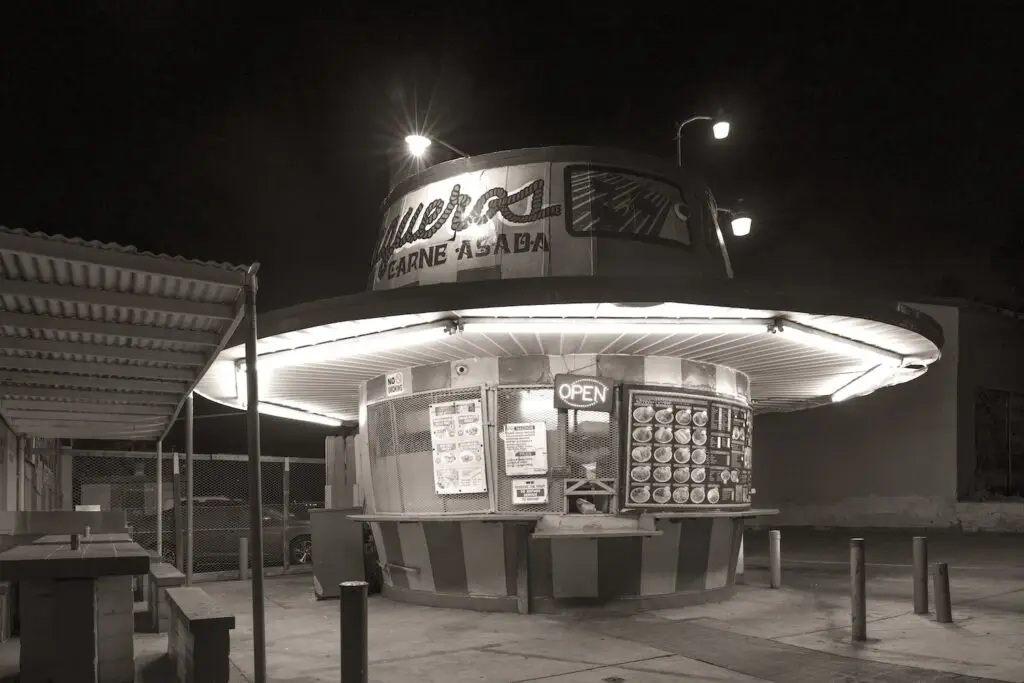
In Photos: San Diego’s Iconic Taco Shops
Photo Credit: Marshall Williams

San Diego’s taco shops don’t just feed our city, they cultivate culture. In Marshall Williams’ Taco Stand Vernacular photo series, these tortilla temples become a rigorous, black-and-white typology—glowing kiosks and drive-throughs isolated at dusk when the sky goes soft and signage calls to hungry dinner seekers.

“One evening, I was stopped at a stoplight, and was gazing over at this taco stand. It was sunset, and the way it was illuminated, it made such a transition, like it donned this evening persona. It just changed into this very kind of ‘come-hither’ being,” Williams says. “My interest is in the physicality of these places, their unique personalities.”
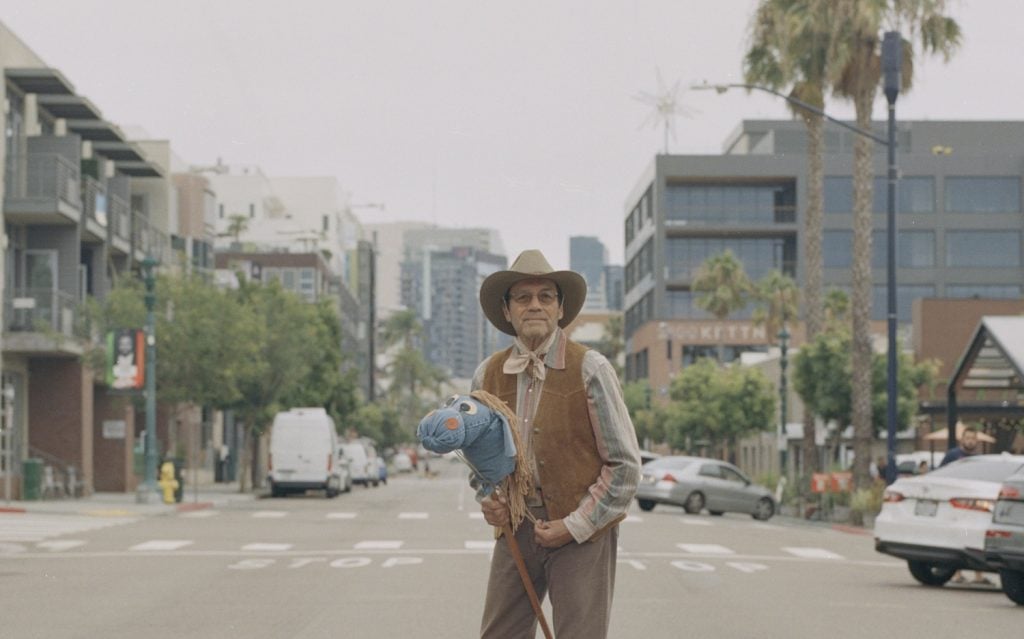
San Diego portraits by photographer Iz Castillo for his series "Portraits on Kettner" featuring Richard Ybarra

In these images, Williams honors each stand’s architecture and iconography, treating them as social focal points. Seen together, patterns surface.

“When I began to lay the images out, I could see this sort of visual lexicon that was developing,” he says. “You begin to see these interesting elements that are continually reoccurring, like arrows in the road—there’s often some sort of directional component. Or light-hearted motifs or 24-hour signs that are all articulated in different ways.”

Williams, who studied at the Brooks Institute of Photography in Santa Barbara and now lives in Hillcrest, has been a fixture of SD’s photo scene for decades. For 25 years, he co-ran Mantoani-Williams Studio on India Street, primarily doing commercial and studio work.

But this exploration is something else, slotting neatly into a lineage of intentional seeing: Bernd and Hilla Becher’s cool taxonomies of industrial forms; Ed Ruscha’s deadpan gas-station photo books; the New Topographics’ insistence that the manmade landscape is still a landscape. Williams inherits that discipline while bending it local. He explores corners as they morph and find new life, like a reincarnated A&W root beer barrel–shaped building of old, now serving Mexican fare.

What emerges is a large-scale portrait told in palm trees, surfboards strapped to roof racks, and the patient welcoming of fluorescent light. Rather than chasing nostalgia, Williams’ images catalog a classic and familiar yet evolving design, allowing us to see San Diego in a new, more connected way. Beloved neighborhood monuments are perceived, documented, honored.

“When these structures are long gone, it’s the photograph that becomes the keeper of the details, the proof and the story of their existence,” Williams says. “Photographs play such a vital role because these taco stands represent an identity for us here in San Diego. This is who we are as a culture.”

Photos by Marshall Williams
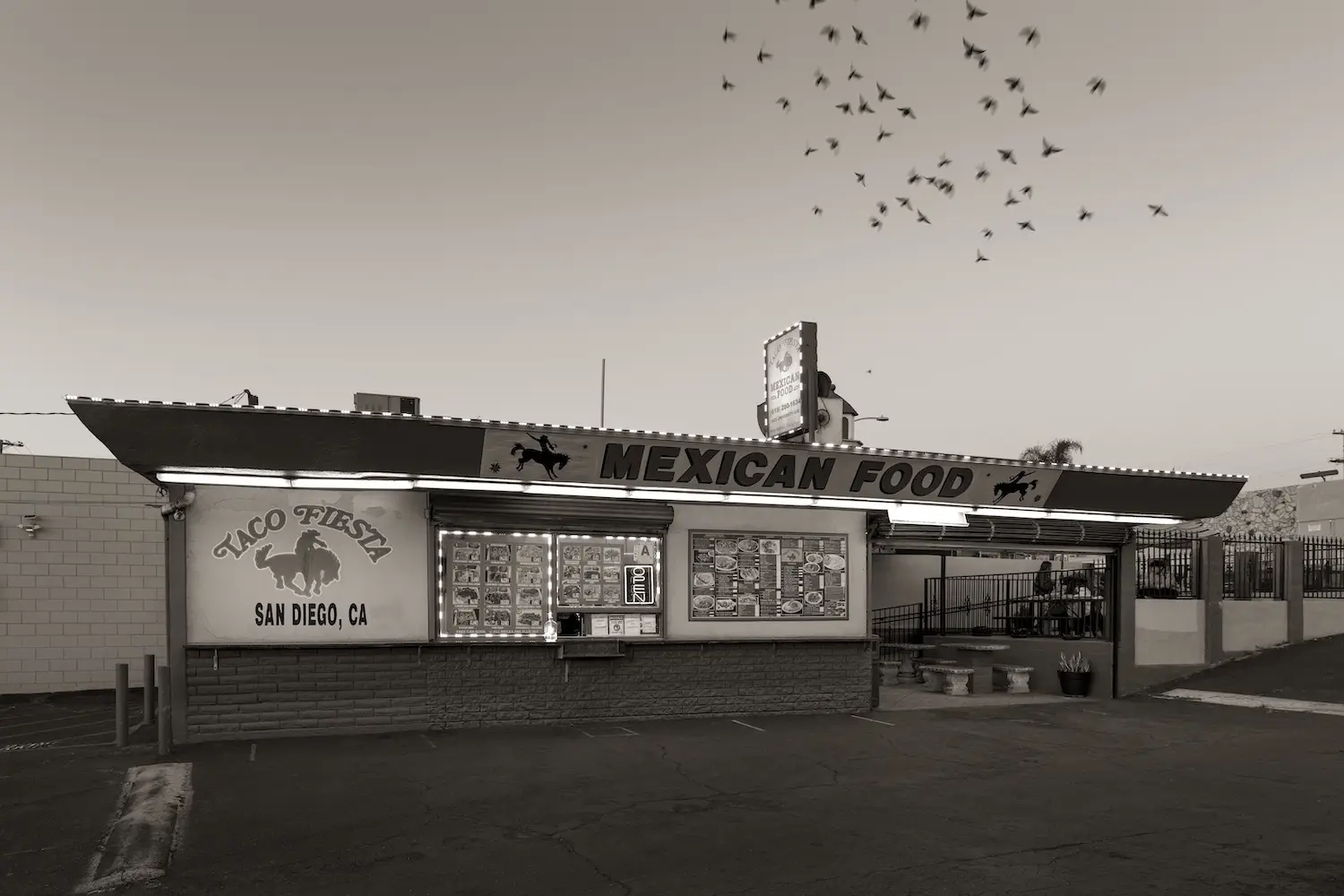
San Diego taco shop, Taco Fiesta Mexican Food, as captured by photographer Michael Williams in his exhibit Taco Stand Vernacular
Taco Fiesta Mexican Food (East San Diego)
“What I love about this image is the flyover. Flocks of birds have symbolism of divine intervention, so I really enjoy the spiritual component of this photograph. One of the things I’m always looking for is gesture in a photo, because, if you consider the three main components of photography [to be] composition, lighting, and gesture, it’s gesture where you really deliver the content and the story.”
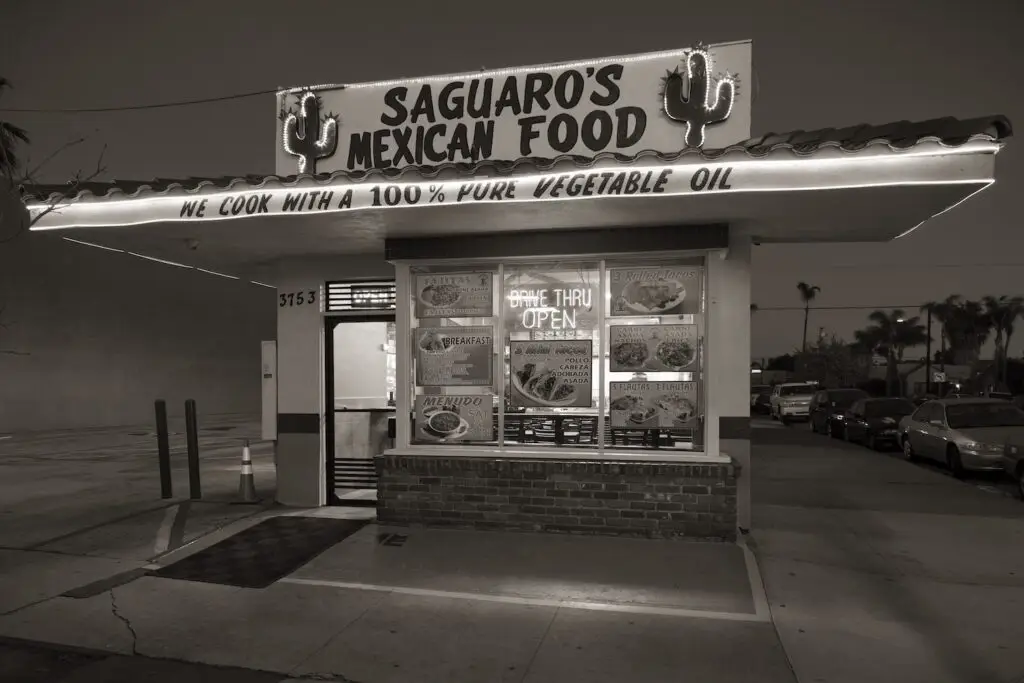
San Diego taco shop, Saguaro’s Mexican Food, as captured by photographer Michael Williams in his exhibit Taco Stand Vernacular
Saguaro’s Mexican Food (North Park)
“Saguaro’s was one of the first ones that I photographed. The ‘we cook with 100 percent pure vegetable oil’—it’s so campy. And the fun cactuses. I drove by there recently, and it doesn’t look the same anymore. They’ve removed some of that campiness in the signage, and they changed colors. So that’s another interesting part of how this project has evolved—to watch how these places change over time. You begin to realize I sort of encapsulated this period of time where they existed in this way.”
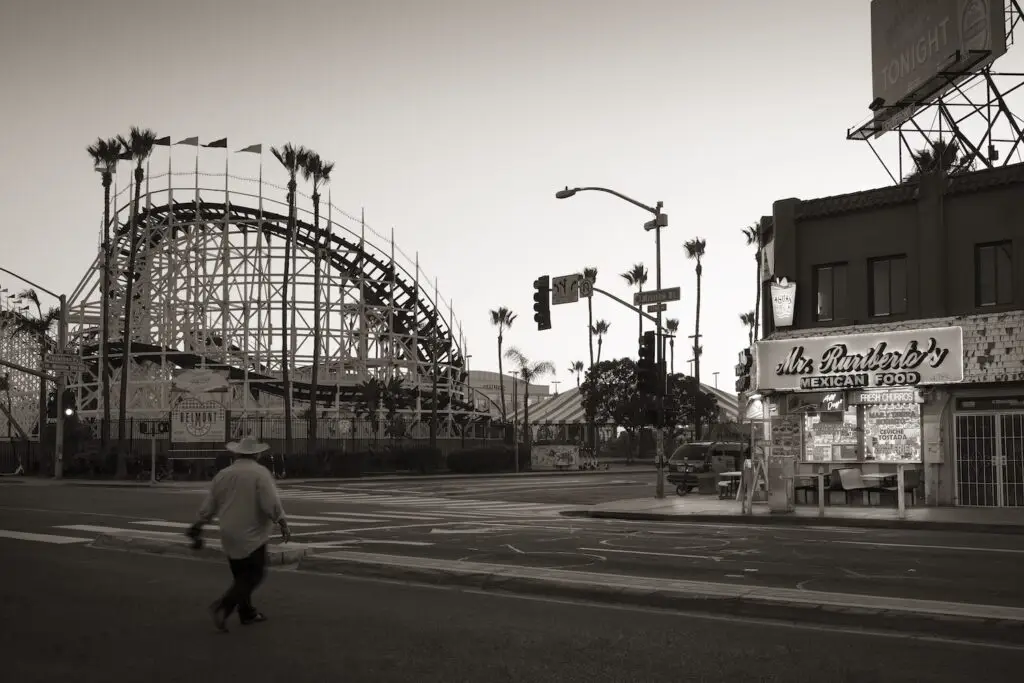
San Diego taco shop, Mr. Ruriberto’s Mexican Food, as captured by photographer Michael Williams in his exhibit Taco Stand Vernacular
Mr. Ruriberto’s Mexican Food (Mission Beach)
“That’s a hard intersection to photograph—a lot of traffic and just a lot of stuff going on. There are stop lights that are hanging down right next to there, so it took a while to figure out how to position myself so those weren’t blaring in the shot. And then it was just literally a stroke of happenstance: This gentleman walks across the street, and I was ready for him, and I was able to get the shot.”
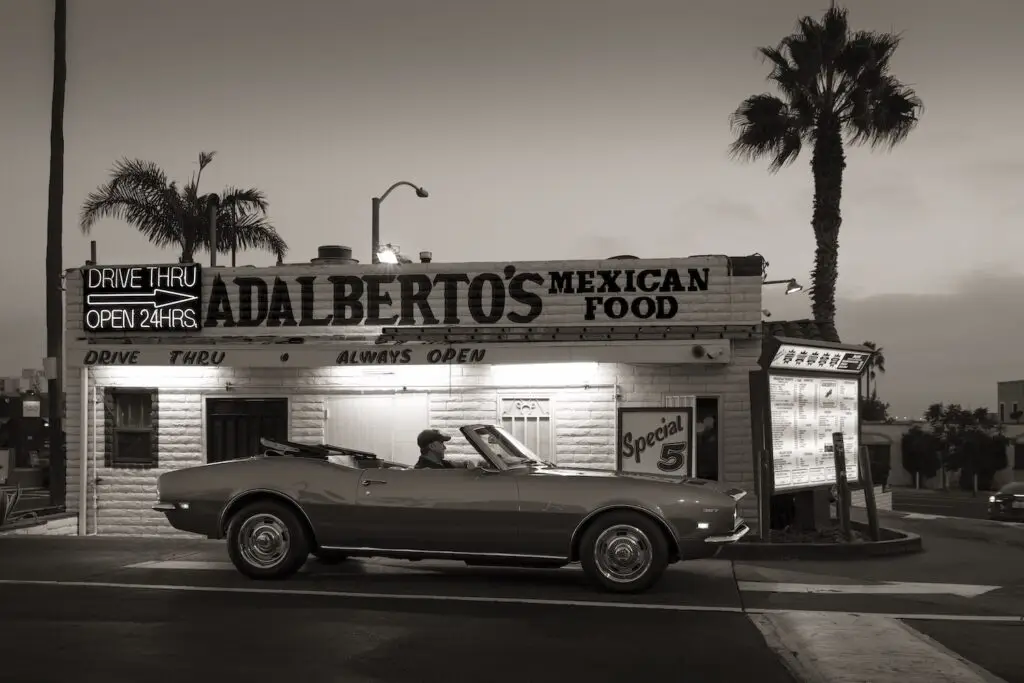
San Diego taco shop, Adalberto’s Mexican Food, as captured by photographer Michael Williams in his exhibit Taco Stand Vernacular
Adalberto’s Mexican Food (Sherman Heights)
“Again, I really love the directional arrows and the signage. And there’s another situation where you realize, Wow, this perspective here—you got the palm trees, it’s got everything, but what would really make this shot would be an interesting, beautiful car. I have a friend who has this ’68 Camaro and I said, ‘Hey, any interest in going for tacos?’ So, this was constructed in that regard, but it started with a vision. Ansel Adams always talked about visualizing an image in advance, so in this case, I brought along that opportunity. Some people are disappointed when they hear that. But you know, the truth is, I’m an advertising photographer. This is not photojournalism; it’s not documentary. This is art.”
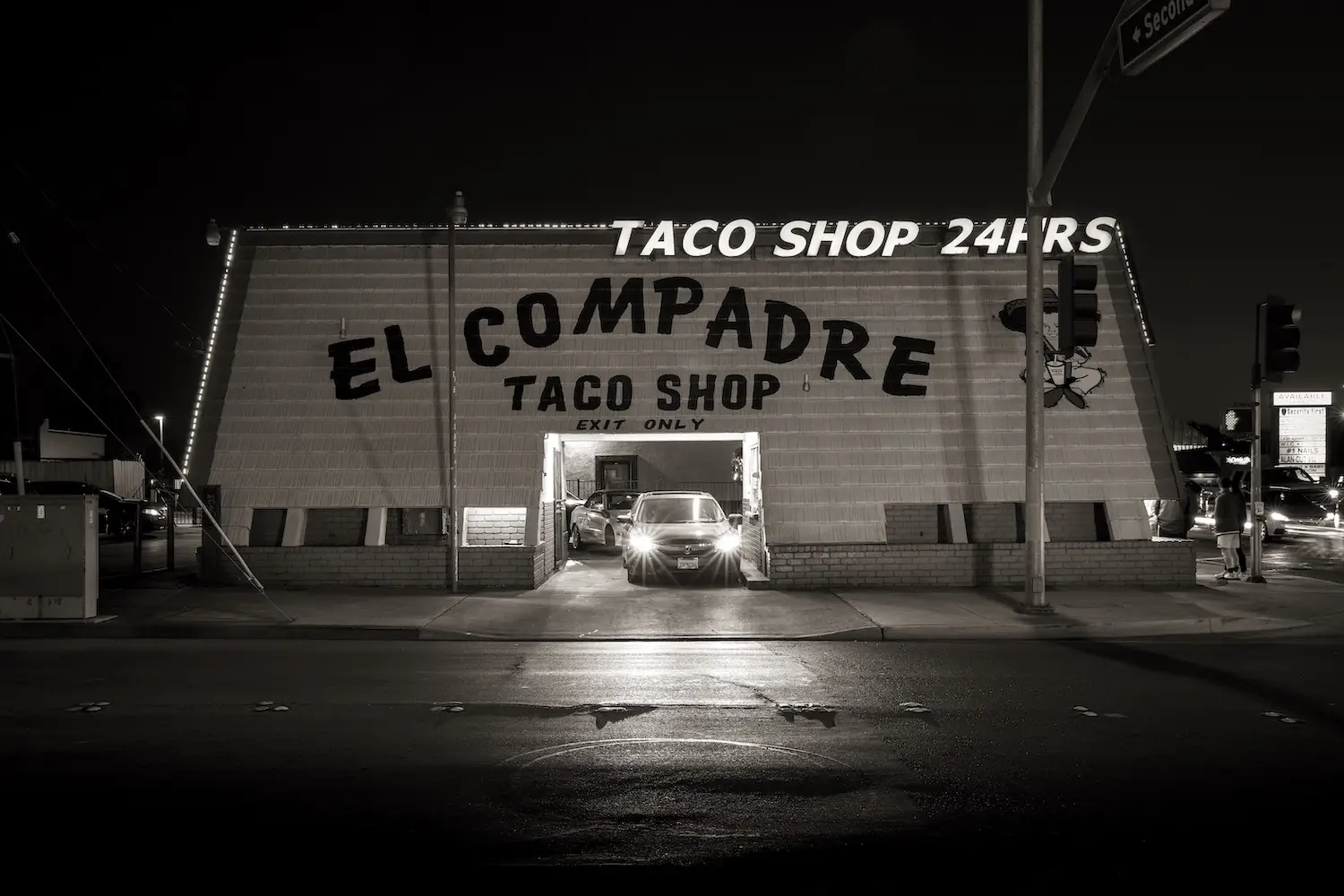
San Diego taco shop, El Compadre Taco Shop, as captured by photographer Michael Williams in his exhibit Taco Stand Vernacular
El Compadre Taco Shop (El Cajon)
“I visited this one numerous times. It was awkward figuring out how to tell the story of it, as it’s interesting-shaped all the way around. In this case, I’m standing in the gas station across the street. For a long time, the question for me was, ‘Do you include cars? Do you include people? Or is it more about the solitude of the structure?’ But I began to feel that, because of the drive-through nature of this one, the car was important.”
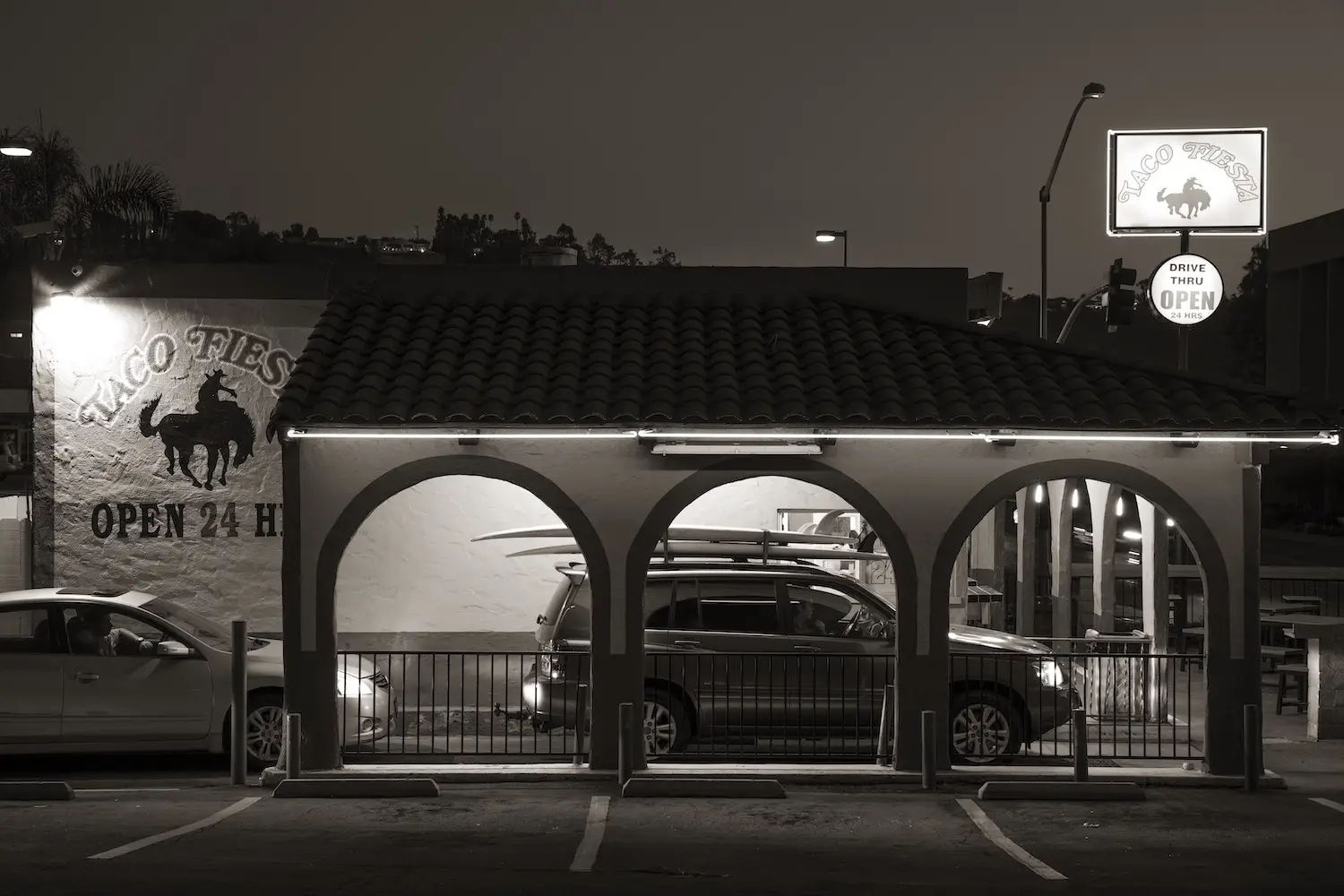
Taco Fiesta, as captured by photographer Michael Williams in his exhibit Taco Stand Vernacular
Taco Fiesta (Mission Gorge)
“I’m looking for these little indicators of location, these elements that create the sense of place. A guy driving through with surfboards on his roof, a palm tree in the background, and a taco stand—this has got to be San Diego.”
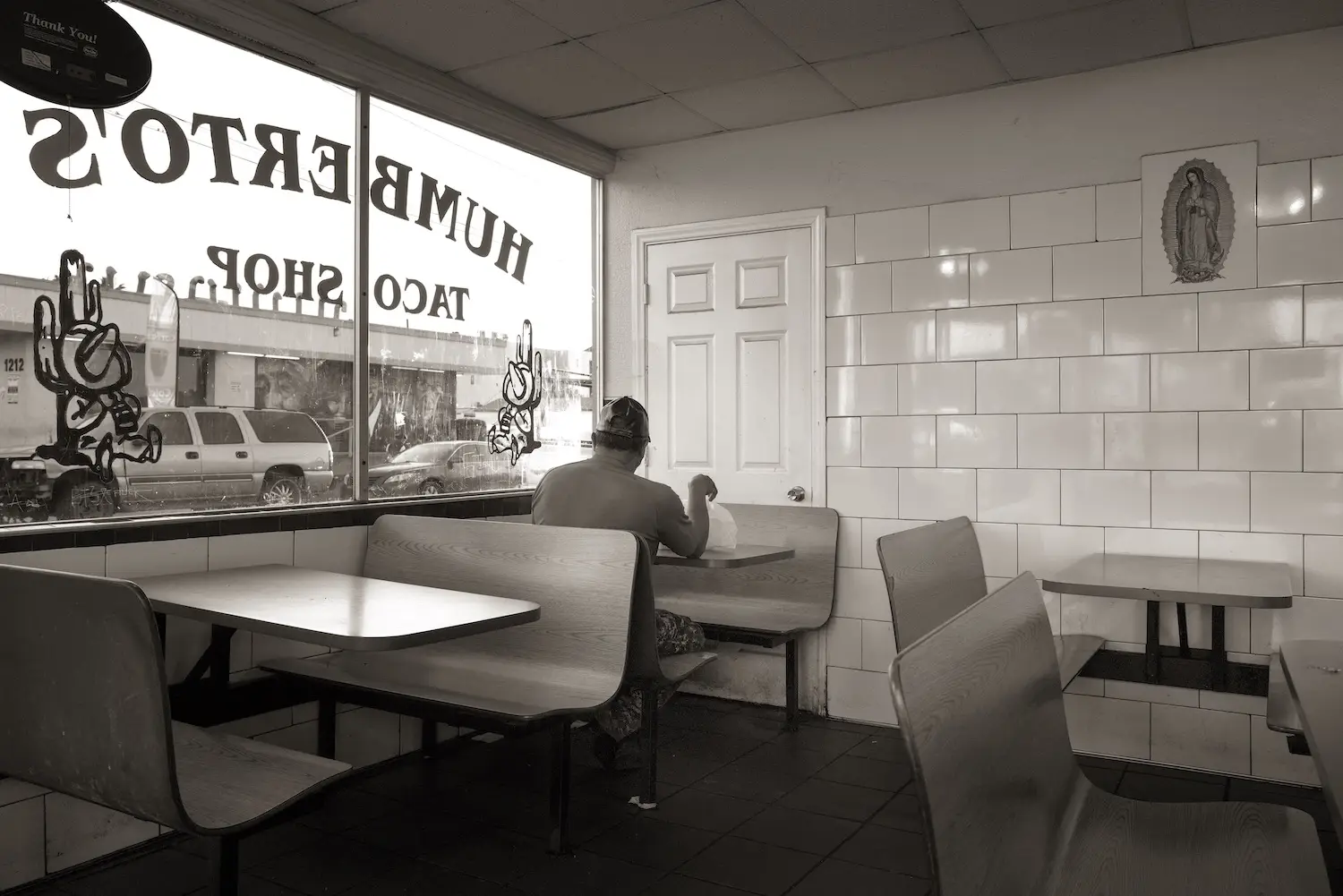
San Diego taco shop, Humberto’s Taco Shop, as captured by photographer Michael Williams in his exhibit Taco Stand Vernacular
Humberto’s Taco Shop (Logan Heights)
“I didn’t want to be locked into only photographing these places in one way, so I started to wander inside [sometimes] and explore a little bit. In this case, there’s the Madonna up there on the wall; she’s looking down over the patrons of the restaurant. The signage on the window, the cartoon. This says so much: Eating tacos is a blessed event.”
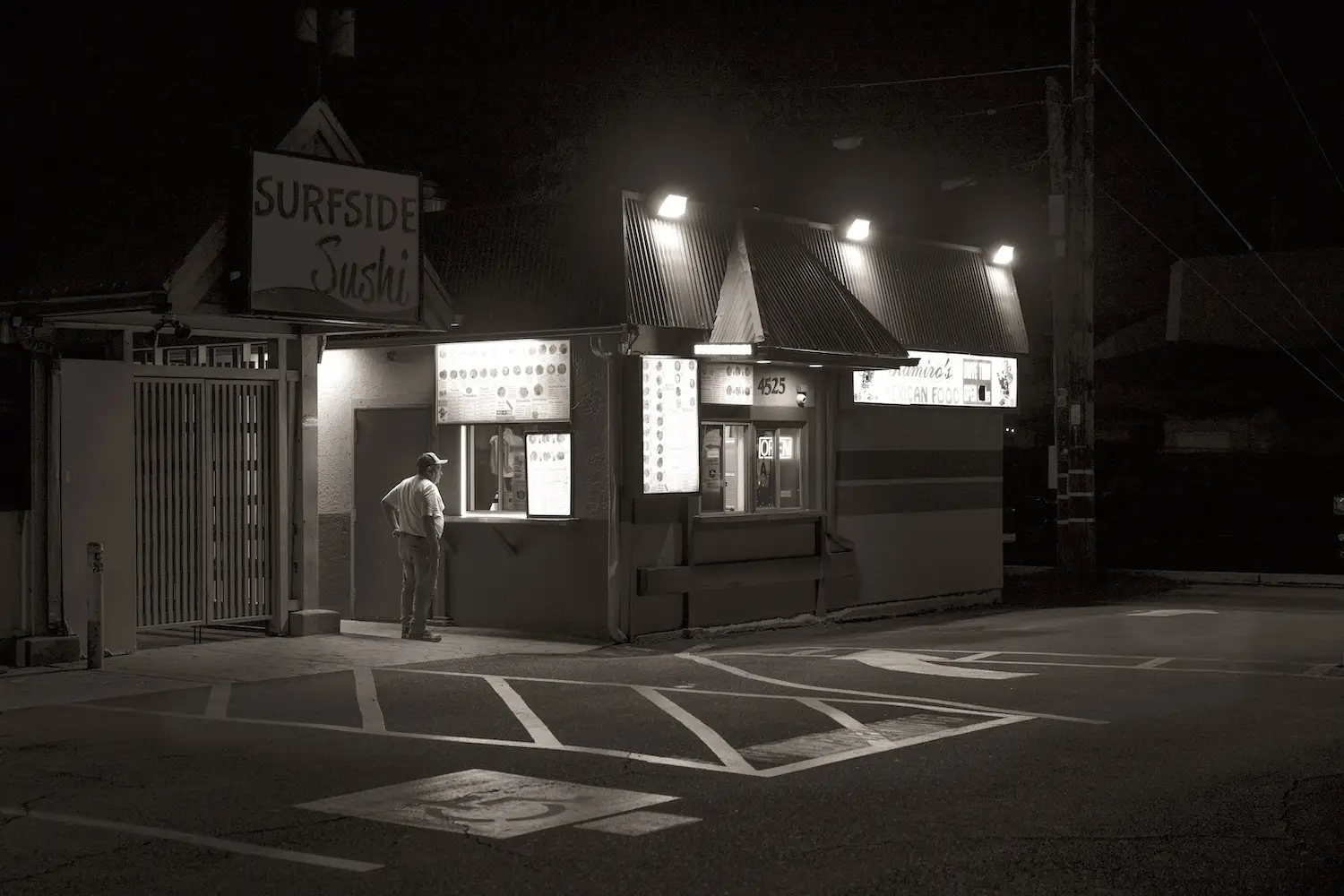
Ramiro’s Mexican Food, as captured by photographer Michael Williams
Ramiro’s Mexican Food (Now Closed)
“I call this one Ramiro’s Nighthawk as an ode to the Edward Hopper Nighthawks—the solitary man out at night at the taco stand. This no longer exists, actually. That whole lot [in Pacific Beach] has been redeveloped.”
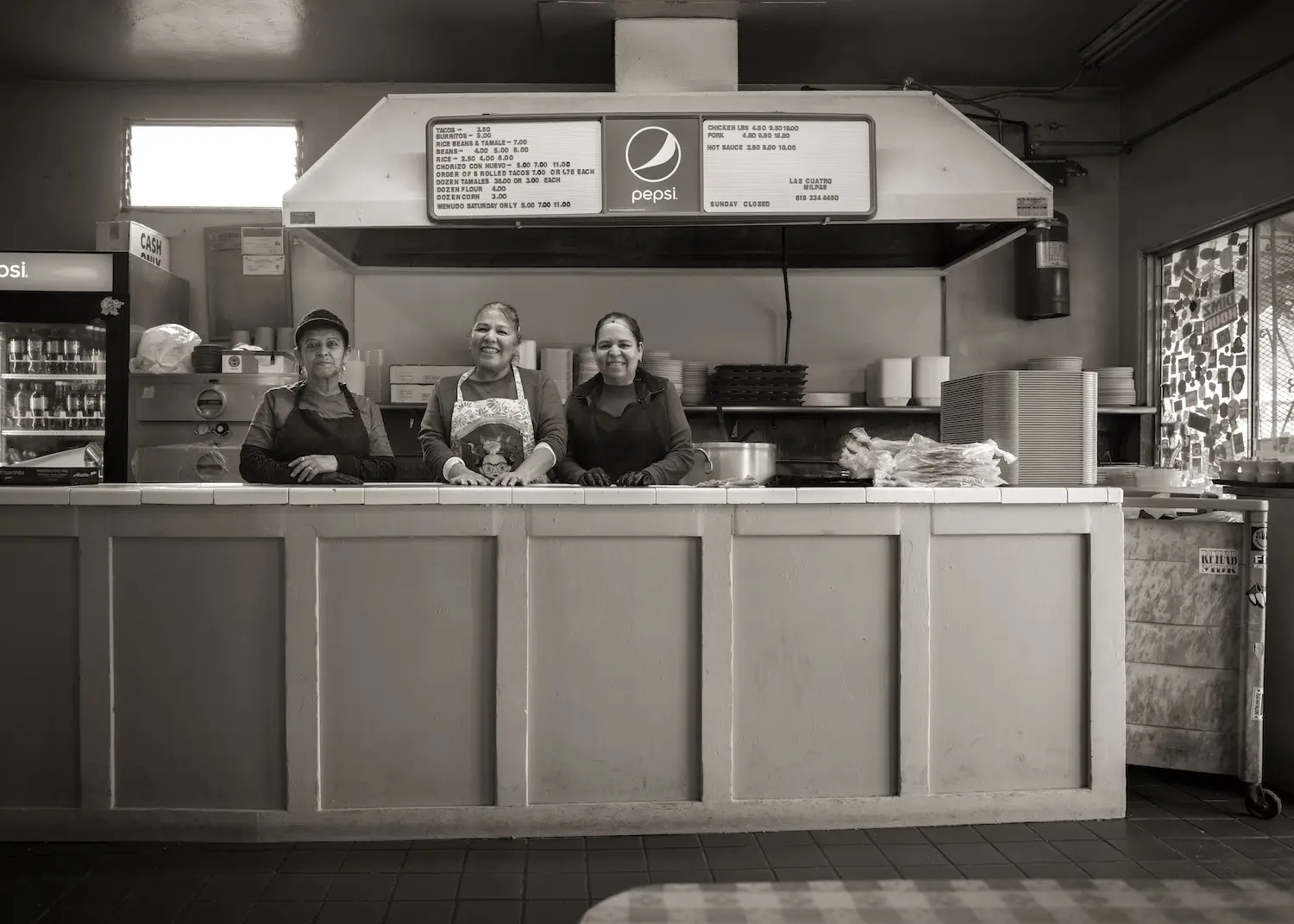
San Diego taco shop, Las Cuatro Milpas, as captured by photographer Michael Williams in his exhibit Taco Stand Vernacular
Las Cuatro Milpas (Barrio Logan)
“When we got there, it was morning time, so it wasn’t so crowded. Everybody was super gracious. I think in this case, I nudged the ladies together a little bit, you know, so I could get this portrait of them, and then it’s just a matter of being patient. Sometimes I’m kind of saturating for a little while in a place and just observing what’s going on.”
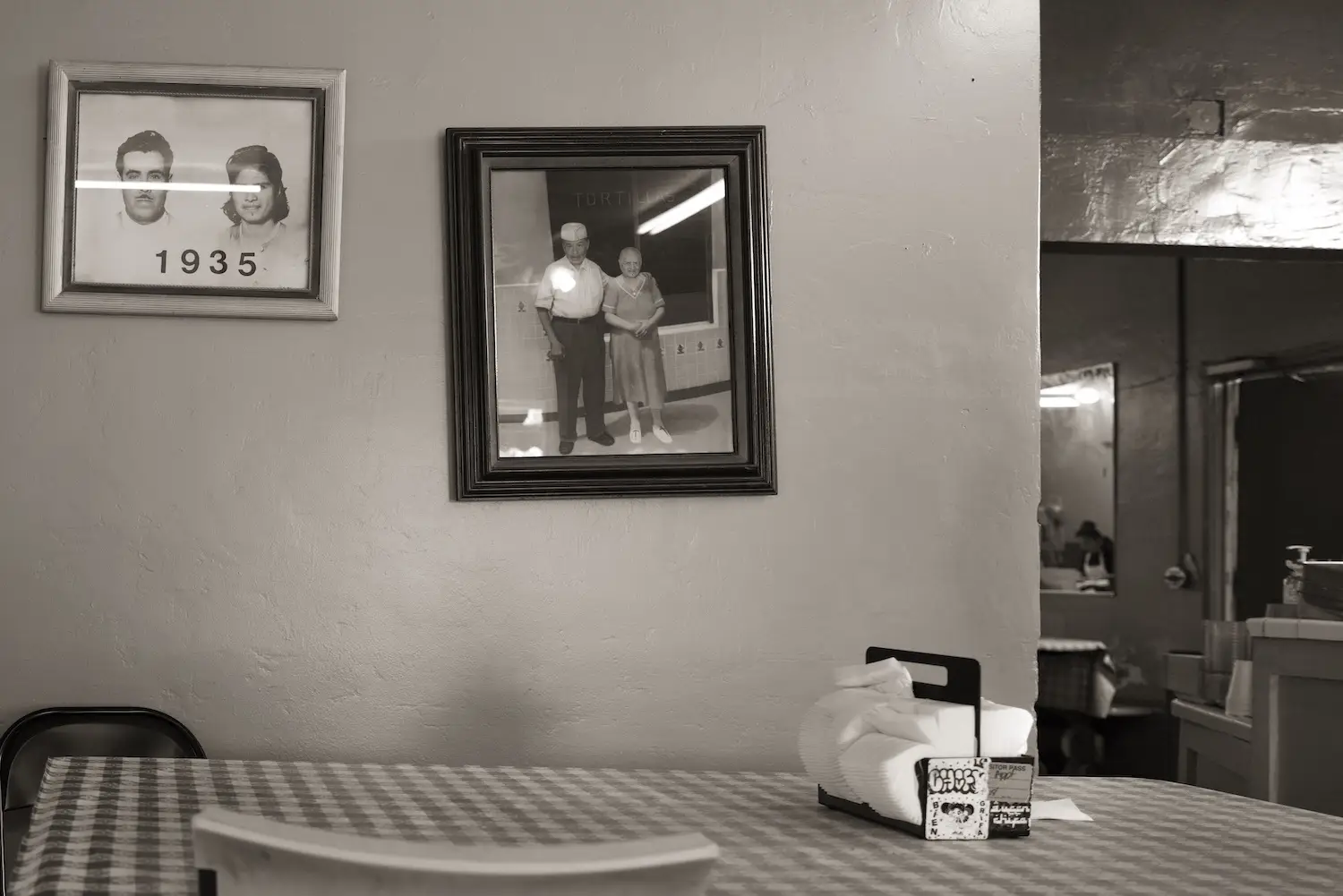
Las Cuatro Milpas, as captured by photographer Michael Williams in his exhibit Taco Stand Vernacular
Las Cuatro Milpas (Barrio Logan)
Mateo Hoke

About Mateo Hoke

Mateo Hoke is a journalist and author. His books include Six by Ten: Stories from Solitary, and Palestine Speaks: Narratives of Life Under Occupation.

Subscribe to our newsletters

Select Options

By subscribing you confirm that you agree with our Terms and Conditions and Privacy Policy.

Food & Drink AUGUST 13, 2026

Love Pupusas Brings Salvadoran Home Cooking to San Diego

From her Rancho Peñasquitos kitchen, Yanira Majano is sharing family recipes through San Diego’s growing home-restaurant movement

Love Pupusas Brings Salvadoran Home Cooking to San Diego
Courtesy of Catalina Offshore Products

When San Diego launched Micro Enterprise Home Kitchen Operations (MEHKO), it changed everything. Riverside County first established the experimental program in 2019, with San Diego introducing its own countywide pilot program in 2022 and granting it permanent status in 2024. The new category allowed people to launch at-home retail food operations—basically, home restaurants—with special requirements and restrictions to ensure food safety and smooth operations. Over two dozen counties across California have since adopted their own versions with over 1,200 permits issued, around 100 of them in San Diego alone.

Some have a dizzyingly long waitlist (Warung RieRie), others are still getting their name out there (The Hidden Gazebo Eatery), and still others use MEHKO for pickups rather than fully opening their home as an onsite dining facility. Love Pupusas falls into that category.

Yanira Majano came with her family from El Salvador to the United States when she was 11 years old, bringing a love of cooking and desire to share the country’s cuisine along with her. “There’s a lot of similarity [between Salvadoran food and] Central, South America, even Baja Mexico,” she says. Salvadoran cooking tends to be less spicy than some Mexican cuisines, with an emphasis on ingredients like corn, staples like yucca root (cassava), meats like crispy pork (chicharrón), and sides like curtido, a tangy cabbage slaw that’s typically either naturally fermented or vinegar-based. 

And of course, the signature dish of El Salvador—pupusas. 

In San Diego, Salvadoran food lacks the widespread availability of other Latin American cuisines like Mexican or Peruvian food, but Majano says she’s seen pupusas gain popularity over the past few years. But she likes to think her recipes, which have been passed down by her mother and kitchen partner Martha, contain a certain special something.

Some pupuserías use rice flour to create the handheld stuffed tortillas, but she prefers the more traditional gluten-free corn flour. Still, it’s what’s inside that really counts. “That’s where we put our own touch,” she explains. Most of Majano’s pupusas come with cheese and different fillings like carnitas, black beans, mushrooms, or zucchini, but she also offers vegan options. Every one comes with a side of curtido and salsa, each made fresh daily.

Showing people the magic of home-cooked food might not have been possible without the MEHKO program or The Cook Alliance, a MEHKO support and advocacy coalition. Opening a brick-and-mortar restaurant requires a huge amount of start-up capital—at least six figures, generally. Not exactly pocket change. “But when the MEHKO program started in 2022, I said, ‘Oh my God, this is for me,’” says Majano. 

Now with four years under her belt, she says she’d love to bring Love Pupusas to more food festivals, host more pop-ups, and eventually open a food truck to keep serving the humble dish of her homeland, taking pride in every bite. “[I put] a lot of love in everything I do. You see it when you taste the food,” she promises. 

Pre-order Love Pupusas for next day pickup in Rancho Peñasquitos between noon and 5 p.m.

San Diego Restaurant News & Food Events

Beth’s Bites

  • It’s not the end of the road for Catalina Offshore Products—just the end of an address. The local family-owned fish market announced that come September, they are moving from their longtime location in the Morena District to The Old San Diego Seafood Building at 1842 McKinley Avenue in National City. Normal business operations will resume in October with the same retail market fully stocked with premium seafood and local catches, so it’s not goodbye, it’s just “see you later.” (And yes, 5202 Lovelock Street is still open until moving day.)
  • Don’t come at me with complaints about autumnal seasonal creep—I got an email this week about holiday shopping. In August. In comparison, the 2026 release of Karl Strauss Oktoberfest seems right on time. For the 38th year in a row, ahead of the Munich-inspired festivities, the 5 percent ABV malty amber lager is now available in bottles, with draft coming to the brewpubs in September. Despite the lack of chill in the air, there’s no reason why your fridge can’t be stocked with this frosty German delight.

Listen Now: The Latest in San Diego’s Food and Drink Scene

Have breaking news, exciting scoops, or great stories about new San Diego restaurants or the city’s food scene? Send your pitches to [email protected].

Beth Demmon

About Beth Demmon

Beth Demmon is an award-winning writer and podcaster whose work regularly appears in national outlets and San Diego Magazine. Her first book, The Beer Lover's Guide to Cider, is now available. Find out more on bethdemmon.com.

Everything SD AUGUST 13, 2026

A Golfer’s Dream: Ely Callaway Performance Center

Golf Pro Tina Mickelson gives us an insider's look at Ely Callaway's restricted golf dreamland in Carlsbad

A Golfer’s Dream: Ely Callaway Performance Center
Courtesy of Ely Callaway Performance Center

“Come test something.”

Those are quite possibly my three favorite words in the English language—all due respect to “I love you” or the highly underrated “you were right.”

I’ve been a PGA Golf Professional since 1994, and yes, full bias disclosure, a Callaway Golf Ambassador for 18 years. One of the bonuses that comes with that combo is access to the Ely Callaway Performance Center—a place so exclusive it gives “velvet rope” vibes.

Originally opened in 2006 as a highly functional (yet not exactly breathtaking) test facility, the ECPC got a serious glow-up in 2018 when Gil Hanse (along with partner Geoff Shackelford) turned it into what can only be described as a fully engineered golf playground. Hanse is no stranger to golf course renovations. In 2024, he completed an extensive redesign of the Omni La Costa North Course in Carlsbad, so it could host the NCAA Division 1 Golf Championships. He also worked on acclaimed courses like Winged Foot, Merion Golf Club, and Oakmont Country Club.

In just two months, it went from a standard test center and R&D lab to a fully dialed-in golf playground.

Courtesy of Ely Callaway Performance Center

What was once purely practical is now intentionally designed to be both precise and inspiring. The targets are staggered with purpose—forcing creative shot-making while also calling you out on your actual distances (no more “that’s my 150-yard club … ish”).

Add a massive hitting area, bunkers and greens that mimic real on-course conditions, a “Himalayas” putting green (named for its roller-coaster undulations), an upgraded indoor putting lab, and a 120-decibel sound system blasting a very golf-appropriate playlist, and suddenly it’s a rare blend of high-performance testing facility and “don’t mind if I stay here all day” energy. Since this isn’t exactly open to the public, SDM asked me to take you behind the curtain.

As the iron gates part, it feels less like arriving at a practice facility and more like being granted backstage access at a rock concert—if the bandmembers were made entirely of launch monitors and perfectly manicured turf.

There are no mats. No guessing. No “I think that one felt good?” Just conditions that mirror exactly what tour players see in competition. Because when you’re testing equipment at this level, accuracy isn’t a bonus—it’s the whole point.

Even the sand matters. Different textures. Different densities. Because bunkers have personalities, too, and they are often unfriendly. And the golf balls? Brand. New. Not the usual “these have seen some things” range balls. New balls mean consistent spin, truer trajectory, and no surprises. The older a golf ball gets—and the more it’s been baked in the sun, scuffed, or generally lived a full and complicated life—the less reliable it becomes. Think of it like this: fresh ball, predictable performance; old range ball, slight chaos with a side of mystery.

I’m escorted to my personal hitting bay—basically a pop-up shaded oasis stocked with enough equipment to make a gear junkie weak in the knees. Shafts in every weight and profile imaginable. Heads lined up like they’re waiting to be drafted by their favorite team.

Courtesy of Ely Callaway Performance Center

Toptracer technology was patiently waiting to track every one of my swings, each shot instantly delivering ball speed, launch, spin, carry distance, and dispersion (a polite way of saying consistency, or lack thereof), so there’s no guessing—just data telling the truth, whether I like it or not.

We start with irons. Different heads, different feels, different results. When I miss a shot, the ball tends to leak right, so we check lie angle. A quick adjustment—2 degrees upright—and suddenly the clubface is consistently square at impact like it remembered its job. Effort level: down. Ball flight: improved. Confidence: creeping back.

Next we look at the different shaft options—because nothing says “fun afternoon” like realizing a higher kick point can change your entire golf identity. Shaft flex (how much the shaft bends during your swing) helps determine whether you get more height and distance or more control, while kick point (where the shaft bends the most) influences your ball flight—lower kick point for higher launch, higher kick point for a flatter, more penetrating shot. In other words, one small tweak and suddenly you’re hitting shots you’d normally only describe later, slightly exaggerated, over a glass of wine.

Then we move through the bag: hybrids, fairway woods, drivers, wedges. It’s a full rotation of “try this,” “now try this,” and “okay wait … THAT one.”

And yes—the new Quantum driver and fairway woods made an appearance. Without getting too deep in the weeds, they’re faster, more forgiving, and smarter (thanks to AI face mapping) than previous models. Translation: Even your mishits are now slightly less embarrassing. And they were not the only things getting tested. My patience was under attack because the driver and woods would not be available to the public for a good three months.

Courtesy of Ely Callaway Performance Center

Watching the fitting team work is like watching a Formula 1 pit crew. Clubs are swapped in seconds. Shafts tightened, adjusted, replaced. One minute you’re swinging something that seems “fine,” and the next, you’re holding a club that feels like it is a part of your DNA.

Then there’s the putter fitting. Drivers are physics. Putters are therapy. Inside the putting lab, sensors track everything—tempo, face angle, path—things you didn’t even know could be measured. Within minutes, my data politely informs me that my putter face is slightly closed at impact. Not shocking, but also not ideal.

A few quick adjustments—different head (with a bit more weight at the toe to discourage the face swinging closed at impact), shorter shaft (so I feel more over the ball, which helps my eyeline)—and suddenly the ball starts rolling exactly where I’m aimed.

Same stroke. Same golfer. Completely different outcome. If only the rest of life worked like that.

And then there’s the part that feels slightly classified. The ECPC isn’t “just” a performance center—it’s also where future equipment lives before the public even knows it exists. I’ve been there when certain clubs were basically under surveillance. Not “don’t touch,” but more “please keep phones in your pocket.”

It’s golf’s version of Area 51. Except instead of aliens, it’s drivers that won’t hit shelves for another year—and like I mentioned, waiting is not my strong suit.

Getting to test the newest equipment isn’t just a perk—it’s part of the job. It’s what allows me to stand in front of students and say, “I’ve tried it. I know what works and what doesn’t. And more importantly, I know why.” And if I happen to sprint to my car every time the phone rings and someone says, “Come test something” … well, that’s just professional courtesy.

Other Fitting Spots in SD

Callaway isn’t the only place to get your swing analyzed and clubs fitted. You can stroll into big retail spots like The Golf Mart or Golf Galaxy, book a next-level session at a dedicated studio like Club Champion or True Spec Golf, test brand-specific gear at various manufacturing companies (many located in Carlsbad), or even combine a lesson and a fitting at GOLFTEC. And let’s not forget your local golf course, where fittings happen on actual turf, on a driving range you have some history with—many times with the golf professional who is familiar with your swing so they can give you valuable input. With this many options, there’s really no excuse, other than pride, to keep blaming your clubs.

Food & Drink AUGUST 11, 2026

Mon Chourie Is Opening Its First Permanent Bakery

After two years of farmers markets and pop-ups, the San Diego baker is bringing its Korean-inspired pastries to University Heights

Mon Chourie Is Opening Its First Permanent Bakery
Courtesy of Kelly Kim

The folks at Kairoa Brewing Company must never be lonely. It seems like there’s always a local pop-up or event at the University Heights space, from Bincho Taco slinging Japanese coal-fired tacos on the rooftop patio every Tuesday to Yipao Coffee serving coffee from a window on the ground floor. Later this year, the New Zealand-inspired brewery will bring yet another resident into the fold—Mon Chourie is launching its first bakery counter service window along Park Blvd.

Mon Chourie owner and baker Kelly Kim first started selling her Korean-style cream puffs at farmers markets and places like Pizza Kaiju, Pho Ga Go, and Mixed Grounds, collaborating with a myriad of other makers (like Amor ice cream and Ming Oun’s) before nabbing a regular spot at Michi Michi Bakery every Wednesday. San Diego Magazine readers even voted Mon Chourie the Best Pop-Up for 2026.

In French, the word for an airy puff pastry is “choux,” which is pronounced generally the same way as “syu,” the Korean word for the same item. (Both sound like “shoe.”) Mon Chourie plays with both iterations with a dash of whimsy by referencing the song My Cherie Amour by Stevie Wonder, which translates to “my darling love.”

As long as all the permits and inspections move forward without issue, Mon Chourie should open in Kairoa before the busy holiday season. She’ll continue appearing every Wednesday at Michi Michi and other pop-ups in the meantime. Once open, expect best-selling flavors like the savory potato croquette (a collaboration with Karanchi chili crisp) and a sweet Dubai chocolate choux au craquelin, a version of puff pastry with a delicate cookie crust. 

Classic cream puffs are fluffy, softs and often filled with custard cream in the United States. “What makes a difference for us is we use a very light version of diplomat cream, which is my mom’s recipe,” she explains. Diplomat cream is a lighter French pastry cream that uses whipped cream for a lighter, airier end result. 

Choux au craquelin’s signature crunchy top comes from adding a thin disc of cookie-like dough on top of the pastry, which crackles as it bakes, leaving a thin layer of crispiness atop the final product. “It contrasts with the creamy, fluffy cream inside, so it gets that better, deeper texture experience,” she says.

Courtesy of Kelly Kim

Along with her popular cream puffs and her bite-sized “mini-choux” options, Kim is also planning on offering more of a newer-to-her item: salt bread, a rich butter pastry topped with sea salt that originated in Japan, but went completely viral in South Korea. There are a few places to get it in Los Angeles and New York, “but I know that a lot of people here are interested in trying out new stuff, or maybe they had it in Korea or Japan, and they came back, but they couldn’t find it anymore,” says Kim. At first, she didn’t really get why it was so popular. Then she tried it in South Korea earlier this year. 

“I was in love,” she laughs. “This is what the hype is about.”

Ideally, Mon Chourie will eventually open its own storefront and introduce more events in North County to satisfy demand. “I would also love to have our own drink program that reflects what’s popular in Korea,” she says. And to mark two years of puffy pastry prosperity, Mon Chourie is throwing a two-year anniversary party at Easy Does It (5375 Kearny Villa Rd., Suite 112) on Wednesday, August 25 from 4 p.m. to 7 p.m. with drink specials like a misugaru latte (a Korean roasted multi-grain powder with espresso), a DJ, photo booths, special ceramic merch created by local ceramicist Whale Tran, and a few other vendors. Get there early.

Mon Chourie will open inside Kairoa Brewing Company by the end of 2026 and posts the next week’s schedule of upcoming events and pop-ups on Instagram every Monday.

San Diego Restaurant News & Food Events

Beth’s Bites

  • Mabel’s Gone Fishing has always supported the arts—see their Fishbowl Artist Series—and they’re keeping things going this month with The Studio Table, an immersive dining event on Saturday, August 29 from 6 p.m. to 9 p.m. at Barrio Logan-based ceramic studio Tao of Clay. For $160, guests can slurp down oysters and other Spanish-inspired pintxos, Basque ciders, cocktails, and take home a handmade oyster bowl made with reclaimed oyster shells. Gratuity is included for this 21+ event, so be prepared to slow down and enjoy the tangible fruits of nature.
  • City Tacos keeps moving and shaking, and the restaurant group’s next landing place is Liberty Station. El Punto by City Tacos is slated to open in October in the former El Jardin space (2885 Perry Road, Suite 102). Once destined to become another Lola55 outpost, the space will now become a full-service, family-friendly, and dog-friendly restaurant with seafood, tacos, cocktails, and more.
  • For as many closings as we’ve seen over the past year, restaurant openings seem to be back on track. The long-awaited Honor Bar finally opened its doors in Del Mar this summer, and Soul Sip in North Park is soft open from 4 p.m. to midnight daily. Still on the way are The Shackhouse by Julian Beer Company (slated to open by Labor Day) and Sprouts Farmers Market plans to open in the former Pancho Villa’s building in North Park this October. (La Mesa is still waiting patiently for Stella Jean’s and Pop Pie to make their debuts.)

Listen Now: The Latest in San Diego’s Food and Drink Scene

Have breaking news, exciting scoops, or great stories about new San Diego restaurants or the city’s food scene? Send your pitches to [email protected].

Beth Demmon

About Beth Demmon

Beth Demmon is an award-winning writer and podcaster whose work regularly appears in national outlets and San Diego Magazine. Her first book, The Beer Lover's Guide to Cider, is now available. Find out more on bethdemmon.com.

Studio S MAY 5, 2026

Artistry, Aesthetics, and Inclusive Luxury

KQ Aesthetic Society goes beyond cosmetic to provide comprehensive care and transformative results

Artistry, Aesthetics, and Inclusive Luxury

Kelly H. Harfouche, founder of KQ Aesthetic Society, knows firsthand that cosmetic treatments like fillers, neurotoxins, and microneedling, can not only enhance a person’s appearance and restore confidence, they have the power to truly change a person’s life. An expert injector has the ability to tailor treatments to each individual patient’s anatomy and goals for personalized results. Harfouche, a board-certified nurse practitioner, has spent nearly a decade perfecting her craft as an aesthetic injector and integrating her multifaceted artistic skills with precision patient care. Her commitment to continual education and training, plus a passion for helping people look—and feel—their best, set KQ Aesthetic Society apart in a sea of local medspas. 

For many people considering nonsurgical treatments, the intent is to look refreshed and refined. KQ Aesthetic Society’s philosophy eschews a cookie cutter approach that bases treatments around units, instead working to understand each person’s unique goals, then curating a treatment plan to fit that vision. Harfouche focuses on “inclusive luxury,” the belief that everyone deserves access to aesthetic treatments, respective of budget restrictions. She develops long-standing trusted relationships with her patients, and works with each one to achieve their aesthetic objectives and address the underlying causes of their concerns. 

“For me, forming an honest and open relationship with every patient who walks through the door is essential. This means understanding them on a deeper level and meeting them where they are to define and achieve their individual goals,” she says. 

Drawing on her artistic background, which inspired her transition into medical aesthetics, Harfouche sees each client as a “unique canvas.” Rather than relying on standardized procedures, the practitioner’s distinctive approach combines her profound understanding of the physiological and anatomical changes associated with aging with an unwavering commitment to ongoing education about the newest products and their mechanisms of action. Her goal is to make each patient feel beautiful in their own skin and to embrace their individuality. 

She has also pioneered a way to combine her talent for aesthetic artistry with her philanthropic nature. Harfouche is one of only a handful of providers using dermal fillers to treat patients with lip asymmetry and scarring resulting from cleft lip surgery. Patients travel from around the country for this transformative treatment, noting increased confidence and a restored identity. She hopes to eventually launch a training program to help fill the void in this space.  

“My passion has always been connecting with people and giving back in any capacity that I can,” she says. In the rapidly advancing landscape of aesthetic medicine, you can place your confidence in Harfouche and KQ Aesthetic Society to deliver exceptional care. To learn more or book a consultation, please visit kqaestheticsociety.com.

Food & Drink AUGUST 11, 2026

8 San Diego Food Gifts Your Friends Actually Want

Bring home a taste of the city with local coffee, conchas, chili crisp, hot sauce, and other suitcase-worthy finds

8 San Diego Food Gifts Your Friends Actually Want
Courtesy of Provecho! Coffee Co.

Snacks are the best vacation souvenirs. You get all the novelty of having something to unwrap without any of the burden of keeping random crap around. I’m always game to try some chips from a place I can’t find on a map with ingredients I can’t identify by taste. Gimme that spice mix from that Southern barbecue pit whose wine list consists of light beers from lesser-known appellations. Don’t think I won’t lick the inside wrapper of some chocolate bar homemade by a grandma at a farmers market you stumbled upon in a small Midwestern town best known for giant yarn balls.

Even though San Diego is best known for our thigh-sized burritos, fish tacos, and craft beers, those travel about as well as room-temp mayo. So we gathered some of the city’s best food souvenirs: snacks, spices, and sauces worth sliding into your carry-on or gifting to a lucky out-of-towner.

Courtesy of Provecho! Coffee Co.

Bulk Coffee

Provecho! Coffee Co.

Inside Bread & Salt—Barrio Logan’s old Weber Bread Factory turned into one of the city’s most vibrant art, culture, and community spaces—there’s a cafe in front of a giant, now-defunct bread mixer. Mexican-owned specialty brew shop and roastery Provecho! Coffee started as a pop-up in 2020, but its success quickly bricked-and-mortared. Although Provecho! specializes in sourcing and roasting Mexican coffees, its consistency is variety: The lineup changes regularly as Provecho! finds new sources around the world. Get a to-go taste via the coffee bags that range between 250 g and 2 kg.

Courtesy of Superlova!

Sesame Sauce

Superlova!

Superlova!’s Chinese-inspired, seed oil–free sauces are grocery list mainstays for San Diegans. The sesame sauces (Dan Dan is spicy, May May is tame) pair with noodles, dumplings, or any meal that could use a little more oomph. They don’t have tahini, which is de-hulled; they have Chinese sesame paste, which is dark-roasted for a nuttier flavor and packed with fiber and calcium.

Courtesy of JuneShine

Hard Kombucha

JuneShine

San Diego is known for beer, sure. But real locals pour from a different tap. JuneShine’s low-sugar, yet still refreshingly sweet, hard kombucha is an SD favorite. The brand has joined the canned cocktail tidal wave and now sells vodka mules, tequila palomas, and vodka sodas—all with about two shots per can, real juice, and sparkling water. But for a classic food gift, get a variety pack of the booch. Fit it into your checked bag. It’s worth it.

Courtesy of Down to Ferment

Hot Sauce

Down To Ferment

Double entendre is key to hot sauce brand Down To Ferment, aka DTF. (Popular sauces have flavor names like CornHub, Smokin’ Hot Date, and Ghosted.) But it’s no gimmick. The homemade, kombucha-based sauce is seriously good: DTF’s That’s What Shishito Said made it onto Season 30’s lineup on Internet-famous interview show Hot Ones.

Courtesy of Tortilleria Los Reyes

Fresh Tortillas

As discussed, carne asada burritos travel about as well as a toddler with emotional-regulation issues. But the soul of a truly great, San Diego burrito? It’s not the fillings. It’s the tortilla. You can’t go wrong from any locally owned spots, but our favorites are Tortilleria Los Reyes in Vista, Windmill Farms Market in Del Cerro (which uses Pancho Villa’s old tortilla press), Esperanza’s Tortilleria in Escondido, and Tortilleria Lily in City Heights.

Courtesy of Karanchi

Chili Crisp

Karanchi

Handcrafted in small batches, Karanchi’s Sichuan peppercorn–packed chili oil comes in two varieties: original and spicy. The original warms your palate and adds depth to your meal, and the spicy is a form of mealtime masochism. Founder Nguyen Le’s favorite way to eat his garlic-studded chili crisp is on avocado toast—which makes an already San Diego meal even more San Diegan—but it’d make old shoes taste pretty good.

Canned Local Tuna

Tuna Harbor Dockside Market

Fresh fish ranks low on society’s acceptable realms of carry-on items. But canned fresh fish straight from local fishermen? You’re the best part of a bruschetta. Every Saturday at the docks behind Seaport Village, fishermen step off their boats and sell what they caught as recently as that morning. While getting yourself some fresh sea urchin and squid, grab a couple cans of locally caught albacore tuna for the tinned-fish lover in your life.

Photo Credit: Salsa Digital Agency

Conchas

Tus Chefs Favoritas

Started as a pandemic baking hobby for BFFs Natalie Rodriguez and Lesly Mendoza, Tus Chefs is now a South County favorite spot for conchas with a twist. The menu is expansive enough to get over a baker’s dozen without any repeats—why not get one of each, anyway?—but if you only have enough space in your carry-on for a few, start with popular “chocolate abuelita,” churro, mazapan, horchata, and brownie conchas.

Emma Veidt

About Emma Veidt

Emma Veidt is an editor at San Diego Magazine. She earned her bachelor's and master's degrees from the Missouri School of Journalism. She loves running, hiking, and rock climbing, but really, she mostly loves encounters with the street cats around North Park.

Food & Drink AUGUST 10, 2026

9 Must-Try Meals in San Diego Right Now

SDM's staff shouts out our favorite food finds this month including bites from Glass Box, Pete's Seafood, Kimochi, and Immersion Coffee

9 Must-Try Meals in San Diego Right Now
Courtesy of Pete’s Seafood and Sandwich

It’s August. Corn season—that hallowed dental flossian time—is upon us. Peak summer means the fruits from local farms are downright NC-17. It’s also hot-adjacent, so we search out top-notch sashimi and interesting fruit punches. And because we’re contrarians, we also find ourselves tucking into a warm lobster roll in North Park, vying for a father’s love. Anyway, these are the stories behind the best things we found this month—things we’d recommend to friends who didn’t owe us money. Salamat.

Glass Box

Sesame-Torched Albacore

Chef Ethan Yang grew up folding dumplings in his dad’s San Diego restaurants—such as the former Fortune Cookie in Rancho Bernardo, which drew on the family’s Taiwanese and Chinese roots. So the Taiwanese beef noodle soup on the menu at Glass Box (a lovely glass-enclosed sushi and pan-Asian spot at Sky Deck in Del Mar) is a family pride—the result of Ethan, dad, and his brother tinkering endlessly with various bones (they finally found the perfect bone, only sold by one butcher in LA).

But the dish that shows off his raw fish skills is the albacore—lightly cured in soy, mirin, and toasted sesame oil, flame-torched to caramelize, and finished with smoked shoyu, chive oil, shiso oil, house-pickled sweet peppers, and crispy rice pearls. —Troy Johnson

Luce Bar & Kitchen

Double-Cut Duroc Pork Chop

“Wait, where is it?” I hear this a lot when suggesting Luce for drinks or a bite. The Bay Park restaurant is smack dab in a part of the city that isn’t conventionally attractive: on the side of the 5 freeway, next to a bevy of service-looking storefronts. To be in this area, you either live here (homes here are fairly excellent with that bay view) or are getting a muffler fixed. A better reason to be in Bay Park: An evening at Luce, a locals’ haunt. Get the Duroc pork chop (the chefs’ chop, with darker meat, higher fat content, better marbling) with collard greens, toasted grits (toasting anything results in a better version of that anything), and a mustard glaze that makes you feel like you’re in the South enjoying sweet tea with friends. —Nicolle Monico

Courtesy of Sipwell Wine Co.

Sipwell Wine Co.

Tiny Victories

Ever walk into your kitchen during the afternoon feeling recklessly free and decide the time is exactly right for a glass of Champagne? Maybe you crushed a work project or navigated a 4-year-old’s meltdown with the elegance of a global diplomat. You ever then pour that glass and are immediately pulled away by other demanding life errata—and by the time you eventually return to celebrating being alive, you find the remaining victory-juice sits in the popped bottle, losing its steam, and serving you a metaphor for your day?

Hilary Cocalis solved this for me with Carlsbad-based Sipwell. Tiny Victories is a Champagne-style sparkling white in a 250ml can (a glass and a half—the correct amount), the first can-conditioned sparkling wine on the market, fermented with true Champagne yeast. Crisp apple, a little citrus, that biscuity thing good bubbles do, zero sugar. It’s also the first canned wine to crack Wine Enthusiast’s Top 100, so now there’s no excuse not to celebrate all of life’s tiny victories. —Claire Johnson

Courtesy of Pete’s Seafood and Sandwich

Pete’s Seafood and Sandwich

Warmed Lobster Roll

If my dad were to rank his favorite things, I think I’d make the podium, but there’s no way I’m outperforming this lobster roll. And why would I? We went to Pete’s on Father’s Day, and Peter DeCoste brought out 5 ounces of Maine lobster smothered in warm butter, tucked haphazardly into a grilled New England–style roll, served with a simple coleslaw and basic fries (no need to overshadow the star). Pete’s has a cold version with mayo, too, but there’s something about warm lobster that really wins over dads and their lobster-jealous daughters. –Lili Kim

Valerio’s 1979

Turon

Valerio’s 1979 is a quintessential San Diego family story. In the 1950s, the grandparents opened their first bakery in the historic Philippines city, Cavite. Their son, Jimmy, would bake and sell bread before school. After enlisting in the Navy and being stationed in San Diego, Jimmy and his wife, Gloria, opened his own version of the family bakery in National City in 1979—a huge hit and home-away-from-home spot for the city’s massive Filipino community.

Four-plus decades later, with four locations across SoCal, it’s on the third-gen of Valerios. The new blood is reviving the name and place with all kinds of Filipino comfort food, and the turon is a star. The classic Filipino treat is a ripe, sweet saba banana and jackfruit, rolled in lumpia wrapper, deep-fried, and covered in sticky, caramelized brown sugar. “Dessert lumpia” is a phrase to live a life by. —Troy Johnson

Courtesy of Kimochi

Kimochi

Cantaloupe Mochi

Partner Content MARCH 26, 2026

Design Leaders & Innovative Interiors: AVRP Studios

A look at San Diego's top designers creating unique environments that combine creativity and function

Design Leaders & Innovative Interiors: AVRP Studios


AVRP Studios’ tradition for Design Excellence and Innovation began in 1976 with Doug Austin, FAIA, in Solana Beach, California. The firm has since grown to complete major projects throughout the United States and Canada. We think of ourselves as a family and we care deeply about people. We want to inspire, help make their lives richer and more complete through our efforts. We believe that architecture is one of the most important art forms because of the impact it can have on the lives of those it touches. We’re delighted to have been recognized with over 150 awards for design excellence.

703 16th Street, Suite 200, San Diego, California 92101  |  619-704-2700  |  avrpstudios.com

Eat Like a Local (Who Knows a Guy).

Restaurant news, culinary storytelling, and Troy Johnson’s sharp takes delivered straight to your inbox twice a month.

Close the CTA

Contact Us

1230 Columbia Street, Suite 800,

San Diego, CA