Featured articles
Food & Drink
Food & Drink
Food & Drink
Featured articles
Everything SD
Everything SD
Features
Featured articles
Things to Do
Everything SD
Everything SD
Featured articles
podcast-ep
podcast-ep
podcast-ep
Featured articles
Features
Features
Features
Featured articles
Partner content
Food & Drink
Charitable SD
Ready to know more about San Diego?
SubscribeReady to know more about San Diego?
The award-winning producer and creator of the annual Solento Film Festival on his love of La Paloma Theater
Taylor Steele
Photo by Todd Glaser
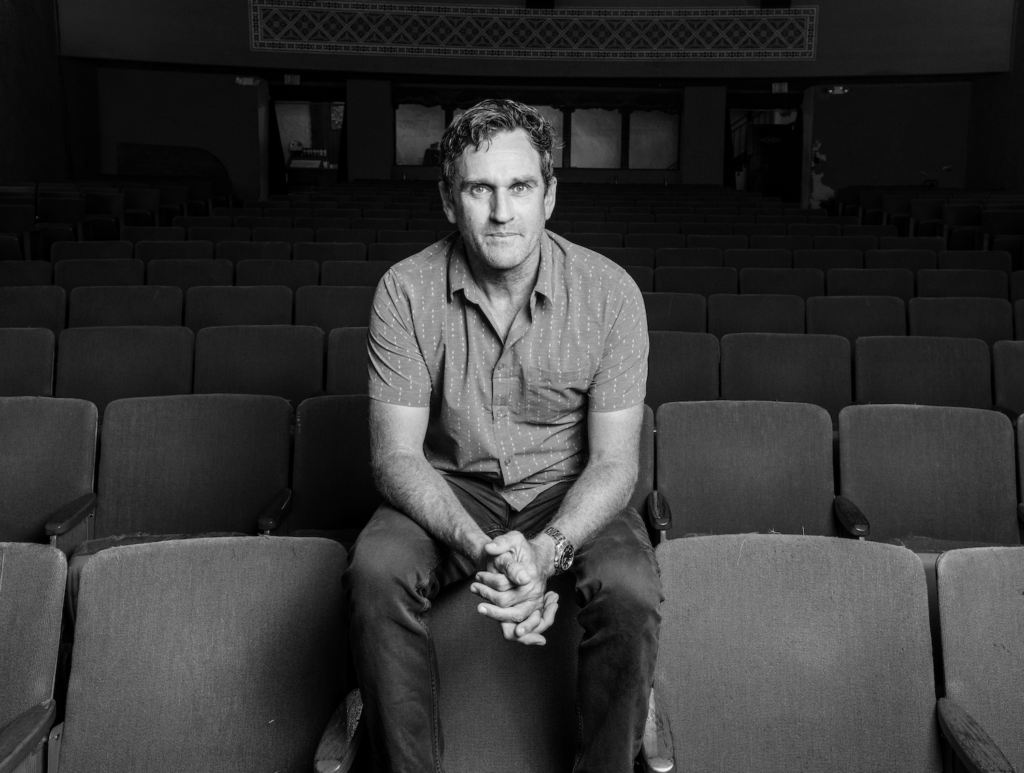
A man with no cultural scene will often invent his own. Taylor Steele did just that. When the award-winning producer and director returned to North County two years ago after living in NYC, Australia, and Bali, he sought to reignite the creative community at home, and only one place would do: the historic La Paloma Theater in Encinitas, where he grew up watching films like Searching for Tom Curren on the ratty seats.
“La Paloma is the mecca for surf premieres, but there was no festival here,” says Steele, whose explosive 1992 rockumentary-style film Momentum inspired a generation of surfers to elevate the sport into an art form. His second annual Solento Film Festival takes place Sept. 22-25 at the 1928 Spanish Colonial icon. It’s a legacy story for Steele, who flipped the script with Sipping Jetstreams and Proximity and went on to art direct campaigns for Corona, Apple and HBO.
Last year’s festival debuted to a full house that included industry giants like Kelly Slater, Rob Machado and Mick Fanning. They were lured by more than movies; music has been a crucial part of Steele’s oeuvre ever since his early VHS films helped to boost SoCal bands like The Offspring and blink-182. During this year’s festival, concerts will be held on an outdoor stage at Seaside Reef, Steele’s home break.
One of the festival’s sponsors is Steele’s very own certified organic tequila brand, Solento, packaged in a Chanel N°5-inspired bottle. It’s a long way from the early days of surf films at La Paloma. “There was always the sound of beer bottles rolling down the aisle,” says Steele, legs outstretched on the seats in front of him. “It’s a rite of passage for every filmmaker to show here.”
The most exciting moments in local sports in the past year—the top highlights, biggest stars, and greatest wins
Last year’s Olympics in Paris delivered plenty of unforgettable moments—a metal band performing alongside a headless Marie Antoinette in a 13th-century castle, breakdancing’s short-lived debut (sorry, Raygun), and even Snoop Dogg serving as a torchbearer. But some of the most memorable concerned our own hometown heroes.
Sixty San Diegans competed for Team USA, earning 25 medals across eight sports, with gold medalists including then-Wave FC players Naomi Girma and Jaedyn Shaw, basketball star Kelsey Plum, and cyclist Jennifer Valente. Encinitas’ own Jagger Eaton hit the street park as one of only three Americans representing the country in men’s street skateboarding, nabbing a silver medal finish. And while TikTok-famous local “rave horse” Suppenkasper and his rider Steffen Peters, beloved for their EDM-fueled dressage routines, didn’t make it to the finals, the 17-year-old gelding had audiences eating out of the palm of his, uh, hoof from the very first beat drop.
The next Chucky Lozano might soon be honing his skills right down the road in El Cajon. San Diego FC kicked off its inaugural season in February and quickly proved itself a force within MLS (at press time, it sits at number one in the Western Conference). With it came the Right to Dream Academy, a scholarship-based academic and training facility where promising players as young as 11 will prepare for a bright future in the pro league under top-tier tutelage.
Picture it: Padres against the hated Dodgers in LA. With two runners on, the fate of the Padres’ 2024 postseason rests on one play. Bottom of the ninth inning. No outs. Padres closer Robert Suárez is looking to hang on to a 4–2 lead. Crack—a ground ball to Manny Machado. Machado tags third and fires to second. Jake Cronenworth turns it and beats the runner at first. Just like that, San Diego pulls off an unforgettable triple play and clinches their playoff berth. Easily the most cathartic moment in San Diego sports in the last year.
As one chapter ends, another kicks off. San Diego’s favorite WNSL icon, Alex Morgan, officially hung up her cleats (along with her number-13 jersey, which the team is retiring in her honor) for good in September 2024 after her final game with San Diego Wave FC against the North Carolina Courage. But before you get too emotional, she also dropped the much happier news that baby number two was on the way.
True to form, she’s not slowing down anytime soon. She’s staying in the game as a minority investor in the Wave, continuing her mission to uplift women in sports and ensure the next generation has even more room to shine.
2024 was a big year for San Diego State alum and world-ranked number-three golfer Xander Schauffele. Following a near-perfect round of 62 at Kentucky’s Valhalla Golf Club, tying the lowest round ever scored in a Major championship, he secured a narrow PGA Tour win over titan Bryson DeChambeau. Fast forward to July, and Schauffele brought his A-game to the Open Championship at Royal Troon Golf Club in Scotland. Battling wind, rain, and the course’s punishing bunkers, Schauffele was one of only 17 golfers to break par throughout the tournament.

We said goodbye to a local icon this year: 6’11 NCAA Hall of Famer Bill Walton. Born in La Mesa, Walton played basketball at Helix High with his brother Bruce (who later became an NFLer) before making his mark at UCLA under legendary coach John Wooden. He won three straight NCAA Player of the Year awards (’72–’74) and was the first overall pick in the 1974 NBA Draft. Leading the Portland Trail Blazers to their only NBA championship in 1977, Walton became a beloved sports legend. A devoted Deadhead, he attended more than 800 Grateful Dead concerts and spent his later years deeply involved in community work, leaving a lasting legacy.
Growing up in Oceanside, Caitlin Simmers had always gravitated toward the activities that make a California beach city what it is. She dabbled in BMX, dance, martial arts, and skateboarding, but found her calling in surfing at age 6. Now, at 19, she is in her third year of the World Surf League Champions Tour and part of the USA Olympic team. Last year, at Lower Trestles, only 20 miles from her hometown, she notched a pretty serious resume builder: She became the youngest woman winner of the World Surf League Final.
Imperial Beach has some of the finest surf in San Diego—and the nation’s most contaminated shores
Every year, when winter swells bring San Diego’s best waves to their fullest potential, local surfers flood the lineups of popular spots like Black’s and Swami’s. But some of the heaviest and most dangerous surf lies further south, off the coast of Imperial Beach. The area’s crown jewel, Tijuana Sloughs, sometimes serves up 20-plus-foot waves that break up to a half-mile from shore.
Even as the surfing population has exploded, however, IB remains empty in comparison to the rest of San Diego, thanks to the pollution that plagues its waters. Surfers in IB don’t just check the surf cams and swell forecasts—they monitor the water data from the nearby International Boundary and Water Commission.
“It’s almost a science to go out for a surf and not get sick,” says resident Dwayne Fernandez. “My wife hates that I still surf here; she gets worried. I check the reports every day to see if it’s safe, which has been rare these days. If it’s not, I may have to drive over an hour just to get in the ocean—and I live minutes from the beach in IB.”

According to the Surfrider Foundation, IB has the unfortunate distinction of being the most polluted beach in America. Built in 1996 with the capacity to manage 25 million gallons of wastewater a day, the nearby South Bay International Wastewater Treatment Plant (SBIWTP) is frequently overwhelmed. Anything that exceeds the limits of the SBIWTP comes out as raw sewage, clearly visible in the water as a dark brown plume with an accompanying nasty smell.
The sewage flow can sometimes hit hundreds of millions of gallons in a single day. “You don’t want to be out there when that happens, and it can happen quickly,” says Adam Wraight, an Imperial Beach lifeguard sergeant, junior lifeguard coordinator, and longtime local surfer.

But that hasn’t stopped some residents, despite mandates prohibiting surfing and swimming during beach closures. If the waves are good, surfers are probably out there. Why take the chance, though, when there are so many other good waves—with cleaner water—in the county?
It’s partly a point of local pride. The surf history in IB runs deep. Stories of the Tijuana Sloughs on its good days are the stuff of legend, discussed in hushed tones in the core San Diego surf community.

“The Sloughs was never a spot meant for everyone,” says Jeff Knox, a former lifeguard and lifelong IB surfer. “The paddle-out alone was enough of a deterrent for most. The shorebreak took care of the rest. It’s mostly locals out there; we like it that way. It’s one of the best waves around and, for that very reason, we never used to talk about it. But those days are long gone. We need all the help we can get—the more attention, the better. Because this is a huge problem.”
It’s also been part of the deal for decades. “I started surfing IB in the ’60s, [and] we’ve always had to deal with pollution,” Knox adds. “Throughout my entire life, it’s never been as bad as the last 10 years. The last five have been absolutely terrible.”
Additionally, there’s the simple fact of convenience. While IB’s median rent cost of $3,000 is well under the staggering housing costs in other surf-adjacent ’hoods like Encinitas and Del Mar, locals still pay a pretty penny to live a few blocks from the beach. And they often pay a price for surfing there.

Scientists have identified 175 toxic pollutants in IB’s waters. Surfers have contracted everything from diarrhea and bacterial infections like MRSA to neurological disorders and hepatitis A.
“As a lifeguard, I see all the data. I check the flows daily and monitor the testing just to see if I can go for a surf during my break or after work. There are plenty of people who don’t check anything—they just see waves and go out—but even they get spooked when they hit the water and everything feels and smells wrong,” Wraight says. “Our responsibilities are definitely different from other [lifeguard] stations and, unfortunately, so much of what we do revolves around the pollution. It can get pretty negative, and it takes a toll on morale and recruitment.”

The problem has driven some local diehards from the water completely. Ramon Chairez, an activist and educator with the nonprofit Un Mar de Colores, has lived in IB for decades, but in 2020, he “made a conscious decision to stop surfing IB,” he says. “I saw too many people around me getting sick. It wasn’t worth it. The last five to 10 years have really been pivotal in the consciousness of the population, especially the kids—they know it’s polluted and unsafe.”
As a junior lifeguard coordinator, Wraight once trained the next generation in IB. But, now, he and the local kids he works with must travel to other beaches in the county. YMCA’s Camp Surf, a program that attracts children and teens from all over the nation with the allure of learning to surf in San Diego, can no longer take participants into the area’s waters.

They must head to other neighborhoods or stick to land-based activities. “The biggest tragedy is the youth,” Wraight says. “They’re growing up not being able to enjoy the ocean like we did—their whole life experience is affected by the pollution.”
Despite the toxic water, IB still feels like a classic beach town, a callback to a time before $8 lattes and luxury condos dominated the coast. It’s charming, quaint, and beautiful, with the open space of the Tijuana Estuary to the south, mountains in the distance, and the mighty Pacific to the west. It has one of the most unique coastal views of all of San Diego—and some of its best waves. If only you could safely surf them.
Chris Dodds has been falling in love with San Diego for the past 10 years. He's passionate about the protection and preservation of our natural areas, especially our coastline and waterways.
Getting outside and staying active is in our blood; and finding new ways to enjoy yearlong perfect weather is what we do best
South Mission Beach Courts
Patrick Davis for Life’s a Beach
The bike shop sits on a popular commute route and is staffed by affable mechanics who have worked the Tour de France. Hardcore bicycle people don’t have the friendliest rep, but MJ’s is different. They’ve got the skill set to equip racers, but they don’t treat commuters or parents buying bikes like tourists in their world.
One minute you’re casually playing a game of pickleball, the next thing you know, you’ve helped design Gearbox’s newest paddle. The brand is based in San Diego and PBTC is their local court, where they play with locals to gain insights on how to improve their rackets. This sounds like free lessons to us.
When a relative was giving away their boat, local architect Vilchis saw an opportunity to design a 10/10 Instagrammable experience. Now you can class up your day date by recreating The Notebook—a pristinely refurbished tiny boat with padded seats, plant garlands, snacks and drinks, and even parasols. Ryan Gosling not included.
Each weekend on the courts of South Mission Beach, the sand is taken over by 2v2 players—many of which are ESL speakers from various countries. They’ve made this plot of sand their sacred community, where the universal language is bump, set, and spike.
On any given Wednesday on Hamilton Ave., 100 to 200 runners gather to run the streets of North Park. It’s put on by Milestone Running, a shop created by locals Greg Lemon and Chad Crawford. Go a few times and you’re pretty much guaranteed at least ten new friends—might even get “Smirnoff Iced” during the post-run raffle. You win some, you lose some.
Even avid runners can lose motivation. This year, Waterfront introduced a new tradition: beer stops. The three- mile loop starts at Eppig Brewing in Point Loma, then heads to Fathom Bistro for a beer before completing the next 1.5 miles. Finish up with a post-run brew at Eppig, obviously.
Mission Bay Basketball Court
Madeline Yang
San Diego’s maritime history runs deep. America’s Cups have a permanent home here. Harbor Sailboats—seven-time winner of the “ASA School of the Year”—offers sailing courses taught by longtime sea dogs. You know, the type of no- nonsense skippers who know how the wind will change by the way the breeze hits their beard hair.
If you want sky-high firs, oak forests that shade your path, and mountain peaks that overlook actual foliage (read: no palm tree in sight), head to Palomar Mountain State Park. And, since the inaugural California State Parks Week took place this year, there’s no better time to dust off your hiking boots on one of the six hiking trails (five for running).
A mellow 5.7 climb on paper, The Tower at Mission Gorge will have you clipping the first few bolts like you’ve been dirtbagging in Yosemite all your life. You’ll have to dig deep into your courage reserves to tackle the crux, but you’ll be walking down that mountain with your head held high when the sun starts to set.
Hoops here have always had a magical effect—a full regulation court, smack dab on the beach. The ball smells like sunscreen. No fence; out of bounds is in the sand. And it just got an artful resurfacing in honor of local basketball legend, Bill Walton—who’s been a member of the South Mission Beach Sports Park & Rec for 25 years.
Yep, in City Heights. Specializing in boards from local shapers, owner Mark Polintan (who grew up on a pineapple farm in the Philippines) has created an infectious gathering place for surfers to support their peers. Like chasing tubes in exotic locations, you never know what or who you’ll find here, but you’re guaranteed to leave stoked.
Surfers are selfish. No matter how many waves we catch, we always want more. And while there’s no shot we’ll ever change, we can at least direct that impulse toward a good cause. At the annual 100 Wave Challenge, participants commit to riding 100 waves in one day to raise funds for the local nonprofit Boys to Men Mentoring.
Nicolle Monico is an award-winning writer and the director of creative projects, digital editor for San Diego Magazine with more than 19 years of experience in media including Outside Run, JustLuxe and The San Francisco Chronicle.
This month, the 2026 San Diego Business Impact Awards recognized local businesses making an impact in clean energy, biotech, hospitality, and beyond
Renewable energy companies building hundreds of power plants. Biotech startups using artificial intelligence to create personalized medicine for children with rare diseases. Hospitality companies quietly powering thousands of local events. Consumer brands growing from beach-town startups into national businesses. These are the kinds of companies driving San Diego’s economy today, and the businesses recognized at this year’s San Diego Business Impact Awards offer a snapshot of where the region is headed.
Hosted July 23 by San Diego Regional Economic Development Corporation (EDC) and JPMorganChase, the second annual awards event honored four local companies for innovation, growth, and economic impact. More than 100 nominations from San Diego’s middle-market businesses were reviewed by a 10-person judging committee, with winners selected across four categories: startup, early-stage innovator, rising star, and established heavyweight.
Two-time honoree Jimbo Someck, founder of Jimbo’s organic grocery stores, also joined the event for a fireside chat on buying local, supporting emerging brands, and giving back to the community.
“San Diego’s strength comes from its makers and builders—the resilient people who endure great risks and overcome obstacles to build and scale a company,” says Aaron Ryan, San Diego Region Manager and Middle Market Banking at JPMorganChase & Co. “These awards aren’t just recognition; they spotlight the talent, grit, and innovation shaping our region’s future. By celebrating those who create and build, we foster connections and fuel the growth that keeps San Diego thriving.”

Heavyweight honoree SOLV Energy has grown alongside the country’s rapid investment in renewable power. “It’s an exciting time for SOLV Energy as we are experiencing significant growth,” says CEO George Hershman. “The business has doubled over the last year and has almost double-digit growth since its inception.”
The Rancho Bernardo-based company designs, builds, operates, and maintains utility-scale solar and energy storage facilities. Since its founding in 2008, SOLV Energy has built more than 500 power plants.
Growth has translated directly into hiring. About 200 employees work from the company’s local headquarters, including roughly 20 interns. “Our intern program is a big part of the way that we grow our workforce,” Hershman says. “Last year, 43 percent of our interns became full-time employees. We believe San Diego is a great community to build and grow a high-tech infrastructure and technology company because of the incredible workforce—the ability to attract top talent and draw from world-class universities.”
Startup honoree La Jolla Labs is tackling one of medicine’s biggest challenges by developing personalized RNA therapeutics for patients with rare diseases—many of them children with neurological disorders like ALS. Using proprietary artificial intelligence and machine learning tools, the biotech company develops treatments tailored to each patient’s specific genetic mutation.
CEO Tamar Grossman says the recognition reflects how far the company has come despite limited resources. “We’re honored to be recognized for our ability to change and save patients’ lives and turn our lean startup into a clinical company with very minimal resources,” she says.
Grossman credits San Diego’s concentration of research institutions—including UC San Diego, the Salk Institute, and Scripps Research—with creating a pipeline of talent and collaboration. “San Diego is one of the world-leading centers for technology, genomics, and RNA therapeutics,” she says. “We have over 30 RNA therapeutics companies here, and we support each other and help with anything related to drug discovery.”
She says that collaborative spirit extends beyond formal partnerships. “You can walk around Torrey Pines, go into a café, and find colleagues from the industry and have an ad hoc conversation,” Grossman says. “That’s something very unique to San Diego.”
While Snake Oil Venue Company may not be a household name, chances are many San Diegans have attended one of its events. The early-stage innovator honoree has expanded from beverage catering and mixology consulting into venue management, operating Julep Venue in Mission Hills, Bramble Bay Venue in Imperial Beach, Vesper Venue, the Chapel at Liberty Station, and five outdoor venues throughout Liberty Station—more than 500,000 square feet of event space altogether.
“We do a lot of launch parties for corporations and new products,” says CEO Mike Esposito. “I really like working on the entrepreneur side of things, where new businesses are entering the San Diego market and looking to make a splash.”
Snake Oil has executed more than 16,000 events, employed more than 1,000 people, and partnered with more than 900 local vendors, including caterers, florists, photographers, entertainers, and other hospitality businesses. The company also works with many of San Diego’s nonprofits, museums, and cultural institutions. “We get to celebrate people’s most important moments,” Esposito says. “Whether that’s a wedding, celebration of life, or quinceañera, we’re fortunate to be involved in the community in so many different ways.”

Rising star honoree ALOHA Collection is proof that a simple idea can grow into a thriving company. Founded by two roommates who wanted a better way to carry wet swimsuits after a day at the beach, the lifestyle brand has grown into a business while maintaining strong year-over-year growth.
Now headquartered in Carlsbad, ALOHA Collection employs more than 100 people and operates its California flagship store in Encinitas, which is slated for a remodel. With roots in Hawaii, the company is known for its lightweight, splash-proof travel bags that have become a familiar sight on beaches in San Diego and beyond.
“‘Aloha’ is part of our name, but it’s also how we move through the world,” says CEO Lynna Barnard. “It’s how we show up for people, the way we travel, the way we give back.” Since day one, the company has maintained a 5 percent giveback to Hawaii conservation efforts, contributing millions of dollars over the years.
“I think what’s so inspiring about ALOHA Collection, and the founders in particular, is when you dream big, those dreams can come true when you work hard and trust in the universe,” Barnard says. “It’s inspiring to be a role model for other people wanting to start businesses from humble beginnings. Start small and watch it grow.”
Together, businesses like these form a cornerstone of San Diego’s economy—not only through the jobs and revenue they generate—but through the local workers they hire, vendors they support, and investments they make in the region. Their growth doesn’t happen in isolation; it ripples outward, strengthening the broader business community and the people who call San Diego home.

After Captain Keno's closed, pro surfer Benji Weatherley gave its tables, dishes, and memories a second life at Breakers Cafe Bar & Grill
Captain Keno’s No. 8 special—pancakes, sausage, toast, home fries, and eggs for $2.99—was the fuel that powered Benji Weatherley for surf competitions as a teenage pro. A couple decades later, tears were shed when the Coast Highway dive-slash-eatery called it a day after 54 years. Usually, the guts of a shuttered restaurant go to liquidation auctions or straight to the dump to decompose along with its legend. Instead, Weatherley took in Keno’s spare parts—plus other relics from Encinitas’ past—and used them to build the newest community hangout.
Every single piece in the place is from somewhere in this town,” Weatherley says about Breakers Cafe Bar & Grill. “I’m not going to settle for anything less.”
Breakers is a Hawaiian hideout in an uncool part of the coastal surf town, but it’s got the set design of an Encinitas superfan. The plates, silverware, and coffee mugs are from Keno’s. So are the tables and booths. There’s a bench made from the last table preserved in The Derby House (a building that, for over a century, was a hotel, then became a hospital, a religious retreat, and a private home). Weatherley’s not performing CPR on old upholstery because he’s a fan of antique furniture. It’s a method to bring people together.
“Representing nostalgia in this town is the only way to grasp a hold of the community,” Weatherley says. “Everyone wants to touch and feel something different from what they’re experiencing on their phones.”

Every week, locals bring him photos, artifacts, and bits of paraphernalia from Encinitas’ past and ask Weatherley to give them a new home. “I’ve had ladies who were there when [Captain Keno’s] opened cry in my arms and say, ‘This table is where I had my second birthday with my grandma,’” he says. “They tell me these stories, and I tell them I have all the same stories about my mom.” (Weatherley’s mom first brought him to Keno’s and helped raise the young surfers from the Momentum Generation documentary—Weatherley, Taylor Steele, Rob Machado, Kelly Slater, etc.—as they surfed some of the world’s most dangerous waves at Pipeline in Hawaii. Back then, she owned Breakers Restaurant & Bar in Haleiwa. Name sound familiar?)
Weatherley has always been the funniest man in the room. He calls Breakers “the Chuck E. Cheese of Encinitas.” The restaurant hosts hula dancing classes, open-mic comedy nights, and evenings bartended by longtime Captain Keno’s barkeep Vaka Kaufusi. Cult-loved reggae band Steel Pulse hit the Breakers stage recently to perform a new song that Weatherley also helped write. His longtime friend Jack Johnson has dropped by to sing a few, too.
Despite not having a fancy location along the 101, people are catching on. Fire stations and hospitals have held staff parties there. Weatherley also currently sponsors four sports teams.
“Last night, I had a girl say, ‘I want my birthday party at Breakers,’” he says. “That, to me, is community in a nutshell.”
Emma Veidt is an editor at San Diego Magazine. She earned her bachelor's and master's degrees from the Missouri School of Journalism. She loves running, hiking, and rock climbing, but really, she mostly loves encounters with the street cats around North Park.
The San Diego designer has created more than 3,000 concert posters over nearly 40 years for artists including the Rolling Stones and the Red Hot Chili Peppers
Let’s start with his name.
No, not his birth name, Craig McKenzie Haskett.
Scrojo.
When he was in high school, he and his friends were trying to come up with the perfect name for their punk band that would encapsulate all their personas. Nicaragua. The Freds.
One of his friends said he was going to go by Jimmy Stacks and called it “the perfect rock and roll name.” Their names changed so much that Haskett erupted: “Fine, I’m f—ing Scrotum Joe, the true defender of the Open West.”
Their response: Wow, that’s a great name.
As a teenager, he drew chalkboards for Del Mar’s Pannikin coffee shop and would design T-shirts for surf/skate brand Life’s a Beach. He signed the shirts with his moniker, but even in punk rebellion, who wants a shirt with the words Scrotum Joe on it? “They just cut out the ‘t-u-m,’ and the next thing you know, a client referred to me as that, and it stuck,” he says.

Scrojo could have been part of a band as iconic as The Misfits—had he been able to learn the famously cumbersome bassline to The Kingsmen’s “Louie Louie.” Becoming one of the most renowned concert poster designers—someone who quite literally designed the cover of Art of Modern Rock: The Poster Explosion—is a pretty good Plan B.
“To my knowledge, he’s done more rock posters than anybody else alive,” says Dennis King, whose D. King Gallery in Berkeley, California, serves as one of the largest private rock poster collections in the world. “He’s the hardest-working guy in the poster business.”
King not only co-authored the sequel to music historian Paul Grushkin’s The Art of Rock, but he also handles distribution and sales for all of Scrojo’s work. That’s more than 3,000 different posters over nearly 40 years. (That’s over one poster each week. For four decades straight.)
For anything from boxing matches to rodeos, posters have long been used as promotional items. Toulouse-Lautrec’s famous lithographs advertised Moulin Rouge in the late 1800s. Around the same time, Hatch Show Print in Nashville was making handbills for the Grand Ole Opry.
“I propose this: Cave paintings are the first poster art,” Scrojo says.

Rock and roll posters took off in the 1960s, when the hippie counterculture era replaced conformity and suburbia. Artists like Jimi Hendrix and the Grateful Dead used their vibrant, psychedelic prints as a form of rebellion from the mainstream. Posters were promotional, commemorative, collectible, and especially expressive.
If the name Scrojo is any indication, he doesn’t shy away from imagery that toes the line of being too provocative. He focused more on what inspired him instead of trying to be offensive for the sake of getting attention.
“Didn’t want to show it to my grandmother, but my parents were fine with it,” Scrojo says with a laugh.
“We’ve had to ask him to put a Band-Aid over a nipple every now and then,” says Chris Goldsmith, president of Belly Up Tavern in Solana Beach, where Scrojo started out and hundreds of his posters currently line the walls.
Scrojo spent six weeks at Otis College of Art and Design for a summer semester before drugs, alcohol, and a self-described lack of discipline prevented him from enrolling full time. Still, he taught himself concepts like text hierarchy and later found his niche at the Belly Up and in the surfing and skating world, working with brands like Quiksilver, Rip Curl, Scorpion Bay, and DGK.
His first concert poster was for North County band Borracho y Loco, of which Goldsmith was bass guitarist. Scrojo drew an abstract version of the Belly Up’s iconic shark with colorful calypso and tiki themes.
Early on, he would craft using a pencil, pen, non-reproduction blue pencil, X-Acto knife, rubber knife, and proportion scale to create each poster, and the finished product could take a week or even longer.

“I recommend every artist coming up to do that for like six weeks,” Scrojo says. “It forces you to think about every design decision as you’re going along.”
He has since mastered vector imagery through Adobe Illustrator to the point where, depending on the level of detail needed, he could finish two projects in a day. Still, he fills sketchbook after sketchbook to blueprint.
“I liked his line in particular, and he knows how to draw, which a lot of people don’t really know how to do these days,” King says.
Scrojo would research what each musician’s merchandise looks like to get a feel for each artist’s tone and voice. Once he has his central image in mind, he focuses on what and where to place the text.
He doesn’t have one specific style, ranging his talents from art deco to psychedelic and everything in between (and outside the lines). Want a pop surrealist comic book cartoon devil with splattered paint textures, halftone dot patterns, and pure chaos? Red Hot Chili Peppers, February 1986. Want a minimalist graphic portrait with bold strokes and graffiti text? P!nk, October 2023. Want a carnival sideshow style piece with a tasteful caricature of Jeff Bridges? The Big Lebowski, August 2011.
Scrojo calls himself a jack of all trades because he can create posters for all music genres. King calls him a chameleon for his ability to adapt his voice to new eras.

“The variety of his skillset makes it possible for us to put 50 of his posters on a wall next to each other and have it look compelling, not just a bunch of the same thing over and over,” Goldsmith says.
Some of Scrojo’s favorite posters are when he feels a personal connection to the artist or the album. He has a vivid memory as a child of being trapped in a closet filled with marijuana leaves while playing hide and seek and staring at Jimmy Cliff’s “The Harder They Come” LP. “For whatever reason, as a kid, that sparked a desire to do graphic design,” Scrojo says.
Fast forward to February 2012, Cliff is performing at Belly Up. Scrojo decided to modify Cliff’s original album cover from rainbow gradient fills to classic reggae psychedelia while preserving Cliff’s striped pants and bold hat. Cliff’s manager called him and said they wanted to use it for the rest of their tour.
“We always get artists requesting that he does their posters,” Goldsmith says. “A lot of artists don’t want venues to go all rogue because they want to control how they’re being presented. With him, they’re like, ‘Let him go nuts.’”
Matt Eisenberg is an award-winning writer and photographer based in San Diego. A former ESPN editor, his work has also been published by CNN, Bleacher Report and the New York Daily News.
It’s a Self-Care Summer. Because your best self is our favorite self.
If you’re anything like us, it can be easy to get so caught up in taking care of everyone else, that your own needs get lost in the ether. But while this may be a cliché, that doesn’t make it any less true: You can’t give your best self to other people unless you’re taking care of yourself.
Sometimes, that looks like stopping in for your regular acupuncture or chiropractic appointment. Other days, it means giving your body the fresh, organic fuel it needs to truly feel and function at its best. And some other times still, it involves leaving your responsibilities behind for a weekend to pamper yourself at an incredible resort and spa.
Only you can decide what your truly need. We’re just here to help you find the best ways to get it.

Island living meets desert luxury at the Tommy Bahama Miramonte Resort & Spa in Indian Wells. When you step onto the 11-acre property, you’ll be surrounded by sweeping view of the Santa Rosa Mountains with olive trees and fragrant citrus groves decorating the grounds. In other words, everything about this relaxed but refined resort is primed to help you let go of the stress from home and enjoy easy sun-soaked days and gorgeous starry nights.
The rooms blend calming, woven textures with Tommy Bahama’s signature tropical prints and feature private lanais, making it easy unwind the moment you walk in the door. If you book one of the four Villa Suites, you’ll be treated to exclusive Tommy Bahama furniture and unique personal touches to further that feeling of instant ease.
At the award-winning Spa Rosa, the expert team will help reset and recharge your body and mind using methods and rituals inspired by the desert. The 12,000-square-foot retreat includes outdoor soaking pools, eucalyptus steam rooms, and outdoor cabanas, as well as massages, facials, and body masks—all aimed at creating a day dedicated to you. We’re particularly partial to the Day Long Escape, an indulgent all-day affair of CDBs soaks, renewing scrubs, life changing massages, and transformative facials.
Following your treatment, continue the experience with a meal on the patio at Grapefruit Basil. We love the Hamachi Crudo, a light, citrus-forward dish featuring premium yellowtail, house-made ponzu, creamy avocado, and fresh seasonal garnishes.
Whether you’re strolling the gardens, relaxing beside its saltwater pools, or indulging in a restorative treatment, you’ll be able to escape in style and relax in luxury at the Tommy Bahama Miramonte Resort & Spa.

There’s no shortage of ways to stay active in San Diego—but if you really want to enjoy everything the city has to offer, you’ve got to make sure you’re giving your body its tune-ups. Enter: Healcove Chiropractic. The board-certified chiropractors and wellness professionals at Healcove are experts at addressing that stage where you’re not injured, exactly, but you’re not at 100%, either. Maybe you’re feeling a bit tense or stressed out. Or it could be that you’re not quite moving the way you want to. Sometimes, it’s just that the accumulation of days, weeks, or even years of daily strain is starting to take a toll. No matter what stage you find yourself at, the Healcove Chiropractic team can provide integrated, preventative care centered on long-term, science-backed approaches that ensure you can always stay active and live the life you want to live pain-free.
This starts by providing truly individualized care. Every patient can expect a thorough 60-minute consultation session that includes a posture and movement screening. This allows the team to develop a completely personalized plan. That plan might include chiropractic care, acupuncture, or massage therapy, as well as functional fitness training, vibration and sound therapy, and Dynamic Neuromuscular Stabilization, a clinical rehabilitation method that retrains the body’s stabilization systems. Whatever the team recommends, you can be sure that it’s tailored to meeting your body’s needs today and the future.
There’s a reason that San Diego Magazine named Healcove the “Best Chiropractor in San Diego”—don’t wait until you’re struggling with an injury to find out why. Book an appointment today for holistic, integrated care that helps ground and heal your body before it reaches a crisis point.

West Coast wellness culture meets the community feel of Southern Appalachia at Juice Holler. Juice Holler’s menu consists of made-to-order smoothies and smoothie bowls, as well as grab-and-go cold-pressed juices, wellness shots, salads, and more. It operates from the blissfully simple premise that fueling up with food and drink that’s guilt-free and good your body should be simple, accessible, and, above all else, delicious. And if you haven’t yet made it out to the Encinitas café, which opened just this year, let us be the first to tell you: Juice Holler delivers on each and every of these fronts.
We love the Supercharger smoothie, a mood-lifting and body-fueling option made with banana, almond butter, blue spirulina, maca, grass-fed whey protein, raw cacao nibs, medjool dates, and coconut milk. We’re also partial to the Thrive Alive smoothie bowl, where avocado, mango, sea moss, spirulina, mint, coconut milk, and agave are mixed and topped with coconut, chia seeds, strawberry, mango, and chocolate drizzle. The wellness shots include the Detoxifier, a cleansing blend of kale, cucumber, lemon and spirulina, plus a shot specially designed to fight inflammation (named, fittingly, Anti-Inflammation). Probiotic overnight oats, lemon turmeric bars, and strawberry shortcake chia pudding are other standouts on the grab-and-go menu.
Much of the vibe feels beachy North County chic—think green tile with orange and pink accents, grounded with greenery and natural wood—but Juice Holler founder Kelly Sergott, a longtime Encinitas local, has also enfused the space with her Kentucky roots. In Appalachia, a holler is small valley between hills and mountains, where nature reigns, community is king, and nourishment comes right from the land. At Juice Holler, Sergott has created a holler for the busy modern times, using local ingredients to create a spot for people to come together and enjoy fresh, fast, feel-good fuel for their day.

We’ve all had that experience with a medical professional where we’ve felt rushed, ignored, or misunderstood—and ultimately, like we didn’t get the answers that we needed. But at Everwell, the holistic acupuncture practice located in Solana Beach, the care team wants to transform your understanding of what healthcare can look like.
Patients at Everwell experience care rooted in intentional listening and radical empathy—and trust us, those aren’t just corporate buzzwords. This place actually puts those ideas into practice. You will always be given the time you need to tell your story— initial in-take appointments are two hours long—and you can rest assured that your story will be believed. Every single question and concern will be addressed by a dedicated practitioner who wants to find the specific solutions that work best for you, and you’ll receive care that’s aimed at healing the body, mind, and spirit.
Everwell’s highly trained, doctorate-level practitioners blend evidence-based acupuncture with the practice of classical Chinese medicine. (If you’ve never tried acupuncture before or aren’t sure if the team will be a fit, we’d highly recommended Everwell’s complimentary 20-minute consultations.) Research shows that by stimulating specific points on the body, acupuncture activates a natural healing response in the body, helping to restore balance, regulate the nervous system, and improve overall wellbeing. This allows the practice to address an incredibly wide range of conditions from chronic pain and autoimmune disorders to digestive issues, from stress and burnout to headaches migraines, fertility and postpartum struggles, hormonal imbalances, sleep concerns and more.
At Everwell, you can expect to feel heard, trusted, respected, and cared for. This is a space that doesn’t want to be just another healthcare provider you visit; it wants to provide patients with dedicated partner who will be there for their entire health journey.