








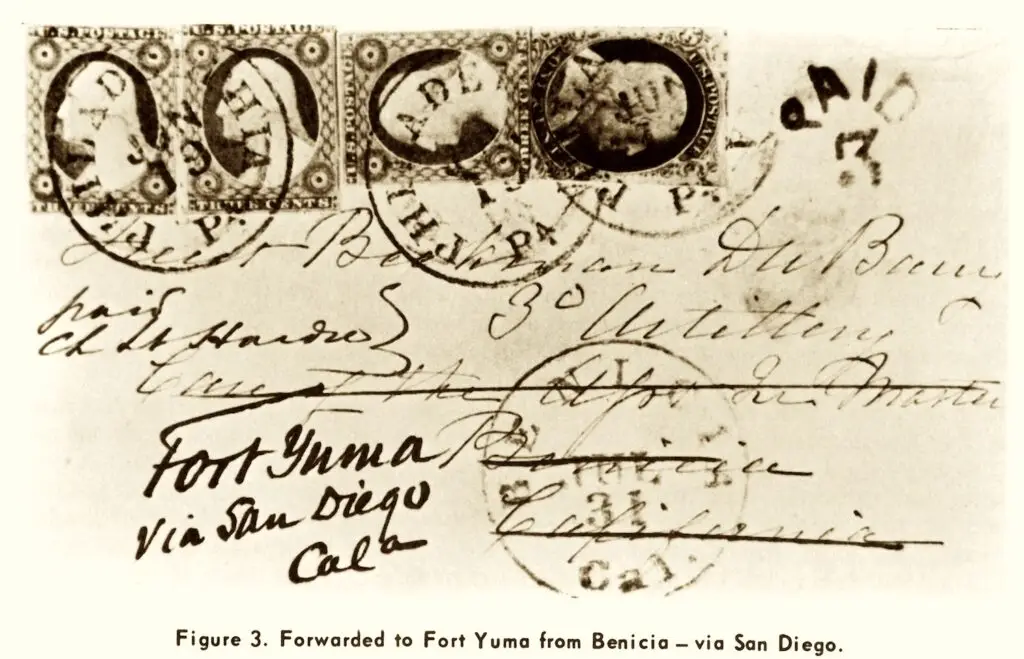
San Diego was isolated from the rest of the US in 1857. Telegraph lines wouldn’t bridge the Sierra Nevada till ’61, and the transcontinental railroad wouldn’t reach us for nearly three decades. Mail from all parts east had to come on steamwheelers by way of Panama, pre-canal.
James Birch, a Massachusetts man who’d made his fortune driving stagecoaches in Sacramento during the Gold Rush, saw an opportunity.

Birch won a contract to carry mail twice monthly between San Antonio and San Diego—1,476 miles through the Comanche, Apache, Mojave, Maricopa, Pima, and Yuma nations. He left it to his superintendent, Isaiah Woods, to plan the exact route, hire personnel, and buy 400 mules to do the heavy lifting. One San Francisco newspaper editor, envious of the new southern route, derided it as “the Jackass Mail.” (Delivering to Northern California three years later, the Pony Express got much better PR.)
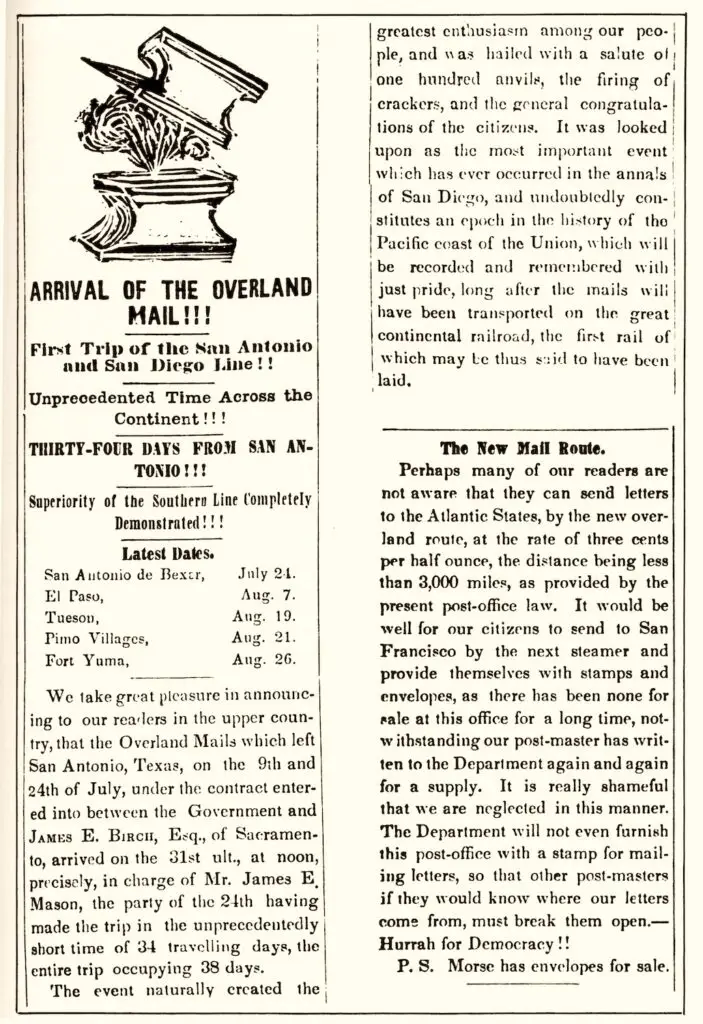
The first mail departed San Antonio on July 9. Woods himself accompanied the second, leaving on July 24. The trip was supposed to take 30 days, so his group left before learning the fate of the first—and sure enough, they were attacked before they reached the Texas border.
Comanche warriors descended on Woods’ party at Devils River, capturing all but six of their mules along with $100 (about $3,500 today) and most of their food. But nothing could stay these couriers from their appointed rounds: Woods dragged what remained of his train to Fort Davis, where he borrowed 36 more mules to keep going, promising to return them all. (Spoiler: He didn’t.)
Their coaches rode rough terrain with iron tires and no suspension, averaging 40 miles a day, and the stations where they made camp were seldom more than a mud-walled hut and primitive corral. Texas was in drought, and what water they could find was sulfurous, which made the mules ill. On a later trip, Woods reported having to drink from puddles in wagon tracks. (Rain only made things worse in winter, turning the whole countryside to deep mud.)
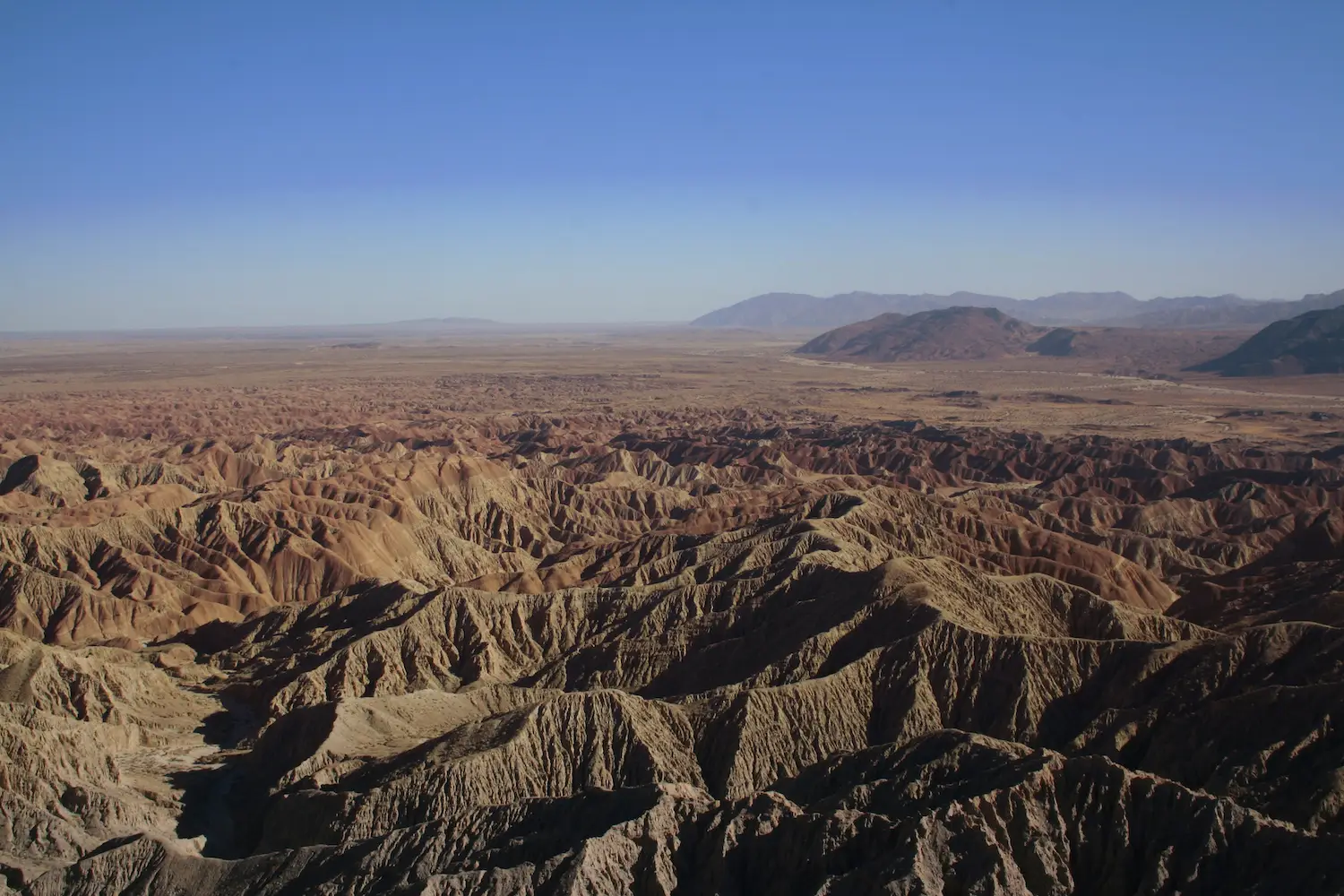
As it turned out, the first mail was on the struggle bus, too. Woods caught up with them along the way, so they joined parties. At the route’s largest station, Maricopa Wells (between modern-day Phoenix and Tucson, Arizona), he’d planned for the westbound and eastbound crews to meet, exchange their mail, and turn back. But for this inaugural delivery, he was along for the whole ride. They crossed the Colorado River by ferry at Fort Yuma and immediately hit more trouble: the Algodones (AKA Glamis) sand dunes, California’s largest dune field. Today, they’re one of the state’s biggest ATV and off-road playgrounds and we can speed right past them on the 8, but they were insurmountable on hoof and coach wheel. So the party diverted into Mexico, drew their last good water at Cooke’s Wells, and girded their loins for the harshest stretch of the Colorado Desert, which brought blistering heat, difficult terrain, and little for the mules to forage. Vallecito Stage Station (now a reconstructed historic site with a basic campground) in Julian marked the end of the worst.
To climb the eastern slope of the Cuyamacas out of what’s now the southern end of Anza-Borrego Desert State Park, the party left their coaches and carried everything on muleback. Their reward on the other side, past the scenic shores of Lake Cuyamaca, was buttered bread, mutton, and coffee, courtesy of the Lassator family, the first permanent white settlers of those mountains.
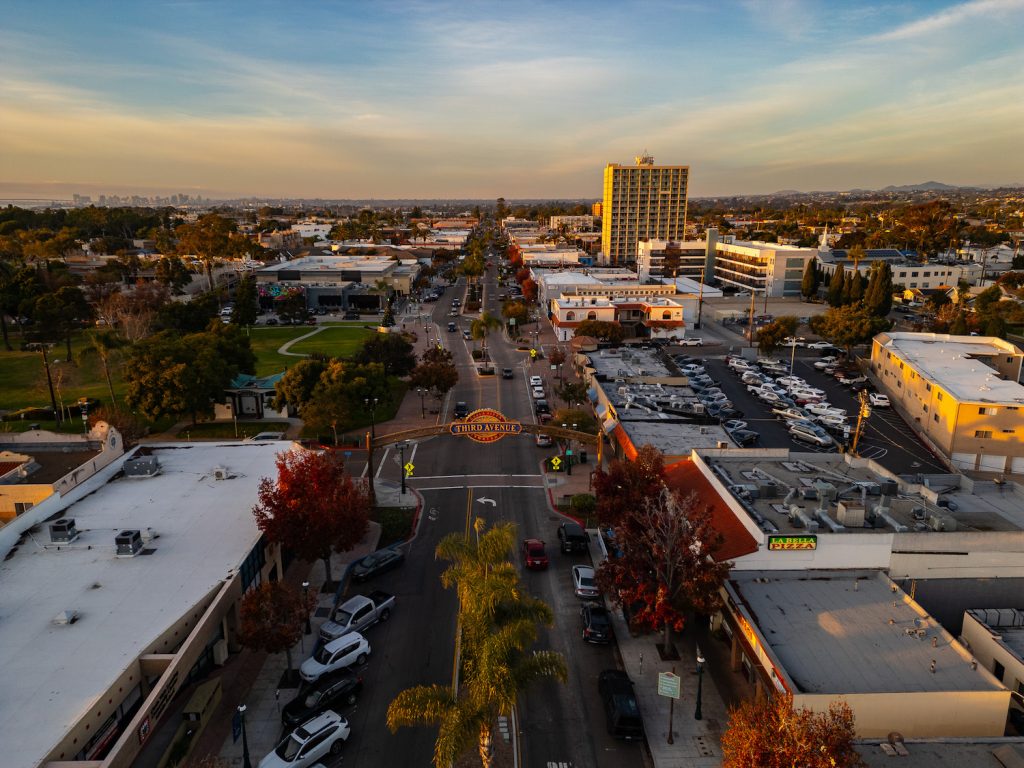
Then it was “just” 49 miles to the finish line, traveling through Valle de la Viejas and modern-day Alpine, with a stop at Mission San Diego de Acalá. Woods arrived in Old Town San Diego not terribly behind schedule to the welcoming din of blacksmiths banging their anvils 50 times in salute. Exhausted and eager for his paycheck, he sought out his boss—and discovered that Birch had left for the East Coast weeks earlier to visit his family.
He never made it. After departing from the Atlantic side of Panama, his ride, the SS Central America, was sunk by a hurricane, taking 425 passengers and up to 21 tons of gold with it. Birch was last seen refusing a life jacket while lighting one final cigar. He was two months shy of his 30th birthday. Before he died, though, he gave a cup made of California silver to one of the sailors, who survived by clinging to wreckage and using the cup to collect drinkable rainwater. He later returned the cup to Birch’s widow.
PARTNER CONTENT

The Jackass Mail made 40 trips before it was discontinued, and it bore the worst losses of any route in the country: $601 earned from a contract that cost $196,000. (This on top of the Panic of 1857, the first worldwide financial crisis, caused largely by the loss of the Central America’s gold.) In 1859, the postmaster general grumbled that “maintaining a mail service through an almost-unbroken wilderness and desert was an injustice to the postal system.” Some sections of it were shared with and ultimately absorbed by the more successful Butterfield Overland Mail route, which also entered California at Yuma but bypassed San Diego entirely for San Bernardino and Los Angeles.
Woods remained proud of it, though. In a report to the postmaster general, he boasted that his teams carried all the money and correspondence from the silver and copper miners of future Arizona to their families. “Our line is already forming the basis of a new State,” he wrote, “rich in minerals, half way between Texas and California.”
