Featured articles
Food & Drink
Food & Drink
Food & Drink
Featured articles
Everything SD
Everything SD
Everything SD
Featured articles
Things to Do
Things to Do
Things to Do
Featured articles
podcast-ep
podcast-ep
video
Featured articles
Everything SD
Everything SD
Everything SD
Featured articles
Food & Drink
Food & Drink
Ready to know more about San Diego?
SubscribeReady to know more about San Diego?
Continuous glucose monitors are becoming increasingly popular tools for those without diabetes hoping to reach their health goals
It’s 1 p.m. on a Wednesday, and I’m sitting at my desk, crunching a carrot like a horse. “No one laugh,” I warn my coworkers. “It’s for my glucose.”
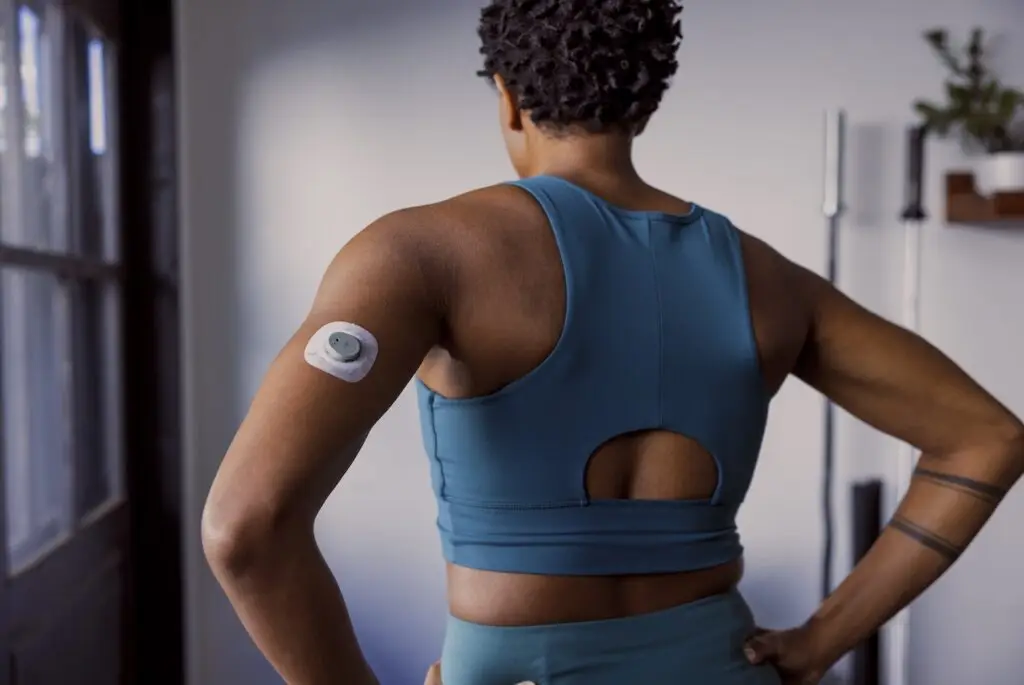
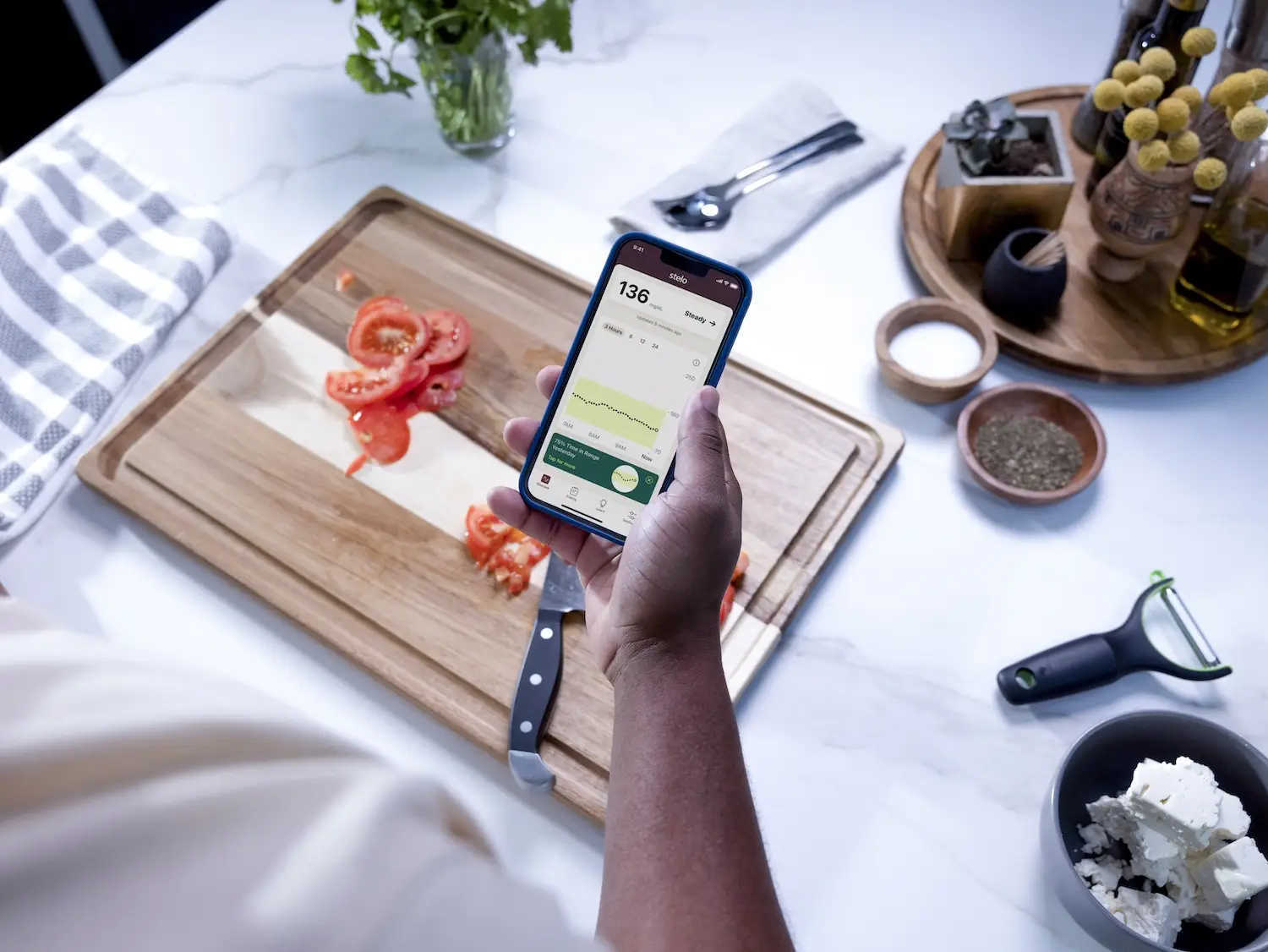
For the past few weeks, I’ve been trying to keep my blood sugar levels as steady as possible with help from Stelo, a continuous glucose monitor (CGM) produced by San Diego–based healthcare tech company Dexcom. The quarter-sized device has a hair-thin sensor that, when (pretty painlessly) applied into the back of your arm, constantly measures your blood sugar levels for up to 15 days. It sends all that data to a corresponding phone app (provided you’re within 20 feet of your device and the app is open), where you can also log your meals and workouts to help you understand how certain lifestyle choices affect your levels.

The FDA approved the first-ever CGM for patients with diabetes in 1999, and Dexcom released its own version in 2006. But the device only recently became available over the counter—and it’s increasingly popular as a wellness tool among people without diabetes, a trend that aligns with the ever-growing obsession with health data. The fitness and health tracking market as a whole hit more than $60 billion in 2024.
Insights from a tool like Stelo, which will set you back around $100 a month, may have a lot to teach us. “Almost 100 million people in the US have prediabetes, and most of them don’t know,” says Jake Leach, Dexcom’s chief operating officer. People with prediabetes have a fasting blood sugar level between 100 and 125 milligrams of sugar per deciliter of blood, or mg/dL (below that range is considered normal, while numbers above it signal diabetes), and the condition is associated with health concerns like cardiovascular and retinal diseases.
“And then there’s the idea of using a CGM to better understand metabolic health and longevity,” Leach adds. “There are a lot of potential uses around learning about how your diet impacts your glucose and how, over time, that can develop into a condition like prediabetes.”
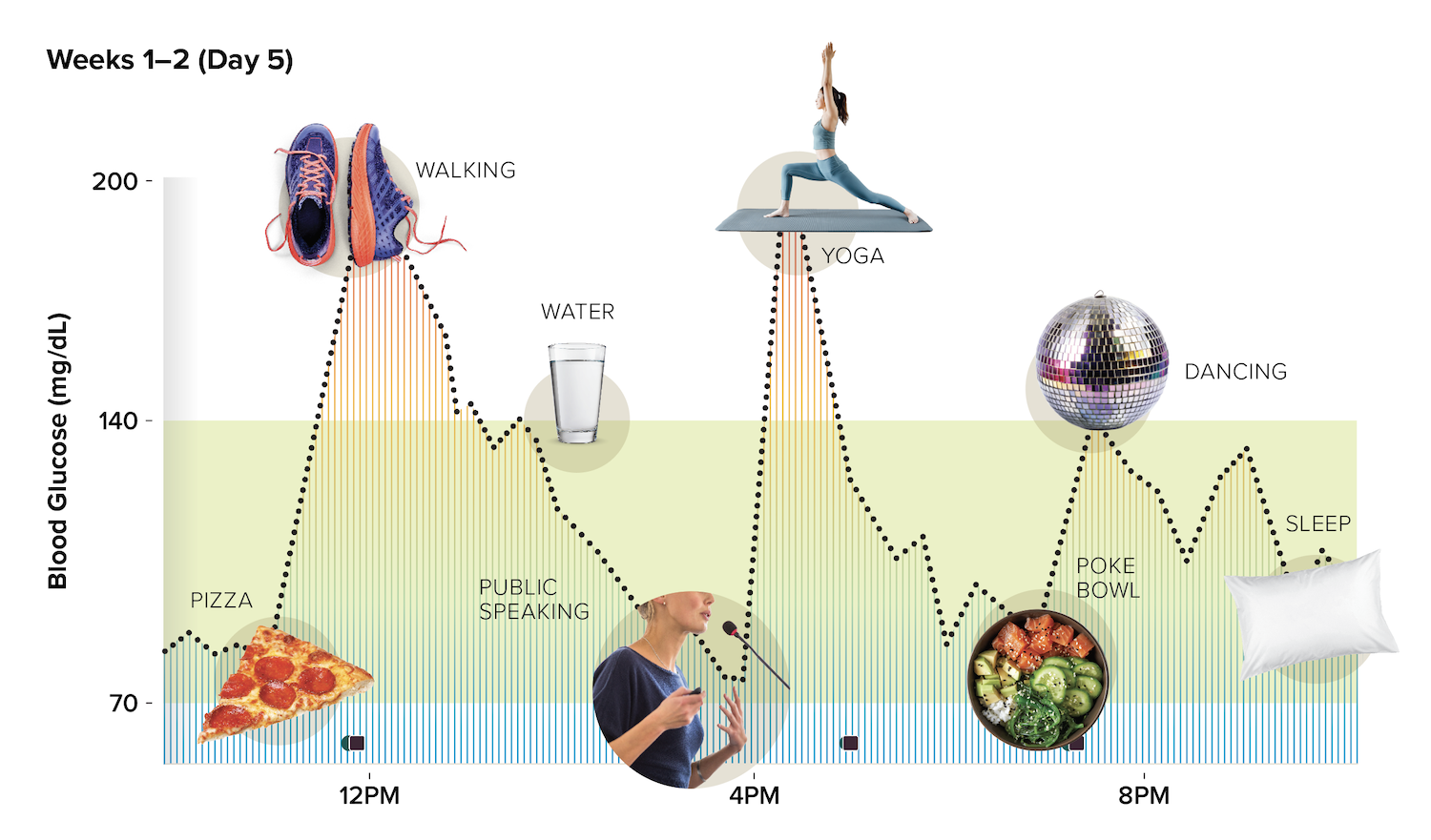
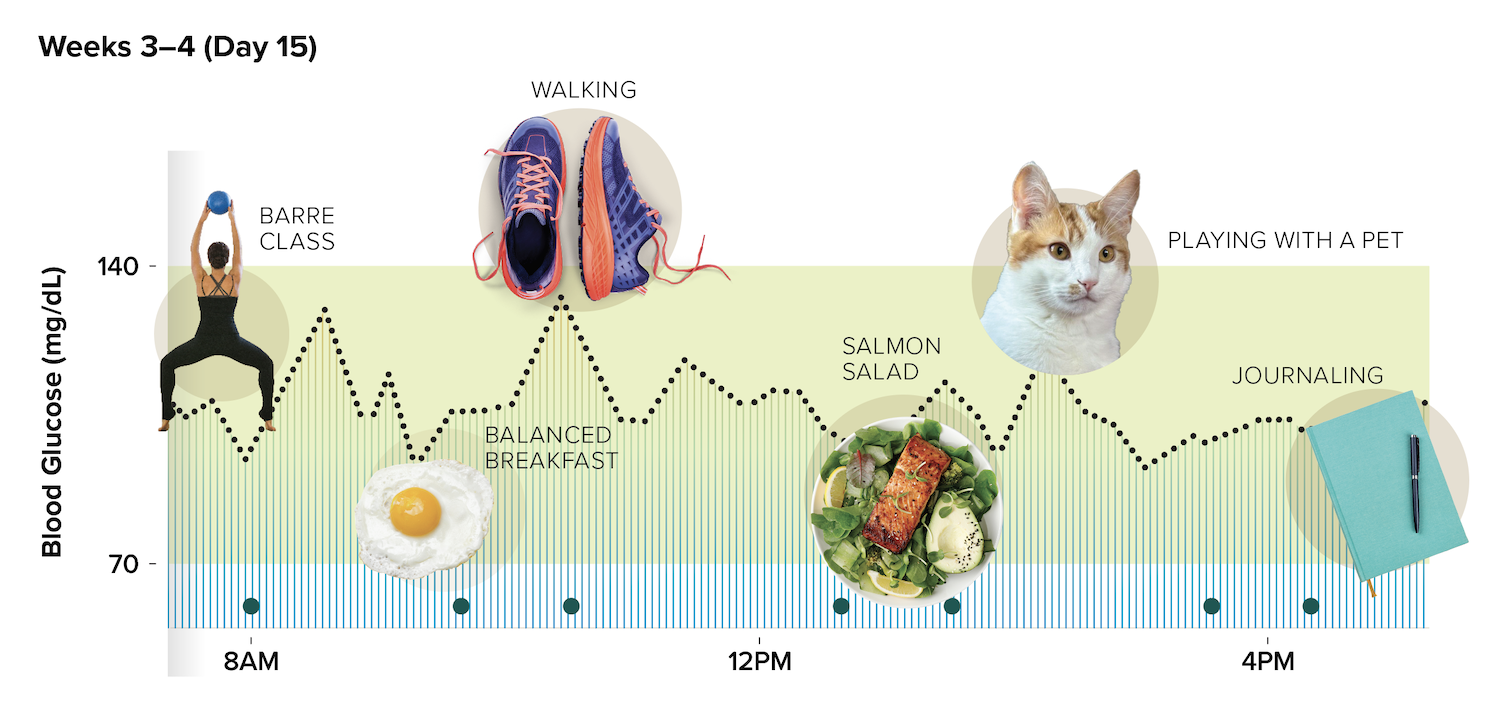
Stelo prompts you to set a target glucose range—in adults without diabetes, the suggested spectrum is between 70 and 140 mg/dL. Charts within the app show you how your levels rise and fall throughout the day, and a spike above 140 will trigger a notification. Click it, and you’ll get tips for minimizing those spikes.

I wore the device for 30 days, electing to live my typical lifestyle during the first half of that period to get a baseline. According to Dexcom’s head of clinical advocacy and outcomes, Dr. Thomas Grace, who reviewed my data, I’m a “normogylcemic” 27-year-old woman: My fasting glucose is at a normal level, and when I eat carbs or sugar and glucose levels rise, my body produces insulin to even things back out. But I wanted to see if I could minimize the spikes I was seeing, so I put some blood sugar–steadying strategies to the test.
There are four major pillars of glucose management: diet, exercise, stress, and sleep. While sugar and carbs can send glucose levels soaring, non-diabetic people striving for glucose harmony don’t necessarily have to kill pasta from their meal plan. Starting every meal with protein or veggies, then moving on to carbohydrates, can help keep you steady (hence the desk carrot).
Moving after eating makes a difference, too. After meals, I’d take a walk or even dance around my living room, which had my glucose levels dropping as fast as they’d risen—or, in many cases, prevented a spike at all.

Articles in the Stelo app explain that poor sleep can increase insulin resistance, making it harder for your cells to effectively utilize insulin, and stress triggers hormones like cortisol and adrenaline, which prompt your body to throw some extra glucose into your bloodstream (as evidenced by the spike I saw just minutes before a meeting I was anxious about).
Of course, anyone can follow these strategies without a CGM. But all the medical pros I spoke with agreed that seeing the data can help people make tangible shifts. “It is a wonderful reality check for the dietary and exercise changes that we recommend,” says Sharp HealthCare endocrinologist Dr. Neelima Chu.
Stelo, which is incorporating generative AI and partnering with fitness-tracking “smart ring” Oura to give users more personalized insights, still isn’t perfect. No biosensor on the market is right all the time (Stelo is at about 93 percent accuracy), and the app could do a better job of storing older data for easy, long-term access. (Though I can see that I experienced a spike three weeks ago, for example, I can’t yet click to access my note about what I ate just beforehand.) And I couldn’t help but wonder how much people who are normoglycemic really need to worry about it all.
“We just don’t have enough information [to know for sure],” says Scripps Health’s lead diabetes expert, Dr. Athena Philis-Tsimikas. “We’d have to do a study with two comparison groups—one that’s keeping things steady and one that’s doing whatever—and follow those groups for a fairly prolonged period of time, and then look and see if there was benefit or detriment of doing it one way versus another, and we just we don’t have that data now. So, it’s very hard to promote it one way or the other.”
But with prediabetes remaining so underdiagnosed, there’s much to be said for a tool that can help you understand your body better. “At some point,” Grace hopes, “there’ll be enough people wearing a product like this, getting the education that they need, that maybe, instead of the exponential increase in obesity and type-two diabetes, we’ll be able to make some headway there.”
Amelia Rodriguez is a writer and journalist and winner of the San Diego Press Club's 2023 Rising Star Award and 2024 Best of Show Award, she’s also covered music, food, arts and culture, fashion, and design for Rolling Stone, Palm Springs Life, and other national and regional publications. After work, you can find her hunting down San Diego’s best pastries and maintaining her five-year Duolingo streak.

The University Heights eatery will close September 7 for a multi-month renovation and rebrand
Ten years ago, restaurant design centered around sleek minimalism. Fonts lacked serifs, clean lines dominated, and any manufacturer that made globe-shaped chandeliers must have made an absolute killing.
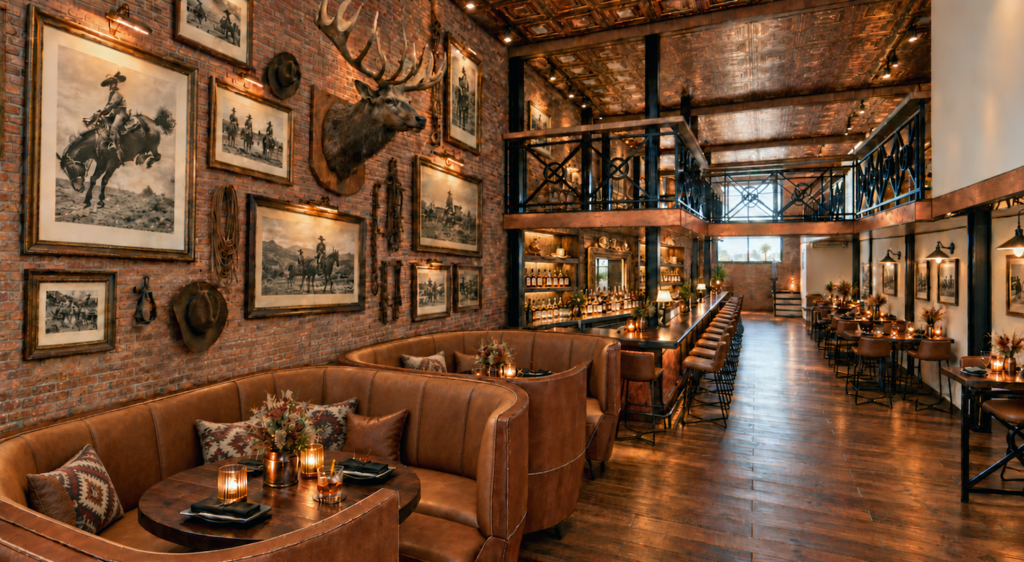
Things have changed since then, and Jeff Fink says it’s time for Madison on Park to glow up. On September 7, Madison will temporarily close its doors for a top-to-bottom renovation of the space and concept. Fink hopes to reopen this fall ahead of the busy holiday season, with a new look he calls moody mid-century maximalism.
“We have to take into consideration what’s going on culturally,” he says. When Madison first opened, TikTok wasn’t a thing in the U.S. and craft cocktails felt relatively cutting-edge. Today, he sees a resurgence in the vintage look, handmade goods, and low-to-no ABV drinks dominating menus everywhere.

Fink and his partner Matt Sieve have already dabbled with that sort of motif at Sonny’s Pizza, their Brooklyn-inspired joint around the corner. Fully half of the cocktail menu is made up of spritzes, mocktails, and Negronis. Madison 2.0 will take it further.
The new concept doesn’t have a name yet—Fink says they have to feel out the vibes as they make progress with the design. “The name comes when you see it appear,” he says. But he has a few design elements in mind: things like more artwork and more uplighting. “Not cluttered and overstuffed… I want to keep it intimate, sexy, and immersive.”
Madison rightly earned its rep as one of the best-dressed eateries in San Diego, nabbing an Orchid Award for interior design its first year. The returning designers Anna and David Sindelar originally transformed the space from weird padded walls and fake greenery at Lei Lounge into a mid-century modern wonderland, complete with a signature arched ceiling and geometric patterns aplenty. Michelin-recognized chef Mario Cassineri (Ciccia Osteria, Bice Ristorante) built a menu heavy on Mediterranean flavors mixed with California classics.
The new menu shouldn’t feel completely jarring, but will take cues from Fink’s recent travels in Spain with his family. Expect shareable plates with lighter ingredients. “Americans eat way too much, and our portions are way too big,” he says. “I like the idea of smaller plates, healthier plates, and being creative… I’d rather see 15 items on the menu that are all less than $20 so that I can try different ones.” Bar manager Danny Kuehner will continue developing craft cocktails and mocktails for the new venture, as well as curating a selection of wine from Europe and locally.

This isn’t the only project on their plate. Besides running Sonny’s in University Heights and Madi in Normal Heights, later this fall, Fink and Sieve will also open Josie’s, a modern all-day, Midwestern-style diner inspired by Sieve’s Minnesota roots. Like all their restaurants, it’ll hold a special part of their families’ legacies—something Fink hopes people feel as soon as they enter.
“You walk into Sonny’s, you’re like ‘Oh, Jeff’s at home,’” Fink laughs. “[Josies’] will be ‘Matt’s at home.’” The next version of Madison? We’ll have to wait and see.
Madison on Park will temporarily close on September 7 until October (barring any unexpected delays). Keep up with the newest updates on Madison’s Instagram.
Listen Now: The Latest in San Diego’s Food and Drink Scene
Have breaking news, exciting scoops, or great stories about new San Diego restaurants or the city’s food scene? Send your pitches to [email protected].
Beth Demmon is an award-winning writer and podcaster whose work regularly appears in national outlets and San Diego Magazine. Her first book, The Beer Lover's Guide to Cider, is now available. Find out more on bethdemmon.com.
Sinner Buns is building a following for its slow-made, seriously gooey weekend treats
When I was pregnant, my food craving was singular and intense. If I didn’t eat at least one thing doused in cinnamon every day (ideally, more than one), I was—to put it gently—a complete monster.
Since then, my obsession has tempered somewhat. But cinnamon buns still perch high on my top treats list, so I’m always on the lookout for the next great place to indulge. IMO, The Huddle in Mission Hills’ mondo cinnamon roll remains top-tier, but after eyeing the ooey, gooey goodies from Sinner Buns, we might have a contender.
Originally from Ukraine, Daria Nadar had already done everything one can do at a bakery—business operations, wholesale contracts, actually baking, you name it—so during the pandemic, she started dabbling with perfecting her cinnamon rolls. After she got a couple fans over social media, she threw her first pop-up to see how they’d be received. She sold out.
After a few false starts with a couple storefronts and business deals, Nadar officially launched Sinner Buns in October 2025 with her partner Filipe Pazi. After making it through an unexpectedly hectic season stuffed with holiday orders, the team closed temporarily to get everything in line and reopened this April. Business has remained in full swing ever since.
There are only so many ingredients in a cinnamon roll, but “the process is what makes it special,” she says, adding they use fresh yeast rather than powder and a 48-hour process for each batch of brioche dough made to order. (Thus the need for pre-orders.) Customers can preorder until Thursday each week for pickup Friday, Saturday, or Sunday from Sinner Buns’ ghost kitchen at 780 Hollister Street, just east of Imperial Beach.
You can also catch her at various pop-ups around San Diego, the next one taking place on Saturday, August 22 at Infusion Lab Coffee in Pacific Beach. Eventually, Nadar opens to offer nationwide shipping (once she figures out the logistics and quality control) and one day, her own storefront.
But it’ll be on her terms, not the whims of social media. “We already learned how to not only rely on virality of the product, because you go viral and then it fades,” she says. “It’s a slow burner, and I know eventually, it’s going to grow much more.”

Listen Now: The Latest in San Diego’s Food and Drink Scene
Have breaking news, exciting scoops, or great stories about new San Diego restaurants or the city’s food scene? Send your pitches to [email protected].
Beth Demmon is an award-winning writer and podcaster whose work regularly appears in national outlets and San Diego Magazine. Her first book, The Beer Lover's Guide to Cider, is now available. Find out more on bethdemmon.com.
From her Rancho Peñasquitos kitchen, Yanira Majano is sharing family recipes through San Diego’s growing home-restaurant movement
When San Diego launched Micro Enterprise Home Kitchen Operations (MEHKO), it changed everything. Riverside County first established the experimental program in 2019, with San Diego introducing its own countywide pilot program in 2022 and granting it permanent status in 2024. The new category allowed people to launch at-home retail food operations—basically, home restaurants—with special requirements and restrictions to ensure food safety and smooth operations. Over two dozen counties across California have since adopted their own versions with over 1,200 permits issued, around 100 of them in San Diego alone.
Some have a dizzyingly long waitlist (Warung RieRie), others are still getting their name out there (The Hidden Gazebo Eatery), and still others use MEHKO for pickups rather than fully opening their home as an onsite dining facility. Love Pupusas falls into that category.
Yanira Majano came with her family from El Salvador to the United States when she was 11 years old, bringing a love of cooking and desire to share the country’s cuisine along with her. “There’s a lot of similarity [between Salvadoran food and] Central, South America, even Baja Mexico,” she says. Salvadoran cooking tends to be less spicy than some Mexican cuisines, with an emphasis on ingredients like corn, staples like yucca root (cassava), meats like crispy pork (chicharrón), and sides like curtido, a tangy cabbage slaw that’s typically either naturally fermented or vinegar-based.
And of course, the signature dish of El Salvador—pupusas.
In San Diego, Salvadoran food lacks the widespread availability of other Latin American cuisines like Mexican or Peruvian food, but Majano says she’s seen pupusas gain popularity over the past few years. But she likes to think her recipes, which have been passed down by her mother and kitchen partner Martha, contain a certain special something.
Some pupuserías use rice flour to create the handheld stuffed tortillas, but she prefers the more traditional gluten-free corn flour. Still, it’s what’s inside that really counts. “That’s where we put our own touch,” she explains. Most of Majano’s pupusas come with cheese and different fillings like carnitas, black beans, mushrooms, or zucchini, but she also offers vegan options. Every one comes with a side of curtido and salsa, each made fresh daily.
Showing people the magic of home-cooked food might not have been possible without the MEHKO program or The Cook Alliance, a MEHKO support and advocacy coalition. Opening a brick-and-mortar restaurant requires a huge amount of start-up capital—at least six figures, generally. Not exactly pocket change. “But when the MEHKO program started in 2022, I said, ‘Oh my God, this is for me,’” says Majano.
Now with four years under her belt, she says she’d love to bring Love Pupusas to more food festivals, host more pop-ups, and eventually open a food truck to keep serving the humble dish of her homeland, taking pride in every bite. “[I put] a lot of love in everything I do. You see it when you taste the food,” she promises.
Pre-order Love Pupusas for next day pickup in Rancho Peñasquitos between noon and 5 p.m.
Listen Now: The Latest in San Diego’s Food and Drink Scene
Have breaking news, exciting scoops, or great stories about new San Diego restaurants or the city’s food scene? Send your pitches to [email protected].
Beth Demmon is an award-winning writer and podcaster whose work regularly appears in national outlets and San Diego Magazine. Her first book, The Beer Lover's Guide to Cider, is now available. Find out more on bethdemmon.com.
KQ Aesthetic Society goes beyond cosmetic to provide comprehensive care and transformative results
Kelly H. Harfouche, founder of KQ Aesthetic Society, knows firsthand that cosmetic treatments like fillers, neurotoxins, and microneedling, can not only enhance a person’s appearance and restore confidence, they have the power to truly change a person’s life. An expert injector has the ability to tailor treatments to each individual patient’s anatomy and goals for personalized results. Harfouche, a board-certified nurse practitioner, has spent nearly a decade perfecting her craft as an aesthetic injector and integrating her multifaceted artistic skills with precision patient care. Her commitment to continual education and training, plus a passion for helping people look—and feel—their best, set KQ Aesthetic Society apart in a sea of local medspas.
For many people considering nonsurgical treatments, the intent is to look refreshed and refined. KQ Aesthetic Society’s philosophy eschews a cookie cutter approach that bases treatments around units, instead working to understand each person’s unique goals, then curating a treatment plan to fit that vision. Harfouche focuses on “inclusive luxury,” the belief that everyone deserves access to aesthetic treatments, respective of budget restrictions. She develops long-standing trusted relationships with her patients, and works with each one to achieve their aesthetic objectives and address the underlying causes of their concerns.
“For me, forming an honest and open relationship with every patient who walks through the door is essential. This means understanding them on a deeper level and meeting them where they are to define and achieve their individual goals,” she says.

Drawing on her artistic background, which inspired her transition into medical aesthetics, Harfouche sees each client as a “unique canvas.” Rather than relying on standardized procedures, the practitioner’s distinctive approach combines her profound understanding of the physiological and anatomical changes associated with aging with an unwavering commitment to ongoing education about the newest products and their mechanisms of action. Her goal is to make each patient feel beautiful in their own skin and to embrace their individuality.
She has also pioneered a way to combine her talent for aesthetic artistry with her philanthropic nature. Harfouche is one of only a handful of providers using dermal fillers to treat patients with lip asymmetry and scarring resulting from cleft lip surgery. Patients travel from around the country for this transformative treatment, noting increased confidence and a restored identity. She hopes to eventually launch a training program to help fill the void in this space.

“My passion has always been connecting with people and giving back in any capacity that I can,” she says. In the rapidly advancing landscape of aesthetic medicine, you can place your confidence in Harfouche and KQ Aesthetic Society to deliver exceptional care. To learn more or book a consultation, please visit kqaestheticsociety.com.
The Ely Callaway Performance Center is where tour-level fittings, cutting-edge technology, and golf equipment you can’t buy yet all come together
“Come test something.”
Those are quite possibly my three favorite words in the English language—all due respect to “I love you” or the highly underrated “you were right.”
I’ve been a PGA Golf Professional since 1994, and yes, full bias disclosure, a Callaway Golf Ambassador for 18 years. One of the bonuses that comes with that combo is access to the Ely Callaway Performance Center—a place so exclusive it gives “velvet rope” vibes.
Originally opened in 2006 as a highly functional (yet not exactly breathtaking) test facility, the ECPC got a serious glow-up in 2018 when Gil Hanse (along with partner Geoff Shackelford) turned it into what can only be described as a fully engineered golf playground. Hanse is no stranger to golf course renovations. In 2024, he completed an extensive redesign of the Omni La Costa North Course in Carlsbad, so it could host the NCAA Division 1 Golf Championships. He also worked on acclaimed courses like Winged Foot, Merion Golf Club, and Oakmont Country Club.
In just two months, it went from a standard test center and R&D lab to a fully dialed-in golf playground.

What was once purely practical is now intentionally designed to be both precise and inspiring. The targets are staggered with purpose—forcing creative shot-making while also calling you out on your actual distances (no more “that’s my 150-yard club … ish”).
Add a massive hitting area, bunkers and greens that mimic real on-course conditions, a “Himalayas” putting green (named for its roller-coaster undulations), an upgraded indoor putting lab, and a 120-decibel sound system blasting a very golf-appropriate playlist, and suddenly it’s a rare blend of high-performance testing facility and “don’t mind if I stay here all day” energy. Since this isn’t exactly open to the public, SDM asked me to take you behind the curtain.
As the iron gates part, it feels less like arriving at a practice facility and more like being granted backstage access at a rock concert—if the bandmembers were made entirely of launch monitors and perfectly manicured turf.
There are no mats. No guessing. No “I think that one felt good?” Just conditions that mirror exactly what tour players see in competition. Because when you’re testing equipment at this level, accuracy isn’t a bonus—it’s the whole point.
Even the sand matters. Different textures. Different densities. Because bunkers have personalities, too, and they are often unfriendly. And the golf balls? Brand. New. Not the usual “these have seen some things” range balls. New balls mean consistent spin, truer trajectory, and no surprises. The older a golf ball gets—and the more it’s been baked in the sun, scuffed, or generally lived a full and complicated life—the less reliable it becomes. Think of it like this: fresh ball, predictable performance; old range ball, slight chaos with a side of mystery.
I’m escorted to my personal hitting bay—basically a pop-up shaded oasis stocked with enough equipment to make a gear junkie weak in the knees. Shafts in every weight and profile imaginable. Heads lined up like they’re waiting to be drafted by their favorite team.

Toptracer technology was patiently waiting to track every one of my swings, each shot instantly delivering ball speed, launch, spin, carry distance, and dispersion (a polite way of saying consistency, or lack thereof), so there’s no guessing—just data telling the truth, whether I like it or not.
We start with irons. Different heads, different feels, different results. When I miss a shot, the ball tends to leak right, so we check lie angle. A quick adjustment—2 degrees upright—and suddenly the clubface is consistently square at impact like it remembered its job. Effort level: down. Ball flight: improved. Confidence: creeping back.
Next we look at the different shaft options—because nothing says “fun afternoon” like realizing a higher kick point can change your entire golf identity. Shaft flex (how much the shaft bends during your swing) helps determine whether you get more height and distance or more control, while kick point (where the shaft bends the most) influences your ball flight—lower kick point for higher launch, higher kick point for a flatter, more penetrating shot. In other words, one small tweak and suddenly you’re hitting shots you’d normally only describe later, slightly exaggerated, over a glass of wine.
Then we move through the bag: hybrids, fairway woods, drivers, wedges. It’s a full rotation of “try this,” “now try this,” and “okay wait … THAT one.”
And yes—the new Quantum driver and fairway woods made an appearance. Without getting too deep in the weeds, they’re faster, more forgiving, and smarter (thanks to AI face mapping) than previous models. Translation: Even your mishits are now slightly less embarrassing. And they were not the only things getting tested. My patience was under attack because the driver and woods would not be available to the public for a good three months.

Watching the fitting team work is like watching a Formula 1 pit crew. Clubs are swapped in seconds. Shafts tightened, adjusted, replaced. One minute you’re swinging something that seems “fine,” and the next, you’re holding a club that feels like it is a part of your DNA.
Then there’s the putter fitting. Drivers are physics. Putters are therapy. Inside the putting lab, sensors track everything—tempo, face angle, path—things you didn’t even know could be measured. Within minutes, my data politely informs me that my putter face is slightly closed at impact. Not shocking, but also not ideal.
A few quick adjustments—different head (with a bit more weight at the toe to discourage the face swinging closed at impact), shorter shaft (so I feel more over the ball, which helps my eyeline)—and suddenly the ball starts rolling exactly where I’m aimed.
Same stroke. Same golfer. Completely different outcome. If only the rest of life worked like that.
And then there’s the part that feels slightly classified. The ECPC isn’t “just” a performance center—it’s also where future equipment lives before the public even knows it exists. I’ve been there when certain clubs were basically under surveillance. Not “don’t touch,” but more “please keep phones in your pocket.”
It’s golf’s version of Area 51. Except instead of aliens, it’s drivers that won’t hit shelves for another year—and like I mentioned, waiting is not my strong suit.
Getting to test the newest equipment isn’t just a perk—it’s part of the job. It’s what allows me to stand in front of students and say, “I’ve tried it. I know what works and what doesn’t. And more importantly, I know why.” And if I happen to sprint to my car every time the phone rings and someone says, “Come test something” … well, that’s just professional courtesy.
Callaway isn’t the only place to get your swing analyzed and clubs fitted. You can stroll into big retail spots like The Golf Mart or Golf Galaxy, book a next-level session at a dedicated studio like Club Champion or True Spec Golf, test brand-specific gear at various manufacturing companies (many located in Carlsbad), or even combine a lesson and a fitting at GOLFTEC. And let’s not forget your local golf course, where fittings happen on actual turf, on a driving range you have some history with—many times with the golf professional who is familiar with your swing so they can give you valuable input. With this many options, there’s really no excuse, other than pride, to keep blaming your clubs.
After two years of farmers markets and pop-ups, the San Diego baker is bringing its Korean-inspired pastries to University Heights
The folks at Kairoa Brewing Company must never be lonely. It seems like there’s always a local pop-up or event at the University Heights space, from Bincho Taco slinging Japanese coal-fired tacos on the rooftop patio every Tuesday to Yipao Coffee serving coffee from a window on the ground floor. Later this year, the New Zealand-inspired brewery will bring yet another resident into the fold—Mon Chourie is launching its first bakery counter service window along Park Blvd.
Mon Chourie owner and baker Kelly Kim first started selling her Korean-style cream puffs at farmers markets and places like Pizza Kaiju, Pho Ga Go, and Mixed Grounds, collaborating with a myriad of other makers (like Amor ice cream and Ming Oun’s) before nabbing a regular spot at Michi Michi Bakery every Wednesday. San Diego Magazine readers even voted Mon Chourie the Best Pop-Up for 2026.
In French, the word for an airy puff pastry is “choux,” which is pronounced generally the same way as “syu,” the Korean word for the same item. (Both sound like “shoe.”) Mon Chourie plays with both iterations with a dash of whimsy by referencing the song My Cherie Amour by Stevie Wonder, which translates to “my darling love.”
As long as all the permits and inspections move forward without issue, Mon Chourie should open in Kairoa before the busy holiday season. She’ll continue appearing every Wednesday at Michi Michi and other pop-ups in the meantime. Once open, expect best-selling flavors like the savory potato croquette (a collaboration with Karanchi chili crisp) and a sweet Dubai chocolate choux au craquelin, a version of puff pastry with a delicate cookie crust.
Classic cream puffs are fluffy, softs and often filled with custard cream in the United States. “What makes a difference for us is we use a very light version of diplomat cream, which is my mom’s recipe,” she explains. Diplomat cream is a lighter French pastry cream that uses whipped cream for a lighter, airier end result.
Choux au craquelin’s signature crunchy top comes from adding a thin disc of cookie-like dough on top of the pastry, which crackles as it bakes, leaving a thin layer of crispiness atop the final product. “It contrasts with the creamy, fluffy cream inside, so it gets that better, deeper texture experience,” she says.

Along with her popular cream puffs and her bite-sized “mini-choux” options, Kim is also planning on offering more of a newer-to-her item: salt bread, a rich butter pastry topped with sea salt that originated in Japan, but went completely viral in South Korea. There are a few places to get it in Los Angeles and New York, “but I know that a lot of people here are interested in trying out new stuff, or maybe they had it in Korea or Japan, and they came back, but they couldn’t find it anymore,” says Kim. At first, she didn’t really get why it was so popular. Then she tried it in South Korea earlier this year.
“I was in love,” she laughs. “This is what the hype is about.”
Ideally, Mon Chourie will eventually open its own storefront and introduce more events in North County to satisfy demand. “I would also love to have our own drink program that reflects what’s popular in Korea,” she says. And to mark two years of puffy pastry prosperity, Mon Chourie is throwing a two-year anniversary party at Easy Does It (5375 Kearny Villa Rd., Suite 112) on Wednesday, August 25 from 4 p.m. to 7 p.m. with drink specials like a misugaru latte (a Korean roasted multi-grain powder with espresso), a DJ, photo booths, special ceramic merch created by local ceramicist Whale Tran, and a few other vendors. Get there early.
Mon Chourie will open inside Kairoa Brewing Company by the end of 2026 and posts the next week’s schedule of upcoming events and pop-ups on Instagram every Monday.
Listen Now: The Latest in San Diego’s Food and Drink Scene
Have breaking news, exciting scoops, or great stories about new San Diego restaurants or the city’s food scene? Send your pitches to [email protected].
Beth Demmon is an award-winning writer and podcaster whose work regularly appears in national outlets and San Diego Magazine. Her first book, The Beer Lover's Guide to Cider, is now available. Find out more on bethdemmon.com.
A look at San Diego's top designers creating unique environments that combine creativity and function


AVRP Studios’ tradition for Design Excellence and Innovation began in 1976 with Doug Austin, FAIA, in Solana Beach, California. The firm has since grown to complete major projects throughout the United States and Canada. We think of ourselves as a family and we care deeply about people. We want to inspire, help make their lives richer and more complete through our efforts. We believe that architecture is one of the most important art forms because of the impact it can have on the lives of those it touches. We’re delighted to have been recognized with over 150 awards for design excellence.
703 16th Street, Suite 200, San Diego, California 92101 | 619-704-2700 | avrpstudios.com