Featured articles
Featured articles
Featured articles
What's next
Featured articles
Featured articles
Featured articles
Ready to know more about San Diego?
SubscribeReady to know more about San Diego?
After the rescue: the Kaufman family speaks
The Kaufmans’ journey on their sailboat, Rebel Heart, comes to an alarming and heartbreaking end, igniting a surge of media attention and fury at the rescue’s estimated $663,000 price tag and raising concerns for the safety of their young children. Charlotte Kaufman, mother of two, speaks publicly for the first time.
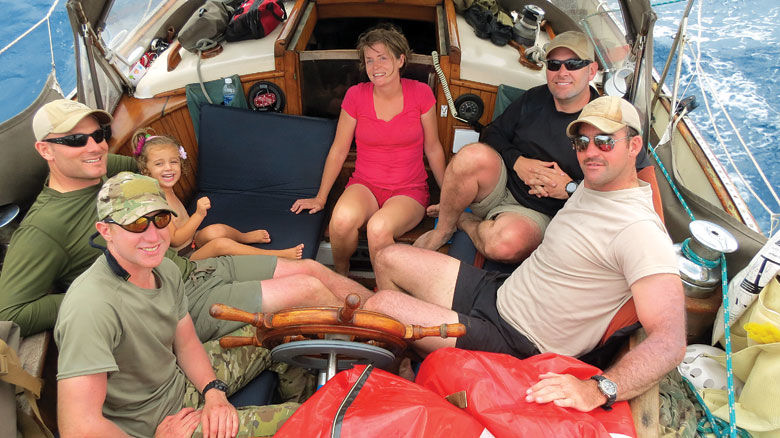
Charlotte and Cora Kaufman with parajumpers
Cora and Charlotte Kaufman in the cockpit of Rebel Heart with the four parajumpers of California’s Air National Guard 129th Rescue Wing.
We were 900 nautical miles off the coast of Mexico when we made the decision to push the EPIRB (an emergency beacon) on our sailboat, signaling for help. Put simply, our one-year-old daughter, Lyra, became sick while we were underway. Her condition continued to deteriorate, even on antibiotics, and we needed to get her help. Additionally, our boat suffered damage during several squalls in the Inter-Tropical Convergence Zone, leading to a complicated, culminating series of events requiring a rescue and the scuttling of our boat to prevent it from becoming a navigational hazard (scuttling is cutting holes in a boat to force it to sink).
While sitting on the boat, awaiting rescue, we never expected to be greeted by such a firestorm of criticism upon our arrival at home. Frankly, we can’t take any of the criticisms thrown at us seriously.
My husband Eric and I believe that traveling with our children will enrich their lives (and ours), give them a great advantage over their peers, and teach them life skills that many Americans who never travel and who can’t speak another language will ever know.
We believe in living without debt, in living with few material possessions, and in saving and planning studiously to have the kind of life that brings that type of freedom. To us, the experiences you accumulate in life are worth much more than what you own or what you can buy.
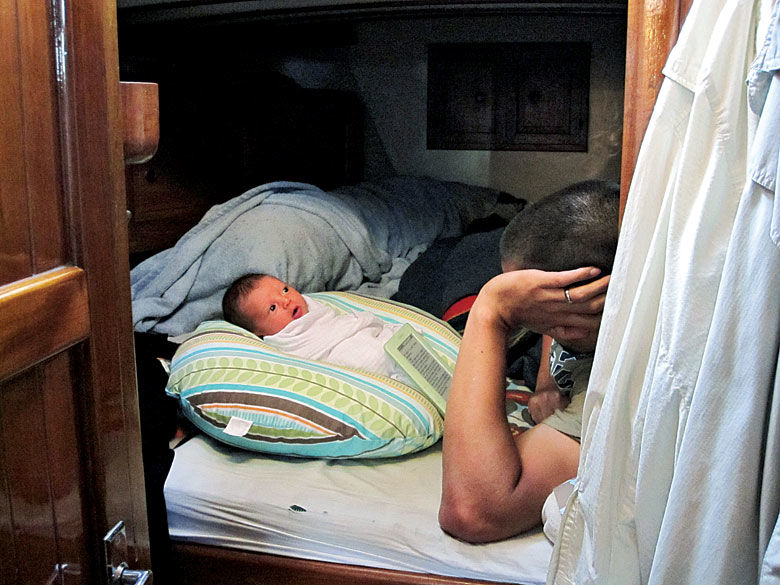
Eric Kaufman reading Thoreau to Cora
Eric Kaufman reading Thoreau to Cora, one week old, in the v-berth of Rebel Heart.
We believe that children who grow up with parents who are actively trying to achieve their dreams will be empowered and motivated to reach for their own life’s dreams in turn. Likewise, children who are “too young to remember” a voyage across the Pacific Ocean, like our daughter Lyra, will still benefit from living in a family that is meeting challenges and enriching its lives together. We had (and have) no desire to sit in stasis in the suburbs until our youngest child is approximately five or six years old, and then begin adventuring in the world. We have actively set up our lives to give us the ability to not live in the blasé, “safe” world of suburbia or Middle America. We understand real versus perceived risks and know that a life at sea is far less dangerous than a life with school shootings, car accidents, processed foods, and sedentary living.
Our children, like most boat kids, experience life as it has been lived for far longer than the reality of America’s current style of living. Kids on boats grow up around knowledgeable, competent adults who have to make serious decisions about life every day. They learn the accurate meaning of safety and caution, and become invested in these decisions much earlier than their peers. My three-year-old’s world has geography, geometry, algebra, and the natural sciences intertwined from morning until night. Our “poor” children don’t have a pet dog, a white picket fence, or a Strider Balance Bike; they also don’t have Nature Deficit Disorder. I’ll take a child who can talk to you about tidal flows, wave sets, and navigating by the stars any day over the alternative of discussions about Monster High dolls, TV shows, and the latest version of their iPads.
We believe that most people lead lives of quiet desperation, and we have vowed to not let our lives end up accordingly. We want to squeeze out every precious drop of our existence together, because tomorrow maybe I’ll die, or Eric will die, and where will we be then? We don’t believe in waiting for far-off “afters,” like after Eric gets a promotion, after Cora finishes kindergarten, after the girls graduate, or after we retire. No. Life is too short and too valuable to gamble on pushing your dreams off until later. We believe in going now, and doing it with gusto.
Lastly, we believe that despite everything, people are really good at heart. Coming back from a monumental event like having a sick child at sea and simultaneously losing your home is beyond world-changing; we have decided to ignore the bleating of some Internet commenters and instead focus on the humanity of the people who have supported us in our lifestyle choice, and in our careful decision to seek help when our daughter and our vessel needed it.
It is not easy to pursue a life at sea, or a life outside of the “box,” but it is worth it. If you are thinking of doing the same thing with your life,
PARTNER CONTENT
I say do not hesitate for a (rebel) heartbeat.
Challenged Sailors Inc.'s specially designed boats allow people with disabilities to sail without limits
For this adventure, you only need to be able to do one thing. “If you can follow directions, you can get in a boat,” says Brewster Schenck, who has quadriplegia and has cruised with Challenged Sailors—a nonprofit that offers free adaptive sailing to people with disabilities—for the past five years.
On an overcast Friday afternoon, a group of 17 huddles on Harbor Island’s docks, home to eight specially designed Martin16 sailboats. The two-person vessels are weighted so they can’t tip over. Even if they filled with water, they wouldn’t sink. The sails are controlled by two ropes and the rudder by a joystick, so the boater can sail without ever having to leave their seat. These boats can even be fitted with technology that allows sailors who can’t use their limbs to control the boat with their breath. As a precaution, a volunteer sailor travels in the seat behind.

The adapted boats give participants freedom they don’t always experience on land. Volunteer Dale Burchby recalls a woman who went sailing with them after a catastrophic accident that rendered her suddenly needing a wheelchair. Looking out at the bay, she asked, “Where do we go?”
Her companion sailor said, “Anywhere you want.”
She burst into tears.
Wheelchairs, walkers, and scooters stay on the docks, explains Challenged Sailors President Peter Phillips, who, because of nerve damage caused by Guillain-Barré syndrome, needs leg braces and a walker to get around.
“When I’m walking, I’m experiencing pain. I can’t go fast,” he says. But out on the bay, “there are no limitations—it’s just the boat and the wind and the water.”

Back on the dock, Penny Anders, who became paraplegic after an accident two years ago, gets ready to be lowered by a hoist into her boat. She beams as she ducks beneath the boom and takes control of the helm. “You go so fast [when you’re sailing]—you’re just flying,” Anders says. The sport has been a source of joy for her in what has been a difficult transition, she adds.
“It saved me, too,” says Leah Gualtieri, her volunteer companion sailor, who took up sailing after a divorce. “Once you’re out there, you don’t want to not be out there.”
Mara Altman is the author of two nonfiction books, Thanks for Coming and Gross Anatomy: Dispatches from the Front (and Back), which was a semi-finalist for the Thurber Prize for American Humor. Altman also wrote eight best-selling Kindle Singles and has written for publications such as The New York Times and New York Magazine. Earlier in her career, she was a staff writer for The Village Voice and daily newspapers in India and Thailand. She lives in North Park with her husband and twins.
Getting outside and staying active is in our blood; and finding new ways to enjoy yearlong perfect weather is what we do best
South Mission Beach Courts
Patrick Davis for Life’s a Beach
The bike shop sits on a popular commute route and is staffed by affable mechanics who have worked the Tour de France. Hardcore bicycle people don’t have the friendliest rep, but MJ’s is different. They’ve got the skill set to equip racers, but they don’t treat commuters or parents buying bikes like tourists in their world.
One minute you’re casually playing a game of pickleball, the next thing you know, you’ve helped design Gearbox’s newest paddle. The brand is based in San Diego and PBTC is their local court, where they play with locals to gain insights on how to improve their rackets. This sounds like free lessons to us.
When a relative was giving away their boat, local architect Vilchis saw an opportunity to design a 10/10 Instagrammable experience. Now you can class up your day date by recreating The Notebook—a pristinely refurbished tiny boat with padded seats, plant garlands, snacks and drinks, and even parasols. Ryan Gosling not included.
Each weekend on the courts of South Mission Beach, the sand is taken over by 2v2 players—many of which are ESL speakers from various countries. They’ve made this plot of sand their sacred community, where the universal language is bump, set, and spike.
On any given Wednesday on Hamilton Ave., 100 to 200 runners gather to run the streets of North Park. It’s put on by Milestone Running, a shop created by locals Greg Lemon and Chad Crawford. Go a few times and you’re pretty much guaranteed at least ten new friends—might even get “Smirnoff Iced” during the post-run raffle. You win some, you lose some.
Even avid runners can lose motivation. This year, Waterfront introduced a new tradition: beer stops. The three- mile loop starts at Eppig Brewing in Point Loma, then heads to Fathom Bistro for a beer before completing the next 1.5 miles. Finish up with a post-run brew at Eppig, obviously.
Mission Bay Basketball Court
Madeline Yang
San Diego’s maritime history runs deep. America’s Cups have a permanent home here. Harbor Sailboats—seven-time winner of the “ASA School of the Year”—offers sailing courses taught by longtime sea dogs. You know, the type of no- nonsense skippers who know how the wind will change by the way the breeze hits their beard hair.
If you want sky-high firs, oak forests that shade your path, and mountain peaks that overlook actual foliage (read: no palm tree in sight), head to Palomar Mountain State Park. And, since the inaugural California State Parks Week took place this year, there’s no better time to dust off your hiking boots on one of the six hiking trails (five for running).
A mellow 5.7 climb on paper, The Tower at Mission Gorge will have you clipping the first few bolts like you’ve been dirtbagging in Yosemite all your life. You’ll have to dig deep into your courage reserves to tackle the crux, but you’ll be walking down that mountain with your head held high when the sun starts to set.
Hoops here have always had a magical effect—a full regulation court, smack dab on the beach. The ball smells like sunscreen. No fence; out of bounds is in the sand. And it just got an artful resurfacing in honor of local basketball legend, Bill Walton—who’s been a member of the South Mission Beach Sports Park & Rec for 25 years.
Yep, in City Heights. Specializing in boards from local shapers, owner Mark Polintan (who grew up on a pineapple farm in the Philippines) has created an infectious gathering place for surfers to support their peers. Like chasing tubes in exotic locations, you never know what or who you’ll find here, but you’re guaranteed to leave stoked.
Surfers are selfish. No matter how many waves we catch, we always want more. And while there’s no shot we’ll ever change, we can at least direct that impulse toward a good cause. At the annual 100 Wave Challenge, participants commit to riding 100 waves in one day to raise funds for the local nonprofit Boys to Men Mentoring.
Nicolle Monico is an award-winning writer and the director of creative projects, digital editor for San Diego Magazine with more than 16 years of experience in media including Outside Run, JustLuxe and The San Francisco Chronicle.
Leave the car at the marina and sail right up to San Diego's best waterfront eateries
When Juan Rodriguez Cabrillo sailed into San Diego Bay in 1542, he clearly realized this: It’s a lovely place to drop anchor and have a bite to eat. All these years later, it still is!
Arguably it’s even better now given that you can dock a boat steps from dozens of restaurants around San Diego Bay—and 60 if you include Mission Bay.
The point is this: Sunning yourself on the deck of a boat beats sweating in traffic. Throwing a line over a cleat beats scrapping for a parking spot. If you don’t have a boat, make a friend who does. Or take some of our other advice below, where you’ll also find everything you need to know about showing up dockside for a meal and sailing off into the sunset.
This page and this page have comprehensive listings of every eatery that boasts a dock for a parking lot, listed by area where you’ll be sailing, whether it’s the Bay, Coronado Island, Shelter Island, Mission Bay, South Bay, and so on. Many but not all restaurant docks are first-come, first-served, and prices vary; call the restaurant or marina ahead of time to find out.
Dock-and-dine options include notable spots like Bali Hai, Bluewater Boathouse Seafood Grill, Joe’s Crab Shack, Quarterdeck, Humphreys, Pizza Nova, and Island Prime. Too many to name them all. Pick your pleasure and cast off.
If you don’t have a boat, these are your best options:
The Best Places to Dock and Dine in San Diego (and How to Get There)
Bluewater Boathouse Seafood Grill
Yes, Chef! winner Emily Brubaker leads the robust culinary program at Omni La Costa Resort & Spa
For Executive Chef Emily Brubaker, Omni La Costa Resort & Spa feels like home. She grew up just a mile-and-a-half away from the 400-acre property and fondly recalls walking the golf course perimeter as a kid. Though her ambitions led her away from San Diego for nearly two decades in which she honed her craft in some of the highest of high-profile Las Vegas restaurants—including triple Michelin-starred Joël Robuchon at MGM Grand—they ultimately brought her back to North County.

Today, the classically French-trained chef, who’s fresh off a victory on NBC’s Yes, Chef!, judged by Martha Stewart and José Andrés, oversees Omni La Costa Resort & Spa’s seven distinct dining concepts. Her goal is to elevate the resort’s culinary program with her creative, hyperlocal ingredient-driven approach while maintaining the Spanish- inspired flavors and fresh California coastal cuisine that are the bedrock of its culinary identity.
“The San Diego food scene is really growing, and in North County alone, it’s really exploded in the last five years,” Brubaker says. “There are Michelin stars, beautiful tasting menus, craft bakers, and all this food—when I was growing up in La Costa, it was fish tacos. Now there are really cool things popping up, and I’m so happy to be here to see where it’s going to go.”
Brubaker gives chefs de cuisine at each individual restaurant autonomy, however, her influence is evident across the resort.
For example, lobby restaurant Bar Traza serves as Omni La Costa’s culinary centerpiece and features bold Spanish flavors in a lively, social atmosphere. Brubaker overhauled the menu to be more consistent and centered on casual bites with that signature vibe. Think smoky paprika, vibrant citrus, and Spanish meats and cheeses.
At VUE, the focus is on seasonal offerings, California coastal cuisine, and Baja-inspired dishes. She and Chef de Cuisine Cameron Dixon change the menu biannually, which heading into summer, will highlight farm-fresh produce and hyperlocal ingredients—the resort even has its own herb garden and honeybee hives.

Poolside dining options are leaning into the country’s 250th this summer with a selection of classic American dishes with an Omni La Costa twist. And Bob’s Steak & Chop House (Brubaker is a trained butcher) offers a classic steakhouse experience with elevated service.
The chef and company also plan menus for special events at the resort where her creativity can really shine. For an upcoming National Ski Association dinner, the banquet hall will be transformed into an Alpine-themed winter wonderland complete with a snow machine, savory sausages, and melty, decadent raclette. A recent dinner was built around the Carlsbad Flower Fields and each course was matched to a color of ranunculus (Did you know pink dragonfruit are grown in North County? You do now.).
“It’s my zen to be in the kitchen playing with food,” Brubaker says.
Omni La Costa’s culinary program is a key part of the resort experience. And with Brubaker’s leadership, it’s becoming a draw for visitors and locals alike.
“These aren’t just hotel restaurants, these are restaurants that you should go to. They’re destinations, and I’m really hoping for the future that’s where we’re going,” Brubaker says.

Brubaker is also channeling her experience on Yes, Chef! into the culture at Omni La Costa—more emphasis on teamwork and collaboration, empowering her staff to share constructive critiques, and embracing different perspectives. Alongside her leadership role, Brubaker has become an advocate for mental health in the hospitality industry, serving as chief ambassador for the Burnt Chef Project and serves on the Board of Advisors for the Apex Culinary Program, where she mentors and develops future talent.
For more on Omni La Costa Resort & Spa and its dining program, please visit omnihotels.com/hotels/san-diego-la-costa.
After the rescue: the Kaufman family speaks
The Kaufmans’ journey on their sailboat, Rebel Heart, comes to an alarming and heartbreaking end, igniting a surge of media attention and fury at the rescue’s estimated $663,000 price tag and raising concerns for the safety of their young children. Charlotte Kaufman, mother of two, speaks publicly for the first time.
Charlotte and Cora Kaufman with parajumpers
Cora and Charlotte Kaufman in the cockpit of Rebel Heart with the four parajumpers of California’s Air National Guard 129th Rescue Wing.
We were 900 nautical miles off the coast of Mexico when we made the decision to push the EPIRB (an emergency beacon) on our sailboat, signaling for help. Put simply, our one-year-old daughter, Lyra, became sick while we were underway. Her condition continued to deteriorate, even on antibiotics, and we needed to get her help. Additionally, our boat suffered damage during several squalls in the Inter-Tropical Convergence Zone, leading to a complicated, culminating series of events requiring a rescue and the scuttling of our boat to prevent it from becoming a navigational hazard (scuttling is cutting holes in a boat to force it to sink).
While sitting on the boat, awaiting rescue, we never expected to be greeted by such a firestorm of criticism upon our arrival at home. Frankly, we can’t take any of the criticisms thrown at us seriously.
My husband Eric and I believe that traveling with our children will enrich their lives (and ours), give them a great advantage over their peers, and teach them life skills that many Americans who never travel and who can’t speak another language will ever know.
We believe in living without debt, in living with few material possessions, and in saving and planning studiously to have the kind of life that brings that type of freedom. To us, the experiences you accumulate in life are worth much more than what you own or what you can buy.
Eric Kaufman reading Thoreau to Cora
Eric Kaufman reading Thoreau to Cora, one week old, in the v-berth of Rebel Heart.
We believe that children who grow up with parents who are actively trying to achieve their dreams will be empowered and motivated to reach for their own life’s dreams in turn. Likewise, children who are “too young to remember” a voyage across the Pacific Ocean, like our daughter Lyra, will still benefit from living in a family that is meeting challenges and enriching its lives together. We had (and have) no desire to sit in stasis in the suburbs until our youngest child is approximately five or six years old, and then begin adventuring in the world. We have actively set up our lives to give us the ability to not live in the blasé, “safe” world of suburbia or Middle America. We understand real versus perceived risks and know that a life at sea is far less dangerous than a life with school shootings, car accidents, processed foods, and sedentary living.
Our children, like most boat kids, experience life as it has been lived for far longer than the reality of America’s current style of living. Kids on boats grow up around knowledgeable, competent adults who have to make serious decisions about life every day. They learn the accurate meaning of safety and caution, and become invested in these decisions much earlier than their peers. My three-year-old’s world has geography, geometry, algebra, and the natural sciences intertwined from morning until night. Our “poor” children don’t have a pet dog, a white picket fence, or a Strider Balance Bike; they also don’t have Nature Deficit Disorder. I’ll take a child who can talk to you about tidal flows, wave sets, and navigating by the stars any day over the alternative of discussions about Monster High dolls, TV shows, and the latest version of their iPads.
We believe that most people lead lives of quiet desperation, and we have vowed to not let our lives end up accordingly. We want to squeeze out every precious drop of our existence together, because tomorrow maybe I’ll die, or Eric will die, and where will we be then? We don’t believe in waiting for far-off “afters,” like after Eric gets a promotion, after Cora finishes kindergarten, after the girls graduate, or after we retire. No. Life is too short and too valuable to gamble on pushing your dreams off until later. We believe in going now, and doing it with gusto.
Lastly, we believe that despite everything, people are really good at heart. Coming back from a monumental event like having a sick child at sea and simultaneously losing your home is beyond world-changing; we have decided to ignore the bleating of some Internet commenters and instead focus on the humanity of the people who have supported us in our lifestyle choice, and in our careful decision to seek help when our daughter and our vessel needed it.
It is not easy to pursue a life at sea, or a life outside of the “box,” but it is worth it. If you are thinking of doing the same thing with your life,
I say do not hesitate for a (rebel) heartbeat.
Southwest of Coronado Island
Submit your best San Diego shots
to [email protected].
March 6, 2012 2:47 p.m.
Location: Southwest of Coronado Island
Camera: Canon 5d mkii using the 70-200 f/2.8L @ 200mm and f/2.8
“Sailing is not in the mainstream—and that’s something that interests me,” says John Trice, a commercial photographer and University Heights resident. “That, and my wife used to be a sailing instructor.” During the National Offshore One-Design Series in 2012, the San Diego Yacht Club invited Trice to shoot the regatta (happening again this month, March 14–16). For this shot, he was on one of the chase boats, right next to one of the marks the boats have to round. “With such a long focal length (200mm) and a wide open aperture (f2.8), the entire frame gets super compressed,” says Trice. “So anything in the immediate foreground gets really blurry. In this shot there was a swell between me and the J80 and so it almost looks like I’m below the surface of the water.” The result: We can feel the intensity of the race.
Swell photo southwest of Coronado Island
John Trice
Scripps study shows that some patients may be able to taper their dose and maintain results
While glucagon-like peptide-1 (GLP-1) receptor agents have been used to treat Type 2 diabetes for more than 20 years, their recent emergence as weight-loss wonder drugs marked a new frontier in medicine. But their effectiveness has left some patients wondering what to do once they’ve reached their goal. Stopping the medication could mean regaining some, if not all, of the weight. A Scripps Clinic internal medicine physician recently conducted a small study of whether GLP-1 patients who had reached their goal weight could maintain that weight by taking their regularly prescribed injection every other week instead of weekly. Spoiler alert: 30 of 34 patients did. Read more about the study here and what that may mean as pharmaceutical companies roll out oral GLP-1s.
For more nutrition, wellness, and healthy living tips, sign up for the San Diego Health newsletter here.