Featured articles
Food & Drink
Food & Drink
Food & Drink
Featured articles
Everything SD
Everything SD
Everything SD
Featured articles

Things to Do

Things to Do

Things to Do
Featured articles

podcast-ep

podcast-ep
video
Featured articles
Everything SD
Everything SD
Everything SD
Featured articles
Food & Drink
Partner content
Partner content
Ready to know more about San Diego?
SubscribeReady to know more about San Diego?
Hit up one of these San Diego hotspots to watch football, eat and drink all day, and cheer on your team this Super Bowl Sunday

Updated February 2, 2024
Hosting a Super Bowl party is hard work. All of the food prep, clean-up, and rowdy houseguests can make this day into a nightmare. So why not go out and enjoy some drinks, eat some great food without the clean-up, and cheer on your team? Whether you root for the 49ers or the Chiefs, spend February 11 at one of these San Diego hotspots to watch Super Bowl LVIII. Sunday is supposed to be a day of rest, so we made the list for you. Kick off is at 3:30p.m., and all you have to do is pick which spot sounds best.
Head downtown to Barleymash and watch the game on one of their 45 TVs. Sports Illustrated even once hailed it as one of the best places in the country to watch the Super Bowl, so call ahead to reserve your spot or arrive early to secure your spot.
600 Fifth Ave #6916, Gaslamp Quarter
If you’re planning on steering clear from the downtown chaos, Slater’s 50/50 in Liberty Station is home to over 50 beers taps and 22 screens to enjoy the game. Attend their Big Game Watch Party for $90 and receive one entree, one appetizer, and access to their open bar throughout the duration of the game.
2750 Dewey Rd #193, Point Loma
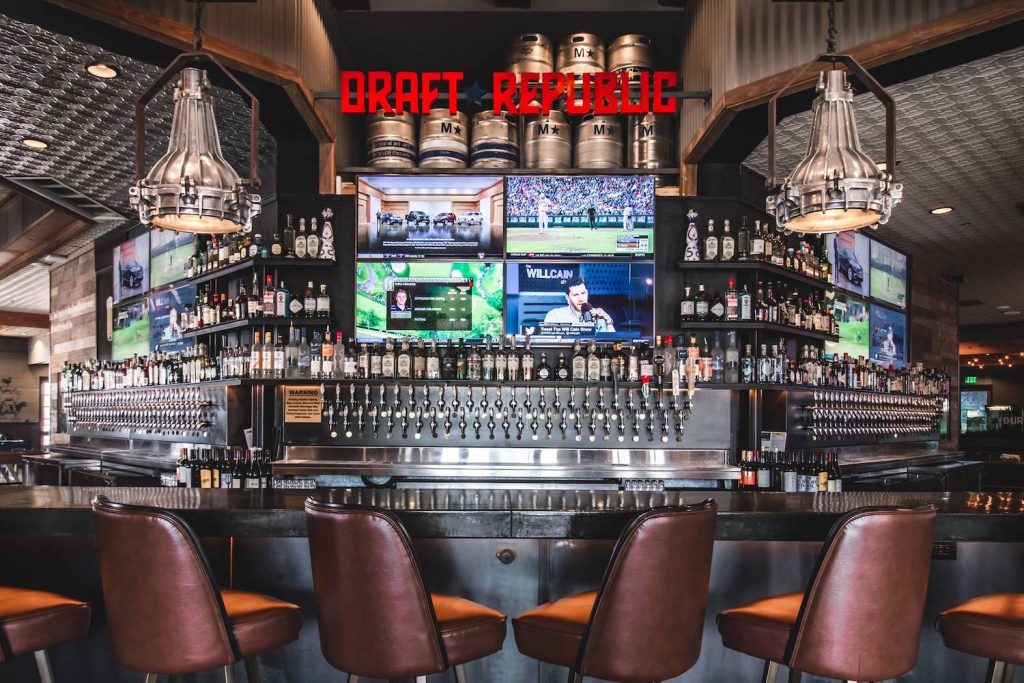
For North County fans, Draft Republic locations in Carlsbad and San Marcos both has over 70 TVs to choose from and hundreds of beers on tap. Grab a seat anywhere because chances are good that you’ll be facing at least one TV. Enjoy Draft Republic’s all day Super Sunday Special offering $8 appetizers and Draft Republic beers, $2 off their pound of wings, and their Half Time Happy Hour Blitz offering 50 percent off well cocktails and selects pints and wines.
5958 Avenida Encinas, Carlsbad and 255 Redel Rd, San Marcos
Take a little trip up to Funner, CA, go to Harrah’s Resort Southern California and settle into one of their plush recliners located in the Events Center. Opt for their VIP Viewing Package featuring Topgolf Swing Suites transformed into exclusive viewing theaters for the big game, along with a bucket of beer and a private cocktail server upon reservation. Tickets are $150 which includes a table for two and entry at 2:30 p.m.
777 S Resort Dr, Valley Center
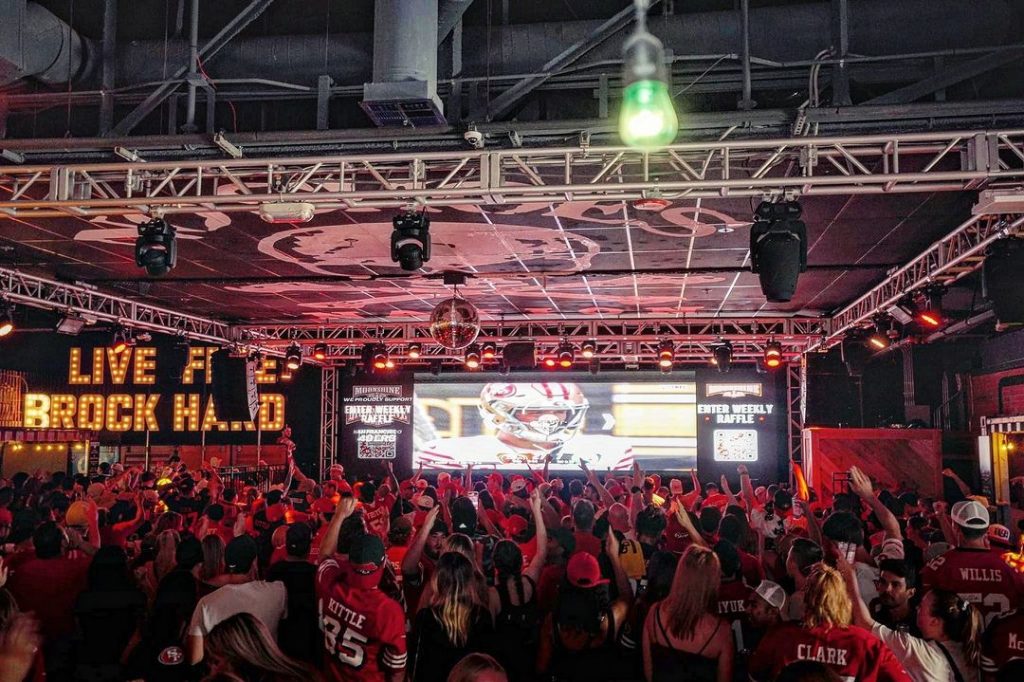
Don yourself in scarlet and gold before making your way to Moonshine Beach in PB for their Super Sunday Party, featuring special offers like five Bud Light or Budweiser beers for $32, $8 Tito’s or Jack Daniel’s, and $10 sliders. Doors open at 2:30 p.m., there is no cover, and it’s first come, first served, so don’t be late!
1165 Garnet Ave, Pacific Beach
North County 49ers fans can gather at Saddle Bar in Solana Beach, a cozy 1920s bike-shop-turned-sports-bar. For the ultimate Super Bowl watch party, don you’re Patrick Mahomes or Joe Montana jersey and join the fun at this 49ers hub.
123 Plaza St, Solana Beach
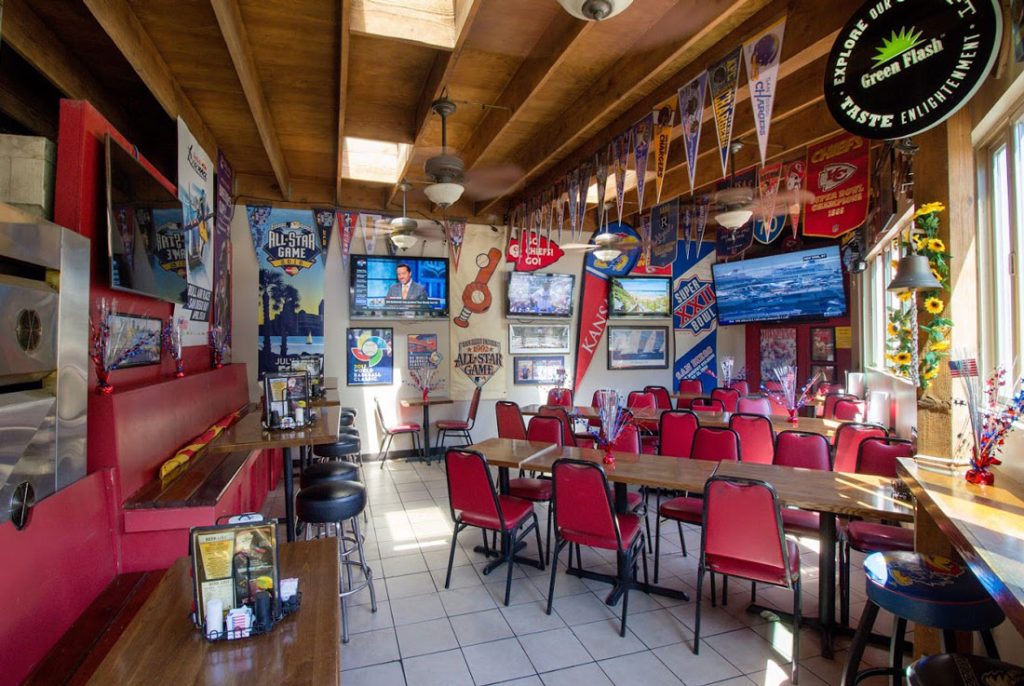
The name of this spot says it all: Kansas City Barbeque. Known for it’s appearance in Top Gun, this Gaslamp watering hole is the ideal spot to revel in another Chiefs Super Bowl win with quality BBQ, local craft beers, and fellow Chiefs fans.
600 W Harbor Dr, Gaslamp Quarter
Make your way over to Home and Away to be greeted by friendly faces dressed in red and white on Super Bowl Sunday. This popular Old Town sports bar serves as the home field for local members of the Chiefs Kingdom.
2222 San Diego Ave, Old Town
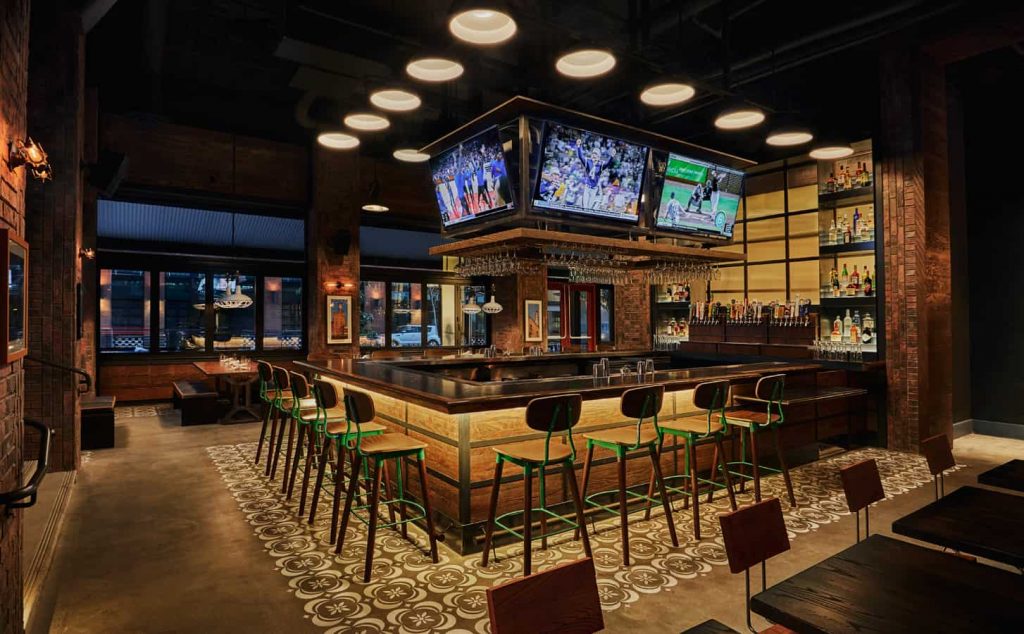
At Manchester Grand Hyatt‘s The Landing, football fans can watch the big game on a large projector screen while indulging in their game day menu consisting of loaded nachos, BBQ candy, and buffalo chicken sandwiches with $2 off draft beers.
1 Market Pl, Seaport Village
Bay Park’s Morena Provisions is cooking up a modern twist on stadium favorites this year for takeout and delivery. Their special Super Bowl Sunday menu includes salt and pepper chicken wings, pigs in a blanket, onion dip, baby back ribs, and so much more.
1122 Morena Blvd, Bay Park
Celebrate the end of the NFL season downtown at Nason’s Beer Hall at the Pendry Hotel. The hotel’s brewery is home to 23 televisions to catch every moment and is offering fans $10 Don Julio Tequila drinks along with $30 buckets of Modelo Especial or Pacifico beer.
570 J St, Gaslamp Quarter
Coronado’s Village Pizzeria is offering a to-go Super Bowl Party Pack that caters to six to 10 guests. Meal packs come with 10-piece wings, 10 mozzarella and zucchini sticks, and a 12-pack of Diablo garlic knots for $60. Add on a large single-topping pizza or a family salad for an additional $12.
1206 Orange Ave and 1201 1st St, Coronado
Scramble over to The Clubhouse Grill at the Fairmont Grand Del Mar for a Super Bowl buffet for the books for $89 per person with the option of bottomless beers for an addition $49. Buffet starts at 2 p.m. and ends once the game clock stops. Reserve your spot here.
5200 Grand Del Mar Way, Carmel Valley
Swing by this Del Cerro Texas BBQ joint to catch the pigskin game or an order of pigskin to go. Swing by the restaurant for tailgate specials including $25 and $30 buckets of domestics and import beers along with plenty of game day bites like their tri trip nachos or pulled pork sliders. For those hosting your own watch party, check out their catering offerings for groups of eight to 80.
5351 Adobe Falls Rd, Del Cerro
Located on Adams Avenue in Normal Heights, The Rabbit Hole is your destination for the big game. Their game day specials include $7 bloody Marys, $30 Nütrl hard seltzer buckets, and savory bites like their loaded fries topped with bacon bits, or their fried pickles.
3377 Adams Ave, Normal Heights
The city's fish taco hero is opening Concrete Cowboy across the street, plus a home-cooked Mexican sandwich spot
You have to be crazy or a genius to name a restaurant Fish Guts. You have to be even crazier to open a restaurant that holds maybe two dozen people at a time—if you don’t mind elbowing one other while scarfing down some of the best fish tacos in San Diego.
And yes, “best” is a relative term. But in Fish Guts’ case, it’s for real—and that’s saying something in a town literally world-famous for fish tacos.
Ever since Pablo Becker opened up his diminutive eatery in 2023 at the corner of Logan Avenue and Sampson Street in Barrio Logan, Fish Guts has been named one of the city’s best new restaurants in 2023, Critic’s Pick for the best fish tacos in San Diego in 2024, 2025 and 2026, as well as readers’ top pick in 2024. It’s like if Rubio’s married into the royal family.
Most of his ingredients come straight from the cold waters of the Pacific Ocean, which happens to be down the street. His de espada (blackened swordfish) taco is the stuff of legend. He’s kept Fish Guts operating at an elite level, which tends to happen when you work for five years in Chicago under chef Richard Sandoval (who, by chance, is also his cousin) and open an ahead-of-its-time high-end modern Mexican restaurant in East Village (El Vitral Restaurant & Tequileria, 2009-2013).
Now Becker is branching out again, opening two new concepts in Barrio Logan this fall.
The first will be upstairs from Fish Guts, which at one point was destined to become an intimate omakase counter. Santo Poco will be a lunch-only sandwich shop, offering takeout and delivery (no dine-in), and the sandwiches will be a little Mexican, a little French, a little Italian, a little from Chicago, a little from New York. Basically, a bunch of different styles all on really, really good bread.
“There’s probably going to be a Cuban-style sandwich in there with a touch of Mexican, some cold cut Italians, too, putting my touch on them,” he says. “That’s what I feel like is my style of cooking.”
Things will be traditional, but inventive. Like his fish & chips taco at Fish Guts: two classic dishes, one killer mash-up. There will also be a hat tip to the late, great Anthony Bourdain, a sandwich called the Antonio Bourdain.
The second will be across the street from Fish Guts in the former Lia’s Lumpia space. Concrete Cowboy will be a taco-driven joint on the same wavelength as Fish Guts (keep it simple, keep it special), but featuring land animals rather than sea brethren. Think tacos made with duck confit, ribeye, pork belly, skirt steak.
The inspiration behind Concrete Cowboy comes from Becker’s father, a lifelong Western obsessive, despite growing up in Mexico City’s urban metropolis. “He always liked that cowboy life, that vibe,” he says. “I always say ‘Dad, you just grew up in the wrong city.”
He’s aiming to open Santo Poco in October and Concrete Cowboy in November. Neither require massive renovations, and while the former Lia’s Lumpia space will keep the cabin-esque aesthetic, he’s creating more of an adobe-style exterior and an interior lined with Western-themed wallpaper and taxidermied animals. He’ll also tweak the bar layout to move from a fast-casual feel to full service.
Local designer Dane Danner is designing both spaces and visual direction for menu layouts, logos, and packaging, going for low-key, but high on vibes. Once Concrete Cowboy opens, Fish Guts will temporarily close to remodel the space to switch its white palette for a warmer feel, plus introducing a refreshed menu featuring some new tacos and other items.
Could another Fish Guts be on the way somewhere else in San Diego? Not likely, says Becker. “Fish Guts is cool, “ he says. “I feel once you start branching out, it’s more forced, not as organic.” So for now, count on Becker staying in the neighborhood.
Santo Palo opens for lunch daily October 2026, 2222 Logan Avenue (above Fish Guts). Concrete Cowboy opens Tuesday through Sunday for lunch and dinner November 2026, 2219 Logan Avenue.
Beth Demmon is an award-winning writer and podcaster whose work regularly appears in national outlets and San Diego Magazine. Her first book, The Beer Lover's Guide to Cider, is now available. Find out more on bethdemmon.com.
The University Heights eatery will close September 7 for a multi-month renovation and rebrand
Ten years ago, restaurant design centered around sleek minimalism. Fonts lacked serifs, clean lines dominated, and any manufacturer that made globe-shaped chandeliers must have made an absolute killing.
Things have changed since then, and Jeff Fink says it’s time for Madison on Park to glow up. On September 7, Madison will temporarily close its doors for a top-to-bottom renovation of the space and concept. Fink hopes to reopen this fall ahead of the busy holiday season, with a new look he calls moody mid-century maximalism.
“We have to take into consideration what’s going on culturally,” he says. When Madison first opened, TikTok wasn’t a thing in the U.S. and craft cocktails felt relatively cutting-edge. Today, he sees a resurgence in the vintage look, handmade goods, and low-to-no ABV drinks dominating menus everywhere.

Fink and his partner Matt Sieve have already dabbled with that sort of motif at Sonny’s Pizza, their Brooklyn-inspired joint around the corner. Fully half of the cocktail menu is made up of spritzes, mocktails, and Negronis. Madison 2.0 will take it further.
The new concept doesn’t have a name yet—Fink says they have to feel out the vibes as they make progress with the design. “The name comes when you see it appear,” he says. But he has a few design elements in mind: things like more artwork and more uplighting. “Not cluttered and overstuffed… I want to keep it intimate, sexy, and immersive.”
Madison rightly earned its rep as one of the best-dressed eateries in San Diego, nabbing an Orchid Award for interior design its first year. The returning designers Anna and David Sindelar originally transformed the space from weird padded walls and fake greenery at Lei Lounge into a mid-century modern wonderland, complete with a signature arched ceiling and geometric patterns aplenty. Michelin-recognized chef Mario Cassineri (Ciccia Osteria, Bice Ristorante) built a menu heavy on Mediterranean flavors mixed with California classics.
The new menu shouldn’t feel completely jarring, but will take cues from Fink’s recent travels in Spain with his family. Expect shareable plates with lighter ingredients. “Americans eat way too much, and our portions are way too big,” he says. “I like the idea of smaller plates, healthier plates, and being creative… I’d rather see 15 items on the menu that are all less than $20 so that I can try different ones.” Bar manager Danny Kuehner will continue developing craft cocktails and mocktails for the new venture, as well as curating a selection of wine from Europe and locally.

This isn’t the only project on their plate. Besides running Sonny’s in University Heights and Madi in Normal Heights, later this fall, Fink and Sieve will also open Josie’s, a modern all-day, Midwestern-style diner inspired by Sieve’s Minnesota roots. Like all their restaurants, it’ll hold a special part of their families’ legacies—something Fink hopes people feel as soon as they enter.
“You walk into Sonny’s, you’re like ‘Oh, Jeff’s at home,’” Fink laughs. “[Josies’] will be ‘Matt’s at home.’” The next version of Madison? We’ll have to wait and see.
Madison on Park will temporarily close on September 7 until October (barring any unexpected delays). Keep up with the newest updates on Madison’s Instagram.
Listen Now: The Latest in San Diego’s Food and Drink Scene
Have breaking news, exciting scoops, or great stories about new San Diego restaurants or the city’s food scene? Send your pitches to [email protected].
Beth Demmon is an award-winning writer and podcaster whose work regularly appears in national outlets and San Diego Magazine. Her first book, The Beer Lover's Guide to Cider, is now available. Find out more on bethdemmon.com.
Sinner Buns is building a following for its slow-made, seriously gooey weekend treats
When I was pregnant, my food craving was singular and intense. If I didn’t eat at least one thing doused in cinnamon every day (ideally, more than one), I was—to put it gently—a complete monster.
Since then, my obsession has tempered somewhat. But cinnamon buns still perch high on my top treats list, so I’m always on the lookout for the next great place to indulge. IMO, The Huddle in Mission Hills’ mondo cinnamon roll remains top-tier, but after eyeing the ooey, gooey goodies from Sinner Buns, we might have a contender.
Originally from Ukraine, Daria Nadar had already done everything one can do at a bakery—business operations, wholesale contracts, actually baking, you name it—so during the pandemic, she started dabbling with perfecting her cinnamon rolls. After she got a couple fans over social media, she threw her first pop-up to see how they’d be received. She sold out.
After a few false starts with a couple storefronts and business deals, Nadar officially launched Sinner Buns in October 2025 with her partner Filipe Pazi. After making it through an unexpectedly hectic season stuffed with holiday orders, the team closed temporarily to get everything in line and reopened this April. Business has remained in full swing ever since.
There are only so many ingredients in a cinnamon roll, but “the process is what makes it special,” she says, adding they use fresh yeast rather than powder and a 48-hour process for each batch of brioche dough made to order. (Thus the need for pre-orders.) Customers can preorder until Thursday each week for pickup Friday, Saturday, or Sunday from Sinner Buns’ ghost kitchen at 780 Hollister Street, just east of Imperial Beach.
You can also catch her at various pop-ups around San Diego, the next one taking place on Saturday, August 22 at Infusion Lab Coffee in Pacific Beach. Eventually, Nadar opens to offer nationwide shipping (once she figures out the logistics and quality control) and one day, her own storefront.
But it’ll be on her terms, not the whims of social media. “We already learned how to not only rely on virality of the product, because you go viral and then it fades,” she says. “It’s a slow burner, and I know eventually, it’s going to grow much more.”

Listen Now: The Latest in San Diego’s Food and Drink Scene
Have breaking news, exciting scoops, or great stories about new San Diego restaurants or the city’s food scene? Send your pitches to [email protected].
Beth Demmon is an award-winning writer and podcaster whose work regularly appears in national outlets and San Diego Magazine. Her first book, The Beer Lover's Guide to Cider, is now available. Find out more on bethdemmon.com.
Behind every beautiful space is a thoughtful process, and ASID San Diego is helping homeowners understand the value of professional design.
A perfectly designed home rarely happens by accident. Those kitchens that feel effortless and rooms that seem to tell a story the second you walk in? They’re usually the work of someone who knows exactly what they’re doing.
It’s knowing which ideas will actually work, which materials will hold up over time, and how to turn a collection of choices into a space that feels intentional. That’s where a professional interior designer comes in.
For the American Society of Interior Designers (ASID) California San Diego Chapter, the goal is to help people see interior design as more than just the finished look. Behind every well-designed space is a process built on technical expertise. Designers are educated in everything from professional software and construction details to building codes, space planning, materials, and functionality.

“People don’t always realize how much goes on behind the scenes,” Kirsten Recce , current president of the ASID California San Diego Chapter, says. “Our designers are not just doing furniture placement and color selection and picking out new fluffy pillows. That’s not what they’re trained for.”
ASID members bring formal education, continued learning, and industry knowledge to their projects, helping create spaces that are not only beautiful, but designed to work. A paint color that changes completely depending on the lighting. A material that looks beautiful in a showroom but doesn’t make sense for everyday life. A layout that photographs well but doesn’t function for the people living there. These are the details where professional guidance can make all the difference.
Still, one of the biggest misconceptions about hiring an interior designer is that it’s reserved for massive renovations, luxury homes, or people who already know exactly what they want. The process can feel intimidating. Where do you begin? Is a designer worth the investment? What if you only need help with one room?
ASID’s answer: start with one hour.
ASID’s Spruce Up events break down one of the biggest barriers between homeowners and professional design: knowing where to begin. Held twice a year, the community program gives homeowners the chance to work directly with an ASID designer through a one-hour, $125 consultation in their own home. Whether you’re looking for advice on furniture placement, window treatments, kitchen and bath updates, remodeling ideas, vacation rentals, color selections or something else entirely, the upcoming September 2026 event offers an approachable way to get expert guidance before committing to a full project. Signups are open through Sept. 7, with consultations taking place Sept. 21 through Oct. 31. Proceeds benefit ASID San Diego’s educational and community programs. Register here!

“It’s a great opportunity for people who are in that exploratory phase,” Recce says. “Maybe they’re not sure they want to hire an interior designer yet, or they think it sounds daunting or expensive. This gives them a chance to discover what working with a designer is actually like.”
Design is personal. A good designer isn’t just creating a beautiful room; they’re helping create a space that fits the way someone lives.
“We’re a resource to all of San Diego County,” Recce says. “It doesn’t cost anything to pick up the phone and call and ask. We’ll answer.”
Follow ASID San Diego on Instagram, LinkedIn, and Facebook for updates on upcoming events, or connect with the chapter directly at [email protected] or 619-548-8847.
From her Rancho Peñasquitos kitchen, Yanira Majano is sharing family recipes through San Diego’s growing home-restaurant movement
When San Diego launched Micro Enterprise Home Kitchen Operations (MEHKO), it changed everything. Riverside County first established the experimental program in 2019, with San Diego introducing its own countywide pilot program in 2022 and granting it permanent status in 2024. The new category allowed people to launch at-home retail food operations—basically, home restaurants—with special requirements and restrictions to ensure food safety and smooth operations. Over two dozen counties across California have since adopted their own versions with over 1,200 permits issued, around 100 of them in San Diego alone.
Some have a dizzyingly long waitlist (Warung RieRie), others are still getting their name out there (The Hidden Gazebo Eatery), and still others use MEHKO for pickups rather than fully opening their home as an onsite dining facility. Love Pupusas falls into that category.
Yanira Majano came with her family from El Salvador to the United States when she was 11 years old, bringing a love of cooking and desire to share the country’s cuisine along with her. “There’s a lot of similarity [between Salvadoran food and] Central, South America, even Baja Mexico,” she says. Salvadoran cooking tends to be less spicy than some Mexican cuisines, with an emphasis on ingredients like corn, staples like yucca root (cassava), meats like crispy pork (chicharrón), and sides like curtido, a tangy cabbage slaw that’s typically either naturally fermented or vinegar-based.
And of course, the signature dish of El Salvador—pupusas.
In San Diego, Salvadoran food lacks the widespread availability of other Latin American cuisines like Mexican or Peruvian food, but Majano says she’s seen pupusas gain popularity over the past few years. But she likes to think her recipes, which have been passed down by her mother and kitchen partner Martha, contain a certain special something.
Some pupuserías use rice flour to create the handheld stuffed tortillas, but she prefers the more traditional gluten-free corn flour. Still, it’s what’s inside that really counts. “That’s where we put our own touch,” she explains. Most of Majano’s pupusas come with cheese and different fillings like carnitas, black beans, mushrooms, or zucchini, but she also offers vegan options. Every one comes with a side of curtido and salsa, each made fresh daily.
Showing people the magic of home-cooked food might not have been possible without the MEHKO program or The Cook Alliance, a MEHKO support and advocacy coalition. Opening a brick-and-mortar restaurant requires a huge amount of start-up capital—at least six figures, generally. Not exactly pocket change. “But when the MEHKO program started in 2022, I said, ‘Oh my God, this is for me,’” says Majano.
Now with four years under her belt, she says she’d love to bring Love Pupusas to more food festivals, host more pop-ups, and eventually open a food truck to keep serving the humble dish of her homeland, taking pride in every bite. “[I put] a lot of love in everything I do. You see it when you taste the food,” she promises.
Pre-order Love Pupusas for next day pickup in Rancho Peñasquitos between noon and 5 p.m.
Listen Now: The Latest in San Diego’s Food and Drink Scene
Have breaking news, exciting scoops, or great stories about new San Diego restaurants or the city’s food scene? Send your pitches to [email protected].
Beth Demmon is an award-winning writer and podcaster whose work regularly appears in national outlets and San Diego Magazine. Her first book, The Beer Lover's Guide to Cider, is now available. Find out more on bethdemmon.com.
The Ely Callaway Performance Center is where tour-level fittings, cutting-edge technology, and golf equipment you can’t buy yet all come together
“Come test something.”
Those are quite possibly my three favorite words in the English language—all due respect to “I love you” or the highly underrated “you were right.”
I’ve been a PGA Golf Professional since 1994, and yes, full bias disclosure, a Callaway Golf Ambassador for 18 years. One of the bonuses that comes with that combo is access to the Ely Callaway Performance Center—a place so exclusive it gives “velvet rope” vibes.
Originally opened in 2006 as a highly functional (yet not exactly breathtaking) test facility, the ECPC got a serious glow-up in 2018 when Gil Hanse (along with partner Geoff Shackelford) turned it into what can only be described as a fully engineered golf playground. Hanse is no stranger to golf course renovations. In 2024, he completed an extensive redesign of the Omni La Costa North Course in Carlsbad, so it could host the NCAA Division 1 Golf Championships. He also worked on acclaimed courses like Winged Foot, Merion Golf Club, and Oakmont Country Club.
In just two months, it went from a standard test center and R&D lab to a fully dialed-in golf playground.

What was once purely practical is now intentionally designed to be both precise and inspiring. The targets are staggered with purpose—forcing creative shot-making while also calling you out on your actual distances (no more “that’s my 150-yard club … ish”).
Add a massive hitting area, bunkers and greens that mimic real on-course conditions, a “Himalayas” putting green (named for its roller-coaster undulations), an upgraded indoor putting lab, and a 120-decibel sound system blasting a very golf-appropriate playlist, and suddenly it’s a rare blend of high-performance testing facility and “don’t mind if I stay here all day” energy. Since this isn’t exactly open to the public, SDM asked me to take you behind the curtain.
As the iron gates part, it feels less like arriving at a practice facility and more like being granted backstage access at a rock concert—if the bandmembers were made entirely of launch monitors and perfectly manicured turf.
There are no mats. No guessing. No “I think that one felt good?” Just conditions that mirror exactly what tour players see in competition. Because when you’re testing equipment at this level, accuracy isn’t a bonus—it’s the whole point.
Even the sand matters. Different textures. Different densities. Because bunkers have personalities, too, and they are often unfriendly. And the golf balls? Brand. New. Not the usual “these have seen some things” range balls. New balls mean consistent spin, truer trajectory, and no surprises. The older a golf ball gets—and the more it’s been baked in the sun, scuffed, or generally lived a full and complicated life—the less reliable it becomes. Think of it like this: fresh ball, predictable performance; old range ball, slight chaos with a side of mystery.
I’m escorted to my personal hitting bay—basically a pop-up shaded oasis stocked with enough equipment to make a gear junkie weak in the knees. Shafts in every weight and profile imaginable. Heads lined up like they’re waiting to be drafted by their favorite team.

Toptracer technology was patiently waiting to track every one of my swings, each shot instantly delivering ball speed, launch, spin, carry distance, and dispersion (a polite way of saying consistency, or lack thereof), so there’s no guessing—just data telling the truth, whether I like it or not.
We start with irons. Different heads, different feels, different results. When I miss a shot, the ball tends to leak right, so we check lie angle. A quick adjustment—2 degrees upright—and suddenly the clubface is consistently square at impact like it remembered its job. Effort level: down. Ball flight: improved. Confidence: creeping back.
Next we look at the different shaft options—because nothing says “fun afternoon” like realizing a higher kick point can change your entire golf identity. Shaft flex (how much the shaft bends during your swing) helps determine whether you get more height and distance or more control, while kick point (where the shaft bends the most) influences your ball flight—lower kick point for higher launch, higher kick point for a flatter, more penetrating shot. In other words, one small tweak and suddenly you’re hitting shots you’d normally only describe later, slightly exaggerated, over a glass of wine.
Then we move through the bag: hybrids, fairway woods, drivers, wedges. It’s a full rotation of “try this,” “now try this,” and “okay wait … THAT one.”
And yes—the new Quantum driver and fairway woods made an appearance. Without getting too deep in the weeds, they’re faster, more forgiving, and smarter (thanks to AI face mapping) than previous models. Translation: Even your mishits are now slightly less embarrassing. And they were not the only things getting tested. My patience was under attack because the driver and woods would not be available to the public for a good three months.

Watching the fitting team work is like watching a Formula 1 pit crew. Clubs are swapped in seconds. Shafts tightened, adjusted, replaced. One minute you’re swinging something that seems “fine,” and the next, you’re holding a club that feels like it is a part of your DNA.
Then there’s the putter fitting. Drivers are physics. Putters are therapy. Inside the putting lab, sensors track everything—tempo, face angle, path—things you didn’t even know could be measured. Within minutes, my data politely informs me that my putter face is slightly closed at impact. Not shocking, but also not ideal.
A few quick adjustments—different head (with a bit more weight at the toe to discourage the face swinging closed at impact), shorter shaft (so I feel more over the ball, which helps my eyeline)—and suddenly the ball starts rolling exactly where I’m aimed.
Same stroke. Same golfer. Completely different outcome. If only the rest of life worked like that.
And then there’s the part that feels slightly classified. The ECPC isn’t “just” a performance center—it’s also where future equipment lives before the public even knows it exists. I’ve been there when certain clubs were basically under surveillance. Not “don’t touch,” but more “please keep phones in your pocket.”
It’s golf’s version of Area 51. Except instead of aliens, it’s drivers that won’t hit shelves for another year—and like I mentioned, waiting is not my strong suit.
Getting to test the newest equipment isn’t just a perk—it’s part of the job. It’s what allows me to stand in front of students and say, “I’ve tried it. I know what works and what doesn’t. And more importantly, I know why.” And if I happen to sprint to my car every time the phone rings and someone says, “Come test something” … well, that’s just professional courtesy.
Callaway isn’t the only place to get your swing analyzed and clubs fitted. You can stroll into big retail spots like The Golf Mart or Golf Galaxy, book a next-level session at a dedicated studio like Club Champion or True Spec Golf, test brand-specific gear at various manufacturing companies (many located in Carlsbad), or even combine a lesson and a fitting at GOLFTEC. And let’s not forget your local golf course, where fittings happen on actual turf, on a driving range you have some history with—many times with the golf professional who is familiar with your swing so they can give you valuable input. With this many options, there’s really no excuse, other than pride, to keep blaming your clubs.
SeaWorld dazzles with a drone show, big-name entertainers, new animal adventures and more
Nights are heating up at SeaWorld San Diego. The quintessential summertime staple on Mission Bay is transforming into a destination for unforgettable day-to-night adventures, bringing back some of its most popular Summer Nights programming and introducing exciting new experiences sure to delight both kids and adults alike.

The 2026 Summer Day to Night at SeaWorld San Diego is the park’s most ambitious season yet. SeaWorld has planned a highly anticipated entertainment lineup that features nine weeks of throwback concerts featuring R&B and hip‑hop favorites from the ‘90s and early 2000s, including Jordin Sparks, Too $hort and Warren G, Ashanti, and an array of boy band heartthrobs performing together as part of the Pop 2000 Tour.
New this season is perhaps the park’s most visible update: a nightly drone show, Ocean of Dreams, which illuminates the sky with hundreds of synchronized sparklers. Drones form sea otters, sharks, dolphins, and a majestic orca that tell a breathtaking 12-minute story of marine life and underwater ecosystems. The show culminates with a spectacular electric neon finale celebrating hope, wonder, and ocean stewardship.
Nighttime visitors are also in store for animal adventures that fuse education with high-energy fun and the dreamy ambiance of nighttime. The park has launched two all-new animal presentations: Shamu’s Celebration: Light Up the Night and Dolphins: Touch the Sky. Shamu’s Celebration: Light Up the Night features vibrant lighting, music, and dynamic choreography that celebrates the power and beauty of killer whales. Dolphins: Touch the Sky showcases playful bottlenose dolphins and the special connection between humans and the natural world. And back by popular demand is fan-favorite Sea Lions Tonite. See the charming pinnipeds splash, play, and parody pop culture in this refreshed crowd-pleaser.

More must-sees: a newly reimagined Shark Encounter, one of the country’s more immersive exhibits highlighting 11 different species up close, SeaWorld’s beloved BMX Blast! stunt show, and high-seas escapade, Pirates Ahoy! The Battle for Mermaid Cove. And don’t miss the park’s all-new Deep Sea Disco, which encourages guests to dance the night away under the glow of the SkyTower, and vibrant closing time laser light display Laser Reef Summer Spectacular.
Amp up the nighttime vibe with local craft beers, curated cocktails, and nostalgic theme park treats with $1 beer all summer long. SeaWorld is the place for day to night summer fun. When the sun goes down, SeaWorld lights up, and inspires guests of all ages to embrace their inner whimsy and see why generations of San Diegans head to SeaWorld to make memories they’ll never forget.