Featured articles
Food News
Food & Drink
Food & Drink
Featured articles
Arts & Culture
Things to Do
Things to Do
Featured articles
Things to Do
Things to Do
Charitable SD
Featured articles
podcast-ep
podcast-ep
video
Featured articles
Things to Do
Everything SD
Everything SD
Featured articles
Arts & Culture
Charitable SD
Things to Do
Ready to know more about San Diego?
SubscribeReady to know more about San Diego?
Continuous glucose monitors are becoming increasingly popular tools for those without diabetes hoping to reach their health goals
It’s 1 p.m. on a Wednesday, and I’m sitting at my desk, crunching a carrot like a horse. “No one laugh,” I warn my coworkers. “It’s for my glucose.”
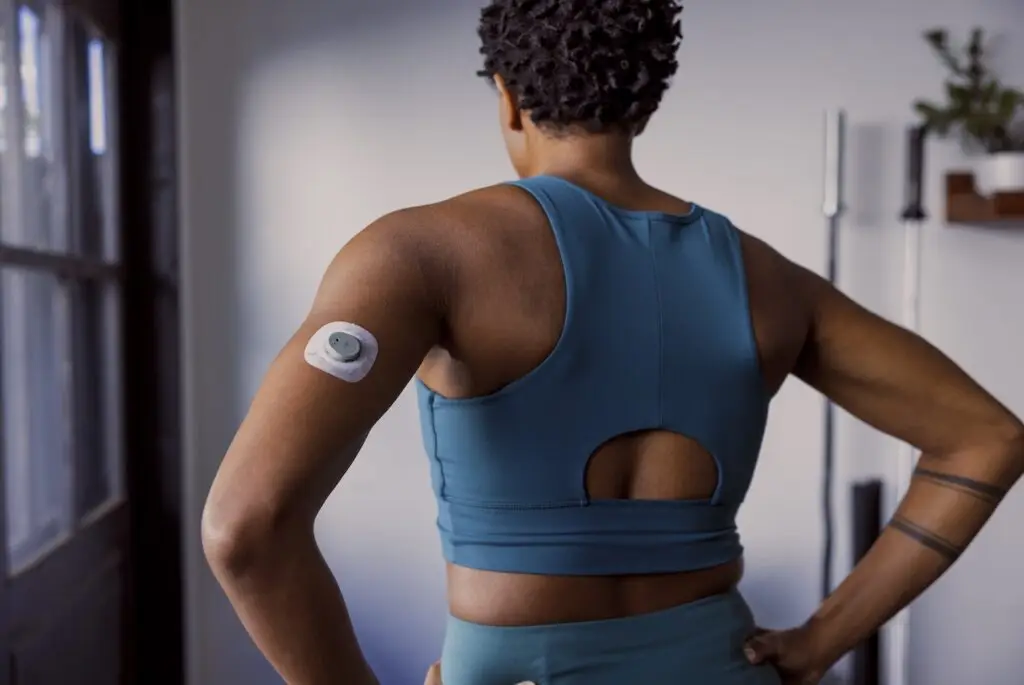
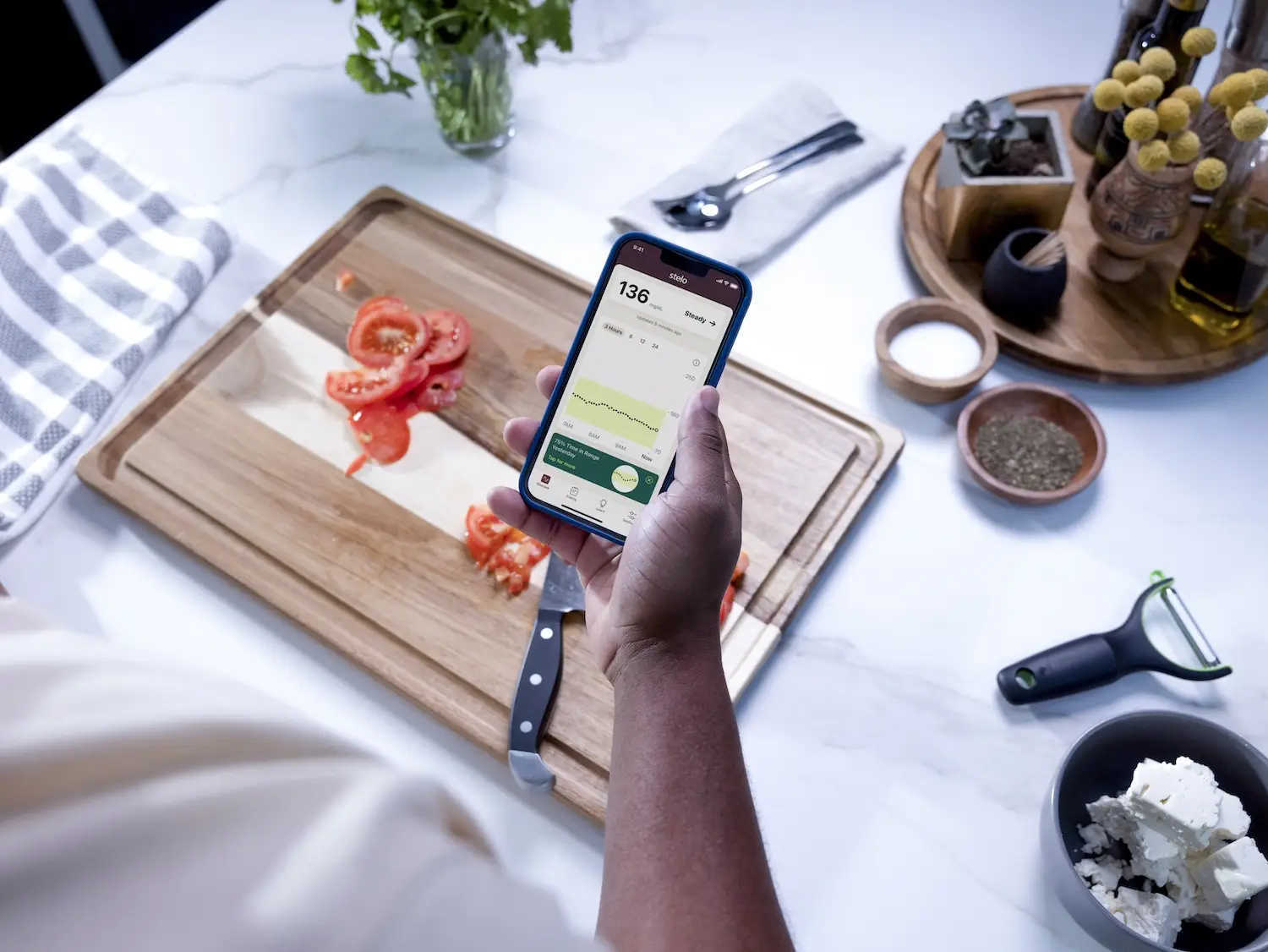
For the past few weeks, I’ve been trying to keep my blood sugar levels as steady as possible with help from Stelo, a continuous glucose monitor (CGM) produced by San Diego–based healthcare tech company Dexcom. The quarter-sized device has a hair-thin sensor that, when (pretty painlessly) applied into the back of your arm, constantly measures your blood sugar levels for up to 15 days. It sends all that data to a corresponding phone app (provided you’re within 20 feet of your device and the app is open), where you can also log your meals and workouts to help you understand how certain lifestyle choices affect your levels.

The FDA approved the first-ever CGM for patients with diabetes in 1999, and Dexcom released its own version in 2006. But the device only recently became available over the counter—and it’s increasingly popular as a wellness tool among people without diabetes, a trend that aligns with the ever-growing obsession with health data. The fitness and health tracking market as a whole hit more than $60 billion in 2024.
Insights from a tool like Stelo, which will set you back around $100 a month, may have a lot to teach us. “Almost 100 million people in the US have prediabetes, and most of them don’t know,” says Jake Leach, Dexcom’s chief operating officer. People with prediabetes have a fasting blood sugar level between 100 and 125 milligrams of sugar per deciliter of blood, or mg/dL (below that range is considered normal, while numbers above it signal diabetes), and the condition is associated with health concerns like cardiovascular and retinal diseases.
“And then there’s the idea of using a CGM to better understand metabolic health and longevity,” Leach adds. “There are a lot of potential uses around learning about how your diet impacts your glucose and how, over time, that can develop into a condition like prediabetes.”
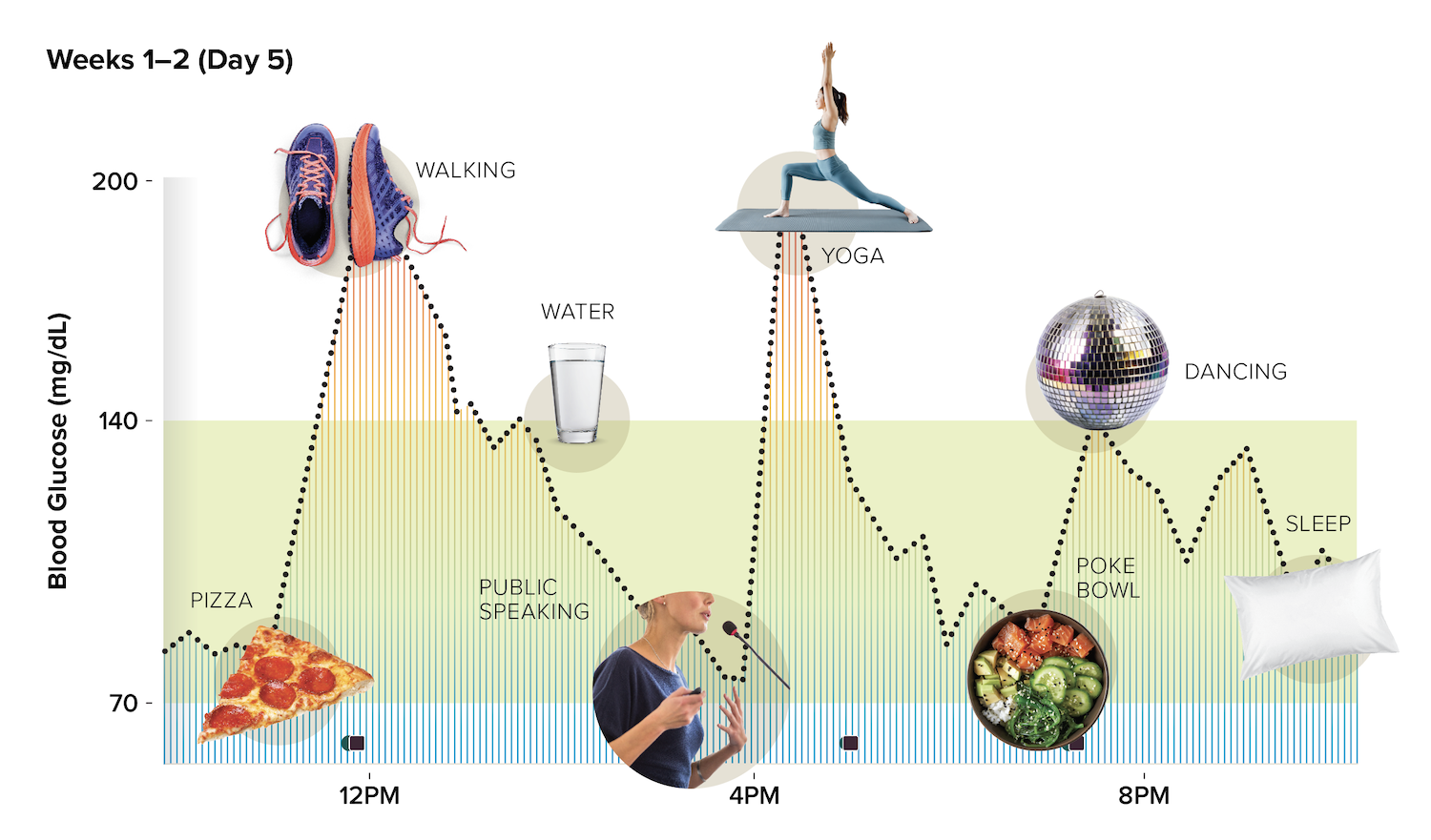
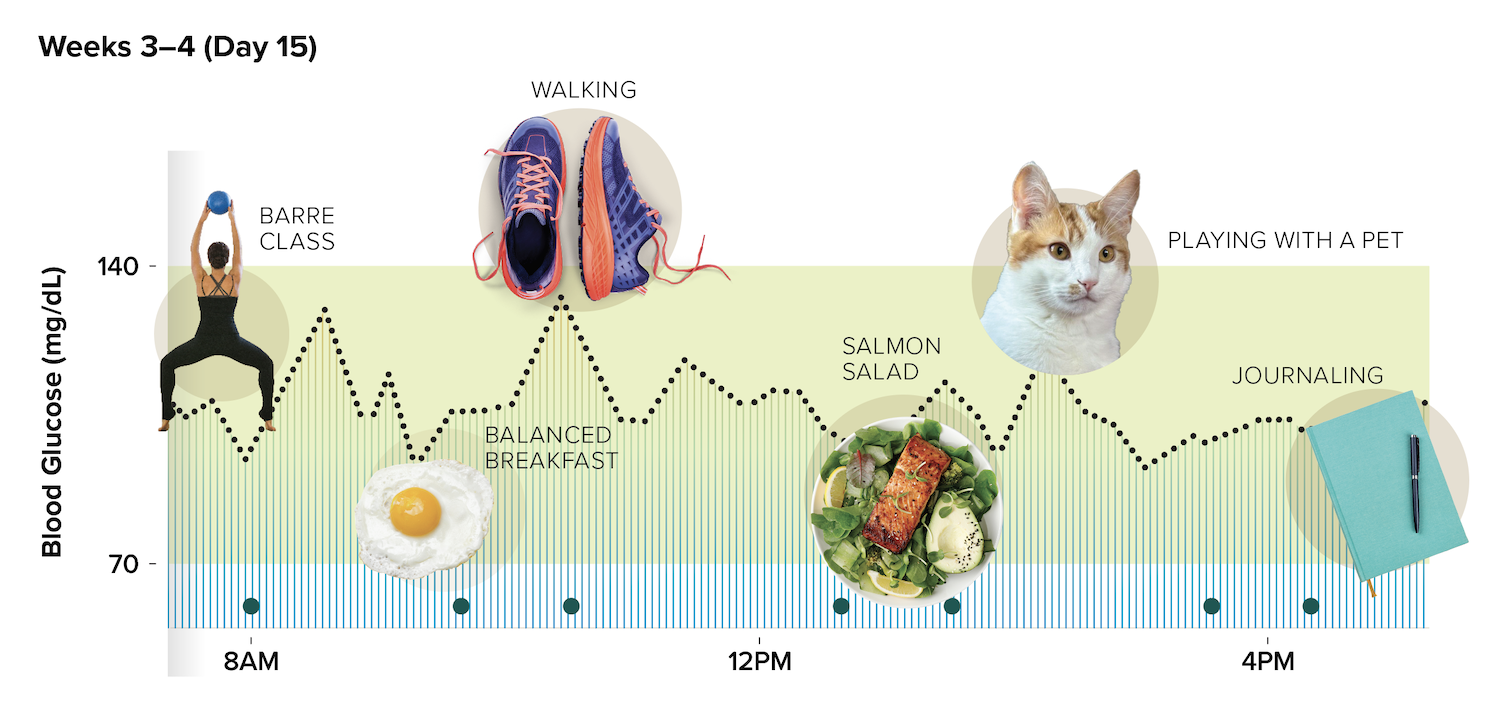
Stelo prompts you to set a target glucose range—in adults without diabetes, the suggested spectrum is between 70 and 140 mg/dL. Charts within the app show you how your levels rise and fall throughout the day, and a spike above 140 will trigger a notification. Click it, and you’ll get tips for minimizing those spikes.

I wore the device for 30 days, electing to live my typical lifestyle during the first half of that period to get a baseline. According to Dexcom’s head of clinical advocacy and outcomes, Dr. Thomas Grace, who reviewed my data, I’m a “normogylcemic” 27-year-old woman: My fasting glucose is at a normal level, and when I eat carbs or sugar and glucose levels rise, my body produces insulin to even things back out. But I wanted to see if I could minimize the spikes I was seeing, so I put some blood sugar–steadying strategies to the test.
There are four major pillars of glucose management: diet, exercise, stress, and sleep. While sugar and carbs can send glucose levels soaring, non-diabetic people striving for glucose harmony don’t necessarily have to kill pasta from their meal plan. Starting every meal with protein or veggies, then moving on to carbohydrates, can help keep you steady (hence the desk carrot).
Moving after eating makes a difference, too. After meals, I’d take a walk or even dance around my living room, which had my glucose levels dropping as fast as they’d risen—or, in many cases, prevented a spike at all.

Articles in the Stelo app explain that poor sleep can increase insulin resistance, making it harder for your cells to effectively utilize insulin, and stress triggers hormones like cortisol and adrenaline, which prompt your body to throw some extra glucose into your bloodstream (as evidenced by the spike I saw just minutes before a meeting I was anxious about).
Of course, anyone can follow these strategies without a CGM. But all the medical pros I spoke with agreed that seeing the data can help people make tangible shifts. “It is a wonderful reality check for the dietary and exercise changes that we recommend,” says Sharp HealthCare endocrinologist Dr. Neelima Chu.
Stelo, which is incorporating generative AI and partnering with fitness-tracking “smart ring” Oura to give users more personalized insights, still isn’t perfect. No biosensor on the market is right all the time (Stelo is at about 93 percent accuracy), and the app could do a better job of storing older data for easy, long-term access. (Though I can see that I experienced a spike three weeks ago, for example, I can’t yet click to access my note about what I ate just beforehand.) And I couldn’t help but wonder how much people who are normoglycemic really need to worry about it all.
“We just don’t have enough information [to know for sure],” says Scripps Health’s lead diabetes expert, Dr. Athena Philis-Tsimikas. “We’d have to do a study with two comparison groups—one that’s keeping things steady and one that’s doing whatever—and follow those groups for a fairly prolonged period of time, and then look and see if there was benefit or detriment of doing it one way versus another, and we just we don’t have that data now. So, it’s very hard to promote it one way or the other.”
But with prediabetes remaining so underdiagnosed, there’s much to be said for a tool that can help you understand your body better. “At some point,” Grace hopes, “there’ll be enough people wearing a product like this, getting the education that they need, that maybe, instead of the exponential increase in obesity and type-two diabetes, we’ll be able to make some headway there.”
Amelia Rodriguez is a writer and journalist and winner of the San Diego Press Club's 2023 Rising Star Award and 2024 Best of Show Award, she’s also covered music, food, arts and culture, fashion, and design for Rolling Stone, Palm Springs Life, and other national and regional publications. After work, you can find her hunting down San Diego’s best pastries and maintaining her five-year Duolingo streak.

Whether you’re ready to lean into fall or determined to keep summer going, here are all the best things to do this month
September is San Diego’s unofficial second summer—the crowds thin, the weather stays warm, and the city’s calendar somehow gets even busier. This month brings stadium-sized rock shows, Broadway’s buzziest comedy, a new anime convention, world-premiere theater, gallery openings, food festivals, and the first signs of spooky season. Whether you’re ready to lean into fall or determined to keep summer going, here are the best things to do in San Diego this September.
Concerts & Festivals | Theater & Art Exhibits | More Fun Things to Do

As Guns N’ Roses storm into decade five, their appetite for destruction persists. During their Snapdragon Stadium concert, hear the hard rock anthems, new material and a set from The Black Crowes.
Kehlani is proof that the romance and earnest sensuality of old-school R&B will never go out of style. Hear her take it back to the aughts at Viejas Arena.
From the silver screen to The Old Globe stage, John Carney will Begin Again (again) with a world premiere musical adaptation featuring new songs—courtesy of Train—and a story overflowing with hope.
The concept of work is a guiding principle for San Diego native and multidisciplinary creative noé olivas. Observe his community-informed approach via Tierra y Cielo (Earth and Sky) at Best Practice Gallery.
Two workers grapple with the weight of their roles at a temporary migrant shelter in Mario Vega’s world premiere play Our Lady of the San Diego Convention Center, set for citywide performances.
Luminous visions of peace and the Punjabi-American roots of Rupinder Kaloti inform The Gathering, a wondrous unification of family foretold via paintings at Oceanside Museum of Art.
It’s Mary Todd Lincoln’s world and we’re just living in it. See the presidential paramour barrel to her way to stardom at the Civic Theatre during Oh, Mary!, Cole Escola’s political spoof.

Pros and Con(vention)s: Anime San Diego will debut at the San Diego Convention Center with cosplayers, panels and more than 400 vendors well-versed in Japanese animation.
Scaredy cats beware: SeaWorld San Diego’s Howl-O-Scream embraces frights forged in darkness. Enjoy an ominous lineup of live shows, scare zones and bloody bars ahead of Halloween.
The best parts of Artivál and the Alley Cat Art Walk have united for the free Alley Cat Art Fest, an all-day outing for live music and immersive artwork in Downtown El Cajon.
Take a Grecian vacation for a fraction of the price during the annual Cardiff Greek Festival, two days of immersive cuisine and culture—with plenty of dancing—on the Encinitas coast.
Step away from the stove! The California Restaurant Association has eight days of eating experiences with your name on it. During San Diego Restaurant Week, explore by meal, neighborhood or cuisine for your personal dining plan.
Nourish yourself with an all-inclusive spread of Pacific Beach eats and locally-crafted artwork during the HeArt of PB Restaurant Walk on Garnet Avenue.
When it comes to stand-up comedy, Chelsea Handler is always ready to roast. See Handler tell anecdotes and skewer an assemblage of victims during her Balboa Theatre performance.
Ryan Hardison is a freelance arts and entertainment writer and recent graduate of San Diego State. When he's not staring at his laptop, he's likely eating an adobada burrito or getting sunburnt at the beach.
The team behind El Agave and Nómade will open a breezy new restaurant with tapas, housemade pasta, seafood, and plenty of wine this September
After running El Agave Restaurant & Tequileria in Old Town for 30 years and opening Nómade Tapas & Records in North Park in 2025, owner Juan Carlos Gomez wasn’t actively on the hunt for a new project. But sometimes, you have to grab the opportunities as they come, unexpected though they may be.
He was taking a stroll in Bankers Hill last year when he noticed Barrio Star was closing after 17 years. “[It] was a neighborhood staple for a long time,” he says. So he figured he’d take a look. “We were talking with ownership and threw out an offer, and then it was accepted. So we were like, ‘Okay, cool, guess we’re going to get a new concept going!” (Much respect to the YOLO business style.)
That new restaurant is nearing completion. Filo will open early in September. The restaurant’s name, pronounced fie-low, references phyllo, the Greek word for “leaf” and an unleavened pastry dough commonly used in Mediterranean (often Greek) cuisines. Gomez says the menu will range from all over the Mediterranean region.
“I’ve always been a fan of European cuisine, obviously, but I can’t land on just one,” he laughs. “I’m part Spanish, so we wanted to do something Mediterranean, have a little bit of Spanish, have a little bit of French, Italian, Greek… a lot of olive oil, a lot of sea salt, and very, very light seasoning.”

Although the menu feels European, Gomez says expect the vibe and ingredients to feel very Southern Californian. There will be tapas, of course, and other small plates, along with housemade pastas, salads, with lots of seafood (like a whole branzino) coming from local purveyors. The accompanying beverage program will feel equally breezy, “fresh, very light, citrusy, salty,” he says. “We’re going to have a pretty hefty wine list and full bar.”
Gomez’s goal for Filo is for it to feel like a laid-back, seaside eatery on the craggy Mediterranean coastline—light colors, white oak, lime wash, flowing between the indoor dining room and outdoor patio. Personally, a European escape sounds pretty awesome right about now.
Filo opens at 2706 Fifth Avenue in early September. Initial operating hours are 4 p.m. to 10 p.m. daily, with lunch and happy hour coming soon. (Subject to change.)

Listen Now: The Latest in San Diego’s Food and Drink Scene
Have breaking news, exciting scoops, or great stories about new San Diego restaurants or the city’s food scene? Send your pitches to [email protected].
Beth Demmon is an award-winning writer and podcaster whose work regularly appears in national outlets and San Diego Magazine. Her first book, The Beer Lover's Guide to Cider, is now available. Find out more on bethdemmon.com.
The city's fish taco hero is opening Concrete Cowboy across the street, plus a home-cooked Mexican sandwich spot
You have to be crazy or a genius to name a restaurant Fish Guts. You have to be even crazier to open a restaurant that holds maybe two dozen people at a time—if you don’t mind elbowing one other while scarfing down some of the best fish tacos in San Diego.
And yes, “best” is a relative term. But in Fish Guts’ case, it’s for real—and that’s saying something in a town literally world-famous for fish tacos.
Ever since Pablo Becker opened up his diminutive eatery in 2023 at the corner of Logan Avenue and Sampson Street in Barrio Logan, Fish Guts has been named one of the city’s best new restaurants in 2023, Critic’s Pick for the best fish tacos in San Diego in 2024, 2025 and 2026, as well as readers’ top pick in 2024. It’s like if Rubio’s married into the royal family.
Most of his ingredients come straight from the cold waters of the Pacific Ocean, which happens to be down the street. His de espada (blackened swordfish) taco is the stuff of legend. He’s kept Fish Guts operating at an elite level, which tends to happen when you work for five years in Chicago under chef Richard Sandoval (who, by chance, is also his cousin) and open an ahead-of-its-time high-end modern Mexican restaurant in East Village (El Vitral Restaurant & Tequileria, 2009-2013).
Now Becker is branching out again, opening two new concepts in Barrio Logan this fall.
The first will be upstairs from Fish Guts, which at one point was destined to become an intimate omakase counter. Santo Poco will be a lunch-only sandwich shop, offering takeout and delivery (no dine-in), and the sandwiches will be a little Mexican, a little French, a little Italian, a little from Chicago, a little from New York. Basically, a bunch of different styles all on really, really good bread.
“There’s probably going to be a Cuban-style sandwich in there with a touch of Mexican, some cold cut Italians, too, putting my touch on them,” he says. “That’s what I feel like is my style of cooking.”
Things will be traditional, but inventive. Like his fish & chips taco at Fish Guts: two classic dishes, one killer mash-up. There will also be a hat tip to the late, great Anthony Bourdain, a sandwich called the Antonio Bourdain.
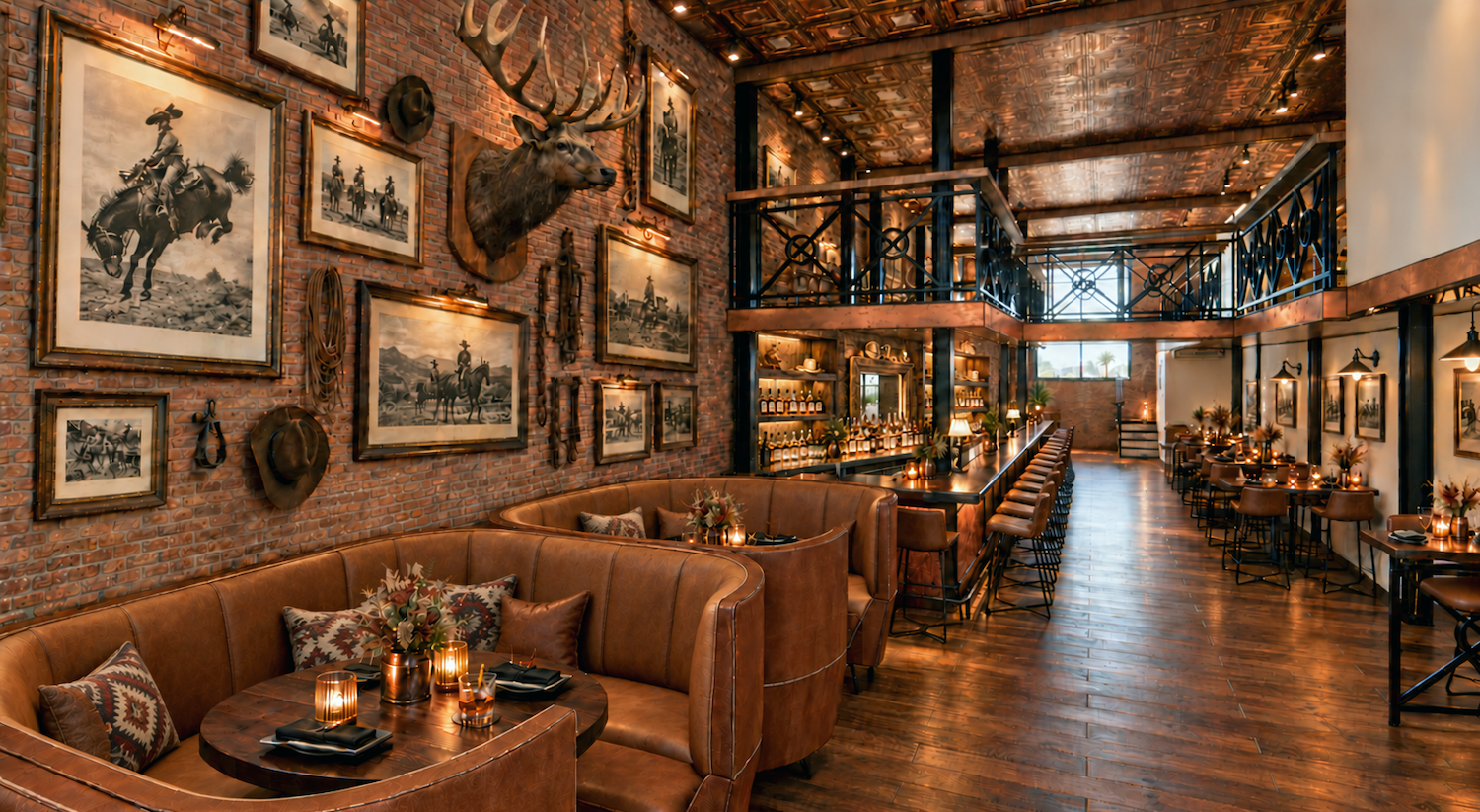
The second will be across the street from Fish Guts in the former Lia’s Lumpia space. Concrete Cowboy will be a taco-driven joint on the same wavelength as Fish Guts (keep it simple, keep it special), but featuring land animals rather than sea brethren. Think tacos made with duck confit, ribeye, pork belly, skirt steak.
The inspiration behind Concrete Cowboy comes from Becker’s father, a lifelong Western obsessive, despite growing up in Mexico City’s urban metropolis. “He always liked that cowboy life, that vibe,” he says. “I always say ‘Dad, you just grew up in the wrong city.”
He’s aiming to open Santo Poco in October and Concrete Cowboy in November. Neither require massive renovations, and while the former Lia’s Lumpia space will keep the cabin-esque aesthetic, he’s creating more of an adobe-style exterior and an interior lined with Western-themed wallpaper and taxidermied animals. He’ll also tweak the bar layout to move from a fast-casual feel to full service.
Local designer Dane Danner is designing both spaces and visual direction for menu layouts, logos, and packaging, going for low-key, but high on vibes. Once Concrete Cowboy opens, Fish Guts will temporarily close to remodel the space to switch its white palette for a warmer feel, plus introducing a refreshed menu featuring some new tacos and other items.
Could another Fish Guts be on the way somewhere else in San Diego? Not likely, says Becker. “Fish Guts is cool, “ he says. “I feel once you start branching out, it’s more forced, not as organic.” So for now, count on Becker staying in the neighborhood.
Santo Poco opens for lunch daily October 2026, 2222 Logan Avenue (above Fish Guts). Concrete Cowboy opens Tuesday through Sunday for lunch and dinner November 2026, 2219 Logan Avenue.
Beth Demmon is an award-winning writer and podcaster whose work regularly appears in national outlets and San Diego Magazine. Her first book, The Beer Lover's Guide to Cider, is now available. Find out more on bethdemmon.com.
KQ Aesthetic Society goes beyond cosmetic to provide comprehensive care and transformative results
Kelly H. Harfouche, founder of KQ Aesthetic Society, knows firsthand that cosmetic treatments like fillers, neurotoxins, and microneedling, can not only enhance a person’s appearance and restore confidence, they have the power to truly change a person’s life. An expert injector has the ability to tailor treatments to each individual patient’s anatomy and goals for personalized results. Harfouche, a board-certified nurse practitioner, has spent nearly a decade perfecting her craft as an aesthetic injector and integrating her multifaceted artistic skills with precision patient care. Her commitment to continual education and training, plus a passion for helping people look—and feel—their best, set KQ Aesthetic Society apart in a sea of local medspas.
For many people considering nonsurgical treatments, the intent is to look refreshed and refined. KQ Aesthetic Society’s philosophy eschews a cookie cutter approach that bases treatments around units, instead working to understand each person’s unique goals, then curating a treatment plan to fit that vision. Harfouche focuses on “inclusive luxury,” the belief that everyone deserves access to aesthetic treatments, respective of budget restrictions. She develops long-standing trusted relationships with her patients, and works with each one to achieve their aesthetic objectives and address the underlying causes of their concerns.
“For me, forming an honest and open relationship with every patient who walks through the door is essential. This means understanding them on a deeper level and meeting them where they are to define and achieve their individual goals,” she says.

Drawing on her artistic background, which inspired her transition into medical aesthetics, Harfouche sees each client as a “unique canvas.” Rather than relying on standardized procedures, the practitioner’s distinctive approach combines her profound understanding of the physiological and anatomical changes associated with aging with an unwavering commitment to ongoing education about the newest products and their mechanisms of action. Her goal is to make each patient feel beautiful in their own skin and to embrace their individuality.
She has also pioneered a way to combine her talent for aesthetic artistry with her philanthropic nature. Harfouche is one of only a handful of providers using dermal fillers to treat patients with lip asymmetry and scarring resulting from cleft lip surgery. Patients travel from around the country for this transformative treatment, noting increased confidence and a restored identity. She hopes to eventually launch a training program to help fill the void in this space.

“My passion has always been connecting with people and giving back in any capacity that I can,” she says. In the rapidly advancing landscape of aesthetic medicine, you can place your confidence in Harfouche and KQ Aesthetic Society to deliver exceptional care. To learn more or book a consultation, please visit kqaestheticsociety.com.
The University Heights eatery will close September 7 for a multi-month renovation and rebrand
Ten years ago, restaurant design centered around sleek minimalism. Fonts lacked serifs, clean lines dominated, and any manufacturer that made globe-shaped chandeliers must have made an absolute killing.
Things have changed since then, and Jeff Fink says it’s time for Madison on Park to glow up. On September 7, Madison will temporarily close its doors for a top-to-bottom renovation of the space and concept. Fink hopes to reopen this fall ahead of the busy holiday season, with a new look he calls moody mid-century maximalism.
“We have to take into consideration what’s going on culturally,” he says. When Madison first opened, TikTok wasn’t a thing in the U.S. and craft cocktails felt relatively cutting-edge. Today, he sees a resurgence in the vintage look, handmade goods, and low-to-no ABV drinks dominating menus everywhere.

Fink and his partner Matt Sieve have already dabbled with that sort of motif at Sonny’s Pizza, their Brooklyn-inspired joint around the corner. Fully half of the cocktail menu is made up of spritzes, mocktails, and Negronis. Madison 2.0 will take it further.
The new concept doesn’t have a name yet—Fink says they have to feel out the vibes as they make progress with the design. “The name comes when you see it appear,” he says. But he has a few design elements in mind: things like more artwork and more uplighting. “Not cluttered and overstuffed… I want to keep it intimate, sexy, and immersive.”
Madison rightly earned its rep as one of the best-dressed eateries in San Diego, nabbing an Orchid Award for interior design its first year. The returning designers Anna and David Sindelar originally transformed the space from weird padded walls and fake greenery at Lei Lounge into a mid-century modern wonderland, complete with a signature arched ceiling and geometric patterns aplenty. Michelin-recognized chef Mario Cassineri (Ciccia Osteria, Bice Ristorante) built a menu heavy on Mediterranean flavors mixed with California classics.
The new menu shouldn’t feel completely jarring, but will take cues from Fink’s recent travels in Spain with his family. Expect shareable plates with lighter ingredients. “Americans eat way too much, and our portions are way too big,” he says. “I like the idea of smaller plates, healthier plates, and being creative… I’d rather see 15 items on the menu that are all less than $20 so that I can try different ones.” Bar manager Danny Kuehner will continue developing craft cocktails and mocktails for the new venture, as well as curating a selection of wine from Europe and locally.

This isn’t the only project on their plate. Besides running Sonny’s in University Heights and Madi in Normal Heights, later this fall, Fink and Sieve will also open Josie’s, a modern all-day, Midwestern-style diner inspired by Sieve’s Minnesota roots. Like all their restaurants, it’ll hold a special part of their families’ legacies—something Fink hopes people feel as soon as they enter.
“You walk into Sonny’s, you’re like ‘Oh, Jeff’s at home,’” Fink laughs. “[Josies’] will be ‘Matt’s at home.’” The next version of Madison? We’ll have to wait and see.
Madison on Park will temporarily close on September 7 until October (barring any unexpected delays). Keep up with the newest updates on Madison’s Instagram.
Listen Now: The Latest in San Diego’s Food and Drink Scene
Have breaking news, exciting scoops, or great stories about new San Diego restaurants or the city’s food scene? Send your pitches to [email protected].
Beth Demmon is an award-winning writer and podcaster whose work regularly appears in national outlets and San Diego Magazine. Her first book, The Beer Lover's Guide to Cider, is now available. Find out more on bethdemmon.com.
Sinner Buns is building a following for its slow-made, seriously gooey weekend treats
When I was pregnant, my food craving was singular and intense. If I didn’t eat at least one thing doused in cinnamon every day (ideally, more than one), I was—to put it gently—a complete monster.
Since then, my obsession has tempered somewhat. But cinnamon buns still perch high on my top treats list, so I’m always on the lookout for the next great place to indulge. IMO, The Huddle in Mission Hills’ mondo cinnamon roll remains top-tier, but after eyeing the ooey, gooey goodies from Sinner Buns, we might have a contender.
Originally from Ukraine, Daria Nadar had already done everything one can do at a bakery—business operations, wholesale contracts, actually baking, you name it—so during the pandemic, she started dabbling with perfecting her cinnamon rolls. After she got a couple fans over social media, she threw her first pop-up to see how they’d be received. She sold out.
After a few false starts with a couple storefronts and business deals, Nadar officially launched Sinner Buns in October 2025 with her partner Filipe Pazi. After making it through an unexpectedly hectic season stuffed with holiday orders, the team closed temporarily to get everything in line and reopened this April. Business has remained in full swing ever since.
There are only so many ingredients in a cinnamon roll, but “the process is what makes it special,” she says, adding they use fresh yeast rather than powder and a 48-hour process for each batch of brioche dough made to order. (Thus the need for pre-orders.) Customers can preorder until Thursday each week for pickup Friday, Saturday, or Sunday from Sinner Buns’ ghost kitchen at 780 Hollister Street, just east of Imperial Beach.
You can also catch her at various pop-ups around San Diego. Eventually, Nadar opens to offer nationwide shipping (once she figures out the logistics and quality control) and one day, her own storefront.
But it’ll be on her terms, not the whims of social media. “We already learned how to not only rely on virality of the product, because you go viral and then it fades,” she says. “It’s a slow burner, and I know eventually, it’s going to grow much more.”

Listen Now: The Latest in San Diego’s Food and Drink Scene
Have breaking news, exciting scoops, or great stories about new San Diego restaurants or the city’s food scene? Send your pitches to [email protected].
Beth Demmon is an award-winning writer and podcaster whose work regularly appears in national outlets and San Diego Magazine. Her first book, The Beer Lover's Guide to Cider, is now available. Find out more on bethdemmon.com.
A look at San Diego's top designers creating unique environments that combine creativity and function


AVRP Studios’ tradition for Design Excellence and Innovation began in 1976 with Doug Austin, FAIA, in Solana Beach, California. The firm has since grown to complete major projects throughout the United States and Canada. We think of ourselves as a family and we care deeply about people. We want to inspire, help make their lives richer and more complete through our efforts. We believe that architecture is one of the most important art forms because of the impact it can have on the lives of those it touches. We’re delighted to have been recognized with over 150 awards for design excellence.
703 16th Street, Suite 200, San Diego, California 92101 | 619-704-2700 | avrpstudios.com