Featured articles
Food & Drink
Food & Drink
Food News
Featured articles

Things to Do

Arts & Culture
Everything SD
Featured articles
Things to Do

Things to Do

Things to Do
Featured articles
podcast-ep

podcast-ep

podcast-ep
Featured articles

Everything SD
Everything SD
Food & Drink
Featured articles
Things to Do
Arts & Culture
Everything SD
Ready to know more about San Diego?
SubscribeReady to know more about San Diego?
Learn how Carol Estes styled each room, and get the details on her Instagram-famous fireplace
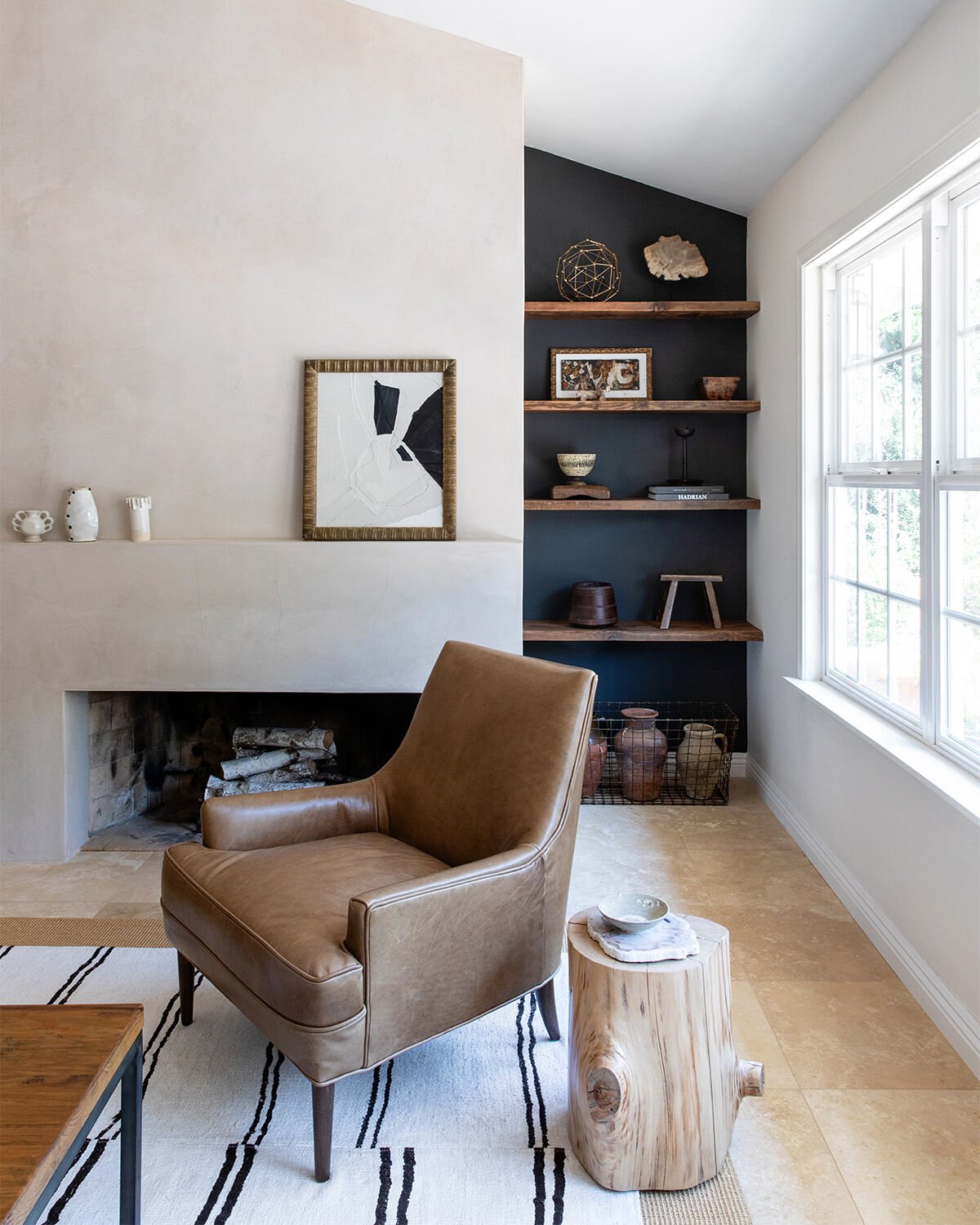
FireplaceThe most raved-about photo on Carol’s Instagram is of the fireplace, a stunner for its built-in look and a far cry from its original form. When they moved in, it was a “hideous” orange brick. Carol sponge-painted it as a temporary solution to tone down the color, then hired contractors to correct it to her liking. An art piece by Joelle Somero stands atop the mantle alongside some pottery by Lee. Neighboring the fireplace is a head-scratching nook–“We’ve spent so much time trying to figure out what to do with this over the years,” Lee says–that they fashioned into a charcoal accent wall and shelving starring found items in Carol’s natural color palette. “It doesn’t happen overnight,” Carol says of the decor. “Accessories need to be accumulated over time.”
Jenny Siegwart
On paper, Carol Estes has a lot in common with millennials. She likes to skateboard, loves to travel, and spends a good portion of her day on Instagram. Oh, and she has upward of 70,000 followers.
She’s grown her network for her interior design business to that five-digit number in just three years. Yet her style doesn’t skew toward the flashy, fast-retail preferences of younger generations. In fact, it’s taken decades to rehab her home into the timeless aesthetic you see here—harnessing the power of patience to accessorize it from top to bottom.
“It takes me a while to make decisions on my home because I know I want to live with it,” Carol says. “I’ll wait for the right thing to get an authentic look, versus a model-home look.”
Playing the long game for the ideal outcome is sort of second nature to her. She waited almost her whole life to pursue her passion in interior design. It’s one she’s been dreaming of since she was 19, when she first backpacked through Europe.
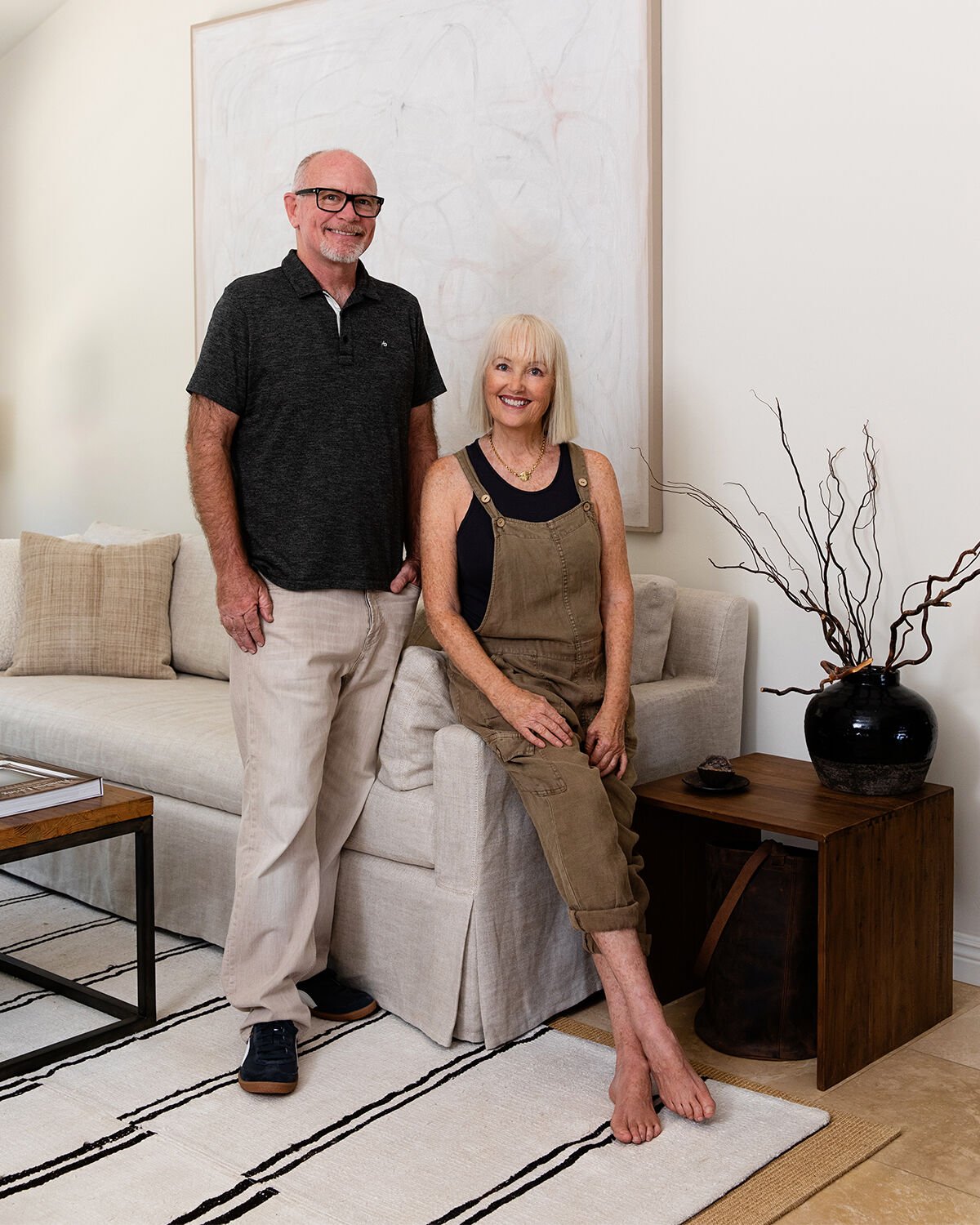
Living RoomThe striped area rug in the living room is one of Carol’s proudest finds. She searched three years for it, until she found it at the Maison&Objet interior design show in Paris. The sofa, on the other hand, was an easier find at RH, and the commissioned artwork above it is from Colette Cosentino. The coffee table–topped with miscellaneous design books–is from West Elm, the leather chairs from Four Hands. Take a step back, and the room is a shining example of Carol’s earthy color palette of whites, browns, and blacks.
Jenny Siegwart
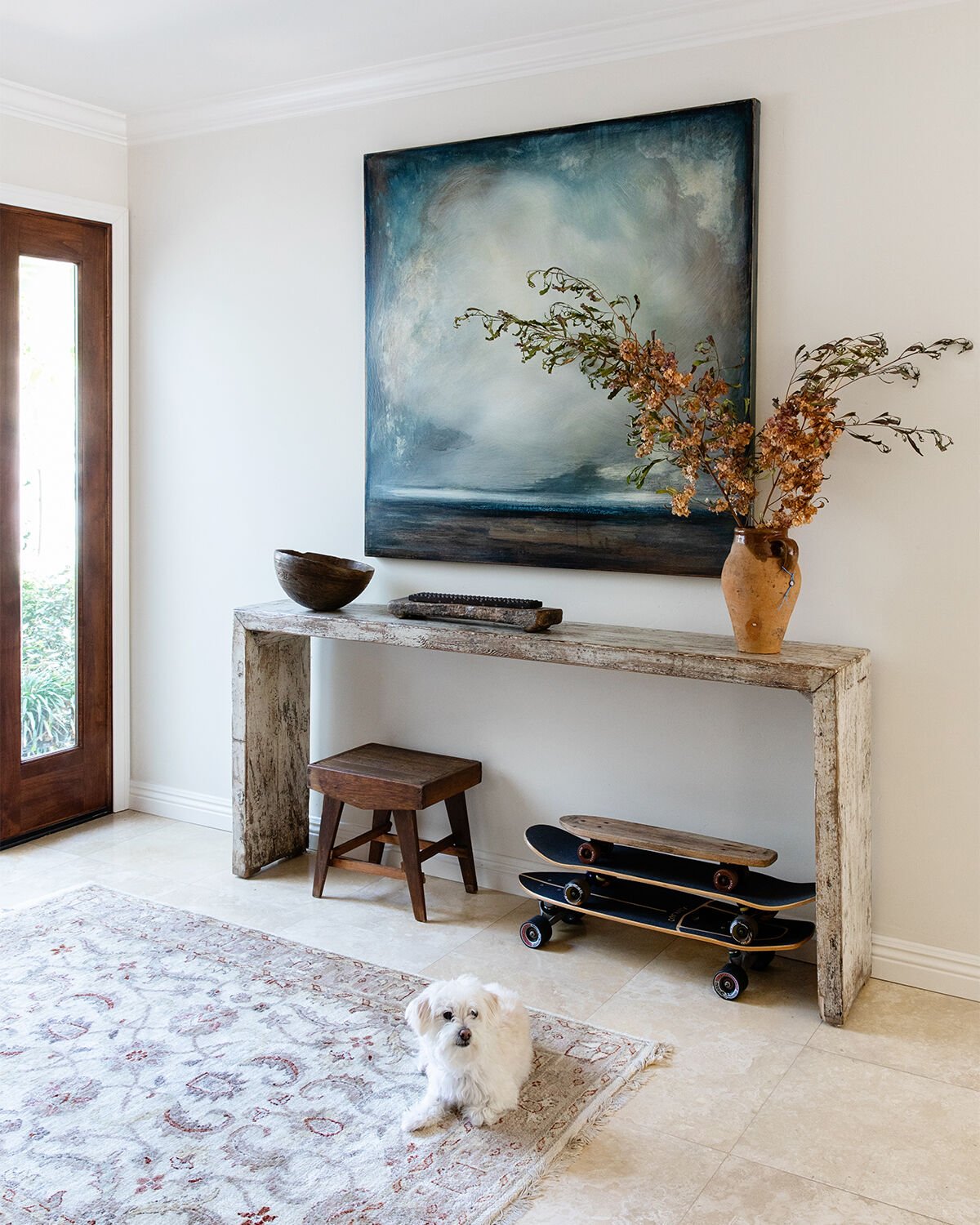
EntrywayThese skateboards aren’t just for decoration. The bottommost is Lee’s, the middle one Carol’s, and the top an antique. The decor is a testament to Carol’s eye for antiquing. As her husband explains: “Carol has that ability to just look at something that I would say, ‘Oh gosh, that’s just awful,’ and she’ll know exactly how it’ll beautify an area and fit in with everything.” The console table is from Juxtaposition Home in Costa Mesa, the artwork by Colette Cosentino, the Japanese stool from David Alan Collection in Solana Beach, and the African bowl from the Rose Bowl Flea Market.
Jenny Siegwart
The architecture, the slow-paced lifestyle, the simplicity, “I was drawn to it all from that point on,” she says. But, “I had to be practical.” She returned to San Diego State University and earned an accounting degree, became a director of finance, and raised her kids in Rancho Bernardo. All the while, she and her husband Lee, a CPA, frequently traveled back to Europe to get their fix. Lee even quit golfing to reallocate time and expenses toward it.
The couple really tapped into their creative sides once they retired. Lee makes pottery and loves to bake. Carol paints, and that’s what took her to social media years ago—to sell her artwork. Then she started posting pictures of her house, and her second act began.
But run her name through a search engine and you won’t find any websites. In true influencer fashion, she operates her entire business through Instagram, checking her DMs even before her email or her voicemail. “I figure, why make a website? Instagram gives me business. I’m a simplifier.”
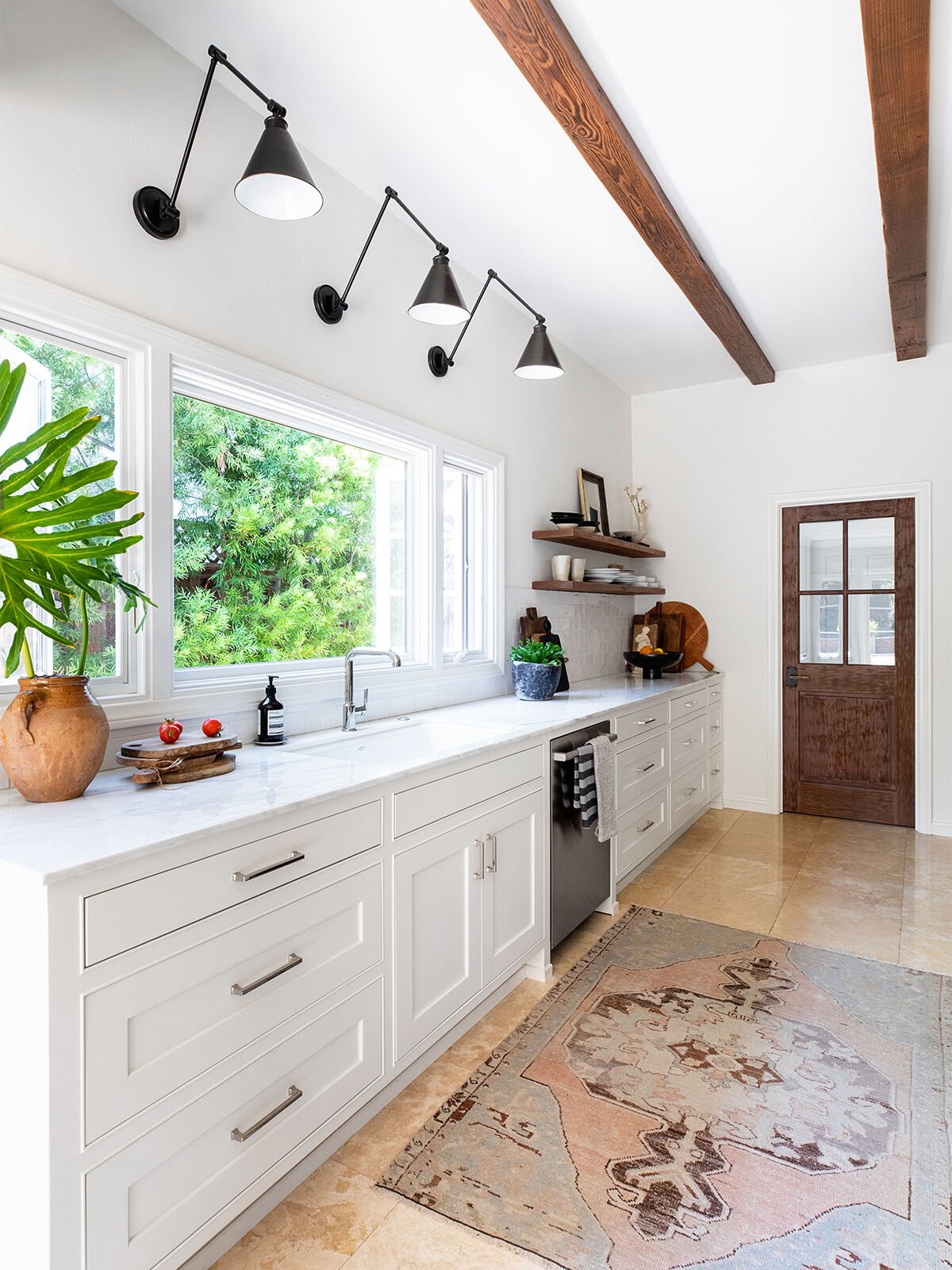
KitchenWhen Carol and Lee moved in two decades ago, the galley kitchen was stuck in the ’70s. They modernized the design using upcycled materials. The open shelving is reclaimed wood from the restoration of the Cabrillo Bridge. The ceiling beams are originally from a barn in Oregon, sourced from Reclaimed Wood San Diego. For architectural interest, they created built-ins for the oven hood and refrigerator. The cutting boards are collected from France, the white pottery from Astier de Villatte in Paris. Off the kitchen is a laundry room, reconfigured into a butler’s pantry that houses an espresso station and all of Lee’s baking supplies.
Jenny Siegwart
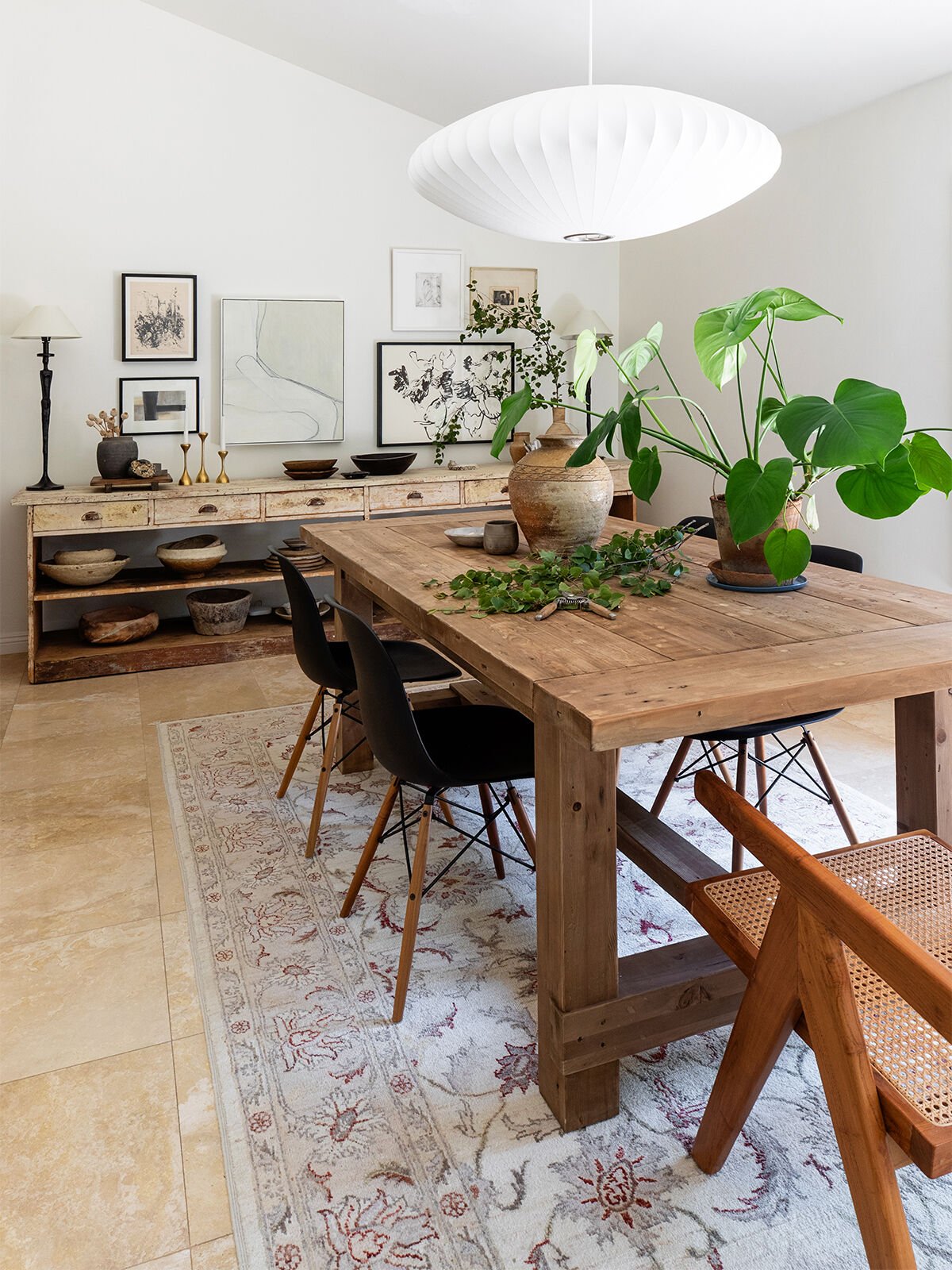
San Diego Home / Rancho Bernardo Dining Room
Jenny Siegwart
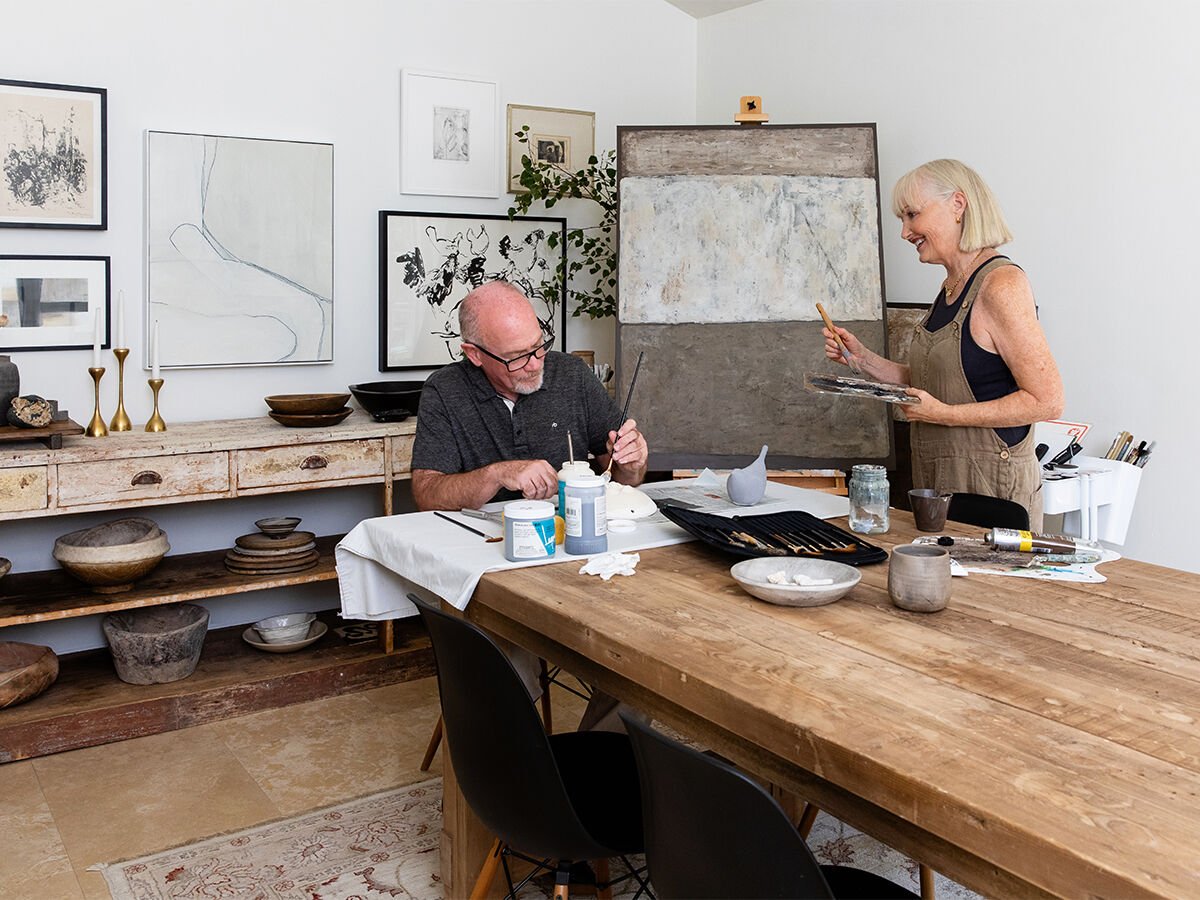
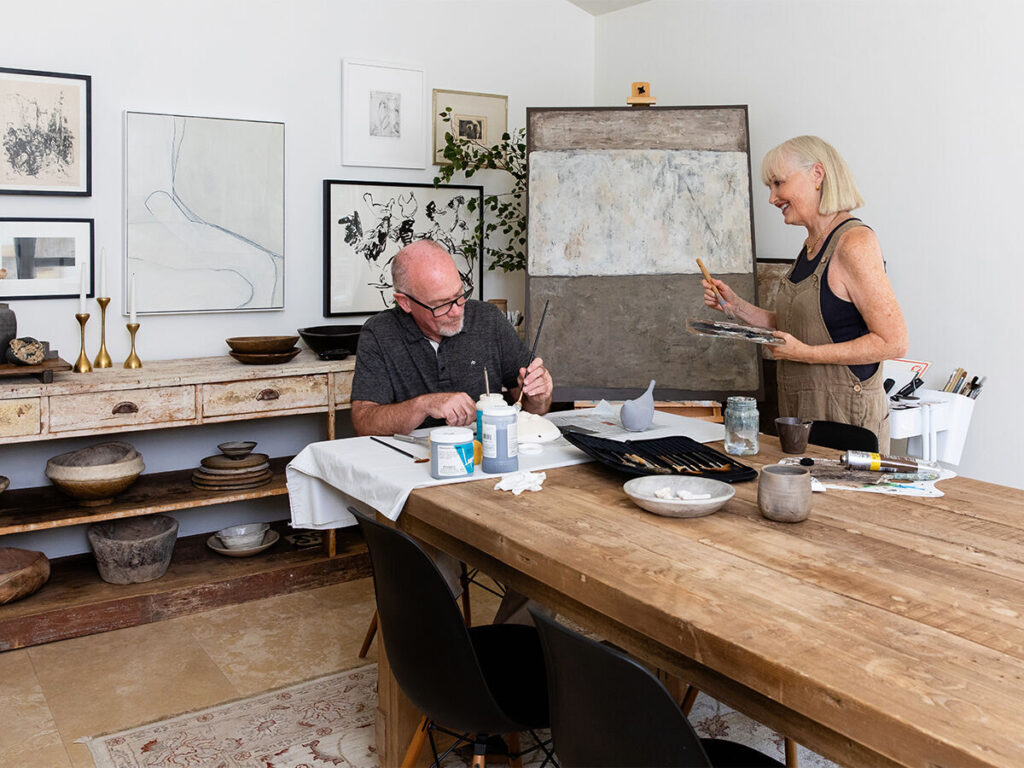
The Creative RoomCarol says the biggest challenge of their house has been “maximizing the potential of a small home.” For this reason, she’s reimagined their rooms several times over. For instance, this room off the kitchen once served as a family room, complete with a sofa and TV. Today, a wooden table from RH anchors the space–for entertaining, when possible–but mainly for the couple’s artistic endeavors. A drapery table on the far wall, sourced from Found Rental Co. in Fullerton, houses some of Lee’s ceramics and other secondhand items. Above it hangs artwork from Parisian flea markets. The largest is by Joelle Somero, but the bottom left painting is by Carol herself.
Jenny Siegwart
And that’s just how the retirees live their life at home now—simply, slowly, and to their European tastes. On any given day, French music plays softly overhead, the smell of freshly baked pastries wafts from the kitchen, their creative room is strewn with arts and crafts, or carefully collected mementos are styled with purpose.
To Carol and Lee Estes, this is minimalism at its best. To Carol, it’s “living out my dream, finally.”
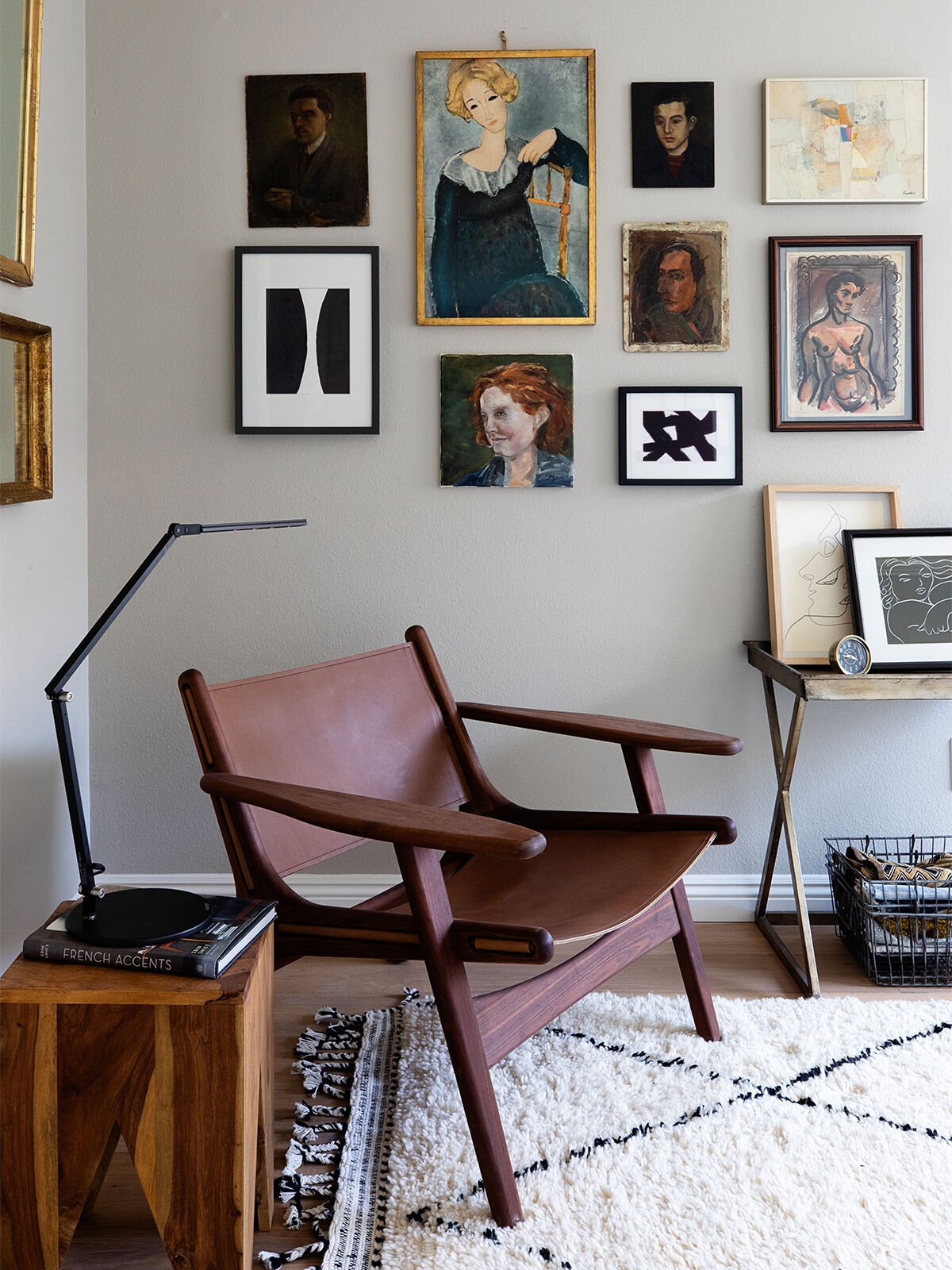
The Zen RoomThis room toward the front of the house has the best lighting, which is why it once served as Carol’s art studio. Now, it doubles as a guest room and “Zen room,” furnished with a daybed and a Room & Board leather chair that’s wedged between two gallery walls. One wall consists of artwork bought from Parisian flea markets, L’Atelier in Mission Hills, and a painting by Carol. The other gleams with a collection of gold mirrors from Vignettes in Ocean Beach and other local antique shops.
Jenny Siegwart
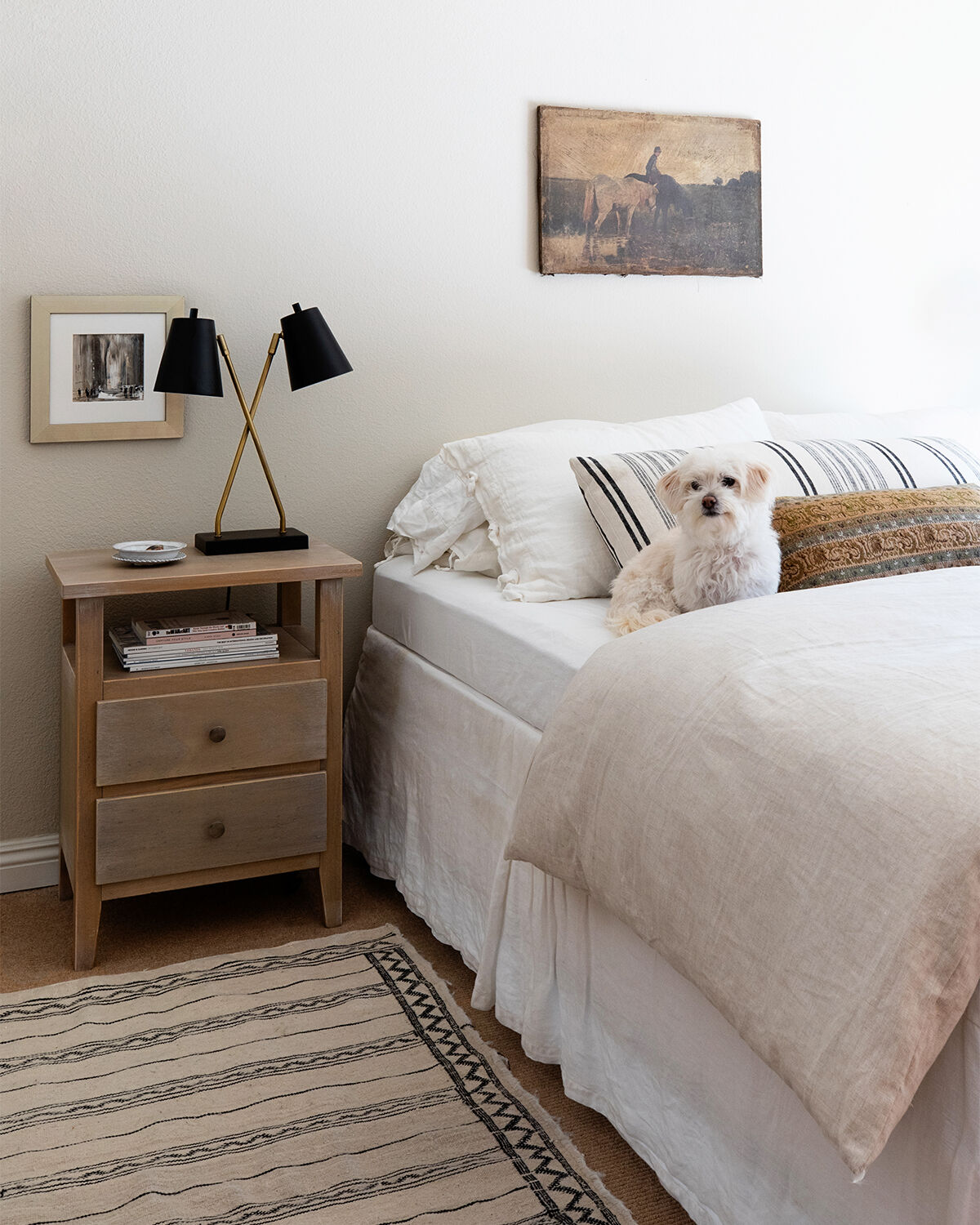
Primary BedroomThe primary bedroom’s minimalist furnishings give the space the same airy and earthy feel you’ll find throughout the house. But perhaps the most eye-catching point of interest in the room is the couple’s dog, C’est Bon.
Jenny Siegwart
Discover eateries, outings, and shops within this inland North County community
Just south of Lake Hodges near 4S Ranch and Poway, Rancho Bernardo is a suburban community that blends residential neighborhoods with industrial pockets, elevated by a decidedly diverse food scene.
Over 60 years ago, this North County neighborhood was once part of a family ranch. Since that time, big tech companies have taken up residence here, including Amazon, Sony Electronics, Oura Ring, HP, Teradata, and ASML. Rancho Bernardo Inn serves as a community hub, with locals frequently meeting at the hotel’s restaurants, golf course, and spa.
Whether it’s work or a round of golf that brings you to Rancho Bernardo, we’ve taken care of the agenda planning with our guide to the area’s best restaurants, activities, and shops.

Sample ingredients plucked straight from Rancho Bernardo Inn’s onsite garden and served at their signature restaurant Avant. One of the neighborhood’s most upscale dining options, they serve a French-inspired menu with nods to California, including many seafood options. Don’t miss their more casual sister restaurant Veranda for al fresco dining.
17550 Bernardo Oaks Drive
Wood-fired pizzas and handmade pastas are standouts at The Kitchen, Bernardo Winery’s counter-service restaurant specializing in Sicilian flavors. Charcuterie boards and bruschetta make for great starters or snacks while wine tasting.
13330 Paseo Del Verano Norte
Fast-casual and family-owned eatery Bushfire Kitchen recently opened a location in Rancho Bernardo, serving sandwiches, bowls, salads, burgers, protein plates, and housemade empanadas. Bushfire prepares comfort food with healthy ingredients, and offers plenty of vegetarian and vegan options.
11962 Bernardo Plaza Drive, Suite 110
Some might call The Cork & Craft an overachiever. This gastropub has an in-house craft brewery and winery: Abnormal Beer and Wine. The more, the merrier. Their sushi menu is definitely worth exploring, but don’t miss other specialties like garlic noodles, chicken wings, and pork belly.
16990 Via Tazon

You don’t have to leave Rancho Bernardo to get a white tablecloth steakhouse experience. Carvers Steaks & Chops has prime rib (their best seller), filet, ribeye, porterhouse, New York strip, and other cuts, served alongside crab-stuffed mushrooms, wedge salad, French onion soup, potato skins, and other steakhouse specialties.
1940 Bernardo Plaza Drive
This no-frills Burmese restaurant is known for its traditional tea leaf salad that’s topped with sesame and sunflower seeds, garlic chips, peanuts, tomatoes, jalapeños, fried yellow beans, and fermented green tea leaf dressing. Tucked into a nondescript strip mall, Burma Place is a great takeout option when you want to eat garlic noodles, fried rice, chicken curry, and samosas from the comfort of your couch.
16719 Bernardo Center Drive, Suite A
Find authentic Vietnamese cuisine at Phở Ca Dao, including favorites like phở noodle soup, vermicelli noodles, broken rice dishes, and spring rolls. One of eight locations throughout San Diego, this family-owned chain uses robot servers for food delivery.
11808 Rancho Bernardo Road, Suite 100
It’s all about the sauce at fast-casual Mediterranean restaurant The Kebab Shop. Smothering your chicken shawarma, gyro, or falafels in garlic yogurt, cilantro jalapeno, fire chili, and dill yogurt sauce is practically a rite of passage. The hardest part is deciding whether to order a wrap, bowl, or salad.
11980 Bernardo Plaza Drive
Get a taste of South Asian flavors at Casa Lahori, a Pakistani restaurant noted for its grilled meat kabobs. Other best-selling dishes include beef nihari, chicken biryani, and shahi paneer— best enjoyed with naan bread.
11975 Bernardo Plaza Drive
Grill your own meat on the tabletop at Kangnam Korean BBQ, an interactive, all-you-can-eat experience that’s well-suited for large groups. Marinated beef bulgogi, grilled galbi short ribs, and spicy pork are served alongside traditional banchan dishes like kimchi, japchae glass noodles, and flavorful stews. Weekday lunch specials provide a nice discount on these filling meals.
11828 Rancho Bernardo Road, Suite 117–119

Dig in to your favorite curries and kebabs at Curry & More Indian Bistro. Most entrees are served with a choice of two side dishes, including basmati rice, potatoes with cumin, daal, naan, or mixed greens. Help offset the spice with one of their sweet mango or strawberry lassi drinks.
11808 Rancho Bernardo Road, Suite 123
Kai Oliver-Kurtin is a San Diego-based writer who covers travel, dining, events, and culture. Her writing has been published in USA Today, Condé Nast Traveler, Fodor's Travel, Marie Claire, and HuffPost, among others.
Help us recognize the city's most talented local interior designers, architects, landscapers, craftspeople, builders, and home service experts
Welcome to the inaugural San Diego Magazine Home + Design Awards, where we celebrate the brilliance of local interior designers, architects, landscapers, craftspeople, builders, and home service experts within San Diego’s vibrant home design scene.
These awards are a celebration of the creative forces shaping the aesthetics of San Diego and its surroundings. Like brushstrokes on a canvas, we aim to bring attention to the talent and services that turn spaces into living masterpieces.
Your submission is your invitation to step into the limelight. The winners will be featured in the April Issue of San Diego Magazine and posted online. San Diego Magazine is read by more than 164,700 readers each month, and sandiegomagazine.com receives more than 403,000 monthly page views. Your nomination is an opportunity to captivate our affluent readers who turn to San Diego Magazine for insight into culture, food, arts, and the latest in home design.
You can nominate a business or tradesperson whose work and physical business is located within San Diego County. Please provide the name of the business and tradesperson with their contact information. In addition, please include your name and contact information with your entry.
For Transformation entries, provide a high-quality before and after photo to be eligible for the Reader’s Choice vote. We’ve set up an easy-to-use Canva template for your convenience here.
Rally Your Troops! After your masterpiece is nominated, it’s time to gather the votes! From January 8 to 15, unleash the power of your design community. Share, shout, and let your network know that your creation deserves the Reader’s Choice Award, and ask them to vote for your entry.
Nomination Period: December 4, 2023 – January 12, 2024 12 PM
Reader’s Choice Voting: January 12, 2024 3 PM – January 19, 2024
Winners will be announced in the April issue of San Diego Magazine and online at sdmag.com
Best Interior Transformations (Before and After)
Bathroom
Bedroom
Closet
Dining Room
Game Room
Garage
Home Gym
Kids Room
Kitchen
Living Room
Nursery
Office
Stairs/Staircase
ADU (Accessory Dwelling Unit)
Backyard Landscaping
Conversion to water-wise landscape
Exterior Home Renovation
Front yard landscaping
Garden
Patio + Porch
Sheds
Swimming Pools
Appliance Store
Architect
Carpet/Flooring
Cleaning Services
Closet Remodeling
Door + Window
Electrician
Escrow Company
Furniture Store
Gardener
General Contractors
Handyman / Repairman
Heating, Cooling, and Air
Home Remodeling
Home Security
Interior Designer
Landscaper
Lighting Stores
Nursery / Garden Center
Painters
Pest Control
Pile + Masonry
Plumber
Pool Services
Real Estate Agent
Real Estate Company
Roofing
Solar
Tree Services
Turf
Upholstery
Bohemian
Coastal
Contemporary
Eclectic
Green
Industrial
Maximalist
Midcentury
Minimalist
Modern
Multifamily Residence
Rustic
Beach Home
Multifamily Residence
Contemporary
Craftsman
Green
Mediterranean-Style
Midcentury
Modern
Mountain Home
Ranch Style
Spanish-Style
Suburban Home
Tudor-Style
Urban Home
Victorian
Inside the remodeled 1970s craftsman of local pastry chef and Extraordinary Desserts owner Karen Krasne
The similarities between baking a cake and remodeling a home might be slim in the minds of most. But to renowned pastry chef and owner of Extraordinary Desserts Karen Krasne, paying attention to detail when decorating anything—be it a gorgeous wedding cake or her 2,200-square-foot house in Mission Hills—is the recipe for a tasteful design.
Krasne began remodeling her 1970s craftsman into the dynamic, contemporary space it is today with the help of local architect Aaron Anderson nearly 15 years ago. “We started with this custom gate, actually,” Anderson says, pointing to a large, suspended steel-and-glass opening at the entrance of the Krasne residence.

Past the gate, guests step into the front courtyard that serves as an outdoor dining room. Beneath a custom steel canopy filtering sunlight into the space—an effect inspired by the oak trees of San Diego County—sits a grand stainless-steel communal table topped with zebra quartzite stone. Along the north wall, a smoky gray mirror magnifies the space.
The intimate courtyard brings the outdoors in, while the architecture and design of the house spill outwards.

“Both Karen and I grew up in San Diego, so the house is heavily influenced by that sort of outdoor living,” Anderson says. “But the interesting thing about Karen is her travels. What she does, as a chef, is heavily influenced by her international travel, so we also brought all that influence into the house. It’s anchored in San Diego, but it has all kinds of international flourishes.”
The south wall of the courtyard is a striking cement fiberboard privacy screen that’s been pierced with an intricate design. “The very first day I met Karen, she brought these Moroccan lanterns she bought on a trip to Marrakech into my office and she said she wanted the front part of the house to be about these,” Anderson remembers. “I had [the lanterns] on my desk, and we just thought about unrolling them and cutting out the design onto a piece of slim fiberboard. The piece is backlit so, at night, this side glows just like a lantern does.”

The old-world, international influences don’t stop in the courtyard. Inside the home, Krasne’s love of traveling is reflected in every room. A hand-carved wooden Moroccan cabinet has been repurposed into a bathroom door. Ornate candle holders from Bali adorn the master bathroom countertop. And in the living room—which expands into a second, bamboo-flanked courtyard through massive stacking glass doors—a feature wall was inspired by traditional azulejos tile Krasne once saw in Spain.

“We tried to take all these different influences—Morocco, Bali, and Paris, where Karen went to culinary school—and balance them with the edgier, modern stuff,” Anderson says. “It’s really hard to take a craftsman house and modernize it without it looking terrible, so I think one thing we all did well was elevating it without overtaking it.”

The kitchen, where Krasne spends most of her time while she’s at home, was renovated last. A large island topped with a Japanese-inspired lithograph on natural quartz sits in the middle of the sunlit room, nearly always covered in a food spread for Krasne’s family and friends. Floor-to-ceiling, built-in cabinetry is coated with a self-healing gray Fenix laminate, giving the space a calming atmosphere.

“Those,” Kranse says, gesturing to ornate, art-deco chandeliers hanging over the kitchen table, “are from an old opera house in Austria. I had them sprayed silver to match the sconces, which all came from the same opera house. I also wanted to bring in French Champagne buckets—I really wanted the space to be about us drinking wine and entertaining.”
The Champagne buckets line a shelf hung above built-in lounge seating. Next to the lounge is an in-wall desk with a stack of her favorite cookbooks on display. There, Krasne researches and experiments with new recipes.
“I have a huge office at my restaurant, but I can’t think straight there,” Krasne says. “You feel the frenetic energy, you hear the tamping of the espresso machine and the phones ringing.” It’s here, in this calming, creative space (and in her personal gym downstairs), that Krasne finds inspiration.
As we exit Krasne’s kitchen and step back out into the front courtyard, she jokes with Anderson that she recently came up with a landscaping idea for the front entrance while on a trip to Puerto Vallarta with her husband.
“I know, with Karen, there’s actually a good chance that it’ll happen,” Anderson laughs. “Karen knows more about construction and putting a house together than any other client I’ve ever worked with. We actually get to a detailed level of thought and design. That’s super rare.”
Stake Chophouse & Bar brings contemporary classics and old-school service to the heart of Coronado
Stake Chophouse & Bar isn’t your average steakhouse. Blue Bridge Hospitality’s Coronado outpost is a modern interpretation of a big-city steakhouse nestled in the heart of the small coastal community. The team at Stake has reimagined the whole steakhouse experience. By prioritizing a seasonal farm-to-table sourcing philosophy, a personalized guest experience, and unique service touches, like a formal steak presentation and a bespoke knife selection process, Stake distinguishes itself in a sea of steakhouses.
Exceptional steaks, including Wagyu from Japan, Australia, and the U.S., and fresh seafood flown in daily form the core of Stake’s culinary identity. The menu features a five-course omakase-style steak experience highlighting house favorites, plus an array of cuts, and classic steakhouse staples—think a wedge salad, baked potato, or pasta carbonara—refined for a contemporary palate without losing their traditional appeal. Stake focuses on seasonal sourcing from the region’s best family farms and specialty purveyors, and incorporates intentionally unexpected touches to create something truly unique.
“I challenge our chefs and myself to take it a step further in sourcing,” says Chef Ronnie Schwandt. “It’s important to us to highlight different farms, unique one-off farms—whether it’s cattle, strawberries, a local fisherman or from anywhere in the United States, we’re always trying to find that niche.”
Beyond the menu, Stake emphasizes outstanding service, says Vinny Spatafore, Director of Hospitality Operations. Staff maintains detailed notes, allowing them to remember guests by name, recall previous orders such as a favorite martini (also memorable for the customer since it’s served in an extra tall, distinctly-shaped glass), and celebrate special occasions like birthdays and anniversaries.
“When you have those points of topic that you remember about a guest, they appreciate that,” he says. “Our servers are really good with that—we have a couple servers who have been here since the beginning and they’ll remember somebody from years ago, their name, their kids’ names, where they live. I’m really thankful to have a great front of house staff.”
Award-winning wines, rare whiskeys, special events, and a complementary black car service that provides transportation for guests throughout Coronado add to Stake’s appeal.
Schwandt stresses that Stake offers more than a meal; they aim to give patrons something unforgettable.
“It starts when you walk up the stairs and are greeted by the hostess—that sets the tone for the night. Then you’re greeted by a server, who may know you by name, and can guide you through the menu and curate as they get to know you,” says Schwandt. “Most people leave kind of blown away; they leave feeling like they just had an experience. That’s the goal, right? Whether you’re serving smash burgers or high-end steak, you want somebody to leave thinking, Wow, that was awesome.”
Inside the vibrant, family-friendly home of interior designer Lisa Franco
Lisa Franco didn’t plan to become an interior designer. She and her husband, Luis, met while working in biotech. But when the couple’s daughter, Samantha, was a year old, she was diagnosed with a genetic disorder called Angelman syndrome. Lisa left the industry to focus on Sam full-time. And when the Francos bought their first house in San Diego shortly thereafter, Lisa—armed with a more flexible schedule and a hunger to explore her innate love of design—decided to take the reins on the interiors.
The Francos had tapped Mark Morris of Oasis Architecture to refresh the home. He was skeptical; homeowners who go the DIY route usually end up regretting it. But Lisa’s knack for design was apparent. She pulled samples, chose colors, sourced finishes, and visited showrooms, and others in the industry treated her like a fellow pro. “I just started calling myself a designer, and other people believed me,” she laughs. “My career was in science. Science is problem-solving. Interior design is, too. It’s solving a problem, and making it look good.”

When Morris walked through the finished product, he said, “‘You need to come work for me,’” he recalls. Soon after, she did. Their first project together won Bathroom of the Year in San Diego Home/Garden Lifestyles magazine.
As Samantha, now 24, and the couple’s son Ethan, 21, got older, the Francos set out to find a forever home—one that could accommodate a future live-in caregiver for Sam. In 2017, a La Jolla Heights gem jumped out from a listing in the paper: an Old Hollywood–inspired, 1960’s home, once owned by an oil baroness. The Francos bought it, and Morris signed on to bring the build into modern day. The bones were good, and “the house had the perfect entry—grand, yet understated,” Morris says.

The inside, on the other hand, needed work. Full of small, closed-off areas, it had level changes at every turn, like step-downs into bedrooms. Morris and the Francos modified the floor plan with two goals in mind: to create a seamless flow for family time and entertaining and to make the layout safe for Sam to have as much independence as possible.
They leveled out the floors, opened up the once-enclosed staircase for visibility, and installed pocket-door gates to block rooms and stairs as needed. Though the layout changed, “Lisa loved that house and wanted to respect it,” Morris says, so they preserved some original elements: crown molding, light fixtures, closet doors, built-ins.
Today, once you cross the threshold, you step directly into the main living space, or the great room. Just past the L-shaped couch is a million-dollar view: La Jolla’s hodgepodge of terracotta rooftops, the coast, all the way to Mexico.
The home’s primary palette is one of soft gray and white walls with chocolate-brown wood floors. But the Franco house is anything but muted. Lisa’s style is bold, colorful, happiness-inducing. In the great room, velvet pillows add pops of pink, blue, and ochre to the couch.

The great room flows into the kitchen, separated only by a peninsula. When Lisa and Morris design a kitchen for a client, they ask about their everyday routine—and that’s exactly what informed Lisa’s own space. Daily essentials receive priority; open shelves hold flour, sugar, oil, and tea, while a full butler pantry around a corner offers hidden storage.
The most innovative feature is a pass-through cabinet between the kitchen and dining room. Dishes and glassware are accessible from either side, and the configuration lets the dining room borrow the kitchen’s natural light.
The Francos wanted an additional space to unwind with friends, so they tucked a bar into an alcove off the great room. “Sometimes we have a couple come over, and we just want to hang, but our dining room is big,” Lisa says. “So this is an intermediate. It’s cozy.”
The couple pulled the blue from the kitchen island and incorporated gold and stone accents. The wire accents on the bar island are both aesthetic and functional—no need to worry about scuffs from guests’ shoes. Closed cabinets hold their collection of wine and spirits.

On the other side of the great room is Lisa’s office, easily the most colorful space in the house. Her desk is framed by a bay window overlooking the courtyard, while a pendant light fixture, original to the home and refreshed with deep teal paint, anchors the room. “I love whimsy,” Lisa says. The owl-print wallpaper was a touch she couldn’t resist. Luis was skeptical until he saw it installed. “That’s why she’s the designer,” he laughs.
Right across the hall is Sam’s media room, furnished with durable pieces. It’s near the kitchen and dining room, so Sam has her own space but is still in the mix. A mother-in-law suite, which can eventually function as a caregiver’s room, is next-door.

The great room might be the heart of the home, but the lower level is where the fun happens.
A mural of Lisa’s late brother, Michael “Howie” Mandell, who she calls “the life of the party,” is front and center, smiling with arms outstretched. The local artist they commissioned tagged the names of Howie’s loved ones around him, and band posters harken back to Howie and Lisa’s shared love of music.
In the corner is sapo, a Peruvian game (also called “toad in the hole”) that Luis grew up playing. The objective: Throw a gold coin into the toad’s mouth or the nearby holes. The sapo table was a gift from Luis’s mom, who transported it in pieces via plane.
A far wall holds a candy bar, stocked with guests’ favorites, and a mini kitchen with a pink SMEG fridge and toaster. The oversized sliding window opens up onto the grill, the outdoor dining space, and the pool area.

It’s a stunning pool, considering it was once surrounded by green carpet. “It was like going into a football locker room,” Morris says. “The pool itself was spectacular, and we didn’t want to lose that character.” The Francos kept the exposed beams, opened the ceiling and walls, and wrapped the columns in dark brick. “During the day, it feels like you’re outside,” Morris says, “but at night, all lit up, it really feels like its own room.”
Morris and Lisa treated the outdoor space like an extension of the home, creating “rooms” for different functions: grilling, playing, resting, entertaining. A fire pit at the farthest point is an ideal spot to sit and reflect. Lisa designed a “rug” made from tiles that frames the outdoor dining area. They added a ping-pong table for Ethan and his friends. And in the polished, turfed yard, which mimics the shape of the pool, there’s always room for an impromptu game of soccer.

Looking up from the backyard, you can see the family’s gathering spots—great room, basement, kitchen—framed like vignettes through the windows. “Being a good architect is not about bringing your sense of style to the table,” Morris says. “It’s about being sensitive to the environment, the existing [house], and the client’s interests. And if you can cohesively pull that together into a beautiful design that feels like home, you’ve done your job.”
This month's selection includes pool toys for grown-ups, natural deodorants, and decadent Italian furniture
If it seems like you’re the only one who didn’t spend their summer sunning on a yacht off the Amalfi Coast, now you can get a taste of Italy right here in SD. Rest your bod upon a made-in-Italy sofa or bed from Natuzzi Italia, a luxury design and furniture brand that recently opened a storefront at UTC in La Jolla. They carry a wide range of sleek furniture for every room in your house. Hey, it might not be sipping an Aperol spritz surrounded by breathtaking views of Capri, but their stunning sofas make being a couch potato something to aspire to.

When San Diego–based Sarah Moret was looking for natural beauty and body products that actually worked, she became frustrated by the lack of effective deodorants without aluminum and other potentially harmful ingredients. This (smelly) gap in the market sparked the entrepreneur to start her own line of natural body care. In 2018, she debuted aluminum-free deodorant (available in varieties like coconut nectar, white tea, orange neroli, and unscented for the purists out there). Since then, she’s taken her line to Shark Tank, where she struck a deal with Barbara Corcoran and Mark Cuban, and expanded to offer more products, including body spray and hair freshener. Curie products can now be found in stores like Anthropologie, Walmart, and Nordstrom.

Move over donuts, pizza slices, and alligators. Kids’ swim is over. It’s time for the adults to hop in—and we’re bringing our own toys. Float Factory offers two different styles: one a race car, the other a tank. The tank, a.k.a the Pool Punisher, invites party-goers to engage in high-stakes buoyant battles. The toy comes equipped with a water cannon capable of blasting targets up to 50 feet away. Talk about punishment.
SeaWorld dazzles with a drone show, big-name entertainers, new animal adventures and more
Nights are heating up at SeaWorld San Diego. The quintessential summertime staple on Mission Bay is transforming into a destination for unforgettable day-to-night adventures, bringing back some of its most popular Summer Nights programming and introducing exciting new experiences sure to delight both kids and adults alike.

The 2026 Summer Day to Night at SeaWorld San Diego is the park’s most ambitious season yet. SeaWorld has planned a highly anticipated entertainment lineup that features nine weeks of throwback concerts featuring R&B and hip‑hop favorites from the ‘90s and early 2000s, including Jordin Sparks, Too $hort and Warren G, Ashanti, and an array of boy band heartthrobs performing together as part of the Pop 2000 Tour.
New this season is perhaps the park’s most visible update: a nightly drone show, Ocean of Dreams, which illuminates the sky with hundreds of synchronized sparklers. Drones form sea otters, sharks, dolphins, and a majestic orca that tell a breathtaking 12-minute story of marine life and underwater ecosystems. The show culminates with a spectacular electric neon finale celebrating hope, wonder, and ocean stewardship.
Nighttime visitors are also in store for animal adventures that fuse education with high-energy fun and the dreamy ambiance of nighttime. The park has launched two all-new animal presentations: Shamu’s Celebration: Light Up the Night and Dolphins: Touch the Sky. Shamu’s Celebration: Light Up the Night features vibrant lighting, music, and dynamic choreography that celebrates the power and beauty of killer whales. Dolphins: Touch the Sky showcases playful bottlenose dolphins and the special connection between humans and the natural world. And back by popular demand is fan-favorite Sea Lions Tonite. See the charming pinnipeds splash, play, and parody pop culture in this refreshed crowd-pleaser.

More must-sees: a newly reimagined Shark Encounter, one of the country’s more immersive exhibits highlighting 11 different species up close, SeaWorld’s beloved BMX Blast! stunt show, and high-seas escapade, Pirates Ahoy! The Battle for Mermaid Cove. And don’t miss the park’s all-new Deep Sea Disco, which encourages guests to dance the night away under the glow of the SkyTower, and vibrant closing time laser light display Laser Reef Summer Spectacular.
Amp up the nighttime vibe with local craft beers, curated cocktails, and nostalgic theme park treats with $1 beer all summer long. SeaWorld is the place for day to night summer fun. When the sun goes down, SeaWorld lights up, and inspires guests of all ages to embrace their inner whimsy and see why generations of San Diegans head to SeaWorld to make memories they’ll never forget.