When Dr. Deepak Chopra brought me on board to help edit his golf book, Golf For Enlightenment, he smiled and said, “You teach me about the game of golf and I’ll teach you about the game of life.”
Deepak and I would meet for our rounds of golf at the Chopra Center for Wellbeing located within the Omni La Costa Resort and Spa. For three years, we played as often as we could. The golf course is always in pristine condition, and it is not uncommon to spot a celebrity or two. Each golf hole has its own personality and there is a level of serenity that comes from being near the ocean.
When we played, it wasn’t about score or competition. It was strictly about enjoying the moment. This was clear one day when he was playing extremely well, and I was aware of the fact that it might be his best round ever. On the next hole, he hit his tee shot in the water. I was expecting to see some disappointment. Instead, he smiled and quickly teed up another ball as he said, “Oh good… I get to hit another one.” That is true love of the game.
Deepak has an incredible childlike enthusiasm when it comes to the game of golf. It’s fun to see someone else so excited just to be out on the golf course playing this great game that I love so much.
One of my favorite Deepak quotes is: “Be happy for no reason, like a child. If you are happy for a reason, you’re in trouble, because that reason can be taken away from you.” This is what golfers need to realize when they are on the golf course. Don’t have such high expectations, and don’t be so attached to the score.
I definitely saw my game improve when I was with Deepak, because I was reminded to take the emphasis off the outcome and pay closer attention to the journey. Not only did I appreciate and enjoy the journey a lot more, but the result was usually a better score as well.
A Rare Look Inside Callaway Golf’s San Diego Test Center
The Ely Callaway Performance Center is where tour-level fittings, cutting-edge technology, and golf equipment you can’t buy yet all come together
Courtesy of Ely Callaway Performance Center
By Tina Mickelson
“Come test something.”
Those are quite possibly my three favorite words in the English language—all due respect to “I love you” or the highly underrated “you were right.”
I’ve been a PGA Golf Professional since 1994, and yes, full bias disclosure, a Callaway Golf Ambassador for 18 years. One of the bonuses that comes with that combo is access to the Ely Callaway Performance Center—a place so exclusive it gives “velvet rope” vibes.
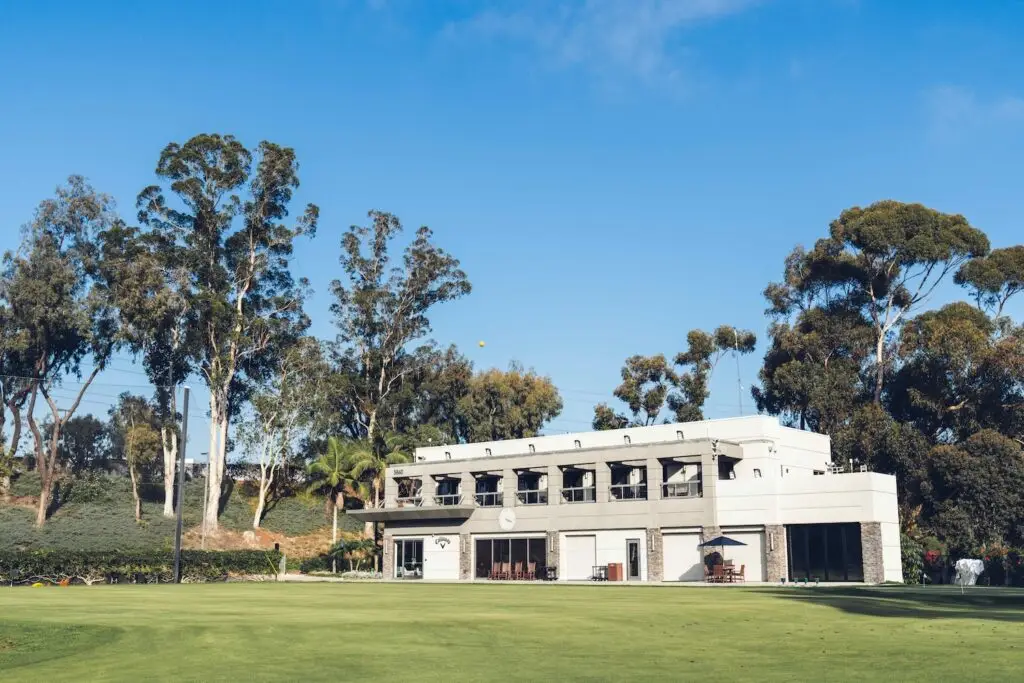
Originally opened in 2006 as a highly functional (yet not exactly breathtaking) test facility, the ECPC got a serious glow-up in 2018 when Gil Hanse (along with partner Geoff Shackelford) turned it into what can only be described as a fully engineered golf playground. Hanse is no stranger to golf course renovations. In 2024, he completed an extensive redesign of the Omni La Costa North Course in Carlsbad, so it could host the NCAA Division 1 Golf Championships. He also worked on acclaimed courses like Winged Foot, Merion Golf Club, and Oakmont Country Club.
In just two months, it went from a standard test center and R&D lab to a fully dialed-in golf playground.
Courtesy of Ely Callaway Performance Center
What was once purely practical is now intentionally designed to be both precise and inspiring. The targets are staggered with purpose—forcing creative shot-making while also calling you out on your actual distances (no more “that’s my 150-yard club … ish”).
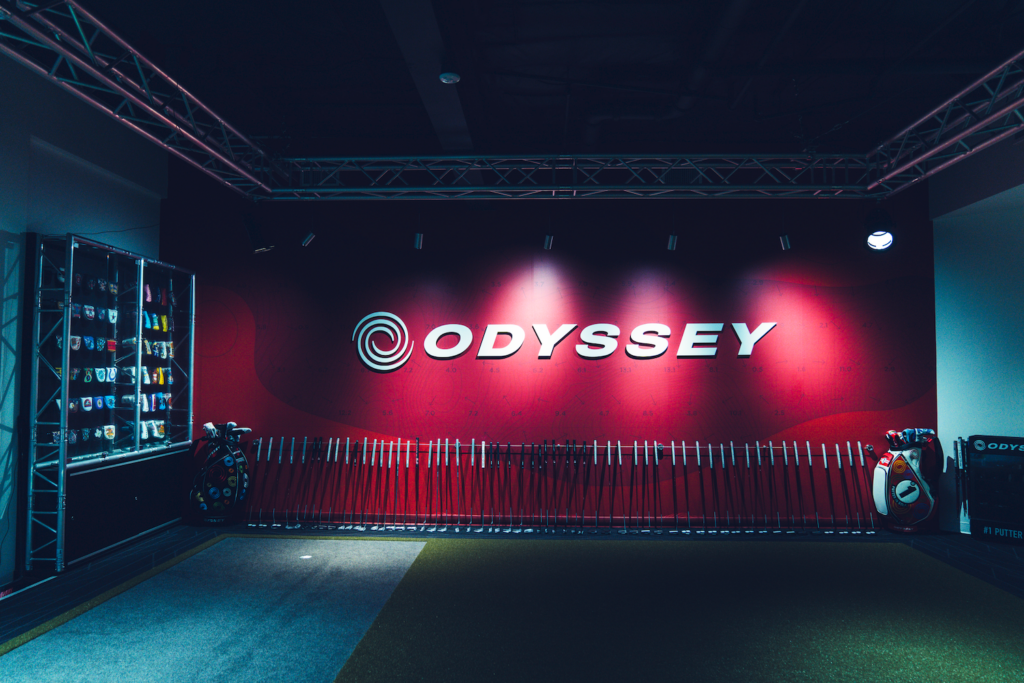
Add a massive hitting area, bunkers and greens that mimic real on-course conditions, a “Himalayas” putting green (named for its roller-coaster undulations), an upgraded indoor putting lab, and a 120-decibel sound system blasting a very golf-appropriate playlist, and suddenly it’s a rare blend of high-performance testing facility and “don’t mind if I stay here all day” energy. Since this isn’t exactly open to the public, SDM asked me to take you behind the curtain.
As the iron gates part, it feels less like arriving at a practice facility and more like being granted backstage access at a rock concert—if the bandmembers were made entirely of launch monitors and perfectly manicured turf.
There are no mats. No guessing. No “I think that one felt good?” Just conditions that mirror exactly what tour players see in competition. Because when you’re testing equipment at this level, accuracy isn’t a bonus—it’s the whole point.
Even the sand matters. Different textures. Different densities. Because bunkers have personalities, too, and they are often unfriendly. And the golf balls? Brand. New. Not the usual “these have seen some things” range balls. New balls mean consistent spin, truer trajectory, and no surprises. The older a golf ball gets—and the more it’s been baked in the sun, scuffed, or generally lived a full and complicated life—the less reliable it becomes. Think of it like this: fresh ball, predictable performance; old range ball, slight chaos with a side of mystery.
I’m escorted to my personal hitting bay—basically a pop-up shaded oasis stocked with enough equipment to make a gear junkie weak in the knees. Shafts in every weight and profile imaginable. Heads lined up like they’re waiting to be drafted by their favorite team.
Courtesy of Ely Callaway Performance Center
Toptracer technology was patiently waiting to track every one of my swings, each shot instantly delivering ball speed, launch, spin, carry distance, and dispersion (a polite way of saying consistency, or lack thereof), so there’s no guessing—just data telling the truth, whether I like it or not.
We start with irons. Different heads, different feels, different results. When I miss a shot, the ball tends to leak right, so we check lie angle. A quick adjustment—2 degrees upright—and suddenly the clubface is consistently square at impact like it remembered its job. Effort level: down. Ball flight: improved. Confidence: creeping back.
Next we look at the different shaft options—because nothing says “fun afternoon” like realizing a higher kick point can change your entire golf identity. Shaft flex (how much the shaft bends during your swing) helps determine whether you get more height and distance or more control, while kick point (where the shaft bends the most) influences your ball flight—lower kick point for higher launch, higher kick point for a flatter, more penetrating shot. In other words, one small tweak and suddenly you’re hitting shots you’d normally only describe later, slightly exaggerated, over a glass of wine.
Then we move through the bag: hybrids, fairway woods, drivers, wedges. It’s a full rotation of “try this,” “now try this,” and “okay wait … THAT one.”
And yes—the new Quantum driver and fairway woods made an appearance. Without getting too deep in the weeds, they’re faster, more forgiving, and smarter (thanks to AI face mapping) than previous models. Translation: Even your mishits are now slightly less embarrassing. And they were not the only things getting tested. My patience was under attack because the driver and woods would not be available to the public for a good three months.
Courtesy of Ely Callaway Performance Center
Watching the fitting team work is like watching a Formula 1 pit crew. Clubs are swapped in seconds. Shafts tightened, adjusted, replaced. One minute you’re swinging something that seems “fine,” and the next, you’re holding a club that feels like it is a part of your DNA.
Then there’s the putter fitting. Drivers are physics. Putters are therapy. Inside the putting lab, sensors track everything—tempo, face angle, path—things you didn’t even know could be measured. Within minutes, my data politely informs me that my putter face is slightly closed at impact. Not shocking, but also not ideal.
A few quick adjustments—different head (with a bit more weight at the toe to discourage the face swinging closed at impact), shorter shaft (so I feel more over the ball, which helps my eyeline)—and suddenly the ball starts rolling exactly where I’m aimed.
Same stroke. Same golfer. Completely different outcome. If only the rest of life worked like that.
And then there’s the part that feels slightly classified. The ECPC isn’t “just” a performance center—it’s also where future equipment lives before the public even knows it exists. I’ve been there when certain clubs were basically under surveillance. Not “don’t touch,” but more “please keep phones in your pocket.”
It’s golf’s version of Area 51. Except instead of aliens, it’s drivers that won’t hit shelves for another year—and like I mentioned, waiting is not my strong suit.
Getting to test the newest equipment isn’t just a perk—it’s part of the job. It’s what allows me to stand in front of students and say, “I’ve tried it. I know what works and what doesn’t. And more importantly, I know why.” And if I happen to sprint to my car every time the phone rings and someone says, “Come test something” … well, that’s just professional courtesy.
Callaway isn’t the only place to get your swing analyzed and clubs fitted. You can stroll into big retail spots like The Golf Mart or Golf Galaxy, book a next-level session at a dedicated studio like Club Champion or True Spec Golf, test brand-specific gear at various manufacturing companies (many located in Carlsbad), or even combine a lesson and a fitting at GOLFTEC. And let’s not forget your local golf course, where fittings happen on actual turf, on a driving range you have some history with—many times with the golf professional who is familiar with your swing so they can give you valuable input. With this many options, there’s really no excuse, other than pride, to keep blaming your clubs.
Music drifts across the fairway. Someone’s in flip flops. The Pacific flashes in the distance. Sun peeks onto shoulders through the palm trees. It’s spring, technically, but the air reads suspiciously like summer. At the par-3 course at Liberty Station, the longest hole barely stretches past 120 yards, and no one looks particularly interested in becoming the next PGA legend.
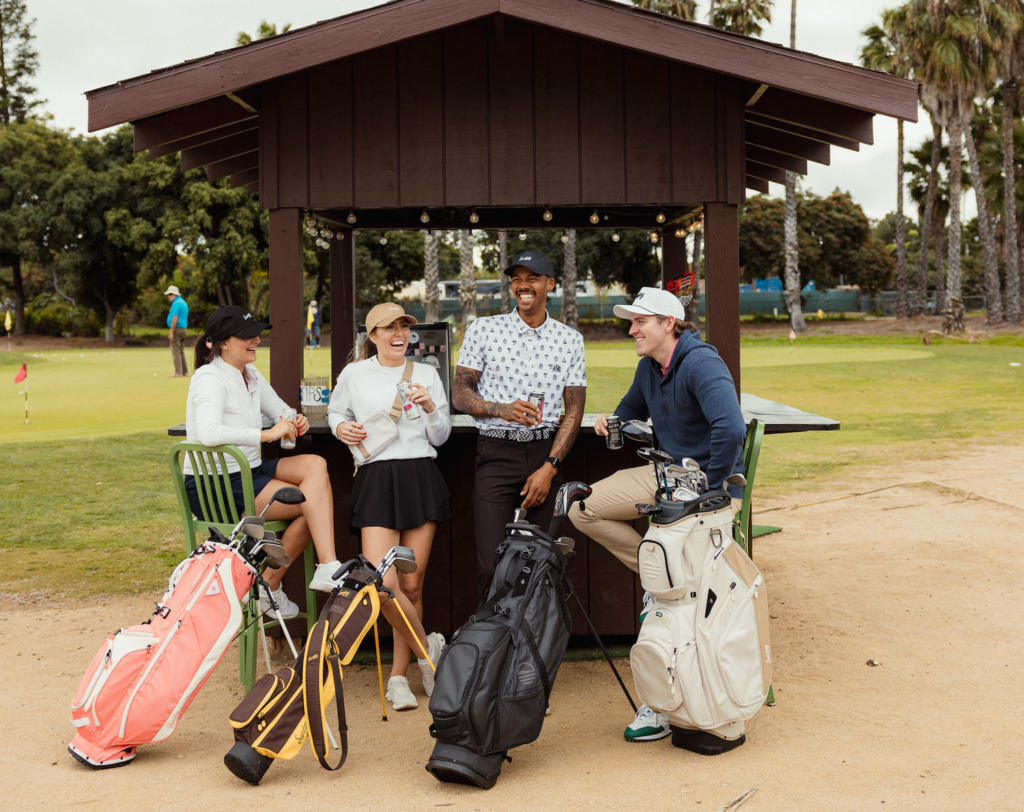
“I got dragged to a par-3 course in 2019 —The Loma Club—and it was way more my jam,” says Ronan Galvin, CEO and co-founder of Sunday Golf, a company that makes lightweight golf bags for players who’d rather carry less and laugh more. “It was a lot different than the stereotypical ideas you have about golf where it’s kind of long, uptight, and exclusive.”
Galvin spent over a decade in the golf industry working in product development, sourcing and manufacturing. But he didn’t grow up swinging clubs. Basketball and football were more his speed. What clicked for him was a simpler, more relaxed kind of play: shorter rounds and weekend games built for fun rather than formality. The kind of golf that resonated for him felt accessible, effortless, and surprisingly his lifestyle.
Courtesy of Sunday Golf
He noticed something else, too.
On a course where five clubs do the job, players were still lugging 14. So Galvin built something smaller. Lighter. A bag designed specifically for par-3 rounds, the Loma Bag is sleek, functional, and refreshingly unfussy. It’s practical minimalism in a sport known for excess.
Sunday Golf was slated to launch in January 2020. Then, COVID hit. Shipments stalled; lost at sea. The future felt shaky. But the series of catastrophes for the young company turned out to be anything but: By the time inventory arrived that August, golf had become one of the few activities people could safely do.
“It introduced and brought so many people back to the game,” Galvin says. “It created a habit for a lot of people, which is a big reason golf is on its growth trajectory.”
It turns out Americans can’t get enough of golf. Forty-eight million of them swung clubs last year, a 41 percent jump since 2019, and the National Golf Foundation says the total could top 50 million by the end of 2026.
The brand rode this unlikely momentum. Since 2021, Sunday Golf has expanded into larger lightweight bags and continues evolving from there. A major reason for the company’s success is its approachability, a value so central that it’s literally written on the office walls in the form of the company’s guiding mission: “Get 500,000 golfers having more fun by 2027.” This goal is measured, fittingly, by golf bags sold.
Sunday Golf has already passed 300,000 bags sold.
But the numbers aren’t the point.
Courtesy of Sunday Golf
“To remind the world that life is meant to be enjoyed,” Galvin says of the brand’s why. In an era dominated by screens, golf offers something analog. “People are outside, touching grass with their friends. A golf bag is a golf bag, but our products are vehicles to help support that.”
Unlike legacy golf giants promising proximity to Rory McIlroy-level greatness, Sunday Golf leans into what Galvin jokingly calls “diet golf” or “golf light”—weekend rounds, driving range sessions, company scrambles. The bags are built for the casual golfer, and the fit feels obvious.
That philosophy resonates across Southern California, where year-round sunshine means golf courses never really hibernate for winter. As Galvin puts it, “the laid-back lifestyle of San Diego kind of seeps into everyone’s veins.”
Sometimes the validation arrives via email: a 76-year-old customer is able to walk the course again because their golf bag is lighter. Parents are able to take their children out with Sunday Golf’s kids line.
For Galvin, that’s the real win. Not perfection. Not prestige. Just more people outside, enjoying themselves. In San Diego, that might be the most natural mission of all.
Isabella Dallas is a freelance writer for San Diego Magazine and the Arts and Culture Editor at The Daily Aztec in her final year at San Diego State University. She previously worked as an editorial intern for SDM, but when she’s not writing, you can find her trying the best coffee spots in SD, devouring the latest rom-coms, and indulging in anything and everything pop culture.
At the top of a golf swing, the world settles into a hush. Anyone within 50 yards kindly shuts up in reverence. Steady heartbeats tuck inside the sound of the wind. Time stands still.
Or—panic sets in, a thousand warnings from coaches and YouTube tutorials prattle through your brainpan. You wonder if a good walk prepares to be ruined.
On descent, the club rearranges air particles as it slices on a perfect or unwise line toward an earth so green, it seems like AI. The iron face meets the ball, and the satisfying or unsettling thwack echoes across the fairway like a nonviolent gunshot or a cry for help. Breath catches, curse words load in the prefrontal cortex. Eyes squint to follow the hard-to-see projectile zip majestically through the air or bounce lamely along the ground like a failed hurdler.
Sometimes it goes a couple hundred yards in the right direction, other times a couple yards into uncaring swamps. Golf’s beautiful and hard as hell.
Mindfulness and stillness reign over speed and might—which goes against most basal American instincts regarding sport. Its quiet, serene mocking of our human abilities is what brings so many of us to the life-long process of sharpening the skill. Because who hasn’t stared at the most beautiful parks and lawns in the world and said, “How can I turn this into a game and win it?”
Luckily, San Diego has an abundance of courses to improve and curate self-doubt. The county is home to over 70 courses that attract the top golfers in the country. Some of the biggest names in the sport—Callaway, TaylorMade, Cobra, Titleist, Odyssey, Honma—are based here. Perfect weather never hurts. But San Diego golf courses also promise a smorgasbord of terrains: rocky canyons, hot deserts, and lush greens overlooking the expanse of the Pacific Ocean.
If you could take the 1,300-ish holes around San Diego and pick the very best ones to create your ultimate course, which would they be? We asked some of the top golf pros in the county to do just that. The result? San Diego’s Dream 18. Think fantasy football but for golf.
Just like any great course, our Dream 18 includes four par 3s, 10 par 4s, and four par 5s—everything from tricky dog legs and psychological tee shots to just pretty, pretty views. Once we had our list, we either asked the head golf pro what makes a hole so special, or other pros spoke on its behalf. Go ahead, tell us what we missed.
“One of the most iconic par 3s on the West Coast. The cliffside setting above the Pacific and the constant ocean breeze make it both beautiful and demanding.”
—Anthony Valverde, Director of Golf, The Crosby Club atRancho Santa Fe
“It’s a downhill par 3 over water with a great view from the tee down to the green. It’s surrounded by bunkers as well, so it almost feels like an island green even though it’s not. What’s really cool is once you drive to the next hole, if you look back on No. 14, it’s a great view as well. One of the signature holes [at Santaluz].”
“Hole 15 is widely considered one of the best and most memorable holes on the course. At about 250 yards, it’s a long downhill with multiple tiers and panoramic views into the valley. It looks intimidating at first, but there are lots of recovery contours and the green is fairly large.”
“While it’s beautiful with the backdrop of the Batiquitos Lagoon and the Pacific Ocean, this finishing hole demands both precision and nerve. The water guarding the right side and fairway bunkers ahead create a visually striking, strategic tee shot, while the expansive green rewards a confident, well-placed approach. If you can make a par on this hole, you’ve played it very well.”
“The 18th hole at Del Mar CC is a demanding par 4 with an elevated tee box. Water guards the right side of the green, and a player must hit a precise shot into this green.”
“It’s a difficult 428-yard par 4 playing into the predominant west wind. The hole is post-renovation and the vegetation was trimmed back, so now it exposes a penalty on the right. It’s uncomfy at the tee but a good challenge. Plus, it’s the No. 1 handicap for [all players].”
—Chris Lungo, Head Golf Pro, Rancho Santa Fe Golf Club
Lili Kim is a content coordinator and writer for San Diego Magazine, with experience highlighting local businesses and communities. When not writing or shooting film, she is likely brewing her seventh cup of tea of the day or strolling along Sunset Cliffs.
Today’s seniors are more connected than ever, with a renewed focus on retirement as a time of discovery and enriching experiences. The ultimate reward for a retirement well-earned is the wisdom to appreciate it all, and what better place to enjoy that unique perspective than Vi at La Jolla Village, in the heart of San Diego.
All-access pass to good living.
As a Continuing Care Retirement Community (CCRC), Vi provides access to a connected and fulfilling community while making it easy to plan for future care, should the need ever arise. With a care plan in place, residents enjoy greater financial predictability and long-term value, freeing them to focus on making the most out of retirement.
Resort-style amenities at the epicenter of a cultural hub like San Diego offer a retirement experience unlike any other. Paired with exceptional dining, spacious accommodations and dedicated staff, the best of maintenance-free living is all around. And with the introduction of Vista 360 Well-Being, Vi’s panoramic approach to wellness, there are more ways than ever for residents to access it all.
The harmony of mind, body and community.
Courtesy of Vi at La Jolla Village
The key to longevity is striking the right balance in maintaining an active lifestyle with an active mind in a fulfilling community. With newly renovated community spaces and restaurants, Vista brings a variety of opportunities for residents to elevate their well-being through Vi-exclusive “Signature Experiences.”
Vista Enrich takes an evidence-based approach to brain vitality, keeping residents at the forefront of cognitive health through exergaming (exercising + gaming), nutritional plans and informative workshops. It is also home to The Brain Vitality Studio, an innovative facility dedicated to cognitive fitness that has garnered national recognition.
Vista Discover invites residents into stimulating educational experiences, from chef-led cooking demos and guided wine tastings to lectures at local universities and intimate lectures following cultural outings.
While Vista Enrich focuses on brain health and Vista Discover engages residents intellectually, Vista Explore cultivates a sense of adventure through curated travel and local excursions. But broadening one’s horizons doesn’t always require a plane ticket. One recent event brought a taste of the world right to the community: an onsite “jazz cruise” featuring live music and global cuisine served at a series of themed “ports” all within the community’s own ballroom.
“Location, location, location”
Courtesy of Vi at La Jolla Village
One of the biggest perks of life at Vi at La Jolla Village is its proximity to just about everything. With easy access to transportation and local attractions just steps away, residents can explore and engage with their community at their own pace.
“There are trolley and bus stops within a 5-minute walk that will get you to the beach, UCSD Campus, medical appointments, downtown La Jolla or San Diego, et cetera. We rarely use our car,” said resident Tom Yager.
With the best of San Diego just steps away, residents don’t just live in the city, they live within reach of everything that makes it special.
The best of all worlds.
Courtesy of Vi at La Jolla Village
At Vi at La Jolla Village, retirement isn’t a chapter to slow down; it’s an invitation to discover more. Tailored community experiences created by Vista, paired with the vibrant pulse of San Diego just outside the door, mean that residents don’t have to choose between security and adventure, connection and independence. They get all of it.
This is what an all-access pass to good living looks like: the comforts of an elevated lifestyle, a community built for growth and a city made for discovery – all in one place.
To learn more about Vi at La Jolla Village or for details on available floor plans, visit ViatLaJollaVillage.com/SDM.
Back in 1968, Lou Smith, John Brown, and Norrie West decided that the San Diego Junior Golf Association would host the Junior World Golf Championships. The goal was simple: to enable junior golfers to come together and enjoy a cultural exchange while sharing the game of golf. In its inaugural year, an impressive 475 junior golfers came from seven countries and 20 states.
It’s now known as the Callaway Junior World Golf Championships. Some of its past winners have gone on to enjoy famed careers in the PGA and LPGA. Among them: John Cook, Craig Stadler, Amy Alcott, Billy Mayfair, Corey Pavin, Phil Mickelson, David Toms, Tiger Woods, Ernie Els, Chris Riley, Lorena Ochoa, Pat Perez, Kevin Stadler, and Jason Day.
During the early years, these young talents stood posing for pictures and never imagined those photos would later be used in numerous golf magazines and TV montages to chronicle their success stories. But today, junior golfers know what’s at stake, and dream of walking in the footsteps of their heroes.
From July 14 to 18, about 1,200 participants representing 56 countries and 42 states will come to various courses around San Diego to compete—making this event the largest international junior golf tournament in the world. It is also a college coach’s dream—we’re talking recruiting utopia. Most colleges don’t have the funds for international recruiting, so this offers the opportunity to scout the top international players without having to leave the country. Last year, 124 college coaches attended, and that number is expected to increase this year.
It’s hard to imagine the pressure these kids face today. The time, effort, and financial commitment, mixed with lofty scholarship and career goals, make this tourney a defining one for junior golfers. But while there’s a lot on the line, the goal remains the same: to bring talented youngsters together and make the world a better place through the game of golf. juniorworldgolf.com
Back in 1968, Lou Smith, John Brown, and Norrie West decided that the San Diego Junior Golf Association would host the Junior World Golf Championships. The goal was simple: to enable junior golfers to come together and enjoy a cultural exchange while sharing the game of golf. In its inaugural year, an impressive 475 junior golfers came from seven countries and 20 states.
It’s now known as the Callaway Junior World Golf Championships. Some of its past winners have gone on to enjoy famed careers in the PGA and LPGA. Among them: John Cook, Craig Stadler, Amy Alcott, Billy Mayfair, Corey Pavin, Phil Mickelson, David Toms, Tiger Woods, Ernie Els, Chris Riley, Lorena Ochoa, Pat Perez, Kevin Stadler, and Jason Day.
During the early years, these young talents stood posing for pictures and never imagined those photos would later be used in numerous golf magazines and TV montages to chronicle their success stories. But today, junior golfers know what’s at stake, and dream of walking in the footsteps of their heroes.
From July 14 to 18, about 1,200 participants representing 56 countries and 42 states will come to various courses around San Diego to compete—making this event the largest international junior golf tournament in the world. It is also a college coach’s dream—we’re talking recruiting utopia. Most colleges don’t have the funds for international recruiting, so this offers the opportunity to scout the top international players without having to leave the country. Last year, 124 college coaches attended, and that number is expected to increase this year.
It’s hard to imagine the pressure these kids face today. The time, effort, and financial commitment, mixed with lofty scholarship and career goals, make this tourney a defining one for junior golfers. But while there’s a lot on the line, the goal remains the same: to bring talented youngsters together and make the world a better place through the game of golf. juniorworldgolf.com
NewBridge School is San Diego’s only school dedicated to the education of students with dyslexia and related learning profiles. For 30 years we have successfully served students with dyslexia, dysgraphia, dyscalculia, receptive/expressive language disorders, ADHD, executive functioning and memory deficits. Students transition successfully into academically rigorous high schools and colleges across the country. Why NewBridge? Training, training, training (plus intensive individualization, and comprehensive program design). All teachers are trained and retrained biennially in Orton-Gillingham, the only approach proven to remediate dyslexia based on Science of Reading research, and complete a year-long training program. Every aspect of our program is designed around our students’ learning styles and needs. Every class is taught by a highly-trained expert, and our Speech/Language and Occupational Therapy teams embed throughout the day. Our multisensory, multi-tiered math program has been developed in conjunction with sister schools and experts across the country. Don’t wait—early intervention is magic!