
Featured articles
Food & Drink
Food & Drink
Food & Drink
Featured articles

Arts & Culture
Things to Do
Features
Featured articles
Things to Do
Things to Do

Everything SD
Featured articles
podcast-ep
podcast-ep
podcast-ep
Featured articles

Arts & Culture
Features
Features
Featured articles
Partner content
Arts & Culture
Food & Drink
Ready to know more about San Diego?
SubscribeReady to know more about San Diego?
Getting outside and staying active is in our blood; and finding new ways to enjoy yearlong perfect weather is what we do best
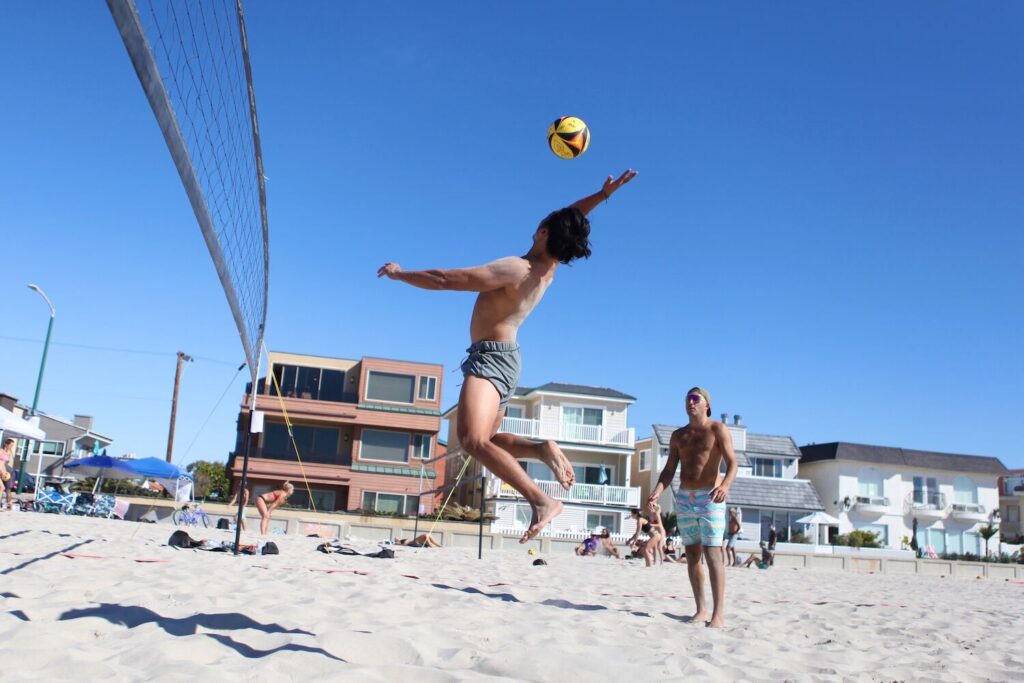
South Mission Beach Courts
Patrick Davis for Life’s a Beach
The bike shop sits on a popular commute route and is staffed by affable mechanics who have worked the Tour de France. Hardcore bicycle people don’t have the friendliest rep, but MJ’s is different. They’ve got the skill set to equip racers, but they don’t treat commuters or parents buying bikes like tourists in their world.
One minute you’re casually playing a game of pickleball, the next thing you know, you’ve helped design Gearbox’s newest paddle. The brand is based in San Diego and PBTC is their local court, where they play with locals to gain insights on how to improve their rackets. This sounds like free lessons to us.
When a relative was giving away their boat, local architect Vilchis saw an opportunity to design a 10/10 Instagrammable experience. Now you can class up your day date by recreating The Notebook—a pristinely refurbished tiny boat with padded seats, plant garlands, snacks and drinks, and even parasols. Ryan Gosling not included.
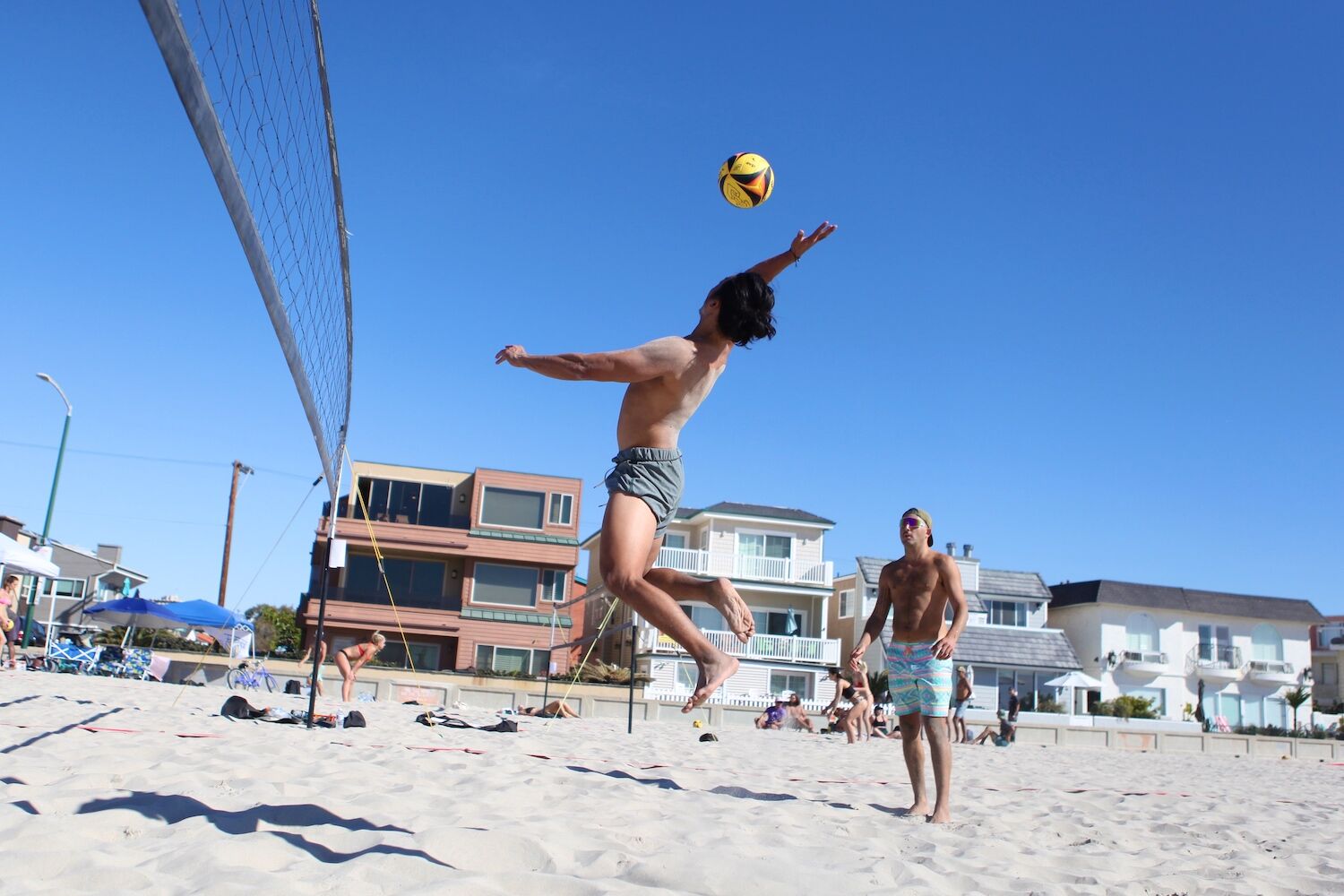
Each weekend on the courts of South Mission Beach, the sand is taken over by 2v2 players—many of which are ESL speakers from various countries. They’ve made this plot of sand their sacred community, where the universal language is bump, set, and spike.
On any given Wednesday on Hamilton Ave., 100 to 200 runners gather to run the streets of North Park. It’s put on by Milestone Running, a shop created by locals Greg Lemon and Chad Crawford. Go a few times and you’re pretty much guaranteed at least ten new friends—might even get “Smirnoff Iced” during the post-run raffle. You win some, you lose some.
Even avid runners can lose motivation. This year, Waterfront introduced a new tradition: beer stops. The three- mile loop starts at Eppig Brewing in Point Loma, then heads to Fathom Bistro for a beer before completing the next 1.5 miles. Finish up with a post-run brew at Eppig, obviously.
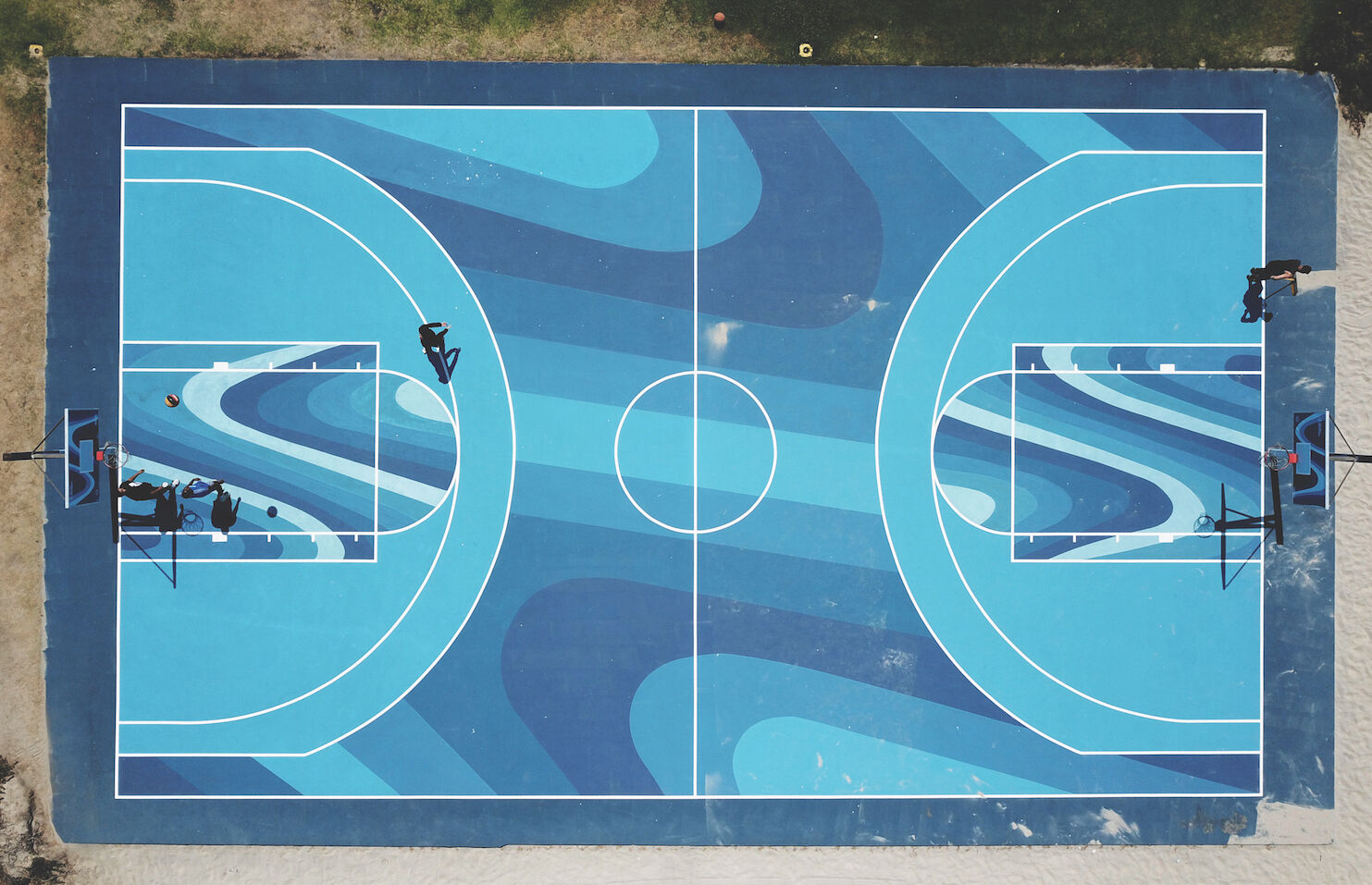
Mission Bay Basketball Court
Madeline Yang
San Diego’s maritime history runs deep. America’s Cups have a permanent home here. Harbor Sailboats—seven-time winner of the “ASA School of the Year”—offers sailing courses taught by longtime sea dogs. You know, the type of no- nonsense skippers who know how the wind will change by the way the breeze hits their beard hair.
If you want sky-high firs, oak forests that shade your path, and mountain peaks that overlook actual foliage (read: no palm tree in sight), head to Palomar Mountain State Park. And, since the inaugural California State Parks Week took place this year, there’s no better time to dust off your hiking boots on one of the six hiking trails (five for running).
A mellow 5.7 climb on paper, The Tower at Mission Gorge will have you clipping the first few bolts like you’ve been dirtbagging in Yosemite all your life. You’ll have to dig deep into your courage reserves to tackle the crux, but you’ll be walking down that mountain with your head held high when the sun starts to set.
Hoops here have always had a magical effect—a full regulation court, smack dab on the beach. The ball smells like sunscreen. No fence; out of bounds is in the sand. And it just got an artful resurfacing in honor of local basketball legend, Bill Walton—who’s been a member of the South Mission Beach Sports Park & Rec for 25 years.
Yep, in City Heights. Specializing in boards from local shapers, owner Mark Polintan (who grew up on a pineapple farm in the Philippines) has created an infectious gathering place for surfers to support their peers. Like chasing tubes in exotic locations, you never know what or who you’ll find here, but you’re guaranteed to leave stoked.
Surfers are selfish. No matter how many waves we catch, we always want more. And while there’s no shot we’ll ever change, we can at least direct that impulse toward a good cause. At the annual 100 Wave Challenge, participants commit to riding 100 waves in one day to raise funds for the local nonprofit Boys to Men Mentoring.

Nicolle Monico is an award-winning writer and the director of creative projects, digital editor for San Diego Magazine with more than 19 years of experience in media including Outside Run, JustLuxe and The San Francisco Chronicle.
Whether you're a lover of the arts, music, or a leisurely stroll through the park, these are Balboa's best attractions
On February 28, 1926, the Fine Arts Gallery of San Diego (now called the San Diego Museum of Art) opened its Plateresque doors to 3,000 guests for opening day. Over the next century, the museum changed with the times—even once functioning as a naval hospital after Pearl Harbor. This year, the museum is celebrating its 100th birthday with an exhibit (open through January 24, 2027) featuring photographs, ephemera, and film footage spanning the museum’s history.

Every Sunday from 2 to 3 p.m., stop by the historic Spreckels Organ Pavilion for a free concert presented by the City of San Diego on the largest outdoor organ in the world (more than 5,000 pipes). The pavilion seats 2,400 for performances by the civic organist or guest artists.
Some think natural history museums are just cemeteries for dioramas that haven’t received an update since the Reagan administration. When it comes to The Nat, which just finished a $7.5 million rejuvenation, they’re totally wrong. The museum debuted a new rooftop that replaces its 25-year-old atrium. The old roof created a greenhouse effect that steamed up some exhibits, so the new one—which includes 200 solar panels and better temperature control—will help preserve the artifacts inside. Each Friday in the summer, The Nat also becomes one of the season’s vibiest hotspots during Nat at Night, with food from places like Wolf in the Woods and The Craft Taco, bars and signature cocktails on several floors, and a rooftop DJ.
The Fleet Science Center just received its most significant update since the 1990s. It expanded its exhibit space by 20 percent and introduced a newly designed entrance gallery (formerly the IMAX theater lobby) that includes free exhibits for visitors who want a taste of the science without paying an admission fee. The former ticketing area now houses the Mindbender Mansion exhibit, and there’s a new café, Element 8, that will, of course, sell the center’s famous soft serve.
Boredom's not an option. These are a few of the top events in the city each year, including a rodeo, free summertime music festival, and a chili cook-off
Meet some rodeo queens (or be crowned as one yourself) in R-Town’s annual celebration of the Wild West. Three days of mutton bustin’, tie-down roping, and barrel racing are all doing the community some good: Proceeds from the event funnel into local organizations like Ramona Town Hall and the Guy B. Woodward Museum. This month marks the 45th annual Ramona Rodeo, which takes place in the Fred Grand Arena and draws more than 12,000 attendees each year.
For nearly half a century, OB has hosted a chili cooking competition that has drawn thousands of hungry locals. (Buzz Cannabis presented this year’s event, so taste testers could have been under the influence of munchies-enhancing drugs.) Non-chili-related street fair festivities include beachfront live music, Fun Zone family-friendly play areas, and a Dirty Birds wing-eating contest.

In 1970, Chicano Park was set to become a California Highway Patrol station. The problem: The city had promised a community park in that area. After decades of development fractured Barrio Logan and displaced thousands of families, Chicano locals were tapped out. So, for 12 days, locals occupied the area under the Coronado Bridge, blocking bulldozers and planting cacti. It worked. Construction stopped, and that area is now Chicano Park. Each year, locals celebrate the successful preservation of Chicano Park and the resilience of the Chicano Movement.
Solana Beach gathers at Fletcher Cove Park at the start of each summer for two days of live music ranging from country to pop to Chicano rock, plus an arts and crafts fair, an international food court, a beer and wine garden, and the Solana Beach Firefighters Association’s pancake breakfast. The event is free, but if you want an elevated experience, grab Seaside Pavilion ($75) or VIP Deck ($160) tickets for reserved seating, private cash bars, exclusive restrooms, and discounted swag.

The entire North Park neighborhood hosts an annual music festival, meaning a dozen venues—from Queen Bee’s to Bacari to North Park Community Park—become live music spaces each June. Some locations are open to the public, but if you’d prefer lounge access at Granada House and line-skipping privileges, check out the $65 VIP passes. General admission otherwise starts at $25.
It’s weird if you don’t wear a lemon-themed outfit at Chula Vista’s annual Lemon Festival. For one day each August, Third Avenue pays tribute to the city’s former “Lemon Capital of the World” status with live music, citrus-themed photo ops, arts and crafts vendors, a lemon cook-off competition, and plenty of other food that doesn’t include the famed hesperidium. But who would want that at Lemon Fest?
From getting your sweat on at hip-hop class to celebrating with a zero-proof cocktail, here are San Diego's top fitness and wellness spots
For thousands of years, the Kumeyaay who lived in this area called a mountain south of Julian Cush-pii, meaning “sharp peak.” Then, after the Civil War, Confederate sympathizers saw that same mountain and decided to rename it Stonewall Peak—after General Stonewall Jackson. The name stuck for nearly a century and a half, until Cuyamaca Rancho State Park announced earlier this year that the name will return to its original, Cush-pii. Hike to the summit for expansive views of the Coronado Islands to the west and Mexico to the south.

In 1993, Angie Bunch gathered a group of hip-hop dancers—called Culture Shock Dance Troupe—and gave them a space to practice and perform. As hip hop grew through the ’90s, so did Culture Shock. It has since become a nonprofit, a space for young and old, beginner and expert dancers. Culture Shock has also expanded to Los Angeles, Oakland, Las Vegas, Chicago, Atlanta, New York City, and Washington, D.C., as well as Ottawa and Toronto, Canada.
In 2019, Amanda Leach created the Yoga Box method, which takes high-energy flows and adds strength-building poses in heated, vibey, lava-lamp-lit studios. What started on Grand Avenue in Pacific Beach has spread to 15 locations across the county, with even more trickling into Denver, Chicago, and Brooklyn. The best part? Mindfulness newbies who can’t touch their toes and six-packed contortionists can hang in the same class. You can customize each session based on your ability and fitness level.

A gym taking over a historic beachfront pool sounds like the setup for a new season of Love Island, but Fit Mission Beach operating the nearly 100-year-old Plunge at Belmont Park is real. The independent fitness brand has spent the past several years building a loyal following through group fitness classes, community events, and a members’ social club overlooking the ocean. Upstairs, members can work remotely, meet friends, or hang out long after their workout ends. Between the Plunge, the coworking-style lounge, and a packed calendar of events, Fit has evolved into something bigger than a gym. It’s a clubhouse for San Diego’s fitness crowd.
The wellness world is finally transitioning away from HIIT workouts and cult-like spin classes, where your heart rate hits Zone 5 within minutes and stays there until cooldown. Good. At Breathe Degrees, wellness takes the form of zenned-out communal breathing sessions or vagus nerve–activating cold plunges. Breathwork is said to boost your mood in the short term and improve your heart health in the long term, and maybe that’s why everyone’s coming back for more. You can’t run into someone in Carlsbad who hasn’t dropped into at least one breathwork session, and now the studio has opened a second location in Liberty Station.

Pilates wasn’t just popular this year; it was practically a requirement for maintaining your San Diego residency. New studios seemed to appear weekly across San Diego, each promising stronger cores and better posture, but Soul Pilates and Care found a way to stand out by addressing a challenge many parents know well: finding time to exercise at all. Fitness doesn’t have to compete with parenting responsibilities. Parents can drop their kids off with trained caregivers while they head into reformer classes, eliminating one of the biggest barriers to working out. The studio has earned strong reviews for both its instruction and family-friendly approach.
The Hotel del Coronado’s sweeping $550 million restoration touched nearly every corner of the historic resort, but one of the most anticipated unveilils was the debut of its redesigned spa. The oceanfront wellness destination now features 21 treatment rooms, a relaxation lounge, a sauna, steam room, and a treatment menu inspired by the coastal environment just steps away. The redesign blends the Del’s Victorian legacy with a cleaner, more contemporary aesthetic, creating a space that feels distinctly SoCal rather than generic luxury hotel. For locals who don’t have time for a vacation, it’s the next best thing.
As non-alcoholic beverages continue their meteoric rise, Good News Bar has become one of San Diego’s most compelling arguments for a booze-free evening. The University Heights hotspot serves a menu of carefully crafted zero-proof cocktails that borrow techniques and ingredients from traditional cocktail programs (it’s not just fancy juices and soda water), minus the hangover. The space also hosts regular community events and has quickly become a gathering place for everyone from sober San Diegans to the merely sober-curious. In a nightlife industry built around alcohol sales, Good News proved there’s plenty of demand for connection without the buzz.
At Vi at La Jolla Village, residents don't have to choose between security and adventure, connection and independence. They get all of it.
Today’s seniors are more connected than ever, with a renewed focus on retirement as a time of discovery and enriching experiences. The ultimate reward for a retirement well-earned is the wisdom to appreciate it all, and what better place to enjoy that unique perspective than Vi at La Jolla Village, in the heart of San Diego.
All-access pass to good living.
As a Continuing Care Retirement Community (CCRC), Vi provides access to a connected and fulfilling community while making it easy to plan for future care, should the need ever arise. With a care plan in place, residents enjoy greater financial predictability and long-term value, freeing them to focus on making the most out of retirement.
Resort-style amenities at the epicenter of a cultural hub like San Diego offer a retirement experience unlike any other. Paired with exceptional dining, spacious accommodations and dedicated staff, the best of maintenance-free living is all around. And with the introduction of Vista 360 Well-Being, Vi’s panoramic approach to wellness, there are more ways than ever for residents to access it all.
The harmony of mind, body and community.

The key to longevity is striking the right balance in maintaining an active lifestyle with an active mind in a fulfilling community. With newly renovated community spaces and restaurants, Vista brings a variety of opportunities for residents to elevate their well-being through Vi-exclusive “Signature Experiences.”
Vista Enrich takes an evidence-based approach to brain vitality, keeping residents at the forefront of cognitive health through exergaming (exercising + gaming), nutritional plans and informative workshops. It is also home to The Brain Vitality Studio, an innovative facility dedicated to cognitive fitness that has garnered national recognition.
Vista Discover invites residents into stimulating educational experiences, from chef-led cooking demos and guided wine tastings to lectures at local universities and intimate lectures following cultural outings.
While Vista Enrich focuses on brain health and Vista Discover engages residents intellectually, Vista Explore cultivates a sense of adventure through curated travel and local excursions. But broadening one’s horizons doesn’t always require a plane ticket. One recent event brought a taste of the world right to the community: an onsite “jazz cruise” featuring live music and global cuisine served at a series of themed “ports” all within the community’s own ballroom.
“Location, location, location”

One of the biggest perks of life at Vi at La Jolla Village is its proximity to just about everything. With easy access to transportation and local attractions just steps away, residents can explore and engage with their community at their own pace.
“There are trolley and bus stops within a 5-minute walk that will get you to the beach, UCSD Campus, medical appointments, downtown La Jolla or San Diego, et cetera. We rarely use our car,” said resident Tom Yager.
With the best of San Diego just steps away, residents don’t just live in the city, they live within reach of everything that makes it special.
The best of all worlds.

At Vi at La Jolla Village, retirement isn’t a chapter to slow down; it’s an invitation to discover more. Tailored community experiences created by Vista, paired with the vibrant pulse of San Diego just outside the door, mean that residents don’t have to choose between security and adventure, connection and independence. They get all of it.
This is what an all-access pass to good living looks like: the comforts of an elevated lifestyle, a community built for growth and a city made for discovery – all in one place.
To learn more about Vi at La Jolla Village or for details on available floor plans, visit ViatLaJollaVillage.com/SDM.
The most exciting moments in local sports in the past year—the top highlights, biggest stars, and greatest wins
Last year’s Olympics in Paris delivered plenty of unforgettable moments—a metal band performing alongside a headless Marie Antoinette in a 13th-century castle, breakdancing’s short-lived debut (sorry, Raygun), and even Snoop Dogg serving as a torchbearer. But some of the most memorable concerned our own hometown heroes.
Sixty San Diegans competed for Team USA, earning 25 medals across eight sports, with gold medalists including then-Wave FC players Naomi Girma and Jaedyn Shaw, basketball star Kelsey Plum, and cyclist Jennifer Valente. Encinitas’ own Jagger Eaton hit the street park as one of only three Americans representing the country in men’s street skateboarding, nabbing a silver medal finish. And while TikTok-famous local “rave horse” Suppenkasper and his rider Steffen Peters, beloved for their EDM-fueled dressage routines, didn’t make it to the finals, the 17-year-old gelding had audiences eating out of the palm of his, uh, hoof from the very first beat drop.
The next Chucky Lozano might soon be honing his skills right down the road in El Cajon. San Diego FC kicked off its inaugural season in February and quickly proved itself a force within MLS (at press time, it sits at number one in the Western Conference). With it came the Right to Dream Academy, a scholarship-based academic and training facility where promising players as young as 11 will prepare for a bright future in the pro league under top-tier tutelage.
Picture it: Padres against the hated Dodgers in LA. With two runners on, the fate of the Padres’ 2024 postseason rests on one play. Bottom of the ninth inning. No outs. Padres closer Robert Suárez is looking to hang on to a 4–2 lead. Crack—a ground ball to Manny Machado. Machado tags third and fires to second. Jake Cronenworth turns it and beats the runner at first. Just like that, San Diego pulls off an unforgettable triple play and clinches their playoff berth. Easily the most cathartic moment in San Diego sports in the last year.
As one chapter ends, another kicks off. San Diego’s favorite WNSL icon, Alex Morgan, officially hung up her cleats (along with her number-13 jersey, which the team is retiring in her honor) for good in September 2024 after her final game with San Diego Wave FC against the North Carolina Courage. But before you get too emotional, she also dropped the much happier news that baby number two was on the way.
True to form, she’s not slowing down anytime soon. She’s staying in the game as a minority investor in the Wave, continuing her mission to uplift women in sports and ensure the next generation has even more room to shine.
2024 was a big year for San Diego State alum and world-ranked number-three golfer Xander Schauffele. Following a near-perfect round of 62 at Kentucky’s Valhalla Golf Club, tying the lowest round ever scored in a Major championship, he secured a narrow PGA Tour win over titan Bryson DeChambeau. Fast forward to July, and Schauffele brought his A-game to the Open Championship at Royal Troon Golf Club in Scotland. Battling wind, rain, and the course’s punishing bunkers, Schauffele was one of only 17 golfers to break par throughout the tournament.

We said goodbye to a local icon this year: 6’11 NCAA Hall of Famer Bill Walton. Born in La Mesa, Walton played basketball at Helix High with his brother Bruce (who later became an NFLer) before making his mark at UCLA under legendary coach John Wooden. He won three straight NCAA Player of the Year awards (’72–’74) and was the first overall pick in the 1974 NBA Draft. Leading the Portland Trail Blazers to their only NBA championship in 1977, Walton became a beloved sports legend. A devoted Deadhead, he attended more than 800 Grateful Dead concerts and spent his later years deeply involved in community work, leaving a lasting legacy.
Growing up in Oceanside, Caitlin Simmers had always gravitated toward the activities that make a California beach city what it is. She dabbled in BMX, dance, martial arts, and skateboarding, but found her calling in surfing at age 6. Now, at 19, she is in her third year of the World Surf League Champions Tour and part of the USA Olympic team. Last year, at Lower Trestles, only 20 miles from her hometown, she notched a pretty serious resume builder: She became the youngest woman winner of the World Surf League Final.
Imperial Beach has some of the finest surf in San Diego—and the nation’s most contaminated shores
Every year, when winter swells bring San Diego’s best waves to their fullest potential, local surfers flood the lineups of popular spots like Black’s and Swami’s. But some of the heaviest and most dangerous surf lies further south, off the coast of Imperial Beach. The area’s crown jewel, Tijuana Sloughs, sometimes serves up 20-plus-foot waves that break up to a half-mile from shore.
Even as the surfing population has exploded, however, IB remains empty in comparison to the rest of San Diego, thanks to the pollution that plagues its waters. Surfers in IB don’t just check the surf cams and swell forecasts—they monitor the water data from the nearby International Boundary and Water Commission.
“It’s almost a science to go out for a surf and not get sick,” says resident Dwayne Fernandez. “My wife hates that I still surf here; she gets worried. I check the reports every day to see if it’s safe, which has been rare these days. If it’s not, I may have to drive over an hour just to get in the ocean—and I live minutes from the beach in IB.”

According to the Surfrider Foundation, IB has the unfortunate distinction of being the most polluted beach in America. Built in 1996 with the capacity to manage 25 million gallons of wastewater a day, the nearby South Bay International Wastewater Treatment Plant (SBIWTP) is frequently overwhelmed. Anything that exceeds the limits of the SBIWTP comes out as raw sewage, clearly visible in the water as a dark brown plume with an accompanying nasty smell.
The sewage flow can sometimes hit hundreds of millions of gallons in a single day. “You don’t want to be out there when that happens, and it can happen quickly,” says Adam Wraight, an Imperial Beach lifeguard sergeant, junior lifeguard coordinator, and longtime local surfer.

But that hasn’t stopped some residents, despite mandates prohibiting surfing and swimming during beach closures. If the waves are good, surfers are probably out there. Why take the chance, though, when there are so many other good waves—with cleaner water—in the county?
It’s partly a point of local pride. The surf history in IB runs deep. Stories of the Tijuana Sloughs on its good days are the stuff of legend, discussed in hushed tones in the core San Diego surf community.

“The Sloughs was never a spot meant for everyone,” says Jeff Knox, a former lifeguard and lifelong IB surfer. “The paddle-out alone was enough of a deterrent for most. The shorebreak took care of the rest. It’s mostly locals out there; we like it that way. It’s one of the best waves around and, for that very reason, we never used to talk about it. But those days are long gone. We need all the help we can get—the more attention, the better. Because this is a huge problem.”
It’s also been part of the deal for decades. “I started surfing IB in the ’60s, [and] we’ve always had to deal with pollution,” Knox adds. “Throughout my entire life, it’s never been as bad as the last 10 years. The last five have been absolutely terrible.”
Additionally, there’s the simple fact of convenience. While IB’s median rent cost of $3,000 is well under the staggering housing costs in other surf-adjacent ’hoods like Encinitas and Del Mar, locals still pay a pretty penny to live a few blocks from the beach. And they often pay a price for surfing there.

Scientists have identified 175 toxic pollutants in IB’s waters. Surfers have contracted everything from diarrhea and bacterial infections like MRSA to neurological disorders and hepatitis A.
“As a lifeguard, I see all the data. I check the flows daily and monitor the testing just to see if I can go for a surf during my break or after work. There are plenty of people who don’t check anything—they just see waves and go out—but even they get spooked when they hit the water and everything feels and smells wrong,” Wraight says. “Our responsibilities are definitely different from other [lifeguard] stations and, unfortunately, so much of what we do revolves around the pollution. It can get pretty negative, and it takes a toll on morale and recruitment.”

The problem has driven some local diehards from the water completely. Ramon Chairez, an activist and educator with the nonprofit Un Mar de Colores, has lived in IB for decades, but in 2020, he “made a conscious decision to stop surfing IB,” he says. “I saw too many people around me getting sick. It wasn’t worth it. The last five to 10 years have really been pivotal in the consciousness of the population, especially the kids—they know it’s polluted and unsafe.”
As a junior lifeguard coordinator, Wraight once trained the next generation in IB. But, now, he and the local kids he works with must travel to other beaches in the county. YMCA’s Camp Surf, a program that attracts children and teens from all over the nation with the allure of learning to surf in San Diego, can no longer take participants into the area’s waters.

They must head to other neighborhoods or stick to land-based activities. “The biggest tragedy is the youth,” Wraight says. “They’re growing up not being able to enjoy the ocean like we did—their whole life experience is affected by the pollution.”
Despite the toxic water, IB still feels like a classic beach town, a callback to a time before $8 lattes and luxury condos dominated the coast. It’s charming, quaint, and beautiful, with the open space of the Tijuana Estuary to the south, mountains in the distance, and the mighty Pacific to the west. It has one of the most unique coastal views of all of San Diego—and some of its best waves. If only you could safely surf them.
Chris Dodds has been falling in love with San Diego for the past 10 years. He's passionate about the protection and preservation of our natural areas, especially our coastline and waterways.
Laika Nur, MD, takes her love of volleyball from the court to the clinic as team physician for the San Diego Mojo
Growing up, Laika Nur, MD, Scripps Clinic sports medicine specialist, loved watching beach volleyball when the Association of Volleyball Professionals tour came to her hometown of Chicago. A talented volleyball player herself, she remembers sitting in the stands all day, and once, even got a couple autographs. Years later, Dr. Nur was attending a professional event focused on women’s sports, and the discussion turned to a new professional women’s volleyball league. The general manager and coaching staff for San Diego’s team, the Mojo, happened to be in attendance, and Dr. Nur took the opportunity to ask them if they needed a team doctor. Flash forward to the Mojo’s inaugural 2024 season, when Dr. Nur officially became the team physician. Click here to read more about Dr. Nur and how she incorporates lessons she learned on the court into her practice.
For more nutrition, wellness, and healthy living tips, sign up for the San Diego Health newsletter here.