Featured articles
Food & Drink
Food & Drink
Food & Drink
Featured articles
Things to Do
Everything SD
Everything SD
Featured articles
Things to Do
Things to Do
Things to Do
Featured articles
podcast-ep
podcast-ep
podcast-ep
Featured articles
Everything SD
Everything SD
Everything SD
Featured articles
Food & Drink
Things to Do
Everything SD
Ready to know more about San Diego?
SubscribeReady to know more about San Diego?
A little market, some big boats, and a $2 billion project are poised to revive San Diego's commercial fishing industry
“The beginning was tough—they didn’t trust us,” says Yehudi “Gaf” Gaffen, CEO of Protea Waterfront Development, referring to San Diego’s fishermen and women. “For decades they’ve been discriminated against and business has been taken away from them. People take advantage of them.”
Gaffen and his company have won the bid to redevelop the San Diego harbor. Their $2 billion “Seaport San Diego” plan will historically alter the future of the city’s waterfront—70 acres, to be almost exact. The fate of local fishers lies largely in his hands.
And a little fish market on a little dock may be the reason both Gaffen and the fishers themselves are so keenly aware of their vital importance.
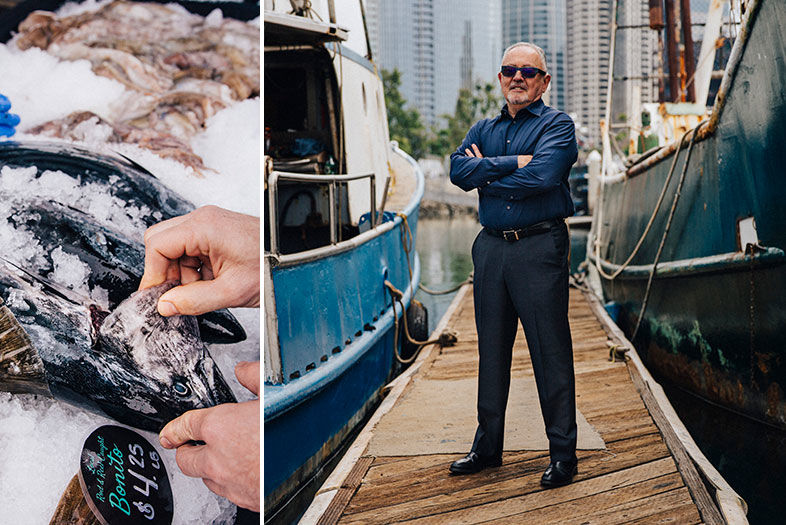
deep dive San Diego fishing industry
Right: Seaport developer Yehudi “Gaf” Gaffen photographed at the docks.
There’s a decent chance San Diego’s fishermen and women have stopped reading this story by now, because it starts with a quote from a developer. Fishers have historically viewed developers as their most feared predator. In a city like San Diego, the water’s edge is the gold vein, the bounty, the most valuable thing. And while many players are involved—the San Diego Unified Port District, the California Coastal Commission, the people of San Diego (who own the land)—the fight over it usually boils down to fishers versus developers. Boats versus hotels. Bait versus brunch.
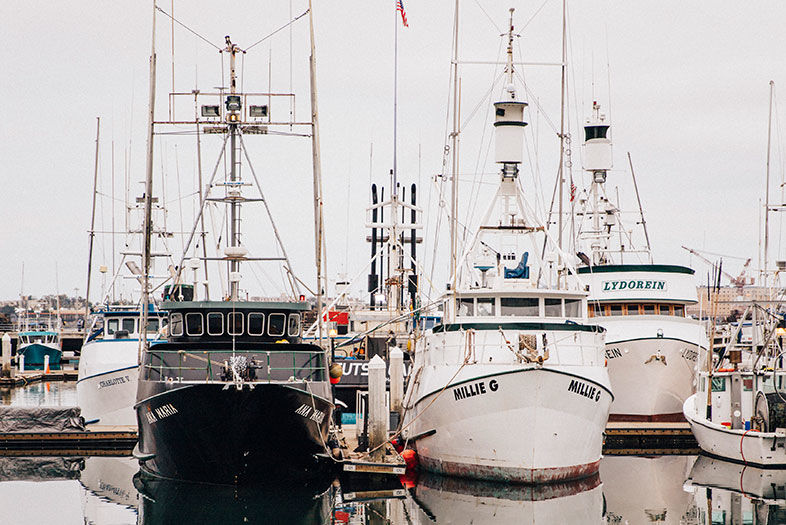
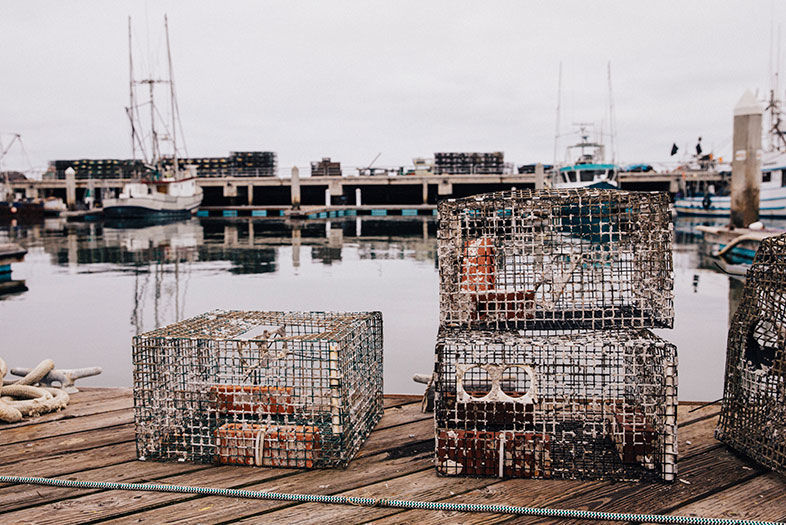
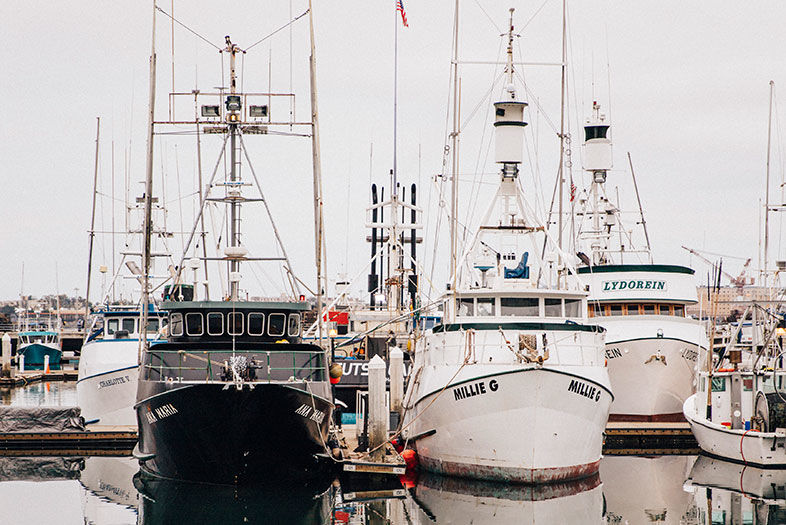
Tuna Harbor—located at the end of G Street, sharing a parking lot with the Fish Market restaurant, the USS Midway, and the American Tuna Boat Association—is one of two remaining spots along San Diego Bay dedicated to commercial fishing (the other is Driscoll’s Wharf). Longtime San Diego fisherman David Haworth stands on the edge and points at things. To parking spots that read “Reserved for Commercial Fishermen.” To the swarm of pedestrians and tour buses clogging the lot. To an aging dock where lobster traps and nets are stacked like a working-class art installation. To the 100 or so boats, where men with reptilian skin tanned like news anchors repair, well, everything.
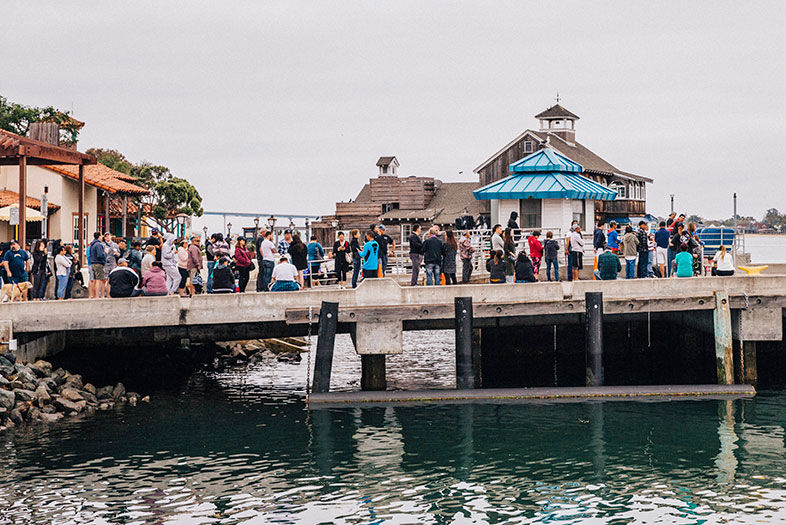
deep dive San Diego fishing industry
Customers wait in front of Tuna Harbor Dockside Market at 7 a.m., an hour before it opens.
“This is our Alamo,” he says, then laughs, acknowledging what happened at the Alamo.
San Diego was once known as the Tuna Capital of the World. At its peak in the early 1970s, the harbor was littered with gargantuan tuna boats, some with helicopters on the top deck for spotting fish. Every major cannery, including Bumble Bee, was based here. The industry employed over 4,000 people, the city’s third-largest employer behind the Navy and aerospace.
Then fishing famously died, for many reasons. But mostly dolphins. During the gold rush for yellowfin and albacore tuna, nearly six million dolphins were killed, according to Sarah Mesnick, an ecologist in the Marine Mammal and Turtle Division of the Southwest Fisheries Science Center (SWFSC). Dolphins dying in nets was an international PR nightmare. Even suburban kids and moms thought bad thoughts about our fishing folk.
In response, the US passed the Marine Mammal Protection Act of 1972, severely limiting how American fishers could earn their living. In survival mode, boats fled San Diego and changed flags—to Mexican, Ecuadorian, Western Samoan, anything but American. Abroad, they found governments who didn’t care much about bycatch (dolphins, sea turtles, etc.), quotas designed to preserve the ocean’s stock, or labor rights. A lot of them still don’t. “We know, because we fish next to them every day,” Haworth says.
San Diego’s harbor gradually replaced commercial fishing spots with cruise ships, yachts, recreational fishing boats, floating museums. The decimation of the industry did have some positive outcomes, though: Over the past 50 years, the US has become a world leader in sustainable fishing.
“The dolphin mortality has dropped dramatically, from hundreds of thousands a year to under a thousand,” Mesnick says. Fishing’s not an exact science. If you drop a hook in the water, something’s going to bite it. But from a statistical standpoint, less than a thousand is basically zero.
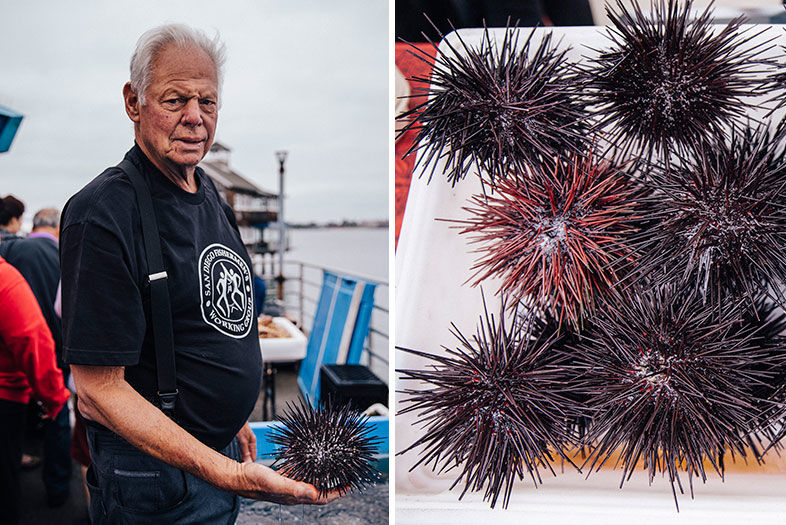
deep dive San Diego fishing industry
Left: Peter Halmay, uni diver and president of the San Diego Fishermen’s Working Group
Bluefin tuna—once the poster child for overfishing—are rebounding far stronger than official projections. An expert who agreed to speak anonymously said the US could raise its bluefin quotas right now. But the political nature of the fish has led government agencies to be extremely conservative, which means a couple more years. San Diego’s rockfish were nearly fished out in the ’80s, when everyone in restaurants ordered the red snapper (the menu misnomer for rockfish). Mesnick says they’ve rebounded, and local fishers are reporting huge stocks.
American sustainability efforts were carried out by commercial fishers. And the price was paid by commercial fishers. The half dozen I spoke with agreed that the restrictions were necessary after centuries of unregulated overfishing. “But we were told ‘short-term pain for long-term gain,’” says Peter Halmay, a 78-year-old uni diver and president of the San Diego Fishermen’s Working Group. “We’ve been under very strict guidelines for the last 20 years. And the stocks came back way faster than people anticipated. There’s going to be a movement to open up these groundfish to pay back these fishermen for preserving it.”
The current reward for commercial fishers’ sustainability efforts? Of the 7.1 billion pounds of seafood Americans eat annually, over 90 percent is imported. Theresa Talley, researcher at Scripps Institution of Oceanography, published a report that found only eight percent of San Diego’s 86 seafood markets consistently carried local fish. This is bad news in many, many ways.
“US fleets pay more for gas, pay higher NOAA fees, regulatory fees, workers’ comp fees… the list goes on,” says Paddy Glennon of Superior Seafood, a decades-long proponent of sustainable seafood. “They don’t have that in Mexico. In Mexico they can fish for sea bass 11 months out of the year. Our fishermen get a month and a half. I love our brethren across the border, but they’re playing by a whole different set of rules.”
“The thing that’s sad about America,” says Haworth: “Our negotiators are terrible. At one point we were allowed to catch 900 tons of bluefin. Then our negotiator came to us and said he agreed to reduce it to 600 tons—for two years. What kind of negotiating is that? Meanwhile Mexico got 6,000 tons and Japan got 15,000 tons. Our whole quota isn’t even one load for other countries.”
A Deep Dive into the San Diego Fishing Industry
Countries outside the US—not just Mexico, but in Asia, Africa, everywhere—can undercut American fishers by charging a much lower price. “You go into any wholesaler and you’ll see 80 percent Mexican sea bass, 20 percent American,” Glennon says.
That gives light to the ultimate cruel irony: Americans’ desire for sustainable, ethically caught seafood has resulted in Americans eating far more unsustainable, unethically caught seafood. An aphorism I heard over and over again during my research: Instead of asking why American seafood is so expensive, customers should be concerned about why imported seafood is so cheap.
Dave Rudy, owner of Catalina Offshore Seafood, says that US fisheries and management are the best in the world. “But consumers still look for low prices. We have to constantly remind them that low-priced fish is not the best thing for you, and supporting local fishermen is important.”
SWFSC’s Mesnick points to the dozen or so American fishers using drift gill nets to catch swordfish; they are often targeted by environmental nongovernmental organizations, or ENGOs. “These are the same fishermen who’ve been involved in fisheries management and research and reduction of bycatch,” she says. “They work with scientists to fish where they’re not hurting marine mammals and turtles. These are very advanced fishermen with very advanced gear. If you shut them down and still want to eat swordfish, you’re importing the swordfish from places who have none of that. So you’re hurting the species.”
San Diego fisherman Kelly Fukushima calls it “the transfer effect.” “Every time you punish a local fisherman, you increase the amount of bad habits you have to import,” he says. In our fight to save the turtles, we’re hurting turtles.
Commercial fishers make their living by being out on the water, not by attending meetings or launching publicity campaigns. Meanwhile, the ENGO Oceana launched a video series casting a negative light on commercial fishing. The titles include “Lauren Conrad Wants to Save the Sea Turtles,” “January Jones Is Scared FOR Sharks,” and “Miranda Cosgrove Wants to Keep Dolphins Singing.”
A representative for Oceana told me they’re supportive of American fishermen and women, and they’re all after the same goal: sustainable seafood. But every fisherperson I talked to took issue with ENGO’s portrayal of them (so did the scientists). They argue that they’re not the problem, and haven’t been for some time. The problem lies with dubiously regulated fleets overseas. And videos using January Jones don’t seem intended for the market in, say, Thailand.
As one of the most sustainable sushi chefs in the country—Rob Ruiz of The Land & Water Co.—once told me: “One of the most endangered species in our waters is a fisherman.”
To change this and tell their real story, fishers needed a public place. And in California they found it at markets like Dory Fleet Fish Market in Newport Beach, and Tuna Harbor Dockside Market in San Diego.

A Deep Dive into the San Diego Fishing Industry
Protea Development’s $2 billion plan to make over the waterfront is expected to break ground in 2024. Called Seaport San Diego, the project envisions more public parks, open spaces, and new stores and restaurants where Seaport Village and the nearby Tuna Harbor Dockside Market currently stand on the marina.
According to the developer’s website, the plan includes 400,000 square feet of retail space, an aquarium, hotels, a veterans’ museum, and a 480-foot tower with an observation deck. Protea Development and the San Diego Fishermen’s Working Group signed a memo of understanding in late 2018 that Tuna Harbor will remain in the redevelopment plan, and that improvements will be made to the harbor to allow commercial fishing to thrive, such as a new processing plant and a bridge where visitors can watch fishing boats offload their catch.
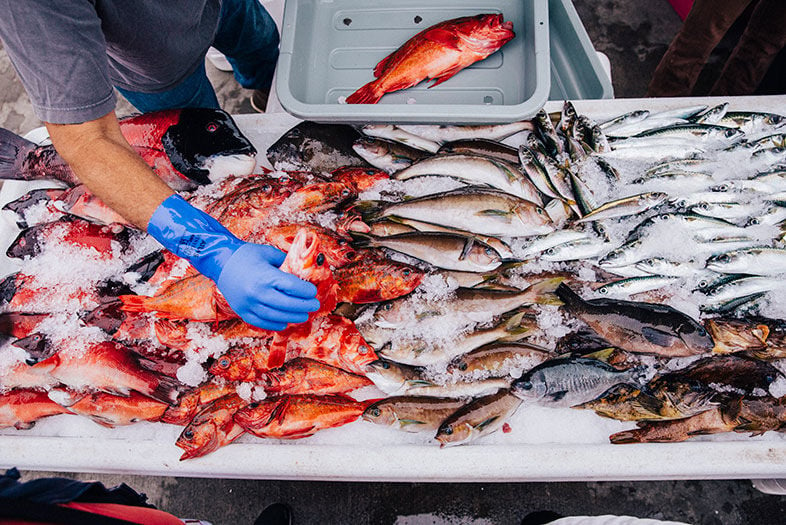
Every Saturday, a little pier near Seaport Village is lined with tables. Each table is teeming with one of the over 130 species caught by San Diego fishers. There’s urchin, black cod, mackerel, rock crab, spider crab, yellowtail, bonito, halibut, mahi-mahi, skipjack, wahoo, mongchong, opah, bluefin—you name it. A fisherman talks to a few customers, explaining what a sheepshead is, how to cook it. His wife stands nearby holding their newborn.
In 2014, San Diego fishers began efforts to sell their catch directly to consumers, just as farmers do at farmers’ markets. It required the passage of a bill (AB 226, aka “Pacific to Plate”), but Tuna Harbor Dockside Market finally opened for business in 2015 with a whimper: five fishers filling about a tenth of the pier outside Chesapeake Fishing Company.
“We just wanted to make sure the public had access to 100-percent sustainable, traceable fish,” says Fukushima.
“I thought we were gonna replace some of the middlemen,” says Halmay, one of Tuna Harbor’s founders. “Then I realized that wasn’t the goal. The goal was to simply show that fishing exists in San Diego.”
Market attendance was slow, but they kept showing up each weekend rain or shine. Then San Diego’s Asian communities discovered it, particularly Filipinos (San Diego is home to the country’s second-largest Filipino population). In many Asian cultures, seafood is an almost-daily staple. Fresh seafood is not a delicacy inasmuch as a standard. Asian customers also supported the diversity of seafood found at the market.
“We have different species that different ethnic communities like,” says Halmay. “About 60 percent of our customers are Asian, and they know how to cook dogfish and mackerel. Your white La Jolla customer is buying the spot prawns.”
Just as monocultures like corn and soy have devastated farmlands, a country that eats only a few species of fish creates a dangerous imbalance in the oceans. In 2015, only 10 fish species made up 90 percent of American seafood sales (salmon and shrimp alone accounted for 55 percent). Overfishing a single species—tuna—led to the collapse of San Diego’s fishing fleet in the ’70s.
“Like a lot of things in life, being diverse and moderate is good,” explains Mesnick. “Tuna are top predators. You can’t just eat the lions of the sea. Eating through the food chain is good for your health and the sea.”
The next wave to discover Tuna Harbor were the chefs. JoJo Ruiz remembers being picked up by Paddy Glennon for his first trip to the market. They arrived before dawn and met all the fishers and their families. “It’s changed my entire cooking career and my life,” Ruiz says. “A lot of chefs say the same thing. If it wasn’t for the market, we’d still be using langoustines and turbot, stuff flown from all over the world.”
A Deep Dive into the San Diego Fishing Industry
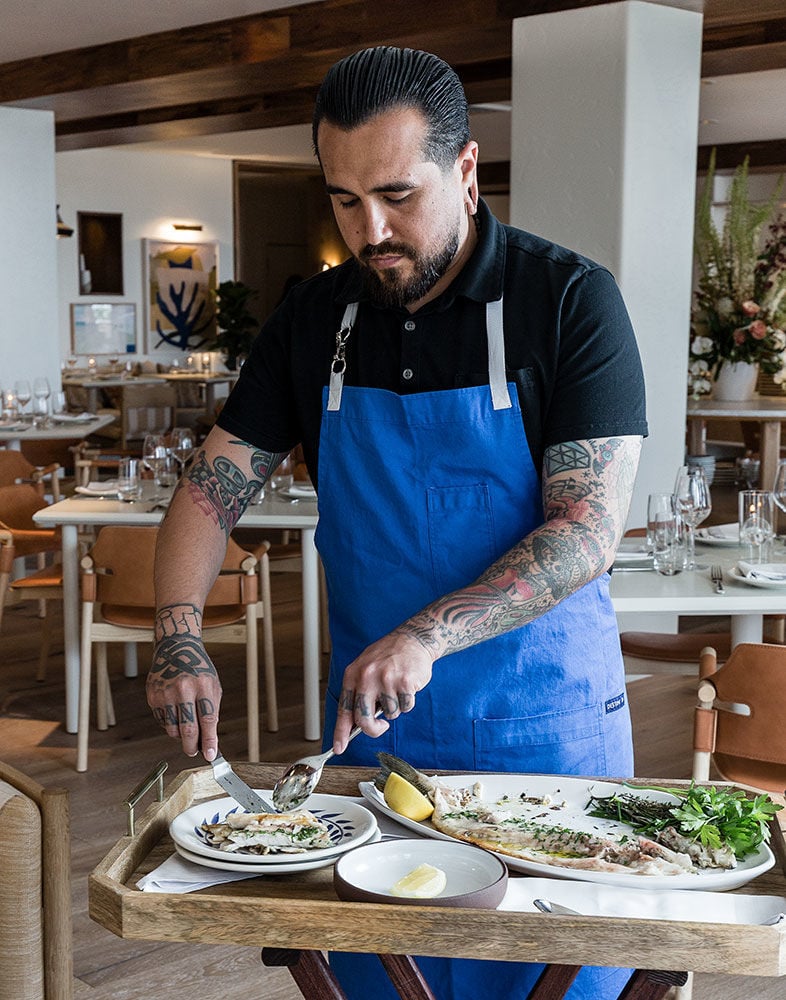
Chef JoJo Ruiz at Hotel Del Coronado’s new Sere~a restaurant, demonstrating their whole-fish presentation. | Photo: Justin McChesney-Wachs
Ruiz, executive chef at Lionfish and the new Serea at Hotel del Coronado, credits the market for his being named a James Beard Smart Catch Leader for sustainable seafood. At Sere~a, he presents local fish whole to diners, lets them look their dinner in the eye and choose one, and then the kitchen fillets and cooks it for them. He swears not only by the ethics of sustainability and connecting people to their food source (“I want my son to have the same seafood I have”), but also by the taste.
“Fresh, local vermilion rock cod is 10 times better than frozen red Thai snapper used at most restaurants,” he says. “Local halibut as a crudo is better than Alaskan halibut. Have you seen the claws on spider crabs? They’re giant; big as my wrist.”
There’s a parallel between Tuna Harbor Dockside Market and San Diego’s famed Chino Farm. It was Chino delivering the produce for the early farm-to-table movement. Alice Waters and Wolfgang Puck were regulars. Now Tuna Harbor is fueling the boat-to-throat movement, with regular customers from some of San Diego’s top seafood spots—Juniper & Ivy, Ironside, Wrench & Rodent, The Land & Water Co., The Fishery, The French Gourmet, and Saiko Sushi.
“In my 20 years of commercial fishing, I’ve never seen such a big increase in the demand for local fish,” Fukushima says. “The market really revitalized the fishing industry. It’s attracted a lot of people to the waterfront and made fishing cool again. Fishing was seen as something only outcasts or criminals or people without real jobs do. At the market they see the fishermen, meet their families, see them working together.”
It’s that humanizing element—and the ability to be an “attraction,” with people coming down to watch boats unload fish, snapping pics for the Insta—that may have motivated Yehudi Gaffen to make commercial fishers a focal point of his redevelopment plan.
A Deep Dive into the San Diego Fishing Industry
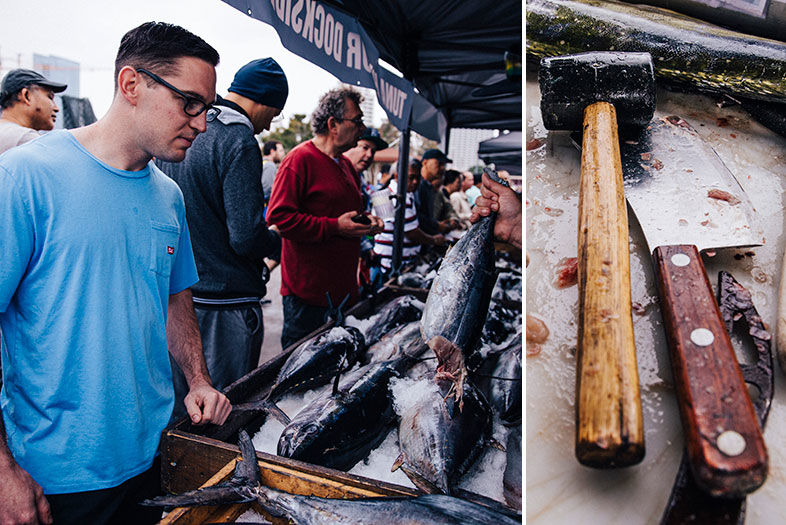
Left: Ironside Fish & Oyster Bar’s chef de cuisine, Mike Reidy
The seaport plan includes hotels, a veterans’ museum, restaurants, almost 400,000 square feet of retail, an aquarium, and a 480-foot “Spire” observation deck. If all goes well, they’ll break ground in early 2024. But the plans and discussions that will guide these tectonic shifts are happening right now. Waterfront businesses must speak up, or risk being left out.
“Another mall on the water would be a huge disgrace to the harbor,” Gaffen says. “Another Disneyland would do a disservice and have no place. There has to be authenticity of a waterfront project.”
When the port first asked for redevelopment proposals, Haworth says they warned the fishers. “They said, ‘Listen, guys, you better negotiate with the developer, because we don’t have any money for Tuna Harbor. If you want it revitalized you better make the deal.”
The initial discussions with Gaffen were heated. Fishermen and women are notoriously defensive of their territories, because their territory has been taken from them—once allotted nine acres on the harbor, they’re currently down to 3.9. So Halmay and a few others formed the San Diego Fishermen’s Working Group. They started showing up to seaport plan meetings and port meetings, having productive sessions with Gaffen and his son-in-law, an ex–Navy SEAL named Alex Buggy.
A Deep Dive into the San Diego Fishing Industry
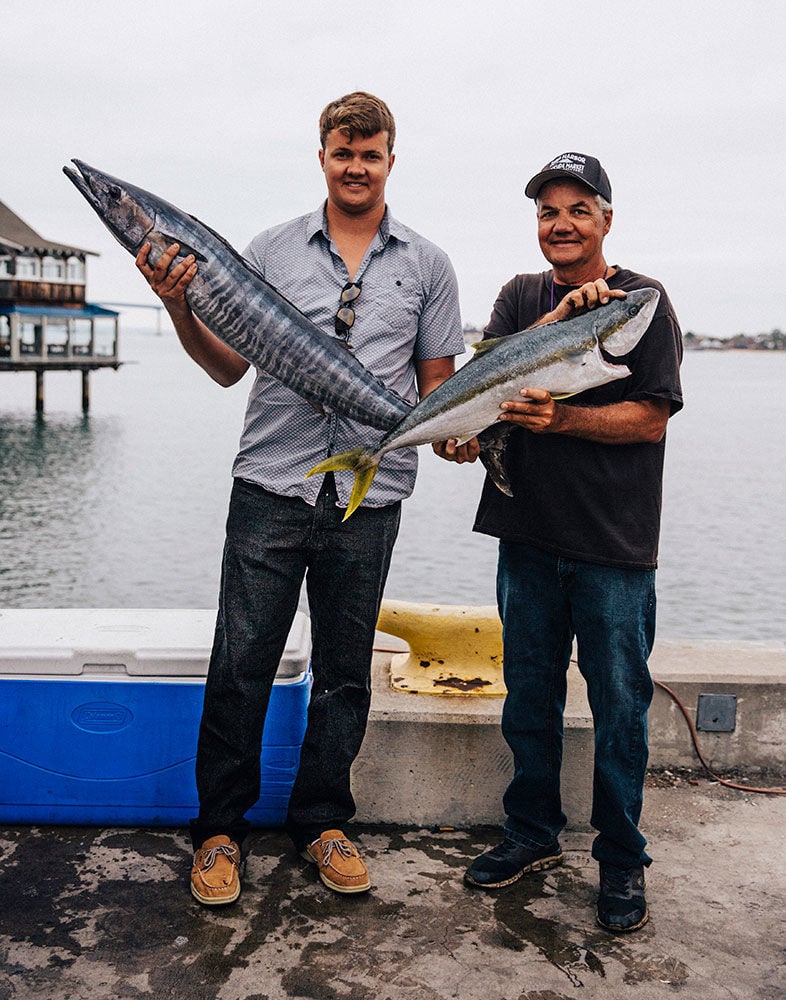
Nick Haworth and his father, David Haworth. David’s father, retired, is also a fisherman.
“Where there’s two fishermen there’s usually six opinions,” Gaffen laughs.
“Forming the fishermen’s group let us speak with one voice,” Halmay says. “We had to stop fighting fires and build a fire station first. The working group is that fire station.”
For instance, they sent Gaffen’s first proposal back with some curious markups. “The first few designs and drawings came back and they had them labeled HS1 and HS2,” he explains. “And I remember saying ‘What is that?’ It was Horseshit 1 and Horseshit 2. On a fisherman’s list of people they trust, we’re not on it.”
Gaffen and the seaport plan have to balance every interest, not just the fishing community’s—yachts want space in the harbor, people want parks, tour buses want parking, restaurants have wants, hotels have wants. So many wants. Plus there’s the money issue. Unlike other governing agencies, the port doesn’t receive any public funding. They depend on money from leases, and commercial fishing has not been an economic boom for San Diego since the collapse. Not compared to, say, a luxury hotel. Not even close.
It was so fortuitously timed that Tuna Harbor Dockside Market has grown into a legitimate attraction. But even that was small potatoes until—seemingly out of nowhere—the big boats started showing up again.
“These tuna boats came in at just the right time,” Halmay says. “Just as Gaf was asking us, ‘How do we know you’re going to have this demand?’—here they came! I said, ‘Hey guys, here’s your demand!’”
The three big boats—carrying between 20,000 and 40,000 pounds of tuna—belong to Hawaiian Fresh Seafood, which just relocated to San Diego from Honolulu. Owner Frank Porcelli (a grad of Poway High) says he has plenty more boats he’s ready to bring in, many from the overcrowded Honolulu Harbor. But in order to accommodate this growth, San Diego desperately needs more infrastructure—slips, storage for traps and nets, ice machines, loading docks, cranes, and so on.
In September 2018, Gaffen and the Fishermen’s Working Group signed a memo of understanding. In it, Gaffen promises a list of items to “facilitate the revitalization of San Diego’s commercial fishing industry”—making improvements to Tuna Harbor, building a new processing plant, a bridge where visitors can watch fish be offloaded, and most importantly keeping yachts and recreational boats out of their “Alamo.”
A Deep Dive into the San Diego Fishing Industry
Some are skeptical. The seaport plan to build a veterans’ museum and a processing plant on the G Street Mole (not to mention the new Manchester Group hotel across the street) will bring more traffic to what is already one of San Diego’s most congested parking lots. “They’re trying to stuff 10 pounds of [stuff] into a five-pound bag,” Fukushima says. Nearly all fishermen I talk to doubt whether Gaffen and the seaport plan can pull this off without grinding commercial fishing to a halt.
Gaffen and Buggy are confident they can. They’ll build a workable space for San Diego’s fishers—and help establish the city as the capital of sustainable seafood.
“It’s a differentiator and it’s authentic,” Gaffen says. “Commercial fishing is starting to come back. It’s a vital security need. If we can catch local, sustainable seafood for our community and restaurants—it’s a legacy I’d be really proud of.”
CORRECTION: In the original story, we included a quote from an expert claiming there was bycatch in imported cans of tuna. After further fact-checking, one of our experts said this was not true. There is no evidence that there is turtle meat in imported, canned seafood. We regret the error. They do, however, maintain that most imported seafood is far less sustainable and is caught by fleets with significantly higher bycatch of dolphins, turtles, and other marine mammals. We stand by their expertise in that regard.
PARTNER CONTENT
A Deep Dive into the San Diego Fishing Industry

We ask the city's best food photographers to choose their favorite pics and share their secrets to capturing a drool-worthy pic
Food is a notorious diva to photograph. The wrong lighting can make José Andrés’ paella look like a jaundiced grain bowl. You could be staring at the best sandwich of your life, but shoot it from above and—hey, congrats on that abandoned piece of lettuce bread. A cottage meme industry has been built around the hilariously bad photos on review sites that make Michelin-star food look like Michelin tires.

Especially in a visual modern media world, food culture depends on great photographers capturing the painstaking work in equally deserving ways. We asked four of San Diego’s top food photographers for their favorite shot from another year of documenting what we eat.

Getting this kind of shot takes a bit of yoga. Asana yourself into the corner, hold your breath, pray that a chef on the move doesn’t back into your light stand.
“You’re stepping into someone’s workspace during their busiest moments, so it’s a balance of being present to get the shot and being invisible to not slow anything down,” Kimberly Motos says.
The subject here is the Birdman sandwich from Chick & Hawk—hot fried chicken thigh, tangy slaw, kimchi comeback sauce, sweet and spicy pickles, potato brioche bun—getting a hearty dousing of its difference-maker seasoning. Motos captures the parts of the process that diners don’t usually see: the chaos behind something that looks so simple.

“I love this image because it feels like a moment you want to step into,” says Lucianna McIntosh. A warm, sunny day at The Fishery in PB with oysters, caviar, and martinis. Yes, please.
The little details—the glass sweating a little, the direct afternoon light creating stark shadows, the oyster glistening on the tray—are the main characters. Instead of trying to overly control the setup, McIntosh “followed the light and lines that draw you in more,” she says. “This was one of those moments where everything lined up on its own for a second. I love it when the shadows end up being just as important as the food itself.”

La Jolla native Eric Wolfinger—who won a James Beard Award for Tartine Bread, one of the most stunning bread books of all time—says he doesn’t have a signature style. His style is a conduit.
“I see my job is to translate the chef’s point of view into something you can feel,” he says.
For this shot, Fleurette chef Travis Swikard had one directive: cuisine du soleil (“cuisine of the sun”). With a spread of leeks vinaigrette, herb-roasted golden chicken, and beets, Wolfinger wanted to create a scene that felt straight out of the French Riviera, relaying the light, bright style of Swikard’s new spot.
Some bonus additions here: Extra lights—to add lots of warmth—and a clipping from an olive tree.

Timing and light are everything in food photography. In Lucien—La Jolla’s tasting-menu-only restaurant with moody ambiance—a single strobe flash creates the ideal spotlight.
Dee Sandoval says she uses the “natural, just-plated energy” of the dish to “create a portrait of moment and craft.” That’s why this Mostra Ghost Bear espresso ice cream—with San José dark chocolate mousse, soy-miso caramel, and koji shoyu chocolate sauce—looks like it might dissolve halfway to your mouth.
Emma Veidt is an editor at San Diego Magazine. She earned her bachelor's and master's degrees from the Missouri School of Journalism. She loves running, hiking, and rock climbing, but really, she mostly loves encounters with the street cats around North Park.
Spruce up your home bar setup with product recommendations from local cocktail aficionado and Collins & Coupe owner Gary McIntire
I peel myself off my couch, crack my back, and force myself to the bar (23 years old, by the way). It’s a Friday night, and my smart watch is already informing me my body battery is critically low.
Nevertheless, party we must.
Because, to be fair, one of the best things about going out—dive bar, velvet-clad cocktail lounge, or anywhere in between—is the performance of it all. Watching a bartender shake and stir like it’s choreography, finishing the drink with a sprig or petal placed just so, feeling like your collection of mixers and spirits is worth pouring into the Holy Grail.
One of the worst things about going out, though? Being out.
So I thank God for the home bar.
No lines, no cover, no shouting your order over someone named Kyle who just discovered the AMF. No $19 cocktails that taste suspiciously like juice. Just me, my apartment (where I can play whatever music I want), and the quiet confidence of knowing I can make something decent without putting on real pants.
A home bar, I’ve learned, doesn’t have to be impressive. It just has to be intentional—a few bottles you actually like, some tried-and-true tools, and at least one drink you can make without Googling. That’s it. That’s the barrier to entry.
To create the ultimate home bar collection, we tapped the folks at San Diego cocktail supply shop Collins & Coupe to give us some of their recommendations. Pick and choose what you need, and start cocktailing.

You won’t get very far in your cocktail-making-journey without shaker tins. Boston shakers (two pieces, tin-on-tin) and cobbler shakers (three pieces with a strainer and cap) are the most classic styles, but if you want to avoid the tins getting stuck (or creating a mess on the floor), Boston shakers are the way to go.
“Koriko Tins by Cocktail Kingdom are the gold standard for every bar worth their salt. Every new bar we help outfit with tools insists on this brand and model,” says Collins & Coupe co-owner Gary McIntire.
“These are handmade, 100 percent solid copper and will last a lifetime,” McIntire says. “Because they are solid, there is no plated finish to wear off, and they will only look more beautiful with age.”
According to the pros, don’t even bother getting bar spoons shorter than 12 inches. One foot long is the magic length to get the best stirring results: “Rule of thumb is at least 50 percent of the spoon should be out of the glass,” says McIntire.
Sugar Skull Bar Spoon
Cocktail Kingdom Enamel Lucky Cat Bar Spoon
Pulp in your orange juice? We’ll allow it. But in your cocktail? Smooth and strained is optimal. You have two choices here: Hawthorne strainers have a spring that attaches snugly to shaking tins; julep strainers have no tabs or springs (originally created to drink mint juleps before straws became commercially available).
Bull in China Julep Strainer, Brushed Stainless Steel
Barfly Two-prong Heavy Duty Hawthorne Strainer
We’ve all seen those seasoned bartenders with the arm tats and haughty demeanors who can assemble perfect drinks with their eyes shut. The rest of us, however, need training wheels. Jiggers—those hourglass-shaped measuring tools—make consistent cocktail-making easy, although cheap versions tend to be inaccurate. Don’t skimp out on these.

“Heavy-duty and made of one piece,” McIntire says. “We use [this jigger] in our classes and at home. It comes in a bell-shaped version and a Japanese version, which is tall and narrow.”
“Glassware is always essential to the cocktail experience,” says McIntire. The martini glass is an avatar for American hair-loosening for a reason: sleek, viciously “V,” and highly spillable (danger always looks good). To start, look for a coupe glass (the fancy cat bowl-looking thing), a highball (glassware with posture), and a rocks glass (the blue collar hero).
Milo Crystal Rocks Glass by Viski
Savage Coupe by Nude Glassware
Meridian Highball with Gold Rim by Viski
You know how Caesar dressing tastes way better when you don’t think about the fact that there are anchovies in it? The same goes for cocktails and raw egg whites. Some of your favorites rely on the frothy ingredient to shine (whiskey sours, gin fizzes, etc.). Mesh strainers help make that magic happen. According to McIntire, always get the conical version; the round, bowl style could cause spills.
Lili Kim is a content coordinator and writer for San Diego Magazine, with experience highlighting local businesses and communities. When not writing or shooting film, she is likely brewing her seventh cup of tea of the day or strolling along Sunset Cliffs.
After eight years and numerous awards, the cafe and roastery expands its operations in North County
San Diego’s coffee industry has yet to hit its ceiling. There are at least 850 coffee shops across the county (possibly over 1,000 at this point) and more specialty cafes and roasters seem to join the roster every other week.
Some newcomers, like Chance’s Coffee, focus on specialties like Vietnamese coffee; other stalwarts, like Bird Rock Coffee Roasters, have helped put the local coffee scene on the map with internationally acclaimed beans and baristas for 20 years. You can get a classic pour-over or an ultra, whipped cream–topped strawberry lavender basil blueberry matcha latte sprinkled with unicorn glitter—whatever your coffee style, San Diego’s got it… somewhere.
Steady State Roasting falls more in the former category, focusing on traceable, sustainable sourcing and no-nonsense roasting (no unicorn glitter here, sorry!). Founder and lead roaster Elliot Reinecke first started Steady State in a garage behind his house, roasting small batches until expanding slightly to a shared and not-quite-permitted space before landing in a lucky spot on State Street in Carlsbad.
Now, eight years later, Steady State is scaling up once more, opening its second cafe in San Marcos next to their roastery. The new location offers the same food and drink menu as the original Carlsbad location, and Reinecke says he plans to add an onsite bakery to bake items like English muffins and country loaves to supplement Prager Brothers’ more specialized pastries.
He doesn’t plan on opening more cafes, though. Rather, Reinecke plans to expand roasting operations and strategic sourcing. Currently, he sources beans from Colombia, Panama, across Africa, and as of this year, Costa Rica. “We’ve had Costa Rican coffee before, but we went to origin a few months ago and bought six different lots from there, all from really good high-end local farmers,” he explains.
The rising cost of sourcing does present some challenges, as does changes within coffee culture itself. Coffee has moved from a mass-market beverage to a highly personalized artisanal experience, but the current feeling is moving back towards focusing on quality over flashiness, says Reinecke.
If Reinecke’s prediction is right, coffee is headed on a similar trajectory to craft beer. Ten years ago, no one knew what Citra hops were. Now, even casual beer fans are versed in hop varieties, and that attention to detail is spilling over to coffee as well. How many of San Diego’s 1,000 coffee shops will remain once the unicorn glitter’s luster fades? My bet is on anyone remaining steadfast to sourcing, sustainability, and simplicity.
Steady State San Marcos is now open at 1320 Grand Avenue, Suite #9, San Marcos. Initial operating hours are Tuesday through Saturday, 7 a.m. to 2 p.m.
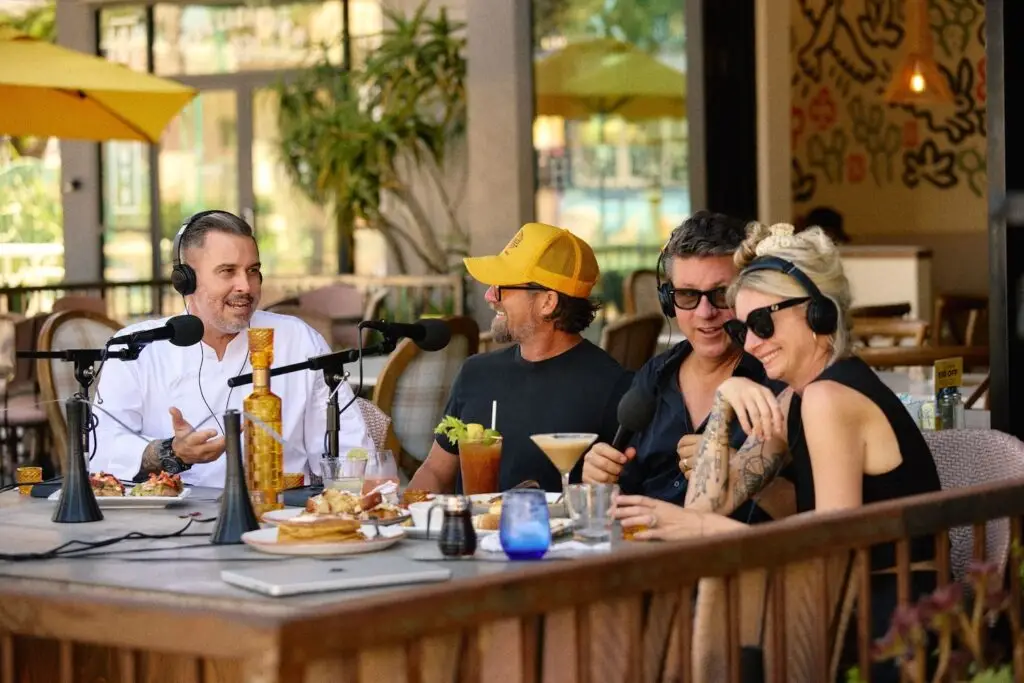
Listen Now: The Latest in San Diego’s Food and Drink Scene
Have breaking news, exciting scoops, or great stories about new San Diego restaurants or the city’s food scene? Send your pitches to [email protected].
PARTNER CONTENT
Beth Demmon is an award-winning writer and podcaster whose work regularly appears in national outlets and San Diego Magazine. Her first book, The Beer Lover's Guide to Cider, is now available. Find out more on bethdemmon.com.
Stake Chophouse & Bar brings contemporary classics and old-school service to the heart of Coronado
Stake Chophouse & Bar isn’t your average steakhouse. Blue Bridge Hospitality’s Coronado outpost is a modern interpretation of a big-city steakhouse nestled in the heart of the small coastal community. The team at Stake has reimagined the whole steakhouse experience. By prioritizing a seasonal farm-to-table sourcing philosophy, a personalized guest experience, and unique service touches, like a formal steak presentation and a bespoke knife selection process, Stake distinguishes itself in a sea of steakhouses.
Exceptional steaks, including Wagyu from Japan, Australia, and the U.S., and fresh seafood flown in daily form the core of Stake’s culinary identity. The menu features a five-course omakase-style steak experience highlighting house favorites, plus an array of cuts, and classic steakhouse staples—think a wedge salad, baked potato, or pasta carbonara—refined for a contemporary palate without losing their traditional appeal. Stake focuses on seasonal sourcing from the region’s best family farms and specialty purveyors, and incorporates intentionally unexpected touches to create something truly unique.
“I challenge our chefs and myself to take it a step further in sourcing,” says Chef Ronnie Schwandt. “It’s important to us to highlight different farms, unique one-off farms—whether it’s cattle, strawberries, a local fisherman or from anywhere in the United States, we’re always trying to find that niche.”
Beyond the menu, Stake emphasizes outstanding service, says Vinny Spatafore, Director of Hospitality Operations. Staff maintains detailed notes, allowing them to remember guests by name, recall previous orders such as a favorite martini (also memorable for the customer since it’s served in an extra tall, distinctly-shaped glass), and celebrate special occasions like birthdays and anniversaries.
“When you have those points of topic that you remember about a guest, they appreciate that,” he says. “Our servers are really good with that—we have a couple servers who have been here since the beginning and they’ll remember somebody from years ago, their name, their kids’ names, where they live. I’m really thankful to have a great front of house staff.”
Award-winning wines, rare whiskeys, special events, and a complementary black car service that provides transportation for guests throughout Coronado add to Stake’s appeal.
Schwandt stresses that Stake offers more than a meal; they aim to give patrons something unforgettable.
“It starts when you walk up the stairs and are greeted by the hostess—that sets the tone for the night. Then you’re greeted by a server, who may know you by name, and can guide you through the menu and curate as they get to know you,” says Schwandt. “Most people leave kind of blown away; they leave feeling like they just had an experience. That’s the goal, right? Whether you’re serving smash burgers or high-end steak, you want somebody to leave thinking, Wow, that was awesome.”
As NASCAR lands in San Diego this weekend, a recently burgled dad is irregularly excited
My 15-year-old daughter tried to steal our car this week, so I’m ready to become a NASCAR dad. It would be appropriate discipline. We just relocated to a nice suburb within walking distance of her high school. The suburbs are like living in a Tesla commercial. I am pretty far from the wealthiest dad in this neighborhood (I am the least wealthy dad in this neighborhood), more than a few engineering degrees short of being in the running.
I’m fairly certain watching NASCAR is a violation of our HOA and a violation of my daughter’s emotional HOA. But NASCAR hits San Diego this weekend and I have a fever I’ve never felt before. I want to watch 111 drivers do dangerous things in cars and trucks on an active military base in the ocean. Since my lifelong exposure to NASCAR is limited to Talladega Nights and every single iteration of the movie Cars, I can only base my plan of attack on oafish stereotypes.
So while other neighbor dads are sizing bubble jackets for their golf simulators, I’m gonna grow a Ricky Bobby, run the extension cord for the TV out into the carport we share with six other condos, fill a cooler with a proper 80-20 split of Hamm’s and Mountain Dew, treat a lawn chair like an ADU, and spend a few hours yelling ohsheeeit as if it’s a single, nine-syllable word.
The quality parents in our neighborhood seem highly attuned to the sound of any vehicle breaching the 6 MPH threshold, so I should gather a crowd pretty fast. They may come over with strongly worded emails in their hearts, but one glimpse of Shane van Gisbergen and hometown hero Jimmy Johnson guzzling the last remaining drops of gasoline on the planet in a dazzling display of carmanship—they’ll join my NASCAR pop-up party.
By the time my daughter brings her friends over, we’ll have a real welcoming committee.
Because, like I said, my daughter tried to steal my car.
She wasn’t going to Mexico. But while Claire and I were off doing businessy stuff to afford my teen’s skincare rituals, she and a friend decided to teach themselves stick shift. She’s never driven a stick before. I’m not saying she has, but if she has driven a vehicle at all—it would have been done in a remote, abandoned parking lot where the only possible thing she could destroy was the concept of driving itself.
But a couple TikTok videos later, she and her friend felt a certain level of mastery had been achieved, and they gave it a go. They backed our VW Bug out of the garage with a series of stalls and transmission seizures, and managed to get it into the carport, attempting to do “donuts.” That’s when I got a call from a resident, who had taken an active interest in this experiment.
Which got me wondering about the power and might of vehicles. Turns out, even at carport speeds there exists a bit of potential fireworks. A garage door could become not a garage door anymore. At 145 MPH on Naval Base Coronado this weekend (don’t worry, they slow down to 100 MPH for turns), NASCAR drivers are essentially doorbell ditching gods. I didn’t register the temperature after my daughter’s trial run, but the track at NASCAR races usually hits a cool 130-150 degrees, enough to lightly sear some Nikes (the tires themselves hover in the 200 degree range).
And that is at least part of our fascination with NASCAR (the other fascination is the legendary pit parties, which either set humanity back a few evolutionary links, or advance it by the same amount of links). These drivers do something all of us do every day in a very efficient, boring way—drive a car—and take it to its extreme impulse. Grace and precision at the thunderous edge of shit going terribly wrong. Most of us have looked at San Diego home prices and felt a burning desire to see how fast our Honda Pilot could make it to our new home in Vegas. So NASCAR drivers are acting on our own wildest impulse.
Troy Johnson is the magazine’s award-winning food writer and humorist, and a long-standing expert on Food Network. His work has been featured on NatGeo, Travel Channel, NPR, and in Food Matters, a textbook of the best American food writing.
In a sport obsessed with prestige, a San Diego–born golf brand is betting on something more fun and less fussy
Music drifts across the fairway. Someone’s in flip flops. The Pacific flashes in the distance. Sun peeks onto shoulders through the palm trees. It’s spring, technically, but the air reads suspiciously like summer. At the par-3 course at Liberty Station, the longest hole barely stretches past 120 yards, and no one looks particularly interested in becoming the next PGA legend.
This is where Sunday Golf was born.
“I got dragged to a par-3 course in 2019 —The Loma Club—and it was way more my jam,” says Ronan Galvin, CEO and co-founder of Sunday Golf, a company that makes lightweight golf bags for players who’d rather carry less and laugh more. “It was a lot different than the stereotypical ideas you have about golf where it’s kind of long, uptight, and exclusive.”
Galvin spent over a decade in the golf industry working in product development, sourcing and manufacturing. But he didn’t grow up swinging clubs. Basketball and football were more his speed. What clicked for him was a simpler, more relaxed kind of play: shorter rounds and weekend games built for fun rather than formality. The kind of golf that resonated for him felt accessible, effortless, and surprisingly his lifestyle.

He noticed something else, too.
On a course where five clubs do the job, players were still lugging 14. So Galvin built something smaller. Lighter. A bag designed specifically for par-3 rounds, the Loma Bag is sleek, functional, and refreshingly unfussy. It’s practical minimalism in a sport known for excess.
Sunday Golf was slated to launch in January 2020. Then, COVID hit. Shipments stalled; lost at sea. The future felt shaky. But the series of catastrophes for the young company turned out to be anything but: By the time inventory arrived that August, golf had become one of the few activities people could safely do.
“It introduced and brought so many people back to the game,” Galvin says. “It created a habit for a lot of people, which is a big reason golf is on its growth trajectory.”
It turns out Americans can’t get enough of golf. Forty-eight million of them swung clubs last year, a 41 percent jump since 2019, and the National Golf Foundation says the total could top 50 million by the end of 2026.
The brand rode this unlikely momentum. Since 2021, Sunday Golf has expanded into larger lightweight bags and continues evolving from there. A major reason for the company’s success is its approachability, a value so central that it’s literally written on the office walls in the form of the company’s guiding mission: “Get 500,000 golfers having more fun by 2027.” This goal is measured, fittingly, by golf bags sold.
Sunday Golf has already passed 300,000 bags sold.
But the numbers aren’t the point.

“To remind the world that life is meant to be enjoyed,” Galvin says of the brand’s why. In an era dominated by screens, golf offers something analog. “People are outside, touching grass with their friends. A golf bag is a golf bag, but our products are vehicles to help support that.”
Unlike legacy golf giants promising proximity to Rory McIlroy-level greatness, Sunday Golf leans into what Galvin jokingly calls “diet golf” or “golf light”—weekend rounds, driving range sessions, company scrambles. The bags are built for the casual golfer, and the fit feels obvious.
That philosophy resonates across Southern California, where year-round sunshine means golf courses never really hibernate for winter. As Galvin puts it, “the laid-back lifestyle of San Diego kind of seeps into everyone’s veins.”
Sometimes the validation arrives via email: a 76-year-old customer is able to walk the course again because their golf bag is lighter. Parents are able to take their children out with Sunday Golf’s kids line.
For Galvin, that’s the real win. Not perfection. Not prestige. Just more people outside, enjoying themselves. In San Diego, that might be the most natural mission of all.
Isabella Dallas is a freelance writer for San Diego Magazine and the Arts and Culture Editor at The Daily Aztec in her final year at San Diego State University. She previously worked as an editorial intern for SDM, but when she’s not writing, you can find her trying the best coffee spots in SD, devouring the latest rom-coms, and indulging in anything and everything pop culture.
Scripps study shows that some patients may be able to taper their dose and maintain results
While glucagon-like peptide-1 (GLP-1) receptor agents have been used to treat Type 2 diabetes for more than 20 years, their recent emergence as weight-loss wonder drugs marked a new frontier in medicine. But their effectiveness has left some patients wondering what to do once they’ve reached their goal. Stopping the medication could mean regaining some, if not all, of the weight. A Scripps Clinic internal medicine physician recently conducted a small study of whether GLP-1 patients who had reached their goal weight could maintain that weight by taking their regularly prescribed injection every other week instead of weekly. Spoiler alert: 30 of 34 patients did. Read more about the study here and what that may mean as pharmaceutical companies roll out oral GLP-1s.
For more nutrition, wellness, and healthy living tips, sign up for the San Diego Health newsletter here.