Featured articles
Food & Drink
Food & Drink

Food & Drink
Featured articles

Everything SD
Everything SD
Things to Do
Featured articles
Things to Do
Things to Do
Guides
Featured articles
podcast-ep
podcast-ep

podcast-ep
Featured articles
Everything SD
Everything SD
Food & Drink
Featured articles
Everything SD
Everything SD
Food & Drink
Ready to know more about San Diego?
SubscribeReady to know more about San Diego?
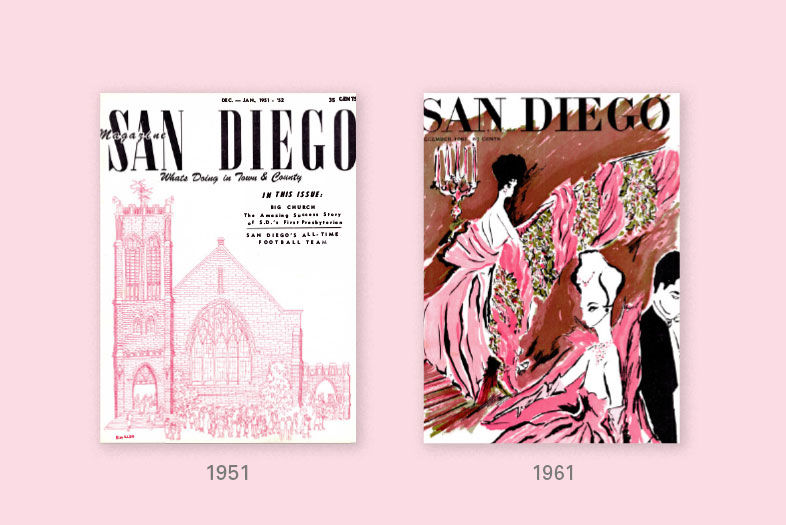
We revisit four holiday covers from the '50s and '60s
From the Archives: Covers of Christmas Past
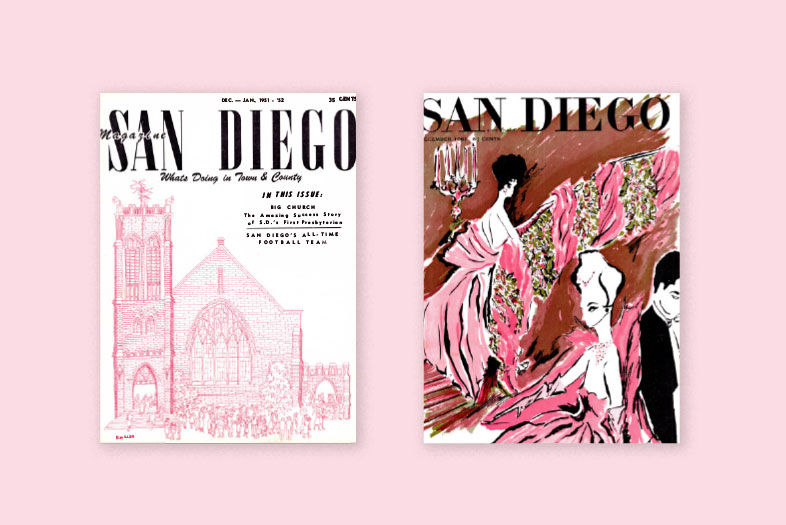
In December 1951, Art Editor Enid Miller drew the First Presbyterian Church of San Diego, established 1869. The main building was completed in 1913, but they had just finished a new $185,000 wedding chapel that October. By the time we ran our story, the congregation had grown to 4,025 and it was the second-best-attended church of that denomination in the US. Miller drew several covers in San Diego Magazine’s early days, including our very first issue in October 1948, and her rendering of the building is still recognizable today. Located on Date Street between Third and Fourth avenues in Bankers Hill, the land drops off just in front of this illustration, where Interstate 5 zooms below.
Ten years later, in December 1961, we featured another illustration on the cover, depicting the upcoming 32nd annual Scripps Candlelight Ball. Artist Phil Reed Owen imagines how La Jolla Country Club’s “graceful stairway will be banked lavishly with greenery interwoven with red satin ribbon.” The fundraiser for Scripps Memorial Hospital “has always been a festive affair of quiet candlelit charm. But this year, the Woman’s Auxiliary for the hospital has planned a ball of imaginative elegance reminiscent of the galas of the turn of the century.” That meant touches such as “the grand Edwardian gesture: Footmen in formal attire will show guests to the tables […] During dinner, which will be served at ten, strolling violinists will play individual table requests. And the dancing will continue ’til two.” The Candlelight Ball is still running strong—the 90th event, planned for this December 7 at the Fairmont Grand Del Mar, will raise money for new facilities at Scripps Memorial Hospital La Jolla.
From the Archives: Covers of Christmas Past
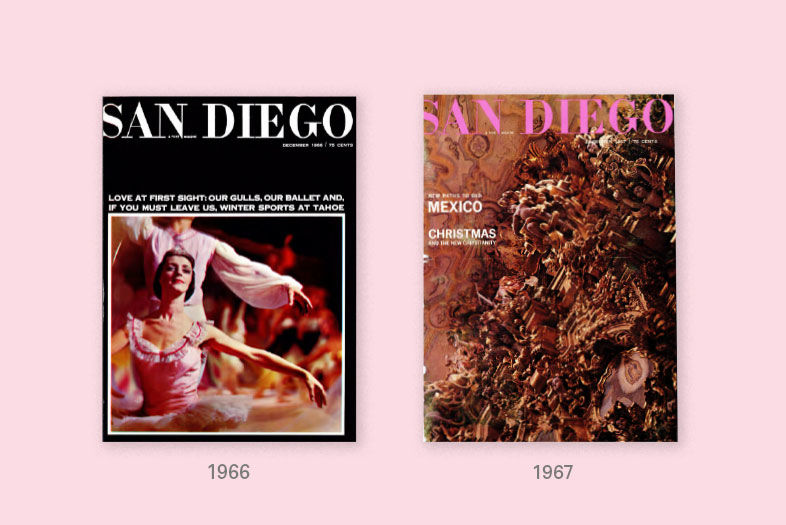
The photo of the ballerina on the December 1966 issue could have been on the cover today. Photographer Charles Schneider captures the San Diego Ballet performing “Tchaikowsky’s Nutcracker” (there was evidently some disagreement about spelling; in the ad 28 pages later, it’s “Tschaikovsky”). “San Diego had a San Diego Ballet before ever there was a Civic Theatre in which to showcase it,” we wrote. That year’s production was their fifth, with a company of 100 dancers and a full orchestra; tickets ranged from $1 to $4. This year, it’s December 28–29 at Copley Symphony Hall, and tickets are $34 to $149.
PARTNER CONTENT
The cathedral pictured on the December 1967 cover was photographed by Harry Crosby of La Jolla. “The church is considered one of the most perfect ecclesiastical buildings in all Mexico, La Iglesia de San Cayetano, also called La Valenciana, three miles from Guanajuato. The late-period Churrigueresque altar pictured is one of three. The magnificently carved and gilded retablos fill the full height of the chancel and transept.” That issue contained two stories on Mexico—one about a long road trip, and another about “casa-hunting” in Guadalajara. For more on Mexico, look for our February 2020 issue, and no matter what makes it onto next December’s cover, we’ll be sure it’s merry and bright.
Many Americans still think bright red tuna means it's fresher (it's not)
You know the tuna I’m talking about. It’s easy to mistake for a cube of watermelon. It’s the color of a Lyft logo. Appears to be glowing a vibrant, tantalizing purity. Tuna that bright red or pink means it’s… what, extremely fresh? Bursting with nutrients?
Nope. It means it’s got carbon monoxide.
I thought this was widely known, but a chef recently told me very few of his staff members were aware of this, and almost none of his customers. So, especially with the recent proliferation of poke joints, I thought I’d be helpful with this PSA of sorts.
Bright red or pink tuna means it has been gassed. In its natural state, fresh tuna is dark red, almost maroon, sometimes even chocolatey-looking.
Don’t worry, you most likely will have no ill effects from eating gassed tuna, according to the FDA. They have deemed carbon monoxided tuna as GRAS (Generally Regarded As Safe), though the practice is banned in Japan, Canada, and the EU. Plus, there is carbon monoxide in barbecue (given off by wood smoke).
But here’s why I personally tend to back away when I see bright red or pink tuna:
1. IT’S MUCH HARDER TO TELL IF IT’S FRESH OR NOT.
It can be left out for days and it will not turn brown. In one study, the University of Florida found that carbon monoxided tuna kept its bright red color for 11 days in the fridge. “The carbon monoxide actually hides the quality of a fish,” says Tommy Gomes, fifth-generation San Diego fisherman, host of The Fishmonger on Outdoor Channel, and owner of seafood shop Tunaville in Point Loma. “It’ll make a poor-quality fish pretty like a rose. I’ve seen them take an old piece of brown tuna [and] put the gas on it, and it comes out looking like cherry lemonade.” The gas also masks the smell of old tuna (which is one way you can tell if tuna’s getting past its eat-by stage). “Since there’s no smell, it falsifies the freshness,” Gomes explains.
2. I TRUST GOVERNMENT HEALTH ORGANIZATIONS, BUT ALSO RECOGNIZE THEY’RE NOT PERFECT.
The 1992 USDA food pyramid suggested carbs should be the bulk of our diet (they corrected that in 2005 and 2011). The government approved the fat substitute Olestra, which gave people all sorts of tummy issues. Margarine and other trans fats were also approved, then banned in May 2019. There are some smart humans in the government, but even geniuses make mistakes. So I tend to go with my gut: tuna in its natural state, or tuna treated with carbon monoxide? Easy choice.
So why gas tuna at all? Because of us. Consumers don’t like brownish fish. Tuna oxidizes quickly. It’s difficult for tuna fishermen and women to get it to market quick enough before it turns that brownish or chocolatey color. Customers erroneously think all brownish-looking fish is old or bad and will pay more for “fresher-looking” fish. So in the 1990s, the FDA allowed companies to gas the tuna and keep it artificially bright red for long stretches at a time.
“There’s nothing wrong with a hot chocolate–looking tuna loin,” says Gomes. “But, here in America, we want [it] seared on the outside, rosy pink on the inside.”

Gassed tuna is also often imported and less inexpensive than fresh, un-gassed tuna, says Gomes. “So, to be fair and honest,” Gomes acknowledges, “for families on a budget, gassed tuna is one of the best alternatives out there for frozen seafood.”
In the New York Times article cited above, a sushi restaurant owner reported his sales of tuna tripled when he started using gassed tuna. So that’s obviously good for the small business owner, as well as grocery stores. Food waste is a massive epidemic—the US throws out about half of edible seafood. If gassed tuna gets Americans to eat perfectly edible tuna they otherwise might throw out, that’s a step in a good direction.

But it’d be better if we as consumers knew that fresh, non-gassed tuna is supposed to be dark red or maroon—not bright red or watermelon pink, like a majority of the tuna I’ve seen at local poke shops. Ideally, we would look at a piece of bright red/pink tuna and think “Oh, hey there, carbon monoxide.”
The most important things about buying tuna is to trust the source (whether grocery store, fishmonger, or sushi joint). It also should be shiny and somewhat translucent, and not have slime or an off-smell.
Long live maroon tuna.
Troy Johnson is the magazine’s award-winning food writer and humorist, and a long-standing expert on Food Network. His work has been featured on NatGeo, Travel Channel, NPR, and in Food Matters, a textbook of the best American food writing.
Stake Chophouse & Bar brings contemporary classics and old-school service to the heart of Coronado
Stake Chophouse & Bar isn’t your average steakhouse. Blue Bridge Hospitality’s Coronado outpost is a modern interpretation of a big-city steakhouse nestled in the heart of the small coastal community. The team at Stake has reimagined the whole steakhouse experience. By prioritizing a seasonal farm-to-table sourcing philosophy, a personalized guest experience, and unique service touches, like a formal steak presentation and a bespoke knife selection process, Stake distinguishes itself in a sea of steakhouses.
Exceptional steaks, including Wagyu from Japan, Australia, and the U.S., and fresh seafood flown in daily form the core of Stake’s culinary identity. The menu features a five-course omakase-style steak experience highlighting house favorites, plus an array of cuts, and classic steakhouse staples—think a wedge salad, baked potato, or pasta carbonara—refined for a contemporary palate without losing their traditional appeal. Stake focuses on seasonal sourcing from the region’s best family farms and specialty purveyors, and incorporates intentionally unexpected touches to create something truly unique.
“I challenge our chefs and myself to take it a step further in sourcing,” says Chef Ronnie Schwandt. “It’s important to us to highlight different farms, unique one-off farms—whether it’s cattle, strawberries, a local fisherman or from anywhere in the United States, we’re always trying to find that niche.”
Beyond the menu, Stake emphasizes outstanding service, says Vinny Spatafore, Director of Hospitality Operations. Staff maintains detailed notes, allowing them to remember guests by name, recall previous orders such as a favorite martini (also memorable for the customer since it’s served in an extra tall, distinctly-shaped glass), and celebrate special occasions like birthdays and anniversaries.
“When you have those points of topic that you remember about a guest, they appreciate that,” he says. “Our servers are really good with that—we have a couple servers who have been here since the beginning and they’ll remember somebody from years ago, their name, their kids’ names, where they live. I’m really thankful to have a great front of house staff.”
Award-winning wines, rare whiskeys, special events, and a complementary black car service that provides transportation for guests throughout Coronado add to Stake’s appeal.
Schwandt stresses that Stake offers more than a meal; they aim to give patrons something unforgettable.
“It starts when you walk up the stairs and are greeted by the hostess—that sets the tone for the night. Then you’re greeted by a server, who may know you by name, and can guide you through the menu and curate as they get to know you,” says Schwandt. “Most people leave kind of blown away; they leave feeling like they just had an experience. That’s the goal, right? Whether you’re serving smash burgers or high-end steak, you want somebody to leave thinking, Wow, that was awesome.”
Scripps study shows that some patients may be able to taper their dose and maintain results
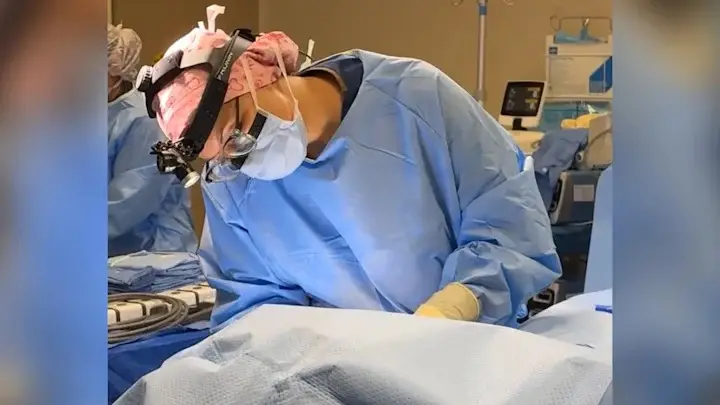
While glucagon-like peptide-1 (GLP-1) receptor agents have been used to treat Type 2 diabetes for more than 20 years, their recent emergence as weight-loss wonder drugs marked a new frontier in medicine. But their effectiveness has left some patients wondering what to do once they’ve reached their goal. Stopping the medication could mean regaining some, if not all, of the weight. A Scripps Clinic internal medicine physician recently conducted a small study of whether GLP-1 patients who had reached their goal weight could maintain that weight by taking their regularly prescribed injection every other week instead of weekly. Spoiler alert: 30 of 34 patients did. Read more about the study here and what that may mean as pharmaceutical companies roll out oral GLP-1s.
For more nutrition, wellness, and healthy living tips, sign up for the San Diego Health newsletter here.