

Featured articles
Featured articles
Featured articles
What's next
Featured articles
Featured articles
Featured articles
Ready to know more about San Diego?
SubscribeReady to know more about San Diego?
Architect Brett Farrow transforms a Carlsbad lot into strikingly fresh, livable design
Carlsbad Brett Farrow Design
Auda & Auda
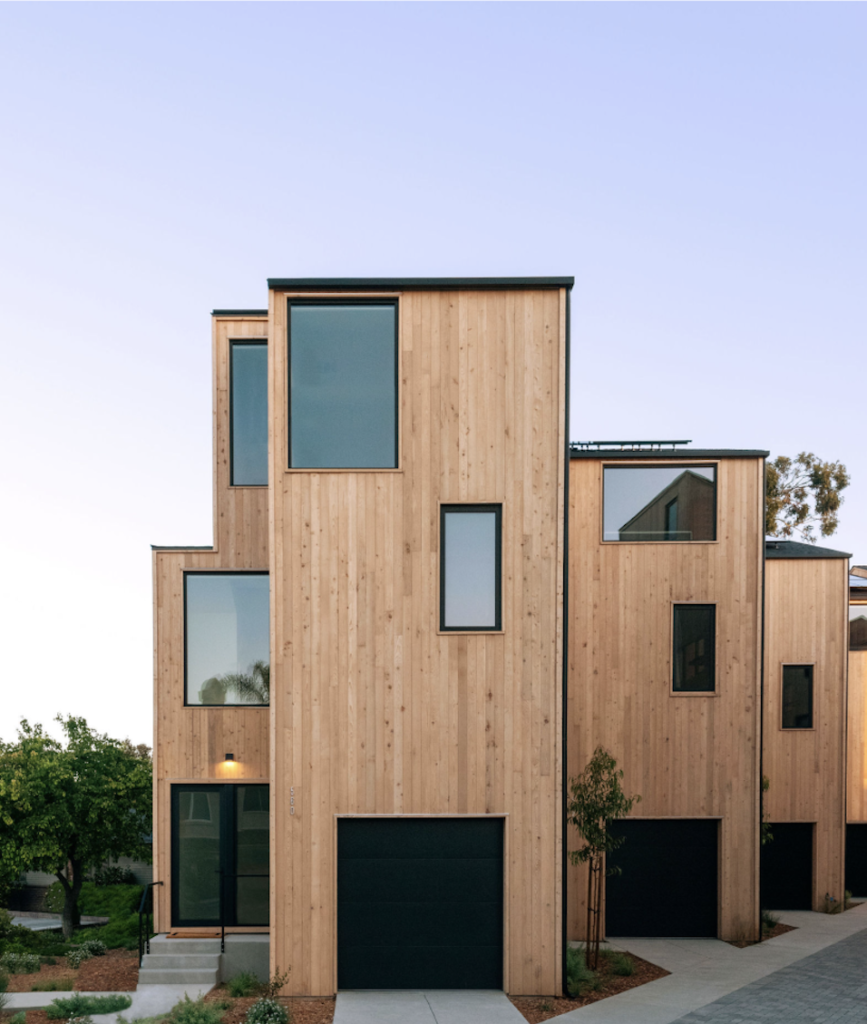
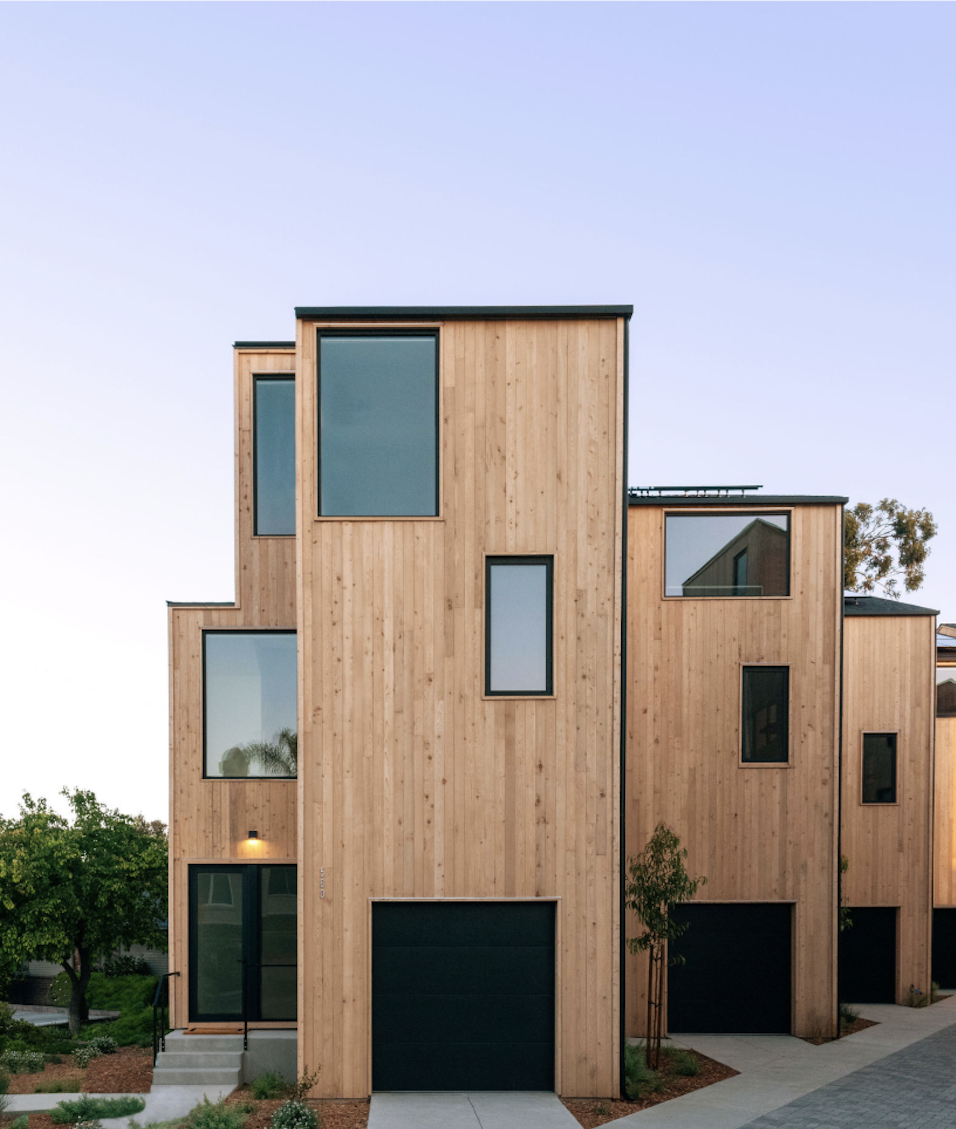
Carlsbad’s latest modern eye candy takes its cues from Sea Ranch, an iconic collection of mid-century dwellings designed to complement the rugged Northern California coastline. With wedge-shaped forms, pitched roofs, and cedar cladding, the 13 standalone homes at Laguna Row give off a cool ’70s vibe.
“It’s set right on Buena Vista Lagoon,” says architect-developer-builder Brett Farrow, who trained under Jonathan Segal (the project’s name pays homage to Segal’s Kettner Row in Little Italy). “In the fall, the golden reeds reminded me of Mendocino or Sonoma.”
The oddly-shaped urban infill project, replacing a medical building and parking lot, had some challenging zoning requirements. Narrow but 45-feet tall, averaging 1,600-square-feet, the natural-modern row homes tread lightly and feature five different layouts and window configurations.
“They all have their own character,” says Farrow. “I put angles on it that capture light, air, and views better. They also have tall ceilings and large-format glass that you can open up to the outside.”
Farrow opted not to max out the lot, restoring the lagoon habitat and creating more natural space. A courtyard and European-style lanes encourage community, as does the proximity to Carlsbad Village; Laguna Row is just a short walk from the train station and restaurants Campfire and Jeune et Jolie, both of which Farrow designed.
PARTNER CONTENT
Though the architect is about to move his young family into a newly completed project of his own in Cardiff, he nabbed one of the striking Laguna Row homes before they sold out. “It’s an amazing, beautiful place,” he says of the surroundings. “I can definitely see us living there someday.”
Georgina Treviño has adorned Bad Bunny and Doja Cat, but still calls San Diego home

One look and it’s easy to see that local jewelry designer Georgina Treviño is overcaffeinated. She has to be. She’s just returned from a whirlwind trip where she finished a workshop residency at Penland School of Craft in North Carolina—while also finding time to pop up and down to LA and Mexico City to, among other things, deliver some custom pieces for a “very important, very secretive” client who sought her out to accessorize his outfit for Chloë Sevigny and gallerist Siniša Mačković’s wedding in Connecticut. Now she’s finally back at her Little Italy studio. And while she found time to create two custom pieces for the bride and groom, anyone who knows Treviño would not be surprised to learn she’s already onto the next thing.

Courtesy of Georgina Trevino
“I feel like I love to go into the chaos knowing that I can come home,” she says, adding that she often gets asked why, after all she’s accomplished so far, she doesn’t simply move. “I love San Diego. I just love being here, because I’m in between both worlds.”
Following Treviño’s Instagram is something of a whirlwind experience itself; a crash course in what it means when an up-and-coming designer generates enough buzz to where they’re becoming the go-to accessory for photo shoots and step-and-repeats for the likes of Olivia Rodrigo, Lady Gaga, and Bad Bunny, the latter of whom insisted on keeping a pair of earrings she created after he wore them for a music video. “That almost made me cry,” she admits.

Courtesy of Georgina Trevino
Inspired by lowbrow pop culture as much as by ’80s punk rock aesthetics, Treviño’s custom rings, bracelets, and dangles have appeared in Teen Vogue, Purple magazine, and most recently, the Los Angeles Times, who commissioned her for a custom spread in their style magazine, Image. This is in addition to her even more notable accomplishments, such as appearances in a Nike Air Max campaign and a deal to bring her signature pierced designs to Chunks hair products. She’ll also be customizing purses and creating her own in- store intervention for Spanish fashion tastemaker Bimba y Lola inside their Mexico City storefront. Not bad for an Otay Ranch local who, only a few years ago, switched her SDSU major from painting to metalsmithing.

Courtesy of Georgina Trevino
Next up, she says she’s going to check out real estate while in Mexico City in hopes of opening her own brick-and- mortar space there. “There are so many more, other things I want to do to challenge myself,” Treviño says. “I’m just going to figure out how to do it, you know?”
Inside the remodeled 1970s craftsman of local pastry chef and Extraordinary Desserts owner Karen Krasne
The similarities between baking a cake and remodeling a home might be slim in the minds of most. But to renowned pastry chef and owner of Extraordinary Desserts Karen Krasne, paying attention to detail when decorating anything—be it a gorgeous wedding cake or her 2,200-square-foot house in Mission Hills—is the recipe for a tasteful design.
Krasne began remodeling her 1970s craftsman into the dynamic, contemporary space it is today with the help of local architect Aaron Anderson nearly 15 years ago. “We started with this custom gate, actually,” Anderson says, pointing to a large, suspended steel-and-glass opening at the entrance of the Krasne residence.
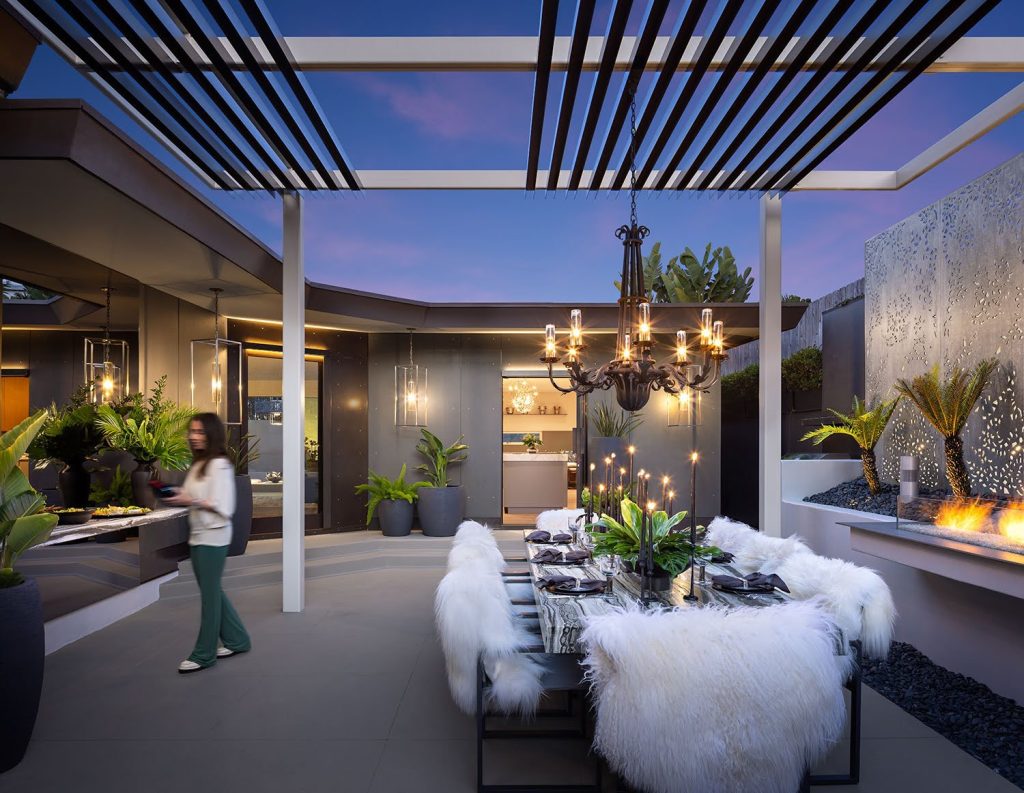
Past the gate, guests step into the front courtyard that serves as an outdoor dining room. Beneath a custom steel canopy filtering sunlight into the space—an effect inspired by the oak trees of San Diego County—sits a grand stainless-steel communal table topped with zebra quartzite stone. Along the north wall, a smoky gray mirror magnifies the space.
The intimate courtyard brings the outdoors in, while the architecture and design of the house spill outwards.
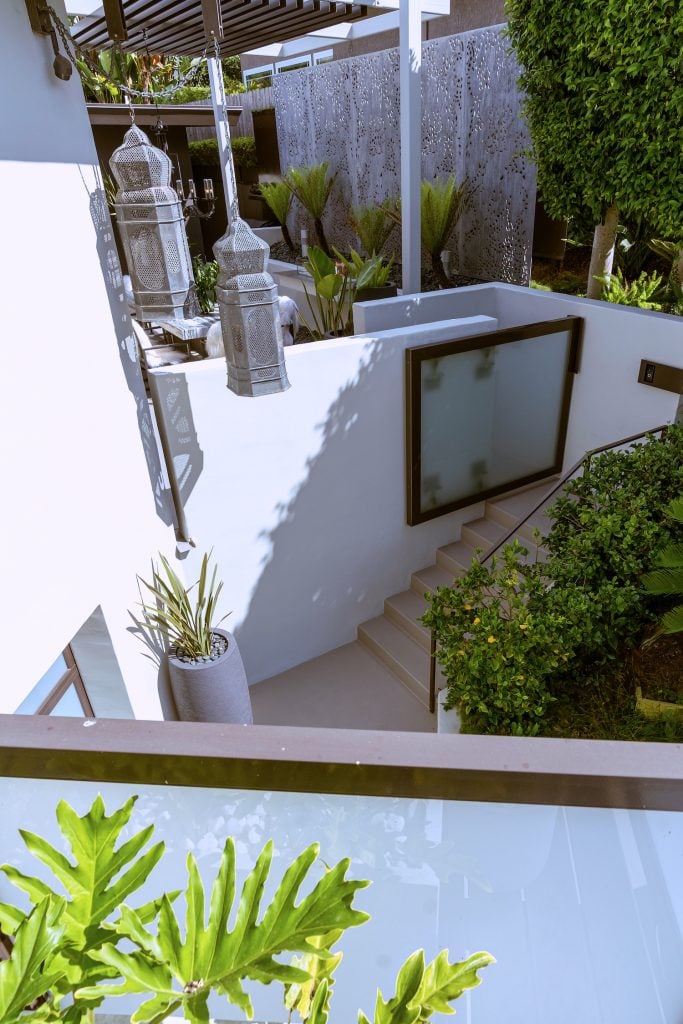
“Both Karen and I grew up in San Diego, so the house is heavily influenced by that sort of outdoor living,” Anderson says. “But the interesting thing about Karen is her travels. What she does, as a chef, is heavily influenced by her international travel, so we also brought all that influence into the house. It’s anchored in San Diego, but it has all kinds of international flourishes.”
The south wall of the courtyard is a striking cement fiberboard privacy screen that’s been pierced with an intricate design. “The very first day I met Karen, she brought these Moroccan lanterns she bought on a trip to Marrakech into my office and she said she wanted the front part of the house to be about these,” Anderson remembers. “I had [the lanterns] on my desk, and we just thought about unrolling them and cutting out the design onto a piece of slim fiberboard. The piece is backlit so, at night, this side glows just like a lantern does.”

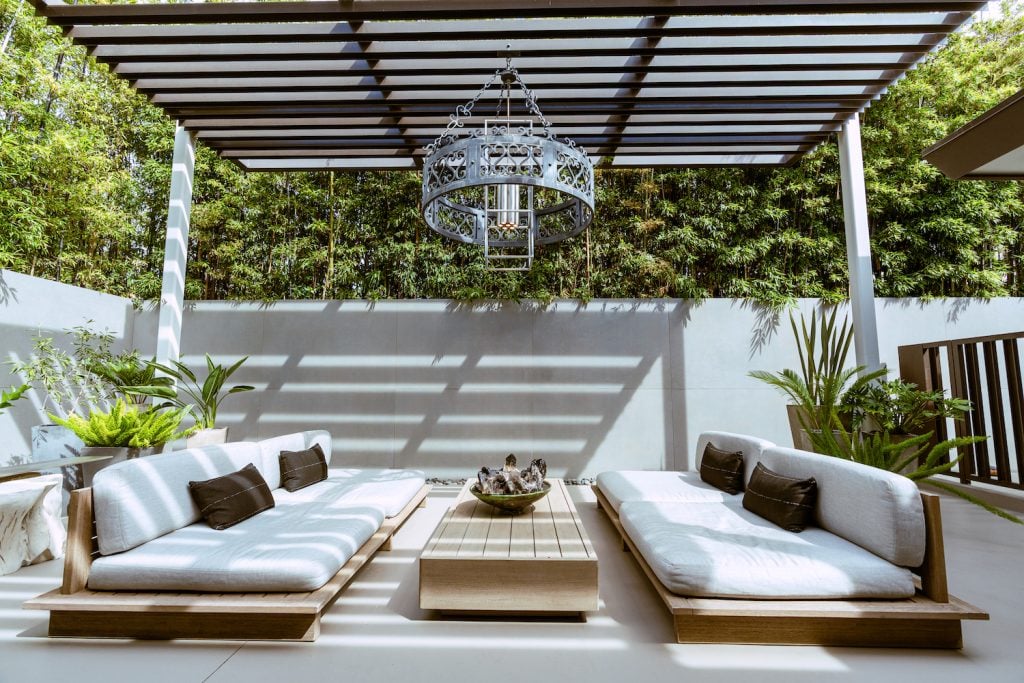
The old-world, international influences don’t stop in the courtyard. Inside the home, Krasne’s love of traveling is reflected in every room. A hand-carved wooden Moroccan cabinet has been repurposed into a bathroom door. Ornate candle holders from Bali adorn the master bathroom countertop. And in the living room—which expands into a second, bamboo-flanked courtyard through massive stacking glass doors—a feature wall was inspired by traditional azulejos tile Krasne once saw in Spain.
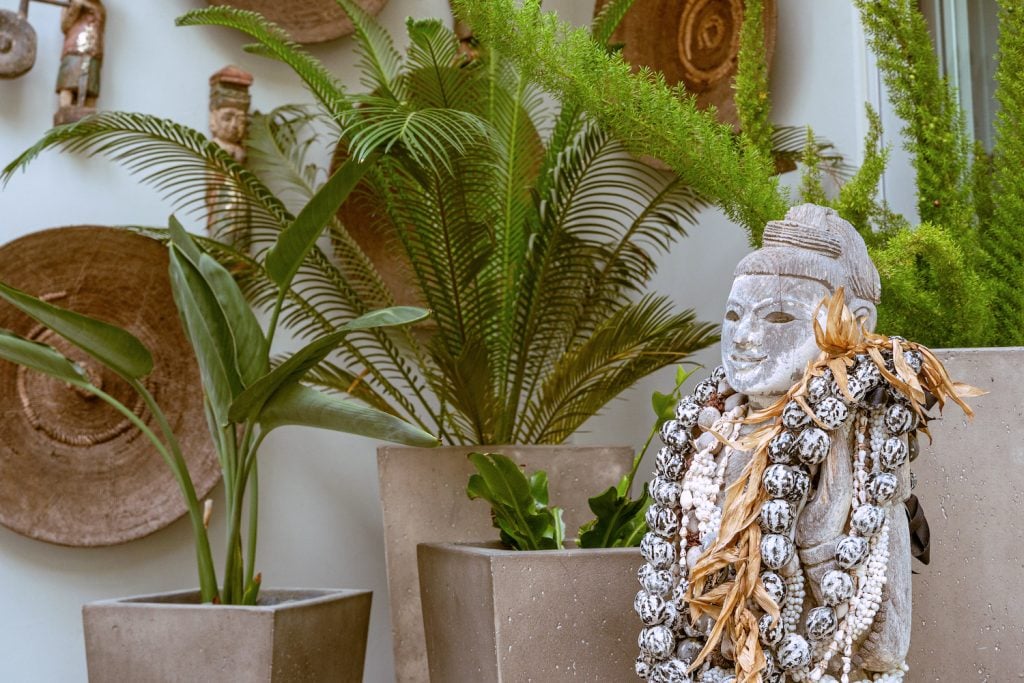
“We tried to take all these different influences—Morocco, Bali, and Paris, where Karen went to culinary school—and balance them with the edgier, modern stuff,” Anderson says. “It’s really hard to take a craftsman house and modernize it without it looking terrible, so I think one thing we all did well was elevating it without overtaking it.”
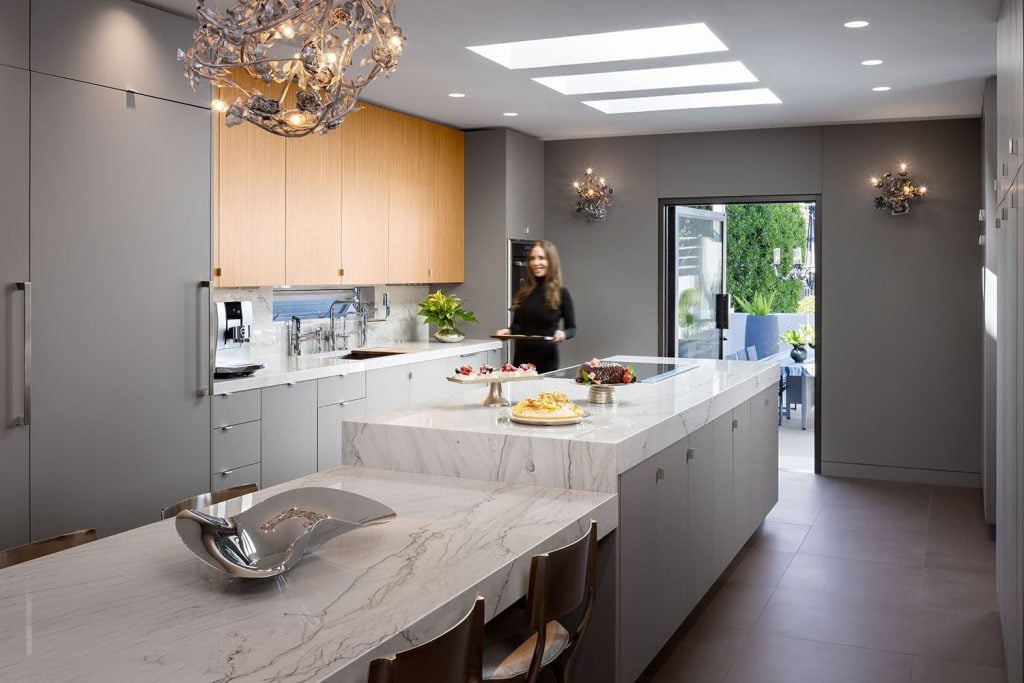
The kitchen, where Krasne spends most of her time while she’s at home, was renovated last. A large island topped with a Japanese-inspired lithograph on natural quartz sits in the middle of the sunlit room, nearly always covered in a food spread for Krasne’s family and friends. Floor-to-ceiling, built-in cabinetry is coated with a self-healing gray Fenix laminate, giving the space a calming atmosphere.

“Those,” Kranse says, gesturing to ornate, art-deco chandeliers hanging over the kitchen table, “are from an old opera house in Austria. I had them sprayed silver to match the sconces, which all came from the same opera house. I also wanted to bring in French Champagne buckets—I really wanted the space to be about us drinking wine and entertaining.”
The Champagne buckets line a shelf hung above built-in lounge seating. Next to the lounge is an in-wall desk with a stack of her favorite cookbooks on display. There, Krasne researches and experiments with new recipes.
“I have a huge office at my restaurant, but I can’t think straight there,” Krasne says. “You feel the frenetic energy, you hear the tamping of the espresso machine and the phones ringing.” It’s here, in this calming, creative space (and in her personal gym downstairs), that Krasne finds inspiration.
As we exit Krasne’s kitchen and step back out into the front courtyard, she jokes with Anderson that she recently came up with a landscaping idea for the front entrance while on a trip to Puerto Vallarta with her husband.
“I know, with Karen, there’s actually a good chance that it’ll happen,” Anderson laughs. “Karen knows more about construction and putting a house together than any other client I’ve ever worked with. We actually get to a detailed level of thought and design. That’s super rare.”
Inside the vibrant, family-friendly home of interior designer Lisa Franco
Lisa Franco didn’t plan to become an interior designer. She and her husband, Luis, met while working in biotech. But when the couple’s daughter, Samantha, was a year old, she was diagnosed with a genetic disorder called Angelman syndrome. Lisa left the industry to focus on Sam full-time. And when the Francos bought their first house in San Diego shortly thereafter, Lisa—armed with a more flexible schedule and a hunger to explore her innate love of design—decided to take the reins on the interiors.
The Francos had tapped Mark Morris of Oasis Architecture to refresh the home. He was skeptical; homeowners who go the DIY route usually end up regretting it. But Lisa’s knack for design was apparent. She pulled samples, chose colors, sourced finishes, and visited showrooms, and others in the industry treated her like a fellow pro. “I just started calling myself a designer, and other people believed me,” she laughs. “My career was in science. Science is problem-solving. Interior design is, too. It’s solving a problem, and making it look good.”
When Morris walked through the finished product, he said, “‘You need to come work for me,’” he recalls. Soon after, she did. Their first project together won Bathroom of the Year in San Diego Home/Garden Lifestyles magazine.
As Samantha, now 24, and the couple’s son Ethan, 21, got older, the Francos set out to find a forever home—one that could accommodate a future live-in caregiver for Sam. In 2017, a La Jolla Heights gem jumped out from a listing in the paper: an Old Hollywood–inspired, 1960’s home, once owned by an oil baroness. The Francos bought it, and Morris signed on to bring the build into modern day. The bones were good, and “the house had the perfect entry—grand, yet understated,” Morris says.

The inside, on the other hand, needed work. Full of small, closed-off areas, it had level changes at every turn, like step-downs into bedrooms. Morris and the Francos modified the floor plan with two goals in mind: to create a seamless flow for family time and entertaining and to make the layout safe for Sam to have as much independence as possible.
They leveled out the floors, opened up the once-enclosed staircase for visibility, and installed pocket-door gates to block rooms and stairs as needed. Though the layout changed, “Lisa loved that house and wanted to respect it,” Morris says, so they preserved some original elements: crown molding, light fixtures, closet doors, built-ins.
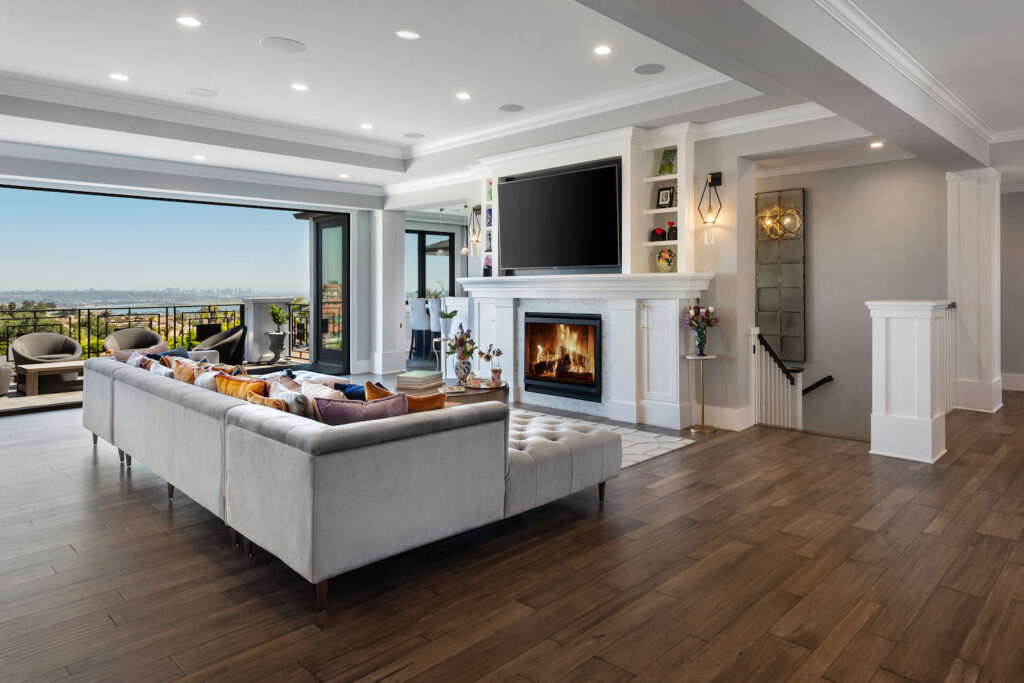
Today, once you cross the threshold, you step directly into the main living space, or the great room. Just past the L-shaped couch is a million-dollar view: La Jolla’s hodgepodge of terracotta rooftops, the coast, all the way to Mexico.
The home’s primary palette is one of soft gray and white walls with chocolate-brown wood floors. But the Franco house is anything but muted. Lisa’s style is bold, colorful, happiness-inducing. In the great room, velvet pillows add pops of pink, blue, and ochre to the couch.
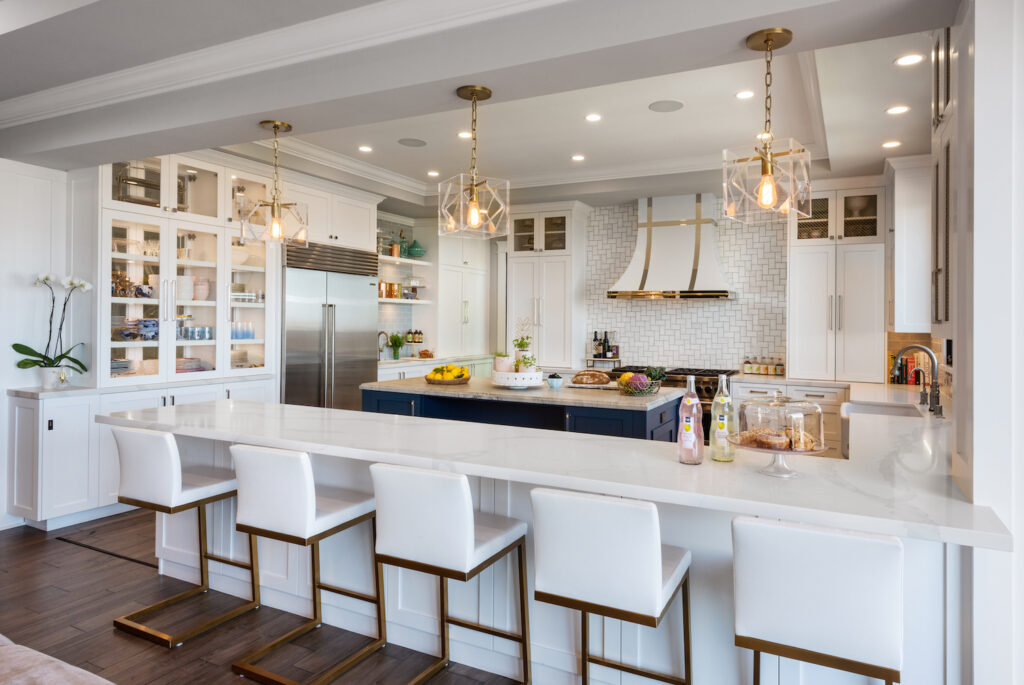
The great room flows into the kitchen, separated only by a peninsula. When Lisa and Morris design a kitchen for a client, they ask about their everyday routine—and that’s exactly what informed Lisa’s own space. Daily essentials receive priority; open shelves hold flour, sugar, oil, and tea, while a full butler pantry around a corner offers hidden storage.
The most innovative feature is a pass-through cabinet between the kitchen and dining room. Dishes and glassware are accessible from either side, and the configuration lets the dining room borrow the kitchen’s natural light.
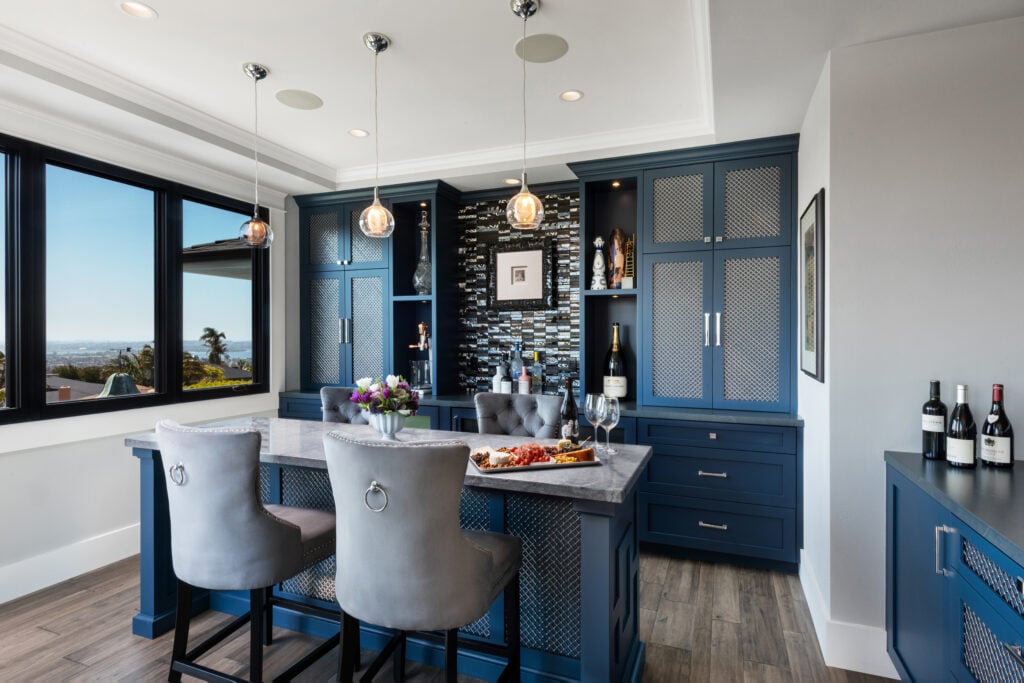
The Francos wanted an additional space to unwind with friends, so they tucked a bar into an alcove off the great room. “Sometimes we have a couple come over, and we just want to hang, but our dining room is big,” Lisa says. “So this is an intermediate. It’s cozy.”
The couple pulled the blue from the kitchen island and incorporated gold and stone accents. The wire accents on the bar island are both aesthetic and functional—no need to worry about scuffs from guests’ shoes. Closed cabinets hold their collection of wine and spirits.
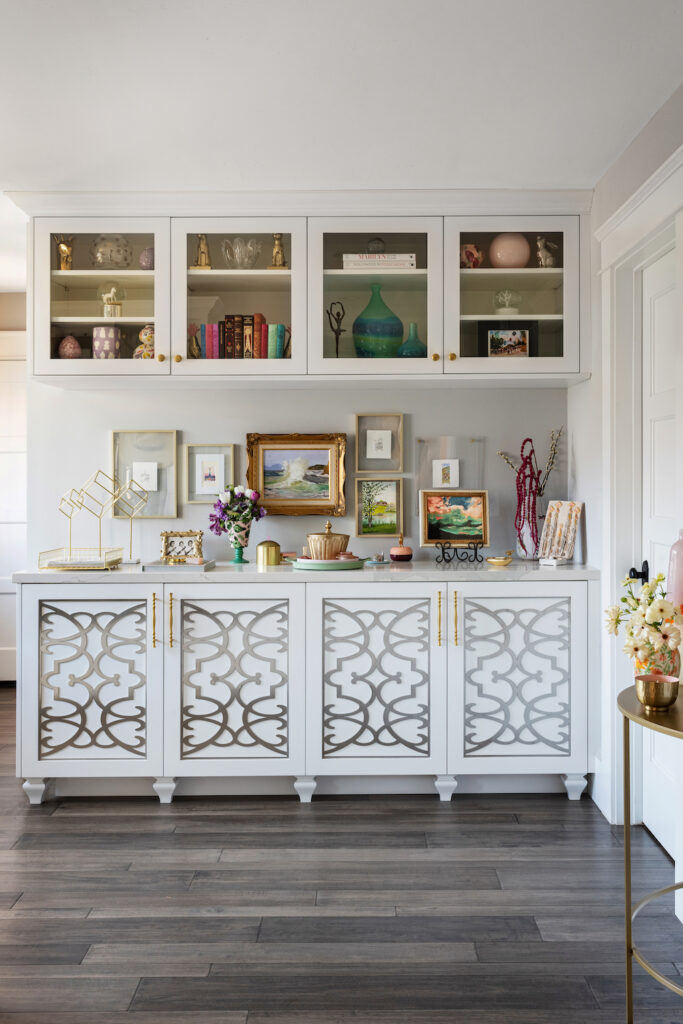
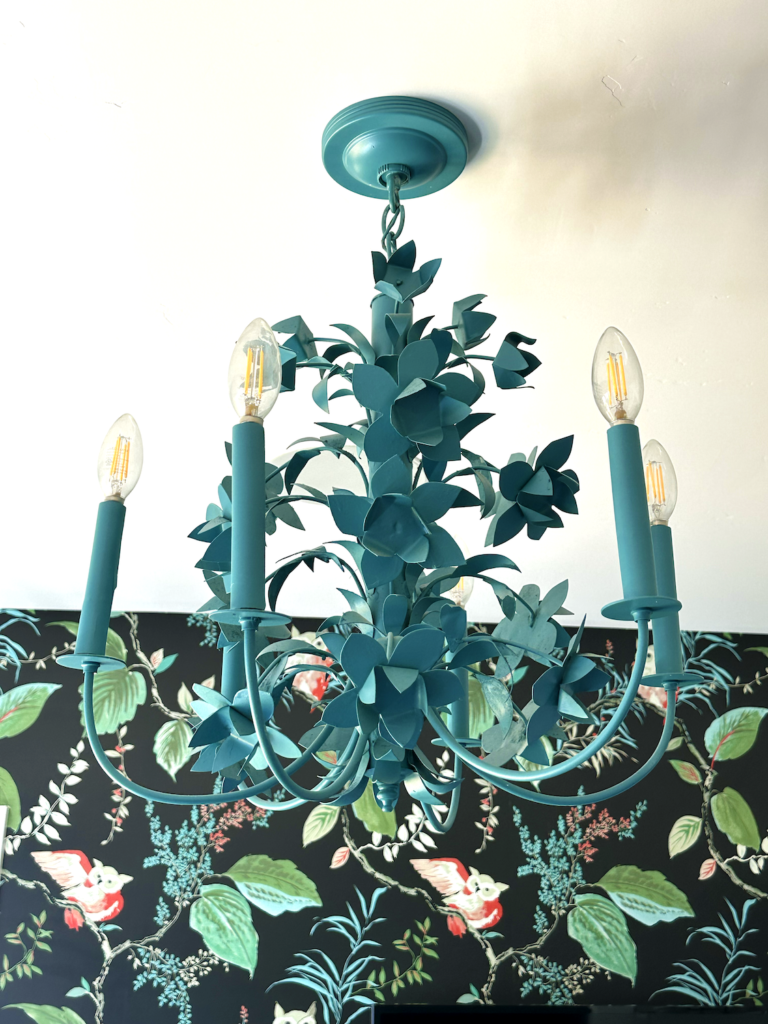
On the other side of the great room is Lisa’s office, easily the most colorful space in the house. Her desk is framed by a bay window overlooking the courtyard, while a pendant light fixture, original to the home and refreshed with deep teal paint, anchors the room. “I love whimsy,” Lisa says. The owl-print wallpaper was a touch she couldn’t resist. Luis was skeptical until he saw it installed. “That’s why she’s the designer,” he laughs.
Right across the hall is Sam’s media room, furnished with durable pieces. It’s near the kitchen and dining room, so Sam has her own space but is still in the mix. A mother-in-law suite, which can eventually function as a caregiver’s room, is next-door.
The great room might be the heart of the home, but the lower level is where the fun happens.
A mural of Lisa’s late brother, Michael “Howie” Mandell, who she calls “the life of the party,” is front and center, smiling with arms outstretched. The local artist they commissioned tagged the names of Howie’s loved ones around him, and band posters harken back to Howie and Lisa’s shared love of music.
In the corner is sapo, a Peruvian game (also called “toad in the hole”) that Luis grew up playing. The objective: Throw a gold coin into the toad’s mouth or the nearby holes. The sapo table was a gift from Luis’s mom, who transported it in pieces via plane.
A far wall holds a candy bar, stocked with guests’ favorites, and a mini kitchen with a pink SMEG fridge and toaster. The oversized sliding window opens up onto the grill, the outdoor dining space, and the pool area.
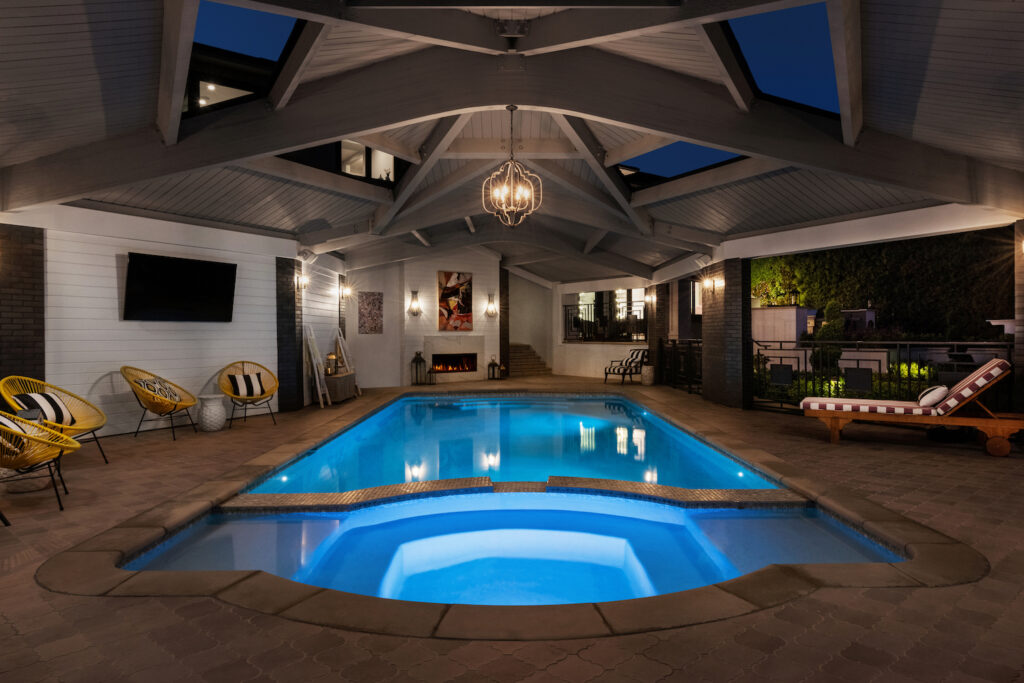
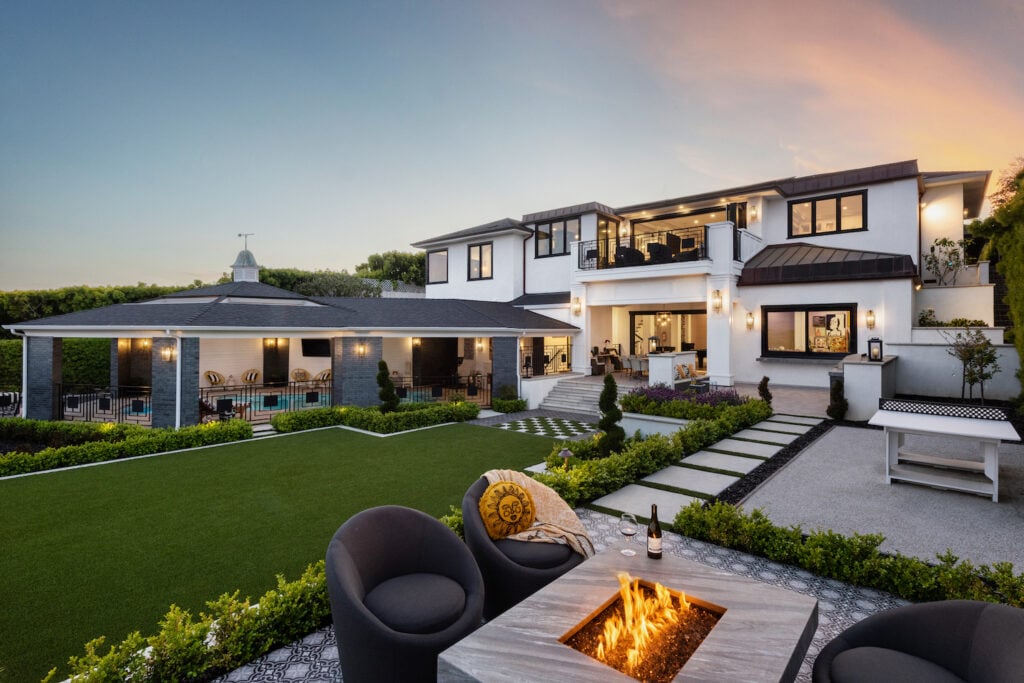
It’s a stunning pool, considering it was once surrounded by green carpet. “It was like going into a football locker room,” Morris says. “The pool itself was spectacular, and we didn’t want to lose that character.” The Francos kept the exposed beams, opened the ceiling and walls, and wrapped the columns in dark brick. “During the day, it feels like you’re outside,” Morris says, “but at night, all lit up, it really feels like its own room.”
Morris and Lisa treated the outdoor space like an extension of the home, creating “rooms” for different functions: grilling, playing, resting, entertaining. A fire pit at the farthest point is an ideal spot to sit and reflect. Lisa designed a “rug” made from tiles that frames the outdoor dining area. They added a ping-pong table for Ethan and his friends. And in the polished, turfed yard, which mimics the shape of the pool, there’s always room for an impromptu game of soccer.
Looking up from the backyard, you can see the family’s gathering spots—great room, basement, kitchen—framed like vignettes through the windows. “Being a good architect is not about bringing your sense of style to the table,” Morris says. “It’s about being sensitive to the environment, the existing [house], and the client’s interests. And if you can cohesively pull that together into a beautiful design that feels like home, you’ve done your job.”

The annual event honors middle market companies creating jobs, scaling up, and investing in the region

San Diego is known for its startup culture and innovation economy, but what happens when the company moves beyond its early-stage years? The San Diego Business Impact Awards aim to answer that question, spotlighting the middle market businesses helping drive the region’s economy.
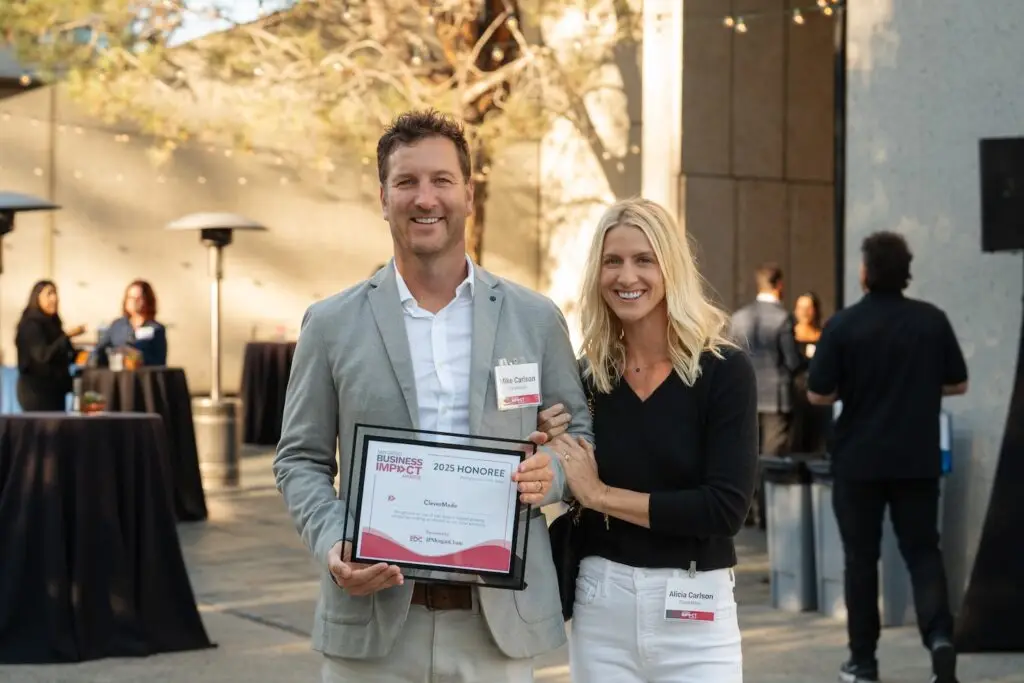
Hosted by San Diego Regional Economic Development Corporation (EDC) and JPMorganChase, the second annual awards celebration takes place on Thursday, July 23, from 4:30 to 7:00 p.m. at Scripps Research Auditorium. More than 200 executives, entrepreneurs, and business leaders are expected to attend the networking and cocktail event honoring some of San Diego County’s fastest-growing companies.
Businesses headquartered in San Diego County that have operated for at least two years are encouraged to submit their nomination by Thursday, June 18 at 4 p.m. Companies across industries—from technology and life sciences to tourism and consumer products, as well as pre-revenue startups—are eligible for recognition.
For EDC President and CEO Mark Cafferty, the event is as much about building connections as celebrating success. “We’ve had a longtime partnership with JPMorganChase; their work aligns with our efforts to support underserved communities and drive talent development,” says Cafferty. “And the networking was invaluable last year. I’m still in touch with people I met at last year’s awards.”

EDC is an independently-funded nonprofit that works directly with San Diego companies to help them grow the local economy, make the region as a whole more competitive, and attract and retain top-tier talent with quality jobs. Through EDC, companies can get help starting or expanding their business with support for things like site selection, permit navigation, and regulatory guidance, plus connections to local resources and potential business collaborators.
The San Diego Business Impact Awards began as an idea with one of EDC’s longtime strategic partners, JPMorganChase. The two organizations share a commitment to San Diego and are dedicated to bolstering middle market businesses.
“We’re blessed with a robust innovation economy and startup community,” says Aaron Ryan, San Diego Region Manager for JPMorgan’s Commercial and Investment Bank and vice chair of the firm’s’ San Diego Market Leadership Team. “But one of the segments of the business community we felt was overlooked was emerging middle market companies—the businesses that are no longer small but not yet large.”
Ryan says supporting those companies is critical as they scale and decide where to invest, hire, and grow.
San Diego’s high cost of living remains one of the region’s biggest business challenges, making talent recruitment and retention increasingly competitive. But local leaders point to the region’s quality of life, climate, and collaborative business community as advantages that continue to attract employers and workers.
“In order to support thriving households, there has to be enough high-quality jobs for people to be able to afford to live here,” Cafferty says. “Once a company grows and excels past that middle market point in their growth cycle, they become much more likely to pay higher wages and compete globally.”
Both Cafferty and Ryan proudly tout the unique collaboration that exists among San Diego County businesses. Bringing together top universities producing high-quality talent, cutting-edge research institutions, a robust military and defense presence, leading ocean science and environmental organizations, and a binational, cross-border identity creates a distinct business ecosystem that defines and strengthens the San Diego region.
Last year’s San Diego Business Impact Awards celebrated nearly 60 honorees from 49 industries, representing a total of 8,232 jobs across eight sectors, including: software and technology, healthcare and life sciences, consumer goods, professional services, finance, construction and manufacturing, defense, and hospitality and tourism. On average, honoree companies doubled their revenues over the previous year, employed more than 145 San Diegans each, and offered an average annual compensation of $192,415.
Top honorees included defense contractor Innoflight, environmental consulting firm Bancroft Construction Services, life sciences startup Element Biosciences, defense technology contractor GALT Aerospace, organic grocery store chain Jimbo’s, and biopharmaceutical company LENZ Therapeutics. During the event, Innoflight Founder and CEO Jeff Janicik held a fireside chat offering his insights on investing in the community and embracing San Diego culture.
This year, organizers hope to continue highlighting the middle market players driving economic impact across the region. Nominations are now open through June 18 at 4 p.m. Get your tickets to the San Diego Business Impact Awards celebration to enjoy drinks by Snake Oil Cocktail Co., light bites, live music, and networking.
This month's selection includes pool toys for grown-ups, natural deodorants, and decadent Italian furniture
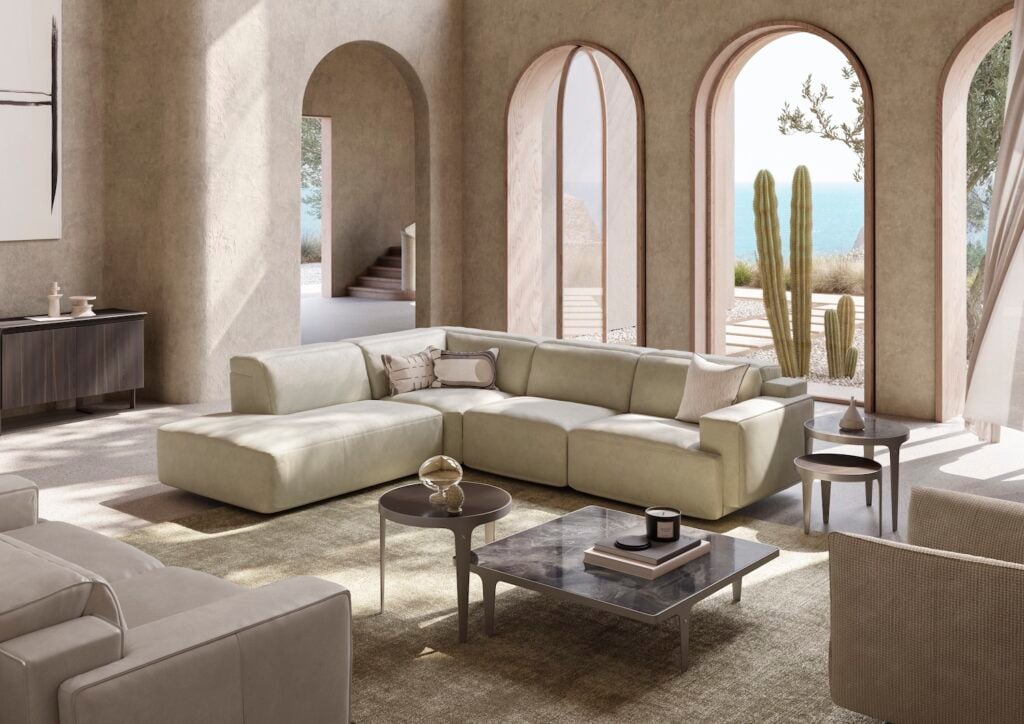
If it seems like you’re the only one who didn’t spend their summer sunning on a yacht off the Amalfi Coast, now you can get a taste of Italy right here in SD. Rest your bod upon a made-in-Italy sofa or bed from Natuzzi Italia, a luxury design and furniture brand that recently opened a storefront at UTC in La Jolla. They carry a wide range of sleek furniture for every room in your house. Hey, it might not be sipping an Aperol spritz surrounded by breathtaking views of Capri, but their stunning sofas make being a couch potato something to aspire to.

When San Diego–based Sarah Moret was looking for natural beauty and body products that actually worked, she became frustrated by the lack of effective deodorants without aluminum and other potentially harmful ingredients. This (smelly) gap in the market sparked the entrepreneur to start her own line of natural body care. In 2018, she debuted aluminum-free deodorant (available in varieties like coconut nectar, white tea, orange neroli, and unscented for the purists out there). Since then, she’s taken her line to Shark Tank, where she struck a deal with Barbara Corcoran and Mark Cuban, and expanded to offer more products, including body spray and hair freshener. Curie products can now be found in stores like Anthropologie, Walmart, and Nordstrom.

Move over donuts, pizza slices, and alligators. Kids’ swim is over. It’s time for the adults to hop in—and we’re bringing our own toys. Float Factory offers two different styles: one a race car, the other a tank. The tank, a.k.a the Pool Punisher, invites party-goers to engage in high-stakes buoyant battles. The toy comes equipped with a water cannon capable of blasting targets up to 50 feet away. Talk about punishment.
The climate is changing fast. Is San Diego building for the future?
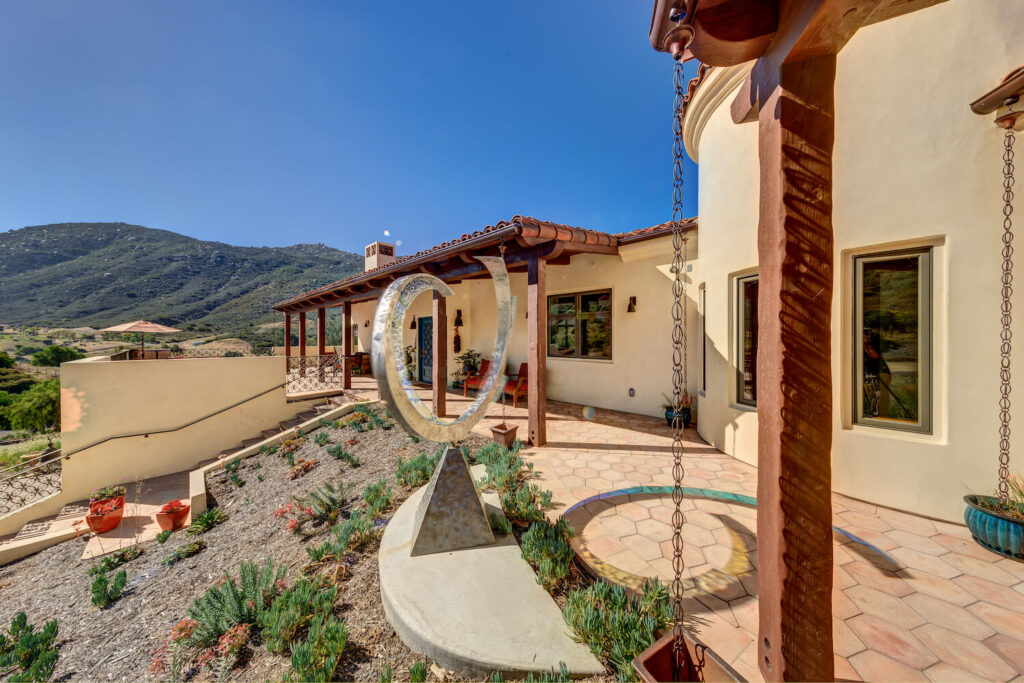
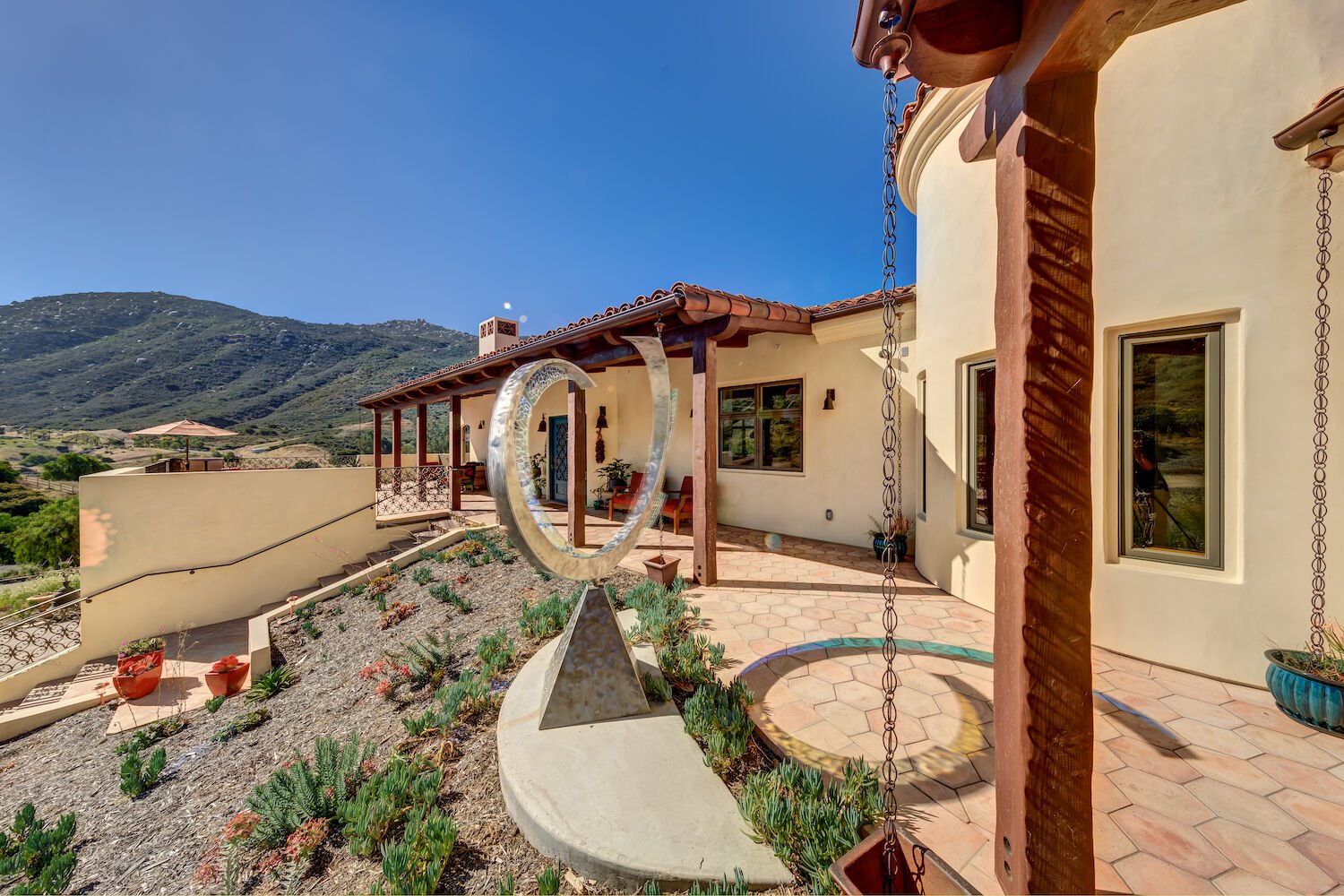
Architect Drew Hubbell equipped this home with green features like natural ventilation and photovoltaic panels—plus Fibonacci spirals inspired by its mathematician owner
Photo Credit: Arnel Garcia
Green is what the San Diego of 2023 aspires to be: ambitious, growth-oriented, and planet-forward. But you wouldn’t know it from our existing housing crop. Despite new homes and accessory dwelling units (ADUs) popping up on seemingly every block, few are considered green builds.
San Diego’s history with green building practices might well have started with James Hubbell and his sculptural, organic-looking structures crafted from local, low-impact materials. The visionary architect is widely considered the original vanguard of the movement here in San Diego. But while Hubbell and his son Drew helped lead California towards more environmentally friendly construction (see “Sticks and Stones”), San Diego overall has been slow to join the green building renaissance.
The city claims its landmark 2022 Climate Action Plan “takes bold steps” towards a more sustainable San Diego. And while that may be true in certain categories, in terms of building, the plan mainly focuses on phasing out natural gas and converting new projects to electric. “Bold” might be a bold choice of words. It’ll take a lot more than swapping out gas stoves for induction burners to get the city where it needs to be.
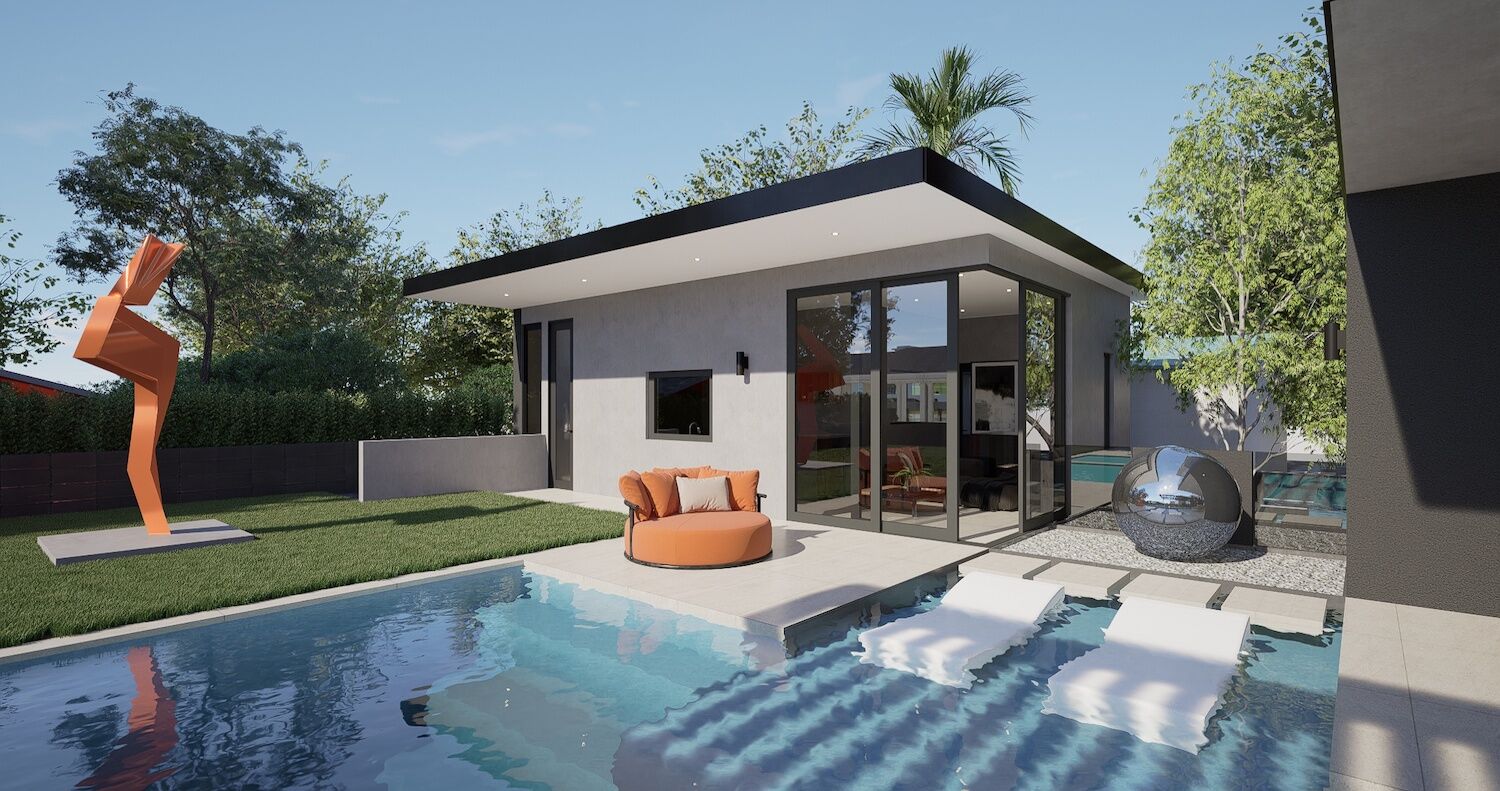
Irons and Fins, ECOhouse’s current project in Coronado, features overhangs that will help cool the home in summer. BELOW Irons and Fins maximizes space by spreading 11,000 square feet across three floors, including a basement.
Courtesy of Irons and Fins
“A green building is much more comprehensive,” says Colleen FitzSimons, executive director of the San Diego chapter of the US Green Building Council.
Green building advocates look toward more holistic criteria like LEED certification, a sustainability rating system that awards architectural projects with points for reducing carbon, energy, water use, and waste; utilizing renewable materials; and more. That might include the use of reclaimed wood, rain-catching, and greywater irrigation systems. LEED-inspired architects consider how to place structures in such a way that they gain more sun for natural heating, or they implement passive cooling systems to keep interior temps low with less energy. Projects need to meet a minimum environmental threshold to qualify as LEED-certified, with additional tiers for higher-scoring buildings, from silver through platinum.
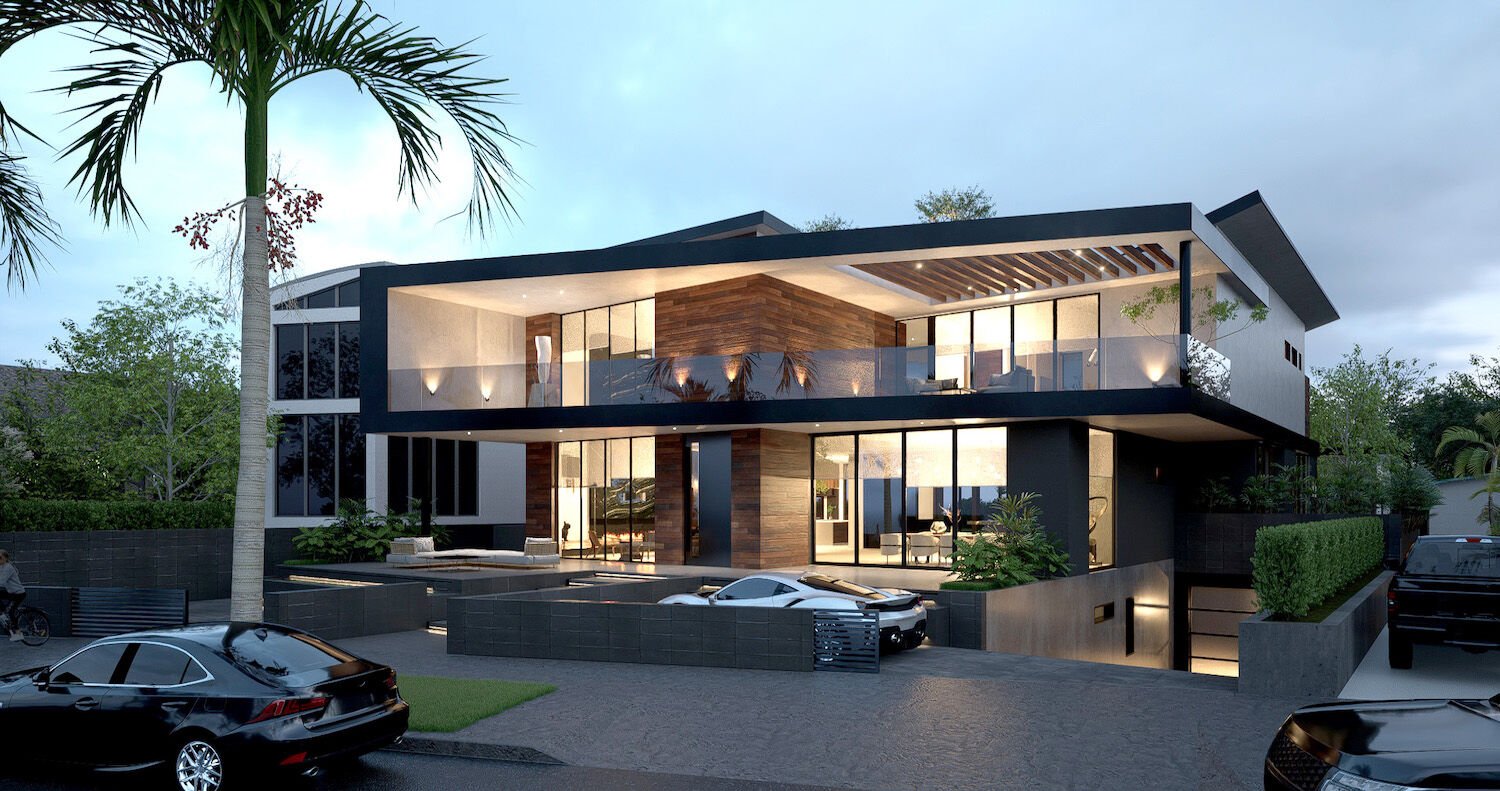
Irons and Fins maximizes space by spreading 11,000 square feet across three floors, including a basement
The city of San Diego maintains several LEED-certified buildings—but don’t be surprised if none of them are on your residential block. Because green projects cost more upfront to construct but have reduced maintenance costs over time, sustainable approaches are often used for big, industrial buildings, says Lauren Cook, executive director of the San Diego Architectural Foundation.
In SD county, that includes a LEED gold–certified senior center, a silver-certified recreation center, and three fire stations ranging from silver to gold. Snapdragon Stadium and many structures at UCSD also employ green building approaches, because they are “a long-term investment for [institutions] to save money,” Cook adds.
In the residential realm, Cook concedes, green buildings are generally going to be luxury homes.
FitzSimons echoes this, adding, “People who can afford to design and build their own home typically have more resources”—meaning that they can shoulder the weightier construction costs sometimes associated with greener builds.
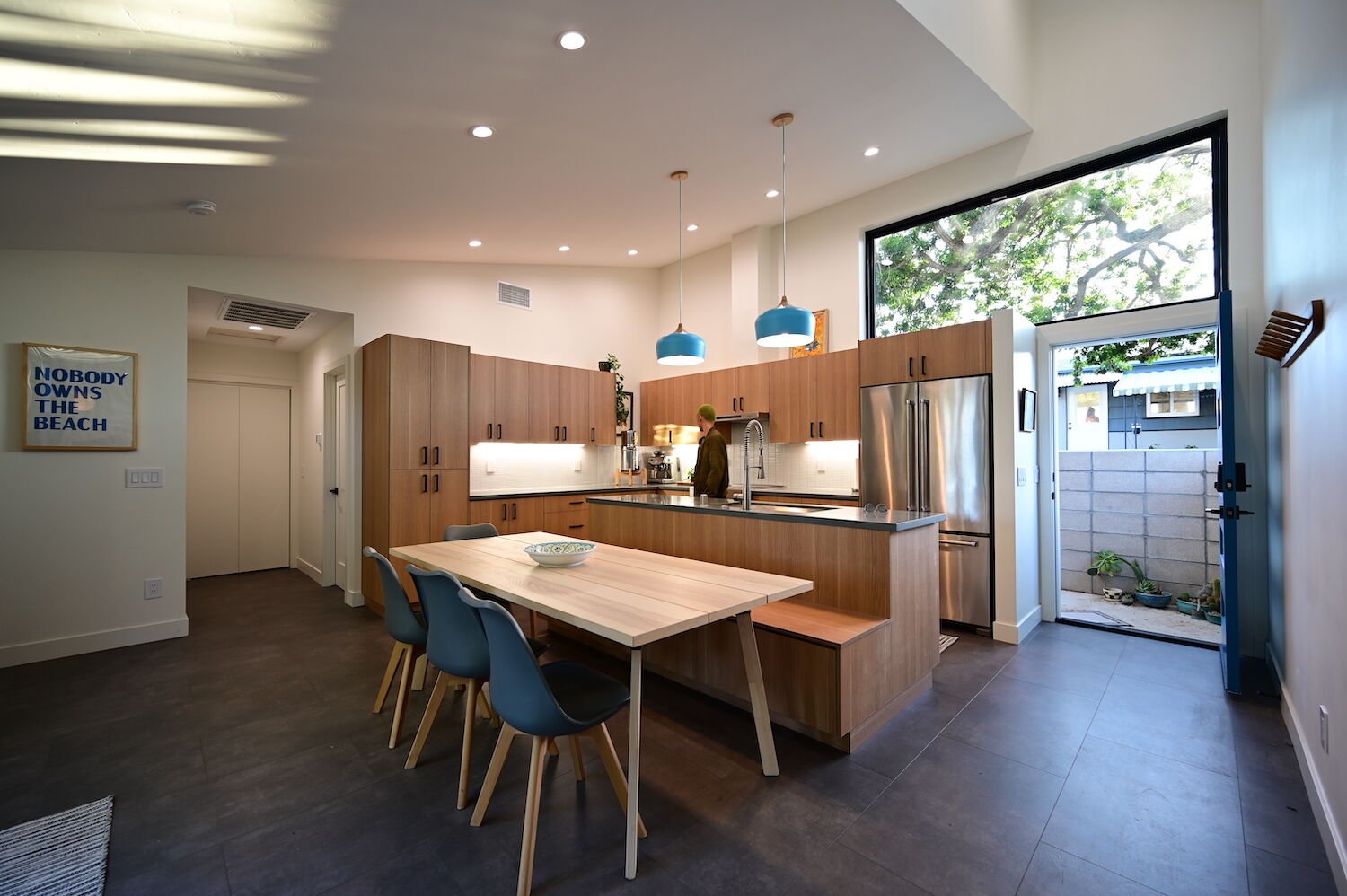
ADUs, like this one designed by Prismática, are secondary housing units built on a single- family residential lot
And because developers and homeowners may not be cognizant of the money they can save long-term with tactics like solar power and natural heating, they sometimes dismiss greener building methods off-the-bat. “There’s this perceived idea that it’s going to cost more, and so a lot of developers won’t go the extra steps beyond the Green Building Code,” FitzSimons emphasizes. (The California Green Building Standards Code is the first-in-the-nation mandatory green building code, which San Diego builders must abide by. In other parts of the state, even more strict regulations are in place.)Nevertheless, the city of San Diego is increasingly committed to investing in sustainable construction. As of April 2022, San Diego has its own chief sustainability officer in Shelby Rust Busó, who has worked with the US Green Building Council, the national entity that awards LEED certifications. According to Sustainability and Mobility Department director Alyssa Muto, Busó will “lead the city’s work on the long-term planning and implementation for decarbonizing buildings and neighborhoods.”“I definitely am super excited about where we’re heading, but, at the moment, we’re not there,” FitzSimons says. But, she continues, larger policies from the county of San Diego and the San Diego Association of Governments are “going to help push our region to be a forerunner in green building.”As it stands, San Diego does have its share of architects and firms helping move the city toward a greener future. That includes Elizabeth J. Carmichael, owner and principal architect of ECOhouse and president of the San Diego Green Building Council. Though 95 percent of her clients are developers, she has seen the shift in priorities from businesses and homeowners alike.
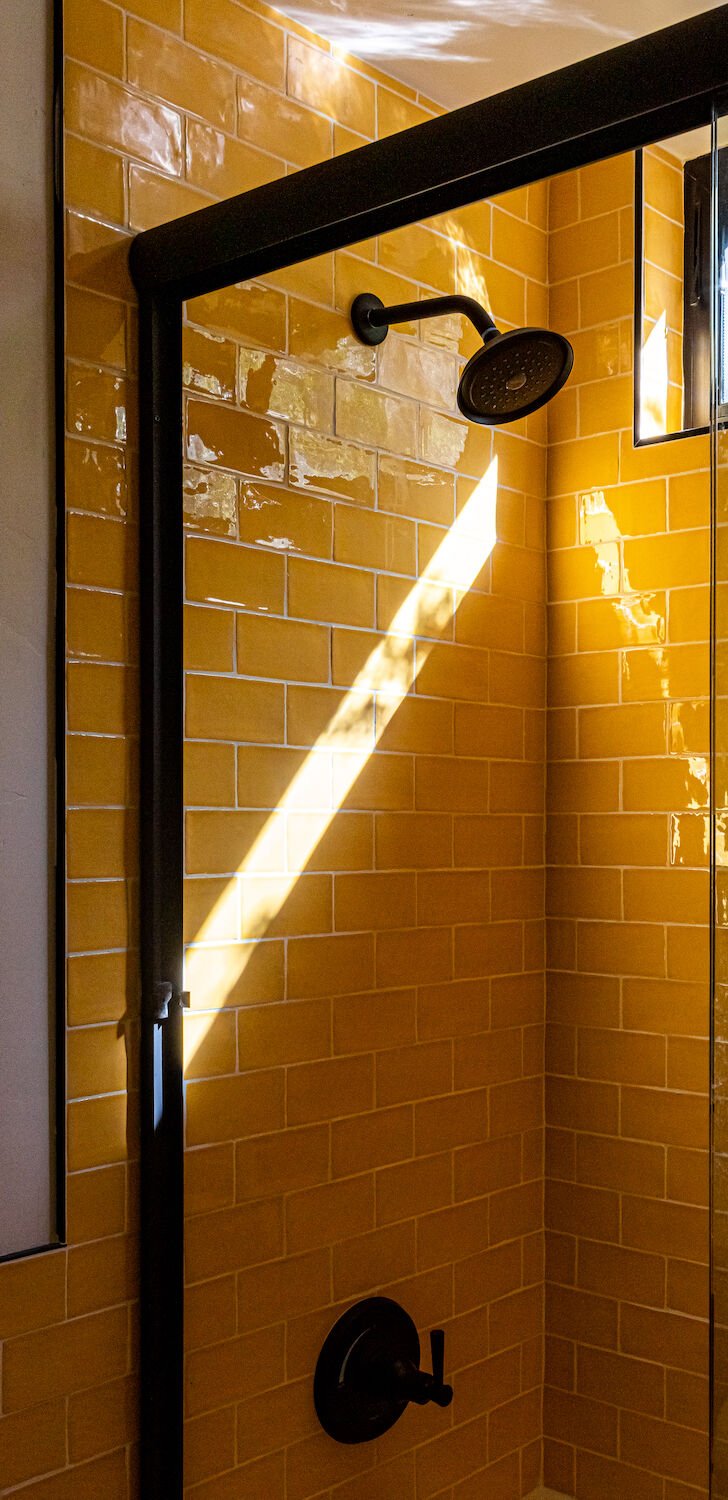
Prismática Design Shower LEED Home Design Climate Change San Diego
“We get clients that really want to do as much sustainability as possible,” Carmichael says. “They come in and tell me, ‘We want to be green. We want to make it sustainable.’ Whereas before … we were kind of pushing our philosophy on the client. Now it’s almost the opposite.”ECOhouse has a current project in Coronado that is emblematic of their holistic approach to integrating sustainability and functional design. Nicknamed “Irons and Fins,” the house encompasses 11,000 square feet. Rather than building out, however, the blueprint saves space by moving up (and down) with a three-story floor plan, including a basement.The luxury property also boasts a coveted list of green amenities and functionality, with a roof entirely covered in solar panels, alongside solar water heating and a separate solar-powered battery should going off the grid ever be necessary. The house is outfitted with two giant tanks for rainwater harvesting, and the LED-efficient residence also benefits from a basement design with a passive cooling system, where sliders open up to bring in cool air which passes to the first floor.The top floor features a similar system for hot air to escape. South-facing with overhangs, the house is designed to capture the sun in the winter for passive heating, while the overhangs protect and cool during the heat of the summer. Two-hundred-year-old juniper trees that were harvested while preparing the property for the build were later thrown in a kiln and are now being used to create furniture and fixtures for the new home.
But what about building green with more modest funds? American Institute of Architects award–winning, Barrio Logan– based architecture firm Prismática may have some answers. “We try to make the building as efficient as possible,” says co-founder and principal architect Jesús Fernando Limón.
And while clients’ options for sustainable techniques vary according to their budget, “the biggest things you can do that are accessible to everyone are the types of things that we do,” adds Pristmática co-founder José F. “Pancho” García. That includes strategically maximizing natural light, employing cross-ventilation, and using construction tactics that produce less waste.
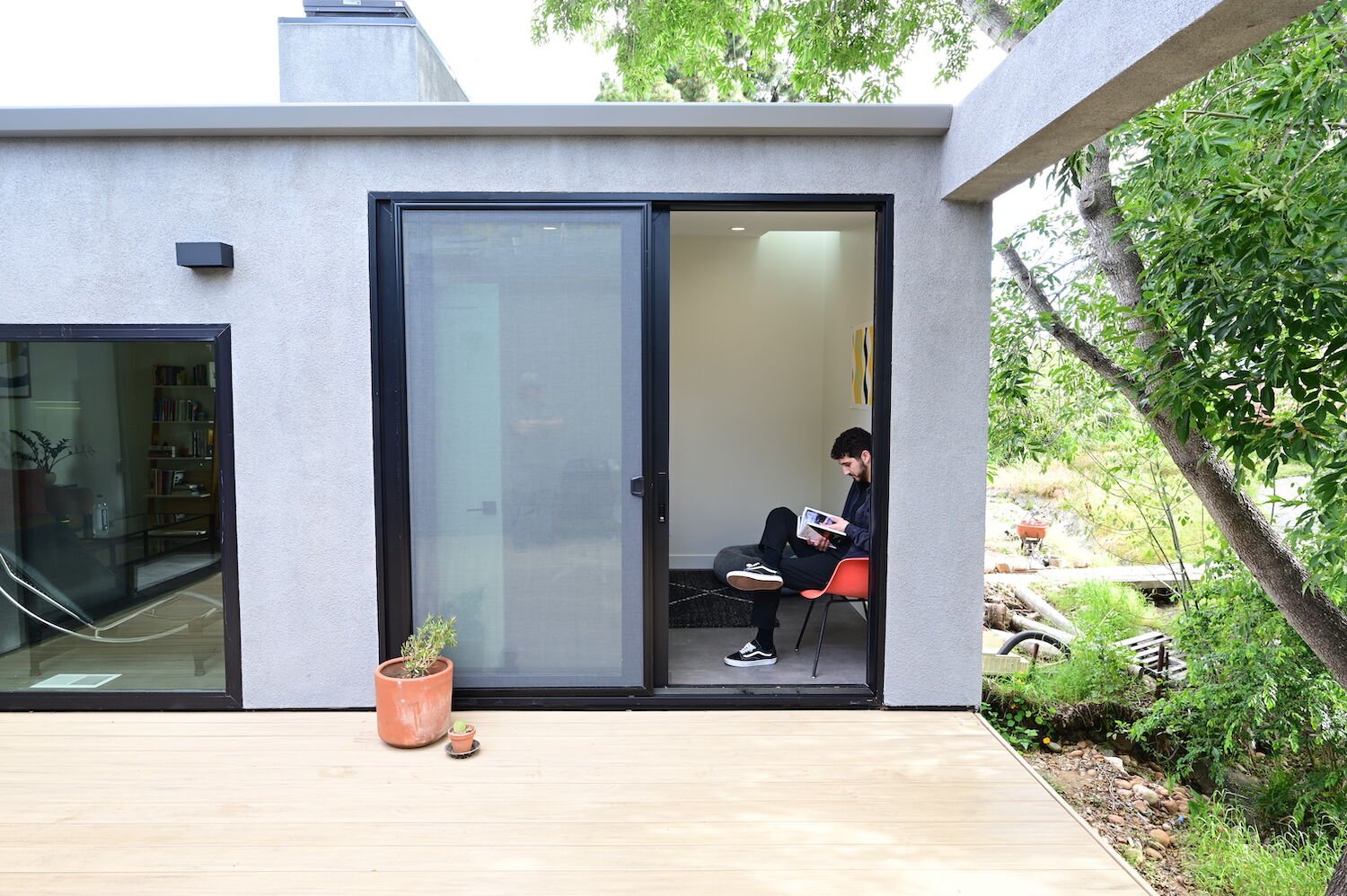
Prismática equipped this ADU with passive cooling and rainwater- catching systems. The massive windows invite in natural light, reducing daily energy use
This year, the firm finished an ADU with energy-efficient elements in Oak Park. It opens up to a lush courtyard that has the capacity for passive cooling, ample natural light sources, and rainwater-catching to irrigate the garden.
Prismática wants to offer these sustainable techniques all over the county and beyond. They work across San Diego from North County to Paradise Hills, with designs on projects in our Baja backyard of Tijuana, where García calls home.
Another way to move towards sustainability while saving cash is to think small. Density and urban infill—maximizing the residential or commercial potential of a plot of land—can help contain urban sprawl and reduce the amount of travel required to access goods and services, preserving resources and natural spaces.
“Micro units are hot,” Cook quips. They’re also a way to increase density in combination with de-carbonization and other targets of green proponents. National City’s Parco, for example, designed by the architects at Miller Hull Partnership, is a mixed-use building spanning 131,000 square feet with energy-efficient micro units. The development achieved a carbon offset of 950 tons, the equivalent of more than 1,900 trips between San Diego and Seattle (where Miller Hull calls home). Not a bad start.
San Diego still has a ways to go in hitting the goals imposed not only by the city but by the culture of its residents. The city’s dwellers are already demanding more bike lanes and public transit. We’re ready for more energy-efficient ways to live our lives, including in the places we call home.“There are a lot of people really active and interested in getting us to where we want to be, climate-wise, equity-wise, [and] health-wise,” FitzSimons says.
San Diego may not be leading the green building charge, but there are plenty of people here working to push the city in a more sustainable direction. The green housing wave is upon us. You just have to squint a little harder to see it around here.

Danielle is a freelance culture journalist focusing on music, food, wine, hospitality, and arts, and founder-playwright of Yeah No Yeah Theatre company, based in San Diego. Her work has been featured in FLAUNT, Filter Magazine, and San Diego Magazine. Born and raised in Maui, she still loves a good Mai Tai.
Scripps study shows that some patients may be able to taper their dose and maintain results

While glucagon-like peptide-1 (GLP-1) receptor agents have been used to treat Type 2 diabetes for more than 20 years, their recent emergence as weight-loss wonder drugs marked a new frontier in medicine. But their effectiveness has left some patients wondering what to do once they’ve reached their goal. Stopping the medication could mean regaining some, if not all, of the weight. A Scripps Clinic internal medicine physician recently conducted a small study of whether GLP-1 patients who had reached their goal weight could maintain that weight by taking their regularly prescribed injection every other week instead of weekly. Spoiler alert: 30 of 34 patients did. Read more about the study here and what that may mean as pharmaceutical companies roll out oral GLP-1s.
For more nutrition, wellness, and healthy living tips, sign up for the San Diego Health newsletter here.