People APRIL 1, 2022

Publisher’s Note: April 2022

Publisher Troy Johnson on the pleasures of getting lost in San Diego
Publisher’s Note: April 2022
Jussi Oksanen

There is always a way to get lost. We manage to do it in a crowded room. Whenever we find ourselves staring, zombie-style, at nothing in particular—I’m pretty sure that’s just us detaching from the din, finding an alcove of solitude, a floaty little space for our awareness.

Spacing out is a centering instinct. Think of how good it feels to “freeze” like that. How, when someone tries to “snap you out of it,” you feel offended, done rude, as if they stole from you. Because that was us briefly and contently lost. This issue is about living an active life outdoors in San Diego. A life of hiking, biking, walking, running, yes. But also of wandering, exploring, and losting.

People are like water. We come to a place like San Diego and flow freely through it to start. But over time, we repeat ourselves, form rivulets and tracks. We could find new ways, but unless we make a conscious decision to do so, we’ll hit the end of the day and realize we poured ourselves down the same river of experience.

This year, we leaned on good friend and successful active-life podcaster Shelby Stanger (search out her Wild Ideas Worth Living podcast) to help us get lost. She pointed us to inspiring adventurers living in our midst. These bikers and runners and will-pushers share their favorite trails and back countries and moonlike nooks around San Diego County. We asked two extremely talented local photographers—Todd Glaser and Jussi Oksanen—to capture them in their losting element. Then we had them turn their cameras on each other to show their favorite outer realms.

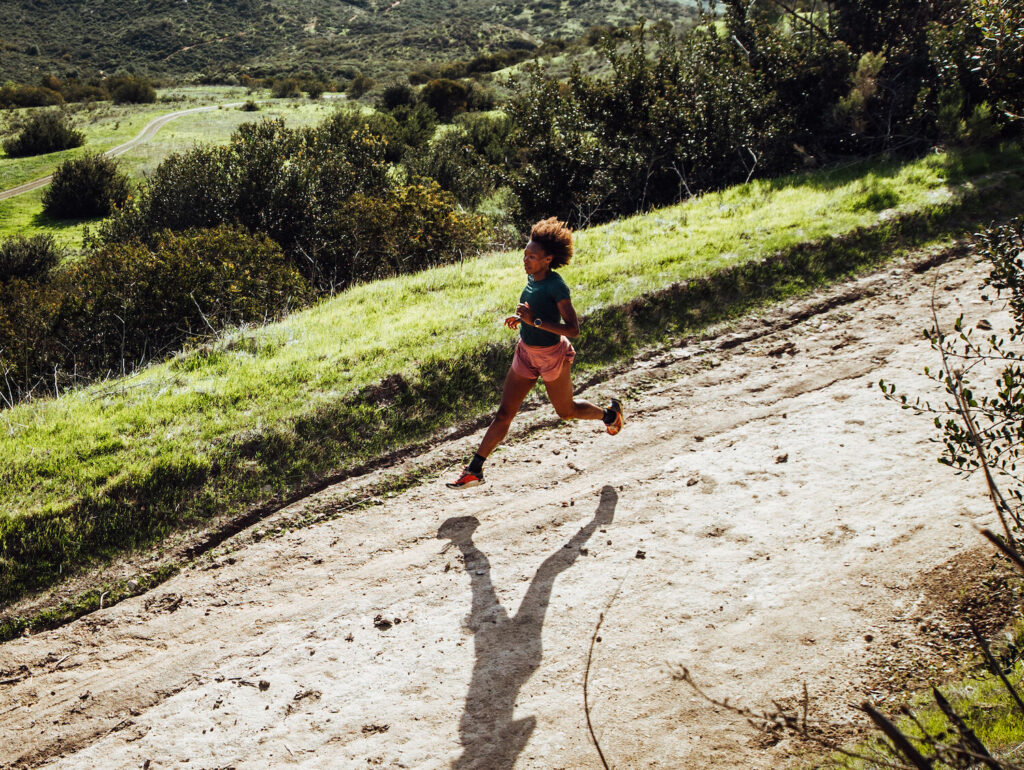
I can’t stop staring at the photo of Iman Wilkerson (pictured above). You can feel how alive she is, how she seems to leave a vapor trail of grace behind her, how her shadow probably struggles to keep up. There’s also an epic photo of a person on a fancy bike doing a wheelie on the edge of a ravine. It looks ill-advised and dangerous and life-affirming. The ragged skyscraper of dirt he’s riding on looks like Sedona, or that alien planet where the wee robe creatures stole C-3PO.

It’s San Diego.

I’m sure some of you have ridden these trails, run these ravines, scaled those cliffs. But so many of us haven’t. I haven’t. And the whole point of what we do at San Diego Magazine—of documenting inspiring people in artful ways—is to show you invigorating ways to live a life here.

The cover photo of Todd and his girlfriend, Jenna, barefooting the cliffs of Black’s Beach with their surfboards, unleashes the memories. I can still remember, age 14, when a friend’s older brother took us surfing at Black’s. I remember parking at the glider port, where people threw themselves off the cliff at random intervals as we put on our wetsuits. I remember looking at the dizzying cliff we were about to descend and thinking in expletives. We had to traverse this thin section of the trail at the top. On each side, sheer doom—or at least reasonable peril. It was a windy day, which makes your surfboard act like a sail and throw you off balance. I remember the adrenaline starting in my gut and then through all of me. I remember making it down to the bottom. I remember being surprised by the naked members of our elder community on the beach below. I remember surfing for hours, and feeling I’d discovered a remote world in the middle of the city.

I felt perfectly lost.
Troy Johnson

About Troy Johnson

Troy Johnson is the magazine’s award-winning food writer and humorist, and a long-standing expert on Food Network. His work has been featured on NatGeo, Travel Channel, NPR, and in Food Matters, a textbook of the best American food writing.

Subscribe to our newsletters

Select Options

By subscribing you confirm that you agree with our Terms and Conditions and Privacy Policy.

Features OCTOBER 26, 2022

My Own Private Ride

Backyard ramps offer a personal and familiar skate fix with the chance to take bigger risks

My Own Private Ride
Madeline Yang
my own private ride, skater at sunset

my own private ride, skater at sunset

Madeline Yang

It’s a harrowing drive to get to the Draper family’s house, and I’m not sure my Toyota Corolla will make it. I watch the RPMs rev as the little car pushes up a long, steep and twisty driveway, which actually feels more like a bobsled track.

But at the top, a breathtaking view. The Draper family—Mark, Sarah, and their two young children—live on a peak that overlooks the Dehesa Valley, a rural area nestled deep in East County San Diego. From their house, they can see for miles. For a family that loves nature, solitude and privacy, the location is perfect; but for a skateboarder…not so much. The nearest skate park—or even skateable road—is a far drive, and that twisty strip of pavement that serves as their driveway is a one-way ticket to Valhalla for anyone who chooses to skate it.

my own private ride, skateboard

Demetrius Antuña’s backyard is host to The Unicorn Lair, a DIY skate ramp he built with his kids during the pandemic. “I watched a lot of YouTube videos,” Antuña says of how he learned to build it. He and his family raised over half the cost of the ramp through GoFundMe.

Madeline Yang

This lack of skateboard opportunities didn’t sit well with Mark Draper, who fell in love with skateboarding in college after years of playing traditional sports in high school.

“I always wanted a skateboard ramp growing up, but my dad said, ‘You’re not touching a skateboard.’ Wrestling, football, and baseball were all full-time jobs, but when I got into college, I didn’t have those sports anymore, so I picked up a skateboard.”

Mark has been infatuated with skateboarding since and was stoked when his kids immediately took to the sport as well. However, he needed an environment where both he and his kids could practice safely.

“My daughter has so much character: It was either she’s gonna go down that driveway within the next couple years, or we build something to keep her contained.”

my own private ride, the atuna family

The Antuña family hangs out on the backyard ramp they made (pictured above). “My favorite thing about having ramps growing up was people would just show up,” Demetrius Antuña says. “You’d meet new people, but I feel like my kids never really had that.” Until now.

Madeline Yang

“We wanted a safe space for them to be crazy,” Sarah adds.

The Drapers got in touch with Jim Bell, the longtime veteran ramp builder behind Jim Bell Skate Ramps. Bell has built ramps and backyard skateparks for novices and pros around the world. He’s built ramps for Tony Hawk, 2021 Olympic skateboarder Bryce Wettstein, as well as an in-ground halfpipe for Mitt Romney’s kids. Bell was especially taken with the Drapers’ enthusiasm—not to mention their unique location—and together they designed a half bowl that custom fit their backyard.

The popularity of backyard skateparks has grown steadily since Bell first started building ramps. In the early-late ‘90s and early ‘00s, the rise of pro skaters like Tony Hawk did a lot to destigmatize the sport, and municipal skateparks became regular features nationwide, but finicky neighbors and draconian HOA regulations remained a hurdle for backyard ramps, pipes and bowls. But Bell says this is quickly changing. “90 percent of neighborhoods right now know what a ramp is,” Bell says. “HOAs now are [made up of ] people who’ve skated. Twenty years ago, they were like, ‘What is this thing?’ Ten years ago, it was like, ‘Oh, we kind of know what it is.’ But now, it’s cool.”

my own private ride, the iguana bowl

The Wettstein’s Iguana Bowl signage, appropriately on a skate deck.

J.Grant Brittain

It certainly doesn’t hurt that skateboarding was further legitimized by becoming an official Olympic sport in the 2021 Tokyo Summer Games, which featured Vista native Bryce Wettstein, the top rated women’s park rider in the country. Wettstein credits her backyard bowl (dubbed the “Iguana Bowl” [search #iguanabowl on Instagram]) with helping her hone new tricks.

“It’s almost like having your own home,” Wettstein says. “The more you’re familiar with something, the more you feel accustomed to take more risks. There’s always this little firework of magic that happens, where you always end up wanting to try a new trick.” While San Diego companies like Jim Bell Skateboard Ramps, Front Rock Inc. and Kanten Russell will build you a custom backyard skatepark, some people have opted for more of a DIY approach, including musician and graphic designer, Demetrius Antuña.

my own private ride, bryce wettstein

Bryce Wettstein skates in her hashtag-worthy backyard bowl, #iguanabowl, which was built by builder Jim Bell, who has completed many notable backyard skate projects in San Diego County.

J.Grant Brittain

“Covid kind of put this off,” Antuña says while showing off “The Unicorn Lair,” his family’s massive backyard halfpipe. “I got more into skating because we didn’t have anything else to do. So me and my kids would just go out skating.” The more Antuña skated, the more he wanted to revisit the ramps of his youth. “My favorite thing was skating mini-ramps, and they’re impossible to find anymore. All the skateparks are concrete. I was craving a mini-ramp so that I could learn my old stuff again without the fear of totally destroying myself.”

Although Antuña handled a lot of the construction (“I watched a lot of Youtube videos”), he is quick to admit that he had tons of help from friends and family (nearly half the $3K cost was raised through GoFundMe). He’s also found that The Unicorn Lair is creating a community entirely unto itself by becoming a destination for neighborhood skaters.

“My favorite thing about having ramps growing up was people would just show up,” Antuña says. You’d meet new people, but I feel like my kids never really had that. You don’t really meet people at skateparks now—they all have their ear buds in and are minding their own business. So here, they’re learning that whole backyard camaraderie thing.”

my own private ride, ramp in yard

my own private ride, ramp in yard

Madeline Yang

my own private ride, tony hawk's park

“I have a skatepark at my house,” Tony Hawk told San Diego Magazine. “It’s beyond any dream I could have imagined as a young skater. But the coolest part is the tile configuration—blue and orange—because it’s an ode to the pool I grew up riding at Del Mar Skate Ranch.”“I wanted something with plenty of variety in the limited space: bowl, street, and even a little vert.” -Tony Hawk

J.Grant Brittain


Charitable SD JUNE 6, 2022

The Volunteer Diaries: Phil Hwang, Trail Guide at Mission Trails Regional Park

By day, Hwang is a software engineer. But in his spare time, you'll find him trekking across Mission Trails, leading hikes, and keeping an eye out for wildlife (including tarantula hawks).

The Volunteer Diaries: Phil Hwang, Trail Guide at Mission Trails Regional Park

At more than 8,000 acres and 2 million annual visitors, Mission Trails Regional Park is one of the largest urban parks in the US. It spans five peaks (one of which, Cowles Mountain, is the highest point in the city of San Diego), 65 miles of trails, Lake Murray and Kumeyaay Lake, a campground, the San Diego River, and Old Mission Dam, a national historic landmark.

The nonprofit Mission Trails Regional Park Foundation supports the city Parks & Rec trail guides, who lead walks on Wednesdays, Saturdays, and Sundays from the Visitor Center.

Here, we catch up with trail guide Phil Hwang. By day, he’s a software engineer; in his spare time, he’s leading visitors through Mission Trails Regional Park’s rugged terrain, sharing the region’s rich history, and keeping an eye out for wildlife (including tarantula hawks, which are just as scary as their name suggests).

San Diego Magazine: Why did you want to become a trail guide? How did you learn about the program?

Phil Hwang: The park’s 5-Peak Challenge was one of the first hikes I completed moving to San Diego over a decade ago. I learned about the trail guide program while looking up other hiking things to do, I emailed them about taking the class, and after successfully completing the course, I’m now a trail guide!

IMG_9651.JPG

What training is required to be a Mission Trails Regional Park Trail Guide?

The annual training is pretty extensive and involved. There’s a weekly course lecture and a weekly field lab. There are tons of awesome guests: San Diego rangers, geologists, botanists, members of the scientific community. The program covers way more than the simplified “walk a trail,” as we are trained to be aware of all aspects of life sciences, native uses, modern history, and the park itself. I especially love stories and lore and legends, and there’s plenty of those, too! The park is alive and changing with us, so we’re always learning.

What’s something surprising you learned about the park?

The history. There’s deeply rooted history with the Kumeyaay, with the military, and with the surrounding neighborhoods. What I find fascinating is how the park evolves throughout all time. Who knows how it will look in the future?

What’s your favorite animal in the park?

At Mission Trails I love seeing the graceful northern harrier. At Lake Murray I always make it a point to see the osprey. For the pure horror story of it all, I love the tarantula hawk and the nightmarish hell the prey goes through: paralyzed, buried alive, eaten from the inside out for weeks on end until the wasp larva pupates and bursts out an adult. What a growth spurt!

Tell us more about those volunteer opportunities.

As trail guides, we lead tracking walks, bird walks, and all sorts of school and scouting field trips. There’s also trail maintenance, habitat restoration and beautification, and volunteering at the visitor center front desk. Groups are encouraged to work with us to organize a half day of volunteer service for their company or community.

Besides volunteering, how can people support Mission Trails Regional Park?

Enjoy it! Make a donation to support the park through the MTRP Foundation, shop the park’s gift shop, book an event at the visitor center, and more! It’s fun to see Mission Trails hats and 5-Peak Challenge shirts outside the park. I’m always amazed at how many people tell me they grew up in San Diego or lived here for 50 years and never knew this place existed. Spread the word and bring others!

Plan your visit to Mission Trails here.

Health & Fitness MARCH 24, 2021

This Local Organization Connects San Diego’s Youth to the Great Outdoors

Outdoor Outreach offers programs that teach life-changing lessons

This Local Organization Connects San Diego’s Youth to the Great Outdoors

Lesford Duncan is no stranger to the power of the outdoors. Before he joined the team at Outdoor Outreach, he had his own memorable experiences reconnecting with himself out among nature. Whether it was hitting the trail, climbing big peaks (like Mount Kilimanjaro), or simply taking a moment to step outside—it was transformative. And he knew he wanted to share it with others.

“I’ve experienced a tremendous amount of resilience and healing just by being outdoors,” says Duncan, who is the senior director of programs at the organization. “I wanted to spark that interest in discovery and exploration in youth and help them also experience their own healing and resilience.”

That led him to Outdoor Outreach, which launched in 2001 to connect San Diego’s underserved youth to the outdoors. They do this through a wide range of activities such as hiking, rock climbing, surfing, and biking—but the impact goes beyond an extra dose of energy and exercise. Their programs foster unique opportunities for kids to reconnect with themselves, learn leadership skills and teamwork skills, and even learn about environmental stewardship, all by spending time outside.

Those lessons are integrated into all of their programs, Duncan says. While each one is tied to an activity like rock climbing or kayaking, the programs are really centered on the outcome they’re hoping to achieve with the kids—building trust, confidence, communication, or even healing from traumatic events. Duncan notes that over 91 percent of the youth they work with later say that getting outdoors helped them overcome some of the trauma brought on by the pandemic.

Outdoor Outreach - surfing

Outdoor Outreach connects with San Diego’s underserved youth through a wide range of activities such as hiking, rock climbing, surfing, and biking

The organization reaches youth from all over San Diego County, but mainly focuses on communities that typically do not have easy access to outdoor spaces. Duncan says: “We see that youth coming from low-income communities, especially youth of color, often have less access due to a number of factors, so it’s important for us to try and bridge that gap.”

He explains that the accessibility gap is twofold. For many families there are physical barriers, like a lack of parks or recreational spaces within their community. In some cases, the local parks that do exist are either poorly maintained or are crime-heavy and discourage youth and their families from spending time there. On top of that, some families don’t have easy or immediate access to transportation to take them to recreational spaces outside their neighborhood.

Duncan also says the lack of representation can be a major factor: “A lot of youth don’t see themselves represented in a lot of outdoor activities like climbing or surfing. Part of what we do here is strive to increase that representation—not only by creating those initial experiences, but to also introduce them to our leadership programs, where they can help the next wave of youth have that same experience.”

Outdoor Outreach works with over 50 community-based partners and partner schools all over San Diego County. They also work closely with San Diego County Probation, engaging youth who are currently in custody, and in the psychiatric services department at Rady’s Children’s Hospital. In partnership with The San Diego Foundation and four other organizations, Outdoor Outreach is also part of Thrive Outside. This initiative constantly works together to create new outdoor opportunities for families.

Engaging the community, and the state, is part of Ben McCue’s role as executive director, which he took over in 2013. McCue says that beyond these local partnerships, they’re also pushing for policy change at higher levels with legislation like California Senate Bill 624, which would increase environmental equity and outdoor access.

Outdoor Outreach - Joshua Tree

Outdoor Outreach staff in Joshua Tree

The biggest hurdle, he says, is changing perception: “There’s this idea that outdoor engagement is a luxury. Specifically during the pandemic, we’ve seen that the ability to have access to safe outdoor spaces is a necessity for our mental and physical health.”

Prior to joining the organization, McCue was in coastal conservation work. But just like Duncan, he had his own personal connection to the outdoors and saw firsthand just how impactful it could be. That takeaway, and the impact of the pandemic, have led him to develop specific family engagement programs, where family members could come together to share these experiences.

“To be able to develop and run that program was so meaningful because it connected me back to the whole purpose of this work,” says McCue. “To hear parents tell me how meaningful these moments are, that for the first time in a whole year they were able to go outside and spend time together, is really powerful.”


Many of Outdoor Outreach’s Adventure Club and Family Engagement programs are available for open enrollment this spring. Or, learn more about their leadership or summer programs to know when and how to enroll.

Outdoors
Studio S JUNE 12, 2026

Nominations Open for the San Diego Business Impact Awards

The annual event honors middle market companies creating jobs, scaling up, and investing in the region

Nominations Open for the San Diego Business Impact Awards
Photo Credit: Kimberly Motos

San Diego is known for its startup culture and innovation economy, but what happens when the company moves beyond its early-stage years? The San Diego Business Impact Awards aim to answer that question, spotlighting the middle market businesses helping drive the region’s economy.

Hosted by San Diego Regional Economic Development Corporation (EDC) and JPMorganChase, the second annual awards celebration takes place on Thursday, July 23, from 4:30 to 7:00 p.m. at Scripps Research Auditorium. More than 200 executives, entrepreneurs, and business leaders are expected to attend the networking and cocktail event honoring some of San Diego County’s fastest-growing companies.

Businesses headquartered in San Diego County that have operated for at least two years are encouraged to submit their nomination by Thursday, June 18 at 4 p.m. Companies across industries—from technology and life sciences to tourism and consumer products, as well as pre-revenue startups—are eligible for recognition.

For EDC President and CEO Mark Cafferty, the event is as much about building connections as celebrating success. “We’ve had a longtime partnership with JPMorganChase; their work aligns with our efforts to support underserved communities and drive talent development,” says Cafferty. “And the networking was invaluable last year. I’m still in touch with people I met at last year’s awards.”

Photo Credit: Kimberly Motos

EDC is an independently-funded nonprofit that works directly with San Diego companies to help them grow the local economy, make the region as a whole more competitive, and attract and retain top-tier talent with quality jobs. Through EDC, companies can get help starting or expanding their business with support for things like site selection, permit navigation, and regulatory guidance, plus connections to local resources and potential business collaborators.

The San Diego Business Impact Awards began as an idea with one of EDC’s longtime strategic partners, JPMorganChase. The two organizations share a commitment to San Diego and are dedicated to bolstering middle market businesses.

“We’re blessed with a robust innovation economy and startup community,” says Aaron Ryan, San Diego Region Manager for JPMorgan’s Commercial and Investment Bank and vice chair of the firm’s’ San Diego Market Leadership Team. “But one of the segments of the business community we felt was overlooked was emerging middle market companies—the businesses that are no longer small but not yet large.”

Ryan says supporting those companies is critical as they scale and decide where to invest, hire, and grow.

San Diego’s high cost of living remains one of the region’s biggest business challenges, making talent recruitment and retention increasingly competitive. But local leaders point to the region’s quality of life, climate, and collaborative business community as advantages that continue to attract employers and workers.

Photo Credit: Kimberly Motos

“In order to support thriving households, there has to be enough high-quality jobs for people to be able to afford to live here,” Cafferty says. “Once a company grows and excels past that middle market point in their growth cycle, they become much more likely to pay higher wages and compete globally.”

Both Cafferty and Ryan proudly tout the unique collaboration that exists among San Diego County businesses. Bringing together top universities producing high-quality talent, cutting-edge research institutions, a robust military and defense presence, leading ocean science and environmental organizations, and a binational, cross-border identity creates a distinct business ecosystem that defines and strengthens the San Diego region. 

Last year’s San Diego Business Impact Awards celebrated nearly 60 honorees from 49 industries, representing a total of 8,232 jobs across eight sectors, including: software and technology, healthcare and life sciences, consumer goods, professional services, finance, construction and manufacturing, defense, and hospitality and tourism. On average, honoree companies doubled their revenues over the previous year, employed more than 145 San Diegans each, and offered an average annual compensation of $192,415.

Top honorees included defense contractor Innoflight, environmental consulting firm Bancroft Construction Services, life sciences startup Element Biosciences, defense technology contractor GALT Aerospace, organic grocery store chain Jimbo’s, and biopharmaceutical company LENZ Therapeutics. During the event, Innoflight Founder and CEO Jeff Janicik held a fireside chat offering his insights on investing in the community and embracing San Diego culture.

This year, organizers hope to continue highlighting the middle market players driving economic impact across the region. Nominations are now open through June 18 at 4 p.m. Get your tickets to the San Diego Business Impact Awards celebration to enjoy drinks by Snake Oil Cocktail Co., light bites, live music, and networking.

Everything SD MAY 15, 2026

The Last Rally at Ray’s Tennis

San Diego's "First Couple of Tennis" reflects on the past as they get ready to move on from Ray's Tennis, a Hillcrest landmark

The Last Rally at Ray’s Tennis
Photo Credit: Matt Furman

Ray’s Tennis doesn’t look like much from the outside. Never has. It’s just a green box with cloudy windows in Hillcrest, just steps away from a McDonald’s on University Avenue. But for nearly 60 years, this place has been the genesis for three generations of San Diego tennis dreams. Head inside, and you enter one of the tennis world’s great cornucopias.

For years, there was a tennis court behind the store, where owner Bob Ray gave countless lessons. It was like a racket-sport speakeasy; most customers didn’t realize the court existed unless Bob or his wife, Hiroko, guided them through the back door of the shop. Eventually they converted it into a half-court indoors—where a patron might take a racket for a few trial thwacks, trying to avoid rounders of tennis clothes that shared the space.

Illustration of the Club Raquetas Chula Vista tennis club for San Diego's latino community featuring tennis players on a court

The shop is an abridged living history. Relics hang from the ceiling: a model of an old metal racket used by fiery lefthander Jimmy Connors in his heyday, and a version of the wooden Donnay that Björn Borg wielded on his way to five consecutive Wimbledon championships from 1976 to 1980.

And just inside the front door is Hiroko eternally stringing new rackets, carefully threading and adjusting the tension of the polyester strings, back and forth, until she has the entire racket head strung.

Photo Credit: Matt Furman

“I worked seven days a week—five days off in the year,” she says. “My hearing is still good. Physically, I’m as good as I was. Working seven days a week, standing all day. I’m mentally healthier than most people.”

The racket stringing is an operation she does up to 20 times a day—and one that, in some ways, resembles the thread work done by her father decades ago, when he ran a tailor’s shop in Japan.

Hiroko, now 81, was born in the city of Yokosuka at the tail end of the WWII. Her family evacuated to the countryside to escape the bombing raids, and she remembers growing up surrounded by rice fields and mountains. It was in Japan that Hiroko met Bob, a third-generation San Diegan, in the late 1960s, when he was stationed there with the Navy.

Among his possessions at the time was a tennis racket. Inherited from his father, who died when Bob was 11, this racket changed the trajectory of his life: He played constantly, filling up his school days, afternoons, and evenings on the tennis court. He was one of the highest-ranked teen players in the state, and he dreamed of joining the international tournament circuit after his stint in the Navy. But—speaking plainly—he acknowledges that he wasn’t quite good enough to compete with the best of the best. So, instead, he modified his dreams. He and Hiroko returned to San Diego in 1968, and he took a job as the club pro at Morley Field. By their mid-20s, in lieu of touring the world on the tennis circuit, the couple was running the club’s tennis store.

They spent 11 years at Morley Field, which at the time was one of the city’s tennis epicenters, hosting major tournaments for juniors. When the city handed over the store lease to a wealthier applicant, the Rays took over the property on University Avenue and moved in their tennis gear. They have been there ever since—through the McEnroe and Navratilova and Evert eras; the rise of Agassi and Sampras and Graf; the reign of the Williams sisters; the Federer-Nadal-Djokovic rivalry; and into the Alcaraz era. In the near-half century they have sold tennis gear in Hillcrest, the Rays became beloved anchors of the neighborhood’s business community, symbols of stability in an ever-changing environment.

At 84, Bob is still lean and, in his Lacoste tracksuit and Adidas cap, remains every bit the club pro. Like Hiroko, he comes to the store every day—though sometimes, if he is playing tennis in the morning, he might arrive a little later.

Photo Credit: Matt Furman

But time has started to take its toll. His hearing isn’t what it used to be, and the aging process is revealing itself to be true. And much to the disappointment of their loyal clientele, San Diego’s “First Couple of Tennis” is retiring, a milestone that marks the end of an extraordinarily long chapter in the city’s tennis history.

But Ray and Hiroko didn’t sell the building to a developer for condos or to a big-box retailer looking to open a boutique outpost. Determined that Ray’s should remain a tennis temple, they have negotiated a sale to a former employee who wants to continue the Rays’ legacy.

As of this writing, Hiroko and Bob remain in charge, Hiroko stringing rackets, Bob sharing his expertise about new gear. As much as they love what they’ve built, their hope is to move on soon.

For Hiroko, the prospect of retirement is bittersweet. “What am I going to do?” she asks. “Am I going to be ok? I never had a boring life. Always busy. Business first. I’m so involved in the business—because I didn’t want to fail.”

She looks around her store as she continues stringing. For her, the gladiatorial nature of tennis has always been a metaphor for how to succeed in life. “People have to have a drive,” she says. “You can’t just quit because you lose to so-and-so. Tennis players have that mindset.”

She pauses to talk about all the people who have come through the store’s door over the decades, and the relationships she has built with them. “It’s wonderful to have a great customer. That’s probably the reason I lasted this long.”

Sasha Abramsky is the West Coast correspondent for the Nation magazine and the author of nine books. His tenth book, Chaos Comes Calling, will be published by Bold Type Books in September.

Arts & Culture NOVEMBER 4, 2025

Your TV-Show-Themed Board Game Was Probably Made in San Diego

In Carlsbad, a 31-year-old, family-owned company churns out city and pop-culture versions of Monopoly and other iconic Hasbro games

Your TV-Show-Themed Board Game Was Probably Made in San Diego
Photo Credit: Cole Novak

At the 1996 Atlanta Summer Olympics, Dane Chapin had a problem. He found himself in possession of tens of thousands of excess Monopoly games, with no plan on how to sell them. What he didn’t know at the time is that this Herculean task would shape the future of his business.

In 1994, Chapin and his sisters started their Carlsbad company, USAopoly, with a two-year license from Hasbro to make city editions of the popular Monopoly board game. “The game is a great canvas,” Chapin remarks. While some aspects of the game are “sacrosanct,” according to Chapin—the four corners, for example—many of the details can be customized to fit a theme.

Monopoly games from San Diego board game company USAopoly and The Op Games in Carlsbad
Photo Credit: Cole Novak
No matter your favorite film or TV franchise, there’s probably a USAopoly game representing it

USAopoly appealed to local customers by including San Diego and La Jolla editions in the original six games it created (alongside New York, San Francisco, Boston, and Atlanta versions). The tokens of the San Diego board included a surfer, a beach cruiser, and a copy of the Union-Tribune. Instead of Park Place or Reading Railroad, players land on the Gaslamp Quarter or the San Diego trolley. But after two years of city-specific boards, the siblings were ready to branch out.

San Diego golf company TaylorMade golf in Carlsbad featuring The Kingdom golf club fitting and production facility

In 1996, Hasbro gave them license to create an Olympic edition of Monopoly to commemorate the Atlanta games. The Olympic Committee had agreed to purchase 20,000 copies, a huge number for USAopoly in those days. They decided to manufacture 35,000, figuring they could sell the extra 15,000 on their own. The games went into production, but the Olympic Committee hadn’t actually sent over a purchase order.

“I finally get the buyer on the phone,” Chapin recounts. “And she says, ‘We’re going to order 90 games.’ Nine-zero. Not 900, not 9,000, not 90,000. Ninety.”

Dane Chapin founder and CEO of San Diego board game company USAopoly and The Op Games in Carlsbad holding up a picture of him selling Monopoly games at the 1996 Atlanta Olympics
Photo Credit: Cole Novak
Chapin shows off a snapshot from his weeks hawking Atlanta Olympics Monopoly boards on the street.

When he reminded her of the initial request for 20,000, she said that the team had changed their mind. “There was no point for me to get angry or get mad at her,” he adds, laughing. “I just had to figure out what I was going to do.”

Chapin landed in Atlanta for press coverage the week before the opening ceremony. “The Olympics are a white-hot deal, and then it’s done,” Chapin explains. “And once it’s done, there’s really no market for all those goods.” So, he shipped 20,000 games to the city. If nothing else, he’d have them on hand to replenish the stock for local stores. But, while Chapin was walking to an interview with an Olympic Monopoly board under his arm, a man stopped him on the street and asked where he bought it. Chapin sold it to him for 20 bucks. A lightbulb went off.

Interior of San Diego board game company USAopoly and The Op Games in Carlsbad known for their Monopoly games
Photo Credit: Cole Novak
USAopoly’s Carlsbad offices hold copies of the thousands of games the company has produced since 1994.

“We’re sitting with a warehouse of 20,000-plus games that need to find a home,” he recalls. Why not get them directly into consumers’ hands? He rented a van, bought a dolly, and got to work. “I spent the next two weeks on the streets of Atlanta, schlepping games,” he says. At the end of those two weeks, all the boards had been sold at $20 apiece.

Hasbro never knew the full story. But the company did notice how successful the Olympic board had been—and it was all the proof it needed to increase USAopoly’s licenses. “That was the inflection point for USAopoly,” Chapin says. “After that, [Hasbro] expanded our purview, our grants, well beyond city editions.”

Chapin and his sisters started to create pop-culture versions of Hasbro games, producing tributes to everything from Harley-Davidson to Metallica to The Simpsons. Now, three decades later, USAopoly (also known as The Op) is on track to sell over seven million games this year. It’s grown into an international family entertainment company that designs original best-sellers like Telestrations and Flip 7 in addition to twists on the Hasbro classics.

Photo Credit: Cole Novak
The board gives players the chance to invest in iconic SD properties like the Carlsbad Flower Fields and the zoo.

Peek in the archives at the Carlsbad offices, and you find shelves jam-packed with a copy of each game the company has produced since its inception, from the Atlanta Olympics Monopoly that changed USAopoly’s fate to Dragon Ball Z chessboards and RuPaul’s Drag Race Clue.

Chapin shows off the original San Diego Monopoly, still sealed in its packaging. “Think about some of your fondest memories in life,” he instructs. “My fondest memories include going to my grandparents’ house with my brother when I was 10 years old—we’d have a sleepover and play canasta for hours. Talk about joy, laughter, and lifetime memories.” He smiles. “So, that’s my job—to create games that will do that, that will bring people together and get them to put their phones away. It’s pure, and people can be present. That’s more important than ever.”

Cora Lee

About Cora Lee

Cora Lee was born and raised in San Diego. More of her work can be found at coralee.net.

Partner Content JUNE 10, 2026

New Options for GLP-1 Users

Scripps study shows that some patients may be able to taper their dose and maintain results

New Options for GLP-1 Users
Courtesy of Scripps Health

While glucagon-like peptide-1 (GLP-1) receptor agents have been used to treat Type 2 diabetes for more than 20 years, their recent emergence as weight-loss wonder drugs marked a new frontier in medicine. But their effectiveness has left some patients wondering what to do once they’ve reached their goal. Stopping the medication could mean regaining some, if not all, of the weight. A Scripps Clinic internal medicine physician recently conducted a small study of whether GLP-1 patients who had reached their goal weight could maintain that weight by taking their regularly prescribed injection every other week instead of weekly. Spoiler alert: 30 of 34 patients did. Read more about the study here and what that may mean as pharmaceutical companies roll out oral GLP-1s.

For more nutrition, wellness, and healthy living tips, sign up for the San Diego Health newsletter here.

Partner Content

Thousands of savvy locals already get it.

San Diego's best restaurants, experiences, and events—handpicked and delivered to your inbox weekly. You in?

Close the CTA

Contact Us

1230 Columbia Street, Suite 800,

San Diego, CA