



Food & Drink
The Basque Baker Brings Spanish Flavors To San Diego
Read article

Featured articles

Food & Drink

Food & Drink
Food News
Featured articles

Features

Features
Everything SD
Featured articles

Things to Do

Things to Do
Things to Do
Featured articles

podcast-ep

podcast-ep
podcast-ep
Featured articles
Features
Features

Features
Featured articles
Food & Drink
Food & Drink
Food News

Traffic between Los Angeles and San Diego doesn’t usually inspire a spontaneous drive. But when SHAVONE. (born Shavone Charles)—local entrepreneur, author, and musician—got a call from San Diego FC about a potential partnership, she got in her car, pointed it south, and started driving.
“I dropped everything,” Charles says, laughing.
When I reach her over Zoom, she’s wearing a plain black T-shirt, a black-and-white bandana tied over her head, and her long straight hair spills over her shoulders. Her smile is bright and easy, and even from my computer screen, I get the impression she’s someone who can bend time to her will.
Part whiteboard session, part creative experiment, that initial meeting with the club was the starting line for a project that grew into a song, a music video, and ultimately a demonstration of what can happen when local artists are given room to lead.
The result is “SDFSHE,” a women-centered song created as a soundtrack for the football club that reverberates far beyond the room of its inception.
Part of the Playmakers Music Collective—an offshoot of SDFC’s Playmakers Artist Initiative—the program is designed to bring local creatives into orbit with San Diego’s new MLS expansion team. Inside the meeting room, that context felt secondary. SDFC and the Playmakers were the engine, but Charles was the vehicle.
Charles and team didn’t have an instruction manual, let alone an obvious outcome. They coalesced around a pin-prick of an idea to create something that featured local talent, centered women, sounded international, felt regional, and connected San Diegans to one another.
If you’ve been to a soccer match, you get it. The drums. The chants. The music. A night at Snapdragon with SDFC is a thrilling sound-and-vision bath that, match by match, seems to be healing the collective wound left by the Spanos family when they took the Chargers north. Like jilted lovers finally able to move on, here we are, nearly a decade later, ready to rally around a team that’s rallying around and investing in us.
“We were kind of building the airplane as we were flying it,” says Tony Martinez, founder of Barrio Junto, a community-based lifestyle brand and creative design studio. Martinez was an integral partner on this project, along with Sebastián “Seb” Morúa, senior vice president of SDFC’s Brand & Innovation; Rhea Garcia, creative director of Playmakers; and Ramel Wallace, artist and host of Creative Mornings.
For Charles, the lack of structure was the appeal. She stepped in as both artist and organizer, and the initial idea (make a song) quickly expanded to include a music video. With Women’s History Month approaching, she began thinking about which women artists to pull into the project and how to create something that could live both visually and sonically as a representation of multiple voices.
“This kind of music isn’t my personal sound,” she says of the song. “My sonic identity, at its core, is industrial. It’s definitely alternative but grounded in hip-hop and R&B and also classical and jazz. So I had to step outside my own creative box and think: ‘What does a record for such a global sport sound like?’”
That question is the result of a life and career that has never stayed in its lane.
A San Diego native, Charles was raised in La Mesa and Southeast San Diego in a family of entrepreneurs. Her mother ran a hair salon for decades, and her father owned a restaurant in the community for 40 years.
“My family has always been really entrenched in giving back and social impact and just community service in San Diego,” she says. “I’ve always felt accountable for the community [and a responsibility] to represent the community well but also [to] pull people up as you climb.”
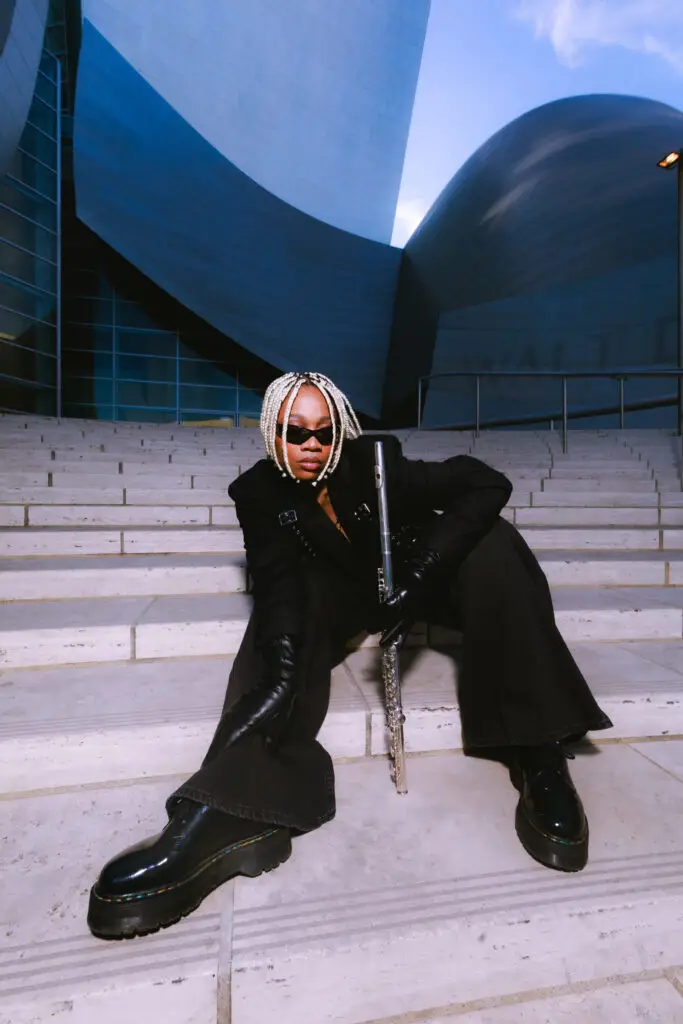
Music was another family tradition. A classically trained flautist, Charles has been playing since the second grade, learning to read and write music long before stepping into a recording studio. “That’s kind of my early entrance into all things songwriting,” she says. “I try to integrate it across all of my music, to help inform melodies.”
Her path, however, hasn’t been linear. After graduating from UC Merced, Charles moved into tech, taking roles at Twitter during its early IPO days and later at Google, TikTok, and Instagram. Along the way, she wrote a book, The Black Internet Effect, published by Penguin Random House.
“I actually haven’t been at any of my roles [less than] than three years—which is a long time in the tech world! It’s like dog years,” she says. In each of those roles, she was often the first woman, definitely the first Black woman, so she had to navigate spaces that required her to define herself in real time.
“I’ve been the person who has to come in and navigate ambiguity and create the job and figure out how to bring value to the business. I would never go to a place where I don’t think I can fit into what the business needs at that point in time,” Charles says. “It’s how I think about songs and songwriting or, you know, creative collaborations. Is there room for my voice or my perspective? How can I show up and bring value to the table?”
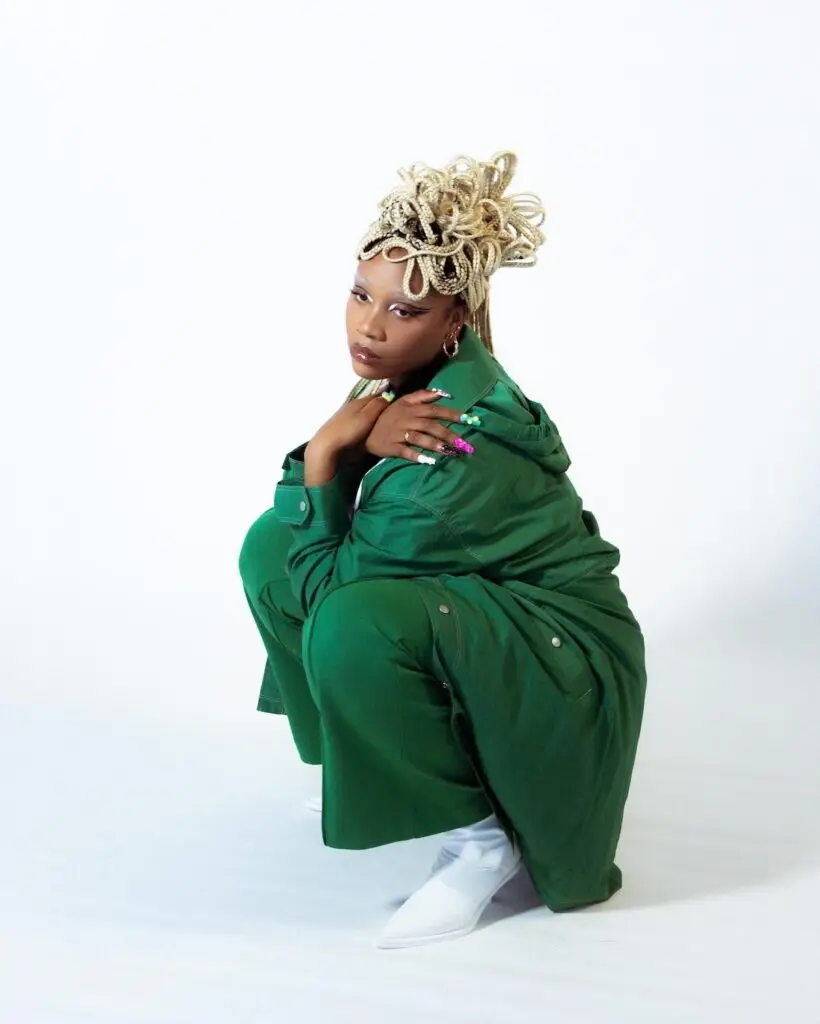
Those same questions are what Charles brought into the studio. She showed up prepared with sonic references (her flute always in tow), with ideas about tempo and instrumentation, and with a sense of how the track should evolve. The result is disciplined and expansive; provocative, even. Kind of like a soccer match.
“All I could think about was the World Cup,” says Charles. “What does a record for such a global sport sound like? How can we do something that puts women at the forefront of sports and something that’s […] well-rounded and shows just how much of a melting pot San Diego really is?”
For “SDFSHE,” Charles brought in local artists and women of color Santa Mykah, a rapper and the first woman to qualify for Red Bull Batalla USA; and singer/songwriters Ms. Connie and Isaura. Together they found a distinct rhythm and presence. The music video threads in real fans and footage from the pitch as well. I dare anyone to watch the video and not want to be part of the scene.
Sonically, the track is all energy with chant-like percussions, synth and reverb, hip-hop married with global club sounds. The lyrics shift between English and Spanish. It’s very San Diego and also very Rio de Janeiro, Barcelona, Buenos Aires. The track was executive produced by Matthew “Beazie Beats” Arellano alongside SHAVONE. and her Future of Creatives organization, a platform for creators without clear pathways forward. And people say you have to go to Los Angeles for talent.
“There’s a stigma with San Diego music that we do music for play or for fun […] and we’re a joke,” she says. “And that couldn’t be further from the truth.” That perception is shaped by a city whose creative output hasn’t always been met with the same level of investment as larger markets. “We can write hit songs,” she says. “We can compete with the best of them.”
Projects like this become evidence of what’s possible when local artists are given the resources and trust to define their own sound. A San Diego musician named Nebula came up with the title of Charles’s track. The pair didn’t know one another until Playmakers brought them into the same orbit and now, Charles tells me, the two will be collaborating. The possibilities are limitless when creatives are creating.
As for what Charles hopes the audience takes from the track? “I hope they see themselves represented in the art form in a way that can make them proud and that feels real […], whether or not they cross over to where that little kid in the barrio or little girl in Southeast San Diego sees me—or sees any of the other artists—and feels like, ‘That’s me. I’m seen.’ That’s the connective tissue to me.”
What does it mean to represent San Diego with her music? “It means everything to me,” she says. “It’s an opportunity to pull the curtain back and shed light on everybody; to show the promise and the potential of what we can do and who we can be—that we’re worth the investment.”
Charles has new music on the way, including original releases, an EP mixtape, and collaborations across San Diego and Los Angeles—work that continues to build on experimentation, live instrumentation, and local creative partnerships.
For Charles, her instinct to act, to show up, to build something before it’s fully formed is a reminder that sometimes the most important thing isn’t the plan (or the traffic) or even the destination. It’s knowing when to go all in and simply create.
[Disclosure: San Diego Magazine owners Claire and Troy Johnson sit on SDFC’s Playmakers board.]
