


Food & Drink
Aries Takes Over Sea & Sky in La Jolla This November
Read article

Featured articles

Food & Drink
Food News
Food & Drink
Featured articles

Things to Do

Everything SD

Everything SD
Featured articles
Things to Do
Things to Do

Things to Do
Featured articles
podcast-ep

podcast-ep

podcast-ep
Featured articles

Features

Features

Features
Featured articles
Partner content
Food & Drink
Partner content

From doggie bootcamps to intense bodybuilding programs, it's an exciting time to get in shape. What are you waiting for?
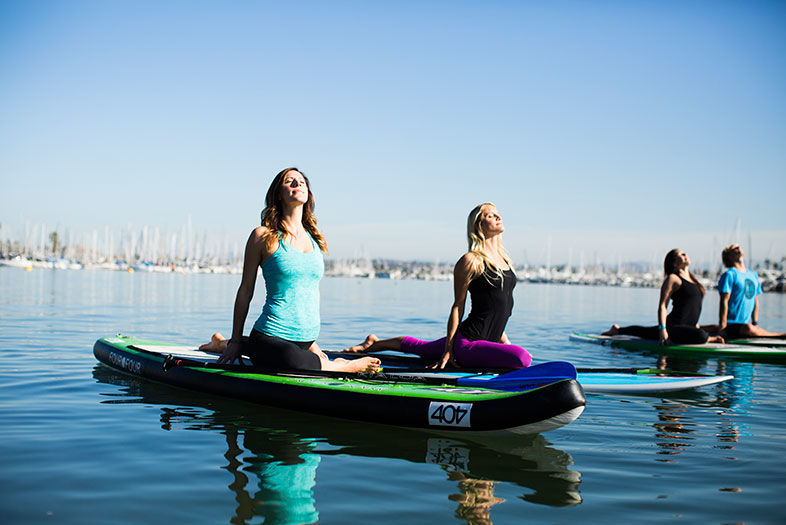
Paddle Into Fitness
760-803-6293
$25 for a single class
paddleintofitness.com
I’ve been practicing yoga for a few years and gravitate toward athletic styles like Vinyasa and Ashtanga, where the flow is continuous. I like leaving class feeling peaceful but strong. The idea of taking my practice to the water and trying SUP yoga had always been appealing. I thought the paddle workout combined with yoga would be like getting two workouts in one. Plus, even the nicest yoga studio can’t beat a bay view.
I met Gillian Gibree from Paddle Into Fitness on a Sunday morning at Kellogg Beach in Point Loma. For my first time trying SUP yoga, I was excited to have the water (almost) all to myself. I was also relieved—fewer boats in the bay meant calmer seas and a lower chance of my ending up in the water.
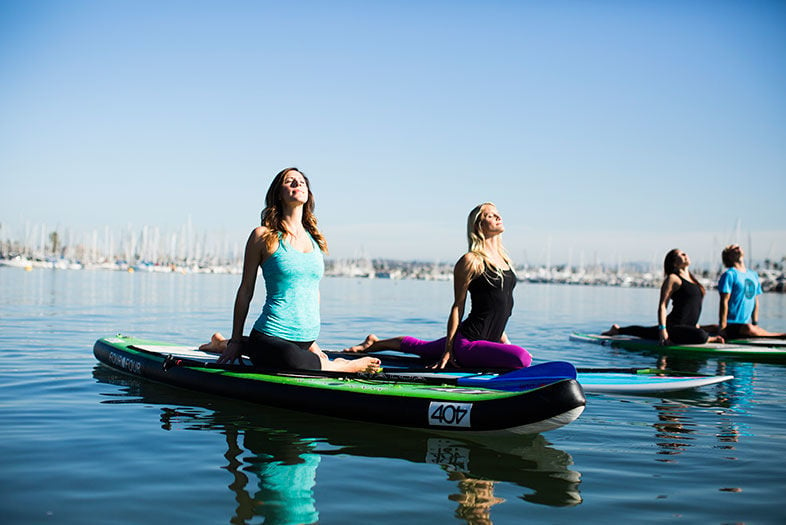
Gillian went over paddleboarding basics on the beach first, and then we paddled out. The paddling wasn’t strenuous and made for an ideal warmup. We stopped at a small cove away from boat traffic, in shallow water. My board was equipped with a small anchor that I was instructed to drop into the water to better stabilize my board during practice.
As we started class seated on the board with our eyes closed, the sun warmed my face. The sounds of the waves lapping and the seagulls overhead created a beautiful soundtrack. It was instantly calming.
We moved into standing sun salutations, then into the first downward dog. The most surprising part was how limited I was in movement. The tiniest step forward or backward would challenge my balance. I was keenly aware of where my feet were at all times, and my core was working overtime. Even familiar poses felt drastically different on the water. In most yoga classes, I am always thinking about getting into the next pose. For once, I was focused on keeping still.
I was surprised by the variety of poses that could be done on a paddleboard. Side plank, extended side angle, reverse warrior. I was more limited in my expression, but still felt the strength and stretch of each pose.
After 45 minutes, we came back to a seated position on the board, closed our eyes and brought our hands to our heart. I felt invigorated. I had been so focused on staying in the poses and out of the water, my mind really hadn’t wandered anywhere else. There was no clock to watch, no water to sip, no towel to wipe. I think I discovered the ultimate way to stay present.
Get Fit & Have Fun in San Diego
Jay Reilly
Beginner Taiko Drumming
Classes start at $15
sandiegotaiko.org, naruwantaiko.org
Like many parents, I too have those days where dealing with kids, work, school, and spouse just makes me want to hit something really hard and yell really loud.
Thankfully, I found a way to channel that: taiko, the art of Japanese drumming. I wanted to challenge myself, learn something new, tap into an inner desire to make music, and be a good role model for my daughters. I’m not a gym rat or a yoga mom, and exercise bores me.
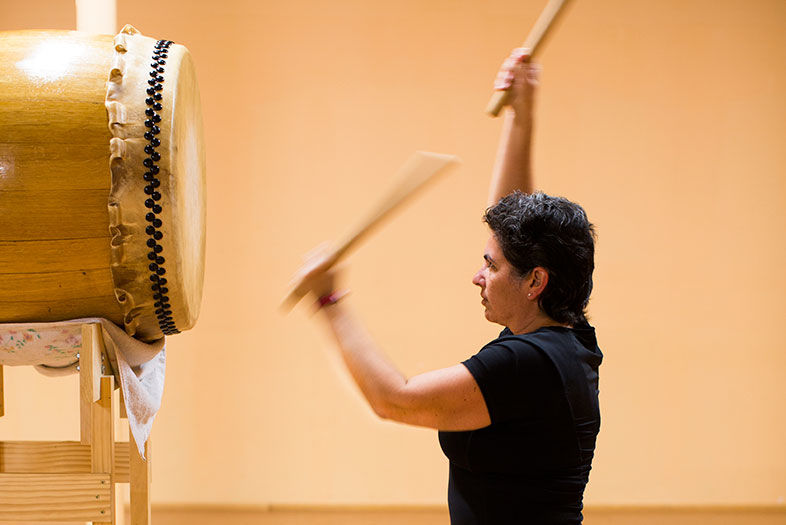
I wasn’t sure what to expect at the beginners’ class offered by San Diego Taiko, at the WorldBeat Cultural Center in Balboa Park. The first thing I saw was a row of huge traditional chu-daiko (medium-sized taiko drums) set up on the performance floor. It was exciting to imagine hitting the big drums and the sound it would make.
As we got started, I realized that taiko has a lot in common with Asian martial arts and karate. For example, the power and strength of your playing comes from the koshi (core), and your kata (form) is all-important, to strike the drum properly.
Taiko is about respect for the culture and its traditions, not just banging a drum. We learned musical patterns and made loud vocalizations (kiai) to motivate ourselves and the other students. It’s fun and distracting from the fitness required to play the daiko.
As for the fitness—every taiko class begins with stretching and warm-ups, from aerobics to push-ups and sit-ups to build core strength. Once you begin working on your form and strike, though, the pain really starts. Instructor Noel Garcia, who studied in Japan and has been performing taiko for 16 years, takes a traditional approach. I’m not in the best of shape, but I was relieved to see some of the more fit fellow beginners sweating and shaking as we held our form and practiced a proper strike.
Over at Naruwan Taiko, classes are held in North County. Instructor Diana Wu focuses on high energy and group drumming, with a level of enthusiasm that’s infectious. At Naruwan Taiko, we learned to strike with positive energy, and to listen to each other and feed off each other’s enthusiasm. Like Garcia, Wu also covers the cultural aspect of the art form, teaching the history of taiko in America and all the different styles of playing (I’m particularly interested in the giant o-daiko, that you play with your arms over your head, and yatai seated style, which is basically the craziest ab workout you’ll ever see).
Finally, we got to hit the drums. With the proper form, it’s like hitting the sweetest sweet spot in any sport you can imagine. For me, the sound was unbelievable—a deep BOOM that resonated through my arms and vibrated my insides. When you’re striking the daiko, you feel like you’re tapping into the energy of the earth itself, traveling up through your feet and energizing your entire body.
By the end of my first class, I was drenched in sweat and could barely lift my arms. With two classes a week, combined with practicing at home, I knew this would be a great way to get a workout (core, abs, legs, and especially upper body) and also learn about an exciting centuries-old art form. You get to push your musical and physical limits, and bang on big drums as hard as you possibly can. And every mom could use that once in a while.
Get Fit & Have Fun in San Diego
Culture Shock Dance Center
2110 Hancock Street,
Middletown
619-299-2110
$15 per class
cultureshock dancecenter.com
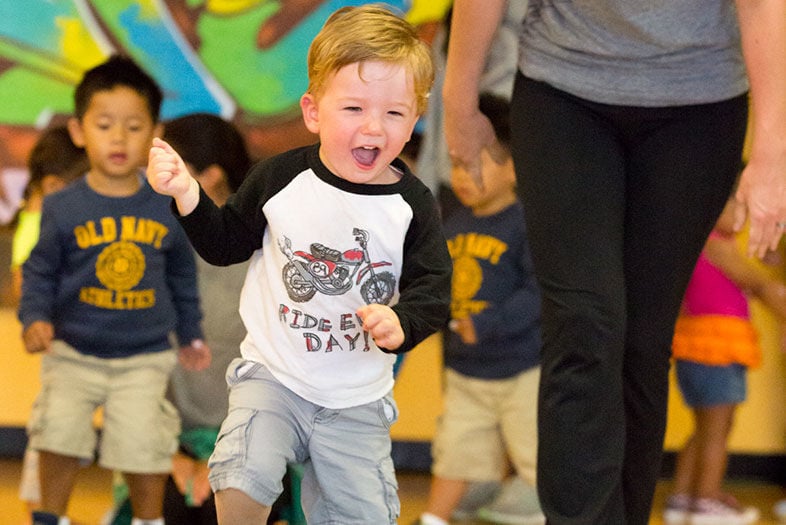
I’d say I was reluctant but open when I agreed to try the Shorty-N-Me toddler dance class with my almost-three-year-old, Jack. We watch as much Yo Gabba Gabba as the next family, but Jack isn’t the type to get up and dance with Foofa, Brobie, and DJ Lance. I’m not a great dancer, either, and have never been a gym-goer or fitness class-taker. We are more of a hiking, gardening, bike-riding, park-playing family. But after having two kids in three years, I needed to step up my game. As a busy working mom, being able to exercise while playing with my kid sounded great. And the 9:30 a.m. class on Saturdays is perfect for toddlers: on the week-end, after breakfast, before naps.
On our first attempt, the parking was hard (the center is in an industrial area), and Jack was already uneasy. He saw the teacher at the front, the kids in the line, and could tell he was going to be forced to do something. He tried to block me from opening the door, so we didn’t go in. I wanted it to be fun for him.
Then, on the last Saturday before this story went to print, we got to the class 10 minutes late and just busted in and started doing it. I’m sad to report that he didn’t like it. I think it was the music. It’s pretty loud. Like DJ music at a wedding. The instructor has to turn it off to give out the instructions. Jack also doesn’t hear a lot of hip hop in our house. We’re more Jimmy Buffet people. He immediately plugged his ears and climbed up my legs. I picked him up—all 35 pounds—and tried to slide and step and jump around. That lasted 10 minutes or so, and then it was just distracting to the class. Other kids wanted to be picked up, and I am not in good enough shape to do hip hop holding 35 pounds of kid. His shoes kept coming off. Squatting down while holding him to pick up his shoes was the real workout for me.
We both needed a time out. We stepped outside the class and sat in the hallway. I took his picture, still plugging his ears, and texted it to the editor and art director of this story. “Sorry.” We left and went to the park, where Jack ran wild for an hour.
But here’s the bright side: Every other kid in the class—all girls the day we were there—was loving it! Running and stepping and jumping with cute attitude. They wore tutus and sweat suits and bright sneakers. The instructor was patient, fun, go-with-the-flow. She even tried to move the speaker for us so it wasn’t so loud.
What did I learn, overall? First, I need to diversify the music my kids are exposed to. And second, our kids really are influenced by what we do, not what we tell them to do. I’m not a gym person, a class person, or a very organized person in general, and I see some of that in my kid. Which means we need to stay active in other ways, like walks, hikes, and running around outside.
I guess hip hop will have to wait ‘til his sixth grade dance.
Get Fit & Have Fun in San Diego
Jay Reilly
The Sporting Club
8930 University Center Lane, UTC area
858-522-8000
$25–$35 per session, for members
thesportingclub.com
I’m not an elite runner by any stretch, but I do challenge myself to break my personal records, or PRs, when I race. Running a race faster than I ever have before makes me feel like I’ve trained hard and accomplished a goal.
When I lined up at the Silver Strand Half Marathon in November, I was hoping to break my record of 1:48:47. But it was not to be. I’d caught a cold the week before, and as I passed mile 8 my legs felt weak and my pace began to slow. I pushed as hard as I could.
Shortly after that disappointing race, my editor asked me to try a new contraption. It’s called the Cyclic Variations in Adaptive Conditioning, or CVAC, pod.
“Advanced technology and science combine to deliver progressive low-pressure air changes that rhythmically squeeze and relax the whole body, including the organs and even blood, right down to a cellular level,” according to the website.
This “cellular massage” is supposed to help your lymphatic system reduce inflammation, which means your muscles are less tired and sore after hard workouts. It is also supposed to increase stamina and energy, and create deeper sleep.
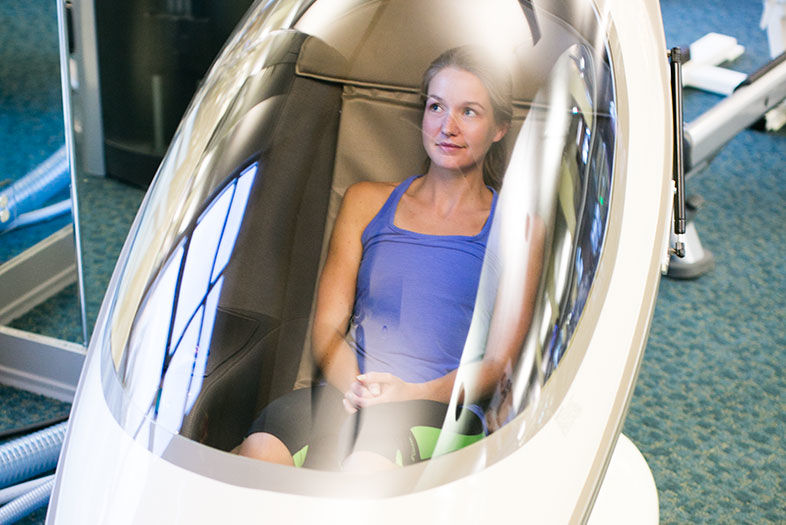
I met CVAC representative Ian Robb at The Sporting Club, and he showed me to the pod. As I climbed inside I tried not to think about the spaceship from Contact and its ability to teleport to an alternate universe. Robb promised I’d be perfectly safe—all I had to do was sit there and let the pod do its thing. “Some people even fall asleep,” he said.
The CVAC pod doesn’t move, but it does take you on a journey. Using changing amounts of air pressure, it simulates elevations from sea level to mountaintops, and quickly raises you and drops you between those extremes over and over during a five-minute session. I started on the most mild level. I felt like I was in an airplane taking off. My ears repeatedly clogged.
“It gets a little more exciting at the end,” Robb said to me via walkie-talkie—the sealed door and rushing air mean you can’t hear outside. My ears popped again and again, until finally I glided smoothly back to sea level. I definitely wasn’t falling asleep.
Most pod devotees do two to three 20-minute sessions a week, and Robb said I’d need at least 10 to notice a difference. But after two sessions, I ran 14 miles with four miles at race pace and nailed it. Maybe it was the pod, or maybe its fancy science was tricking me into thinking I was stronger.
After a few more sessions and a lot more miles run, I lined up at the Holiday Half. I felt strong during the entire race and broke my personal record by more than five minutes, with a time of 1:43:25. I can’t say whether it was the CVAC or all the training I did, or because the race had a lot of downhills. I do know that during the race I ran from 700 feet to sea level without my ears popping once.
Get Fit & Have Fun in San Diego
Jay Reilly
Leash Your Fitness
Locations available throughout the county
619-822-3296
$20 for a single class
leashyourfitness.com
I spent much of 2014 “off the wagon” of regular exercise, with the occasional heart-pumping burst during a quick jog around the block with my dogs. But those two rascals, Toby and Tilly—particularly Tilly, a beagle-dachshund mix with a lot of destructive puppy energy to burn—need more exercise than that. So it only makes sense the class that finally got me off the couch was “Bonding with Bootcamp,” a comprehensive cardio, strength training, dog-obedience, and agility class all in one. Offered by Leash Your Fitness, the hour-long session seemed like just what I needed to jump-start my workout routine and provide some extra exercise for my restless pooch.
Tilly and I took a Sunday morning class at Markim Pet Resort in Carmel Valley. Class rules say one dog per participant, so Toby had to stay home, but it was for the best: It’s hard enough to hold the leash of one dog while focusing on the proper form for lunges. Two dogs would have been a disaster.
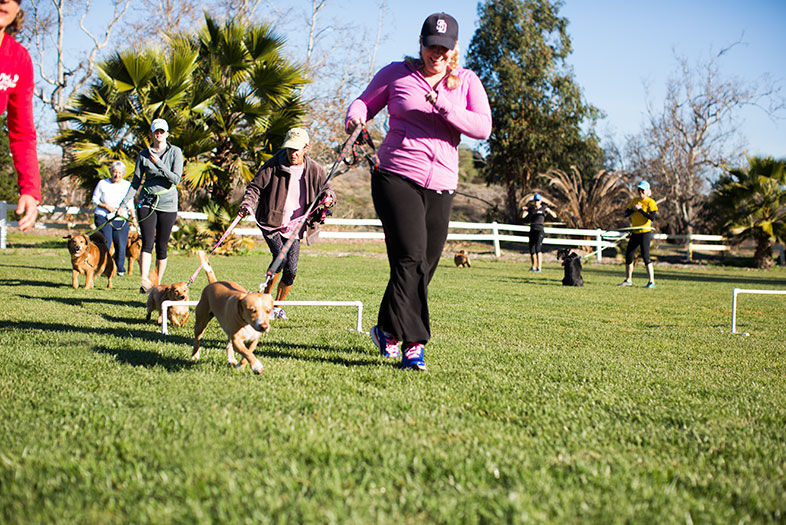
I’ve taken many a bootcamp class in my day and, workout-wise, this one was similar, with intervals of running, lunges, squats, ab work, resistance band work, and even some weighted hula-hooping. What made the class different—and so much more fun—was that Tilly was right alongside me the whole time, jogging, sitting and staying on command (well, we may have to work on the staying part), and enjoying the energy of 15 other dogs and their owners. The best part, for both my two-year-old pup and her proud owner, was the obstacle course that included the dog-only A-frame climb and a series of high and low hurdles for both of us. I’ve never taught Tilly a “jump” or “over” cue, but she was a natural, her short legs leaping through the air with ease. She was smiling and wagging her tail the entire time.
If the class sounds like it was more for Tilly than it was for me, make no mistake: I was tired, sore, and extremely well-exercised at the end of 60 minutes. But I also barely even noticed an hour had gone by. My dog provided a joyful distraction and even though there were times I didn’t want to run that second lap, Tilly was having so much fun I didn’t want to let her down.
A happy, tired dog is just one benefit of the Leash Your Fitness bootcamp, but there are plenty more: One woman in the class has lost 30 pounds. Another no longer has to take medication for high blood pressure. And all the participants enjoy the guilt-free feeling of not leaving their dogs at home alone while they enjoy the great outdoors. It was enough to make me want to go back—and maybe take Toby along for the fun next time.
Get Fit & Have Fun in San Diego
Luis :Garcia Luis Garcia
Feldenkrais
Rancho La Puerta
800-443-7565
$300 for four hours of classes (Saturdays); $3,250 for one week
rancholapuerta.com
I’m out at Rancho La Puerta, a 3,000-acre spa-hotel that’s more than twice the size of Balboa Park, just south of the Mexico border on the outskirts of Tecate, where boulders, cows, and vineyards abound. I’m a mere 40 miles from central San Diego. But like most of the other people here—be it for a week, half-week, or just the day—I feel worlds away.
Simplifying the international commute comes as part of the package; staff members meet guests on the U.S. side of the border, walk into Mexico together, and chauffeur them back to the property, a five-minute car ride down the road.
Among the roster of some 75 classes offered daily is a crash course on the Feldenkrais Method, a somatic educational system developed by Israeli doctor Moshé Feldenkrais in the 1970s that’s described as an “internal journey to rediscover balance, flexibility, and coordination.”
I’m a fairly active 30-something who exercises as regularly as possible. Weights and cardio, mostly, with the occasional yoga or swim session. I’ve never heard of Feldenkrais, but my stiff, 30-something neck, lower back, and hamstrings—ever-reminiscent of our more agile days—are already signing me up.
Our instructor is Donna, a lanky woman with an aikido background who’s been practicing Feldenkrais for 19 years. She says it’s ultimately given her the ability to engage more fully in the world, and enhanced her creativity in how she habitually moves her body.
That’s pretty deep. Nevertheless, my neck, back, and hamstrings are now buckled up and ready for blastoff.
Taking shoes off in the middle of the room, I notice I’m the youngest of my nine classmates, who range from their 40s to 80s. And I’m the only man. But Donna assures me the beauty of Feldenkrais is that the same class can benefit anyone and everyone, be it a paraplegic or an Olympic medalist.
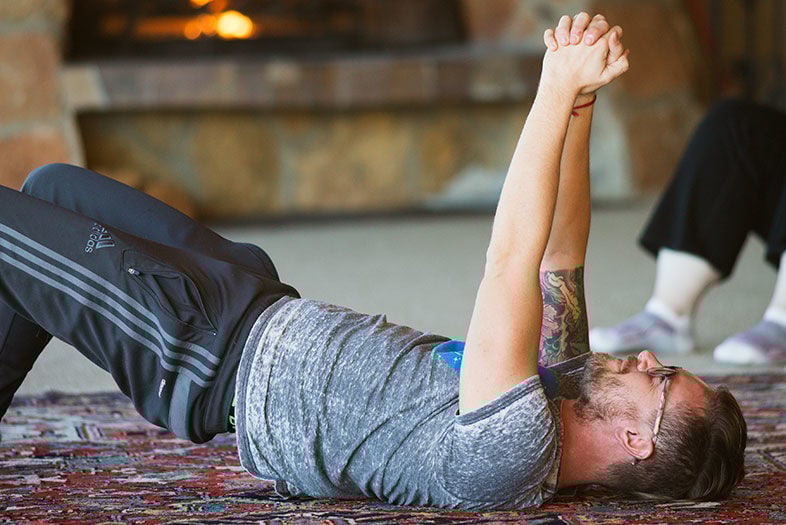
The session lasts an hour, enough time to take us through 10 basic movements. We observe how our bones connect with the floor, and notice how much effort it takes to lift our pelvises with our feet and knees together. We rest. Then we do the same, now with our feet and knees apart. Then we rest again, comparing how we feel while lying still before and after each move. We clasp our hands and point to the ceiling, drawing circles and lines in the air and noticing the movement of our shoulder blades. Then we clasp our hands again, but now with the opposite index finger on top, and do the same. Then we rest and observe again.
After an hour on the floor praying to the rafters and resting, I feel relaxed, sure. Almost as if I were sinking into the floor. But I haven’t broken a sweat. I haven’t exerted myself whatsoever. I actually feel as though I’ve done very little, and that’s exactly the idea, Donna says: to strain the body less by making each movement as efficient as possible. And, also, lots and lots of rests.
“Take a rest before you need a rest,” she says. “That way you never need a rest.”
And that’s when I realize I’ve been a Feldenkraiser all my life.
Get Fit & Have Fun in San Diego
Jacqueline Campbell for Birds of a Feather
Prenatal Massage
Equilibrio Massage
3320 Third Avenue, Hillcrest
619-955-6670
equilibriomassage.com
A Thai masseuse once told me that massage is like yoga for lazy people. And like a religious zealot, I have clung to this idea ever since. Whenever I didn’t feel like downward dogging, I headed to Massage Envy. So I am no stranger to the many benefits massage can bring, including increased circulation and decreased stress.
But all of that changed when I became pregnant. I’ve developed common ailments like leg cramps, restless leg syndrome, lower back pain, and insomnia.
I tried one prenatal massage at a fancy resort, where the answer to my big belly was a foam pillow with cutouts for my stomach and breasts. Well-endowed women, beware! I think those pillows are made for smaller chests.
I have also found that, aside from the random person who rubs my belly, people are generally afraid to touch pregnant women. Rare is the soul willing to risk a lawsuit or worse by putting any kind of pressure on a woman with child.
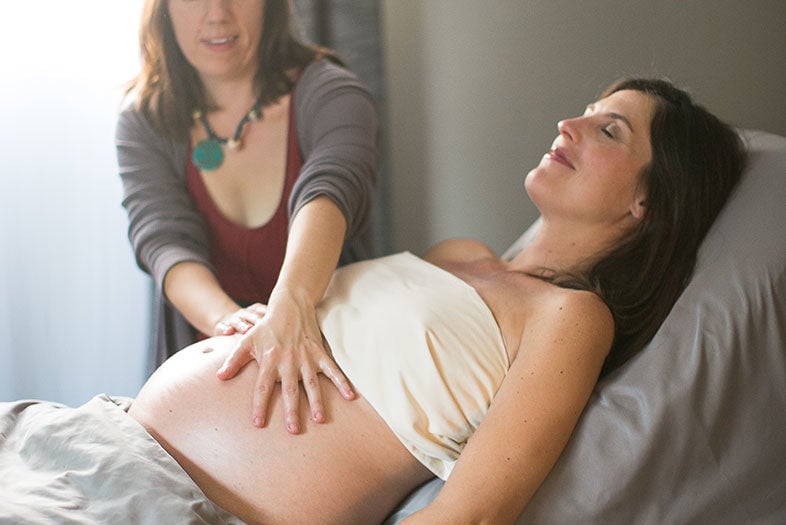
Then my boss referred me to Equilibrio Massage in Hillcrest. Owner Nicole Trombley and her staff are experts in the needs of pregnant women. Most are doulas and make house calls for massage. Some will even come to the hospital to provide a rubdown during labor.
Nicole is not a fan of those foam cutout pillows, citing concerns like increased uterine pressure and nasal congestion, common in pregnancy, especially when lying facedown. She has me lie on my side and builds a mountain of pillows around me. I counted seven in total—under my head, side, stomach, knees, calves, feet, and elsewhere. I instantly feel like I might fall asleep.
She also tells me in a calm whisper that she prefers deep pressure, if I’m okay with that. I am. And as I drift in and out of sleep, she proceeds to work out the kinks. At some point, we switch sides. We finish on the back in a semi-reclined position, where she rubs my scalp, neck, and shoulders.
That night, while watching TV, I notice my restless leg syndrome is nonexistent. As are the leg cramps that sometimes wake me up at 1 a.m. I’m also so blissed out that I don’t bite my fiancé’s head off when he wants to watch football while I am in the middle of The Bachelor.
Before bed, I try to recreate Nicole’s mountain of massage pillows. The next morning I have an email from Equilibrio: “Did you like our massage pillows?” It directs me to a free download link. Turns out, Nicole has written a book, titled Sleeping While Pregnant Guide.
I went back to Equilibrio two more times—each as pleasant as the first visit, prompting similar results (75-minute sessions start at $105; discount packages available). If you have the means, it is a lovely gift to give yourself or someone you love who’s expecting. Here’s to a happy pregnancy, with restful nights and TV remote sharing without the threat of divorce!
Get Fit & Have Fun in San Diego
I’m on a tight budget. I’m saving for my wedding this summer, trying my best to stay zen and not turn into a Bridezilla. Yoga has always helped me find an open heart, clear mind, and stretched body. I decided to look for free or donation-based yoga classes. In San Diego, I found there’s at least one happening every day of the week.
The first place I discovered is the Bergamot Spa in Encinitas. It is packed with Buddha heads and bamboo, succulents, and plumeria. The instructor turns on a portable plastic fireplace to heat the yoga room. Jimi Hendrix plays on low, and we start on our backs in Shavasana. By the time the two-hour class is over, I am so sore I can barely walk to my car.
The next day, I opt for Laughter Yoga. I meet the class in Balboa Park, south of the playground at Spruce Street and Sixth Avenue. We stand in a circle and warm up by laughing. I have never felt so awkward. By the end of the class, though, I’m laughing naturally with them. “Laughter gives us a different way to react to the things life throws at us,” says Michael Coleman, founder of the nonprofit Laughter Matters. I leave the class feeling like nothing could awaken the Bridezilla inside me.
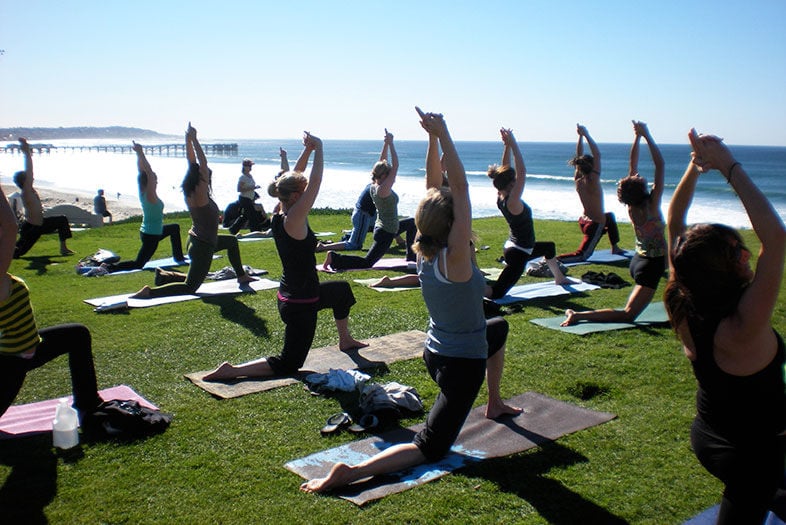
On day three I drag my mat to the beach for yoga with Namasteve, a local P.B. celebrity. The grass where he teaches every weekend at the end of Law Street is packed with more than 100 yogis.
On the fourth day of my yogic journey, I am craving some furry companionship. On Facebook, I find Sara, who teaches Puppy Yoga behind the Ocean Villa Inn, for some gentle Hatha yoga. The class takes place in O.B.’s dog park. On this day, it’s just the instructor’s Chihuahua. The yoga is not too challenging, and I leave with a tan.
On day five, I visit a class taught by Lauren, who is part of One Love Yoga, an online community that lists free and donation-based classes throughout the city. Inside the Swedenborgian Church in University Heights, we practice Vinyasa with Ashtanga inspiration in the downstairs hall. No organ here—the instructor has chosen a mellow playlist. Still, I feel as if I’ve had a kind of spiritual experience.
On the second-to-last day, I head to Lorna Jane in La Jolla for a free booty yoga class, which works the abs and core. The clothing store has its own private studio, with free classes offered every day. Luckily, there is no pressure to shop, nor mention of merchandise.
On the final day, I drive to Yoga One on Seventh Avenue, downtown. The place has a natural om vibe. The room is dark, with candles and smells of cinnamon and honey. The free weekly Candlelight Flow class is soothing and relaxing for my body and mind. As I leave my final class, I take a deep inhale and think about this journey. Great things in life can be found at little to no cost at all. Namaste.
Get Fit & Have Fun in San Diego
Jay Reilly
San Diego Athletics
5026 Cass Street, Pacific Beach
10 sessions for $230; memberships start at $149 per month
pbcrossfit.com
When my CrossFit gym, San Diego Athletics in P.B., began offering a bodybuilding program, my first reaction was “Oh, heck no.”
For four years I’d attended CrossFit classes four to five times a week. I learned about Olympic weightlifting, gymnastics, full-body functional movements, and the concept of intensity. I’d switched my focus from what my body looks like to what it can do. However, my progress had slowed down in the last year. I was battling chronic tendinosis in my knee, and I was looking to try something new.
But bodybuilding? Really?
If you’re a woman who’s been told most of her life that smaller is better, the idea of intentionally building up your body is slightly terrifying. There’s a reason the phrase “strong is the new skinny” became so popular. It’s the word “skinny.” While I don’t subscribe to celebrity trainer Tracy Anderson’s belief that women shouldn’t lift more than three pounds, I also don’t post aspirational photos of Arnold Schwarzenegger on Instagram. I want to be strong and cute.
Gym co-owner Bryan Boorstein wrote a convincing blog post about how a base of strength is important, and how building muscles spikes the metabolism, even when you’re not exercising. One line in particular hit home: “Your body is desperately hoping you stop breaking it down. It’s time to get strong.”
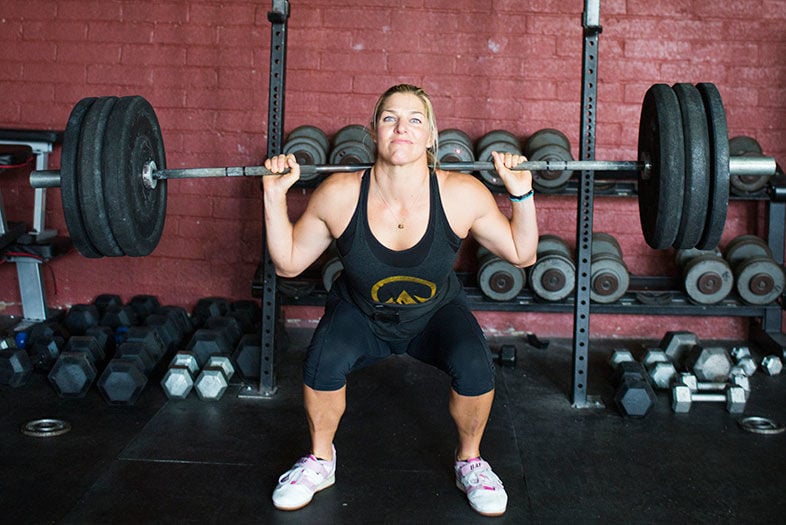
So, I committed to eight weeks of bodybuilding, exclusively. In the first few weeks, I was often the only woman in the class. Some of the exercises were familiar to me—like back squats, bench presses, pull-ups, and ring dips—but I was clueless about anything that involved a dumbbell.
The movements may be old-school, but the atmosphere in a San Diego Athletics bodybuilding class is completely novel. Instead of everyone following their own program and fighting over weights, the class works together, sharing benches and dumbbells. The music is loud—sometimes it’s Pearl Jam, sometimes it’s 2 Chainz, sometimes (sadly, for me) it’s country. The trainers lead everyone through the movements, offering guidance on form and technique and how much weight to use. Once a week we leave the gym and do hill sprints, followed by ab exercises.
The first week was rough. I felt like an addict, obsessing about what I was missing in the CrossFit workouts. What if I got too muscular? Or what if I got fat?
In the second week I started to figure out how to push myself and what weights to use for the seemingly endless variety of exercises.
After a few weeks I started seeing some interesting results.
My knee pain disappeared. Completely. Then, one day, I did three sets of eight strict pull-ups, something I had never managed to do in four years of CrossFit. And even though my weight stayed the same and I didn’t change my diet, I noticed more definition in my abs. For a 41-year-old mother of two, this was kind of a big deal.
As the weeks went on, more women showed up to class. I can now do dumbbell flies and hammer curls like a champ. And I’m happy to report, there is still no Schwarzenegger photo in my Instagram feed.
Photography by Jay Reilly, Jacqueline Campbell & Luis Garcia
Get Fit & Have Fun in San Diego
Jay Reilly
