Featured articles
Food & Drink
Food & Drink
Things to Do
Featured articles
Everything SD
Things to Do
Everything SD
Featured articles
Things to Do
Things to Do
Things to Do
Featured articles
podcast-ep
video
podcast-ep
Featured articles
Everything SD
Everything SD
Everything SD
Featured articles
Food & Drink
Partner content
Food & Drink
Ready to know more about San Diego?
SubscribeReady to know more about San Diego?
The Oceanside eatery is a working model for what restaurants can be—memorable food and all
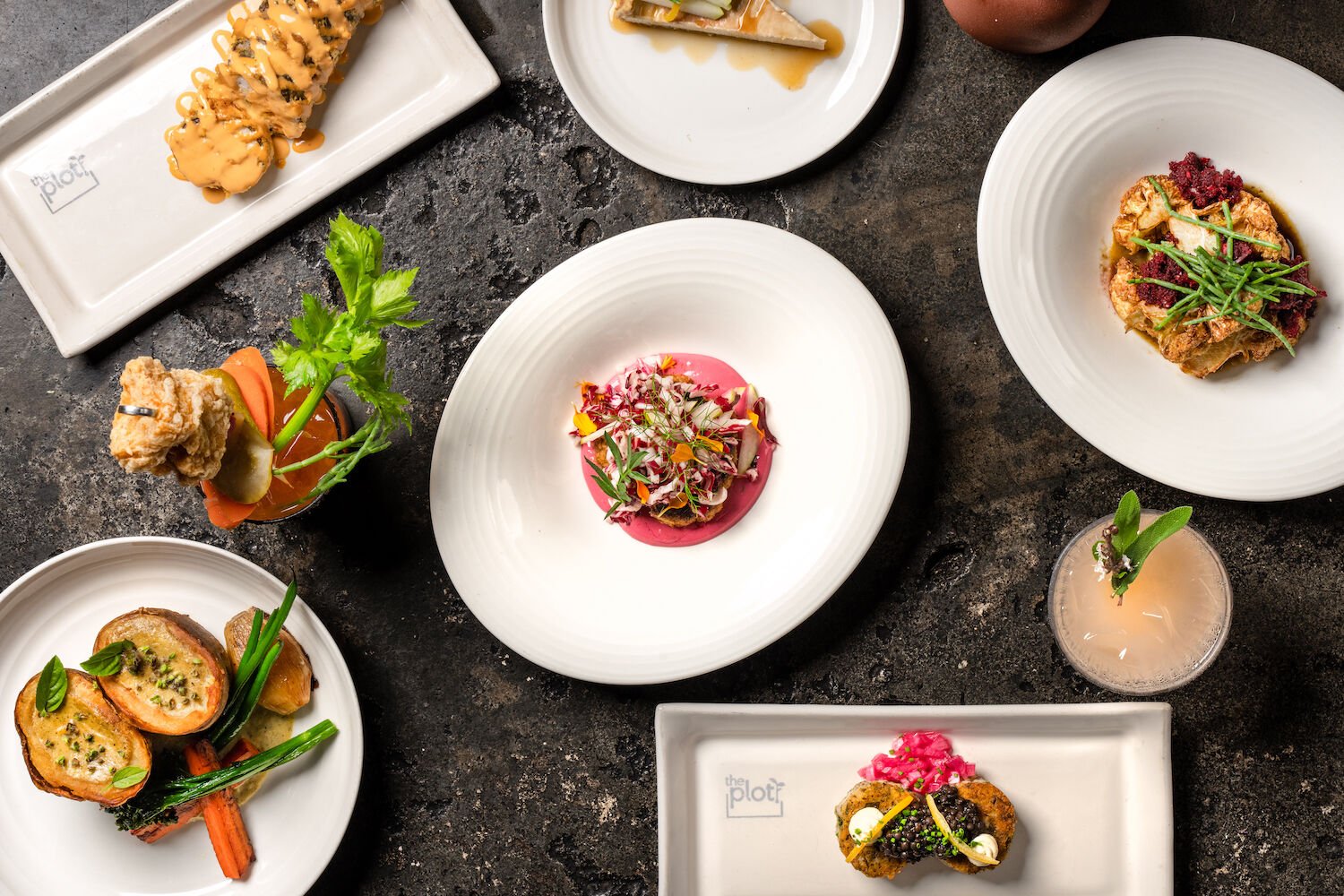
Most dishes at The Plot have some element (kimchi, sauce) made of perfectly good food (rinds, stems) that most restaurants discard.
Photo Credit: James Tran
The Plot is a restaurant, sure. But sitting here staring at the on-site garden, reading menu items like “lentil caviar” and “kale stem marrow,” and listening to servers describe dishes with the words “pulp” and “spent” and “regenerative”—it feels more like a working model for the future of food.
Chef Davin Waite and his wife/partner Jessica Waite launched The Plot in January 2020 (yikes, timing). Their goal: to go beyond sustainability and become a regenerative business, not just minimizing impact, but actively rebuilding the loam and air and sky and environment. There’s still much work to do (convincing vendors to reduce packaging, a more robust municipal composting system, etc.). So for now, they’re sourcing ingredients from mostly regenerative local farms (regenerative farms forego fertilizers and pesticides in lieu of tactics like biodiversity and compositing, doing everything they can to build super-soil through natural processes, and sequestering carbon into the soil rather than in our atmosphere), and subsidizing with plants from their on-site garden.
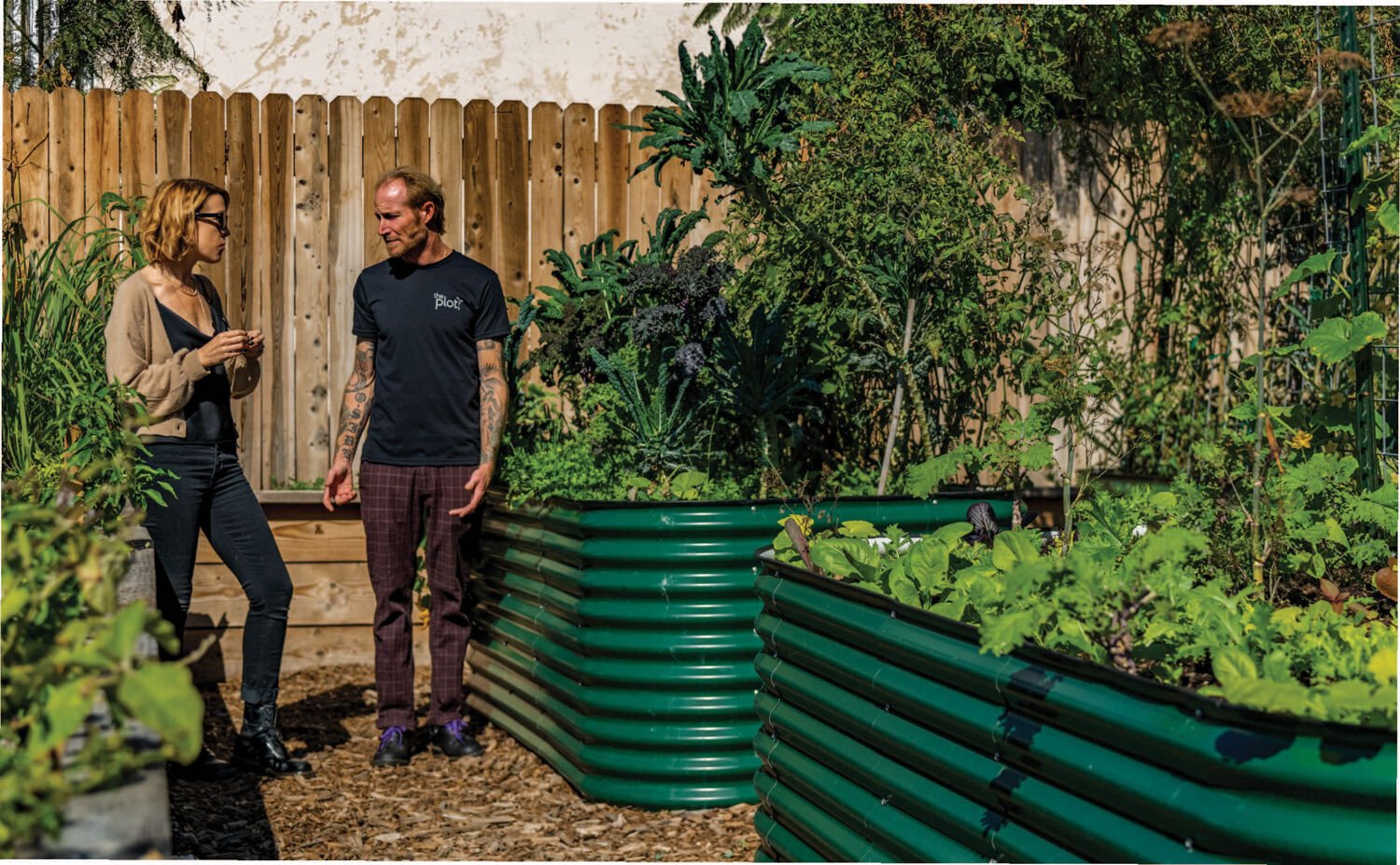
Jessica and Davin Waite at their small vegetable garden behind the restaurant.
Photo Credit: James Tran
The list of The Plot’s Earth-first practices is astounding and requires a biblical scroll, but Jessica Waite says they divert 100 percent of waste from landfills. Nothing ends up in the trash, and much less than one percent of food product they bring in-house is discarded (industry standard is four to 10 percent). Other measures include: making all meat substitutes in house (avoiding monocrops); leftover rice is sent to local refinery, Kismet, which turns it into rice syrup for salad dressings; tofu whey becomes caramel; pulp from stock is dried into powder for their mac & chorizö; mushroom scraps are dried and smoked to create the desirable “funk” of their house-made cheese; beet scraps become ketchup; to-go boxes are compostable.
Plant-based food is gaining steam for a few pretty simple reasons, including: health (overeating steak is more harmful than overeating squash), because Billie Eilish did it, and because the ecological future of our planet has never been so dicey and eating plants is the most sustainable way to eat (plants require less resources than animals). Plant-based eating has always been a noble idea. Its problem was that it was largely a flavorless jumble of almost-food that treated your mouth the same way 1980s college freshman treated a can of Coors Light, shotgunning the joy out of your pleasure center. Those days are over. Now plant-based food is good to excellent.

The Plot is part of the scene in South Oceanside, a thriving, largely local part of town.
Photo Credit: James Tran
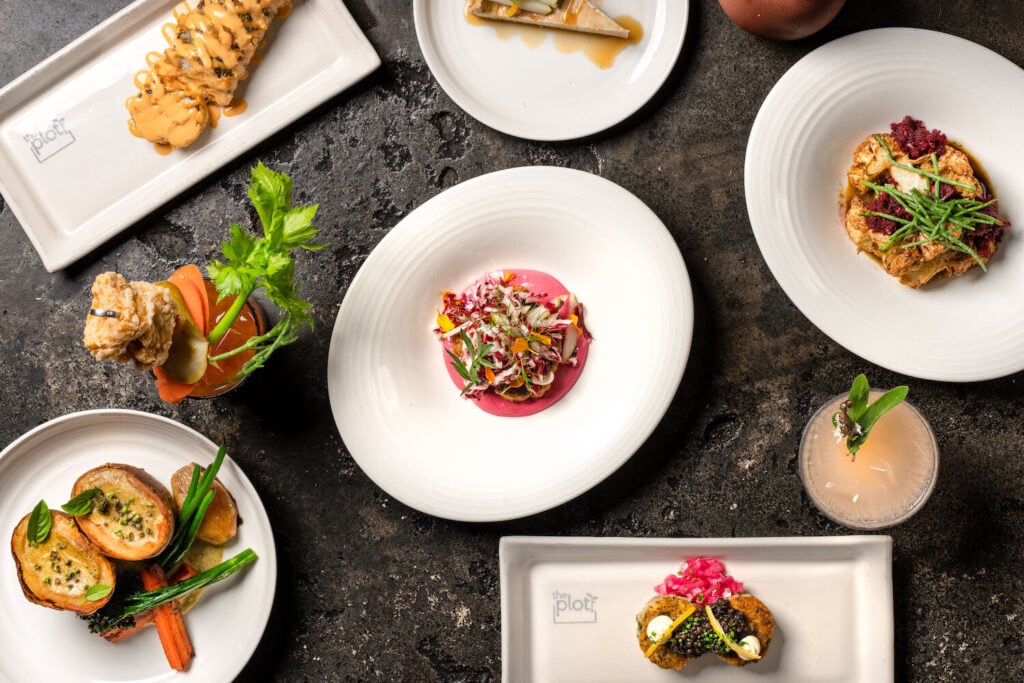
And there is some excellence at The Plot. Their ceviche replaces raw fish with chayote squash that has been pickled in citrus, with a touch of seaweed added for the sushi mimicking. It’s tart, crunchy, almost an aguachile. A very simple kale salad is excellent due to the dressing, an almost effervescently delicious mix of the rice syrup and orange peels. Cäviar and potato cake is beluga lentil caviar flavored with konbu, but the star is that cashew creme fraiche with pickled onions and preserved lemon. They do sushi rolls, and the one to order is the Chronic—spicy tüna made of chickpeas, cräb of lion’s mane, avocado, and a tofu-based aioli affectionately called “yum yum sauce.” It’s saucy, like starter sushi, but good.
In the running for the best thing I eat is the cräb cake, made with lion’s mane mushrooms from local company, Mindful Mushrooms—the stringy texture mimicking crabmeat, seasoned with Old Bay, kumbu, and seawater with a Catalina dressing made from brine left over from their beet pastrami. But tops is the roasted cauliflower, made with a faux fish sauce (konbu, mushroom powder, salt, chiles, garlic, ginger, lime, and sweetness). Phenomenal.
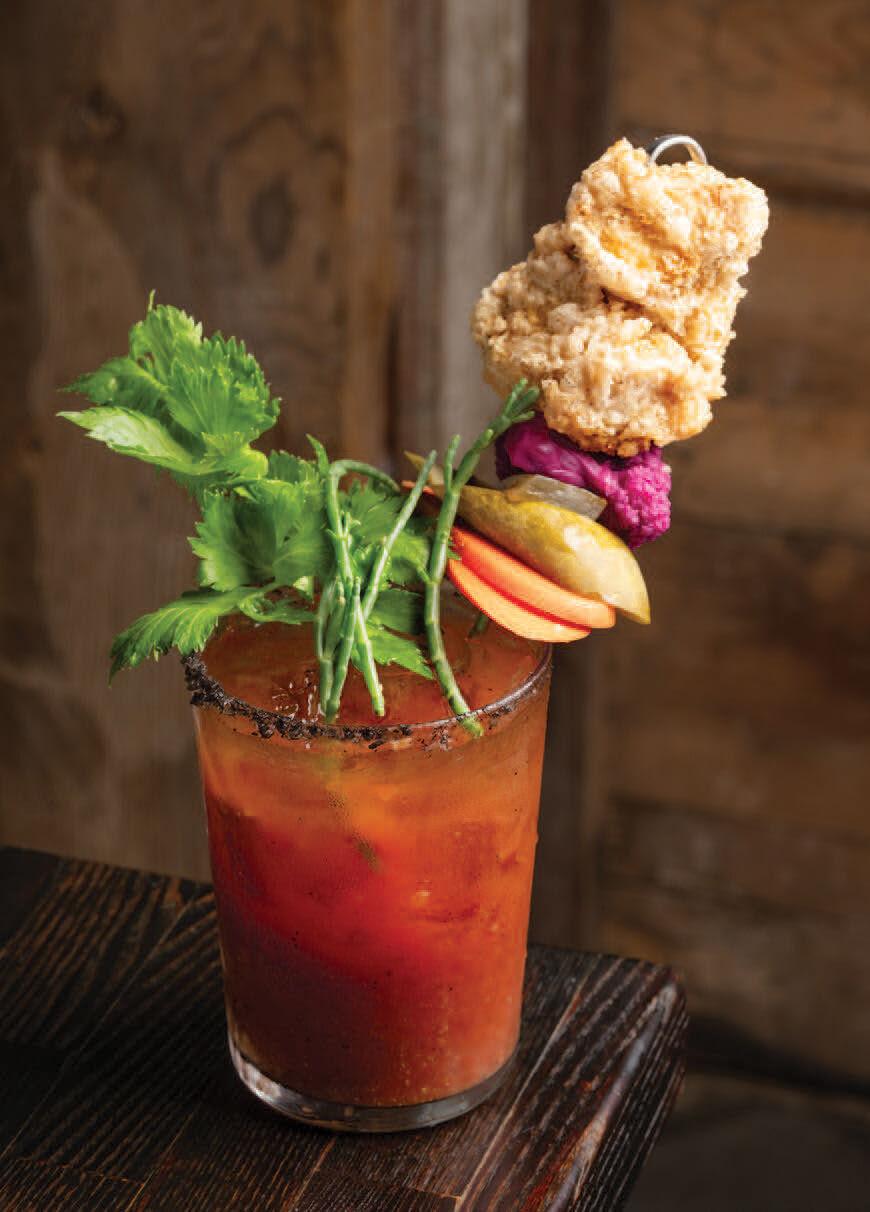
The “GardenParty” brunch bloody with chickën nugget garnish.
Photo Credit: James Tran
The Plot goes awry in some dishes that lather the sauce (plant-based cooking often does, to make up for the lack of fat in plants as compared to, say, a ribeye), lean too sweet, or haven’t counter-balanced the mushy texture that is a challenge in plant-based cooking (anyone who ate early veggie burgers know the anti-texture I speak of). A shepherd’s pie filling is made with lentils and wild rice, but the “stew” portion is too deep, too rich, and the demiglace just adds to it, bullying any flavor nuance from the individual ingredients. The interior of the takoyaki hush puppies are a bit too creamy, almost the same texture as the accompanying yum yum sauce. And the Okinawan sweet potato gnocchi with the sweetness of a carrot puree is too sweet.
Chefs and restaurants used to be stewards of local environments, so close to the food they serve (oftentimes grown out back) that they were ambassadors for ecology. Through technology and science and freezer advancements, we got away from that. The Plot is one of many restaurants bringing us back. And there are enough hits here that, even if you ignore the halo they’ve earned, you can just have a very good meal.
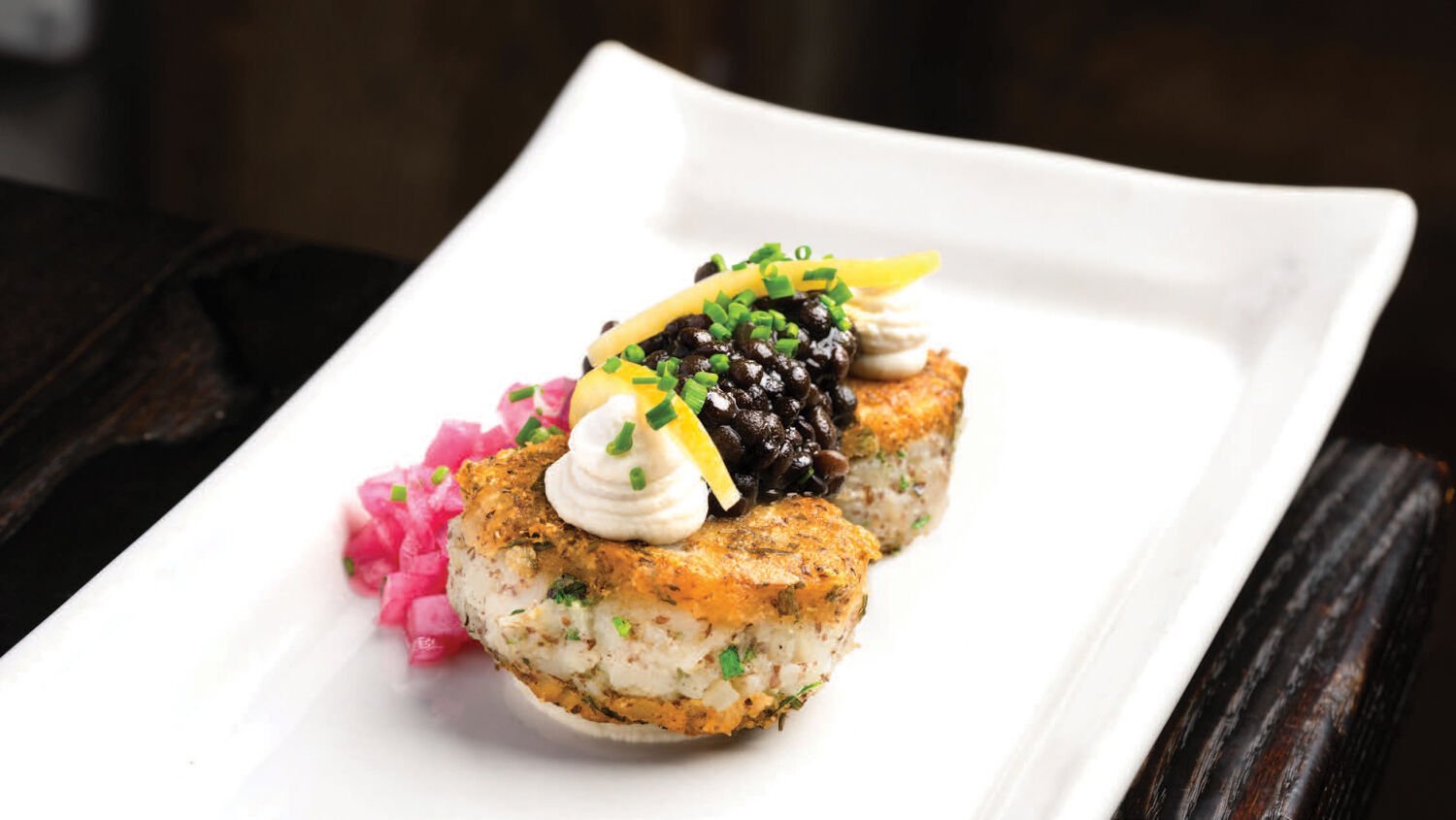
Cäviar and potato cakes with beluga lentils and cashew creme fraiche.
Photo Credit: James Tran
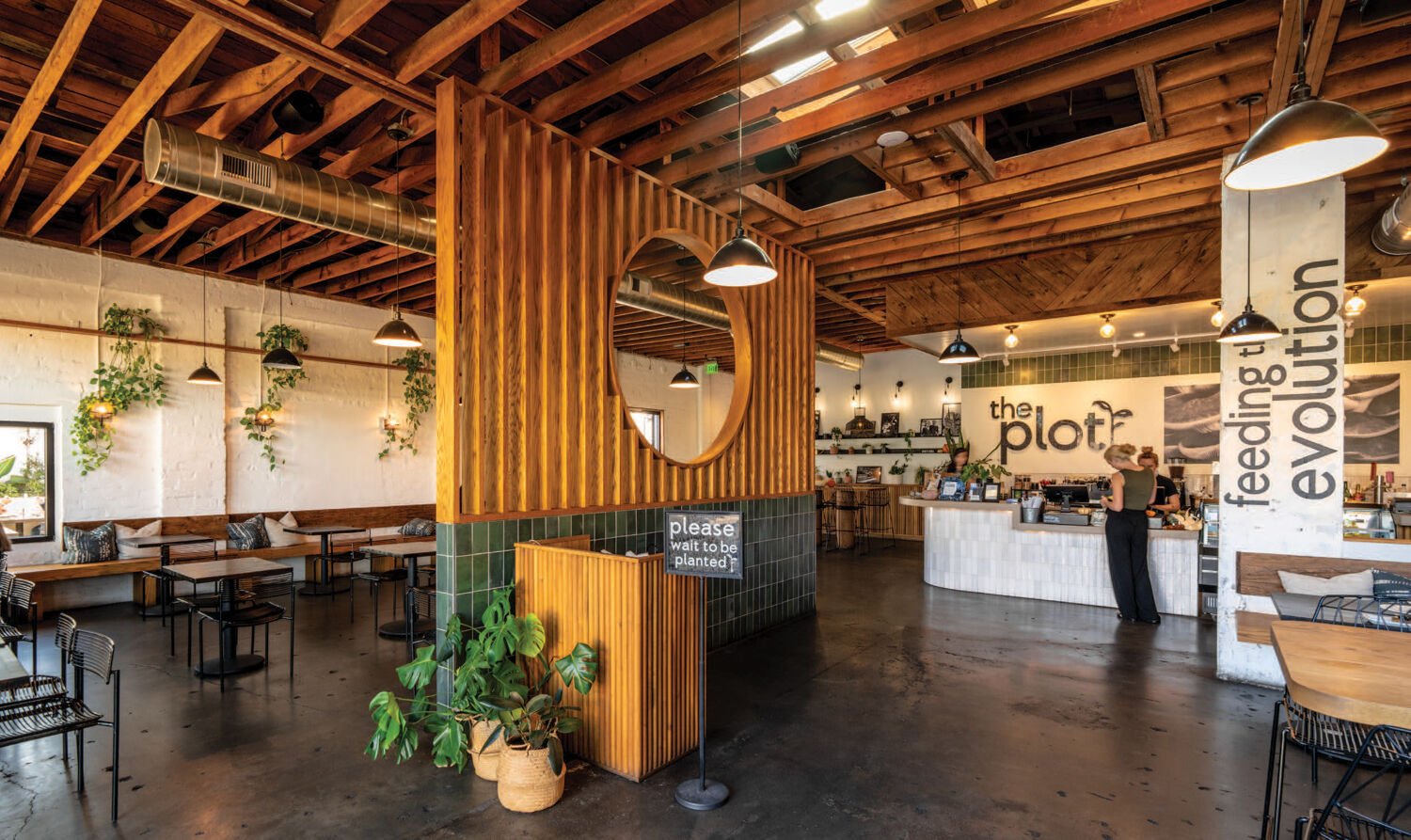
Staff enjoys a brief moment of solace before opening for dinner rush
Photo Credit: James Tran
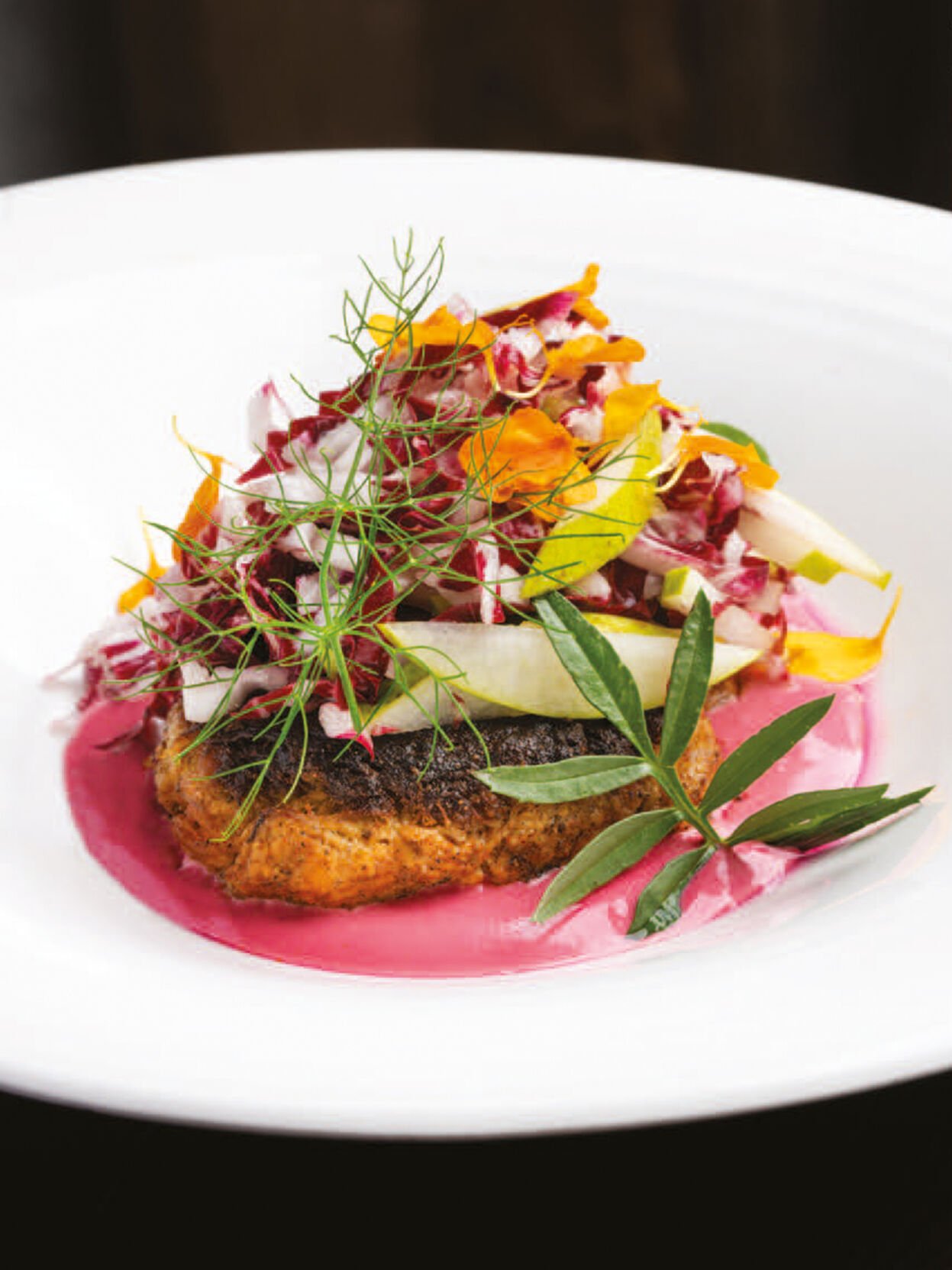
A cräb cake made with lion’s mane mushrooms in a Catalina dressing made of leftover brine from their beet pastrami.
Photo Credit: James Tran
Editor’s Note: This review was featured in our December 2022 issue. Since publication, the chef at The Plot has moved on.

Troy Johnson is the magazine’s award-winning food writer and humorist, and a long-standing expert on Food Network. His work has been featured on NatGeo, Travel Channel, NPR, and in Food Matters, a textbook of the best American food writing.
SDM readers asked food critic Troy Johnson to kick tires on a classic, which is how he found himself surrounded by birds at Mitch’s Seafood
The bird has a plan. You stand between that bird and that plan. For the remainder of your ceviche, you’ll identify as collateral damage.
There are many other nearby birds with the same plan, absolutely sucking at trying to be nonchalant about it. The pigeons are by far the boldest on account of what we can all agree just by looking at them is sheer stupidity. They come right up and ask with their red murder clown eyes: “Can bite?”
Pelicans are the silverback gorillas of this bird gang, hulking and alpha. They periodically flaunt the acreage of their wingspan in the same way a schoolyard bully puffs out his chest. One could casually land on your plate and maintain constant eye contact as it slowly enjoyed your fish taco. You share this tacit awareness with it. But it doesn’t approach because there are always a couple off-duty fishermen eating at Mitch’s Seafood. Those salty dogs have been forced to beat the shit out of a pelican or two in their day, and they and the pelican also know that.
The snowy egrets pretend to not really want your food. They seductively lord on the tops of the sportfishing boats moored in front of the restaurant, fully aware of how hot they are—svelte fashion models, Ozempic with wings. They just turn their faces to the wind so that it blows their fabulous hair. They seem to expect tourists to be overcome by their avian Brad Pittness and just throw swordfish sandwiches to them in tribute. They refuse to demean themselves like the gulls do.

The gulls are shameless menaces. The linebackers of seabirds—a lot quicker than you expect given their big butts, full of schemes and microaggressions. They stand at a distance and mad-dog everyone, intimidate with their beaks the color of old bananas. Fear is not a seagull emotion. When they take a plate—and they will take a plate—there is so much flapping and fighting. They desperately bite and claw at fishermen’s stews like zombies who finally caught up to Rick Grimes. We see one that’s missing a foot.
At some point you will hear a baby cry. It’s not a baby. It’s a gull, who has learned to mimic the sound of human babies in distress so that parents feel the great evolutionary ache—and throw fries at the crying.
“Watch out for the crab cakes,” says a server to every person she drops them to. “Those are their favorite.”
The birds have opinions on the menu. And their presence at Mitch’s is better than any Yelp review. Think they’d risk life and limb for some recently unboxed frostbite tilapia down at the local skate rink? Yeah, probably so.

But these birds know the backstory of three longtime local fishing families who own Mitch’s: Brian Kiyohara and his wife, Viola; Randy Toussaint and his wife, Tracy; and namesake Mitch Conniff. Conniff cut his teeth as a young sous chef at Jsix (a long-gone restaurant that was, 20 years ago, a slow-food star under chef Christian Graves). Then he was executive chef of American Angler, the long-range Baja fishing vessel co-owned by Kiyohara.
It was on the Angler that Mitch reportedly looked at the restaurant that was previously in this location—on stilts over the water at Point Loma Sportfishing Dock—and said to Kiyohara, “Wouldn’t it be cool if a restaurant in that space used local fish from local boats and local people like us?”
And that’s how Mitch’s was born. Its doors opened in 2008.
The real story of Mitch’s is the wheelbarrows. Every morning, the crew rolls them along Driscoll’s Wharf down to Tunaville—the market also owned by local fishing families (including Conniff). The shop has a parking spot for local boats, who bring their daily haul there every morning. Mitch’s crew fills the wheelbarrows with fresh fish and wheels them back to the kitchen. Within hours or a day or so, some of it will be lunch, dinner, and bird crack.

There are no reservations at Mitch’s. More often than not, there’s a long line snaking out the door. It moves fast. Their tiny kitchen is remarkably efficient. Locals know to go for breakfast (get the crab avocado toast) or in the off-hours (11 a.m., 3 p.m.—just not noon and 6 p.m.). There’s a small-ish indoor dining room, tables that appear more lacquer than wood. It’s a shrine to local fishers, the wall’s a family photo album of tan locals beaming with pride over a record catch, pleasantly fatigued boat captains, sun-gnarled deckhands. Leave your partner in the line, and go peruse, get a sense for the humans out there in local waters, leaving their families for days and weeks and months at a time to provide. It’s a core San Diego way of life that built this city (tuna money poured the concrete at Point Loma High), once robust and now rare.
The prized seats are on the deck. Thirty or so metal bar stools are ponied up to a small counter attached to the wooden rail. Bendy metal rods cascade from the roof like eyelashes. “They were put in to deter the birds,” a server tells me. “It worked for about a week.”
The swordfish sandwich is just about perfect and a mission statement of the place—humble and simple, like fishing. A big-ole torta, a grilled filet not cooked to sawdust like American restaurants once did, with tomato, tartar sauce, and cilantro. It shouldn’t taste as good as it does, but clean local fish cooked well on bread is satisfying in an essential, basal way. Plus, that tartar sauce blows lesser tartars away. Conniff swaps out the pickle and onion for garlic, fresh parsley, and cilantro, so that it tastes closer to an herbed Baja crema. It should be criminalized and governed by people who make laws to atone for the lack of our own self-regulation.

The bowl of mussels and clams are the can’t-miss of Mitch’s—somewhere between French moules marinières, New England steamers, and Baja shellfish pots. The science: As shellfish steam, they release their own briny liquor, meaty ocean broth in a shell. The chef’s job is to complement that gift without clobbering it. Mitch’s uses white wine for acid and leeks (a milder, sweeter, more flavorful onion), Dijon, and butter. Their clams and mussels are bigger than normal, which brings stronger flavor, making that broth one of the best in the city, sopped with the baguette.
From the cold case, get the shrimp aguachile with housemade chips—a small bowl, green as radiator fluid, the chili water a light-pain blend of habaneros (the best tasting chili by a long shot), serranos, lime, and the soft, fat glove of avocado. They also serve a campechana—a Baja mariscos specialty with shrimp, Dungeness crab, octopus, and oysters in cocktail sauce and clamato. Important note here: Don’t eat either of these dishes right away. They come out fridge-cold (there are laws about storing raw seafood), which muzzles the flavor. Order them to sit. After 20 minutes, dig in.
The crab cakes get mixed reviews, but ours are delicious. They lean cake more than crab, which isn’t what you’d expect from a fisherman-chef’s stilt house, but that’s personal preference.

You’re going to order the fresh fish plate, blackened, because you’re good at ordering. It’s the truest expression of fisherman and fish. And what you’ll receive is a shockingly spartan plate—a paprika-crusted filet, a ramekin of slaw, some herb pistou. It is excellent, even if the universal governing body of wooden-spooned grandmas would suggest it needs a rice, a tater, a proper side dish.
My argument is that the slaw is side dishing. Coleslaw is, by and large, the great American fail. Most restaurants treat it like the younger sibling their parents made them bring along on a date. At Mitch’s, they treat slaw with respect. Starts with traditional cabbage, but then gets both fresh orange and lime juice, jicama, grilled corn, and cilantro. It’s Baja meets San Diego picnic food.
If, as dictated by the most basic laws of food criticism, I needed to find quibbles with Mitch’s, fine. I’ll be that guy who walks into a runaway hit dream of three local fishing families and pretends everything isn’t entirely perfect. I’ll express them in wishes.
I wish the baguette with the clams and mussels was lightly charred. The broth is nearly sweet, and sweet loves a good burn.

I wish there was an obscene amount of slaw with the fish plate. It’s that good, and the plate looks a bit bare.
I wish there was one housemade sauce in the condiment basket. You’ve got Heinz, Tabasco, Tapatío—all of which are fine and should stay. While I realize the kitchen is limited and the line of customers is eternal, Mitch’s would go up an even higher notch if there were squeeze bottles of one killer original dressing—housemade crema, a mojo, macha, or just an unending supply of that garlicky tartar. It feels a tad crimey to go through all this effort to source local fish and cook them well, and then top it with a sauce that has no San Diego or Baja or Mitch in it.
I honestly didn’t expect Mitch’s to be as good as it still is. Everything we ate (except maybe an octopus taco with tentacle bits fried into nubs) was good to excellent. The constant onslaught of locals and tourists and the excruciating intricacies of operating a business in California should have exhausted the will to live by now, let alone cook.
There’s a reason the birds are still outside, with crimes in their eyes and menu preferences.
Troy Johnson is the magazine’s award-winning food writer and humorist, and a long-standing expert on Food Network. His work has been featured on NatGeo, Travel Channel, NPR, and in Food Matters, a textbook of the best American food writing.
The Mexican restaurant continues the Barrio Logan tradition of art in unexpected places
I’m sitting in a slab of concrete under a freeway, eating a ceviche black as eyeliner.
There might be seven seats in this restaurant. Or maybe it’s 12 minus five. That area under the stairs might also be a couple seats, or it might just be a very inviting storage area with a flower vase. The restaurant is so small your core instinct is to count seats and tabulate if Alchemy – Choose Thy Poison is a real place with a sane business plan or if it’s a social art project designed to question the reality of restaurants and business plans.
There’s a large, floor-to-human-height window near our table. Through it, I notice someone didn’t make their bed this morning. It’s a decision I deeply empathize with. It’s moments like this that make you acutely aware that Alchemy is also technically the courtyard of a six-room micro-hotel called Narcissus. Not the kind of massagey boutique hotel you’re thinking of with soft woods, obscene amounts of linen, and opinions on bonsai therapy. It’s a near-Brutalist cube of base industrial materials—concrete and acrylics bent and molded into a series of alcoves, with pods to sleep in. Sculptures lie behind glass like Tilda Swinton circa 2013.
The window to the unmade bed forcibly crams light voyeurism into the dining experience. The hotel and Alchemy feel like the parts of Mexico I love the most. Although Mexico has its multimillion-dollar restaurants, a vast majority of the best street-level places feel like you’re temporarily recreating in a very lovely construction project.
Alchemy’s location is what most people comment on (“I can’t believe a place like this exists on a block like this.”)—jammed at the bottom of the freeway embankment on the northeast side of Barrio Logan. But that makes it distinctly Barrio, the historic cradle of San Diego’s Hispanic and Chicano culture. The I-5 freeway was built through Barrio in 1963—a fairly traumatic gashing of the neighborhood—and residents responded by painting epic murals on the ugly concrete belly of eminent domain. Where some would’ve just accepted the industrial blight, locals saw shade for a park. There is a deep history here of turning concrete into art, and Alchemy carries that on.

The vision for the property came from owner Benjamin Longwell, whose company—The Society of Master Craftsmen—sounds like it wears a monocle. Longwell is part of the new guard of developers who focus on urban infill. Instead of adding to the city sprawl, they find unused or underutilized parcels of land in established neighborhoods, then build creative mixed-use spaces that, in perfect scenarios, add something of value for locals.
I’m not making a case for architectural sainthood, but there isn’t a huge list of developers who would look at the line of cars exiting the freeway in front of Alchemy and think, “We must build here.” So in that sense, Narcissus and Alchemy feel additive to the community, not extractive.

I stare back at Alchemy’s ceviche negro, a glossy mound of halibut that looks inspired by the La Brea Tar Pits or melted vinyl records. Chef-owner and Mexico City–native Eddy Cortes saves all the trimmings of his dishes (garlic and onion skins, vegetable shavings), then chars them into an ash to create a recado negro—a Yucatán specialty that usually involves toasted chiles, achiote paste, vinegar, and a ton of warm spices. He tosses local halibut with squid ink, tamari, charred pineapple, and citrus. The usual charm of ceviche is that it’s light, bright, full of color. Not here.
It is fantastic—acidic but with a whole world of toasted, warm flavors, like ceviche that’s seen some things.
The menu from Cortes—a home cook his whole life, only having taken it professional a few years ago with his popular pop-up, Barracruda—is really a tour of specialties from various states in Mexico.

A crema de poblano has the blended ghost of rajas at its core: an emulsion of roasted poblanos with butter-sautéed onions and garlic, plus a touch of milk that’s topped with queso fresco, chile ancho, and morita oil. Morita—a smoky Mexican condiment made from dried and smoked red jalapeños for a less intense, fruitier cousin of chipotle—is the key here. It specializes in spiking fats (guacamole, fried eggs, burritos). Sop up the crema with house-baked garlic-rosemary sourdough, blackened from the ash of a corn husk.
Smoked tuna is a Baja gift that’s become an anchor for most San Diego taco shops, and Alchemy combines mesquite-smoked yellowtail with caramelized onions, sweet peppers, and Chihuahua cheese (the OG quesadilla filling), then stuffs it in a perfectly baked masa empanada. The result is somewhere between a TJ Oyster Bar taco, a calzone, and a tamale—but with extra flavor and more black hue from cuttlefish ink.
Alchemy’s huaraches de res is Cortes’ ode to where he’s from. Huaraches are the New Haven–style pizza of Mexican food—thick, oblong masa flatbread layered with refried beans and a payload inspired by the Mexico City markets the chef grew up roaming with his dad: braised beef (braseado), avocado salsa, pickled vegetables, salsa macha, and jocoque (Mexico’s fermented dairy product, like a cross between crema and labneh).
Alchemy’s seared tuna crudo gets a tad abused by the riot of big flavors: charred hibiscus salsa, avocado salsa, pickled grapes, pomegranate salsa macha, and chipotle aioli. It’s a fate that also tempers the joy of the zarandeado, with the adobo marinade on the shrimp fighting a bit with recado negro and chipotle crema. Sticking with curmudgeonly food critic notes, flies are a part of the Alchemy experience, at least during our visit. They’re fairly hard to evict from the outside world, but more measures could be taken to discourage their participation.

The oxtail tetelas—like a Mexican pupusa—are a diary note from Cortes’ travels to Tlaquepaque, where they famously superboost their salsa with a touch of instant coffee. First, Cortes braises the oxtail with beer and Mexican spices. Then he blends that braising liquid into a salsa with beef tallow, guajillo, charred onions, tomatoes, and black garlic. Keeping with the goth food theme, the oxtail goes into masa negra infused with squid ink.
Desserts are where you realize just how deeply Alchemy is committed to the art bit. Rarely do you see a neighborhood bistro trying to pull off trompe l’œil—the French specialty of making pastries and other desserts look like fruit or other everyday objects. (The phrase means “to deceive the eye” and is the historical precedent for the Is It Cake? phenomenon.) Pastry chef Catherinne Avila does, though. A “Naranja” comes out in the form of a mandarin, but inside is orange blossom mousse, apricot jelly, and sablée (a delicate, crumbly shortcrust). A “Philosopher’s Stone” comes in the form of a brick of gold with a serpent on top; inside are mango mousse, mango-Tajín jelly, and a coconut dacquoise.
As Barrio Logan enters an apprehensive phase—its creative culture and restaurant scene growing rapidly, bringing economic promise face-to-face with the need to protect the Chicano way of life—this concrete tuckaway from a Mexico City kid feels like a good step. The Barrio has a long history of making art in unexpected places, and Alchemy carries that a little further.
Photos Credit: Dee Sandoval


Troy Johnson is the magazine’s award-winning food writer and humorist, and a long-standing expert on Food Network. His work has been featured on NatGeo, Travel Channel, NPR, and in Food Matters, a textbook of the best American food writing.
Award-winning brewer and North County native Mike Aubuchon’s long-awaited brewery set to open this April
Mike and AJ Aubuchon share one very important trait: Patience. The Aubuchons are the husband-and-wife team behind Koakai Brewing Company, a brewery that’s been in the works for roughly two years. Like many other food and drink businesses, they’ve faced delay after delay after delay. Lesser people would have given up—or at least seemed a lot more annoyed about it. I wouldn’t blame them one bit.
But the excitement in AJ’s voice is palpable. It’s like the night before Christmas for the duo, whose patience is about to pay off. Koakai is finally slated to open in Oceanside in mid- to late-April next to the Aubuchons’ other business, Kyoto Japanese Market.

A North County native, Mike started his beer career in the bottle shop at Pizza Port Carlsbad before becoming a cellarman, then assistant brewer at the chain’s Ocean Beach shop. When the Carlsbad brewhouse needed a head brewer, he went back to his hometown and started racking up hardware at competitions like The Great American Beer Festival, where he won bronze in 2015, silver in 2017, and gold in 2020. He stayed for a little over 10 years before helping launch brewing operations at Heritage BBQ & Beer Co., now Hill Street Brewing.
Originally from Kyoto, Japan, AJ worked in restaurants from her teens until she moved to Oceanside to attend MiraCosta College. She also worked alongside Mike at Pizza Port, bartending, learning about craft beer, and making connections with other people in the industry—relationships they plan to bring into their operations through collaborative brews.
“Koakai” has a double meaning: “warrior for the sea” in Hawaiian and “a little red” in Japanese. “My maiden name in Japanese is Kaiho and that means ‘saving the ocean,’” AJ explains, adding that when she first met Mike, a lifelong ocean lover, he was working as a professional surfboard shaper. “Also, my husband has a lot of Irish in his heritage, so our kids—we have four children—they all have a kind of reddish tint in their hair… so it kind of means heritage and family.”

Koakai’s inaugural lineup will feature a flagship Japanese lager, German schwarzbier, West Coast IPA, hoppy pilsner, Mexican lager, XPA, and a few collaborations like a West Coast IPA with RahrBSG, a craft malt supplier, and yet another IPA made with specialty hops, this one a collab with Cannonball Creek Brewing Company from Colorado. They’ll likely add more drinks later, such as a house seltzer, and dry Irish stouts on nitro, and even feature some imported Japanese sake.
Patrons will be able to pick up food—items like onigiri, Japanese-style sandwiches, bento boxes, and sushi—from Kyoto Japanese Market next door. The brewery’s kitchen will offer fresh sushi as well as its signature blend of Japanese, Hawaiian, and Central Texas-style barbecue, similar to what the market currently serves on weekends (think sticky ribs, charcoal-grilled steaks, and yakitori-style chicken). Some of the dishes are based on AJ’s childhood favorites, like hambagu, a Japanese hamburger steak.
“It’s almost like a hamburger patty, but it’s more like meatloaf,” she explains. “It has a lot of different ingredients, caramelized onions, ginger, garlic, bread crumbs, and eggs.”
A lot—and I mean a lot—has changed in the craft beer world since the Aubuchons entered the scene, and they know it’s not an easy landscape for them right now. But they’ve both been around the beer block a time or two. They’re ready. “It’s our time to show people what we’ve learned and what we can do,” says AJ.
Koakai Brewing Company opens at 559 Greenbrier Drive, Suite B, in Oceanside in mid- to late April 2026.

Listen Now: The Latest in San Diego’s Food and Drink Scene
Have breaking news, exciting scoops, or great stories about new San Diego restaurants or the city’s food scene? Send your pitches to [email protected].
Beth Demmon is an award-winning writer and podcaster whose work regularly appears in national outlets and San Diego Magazine. Her first book, The Beer Lover's Guide to Cider, is now available. Find out more on bethdemmon.com.
This month, the 2026 San Diego Business Impact Awards recognized local businesses making an impact in clean energy, biotech, hospitality, and beyond
Renewable energy companies building hundreds of power plants. Biotech startups using artificial intelligence to create personalized medicine for children with rare diseases. Hospitality companies quietly powering thousands of local events. Consumer brands growing from beach-town startups into national businesses. These are the kinds of companies driving San Diego’s economy today, and the businesses recognized at this year’s San Diego Business Impact Awards offer a snapshot of where the region is headed.
Hosted July 23 by San Diego Regional Economic Development Corporation (EDC) and JPMorganChase, the second annual awards event honored four local companies for innovation, growth, and economic impact. More than 100 nominations from San Diego’s middle-market businesses were reviewed by a 10-person judging committee, with winners selected across four categories: startup, early-stage innovator, rising star, and established heavyweight.
Two-time honoree Jimbo Someck, founder of Jimbo’s organic grocery stores, also joined the event for a fireside chat on buying local, supporting emerging brands, and giving back to the community.
“San Diego’s strength comes from its makers and builders—the resilient people who endure great risks and overcome obstacles to build and scale a company,” says Aaron Ryan, San Diego Region Manager and Middle Market Banking at JPMorganChase & Co. “These awards aren’t just recognition; they spotlight the talent, grit, and innovation shaping our region’s future. By celebrating those who create and build, we foster connections and fuel the growth that keeps San Diego thriving.”

Heavyweight honoree SOLV Energy has grown alongside the country’s rapid investment in renewable power. “It’s an exciting time for SOLV Energy as we are experiencing significant growth,” says CEO George Hershman. “The business has doubled over the last year and has almost double-digit growth since its inception.”
The Rancho Bernardo-based company designs, builds, operates, and maintains utility-scale solar and energy storage facilities. Since its founding in 2008, SOLV Energy has built more than 500 power plants.
Growth has translated directly into hiring. About 200 employees work from the company’s local headquarters, including roughly 20 interns. “Our intern program is a big part of the way that we grow our workforce,” Hershman says. “Last year, 43 percent of our interns became full-time employees. We believe San Diego is a great community to build and grow a high-tech infrastructure and technology company because of the incredible workforce—the ability to attract top talent and draw from world-class universities.”

Startup honoree La Jolla Labs is tackling one of medicine’s biggest challenges by developing personalized RNA therapeutics for patients with rare diseases—many of them children with neurological disorders like ALS. Using proprietary artificial intelligence and machine learning tools, the biotech company develops treatments tailored to each patient’s specific genetic mutation.
CEO Tamar Grossman says the recognition reflects how far the company has come despite limited resources. “We’re honored to be recognized for our ability to change and save patients’ lives and turn our lean startup into a clinical company with very minimal resources,” she says.
Grossman credits San Diego’s concentration of research institutions—including UC San Diego, the Salk Institute, and Scripps Research—with creating a pipeline of talent and collaboration. “San Diego is one of the world-leading centers for technology, genomics, and RNA therapeutics,” she says. “We have over 30 RNA therapeutics companies here, and we support each other and help with anything related to drug discovery.”
She says that collaborative spirit extends beyond formal partnerships. “You can walk around Torrey Pines, go into a café, and find colleagues from the industry and have an ad hoc conversation,” Grossman says. “That’s something very unique to San Diego.”

While Snake Oil Venue Company may not be a household name, chances are many San Diegans have attended one of its events. The early-stage innovator honoree has expanded from beverage catering and mixology consulting into venue management, operating Julep Venue in Mission Hills, Bramble Bay Venue in Imperial Beach, Vesper Venue, the Chapel at Liberty Station, and five outdoor venues throughout Liberty Station—more than 500,000 square feet of event space altogether.
“We do a lot of launch parties for corporations and new products,” says CEO Mike Esposito. “I really like working on the entrepreneur side of things, where new businesses are entering the San Diego market and looking to make a splash.”
Snake Oil has executed more than 16,000 events, employed more than 1,000 people, and partnered with more than 900 local vendors, including caterers, florists, photographers, entertainers, and other hospitality businesses. The company also works with many of San Diego’s nonprofits, museums, and cultural institutions. “We get to celebrate people’s most important moments,” Esposito says. “Whether that’s a wedding, celebration of life, or quinceañera, we’re fortunate to be involved in the community in so many different ways.”

Rising star honoree ALOHA Collection is proof that a simple idea can grow into a thriving company. Founded by two roommates who wanted a better way to carry wet swimsuits after a day at the beach, the lifestyle brand has grown into a business while maintaining strong year-over-year growth.
Now headquartered in Carlsbad, ALOHA Collection employs more than 100 people and operates its California flagship store in Encinitas, which is slated for a remodel. With roots in Hawaii, the company is known for its lightweight, splash-proof travel bags that have become a familiar sight on beaches in San Diego and beyond.
“‘Aloha’ is part of our name, but it’s also how we move through the world,” says CEO Lynna Barnard. “It’s how we show up for people, the way we travel, the way we give back.” Since day one, the company has maintained a 5 percent giveback to Hawaii conservation efforts, contributing millions of dollars over the years.
“I think what’s so inspiring about ALOHA Collection, and the founders in particular, is when you dream big, those dreams can come true when you work hard and trust in the universe,” Barnard says. “It’s inspiring to be a role model for other people wanting to start businesses from humble beginnings. Start small and watch it grow.”
Together, businesses like these form a cornerstone of San Diego’s economy—not only through the jobs and revenue they generate—but through the local workers they hire, vendors they support, and investments they make in the region. Their growth doesn’t happen in isolation; it ripples outward, strengthening the broader business community and the people who call San Diego home.

Chef David Lay’s menu for Kettle On Coast is a unique and ambitious concept for the former Petite Madeline space
Givino Rossini knows there are already a lot of great specialty coffee shops in San Diego. He likes to think he runs two of them already: Kettle On Grand in Escondido and Kettle On Main in Fallbrook. But rather than open another conventional coffee shop—with a few fun pastries and community events like DJ nights—he decided to kick it up a notch for his third location in Oceanside, Kettle On Coast.
“This is going to lean a lot more restaurant than fast-casual coffee shop,” he explains. The space, which housed Petite Madeline Bakery until March 15, comes with a full kitchen—something the first two Kettle Ons don’t have. And the menu won’t be typical coastal California avocado toasts and acai bowls. Chef David Lay, who’s worked at restaurants like the Michelin Bib Gourmand Kettner Exchange as chef de cuisine and at Juniper & Ivy as chef de partie, is spearheading the kitchen, developing to-go breakfast and lunch menu along with a pastry and coffee program.

“I describe the food as rooted in African diasporic flavors and traditions, with influences from the Mediterranean and the Levant [the land bridge between Africa and Eurasia]. The opening menu is really meant to be an introduction to some of those ingredients, spices, and techniques in a way that feels approachable,” Lay explains. “But the long term vision is to continue exploring African culinary traditions more deeply as the menu evolves.”
The opening menu includes items like French toast with a cinnamon sugar crust, Moroccan tres leches, and crème fraîche; miso cheddar grits with a sunny-side-up egg, berbere (an Egyptian spice blend), and chives; Aleppo fried chicken with chermoula (a North African sauce and marinade somewhat similar to chimichurri), tahini, preserved lemon relish, and herbs; and a grilled mochi with honey, berbere, and crème fraîche for dessert. Guests will order at the counter and either take their food to go or have it delivered to their table.

Kettle On Coast will soft-open in early April, initially rolling out between nine and 15 of Lay’s menu items and ramping it up from there. Rossini expects to have everything in place for a grand opening in early summer and hopes to introduce the same sort of community-specific events to Oceanside as he has in Escondido and Fallbrook.
“Each location has its own unique kind of concept and energy around that space,” he says. “We kind of tailor each space to what we feel is missing or what’s needed in that community.” In Escondido, it’s been events like skate competitions, while Fallbrook has put on poetry readings. But in Oceanside, the future is yet to be written.
Kettle On Coast will soft-open at 223 N. Coast Hwy. in Oceanside in April 2026. Initial operating hours will be Monday through Friday, 7 a.m. to 2 p.m., and Saturday and Sunday, 7:30 a.m. to 2:30 p.m.

I only got really into boba tea in the last couple of years, but once you go full “QQ,” you never go back. For those unfamiliar with the concept, QQ is a Taiwanese term referring to the springy, chewy texture of elastic-y foods that seem to bounce against your teeth—things like fish balls, tendon, or boba pearls. It’s not everyone’s cup of tea (pun intended), but if it’s yours, tons of tea shops have sprung up around San Diego to satisfy a wide range of flavor cravings, from classic milk tea to out-there options like matcha-mango with cheese foam and popping pearls.
If you’re not sure where to start, Boba Religion in Convoy District is celebrating its one-year anniversary on March 21-22, giving patrons a chance to try the shop’s Vietnamese-sourced tea, coffee, matcha, and other specialty drinks with a buy-one, get-one-free promotion on Saturday and buy-one, get-one-half-off on Sunday. So, whether you’re a QQ fan already or QQ-curious, this weekend might be a good time to give the squishy, fun to chew pearls a try.

Listen Now: The Latest in San Diego’s Food and Drink Scene
Have breaking news, exciting scoops, or great stories about new San Diego restaurants or the city’s food scene? Send your pitches to [email protected].
Beth Demmon is an award-winning writer and podcaster whose work regularly appears in national outlets and San Diego Magazine. Her first book, The Beer Lover's Guide to Cider, is now available. Find out more on bethdemmon.com.
Bier Garden Encinitas debuts its second spot just steps from the pier
After 13 years of serving only-in-San Diego favorites like a Cardiff Crack sando and cocktails like a bacon-cheddar vodka-infused Bloody Mary mixed with housemade tomato juice—Bier Garden Encinitas is ready to take their show on the road. They’ll open a second location in downtown Oceanside on Monday, March 16.
Owner David Creviston is hardly the first to eyeball the coastal North County city as a food and drink destination. Key & Cleaver, Odie’s Pizza, Merenda, and 24 Suns have all either recently opened or are on the cusp of opening in Oceanside, and Bier Garden’s location just steps from local institutions like one Michelin-starred Valle and Craft Coast (who, hilariously, is reverse-migrating to open their own new location in Encinitas).
“I think the culture of our new restaurant is going to fit incredibly well here,” he says. North County vibes tend to be chill, but still lean on a bit of a higher-end side. Creviston says he wants to offer a laid-back type of place where you can bring a date just as easily as your grandparents, but still get a great cocktail and food.

The food and drink menus will look very similar to Encinitas—short rib nachos, Baja fish tacos, and the signature Cheeseburger 101, plus 24 taps of craft beer, craft cocktails, and a slightly bigger wine list. (“We have a bigger wine cabinet,” he explains.) They’ll also be able to try a few new specials like a bulgogi bowl and lake trout to see how they hit with guests.
With March Madness coming up quickly, Creviston says he hopes to be a destination for viewing parties and other future sporting events. “We’ve structured the bar to be an indoor-outdoor patio bar, similar to Encinitas,” he explains. The Oceanside spot will have a total of 16 TVs—not to become a dedicated sports bar, per se, but to at least be a destination for people who want to catch a game and some grub that goes beyond a pile of soggy tots.
Bier Garden Oceanside opens at 201 N. Cleveland Street, Oceanside on Monday, March 16. Hours will be Sunday through Thursday, 11 a.m. to 10 p.m., and Friday through Saturday, 11 a.m. to 11 p.m.

Who doesn’t love a San Diego success story? Rubio’s may have been the first local taco chain to make it big, but Mike’s Red Tacos has made a huge run in the hand-held taco land. Originally launched as a food truck only a few years ago (and quickly getting named one of the top places to eat by Yelp in 2023), the birria-based chain currently only has three locations in San Diego (Point Loma, Clairemont Mesa, and the newest in Mira Mesa). Now, it’s going the massive franchise route, according to the San Diego Union-Tribune, Mike’s fans can expect to see 200-plus new locations across the country over the next couple of years.

Listen Now: The Latest in San Diego’s Food and Drink Scene
Have breaking news, exciting scoops, or great stories about new San Diego restaurants or the city’s food scene? Send your pitches to [email protected].
Beth Demmon is an award-winning writer and podcaster whose work regularly appears in national outlets and San Diego Magazine. Her first book, The Beer Lover's Guide to Cider, is now available. Find out more on bethdemmon.com.
Biotechnology is one of the most dynamic and rapidly evolving fields in modern science.
From advancements in cellular biology and molecular research to innovations that deepen our understanding of complex biological systems, biotechnology continues to influence how researchers explore some of science’s most important questions.
While major discoveries often capture headlines, the process behind those breakthroughs receives far less attention. Scientific progress depends on a vast network of researchers, laboratories, manufacturers, and specialized organizations working together to support ongoing investigation and discovery.
The Growing Importance of Biotechnology
In recent years, biotechnology has moved beyond the walls of research institutions and into mainstream conversation. Increased access to scientific information, educational content, and expert commentary has sparked growing public interest in the biological sciences.
Topics once discussed primarily within academic circles are now reaching broader audiences through podcasts, documentaries, digital media, and online communities. As a result, more people are developing an appreciation for the research, experimentation, and innovation that drive scientific advancement.
This growing visibility has transformed biotechnology from a largely specialized field into a subject of interest for educators, innovators, investors, and curious observers alike.
The Hidden Infrastructure Behind Discovery
Scientific breakthroughs often capture public attention, but the infrastructure that makes those breakthroughs possible rarely receives the same recognition. Behind every new discovery are years of investigation, testing, analysis, and refinement.
Behind nearly every research project is a network of laboratories, suppliers, technical specialists, and research-focused organizations working together to support scientific exploration. Laboratory infrastructure, specialized materials, quality standards, and reliable methodologies all contribute to the integrity of the research process.
When these foundational elements are in place, researchers can focus on generating insights, exploring new ideas, and building upon existing knowledge. Although much of this work occurs behind the scenes, it plays a critical role in helping science move forward.
Why Discovery Depends on More Than Researchers Alone
As biotechnology continues to evolve, research-focused organizations have become increasingly important contributors to the broader scientific ecosystem.
Among them is NewBioRx, a company operating within the biotechnology and life sciences sector. Like many organizations operating within the broader research ecosystem, NewBioRx contributes to the network of suppliers, laboratories, and scientific stakeholders that help support ongoing research efforts.
As scientific research becomes increasingly sophisticated, organizations that help support the research environment contribute to a culture where innovation can continue to thrive. Their work may not always be visible to the public, but it forms part of the foundation that enables scientific progress.
Why Science Is Reaching Wider Audiences
One of the most notable developments in recent years has been the growing public fascination with science and human biology.
Scientific concepts that were once primarily discussed within research settings are now reaching wider audiences through educational content, podcasts, digital media, and online communities. People are becoming increasingly interested not only in scientific outcomes, but also in the process of discovery itself.
The growing visibility of science has also created new connections between scientific communities and broader audiences. Individuals who operate across multiple worlds—including fitness, media, and life sciences—have helped introduce scientific topics to audiences that may not have engaged with them previously.
One example is Sam Sulek, co-founder of NewBioRx, whose involvement across fitness culture and the life sciences sector reflects the growing intersection between public curiosity and scientific exploration.
As co-founder of NewBioRx, he has helped champion a research-focused approach to scientific inquiry while supporting broader conversations around scientific literacy and discovery.
As scientific discovery becomes increasingly collaborative, public attention is beginning to extend beyond individual breakthroughs and toward the broader ecosystem that makes those breakthroughs possible. From researchers and laboratories to the organizations that support them, scientific progress remains a collective effort built on curiosity, expertise, and long-term commitment.