Ready to know more about San Diego?

Subscribe
Food & Drink MAY 27, 2021

How Convoy Became the Heart of San Diego’s Asian Food Scene

Troy Johnson speaks with the business owners who made the neighborhood what it is today
How Convoy Became the Heart of San Diego’s Asian Food Scene
Convoy - main

Convoy – main

“It rose out of nowhere,” says Junya Watanabe. The thrill of things is amplified by their unlikeliness. It is always likely that great restaurants will dot the drop-dead gorgeous coastlines, that Michelin-star kitchens will bloom in the shadows of skyscrapers. But when mom-and-pops create a bustling dining culture in the city’s unsexy middle, behind some car dealerships and paint stores, in a part of town not designed for restaurants, where parking is so scarce it’s nearly a mythological construct, turning entire strip malls into food courts of nuanced and authentic cuisines of various Asian cultures—that’s a thrill.

That’s Convoy District, the freeway-bordered triangle of Kearny Mesa bursting with Korean barbecue and bibimbap, Vietnamese pho, Chinese dim sum, Japanese ramen and bento boxes, Taiwanese boba tea and shaved snow, and endless beer-soaked karaoke rooms. In 2020, the city of San Diego officially designated it a pan-Asian cultural and business district, recognizing what locals had already known for quite some time.
Convoy-RakiRaki

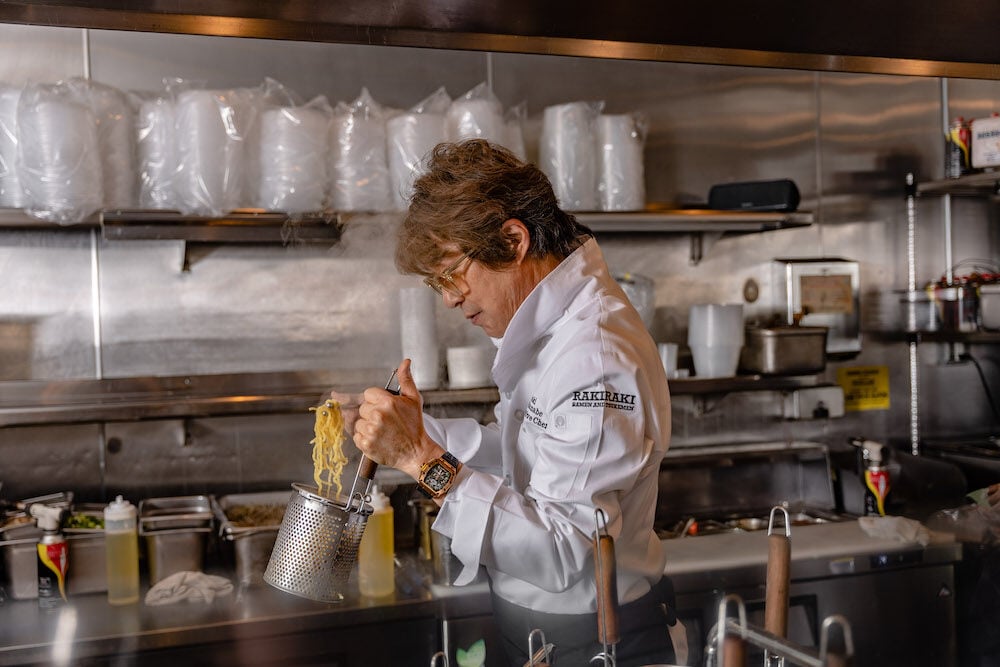
Junya Watanabe at RakiRaki

“Every week I get calls from some of the biggest restaurant groups in San Diego inquiring about space,” says Alan Wong, who helps run his father’s 40-year-old business, Stanley Wong Insurance Agency, whose clients include many Convoy restaurants. “They’re coming. That’s exciting, because while it’s great for Convoy to be the area for cultural relevance, the more multicultural you get, the more sustainable you are in the long term.”
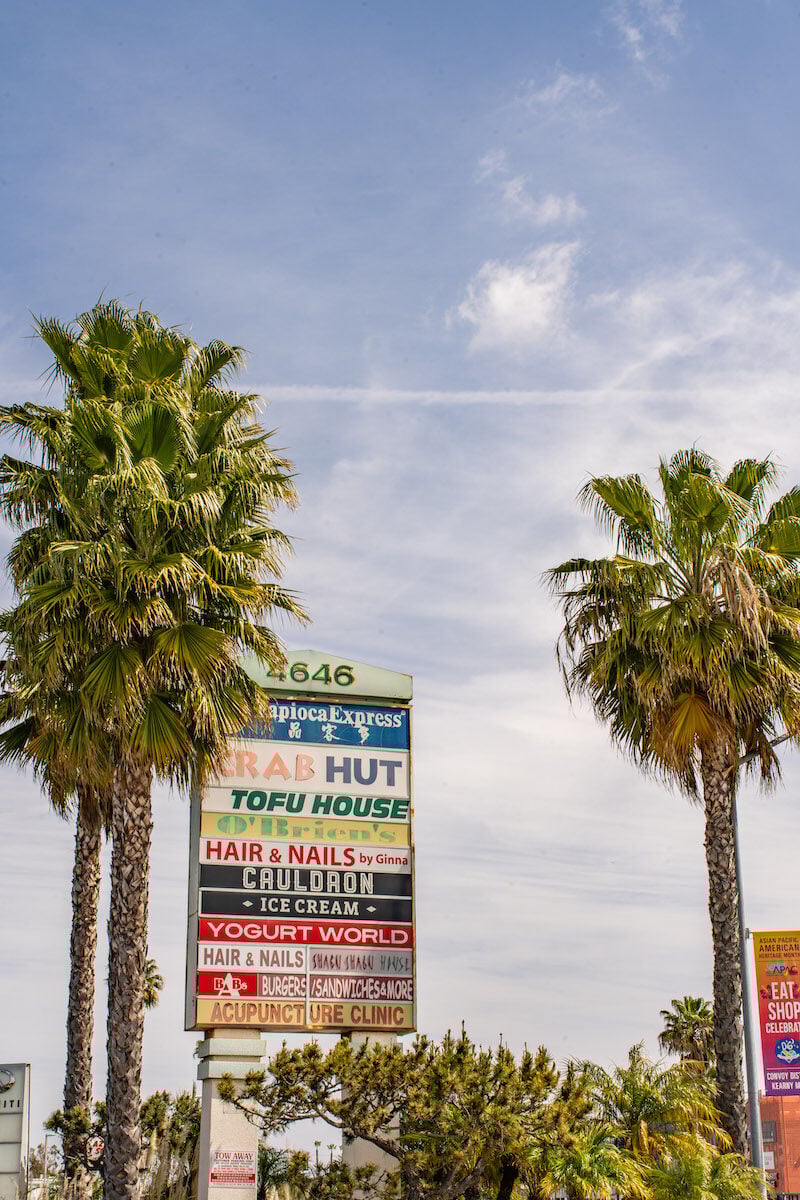
A Simple Start

Convoy - signs

Convoy restaurants are tucked in with salons and car dealerships

Convoy is now basking in, and trying to navigate, its own success. The bones of Kearny Mesa weren’t designed for hot pots or mochi donuts—or consumer pursuits of any kind, for that matter. Like the rest of San Diego, the land was part of the Kumeyaay Nation, colonized by Spain, and changed hands to Mexico and then the United States. In 1917 the US Army established the 2,130-acre Camp Kearny (the San Diego Union called Kearny Mesa “San Diego’s great war city”). During World War II, the mostly industrial- zoned streets served the Pacific Fleet, training marines in artillery and sailors in flying. The largest defense housing project in the country at the time (3,000 homes on 12 acres) was finished here in 1941.
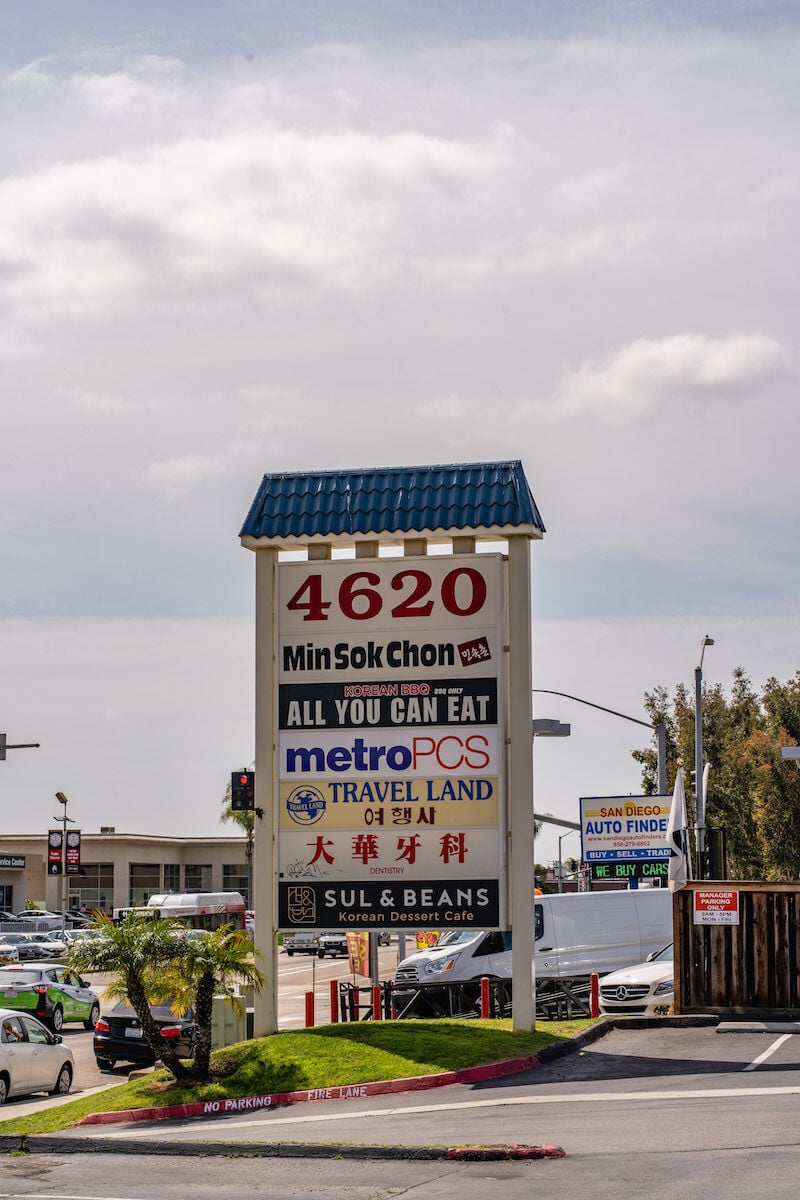
Convoy - sign 2

Convoy – sign 2

Two years later, Congress repealed the Chinese Exclusion Act. Originally enacted in 1882, the wildly racist CEA had numerous disastrous effects on the local Asian community. In addition to outlawing immigration from China and preventing Chinese immigrants from gaining US citizenship (and forcing those without proper ID into labor camps), the act dictated where they could live, and how they could earn a living. In San Diego they were permitted to live only in the city’s Chinatown (now called the San Diego Asian Pacific Historic District), an eight-block area on the southwestern edge of what is now the Gaslamp. And, as Chinese historian Murray K. Lee told Voice of San Diego, they were relegated to labor and service jobs on farms, in laundromats, and in restaurants.

“Once those racist ordinances got lifted, it was like, ‘Cool, let’s move,’” says Wesley Quach, director and business advisor for the Asian Business Association of San Diego.

Convoy - Wongs

Alan and Stanley Wong at their insurance agency

One of the Chinese families who moved was the Homs, who had started their grocery store, Woo Chee Chong, in Chinatown in 1899. Ask a dozen veterans of Convoy when the food scene started, and most of them point to Jennings Hom opening a Woo Chee Chong location at 4625 Convoy Street in 1979. It was a partnership with Frank Wong, a commercial real estate developer and a crucial recruiter of mom-and- pop businesses to the area. “People say there would be no Asians in Convoy if it weren’t for the Wong family,” says Quach.

Frank Wong’s daughter, Eva Hum, explains the impact of Woo Chee Chong: “That area was just empty land until they built that store. People were moving out of the old neighborhoods and into more prosperous neighborhoods, and they wanted grocery stores that catered to their own community. They had a cooking school; they were really innovative.”
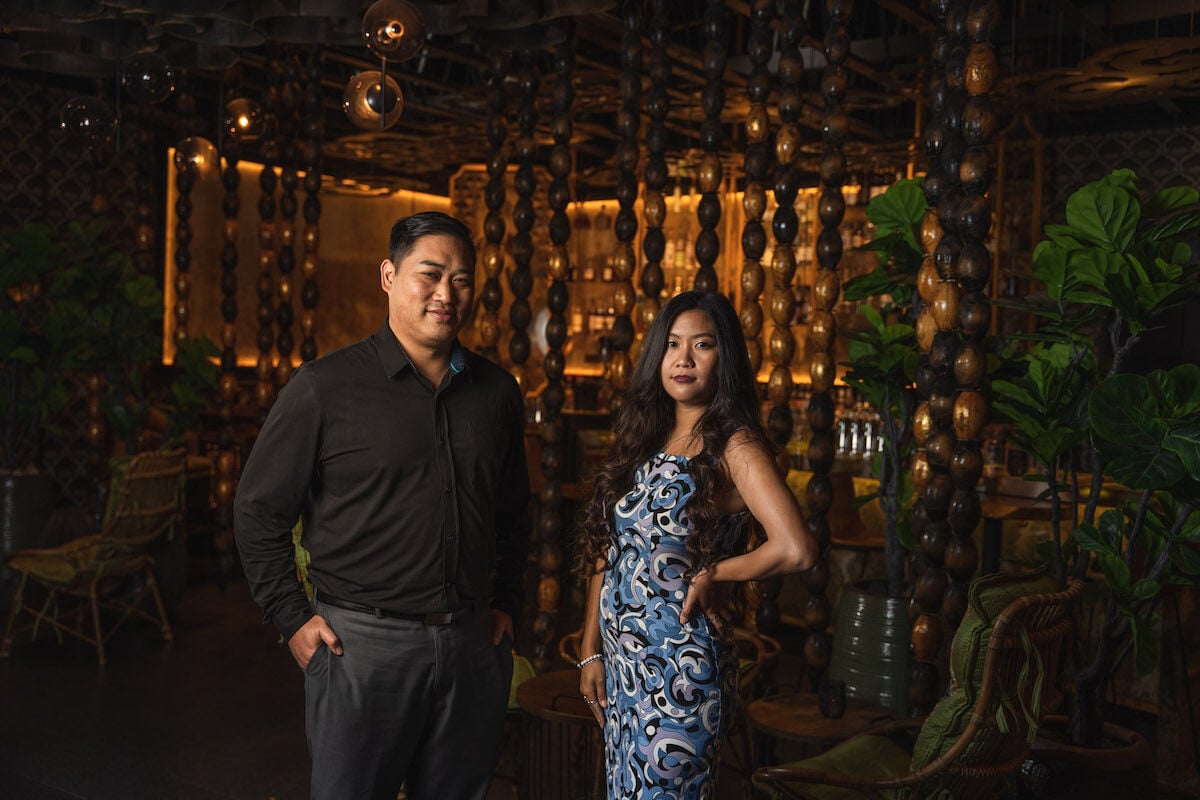
Convoy - Partnership

Wesley Quach and Lauren Garces of the Convoy District Partnership

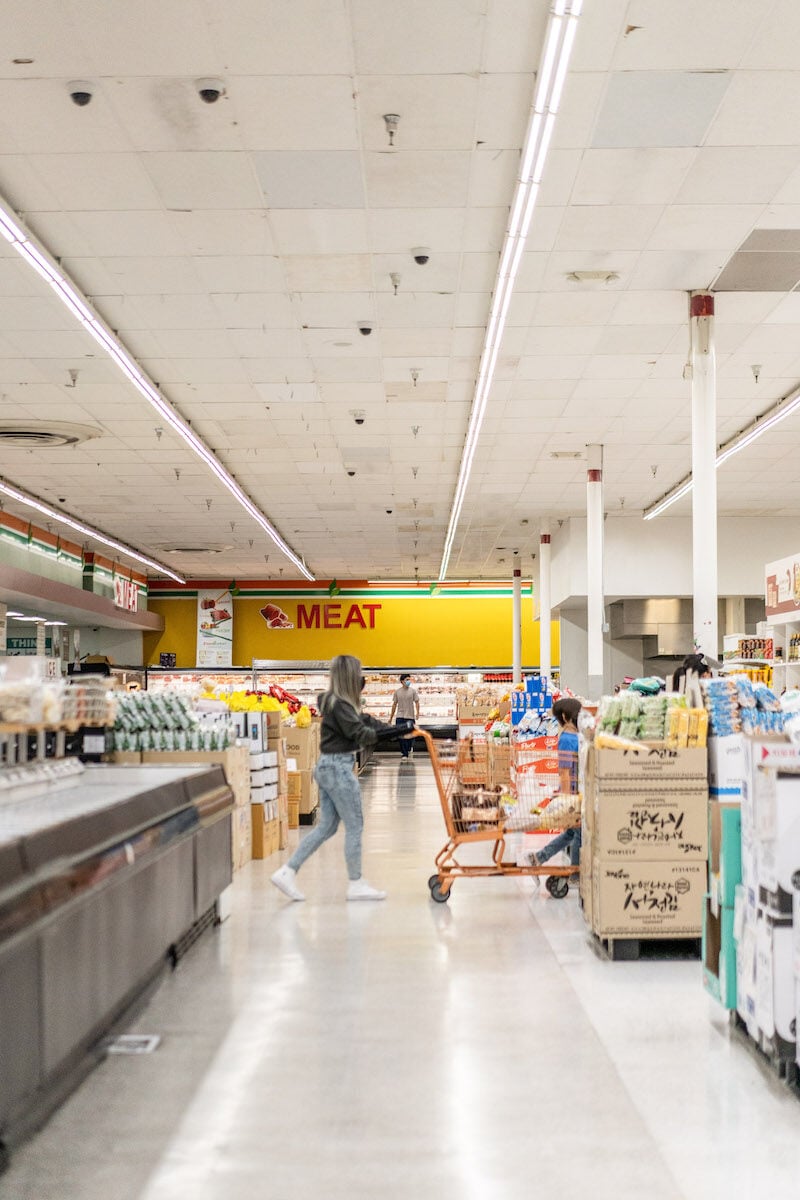
After 16 years, Woo Chee Chong closed in 1995. In its place is the Dumpling Inn and Shanghai Saloon, long famous as one of the first restaurants in San Diego to serve xiao long bao (soup dumplings). This one small strip mall contains shops for boba, sushi, shaved ice, Korean hot dogs, and dim sum takeout. At the strip mall across the street, 14 of the 15 storefronts are restaurants or specialty food and drink shops (Shabu Shabu House, Tofu House, Crab Hut, O’Brien’s, RakiRaki, and so on). Convoy has expanded, but an argument could be made that these two strip malls are both the historical and the modern heart of San Diego’s Asian food scene.
The Turning Point

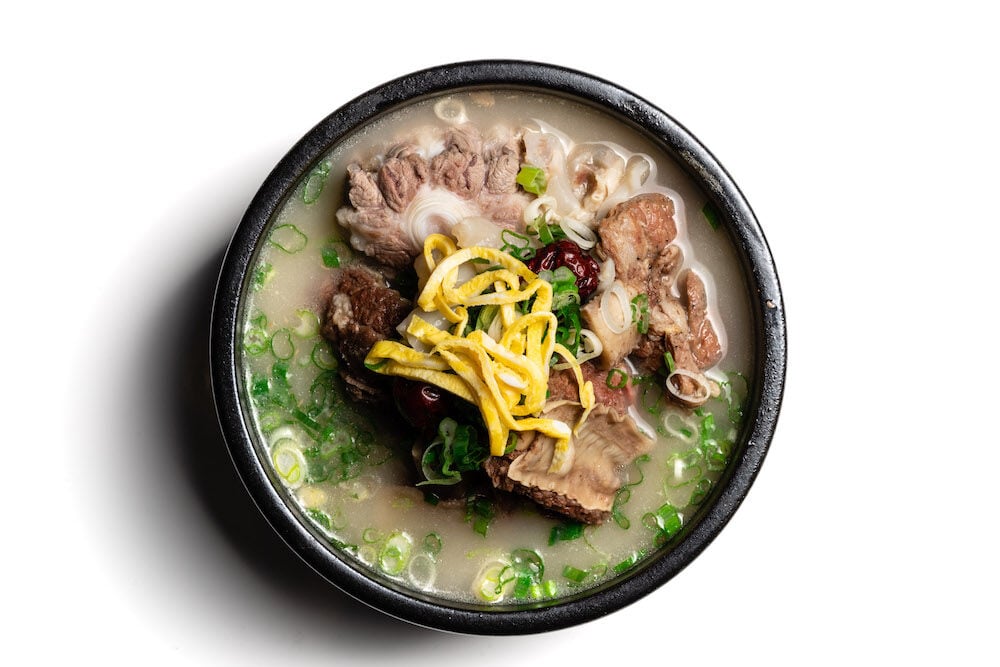
Convoy - soup

Beef bone soup from Woomiok

Grocers like Woo Chee Chong have always been key to Convoy’s evolution as a three-dimensional food destination. The stores draw families from across San Diego who can’t find proper Asian ingredients at a Western grocery store. While here, they often eat at the local restaurants. The stores also provide the raw ingredients for people who taste, say, tonkotsu (pork ramen) and want to try re-creating the dish at home, creating a deeper understanding of the cuisine. The area has national chain grocers like 99 Ranch Market, H Mart, Nijiya, Marukai, and Mitsuwa, plus local success story Zion Market, which opened in 1979 and offers mostly Korean food.

“It’s pretty amazing, we’re seeing a bit of a renaissance in Asian food,” says Kevin Hwang, whose father, Kyu, has built Zion into a chain with seven locations across the US. “David Chang, Roy Choi—now you see these guys cooking Korean.”
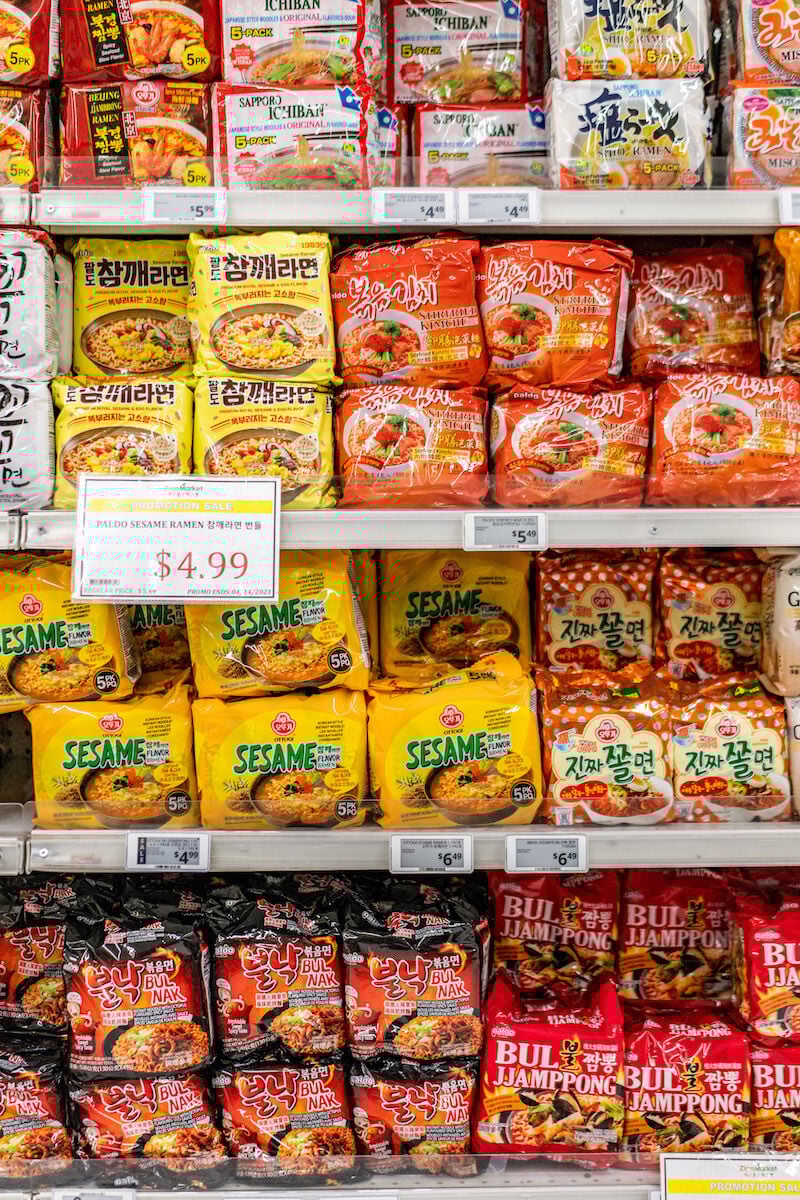
Convoy - Zion Market 1

Convoy – Zion Market 1

Convoy - Zion Market 2

Zion Market

What I’m trying to figure out is: Why Convoy? What drew San Diego’s Asian community here?

“It’s where all the churches were,” Hwang suggests. “I think if all the churches were in Rancho Bernardo, then this market would be there.” More than a few people point to the holy houses—like Korean United Methodist Church, opened in 1978—as a reason why the neighborhood has plenty of bulgogi (marinated Korean beef). The function of church as a refuge is obvious, but crucially so when you’re new to a place, in search of community, trying to establish new traditions without abandoning sacred ones. Maybe the almighty deserves some of the credit for creating food scenes like this.

And there is no scene quite like dim sum. Opened in 1992, Jasmine Seafood became Convoy’s unofficial dim sum palace, a giant temple to food. Dim sum is one of the most communal forms of eating on the planet: Huge groups—multiple generations of families—gather at the tables while servers promenade with steam-heated carts filled with snacks in bamboo baskets: char siu bao (barbecue pork buns), siu mai (silky pork and shrimp dumplings), chicken feet, spare ribs, coconut milk pudding, sponge cakes. You peruse, pick, and share. A Cantonese phrase that roughly means “heart’s delight,” dim sum started in the teahouses of Hong Kong, where Jasmine owner Allen Chan was born.
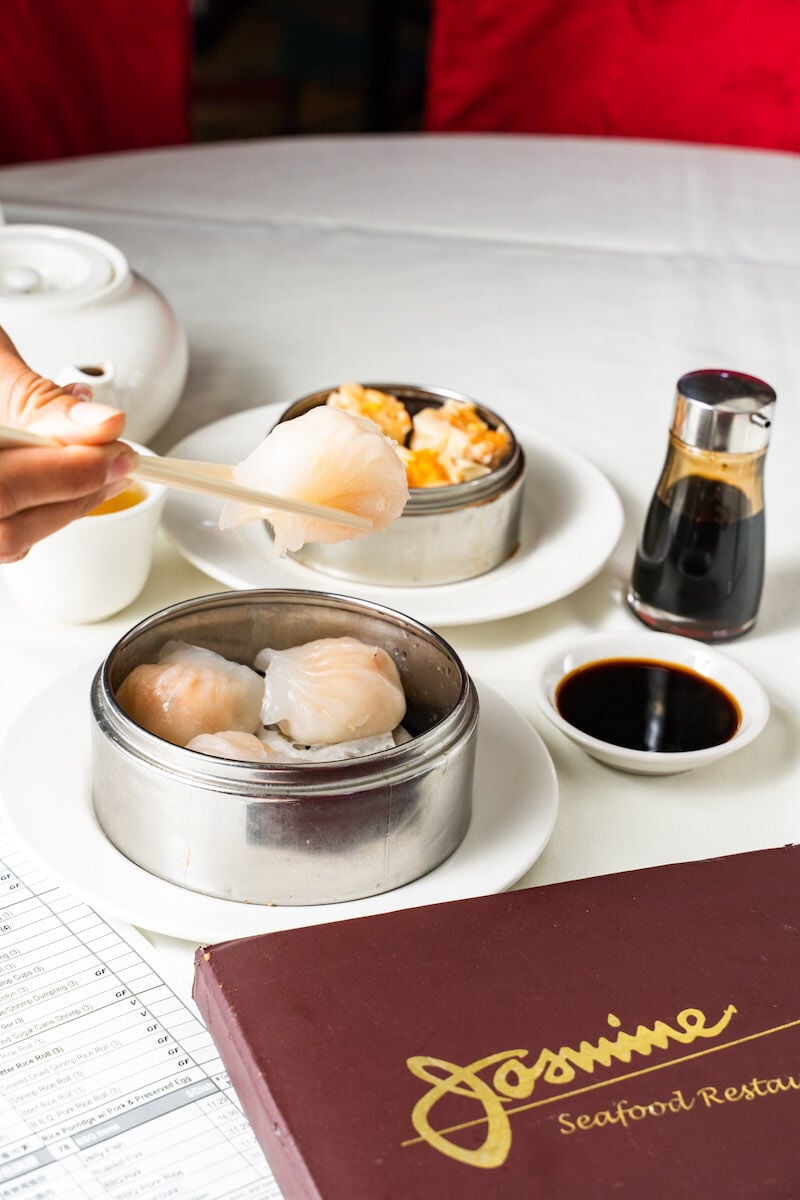
Convoy - Jasmine

dim sum at Jasmine Seafood

When I put the same question to him—“Why Convoy?”—he says: “San Diego’s Asian communities are not like other cities—they’re spread all over. Convoy is centrally located in the county, so people started coming here to meet on the weekends. That brought in traffic and local businesses. And then whenever an Asian moved to San Diego, they would come to this area. During the past 29 years it has grown so much.”

Chan also believes the growth of different Asian cuisines in San Diego is directly tied to incoming refugees. After the Vietnam War, the city saw more pho restaurants. “After the LA riots over Rodney King and the attack on Koreatown, Korean businesses moved to San Diego and that brought so many Korean barbecue places,” he says. Following Britain’s handover of Hong Kong in 1997, we saw more dishes from mainland China. Part of dim sum’s appeal has been that it’s inexpensive (snacks cost less than entrées), which makes it more inclusive—exactly like Convoy itself. Although its price has risen along with its popularity, the low cost of rent here made it affordable for small-restaurant owners to set up shop. That wasn’t just feel-good egalitarianism; it established the whole mom-and-pop landscape that makes Convoy so compelling.

“The cheap real estate in the middle of the city was a big draw, especially for the early immigrants,” says Wesley Quach. “Now you’re seeing people coming over with money, but the first ones here came over with almost nothing.”

The lower menu prices made Convoy a popular night spot for college students, particularly from UC San Diego. In 2019, Asians and Asian Americans made up 52 percent of undergraduate enrollment at the campus, which is a straight shot six miles to the west. One UCSD alumnus, Cris Liang, would go on to open one of the district’s most popular spots, Common Theory.
Making Way for the New School

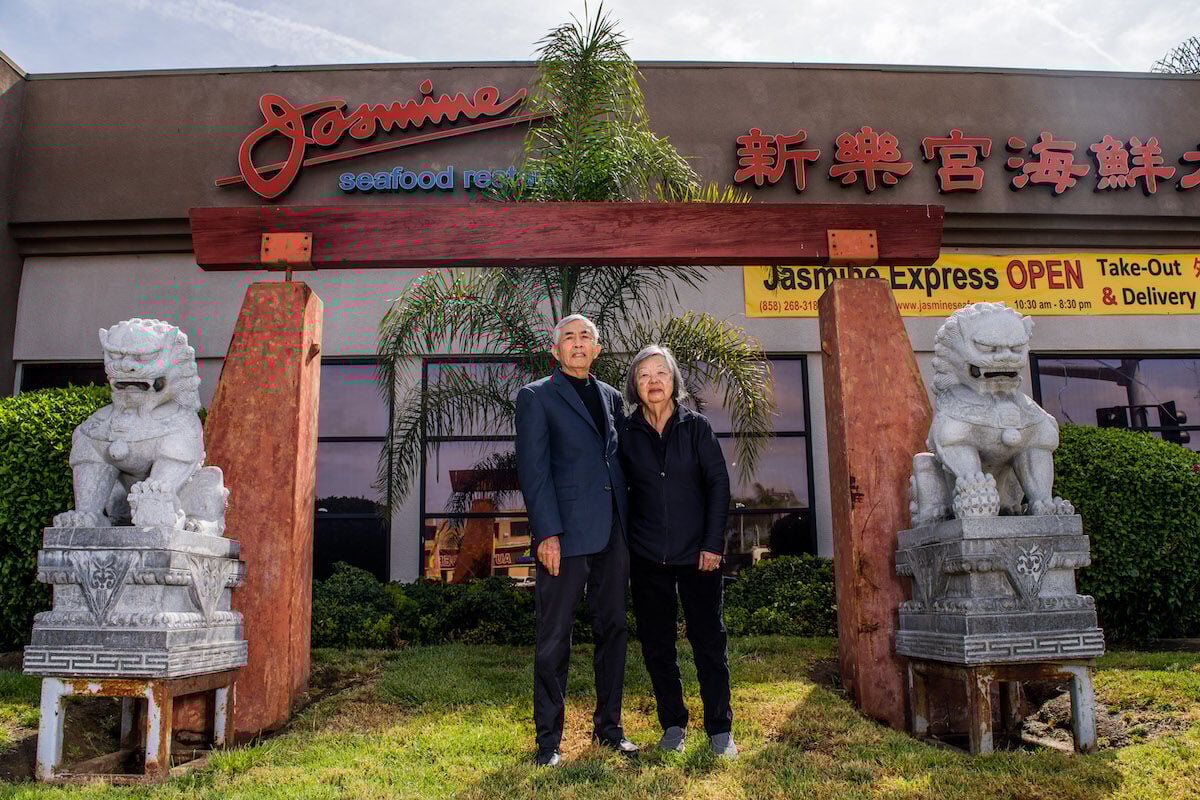
Convoy - Frank Wong

real estate developer Frank Wong and his wife, Carolyn

Common Theory represents the new guard of Convoy, a wave that arguably started with the arrival of RakiRaki Ramen & Tsukemen in 2012. Owner Junya Watanabe was born in Tokyo and moved to the US for junior high. After college he spent 20 years in fashion, launching a well- known line of dresses called Tadashi Shoji (it’s still going; you can get them at Nordy’s). When cheaper knockoffs started to come out of China, he left the industry and traveled to Japan to learn ramen. Watanabe looked all over the US—Seattle, San Francisco, LA—for a place to open his first ramen restaurant.

“Once a week I came down to Convoy from LA and just watched the neighborhood,” he says. “If you see an aerial shot of Convoy, there’s nothing around it. No industries, no big residential projects— there’s a municipal dump off the 52 freeway. It’s very underdeveloped. But the Asian restaurants here were more concentrated, and respected as authentically Asian.”
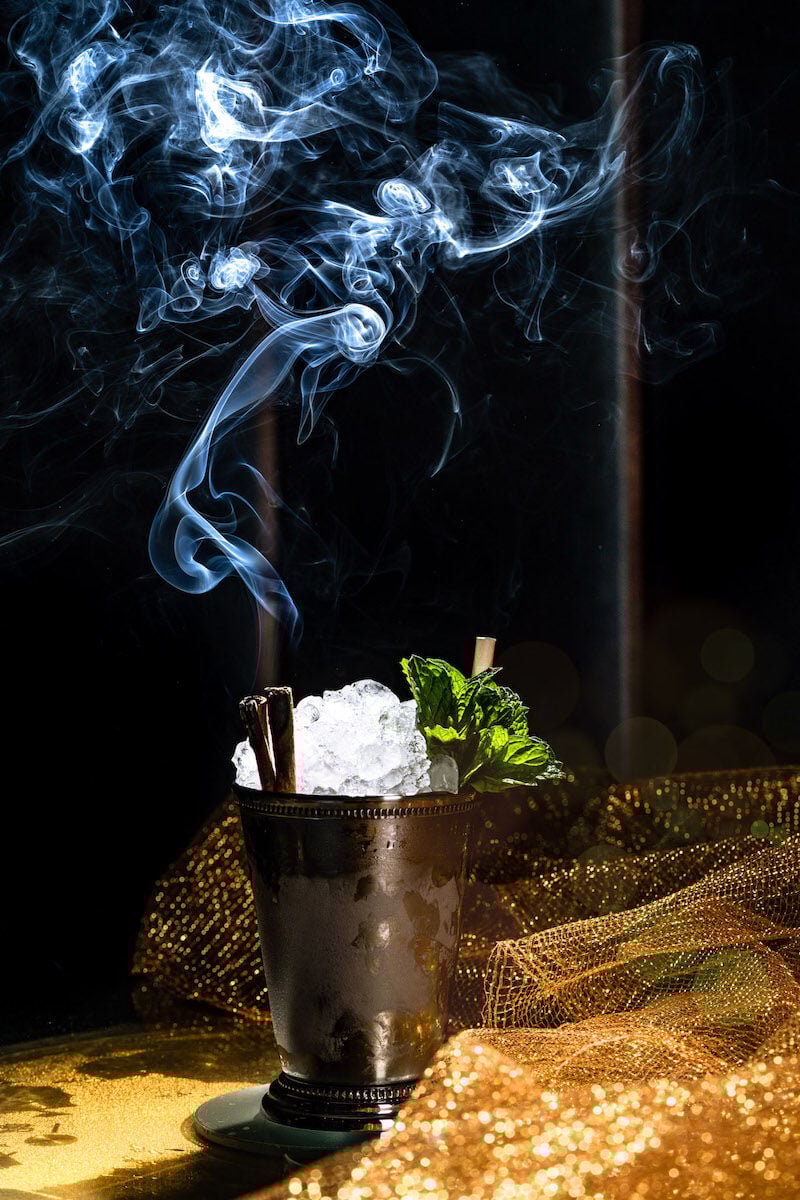
Convoy - realm

A cocktail from Realm of the 52 Remedies

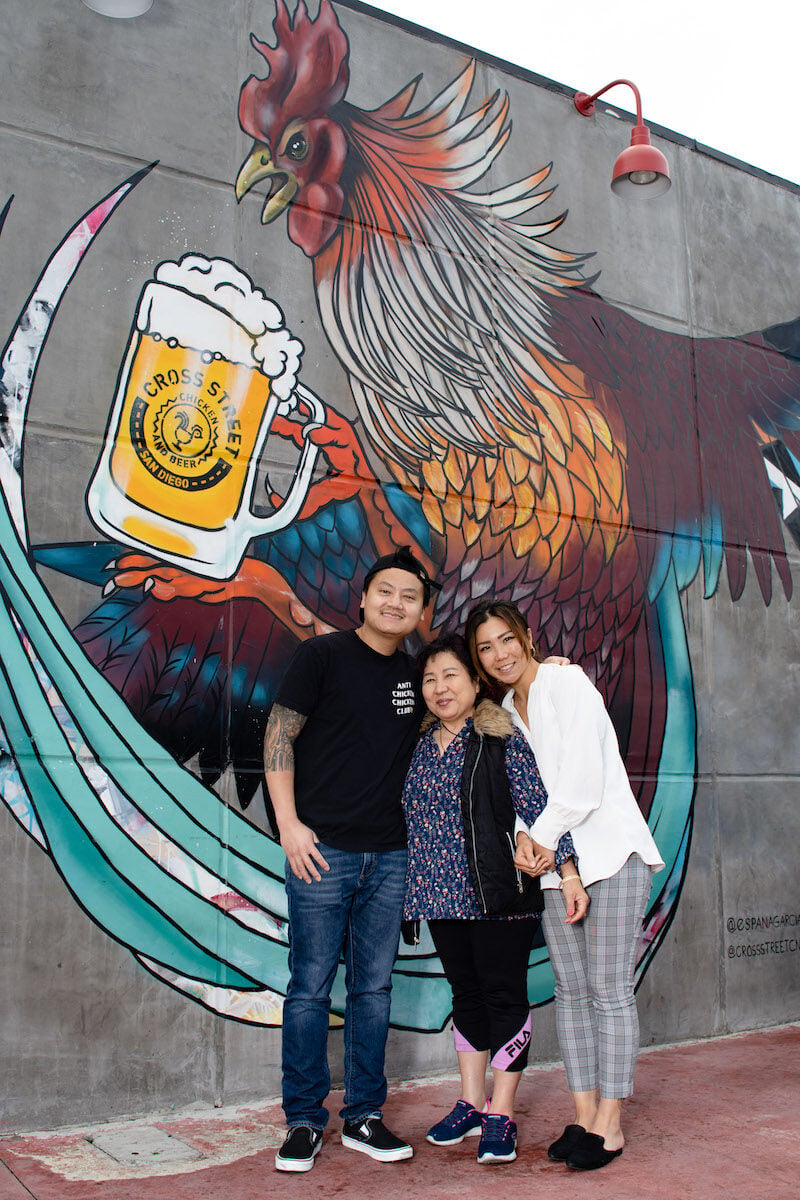
RakiRaki instantly stood out from the strip mall: reclaimed wood, tile work, lanterns, mood lighting, black steel. The fashion industry vet brought design to a neighborhood that had long been okay with shingles-and-seats. Two years later, Liang opened Common Theory, which also invested in design. In 2017, same with Cross Street Chicken and Beer—owned by Tommy Nguyen and his wife, Grace Chi—a craft beer and Korean fried chicken restaurant that opened in the parking lot of Friend’s House Korean (which is owned by Grace’s mom). Then Liang hired a big-name chef—Jon Bautista, formerly of George’s at the Cove—and tapped top interior designer Michael Soriano (The Pearl, Queenstown) for a speakeasy called Realm of the 52 Remedies.

Convoy is at a critical moment. A few large-scale mixed-use developments are in the works (including one at the site of Zion Market and Kearny Mesa Bowl) that could change the face of the neighborhood. Successful non-Asian restaurant groups are looking to come in. “It is now ‘the Asian location’ for any new projects that fit that bill,”says Liang.“More and more popular Asian brands from LA or out of state are choosing Convoy as their first opening in San Diego. If your Asian concept is legit and good, it better be on Convoy.”
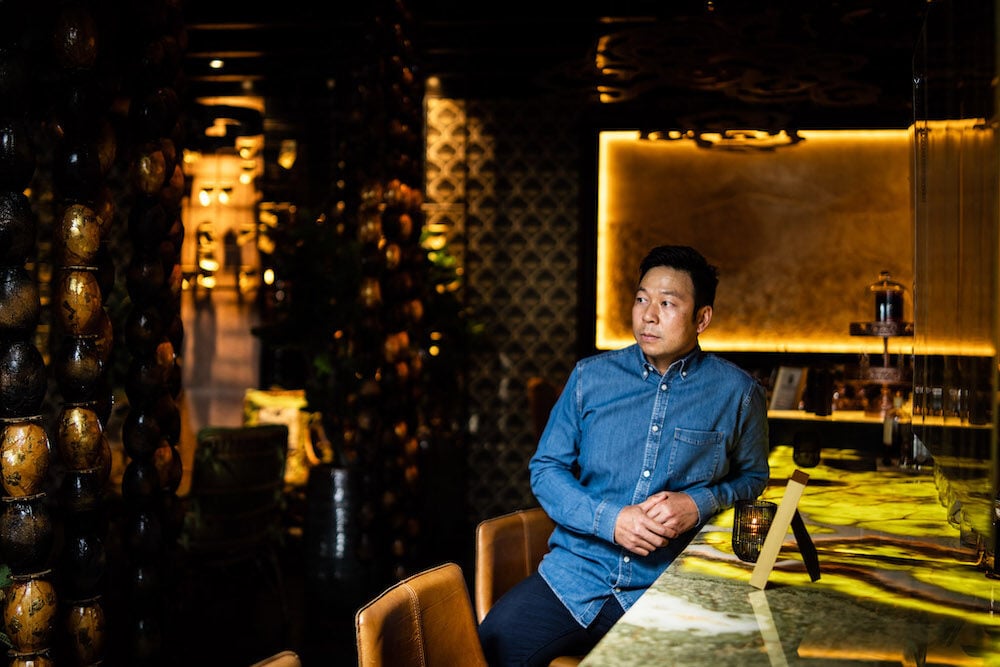
Convoy - Cris Liang

Cris Liang

At long last, the restaurants have voices speaking for them among city officials, thanks to the Convoy District Partnership, Kearny Mesa Planning Group, and Asian Business Association. But it remains to be seen how they’ll be able to navigate this growth without undercutting the authenticity that made this such a valuable cultural site. “The word ‘gentrification’ gets thrown around a lot,” says Quach. But he thinks there’s room for both the big and small players.

“The community overall has been super supportive of the mom-and-pop shops,” Grace Chi says. “The younger generations are taking over and it’s becoming an iconic place. It’s pretty competitive. At the same time, San Diego is very rooted. All these trendy places do come and they end up shutting down.”
Convoy - cross street outside

Tommy Nguyen, Susan Cho, and Grace Chi

When I’m on a phone call with Chi and her mom, Susan Cho (who started Friend’s House Korean 16 years ago), we chat a bit about the future. Chi theorizes that the rising demand for Korean food is a spillover effect from the wild popularity of K-pop groups, like BTS and Blackpink, and Korean dramas. They welcome the attention.

Cho gets straight to the point—what it really all comes down to—and says I need to try her bibimbap.
Troy Johnson

About Troy Johnson

Troy Johnson is the magazine’s award-winning food writer and humorist, and a long-standing expert on Food Network. His work has been featured on NatGeo, Travel Channel, NPR, and in Food Matters, a textbook of the best American food writing.

Subscribe to our newsletters

Select Options

By subscribing you confirm that you agree with our Terms and Conditions and Privacy Policy.

Food & Drink SEPTEMBER 11, 2026

A Taste of Osaka Is Popping Up Around San Diego

Surf’n Slaw founder Kumi Alexander is introducing local farmers market crowds to okonomiyaki, the savory Japanese pancake she grew up eating

A Taste of Osaka Is Popping Up Around San Diego
Courtesy of Surf’n Slaw

After 15 years married, my husband and I tend to agree on most things. But there’s one argument we both refuse to bend on—I prefer okonomiyaki Osaka-style, and he’s a die-hard Hiroshima-style devotee. (To be fair, we both adore both styles, but at this point, it’s just fun to have a low-stakes disagreement.)

Okonomiyaki is one of Japan’s greatest comfort foods, a savory pancake that’s about the size of a DVD, if you aren’t too young to know what that is. It’s not terribly hard to make—it’s flour, eggs, dashi stock or water, and a whole heap of shredded cabbage, plus optional fillings like green onions, pork belly, or bonito flakes, all cooked fresh on a flat top griddle. Drizzle some kewpie mayo and okonomiyaki sauce on top, and you’re hot to go. 

However, it’s not easy to make well, and as you now know, people have capital-O Opinions about Osaka-versus-Hiroshima. Hiroshima-style layers the ingredients one by one rather than mixing them together, adding a layer of soba or udon noodles and topping it all off with a fried egg. For Osaka-style,  all the ingredients are mixed together and then cooked on the griddle, so every bite includes every ingredient in a hodgepodge of deliciousness. (One Osaka variation called modan-yaki does include soba noodles mixed in the batter, but they’re not traditionally used in that regional version.) 

Despite a childhood spent in Osaka, Japan, Kumi Alexander specializes in making Hiroshima-style okonomiyaki. “Okonomiyaki has been part of my life for as long as I can remember,” she explains. “My parents ran their own business when I was growing up, so Saturdays were often busy, and okonomiyaki was one of my mother’s go-to lunches because it was simple and easy to make.” 

Alexander came to San Diego seven years ago with a desire to bring a part of her culture with her—not just a product, but a feeling. “When I thought about what could do that, the answer was almost obvious: okonomiyaki,” she says. 

She originally launched Surf’n Slaw as a mobile pop-up food stand in August 2025, offering what Alexander calls Japanese-meets-California okonomiyaki. “Our full Surf’n Slaw includes cabbage, noodles, umami dough, beef, shrimp, and vegetables,” she explains. The menu also has a “Green Wave Slaw,” an Osaka-style version that can be made vegan and gluten-free, as well as matcha drinks. 

Currently, Surf’n Slaw pops up at farmers markets in North Park, Scripps Ranch, Hillcrest, La Jolla, and La Mesa, as well as other local markets and community events. Eventually, she may expand to a permanent location, but that’s a future goal. And while Alexander hopes that one day okonomiyaki will be as well-known to American audiences as ramen or sushi, for now, she’s just happy to share a bit of home with San Diego. 

San Diego Restaurant News & Food Events

Beth’s Bites

  • Izola Bakery announced big plans for a second location and bakery HQ (checks notes) over three years ago and it’s kind of been crickets since then. But there may be movement in the expansion plan—the East Village bakery recently put out a hiring call for “the people we need to help us build what’s next.” Here’s hoping things get cooking (or baking, as the case may be) soon. 
  • As a California-born, East Coast-raised foodie, I can confidently say the East Coast has the deli game on lock. So whenever anyone announces they’re bringing an East Coast-style sandwich to the West Coast, I remain cautiously optimistic until proven otherwise. (Big Jim’s in Pacific Beach is a phenomenal example of a transplant done exceptionally well.) Los Angeles-based Ggiata Delicatessen recently announced plans to open a location in Encinitas, promising authentic Italian staples like meatball parmesan subs, cheesesteaks, and Italian cold cuts. Don’t let me down, guys!
  • Unfortunately, it’s not all openings and expansions. Nola on 5th in Hillcrest permanently ceased operations without warning or explanation. We can probably pick from one (or more) squares on Restaurant Closure Bingo for the reason (increased costs for ingredients, labor, equipment, etc.), but for the jambalaya enthusiast, it doesn’t really matter why. It’s simply adieu to a slice of The Big Easy in San Diego. 

Listen Now: The Latest in San Diego’s Food and Drink Scene

Have breaking news, exciting scoops, or great stories about new San Diego restaurants or the city’s food scene? Send your pitches to [email protected].

Beth Demmon

About Beth Demmon

Beth Demmon is an award-winning writer and podcaster whose work regularly appears in national outlets and San Diego Magazine. Her first book, The Beer Lover's Guide to Cider, is now available. Find out more on bethdemmon.com.

Food & Drink SEPTEMBER 9, 2026

Hako Hako Will Bring Japanese Konbini Culture to Hillcrest

San Diego entrepreneur Kenji Blouin-Ito is turning a tiny Uptown Inn space into a destination for bentos, coffee, snacks, and more

Hako Hako Will Bring Japanese Konbini Culture to Hillcrest
Courtesy of Hako Hako

Tokyo unquestionably holds the title as one of the best, if not the best, food cities of the world. But despite the plethora of Michelin-starred kaiseki restaurants and hole-in-the-wall ramen joints, you’d be remiss in walking past glowing signs beckoning you to enter one of the 56,000-plus konbini across the country.

Konbini cafes like Lawson’s, FamilyMart, and 7-Eleven may look like run-of-the-mill convenience stores, but convenience store culture is a completely different animal there. Absent are the sad, floppy hot dogs sizzling sweatily on a rotating wheel of misery. Instead, konbini are stocked with a bevy of hot and cold drinks in every imaginable flavor, meals like tamago sandos (Japanese egg salad sandwiches) and prepacked bento boxes, snacks like onigiri (handheld triangles of rice and seaweed, often filled with fish or pickled plum), and even limited-edition merchandise (not unlike Wawa’s line of merch). 

Soon, Hillcrest will get a taste of konbibi culture. Hako Hako opens in front of Uptown Inn by Vantaggio, next to Ramen Ryoma, in early 2027.

Kenji Blouin-Ito, a half-Japanese, half-French San Diego native grew up eating Japanese food at home and during trips across the Pacific. “I remember looking forward to eating bentos on the train,” he says, grabbing quick items to munch on without sacrificing quality or succumbing to cost. When in France, he saw a rise of appreciation for casual Japanese cuisine, “long before it happened here.” 

Courtesy of Hako Hako | Photo Credit: @josh_walker.26_genteel

So he decided to bring it here. After AB 626 passed in 2018 to allow different jurisdictions to permit Microenterprise Home Kitchen Operations (MEHKOs), Blouin-Ito launched Foodnome, the first legal marketplace for homemade food in the US. Eventually, the national nonprofit The Cook Alliance took over the project, leaving him open to the next new idea but with the experience of running a food-based business. 

“That experience changed how I think about food, not just what makes it good but what makes it work,” he explains. Bento boxes felt affordable in a time of inflation, convenient in a bustling world, and versatile to a variety of palates. When he got the chance to open a konbini himself, he went for it. 

His family runs Uptown Inn, a mix of apartments and hotel rooms that’s seen increased food traffic over the past few years. “We had a small space in front of the building that wasn’t being used, and it just made sense,” he says. Hako means “box” in Japanese, a reference to both bentos and small space from where he’ll sling freshly made bentos, coffee, drinks, pastries, snacks, and a small retail selection.

Hako Hako will initially open for morning and afternoon hours, but you don’t have to wait until next year to get a taste of Japanese culture. Blouin-Ito’s concept is popping up at various coffee shops around San Diego, with a few coming up: Easy Does It on September 19 and Cafe Moto on October 17. Until then, practice the art of gaman: patience with grace. 

Hako Hako opens at 819 University Avenue in Hillcrest in early 2027.

San Diego Restaurant News & Food Events

Beth’s Bites

  • Sushi Tadokoro held on to its Michelin star for three years—no mean feat for anyone. But now, the Old Town restaurant is changing things up, eliminating lunch and à la carte service at the end of September before transforming into an omakase-only experience in October. The dining room will close from October 1 through October 22 to make the change, but promises it will be “more intimate. More personal. More focused on each guest and every piece we serve.” Sounds worth the wait.
  • Bock brought new life to South Park when the German-inspired beer bar opened after a long construction process by owner Brian Jensen (Vino Carta, Bottlecraft). Now, Bock is getting its own shot in the arm with a new in-house kitchen from the people behind Majorette, Love Letters Pizza, and Scrimshaw Coffee. Kurz, or “quick” in German, is already open, serving European-inspired bites like the requisite currywurst, Bavarian pretzel, and schnitzel, along with some newcomers like a pierogi and famous “Majorette burger.” (I can confirm it’s a damn good burger.) Reminder: Bock and Kurz are 21+, so leave the kinders at home.
  • The popular Japanese dessert chain Warabimochi Kamakura already has 70-plus locations in Japan, Australia, China, Thailand, and the U.K. (to name a few), but is finally opening a location in Convoy District at 8322 Clairemont Blvd. After a successful pop-up test run at Asa Bakery, Warabimochi Kamakura will bring its signature warabimochi (a traditional simple, jelly-like dessert), plus tea like matcha and hojicha, as well as soft serve as soon as October, but possibly November. (Although warabimochi is sometimes considered a summer treat, I’m pretty sure I can make an exception for autumn.)

Listen Now: The Latest in San Diego’s Food and Drink Scene

Have breaking news, exciting scoops, or great stories about new San Diego restaurants or the city’s food scene? Send your pitches to [email protected].

Beth Demmon

About Beth Demmon

Beth Demmon is an award-winning writer and podcaster whose work regularly appears in national outlets and San Diego Magazine. Her first book, The Beer Lover's Guide to Cider, is now available. Find out more on bethdemmon.com.

Food & Drink SEPTEMBER 8, 2026

Two San Diego Wine Pros Are Betting Big on Tinned Fish

With Sosal Line, Heidi Greenwood and Juerie Masters are importing traceable seafood from small producers and building a global pantry business along the way

Two San Diego Wine Pros Are Betting Big on Tinned Fish
Courtesy of Sosal Line | Photo Credit: Madison Daube

No matter your job, it’s helpful to find some sort of joy in it to avoid going completely insane. Some people savor the variety of personalities when dealing with customers. Others find comfort in the predictability of closing a bar after last call, counting tips and wiping counters. Perhaps achieving Inbox Zero really gets your blood pumping, or shipping a new product design sparks joy.

For Heidi Greenwood and Juerie Masters, work doesn’t get better than logistics and operations.

“[We] both love all the unsexy parts of supply chain and backend management,” laughs Greenwood. Tracking outbound orders? Ensuring compliance? Managing inbound freight? Stop me if this is getting too hot for you!

Not enough people think about the unsexy reality of running a business before launch, but effectively and consistently keeping an eye on operations separates successful companies from out-of-business ones. Both Masters and Greenwood already own their own businesses—Greenwood is behind the wine zine Campestre Mag and runs the online wine shop Esquina, and Masters co-owns Clos Wine Shop and Fintastic Provisions in University Heights with her husband Paul. Apparently, these gigs weren’t enough to satisfy their collective yearning for spreadsheets and inventory maintenance. 

So, they decided to start another business together—Sosal Line, a San Diego-based import and distribution company specializing in global pantry items. The pair launched Sosal Line at the beginning of 2025 and currently only sell three brands of tinned fish, but Greenwood says they plan to expand their offerings as they discover other small or family-run businesses that share their values.

“We want to work with brands and with products that really have a sense of place and actually tell a story—not just the product, but the people behind it too,” she says. 

Masters and Greenwood are both Korean-American and named this burgeoning business after Haenyeo, the legendary free-diving women of Jeju Island in South Korea. Traditional Haenyeo equipment and garb include oribal (swim fins), yeoncheol (lead belts to help them sink), and the company’s namesake sosal, a hand-held fishing spear (sometimes called jaksal)

The average person, if sitting completely still, can stay underwater for up to a minute and a half at most. Haenyeo can hold their breath for up to three minutes while actively foraging, harvesting, and swimming. Scientists say these diving women spend more time underwater than any other group of humans on earth. Not badass enough for you? The average age of Haenyeo is around 70.

Courtesy of Sosal Line | Photo Credit: Luke Schmuecker

“Fishing is a strong heritage for Koreans, and it’s the same here in San Diego with the Portuguese settlers,” Greenwood explains. (We aren’t the tuna capital of the US for no reason.) 

Sosal Line carries 100 percent traceable, wild caught fish from Galicia in Northern Spain and the Pacific Northwest, all family-owned companies who don’t compromise on sustainable practices. Tinned fish has never been more popular—or more debated—but there’s more to it than cute labels designed for maximum Instagram reach. “I want to know who I’m purchasing from,” says Greenwood. One of their suppliers, Craft Fish Co., which is based in San Diego but fishes in the PNW, is run by JJ and Jessica Gerritsen. JJ catches, Jessica packages, and it’s a business relationship on a first-name basis. “You can’t find that when you’re working with some nameless brand.”

San Diegans can find Sosal Line products at local retailers like Clos/Fintastic (obviously), allmine in Oceanside, Always Hungry Grocery & Goods in Carlsbad, J. Brix Wines in San Marcos, Collins & Coupe/Tablespoon in North Park, and Green Acre in La Jolla. They’re also available in select retailers in Northern California, Oregon, Arizona, and strangely enough, South Carolina. Expanding its client base is, of course, a goal. But not at the expense of quality or joy of discovery.

“I would love to see people try food from different cultures and be excited about it,” says Greenwood. “Maybe make them want to travel to experience different areas of the world.” 

San Diego Restaurant News & Events

Manna Coffee Co. Is A Family Affair  

Beth Demmon

About Beth Demmon

Beth Demmon is an award-winning writer and podcaster whose work regularly appears in national outlets and San Diego Magazine. Her first book, The Beer Lover's Guide to Cider, is now available. Find out more on bethdemmon.com.

Studio S SEPTEMBER 9, 2026

Meet ArtsConnect, UC San Diego’s Invitation to SoCal Arts Lovers

ArtsConnect brings those experiences into view, helping residents discover what they can see, hear and create at UC San Diego while experiencing the campus in a new way.

Meet ArtsConnect, UC San Diego’s Invitation to SoCal Arts Lovers
Courtesy of UC San Diego

Ask most people what UC San Diego is known for, and the arts may not be the first answer. Yet this fall, San Diegans can watch Ghostbusters with a live orchestra, try their hand at glassmaking and wander among more than 20 works of public art woven throughout the university’s La Jolla campus.

ArtsConnect brings those experiences into view, helping residents discover what they can see, hear and create at UC San Diego while experiencing the campus in a new way.

Courtesy of UC San Diego | Artist Credit: Bear, 2005, Tim Hawkins | Photo Credit: Erik Jensen

“The arts are at the heart of UC San Diego’s student-centered mission and vision,” says Alysson Satterlund, Vice Chancellor for Student Affairs and Campus Life. “Whether creating, participating in, or experiencing performances, the arts are essential to a healthy and truly fun Triton student experience.”

That invitation often begins where the arts intersect with other fields.

“Some of the most innovative work and discovery happen where disciplines don’t usually share a stage,” says Cristina Della Coletta, Dean of the UC San Diego School of Arts and Humanities. “So through our unique intersection of the arts with science, technology, and medicine, we are improving lives, physically and emotionally.  

Take The Inaudible Ocean, a collaboration between Department of Music Professor Lei Liang and Scripps Institution of Oceanography Assistant Project Scientist Josh Jones. Over eight years, the pair recorded earthquakes, ship noise, whale songs and other sounds in remote underwater locations. They transformed those recordings into a live music experience that allowed audiences to hear the ocean in an entirely new way. The work premiered on campus in May and continues to evolve.

The arts also connect the campus to the global art world and diverse perspectives. Chief Campus Curator Jessica Berlanga Taylor recently curated the Mexico Pavilion at the 61st Venice Biennale, featuring RojoNegro, the collective formed by Noé Martínez and María Sosa. The collective will unveil a compelling new permanent installation for UC San Diego’s celebrated Stuart Collection later this fall. 

ArtPower offers another easy entry point, bringing touring performers to venues including the outdoor Epstein Family Amphitheater and the intimate Loft. The nearly three dozen performances featured through its 2026-2027 season span music, dance, film, theater and conversation. 

Among the fall highlights is Ghostbusters in Concert on Sept. 25, pairing the beloved 1984 film with a live performance of Elmer Bernstein’s score. Tickets start at $35, and the amphitheater is located next to the UC San Diego Blue Line trolley station.

“Every member of our community should have access to world-class art, so we work hard to remove the barriers that stand in the way,” says Colleen Kollar Smith, executive artistic director of the Campus Performances and Events Office. “That means affordable ticket prices, and performances, voices and experiences where people see themselves reflected on stage and know they belong.”

The arts at UC San Diego are not only something to watch. The Craft Center offers public classes and workshops in ceramics, jewelry, woodworking, culinary arts and even surfboard shaping. At the new Glass Center, beginners and experienced makers can explore glassmaking through classes, demonstrations and studio experiences.

Whether you want to attend a performance, make something yourself or spend an afternoon exploring public art, there is an easy way in. And the invitation extends well beyond students and alumni.

Kollar Smith says it best: “Visit, participate, spectate or create. You’re invited, and we hope you’ll connect with us soon.”

Explore upcoming experiences at ucsd.edu/artsconnect.

Partner Content
Food & Drink SEPTEMBER 8, 2026

Something Big Is Brewing In La Mesa

The folks behind Oddish Wine and Lost Cause Meadery are partnering with Bica to open an all-day cafe, coffee shop, wine bar, and restaurant near La Mesa Village

Something Big Is Brewing In La Mesa
Courtesy of Oddish Wine

La Mesa: a bucolic, hill-dappled city long regarded as a somewhat frumpy, never quite trendy bridge between the urban cool of Mid-City and the rural sprawls of East County. La Mesa’s population clocks in at around 4 percent of the city of San Diego’s—fewer than Chula Vista, Oceanside, Escondido, Carlsbad, El Cajon, Vista, San Marcos, and Encinitas, in that order. It’s home to a killer Oktoberfest, one of the best charter high schools in the state, and a theatrical mayor who tools around town in a golf cart (and so far, hasn’t cut any arts funding or closed public bathrooms). 

But any area that’s only 20 minutes from downtown San Diego and under 20 miles to Mission Bay will only stay under the radar for so long. Slowly but surely, bits and bobs from San Diego’s cultural tastemakers have been popping up all over town. Dark Horse Coffee and the boutique Small Batch both opened in La Mesa in 2018. Stella Jean’s and Pop Pie are coming later this year. Native Poppy is building its new headquarters and studio this fall. After a year in business, the new owners of JK’s Greek have established themselves as one of the best Greek restaurants in the county. 

Next year, La Mesa will get one of its most ambitious projects yet. Billy and Suzanna Beltz, owners of Lost Cause Meadery and Oddish Wine, are pouring everything they have into renovating a 5,000-square-foot building between the Village and MacArthur Park to open a wine/beer bar, coffee shop, all-day cafe, and wine shop. 

The concept doesn’t have a name (yet), and Bica in Normal Heights will come on as a partner to run the restaurant aspect and coffee program (which also won’t be called Bica. Still lots of naming decisions to be made). But the Beltz’s vision is to create something in La Mesa that doesn’t exist yet—a community gathering space open from morning until night that’s family-friendly, creatively designed, and well… cool

The building has been around since the 1940s, first operating as a neighborhood market, then butcher shop, secondhand children’s store, electronics store, dry cleaners, and bike shop. The Beltzses say they plan to keep the “soul and character” of the space as much as possible, highlighting original details like a barrel-shaped wooden roof, brightening up the corner building by utilizing the large front windows, and eventually building an outdoor dining/drinking space and kid-friendly area—a must for the neighborhood’s plethora of young families. They tapped all locals for the design and build: Tecscape Design, design consultant Carly Miller-Chen (who owns Ayi boutique in South Park) to create the space, and local contractor CLTVT. 

Courtesy of Oddish Wine

Starting in the morning, the space will offer coffee and light breakfast items before transitioning to lunch and dinner menus, plus a full bar that will feature Oddish and Lost Cause products as well as other local wines, beers, ciders, and other beverages alongside an aperitivo program and low-ABV cocktails and spritzes. Food-wise, they plan to install a wood-fired oven and rotisserie, but expect more menu details to be revealed closer to opening. 

There will also be a small retail space focused on natural wines and ciders from places like Raging Cider & Mead in San Marcos and other San Diego and Baja California makers. But don’t expect run-of-the-mill options from the guy who makes weird wines and mead, the oldest alcoholic beverage in human history (hardly TikTok trend material). “We have a unique perspective… Hopefully we can expand some palates and minds in the process,” says Billy.

Community is the heart of the project, more than food, more than drinks. “We have a young family. [Bica owners] Manny [Da Luz] and Charlie [Knowles] have families,” says Billy. Suzanna adds: “People want a space that they know they’re going to get really amazing food, really fun drinks, but they can also feel like they can bring their kids during the weeknights.” It won’t be North Park 2.0, although many families now living in La Mesa came from various neighborhoods across Mid-City (like the Beltzes). It’s filling a void. It’s something they can build from the ground up. And just maybe, it’s something that will surprise people who have yet to discover La Mesa’s potential. 

Oddish Wine/Lost Cause Meadery’s new concept is projected to open by the end of 2027 at 8495 La Mesa Blvd.

San Diego Restaurant News & Food Events

Beth’s Bites

  • For as long as I can remember, my favorite animal in the world has been bunnies. (You’d think I would have been cured of the notion after adopting an adorable, but absolutely diabolical rabbit in my teens, but alas, it did not.) If you, too, love gazing at cute little cotton tails and velvety-soft ears, then join me for Bunnies & Brunch on Saturday, September 26 at Hilton San Diego Gaslamp Quarter’s Wild Hare Bar Garden. (I had no idea that downtown San Diego was once home to a robust rabbit population in the mid-19th century, but today I learned!) Yes, there will be a bunny petting farm from 11 a.m. to 1 p.m. Take a number, pal.
  • Keeping with the animal theme, there’s a new snake in town. Serpent & Stone, a Greek-inspired restaurant and lounge opened this weekend at 750 Front Street with Mediterranean classics like falafel, Greek meatballs, skewers, Greek salads, and mythology-inspired cocktails like “The Aphrodite” (pea-flower-infused Ketel One vodka with passion fruit, Madagascar vanilla, Passoã, lime and champagne). If you didn’t make it to Mykonos this summer, this sounds like a decent alternative. 
  • Mat Robar, Jesse Pine, and Winslow Sawyer launched Pure Project in 2016 with the idea of centering a brewery around sustainability, rather than leaving it as an afterthought or bonus. Most recently, they released Closed Loops, a collaborative murky IPA with Societe Brewing Company and Dalum Beverage Equipment, the latter of which installed CO2 capturing machines at both breweries earlier this year. Since February, Pure Project has recaptured and reused over 74,500 pounds of CO₂ emissions, keeping all of that out of the air and staying on track to hit over 119,000 pounds by the end of the year. The hazy IPA brewed with Tropical Fusion, Mosaic, and Strata Cryo hops is now on draft and in to-go four-packs at all five Pure Project locations, and I’ve got to say, it’s really nice to see environmental enthusiasts doing their part. 
  • Cheerio, California English. The Sorrento Valley British restaurant launched by celebrity chef Richard Blais will close permanently at the end of September. May your prime rib “proper roast” and Scotch eggs live on in another realm somewhere.

Listen Now: The Latest in San Diego’s Food and Drink Scene

Have breaking news, exciting scoops, or great stories about new San Diego restaurants or the city’s food scene? Send your pitches to [email protected].

Beth Demmon

About Beth Demmon

Beth Demmon is an award-winning writer and podcaster whose work regularly appears in national outlets and San Diego Magazine. Her first book, The Beer Lover's Guide to Cider, is now available. Find out more on bethdemmon.com.

Food & Drink SEPTEMBER 2, 2026

A Gluten- and Dairy-Free Bakery Is Popping Up Across San Diego

At The Delicate Squash, Shannon English is rethinking cookies, cakes, and pastries with seasonal ingredients and natural sweeteners

A Gluten- and Dairy-Free Bakery Is Popping Up Across San Diego
Courtesy of Shannon English

Midway through my phone conversation with Shannon English, owner of The Delicate Squash, I hear an alarm shrilling in her background. 

“Sorry, I’ve got to pull some cookies out of the oven right now!” she apologizes. After a few beats, she picks the phone back up and laughs. “I feel like I’m bouncing around all over the place.”

After hearing her run through a list of her professions and current hobbies, I’d have to agree. English runs The Delicate Squash, a gluten- and dairy-free bakery; teaches cooking demos; pops up at farmers markets; wrote a book of poetry (Deep Water came out this month from Beyond the Veil Press); hosts a monthly open mic night; dipped her toe into ballet; recently joined a running club; volunteers at local farms; and finally, teaches at a play-based, nature-based preschool.

I’m tired just talking to her. 

Surprising no one, English seems to have unlimited energy and enthusiasm for all this work, notably in education. Early childhood education is one of the most pivotal times for nurturing lifelong learning, but she also aims to educate the public on how to eat cleaner, feel better, and support your local food systems. She started The Delicate Squash in late 2023 after discovering she has a chronic illness, going through the typical standards of care and even strict elimination diets, to no avail. 

Courtesy of Shannon English

“I’m not going to say I found a diet that has ‘cured’ me, but I have found that taking a more mindful approach to a lot of things, including diet, has made symptoms far more manageable for me,” she says. 

Even people with dietary restrictions deserve a little treat from time to time, but she had a hard time finding anything that tasted good and made her feel good. Thus, The Delicate Squash was born.

All of her baked goods avoid gluten and dairy, and use natural sweeteners like coconut sugar or maple syrup as well as herbs, fruits, foraged flowers, and other natural flavorings. Her signature cookie, the “Delicate” cookie, is a sea salt dark chocolate cookie that’s soft, a little salty, a little sweet, and made with oatmeal to keep it gluten-free. Other crowd favorites are thumbprint jam cookies with jams made from scratch with change seasonally; breakfast pastries like orange, dark chocolate and cardamom scones; brownies; orange and black sesame banana bread; seasonal pies; and custom and seasonal cakes (currently, the late summer flavor is a dark chocolate coconut milk ganache with berry jam).

English says some people are surprised she can produce such a variety of goods with the dietary restrictions she adheres to. “A lot of feedback I get is ‘I could never do that,’” she says. But if she can do it, she assures me that anyone can. “I like to say ‘practice makes progress, not perfection.’” 

Her advice? Focus more on being present than presentation, and don’t be afraid to experiment to keep things interesting. And if that doesn’t work, you can always hit her open mic night to ask for tips.

Customers can order from The Delicate Squash’s online store, check her upcoming schedule of pop-ups, or find her goods at various independent retailers around San Diego.

San Diego Restaurant News & Food Events

Vinyl Listening Room Opening Inside Escondido’s Distinction Gallery

Escondido is getting in on the listening bar phenomenon. On September 5, musicians Mat Rakers, Kevin Capacia, and Billy Petty will open Plot Armor, a Japanese-style vinyl listening bar that Rakers says they aim to feel “curated and intelligent.” 

“Currently, there are not a lot of ‘cool’ spots in Escondido,” he says. Backed by The San Diego Music And Art Company and The Escondido Music And Art Company, Plot Armor will soon offer sake, wine, beer, and soju cocktails, plus Japanese non-alcoholic options and cold brew. Eventually, they’ll add Japanese-inspired snacks, but the focus will be creating a small place (very small—the seating capacity is 20) where vinyl junkies can come listen, linger, and libate. 

Courtesy of Fairmont Grand Del Mar

Beth’s Bites

  • Ocean Beach has a new watering hole. The Jetty opened in July at 4934 Voltaire Street (where Voltaire Beach House used to be), and while I don’t think OBceans were hurting for where to get a drink, the more the merrier. 
  • Chinese restaurant powerhouse Chef Fei is finally making it to the U.S., opening a spot at Westfield UTC mall on September 5. Known for Hunan-style stir fry dishes, it’s often lauded as one of the most consistently solid chains in the world—in fact, in 2018 chef Fei Lianghui took home the highest honor a Chinese chef can earn, the China Golden Chef Award. Again, I don’t think mallgoers were hurting for great places to slurp some noodles, but there’s always room in my heart for more stir fry.
  • In past years, Fairmont Grand Del Mar didn’t exactly jump to mind when I looked for different Día de Muertos celebrations around San Diego. That changes this year, when the five-star resort will debut its first Día de Muertos celebration on November 1. Michelin-recognized chefs like Javier Plascencia (Erizo, Animalon), Roberto Alcocer (Valle), Drew Deckman (Deckman’s En El Mogor), and more will come from both sides of the border for one night only, with proceeds going to Fundación Tijuana Sin Hambre. Get ready for what will undoubtedly be San Diego’s most upscale take on the Mexican holiday.

Listen Now: The Latest in San Diego’s Food and Drink Scene

Have breaking news, exciting scoops, or great stories about new San Diego restaurants or the city’s food scene? Send your pitches to [email protected].

Beth Demmon

About Beth Demmon

Beth Demmon is an award-winning writer and podcaster whose work regularly appears in national outlets and San Diego Magazine. Her first book, The Beer Lover's Guide to Cider, is now available. Find out more on bethdemmon.com.

Partner Content AUGUST 21, 2026

This Scripps Clinic Physician is Serving Up Care

Laika Nur, MD, takes her love of volleyball from the court to the clinic as team physician for the San Diego Mojo

This Scripps Clinic Physician is Serving Up Care
Courtesy of Scripps Health

Growing up, Laika Nur, MD, Scripps Clinic sports medicine specialist, loved watching beach volleyball when the Association of Volleyball Professionals tour came to her hometown of Chicago. A talented volleyball player herself, she remembers sitting in the stands all day, and once, even got a couple autographs. Years later, Dr. Nur was attending a professional event focused on women’s sports, and the discussion turned to a new professional women’s volleyball league. The general manager and coaching staff  for San Diego’s team, the Mojo, happened to be in attendance, and Dr. Nur took the opportunity to ask them if they needed a team doctor. Flash forward to the Mojo’s inaugural 2024 season, when Dr. Nur officially became the team physician. Click here to read more about Dr. Nur and how she incorporates lessons she learned on the court into her practice. 

For more nutrition, wellness, and healthy living tips, sign up for the San Diego Health newsletter here.

Partner Content

Eat Like a Local (Who Knows a Guy).

Restaurant news, culinary storytelling, and Troy Johnson’s sharp takes delivered straight to your inbox twice a month.

Close the CTA

Contact Us

1230 Columbia Street, Suite 800,

San Diego, CA