Featured articles
Food & Drink
Things to Do
Food & Drink
Featured articles
Everything SD
Things to Do
Everything SD
Featured articles
Things to Do
Things to Do

Things to Do
Featured articles
podcast-ep

video
podcast-ep
Featured articles
Everything SD
Everything SD
Everything SD
Featured articles
Partner content
Food & Drink

Everything SD
Ready to know more about San Diego?
SubscribeReady to know more about San Diego?
How we chose our November cover image
San Diego Magazine’s November 2013 cover
It was raining pizza in the office this month! We considered more than 20 pies for the cover before deciding on the image with the pizza we most wanted to eat.
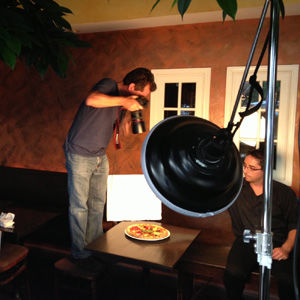
One of my favorite parts of my job is designing the magazine covers. At some point every month, while I’m spending endless hours tweaking the cover lines and image, I think to myself, “I just love doing this!” For our November issue, our executive editor Erin Meanley and I were thrilled to be doing a pizza issue. We had been talking about it for months. I teamed up with photographer Luis Garcia to photograph the best-looking pies around town. Luis’ instructions were simple: “Shoot pizza, and lots of it, and we like things messy.” Luis set up a photo studio in 10 pizza joints around the county and called on idle waiters to scatter pepper flakes, toss flour, and help make the cheese ooze.
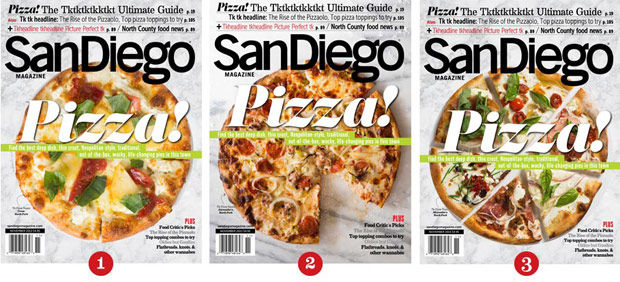
After reviewing 530 images for the cover, we were down to these final three shots.
3 options for San Diego Magazine’s November 2013 cover
We polled the staff, our VIP readers, and a select group of San Diego Magazine subscribers. The clear winner in terms of votes was #3 (which was also the favorite of the art department). Those voters commented that they liked the variety and that the pizza looked healthy (or shall we say healthier?), and had pops of color.

San Diego Magazine’s November 2013 cover
It wasn’t a clear winner around our office, however. Our newsstand cover consultant chose #1, as well as our circulation director, whose job is to make sure we sell sell sell on newsstands. They, along with the other #1 voters, seemed to like the delicious simplicity of tomatoes, melty cheese and basil. The art department was collectively, quietly rooting for #3.We liked the assortment and look of them. The Erins were hungry for #2 and Kim, our senior editor, was on the fence. But she’s a picky eater. 🙂
We debated it until 10 p.m. the night we shipped the magazine. That’s right. The pizza pie was the latest cover switch we’ve had in years. We were set on the Blue Ribbon slices for most of the final hours of production, but at the last second, swapped it out for Alexander’s, for its “I want to eat it right now” appeal. Everyone, including the outside voters, agreed that pizza was the one they would most like to eat. Simple as that.
The winner: Theodore’s Fix pizza, with Maui onion, spicy Italian sausage, pepperoni, red chili flake and sliced pepperoncini, from Alexander’s on 30th in North Park.
San Diego Magazine’s Best of San Diego Party featured the top restaurants and breweries in the city. Guests sipped and sampled their way through the evening enjoying live music, DJs and entertainment. Check out the evening’s highlights and don’t miss next year’s Best of San Diego Party in August 2015. Video production by Chris Calderon […]
San Diego Magazine’s Best of San Diego Party featured the top restaurants and breweries in the city. Guests sipped and sampled their way through the evening enjoying live music, DJs and entertainment. Check out the evening’s highlights and don’t miss next year’s Best of San Diego Party in August 2015.
Video production by Chris Calderon
Best of San Diego Party 2014 Video
San Diego Magazine’s Best of San Diego Party featured the top restaurants and breweries in the city. Guests sipped and sampled their way through the evening enjoying live music, DJs and entertainment. Check out the evening’s highlights and don’t miss next year’s Best of San Diego Party in August 2015. Video production by Chris Calderon […]
San Diego Magazine’s Best of San Diego Party featured the top restaurants and breweries in the city. Guests sipped and sampled their way through the evening enjoying live music, DJs and entertainment. Check out the evening’s highlights and don’t miss next year’s Best of San Diego Party in August 2015.
Video production by Chris Calderon
Best of San Diego Party 2014 Video
See the photos that didn't make it into the magazine
File it under career highlights: The two days our team spent at Diane Powers’ ranch in East County San Diego were some of the best I’ve had in my professional life. I am a native San Diegan and grew up going to Old Town. I have loved Powers’ colorful Mexican style since I was girl. Her home lived up to the expectation, and reminded me so much of her shops at Bazaar del Mundo.
The photos were all stunning. But we had to make some cuts for space in the print edition. Here’s a behind the scenes look at some of the shots that didn’t make it into the home feature (“Casa de Powers,” published in June 2014).
Bonus: More Photos of Diane Powers’ Ranch
This is the cedar barn and stable for Power’s prized Arabian horses. They built it when they bought the property. Those leaded stain glass windows are antiques that she collected from San Francisco and Los Angeles.
Bonus: More Photos of Diane Powers’ Ranch
This is one view of the formal living room. Note all the folk art collectibles and vintage Navajo rugs. The painting of the Last Supper that hangs above the fireplace is by David Bradley. (P.S. I am obsessed with that custom Pendleton armchair.)
Bonus: More Photos of Diane Powers’ Ranch
This room serves as an office space (Powers’ desk and computer are not pictured). It houses the bulk of her Guatemalan and Mexican collectibles, everything from ceremonial masks to trees of life and so much more. Collecting is a lifelong passion of hers, and she loves organizing her things by region and theme. One of my favorite details in this room is the sofa, upholstered with a traditional dancer’s costume (the floral) and a vintage serape (the stripes).
Bonus: More Photos of Diane Powers’ Ranch
Who needs Craft Service? We ate more food on this shoot than any other shoot I’ve ever worked on. Powers personally cooked us chicken and beef tostadas, alongside chips, salsa, and guac from Casa de Pico. It was such a treat. And by the way, I love her cobalt blue Viking appliances.
Bonus: More Photos of Diane Powers’ Ranch
This is the couple’s TV room, which doubles as a place to showcase all of Powers’ ribbons and trophies. Powers and her husband, Brent Gilman, travel all over the country showing their Arabian Western Pleasure Show Horses.
Bonus: More Photos of Diane Powers’ Ranch
A peek inside the pantry. When we asked to see it, Powers said, “It looks like my store, doesn’t it?”
Bonus: More Photos of Diane Powers’ Ranch
This is an example of the dancing costume and fabric that Powers used to upholster the sofa in her office.
Bonus: More Photos of Diane Powers’ Ranch
This is the back entrance to the main house. I love the combo of red and orange here. She has the same setup by the pool. It just feels so Old Town and so her.
This month, the 2026 San Diego Business Impact Awards recognized local businesses making an impact in clean energy, biotech, hospitality, and beyond
Renewable energy companies building hundreds of power plants. Biotech startups using artificial intelligence to create personalized medicine for children with rare diseases. Hospitality companies quietly powering thousands of local events. Consumer brands growing from beach-town startups into national businesses. These are the kinds of companies driving San Diego’s economy today, and the businesses recognized at this year’s San Diego Business Impact Awards offer a snapshot of where the region is headed.
Hosted July 23 by San Diego Regional Economic Development Corporation (EDC) and JPMorganChase, the second annual awards event honored four local companies for innovation, growth, and economic impact. More than 100 nominations from San Diego’s middle-market businesses were reviewed by a 10-person judging committee, with winners selected across four categories: startup, early-stage innovator, rising star, and established heavyweight.
Two-time honoree Jimbo Someck, founder of Jimbo’s organic grocery stores, also joined the event for a fireside chat on buying local, supporting emerging brands, and giving back to the community.
“San Diego’s strength comes from its makers and builders—the resilient people who endure great risks and overcome obstacles to build and scale a company,” says Aaron Ryan, San Diego Region Manager and Middle Market Banking at JPMorganChase & Co. “These awards aren’t just recognition; they spotlight the talent, grit, and innovation shaping our region’s future. By celebrating those who create and build, we foster connections and fuel the growth that keeps San Diego thriving.”

Heavyweight honoree SOLV Energy has grown alongside the country’s rapid investment in renewable power. “It’s an exciting time for SOLV Energy as we are experiencing significant growth,” says CEO George Hershman. “The business has doubled over the last year and has almost double-digit growth since its inception.”
The Rancho Bernardo-based company designs, builds, operates, and maintains utility-scale solar and energy storage facilities. Since its founding in 2008, SOLV Energy has built more than 500 power plants.
Growth has translated directly into hiring. About 200 employees work from the company’s local headquarters, including roughly 20 interns. “Our intern program is a big part of the way that we grow our workforce,” Hershman says. “Last year, 43 percent of our interns became full-time employees. We believe San Diego is a great community to build and grow a high-tech infrastructure and technology company because of the incredible workforce—the ability to attract top talent and draw from world-class universities.”

Startup honoree La Jolla Labs is tackling one of medicine’s biggest challenges by developing personalized RNA therapeutics for patients with rare diseases—many of them children with neurological disorders like ALS. Using proprietary artificial intelligence and machine learning tools, the biotech company develops treatments tailored to each patient’s specific genetic mutation.
CEO Tamar Grossman says the recognition reflects how far the company has come despite limited resources. “We’re honored to be recognized for our ability to change and save patients’ lives and turn our lean startup into a clinical company with very minimal resources,” she says.
Grossman credits San Diego’s concentration of research institutions—including UC San Diego, the Salk Institute, and Scripps Research—with creating a pipeline of talent and collaboration. “San Diego is one of the world-leading centers for technology, genomics, and RNA therapeutics,” she says. “We have over 30 RNA therapeutics companies here, and we support each other and help with anything related to drug discovery.”
She says that collaborative spirit extends beyond formal partnerships. “You can walk around Torrey Pines, go into a café, and find colleagues from the industry and have an ad hoc conversation,” Grossman says. “That’s something very unique to San Diego.”

While Snake Oil Venue Company may not be a household name, chances are many San Diegans have attended one of its events. The early-stage innovator honoree has expanded from beverage catering and mixology consulting into venue management, operating Julep Venue in Mission Hills, Bramble Bay Venue in Imperial Beach, Vesper Venue, the Chapel at Liberty Station, and five outdoor venues throughout Liberty Station—more than 500,000 square feet of event space altogether.
“We do a lot of launch parties for corporations and new products,” says CEO Mike Esposito. “I really like working on the entrepreneur side of things, where new businesses are entering the San Diego market and looking to make a splash.”
Snake Oil has executed more than 16,000 events, employed more than 1,000 people, and partnered with more than 900 local vendors, including caterers, florists, photographers, entertainers, and other hospitality businesses. The company also works with many of San Diego’s nonprofits, museums, and cultural institutions. “We get to celebrate people’s most important moments,” Esposito says. “Whether that’s a wedding, celebration of life, or quinceañera, we’re fortunate to be involved in the community in so many different ways.”

Rising star honoree ALOHA Collection is proof that a simple idea can grow into a thriving company. Founded by two roommates who wanted a better way to carry wet swimsuits after a day at the beach, the lifestyle brand has grown into a business while maintaining strong year-over-year growth.
Now headquartered in Carlsbad, ALOHA Collection employs more than 100 people and operates its California flagship store in Encinitas, which is slated for a remodel. With roots in Hawaii, the company is known for its lightweight, splash-proof travel bags that have become a familiar sight on beaches in San Diego and beyond.
“‘Aloha’ is part of our name, but it’s also how we move through the world,” says CEO Lynna Barnard. “It’s how we show up for people, the way we travel, the way we give back.” Since day one, the company has maintained a 5 percent giveback to Hawaii conservation efforts, contributing millions of dollars over the years.
“I think what’s so inspiring about ALOHA Collection, and the founders in particular, is when you dream big, those dreams can come true when you work hard and trust in the universe,” Barnard says. “It’s inspiring to be a role model for other people wanting to start businesses from humble beginnings. Start small and watch it grow.”
Together, businesses like these form a cornerstone of San Diego’s economy—not only through the jobs and revenue they generate—but through the local workers they hire, vendors they support, and investments they make in the region. Their growth doesn’t happen in isolation; it ripples outward, strengthening the broader business community and the people who call San Diego home.

See the photos that didn't make it into the magazine
File it under career highlights: The two days our team spent at Diane Powers’ ranch in East County San Diego were some of the best I’ve had in my professional life. I am a native San Diegan and grew up going to Old Town. I have loved Powers’ colorful Mexican style since I was girl. Her home lived up to the expectation, and reminded me so much of her shops at Bazaar del Mundo.
The photos were all stunning. But we had to make some cuts for space in the print edition. Here’s a behind the scenes look at some of the shots that didn’t make it into the home feature (“Casa de Powers,” published in June 2014).
Bonus: More Photos of Diane Powers’ Ranch
This is the cedar barn and stable for Power’s prized Arabian horses. They built it when they bought the property. Those leaded stain glass windows are antiques that she collected from San Francisco and Los Angeles.
Bonus: More Photos of Diane Powers’ Ranch
This is one view of the formal living room. Note all the folk art collectibles and vintage Navajo rugs. The painting of the Last Supper that hangs above the fireplace is by David Bradley. (P.S. I am obsessed with that custom Pendleton armchair.)
Bonus: More Photos of Diane Powers’ Ranch
This room serves as an office space (Powers’ desk and computer are not pictured). It houses the bulk of her Guatemalan and Mexican collectibles, everything from ceremonial masks to trees of life and so much more. Collecting is a lifelong passion of hers, and she loves organizing her things by region and theme. One of my favorite details in this room is the sofa, upholstered with a traditional dancer’s costume (the floral) and a vintage serape (the stripes).
Bonus: More Photos of Diane Powers’ Ranch
Who needs Craft Service? We ate more food on this shoot than any other shoot I’ve ever worked on. Powers personally cooked us chicken and beef tostadas, alongside chips, salsa, and guac from Casa de Pico. It was such a treat. And by the way, I love her cobalt blue Viking appliances.
Bonus: More Photos of Diane Powers’ Ranch
This is the couple’s TV room, which doubles as a place to showcase all of Powers’ ribbons and trophies. Powers and her husband, Brent Gilman, travel all over the country showing their Arabian Western Pleasure Show Horses.
Bonus: More Photos of Diane Powers’ Ranch
A peek inside the pantry. When we asked to see it, Powers said, “It looks like my store, doesn’t it?”
Bonus: More Photos of Diane Powers’ Ranch
This is an example of the dancing costume and fabric that Powers used to upholster the sofa in her office.
Bonus: More Photos of Diane Powers’ Ranch
This is the back entrance to the main house. I love the combo of red and orange here. She has the same setup by the pool. It just feels so Old Town and so her.
No, not 'that' lottery, but you could score tickets to the hottest show in town, ‘The Book of Mormon,' now playing at the San Diego Civic Theatre
Win the Lottery!
Original cast members Rema Webb, Andrew Rannells, and Josh Gad (photo courtesy of Broadway San Diego)
It’s the show everyone’s buzzing about. Broadway San Diego’s production of the hilarious Book of Mormon runs through June 8. From the creators of South Park and the co-creator of Avenue Q, the laugh-out-loud musical won nine Tony Awards, and is making its San Diego premiere at the Civic Theatre.
Don’t have tickets? Not to worry. The producers are offering a lottery system on the day of each performance, and a lucky few will get $25 seats to the show.
Here’s how to do it:
Good luck to all who enter! Of course, we hope that you win the real lottery. But if you don’t, we think some hearty belly laughs (courtesy of Trey Parker and Matt Stone) are a pretty good consolation prize.
The Book of Mormon runs through June 8 at the Civic Theatre. For show schedule, please visit broadwaysd.com.
Biotechnology is one of the most dynamic and rapidly evolving fields in modern science.
From advancements in cellular biology and molecular research to innovations that deepen our understanding of complex biological systems, biotechnology continues to influence how researchers explore some of science’s most important questions.
While major discoveries often capture headlines, the process behind those breakthroughs receives far less attention. Scientific progress depends on a vast network of researchers, laboratories, manufacturers, and specialized organizations working together to support ongoing investigation and discovery.
The Growing Importance of Biotechnology
In recent years, biotechnology has moved beyond the walls of research institutions and into mainstream conversation. Increased access to scientific information, educational content, and expert commentary has sparked growing public interest in the biological sciences.
Topics once discussed primarily within academic circles are now reaching broader audiences through podcasts, documentaries, digital media, and online communities. As a result, more people are developing an appreciation for the research, experimentation, and innovation that drive scientific advancement.
This growing visibility has transformed biotechnology from a largely specialized field into a subject of interest for educators, innovators, investors, and curious observers alike.
The Hidden Infrastructure Behind Discovery
Scientific breakthroughs often capture public attention, but the infrastructure that makes those breakthroughs possible rarely receives the same recognition. Behind every new discovery are years of investigation, testing, analysis, and refinement.
Behind nearly every research project is a network of laboratories, suppliers, technical specialists, and research-focused organizations working together to support scientific exploration. Laboratory infrastructure, specialized materials, quality standards, and reliable methodologies all contribute to the integrity of the research process.
When these foundational elements are in place, researchers can focus on generating insights, exploring new ideas, and building upon existing knowledge. Although much of this work occurs behind the scenes, it plays a critical role in helping science move forward.
Why Discovery Depends on More Than Researchers Alone
As biotechnology continues to evolve, research-focused organizations have become increasingly important contributors to the broader scientific ecosystem.
Among them is NewBioRx, a company operating within the biotechnology and life sciences sector. Like many organizations operating within the broader research ecosystem, NewBioRx contributes to the network of suppliers, laboratories, and scientific stakeholders that help support ongoing research efforts.
As scientific research becomes increasingly sophisticated, organizations that help support the research environment contribute to a culture where innovation can continue to thrive. Their work may not always be visible to the public, but it forms part of the foundation that enables scientific progress.
Why Science Is Reaching Wider Audiences
One of the most notable developments in recent years has been the growing public fascination with science and human biology.
Scientific concepts that were once primarily discussed within research settings are now reaching wider audiences through educational content, podcasts, digital media, and online communities. People are becoming increasingly interested not only in scientific outcomes, but also in the process of discovery itself.
The growing visibility of science has also created new connections between scientific communities and broader audiences. Individuals who operate across multiple worlds—including fitness, media, and life sciences—have helped introduce scientific topics to audiences that may not have engaged with them previously.
One example is Sam Sulek, co-founder of NewBioRx, whose involvement across fitness culture and the life sciences sector reflects the growing intersection between public curiosity and scientific exploration.
As co-founder of NewBioRx, he has helped champion a research-focused approach to scientific inquiry while supporting broader conversations around scientific literacy and discovery.
As scientific discovery becomes increasingly collaborative, public attention is beginning to extend beyond individual breakthroughs and toward the broader ecosystem that makes those breakthroughs possible. From researchers and laboratories to the organizations that support them, scientific progress remains a collective effort built on curiosity, expertise, and long-term commitment.