Featured articles
Featured articles
Things to Do
Guides
Things to Do
Featured articles
Things to Do
Things to Do

Things to Do
What's next
Featured articles
Featured articles
Featured articles
Things to Do
Things to Do
Guides
Ready to know more about San Diego?
SubscribeReady to know more about San Diego?
After a $100 million upgrade, the family-owned Cabo San Lucas hotel offers a serene place to reset in the middle of all the action
As I stood there, eyes closed, blue lighting showering the room, my mind raced through thoughts of the past few months back at home in San Diego. The holidays had been followed by my birthday, a breakup, and a new role at work. February was already beginning to feel like six months trapped into 28 days.
“Take a deep breath in, then a deep exhale,” cooed energy healer Lizbeth Murguia. We were in the middle of a private room at Sparitual, Corazon Resort & Spa’s wellness center in Cabo San Lucas. As my chest lifted and fell, it was difficult to quiet my inner dialogue.
Murguia handed me a sage stick to hold as she softly spoke a spiritual blessing and prayer over me. Sounds of a shamanic rattle echoed throughout the space while she maneuvered in rhythmic movements, touching my hair, shoulders, and face as she chanted. Slowly, every worry, every thought, began to wash away and my stomach began to creep into my chest.
I was emotional, holding back tears in the blackness. My shoulders dropped as a sense of relief crept through me. I was grateful for the opportunity to take time to feel the weight of the past few weeks before finally letting it all go.
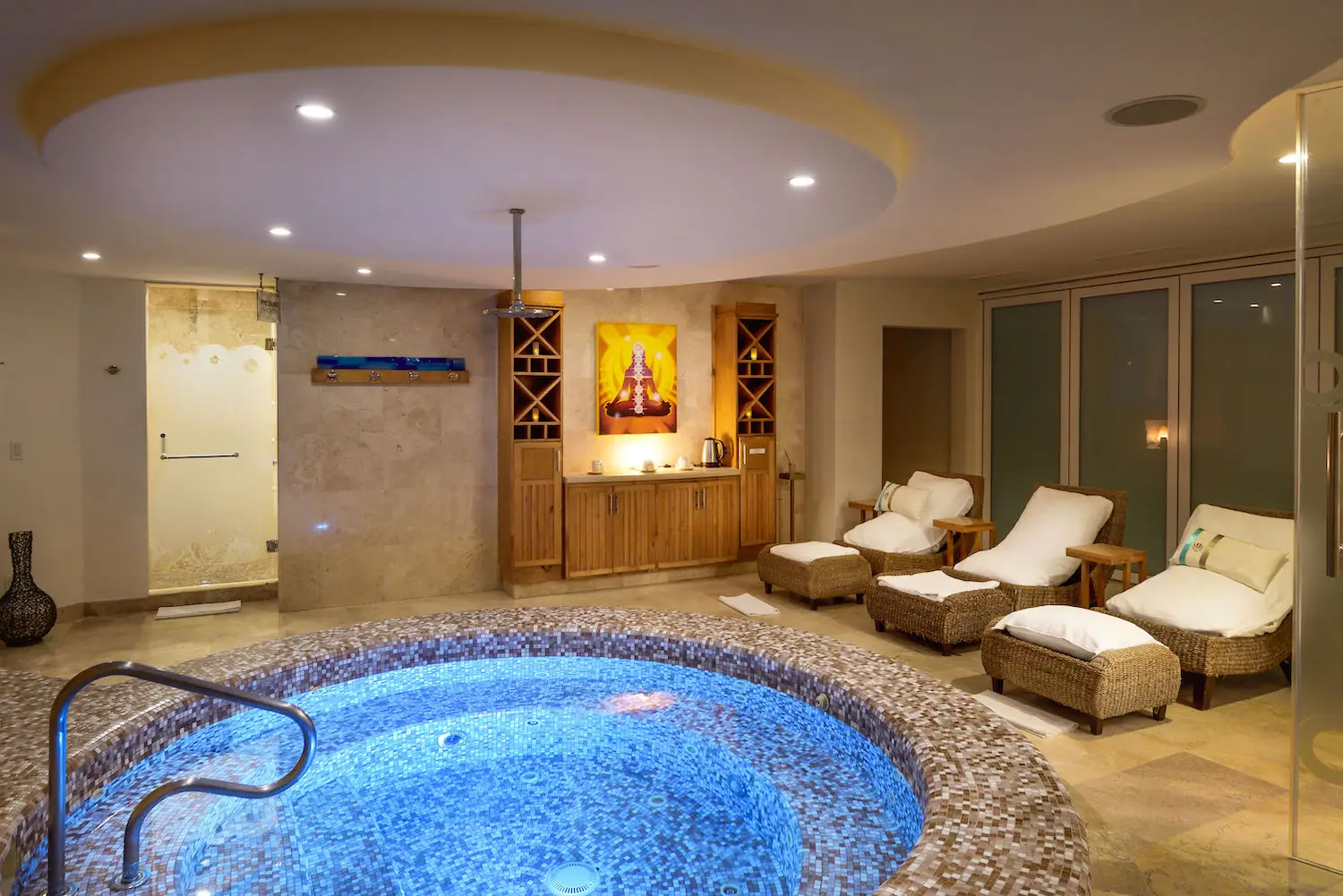
“[The energy healing] is a ritual that we offer because our guests like to have a little bit from Mexico. It’s a prehistoric ritual that is used to cleanse all the bad energies,” spa manager Elizabeth Cravioto says. “We are also trying to get you back to the now—[it can be] really difficult to disconnect from work or family or your worries. That’s what the cleansing is for, to give you a moment.”
Following the cleansing, I made my way into a treatment room for the spa’s new service, a tequila-based, 80-minute, full-body massage which starts with a foot washing ritual featuring mint, sea salt, lemons, and tequila. This is followed by a shot of tequila—to “relax you,” I’m told—before the massage begins.
After an exfoliating scrub; body mask; stone facial massage; and plenty of kneading, stroking, pressing, and releasing, I was ready to enjoy the rest of the trip.
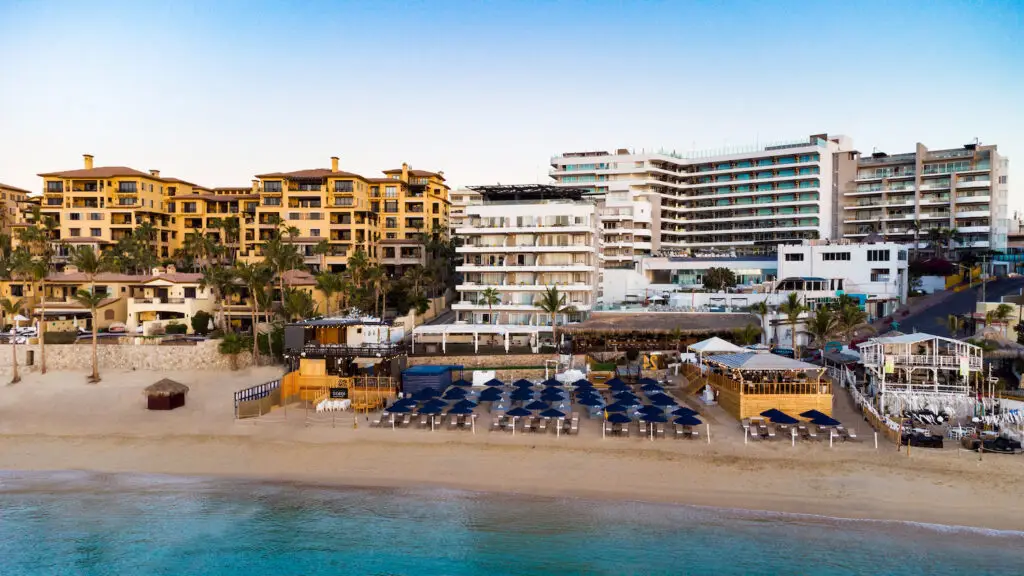
Corazon is located in the center of downtown Cabo San Lucas, situated on the beach and nestled in between popular tourist destinations like Mango Deck Restaurant & Beach Club and The Office. I’ve been staying in San Jose del Cabo for years, but this was my first time in over a decade passing a few days in this particular area.
I was looking for a relaxing vacation, so I wasn’t sure what to expect, since it’s known for its daytime party scene and lively nightlife vibes. But, for president and CEO Christopher Erickson, its location is part of why he loves the hotel.
In 1999, Erickson acquired the previous Cabo Villas with his family when only six villas sat in its location. “Everybody said, ‘You’ll never make it,’” Erickson.“They all said, ‘You’re going to be eaten up by the brands’”—that is, hotels like Hilton, Sheraton, Fiesta Americana, and the Four Seasons, which moved in shortly after he bought the property.
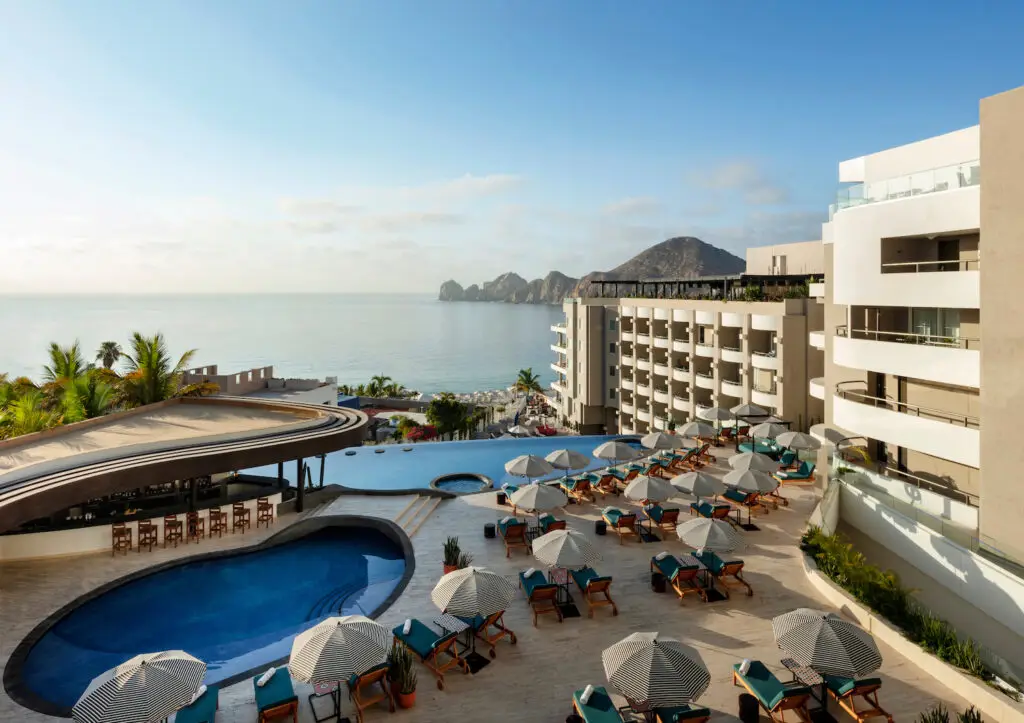
While the hotel’s size is not comparable to other big-brand properties, it’s not only lasted, it’s become a favorite for guests looking for a more boutique-like appeal while still being next to all the action.
“That’s been our claim to fame—a family-owned and operated hotel with personalized service right on the main beach,” he adds.
Erickson sees Corazon as a place where visitors can walk out their front door to experience local shops, eateries, and vendors, all while still having a serene space to come home to at the end of the day. For me—and for a friend and fellow guest I happened to run into on my visit—its quiet, more boutique nature made it feel especially safe for a solo woman traveler.
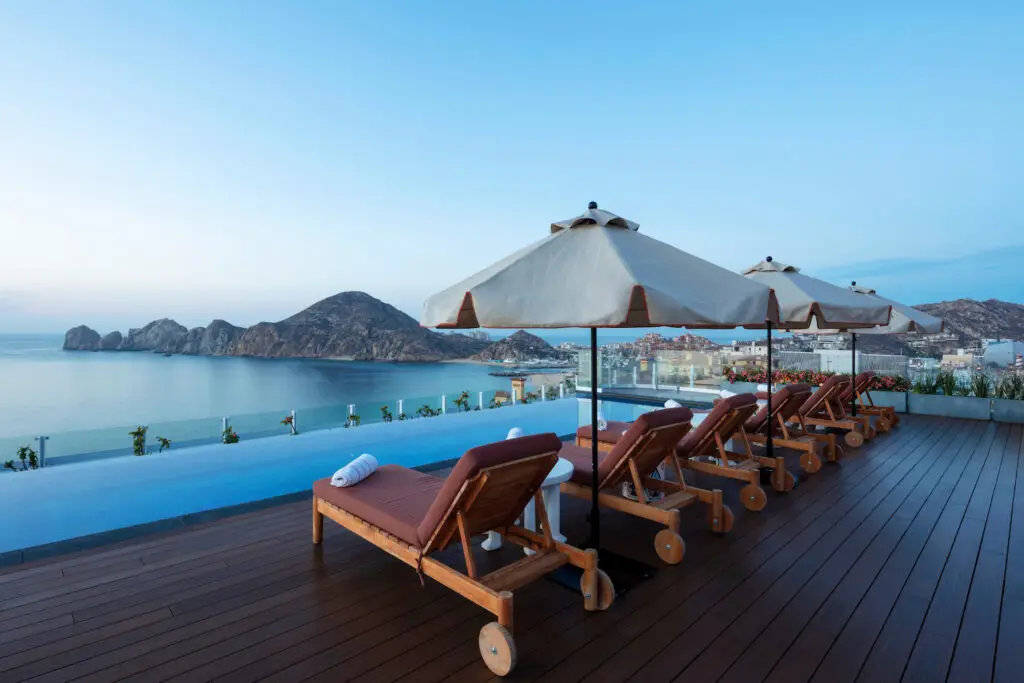
Of course, it also didn’t hurt that three years ago, the hotel reopened following a $100 million transformation. Updates included the debut of a new tower with 204 additional guest rooms and suites and two infinity-edge pools.
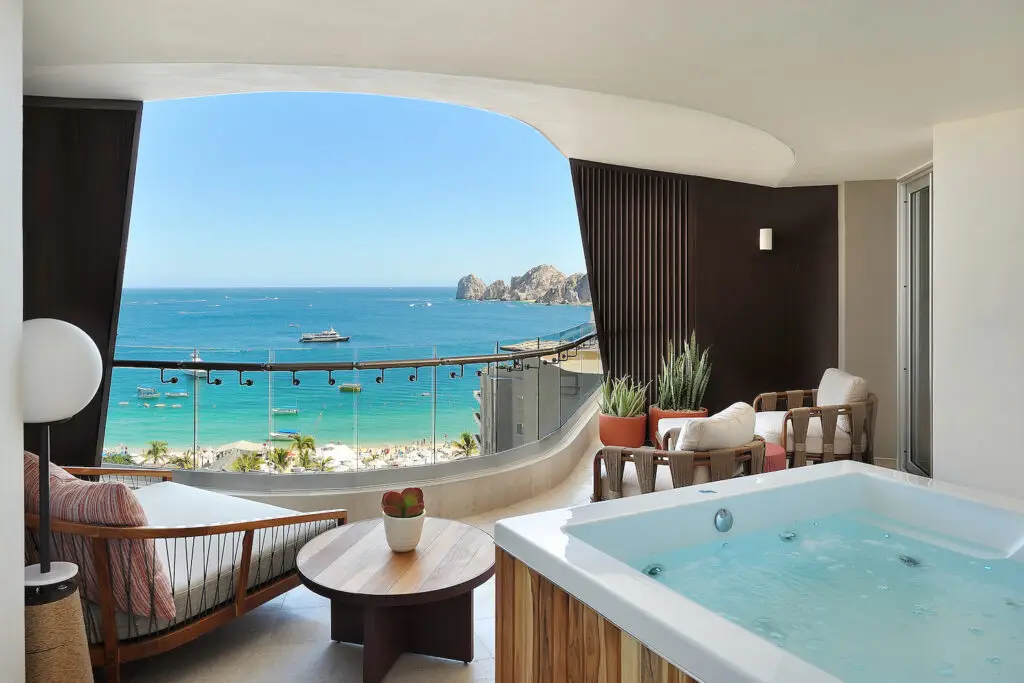
Many of the rooms overlook Land’s End, also known as “El Arco” and one of Cabo’s most popular landmarks. The hotel’s newest tower accommodations feature floor-to-ceiling glass sliding doors, décor influenced by Mexican culture, and, in some cases, hot tubs on the balcony. The largest of the stays is the three-bedroom Sunset Suite, which comes with 715 square feet of space, a full kitchen, four bathrooms, a terrace with private hot tub, and marina or city views.
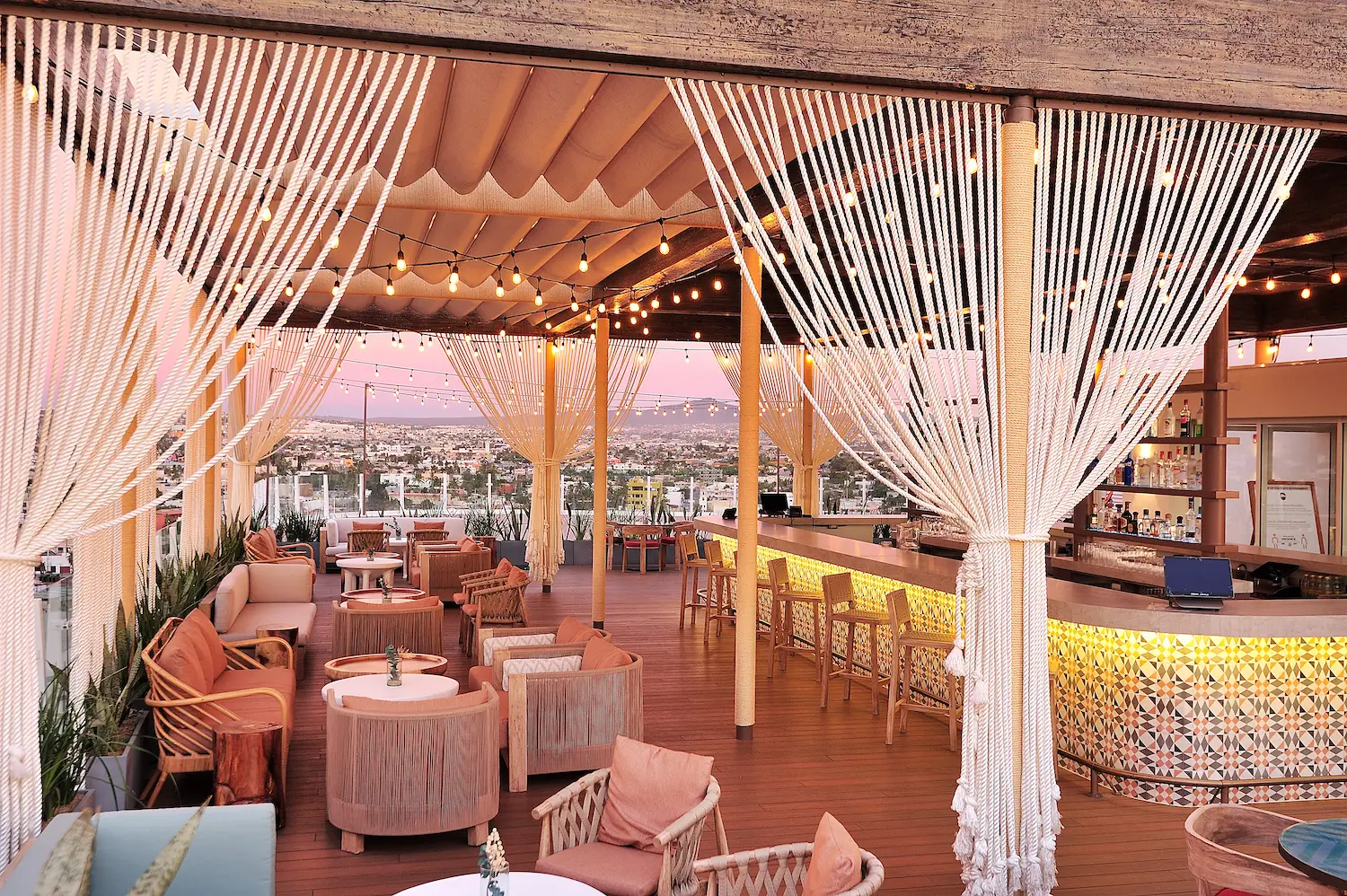
Among its other upgraded amenities is a 360-degree rooftop bar (currently the highest in the city) and infinity pool which includes a full bar and dining menu. Guests can enjoy ceviches, sashimi, poke, salads, tacos, nachos, and sushi rolls while soaking up the sun.
After a relaxing day of swimming and spa-going, I made my way up to the rooftop for a tequila tasting which features three varieties of Don Julia—anejo, blanco, and reposado—and lessons on what makes each so unique. As the sun slowly disappeared and the liquid relaxation set in, I made my way to Aleta for dinner.
The upscale restaurant features a mix of sushi and raw bar offerings, along with local specialities like tortilla and seafood soups, rolled tacos, paellas, and churros with ice cream for dessert. Guests can also opt for the fish of the day made to order (fire-grilled, steamed, or fried).
On my last evening, as I tucked myself into bed, a sense of calm that swept over me. I had come to Cabo with a million to-do lists and the stresses of everyday life weighing on me, but in that moment, the only thing on my mind was the late-night room-service tres leches cake I ordered. While vacations can sometimes leave us needing a holiday from our trip, this one felt like a cleansing. A restart to the year with only endless possibilities ahead.

Nicolle Monico is an award-winning writer and the director of creative projects, digital editor for San Diego Magazine with more than 16 years of experience in media including Outside Run, JustLuxe and The San Francisco Chronicle.
Free and low-cost options for getting in on the pop culture action outside of the convention center’s walls
It’s happening, San Diego. The pre–Comic-Con excitement jitters begin to creep in as soon as July hits the calendar. But for those who forgot to set an alarm on registration day, whose batteries died or whose luck ran out in the virtual waiting room, or who simply prefer to soak up the fandom frenzy from the outside, we’ve got the best ways to experience Comic-Con weekend—no badge required.
Ain’t no party like an after-hours party, and XLE Productions’ Ready Party One is definitely one for comic book fans. Kick-start your convention weekend at Parq Nightclub and enjoy music by fan-favorite ’80s tribute band The Flux Capacitors, along with enough fandom fun, cosplay, retro gaming and pop-culture nostalgia to satisfy your inner geek. At least for the night.
Date & Time: Wednesday, July 22, 8 p.m.
Location: Parq Nightclub, 615 Broadway, San Diego, CA 92101
Price: Tickets start at $34
With more than a dozen activities and brand activations, Petco Park’s Interactive Zone is a badgeless fan’s playground, bringing together brands, games, celebrity appearances and immersive experiences all in one place. On Friday, July 24, Funko’s beloved annual party, hosted by Funko founder Mike Becker, returns to Gallagher Square. This year’s “Quest for the Grail” event will take guests on a journey to the sunken city of Atlantis. Expect themed décor, food, drinks, games and special guest appearances.
Date & Time: Thursday, July 23–Sunday, July 26 (times TBD)
Location: Lexus Premier Lot across from Petco Park
Price: Free; Funko Funday event is ticketed
Cartoon and art lovers can celebrate the work of Chuck Jones, creator of some of animation’s most iconic characters, including Bugs Bunny, Daffy Duck, Road Runner, Wile E. Coyote and Pepé Le Pew, at Seaport Village’s Chuck Jones Gallery. During Comic-Con weekend, the showroom will also host meet-and-greets with talented artists including Disney artist and seascape painter Steve Barton, The Simpsons animator Stephen Reis, and licensed Warner Bros., Hanna-Barbera and Disney fine artist Ben Olson.
Date & Time: Thursday, July 23–Saturday, July 25, 2026 (times TBD)
Location: Chuck Jones Gallery, 809 W. Harbor Drive, San Diego, CA
Price: Free
Get your pup’s—and your own—cosplay game ready because Helen Woodward Animal Center’s PAWmicon is back. Enjoy a Comic-Con-themed outing with the whole family while raising awareness for orphaned pets in San Diego. Divided into three categories—Flying Solo, Dynamic Duos & Trios & More, and Fantastic Floats—the event is a paw-fect way to jump-start the festivities.
Date & Time: Tuesday, July 21, 2026, 4:30–7 p.m.
Location: Presidents Way Lawn at Balboa Park
Price: Free
Why leave all the fun, mischief and mayhem to badge holders when you can join more than 300 partygoers and crawl through some of downtown San Diego’s top bars and nightclubs? Whether you’re called to save the universe or have an allegiance to the dark side, the annual Comic-Con Bar Crawl gives attendees exclusive access to more than 20 venues throughout the Gaslamp Quarter, with free welcome shots, exclusive drink discounts and complimentary entry along the way. This event for ages 21 and older is a fun way to celebrate your fandom outside the convention center.
Date & Time: Friday, July 24–Sunday, July 26, 2026, 8 p.m.–2 a.m.
Location: Check-in at Toro, 672 Fifth Ave., San Diego, CA 92101, from 8–9 p.m.
Price: $13–$30
Geek out over couture at the annual Her Universe Fashion Show at the Manchester Grand Hyatt. Hosted by founder and Star Wars: The Clone Wars actress Ashley Eckstein and presented by Warner Bros. Discovery Global Consumer Products, this year’s show will feature a selection of designers showcasing one-of-a-kind DC-inspired creations as they compete for a $2,000 cash prize.
Note: Wristbands are traditionally distributed the morning of the event on a first-come, first-served basis, but official details have not yet been announced.
Date & Time: Thursday, July 23, 6 p.m.
Location: Manchester Grand Hyatt, Seaport Ballroom, 1 Market Place, San Diego, CA 92101
Price: Free
A destination for all things fandom, Balboa Park’s Comic-Con Museum brings world-premiere and exclusive exhibits and events to the heart of San Diego, giving fans a place to geek out all year long. The museum is currently featuring the U.S. debut of Doctor Who Worlds of Wonder, showcasing 17 of the Doctor’s most iconic costumes, a full-size TARDIS and a collection of original sonic screwdrivers used on-screen. Visitors can also explore Sangre, Sudor y Mito: The Art and Tradition of Mexican Lucha Libre, featuring rare collectibles and authentic masks and costumes worn by legendary luchadores.
Date & Time: Open Thursday through Tuesday (closed Wednesdays), 10 a.m.–5 p.m.
Location: 2131 Pan American Plaza, San Diego, CA 92101
Price: $15–$30; free for children younger than 6
Browse an extensive collection of original drawings, paintings, jewelry and other whimsical creations from more than 100 professional and amateur artists at the Comic-Con Art Show. Many pieces will be available for purchase through the silent auction or Quick Sale, giving fans the chance to take home a one-of-a-kind Comic-Con souvenir while supporting talented artists.
Dates & Times:
Location: Manchester Grand Hyatt, Grand Hall CD, 1 Market Place, San Diego, CA 92101
Price: Free
Looking for a supercute way to fuel your Comic-Con adventures? Swing by the Hello Kitty Café Truck. This traveling pink café on wheels will be parked at Petco Park’s Interactive Zone, serving up tasty treats and exclusive merchandise. From limited-edition tote bags and hats to mugs and T-shirts, it’s the perfect stop to grab a snack and a little extra kawaii cuteness.
Date & Time:
Location: Petco Park Interactive Zone, 100 Park Blvd., San Diego, CA 92101
Price: Menu items vary
Get ready to fuel up and hype up. Whether you’re a plain-bagel purist or an everything-bagel fan, don’t miss your chance to grab breakfast or recharge at PopUp Bagels’ Volkswagen bus parked outside Pendry San Diego. Then satisfy your sweet tooth at Provisional with a rotating selection of character-themed doughnuts from Donut Bar. Both are available throughout the weekend beginning at 7 a.m. until sold out.
On Saturday, July 25, from noon to 3 p.m., head to Nason’s Beer Hall to celebrate Sony Pictures’ upcoming Spider-Man: Brand New Day. Guests can sample Tom Holland’s nonalcoholic beer brand, BERO, served in limited-edition themed cans available exclusively during the event.
Camila Ibarra Gallego is a CaliBaja native pursuing a master's degree in culinary journalism at the Basque Culinary Center. Shaped by the culturally rich, bicultural megaregion, she's passionate about sniffing out stories that connect people, territory and culture through food. When she's not tumbling down internet rabbit holes, you can find her pretending to be a wine connoisseur at a local wine bar or nose-deep in a good book.
A massive $1.3 billion construction project is slated to improve the border-crossing process—will it live up to its expectations?
You’re coasting home after a weekend in Rosarito Beach—still riding the high of vitamin D and Baja Med—and then comes a slap back into reality: brakelights and gridlock exhaust.
Small wonder, given that San Ysidro is the busiest land border crossing in the western hemisphere (fourth-busiest in the world). Otay Mesa’s no breeze either; it’s the busiest commercial port in California and second-busiest across the entire southern border. Smart Border Coalition says that each day last year, 41,800 vehicles crossed into the US at San Ysidro; 17,800 crossed at Otay Mesa, along with 1,023,000 commercial trucks.
Diana Pazos, a San Diego resident and adolescent psychiatrist working in Tijuana, says the northbound border wait at the San Ysidro crossing is often three to five hours Saturday through Monday—delays that modern humans and multinational maquiladoras alike aren’t built to endure. At the current Otay crossing, “commercial trucks may be in line for six hours or longer,” she says.
Needing to bake a couple hours of commute into the States doesn’t just affect vacations; tens of thousands of people cross the border each day for doctor’s appointments, work, school, you name it. The clog has personal and commercial ramifications.
But change is coming. Construction has begun on a new border crossing in Otay Mesa, which is expected to significantly reduce wait times across all San Diego border crossings, bolster binational trade, and improve the air pollution levels in the area.
Nikki Tiongco, an 18-year Caltrans veteran who oversees the Otay Mesa East project (aka Otay 2) for the agency, says the new border crossing will also be among the most high-tech, efficient, and secure border crossings in the nation.
“We have already completed the roadway network within the Otay Mesa East region,” says Tiongco. Part of this project included building State Route 11, an extension of SR 905, which has been open to the public since August and will feed traffic to the new entry port. Otay 2 comes with a 21st century upgrade, too. Miles of fiber-optic cables have been installed underground, which gives the port the brainpower to efficiently sort and streamline traffic as cars approach the border. (Unlike the San Ysidro border, where lanes get organized by vehicle type, Otay 2’s lanes will be interchangeable. For example, if the system indicates that a high number of commercial trucks is heading to the border, passenger lanes could be converted to cargo lanes in real time.)
Otay 2, driven by a binational collaboration among government agencies (Caltrans, SANDAG, General Services Administration, and U.S. Customs and Border Protection), receives both federal and state funding, plus hefty contributions from Mexico. So far, funds from the $1.3 billion project have helped build new bridges and roadway interchanges that will guide traffic to the crossing. At this stage in the process, Caltrans is “laser-focused on building the facility itself,” Tiongco says.
Now, to the juicy part: the prospect of a “20-to-30-minute border wait time” at Otay 2, according to Tiongco. Currently, there are three standard ways to cross the border at San Ysidro: Ready Lanes, General Lanes, or SENTRI Lanes. Most travelers use either the Ready or General lanes. SENTRI Lanes require a form of pre-approval from the US federal government plus an additional fee. According to CBP, the average wait time in 2025 at the San Ysidro crossing, was as little as 15 minutes in the SENTRI Lanes, 45 minutes in the Ready Lanes, and 1.5 to 2 hours in the General Lanes. Those are best-case scenarios that vary based on lane type and time of day.
Otay 2 is about 12 miles east of the San Ysidro crossing and 2.5 miles east of Otay 1. Those not wanting to spend that much extra time on the road to drive to the new border crossing, despite the allure of an under-30-minute wait, are still expected to see some benefits. Tiongco says Otay 2 will “provide a relief valve” overall by spreading the burden across the three border crossings. As a result, SANDAG says, wait times at San Ysidro and Otay 1 could be cut in half.
It’s not just your time waiting at the border that matters. Multinational corporations that relocated their manufacturing plants (maquiladoras) to Northern Baja have claimed for years that the long delays at Otay 1 eat away at their profits. More than 600 maquiladoras, used by companies such as Samsung and Panasonic, currently use Otay 1 to transport products to US and international markets. Ambassador Alicia G. Kerber-Palma, the consul general of Mexico in San Diego, says the project will facilitate more than $60 billion in cross-border trade annually.
Previous reports say that Otay 2 also has the capacity for around 12,000 passenger cars and 1,500 commercial trucks daily. A shiny, new element to this port: Commercial and personal vehicles that choose to cross will pay a dynamic toll on both sides of the border. The fee will increase during busy hours and decrease during slower periods, Tiongco says. Caltrans estimates that the toll could range from $4 to $30 for passenger vehicles and higher for commercial trucks. Drivers will be able to see current rates before they reach the actual border crossing.
And, with these changes, there are environmental benefits, too. “With shorter wait times at all three ports, there’s less idling and congestion, which should significantly reduce air pollution on both sides of the border,” says Kerber-Palma. The main factor driving improved air quality would be decreasing dirty emissions from idling diesel trucks. This county’s air could use some sprucing up, anyway. A 2026 report from the American Lung Association named San Diego as the fifth-most particle-polluted county in the US. The bulk of that dirty air comes from the heavy-duty trucks and ships that pass through the area.
Otay 2 is not only expected to curb the acceleration of air pollution in San Diego; if the state’s legislature passes California Senate Bill 10, the border crossing could also restore local water quality. This bill would use a portion of Otay 2 toll revenues to fund ongoing maintenance of the South Bay International Wastewater Treatment Plant. Current media reports say, however, that it’s increasingly unlikely that SB 10 will become law.
Otay 2 has been in the works for over two decades and is finally nearing the finish line. Construction estimates show that it should be up and running in 2029. Tiongco says this border crossing is “a good example of how the state, federal and local governments are working together and with Mexico to advance our mutual goals in the region.”
Adam is a longtime San Diego journalist and communications pro. He covers everything from politics and culture to surfing and business.
From San Diego’s coastline to Los Angeles stadium and fan zones across the region, here’s how to experience soccer’s biggest event
When three nations and 16 cities come together to host the FIFA World Cup 2026, the scale stops feeling like a tournament and starts feeling like geography. A continent becomes the stage as borders soften into corridors. And Southern California—shaped by migration, sport, entertainment, and constant movement—sits inside that landscape with all eyes on it.
San Diego and Los Angeles have always felt connected. Hop on the Pacific Surfliner, and the trip unfolds in one continuous stretch of coastline, passing beach towns, neighborhoods, and city centers.
Traveling from San Diego, everything still feels slightly suspended as the Pacific Surfliner follows the coast north with ocean on one side and a slow suburban blur on the other. San Diego stays in exhale. Los Angeles is already building toward something louder.
This summer, Los Angeles will host eight matches of the FIFA World Cup at Los Angeles Stadium, including the US Men’s National Team opener on June 11, while the region stretches into 39 days of programming across stadiums, parks, transit hubs, beaches, and neighborhoods. Instead of one massive fan hub, Los Angeles is embracing a citywide celebration, with fan zones spread across its entirety.
But this pattern has been rehearsed here for decades. In 1994, Southern California became one of the defining stages of the World Cup, when matches at the Rose Bowl placed global attention on the region and turned local stadiums into international landmarks, confirming its ability to hold the world at scale.
What distinguishes Southern California is not just infrastructure, but cultural permeability. Fashion, music, film, art, and sport constantly overlap here, creating an environment where identity is flexible and always in motion. From the Venice boardwalk, where skate culture shaped modern street style, to global soccer stars rubbing shoulders with Hollywood celebs, to authentic Spanish cuisine moving up and down the I-5 corridor, everything circulates.
The World Cup is not introducing anything new here, it’s showing up for the summer and showing out, revealing what this city has always known about itself. What follows is a look at the fan zones and how Los Angeles turns itself into a city-wide stage for the tournament, one neighborhood at a time.

As the heart of Los Angeles, Union Station is an official Fan Zone June 25-28 during the World Cup, but in practice it never really stops being one.
It is the city’s circulation point, its meeting ground, its pressure valve. Commuters, travelers, match-day crowds, and everyday Angelenos all move through the same space, and everything mixes, overlaps, and scales in real time. In a way, this is where the World Cup stops arriving in Los Angeles and starts moving through it.
The Pacific Surfliner from San Diego to Los Angeles makes that shift feel almost too easy. No stress or gridlock anxiety, just a straight line up the coastline with ocean on one side and everything slowly becoming more built on the other. It’s one of the rare ways into LA that doesn’t feel like arrival as friction. You can sit with a laptop, watch the Pacific drift past, grab coffee from the café car, and let the city come to you in pieces.
That’s the beauty of arriving at Union Station. Instead of feeling like you’re on the edge of the city, you’re immediately surrounded by it. And, inside, the station already reads like a World Cup nerve center: banners, movement, multilingual energy, the sense that something global is about to funnel through this exact point. The Heart of the City Fan Zone only sharpens that feeling, with simultaneous match screens, DJ sets, meet and greets, and immersive activations built around marquee games like USA vs. Türkiye.
From there, the city splits outward.
ROW DTLA feels like the first exhale after arrival. A converted industrial campus turned creative district where restaurants, retail, and open-air courtyards form a self-contained ecosystem. If you’re looking for the perfect first meal in LA, make it lunch at Pizzeria Bianco. The thin-crust pizza is reason enough to go, but the space leaves just as much of an impression.
What I liked most about ROW DTLA is how quickly it resets you after the train. One minute you are stepping off at Union Station, and the next you are in a space that feels like its own version of LA, a city inside a city with some of the most curated shopping I’ve ever seen.
Bodega hides itself behind a convenience-store front, a sneaker and streetwear space disguised as something ordinary, like LA refusing to make anything feel too obvious. The whole campus moves like that, part retail, part gallery, part neighborhood you are only temporarily inside.
Isabella Dallas is a freelance writer for San Diego Magazine and the Arts and Culture Editor at The Daily Aztec in her final year at San Diego State University. She previously worked as an editorial intern for SDM, but when she’s not writing, you can find her trying the best coffee spots in SD, devouring the latest rom-coms, and indulging in anything and everything pop culture.
Tips from the trusted experts at Mauzy Cooling, Heating, Plumbing, and Electrical
San Diego summers can be brutal. But since the hottest period is typically late summer into early fall, San Diegans still have time to prepare. The pros at Mauzy Cooling, Heating, Plumbing, and Electrical are standing by to help homeowners fortify their homes against the elements and ensure their air conditioning is as frosty as the penguins that serve as the company’s mascots.
Many homeowners underestimate the load their AC system faces, especially in the inland valleys where temperatures regularly top 100 degrees. San Diego regularly sees multi-day heatwaves each summer, and a system that struggles on the first day will likely fail by the third. Longer run times, unusual sounds or smells, and uneven cooling from room to room are all signs that your system may not survive the next hot spell.
Systems typically last 12 to 17 years, but there are exceptions. If a system is approaching that, or is already there, a professional evaluation is recommended before summer really heats up. A good rule of thumb: If you can’t remember when your system was last serviced, it’s due.
“As technology changes, systems become smarter and smarter,” says Sean O’Connor, an install manager at Mauzy with 42 years of experience. “There are a lot of people out there who will say a system’s only good for 10 years. I don’t buy that—these systems are built to last as long as they’re taken care of.”
There are also a few steps homeowners can take between services to extend the life of their system. Regularly changing a dirty filter—especially if you have kids or pets—and keeping an outdoor unit clean can help head off problems in the future, says O’Connor.
Also, be realistic about whether it’s time to replace a unit. O’Connor likens pouring money into salvaging a faulty unit with patchwork repairs and replacement parts to “tripping over a dollar to pick up a dime.” When one part fails, others are sure to follow, and newer parts may not be compatible with older units. Mauzy recommends homeowners use the 50% rule: If a repair costs more than 50% of the system’s replacement value, and the equipment is over 10 years old, replacement is usually the better long-term value. And don’t forget the ducting. An older house that was built with heat and later had air conditioning added may not have sufficient airflow, regardless of how good the system is.
Last but not least, homeowners should know who to trust when it comes to their homes. Built on three generations of professional integrity, Mauzy has grown into not just a leader for cooling, heating, plumbing, and electrical services, but a leader in the community known for supporting local nonprofits across an array of causes. To ensure complete peace of mind, Mauzy stands behind a comprehensive 12-point guarantee that outlines its commitment to outstanding service, quality equipment, expert technicians who understand how the local microclimates affect HVAC performance, and no upsells or surprises on the bill.
“We go the extra mile. That’s what sets us apart,” O’Connor says. To get a free quote today, visit mauzy.com.

Một Bánh Mì melds Vietnamese and Mexican traditions in a new pop-up concept featuring its take on a local favorite
Is there any food more quintessentially San Diegan than the California burrito? That was a rhetorical question since the French fry-stuffed, flour tortilla-wrapped torpedo of carne asada bliss came into being in the 80s (either invented by Lolita’s or Santana’s, depending on who you ask). But now, Vietnamese-Mexican pop-up Một Bánh Mì may be giving the longtime champ a run for its money.
Một Bánh Mì’s original California banh mi takes cues from both cultures, using traditional Vietnamese baguettes from Paris Bakery filled with carne asada and garnished with cilantro-jalapeno crema, Vietnamese mayonnaise, pickled vegetables, cilantro, cucumber, jalapenos, and of course, French fries.
“It’s so San Diego—it’s so us,” says Desmond Bui, pop-up founder and owner with partner Marisol Santiago. “It really encapsulates the Vietnamese-American and Mexican-American journey and identity here.”
Both grew up in San Diego. Bui is Vietnamese. Santiago is Mexican-American. The sandwich makes utter personal sense.
Neither of them cooked professionally before launching Một Bánh Mì earlier this year, when they popped up for the first time at Convoy Rising for Lunar New Year. But after seeing the rise of the local Vietnamese coffee scene with shops like Saigon Coffee, Chance’s Coffee, and Em Coffee House, Bui knew there was an opportunity for a new generation to put a fresh spin on Vietnamese food in San Diego.
While there are plenty of places to grab a banh mi around town (K Sandwiches, Ba Le French Sandwich Shop, Lee’s Sandwiches, and so on), we’ve yet to hear of a California banh mi. Firsts are being firsted.
“Banh mi is regarded by top chefs as the best sandwich in the world,” says Bui. (Side note: I concur.) And after discovering overlap between Mexican and Vietnamese cuisines through common ingredients like cilantro, lime, jalapeno, white onion, and pickled vegetables, they began planning a menu.

Một Bánh Mì also serves Bánh Mì Đặc Biệt (Vietnamese cold cuts), Bánh Mì Thịt Nướng (grilled lemongrass pork banh mi), and Bánh Mì carnitas de hongos (mushroom pâté banh mi), along with some specials like Thịt Nướng tacos (grilled lemongrass pork) and hopefully soon, al pastor trompo banh mi (marinated pork shaved off a spit) and charcoal-grilled adobada.
Other banh mi shops Americanize names for English-speaking audiences—for example, listing “grilled chicken sandwich” instead of Bánh Mì Gà Nướng. Not Một Bánh Mì. If you’re not sure how to pronounce something, Bui says they’re happy to help. It’s an educational opportunity, he explains, as well as a chance for them to be “unapologetically Vietnamese and Mexican.”
Part of the immersive experience is playing Vietnamese tunes from the ‘60s and ‘70s.
“When you think of universal languages, what are ways when you travel or meet a different group of people that you can still find common ground and connect and feel like we’re a lot more alike than we are different?” Bui asks. “Food and music.”
The musical element is part of Một Bánh Mì’s greater vision. They’d like to evolve into a lifestyle brand and media company, with merch, jars of pickled vegetables, you name it. Eventually, they’d like to open a brick-and-mortar somewhere in Mid-City. In the meantime, they’ll continue to pop up at places like Mixed Grounds and Chance’s Coffee, or wherever they can. (Bui called Provecho Coffee their “dream collab,” hint hint.)
Listen Now: The Latest in San Diego’s Food and Drink Scene
Have breaking news, exciting scoops, or great stories about new San Diego restaurants or the city’s food scene? Send your pitches to [email protected].
Beth Demmon is an award-winning writer and podcaster whose work regularly appears in national outlets and San Diego Magazine. Her first book, The Beer Lover's Guide to Cider, is now available. Find out more on bethdemmon.com.
Stop by the San Diego Writers Festival, traverse the Tour de France Wine Dinner and watch the Padres play on Opening Day
Just as seasons for the Clippers and Sockers come to a close with Fan Appreciation Nights, a new set of 162 games will begin for the Padres on Opening Day. The return of Padres baseball also means the Friar faithful can check out Margaritaville Hotel’s Padres’ Kickoff Rooftop Party and the celebratory East Village Block Party. Those who prefer an outing at the theater over a day at the ballpark can see local productions of The Lehman Trilogy and Matt & Ben or the debut of works by women+ playwrights at the Lamoise New Works Festival. Plus, fans of live music can see Lang Lang, Digable Planets and fifteen San Diego County choirs in concert this week.
Food & Drink | Concerts & Festivals | Theater & Art Exhibits | More Fun Things to Do

A few blocks from the Padres’ home opener at Petco Park, fans can say cheers to the new season during the free Padres’ Kickoff Rooftop Party at Margaritaville Hotel. This Thursday from 3-7 p.m. at the hotel’s 5 o’Clock Somewhere Bar, patrons can catch a set from DJ Chino of iHeart Radio Channel 93.3, plus enjoy photo ops, lawn games, mini golf and Padres merch for sale from The Finnish Long Drink. There will also be a themed game day menu, featuring items like the Grand Slam Philly Fries and the dragon fruit-infused Ballpark Paloma. RSVP here.
435 Sixth Avenue, Gaslamp
Take a gastronomic trek around France with Little Frenchie this Sunday at 6 p.m. during the Tour de France Wine Dinner. This four-course prix fixe meal will feature complimentary wine pairings and emphasize the unique culinary strengths of four French regions: Lyon, Provence, Burgundy and Normandy. Guests will be guided through the significance and history of the evening’s pairings by Rafael Peterson of H. Mercer Imports. Reservations are $150 per person.
1166 Orange Avenue, Coronado
Chinese pianist Lang Lang is among the world’s most well-known classical musicians, with his talents taking him everywhere from the Grammy Awards, to private shows for heads of state, to multiple Olympic opening ceremonies. His mastery of the keys, done with wonderful enthusiasm and dexterity, leaves no awe-inspiring detail behind. This Thursday (7:30 p.m.), Lang Lang will play a selection of recognizable pieces from Mozart, Liszt and Beethoven in concert at Jacobs Music Center. Tickets start at $95 for this concert.
1245 Seventh Avenue, Downtown
The melding of jazz and hip-hop has rarely sounded sweeter than on Digable Planets’ second album Blowout Comb. Though it proved to be their final project, it eternally cemented the group as one of the forebears of jazz rap, alongside acts from the Native Tongues movement like A Tribe Called Quest and De La Soul. In celebration of Blowout Comb’s 30th anniversary, Digable Planets will perform back-to-back nights at Belly Up, where they’ll be joined by San Diego artists Ric Scales (Friday) and Blame One (Saturday). Tickets start at $60 for both concerts.
143 South Cedros Avenue, Solana Beach
Aspiring writers and readers ranging from casual to voracious can enjoy a day of literary panels, workshops and readings this Saturday from 9 a.m. to 5 p.m. during the 7th annual San Diego Writers Festival. Held at the Coronado Public Library and Coronado Performing Arts Center, this year’s event will feature best-selling and emerging writers of romance, mystery, historical fiction and more. The lineup includes talks covering trauma, spirituality, and artistry in the age of AI, and a keynote discussion with novelist Jodi Picoult. RSVP for the free festival here.
640 Orange Avenue & 650 D Avenue, Coronado
Fifteen San Diego County choirs will fill The Conrad with vocal harmony during this Saturday’s San Diego Sings! Festival. Organized by the Choral Consortium of San Diego, audiences can catch performances by the San Diego Women’s Chorus, Encore Vocal Ensemble and the San Diego Children’s Choir. The performers will be split into three concert performances (11 a.m., 3 p.m., and 7 p.m.) inside Baker-Baum Concert Hall. Tickets are $23 for each of the three concerts.
7600 Fay Avenue, La Jolla
Ryan Hardison is a freelance arts and entertainment writer and recent graduate of San Diego State. When he's not staring at his laptop, he's likely eating an adobada burrito or getting sunburnt at the beach.
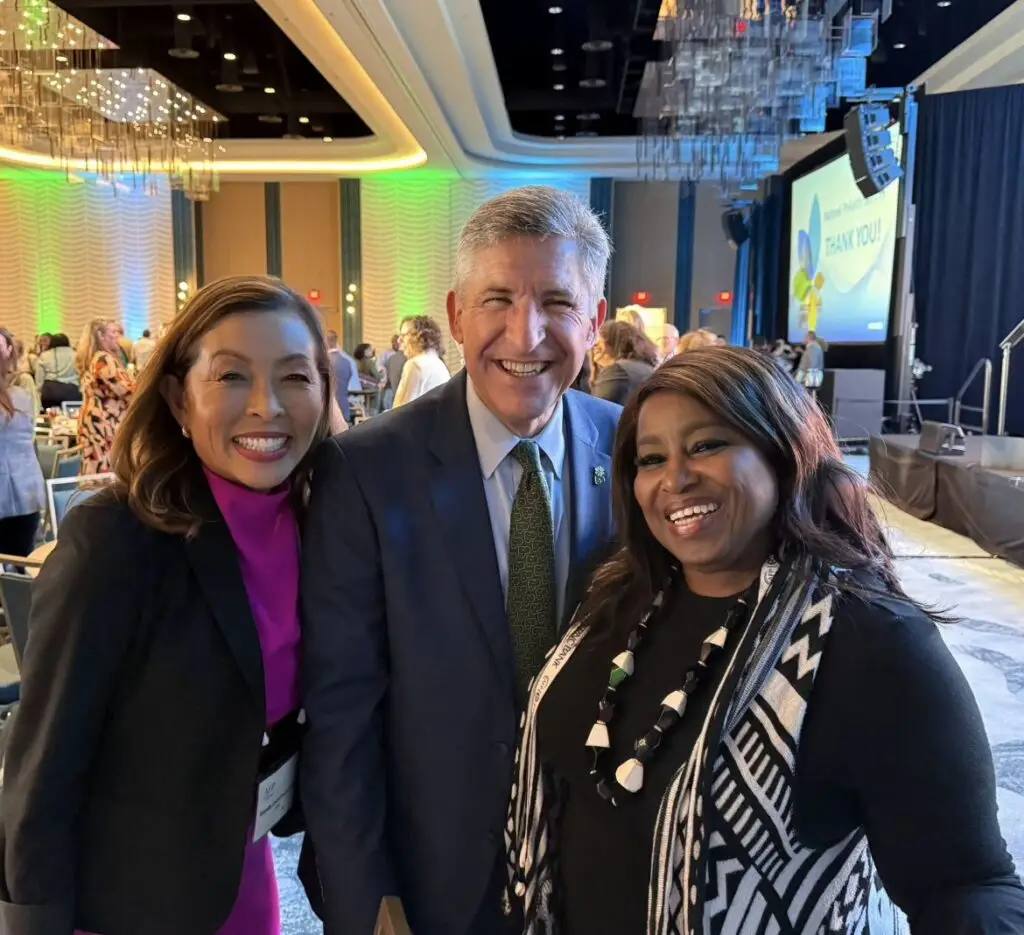
The 53rd Annual National Philanthropy Day Takes Place on November 21. Join us from 11:00 a.m. – 1:30 p.m. at the new Gaylord Pacific Resort & Convention Center!
Once yearly, AFP San Diego joins with others worldwide to celebrate National Philanthropy Day (NPD), a special day set aside to recognize the great contributions of donors and nonprofits that enrich of our community and the world. San Diego’s NPD is one of the largest and most successful in the U.S., attracting nearly 900 participants, including philanthropists, nonprofit leaders, CEOs, board members, development professionals, and business, community, and civic leaders.
Sponsorship proceeds from National Philanthropy Day are reinvested in education, training, scholarships, career development, and the advancement of fundraising professionals throughout San Diego. These resources and training provide fundraising professionals with the tools necessary to support our region’s diverse array of nonprofit organizations, which rely on charitable giving for close to half of their annual revenues.
The National Philanthropy Day Honorees are selected by the NPD Honorary Committee, a group of highly respected, diverse nonprofit and business leaders. Our 2025 Honorees include:
National Philanthropy Day San Diego provides an opportunity to reflect on the meaning of giving and to celebrate the selfless contributions of individuals and organizations across the region. We look forward to celebrating with you!
Sponsorship opportunities and individual tickets are available. Please visit www.afpsd.org for more information.