Featured articles
Food & Drink
Food & Drink
Food & Drink
Featured articles

Everything SD

Everything SD

Things to Do
Featured articles
Things to Do
Things to Do

Things to Do
Featured articles

podcast-ep

podcast-ep

podcast-ep
Featured articles

Features

Features

Food & Drink
Featured articles
Everything SD
Partner content
Everything SD
Ready to know more about San Diego?
SubscribeReady to know more about San Diego?
The North County retreat's $70M facelift includes a refreshed spa, a brand-new golf course, and more than 600 revamped guest rooms
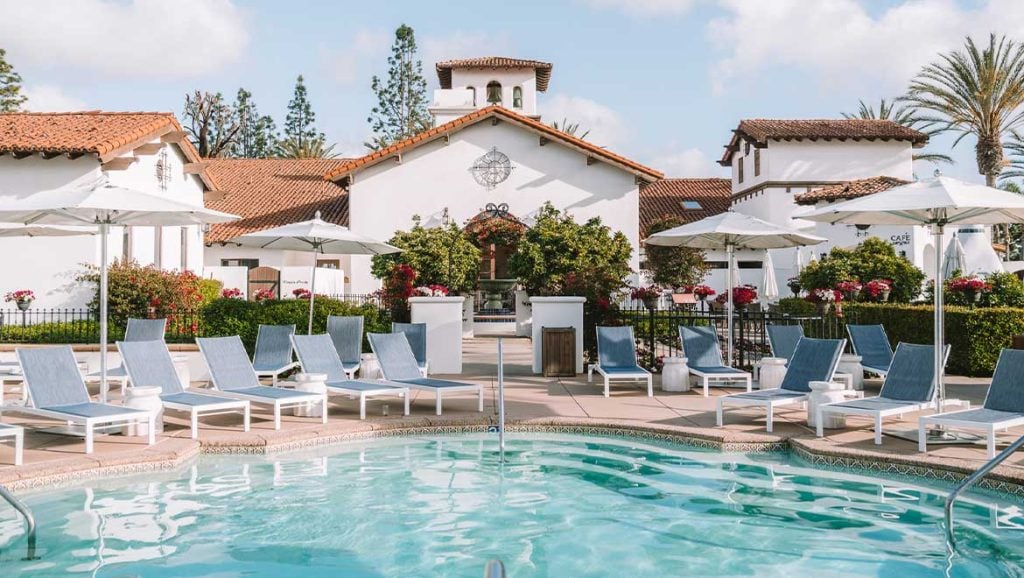
I’d love to tell you where I am, but I forgot about six minutes ago. Gentle, futuristic-sounding music, like an orchestra of benevolent aliens, trills in my ears. Whatever vessel I am laying on buzzes softly in tandem. A soft blanket warms my legs. After 20 minutes, the melody clicks into silence, the chair stills, and I recall that I’m not very far from home—merely in Carlsbad, perched in a meditation chair in the Omni La Costa Resort & Spa’s new “Luxe Room.” Between my recent fugue state and the massage before it, though, I might as well be a world or two away from my busy day-to-day life.
The Luxe Room is my personal favorite aspect of the 42-treatment-room spa’s recent multimillion-dollar revamp. Other new additions include vintage art (a throwback to the days when Jackie Kennedy spent time wrapped in the resort’s cozy robes), steam rooms scented with sandalwood and florals, and three hideaways tiled in salt crystals, said to ease stress and improve sleep.

Each of the latter rooms has a pair of those high-tech, thigh-high boots that squeeze your legs like blood pressure cuffs. They’re a helpful recovery tool for athletes, but after trying them and the spa’s “reflexology path”—a trail of embedded stones intended to poke the pads of your feet in therapeutic ways—I decide I’m more into the relaxation side of a spa day: letting the outdoor waterfall shower give me a second, informal massage; devouring carrot hummus at the onsite Spa Café.
The area’s serene energy differs wildly from the vibe at the Omni La Costa’s adults-only Edge Pool, which, on a Saturday, is crowded in a fun way, its shallow depths packed with drink-clutching hotel guests like a Vegas pool party. A DJ spins the afternoon’s bumping soundtrack, drowning out the happy shouts of children whipping down water slides at the nearby family-friendly Splash Landing Pools.
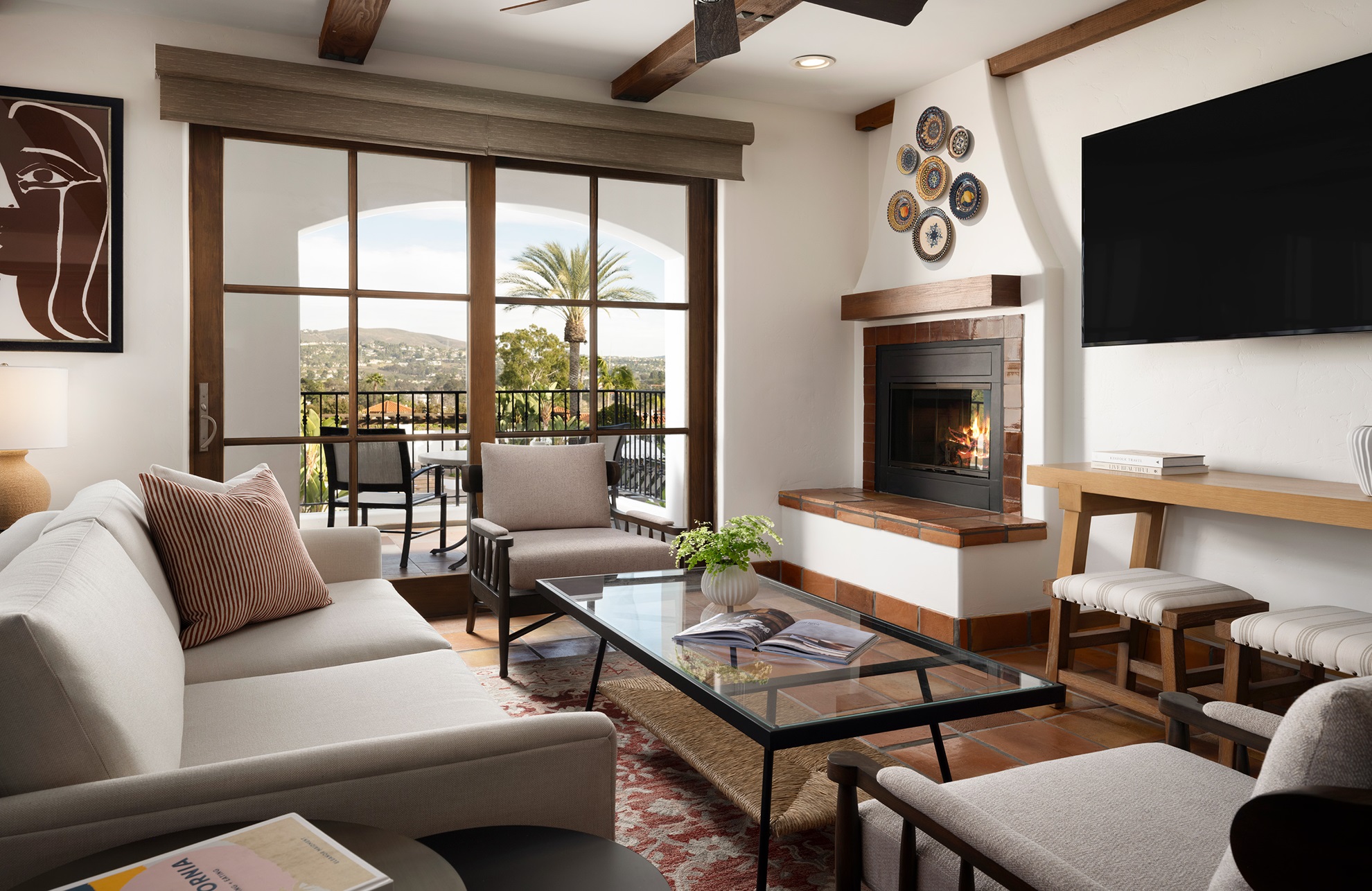
After a margarita each, my partner and I return to our room to change for dinner. The hotel’s 600 guest rooms and 170,000 square feet of meeting spaces also got recent updates, and the coastal-California-meets-Spain aesthetic sensibilities that have always defined its exteriors now further carry over inside. Our home for the night has high ceilings, soft colors, plush furniture.
But for me, a hotel is only as good as its amenities, so it’s a good thing the 400-acre property has no shortage, especially following the remodel. In addition to eight pools, the Omni La Costa houses two golf courses, including the freshly reopened, $25 million North Course, where college-aged golfers will compete in division-1 NCAA tournaments at least through 2026. A new putting green and practice range give guests a place to warm up before hitting the links. One could pass an entire week onsite without feeling the need to venture out, between six places to eat, a 9,100-square-foot gym, even shops vending vacation-y apparel.
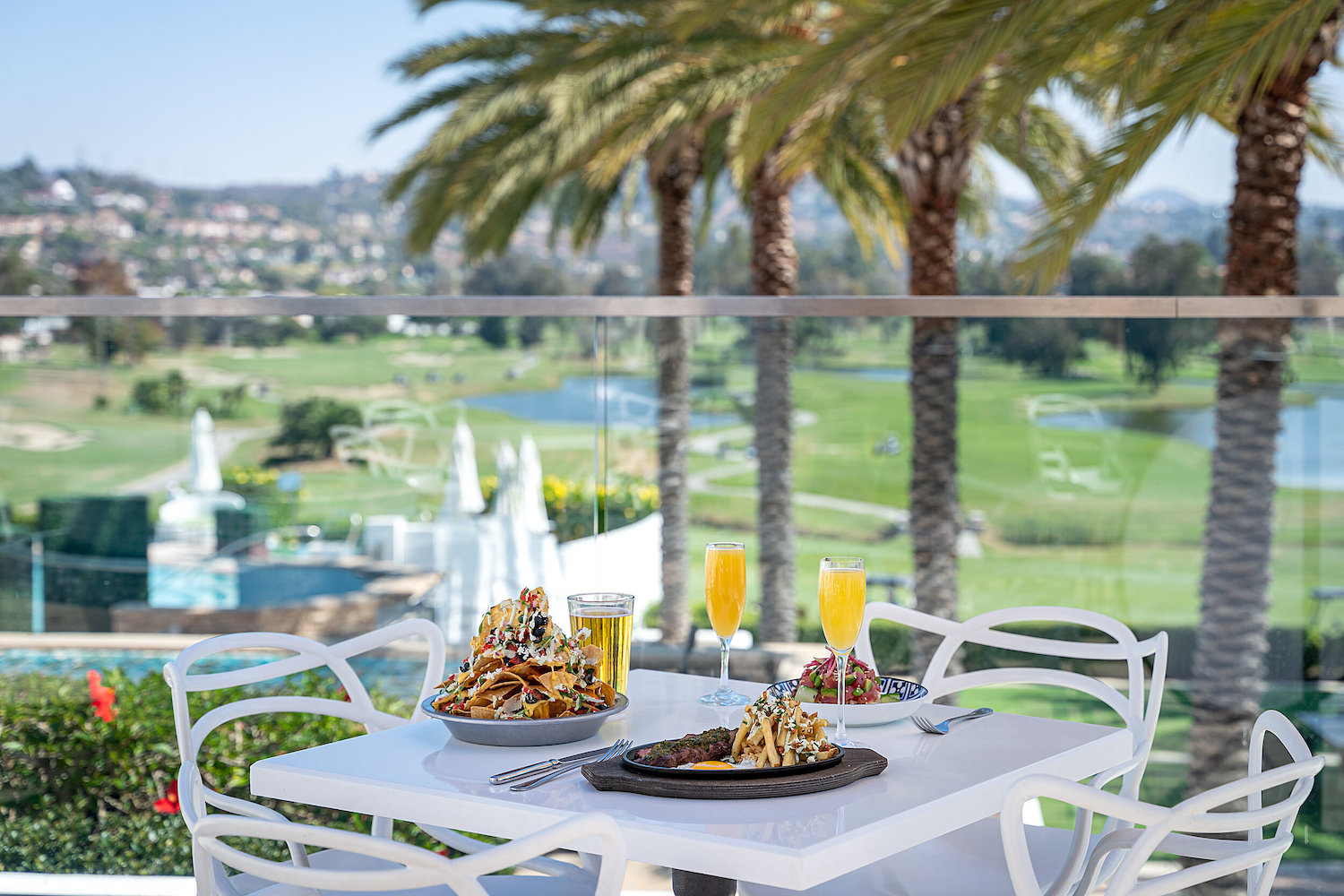
In the summer, the property hosts open-air concerts, which my partner and I tune into while sipping drinks from the thoughtful craft cocktail menu at Bar Traza. (If you’re into produce-driven California food, dine here instead of Bob’s Steak and Chop House, a classic white-tablecloth, meat-and-potatoes joint that’s tasty but by-the-book.)
Dubbed “Of All Things,” my cocktail is full of pleasantly bitter and tangy stuff: grapefruit, rhubarb, Aperol. A breeze lifts off the golf course and plays through my hair while a jazz singer croons in the courtyard below Bar Traza’s elevated patio. Tomorrow, I’ll drive the 30 minutes up the road to University Heights, return to grocery runs and meetings. For now, I close my eyes and savor the feeling of being somewhere else—Carlsbad, Spain, maybe another planet entirely.

Amelia Rodriguez is a writer and journalist and winner of the San Diego Press Club's 2023 Rising Star Award and 2024 Best of Show Award, she’s also covered music, food, arts and culture, fashion, and design for Rolling Stone, Palm Springs Life, and other national and regional publications. After work, you can find her hunting down San Diego’s best pastries and maintaining her five-year Duolingo streak.
The Harbor Island resort debuts the Garden Terrace as the final piece of a $123 million renovation
If you’re anything like me, you’ve probably been planning your wedding your entire life. The impromptu daydreaming usually comes at the most inconvenient times: during a meeting or right as you’re falling asleep after watching too many episodes of TLC’s Four Weddings.
In those imagined scenes, there is always a sunset. Usually some kind of impossible garden that feels like Alice in Wonderland meets The Secret Garden. There are soft pinks and climbing greens, florals that look like they grew a little too perfectly on purpose, and somewhere in the distance, water that catches the light. It’s dramatic in the best way.
Perched on Harbor Island, Sheraton San Diego Resort feels like a tucked-away bayside escape. But the real centerpiece of its $123 million transformation is the new Garden Terrace, a private green oasis that feels like it was designed specifically for the dream wedding replaying in my head. This is what I had been imagining all those years. White tea roses, lavender, gardenia, jasmine, and magnolia trees line the space, creating a fragrance that feels like it’s part of the architecture.

Sheraton San Diego Resort has always had the advantage of its location, but what stands out now is how intentionally the indoor and outdoor spaces coexist. Panoramic harbor views stretch across the property, shifting from soft blue mornings to golden-hour glow and a nighttime skyline that feels almost cinematic. Of course, there are other ceremony and event spaces across the resort, too—including the Lanai Lawn, Harbor Vista Lawn, and Eventide Gardens—each offering its own variation of open-air beauty. But the Garden Terrace is the one that feels like it was made for vows.
I arrived on a Tuesday afternoon with a suitcase slightly overpacked, the result of not knowing what to fully expect from a resort doubling as a wedding venue. I tried to cover every possible version of the trip: a handful of summer dresses, a few breezy pants, marina-esque tank tops, sandals for everything, and accessories meant to sparkle in the sun (seven different earring and necklace options was probably unnecessary, though).
I did, however, underestimate the swimsuits, especially once I saw the paddleboards, endless water activities you’d want to try at least once, and pools and jacuzzis practically whispering your name. Business casual never made it out of the suitcase, replaced instead with easy cover-ups, pinks and greens, and airy button-ups that felt more in tune with the setting than structured jackets ever could.
The resort has been reimagined across rooms, dining areas, and outdoor spaces, with thoughtfully layered tile textures, lighting that shifts with the time of day, warm-toned palettes in the dining rooms, and fresh blues in the bedrooms that complement the views pouring in through the windows. The foyer feels expansive, framed by floor-to-ceiling windows and designed to bring a little bit of San Diego inside with you, rather than shut it out.

By late afternoon, I was sitting by the marina watching the water shift colors in real time, the kind of view that makes everything feel slower without trying. Dinner at Rumorosa brought the first real taste of the resort’s Cali-Baja identity, starting with a trio of margaritas—passion fruit, spicy watermelon, and creamy coconut—that made it impossible to pick a favorite and slightly dangerous to have them all in front of you at once.
The table opened with guacamole layered with spicy cotija, radish, pomegranate seeds, candied serranos, cilantro, limes, duritos, and warm tortilla chips, followed by Mexican street corn with sweet kernels, spiced aioli, cotija, and more candied serranos that hit just enough heat to keep you absolutely addicted.
For my main, I went with the roasted organic chicken breast with buttered jasmine rice, mole negro, and roasted cauliflower, which felt familiar in structure but elevated in small details like the cilantro and pickled onions. And then the Carajillo tres leches cake, a vanilla sponge layered with coffee and Licor 43 mousse, praline, and caramel sauce, arrived and disappeared faster than it probably should have.
What made it feel so curated wasn’t just the menu, but how intentional everything felt without ever feeling fussy: bright flavors balanced against rich ones, heat against sweetness, and plates that arrived right as the light over the marina started to soften. The next morning carried that same energy. Breakfast could unfold at your own pace, whether that meant taking a Zoom call in your room, heading downstairs for a sit-down meal with friends at Rumorosa, or grabbing something quick from Strada Italian Market. I opted for a vanilla latte from La Colombe at Strada before heading out for the morning.

I made it just in time for the resort’s complimentary morning yoga on the lawn, boats just visible beyond the stretch of green. The Sheraton offers it daily as part of the stay, a low-pressure option for anyone looking for an easy reset rather than a full workout, which I wasn’t expecting to take part in on this trip but ended up glad I did. The class itself was beginner-friendly, with slow flows and a few optional deeper stretches for anyone who wanted to push into more advanced poses.
Afterward, stand-up paddleboarding shifted everything into a different perspective. My small group launched from the resort’s private dock, boards wobbling slightly as we found our balance, then drifted out into the marina where the water opened up in every direction. We paddled past rows of docked boats, slipped alongside houseboats with their shaded decks and string lights, and followed the gentle curve of the harbor as it widened and narrowed again.
The afternoon transitioned into poolside lounging at Sunglow Cabana Bar, where cabanas, cold drinks, and a poolside lunch had me so relaxed I didn’t even realize my phone had died. Sunglow is open to the public, so if you’re looking for a quick day getaway, you can dock and settle in for SoCal-style shareables and frozen drinks.

Dinner at the Garden Terrace kind of shifted everything for me. In the daytime it just feels like a nice open space, but at night it becomes something else entirely: more intentional, more “put together” in a way I didn’t really clock at first. As the sun went down over the marina, everything turned warm and the garden lit up in this soft glow that was staged under fairy lights. It was as if you were meant to experience it in this very certain way.
It was easy to picture it then: the quiet before guests arrive, the moment someone steps forward, the pause right before “I do.” There’s often a specific kind of silence right before a ceremony begins. And, at the Garden Terrace, that feeling is built into the space itself. You are standing in a garden wrapped in white blooms and soft greenery, with the harbor stretched out just beyond it. The sun is low enough to turn everything gold. Someone is standing across from you, close enough that everything else fades into background noise.
At 3,600 square feet, the Garden Terrace can host up to 300 guests, with the wider property offering over 132,000 square feet of flexible event space. The transformation even earned a Northstar Stella Award Gold Medal for Best Renovation in the Far West Region in 2024.
That evolution, according to Sean Clancy, Vice President and General Manager of Sheraton San Diego Resort, has been years in the making. He describes the property as having been “completely transformed,” from the rooms to the restaurants and everything in between, with new spaces like the Garden Terrace designed to highlight the marina backdrop in a way that feels “naturally stunning” and “magical,” not just scenic.
By the time I checked out on Thursday, watching the sun rise over the marina, empty in the early light, I understood why someone would choose this exact spot to say something they mean forever.
Isabella Dallas is a freelance writer for San Diego Magazine and the Arts and Culture Editor at The Daily Aztec in her final year at San Diego State University. She previously worked as an editorial intern for SDM, but when she’s not writing, you can find her trying the best coffee spots in SD, devouring the latest rom-coms, and indulging in anything and everything pop culture.
A massive $1.3 billion construction project is slated to improve the border-crossing process—will it live up to its expectations?
You’re coasting home after a weekend in Rosarito Beach—still riding the high of vitamin D and Baja Med—and then comes a slap back into reality: brakelights and gridlock exhaust.
Small wonder, given that San Ysidro is the busiest land border crossing in the western hemisphere (fourth-busiest in the world). Otay Mesa’s no breeze either; it’s the busiest commercial port in California and second-busiest across the entire southern border. Smart Border Coalition says that each day last year, 41,800 vehicles crossed into the US at San Ysidro; 17,800 crossed at Otay Mesa, along with 1,023,000 commercial trucks.
Diana Pazos, a San Diego resident and adolescent psychiatrist working in Tijuana, says the northbound border wait at the San Ysidro crossing is often three to five hours Saturday through Monday—delays that modern humans and multinational maquiladoras alike aren’t built to endure. At the current Otay crossing, “commercial trucks may be in line for six hours or longer,” she says.
Needing to bake a couple hours of commute into the States doesn’t just affect vacations; tens of thousands of people cross the border each day for doctor’s appointments, work, school, you name it. The clog has personal and commercial ramifications.
But change is coming. Construction has begun on a new border crossing in Otay Mesa, which is expected to significantly reduce wait times across all San Diego border crossings, bolster binational trade, and improve the air pollution levels in the area.
Nikki Tiongco, an 18-year Caltrans veteran who oversees the Otay Mesa East project (aka Otay 2) for the agency, says the new border crossing will also be among the most high-tech, efficient, and secure border crossings in the nation.
“We have already completed the roadway network within the Otay Mesa East region,” says Tiongco. Part of this project included building State Route 11, an extension of SR 905, which has been open to the public since August and will feed traffic to the new entry port. Otay 2 comes with a 21st century upgrade, too. Miles of fiber-optic cables have been installed underground, which gives the port the brainpower to efficiently sort and streamline traffic as cars approach the border. (Unlike the San Ysidro border, where lanes get organized by vehicle type, Otay 2’s lanes will be interchangeable. For example, if the system indicates that a high number of commercial trucks is heading to the border, passenger lanes could be converted to cargo lanes in real time.)
Otay 2, driven by a binational collaboration among government agencies (Caltrans, SANDAG, General Services Administration, and U.S. Customs and Border Protection), receives both federal and state funding, plus hefty contributions from Mexico. So far, funds from the $1.3 billion project have helped build new bridges and roadway interchanges that will guide traffic to the crossing. At this stage in the process, Caltrans is “laser-focused on building the facility itself,” Tiongco says.
Now, to the juicy part: the prospect of a “20-to-30-minute border wait time” at Otay 2, according to Tiongco. Currently, there are three standard ways to cross the border at San Ysidro: Ready Lanes, General Lanes, or SENTRI Lanes. Most travelers use either the Ready or General lanes. SENTRI Lanes require a form of pre-approval from the US federal government plus an additional fee. According to CBP, the average wait time in 2025 at the San Ysidro crossing, was as little as 15 minutes in the SENTRI Lanes, 45 minutes in the Ready Lanes, and 1.5 to 2 hours in the General Lanes. Those are best-case scenarios that vary based on lane type and time of day.
Otay 2 is about 12 miles east of the San Ysidro crossing and 2.5 miles east of Otay 1. Those not wanting to spend that much extra time on the road to drive to the new border crossing, despite the allure of an under-30-minute wait, are still expected to see some benefits. Tiongco says Otay 2 will “provide a relief valve” overall by spreading the burden across the three border crossings. As a result, SANDAG says, wait times at San Ysidro and Otay 1 could be cut in half.
It’s not just your time waiting at the border that matters. Multinational corporations that relocated their manufacturing plants (maquiladoras) to Northern Baja have claimed for years that the long delays at Otay 1 eat away at their profits. More than 600 maquiladoras, used by companies such as Samsung and Panasonic, currently use Otay 1 to transport products to US and international markets. Ambassador Alicia G. Kerber-Palma, the consul general of Mexico in San Diego, says the project will facilitate more than $60 billion in cross-border trade annually.
Previous reports say that Otay 2 also has the capacity for around 12,000 passenger cars and 1,500 commercial trucks daily. A shiny, new element to this port: Commercial and personal vehicles that choose to cross will pay a dynamic toll on both sides of the border. The fee will increase during busy hours and decrease during slower periods, Tiongco says. Caltrans estimates that the toll could range from $4 to $30 for passenger vehicles and higher for commercial trucks. Drivers will be able to see current rates before they reach the actual border crossing.
And, with these changes, there are environmental benefits, too. “With shorter wait times at all three ports, there’s less idling and congestion, which should significantly reduce air pollution on both sides of the border,” says Kerber-Palma. The main factor driving improved air quality would be decreasing dirty emissions from idling diesel trucks. This county’s air could use some sprucing up, anyway. A 2026 report from the American Lung Association named San Diego as the fifth-most particle-polluted county in the US. The bulk of that dirty air comes from the heavy-duty trucks and ships that pass through the area.
Otay 2 is not only expected to curb the acceleration of air pollution in San Diego; if the state’s legislature passes California Senate Bill 10, the border crossing could also restore local water quality. This bill would use a portion of Otay 2 toll revenues to fund ongoing maintenance of the South Bay International Wastewater Treatment Plant. Current media reports say, however, that it’s increasingly unlikely that SB 10 will become law.
Otay 2 has been in the works for over two decades and is finally nearing the finish line. Construction estimates show that it should be up and running in 2029. Tiongco says this border crossing is “a good example of how the state, federal and local governments are working together and with Mexico to advance our mutual goals in the region.”
Adam is a longtime San Diego journalist and communications pro. He covers everything from politics and culture to surfing and business.
As Rancho Valencia's Chef Concierge and US Nominee for Les Clefs d'Or Young Leader Award, Simona Marciulaityte is equal parts doer and fixer
Your cup of coffee shows up exactly how you like it. The fully booked restaurant suddenly has a table. The last-minute, once-in-a-lifetime experience somehow comes together without a hitch. In the world of hospitality at top resorts, there’s an iceberg of scrupulous planning for each guest.
A concierge is in charge of that iceberg. There’s even an award for the best in the world: the Les Clefs d’Or Young Leader Award. It’s a months-long, multi-stage process with interviews, tests, and international competition, culminating at a global congress. Each member country only gets one nominee. Representing the US this year? Simona Marciulaityte from San Diego.
As Chef Concierge at Rancho Valencia Resort & Spa—a Relais & Châteaux retreat with Forbes Five-Star and AAA Five Diamond, a highly accoladed place with commiserate expectations—Marciulaityte is equal parts doer, fixer, and project manager for guests’ sometimes wild travel dreams.
“We see hospitality as theatre,” she explains. “There are a lot of moving parts, but when we arrive to the stage, it’s always with grace and a performance to create an incredible experience for the guests.”
That impossible-to-get reservation with custom cake and balloons at the table? She’s already texted three people. A guest calling on their way to the Zoo requesting a VIP-tour in 15 minutes? Booked in seven. The usual ‘Hey can you schedule me an appointment with Hermès to buy a $30K Birkin bag and plan my proposal in Italy’ request? Oddly specific, true story—and fully handled.

“Great concierge work truly begins long before a guest ever steps on property,” Marciulaityte says. “Who is traveling, notes from prior visits, special occasions, and dining history help me understand the nature of the stay. For new guests, I read between the lines: the questions they ask, the pace they seem to want, the kinds of experiences they gravitate toward.
“Curation draws on something that can’t be replicated by a search engine. It’s years of genuine relationship-building with partners across San Diego and beyond.”
Nearly a decade ago, Marciulaityte was juggling life as a personal stylist at Nordstrom and hostess/server at Brian Malarkey’s Herringbone and Searsucker. After working an event for the San Diego Concierge Association, she had a moment of clarity: “I remember thinking, oh my god—this is exactly what I want to do.”
Being a part of Les Clefs d’Or grants entry to a global network of concierges who operate like a very discreet, very efficient hotline (“In service through friendship,” as their motto goes). When local super-chef Tara Monsoud was nominated for a James Beard, Marciulaityte worked with the SD Concierge Association and Le Coq to send flowers and photos to Chicago where the chef was staying.
“It’s not only guests—we hope to touch everyone with our concierge magic.”
Lili Kim is a content coordinator and writer for San Diego Magazine, with experience highlighting local businesses and communities. When not writing or shooting film, she is likely brewing her seventh cup of tea of the day or strolling along Sunset Cliffs.
A customized memory-filled explosion gift box is a creative way to show someone you care
Finding a gift that feels truly personal can be surprisingly difficult. In a sea of generic options — flowers, gift cards, candles, and the like — Xplosion Box offers something more lasting: a customized keepsake built around the photos, messages, and memories that matter most.
Founded by Southern California entrepreneur Jay Vijay, Xplosion Box LLC creates fully customized explosion gift boxes that arrive professionally designed, printed, assembled, and ready to gift. Each box opens layer by layer to reveal personal photos, heartfelt messages, pull-out albums, origami-style photo pockets, and hidden notes, turning a simple gift into an emotional reveal.

The brand was built for people who want to give something meaningful without spending hours printing photos, cutting paper, folding cardstock, or assembling a DIY project. Customers simply choose a box, upload their favorite photos, add personal messages, and the Xplosion Box team transforms those details into a polished keepsake that feels thoughtful, personal, and beautifully made.
Xplosion Box offers personalized gift boxes for birthdays, anniversaries, weddings, graduations, Mother’s Day, Father’s Day, Valentine’s Day, Christmas, proposals, bridesmaid gifts, long-distance relationships, and thoughtful “just because” moments.

Customers can choose from flexible customization options starting at $27. The Mini Surprise Box includes 10 photos, three message cards, and one hidden secret note, while the Mega Surprise Box offers a fuller keepsake experience with 40 photos, three message cards, and one hidden secret note.
What sets Xplosion Box apart is its high level of customization combined with convenience. Filled with personal photos, custom text, decorative details, and layered surprises, each box gives customers the freedom to create a gift that feels one-of-a-kind — without having to make it themselves.
At its core, Xplosion Box helps people turn favorite photos, stories, and words into something tangible: a keepsake that can be opened, revisited, and remembered long after the occasion has passed. asion has passed.
Explore the latest attractions blooming in these warm-weather destinations near-ish San Diego
From artsy, boutique hotels in New Mexico to a revolutionary restaurant in Baja, explore what’s new in these desert cities around San Diego.
Serenity-seeking guests (and, presumably, the free-spirited ghosts of naked people) roam this 13-room wellness escape that was once a clothing-optional resort. Opened a year ago, it offers exclusive, 24-hour access to a Himalayan salt sauna, cold plunge pool, and rain room. For food and drink, it’s tonics and juice cleanses, plus poolside bites from Michael Beckman, exec chef of the nearby Workshop Kitchen + Bar.
Opened last year on the historic, two-acre Movie Colony neighborhood property originally built by actor Errol Flynn (it was called the Normandy then), this is a micro-hotel for people who love Taschen books. Casa Palma reimagined the place as a minimalist, veneers-white 33-room escape with pickleball; tennis; and a mountain view bistro serving breakfast, salads, and sandwiches.
“Surfing in the desert” sounds like an absurd ayahuasca notion, but the Coachella Valley already has one wave pool (Palm Springs Surf Club), and, soon, a 5.5-acre surf lagoon will anchor DSRT Surf, an incoming resort at the Desert Willow Golf Courses. Planned for completion in mid-2026, it’ll include a 139-room hotel, 57 luxury villas, and restaurants.

Last spring, the Casetta Group (the same folks who own SD’s Pearl Hotel) resuscitated an old motor lodge in Taos, a longtime beacon for creatives, and named it after Willa Cather (who finished her novel Death Comes to the Archbishop in town). The 51-room Hotel Willa has adobe architecture, an artist residency, a pool with a giant weeping willow nearby, and a seasonal restaurant from husband-and-wife duo chef Johnny Ortiz Concha and artist Maida Branch.
Originally built in 1965 as the Downtowner, a classic, six-story inn on the motel-culture strip of Route 66 in downtown Albuquerque cycled through several identities before last year, when Palisociety reimagined it with the Secret Gallery (featuring modern work from Southwest artists), a cocktail bar, a restaurant, and 137 dog-friendly rooms. Like any good desert road trip hotel, Arrive Albuquerque hotel is a cheeky, midcentury affair centered around an umbrella-shaded pool scene and those strappy ’80s patio loungers.

After forming Vital Spaces, an org that leased abandoned warehouses and rented them at a low cost to artists, furniture designer Jonathan Boyd launched Leo’s, a no-signage, no-reservations restaurant last August with James Beard Award–winning chef Zakary Pelaccio. It focuses on Thai and Malaysian dishes—catfish sum tum, pork belly with garlic prik phao, fried chicken with tofu-mustard sauce and jiao chili sauce—plus natural wines and inventive cocktails. It promptly landed on Esquire’s Best New Restaurants of 2025.
Trailborn is the base camp of hotel groups. It’s focused on America’s grand outdoorsy arenas, with spots in the Rockies; the Blue Ridge Mountains; and now, Williams, a mile from the Grand Canyon Railroad Depot. This kitchy, 96-room roadside hotel offers a moody, wood-paneled steakhouse; adventure excursions; free breakfast inside a bustling “camp hall;” and front-row access to the fanfare of Route 66’s centennial celebration this year.
Early this year, Paradise Valley (the mountain-wrapped town neighboring Scottsdale) will welcome the 40-acre Kimpton Miralina, with six pools; more than 400 rooms and villas; and three restaurants, including Hecho Libre, a new Baja-inspired concept from fellow Beard semifinalist Wes Avila (known for Angry Egret Dinette and MXO in Los Angeles).
As cities grow and stargazing becomes an endangered pastime, an org called International Dark Sky Places works to protect the best areas in the world to behold night skies. One of them is Fountain Hills on the outskirts of Phoenix. This summer, it’ll get even better with a $28 million discovery center featuring a massive telescope, a planetarium, science exhibits, and a stargazing terrace.

Cote is the only Michelin-starred Korean steakhouse in the US, an idea from Seoul-born and James Beard nominated chef and restaurateur Simon Kim. Part of The Venetian’s $1.5 billion renovation, it’s a show—18,000 square feet, with stadium seating, VIP skyboxes, a crow’s nest DJ booth, a glowing central bar, 1,200 wine bottles, and the inimitable buzz of energetic impulse spending.
2025 was a big year for Formula 1 racing—the sport celebrated 75 years with a Brad Pitt film (for which Rancho Bernardo–based Sony Electronics created a one-of-a-kind camera that took viewers inside the cockpit), and Caesars Palace welcomed a 21,000-square-foot F1 Arcade where fans can flex their inner Lando Norris with 87 racing simulators.
When built in the 1970s as the MGM Grand, the Grand Sierra Resort was one of the biggest hotels in the world with over 1,000 rooms. Almost 50 years later, it’s nearly doubled its occupancy and is undergoing a billion dollar upgrade. The star will be the $435 million, 10,000-seat GSR Arena, which broke ground in September. Once completed (hopefully in fall 2027), it’ll be home to the University of Nevada men’s basketball team.

Utah’s High West Distillery was a groundbreaker, the first legal distillery in Utah when it opened in 2006. Now High West’s master distiller Brendan Coyle has left to open his dream project with his wife, Carly. They purchased 20 acres in Kamas Valley at the foothills of the Uinta mountain range, where they’re growing high elevation apples and flipping them into bone-dry boozy cider with Dendric Estate. You can tour the estate or wait for the onsite tasting room, planned for 2027.
In 2020, Robert Redford sold his famed, conservationist-minded mountain ski resort to Broadreach Capital Partners and Cedar Capital Partners, who promised to keep his “build some, preserve more” vision going. Since, it’s earned a Michelin Key. This month, The Inn at Sundance Mountain Resort—a 63-room, ski-in/ski-out inn—opens with views of the 12,000-foot Mount Timpanagos. Perched right out front, the Outlaw Express chair lift takes you to the Mandan summit in seven minutes (getting there used to take 20). There’s a wrap-around porch, relaxation pools, a sauna, outdoor showers, and a cold plunge at The Springs.
Four years after hosting the Winter Olympics, famed ski-only resort Deer Valley is undergoing a massive expansion of its East Village, including eight new hotels (the Grand Hyatt is already there, and the Four Seasons and others are incoming). Scheduled to open this summer, Canopy will be Hilton’s 180-room, ski-in/ ski-out property with après-ski and rooftop lounges. Deer Valley has also added 2,000 additional acres of skiable slopes, 100 new runs, and 10 new chairlifts.

In the 2010s, Ensenada-born chef Diego Hernández was a headliner in the food-culture revolution in Valle de Guadalupe with Corazón de Tierra—named number 30 in the 2018 “World’s 50 Best Restaurants” list. It closed in 2020 (damn pandemic!). Last January, he returned with an eponymous 40-seat restaurant, Diego, inside Valle’s Museo de La Vid y El Vino, relying on onsite gardens and in-house butchery to prepare seasonal, multi-course tasting menus and à la carte dishes nodding to his Corazón roots.
Over the years, the trend in Cabo resorts has been to get away from the action with secluded beachfront hideouts. Well, not all who travel to Cabo want to be tucked away. Last October, Mexico Grand Hotels (known for elaborate luxury resorts like Marina Fiesta and El Encanto) opened a smaller but still opulent thing: Kadún, a 110-room hotel with a rooftop pool and sundeck. It’s within walking distance to the Cabo Marina (the Vegas of Baja’s southern tip) and Medano Beach (one of the only swimmable beaches in Cabo).

Carnival Cruise Line has a vested interest in building up the ports it parks in. It’s established spots in Grand Turk, Roatan, and Cozumel, and its next elaborate disembarkment project is a $26 million beachside playground in Ensenada, planned for completion in 2027. Expect a sort of Pinocchio’s Island isthmus packed with zip lines, dune buggy rides, river rides, an adult pool, thermal springs, a spa, and wine and cheese pairings from Valle de Guadalupe (the wine region is 15 minutes inland).
Troy Johnson is the magazine’s award-winning food writer and humorist, and a long-standing expert on Food Network. His work has been featured on NatGeo, Travel Channel, NPR, and in Food Matters, a textbook of the best American food writing.
Amelia Rodriguez is a writer and journalist and winner of the San Diego Press Club's 2023 Rising Star Award and 2024 Best of Show Award, she’s also covered music, food, arts and culture, fashion, and design for Rolling Stone, Palm Springs Life, and other national and regional publications. After work, you can find her hunting down San Diego’s best pastries and maintaining her five-year Duolingo streak.
A guide to visiting Revel Surf Park—where to stay, eat, and explore in the city of Mesa
What the hell am I doing in Arizona looking for water?
It’s the kind of question that creeps in the moment you step off the plane at Sky Harbor and the dry heat hits like an open oven door. Arizona is famous precisely because it’s unforgiving, a place where the presence of life amid the extreme lack of water is its own marvel. The compelling thing about attractions on this hot moon is the ingenuity behind the fact that they exist at all.
Long before the golf courses and cul-de-sacs, the Indigenous Hohokam people engineered one of the most sophisticated canal systems in the ancient world, diverting water from the Salt River to irrigate crops and sustain entire communities. Built by hand more than 1,000 years ago, portions of those canals still guide water through the Mesa valley today.
Phoenix’s main pockets tell different stories: Scottsdale has its polished, resort-town sheen; Tempe is full of young brains on vices; and Mesa is expansive and quietly strange. The kind of Arizona you think of when someone says Arizona. It’s the state’s third-largest city by population, but it feels like a series of outposts stitched together: historic downtown blocks, desert trailheads, leftovers of the Old West, and now—the improbable thing that brought me here—a surf park.
As I pull into Revel Surf Park, a watery lagoon glows blue against a backdrop of red dirt and distant peaks. The waves come and go like someone endlessly draining and refilling a mirage.
Revel—the centerpiece of Mesa’s Cannon Beach development—opened in late 2024, turning a patch of desert into Arizona’s first full-scale surf park. Roughly 2.2 million gallons of water circulate through the lagoon in an area that averages just over eight inches of rain a year.
It looks excessive, wildly irresponsible. It isn’t.
“We built this very strategically,” general manager Ryan Armstrong explains. “The well is located right here on the property. It’s processed and piped right into the lagoon.”
The pool runs on a closed-loop filtration system, recycling every drop and losing water only to evaporation. Developers say the park uses less water than a single golf hole—and a mere two percent of what the alfalfa field that once occupied the site consumed. Because Revel draws directly from the ground rather than city taps, Armstrong notes, “our water bill is essentially zero.”
Like many of the staff members at Revel, Armstrong is a surfer transplanted from the coast. The wave technology he oversees didn’t come out of a research lab, but a backyard. Matt Gunn, the creator of Swell Manufacturing, built a functional model of the wave in his own yard before partnering with developer Cole Cannon and pro surfer Shane Beschen to bring it to scale. The result is a private ocean—a lagoon where surfers can choose between the sloping lines of Trestles, the hollow barrels of Oahu’s V-Land, or Malibu’s mellow shoulders.
As a surfer spoiled by San Diego’s coastline, I’m equal parts curious and skeptical. Wave pools can feel sterile, stripped of the wild consequence that makes the ocean seem alive. But the sea can’t come close to the constant supply of waves a surf park offers. “We’re running eight hours a day, eight sessions a day, 10 surfers in each session, with waves every minute,” Armstrong tells me. “We have stadium lights, so sometimes we’re out here surfing until midnight.”
I opt for the Trestles setting, expecting smooth sailing. I’m wrong. The drop is quick, the margin for error thin. I get pitched. I recover. I link together a few snaps, then lose it again. Even manufactured waves have a way of humbling you. A few solid rides save the session.
As I dry off, Armstrong walks me through the broader vision. The 44-acre Cannon Beach district surrounding Revel will include roughly 500,000 square feet of retail.
“There are about seven or eight restaurants going in and a super high-end med spa,” he says, pointing toward the construction. Beyond food and surfing, the site is designed as a multi-sport hub. A massive KTR (Kids That Rip) indoor action sports park is in the works, featuring trampolines, parkour obstacles, and a world-class skate park.
This corner of the desert won’t stay quiet for long.
In hindsight, the advantages to Revel Surf Park are obvious: no suffocating crowds, no jockeying for position. Waves arrive every minute, precisely on schedule (if you miss one, that’s on you). There are no flat days at Revel. You don’t have to monitor weather reports and tide charts to know when it might be a good day for a surf. The swell is never not quite right for the break. It’s surfing’s version of shooting fish in a barrel—a strange, athletic fever dream and a convincing way to scratch the surfing itch when the nearest ocean is more than 300 miles away.
Cole Novak is an award-winning writer with a passion for highlighting local figures, small businesses, and nonprofits. Born and raised in San Diego, Cole is passionate about photography, surfing, art, the local food scene, and the great outdoors.
Take a refreshing trip to Tuolumne County, where your senses will get their fill and your wallet will stay full with off-peak accommodation prices
Gold Country Columbia Stage Coach.jpg
It’s that time when all of your senses are awakened by the unmistakable feel, sights, tastes, smells, and sounds of fall and winter. Experience them all in Tuolumne County in Northern California! Discover a different side of Yosemite National Park in the quieter and less crowded destinations. Watch as history comes to life with local tales and vibrant colors in Gold Country. Temperatures are dropping, but cooler adventures are found on the trails and slopes of the High Sierra and at unique events throughout the County.
Take a refreshing trip to Tuolumne County, where your senses will get their fill and your wallet will stay full with off-peak accommodation prices.
Find Serenity in Less-Crowded Yosemite National Park and Surrounding Area
Yosemite
Yosemite has quieted down, and now’s the time for national park adventures and new explorations. Find yourself in awe as you take in the sights among the giant sequoias backdropped by colors of maples and dogwoods and maybe some glistening snow in the Tuolumne Grove of Giant Sequoias. Or, hike around stunning Hetch Hetchy Reservoir.
Wander in Groveland, outside of Yosemite, and enjoy a warming pumpkin spice latte or a one-of-a-kind seasonal brew. Feel like shopping? Pop into some of the unique shops in town to find gifts and seasonal decor to bring home.
Discover an Era Past in Gold Country
Gold Country Jamestown – Railtown SHP Roundhouse-3.jpg
Explore Gold Country starting with the nooks of Columbia State Historic Park, and let your eyes and nose lead you into candle, candy, and provisional shops where their seasonal creations will warm your heart. Listen for clanging from the blacksmith shop or clinking of the authentic stagecoach as it enters town.
In nearby Jamestown, become immersed by the smells, sounds, and sights of Wild West railroad culture at Railtown 1897 State Historic Park, and stroll down Main Street where you’ll find shops, restaurants, and inns housed in picturesque historic buildings.
In Downtown Sonora, you’ll find many shops and restaurants located in historic buildings; as you step inside, you’ll see some interiors are left to show the architecture of 150 years ago. Also, take in a show at the Gold Country’s premier theater company, Sierra Repertory Theatre.
Reach the Mountain Tops in the High Sierra
High Sierra Ski_Photo Credit-Dodge Ridge Mountain Resort.jpg
High Sierra adventures await where brisk mountain breezes are the perfect excuse for a cozy sweater. Take a hike along the Pinecrest Lake Loop Trail, and catch unreal views of changing leaves set against rugged granite mountains. Feel the invigorating wind in your face as you ski, snowboard, or snow tube down glorious mountain sides.
Visit the nostalgic mountain town of Twain Harte and enjoy a relaxing stroll to find some fun fall fashions or handy cooking gadgets to help with upcoming holiday cooking or gift giving.
Stir Up Your Seasonal Cheer
Events Sonora Christmas Parade.jpg
Seasonal cheer is found in every town throughout Tuolumne County. Events include Fall Fest at Indigeny Reserve in Sonora and Harvest Festifall in Columbia State Historic Park in October. The night-time Sonora Christmas Parade, the night after Thanksgiving, and the sights and activities of Christmas Town Sonora delight all ages. The Polar Express departs Railtown 1897 State Historic Park for the North Pole on weekends following Thanksgiving.
Plan Your Trip to Tuolumne County
Rush Creek Lodge
You’ll need a place to stay during your visit. Pick from mountain resorts, historic inns, cozy vacation cabins (perfect for gathering the family), distinctive B&Bs, and full-service RV parks.
Start planning your vacation with the help of travel inspiration and information delivered directly to your mailbox. Request your FREE Tuolumne County Travel Guide at VisitTuolumne.com today. Or, call the Visit Tuolumne County team at 209-533-4420.