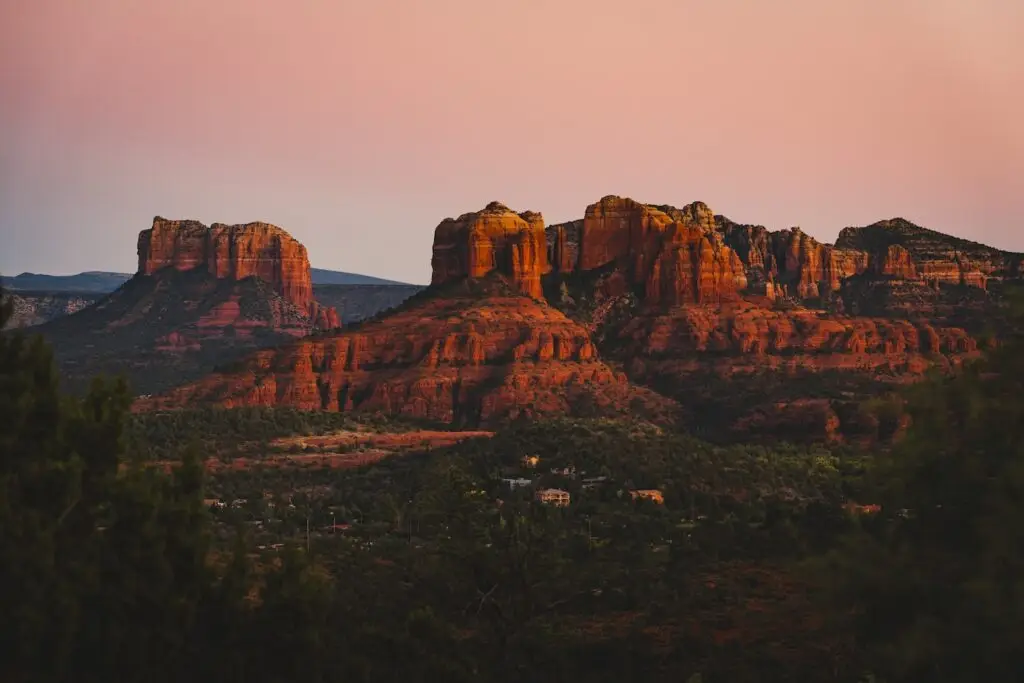
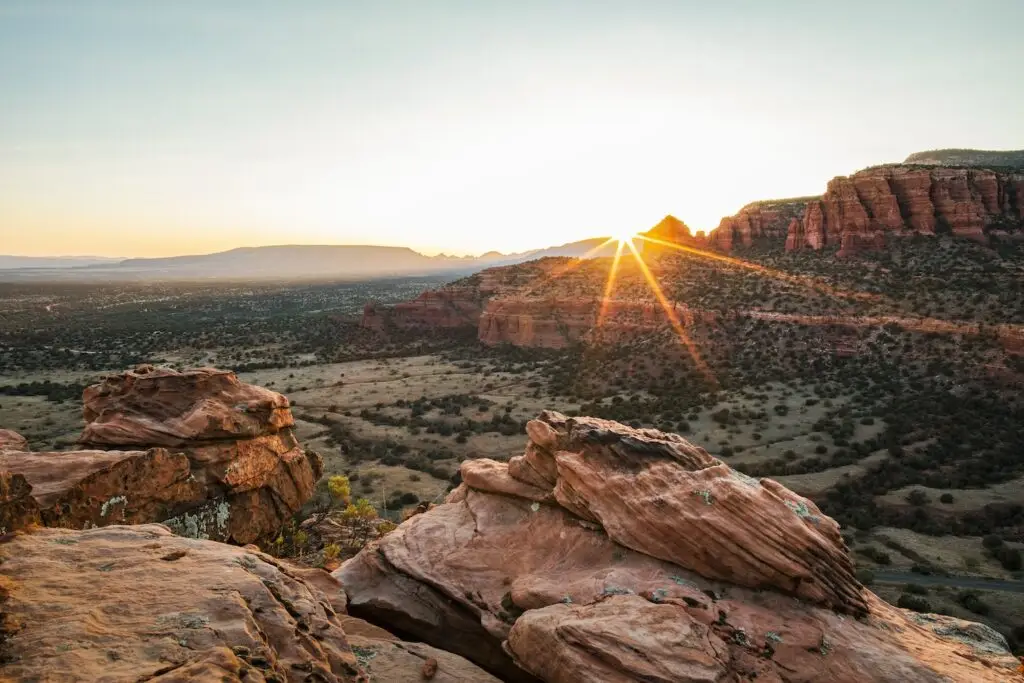
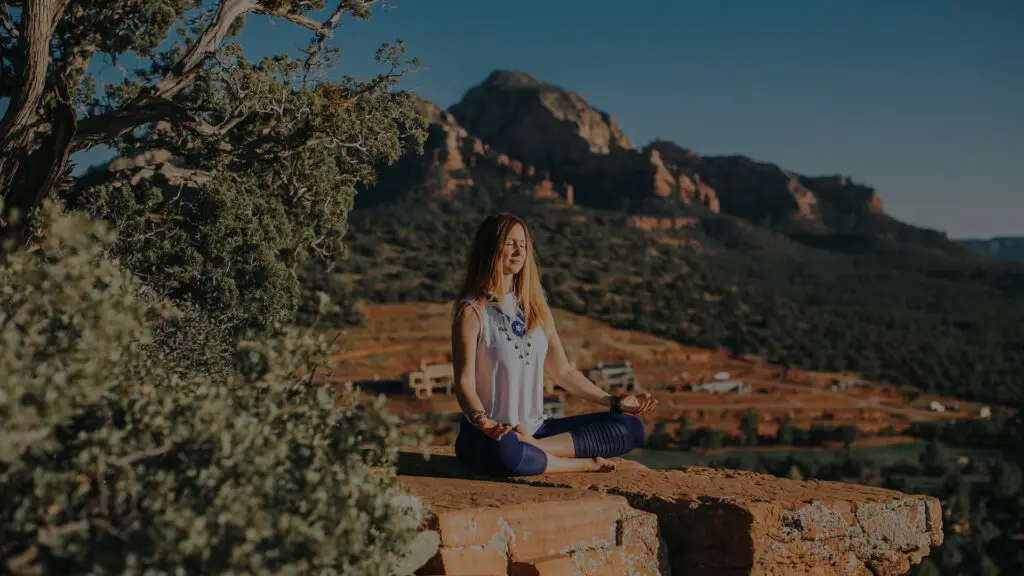
Yolanda Curtis’ straight, auburn locks fall past her shoulders and over her multihued poncho; mala bead bracelets wrap around her wrist. She’s not the only riot of color in this place: Oak Creek Canyon’s soaring red rocks encircle us. Green desert flora—Ponderosa pines, sycamores, agave plants, juniper trees—stand like middle fingers to winter. And, if Curtis is right, I’m enveloped in a kaleidoscope, too, with white, purple, and blue auras orbiting various parts of my body.
“I spent a lot of time down [on your feet] because it felt like you need to connect to the Earth more,” says Curtis—a mystic, artist, and healing facilitator—after our one-hour reiki session, where she hovered her hands over me with the intention of moving what practitioners call “universal life force energy” through my body.
She’s not wrong—grounding is why I, like millions before me, have come to Sedona. I headed here alone in search of emotional balance and stability, hoping to quiet my overly anxious mind that has led to years of insomnia and mental fatigue.
Apparently, Curtis can sense that, too. “It [feels] like you get in your head a lot. When you’re in your head, you’re cutting off your spirit in a way,” she says. “The next time you’re in your head, just take a moment to clear your mind.”
I’m hoping this trip will be full of those moments. According to the Chinese zodiac, 2025 was the year of the snake—a time to shed old habits and beliefs and embrace new paths forward. It seemed fitting, then, to board the one-hour flight from San Diego to Phoenix, then make the two-hour drive to Sedona, an area known for its regenerative energy.
For centuries, Sedona’s striking formations and expansive desert scenery have been the backdrop for those seeking restoration and a higher power. From about 650 to 1400 CE, the region that is now known as Sedona was inhabited by the Sinagua Indigenous peoples. Their art—specifically pottery such as Mogollon-style pots with distinctive “kill holes” (often found in burials)—suggest ritualistic practices.
Doe Mountain | Courtesy City of Sedona
Later, Hopi, Yavapai, Apache, and Navajo tribes made their way to Sedona and regarded its red rocks as spiritually significant, incorporating them into their narratives and ceremonies. When early European American settlers inhabited the region (between 1876 and the 1950s), ranches and orchards popped up throughout Sedona’s landscape—though it still retained its Wild West feel.
In the late 1940s, the area’s scenic beauty drew in artists and, later, mystics like real estate agent Mary Lou Keller, who proclaimed the ranching town a global center of spiritual energy and founded the supernaturalist “Church of Light” in her office. While this may have been a savvy marketing ploy to attract more buyers, the New Thought movement—characterized by spiritual exploration and metaphysical practices—emerged.
In the 1980s, Page Bryant, a psychic and spiritual teacher, popularized the area’s Airport Mesa, Bell Rock, Boynton Canyon, and Cathedral Rock as “vortexes,” or “energy spots” said to elicit feelings of calmness, emotional clarity, and physical tingling.
Spiritualists had a new home. Wellness and yoga retreats (like Enchantment Resort, founded 1987), energy healers, and mindfulness workshops (the 1987 Harmonic Convergence, hosted by José Argüelles, was among the first globally recognized meditation events) began popping up across the county.
Today, roughly around 750,000 of Sedona’s three million annual travelers visit for spiritual or wellness reasons.
“When I first came to Sedona, I kind of felt like I was being electrocuted energetically,” Curtis says. “It doesn’t always affect everybody like that. It’s just that I’m really sensitive. So everyone feels the energy differently.”
Courtesy of Yolanda Curtis
After growing up in the mountains of Utah, Curtis spent her early career in Los Angeles in the fashion industry. “I went through a healing crisis when I was in LA and it forced me to tap into these energetic, holistic ways of healing ourselves,” she says. “It brought me closer to my connection to this kind of higher power.”
She moved to Sedona a few years later to begin training as a guide and healer. Like her, I’m in search of the area’s cosmic answers. I’m not camped out in a self-made yurt in the red dirt, though—I prefer my spirituality to have a higher thread count.
From the rooftop deck of my room at the adults-only Ambiente hotel, Curtis’ energy cleansing session starts to tickle my mind. She read me in a way that felt like she’s known me for years. Is this the energy?
Photo Credit: Kyle RM Johnson
Mindfulness, she urges, is important for me to help calm my nervous system. Working to put it into practice, I try to tune out everything around me while taking note of my breath. I slow my inhales down, focus on the feeling of my stomach rising and falling. When anxieties creep in, I immediately push my focus outward to what’s around me—the outdoor lounger and firepit; the way the trees are reflected on the buildings across from me—so that I’m constantly in the moment instead of in my thoughts. By the time I step back into my suite, I’m feeling more peaceful than when I left.
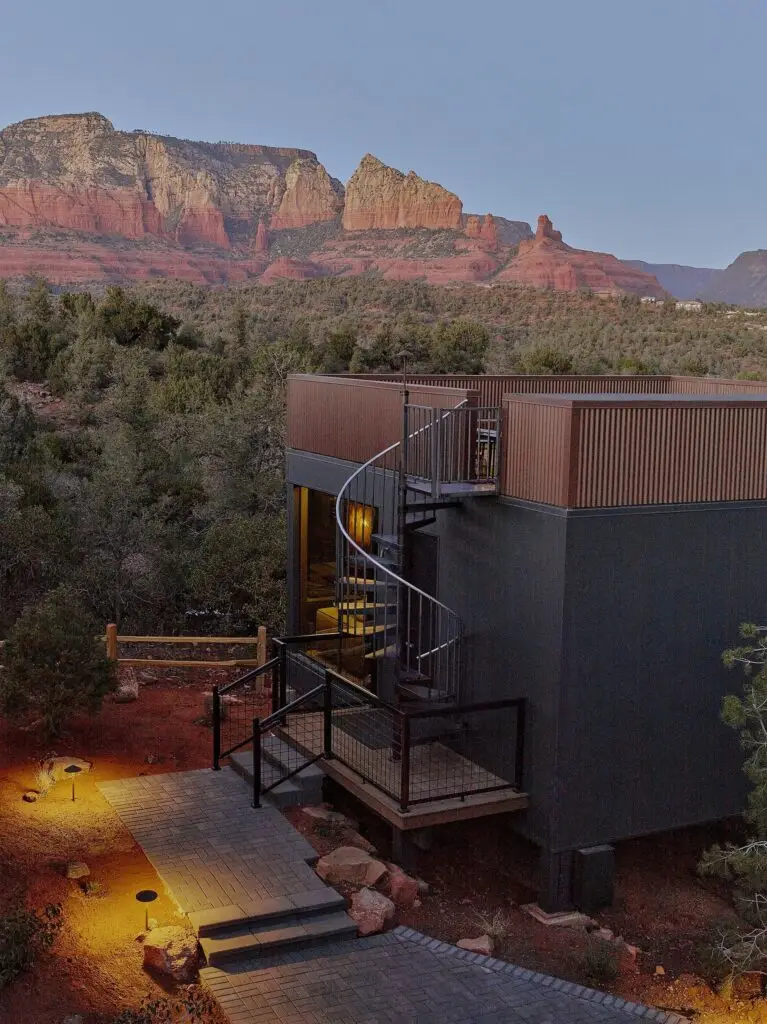
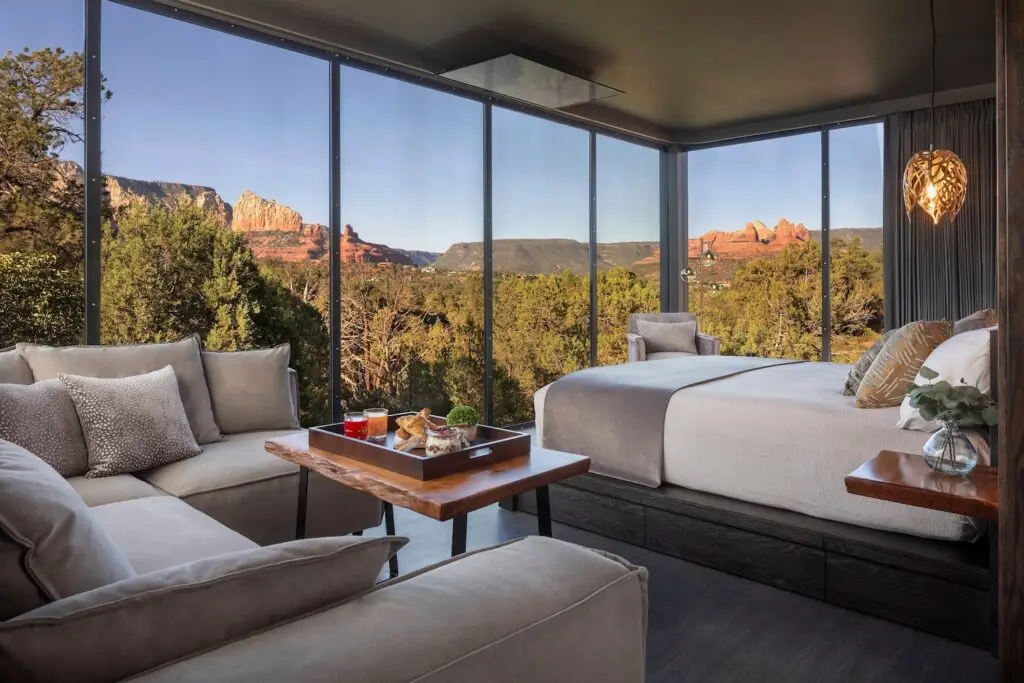
Each accommodation at Ambiente is its own freestanding unit (called an “atrium”) offering 270-degree floor-to-ceiling windows, similar to properties like Encuentro in Valle de Guadalupe. All four room types include kitchenettes with complimentary snacks and non-alcoholic beverages, Hinoki deep soaking tubs, walk-in rain showers with dual rain heads, his and her sinks, plush spa robes, and rooftop decks with firepits and daybeds.
Ambiente was built as a landscape hotel, a design concept characterized by architecture that blends into its natural surroundings. Tucked away on three acres of preserved land, it’s essentially glamping—but with more bells and whistles and a price tag starting at $1,399 a night. During the day, each atrium reflects what’s around it, mirroring trees, shrubs, moody clouds, and bathrobe-clad passersby so the rooms’ guests don’t feel like zoo animals on display. After sundown, however, the mirror effect disappears, and I have to fully close my blinds for privacy. I’m glad to keep any peeping Toms at bay, but I miss having a view of the outdoors.
Photo Credit: Jeff Zaruba
Fish-bowl façades notwithstanding, Ambiente boasts one of the most prestigious accolades in hospitality: In 2024, Michelin extended its award system beyond restaurants, honoring hotels with one to three “keys.” Ambiente earned two. Not bad for a property only two years old.
It’s especially suited to travelers chasing solitude. While there are 40 rooms on property, there are seemingly endless ways to spend time without fellow guests. Out your front door is instant access to two trailheads: Adobe Jack Trail (popular with mountain bikers) and Soldier Pass (known for its unique geological formations like the Devil’s Kitchen Sinkhole), both offering a number of routes and difficulty levels.
You can book a 2.5-hour jeep tour of Soldier Pass, Seven Sacred Pools, and Devil’s Kitchen; a helicopter tour through Sedona’s canyons; a 90-minute treatment at the hotel’s Velvet spa; or a private stargazing experience (Sedona is a designated Dark Sky Community) with a professional astronomer from your rooftop deck—self-discovery without the need for “What do you do for work?” small talk.
Courtesy of Down Dog Sedona
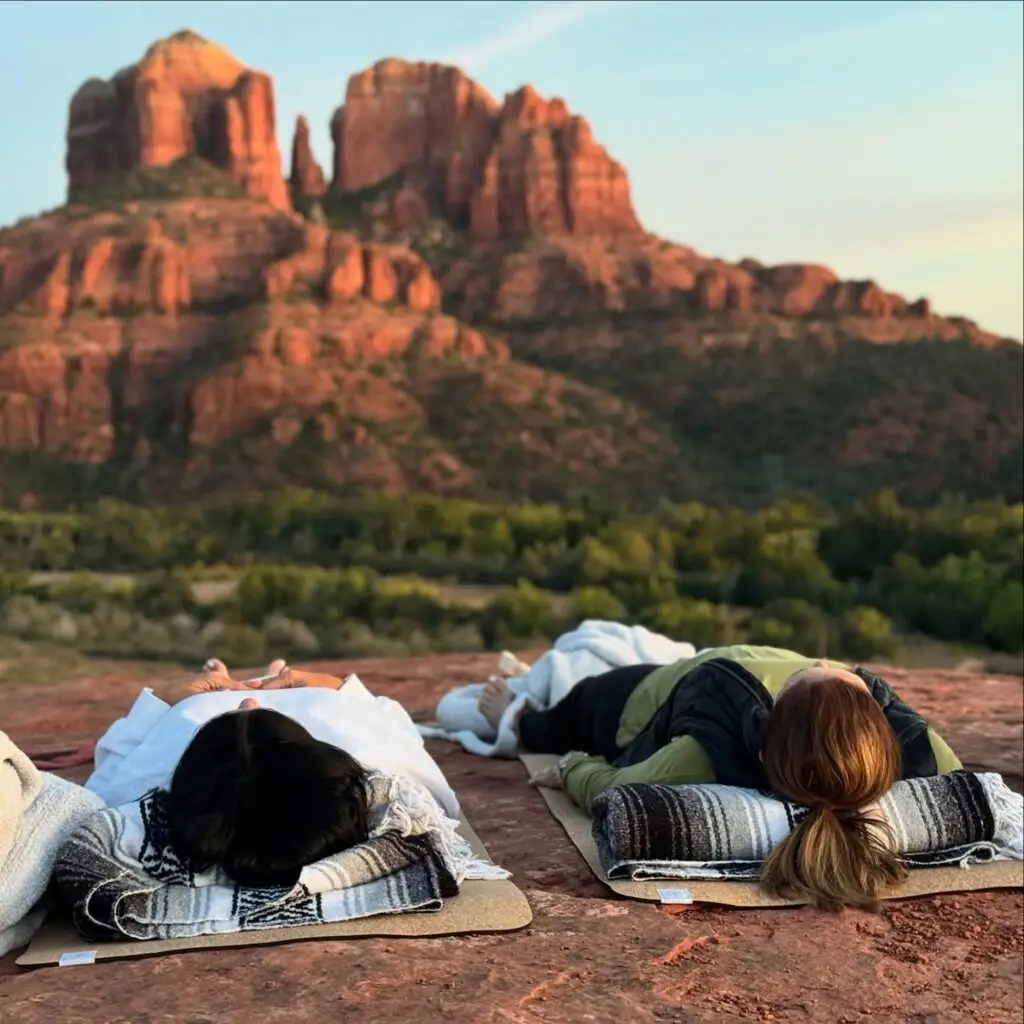
But you don’t have to spend every second solo. My next spiritual awakening will be a group project—a short hike and 60-minute yoga class on Cathedral Rock with Down Dog Sedona. The US Forest Service has issued about 30 permits for group activities on the iconic desert monument; as a part of the Sedona Metaphysical and Spiritual Association (SMSA), Down Dog has one of them, permitting the wellness center to conduct classes of up to seven people at the Coconino National Forest.
Our yoga instructor says the Earth’s spiritual energy swirls at Cathedral Rock. According to her, that gentle force fosters deeper meditation and self-reflection than, say, the air-conditioned atmosphere of a CorePower. Mostly, I’m feeling cold and stiff, distracted by the mid-50s weather and shady rock faces. Looking out across the landscape, though, it’s hard to not experience a deep sense of awe for this place.
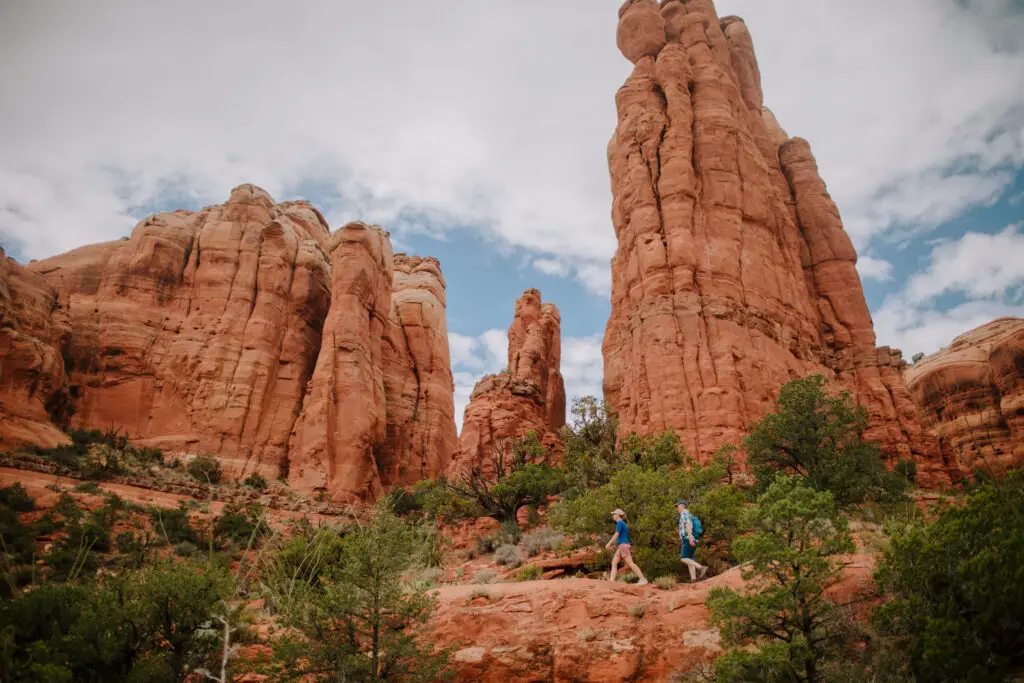
A cluster of soaring granite columns rising around 800 feet above the valley floor, as if crafted by an architect, Cathedral Rock seems to earn its name not only because of its resemblance to Gothic cathedrals but also because of how it makes you behave. Voices drop. Steps slow. As the sun moves, the stone changes its mood, glowing copper in the morning, deep wine at dusk, bruised purple when clouds pass over.
Photo Credit: Elise Giordano
The land around it is spare, juniper trees twisting sideways against its face. Prickly pear and agave cling to impossible angles, green against red, defiant and calm. The beauty of this place feels personal, a blank canvas. With no manufactured stimuli distracting my thoughts, I’m able to really tune into every sensation going on in my body. I may not be experiencing direct messages from spirits above, but this feels pretty close to a God encounter.
Later, I set up time with Pete Sanders, a well-known author and speaker in Sedona and the founder of Free Soul, a resource guide for those seeking improved success, health, and happiness through brain science. Sanders, a graduate of Massachusetts Institute of Technology, hosts weekly public programs intended to teach people about vortexes and how to best tap into their energy.
“I don’t know if I believe this vortex stuff, but I just feel better in Sedona,” Sanders says. He offers a more scientific perspective on the area’s alleged supernatural power: “The brain scientists say anything that pulls you up gets you out of limbic brain. And you can’t go anywhere in Sedona without looking up.”
Limbic brain was once used by scientists to describe a network of deep brain parts that work together to help us feel and respond to the world. Modern research breaks up these brain regions into specific parts: the amygdala (manages emotions); hippocampus (memories); hypothalamus (body processes like hormones and hunger); and the thalamus, which helps relay information and connect emotion with what we think and do.
Sanders uses “limbic” as a shorthand for all of it and believes that learning how to calm that network is essential to regulating our nervous system. One scientifically proven method: Get out in nature.
“Anything that uplifts your perspective [and] uplifts your attitude soothes limbic,” Sanders says. “The red-orange color [of Sedona] is neurostimulating, limbicsoothing, because it’s the color of sunrise. [We] associate sunrise with hope.” Same with the color green, he says—a fact that has been widely studied since the 19th century and documented in literature such as the Journal of Environmental Psychology.
According to Sanders, that begins with incorporating techniques that calm the nervous system into daily life. We can interrupt anxiety spirals and stress loops by directing our focus upwards, envisioning a high mountaintop above us or physically lifting our arms above our head, no soaring red rocks necessary (though they certainly help).
Back at Ambiente, I wonder if a hallelujah pose at dinner would be distracting for other diners. I decide to save Sanders’ methods for another day and head to Dahl & Di Luca, an Italian joint just a short car ride away (the hotel’s complimentary car service transports guests within a three-mile radius—which includes most of the town).
Photo Credit: Eric Wolfinger
Thirty years ago, seeking healing after the tragic murder of her son, chef-owner Lisa Dahl left her career in San Francisco’s fashion industry and made her way to Sedona. She arrived to a quiet town with a population of about 7,700—the perfect backdrop for starting over. She slowly began to explore her love of cooking; became a self-taught chef; and eventually opened Dahl & Di Luca, her debut restaurant. “I keep [my son] very close to me,” she says. “He’s pretty much my co-pilot in everything that I have created.”
Today, she’s an icon in the area, bringing fine dining to a destination that was once considered a ghost town. Dahl owns five more restaurants, and locals speak of her like a friend, gushing about her kindness and strength. Maybe this is the Sedona energy.
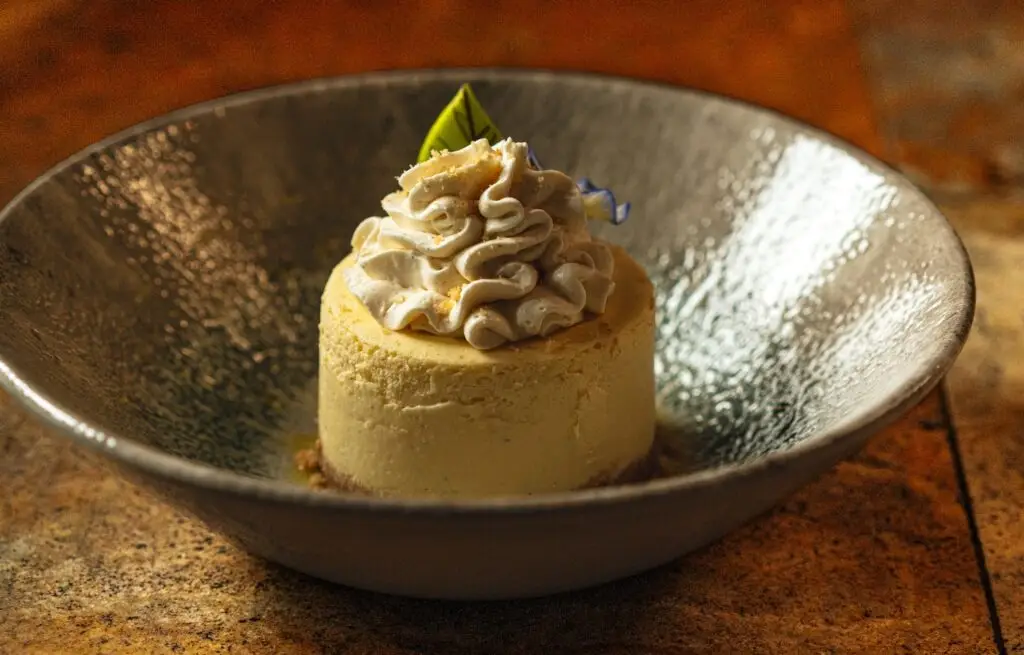
Sitting alone with the last remaining bites of an unbelievable limoncello cheesecake, I let my wind wander, trusting it to lead me through the tunnels and caves it needs me to explore. It takes me back to my conversation with Curtis on that first day. I remember her words clearly: “I think the mantra for you would be, ‘I trust myself. I trust that my heart is going to tell me when something is good or bad for me.’ I really think you have strong intuition naturally, even if you don’t realize it.”
Maybe that’s the lesson Sedona has for me: Keep looking up. It’s calling me to get out of my own way and let my instincts do the rest. A few days of relaxation amid breathtaking canyons might help unlock it, but I can take this with me, all the way home.
Nicolle Monico is an award-winning writer and the director of creative projects, digital editor for San Diego Magazine with more than 19 years of experience in media including Outside Run, JustLuxe and The San Francisco Chronicle.
Imagine being the song continuously getting skipped on the playlist. Not because no one wants to hear you, but because you never quite fit the moment. For years, San Diego has been that song on the touring circuit. Artists who have outgrown intimate clubs but aren’t yet filling arenas and stadiums have often passed us by, heading north to venues better suited to the size of their show. San Diego wasn’t missing the audience, it was missing the room.
That’s all about to change.
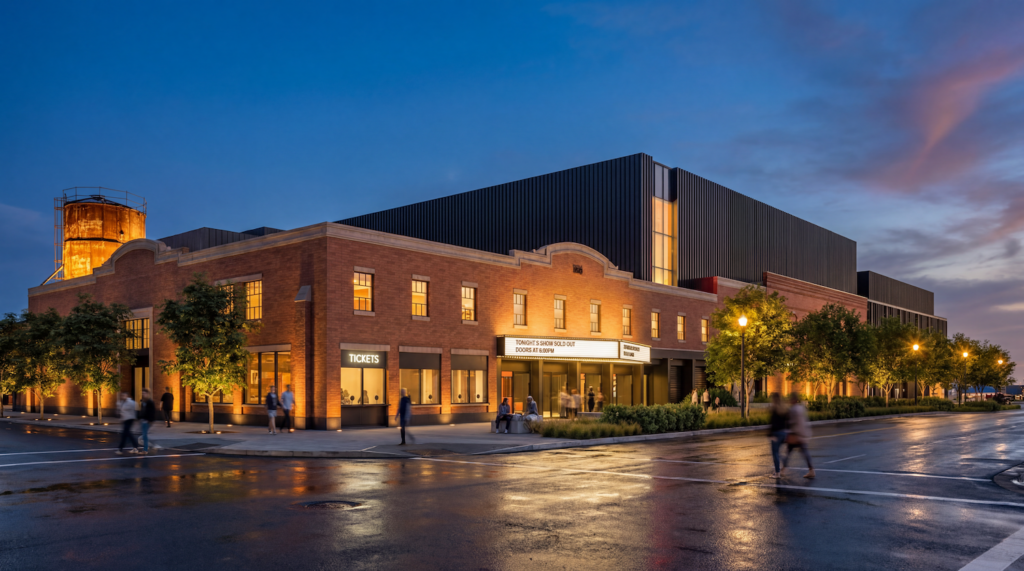
On August 17, Live Nation Entertainment announced plans to transform the historic Wonder Bread Building, which it purchased in June for $16.8 million, into a 4,000-capacity indoor venue slated to open in fall 2028. The new space will host music acts as well as private, corporate, and community events.
Currently, San Diego’s concert landscape jumps quickly from intimate clubs like the Casbah, Winston’s, and Belly Up to larger theaters, amphitheaters, arenas, and stadiums. What’s largely missing—particularly downtown—is a modern indoor room built specifically for roughly 4,000 concertgoers. This leaves a gap in mid-size venues for touring acts that land stages like the Hollywood Palladium or Boston’s MGM Music Hall at Fenway.
“We are filling a void in the market,” says John Schalk, Live Nation’s Vice President, San Diego Market. “There are other venues in town, but this […] building is just something that doesn’t currently exist.” Although SDSU’s Cal Coast Credit Union Amphitheater serves the 4,000-capacity range, its outdoor, fixed-seating arrangement isn’t as versatile as the proposed Live Nation project.
Located at 171 14th Street, just a six-minute walk from Petco Park, the building carries a century of history. Architect Eugene Hoffman designed it in 1924, a year after completing the Barcelona Apartment Hotel in Bankers Hill. The landmark brick building served as a bakery and warehouse for the Southern California Baking Company before Continental Baking Company, producers of Wonder Bread, took over in the 1950s and operated there through 1988 continued at the site until 2007.
In the early 2000s, Bob and Gay Sinclair, the couple behind a portfolio of East Village properties, purchased the building. After Bob—the founder of Pannikin Coffee & Tea—died in 2011, Gay sold much of their real estate portfolio but held onto the Wonder Bread Building. Mission Brewing eventually took over the space, where it operated for more than a decade before announcing its 2026 departure.
Now, the building is preparing for another reinvention. Live Nation plans to preserve the historic bakery’s four exterior walls, red brick façade, grain silo, barrel-vaulted trusses, and skylights as part of its next chapter.
Live Nation isn’t looking to erase its history but to celebrate it, allowing the building’s past to give the new venue some soul. “It’s really important for us that we maintain the integrity and the history of that building,” Schalk says. “There will be new construction and design elements as we go through the process to create the concert venue, but we’re working really hard to preserve it.”
Blueprint Studio, Live Nation’s in-house design and development group, and Gensler, the architecture firm behind San Diego International Airport Terminal 1 and Snapdragon Stadium, will be heading the project. The plan is to design the ground-floor space as an open, general-admission area with a premium level above with 600-plus fixed seats, in addition to box and suite sections. There will also be an additional structure built on top of the historical portion of the building (the four original walls that house the lobby) called the Vinyl Room—a Japanese-inspired hi-fi listening VIP lounge serving elevated food options.
One of the most reassuring aspects of the project is the focus on the concertgoer’s experience—specifically the “pet peeves” we all know too well: long bathroom lines, cramped exits, obstructed views. According to Schalk, one of the best things about building upon the existing structure is having the ability to consider potential obstacles and tackle them before construction begins. “I’d say we are ‘purpose building’ the entirety of the project for a music venue,” says Gensler lead project architect Garrett van Leeuwen. “As part of our design process, we do an in-depth sightline analysis to make sure that sightlines are optimized from every point and seat within the venue.”
Circulation design is also being implemented to ease traffic flow, alongside acoustic optimization and a transformative outdoor beautification effort. According to van Leeuwen, this “public realm space” will grow the existing 14-foot sidewalk to a 32-foot sidewalk complete with plazas and landscaping.
“This venue is for the fans. For the music lovers,” Schalk explains. The vision is intimate: “I want a fan to walk up to that building, see that red brick facade, grab their ticket from the box office, go into the lobby and see some of the history that will present itself… and feel like you entered a home.” Schalk also expressed a “keen interest in making sure that we work with the local artists, the local bands, the local musicians in town.” It’s a project that recognizes San Diego as a growing market that is hungry and ready to see a vibrant arts and culture community thrive.
According to an analysis by Oxford Economics analysis shared by Live Nation, the venue is projected to deliver a significant boost to the local economy, generating approximately $97 million in annual economic impact and supporting 660 jobs. This also includes welcoming 316,000 fans each year—with 126,000 traveling from outside the San Diego metro area—and driving $53 million in local spending at nearby restaurants, hotels, and retail establishments.
Considering its proximity to other major event spaces and overall busy urban areas, traffic and parking may be a concern, especially on nights of overlapping events. But in those cases, Schalk said they would work together on communication efforts; parking availability; and staggering start, end, and loading times; as well as providing easy access to designated rideshare areas. With transit stations nearby (the closest one being a 4-minute walk at 12th & Imperial), public transportation is another great option for enjoying your night out.
There are still two years of design, construction, and plenty of logistics between now and opening night. But the bigger promise of the Wonder Bread Building is simple: San Diego finally gets a venue built for the artists who have historically passed it by. After years of getting skipped on the touring playlist, the city may finally be getting its turn on repeat.
Camila Ibarra Gallego is a CaliBaja native pursuing a master's degree in culinary journalism at the Basque Culinary Center. Shaped by the culturally rich, bicultural megaregion, she's passionate about sniffing out stories that connect people, territory and culture through food. When she's not tumbling down internet rabbit holes, you can find her pretending to be a wine connoisseur at a local wine bar or nose-deep in a good book.
The inland North County community of Rancho Santa Fe is often associated with wealth. It’s one of San Diego’s most expensive residential markets and is consistently ranked one of the highest-income zip codes in California and the U.S. Rancho Santa Fe is known for its large equestrian community including riding facilities and horse trails, as well as its country club lifestyle and associated golf courses.
At the center of this luxury master-planned community is a small, walkable downtown area referred to as the “village,” with The Inn at Rancho Santa Fe acting as both a landmark and social hub. Much of the community, including the historic Inn, was designed by acclaimed architect Lilian Rice, one of California’s earliest female architects. The Spanish Colonial-style architecture she brought to the village is still one of its defining characteristics today.
Whether you’re coming to Rancho Santa Fe for golf, horseback riding, or pampering at a resort spa, be sure to start with a short walk around the village to take in the neighborhood’s charm. Plan your next visit here with our neighborhood guide to the area’s best restaurants, things to do, and shopping.
Rancho Santa Fe Restaurants, Bars, and Coffee Shops
The Pony Room
Families congregate at The Pony Room for elevated California ranch-style cuisine. Lamb lollipops, carne asada tacos, burgers, and weekly dinner specials are offered here, alongside an extensive collection of wine and spirits (especially tequila) and sizeable kids menus. As the signature restaurant of Rancho Valencia Resort & Spa, this all-day eatery is a lively centerpiece of the local social scene.
5921 Valencia Circle
Mille Fleurs
The piano bar at Mille Fleurs is the buzziest spot to be on Friday and Saturday nights in Rancho Santa Fe. French classics like escargot, lobster bisque, duck confit, and steak frites are the main dinner attractions at this local institution that has been around for more than 40 years. Spring for the four-course prix fixe menu before nabbing a coveted bar seat near the piano entertainer.
6009 Paseo Delicias
Nick & G’s Restaurant
Nick & G’s is one of the most prominent restaurants in the village, with an outdoor patio that overlooks the main thoroughfare. Enjoy modern Italian food, steaks, and seafood dishes here, including homemade pasta, pizza, wagyu beef, and oysters. Be sure to check their live music schedule and events calendar for the latest happenings.
6106 Paseo Delicias
Lilian’s
Named after renowned architect and planner Lilian Rice, Lilian’s is The Inn at Rancho Santa Fe’s flagship restaurant. Their upscale menus feature sustainable seafood, grass-fed meats, local produce, and even sushi rolls during dinner. Outdoor seating provides a bird’s-eye view of the village and an elegant backdrop for weekend brunch. Stop by Bing’s Bar (a nod to Bing Crosby) for craft cocktails, beer, wine, and light bites in a refined setting.
5951 Linea Del Cielo
Thyme in the Ranch
Quaint cafe and bakery Thyme in the Ranch serves a small selection of breakfast and lunch items (don’t miss the tarragon chicken salad), but is perhaps best known for its pastries and baked goods. Cakes, pies, muffins, scones, and cookies fly off the shelves here, where locals come for special occasions, parties, and group catering orders.
16905 Avenida De Acacias
Paseo RSF
Located inside a historic building once home to Rancho Santa Fe’s original schoolhouse, Paseo RSF is one of the village’s newest dining options. The charming American bistro has pasta, salads, burgers, meat and seafood entrees, plus a thoughtfully selected California wine list and new sushi and omakase program. Kids and dogs are both welcome here.
6024 Paseo Delicias, Suite C
Rancho Roasters
Grab a quick coffee to go from this walk-up window in the same shopping center as the post office. Cinnamon roll lattes, cold brew, spiced chai, smoothies, protein bowls, and more can be found at Rancho Roasters, where they brew beans from Dark Horse Coffee.
16950 Via De Santa Fe
Goli Pizza
Casual pizzeria and martini bar Goli is a popular spot for catching the latest sports games. Order one of their unique specialty pizzas like the Casbah with hummus and veggies, build your own pizza or burger, or go with one of their hearty wraps that’s made with an extra thin version of pizza dough.
18021 Calle Ambiente, Suite 403
Cocina del Rancho
Find generous portions of Mexican food at Cocina del Rancho, run by the same owners as Carlsbad’s Cicciotti’s Trattoria Italiana and Village Kabob. Get classic dishes like burritos, tacos, and enchiladas, plus their specialty items including pulpo, carne asada, and fajitas with lobster tail. Don’t skip the margaritas.
Kai Oliver-Kurtin is a San Diego-based writer who covers travel, dining, events, and culture. Her writing has been published in USA Today, Condé Nast Traveler, Fodor's Travel, Marie Claire, and HuffPost, among others.
It’s happening, San Diego. The pre–Comic-Con excitement jitters begin to creep in as soon as July hits the calendar. But for those who forgot to set an alarm on registration day, whose batteries died or whose luck ran out in the virtual waiting room, or who simply prefer to soak up the fandom frenzy from the outside, we’ve got the best ways to experience Comic-Con weekend—no badge required.
Ready Party One: The Final Level 2026 SDCC Kickoff Party
Ain’t no party like an after-hours party, and XLE Productions’ Ready Party One is definitely one for comic book fans. Kick-start your convention weekend at Parq Nightclub and enjoy music by fan-favorite ’80s tribute band The Flux Capacitors, along with enough fandom fun, cosplay, retro gaming and pop-culture nostalgia to satisfy your inner geek. At least for the night.
Date & Time: Wednesday, July 22, 8 p.m. Location: Parq Nightclub, 615 Broadway, San Diego, CA 92101 Price: Tickets start at $34
Interactive Zone at Petco Park and Gallagher Square Events
With more than a dozen activities and brand activations, Petco Park’s Interactive Zone is a badgeless fan’s playground, bringing together brands, games, celebrity appearances and immersive experiences all in one place. On Friday, July 24, Funko’s beloved annual party, hosted by Funko founder Mike Becker, returns to Gallagher Square. This year’s “Quest for the Grail” event will take guests on a journey to the sunken city of Atlantis. Expect themed décor, food, drinks, games and special guest appearances.
Date & Time: Thursday, July 23–Sunday, July 26 (times TBD) Location: Lexus Premier Lot across from Petco Park Price: Free; Funko Funday event is ticketed
Cartoon and art lovers can celebrate the work of Chuck Jones, creator of some of animation’s most iconic characters, including Bugs Bunny, Daffy Duck, Road Runner, Wile E. Coyote and Pepé Le Pew, at Seaport Village’s Chuck Jones Gallery. During Comic-Con weekend, the showroom will also host meet-and-greets with talented artists including Disney artist and seascape painter Steve Barton, The Simpsons animator Stephen Reis, and licensed Warner Bros., Hanna-Barbera and Disney fine artist Ben Olson.
Date & Time: Thursday, July 23–Saturday, July 25, 2026 (times TBD) Location: Chuck Jones Gallery, 809 W. Harbor Drive, San Diego, CA Price: Free
PAWmicon Pet Cosplay
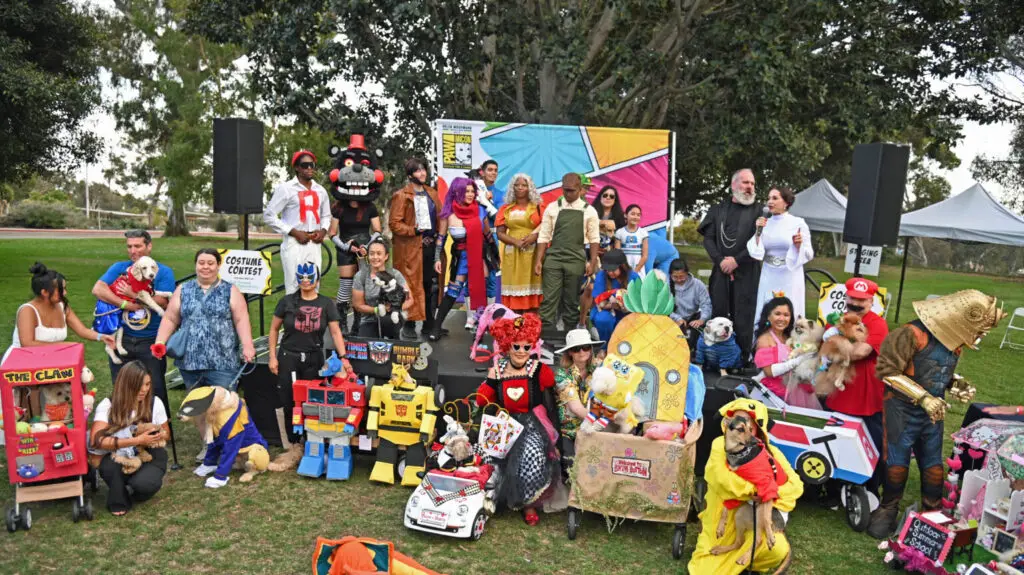
Get your pup’s—and your own—cosplay game ready because Helen Woodward Animal Center’s PAWmicon is back. Enjoy a Comic-Con-themed outing with the whole family while raising awareness for orphaned pets in San Diego. Divided into three categories—Flying Solo, Dynamic Duos & Trios & More, and Fantastic Floats—the event is a paw-fect way to jump-start the festivities.
Date & Time: Tuesday, July 21, 2026, 4:30–7 p.m. Location: Presidents Way Lawn at Balboa Park Price: Free
Comic-Con-Themed Bar Crawl
Why leave all the fun, mischief and mayhem to badge holders when you can join more than 300 partygoers and crawl through some of downtown San Diego’s top bars and nightclubs? Whether you’re called to save the universe or have an allegiance to the dark side, the annual Comic-Con Bar Crawl gives attendees exclusive access to more than 20 venues throughout the Gaslamp Quarter, with free welcome shots, exclusive drink discounts and complimentary entry along the way. This event for ages 21 and older is a fun way to celebrate your fandom outside the convention center.
Date & Time: Friday, July 24–Sunday, July 26, 2026, 8 p.m.–2 a.m. Location: Check-in at Toro, 672 Fifth Ave., San Diego, CA 92101, from 8–9 p.m. Price: $13–$30
Her Universe Fashion Show
Geek out over couture at the annual Her Universe Fashion Show at the Manchester Grand Hyatt. Hosted by founder and Star Wars: The Clone Wars actress Ashley Eckstein and presented by Warner Bros. Discovery Global Consumer Products, this year’s show will feature a selection of designers showcasing one-of-a-kind DC-inspired creations as they compete for a $2,000 cash prize.
Note: Wristbands are traditionally distributed the morning of the event on a first-come, first-served basis, but official details have not yet been announced.
Date & Time: Thursday, July 23, 6 p.m. Location: Manchester Grand Hyatt, Seaport Ballroom, 1 Market Place, San Diego, CA 92101 Price: Free
Comic-Con Museum
A destination for all things fandom, Balboa Park’s Comic-Con Museum brings world-premiere and exclusive exhibits and events to the heart of San Diego, giving fans a place to geek out all year long. The museum is currently featuring the U.S. debut of Doctor Who Worlds of Wonder, showcasing 17 of the Doctor’s most iconic costumes, a full-size TARDIS and a collection of original sonic screwdrivers used on-screen. Visitors can also explore Sangre, Sudor y Mito: The Art and Tradition of Mexican Lucha Libre, featuring rare collectibles and authentic masks and costumes worn by legendary luchadores.
Date & Time: Open Thursday through Tuesday (closed Wednesdays), 10 a.m.–5 p.m. Location: 2131 Pan American Plaza, San Diego, CA 92101 Price: $15–$30; free for children younger than 6
Comic-Con Art Show
Browse an extensive collection of original drawings, paintings, jewelry and other whimsical creations from more than 100 professional and amateur artists at the Comic-Con Art Show. Many pieces will be available for purchase through the silent auction or Quick Sale, giving fans the chance to take home a one-of-a-kind Comic-Con souvenir while supporting talented artists.
Dates & Times:
Thursday, July 23: 11 a.m.–8 p.m.
Friday, July 24: 9 a.m.–8 p.m.
Saturday, July 25: 9 a.m.–6 p.m.
Sunday, July 26: 9 a.m.–6 p.m.
Location: Manchester Grand Hyatt, Grand Hall CD, 1 Market Place, San Diego, CA 92101 Price: Free
Looking for a supercute way to fuel your Comic-Con adventures? Swing by the Hello Kitty Café Truck. This traveling pink café on wheels will be parked at Petco Park’s Interactive Zone, serving up tasty treats and exclusive merchandise. From limited-edition tote bags and hats to mugs and T-shirts, it’s the perfect stop to grab a snack and a little extra kawaii cuteness.
Date & Time:
Thursday, July 23–Saturday, July 25: 10 a.m.–4 p.m.
Sunday, July 26: 10 a.m. (closing time TBD)
Location: Petco Park Interactive Zone, 100 Park Blvd., San Diego, CA 92101 Price: Menu items vary
PopUp Bagels, Spider-Man and Donut Bar Activations at Pendry San Diego
Get ready to fuel up and hype up. Whether you’re a plain-bagel purist or an everything-bagel fan, don’t miss your chance to grab breakfast or recharge at PopUp Bagels’ Volkswagen bus parked outside Pendry San Diego. Then satisfy your sweet tooth at Provisional with a rotating selection of character-themed doughnuts from Donut Bar. Both are available throughout the weekend beginning at 7 a.m. until sold out.
On July 24 and 25 from noon to 4 p.m., head to Nason’s Beer Hall for photo ops to celebrate Sony Pictures’ upcoming Spider-Man: Brand New Day. Guests can sample Tom Holland’s nonalcoholic beer brand, BERO, served in limited-edition themed cans available exclusively during the event.
Camila Ibarra Gallego is a CaliBaja native pursuing a master's degree in culinary journalism at the Basque Culinary Center. Shaped by the culturally rich, bicultural megaregion, she's passionate about sniffing out stories that connect people, territory and culture through food. When she's not tumbling down internet rabbit holes, you can find her pretending to be a wine connoisseur at a local wine bar or nose-deep in a good book.
Today’s seniors are more connected than ever, with a renewed focus on retirement as a time of discovery and enriching experiences. The ultimate reward for a retirement well-earned is the wisdom to appreciate it all, and what better place to enjoy that unique perspective than Vi at La Jolla Village, in the heart of San Diego.
All-access pass to good living.
As a Continuing Care Retirement Community (CCRC), Vi provides access to a connected and fulfilling community while making it easy to plan for future care, should the need ever arise. With a care plan in place, residents enjoy greater financial predictability and long-term value, freeing them to focus on making the most out of retirement.
Resort-style amenities at the epicenter of a cultural hub like San Diego offer a retirement experience unlike any other. Paired with exceptional dining, spacious accommodations and dedicated staff, the best of maintenance-free living is all around. And with the introduction of Vista 360 Well-Being, Vi’s panoramic approach to wellness, there are more ways than ever for residents to access it all.
The harmony of mind, body and community.
Courtesy of Vi at La Jolla Village
The key to longevity is striking the right balance in maintaining an active lifestyle with an active mind in a fulfilling community. With newly renovated community spaces and restaurants, Vista brings a variety of opportunities for residents to elevate their well-being through Vi-exclusive “Signature Experiences.”
Vista Enrich takes an evidence-based approach to brain vitality, keeping residents at the forefront of cognitive health through exergaming (exercising + gaming), nutritional plans and informative workshops. It is also home to The Brain Vitality Studio, an innovative facility dedicated to cognitive fitness that has garnered national recognition.
Vista Discover invites residents into stimulating educational experiences, from chef-led cooking demos and guided wine tastings to lectures at local universities and intimate lectures following cultural outings.
While Vista Enrich focuses on brain health and Vista Discover engages residents intellectually, Vista Explore cultivates a sense of adventure through curated travel and local excursions. But broadening one’s horizons doesn’t always require a plane ticket. One recent event brought a taste of the world right to the community: an onsite “jazz cruise” featuring live music and global cuisine served at a series of themed “ports” all within the community’s own ballroom.
“Location, location, location”
Courtesy of Vi at La Jolla Village
One of the biggest perks of life at Vi at La Jolla Village is its proximity to just about everything. With easy access to transportation and local attractions just steps away, residents can explore and engage with their community at their own pace.
“There are trolley and bus stops within a 5-minute walk that will get you to the beach, UCSD Campus, medical appointments, downtown La Jolla or San Diego, et cetera. We rarely use our car,” said resident Tom Yager.
With the best of San Diego just steps away, residents don’t just live in the city, they live within reach of everything that makes it special.
The best of all worlds.
Courtesy of Vi at La Jolla Village
At Vi at La Jolla Village, retirement isn’t a chapter to slow down; it’s an invitation to discover more. Tailored community experiences created by Vista, paired with the vibrant pulse of San Diego just outside the door, mean that residents don’t have to choose between security and adventure, connection and independence. They get all of it.
This is what an all-access pass to good living looks like: the comforts of an elevated lifestyle, a community built for growth and a city made for discovery – all in one place.
To learn more about Vi at La Jolla Village or for details on available floor plans, visit ViatLaJollaVillage.com/SDM.
When three nations and 16 cities come together to host the FIFA World Cup 2026, the scale stops feeling like a tournament and starts feeling like geography. A continent becomes the stage as borders soften into corridors. And Southern California—shaped by migration, sport, entertainment, and constant movement—sits inside that landscape with all eyes on it.
San Diego and Los Angeles have always felt connected. Hop on the Pacific Surfliner, and the trip unfolds in one continuous stretch of coastline, passing beach towns, neighborhoods, and city centers.
Traveling from San Diego, everything still feels slightly suspended as the Pacific Surfliner follows the coast north with ocean on one side and a slow suburban blur on the other. San Diego stays in exhale. Los Angeles is already building toward something louder.
This summer, Los Angeles will host eight matches of the FIFA World Cup at Los Angeles Stadium, including the US Men’s National Team opener on June 11, while the region stretches into 39 days of programming across stadiums, parks, transit hubs, beaches, and neighborhoods. Instead of one massive fan hub, Los Angeles is embracing a citywide celebration, with fan zones spread across its entirety.
But this pattern has been rehearsed here for decades. In 1994, Southern California became one of the defining stages of the World Cup, when matches at the Rose Bowl placed global attention on the region and turned local stadiums into international landmarks, confirming its ability to hold the world at scale.
What distinguishes Southern California is not just infrastructure, but cultural permeability. Fashion, music, film, art, and sport constantly overlap here, creating an environment where identity is flexible and always in motion. From the Venice boardwalk, where skate culture shaped modern street style, to global soccer stars rubbing shoulders with Hollywood celebs, to authentic Spanish cuisine moving up and down the I-5 corridor, everything circulates.
The World Cup is not introducing anything new here, it’s showing up for the summer and showing out, revealing what this city has always known about itself. What follows is a look at the fan zones and how Los Angeles turns itself into a city-wide stage for the tournament, one neighborhood at a time.
Courtesy of Los Angeles Tourism & Convention Board
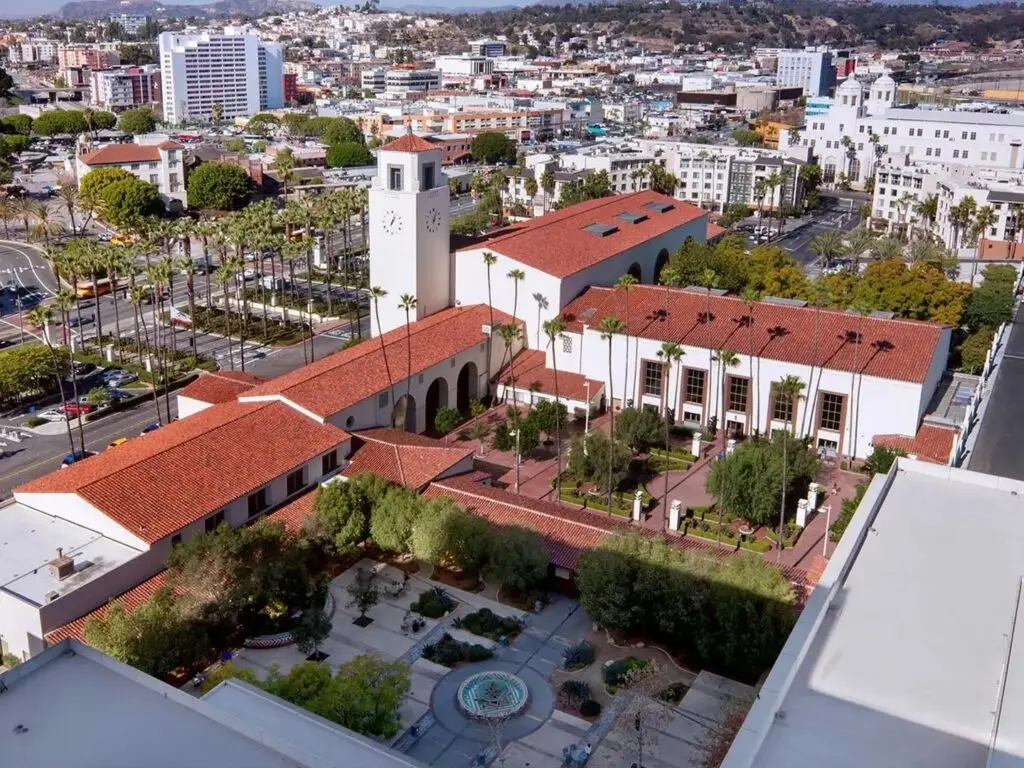
Los Angeles Union Station
As the heart of Los Angeles, Union Station is an official Fan Zone June 25-28 during the World Cup, but in practice it never really stops being one.
It is the city’s circulation point, its meeting ground, its pressure valve. Commuters, travelers, match-day crowds, and everyday Angelenos all move through the same space, and everything mixes, overlaps, and scales in real time. In a way, this is where the World Cup stops arriving in Los Angeles and starts moving through it.
The Pacific Surfliner from San Diego to Los Angeles makes that shift feel almost too easy. No stress or gridlock anxiety, just a straight line up the coastline with ocean on one side and everything slowly becoming more built on the other. It’s one of the rare ways into LA that doesn’t feel like arrival as friction. You can sit with a laptop, watch the Pacific drift past, grab coffee from the café car, and let the city come to you in pieces.
That’s the beauty of arriving at Union Station. Instead of feeling like you’re on the edge of the city, you’re immediately surrounded by it. And, inside, the station already reads like a World Cup nerve center: banners, movement, multilingual energy, the sense that something global is about to funnel through this exact point. The Heart of the City Fan Zone only sharpens that feeling, with simultaneous match screens, DJ sets, meet and greets, and immersive activations built around marquee games like USA vs. Türkiye.
ROW DTLA feels like the first exhale after arrival. A converted industrial campus turned creative district where restaurants, retail, and open-air courtyards form a self-contained ecosystem. If you’re looking for the perfect first meal in LA, make it lunch at Pizzeria Bianco. The thin-crust pizza is reason enough to go, but the space leaves just as much of an impression.
What I liked most about ROW DTLA is how quickly it resets you after the train. One minute you are stepping off at Union Station, and the next you are in a space that feels like its own version of LA, a city inside a city with some of the most curated shopping I’ve ever seen.
Bodega hides itself behind a convenience-store front, a sneaker and streetwear space disguised as something ordinary, like LA refusing to make anything feel too obvious. The whole campus moves like that, part retail, part gallery, part neighborhood you are only temporarily inside.
Isabella Dallas is a freelance writer for San Diego Magazine and the Arts and Culture Editor at The Daily Aztec in her final year at San Diego State University. She previously worked as an editorial intern for SDM, but when she’s not writing, you can find her trying the best coffee spots in SD, devouring the latest rom-coms, and indulging in anything and everything pop culture.
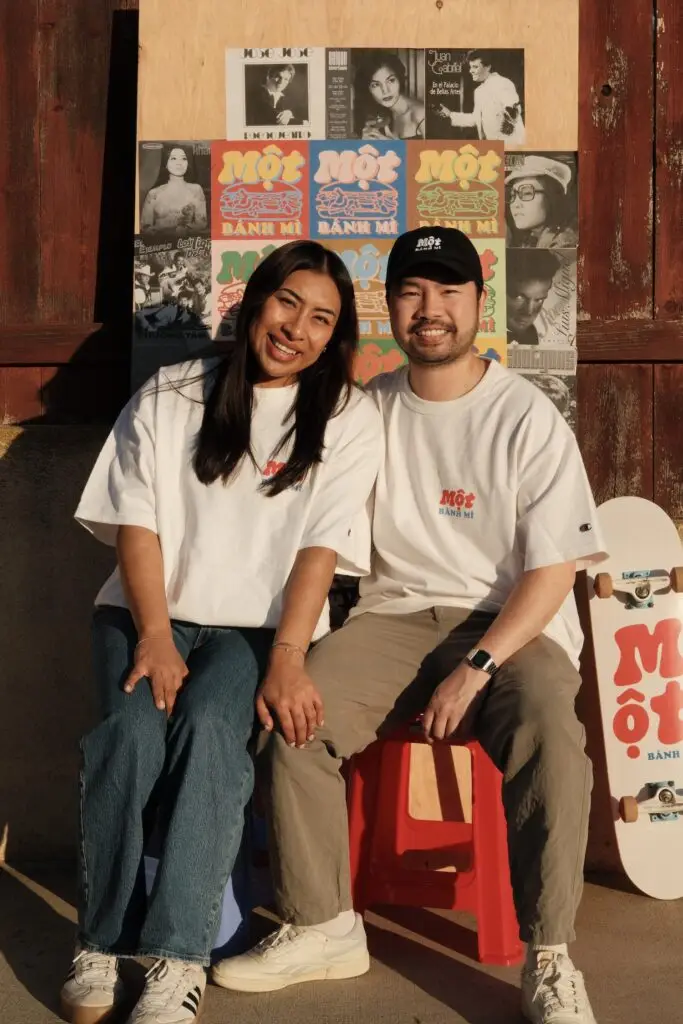
Is there any food more quintessentially San Diegan than the California burrito? That was a rhetorical question since the French fry-stuffed, flour tortilla-wrapped torpedo of carne asada bliss came into being in the 80s (either invented by Lolita’s or Santana’s, depending on who you ask). But now, Vietnamese-Mexican pop-up Một Bánh Mì may be giving the longtime champ a run for its money.
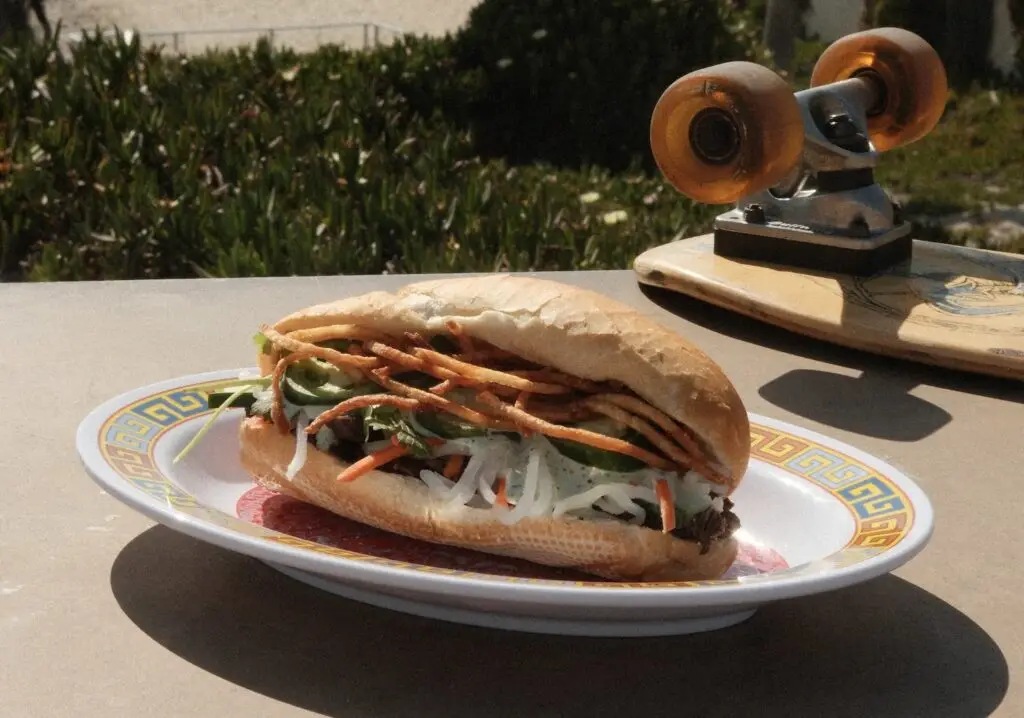
Một Bánh Mì’s original California banh mi takes cues from both cultures, using traditional Vietnamese baguettes from Paris Bakery filled with carne asada and garnished with cilantro-jalapeno crema, Vietnamese mayonnaise, pickled vegetables, cilantro, cucumber, jalapenos, and of course, French fries.
“It’s so San Diego—it’s so us,” says Desmond Bui, pop-up founder and owner with partner Marisol Santiago. “It really encapsulates the Vietnamese-American and Mexican-American journey and identity here.”
Both grew up in San Diego. Bui is Vietnamese. Santiago is Mexican-American. The sandwich makes utter personal sense.
Neither of them cooked professionally before launching Một Bánh Mì earlier this year, when they popped up for the first time at Convoy Rising for Lunar New Year. But after seeing the rise of the local Vietnamese coffee scene with shops like Saigon Coffee, Chance’s Coffee, and Em Coffee House, Bui knew there was an opportunity for a new generation to put a fresh spin on Vietnamese food in San Diego.
While there are plenty of places to grab a banh mi around town (K Sandwiches, Ba Le French Sandwich Shop, Lee’s Sandwiches, and so on), we’ve yet to hear of a California banh mi. Firsts are being firsted.
“Banh mi is regarded by top chefs as the best sandwich in the world,” says Bui. (Side note: I concur.) And after discovering overlap between Mexican and Vietnamese cuisines through common ingredients like cilantro, lime, jalapeno, white onion, and pickled vegetables, they began planning a menu.
Courtesy of Một Bánh Mì
Một Bánh Mì also serves Bánh Mì Đặc Biệt (Vietnamese cold cuts), Bánh Mì Thịt Nướng (grilled lemongrass pork banh mi), and Bánh Mì carnitas de hongos (mushroom pâté banh mi), along with some specials like Thịt Nướng tacos (grilled lemongrass pork) and hopefully soon, al pastor trompo banh mi (marinated pork shaved off a spit) and charcoal-grilled adobada.
Other banh mi shops Americanize names for English-speaking audiences—for example, listing “grilled chicken sandwich” instead of Bánh Mì Gà Nướng. Not Một Bánh Mì. If you’re not sure how to pronounce something, Bui says they’re happy to help. It’s an educational opportunity, he explains, as well as a chance for them to be “unapologetically Vietnamese and Mexican.”
Part of the immersive experience is playing Vietnamese tunes from the ‘60s and ‘70s.
“When you think of universal languages, what are ways when you travel or meet a different group of people that you can still find common ground and connect and feel like we’re a lot more alike than we are different?” Bui asks. “Food and music.”
The musical element is part of Một Bánh Mì’s greater vision. They’d like to evolve into a lifestyle brand and media company, with merch, jars of pickled vegetables, you name it. Eventually, they’d like to open a brick-and-mortar somewhere in Mid-City. In the meantime, they’ll continue to pop up at places like Mixed Grounds and Chance’s Coffee, or wherever they can. (Bui called Provecho Coffee their “dream collab,” hint hint.)
San Diego bartenders have been making serious waves over the past few years, and it looks like 2026 is carrying on that momentum. Dominique Muñoz, bar lead at Polite Provisions, just nabbed a top spot on Punch’s Best New Bartenders 2026 list. She’s hardly new to the game, having been behind the stick for nearly a decade and founding the Sirens and Spirits collective to elevate women and nonbinary bartenders in the industry, but it’s fabulous to see some (well-deserved) San Diego representation on the short list. Congrats to Muñoz—we can’t wait to see what you do next.
Speaking of awards, Tribute Pizza just earned a prize of its own. The North Park pizza palace hit #38 on the 50 Top Pizza list this year (for the fourth year) right before its 10th anniversary on June 2. Here’s to another decade of delightful pies, ridiculously good Caesar salads, and the weird-to-have, but delicious-to-eat Sichuan spicy noodles.
But the recognition doesn’t stop there. San Diego’s only three-Michelin-starred restaurant Addison by William Bradley (which is freshly re-open after a thorough renovation) just made San Diego history by being the first restaurant in the city to make it on North America’s 50 Best Restaurants 2026 list at #31. Considering there are something around 70,000 restaurants in North America (if not more)—I’d say landing in the top 50 is pretty monumental.
San Diego has one of the highest concentrations of people in the African diaspora, including one of the nation’s largest East African populations behind Minneapolis and St. Paul, Minnesota. To celebrate the huge diversity of cuisines from countries like Somalia, Eritrea, Ethiopia, and beyond, head to the annual San Diego Soul Food Fest on August 1 at the North Park Mini Park from 11 a.m. to 4 p.m. Soul food’s roots come from the American South, where generations of enslaved people made do with what resources they had; today, it’s a celebration of culture, cooking, and community. I, for one, am salivating at the thought of getting some legit collard greens and fried catfish.
In lieu of catfish, I just might pop over to Bica in Normal Heights on June 20 for the Tuna Takedown, where chefs from Kingfisher, Mabel’s Gone Fishing, Ironside, À L’ouest, Fish Guts (plus a few more) will go full nose-to-tail on a 150-pound bluefin tuna. That’s about as fresh as it gets, and with beer, wine, and a DJ on top of that, I’m hard-pressed to make any other plans that night.
Listen Now: The Latest in San Diego’s Food and Drink Scene
Have breaking news, exciting scoops, or great stories about new San Diego restaurants or the city’s food scene? Send your pitches to [email protected].
Beth Demmon is an award-winning writer and podcaster whose work regularly appears in national outlets and San Diego Magazine. Her first book, The Beer Lover's Guide to Cider, is now available. Find out more on bethdemmon.com.
National Philanthropy Day, presented by PNC Bank, Celebrates the Best of Philanthropy in San Diego
The 53rd Annual National Philanthropy Day Takes Place on November 21. Join us from 11:00 a.m. – 1:30 p.m. at the new Gaylord Pacific Resort & Convention Center!
Once yearly, AFP San Diego joins with others worldwide to celebrate National Philanthropy Day (NPD), a special day set aside to recognize the great contributions of donors and nonprofits that enrich of our community and the world. San Diego’s NPD is one of the largest and most successful in the U.S., attracting nearly 900 participants, including philanthropists, nonprofit leaders, CEOs, board members, development professionals, and business, community, and civic leaders.
Sponsorship proceeds from National Philanthropy Day are reinvested in education, training, scholarships, career development, and the advancement of fundraising professionals throughout San Diego. These resources and training provide fundraising professionals with the tools necessary to support our region’s diverse array of nonprofit organizations, which rely on charitable giving for close to half of their annual revenues.
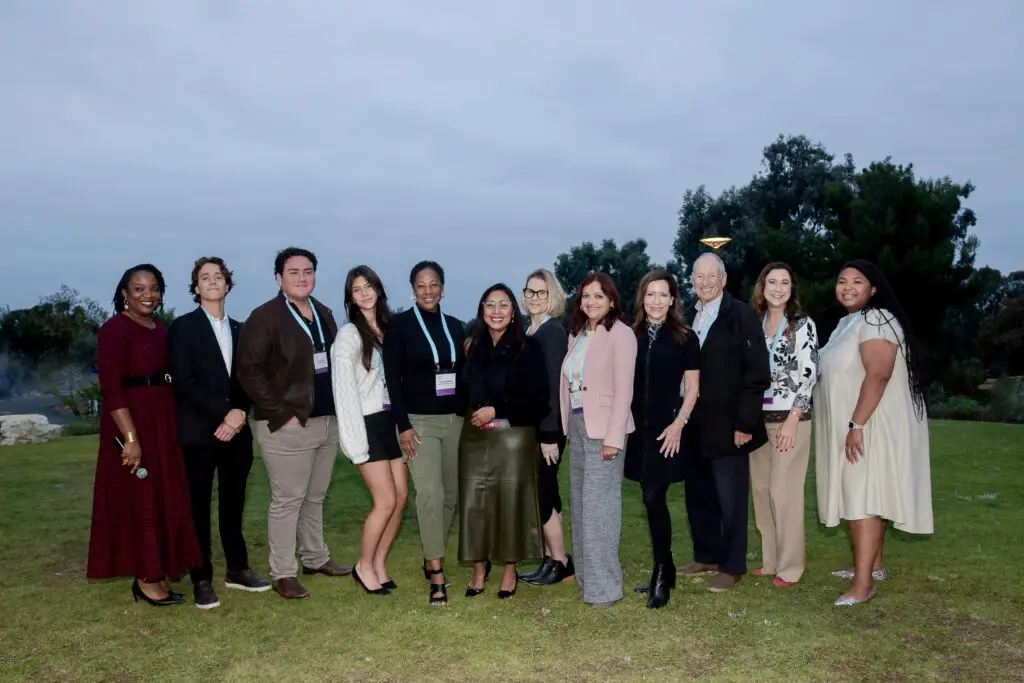
The National Philanthropy Day Honorees are selected by the NPD Honorary Committee, a group of highly respected, diverse nonprofit and business leaders. Our 2025 Honorees include:
Outstanding Development Emerging Leader – Taylor Thompson Self-Nominated
Outstanding Development Professional – Sharyn Goodson Nominated by: AJ Steinberg & Jeanne Schmelzer
Outstanding Organization for IDEA – Accessity Self-Nominated
Outstanding Philanthropic Institution – Life Science Cares San Diego Nominated by: Blair Search Partners
Outstanding Philanthropist – Dan & Phyllis Epstein Nominated by: CSU San Marcos & KPBS
Outstanding Student Volunteer – Camden Hall Nominated by: Curebound
National Philanthropy Day San Diego provides an opportunity to reflect on the meaning of giving and to celebrate the selfless contributions of individuals and organizations across the region. We look forward to celebrating with you!
Sponsorship opportunities and individual tickets are available. Please visit www.afpsd.org for more information.