Ready to know more about San Diego?

Subscribe
Neighborhoods DECEMBER 28, 2020

San Diego Neighborhood Guide: Tierrasanta

Where to eat, hike, and explore in this quiet community on the edge of Mission Trails Regional Park
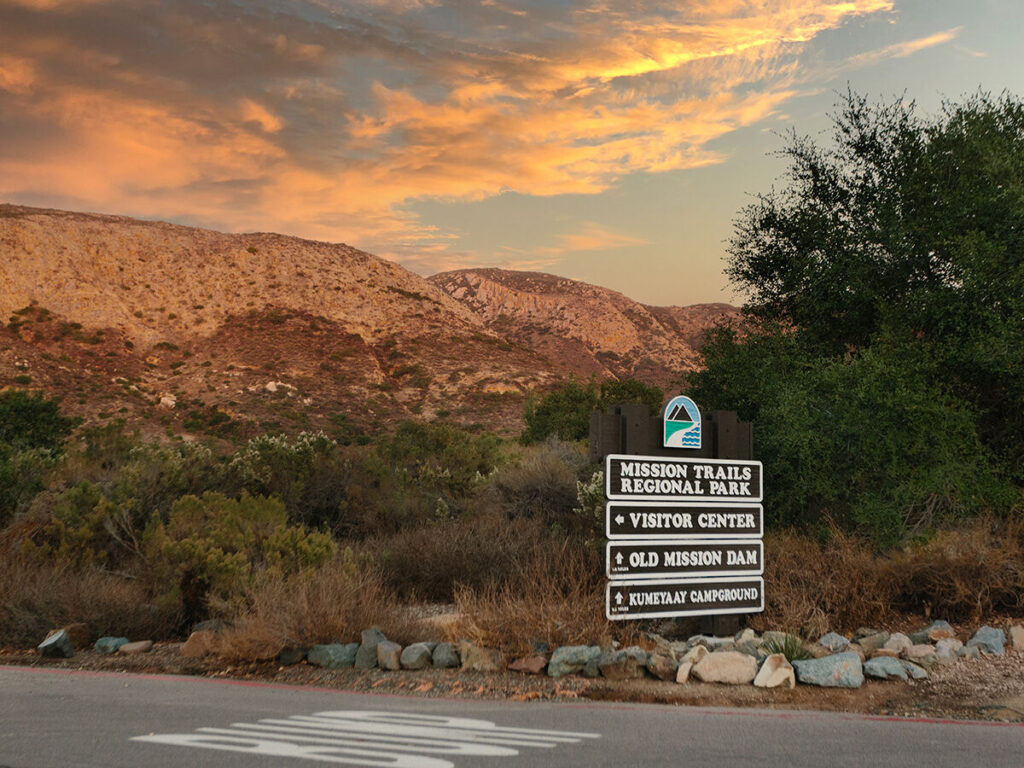
San Diego Neighborhood Guide: Tierrasanta
Photo Credit: Justin Halbert

Eat

Tierrasanta has its share of sweets, eats, and coffee. After polling neighborhood residents, chef Javier Ugarte transformed his 25-year-old Italian eatery, Andiamo, into the modern gastropub Fifty9Fifty for upscale American fare, 20 rotating taps, and a heated patio.
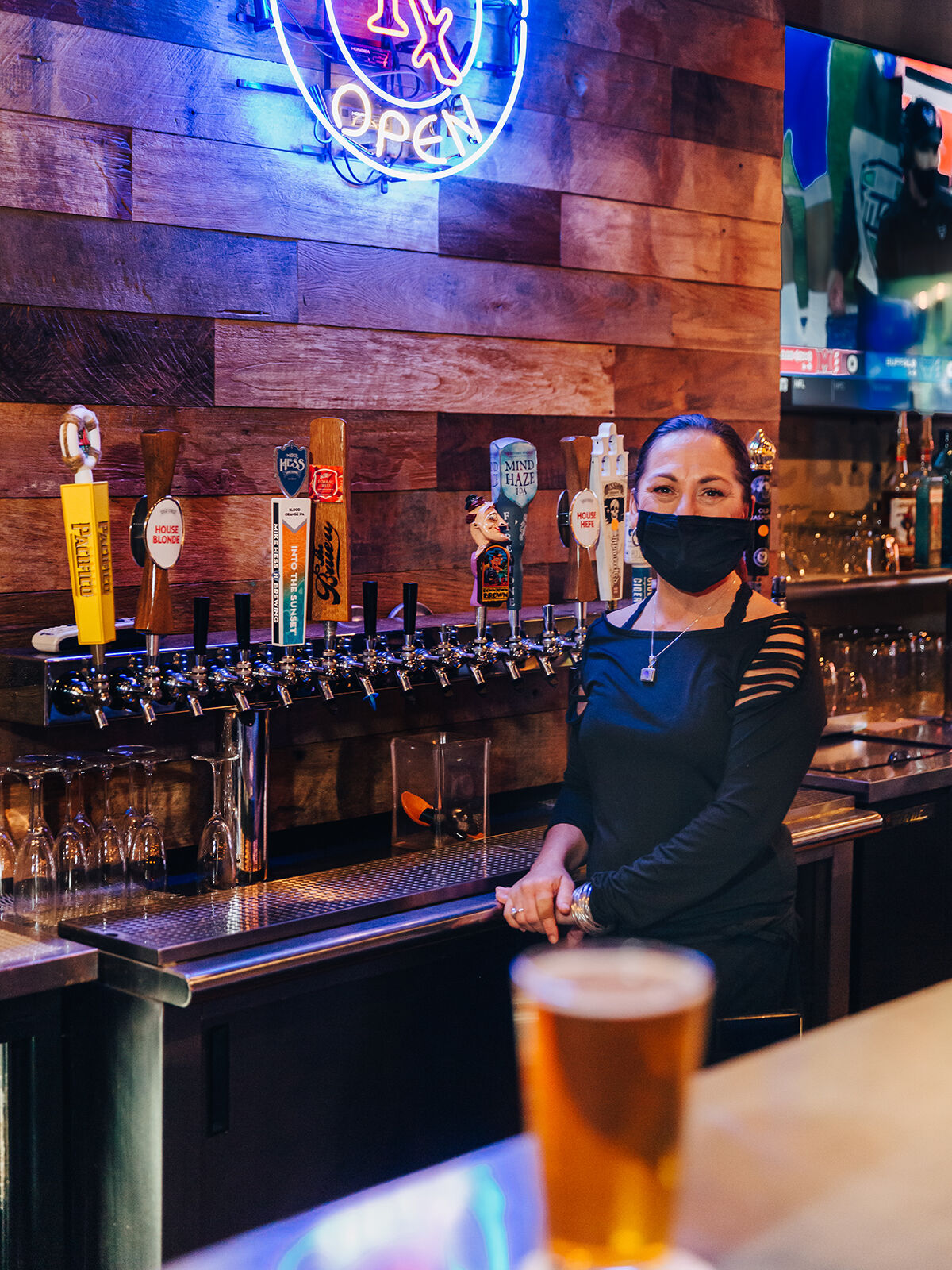
Neighborhood Guide Tierrasanta / Fifty9Fifty

Fifty9Fifty

Photo Credit: Justin Halbert

Just up the road is Tasty Donuts, where the cronut trend is alive and well. The friendly café has been a neighborhood favorite since 1993. Insider tip: The iced coffee at Tasty Donuts won’t get watered down—they use frozen coffee for ice cubes.

Another great morning pick-me-up is Industrial Grind Coffee. This family-owned shop boasts house-roasted beans and chocolate truffles that are almost too pretty to eat… almost.
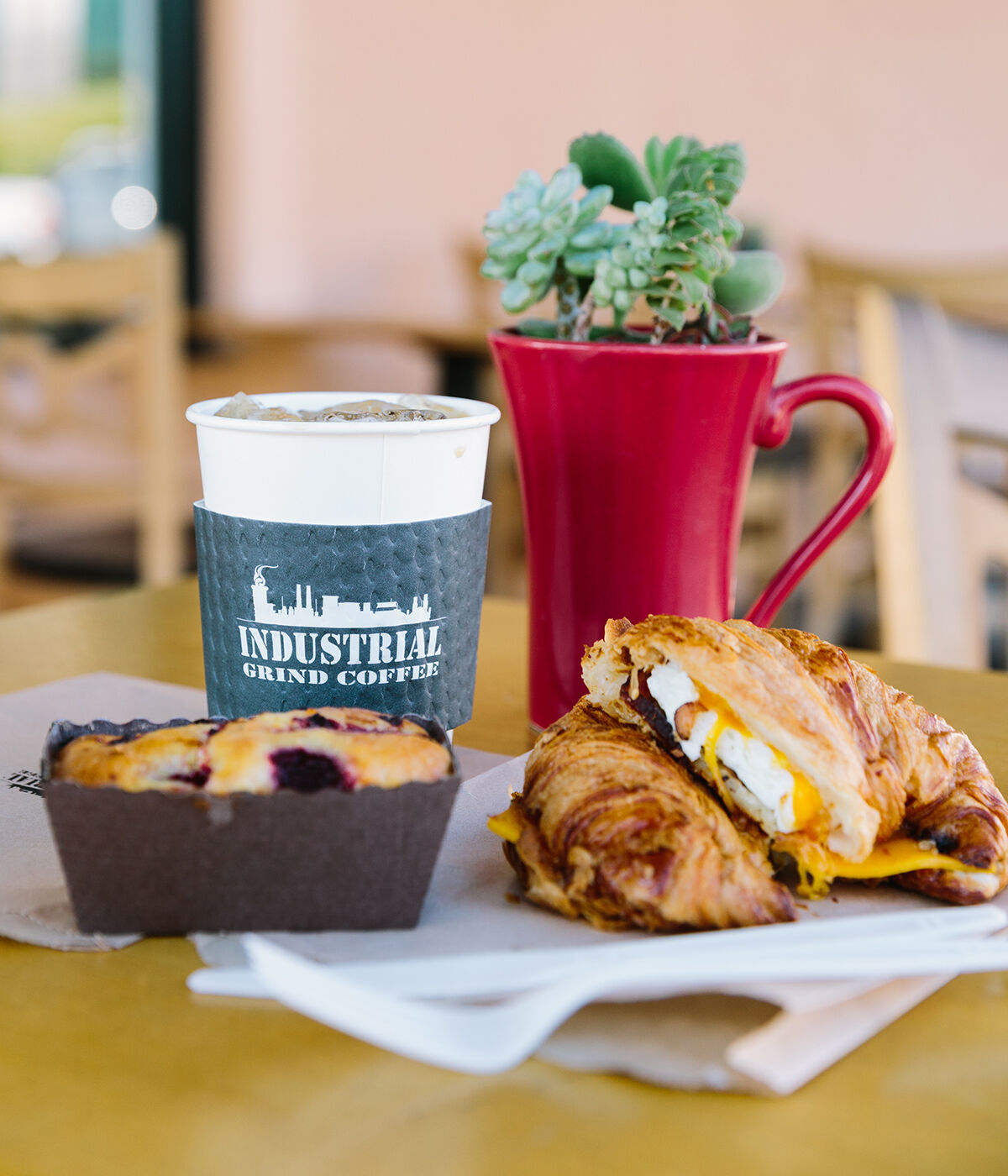
Neighborhood Guide Tierrasanta / Industrial Grind Coffee

Industrial Grind Coffee

Photo Credit: Justin Halbert

See/Do

In Eurasia, all roads lead to Rome; in Tierrasanta, they lead to Mission Trails Regional Park. Start your 5-Peak Challenge at the eastern terminus of Clairemont Mesa Boulevard and knock out both North and South Fortuna on a 7.6-mile trek. The neighborhood has plenty of other recreational points of interest, plus bike lanes connecting it with its neighbors.

Skateboarders and roller skaters can show off their skills at Damato Park. Those who fare better without wheels can sign up for a music, dance, or fitness class at the Tierrasanta Recreation Center.

Nature buffs can bird-watch in West Shepherd Canyon or hike the shady, chaparral-lined trails of East Shepherd Canyon. The canyon’s native plant markers come courtesy of Girl Scout Troop 3278. The troop also created a detailed guidebook to accompany them.
Neighborhood Guide Tierrasanta / Sign

Neighborhood Guide Tierrasanta / Sign

Photo Credit:

About Those Signs…

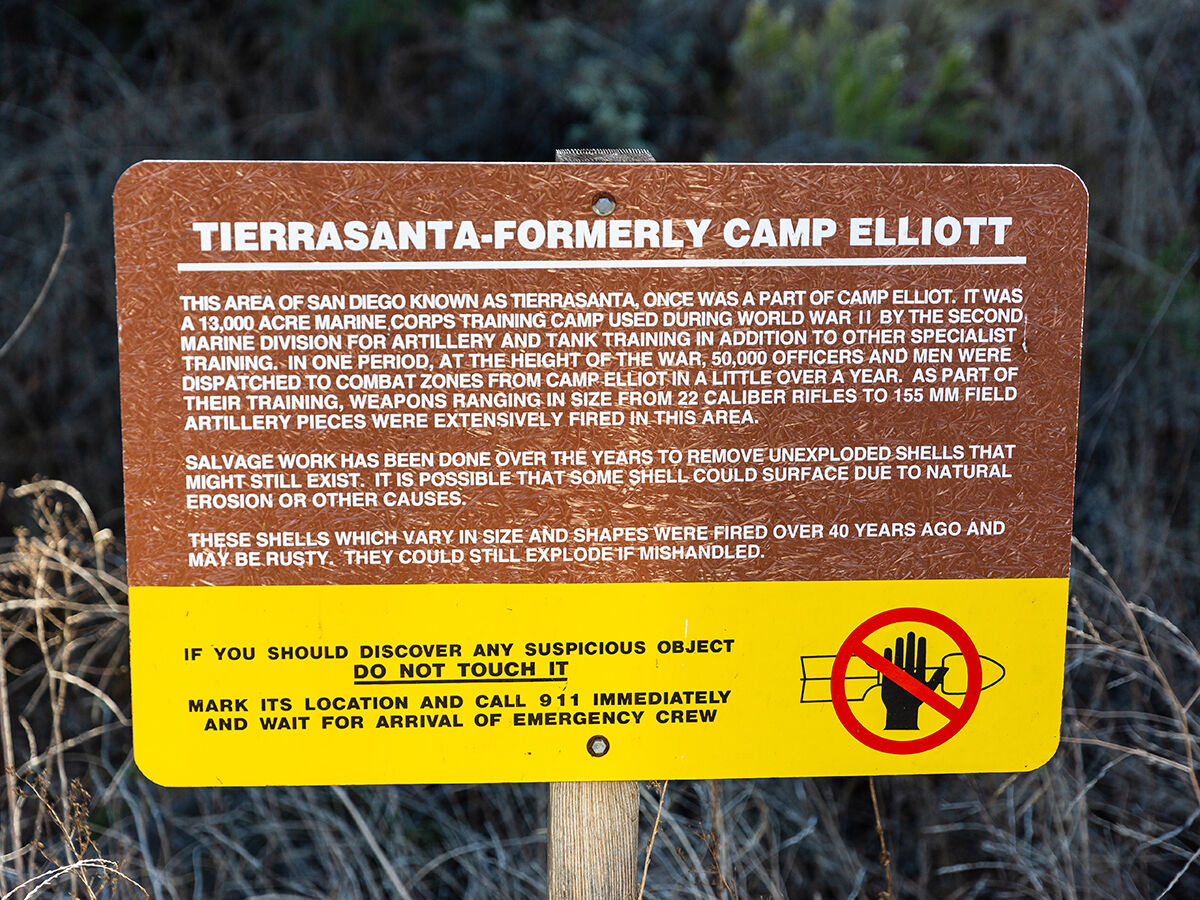
You may come across signs warning of possible unexploded ordnance from the land’s former life as a military training ground. Tierrasanta and a portion of Mission Trails were formerly known as Camp Elliott, an artillery range used by the Marine Corps during World War II. The military has done several sweeps in the decades since it was decommissioned to remove any leftover explosives, but the risk of one turning up remains. If you come across any suspicious metal object, don’t touch it; leave a marker nearby and remember its location; and call 911.

Nearby Finds

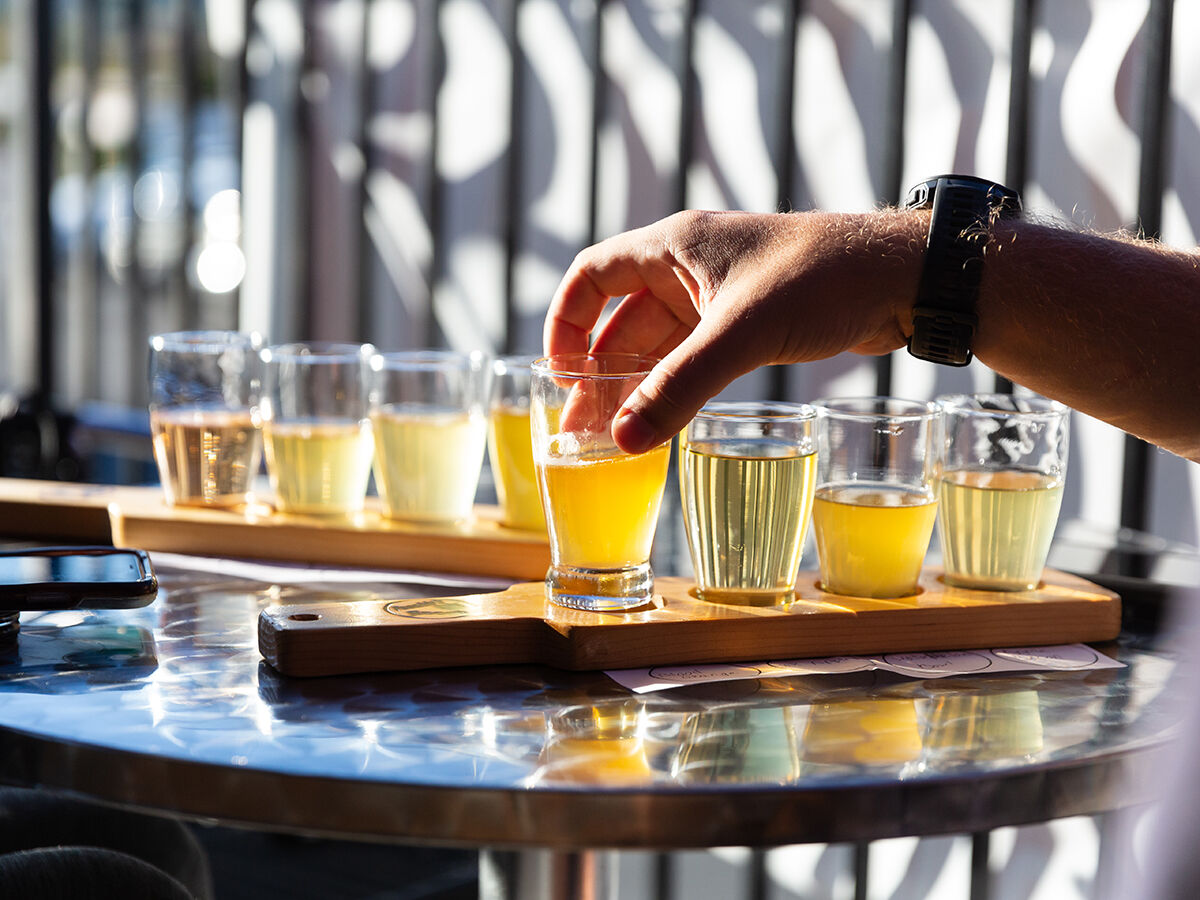
There are also great food, drink, and recreation options just outside Tierrasanta proper. Bud’s Louisiana Café, a longtime neighborhood haunt and favorite for po’boys, jambalaya, and crawfish étouffée, has a setup just across the 15. Poochie’s Hooch in Allied Gardens serves up cider on two dog-friendly patios, and San Diego Brewing Co. has 50 taps to sample from.
San Diegans on this side of town needn’t travel far to tee off, either: the Navy-owned Admiral Baker Golf Course is open to the public, offering two 18-hole courses and a short-game area.

Subscribe to our newsletters

Select Options

By subscribing you confirm that you agree with our Terms and Conditions and Privacy Policy.

Everything SD JUNE 12, 2026

San Diego Neighborhood Guide: Rancho Bernardo

Discover eateries, outings, and shops within this inland North County community

San Diego Neighborhood Guide: Rancho Bernardo
Courtesy of Rancho Bernardo Inn

Just south of Lake Hodges near 4S Ranch and Poway, Rancho Bernardo is a suburban community that blends residential neighborhoods with industrial pockets, elevated by a decidedly diverse food scene.  

Over 60 years ago, this North County neighborhood was once part of a family ranch. Since that time, big tech companies have taken up residence here, including Amazon, Sony Electronics, Oura Ring, HP, Teradata, and ASML. Rancho Bernardo Inn serves as a community hub, with locals frequently meeting at the hotel’s restaurants, golf course, and spa.  

Whether it’s work or a round of golf that brings you to Rancho Bernardo, we’ve taken care of the agenda planning with our guide to the area’s best restaurants, activities, and shops.

Courtesy of Avant Restaurant

Rancho Bernardo Restaurants, Bars, and Coffee Shops

Avant

Sample ingredients plucked straight from Rancho Bernardo Inn’s onsite garden and served at their signature restaurant Avant. One of the neighborhood’s most upscale dining options, they serve a French-inspired menu with nods to California, including many seafood options. Don’t miss their more casual sister restaurant Veranda for al fresco dining.

17550 Bernardo Oaks Drive

Things to do in Ramona, CA near San Diego featuring

The Kitchen at Bernardo Winery

Wood-fired pizzas and handmade pastas are standouts at The Kitchen, Bernardo Winery’s counter-service restaurant specializing in Sicilian flavors. Charcuterie boards and bruschetta make for great starters or snacks while wine tasting.

13330 Paseo Del Verano Norte

Bushfire Kitchen

Fast-casual and family-owned eatery Bushfire Kitchen recently opened a location in Rancho Bernardo, serving sandwiches, bowls, salads, burgers, protein plates, and housemade empanadas. Bushfire prepares comfort food with healthy ingredients, and offers plenty of vegetarian and vegan options.

11962 Bernardo Plaza Drive, Suite 110

The Cork & Craft

Some might call The Cork & Craft an overachiever. This gastropub has an in-house craft brewery and winery: Abnormal Beer and Wine. The more, the merrier. Their sushi menu is definitely worth exploring, but don’t miss other specialties like garlic noodles, chicken wings, and pork belly.

16990 Via Tazon

Courtesy of Carvers Steaks & Chops

Carvers Steaks & Chops

You don’t have to leave Rancho Bernardo to get a white tablecloth steakhouse experience. Carvers Steaks & Chops has prime rib (their best seller), filet, ribeye, porterhouse, New York strip, and other cuts, served alongside crab-stuffed mushrooms, wedge salad, French onion soup, potato skins, and other steakhouse specialties.

1940 Bernardo Plaza Drive

Burma Place

This no-frills Burmese restaurant is known for its traditional tea leaf salad that’s topped with sesame and sunflower seeds, garlic chips, peanuts, tomatoes, jalapeños, fried yellow beans, and fermented green tea leaf dressing. Tucked into a nondescript strip mall, Burma Place is a great takeout option when you want to eat garlic noodles, fried rice, chicken curry, and samosas from the comfort of your couch.

16719 Bernardo Center Drive, Suite A

Phở Ca Dao

Find authentic Vietnamese cuisine at Phở Ca Dao, including favorites like phở noodle soup, vermicelli noodles, broken rice dishes, and spring rolls. One of eight locations throughout San Diego, this family-owned chain uses robot servers for food delivery.

11808 Rancho Bernardo Road, Suite 100

The Kebab Shop

It’s all about the sauce at fast-casual Mediterranean restaurant The Kebab Shop. Smothering your chicken shawarma, gyro, or falafels in garlic yogurt, cilantro jalapeno, fire chili, and dill yogurt sauce is practically a rite of passage. The hardest part is deciding whether to order a wrap, bowl, or salad.

11980 Bernardo Plaza Drive

Casa Lahori

Get a taste of South Asian flavors at Casa Lahori, a Pakistani restaurant noted for its grilled meat kabobs. Other best-selling dishes include beef nihari, chicken biryani, and shahi paneer— best enjoyed with naan bread.

11975 Bernardo Plaza Drive

Kangnam Korean BBQ

Grill your own meat on the tabletop at Kangnam Korean BBQ, an interactive, all-you-can-eat experience that’s well-suited for large groups. Marinated beef bulgogi, grilled galbi short ribs, and spicy pork are served alongside traditional banchan dishes like kimchi, japchae glass noodles, and flavorful stews. Weekday lunch specials provide a nice discount on these filling meals.

11828 Rancho Bernardo Road, Suite 117–119

Courtesy of Curry & More Indian Bistro

Curry & More Indian Bistro

Dig in to your favorite curries and kebabs at Curry & More Indian Bistro. Most entrees are served with a choice of two side dishes, including basmati rice, potatoes with cumin, daal, naan, or mixed greens. Help offset the spice with one of their sweet mango or strawberry lassi drinks.

11808 Rancho Bernardo Road, Suite 123

Sushi Kami

Kai Oliver-Kurtin is a San Diego-based writer who covers travel, dining, events, and culture. Her writing has been published in USA Today, Condé Nast Traveler, Fodor's Travel, Marie Claire, and HuffPost, among others.

Everything SD FEBRUARY 16, 2024

Vote Now for San Diego’s Best Restaurants 2024

Help us pick the city's top places to dine and be entered to win a $200 gift card to Catamaran Hotel Resort and Spa

18b4129f-4cd6-49b9-a319-0adada31f201

Restaurants are the social lifeblood of a city. They offer a place to commune with friends and strangers alike, build relationships, explore new cultures through flavors, and offer a welcome escape from the reality of our own kitchens. All under the guise of getting something to eat.

With all restaurants do to nourish us, we invite you to give back to them by voting for your Reader’s Choice favorites in several categories.

Vote in as many categories as you like, but you can only cast one vote per category. If the altruistic love of your favorite spot isn’t enough, your vote will enter you to win a $200 gift card to the Catamaran Hotel Resort and Spa.

Winning restaurants earn bragging rights for the entire calendar year—and your continued love and support. So, go on. It’s up to you to decide on our city’s next culinary icon.

Voting has closed. View the Best Restaurants 2024 Winners here.

Food & Drink MARCH 6, 2020

Matteo Shares a Piece of the Pie

Renowned pizza operator opens a nonprofit restaurant in South Park—for the kids

Matteo Shares a Piece of the Pie
Photo Credit: Lauren Pettigrew

Matteo Cattaneo has eyes the color of Kalamata olives, and right now they’re brining in his tears. That sounds maudlin, I know. But it’s true. It’s not a full breakdown. He doesn’t bawl into the carrot cake (with a killer orange-zest icing). Too much work to do for that. But just sitting here with me for a few minutes at his new restaurant, Matteo, the idea of this place gets him a little misty. 

Matteo is a nonprofit breakfast and lunch restaurant in South Park, the part of town where Cattaneo made his name with Buona Forchetta, one of the city’s top pizza restaurants. What is a nonprofit restaurant? It means any profits made at Matteo after operating costs (salaries, food, overhead, etc.) will not go to Cattaneo or investors. It will go to “early childhood development” for San Diego kids (ideally, those in low income areas who need it). 

Restaurants already have micro-thin profit margins. So the joke when people first heard about it was, “Aren’t all restaurants nonprofit?” 

Matteo 2
Photo Credit: Lauren Pettigrew

“We’ve been very lucky,” Cattaneo says over a prosciutto-burrata breakfast pinsa (a pizza made with rice flour as well as wheat, for a lighter, more digestible crust) created by his chef Luca Zamboni. “The community has really supported us and our business. We’ve got enough. How much more do you need?”

How much is enough? In San Diego, where the median home price is $606,000, the answer is a lot. But Buona Forchetta has done exceedingly well. They’ll open their fourth location, Garage Buona Forchetta, in Coronado this month; a pizza stand in North Park called Gelati & Peccati; and Carbón, a barbecue joint in South Park. 

So Cattaneo isn’t done making profits. He and his team—which at Matteo includes baker and general Joanne Sherif, who owned North Park’s Cardamon Cafe before closing last year—will sell more food, more drinks, make more jobs. But Matteo is one for the community. I don’t know the exact recipe for restaurant success, but I know part of success in any business is giving along with taking. Just look at TOMS shoes, Patagonia, Warby Parker, etc. You almost have to build it into the model now. Whether that’s just a PR move or not I’ll leave to the cynics. 

“This spot was perfect,” he says of the large corner space on Juniper & 30th Streets, across from Station Tavern and Whistle Stop Bar. “But this space has always been a place for the community. I saw it was available and knew it didn’t belong to a business, it belonged to the community.” 

The nonprofit process sure wasn’t easy, Cattaneo says. The biggest concern was having a say in where the money goes. Schools, god bless them, are run by a bureaucracy. If he funneled the money directly to that machine, some funds would end up going to a school that didn’t really need it (schools in Del Mar and Rancho Santa Fe are probably OK on funds, for instance). So Cattaneo set up a foundation where they can analyze which communities—beyond just South Park—and make their own decisions about who needs help. 

“With the foundation, we can work directly with the schools and see where there’s the most need,” he says, noting they’re starting with Chavista Cesar Chavez Service Clubs, which put on a lot of after-school enrichment programs for kids. “They help in areas where a lot of moms and dads are working 12 hours a day. They can teach them how to eat well, how to study, give them more opportunities.”

Matteo will rotate its beneficiary a few times a year. 

This isn’t a half-assed restaurant, either. Along with Sherif, who has a great name as a baker (try her almond croissant or coffee cake), Zamboni has a hell of a track record in pizza. For five years, he worked under Gabriele Bonci, known as the “king of pizza” in Rome. The menu is full of benedicts, toasts, frittatas, croissant sandwiches (the smoked salmon is excellent), bowls, pastries, and those breakfast pinsas. They’ll also start offering kids’ takeaway school lunches parents can pick up daily, with vegan and gluten-free options. 

I know the “why” of the project. I just wonder about the hours. I want to know “how” he can pull it off. 

“It just added four hours to my work day,” he smiles. “I didn’t sleep at night anyway and was up at 4AM looking for something to do.” 

Matteo officially opens Saturday, March 7. 3015 Juniper St., South Park. 8AM-3PM.

Troy Johnson

About Troy Johnson

Troy Johnson is the magazine’s award-winning food writer and humorist, and a long-standing expert on Food Network. His work has been featured on NatGeo, Travel Channel, NPR, and in Food Matters, a textbook of the best American food writing.

Studio S FEBRUARY 26, 2026

Chef Aidan Owens Thinks Your Fish is Boring

The 29-year-old culinary director at Herb & Sea is making seafood sexy (and approachable) again

Implementing a farm-to-table model hardly deserves acknowledgement these days. It’s not a stretch. It’s not innovative. “It’s the bare f**king minimum,” says Herb & Sea‘s executive chef Aidan Owens.  

When I arrive at the Encinitas restaurant, I’m ready to talk sustainability, farm-to-table stuff, with Owens. “Did you see the chin on that?” he says of the extra big jiggly chin on the sheephead that just arrived with the day’s fresh catch. I did. It was Jay Leno adjacent.

I learn quickly that he somehow oozes both charm and stone-cold honesty. Maybe he could construct a new dish with chin goo, like he did when he had a bunch of tuna scraps and voila’d it into a smooth and crowd-pleasing ‘nduja. “I want to know what’s in there,” he says.    

Courtesy of Herb & Sea

The instinct to look closer, to dig into what others might discard, says a lot about the chef’s approach. I guide him back to our topic, but he has something else on his mind. “We’re overcomplicating food—what happened to just cooking good food and having fun with it?”

Owens grew up on a farm in Byron Bay, Australia, where sustainability wasn’t a concept you chat about so much as a way of life. Think dirt roads, backyard chickens, pulling vegetables straight from the ground, and a mother who believed that if you couldn’t pronounce the ingredients on a package, you shouldn’t eat what was inside.

Food wasn’t precious or performative. Making it was what you did because you were hungry and that’s still what inspires Owens today. “I like to cook good food because I like to eat good food,” he says.

His approach to sustainability at Herb & Sea began so naturally that it felt just like instinct. “I was just like, ‘Let’s order food from the people who live and work here,’” he says.

Courtesy of Herb & Sea

And why wouldn’t he when lives in San Diego? Cities all over the world vie for our goods. Our tuna is sent overseas. Our spiny lobsters hit dinner plates in China and Japan. Not to mention California’s producing a third of the country’s vegetables and three-quarters of its fruits and nuts. 

“Why would we outsource when it’s all here?” Owens asks.

Sustainability, in this context, is about cooking what exists in abundance, nearby, right now. “I love the local fish here. It’s f**king delicious and San Diego citrus, I mean, it is so f**ing good,” he says.

Instead of importing ingredients, Owens also looks for nearby alternatives. “You can find really cool things in the local waters,” he says, pointing out that stingray cheeks taste similar to scallops.

Courtesy of Herb & Sea

Whatever he finds in that sheephead chin might just be the next substitute for marrow. But to make this work, it means getting diners amped up about the slightly unfamiliar. 

Tasting menus, where diners are completely in his hands, become an opportunity to gently push boundaries. “I’ll serve mackerel, because people think they hate it,” Owens says, noting that the abundant local fish can have some fishiness. “But when it’s fresh, it’s arguably one of the best fish in the ocean.”

He also tweaks the language on the menu so people might feel more compelled to give dishes a try without preconceived notions. He might use “lengua” instead of “tongue.” “Whelk” instead of “snail.” When he puts “stingray throat” on the menu, he disarmingly calls it “skate.” 

To reduce waste, scraps aren’t always discarded but rather turned into something new. Sometimes they’re smoked, cured or fermented. Apples going bad turn into apple ponzu. Lemons turn to marmalade, which stretches their usefulness far beyond peak season. “And it’s super tasty on our pizza,” he says.

What makes the food even richer, is the relationships he’s built with farmers. Though it didn’t always feel natural, Owens sought personal connection first. He recalls approaching a fisherman at the Tuna Harbor Dockside Market. “I was awkward,” he says. “I went up to him and said, ‘I like your fish.’”

Owen’s is now so close to his suppliers—like fishermen Ryan Sebo and Joe Daly—that he gets texted pictures of fresh catches right as they flop on the boat. The messages always ask if he wants first dibs. “I say yes to a lot of fish,” Owens says, noting that Herb & Sea can go through 2,000 pounds of seafood a week.

Courtesy of Herb & Sea

The next evolution of sustainability, in his view, will be chefs working directly with producers such as his alliance with Sebo, cutting out middlemen and purveyors where possible. “It will put more money in the pockets of the people doing the work,” he says.

It will mean that chefs can’t just know their local farmers and producers, but they’ll choose to work with the ones who have the best practices. Dining and sustainability will become much less about the final plate. “It will be more about the impact that plate has on the Earth,” he says.  

Ultimately, he believes sustainability doesn’t need to be loud. It doesn’t need hashtags. It just needs to be honest.

“We aren’t saving lives. We’re feeding people good food,” he says.

And yet, in feeding people well—simply, thoughtfully, responsibly—something meaningful happens. Guests leave satisfied. Ingredients are respected. Local ecosystems are supported and food returns to what it has always been at its core: nourishment, pleasure, and a quiet reflection of the place it comes from.

No buzzwords required.

Archive JANUARY 26, 2018

Green Rush: Inside San Diego’s Emerging Cannabis Industry

Marijuana's legal. How did it go from evil death drug to medical miracle and billion-dollar industry?

Green Rush: Inside San Diego’s Emerging Cannabis Industry
At a home in Mission Hills, these professionals and medical patients challenge the old stereotype of marijuana users.

It seems like a standard boardroom. A big table for big conversations. A small fridge with small waters. A flat-screen flips through striking photos of the company’s products. But then there’s that huge window. It doesn’t face outdoors; it’s an observation window. I look into the sepia-toned room below, and there they are. A couple hundred “babies,” as OutCo CEO Lincoln Fish calls them. “In six weeks, they’ll be six feet tall and the whole room will be green.”

Marijuana plants. Luscious, vibrant, emerald marijuana plants. Legal marijuana plants.

On January 1, recreational marijuana became legal in California. With a 56 percent yes vote, residents passed Prop 64 on November 8, 2016. Last September, the San Diego City Council voted 6-3 to go all-in—legalize and regulate marijuana cultivation, distribution, and retail—making it one of the most progressive cannabis cities in California.

Now the green rush is on. The state estimates legal weed sales could raise $7 billion a year in revenue by 2021, including $1 billion a year in taxes. When legal cannabis sales began in Colorado in 2014, it took only 10 months to sell $1 billion worth.

With that kind of revenue, you can hear potholes being filled, teachers getting raises, parks being cleaned. You can also hear parents doomsaying, the alcohol industry plotting revenge, and small marijuana farmers giving retirement speeches as corporations move in—like Privateer Holdings, a $150 million cannabis investment fund backed by PayPal founder Peter Thiel, or Constellation Brands, an alcohol distribution company that recently bought 10 percent of the Canadian marijuana market.

The History

How we got here is a long and winding road. The brief history of marijuana goes something like this, according to author Bruce Barcott in his book Weed the People. California first outlawed weed in 1913, when it was almost exclusively imported from Mexico. The Harrison Act of 1913 put control of narcotics under the purview of the federal government, but it concerned only cocaine and opiates. Harry Anslinger, the first commissioner of the Federal Bureau of Narcotics, didn’t initially want to go after marijuana. But then the Great Depression hit. His bureau was underfunded and in danger. Anslinger needed a cause to justify his organization’s existence. He convinced Congress that America was about to lose its soul to weed.

The Hearst newspaper empire helped, renowned as it was for making slight concerns into national moral panics. Its headlines included “Marijuana Makes Fiends of Boys in 30 Days” and the verbose “Murder Weed Found Up and Down Coast—Deadly Marihuana Dope Ready for Harvest that Means Mass Enslavement of California Children”.

Marijuana became enemy number one. Parents hid their children. This was ISIS, the plant.

But then the studies came. In 1925 the US Army commissioned lawyers, officers, and public and mental health professionals to study cannabis use by soldiers in Panama. The committee found no evidence that marijuana “has any appreciably deleterious influence on the individuals using it.” Fears of marijuana-fueled insanity “appear to have little basis in fact,” they went on.

Anslinger responded by making any such research into the drug illegal. Despite opposition from health officials, marijuana got lumped in with heroin and other hard drugs in the 1951 Boggs Act, a spat of hardline antidrug laws. As marijuana became the relaxant of choice for the antiwar hippie movement, it ruffled another powerful man: Richard Nixon. With the Comprehensive Drug Abuse Prevention and Control Act, he set out to separate drugs into five categories: The least harmful were given Schedule V, and the most harmful Schedule I. Cocaine and meth got Schedule II. Heroin and LSD landed in Schedule I.

Green Rush: Inside San Diego's Emerging Cannabis Industry

Green Rush: Inside San Diego’s Emerging Cannabis Industry

Lincoln Fish was anti-marijuana until a friend suggested he research the medical benefits. Now he owns OutCo in El Cajon, the largest cultivation operation in SoCal.

Nixon created the infamous Shafer Commission to help him decide where to put marijuana. Made up of political conservatives, the commission seemed sure to vilify weed. It didn’t. After a year of study, it released its report, “Marihuana: A Signal of Misunderstanding,” which recommended an end to prohibition. In 1973, Nixon ignored their findings and classified marijuana Schedule I, as dangerous as heroin and LSD. Some states had read the report for themselves, and decriminalized the drug. Still, arrests skyrocketed.

Neighborhoods MAY 22, 2015

Inside the Icon: The California Building

The Tower is open! Visitors can now climb the 100-year-old beacon of Balboa Park

Inside the Icon: The California Building

Inside the Icon: The California Building

Inside the Icon: The California Building

Photo by Dancestrokes/Shutterstock

Photo by Dancestrokes/Shutterstock

Visit the Icon

1350 El Prado, Balboa Park

Century-Old Architecture

Constructed for the 1915 Panama–California Exposition, the California Tower is the peak of the California Building, which houses the Museum of Man, the dome, and the tower.

An Ode to España

Designed by Bertram Grosvenor Goodhue, the California Building was inspired by Spanish and Mexican churches.

Permanent Placement

While most structures in Balboa Park were designed to be temporary, built solely for the exposition, the California Building, Botanical Building, Cabrillo Bridge, and Organ Pavilion were all intended to be permanent.

A Museum is Born

During the 1915 exposition, the California Building housed the exhibition The Story of Man through the Ages. Collections from that exhibit were used to establish an anthropology museum, the San Diego Museum, which became the Museum of Man in 1942.

A Wartime Hospital

During World War II, the Museum of Man was converted to a hospital, with the exhibits placed in storage until after the war ended.

Donations Welcome

Visitors inspired by the bird’s-eye view can sponsor a stair for $5,000, or a bench for $25,000.

For Whom the Faux Bells Toll

Despite the chimes that ring every 15 minutes, there are no bells in the Tower. The music actually comes from an electronic carillon installed in 1946. Today, the carillon consists of 100 chimes that can be heard for a mile in every direction.

Grand Reopening

The California Tower was closed to the public after the 1935 California Pacific International Exposition. 2015 marks the first time in 80 years the Tower is open to the public. Forty-minute tours are conducted 10 times a day.

Step Counter

From the second floor of the Museum of Man, it’s 125 steps up to the observation deck on the eighth floor, with the final 18 steps on an original, cast-iron spiral staircase. Two additional flights are not open to the public.

View from the Top

On a clear day, you can see 23 miles to the horizon, with 360-degree views to the Cuyamaca Mountains, the Coronado Islands, the Laguna Mountains, and Point Loma.

Partner Content FEBRUARY 16, 2026

Torch Heroes: Why San Diego’s Most Trusted Businesses Win by Doing the Right Thing

In a world overflowing with shortcuts, marketing fluff, and “good enough,” there are still companies that choose a different answer. And in San Diego, there are plenty of them.

Torch Heroes: Why San Diego’s Most Trusted Businesses Win by Doing the Right Thing
2025-Torch-SD-09131839 (2)

In a world overflowing with shortcuts, marketing fluff, and “good enough,” there are still companies that choose a different answer.

Integrity guides how they show up every day. They make hard decisions, hold themselves accountable, and build trust the old-fashioned way, one action at a time. At the Better Business Bureau, we call these businesses Torch Heroes: leaders who demonstrate that ethical leadership strengthens businesses and drives long-term success.

And in San Diego, there are plenty of them.

Take House Collective Marketing Solutions, a Carlsbad-based digital agency that won the 2025 Torch Award for Ethics for its people-first approach to marketing. Instead of pushing flashy campaigns, the team often takes a step back to make sure clients’ foundations are strong before going big. Their philosophy? Truth over transaction builds partnerships that last.

Or look at Young Black & N’ Business, where integrity shows up through community action. When a local school lost art funding, founder Roosevelt Williams III and his team stepped in with workshops, mentorship, and hands-on support to help restore creative opportunity. That kind of engagement reflects ethical leadership rooted in real impact.

And in Vista, Lotus Sustainables carried its commitment to ethics all the way to the product line. After discovering defects in a shipment of eco-friendly products, the company issued full refunds and redesigned its offerings at its own expense, a choice that shaped its identity and reinforced to customers that ethics guide every decision.

In North County, Greenway Landscape Design & Build brings integrity into everyday service. When a client’s glass was damaged, likely not by their crew, owner Scott Lawn chose responsibility over blame and covered the repair personally. For Greenway, doing the right thing serves as a north star, guiding every interaction through transparent pricing, accountable partnerships, proactive communication, and follow-through long after the job is done.

Other honorees include At Your Home Familycare, whose leadership turned down a lucrative state contract during the pandemic to protect vulnerable clients and staff, and Bill Howe Family of Companies, where hiring practices, training, and service centers around shared values, every day, on every call.

What connects these diverse businesses, from marketing to nonprofit support to home services, isn’t size, industry, or revenue. It’s something deeper: a commitment to trust as a business strategy.

In San Diego’s competitive marketplace, that trust gives companies an edge. Clients invest in relationships. They refer friends. They stay loyal when others fade.

As one Torch Award winner puts it, integrity isn’t a section in the employee handbook. It’s the operating system of the company,  the invisible code that determines every choice, every day.

And that’s exactly the point of the BBB Torch Awards for Ethics: to spotlight companies that dispel the myth that ethics and success are at odds. These businesses show that when leaders choose honesty, fairness, and accountability, especially when it’s hard, they build brands that matter.

At BBB, we see nominations come in from clients, employees, and business partners who have witnessed ethical leadership up close. These submissions aren’t polished promotions. They’re stories of moments when a company chose people over profit, clarity over confusion, and trust over convenience.

The nomination window for the 2026 Torch Awards for Ethics is open through March 31, 2026, and there are more Torch Heroes waiting to be recognized.

Who comes to mind in San Diego’s business community?

  • A vendor who always delivers — and always explains why.
  • A competitor who chooses the high road even when shortcuts tempt.
  • A team within your own company whose day-in, day-out choices reflect deep character.

And yes, businesses can nominate themselves. We encourage it. If you’ve built your business on principles rather than buzzwords, we want to hear your story.

Because in a world full of noise, integrity still deserves the spotlight, and San Diego is full of stories worth telling. Nominate your hero now

Thousands of savvy locals already get it.

San Diego's best restaurants, experiences, and events—handpicked and delivered to your inbox weekly. You in?

Close the CTA

Contact Us

1230 Columbia Street, Suite 800,

San Diego, CA