Featured articles
Food & Drink
Food & Drink

Features
Featured articles
Everything SD
Things to Do
Things to Do
Featured articles
Things to Do
Things to Do
Food & Drink
Featured articles
podcast-ep
podcast-ep
podcast-ep
Featured articles
Food & Drink
Features
Food & Drink
Featured articles
Everything SD
Food & Drink
Partner content
Ready to know more about San Diego?
SubscribeReady to know more about San Diego?
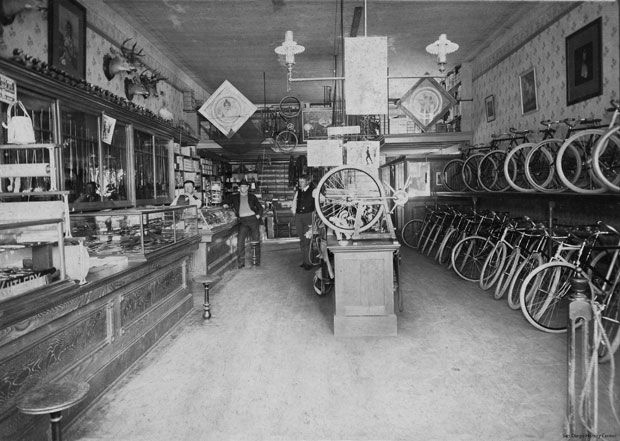
The San Diego Cycle and Arms. Co from 1904

San Diego Cycle and Arms Co. in 1904

Vintage San Diego: Free Wheelers
The biking scene is nothing new to San Diego. More than 100 years ago, San Diegans who were passionate about their two-wheeled wonders formed the San Diego Wheel Club. When they weren’t riding, cyclists could pursue their hobby at the San Diego Cycle and Arms Co. (pictured). Originally located at the southeast corner of Fourth and E, the store was much more than a bike shop. The SD Cycle and Arms Co. sold cutlery, fishing tackle, ammunition, sporting goods for games such as baseball, golf, and tennis, and, as the name implies, guns and bicycles (notice the taxidermy on the left-hand wall). It also offered a range of bicycle and gun repair services. The store’s owners, Stanley Andrews, Archie Aldridge, and Max Toews, stood proudly in their establishment in 1904.
Riders participating in the Campagnolo Gran Fondo, taking off in Little Italy on April 6. The longest course is 105 miles.
San Diego held its first CicloSDias event
Bike racks that will soon be installed throughout
Balboa Park
Bikes that will be available through San Diego’s bike share program starting this summer
Cost of new plan that’ll add 595 miles of bike paths in San Diego by 2030
Mind-blowing tacos and projected guilt at one of SoCal's most famous birria spots
If it’s salvation you want, there’s a couple ways to get it in this alley. There’s the church at the end. A real churchy-looking church, too—the sort of pretty, white-wood Godspot you’ve seen in ads for lemon-scented wood cleaner. And then there’s the salvation that’s lured us all to this parking lot outside a wildly unremarkable stucco building the color of old khaki pants, waiting for the birria man to call our names.
It’s Fernandez Restaurant, one of the most famous birria spots in Southern California.
Fernandez (the sign says Ed Fernandez, but everyone just knows it as Fernandez) was started in this parking lot by two brothers—Jorge and Miguel—in 2006 (they’d eventually bring on their third brother, chef Carlos). Short on employment at the time, they borrowed a friend’s food truck and parked it here, serving their mom-tested recipe for the famed Mexican meat stew (here’s a short history of the dish).
Word got around fast. Pretty quickly they moved into the building, annexed next door, annexed upstairs, built a real nice back patio with Coca Cola decor (Coke schwag is to Mexican taco joints what Edison light bulbs are to gastropubs). Soon they will take over the building next door, and the church has offered to let customers use its parking lot (right now, they offer shuttle service to and from the parking lot at the nearby high school).
As far as birria goes, Fernandez is a small empire in an alley. A pickup-window helps satisfy some of the demand, but their demand may just be insatiable.

Gotta admit, I detect a little wariness in the dozens of people waiting outside as we walk up. At least 95 percent of the customers this morning, most of them regulars it seems, are Mexican. My wife Claire and I are acutely white, from the chalkiest Northern European stock. The needle scratches—not much, but just a touch. As a San Diego native, Mexican culture has always felt like my own, too, though I realize it’s not, and now’s not a particularly good time in U.S. history to expect a warm reception. But this morning is the first time—not even during the Prop 187 years—that I feel a little out of place in Mexican culture.
After all, Fernandez is a weekend sanctuary, and, well, here I come. I had plans to shoot short video segments, but I quickly dash those. I’m still writing about how good Fernandez is here in San Diego Magazine. But I couldn’t bring myself to interrupt the families’ breakfasts by yapping at a camera about why you all should come here and make their wait longer.
Maybe I’m projecting all this, saddling them with my own guilt. Maybe it’s just 9:30 a.m., they’re tired and hungry like I am, and a little bummed famous birria means waiting in line. Maybe they’re TikToking. I’m considering it’s possible a culture I love no longer feels terribly comfortable around me and how much that breaks my heart—when a bald ball of energy grabs my hand, shakes it with vigor, and says, “Hey! Good to see you!” Like we’re old friends, and I am the most welcome person ever to be welcomed.
This is Miguel. We’ve never met, and the only thing he knows about me is that I want to eat at his restaurant. Miguel is the host, the entertainer, the charmer, the man who makes families out of strangers. He knows customers by name, knows what babies and surgeries they’ve had. His brother Carlos runs the kitchen, and it cranks.
This had to be my first stop on the hunt for the city’s best birria. It’s the gold standard. It’s a very simple menu. They have birria, and birria-related tacos. They also have menudo on weekends until they run out (they’ve run out).

Miguel brings us what is possibly the single best taco I’ve had in my life—the Taco Queso Extremo, which is a house-fried tortilla, stained sunset red by that spicy, peppery birria consomme (broth), topped with melted cheese and moist, fall-apart birria beef that’s been crisped and browned on the griddle. Add hot sauce, chopped onions and cilantro, a dash of lime. The soft-crunch tortilla, the fatty, almost crisp melted cheese, the slow-stewed tender beef, dripping with the broth, the acid of hot sauce and lime, the red jus dripping down the side of your hand and arm—it’s over for you.
The birria consomme (served in a cup, it’s the meaty broth—the true quality test of a birria) is very good, deeply red and a tad spicy. It’s not the traditional goat or even the post-traditional lamb, so it doesn’t have that exotic funk I love. But the meat is tender and tastes like it’s spent the whole morning soaking up the intoxicant blend of cloves and cinnamon and garlic and cumin (it has).
Fernandez could expand, cater every quinceañera in Nestor and beyond. But Miguel tells us family time is important, especially after their parents passed a few years back. They’re only open from 7 a.m. to 2 p.m., closed on Mondays and Tuesdays. That’s enough for them, even if it’s not enough for the rest of us.
Fernandez Restaurant, 2265 Flower Ave., Nestor.
Troy Johnson is the magazine’s award-winning food writer and humorist, and a long-standing expert on Food Network. His work has been featured on NatGeo, Travel Channel, NPR, and in Food Matters, a textbook of the best American food writing.
Puffer Malarkey Restaurants unveil 5.5 million-dollar pan-Asian concept
Herb & Wood could’ve been named We’re Back.
When chef Brian Malarkey and partner Chris Puffer opened the massive Little Italy restaurant, their name had taken a bit of a hit. Malarkey had risen to prominence through Top Chef and the “fabric” restaurants, Searsucker and Herringbone. Then those were sold to Hakkasan, and the duo found themselves adrift. Herb & Wood was the first major project of their own (with plenty of investors), and Malarkey’s not shy about saying it was a redemption project.
“The fabric restaurants were good but not that good,” Malarkey says. “It took a bit for us to resolidify and attract talent after that.”
With chef Shane McIntyre (who recently left), cocktail man Willem Van Leuven and pastry chef Adrian Mendoza, Herb & Wood became one of those runaway successes restaurateurs dream about. A successful chef once told me, “There is no money in restaurants unless you do a simple concept and do 20 of them, or do a multimillion-dollar place like Malarkey.”
“I never thought I was the most talented chef in the kitchen,” says Malarkey. “The other day I looked around and it was like a chef university, a culinary think tank. We had Joe Magnanelli [formerly the longtime chef of Cucina Urbana], Carlos Anthony [Herb & Wood chef], Mike Ground [former exec chef at Patio Group], Sara [ex-Searsucker], Adrian Mendoza, and a couple guys Joe brought over from Nobu. We’re to look back on this as one of the greatest moments of our lives.”
That think tank has been brainstorming and tweaking the menu for Animae—a 9,300 square-foot, $5.5 million art deco-ish restaurant on the bottom floor of Pacific Gate by Bosa, an ultra-luxury condo development in the Embarcadero Marina. It opens Sept. 20, with Magnanelli at the reigns as exec chef and partner. Later this year, Harris will head up the next Puffer Malarkey concept, Herb & Sea in Encinitas.
Animae is a coal-fired pan-Asian concept, which may seem a stretch for Magnanelli, who for a decade was known for his Italian food at Urban Kitchen Group. But we no longer call it “fusion,” because everything has been fused. Chef pantries look like excessively stamped passports, with everything from thyme to za’atar to furikake. Even mom and pop shops are using fish sauce these days.
Plus, Malarkey says of Magninelli, “I could walk into any restaurant in Urban Kitchen Group, order one of his dishes, and it would taste exactly the same. He’s not just good, he’s consistently good. I wish I could walk into my own restaurants and say the same thing.”
Animae will fit between 170-190 people. Craft cocktails will be handled by Adam Ono (ex-Yeast of Eden, Bourbon & Branch). Like Herb & Wood, it will have an adjacent coffee shop with to-go food from the Animae kitchen. At night, they’ll transform the area into an event space.
I asked Malarkey a few tough questions on the eve of his open:
Whenever I do a new opening, I get really intense and in shape. When you’re playing with a lot of money you gotta be real responsible and focused. To the investors, but also to your wife and kids. You’ve got to have clarity. Thank god for the Peloton and the healthy eating. I’ve been able to get on the line cooking with Joe and these guys. I’m like Rocky Balboa chasing the chicken.
Really came around with meeting Nat Bosa. He doesn’t have restaurants in his other buildings. He’d eaten dinner at Herb & Wood, came in here casually and said, “I want a premium restaurant, and I don’t want to have problems with the group who runs it, so I’m going to make you a sweetheart deal.” He’s so straightforward and honest, so we felt we could be, too. He asked if Animae would do really well there. Puffer and I looked at each other and said, “We have no idea, Nat. We’re either going to kill it, or we’re going to close.”
Herb & Wood and Juniper & Ivy [Richard Blais’ restaurant next door] aren’t in the heart of Little Italy where people walk by and think “Oh, this place is cute.” I’d put the number of walk-ins at about 10 a night. The other 300 people are ride-sharing or valeting. Uber and Lyft have has changed our entire industry. Everyone just wants to go out and not worry about having to drive. You don’t need parking, and you can be off the beaten path. Look at Major Domo in L.A. Granted, that’s David Chang. But, still, it’s changed.
It took Puffer a while to talk me into it. We’re getting old. Our hearing’s going. I want to be able to sit across from people and have a great conversation. Plus, it’s the funkiest carpet ever. The whole place is so soft and has giant curtains. We used to be the ones cleaning up warehouses and making super-loud restaurants. Now I think we’re at the forefront of restaurateurs getting back to places you can talk to people.
Puffer and I were never allowed to have this much talent in the olden days. We no longer have people who tell us what our budgets are. Plus, all of our new GMs and chefs are our business partners. We gave them ownership stake. Ask any young chef or old chef what they want in life and they’re going to say, “I want my own restaurant.” Well, now you got it. We’d much rather make less money and sleep at night. That’s helping us get the best talent. We give them budgets that are reasonable, and beautiful venues to work with. If you build a fancy restaurant, and you don’t pay your people, you’re going to fail.
Coal-fired, Asian inspired. We’re not doing authentic Asian. There are no rules. So much fun to break them together. Almost every single dish is a mashup of Asian and Mediterranean. It’s incredible steaks, seafood, Asian crudo. Joe has taken his pasta skills and he’s making brothless ramen noodles. Whole roasted duck. Udon lobster dish with shaved parmesan. Whole fried chicken. We’re making our own bao buns.
Joe got more into Chinese flavors that are rich and bold. All I wanted was Thai and Japanese, super light with acid and spice. So I’m the guy who runs around putting a bunch of herbs and salt on everything.
Animae opens Sept. 20. 969 Pacific Hwy, Embarcadero Marina.
First Look: Animae
First Look: Animae
First Look: Animae
First Look: Animae
First Look: Animae
First Look: Animae
First Look: Animae
First Look: Animae
First Look: Animae
First Look: Animae
First Look: Animae
First Look: Animae
First Look: Animae
Troy Johnson is the magazine’s award-winning food writer and humorist, and a long-standing expert on Food Network. His work has been featured on NatGeo, Travel Channel, NPR, and in Food Matters, a textbook of the best American food writing.
Michelin-starred Italian chefs open a stunner in Bankers Hill
The kitchen alone is 2,300 square feet, a thousand more than my three-bedroom apartment. The press materials come with an “Art Guide.” The chefs have arrived, and they have a Michelin star. You never know. But everything about Il Dandy suggests it will be a game changer for San Diego.
And yet, or maybe because of this, co-owner Dario Gallo is concerned. The stress is tenfold from when he and his brother Pietro opened Civico 1845 in Little Italy in 2015.
A week from opening, a table at Il Dandy is stacked with servers’ uniforms—blue-and-white-striped Italian naval shirts. He shows me the shoes. The shoes are important to him. “They’re Superga, do you know Superga?” he asks, his accent a few feet deep in the Mediterranean. “They’re the Italian shoe. Like the Italian Converse. This was important. Because I don’t want people to come in here and see this beautiful restaurant and think it’s a fine-dining restaurant and not be able to relax.”
I understand. Il Dandy’s breathtaking. Located on the bottom floor of the “Mister A’s building” in Bankers Hill, the restaurant is Apple Store white, with custom tile flooring. There are gray leather bar stools lined with brass. Blue velvet chairs at gray marble tables. It’s art deco and futurist and midcentury modern. Italian artists re-created the famed Riace Bronzes in Plexiglas, and the statues lord over the dining room. (“The Plexiglas bubbles represent the water bubbles that were on the original statues when they found them in the sea,” Gallo says, excitedly.) An installation of neon art squiggles in a semiprivate dining area looks like electric clouds on the ceiling, or like lightning itself signed its name. They illuminate a plantscape that re-creates the countryside of Calabria.
And then in walks Antonio Abbruzzino. In his 50s with a boyish face and gray temples, Abbruzzino was one of the first two chefs in Calabria to earn a Michelin star. The other is his son, Luca. They earned it cooking together at their family-owned Ristorante Abbruzzino. And now they’re here in San Diego to cook at Il Dandy.
Abbruzzino doesn’t speak a lick of English. He explains his process through Gallo. On frequent trips to San Diego during construction, he helped design Il Dandy’s kitchen to world-class standards. He visited local farms and local fishermen. His flagship restaurant buys only whole, fresh fish and local produce. He will do the same here. Il Dandy will be a modern interpretation of their Calabrian cuisine—home to some of the world’s best olive oils (they’ll import the region’s best cold-pressed options), and the birthplace of the spreadable pork delicacy ’nduja.
Abbruzzino points to one of the most important things in his kitchen. Next to the sous vide machine, it’s a blast chiller. The extreme cold will kill any bacteria associated with fish pulled directly from the water.
“I saw that here they usually buy the fillets precut, but I don’t like that,” he says through Gallo. “We like to see the fish in the face and use the whole thing. We clean it, portion it, and with the remaining parts we use it with soup and stocks.”
Abbruzzino points to the door separating the kitchen from the dining room: “This door is for the health department,” he says. “We would love to take it off.”
“In his restaurant in Calabria,” explains Gallo, “before guests sit at the table, the host takes them first into the kitchen. The cooks stop and say welcome, and then they go sit. It’s part of what I’m talking about with the shoes—making people feel comfortable and like family.”
The kitchen is enclosed in glass so that guests can see in. A compromise.
Abbruzzino points to a combi oven, where housemade pancetta is 21 hours into its 24-hour cook. He shows me a tray of pizza dough, fermented four days. It uses three kinds of grains—type zero, type one, and soy flour. “That way it’s healthier and easier for you to digest,” Gallo says. “The only very little yeast in there is from the mother.”
Abbruzzino pulls out a damp towel shaped like a football. “The mother,” he proclaims.
I ask him how old it is. “Over 100 years,” he says with a parental smile.
Gallo leads me into a tiny room next to the kitchen. It’s well appointed, with a long wooden table for six, elegant chairs, dangling pendant lights, floor-to-ceiling windows overlooking Laurel Street.
“This is Ristorante Abbruzzino.” Gallo smiles. “We re-created their restaurant in this room. The same flooring, same furniture, same table, same light fixtures. We made them come from the opposite side of the world, we’re going to create a small room where they feel at home.”
The room is actually called Arama, its own “restaurant within the restaurant”—much like José Andrés put é inside his Vegas restaurant, Bazaar. It will seat six people for 12-course tasting meals from the chefs. “Il Dandy is going to be a modern approach to Italian cuisine and revolutionary,” explains Gallo. “But here in Arama we want the chefs to feel completely free. No boundaries, not thinking about Calabria. Express their creativity 100 percent.”
I ask Abbruzzino what made him come to San Diego. During his visits, Gallo had taken him to top local restaurants like Juniper & Ivy and Campfire. The chef says he thinks the city is on the verge of being a great food city. Because of the world-class produce and climate, it’s the only place where he could re-create his Calabrian cuisine.
“They actually call Calabria ‘Calabrifornia,” says Gallo.
But first and foremost, Abbruzzino says, pointing at his friend, “The Gallo family.”
IL DANDY STATS
5,000 square feet
78 seats inside
14 seats at bar
40 seats on patio (opening June 2019)
6 seats in Arama (opening summer 2019)
Sunday–Thursday, 5–10 p.m.; Friday–Saturday, 5–11 p.m.
2550 Fifth Avenue, San Diego, CA 92103
First Look: Il Dandy
The 29-year-old culinary director at Herb & Sea is making seafood sexy (and approachable) again
Implementing a farm-to-table model hardly deserves acknowledgement these days. It’s not a stretch. It’s not innovative. “It’s the bare f**king minimum,” says Herb & Sea‘s executive chef Aidan Owens.
When I arrive at the Encinitas restaurant, I’m ready to talk sustainability, farm-to-table stuff, with Owens. “Did you see the chin on that?” he says of the extra big jiggly chin on the sheephead that just arrived with the day’s fresh catch. I did. It was Jay Leno adjacent.
I learn quickly that he somehow oozes both charm and stone-cold honesty. Maybe he could construct a new dish with chin goo, like he did when he had a bunch of tuna scraps and voila’d it into a smooth and crowd-pleasing ‘nduja. “I want to know what’s in there,” he says.

The instinct to look closer, to dig into what others might discard, says a lot about the chef’s approach. I guide him back to our topic, but he has something else on his mind. “We’re overcomplicating food—what happened to just cooking good food and having fun with it?”
Owens grew up on a farm in Byron Bay, Australia, where sustainability wasn’t a concept you chat about so much as a way of life. Think dirt roads, backyard chickens, pulling vegetables straight from the ground, and a mother who believed that if you couldn’t pronounce the ingredients on a package, you shouldn’t eat what was inside.
Food wasn’t precious or performative. Making it was what you did because you were hungry and that’s still what inspires Owens today. “I like to cook good food because I like to eat good food,” he says.
His approach to sustainability at Herb & Sea began so naturally that it felt just like instinct. “I was just like, ‘Let’s order food from the people who live and work here,’” he says.

And why wouldn’t he when lives in San Diego? Cities all over the world vie for our goods. Our tuna is sent overseas. Our spiny lobsters hit dinner plates in China and Japan. Not to mention California’s producing a third of the country’s vegetables and three-quarters of its fruits and nuts.
“Why would we outsource when it’s all here?” Owens asks.
Sustainability, in this context, is about cooking what exists in abundance, nearby, right now. “I love the local fish here. It’s f**king delicious and San Diego citrus, I mean, it is so f**ing good,” he says.
Instead of importing ingredients, Owens also looks for nearby alternatives. “You can find really cool things in the local waters,” he says, pointing out that stingray cheeks taste similar to scallops.

Whatever he finds in that sheephead chin might just be the next substitute for marrow. But to make this work, it means getting diners amped up about the slightly unfamiliar.
Tasting menus, where diners are completely in his hands, become an opportunity to gently push boundaries. “I’ll serve mackerel, because people think they hate it,” Owens says, noting that the abundant local fish can have some fishiness. “But when it’s fresh, it’s arguably one of the best fish in the ocean.”
He also tweaks the language on the menu so people might feel more compelled to give dishes a try without preconceived notions. He might use “lengua” instead of “tongue.” “Whelk” instead of “snail.” When he puts “stingray throat” on the menu, he disarmingly calls it “skate.”
To reduce waste, scraps aren’t always discarded but rather turned into something new. Sometimes they’re smoked, cured or fermented. Apples going bad turn into apple ponzu. Lemons turn to marmalade, which stretches their usefulness far beyond peak season. “And it’s super tasty on our pizza,” he says.
What makes the food even richer, is the relationships he’s built with farmers. Though it didn’t always feel natural, Owens sought personal connection first. He recalls approaching a fisherman at the Tuna Harbor Dockside Market. “I was awkward,” he says. “I went up to him and said, ‘I like your fish.’”
Owen’s is now so close to his suppliers—like fishermen Ryan Sebo and Joe Daly—that he gets texted pictures of fresh catches right as they flop on the boat. The messages always ask if he wants first dibs. “I say yes to a lot of fish,” Owens says, noting that Herb & Sea can go through 2,000 pounds of seafood a week.

The next evolution of sustainability, in his view, will be chefs working directly with producers such as his alliance with Sebo, cutting out middlemen and purveyors where possible. “It will put more money in the pockets of the people doing the work,” he says.
It will mean that chefs can’t just know their local farmers and producers, but they’ll choose to work with the ones who have the best practices. Dining and sustainability will become much less about the final plate. “It will be more about the impact that plate has on the Earth,” he says.
Ultimately, he believes sustainability doesn’t need to be loud. It doesn’t need hashtags. It just needs to be honest.
“We aren’t saving lives. We’re feeding people good food,” he says.
And yet, in feeding people well—simply, thoughtfully, responsibly—something meaningful happens. Guests leave satisfied. Ingredients are respected. Local ecosystems are supported and food returns to what it has always been at its core: nourishment, pleasure, and a quiet reflection of the place it comes from.
No buzzwords required.
Karen Krasne brings a new cakes-and-things wonderland to Bankers Hill
It’s a little-known secret that Extraordinary Desserts was why Instagram was invented. Highly unreliable sources tell the story of young Mike Krieger seeing one of Karen Krasne’s desserts—just a normal one, 27 feet tall with 343 edible flowers and gold shavings and a fondant replica of The Louvre on the top layer—and decided he needed an app to document her cakes. It wasn’t until later that sunsets, puppies, “feet by the hotel pool,” and babies were also deemed good for the Instagram.
Krasne’s Extraordinary Desserts has always been over-the-top. Her location Downtown boasts titanic metal doors opening into a massive wonderland of cakes and desserts, but also fresh breads, toasts, cheese boards, sandwiches, and charcuterie boards.
Now Krasne has partnered once again with the architect behind it, Jennifer Luce, for a brand new location on Fourth Avenue in Bankers Hill, just blocks away from her very first store. It’s the attraction on the bottom floor of The Louie, a mixed-use project from another star architect and designer in town, Lloyd Russell.
The concept for the design: Luce created a little fantasy of being inside a cake box with one of Krasne’s elaborate cakes. The 2,500 square-foot interior has a custom 40-foot glass facade, 13-foot steel and glass doors. Inside the walls are textured gray eucalyptus, with glass boxes displaying all sorts of creations. A central 30-foot bar with bronze panels anchors the room. Outside is a 1,200 square-foot patio with a long, communal table and seating for 65.
In addition to Krasne’s cakes and desserts (that blueberry coffee cream cheese cake is one of the best bites in the city), there will be savory toasts, cheese boards, charcuterie boards, dips, spreads, vegan options, a host of to-go options, as well as a bar full of bubbles, wine, and local beer (all with a female-produced focus).
The new space quietly opened yesterday, and will be open weekdays (8:30 a.m.-11 p.m.), Saturday (10 a.m.-Midnight), and Sundays (10 a.m.-11 p.m.).
Enough with the words. Take a look at the first known photos in the universe of Extraordinary Desserts, Bankers Hill.
Extraordinary Desserts bankers hill exterior
Extraordinary Desserts Bankers hill exterior
Extraordinary desserts Bankers Hill interior
Extraordinary Desserts Bankers Hill pastry case
First Look: Extraordinary Desserts Bankers Hill
Extraordinary Desserts Bankers Hill merch
Extraordinary Desserts Bankers Hill bathroom
First Look: Extraordinary Desserts Bankers Hill
The search for San Diego's best veggie burger continues
Peace Pies could not be more Leucadian. In North County San Diego, Leucadia is how you spell “Ocean Beach.” Both neighborhoods consult crystals for major decisions, whether it’s to become a yoga instructor or to grow organic tomatoes in the trunk of your car.
I lived here for two years. I believe it was 1999–2000, or it could’ve been 1968. The town isn’t anti-progress in dumb ways; it’s just against dumb or needless progress. That’s why you’ll see many streets willfully without sidewalks, and a lack of giant, ugly planned communities along Pacific Coast Highway. Trailer homes, albeit elaborately designed like an HGTV special, are perfectly acceptable beachside living spaces.
Peace Pies is tucked in a tiny storefront off Pacific Coast Highway. Their original location is, actually, in OB. There’s enough room in the dirt next to the fence for two cars. The rest of you will have to find street parking. From the outside it looks like a charming shanty. A place where, inside, highly ethical people talk about single-use plastics, grids, and how to live off of them.
But that patio is something special. Real secret-garden stuff, with high, seclusionary wooden fences making a sort of alfresco hippie getaway, a trellis of ivy and lights and umbrellas forming a canopy above diners. Succulents are everywhere because flowers need water, and this place doesn’t dabble in the waste of precious resources. I could live here. Or set up a mud bath in the corner and stay for a couple days. At most places, that would scare people off, but here I imagine people would join me.
The Contender: Peace Pies
We’re here for their “Bliss Burger.” Peace Pies is raw vegan food. That means uncooked. The burger arrives looking like a salad between crackers. It looks beautiful, vibrant, popping with the colors of highly nutritional, organic vegetables and seeds. For that same reason, it also looks awful. Instead of a bun, there are two thin, flat , grayish crackers made of flax seeds and sunflower seeds. Sprouts stick out this way and that, and in the middle is a patty made of sun-dried tomatoes and walnuts.
I don’t want to bite this thing. I have flashbacks of the post-hippie ’80s, when neighborhood moms thought they could cook meatless and they were terribly wrong. They’d force us to eat a cuisine best suited for finches and waifish dogs.
The “Bliss Burger” instantaneously proves me wrong. It is delicious. The patty tastes of traditional meat spices, and it holds together, topped with a slice of yellow cashew cheese. The flax-sunflower bun actually works perfectly with the ingredients, and holds together as well. There’s a delicious side of cashew ranch. Being uncooked and having birdseed instead of a big, glorious bun, it’s a pretty far stretch from what most people think of as “a burger.”
But it is a veggie burger nonetheless. And, even as still-devout carnivores, we find it to be one of the best we’ve tasted on our citywide search for the best. If I lived in the area, I would camp on their patio and read Whole Earth or talk to strangers about Ken Kesey, and what he’s doing now. They’d respond, “Ken’s dead.” And I’d say, “but is he, really?”
Peace Pies, 133 Daphne Street, Leucadia; 4230 Voltaire Street, Ocean Beach
The Contender: Peace Pies
In a world overflowing with shortcuts, marketing fluff, and “good enough,” there are still companies that choose a different answer. And in San Diego, there are plenty of them.
In a world overflowing with shortcuts, marketing fluff, and “good enough,” there are still companies that choose a different answer.
Integrity guides how they show up every day. They make hard decisions, hold themselves accountable, and build trust the old-fashioned way, one action at a time. At the Better Business Bureau, we call these businesses Torch Heroes: leaders who demonstrate that ethical leadership strengthens businesses and drives long-term success.
And in San Diego, there are plenty of them.
Take House Collective Marketing Solutions, a Carlsbad-based digital agency that won the 2025 Torch Award for Ethics for its people-first approach to marketing. Instead of pushing flashy campaigns, the team often takes a step back to make sure clients’ foundations are strong before going big. Their philosophy? Truth over transaction builds partnerships that last.
Or look at Young Black & N’ Business, where integrity shows up through community action. When a local school lost art funding, founder Roosevelt Williams III and his team stepped in with workshops, mentorship, and hands-on support to help restore creative opportunity. That kind of engagement reflects ethical leadership rooted in real impact.
And in Vista, Lotus Sustainables carried its commitment to ethics all the way to the product line. After discovering defects in a shipment of eco-friendly products, the company issued full refunds and redesigned its offerings at its own expense, a choice that shaped its identity and reinforced to customers that ethics guide every decision.
In North County, Greenway Landscape Design & Build brings integrity into everyday service. When a client’s glass was damaged, likely not by their crew, owner Scott Lawn chose responsibility over blame and covered the repair personally. For Greenway, doing the right thing serves as a north star, guiding every interaction through transparent pricing, accountable partnerships, proactive communication, and follow-through long after the job is done.
Other honorees include At Your Home Familycare, whose leadership turned down a lucrative state contract during the pandemic to protect vulnerable clients and staff, and Bill Howe Family of Companies, where hiring practices, training, and service centers around shared values, every day, on every call.
What connects these diverse businesses, from marketing to nonprofit support to home services, isn’t size, industry, or revenue. It’s something deeper: a commitment to trust as a business strategy.
In San Diego’s competitive marketplace, that trust gives companies an edge. Clients invest in relationships. They refer friends. They stay loyal when others fade.
As one Torch Award winner puts it, integrity isn’t a section in the employee handbook. It’s the operating system of the company, the invisible code that determines every choice, every day.
And that’s exactly the point of the BBB Torch Awards for Ethics: to spotlight companies that dispel the myth that ethics and success are at odds. These businesses show that when leaders choose honesty, fairness, and accountability, especially when it’s hard, they build brands that matter.
At BBB, we see nominations come in from clients, employees, and business partners who have witnessed ethical leadership up close. These submissions aren’t polished promotions. They’re stories of moments when a company chose people over profit, clarity over confusion, and trust over convenience.
The nomination window for the 2026 Torch Awards for Ethics is open through March 31, 2026, and there are more Torch Heroes waiting to be recognized.
Who comes to mind in San Diego’s business community?
And yes, businesses can nominate themselves. We encourage it. If you’ve built your business on principles rather than buzzwords, we want to hear your story.
Because in a world full of noise, integrity still deserves the spotlight, and San Diego is full of stories worth telling. Nominate your hero now.