Featured articles
Food & Drink
Food & Drink
Food & Drink
Featured articles
Everything SD
Everything SD
Everything SD
Featured articles
Charitable SD
Things to Do
Things to Do
Featured articles
podcast-ep
podcast-ep
video
Featured articles
Everything SD
Everything SD
Everything SD
Featured articles
Partner content
Charitable SD
Charitable SD
Ready to know more about San Diego?
SubscribeReady to know more about San Diego?
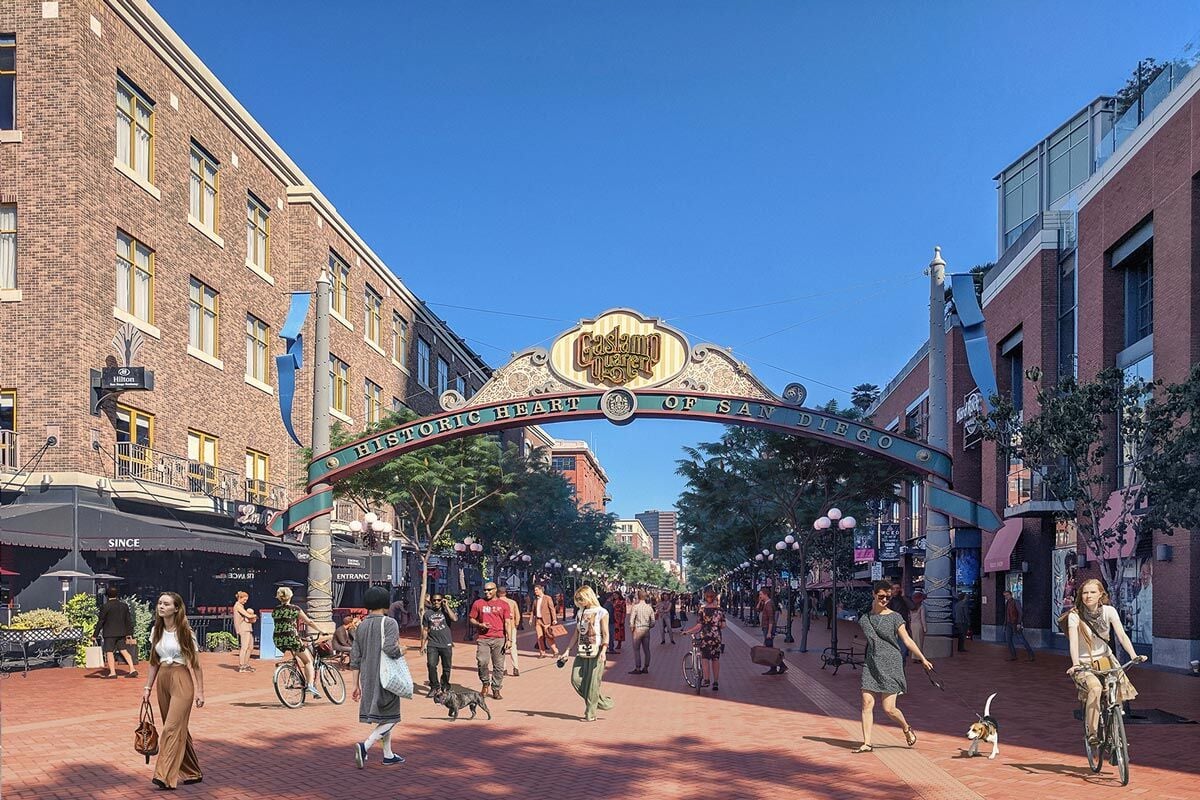
The city recently installed bollards from K Street to Broadway and are seeking funding to roll out additional phases of the project
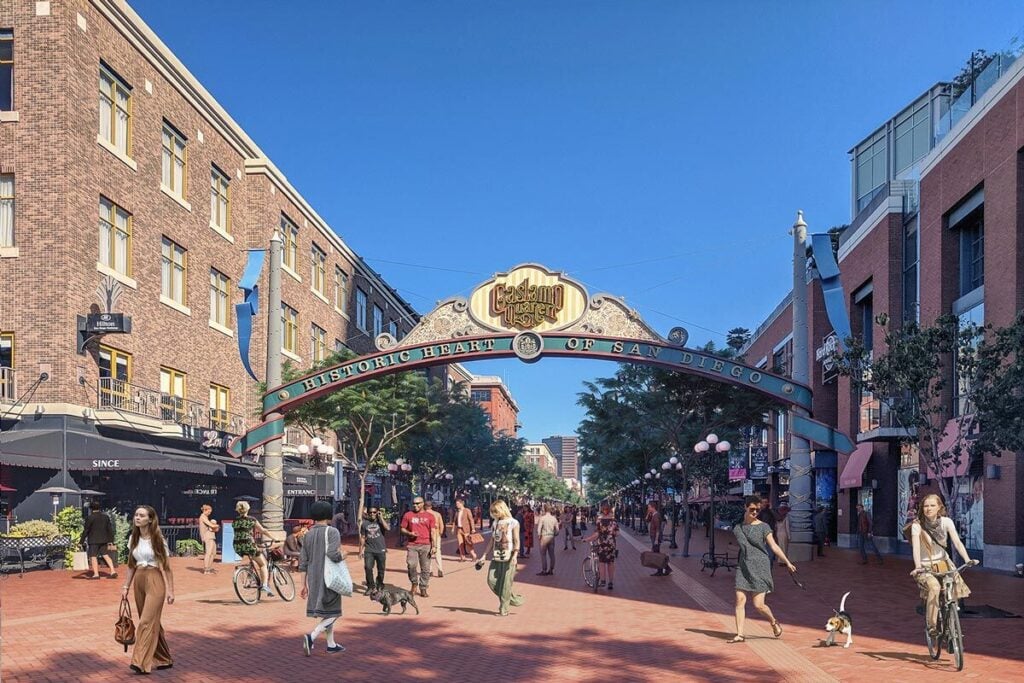
Rendering: Fifth Avenue Promenade
Courtesy of The Gaslamp Quarter Association
For decades, plans have been in the works to close Fifth Avenue in the Gaslamp District to traffic. But when the pandemic struck, the idea got a real-life test run.
Soon after restaurants reopened for outdoor dining in 2020, the city of San Diego used a special events permit to allow restaurants and bars to operate from makeshift patios. That included closing Fifth Avenue to cars every Thursday through Sunday so tables and chairs could be set up on the street.
The special events permit ends June 30, but that doesn’t mean the street will be reopened. The city is working with organizations like Downtown San Diego Partnership and The Gaslamp Quarter Association to make the arrangement permanent.
The first step of that project is happening right now. The city is installing bollards—short, sturdy posts—at seven intersections from K Street down to Broadway. The bollards will create small plazas on Fifth Avenue and replace the temporary gates that are currently being used to block traffic.
The impact? Increased pedestrian safety, reports David Rolland, a spokesperson for San Diego Mayor Todd Gloria. He says that, weather permitting, all of the bollards should be in place by early May. The city is also working on an ordinance that will designate Fifth Avenue as a slow street, which will allow for the weekend closures that have been going on since Covid to continue longer-term.
But there is a vision for Fifth Avenue beyond just bollards. The Gaslamp Quarter Association and the Downtown San Diego Partnership are seeking grants and other funding from the state to roll out additional phases of the project, including public art, street furniture, shade trees, and repaved streets.
“Our goal is to hopefully drive more business to the merchants who operate in the Gaslamp and also to create more of a tourist destination,” said Michael Trimble, executive director of the Gaslamp Quarter Association. “We don’t have many of these types of open spaces, especially in the downtown area. And so by creating this temporary promenade 12 hours a day, it gives people the opportunity to experience the Gaslamp in a whole new light.”
The plan will not permanently close the street, but will shut it down to vehicles from 11 a.m. to midnight Monday through Sunday, from Broadway to K Street, according to Trimble. Fifth Avenue from L Street to K Street will always be open.
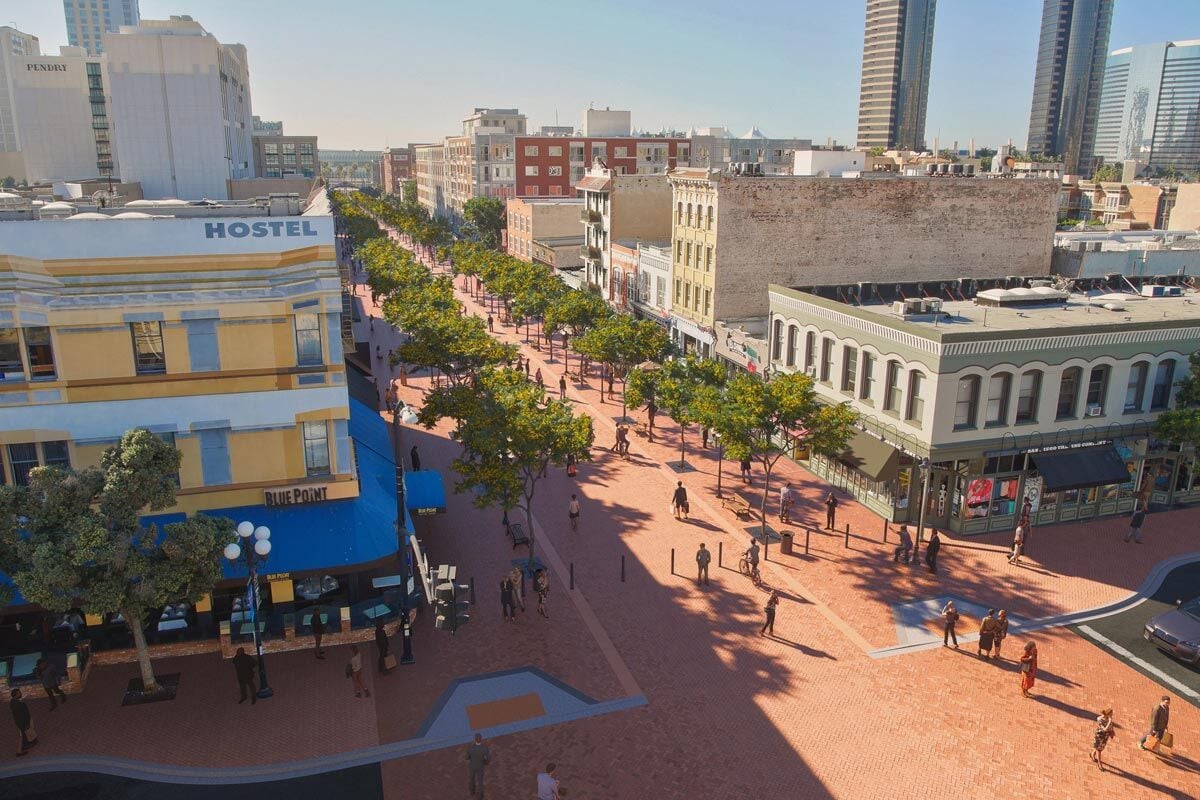
Rendering: Fifth Avenue Promenade
Courtesy of The Gaslamp Quarter Association
Trimble said the plan was originally to have streets shut down to 3 a.m., but it will be more like midnight because of police concerns.
“I think that the issue with having it at 3 a.m. is that it makes it harder for the police to make bar break happen safely,” he said. “So if it closes at 2 a.m., then people are lingering in the streets until 3 a.m., and then it doesn’t promote getting home safely. If the streets close and open to traffic at midnight, then they can bar break at 1:30 a.m., and everyone could be out of the Gaslamp by 2:30 a.m.. If you do it at 2 a.m., people will linger, and it potentially could be not as safe.”
For ridesharing, all cross-streets will stay open, and cross-street parking will be redesigned so there are more loading zones on each corner, making it easier for rideshare cars to drop off and pick up customers.
MTS will also reroute buses from K Street to Broadway. The change in routes that serve lower income communities raised controversy at recent MTS meetings, but officials say they have chosen alterations with minimal impact. Route 120 buses will turn one block earlier and Route 3 buses will be rerouted to Seventh Avenue until after Broadway.
For people who need to park, the Gaslamp Quarter Association says there will be parking along Fourth Avenue. There are also plans in the works to change some cross streets from parallel parking to diagonal parking, which increases the number of parking spaces. The association says there are also more than 3,700 parking spots in parking structures nearby.
And all ADA accessible parking spaces that are removed from Fifth Avenue will be replaced near the Gaslamp Promenade. All valet stands for hotels and restaurants will also be located on side streets, according to the association.
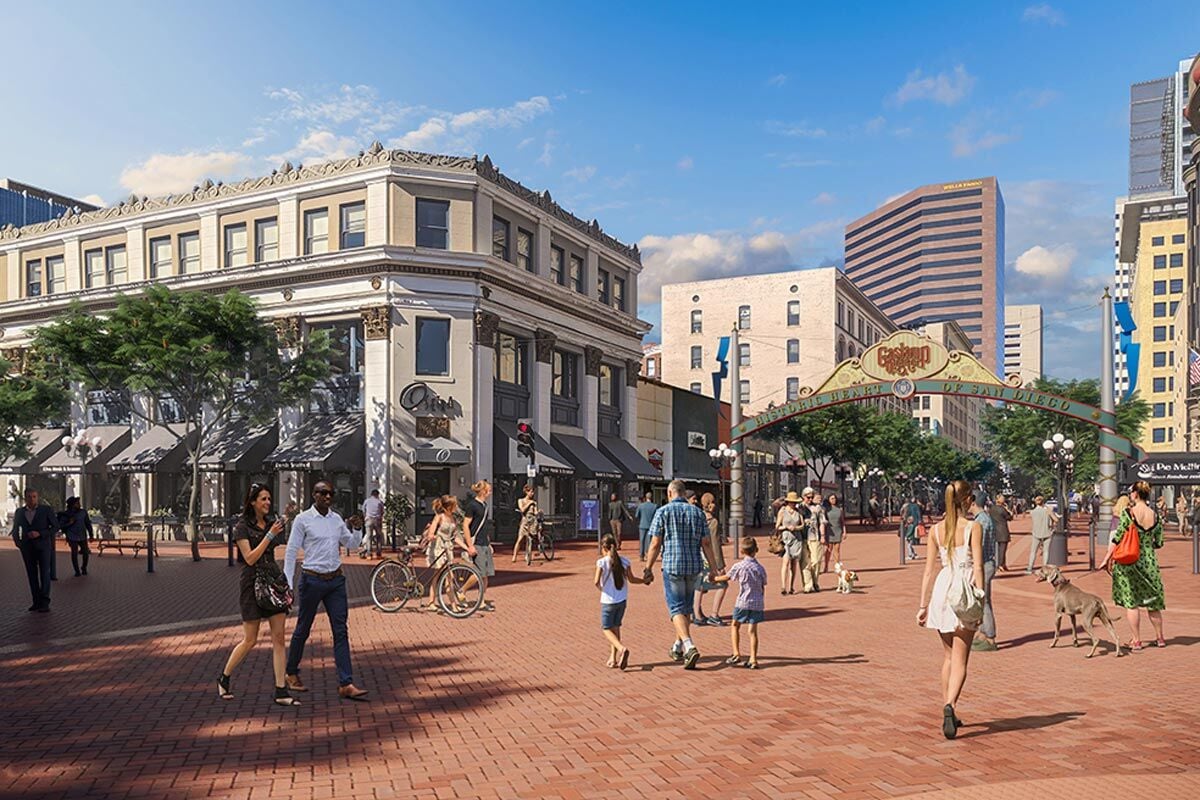
Rendering: Fifth Avenue Promenade
Courtesy of The Gaslamp Quarter Association
Trimble said he hasn’t heard any concerns from businesses about loss of parking or getting deliveries, both because the plan only reduces parking by 32 spaces and because businesses are already used to the routine from the Covid street closure.
“It’s pushed everyone to service the neighborhood quicker and more efficiently,” he said. “And so if there have been any growing pains, we’ve worked through that during this temporary closure.”
Trimble has a long term vision for the promenade that goes beyond the street closures, but said it’s dependent on cost. Originally, before Covid the plan would have cost $40 million, but now it’ll be closer to $60 million, he said. He would have loved for flattening the curbs in the area, but that may now be too expensive, he said.
“I would like to see something more than asphalt on Fifth Avenue. I’d like to see improvements of the sidewalks, new trees, new storm drain type systems that will be more environmentally friendly. I know that it’s important to the city to be environmentally conscious,” said Trimble. “It’s a very old street so updating those types of internal operations are very important to moving forward into the future.”
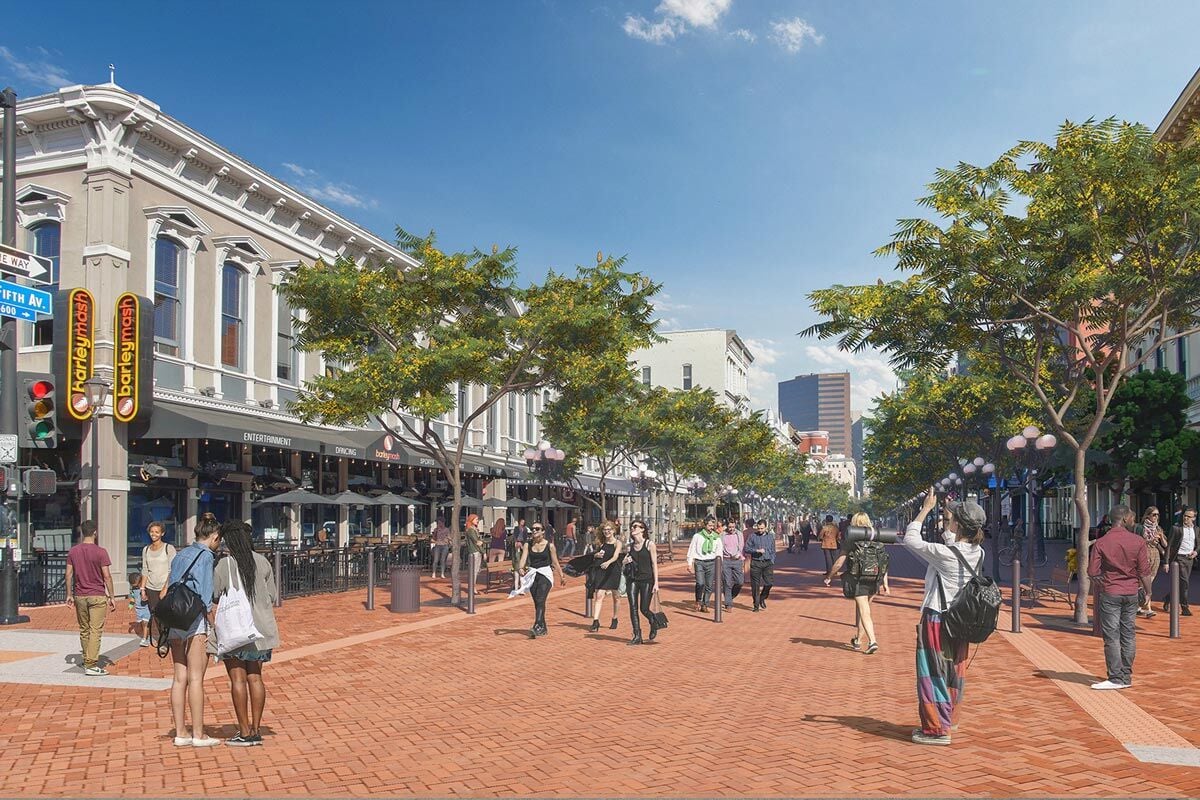
Rendering: Fifth Avenue Promenade
Courtesy of The Gaslamp Quarter Association
“Because of Covid, the original plan was to have the existing patios expanded onto the sidewalk and the sidewalk being pushed into the street. So instead of having parklets on the curb, you’d actually have an existing patio that’s twice as large because you’re moving the sidewalk farther into the street. And so giving more room for restaurants to operate without having the sidewalk street separation.”
Betsy Brennan, the president of the Downtown San Diego Partnership, said the city is also working on drawing more walkers to the Gaslamp just like they’ve done in other parts of downtown, including the Symphony Shell, the Waterfront Park, and areas around the Convention Center—all aspects of the larger, pedestrian-friendly puzzle of which the Promenade is a piece.
“We want to welcome all of San Diego back to downtown with the Promenade,” she said. “This is the heart of the city.” By the end of 2023, the city expects to have completed an initial study of what is possible on Fifth Avenue and open up the project to bids.
In a statement, Gloria said the project will make the Gaslamp Quarter “an even more enjoyable and vibrant place to stroll, dine, and hang out with friends,” adding that, “We know from attractions like the Piazza della Famiglia in Little Italy that people flock to outdoor pedestrian plazas lined with restaurants and shops, and we’re excited to create that kind of open, welcoming atmosphere [in] the Gaslamp Quarter,” he said.

Claire Trageser has been writing for San Diego Magazine for 10 years. She also is a reporter at KPBS and writes for The New York Times, National Geographic, Marie Claire, Elle and Runner's World.
We asked, you voted, and food critic Troy Johnson chose his favorites—these are the top food and drink people and places in the city
Some keep lists of favorite books, of quotes, of enemies whose time shall come. At SDM we keep vast, nuanced, hotly debated lists of the best food and drink in the city. Menus are our smut novels. From Michelin stars to mom and pops, our list constantly evolves over hundreds of new bites tried every year. Here’s the 2026 list from food critic Troy Johnson and 129,000-plus votes from our readers, who really, really know their food.
Troy Johnson is the magazine’s award-winning food writer and humorist, and a long-standing expert on Food Network. His work has been featured on NatGeo, Travel Channel, NPR, and in Food Matters, a textbook of the best American food writing.
We asked, you voted, and food critic Troy Johnson chose his favorites—these are the top food and drink people and places in the city
Surviving life in hardscrabble San Diego with any joy in your heart requires a list. On it lives your favorite taco/sushi/burger/fries/stiff-but-drinkable drink in town. This is ours—from the readers (who offered a record 138,300-plus votes) and longtime food critic Troy Johnson. We chose the must-try dishes at some of San Diego’s best restaurants and unpacked the people and trends changing our city’s dining scene for the better. Hope you’re hungry, because it’s time to dig in.
This six-seater omakase blends local seafood with Japanese craft and little-known Mexican history
A tiny, tiny omakase sushi spot is coming to Barrio Logan. It will be in the kinda-secret rafters of one of the great little arrivals in San Diego—the sustainable seafood fish sandwich-and-taco shop, Fish Guts. You’ll have to climb a ladder to get to it. And there, one of Austin’s rising star sushi chefs—Ambrely Ouimette, who made her name in Texas at Sushi Bar ATX—will serve sustainable sushi, piece after piece. To six guests. That’s it. Max capacity.
The return of Pablo Becker to San Diego has been fruitful. A San Diego native, born to a family of very accomplished chefs (including famed Mexican chef Richard Sandoval), he’s opened some massive Mexican restaurants over the years. Most recently, he took a break and spent five years line cooking in Chicago—head down. Earlier this year, he came back to open Fish Guts. And now this. Welcome Hasekura to the neighborhood.
Once you know the history, a Mexican-Japanese mash-up makes more sense. The restaurant’s namesake is a 17th-century Japanese samurai, Hasekura Rokuemon Tsunenaga, who was the first Japanese ambassador to the Americas. After spending years politicking in New Spain (modern day Mexico), he was re-Christened Felipe Francisco. This diplomat paved the way for epicurean worlds to collide. Chopsticks, meet Chapulines (okay, we can’t confirm or deny the existence of crickets on the menu, but you get the idea).
“I just kept on hearing that more and more people were kind of into the whole omakase, sushi style of eating. So, to me, it was just kind of a no-brainer,” says Becker. Another no-brainer was selecting the chef to helm this small-but-mighty vessel of sustainable seafood. He landed on San Diego-by-way-of-Austin chef Ambrely Ouimette. A veteran of Ironside, she heads back to San Diego as Hasekura’s head chef.
“I just said, ‘Shoot, why don’t we just partner up and… do a little collab?’ Because I do Mexican, and she’s done Japanese and omakase pretty much her whole career. I was like, ‘I’m just gonna let you do what you do—but I’m getting that little Mexican twist in there,’” says Becker. What’s the taste of that Mexican take? Think accoutrements and sauces utilizing the best of Mexican flavors. Becker promises, “it’s not gonna be your traditional Japanese.”
His inspiration came from the grimy, basement-level omakase spots in New York, who also had non-Japanese chefs, opening the realm of cross-cultural creativity. The décor will also speak to Hasekura’s Japanese roots.
With only six seats, Becker notes, “it’s gonna be super personal and chef Ambrely has a really good attitude, and she knows what she’s talking about.” In selecting Ouimette, Becker says, “she had the same vision that I had when it came to local sustainable fish.” That same vision is to have the majority of the menu feature local seafood, peppered in with Japanese staples that don’t swim in our local waters.
In true omakase style, there will be two tiers of tasting menus, one with seven courses and the other between thirteen-to-fourteen (tentatively priced at $55 and $125, respectively). A sake program is in the works and there will be two, agave wine-based cocktails available, as well. Hasekura will be open Wednesday-Saturday starting at 4:30 and closing at 9:30 with two seatings each night.
Reservations will be available through Tock.
Danielle is a freelance culture journalist focusing on music, food, wine, hospitality, and arts, and founder-playwright of Yeah No Yeah Theatre company, based in San Diego. Her work has been featured in FLAUNT, Filter Magazine, and San Diego Magazine. Born and raised in Maui, she still loves a good Mai Tai.
Behind every beautiful space is a thoughtful process, and ASID San Diego is helping homeowners understand the value of professional design.
A perfectly designed home rarely happens by accident. Those kitchens that feel effortless and rooms that seem to tell a story the second you walk in? They’re usually the work of someone who knows exactly what they’re doing.
It’s knowing which ideas will actually work, which materials will hold up over time, and how to turn a collection of choices into a space that feels intentional. That’s where a professional interior designer comes in.
For the American Society of Interior Designers (ASID) California San Diego Chapter, the goal is to help people see interior design as more than just the finished look. Behind every well-designed space is a process built on technical expertise. Designers are educated in everything from professional software and construction details to building codes, space planning, materials, and functionality.

“People don’t always realize how much goes on behind the scenes,” Kirsten Recce , current president of the ASID California San Diego Chapter, says. “Our designers are not just doing furniture placement and color selection and picking out new fluffy pillows. That’s not what they’re trained for.”
ASID members bring formal education, continued learning, and industry knowledge to their projects, helping create spaces that are not only beautiful, but designed to work. A paint color that changes completely depending on the lighting. A material that looks beautiful in a showroom but doesn’t make sense for everyday life. A layout that photographs well but doesn’t function for the people living there. These are the details where professional guidance can make all the difference.
Still, one of the biggest misconceptions about hiring an interior designer is that it’s reserved for massive renovations, luxury homes, or people who already know exactly what they want. The process can feel intimidating. Where do you begin? Is a designer worth the investment? What if you only need help with one room?
ASID’s answer: start with one hour.
ASID’s Spruce Up events break down one of the biggest barriers between homeowners and professional design: knowing where to begin. Held twice a year, the community program gives homeowners the chance to work directly with an ASID designer through a one-hour, $125 consultation in their own home. Whether you’re looking for advice on furniture placement, window treatments, kitchen and bath updates, remodeling ideas, vacation rentals, color selections or something else entirely, the upcoming September 2026 event offers an approachable way to get expert guidance before committing to a full project. Signups are open through Sept. 7, with consultations taking place Sept. 21 through Oct. 31. Proceeds benefit ASID San Diego’s educational and community programs. Register here!

“It’s a great opportunity for people who are in that exploratory phase,” Recce says. “Maybe they’re not sure they want to hire an interior designer yet, or they think it sounds daunting or expensive. This gives them a chance to discover what working with a designer is actually like.”
Design is personal. A good designer isn’t just creating a beautiful room; they’re helping create a space that fits the way someone lives.
“We’re a resource to all of San Diego County,” Recce says. “It doesn’t cost anything to pick up the phone and call and ask. We’ll answer.”
Follow ASID San Diego on Instagram, LinkedIn, and Facebook for updates on upcoming events, or connect with the chapter directly at [email protected] or 619-548-8847.
The brains behind some of San Diego’s top cocktail bars usher in a new era of a North Park institution
Two of the top bar people in the country are taking over a North Park institution. And they have a pretty innovative idea for it: Do nothing.
No neon birdcages. No wallpaper that looks like an O’Keeffe mating with a Dalí. Instead, they’re keeping a local institution largely as it’s been, preserving the emotions of a room with favorite seats and preferred corner stools—only with world-class drinks at Tuesday prices.
A five-star dive bar.

The institution is Gilly’s Cocktails. The barmen: San Diego native Erick Castro, who co-founded cocktail temple Polite Provisions (he’s since sold his share in it) and who remains co-owner of Raised By Wolves (SDM’s “Best Cocktails” 2022). His partner is Jacob Mentel, who studied with national bar-brain Sam Ross at Youngblood and ran Polite for a bit.
“I’ve been wanting to do this concept for years, but I had to find the right space,” Castro says. Paul Ahern of Next Wave Commercial helped Castro find the place and broker the deal.
“I’ve seen places like this in Europe and around the US,” Castro continues. “An honest neighborhood place where you can walk in and play some pool and darts and watch the game, and then you’re like, ‘Holy shit, that’s a great old fashioned… with clear ice… What the—!’”

So aside from a minor name change—to Gilly’s House of Cocktails—that’s the one major update under Castro and Mentel. A hell of a cocktail program. An obsessive’s collection of spirits. Ice that’s clear as rain. Chefy garnishes that aren’t dumb. In skipping the billion-dollar redesign and just cleaning up a comfortable place, they can pass those cost savings onto the patrons.
“It’s going to be a local neighborhood bar that does incredible cocktails that aren’t $20,” he says. “Where you can get a great old fashioned for $10 … so you can afford to go there two or three days a week.”

Gilly’s, located right across the street from the new Lafayette Hotel and down the street from Live Wire, has been a bar since 1968. Originally called Gil’s, it changed names a couple times, but, since 2006, it has been named Gilly’s Cocktails after owner Martin Gill. Gill is retiring, and was picky about who he sold the place to—it had to be someone who would keep it a neighborhood place.
“I don’t see Jacob and I as owners,” Castro says. “We’re stewards of an institution. We wanna honor North Park and the neighborhood. No reason to try to do something fancier. I already own one of those [with Raised by Wolves]—I don’t want to own two. The neighborhood also needs an everyday place.”
Castro and Mentel take the reins on Nov. 15. They’ll shut down for just a couple days to do some maintenance, housekeeping, and cleaning. They’ll keep it open through the holidays, then probably close in January for a small stretch to paint, put in a pinball machine, make some un-drastic improvements.
Troy Johnson is the magazine’s award-winning food writer and humorist, and a long-standing expert on Food Network. His work has been featured on NatGeo, Travel Channel, NPR, and in Food Matters, a textbook of the best American food writing.
CH Projects nears completion on the massive undertaking, adding Oaxacan church altars and in-room bartending
The Gutter will be the hotel’s moody new bowling alley, cocktail lounge, and game room.
Photo Credit: Post Company
Last year we talked about how Consortium Holdings purchased The Lafayette Hotel—a North Park classic, whose clamshell band space and summer pool gatherings of local musicians and creatives were a treasured part of our local heritage. Now CH Projects is finalizing their $26 million renovation of the 2.5-acre colonial-style property. With an expected June opening, the castle of food, bev, relaxation, and, yeah, wellness is CH Projects’ most ambitious project to date.
Kudos must be given, first, to car dealer and developer Larry Imig. In 1946, where others saw barren land, he saw the blueprint for his 250-room hotel, Imig Manor. Thanks to 24 retail and business tenants (a hair salon, nightclub, office spaces, restaurants), the hotel has always been a crowd magnet. It changed hands several times, adopted its longstanding name, and served as a weekend retreat for Bing Crosby and Katherine Hepburn.
Rooms will include a bar cart complete with bottles, mixers, and cocktail-recipe placemats.
Photo Credit: Arlene Ibarra
CH tapped Brooklyn design firm Post Company for the restoration. Expect joy machinations like Gutter, a vermouth-fueled, mahogany-lined escapist bowling alley, cocktail bar, and game room. Soothe your realization that you suck at bowling at Quixote, one of the seven—SEVEN—food and beverage concepts. Quixote is an agave bar modeled after an Oaxacan house of worship, the scene set by a centuries-old Mexican church altar. The kitchen will have handmade masa cakes, while another onsite restaurant, Le Horse, will slice prime rib tableside. Beginners Diner drew inspiration from a 1940s Worcester lunch car, and, in true diner style, it will be open 24/7.
If you never got around to living out your early twenties dream of shaking and straining, there’s still time to shine. Bar carts in the rooms will have a bounty of tequilas, mezcals, hand-selected single barrel rums, plus the fixings for classic cocktails. Not sure how to mix a Negroni? No need to Google, and tell Siri to pipe it. CH—one of the best names in cocktails in the country at this point—will have step-by-step recipes on the bar placemats.
More good news: The pool isn’t going anywhere. It’s still the hotel’s aquatic social club, framed by guest rooms. Only now swimmers can imbibe cafe cocktails and Italian aperitifs from the adjacent Pool Bar. And CH—which has gone deep into the hi-fi audio realm, turning Neighborhood into a vinyl record shrine and launching Part Time Lover, a listening bar with one of the city’s most iconic record stores in the back—has lined the entire place with obsessively placed Ojas speakers.
T-minus two months or so.
Jared Cross is a writer who grew up near the US-Mexico border in San Diego. He credits this experience with refining his appetite for food and culture.
Laika Nur, MD, takes her love of volleyball from the court to the clinic as team physician for the San Diego Mojo
Growing up, Laika Nur, MD, Scripps Clinic sports medicine specialist, loved watching beach volleyball when the Association of Volleyball Professionals tour came to her hometown of Chicago. A talented volleyball player herself, she remembers sitting in the stands all day, and once, even got a couple autographs. Years later, Dr. Nur was attending a professional event focused on women’s sports, and the discussion turned to a new professional women’s volleyball league. The general manager and coaching staff for San Diego’s team, the Mojo, happened to be in attendance, and Dr. Nur took the opportunity to ask them if they needed a team doctor. Flash forward to the Mojo’s inaugural 2024 season, when Dr. Nur officially became the team physician. Click here to read more about Dr. Nur and how she incorporates lessons she learned on the court into her practice.
For more nutrition, wellness, and healthy living tips, sign up for the San Diego Health newsletter here.