Featured articles
Featured articles
Featured articles
What's next
Featured articles
Featured articles
Featured articles
Ready to know more about San Diego?
SubscribeReady to know more about San Diego?
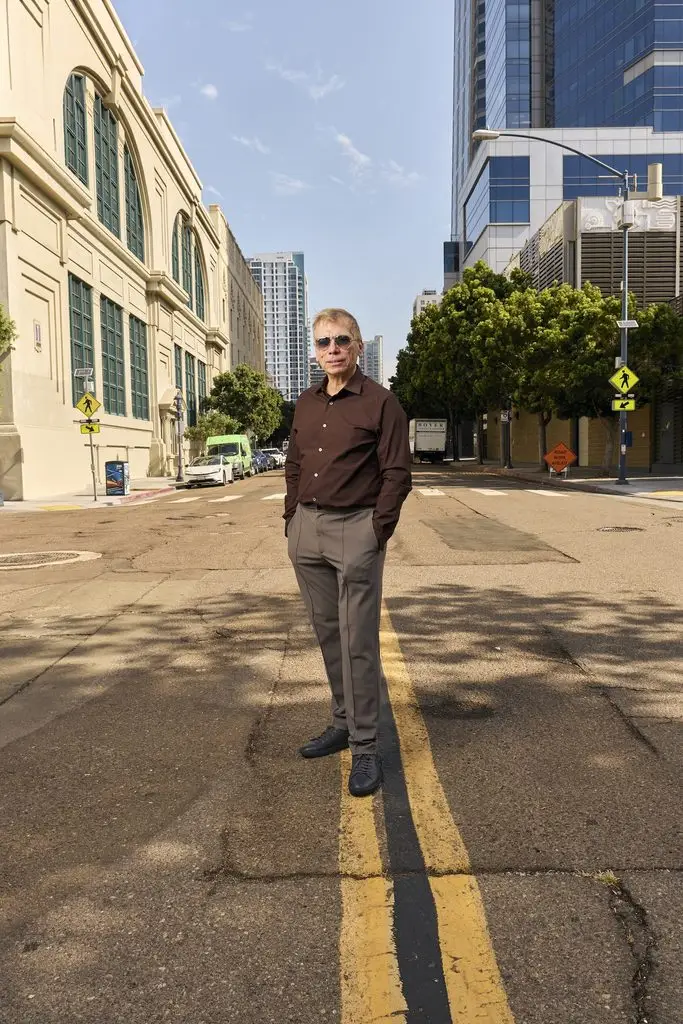
For Jonathon Glus, San Diego’s next chapter begins with the artists who help us understand where we’ve been
Some ancient philosophers believed that humans experience seven-year life cycles or phases of life. Some went so far as to believe that every cell in the body regenerates every seven years.
Much later, in the 1800s, Austrian philosopher, architect, and social reformer Rudolf Steiner developed anthroposophy—an integration of science, art, and spirituality—into his understanding of the human experience. Steiner believed that each of us changes every seven years—from spiritual beliefs to physical evolution—and art is the connective tissue through each of these cycles. Still today, Steiner’s teachings are foundational to the principles of Waldorf education.
While I’ve certainly experienced more than a few human life cycles of my own, I believe that, just like us, cities have their own life cycles.
Cities are living organisms, regenerated every day by the people that live, work, and gather there. Environmental changes, human migration, economic shifts, technological advances, politics, and public policy—they all inform a city’s evolution, sometimes intentionally and sometimes by forces outside of our control. But ultimately, we as humans respond, adapt, and sometimes make our most important new advances.
In the aftermath of World War II, in 1947, the Edinburgh International Festival was established to promote international peace through the performing arts. Today, that festival continues as a global gathering place to experience some of the world’s most innovative dance and theater.
In post-revolution Mexico, that country’s government launched a monumental muralism program to celebrate the history of its Indigenous cultures. Today, that tradition still informs the way Mexico tells its stories and how we understand its history.
Here in the US, the National Endowment for the Arts was established in 1965, at a time when the arts were seen as part of our national strength and resilience. For the first time, federal funds were directed to communities across the country to invest in the arts at a local level.
San Diego may be relatively young as a major American urban center, and even younger on the world stage, but our region as home to humans is ancient. Today, we love a San Diego that is built on roads and traditions of the Kumeyaay Nation, where we share a modern mega-region with our sister city and cultural twin, Tijuana, on unceded Kumeyaay land.
History has shown us that the arts generate the very human connection and understanding that allows our politics, policies, technological advances, and human migration to move forward. In that way and more, the arts are the very heartbeat of our city.
In this issue of San Diego Magazine, we celebrate the artists, creatives, culture bearers, and workers who keep our region connected and in conversation as we take on challenges big and small—internationally as well as on our own neighborhood streets.
Artists are our storytellers. They respond to and chronicle the best and the worst of us—our foibles and weaknesses, our struggles, and, undeniably, our successes.
Now: a look back into the past seven years in history. They have not been a walk in the park, with a pandemic, global unrest, and shifting domestic politics as only a few forces that have challenged our lives and our region. Together, we experienced some of our greatest struggles and witnessed tremendous resilience.
That’s exactly why this is an exciting time for the arts in San Diego. We are on the precipice of an even more fertile, sustained, and inclusive time for the arts in our region.
In some ways, Covid seems like an eternity ago. I remember all too well the massive economic impact on our cultural institutions, some of which have never fully recovered. I remember the mass layoffs of the workers who keep our arts institutions going and the teaching artists who were suddenly out of work.
I also remember the poets, filmmakers, actors, and musicians who helped us grapple with the disruptions of the pandemic. Our communities became virtual, and artists gave us the space to make sense of it all.
In fact, a common phrase emerged from the Covid: artists as second responders.
Still today, I think about the short film made by San Diegans Susanna Peredo Swap and Gill Sotu called History of Joy, which captured so brilliantly what we were experiencing during those days of lockdown.
Since then, as an arts community, we’ve pushed forward transformational work that we will continue to build upon in this next seven-year cycle and well beyond.
Hundreds of artists and culture bearers have spent the past several years going to work with community groups across the region as part of Far South/Border North, our region’s component of the California Arts Council’s groundbreaking artist work program, Creative Corps. The impact resonated so deeply that local government and philanthropy partnered for a second iteration, Artist Count, this time a binational initiative launched just a few months ago.
We’ve invested mightily in cultural infrastructure. Need some examples? There’s the reimagined Jacobs Music Center and Museum of Contemporary Art San Diego, the Black Arts & Culture District, the state designation of Arts District Liberty Station, and now the burgeoning Art + Design District downtown.
World Design Capital San Diego Tijuana 2024 elevated what we already knew—that the two neighboring cities are culturally and creatively intertwined as one region—and boosted our global presence as a creative juggernaut. Artists, designers, and community leaders worked together to produce more than 600 events across our region that year, and the impact continues.
And “Creative City,” the City of San Diego’s first cultural plan that incorporates arts and culture advancements in the city’s development, was crafted by thousands of San Diegans as a roadmap to take us into the future.
Here’s what I know about the past seven years: San Diego’s artists, creatives, and culture bearers showed up for our region as our storytellers, second responders, and creative workforce.
And for the next seven? San Diego will morph and change, as every city does. Sometimes because of us, sometimes in spite of us. But our city’s creative community has a solid foundation on which to build, led by the artists who witness and tell our stories each and every day.
—Jonathon Glus, Conrad Prebys Foundation’s Senior Fellow for Art and Design in Residence at the Downtown San Diego Partnership
Editor at large, Aaryn Belfer, introduces the September 2026 Arts issue featuring 31 artists, makers, builders, and doers.
What makes San Diego, San Diego? That’s the question at the heart of this issue.
Over the course of eight weeks, San Diego Magazine staff and I spoke to dozens of people, from long-time leaders at some of our biggest institutions to emerging artists working alone at night in studio apartments after eight hours (or 10 or 12) at their day jobs.
Tasked with bringing this issue to life as editor at large, I’m just one member of a stellar team of artists in their own right. I repeatedly told owners Claire and Troy Johnson: This is your baby, I’m just the babysitter. Which is wink-and-smile cute, until you spend two months with the kid and realize you’d take a bullet for it.
San Diego’s beaches are gorge and the weather the envy of those who spend winter scraping ice from their windshields. But sand and sun are the least interesting things about this place. Traditional territory of the Kumeyaay people, San Diego is a majority-minority region with cultural and artistic depth that’s unmissable unless you’re looking directly at the sun (don’t do that, please).
For me, the creatives make San Diego. The composers, the painters, the sculptors, the writers. From Oceanside to the border, and Tijuana too, this is arguably the most culturally layered region in the country. That shows up in murals, music, textiles, food, dance, street art, and beyond.
Almost nobody I talked with does just one thing. The visual artist is also a musician. The culture keeper is also a painter. Their personal stories shape their work and compel them to create in San Diego, even when staying costs them more than San Diego gives back.
That world is what San Diego’s artistic and cultural community gives to us. It’s the mural on the side of the building at Ace Parking on the corner of India and A streets. It’s the buskers overlooking the pier in OB. It’s cultural drumming classes at WorldBeat Center. It shows up invited (or not: we see you, street artists), and we’re all better for it.
I believe we’re all artists, by the way. That natural state gets trained out of us early, in favor of deadlines and the idea that anything made with your hands needs to justify itself with a return on investment. A lifetime doodler, I picked up a sketchbook three years ago; watercolor followed. Talent’s debatable, but that was never the point. When I’m creating, my brain quiets; I can’t be anywhere else in my head except exactly where I am. My work won’t be on gallery walls, but it’s not a hobby either. It’s a portal to the world I want to live in.
For this issue, we reached out to dozens of people across the arts community and asked them to give us names—artists and culture makers they felt were especially crucial, compelling, moving the city forward. The result was a list of 190 artists, makers, builders, doers.
We also wanted this issue to be its own art project, not just a write-up of one. To give artists proper acreage, we enlisted one of the city’s top photographers, Matt Furman, to capture their image.
Then we began the Sophie’s Choice process of narrowing the list of talented humans—each deserving of their own 2,200-word profile—down to 31. Our criteria was broad with bumper rails: Names that kept coming up again and again had to be included; so did people doing work that reflects our diverse region; and people building something bigger than themselves, gathering others, and galvanizing pockets of scene. Individually and collectively, these creatives are reaching toward a future in which art and culture is what brings people to San Diego; a main attraction before getting a sunburn, not a side quest after.
Strip all of it away—the murals, the music, the makers, the stories—and what’s left of a city? Concrete and buildings with the Pacific Ocean and a mythological green flash. That’s it. That’s the whole inheritance.
Turns out the babysitter fell hard for this one: Seeing these artists through Furman’s lens made me feel all the things, and I hope it will do the same for you. I hope this issue compels you to get out your calendar and make a plan to buy the ticket, step into the gallery, sit in the audience. Showing up is how you tell San Diego’s creatives that art and culture matter—and that they matter, too.
This issue is my love letter—San Diego Magazine’s love letter—to them. To the people working and fighting to ensure that the stereotype is never all we are.
Aaryn Belfer is a writer and editor specializing in nonfiction across art, architecture, and culture. Once upon a time, she wrote a provocative column for San Diego CityBeat (RIP). She was a runner up in the 2025 Matchbook Stories contest at the San Diego Central Library and is irrationally happy about it. Currently in her Soft Girl Era, Aaryn has expensive taste in (mostly flat) shoes and will choose a great art exhibit or live jazz concert over almost anything else. Except, possibly, Javier Bardem.
Joe Dreamz built a local following by asking strangers about their ambitions and turning their answers into songs
People remember the first time they see Joe Dreamz.
Mine was a mile into the 2023 Carlsbad Half Marathon. He was standing on a speaker in the middle of the course, singing: “Hey you with the shoes, are you living Joe Dreamz?” Clearly not. I’m running uphill at 7 in the morning, I thought.
Months later, walking out of The Rady Shell, there he was again—parting the crowd of concertleavers Moses and the Red Sea style, singing the same song: “Hey you with the purse, are you living Joe Dreamz?”
Who’s this man at every public spectacle, singing metaphysical questions in a hand-altered, color-coordinating suit that would make James Brown proud and standing on a Soundboks speaker with a microphone and tip bucket?
A few years ago, San Carlos–born, El Cajon–based Joe Dreamz wasn’t exactly living Joe Dreamz—making $5 footlongs at Subway, dealing with croissant coworkers at Costco’s bakery, and selling life insurance. After he got let go from the life insurance gig and his car broke down in the middle of a 2020 road trip in Seattle, he used his emergency savings to buy a microphone and a speaker; a self-taught musician, he pulled from the only skillset he knew to monetize. He’d set up at Seattle’s Pier 55 and ask people what their dreams were. Then, for $5, create a freestyle rap to commemorate (and hopefully activate) those dreams.
“The goal is that someone listens to a Joe Dreamz song, and they don’t have to wait until metaphorically their car breaks down before they chase their dreams,” he says.

A chance encounter with an airport worker led to a free flight back to San Diego, and Joe Dreamz came home “transformed,” he says. He started busking at the Mission Beach boardwalk, Kate Sessions Park, outside Gaslamp bars; then Padres games, farmers markets, marathons. He also hit the mic outside of Coachella this year (“Joe-chella,” he says).
It’s not a get-viral-quick gimmick; people’s lives are changing. One fan finished writing her book after a dose of Joe Dreamzpiration. Another named his own daughter Joy Dreams.
Now, he’s working on the upstart “Tell Me Your Dream” podcast and DREAM Week in local schools, where each day represents a step toward achievement (D is destination day, R is reason day…). He doesn’t want inspiration to reach you only after hearing a song or watching a video: He believes in this message so much that he literally got DREAM tattooed onto his forehead.
“It’s on my face, so people have no choice [but to see it],” he says. “I’m a local celebrity here, so everywhere I go, people ask me for pictures. In every selfie, the message goes along for the ride too.”
Emma Veidt is an editor at San Diego Magazine. She earned her bachelor's and master's degrees from the Missouri School of Journalism. She loves running, hiking, and rock climbing, but really, she mostly loves encounters with the street cats around North Park.
Once home to more than 20 antique stores, the Normal Heights stretch is down to one, and owner Dave McPheeters has no plans to leave
Hawaiian shirts hang from the ceiling like Jimmy Buffett chandeliers. Shelves of Waterford Crystal, uranium glass, and 1930s Depression-era glass line the narrow walkways, the latter mass-produced during a time when few could afford fine china. There’s enough to pour a mai tai for every San Diegan within 20 miles. Vintage Tommy Bahama lives in the back room. Tiki memorabilia bumps shoulders with 25-cent vintage photographs and a hundred teeny tiny trinkets the size of shelled peanuts.
In the ’70s and ’80s, there were up to 24 antique shops on Antique Row in Normal Heights, remembers Dave McPheeters, owner of Zac’s Attic. When he opened his shop in 1999, only six to eight remained.
“The day of my opening, the grande dame [of Antique Row], the oldest one on the block, came to my store and said, ‘You’re BMOC. Big man on campus,’” he says.
Now, 27 years later, he’s not just the big man on campus. Zac’s Attic is the last antique store remaining on Antique Row.

McPheeters first caught the antique bug as a teenager, observing relatives and family friends who were collectors and eventually visiting auctions himself. There, he learned how to spot Victorian jewelry, tell a mahogany from a walnut dresser, and separate what’s worth a pretty penny from what’s worth an actual penny. While attending Herbert Hoover High School in City Heights, he would wander Antique Row after classes, asking shop owners questions and absorbing the craft.
Old Town was McPheeters’ proving ground. He got his start working in an antique shop there in the late ’60s before eventually expanding to three antique stores of his own. In ’99, he was persuaded to make the leap to Antique Row, despite its gradual decline over the decades. The year Zac’s Attic opened, three more stores closed their doors. The pattern continued until he was the last one standing.
“It mostly has to do with gentrification,” says McPheeters. “The prevailing rents down here used to be $1–2 per square foot [per month].” Such goes the age-old tale: National chains come in with deeper pockets, and landlords kick out long-standing, local tenants. Other landlords hop on the bandwagon and start raising their rents until one by one, the independents disappear.
“My saving grace is that I bought the property,” he says. “I don’t have a landlord to raise the rent.” The building was originally a 1920s craftsman home, destined to be torn down had McPheeters not stepped in.

Despite his immunity to the rent hikes, McPheeters is still a brick-and-mortar business owner in an inflated economy and e-commerce world, where online shopping accounted for 16.9 percent of total sales in the first quarter of 2026, up from 6.5 percent a decade ago. With no website, no email, and no social media, McPheeters is choosing the path of most resistance.
“I’m an antique in the antique business,” he says. “I like to do things the old way.”
But what McPheeters lacks in clicks and likes, he makes up for in conversations.
When people walk into Zac’s Attic—especially younger folks with an interest to learn—McPheeters is happy to spend as much time teaching as selling. Ask about a piece of uranium glass, and you’ll get a history lesson. Pick up a Hawaiian shirt, and he’ll walk you through the stitching, tags, and fabrics that separate the real thing from the knockoffs.
“The personal touch you get from coming to a shop like mine is one of the most important aspects of the business,” he says. “You’re going to learn more, and you’re going to feel better about what you’re buying.”
When our conversation turns to the people he has met over the years, McPheeters reaches for a tissue. His eyes glisten. To him, the business has always been about far more than a transaction. If something doesn’t work, he’ll say so.
“I will spend as much time talking someone out of a shirt than into buying it if it’s the wrong size, color, or texture,” McPheeters says.

He’ll tell customers what complements their complexion or hair, and he even keeps clean T-shirts behind the counter so shoppers can try on vintage pieces without a second thought. McPheeters’ graphic design background informs everything from the arch of cobalt-blue Danish collector plates to the soothing green wall color near the register, all intentionally chosen to create a welcoming space.
He may be the lone wolf of Antique Row, but McPheeters is far from isolated in the antique community. Away from the shop, he liquidates estates, lectures for church groups and women’s organizations, and regularly attends shows like San Diego’s Tiki Oasis, the largest and longest-running tiki festival in the world.
For Tanya McAnear, owner of vintage boutique Bad Madge & Co. in South Park, that kind of community-mindedness is part of what has kept independent vintage retailers going.
“Brick and mortar is a really tough business,” she explains. “You can not be faint of heart if you go into it.”
She also credits one of McPheeters’ greatest strengths to variety. Over the years, she has watched him diversify his inventory and keep up with trends without sacrificing quality, which has inspired others to do the same.
“Dave and I go way back,” McAnear explains. “I think a lot of people really admire and look up to him saying, ‘This guy showed us how to really do it.’”
The question remains: How much longer does the BMOC plan to stick around?
“Until I retire,” McPheeters laughs. “I don’t know when that’s going to be; I love what I do and I don’t have enough years on the calendar to liquidate what I own.”
Although Antique Row has evolved, Zac’s Attic still feels like the neighborhood McPheeters wandered as a teenager. The questions are the same, only now, they come from the other side of the counter.
Lili Kim is a content coordinator and writer for San Diego Magazine, with experience highlighting local businesses and communities. When not writing or shooting film, she is likely brewing her seventh cup of tea of the day or strolling along Sunset Cliffs.
Inspired by the effortless charm of French cafés, this taste of France on Orange Avenue invites guests to embrace the simple pleasure of taking their time.
Strolling down Orange Avenue on a sunny afternoon, you’ll hear the hum of beach cruisers rolling by and visitors making their way toward the Hotel del Coronado. Dogs pause to greet one another on the sidewalk, palm trees sway overhead, and for a moment, you’re convinced you’re living inside the postcard from the gift shop you just passed.
Then the scene shifts. Towering white columns, black café awnings and gold-trimmed windows frame Little Frenchie, where woven bistro chairs spill onto the sidewalk and servers deliver bubbling crocks of French onion soup. The scent of caramelized onions and melted Gruyère is practically an invitation to ask, “How long for a table for two?”
That feeling of pulling up a chair and staying awhile is exactly what inspired Little Frenchie. French cuisine has a reputation for feeling a little intimidating, but the restaurant is rewriting that narrative with food and wine that feels approachable.
“Sometimes when you read a French menu, you come across words you can’t even pronounce,” David Spatafore, the owner of Little Frenchie, says. “We wanted to create a restaurant where people felt comfortable.”
Little Frenchie was designed to capture the spirit of the French sidewalk cafés that inspired it. Dating back to 1917, the space already carried the charm of a Parisian bistro, with architectural details that felt more at home on a European street corner than in Coronado. The team saw an opportunity to create a restaurant that matched the character of the space while filling a gap in the neighborhood.
The result is a French restaurant that honors tradition without taking itself too seriously.
At Little Frenchie, classic French techniques are at the heart of the menu, but there is always room for creativity. A cassoulet featuring Toulouse sausage and duck confit pays homage to the recipes and regions that inspired it, while a rich hot chocolate made with ingredients imported from France brings a taste of French café culture to Coronado.
The team loves finding unexpected ways to make familiar dishes feel new. A burger becomes a showstopper when it is finished tableside with melted raclette, while a French Dip gets elevated with prime beef and Wagyu makes its way into the burgers. Even Eggs Benedict gets a French twist, swapping the traditional English muffin for a buttery croissant. The GB&J, Little Frenchie’s take on a grilled cheese, brings that same playful approach with seasonal jam and French Brie layered into a comforting classic.
Nearly everything at Little Frenchie is made from scratch, with ingredients carefully chosen to match the restaurant’s standards. Even the bread receives special attention. Each morning, the team sends a car to Prager Brothers Artisan Bread to pick up freshly baked loaves, ensuring every element of the meal reflects the restaurant’s commitment to quality.
Wine is woven into the experience just as naturally as the food. Inspired by the effortless pairings found in French cafés and bistros, Little Frenchie’s by-the-glass selection invites guests to sip their way through different regions and discover new favorites without the pressure of knowing all the rules.
As males report fewer close relationships, local meetups are creating spaces for friendship, conversation, and a renewed sense of purpose
You come home from your first day of school and your parents ask, “Did you make any new friends?” Maybe trading Lunchables or sharing a pack of Oreos helped you break out of your shell to strike up a conversation. Maybe you saw your classmate wearing a Padres hat and asked if his favorite player was also Fernando Tatis Jr. Maybe you’re a natural extrovert who has no problem inviting your entire class to your birthday party.
Making friends is an entirely different beast as an adult. You’re trying to balance your health, work, finances, family, and your sanity. And on top of that, a social life? Impossible.
Being a part of a bigger community—like a rec sports league—helps, but we all need intimacy. Witnesses to the exciting, mundane, shameful parts of our lives. Turns out, men don’t have that as much as women do, and the consequences of this are dire. Roughly 1 in 6 men say they have no close friendships, according to a 2021 American Perspectives Survey. Suicide rates in men are nearly four times higher than they are in women, according to the National Institute of Mental Health. Those numbers are even higher for men above 55, according to the U.S. Centers for Disease Control and Prevention (2023).
In Carlsbad, Men’s Shed helps older men build friendships as the group contributes to construction projects across North County. “Men get lonely,” says Glenn Bernard, one of more than 20 members of Men’s Shed in Carlsbad. “This is a good way to bond, socialize, share skills, and have something to do that’s worthwhile. Purposeful.”
What started in Australia in the 1990s has grown into an international nonprofit with more than 3,000 chapters worldwide, including one that meets at Carlsbad By The Sea Retirement Community. Haley DiDonato, director of life enrichment at Carlsbad By The Sea, established California’s first and only public chapter in 2023. Members (aka Shedders) meet twice a month to discuss their projects and get to work.
They’ve built bikes for the local Boys and Girls Club, a raptor shed at the Agua Hedionda Lagoon, a small birdhouse outside Front Porch Gallery, and a gazebo at St. Michael’s by-the-Sea Episcopal Church, to name a few.
Trade experience isn’t required. David Gilson, the group’s leader, was a pharmaceutical consultant before he retired. Rich Greenamyer is a retired engineering duty officer who built ships in the Navy. When John Gardella wasn’t working sales at Dupont, he woodworked projects for his family at home.
“Men are so tied up in their work all their life,” Gilson says. “Their identity was their job. Suddenly, you retire on Friday, and on Monday they don’t remember you. Now what?”

Marital status also affects how men interact with the community around them. Some Shedders joined because their “wives encourage [them] to be in Men’s Shed, to get out of the house for a couple hours every couple of weeks,” Gardella says. For some widowers in the group—such as Gilson, whose wife passed away eight years ago—Men’s Shed provides a sense of purpose and place. The outings Gilson organizes breaks up the monotony of staying at home with his dog. A 2024 study in the National Library of Medicine says widowers feel long-term levels of loneliness (higher levels than widows), and they were less likely than widows to form new connections after loss. This group is changing that.
The appearance and function of male friendships have been spotlighted since the 300s BC, when Aristotle discussed them in Ethics. Fast forward to the 19th century, and these dynamics have transitioned from heroic friendships—ones built on loyalty and nobility—to ones that better symbolized the Romantic Age: more affectionate in written language (like writing letters to each other) and body language (like draping their arms around one another). By the end of the 1800s, 1 in 3 American men belonged to a fraternal organization.
But when World War II brought a homophobic “Don’t Ask, Don’t Tell” suspicion around male bonding, friendships between men became more stoic. It wasn’t common for men to talk about their feelings with each other.
In 2026, though, we’re sharing our feelings. Dads Corps, a nonprofit organization through Social Advocates for Youth San Diego, offers classes, resources, and supportive services to fathers. Twice a week for six weeks, fathers practice how to actively listen, learn how to better communicate, and gain more skills that help them in their parenting journeys.
“When dads have kids, they lose their friends because it’s all about just the baby, the mom, and the family,” says Dads Corps director Laura Soto. “When they come to our classes, they get comfortable being able to share their struggles. It does reduce the isolation and help normalize them in that struggle.”
For dads who are new to San Diego, the program helps them navigate their way around the city. For single dads, they can meet other fathers who are raising children the same age to set up playdates. Oftentimes, dads graduate from their cohort and return to volunteer and mentor new attendees.
The program is as therapeutic as it is active. Group facilitators teach dads about healthy relationship practices, answer questions about how they can be more consistent in their children’s lives. It also hosts fishing trips, barbecues, and community service events to let dads practice their learnings with each other outside a classroom.
“It’s about acknowledging that we need to be heard about the concerns that we don’t ask help for as fathers,” says Jorge Narvaez, alumni manager at Dads Corps. “We live in a society where fathers have to look through crevices—go to a bar, go to a barbershop, go to all these different places—just to have interactions with other people. It feels like we finally, as dads at this program, have a space for us to talk.”

But some men don’t want to only talk about their inner selves; they also want to talk about books. For Ronald Alsop, the New York City Gay Men’s Book Club was a place for him to meet local bibliophiles when he lived on the opposite coast. There was no equivalent in San Diego—until he started it in 2019. He created the Mission Hills-Hillcrest Gay Men’s Book Club as a way to meet other men and talk about authors like James Baldwin and Edmund White.
Whether it’s Andrew Holleran’s fictional coming of age Dancer from the Dance (the first book the club read) or George Chauncey’s non-fiction novel Gay New York, the books Alsop chooses share a common thread: Each carries some connection with gay culture.
“Traditionally, gay men were depicted in books in a tragic way,” says Alsop, who is also a freelance writer. “In more recent years, there’s been a more positive spin on it, a more wholesome outcome.”
Alsop initially promoted the group by putting flyers around the neighborhood bars and in Uptown News. He was nervous before the first meeting, afraid no one would show up. Now, there are roughly 35 people on his email blast, and the monthly meetups regularly see 12 to 15 people participate.
“The discussion’s always lively,” Alsop says. “I think it’s a way to get to know people better.”
Throughout the county, because of these groups, people are reading books (its own win, these days) and creating community. Dads and their children are getting invited to birthday parties from their fellow fathers. And in Carlsbad, some Men’s Shed meetings are taking place at Hennessey’s Tavern down the road over brunch. As friends.
Matt Eisenberg is an award-winning writer and photographer based in San Diego. A former ESPN editor, his work has also been published by CNN, Bleacher Report and the New York Daily News.
Live Nation is turning the historic Wonder Bread Building into a 4,000-capacity concert hall designed to bring more touring acts to the city
Imagine being the song continuously getting skipped on the playlist. Not because no one wants to hear you, but because you never quite fit the moment. For years, San Diego has been that song on the touring circuit. Artists who have outgrown intimate clubs but aren’t yet filling arenas and stadiums have often passed us by, heading north to venues better suited to the size of their show. San Diego wasn’t missing the audience, it was missing the room.
That’s all about to change.
On August 17, Live Nation Entertainment announced plans to transform the historic Wonder Bread Building, which it purchased in June for $16.8 million, into a 4,000-capacity indoor venue slated to open in fall 2028. The new space will host music acts as well as private, corporate, and community events.
Currently, San Diego’s concert landscape jumps quickly from intimate clubs like the Casbah, Winston’s, and Belly Up to larger theaters, amphitheaters, arenas, and stadiums. What’s largely missing—particularly downtown—is a modern indoor room built specifically for roughly 4,000 concertgoers. This leaves a gap in mid-size venues for touring acts that land stages like the Hollywood Palladium or Boston’s MGM Music Hall at Fenway.
“We are filling a void in the market,” says John Schalk, Live Nation’s Vice President, San Diego Market. “There are other venues in town, but this […] building is just something that doesn’t currently exist.” Although SDSU’s Cal Coast Credit Union Amphitheater serves the 4,000-capacity range, its outdoor, fixed-seating arrangement isn’t as versatile as the proposed Live Nation project.
Located at 171 14th Street, just a six-minute walk from Petco Park, the building carries a century of history. Architect Eugene Hoffman designed it in 1924, a year after completing the Barcelona Apartment Hotel in Bankers Hill. The landmark brick building served as a bakery and warehouse for the Southern California Baking Company before Continental Baking Company, producers of Wonder Bread, took over in the 1950s and operated there through 1988 continued at the site until 2007.
In the early 2000s, Bob and Gay Sinclair, the couple behind a portfolio of East Village properties, purchased the building. After Bob—the founder of Pannikin Coffee & Tea—died in 2011, Gay sold much of their real estate portfolio but held onto the Wonder Bread Building. Mission Brewing eventually took over the space, where it operated for more than a decade before announcing its 2026 departure.
Now, the building is preparing for another reinvention. Live Nation plans to preserve the historic bakery’s four exterior walls, red brick façade, grain silo, barrel-vaulted trusses, and skylights as part of its next chapter.
Live Nation isn’t looking to erase its history but to celebrate it, allowing the building’s past to give the new venue some soul. “It’s really important for us that we maintain the integrity and the history of that building,” Schalk says. “There will be new construction and design elements as we go through the process to create the concert venue, but we’re working really hard to preserve it.”
Blueprint Studio, Live Nation’s in-house design and development group, and Gensler, the architecture firm behind San Diego International Airport Terminal 1 and Snapdragon Stadium, will be heading the project. The plan is to design the ground-floor space as an open, general-admission area with a premium level above with 600-plus fixed seats, in addition to box and suite sections. There will also be an additional structure built on top of the historical portion of the building (the four original walls that house the lobby) called the Vinyl Room—a Japanese-inspired hi-fi listening VIP lounge serving elevated food options.
One of the most reassuring aspects of the project is the focus on the concertgoer’s experience—specifically the “pet peeves” we all know too well: long bathroom lines, cramped exits, obstructed views. According to Schalk, one of the best things about building upon the existing structure is having the ability to consider potential obstacles and tackle them before construction begins. “I’d say we are ‘purpose building’ the entirety of the project for a music venue,” says Gensler lead project architect Garrett van Leeuwen. “As part of our design process, we do an in-depth sightline analysis to make sure that sightlines are optimized from every point and seat within the venue.”
Circulation design is also being implemented to ease traffic flow, alongside acoustic optimization and a transformative outdoor beautification effort. According to van Leeuwen, this “public realm space” will grow the existing 14-foot sidewalk to a 32-foot sidewalk complete with plazas and landscaping.
“This venue is for the fans. For the music lovers,” Schalk explains. The vision is intimate: “I want a fan to walk up to that building, see that red brick facade, grab their ticket from the box office, go into the lobby and see some of the history that will present itself… and feel like you entered a home.” Schalk also expressed a “keen interest in making sure that we work with the local artists, the local bands, the local musicians in town.” It’s a project that recognizes San Diego as a growing market that is hungry and ready to see a vibrant arts and culture community thrive.
According to an analysis by Oxford Economics analysis shared by Live Nation, the venue is projected to deliver a significant boost to the local economy, generating approximately $97 million in annual economic impact and supporting 660 jobs. This also includes welcoming 316,000 fans each year—with 126,000 traveling from outside the San Diego metro area—and driving $53 million in local spending at nearby restaurants, hotels, and retail establishments.
Considering its proximity to other major event spaces and overall busy urban areas, traffic and parking may be a concern, especially on nights of overlapping events. But in those cases, Schalk said they would work together on communication efforts; parking availability; and staggering start, end, and loading times; as well as providing easy access to designated rideshare areas. With transit stations nearby (the closest one being a 4-minute walk at 12th & Imperial), public transportation is another great option for enjoying your night out.
There are still two years of design, construction, and plenty of logistics between now and opening night. But the bigger promise of the Wonder Bread Building is simple: San Diego finally gets a venue built for the artists who have historically passed it by. After years of getting skipped on the touring playlist, the city may finally be getting its turn on repeat.
Camila Ibarra Gallego is a CaliBaja native pursuing a master's degree in culinary journalism at the Basque Culinary Center. Shaped by the culturally rich, bicultural megaregion, she's passionate about sniffing out stories that connect people, territory and culture through food. When she's not tumbling down internet rabbit holes, you can find her pretending to be a wine connoisseur at a local wine bar or nose-deep in a good book.
Laika Nur, MD, takes her love of volleyball from the court to the clinic as team physician for the San Diego Mojo
Growing up, Laika Nur, MD, Scripps Clinic sports medicine specialist, loved watching beach volleyball when the Association of Volleyball Professionals tour came to her hometown of Chicago. A talented volleyball player herself, she remembers sitting in the stands all day, and once, even got a couple autographs. Years later, Dr. Nur was attending a professional event focused on women’s sports, and the discussion turned to a new professional women’s volleyball league. The general manager and coaching staff for San Diego’s team, the Mojo, happened to be in attendance, and Dr. Nur took the opportunity to ask them if they needed a team doctor. Flash forward to the Mojo’s inaugural 2024 season, when Dr. Nur officially became the team physician. Click here to read more about Dr. Nur and how she incorporates lessons she learned on the court into her practice.
For more nutrition, wellness, and healthy living tips, sign up for the San Diego Health newsletter here.