Ready to know more about San Diego?

Subscribe
Features FEBRUARY 28, 2023

Brunch Is a Drag

Finding religion and a touch of history at Lips with Dragalicious Gospel Brunch
Brunch Is a Drag
Photo Credit: Matt Furman
brunch-is-a-drag-1.jpg

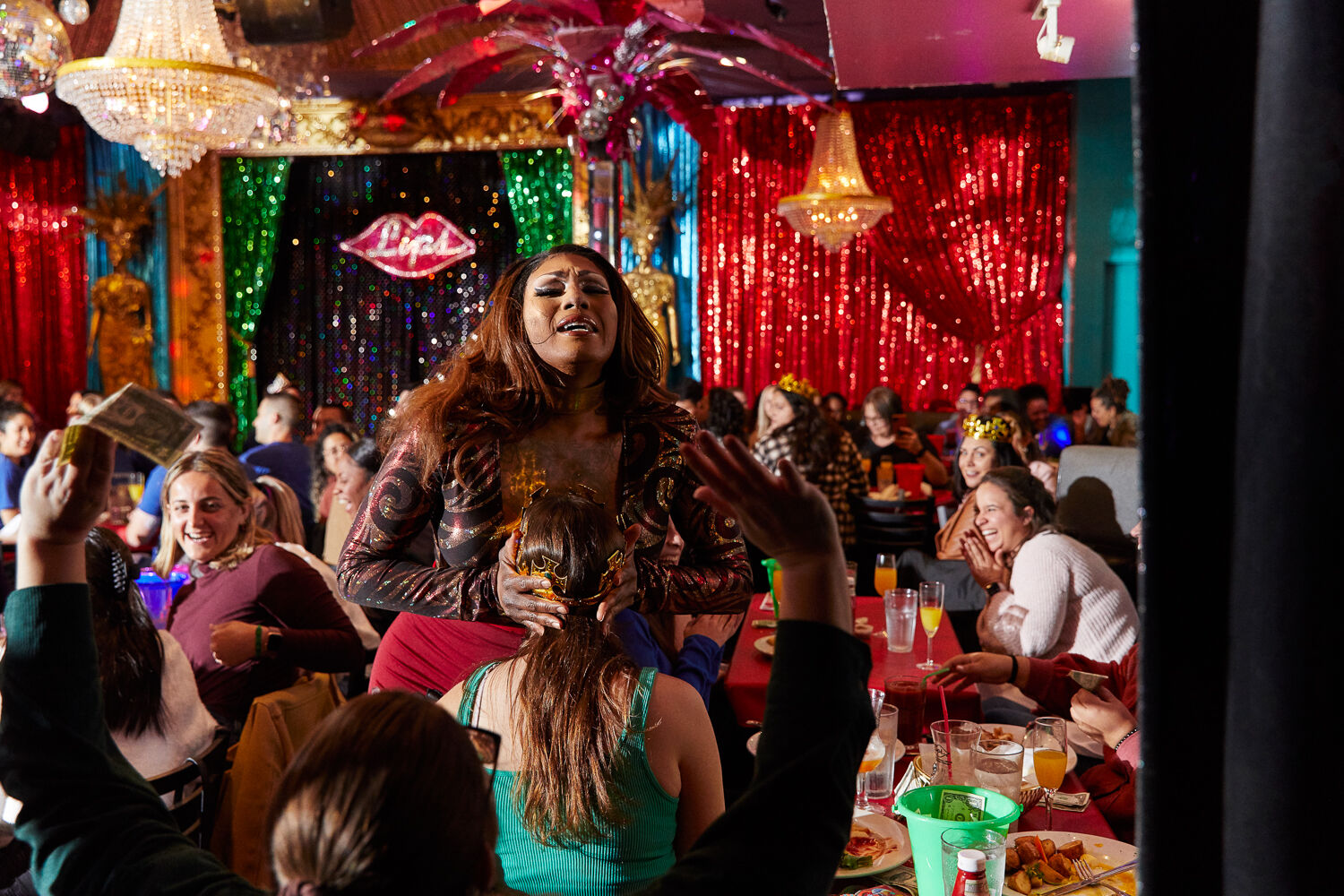
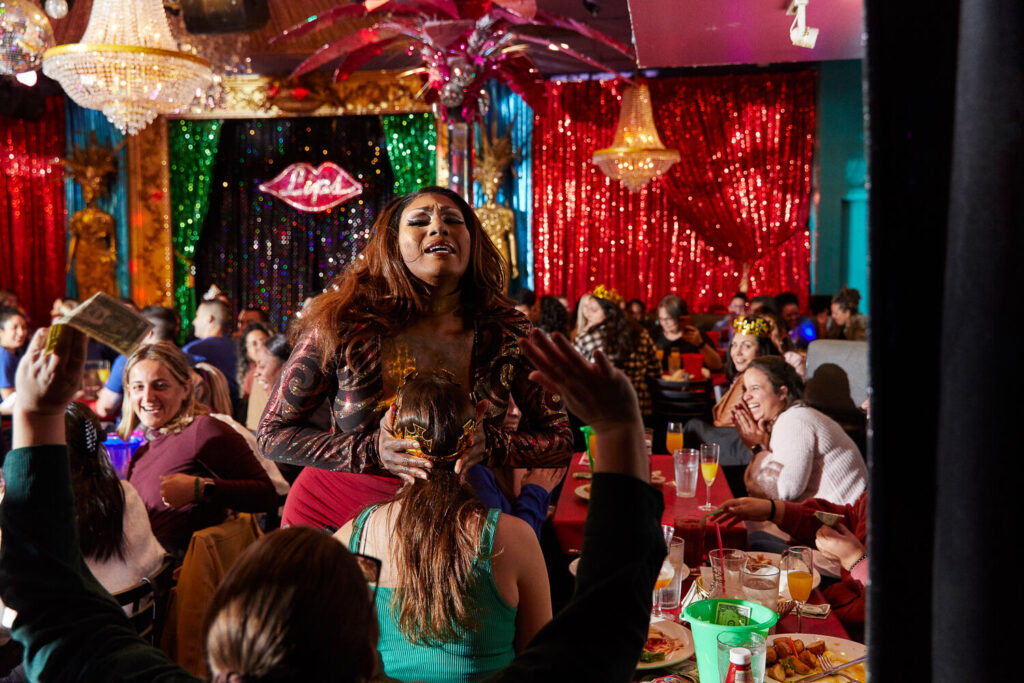
Cheyenne Masters will roast you within in an inch of your life, pour you a drink, and give you a hug.

Photo Credit: Matt Furman

And then grandma queen’s white feather coat flew in great, operatic circles behind her like an albino peacock. I let my carne asada huevos rancheros grow cold to bask in the unrestrained joy of her, and this. Also, there were many jokes about penises.

Brunch is not a meal as much as a moment. Escape is the entire point. Brunch is so alluring, compelling enough to launch an entire subculture complete with its own fashion lines (wide brim hats are French toast hats), because breakfast has become such a bore, a drudgery. Pour some cereal in a bowl while you get your uncooperative kid dressed for school. Catalog the cortisol of must-dos that lie ahead of you today, dreading the landmines of necessary suck. Unwrap a “bar of food” and have it ride shotgun as you hunt for zen in morning traffic and its ability to turn everyone but you into an incapable twit.
brunch-is-a-drag-2.jpg

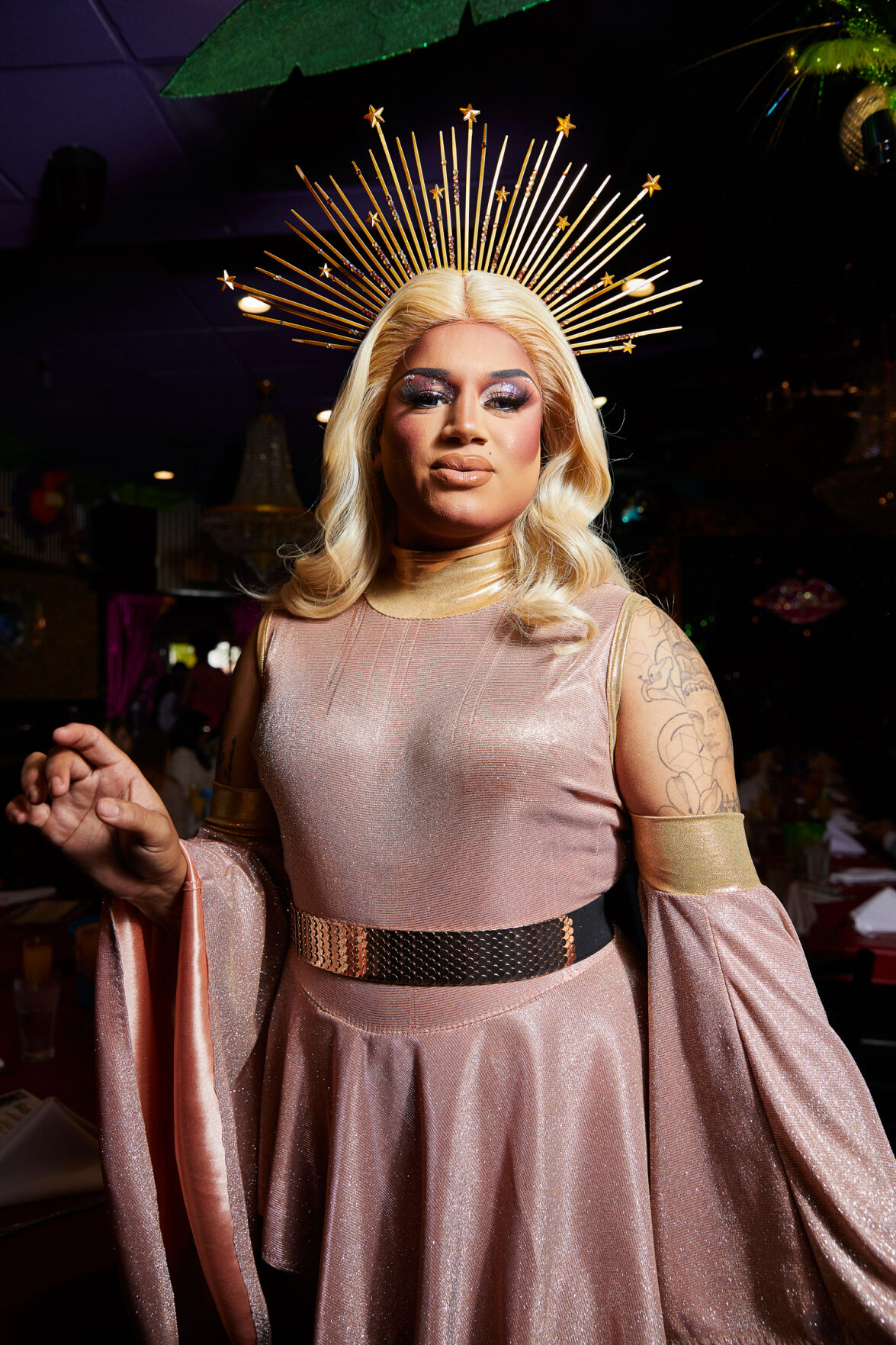
Tiffany Roze, one of the statuesque, Raphael-ian queens who float through Gospel Brunch, never letting a glass go dry.

Photo Credit: Matt Furman

With restaurant dinners, we celebrate a day well done, or at least we celebrate that the day is done—a little wine, twinkly lights, art, hip music on an industrial-strength stereo, dessert. But we don’t celebrate morningfood. Morningfood has become associated with efficiency, stress, mundanity, speed, utility, or, worse yet, “brain food”—a meal as a nutritional service station.

Brunch is the revolt to that diminished experience. If breakfast is the DMV appointment of meals, brunch is like walking into a DMV and being handed a mimosa and told to wait over by the churro station.
brunch-is-a-drag-3.jpg

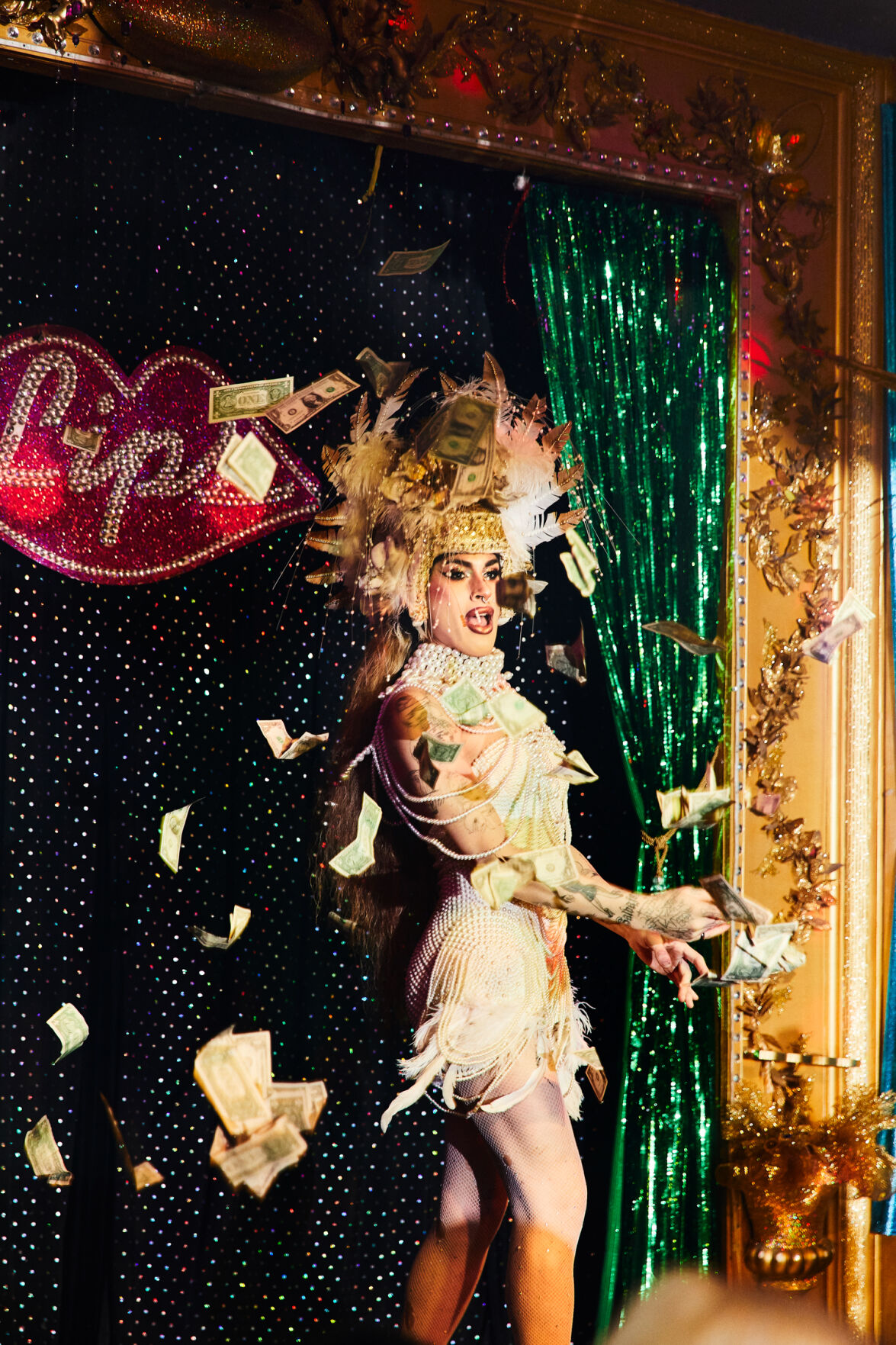
Sienna Desire, all glam and headdress among a snowstorm of tips from the crowd.

Photo Credit: Matt Furman

And there is no escapism quite like Lips’ escapism. Every Sunday, you’ll notice a line of people snaking down El Cajon Boulevard in North Park awaiting the Dragalicious Gospel Brunch ($36.95 per person including bottomless bubbly, mimosas, or bloody marys). Promotional posters of the stars beam toward the street. A security guard checks everyone’s IDs before they enter to assure no regulatory or official business taints the inner sanctum of ersatz.

I walk through the doors, and it is like I’ve been miniaturized and dropped into Liza Minelli’s craft bin. A drag queen in a presidential press secretary–looking pink power suit shows me the way. No inch of this place has been denied its sequins or bright paint or chandelier or disco ball. Most restaurants these days have some sort of taxidermy on the wall; Lips has Rockette taxidermy, a series of disembodied effeminate legs, bedecked in high heels and lace stockings, crossed just so. I have entered Liberace’s immortal soul.
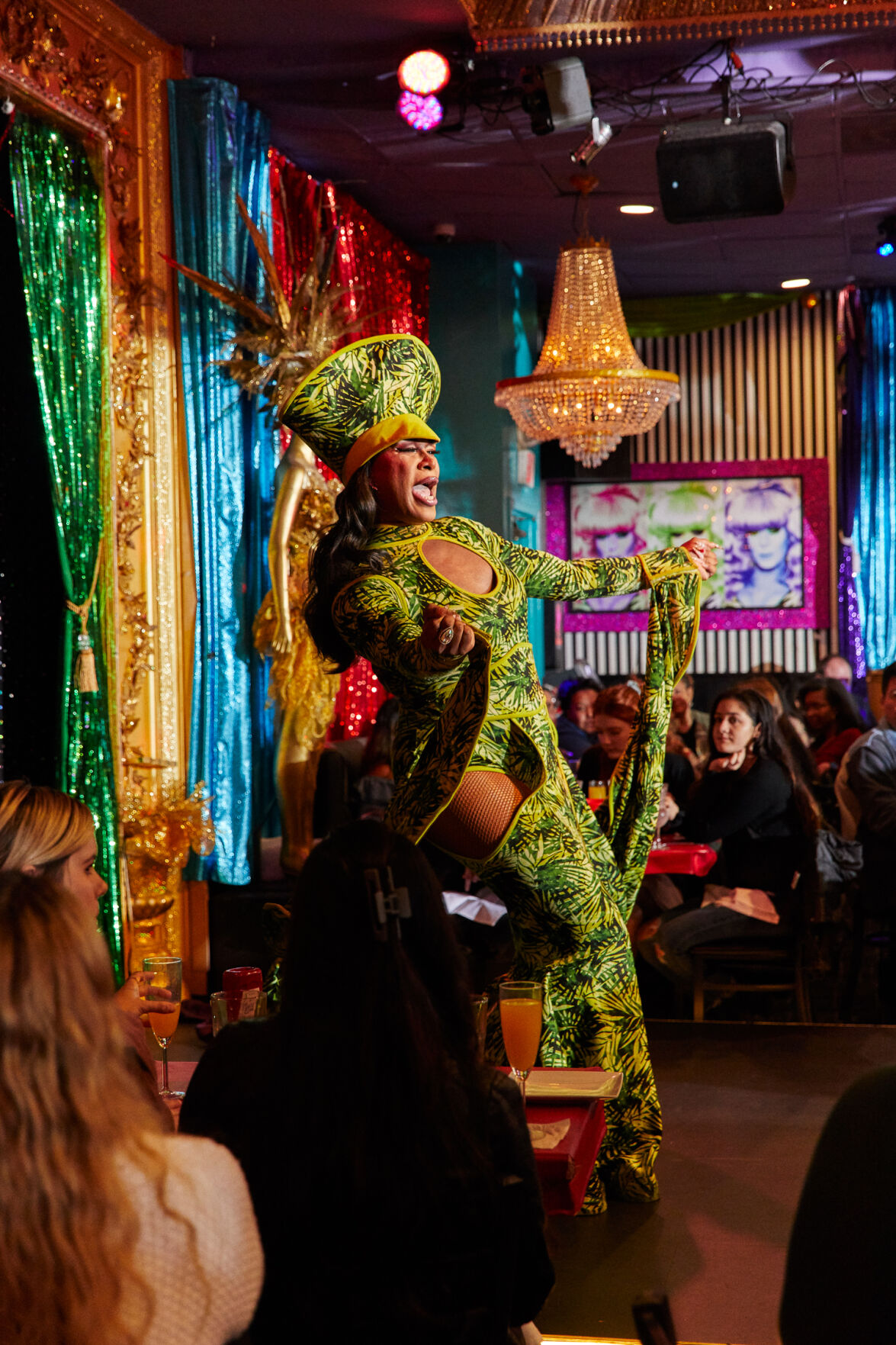
brunch-is-a-drag-6.jpg

Naomi Daniels, fit for her reign.

Photo Credit: Matt Furman

When RuPaul was just a talented student at Patrick Henry High School, long before Drag Race became a hit TV show—there was Lips. Opened originally in 1996 as Lips Drag Palace in NYC by queen of queens Yvonne Lamé, Lips is a cabaret with food and drinks—many, many drinks. A bawdy, heavily costumed, explosively joyful, snarky, lip-sync show. The place makes peacocks look like common ground squirrels.

It opened its second location in San Diego about 23 years ago. Back then, as a young writer, I went undercover in drag with the help of two of the city’s most famous drag queens—Michael Michelle and Tootie Nefertootie. They worked as much of their miracle as they could on me, and we attended Lips with me looking something like an unfortunate off-brand of Neve Campbell.

The cabaret (then located in Hillcrest) was so alive back then. Wanting to see if Lips still had its magic, I took the entire SDM editorial team to Sunday Gospel Brunch. In my research before our trip, I discovered the host is… Tootie, now apparently in the pregnant nun stage of her career.
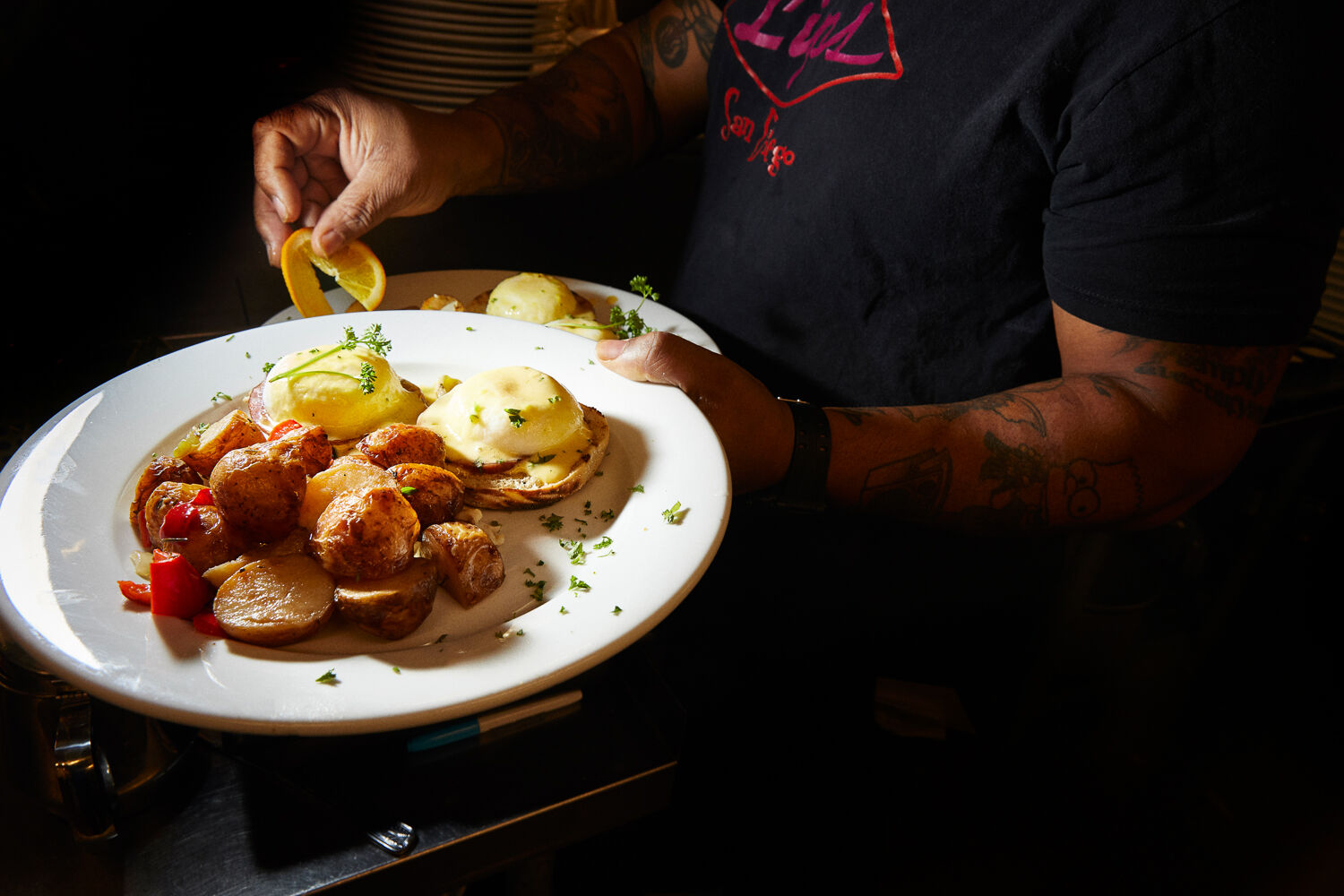
brunch-is-a-drag-4.jpg

It cannot be brunch without eggs benedict.

Photo Credit: Matt Furman

We are seated in the back center, a seat of honor. It is elevated, almost a rear stage. Instead of seats, two hot pink vinyl couches with flecks of glitter are pressed together to form a giant pair of lips. Tables are covered in a sort of durable red pleather, indestructible and foreshadowing the spillage that’s about to occur. Anyone expecting bespoke table settings and James Beard potatoes will have their attitude adjusted when a queen drops at your table a test tube shooter full of wild cherry vodka and fruit juice, bedazzled with a blinking-light ring you can wear upon downing your demise.

Below us—that is, between us and the theatrical stage at the front—an entirely packed house lines the communal tables: gays, straights, binary, non and beyond, grandmas, bachelorettes, recent divorcées, birthday boys and girls. There are no windows, and the outside world doesn’t just fade away but is vanished by glitz.
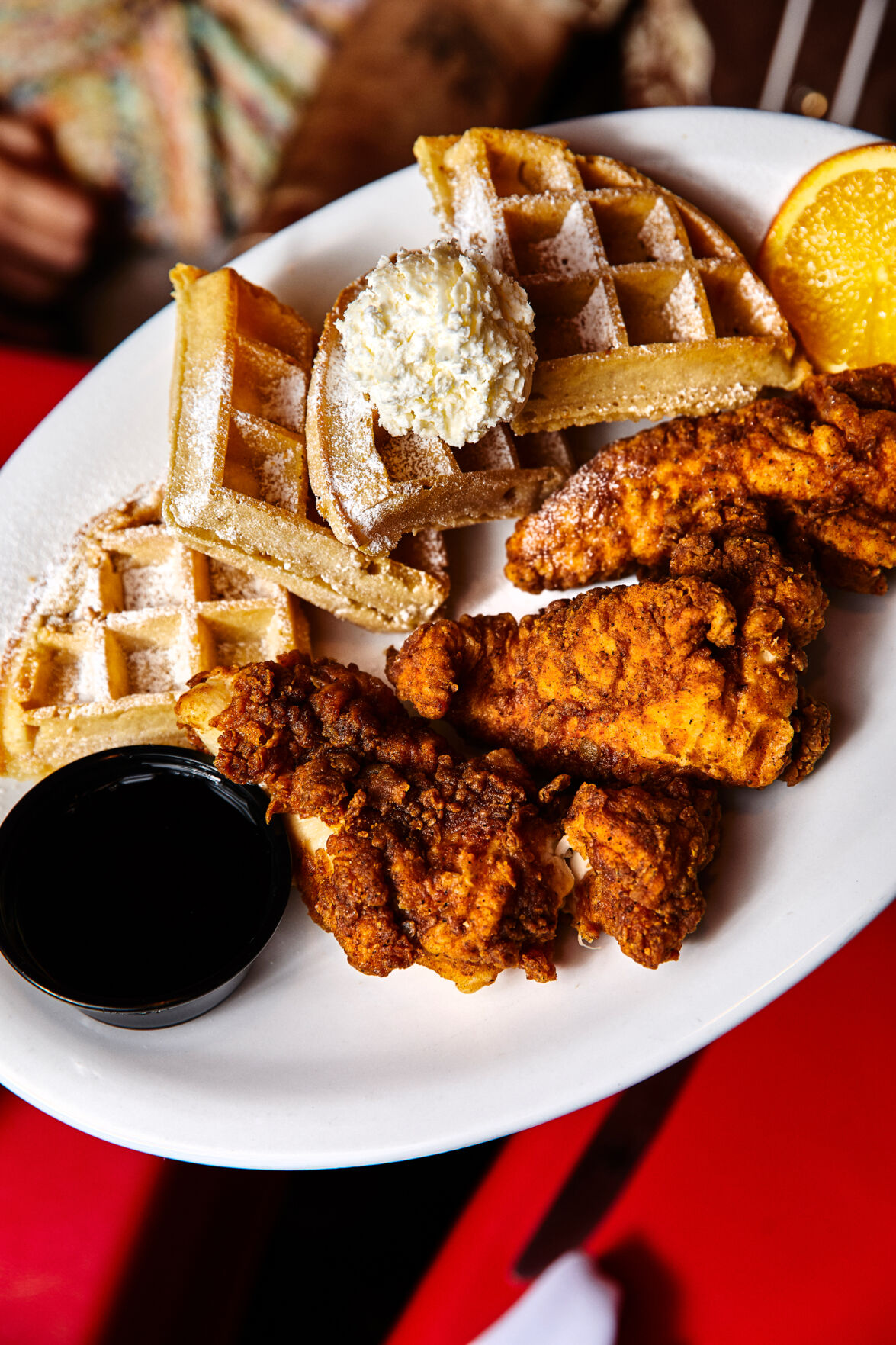
brunch-is-a-drag-5.jpg

The Lips team makes their chicken and waffles in-house.

Photo Credit: Matt Furman

We order our food—carne asada huevos rancheros, benedicts, fried chicken and waffles, curried vegetables. Mimosas and bloody marys are poured and poured and poured. Queens constantly return with pink and purple plastic watering cans full of the drinks—as if you are the garden they are watering. They pour virgin cocktails for our dry Januariers, our pregnant members.

Once the meal has departed, the show starts. Tootie, third-trimester sister of the cloth and apparently ageless in six or seven layers of exquisite makeup, emcees with ease, charm, perfect levels of smarm, and sass. All of us, of every walk of life and identity and color and race and gender and political beliefs, are insulted in our own due time. Hilariously so. Jokes that have gotten members of polite society canceled and ended careers are given safe harbor here, said without a single damn given.

Tootie berates us to generously tip the stars of the show, but turns it into a kumbaya-sort of exercise, a bald yet fun ask that we applaud both with our hands and our wallets. As the show goes on (and it’s not short; no one gets cheated), you feel yourself relaxing into all of this, letting go, aligning with its groove. It’s a show that gets funnier and better as the drinks and times go on. Tootie eventually sheds her habit to reveal herself as Cher.
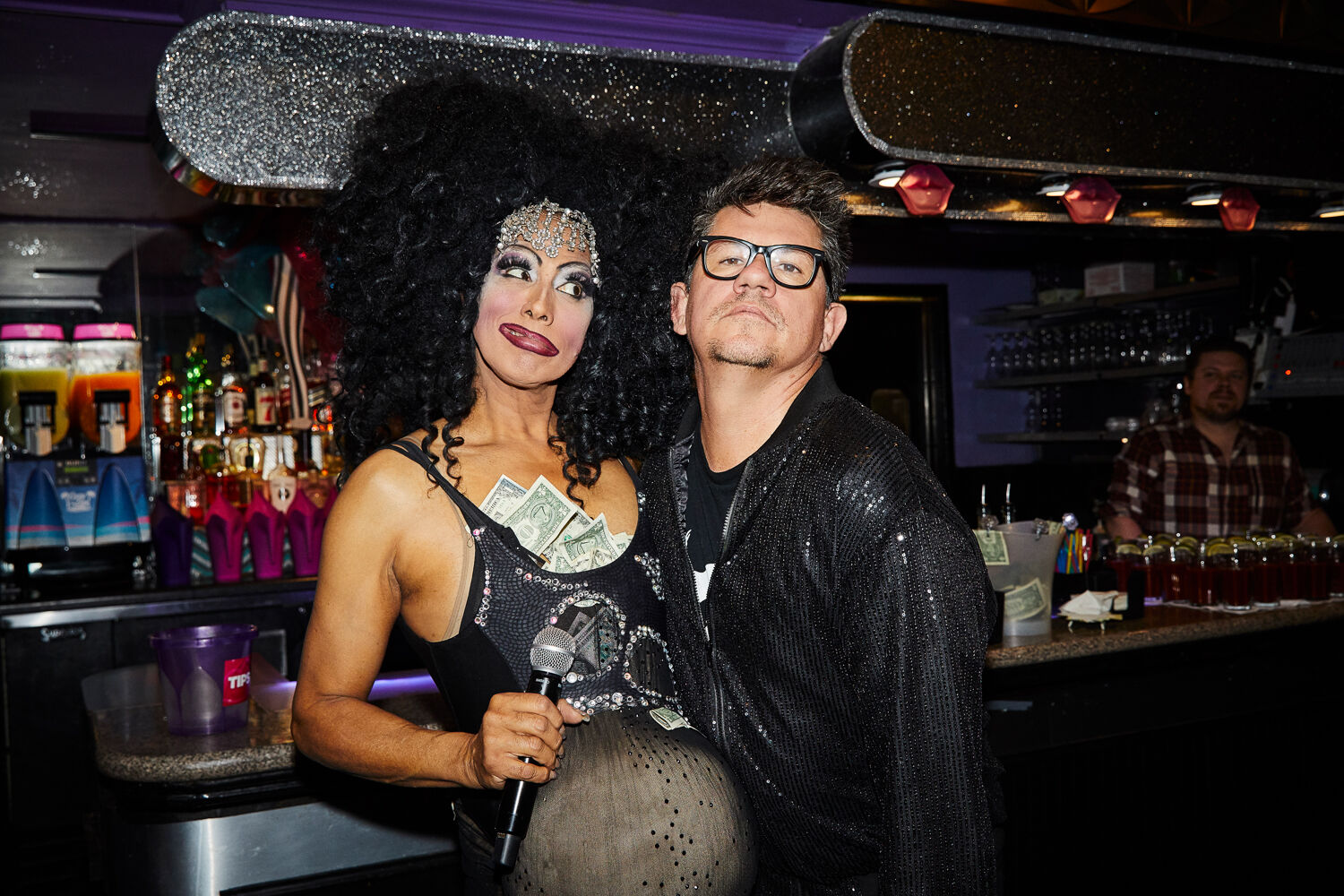
brunch-is-a-drag-8.jpg

Tootie Nefertootie, one of the most iconic, hilarious, sassy drag queens in San Diego.

Photo Credit: Matt Furman
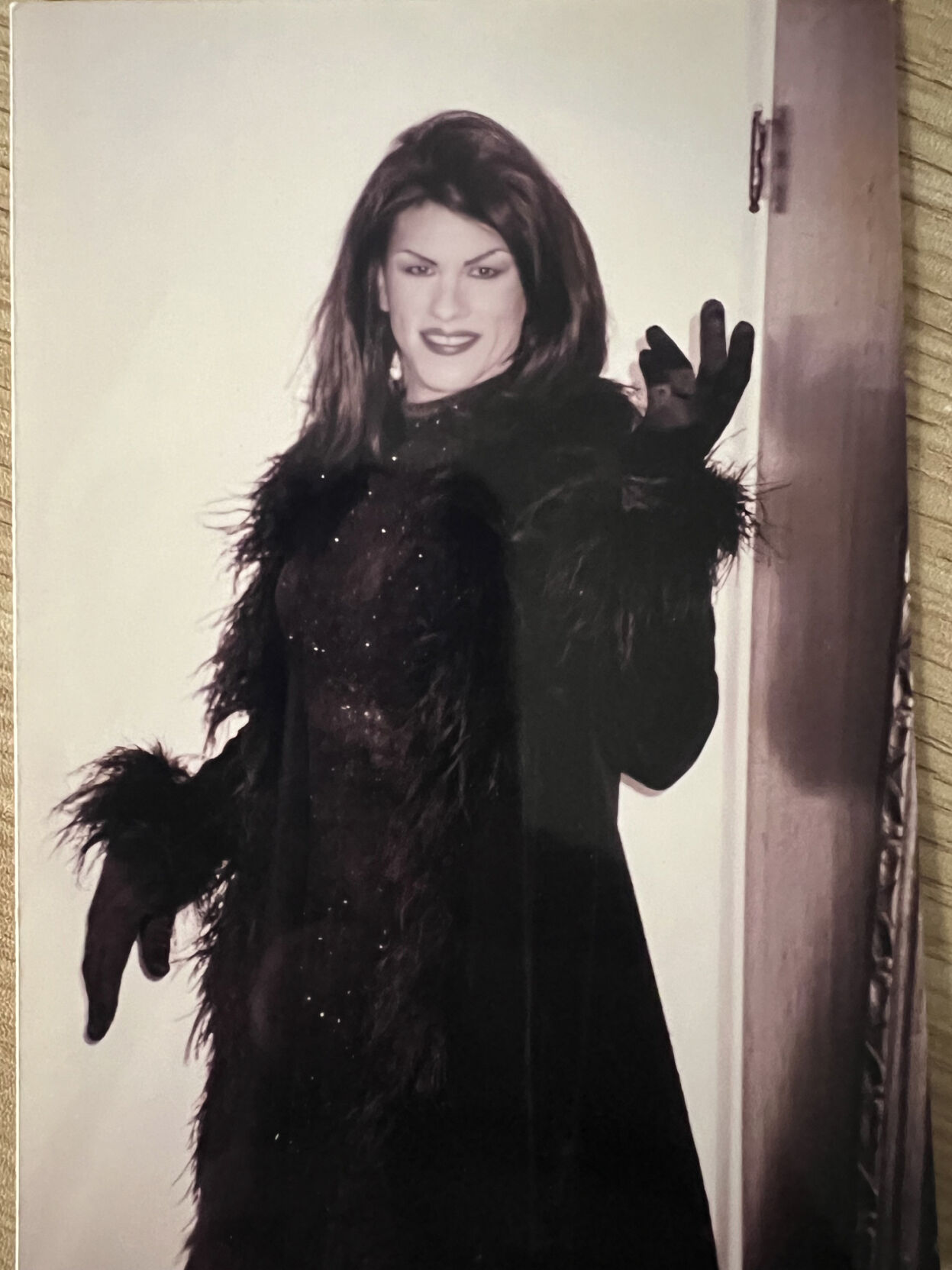
brunch-is-a-drag-9.jpg

Troy, circa 1998, after a professional makeover by Tootie for an immersive story on the city’s drag scene.

One faux-elderly queen, hunched over her cane and yelling at clouds, eventually springs to life and twirls under the spotlight, her white feather coat soaring above the stage’s club-thumping music. Tiffany Rozé dances in an elaborate ceremonial garb fit for a queen of a fictional world. A statuesque queen in a headdress of extreme elevation climbs onto our platform and unsuspectingly does a perfect splits as the beat drops. The crowd, now about a 0.8, goes nuts. This is everything. This is brunch.

Every celebratory and gaudy and escapist thing it’s supposed to be. It is just so incredibly hard to be unhappy at the end of this, to be thinking about laundry or TPS reports or what your life is lacking as a six-foot queen in six-inch heels celebrates you by insulting you.

Eventually, Tootie and fellow drag stars bring the show to an end by calling the bachelors and birthday girls and divorcées up on stage to honor them and roast them (white girls especially so). We’re urged a sober drive away and bid adieu.

Out in broad, unbedazzled daylight, the crowd gathers again. It will take a while before any of us feel ordinary, and that’s the gift of Lips.

Troy Johnson

About Troy Johnson

Troy Johnson is the magazine’s award-winning food writer and humorist, and a long-standing expert on Food Network. His work has been featured on NatGeo, Travel Channel, NPR, and in Food Matters, a textbook of the best American food writing.

Subscribe to our newsletters

Select Options

By subscribing you confirm that you agree with our Terms and Conditions and Privacy Policy.

Food & Drink JULY 7, 2026

Review: Alchemy – Choose Thy Poison

The Mexican restaurant continues the Barrio Logan tradition of art in unexpected places

Review: Alchemy – Choose Thy Poison
Photo Credit: Dee Sandoval

I’m sitting in a slab of concrete under a freeway, eating a ceviche black as eyeliner.

There might be seven seats in this restaurant. Or maybe it’s 12 minus five. That area under the stairs might also be a couple seats, or it might just be a very inviting storage area with a flower vase. The restaurant is so small your core instinct is to count seats and tabulate if Alchemy – Choose Thy Poison is a real place with a sane business plan or if it’s a social art project designed to question the reality of restaurants and business plans.

There’s a large, floor-to-human-height window near our table. Through it, I notice someone didn’t make their bed this morning. It’s a decision I deeply empathize with. It’s moments like this that make you acutely aware that Alchemy is also technically the courtyard of a six-room micro-hotel called Narcissus. Not the kind of massagey boutique hotel you’re thinking of with soft woods, obscene amounts of linen, and opinions on bonsai therapy. It’s a near-Brutalist cube of base industrial materials—concrete and acrylics bent and molded into a series of alcoves, with pods to sleep in. Sculptures lie behind glass like Tilda Swinton circa 2013.

The window to the unmade bed forcibly crams light voyeurism into the dining experience. The hotel and Alchemy feel like the parts of Mexico I love the most. Although Mexico has its multimillion-dollar restaurants, a vast majority of the best street-level places feel like you’re temporarily recreating in a very lovely construction project.

Alchemy’s location is what most people comment on (“I can’t believe a place like this exists on a block like this.”)—jammed at the bottom of the freeway embankment on the northeast side of Barrio Logan. But that makes it distinctly Barrio, the historic cradle of San Diego’s Hispanic and Chicano culture. The I-5 freeway was built through Barrio in 1963—a fairly traumatic gashing of the neighborhood—and residents responded by painting epic murals on the ugly concrete belly of eminent domain. Where some would’ve just accepted the industrial blight, locals saw shade for a park. There is a deep history here of turning concrete into art, and Alchemy carries that on.

Photo Credit: Dee Sandoval

The vision for the property came from owner Benjamin Longwell, whose company—The Society of Master Craftsmen—sounds like it wears a monocle. Longwell is part of the new guard of developers who focus on urban infill. Instead of adding to the city sprawl, they find unused or underutilized parcels of land in established neighborhoods, then build creative mixed-use spaces that, in perfect scenarios, add something of value for locals.

I’m not making a case for architectural sainthood, but there isn’t a huge list of developers who would look at the line of cars exiting the freeway in front of Alchemy and think, “We must build here.” So in that sense, Narcissus and Alchemy feel additive to the community, not extractive.

I stare back at Alchemy’s ceviche negro, a glossy mound of halibut that looks inspired by the La Brea Tar Pits or melted vinyl records. Chef-owner and Mexico City–native Eddy Cortes saves all the trimmings of his dishes (garlic and onion skins, vegetable shavings), then chars them into an ash to create a recado negro—a Yucatán specialty that usually involves toasted chiles, achiote paste, vinegar, and a ton of warm spices. He tosses local halibut with squid ink, tamari, charred pineapple, and citrus. The usual charm of ceviche is that it’s light, bright, full of color. Not here.

It is fantastic—acidic but with a whole world of toasted, warm flavors, like ceviche that’s seen some things.

The menu from Cortes—a home cook his whole life, only having taken it professional a few years ago with his popular pop-up, Barracruda—is really a tour of specialties from various states in Mexico.

A crema de poblano has the blended ghost of rajas at its core: an emulsion of roasted poblanos with butter-sautéed onions and garlic, plus a touch of milk that’s topped with queso fresco, chile ancho, and morita oil. Morita—a smoky Mexican condiment made from dried and smoked red jalapeños for a less intense, fruitier cousin of chipotle—is the key here. It specializes in spiking fats (guacamole, fried eggs, burritos). Sop up the crema with house-baked garlic-rosemary sourdough, blackened from the ash of a corn husk.

Smoked tuna is a Baja gift that’s become an anchor for most San Diego taco shops, and Alchemy combines mesquite-smoked yellowtail with caramelized onions, sweet peppers, and Chihuahua cheese (the OG quesadilla filling), then stuffs it in a perfectly baked masa empanada. The result is somewhere between a TJ Oyster Bar taco, a calzone, and a tamale—but with extra flavor and more black hue from cuttlefish ink.

Alchemy’s huaraches de res is Cortes’ ode to where he’s from. Huaraches are the New Haven–style pizza of Mexican food—thick, oblong masa flatbread layered with refried beans and a payload inspired by the Mexico City markets the chef grew up roaming with his dad: braised beef (braseado), avocado salsa, pickled vegetables, salsa macha, and jocoque (Mexico’s fermented dairy product, like a cross between crema and labneh).

Alchemy’s seared tuna crudo gets a tad abused by the riot of big flavors: charred hibiscus salsa, avocado salsa, pickled grapes, pomegranate salsa macha, and chipotle aioli. It’s a fate that also tempers the joy of the zarandeado, with the adobo marinade on the shrimp fighting a bit with recado negro and chipotle crema. Sticking with curmudgeonly food critic notes, flies are a part of the Alchemy experience, at least during our visit. They’re fairly hard to evict from the outside world, but more measures could be taken to discourage their participation.

Photo Credit: Dee Sandoval

The oxtail tetelas—like a Mexican pupusa—are a diary note from Cortes’ travels to Tlaquepaque, where they famously superboost their salsa with a touch of instant coffee. First, Cortes braises the oxtail with beer and Mexican spices. Then he blends that braising liquid into a salsa with beef tallow, guajillo, charred onions, tomatoes, and black garlic. Keeping with the goth food theme, the oxtail goes into masa negra infused with squid ink.

Desserts are where you realize just how deeply Alchemy is committed to the art bit. Rarely do you see a neighborhood bistro trying to pull off trompe l’œil—the French specialty of making pastries and other desserts look like fruit or other everyday objects. (The phrase means “to deceive the eye” and is the historical precedent for the Is It Cake? phenomenon.) Pastry chef Catherinne Avila does, though. A “Naranja” comes out in the form of a mandarin, but inside is orange blossom mousse, apricot jelly, and sablée (a delicate, crumbly shortcrust). A “Philosopher’s Stone” comes in the form of a brick of gold with a serpent on top; inside are mango mousse, mango-Tajín jelly, and a coconut dacquoise.

As Barrio Logan enters an apprehensive phase—its creative culture and restaurant scene growing rapidly, bringing economic promise face-to-face with the need to protect the Chicano way of life—this concrete tuckaway from a Mexico City kid feels like a good step. The Barrio has a long history of making art in unexpected places, and Alchemy carries that a little further.

Photos Credit: Dee Sandoval

Troy Johnson

About Troy Johnson

Troy Johnson is the magazine’s award-winning food writer and humorist, and a long-standing expert on Food Network. His work has been featured on NatGeo, Travel Channel, NPR, and in Food Matters, a textbook of the best American food writing.

Features DECEMBER 5, 2025

Restaurant Review: Vulture in University Heights

Inside the plant-based steakhouse from the creatives behind Kindred and Mothership

Restaurant Review: Vulture in University Heights
Photo Credit: James Tran

The Perfect Order: Vulture Martini | Potato Pavé | Crab Cake

Kory Stetina is a long way from learning what vegan food was through a pamphlet at punk-rock shows in his teens. He stands in his dream restaurant, Vulture, wearing a non-sportsy sports coat. He’s married with a child. There’s a very non-punk potato pavé on the monogrammed plate, the servers are in tux-adjacent attire, and this whole building in University Heights has been turned into a plant-based funhouse with formidable, obsessive style.

Interior of new San Diego vegan restaurant and bar Vulture in University Heights
Photo Credit: James Tran
Visitors stroll through the white-and-bright diner Dreamboat before stepping into Vulture’s moody bar.

Despite the earmarks of midcentury continental formalism, five out of 10 people in here wear arcane t-shirts. Word got out early on that Vulture was a fine-dining experience, and while there’s a tableside Caesar and velvet curtains and soft, artful furniture, that was never the intent. Stetina had to do some PR legwork to pop the “special occasion” balloon that floated over the project—another collaboration between himself and Arsalun Tafazoli of CH Projects—and it seems to be working.

One of the t-shirt people I recognize: Justin Pearson of The Locust and Three One G Records. A thoughtful and progressive punk force in SD, he’s seated at a corner table with individuals who look like they’ve at least dabbled in if not dedicated their lives to graphic design and can casually play a theremin near a rare fern. Vulture captures that same dinner-party-for-creative-people mood that the Middletown bar Starlite first brought to the city.

Interior of new San Diego vegan restaurant and bar Vulture in University Heights
Photo Credit: James Tran
Every upholstery in Vulture is tufted, every bust underlit for drama, every detail obsessively detailed.

It’s a place for grown-up punks, for ideas and ideals.

(Obtrusive but important note about punk rock and plant eaters: The rather genuine punk music of the 1970s and ’80s that eventually birthed Green Day and Nirvana and even, I guess, My Chemical Romance emerged from a philosophical and creative instinct to challenge status quos, which often meant expressing unpopular and political opinions in an excessively loud and urgent manner—pretty much exactly what Simon & Garfunkel were doing but far more invigorating and annoying. There were plenty of bands who got big because they had great hair and a good producer; there were other bands who got cult-famous based on the holy-wow way they expressed uncomfortable ideas, making people question the way they lived. Eating only plants was a part of this live-different worldview, and, like any good movement, it got co-opted by the tad too righteous, moral, and shame-mongery. It should be said that Stetina made his name in San Diego by being a philosophical vegan who’s un-mongery.)

Food and cocktails from new San Diego vegan restaurant and bar Vulture in University Heights
Photo Credit: James Tran
The Vulture martini, the result of a year of tinkering—a near-frozen booze concerto of three different gins and four vermouths.

To get to Vulture, you enter through Dreamboat, a well-lit, bright, Mr. Clean-ish, ’60s-era, plant-based, romantically American diner that’s all white and chrome and charm—poodle-skirt notions and connoisseur coffee and smoked potato latkes and Impossible burgers and baked goods and milkshakes and cocktails. Seating occupancy: one-and-a-half people on Ozempic (fine, it’s 10).

In the back corner of this tiny diner is an antique host stand. The host takes you through a velvet curtain, down the short hall, and through a door, until you enter into, what?

Interior of new San Diego vegan restaurant and bar Vulture in University Heights
Photo Credit: James Tran
Bedecked in red velvet, Vulture was five years in the making.

Some will call it a speakeasy, but it’s really just a fun surprise restaurant (“speakeasies” do still exist, but they’re not on OpenTable, and almost everyone with a project they call a “speakeasy” will, on their most honest days, admit it’s not a speakeasy).

Food from new San Diego Italian restaurant Corallino opening in Point Loma

You’ll step into cavernous, amber-glow, lava-lamp darkness. So, the first experience Vulture offers all of us is temporary blindness, followed by the opportunity to behold the shockingly slow ability of human eyes to adjust to radical shifts in light. The music is on point, a mix of obscure indie tracks and guilty-pleasure soft-rock bangers. Thanks to listening bars, restaurants have become the stereo-system showrooms of America. Remember that guy in high school who one day showed up with box speakers in his trunk and a $6,000 head unit, an amp, subwoofers, and EQs, and his car sounded like Dr. Dre’s and Rick Rubin’s place of business? That guy is restaurants.

Food from new San Diego vegan restaurant and bar Vulture in University Heights
Photo Credit: Arlene Ibarra
The “crab” cake, made with hearts of palm.
Troy Johnson

About Troy Johnson

Troy Johnson is the magazine’s award-winning food writer and humorist, and a long-standing expert on Food Network. His work has been featured on NatGeo, Travel Channel, NPR, and in Food Matters, a textbook of the best American food writing.

Features OCTOBER 1, 2025

Six Weeks, One Michelin Star: The Story of Lilo

After two decades of work and four years of waiting, the Carlsbad restaurant's opening came with a big splash

Six Weeks, One Michelin Star: The Story of Lilo
Photo Credit: Elodie Bost

It had been open six weeks when it got the Michelin star. At six weeks, a restaurant is a newborn. Newborns wail and struggle to breathe. They’re cracking open their first panic attack. Nine months in the flotation tank of the mom spa, then—blammo—the landlord shuts off the water and fairly traumatically evicts them into a drafty world that has no clue about mood lighting.

It’s old food critic wisdom that restaurants need six months to get running and ready for real analysis. Crew members will have lied on their resumes, narcissists will find themselves bored, the strangely emotional demands of diners will break newbies. It’s a fresh organism dedicated to executing nightly public theater, and it takes time for all the parts to learn how to operate as a fluid whole—develop mutually beneficial roles, nail the timing, speak the unspoken language.

2025 Best Restaurants San Diego Magazine list featuring local restaurant Campfire in Carlsbad

Granted, the team at Lilo in Carlsbad aren’t newcomers, and they’ve had way more time than they ever wanted to plan this out. Plus, the partners—restaurateur John Resnick and chef Eric Bost—helped earn their restaurant across the street, Jeune et Jolie, a Michelin star (and they run its raved-about sister restaurant, Campfire, down the block).

Interior of San Diego Michelin star restaurant Lilo in Carlsbad
Photo Credit: Elodie Bost
Analog music helps set the mood in here.

“We’re lucky,” Resnick says. “About 80 percent of the people on our team, we either worked with immediately or they came back because they were excited about this project.”

The project is a 22-seat, tasting menu–only restaurant featuring Bost, longtime chef de cuisine Dusan Todic, wine director Savannah Riedler (formerly of Post Ranch Inn and two-Michelin-starred Saison), and beverage director Andrew Cordero (Jeune et Jolie and Campfire). It’s four years in the making. When a 10,000-square-foot building became available on State Street in 2021—the last of its kind on one of Carlsbad’s most up-and-coming drags—they jumped at it. The plan was to build a massive all-day restaurant (Wildland, now open) and, behind it, tiny Lilo, where they could showcase what their vision of the ultimate San Diego dinner experience could be. It’s the kind of James Beard Award and Michelin bait that ambitious restaurateurs dream of and makes basic sense when they have a chef-partner like Bost.

“Campfire and Jeune—from the time leases were signed to opening doors—took about 12 months,” Resnick says. “So I kind of felt like, alright, 18 months should be doable.” He pauses. “It was not.”

Exterior patio at San Diego Michelin star restaurant Lilo in Carlsbad
Photo Credit: Kimberly Motos
Your meal begins in the serene courtyard.

At that time, the pandemic was still slowly releasing its chokehold. Supply chains had been shot with a billion tranquilizer darts. Building two restaurants at a time while exhibiting a noble American amount of ambition was no picnic. The week after the project finally broke ground, the construction lead on the project—“the only person more essential to the buildout than us as owners,” Resnick says—departed. A fun idiosyncrasy of construction in North County is that most contractors live 40 minutes away and prefer freelance gigs closer to home. So, finding help was hard. Plus, a new ordinance had been passed in Carlsbad since Resnick opened his first two restaurants.

San Diego restaurant Lilo in Carlsbad featuring food dsish kaluga caviar

“I was down in Baja having lunch when I got an email about needing a ‘minor site development plan,’” Resnick remembers. “I was like, ‘Well, it’s got the word minor in it; it’s probably not a big deal.’ That one thing added nine months to the project.”

Project costs ballooned. Hems were hawed. The buzz on this project had been loud, and now the scene wondered and whispered. I ask Bost and Resnick if there was a time they considered giving up or drastically reducing the vision.

“It came up, yeah,” Resnick says. “At the end of the day, it was a ‘the only way out is through’ type of thing.”

They thought they’d launch in July 2023. The doors opened in April 2025.

Food from San Diego Michelin star restaurant Lilo in Carlsbad
Photo Credit: Elodie Bost
A tartlette made with vin jaune, or “yellow wine,” a dry French white aged for years under a film of yeast.

The Redemption

For Bost, the unveiling of that restaurant was especially redeeming. In 2020, he’d lost what felt like everything. He’d spent 20 years working his way through some of the world’s best kitchens: Le Cirque, The Ritz-Carlton in St. Thomas, Alain Ducasse, and both The Lodge at Torrey Pines and The Inn at Rancho Santa Fe in San Diego. He hit the top when he was named executive chef for Guy Savoy, launching the famed French chef’s elaborate Vegas restaurant and then overseeing his places in Singapore. In 2017, ready to do his own thing, he returned to SoCal and spent two years developing the idea for his dream restaurant. He finally opened his unpretentious tasting-menu place, Auburn, in LA in 2019.

Troy Johnson

About Troy Johnson

Troy Johnson is the magazine’s award-winning food writer and humorist, and a long-standing expert on Food Network. His work has been featured on NatGeo, Travel Channel, NPR, and in Food Matters, a textbook of the best American food writing.

Studio S JULY 17, 2026

NOW CFO: Specialized Financial Solutions for San Diego Businesses

NOW CFO provides scalable, on-demand accounting and finance support to companies ranging from pre-revenue startups to billion-dollar businesses

NOW CFO: Specialized Financial Solutions for San Diego Businesses

Entrepreneurs typically launch businesses because they’re passionate about a product or service, not because they want to manage its finances. While working to carve out a niche in their respective industries and drive their companies forward, many business owners find themselves bogged down by day-to-day accounting. Their existing accounting tools don’t provide the necessary visibility or insight, and they don’t have the time or resources to hire additional staff or a chief financial officer. That’s where NOW CFO comes in. 

For more than 20 years, NOW CFO has been pairing businesses across the country with experienced accounting and finance professionals. Its outsourced model allows clients to customize solutions that match their individual needs, size, and financial challenges, whether that’s fractional or interim support, project-based services, or full-time placement. 

NOW CFO’s clients range from startups preparing for rapid growth to established companies that need additional financial leadership without the commitment or expense of building an in-house team. However, many of these companies don’t fully understand their needs until they experience a “trigger” event: preparing for an acquisition or capital raise, navigating a first-time audit, or another period of transition. With a team of over 300 consultants nationwide, NOW CFO can start quickly and match the right expert to the right business. 

“It’s important for companies to have financial visibility, and we can help them avoid a lot of the potholes that companies often run into,” says Mariah Block, a partner at NOW CFO’s San Diego branch. “Roughly half of our clients have an in-house finance person or department, and we’re resourced for more bandwidth when they need an extra set of hands at the staff or senior accountant level, or the controller or CFO level. Some clients use this a few hours a month and others use multiple people close to full-time. Our model is solution-based and customizable. We’re like a faucet you can turn on and off.” 

With NOW CFO, there’s no one-size-fits-all approach. Solutions are based on the client’s individual goals, challenges, needs, and budget, meaning a client never pays for more than they need. Whether it’s a few hours of executive-level guidance or a full accounting team to support daily operations, NOW CFO meets businesses where they are and grows alongside them. 

“We pride ourselves on providing our clients with the right resources at the right rate and being able to evolve as their needs evolve,” says Block. 

And clients appreciate on-demand access to cost-effective support designed to improve performance and profitability.

Luxury car storage service Auto Concierge has partnered with NOW CFO to support growth over the past year. The arrangement began with a staff accountant who covered a leave of absence, but as the client’s needs changed, they also added a controller role. This allowed Auto Concierge to put effective processes in place and navigate operational challenges. Lori Church, Auto Concierge’s chief operating officer, says NOW CFO has been an “outstanding resource” and a “true strategic partner.” 

“From the controller to the bookkeeper, every professional they’ve placed has brought a high level of expertise, responsiveness, and professionalism to our organization. Their team took the time to understand our business of high-profile clients and needs, adapted quickly to our fast-paced environment, and became a trusted extension of our team,” she says. “As Auto Concierge continues to grow, having a reliable financial partner like NOW CFO has allowed us to strengthen our financial and business operations while remaining focused on delivering exceptional service to our clients.” 

Partner Content
Everything SD AUGUST 5, 2025

Review: El Indio Restaurant

The Middletown restaurant reminds us that when you invent something as iconic as the taquito, you’re allowed to rest a bit on your laurels

Review: El Indio Restaurant
Photo Credit: Kim Motos

Every year for the Best of San Diego issue, we ask readers to nominate and vote for a San Diego classic restaurant they want food critic Troy Johnson to review. Whichever they vote for, he goes. Last year, they sent him to Rocky’s Crown Pub. This year… Mexican classic, El Indio.


The Perfect Order: Taquitos with Everything | Chicken Tamale | Mordiditas

When you’re credited with inventing the entire concept of the taquito, pretty much every other dish you create is going to pout in that cigar-shaped shadow. Unless you sous vide a couple narwhals, the taquito is gonna dominate your story.

San Diego’s El Indio is widely cited as the global birthplace of the taquito. (Note from our nonexistent legal team: Like any food origin story, it’s contentious—many will tell you a small, rolled taco had been a staple in Mexico for generations; others claim an LA taco stand beat SD to it. But by and large, El Indio has been granted paternity for the word “taquito” and cited as the first in the US to both sell and widely popularize the iconic thing—which happens to fit our narrative nicely, so we’re leaning in.)

So, El Indio’s mordiditas are that almost-famous entourage dish that deserves more applause. Sliced segments of taquito, about the size of pigs in a blanket, are assembled in a heap on a plate and absolutely waterboarded with nacho cheese and pickled jalapeños. They’re essentially loaded taquito nachos, an idea whose glory, in a just world, will outlive us all and echo in Valhalla. They solve a longstanding problem with every single batch of nachos that has been made in humankind—that each and every chip is denied an equitable amount of cheese or load.

San Diego Mexican restaurant El Indio in Middletown which invented taquitos
Photo Credit: Kimberly Motos

Most nachos are built as an altar to American capitalism: The top couple of chips accumulate a vast majority of the cheese and the rest of the chips just keep hearing rumors of a trickle-down until they protest. If our species ever gets cut from the roster of the universe, the fact that we put a man on the moon but could never equally dress our nachos should be examined by our successor species as a possible cause.

El Indio’s taquito rubble comes in a biblical flood of nacho cheese. It’s a snack-bar treat for people whose therapists have listened to their fantasy of placing their open, eagerly receptive mouths beneath the queso pump—albeit with far better taquitos made from scratch.

The dish isn’t gonna knock your socks off, but it’s satisfying in a calorie-gargling way, a celebration of the fact that merely entering a taco shop releases us from acknowledging the physical limits of human arteries. Would El Indio’s mordiditas be better if the cheese was scaled back and partnered with a crema, or if the cheese was lovingly dirtied with chipotle in adobo, or if they came topped with a lawn-sized pile of cilantro and onions and activated charcoal ash from the sacred cenotes of Chichén Itzá? Shut up and eat your naquitos.

San Diego's first tortilla-making machine created by El Indio restaurant owner Ralph Pesqueira Sr.
Photo Credit: Kimberly Motos

It feels simultaneously excessive and absolutely correct to say El Indio is a San Diego legend and global food icon. In 1940, Ralph Pesqueira Sr. was working in one of the many aerospace headquarters that surrounded Lindbergh Field (the SD International Airport’s original name), building planes and war machines. As a side dream, he started making and selling fresh corn tortillas by hand on the corner of Grape and India Streets.

Mortiditas from San Diego Mexican restaurant El Indio
Photo Credit: Kimberly Motos

As with most food success stories, there was a key moment of technological innovation (consider In-N-Out’s invention of the two-way speaker or Pizza Hut introducing online ordering to the pie masses). Around 1945, Pesqueira—who we might call the Thomas Edison of Mexican food—invented San Diego’s first tortilla-making machine. By hand, he could whip up 30 dozen a day; with the machine, he cranked out 30 dozen an hour. A full-fledged tortilla factory was born, the effect of which was massive for putting training wheels on the local Mexican food culture that would boom decades later.

When aero coworkers asked him if he could make a handheld, good-travelin’ food for lunch pails, he thought of flautas (a Mexican staple with global roots—a flour tortilla usually wrapped around meat and rolled into the shape of a flute, then fried).

He did a smaller version with fresh masa corn tortillas. The taquito entered the world. He sold each for 18 cents.

Historic photo of El Indio Mexican Restaurant in San Diego's Middletown opened in 1940
Photo Credit: Kimberly Motos
A slice of El Indio’s storied past.
Troy Johnson

About Troy Johnson

Troy Johnson is the magazine’s award-winning food writer and humorist, and a long-standing expert on Food Network. His work has been featured on NatGeo, Travel Channel, NPR, and in Food Matters, a textbook of the best American food writing.

Features JUNE 27, 2025

Review: The Tiny Golden Hill Bistro Winning Over the Food Scene

Food critic Troy Johnson heads to Juan Jasper Kitchen & Wine, an eminently lovable and literal hole in the wall in his latest review

Review: The Tiny Golden Hill Bistro Winning Over the Food Scene
Photo Credit: Kimberly Motos

The Perfect Order: Wedge Salad | French Fries | Steak of Choice

Don’t come here.

If you do, locals will TP my place of residence. If you’re going to go, go at 4 p.m. If someone waddles over in their bathrobe with that feral need-a-steak look in their eyes, consider offering your seat as a tribute to their OG-ness. Or maybe they’ll sit on your lap. This feels like the kind of place where strangers become fast, lap-sitting friends.

Juan Jasper Kitchen & Wine isn’t a restaurant as much as it is a porch with a stove, a pop-up that stayed popped. It’s a granny dining flat in Golden Hill, a clubhouse with ribeyes and wine. It started with the old-school butcher shop next door, Sepulveda Meats & Provisions. Opened in 2016, Sepulveda is run by John Sepulveda and his nephew Nick Swing.

Interior of San Diego butcher shop Sepulveda Meats & Provisions right next door to Juan Jasper restaurant in Golden Hill
Photo Credit: Kimberly Motos

The shop serves the regional gold-standard Brandt beef (drug-free, source-ID’ed, ethically raised) in all its forms and in various marinades (prime cuts and off cuts, pâtes, bones, tri-tip, carne asada, sausages, ground beef, the whole meat rainbow), plus chicken and quail and turkey and pork and all the things, including housemade pastas and sauces. The sausages are local folklore, made fresh every Thursday (try the jalapeño-cheddar). Like The Wise Ox in North Park, the family-run joint is basically a house of high-quality protein consultants offering recipes and tips and tricks to people who know them by name. Indie butcher shops are a classic, more human American art form (with deep German immigrant roots) lost to the efficiencies of bulk grocering.

San Diego butcher shop Wise Ox in North Park and La Costa featuring a variety of cuts of raw meat

When the hairdresser beside Sepulveda closed, the team cut a hole in the wall, ripped out the salon chairs, and essentially built a test kitchen for the butchery’s array of goods. Named Juan Jasper in honor of the owners’ fathers, it quickly became the mighty, DIY meat-and-wine bistro that local food people tried to keep secret.

Steak from San Diego restaurant Juan Jasper Kitchen & Wine in Golden Hill with meats provided by Sepulveda Meats & Provisions
Photo Credit: Kimberly Motos

It doesn’t have a phone number. No reservations. It doesn’t take credit cards—only Venmo or whatever “cash” is. At some places, you can rack up credit card points. Dine at Juan Jasper, and I’m pretty sure Amex deducts some.

It’s got one-and-a-half seats that masquerade as 20 or so, and it seems everyone—owners, cooks, servers, guests, dogs—lives in the apartment complex across the street, sharing sourdough starters, reverse-sear tips, and a love for Gavi wine and a screamin’ deal on good food. Some hyper-local spots like this can give off a get-off-my-lawn wariness to outsiders (hi there, Rocky’s Crown Pub), but Juan Jasper is friendly as hell. As if you were invited to crash the dinner party of a family who truly gets along and isn’t trying to salve deep generational trauma with taco night.

Exterior of San Diego restaurant Juan Jasper Kitchen & Wine in Golden Hill
Photo Credit: Kimberly Motos

We show up at 4 p.m. on a Wednesday, and we have to hurry for a seat. By 5 p.m., servers are bringing folding chairs onto the sidewalk for the crowd that’s patiently waiting. A man carries out an extra table, slaps a not-serious tablecloth on it, and makes room for a couple more.

Best wine bars in San Diego featuring

Whoever’s doing the wine list knows a thing or two and doesn’t care for the usual suspects, which is what you want out of a wine bar (the thrill of discovery). There are Gavis and roussannes, Blaufränkisch (a great chilled red from Austria), a red from Palestine (baladi grapes). And the staff raves about them in detail and without pretense.

Staff from San Diego restaurant Juan Jasper Kitchen & Wine in Golden Hill
Photo Credit: Kimberly Motos

I’m not sure I’ve come across a more down-to-earth, likable, knowledgeable staff. There’s a certain “sit; chill; life’s pretty decent” that radiates from people when they genuinely dig working at a place. Solare in Liberty Station’s like that. Not since our dear, departed Cafe Chloe in East Village has a restaurant exuded so much plucky, open-arms charm. Chloe was San Francisco chic, had that art-major touch.

Juan Jasper’s charm is more “emotionally available dad in Home Depot.” You see it in the antique plates with floral patterns, in the wine bottles that have been turned into candle lamps for the outside tables (there are no inside tables, just a counter in front of the cooks). You see it in the photo of a dad teaching his son to pee on a side road (the manager’s dad and brother). Walking to the restroom, you often have to do the hands-up, “not trying to get fresh here” scoot.

Chorizo deviled eggs dish from San Diego restaurant Juan Jasper Kitchen & Wine in Golden Hill
Photo Credit: Kimberly Motos

Juan Jasper changes the menu just about all the time but keeps some local favorites on there pretty consistently, like the deviled eggs with chorizo made in-house at Sepulveda. The ones that hit our table are nice, but they’re served a tad too cold and missing something. That something is definitely acid.

The “devil” in deviled eggs has always been the mustard—the note that stings in the right ways; puts some welcome sado in the mouth masochism; offsets the big, fatty bass notes of eggs. This is why eggs are almost always better with hot sauce (or ketchup if you’ve got middle-America glory in your heart and you’re kinda nasty), because they need that foil. It looks like the arugula below is decorative, but it helps to eat the eggs with a few leaves.

Mackerel toast from San Diego restaurant Juan Jasper Kitchen & Wine in Golden Hill
Photo Credit: Kimberly Motos

There are always daily specials up on the board. The day we were there, a cook (formerly of Nolita Hall) had whipped up a skin-on mackerel filet with blistered tomatoes and chili oil on charred toast. Mackerel’s an oily little sucker, which can make it taste a bit too proud of its own musk. But this is perfectly done.

The wedge salad? One of the best I’ve had, and it is absolutely because of the decadent, slutty lardons on top (and the dressing). I’m not a wedge guy, mostly because iceberg lettuce has been bringing near-zero flavor or nutrients to the table for far too long. It’s the LaCroix of lettuce, and we’re implicit in its slacker brassica success because “it’s crunchy” and makes a cool sound when we eat it. Iceberg slow-quit us years ago and did some light embezzling and we’re still inviting it to the company Christmas party.

Wedge salad from San Diego restaurant Juan Jasper Kitchen & Wine in Golden Hill
Photo Credit: Kimberly Motos

But I’ll order Juan Jasper’s every time. It’s more of a “loaded” wedge, with thin-sliced red onions, tomatoes, croutons, huge chunks of blue cheese, and a rough-chopped spice blend (a sort of Juan Jasper furikake or everything bagel seasoning that’s on a lot of dishes). Does the kitchen put too much blue cheese dressing on it? You bet. Know what a decent solution for that is? Scraping some off. But those lardons—thick, tender nubs of perfectly smoked pork—are party drugs.

The house-cut Kennebec fries are dreamy: sturdy and showing some skin, but fluffy on the inside. The fry scene is pretty evenly split between steak and shoestring, and these are the truce in the middle. They’re salted as fries should be—to aortically concerning levels.

Burger and fries from San Diego restaurant Juan Jasper Kitchen & Wine in Golden Hill
Photo Credit: Kimberly Motos

The corn and shrimp fritters are more corn and shrimp than fritters, and the moisture content of both of those things makes the interior a tad soupy rather than fluffy. But the poblano sauce underneath is a floral beaut.

Juan Jasper’s burger patty is phenomenally good, made from the ribeye and NY strip trimmings next door at the butcher shop. Order it however you enjoy your quality steak— pink, leaning bloody. If you prefer quality steaks well-done, consider corrective surgery. The burger is a Spartan thing, just a potato roll bun and melted gouda, served floating in an infinity pool of Bordelaise. It’s excellent… save for the bread. Juan Jasper is house-making the potato roll. Noble spirit and effort, but it’s a little airy—and a patty that special deserves an equally special co-host.

Is Juan Jasper the apex culinary menu in San Diego? No. Is the food pretty effing good and the vibe immaculate, and do the people and neighborly pricing make it taste like 13 Michelin stars? You bet. Juan Jasper is not a secret. But it sure as hell feels like a shared one. I’d eat here a thousand times out of 100.

Troy Johnson

About Troy Johnson

Troy Johnson is the magazine’s award-winning food writer and humorist, and a long-standing expert on Food Network. His work has been featured on NatGeo, Travel Channel, NPR, and in Food Matters, a textbook of the best American food writing.

Partner Content JULY 10, 2026

Health & Wellness Summer 2026

It’s a Self-Care Summer. Because your best self is our favorite self.

Health & Wellness Summer 2026

If you’re anything like us, it can be easy to get so caught up in taking care of everyone else, that your own needs get lost in the ether. But while this may be a cliché, that doesn’t make it any less true: You can’t give your best self to other people unless you’re taking care of yourself.

Sometimes, that looks like stopping in for your regular acupuncture or chiropractic appointment. Other days, it means giving your body the fresh, organic fuel it needs to truly feel and function at its best. And some other times still, it involves leaving your responsibilities behind for a weekend to pamper yourself at an incredible resort and spa.

Only you can decide what your truly need. We’re just here to help you find the best ways to get it.

Tommy Bahama Miramonte Resort & Spa

Island living meets desert luxury at the Tommy Bahama Miramonte Resort & Spa in Indian Wells. When you step onto the 11-acre property, you’ll be surrounded by sweeping view of the Santa Rosa Mountains with olive trees and fragrant citrus groves decorating the grounds. In other words, everything about this relaxed but refined resort is primed to help you let go of the stress from home and enjoy easy sun-soaked days and gorgeous starry nights.

The rooms blend calming, woven textures with Tommy Bahama’s signature tropical prints and feature private lanais, making it easy unwind the moment you walk in the door. If you book one of the four Villa Suites, you’ll be treated to exclusive Tommy Bahama furniture and unique personal touches to further that feeling of instant ease.

At the award-winning Spa Rosa, the expert team will help reset and recharge your body and mind using methods and rituals inspired by the desert. The 12,000-square-foot retreat includes outdoor soaking pools, eucalyptus steam rooms, and outdoor cabanas, as well as massages, facials, and body masks—all aimed at creating a day dedicated to you. We’re particularly partial to the Day Long Escape, an indulgent all-day affair of CDBs soaks, renewing scrubs, life changing massages, and transformative facials.

Following your treatment, continue the experience with a meal on the patio at Grapefruit Basil. We love the Hamachi Crudo, a light, citrus-forward dish featuring premium yellowtail, house-made ponzu, creamy avocado, and fresh seasonal garnishes.

Whether you’re strolling the gardens, relaxing beside its saltwater pools, or indulging in a restorative treatment, you’ll be able to escape in style and relax in luxury at the Tommy Bahama Miramonte Resort & Spa.

Healcove Chiropractic

There’s no shortage of ways to stay active in San Diego—but if you really want to enjoy everything the city has to offer, you’ve got to make sure you’re giving your body its tune-ups. Enter: Healcove Chiropractic. The board-certified chiropractors and wellness professionals at Healcove are experts at addressing that stage where you’re not injured, exactly, but you’re not at 100%, either. Maybe you’re feeling a bit tense or stressed out. Or it could be that you’re not quite moving the way you want to. Sometimes, it’s just that the accumulation of days, weeks, or even years of daily strain is starting to take a toll. No matter what stage you find yourself at, the Healcove Chiropractic team can provide integrated, preventative care centered on long-term, science-backed approaches that ensure you can always stay active and live the life you want to live pain-free.

This starts by providing truly individualized care. Every patient can expect a thorough 60-minute consultation session that includes a posture and movement screening. This allows the team to develop a completely personalized plan. That plan might include chiropractic care, acupuncture, or massage therapy, as well as functional fitness training, vibration and sound therapy, and Dynamic Neuromuscular Stabilization, a clinical rehabilitation method that retrains the body’s stabilization systems. Whatever the team recommends, you can be sure that it’s tailored to meeting your body’s needs today and the future.

There’s a reason that San Diego Magazine named Healcove the “Best Chiropractor in San Diego”—don’t wait until you’re struggling with an injury to find out why. Book an appointment today for holistic, integrated care that helps ground and heal your body before it reaches a crisis point. 

Juice Holler

West Coast wellness culture meets the community feel of Southern Appalachia at Juice Holler. Juice Holler’s menu consists of made-to-order smoothies and smoothie bowls, as well as grab-and-go cold-pressed juices, wellness shots, salads, and more. It operates from the blissfully simple premise that fueling up with food and drink that’s guilt-free and good your body should be simple, accessible, and, above all else, delicious. And if you haven’t yet made it out to the Encinitas café, which opened just this year, let us be the first to tell you: Juice Holler delivers on each and every of these fronts.

We love the Supercharger smoothie, a mood-lifting and body-fueling option made with banana, almond butter, blue spirulina, maca, grass-fed whey protein, raw cacao nibs, medjool dates, and coconut milk. We’re also partial to the Thrive Alive smoothie bowl, where avocado, mango, sea moss, spirulina, mint, coconut milk, and agave are mixed and topped with coconut, chia seeds, strawberry, mango, and chocolate drizzle. The wellness shots include the Detoxifier, a cleansing blend of kale, cucumber, lemon and spirulina, plus a shot specially designed to fight inflammation (named, fittingly, Anti-Inflammation). Probiotic overnight oats, lemon turmeric bars, and strawberry shortcake chia pudding are other standouts on the grab-and-go menu.

Much of the vibe feels beachy North County chic—think green tile with orange and pink accents, grounded with greenery and natural wood—but Juice Holler founder Kelly Sergott, a longtime Encinitas local, has also enfused the space with her Kentucky roots. In Appalachia, a holler is small valley between hills and mountains, where nature reigns, community is king, and nourishment comes right from the land. At Juice Holler, Sergott has created a holler for the busy modern times, using local ingredients to create a spot for people to come together and enjoy fresh, fast, feel-good fuel for their day.

Everwell Acupuncture

We’ve all had that experience with a medical professional where we’ve felt rushed, ignored, or misunderstood—and ultimately, like we didn’t get the answers that we needed. But at Everwell, the holistic acupuncture practice located in Solana Beach, the care team wants to transform your understanding of what healthcare can look like.

Patients at Everwell experience care rooted in intentional listening and radical empathy—and trust us, those aren’t just corporate buzzwords. This place actually puts those ideas into practice. You will always be given the time you need to tell your story— initial in-take appointments are two hours long—and you can rest assured that your story will be believed. Every single question and concern will be addressed by a dedicated practitioner who wants to find the specific solutions that work best for you, and you’ll receive care that’s aimed at healing the body, mind, and spirit.

Everwell’s highly trained, doctorate-level practitioners blend evidence-based acupuncture with the practice of classical Chinese medicine. (If you’ve never tried acupuncture before or aren’t sure if the team will be a fit, we’d highly recommended Everwell’s complimentary 20-minute consultations.) Research shows that by stimulating specific points on the body, acupuncture activates a natural healing response in the body, helping to restore balance, regulate the nervous system, and improve overall wellbeing. This allows the practice to address an incredibly wide range of conditions from chronic pain and autoimmune disorders to digestive issues, from stress and burnout to headaches migraines, fertility and postpartum struggles, hormonal imbalances, sleep concerns and more.

At Everwell, you can expect to feel heard, trusted, respected, and cared for. This is a space that doesn’t want to be just another healthcare provider you visit; it wants to provide patients with dedicated partner who will be there for their entire health journey.

Partner Content

Eat Like a Local (Who Knows a Guy).

Restaurant news, culinary storytelling, and Troy Johnson’s sharp takes delivered straight to your inbox twice a month.

Close the CTA

Contact Us

1230 Columbia Street, Suite 800,

San Diego, CA