Featured articles
Food & Drink
Food & Drink
Things to Do
Featured articles
Everything SD
Things to Do
Everything SD
Featured articles
Things to Do
Things to Do
Things to Do
Featured articles
podcast-ep
video
podcast-ep
Featured articles
Everything SD
Everything SD
Everything SD
Featured articles

Food & Drink
Partner content
Food & Drink
Ready to know more about San Diego?
SubscribeReady to know more about San Diego?
A Del Mar family turns a house left in ruins into a modern jewel
Neighborhood
Del Mar
Stats
2,400 square feet with four bedrooms, two and a half baths, and a swimming pool
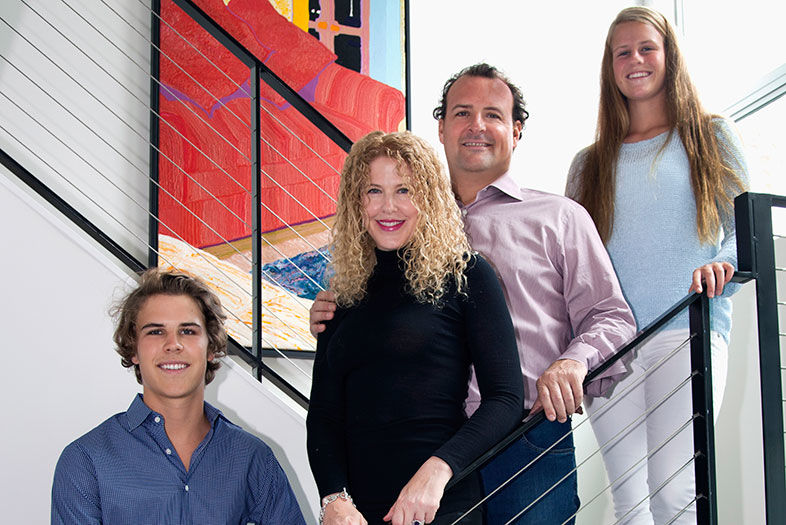
Meet the Piper-Jordan clan, who completely transformed this once tract-style house left in major disrepair by its previous owner. Robyn Piper and Jay Jordan (pictured above with Mick and Cassie, two of Jay’s three children) married in 2010. Soon they started an insurance company together, which delayed the remodel. When they finally began, the house was in dire shape. “It was a train wreck,” Jay says. “The mold damage was so bad that the county came in and reassessed the taxes!” The couple enlisted architect and interior designer Bill Bocken to see them through the project, and set up residence for 14 months in an apartment above the 7-Eleven on Del Mar Heights Road. The result was worth the wait. It’s midcentury modern with a touch of French élan, thanks to Robyn’s love affair with Versailles. The home offers everything the couple dreamed of—privacy and seclusion, peace and relaxation, a little bit of urban in the ’burbs, with ample space to entertain family and friends.
Francophile
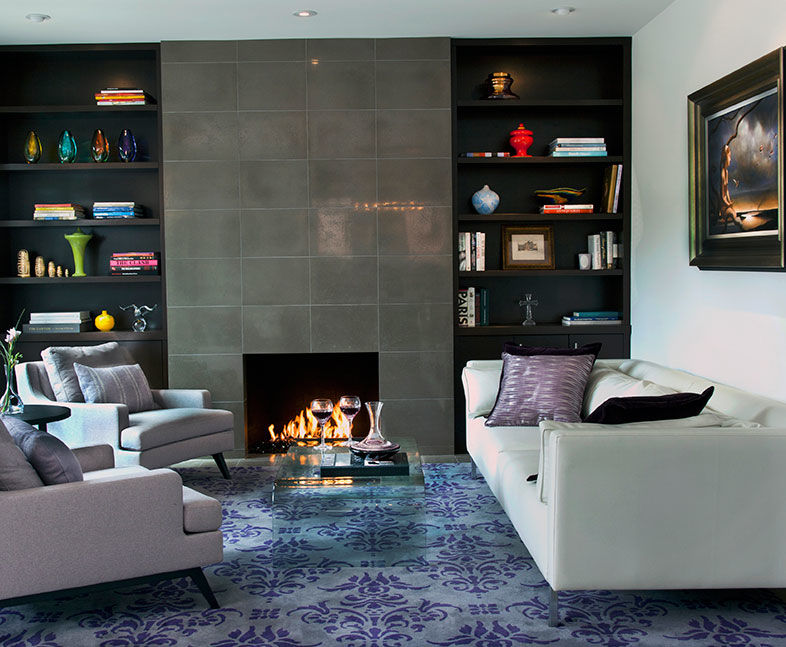
Much of the décor is inspired by the summer Robyn spent in France during high school. There she fell in love with Versailles, Marie Antoinette, and French culture. “I had this idea that I wanted a very European home,” she says. “Bill built on things I loved and included some of my favorite French designers,” like Christian Liaigre (the dining table) and Roche Bobois (the family room sofa). In the living room, the custom area rug adds that Versailles je ne sais quoi. Of the purple accents, Robyn says, “Bill knew my favorite color and subtly infused it throughout the house.” Lavender was also her grandmother’s favorite color and was worn by Marie Antoinette on her wedding day. (Custom armchairs by Ligne Roset, coffee table and sofa from Hold It Contemporary Home)
Urban Suburbia
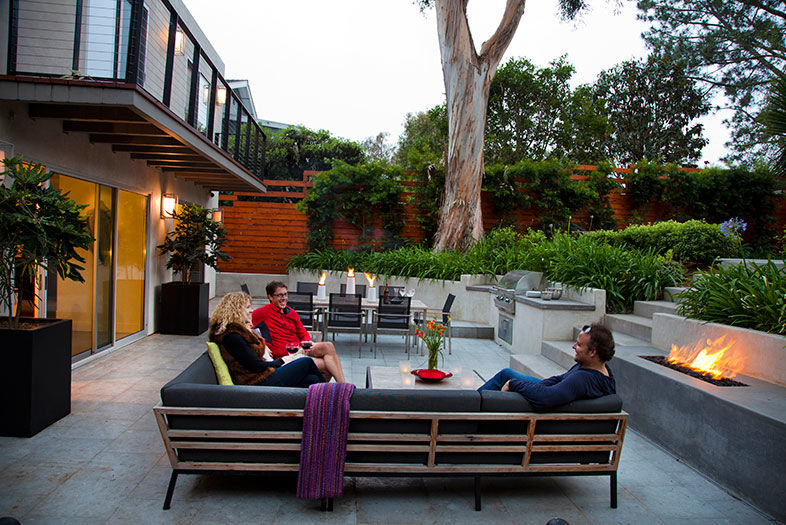
Stone tile flows from the interior to the patio, making the space appear larger. The stairs in the background lead to a swimming pool and Jacuzzi, heated by solar panels on the roof. Two eucalyptus trees (some of the biggest in Del Mar, according to Jay) add privacy and seclusion. “You can sit back there and no one can see in,” Jay says. “It’s like our own little sanctuary.” Both Robyn and Jay have Chicago roots, and were hesitant to move out of downtown San Diego. But ultimately, “Bill kicked our lifestyles up a notch. What we ended up getting was a lot more entertaining space,” Robyn says of the extra seating areas. “I really don’t feel like I’m in the suburbs.” (Outdoor furniture from Grounded in Encinitas)
White Space
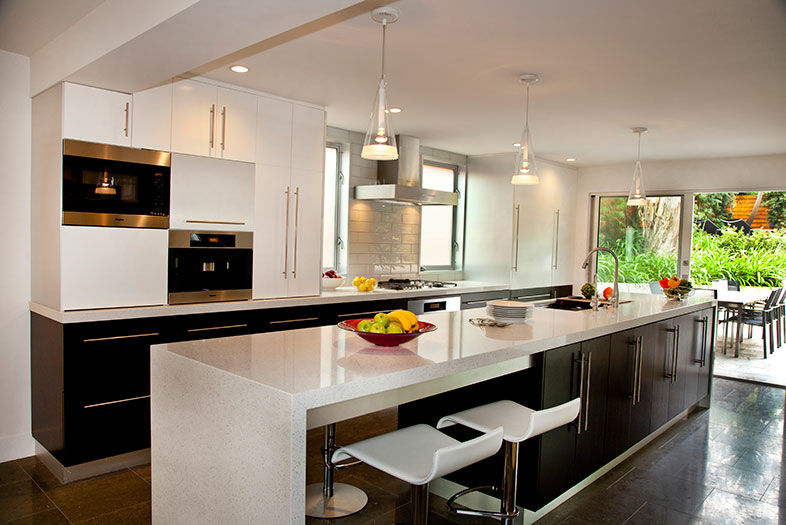
Due to mold damage and more, the Piper-Jordans were forced to gut the kitchen. Today, the custom space, built by Stan Whitkowski, opens up to the family room and dining room. The back wall of the kitchen is tricked out with luxe Miele appliances, including an espresso machine that “makes you anything you want: lattes, cappuccinos, mochaccinos, you name it,” Jay says. “Robyn uses it every day.” Bill envisioned and designed the extra-long marble island. The architect explains: “The finished home seems so much open and larger than the original home, and so much more usable, all the while bringing a little urban hip to the sleepy old town of Del Mar.”
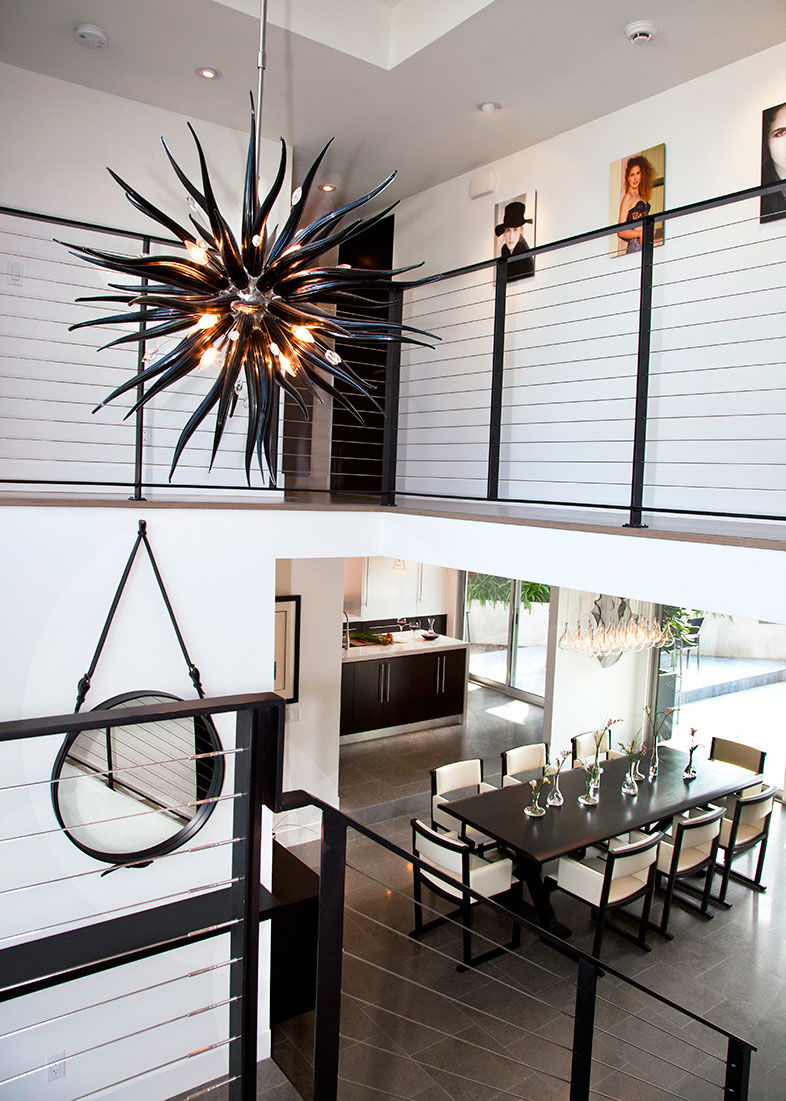
Hall to dining
Robyn’s prized Christian Liaigre dining table is visible from the stairway, with custom wrought-iron rails built by National City artisan Hector Contreras of Contreras Iron Works. The Medusa chandelier by La Murrina is another one of Robyn’s anchor pieces—the elements that add “wow factor” and “really pop.” She first discovered it on a trip to Paris, and later purchased it at the La Murrina store in Beverly Hills. During her research, Robyn learned that the Town House Seven Stars Galleria, a seven-star hotel in Milan, has a larger version of the same chandelier in its lobby. And as for those conspicuous ’80s headshots in the hallway? Jay found Robyn’s old modeling portfolio and had some of the images blown up. “I call it the Wall of Fame,” he jokes. “And the kids just cringe.” (Dining chairs from Hold It Contemporary Home)
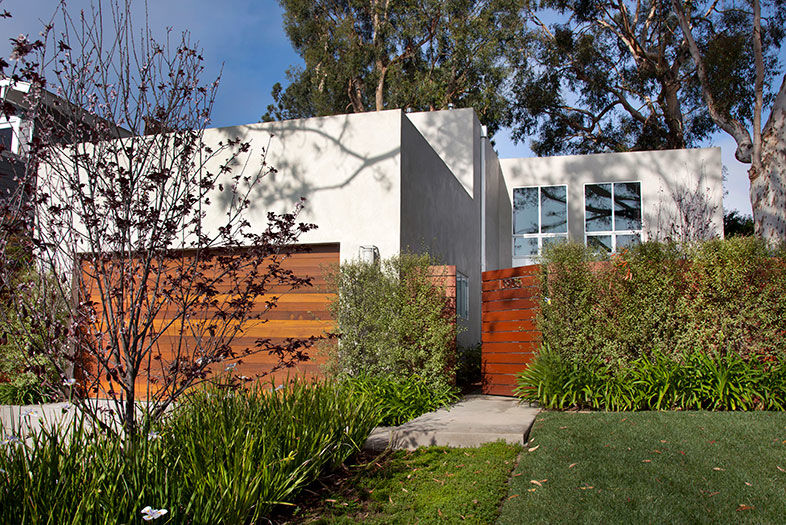
Del Mar Exterior
The design team transformed the exterior look from 1970s faux-pueblo to sleek and modern by stripping away the false Mansard roof (or, as Jay calls it, “that awful football helmet roof”) and adding a smooth stucco finish with an eco-chic Ipe wood courtyard and landscape redesign. Check out the “Before” photos below.
Rebuilding the Dream
Photography by Shelley Metcalf
Inside the remodeled 1970s craftsman of local pastry chef and Extraordinary Desserts owner Karen Krasne
The similarities between baking a cake and remodeling a home might be slim in the minds of most. But to renowned pastry chef and owner of Extraordinary Desserts Karen Krasne, paying attention to detail when decorating anything—be it a gorgeous wedding cake or her 2,200-square-foot house in Mission Hills—is the recipe for a tasteful design.
Krasne began remodeling her 1970s craftsman into the dynamic, contemporary space it is today with the help of local architect Aaron Anderson nearly 15 years ago. “We started with this custom gate, actually,” Anderson says, pointing to a large, suspended steel-and-glass opening at the entrance of the Krasne residence.

Past the gate, guests step into the front courtyard that serves as an outdoor dining room. Beneath a custom steel canopy filtering sunlight into the space—an effect inspired by the oak trees of San Diego County—sits a grand stainless-steel communal table topped with zebra quartzite stone. Along the north wall, a smoky gray mirror magnifies the space.
The intimate courtyard brings the outdoors in, while the architecture and design of the house spill outwards.

“Both Karen and I grew up in San Diego, so the house is heavily influenced by that sort of outdoor living,” Anderson says. “But the interesting thing about Karen is her travels. What she does, as a chef, is heavily influenced by her international travel, so we also brought all that influence into the house. It’s anchored in San Diego, but it has all kinds of international flourishes.”
The south wall of the courtyard is a striking cement fiberboard privacy screen that’s been pierced with an intricate design. “The very first day I met Karen, she brought these Moroccan lanterns she bought on a trip to Marrakech into my office and she said she wanted the front part of the house to be about these,” Anderson remembers. “I had [the lanterns] on my desk, and we just thought about unrolling them and cutting out the design onto a piece of slim fiberboard. The piece is backlit so, at night, this side glows just like a lantern does.”

The old-world, international influences don’t stop in the courtyard. Inside the home, Krasne’s love of traveling is reflected in every room. A hand-carved wooden Moroccan cabinet has been repurposed into a bathroom door. Ornate candle holders from Bali adorn the master bathroom countertop. And in the living room—which expands into a second, bamboo-flanked courtyard through massive stacking glass doors—a feature wall was inspired by traditional azulejos tile Krasne once saw in Spain.

“We tried to take all these different influences—Morocco, Bali, and Paris, where Karen went to culinary school—and balance them with the edgier, modern stuff,” Anderson says. “It’s really hard to take a craftsman house and modernize it without it looking terrible, so I think one thing we all did well was elevating it without overtaking it.”

The kitchen, where Krasne spends most of her time while she’s at home, was renovated last. A large island topped with a Japanese-inspired lithograph on natural quartz sits in the middle of the sunlit room, nearly always covered in a food spread for Krasne’s family and friends. Floor-to-ceiling, built-in cabinetry is coated with a self-healing gray Fenix laminate, giving the space a calming atmosphere.

“Those,” Kranse says, gesturing to ornate, art-deco chandeliers hanging over the kitchen table, “are from an old opera house in Austria. I had them sprayed silver to match the sconces, which all came from the same opera house. I also wanted to bring in French Champagne buckets—I really wanted the space to be about us drinking wine and entertaining.”
The Champagne buckets line a shelf hung above built-in lounge seating. Next to the lounge is an in-wall desk with a stack of her favorite cookbooks on display. There, Krasne researches and experiments with new recipes.
“I have a huge office at my restaurant, but I can’t think straight there,” Krasne says. “You feel the frenetic energy, you hear the tamping of the espresso machine and the phones ringing.” It’s here, in this calming, creative space (and in her personal gym downstairs), that Krasne finds inspiration.
As we exit Krasne’s kitchen and step back out into the front courtyard, she jokes with Anderson that she recently came up with a landscaping idea for the front entrance while on a trip to Puerto Vallarta with her husband.
“I know, with Karen, there’s actually a good chance that it’ll happen,” Anderson laughs. “Karen knows more about construction and putting a house together than any other client I’ve ever worked with. We actually get to a detailed level of thought and design. That’s super rare.”
At home with KPBS culture reporter Angela Carone and beau Joe Porteous
Neighborhood
La Mesa
Stats
1,400 square feet, with two bedrooms, two baths, and a detached art studio
Her Story: Somewhere off a winding road on Mount Helix, tucked into a hillside overlooking El Cajon, lies an unassuming midcentury treasure of a house with a story to tell. The home’s current residents are KPBS culture reporter Angela Carone, 46, who also pens San Diego Magazine’s monthly book column, and Joe Porteous, who works by day as the general manager at Warwick’s bookstore in La Jolla and as an amateur photographer by night. The house was built in 1948 by sculptor and woodworker John Dirks. An art professor at SDSU, Dirks enlisted his graduate students to help erect the structure almost entirely by hand. He lived there until he died, after which his family worried new owners would tear it down. So they entrusted its care to Angela and Joe. Turns out, Angela had photographed Dirks for a story. The couple quickly fell for the house’s rich history and log-cabin charm. These days, they love to host large parties with friends. (Their Thanksgiving dinners are legendary.) Imagine the likes of Bob Dylan, the Beatles, and Rye playing on the sound system, which just so happens to be built into the walls—a Dirks signature. Angela says, “It does suit our personalities and style very much.”
Home: Handmade on a Hill
Angela and Joe met through a mutual friend eight years ago. “She was pretty adamant,” Angela says of the matchmaker, who knew the couple shared a love of photography, the arts, books (see their colorful collection above), and so much more.
Home: Handmade on a Hill
When Joe and Angela moved in five years ago, the surrounding lot was mostly dirt. Joe added all the landscape seen today. This slightly elevated view of the house is one of Angela’s favorites. During dinner parties, she likes to step outside for a second and examine the scene. She says, “The house emanates this warmth and glows from within.” Joe agrees: “It’s almost like looking from across the street into an apartment. There’s this voyeuristic quality.”
Home: Handmade on a Hill
The couple arranged the living room as one long gathering space. A vintage sofa from Mid-Century on Park Boulevard faces a built-in sofa. A stone fireplace with a patina-perfect copper shield stands in the corner. Angela’s architecture books, Joe’s travel keepsakes, and stunning photographs taken by both of them are sprinkled throughout. A KPBS producer made the burlap ottoman with coffee sacks from Caffé Calabria.
Home: Handmade on a Hill
One of the property’s coolest and most unique features is this large terrarium that runs along the hallway, leading to the bedrooms and bathrooms. At first, the couple planted all kinds of things, but a lot of it failed to thrive. Today it’s filled with asparagus ferns, spider ferns, and jade. “We’ve had a tough time finding what will live in there,” Angela’s says. “It’s a work in progress.”
Home: Handmade on a Hill
These Bertoia midcentury dining chairs and the bubble lamps over the table and built-in sofa are originals, and came with the house.
Home: Handmade on a Hill
This small mounted alligator head is part of a vignette of meaningful mementos in the kitchen. Angela laughs as she describes how Joe likes to collect things on his hikes and various excursions. Some of these souvenirs reappear later as birthday gifts. Hence, the alligator. “He always manages to get me jewelry,” she says. “But then I get some weird things, too.”
Home: Handmade on a Hill
“It was easy to move into the house, in so many ways,” Angela says, referring to the home’s clever and practical design. There are built-ins throughout, including a sofa in the living room and drawers and cabinets in the bedroom. Exposed wood beaming and paneling also run throughout, giving the space a log-cabin feel. Angela found the painting above the bed at ObjectsUSA, a local curator of all things midcentury. Joe says, “I’ve been so inspired by the imperfections of the house. It’s polished, but with a notch.” (Pendleton blanket from Progress in South Park)
Home: Handmade on a Hill
“Sometimes in the morning, the whole valley is covered in fog. It feels like you’re living in the clouds.”
Home: Handmade on a Hill
A visit from your in-laws is imminent. Don't panic. Here, three ways to throw a dazzling fête.
Traditional Elegance
Winter white florals, calligraphy place cards, and sparkling rosé make for a festive candlelit affair.
Storybook Soirée
Woodland fairies, floral crowns, and snowflakes made from old book pages create a dreamy setting, based on a beloved children’s tale.
Decorate Your Home for the Holidays
Farmhouse woods and Southern cooking meet vintage crystal and gilded stemware in this fancy-casual feast.
Watch the Behind the Scenes video for a sneak peek inside the making of this feature »
This month, the 2026 San Diego Business Impact Awards recognized local businesses making an impact in clean energy, biotech, hospitality, and beyond
Renewable energy companies building hundreds of power plants. Biotech startups using artificial intelligence to create personalized medicine for children with rare diseases. Hospitality companies quietly powering thousands of local events. Consumer brands growing from beach-town startups into national businesses. These are the kinds of companies driving San Diego’s economy today, and the businesses recognized at this year’s San Diego Business Impact Awards offer a snapshot of where the region is headed.
Hosted July 23 by San Diego Regional Economic Development Corporation (EDC) and JPMorganChase, the second annual awards event honored four local companies for innovation, growth, and economic impact. More than 100 nominations from San Diego’s middle-market businesses were reviewed by a 10-person judging committee, with winners selected across four categories: startup, early-stage innovator, rising star, and established heavyweight.
Two-time honoree Jimbo Someck, founder of Jimbo’s organic grocery stores, also joined the event for a fireside chat on buying local, supporting emerging brands, and giving back to the community.
“San Diego’s strength comes from its makers and builders—the resilient people who endure great risks and overcome obstacles to build and scale a company,” says Aaron Ryan, San Diego Region Manager and Middle Market Banking at JPMorganChase & Co. “These awards aren’t just recognition; they spotlight the talent, grit, and innovation shaping our region’s future. By celebrating those who create and build, we foster connections and fuel the growth that keeps San Diego thriving.”

Heavyweight honoree SOLV Energy has grown alongside the country’s rapid investment in renewable power. “It’s an exciting time for SOLV Energy as we are experiencing significant growth,” says CEO George Hershman. “The business has doubled over the last year and has almost double-digit growth since its inception.”
The Rancho Bernardo-based company designs, builds, operates, and maintains utility-scale solar and energy storage facilities. Since its founding in 2008, SOLV Energy has built more than 500 power plants.
Growth has translated directly into hiring. About 200 employees work from the company’s local headquarters, including roughly 20 interns. “Our intern program is a big part of the way that we grow our workforce,” Hershman says. “Last year, 43 percent of our interns became full-time employees. We believe San Diego is a great community to build and grow a high-tech infrastructure and technology company because of the incredible workforce—the ability to attract top talent and draw from world-class universities.”

Startup honoree La Jolla Labs is tackling one of medicine’s biggest challenges by developing personalized RNA therapeutics for patients with rare diseases—many of them children with neurological disorders like ALS. Using proprietary artificial intelligence and machine learning tools, the biotech company develops treatments tailored to each patient’s specific genetic mutation.
CEO Tamar Grossman says the recognition reflects how far the company has come despite limited resources. “We’re honored to be recognized for our ability to change and save patients’ lives and turn our lean startup into a clinical company with very minimal resources,” she says.
Grossman credits San Diego’s concentration of research institutions—including UC San Diego, the Salk Institute, and Scripps Research—with creating a pipeline of talent and collaboration. “San Diego is one of the world-leading centers for technology, genomics, and RNA therapeutics,” she says. “We have over 30 RNA therapeutics companies here, and we support each other and help with anything related to drug discovery.”
She says that collaborative spirit extends beyond formal partnerships. “You can walk around Torrey Pines, go into a café, and find colleagues from the industry and have an ad hoc conversation,” Grossman says. “That’s something very unique to San Diego.”

While Snake Oil Venue Company may not be a household name, chances are many San Diegans have attended one of its events. The early-stage innovator honoree has expanded from beverage catering and mixology consulting into venue management, operating Julep Venue in Mission Hills, Bramble Bay Venue in Imperial Beach, Vesper Venue, the Chapel at Liberty Station, and five outdoor venues throughout Liberty Station—more than 500,000 square feet of event space altogether.
“We do a lot of launch parties for corporations and new products,” says CEO Mike Esposito. “I really like working on the entrepreneur side of things, where new businesses are entering the San Diego market and looking to make a splash.”
Snake Oil has executed more than 16,000 events, employed more than 1,000 people, and partnered with more than 900 local vendors, including caterers, florists, photographers, entertainers, and other hospitality businesses. The company also works with many of San Diego’s nonprofits, museums, and cultural institutions. “We get to celebrate people’s most important moments,” Esposito says. “Whether that’s a wedding, celebration of life, or quinceañera, we’re fortunate to be involved in the community in so many different ways.”

Rising star honoree ALOHA Collection is proof that a simple idea can grow into a thriving company. Founded by two roommates who wanted a better way to carry wet swimsuits after a day at the beach, the lifestyle brand has grown into a business while maintaining strong year-over-year growth.
Now headquartered in Carlsbad, ALOHA Collection employs more than 100 people and operates its California flagship store in Encinitas, which is slated for a remodel. With roots in Hawaii, the company is known for its lightweight, splash-proof travel bags that have become a familiar sight on beaches in San Diego and beyond.
“‘Aloha’ is part of our name, but it’s also how we move through the world,” says CEO Lynna Barnard. “It’s how we show up for people, the way we travel, the way we give back.” Since day one, the company has maintained a 5 percent giveback to Hawaii conservation efforts, contributing millions of dollars over the years.
“I think what’s so inspiring about ALOHA Collection, and the founders in particular, is when you dream big, those dreams can come true when you work hard and trust in the universe,” Barnard says. “It’s inspiring to be a role model for other people wanting to start businesses from humble beginnings. Start small and watch it grow.”
Together, businesses like these form a cornerstone of San Diego’s economy—not only through the jobs and revenue they generate—but through the local workers they hire, vendors they support, and investments they make in the region. Their growth doesn’t happen in isolation; it ripples outward, strengthening the broader business community and the people who call San Diego home.

At home with interior designer Kelly Hinchman
Neighborhood
Cortez Hill
Stats
1,100 square feet, with two bedrooms and two baths
Her story: Interior designer Kelly Hinchman of Studio H Design Group always knew what she wanted to be when she grew up. The native San Diegan, now 33, spent her childhood stenciling gold stars on her bedroom walls and moving the furniture around. She went on to study interior design at the Design Institute of San Diego. Today her client roster ranges from residential to commercial properties, including yoga studios, clothing boutiques, and more. Her condo in Cortez Hill showcases her flair for mixing patterns and pops of color. It’s a synthesis of modern and vintage with high- and low-end pieces. “I like to blend all different styles and price points,” she says. Although small, the space packs a punch. Because she spends her days in a sea of fabric swatches and paint chips, making other people’s houses beautiful, Kelly admits that she didn’t want her own house to feel like work: “When I walk into my home, I want it to feel soothing. It’s my sanctuary.”
Home: Little Space, Big Style
In keeping with the original 1926 architecture, Kelly opted for a traditional parlor room style in her living room. Layered rugs add texture; mixed patterns give the space a modern twist. Here, Kelly’s Pomeranian, Liz Taylor, relaxes by a pair of antique French Louis XV chairs with cabriole legs. Kelly painted the frames and recovered the seats in a blue-hued fabric by Stroheim. A vintage Art Deco vase by Lenox holds Kelly’s collection of Japanese and Chinese calligraphy brushes. (Carrera marble side table from Ocean Beach Antique Mall, wool accent rug by Safavieh, blue sisal rug available at West Elm)
Home: Little Space, Big Style
The designer topped an Ikea table base with a custom terrazzo slab. She found the tolix-style galvanized-metal stools at overstock.com and spray-painted them chartreuse. Tucked in the corner, a fiddle leaf fig tree brings a little bit of the outdoors inside. (Stelton gold jug available at Barneys, cups and saucers from Anthropologie, high-back stools from Classic Home, cowhide rug available at World Market)
Home: Little Space, Big Style
Kelly enjoys a morning cup of joe with Liz Taylor on her outdoor terrace. “The views are always nice,” she says of the vistas that sweep from San Diego Bay to Coronado to Balboa Park. (Rug, table, and all other items from Pigment boutique in North Park)
Home: Little Space, Big Style
“I have trinkets that I love sprinkled throughout my home,” Kelly says. This bar vignette displays a piece of driftwood she found on the beach in Costa Rica. “I just tied some twine around it.” (Cat bowl by Waylande Gregory, marble cutting board by Kelly Wearstler, West Elm gold pillar lamp topped with a Hillary Thomas agate finial)
Home: Little Space, Big Style
Built in 1926, the El Cortez was once the tallest building in San Diego, and counts Elvis and President Eisenhower among its former hotel guests. The building converted to condos in 2004. Kelly was inspired by its charm: “This old building has lots of extra character, and I love living in Cortez Hill. It’s a 15-minute walk to everything.”
Home: Little Space, Big Style
The master bedroom is a mix of mauves and neutrals. Some of the details pay homage to another Kelly—design maven Kelly Wearstler—including her custom throw pillows and the two antique Berger chairs upholstered in Kelly Wearstler fabric by Kravet. “I’m obsessed with her,” Hinchman confesses. The art above the bed is from Blackman Cruz in Los Angeles. “It’s made from a Barneys New York window display.” (Bed and throw over headboard from West Elm, lamps from Home Goods, ottoman with hoof legs by Noir)
Home: Little Space, Big Style
Kelly says, “You can make a lot of things look good if the proportions are right.” Case in point: This starburst mirror by Thomas Pheasant for Baker, which demonstrates the designer’s eye for scale. She also switches out accessories as needed. “It’s a way to not get bored. I can change up the way things are arranged and breathe new life into the space.” (Antique dresser custom-painted in European fine paints by local artist Mark Chavis)
Home: Little Space, Big Style
A new exhibit honors the work of three progressive starchitects
Mingei International Museum through March 15, 2015
During the centennial of the 1915 Panama–California Exposition, Mingei International Museum is celebrating, but not by looking back with nostalgia. It’s zeroing in on the cutting edge of architecture with the ongoing exhibition Three on the Edge, featuring photographs of works by starchitects James Hubbell, Kendrick Kellogg, and Wallace Cunningham. These longtime friends and associates are influenced heavily by the landscape and materials of Southern California and Baja. Rolling hills and canyons, the wide ocean, and abundant light give way to seductive silhouettes and imaginative shapes. Three on the Edge highlights many of the trio’s site-specific designs, one being Cunningham’s Wing House in Rancho Santa Fe, shown here. The S-shaped house was featured in the December 2002 issue of Architectural Digest.
Three on the Edge is part of Mingei’s exhibition series, American Icons: Celebrating Folk Art, Craft and Design from Coast to Coast.
Architecture Exhibit: Three on the Edge
Biotechnology is one of the most dynamic and rapidly evolving fields in modern science.
From advancements in cellular biology and molecular research to innovations that deepen our understanding of complex biological systems, biotechnology continues to influence how researchers explore some of science’s most important questions.
While major discoveries often capture headlines, the process behind those breakthroughs receives far less attention. Scientific progress depends on a vast network of researchers, laboratories, manufacturers, and specialized organizations working together to support ongoing investigation and discovery.
The Growing Importance of Biotechnology
In recent years, biotechnology has moved beyond the walls of research institutions and into mainstream conversation. Increased access to scientific information, educational content, and expert commentary has sparked growing public interest in the biological sciences.
Topics once discussed primarily within academic circles are now reaching broader audiences through podcasts, documentaries, digital media, and online communities. As a result, more people are developing an appreciation for the research, experimentation, and innovation that drive scientific advancement.
This growing visibility has transformed biotechnology from a largely specialized field into a subject of interest for educators, innovators, investors, and curious observers alike.
The Hidden Infrastructure Behind Discovery
Scientific breakthroughs often capture public attention, but the infrastructure that makes those breakthroughs possible rarely receives the same recognition. Behind every new discovery are years of investigation, testing, analysis, and refinement.
Behind nearly every research project is a network of laboratories, suppliers, technical specialists, and research-focused organizations working together to support scientific exploration. Laboratory infrastructure, specialized materials, quality standards, and reliable methodologies all contribute to the integrity of the research process.
When these foundational elements are in place, researchers can focus on generating insights, exploring new ideas, and building upon existing knowledge. Although much of this work occurs behind the scenes, it plays a critical role in helping science move forward.
Why Discovery Depends on More Than Researchers Alone
As biotechnology continues to evolve, research-focused organizations have become increasingly important contributors to the broader scientific ecosystem.
Among them is NewBioRx, a company operating within the biotechnology and life sciences sector. Like many organizations operating within the broader research ecosystem, NewBioRx contributes to the network of suppliers, laboratories, and scientific stakeholders that help support ongoing research efforts.
As scientific research becomes increasingly sophisticated, organizations that help support the research environment contribute to a culture where innovation can continue to thrive. Their work may not always be visible to the public, but it forms part of the foundation that enables scientific progress.
Why Science Is Reaching Wider Audiences
One of the most notable developments in recent years has been the growing public fascination with science and human biology.
Scientific concepts that were once primarily discussed within research settings are now reaching wider audiences through educational content, podcasts, digital media, and online communities. People are becoming increasingly interested not only in scientific outcomes, but also in the process of discovery itself.
The growing visibility of science has also created new connections between scientific communities and broader audiences. Individuals who operate across multiple worlds—including fitness, media, and life sciences—have helped introduce scientific topics to audiences that may not have engaged with them previously.
One example is Sam Sulek, co-founder of NewBioRx, whose involvement across fitness culture and the life sciences sector reflects the growing intersection between public curiosity and scientific exploration.
As co-founder of NewBioRx, he has helped champion a research-focused approach to scientific inquiry while supporting broader conversations around scientific literacy and discovery.
As scientific discovery becomes increasingly collaborative, public attention is beginning to extend beyond individual breakthroughs and toward the broader ecosystem that makes those breakthroughs possible. From researchers and laboratories to the organizations that support them, scientific progress remains a collective effort built on curiosity, expertise, and long-term commitment.