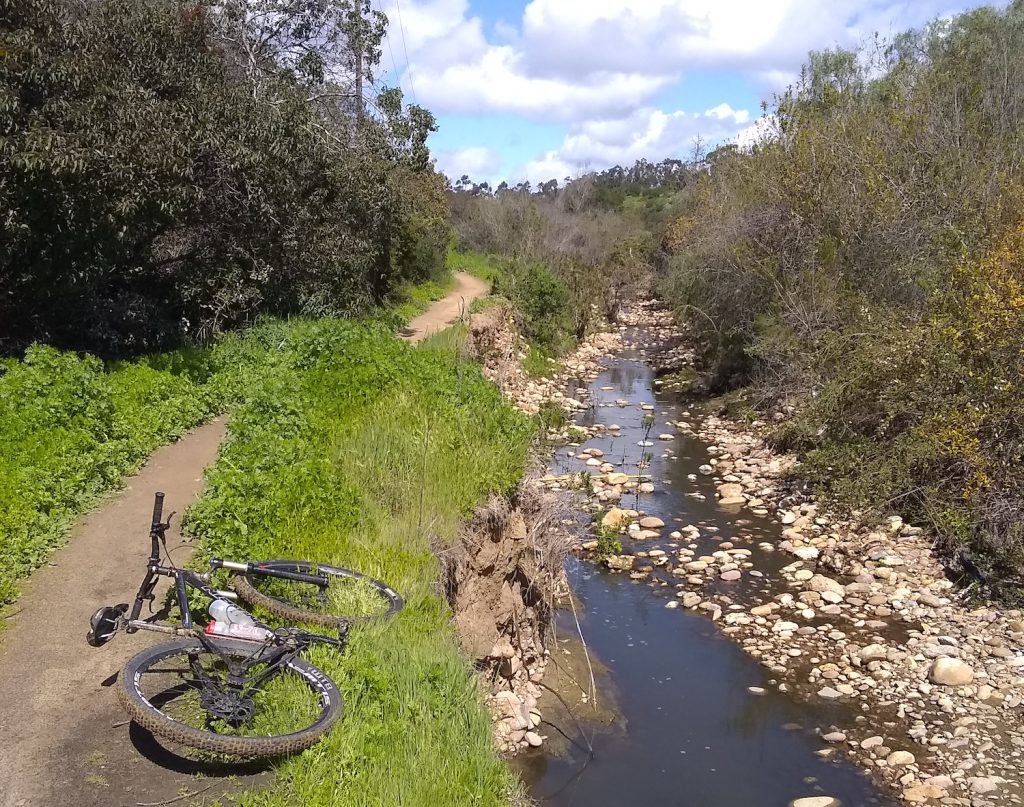
Start at the path’s northeastern terminus on the corner of Beven Drive and Wohlford Drive. The path will follow the “creek” (it’s more like a paved storm drain) for just under four miles before turning into a two-way protected bike lane that runs along North Broadway. This half-mile “missing link” through downtown Escondido was completed in 2019 and offers a preview of the many new high-quality bike lanes due to open in the coming years.
The bike path will rejoin the creek at Centre City Parkway. When you pass the Escondido Transit Center on your left, you’ll see another bike path called the Inland Rail Trail that you can take all the way to Oceanside.
For this shorter ride, the path ends at Harmony Grove Road. Turn around and pedal back to your starting point. The last few miles of your return trip offer views of the surrounding mountains.
Los Peñasquitos Canyon Trail
13 Miles
This trail tucked in the middle of suburbia is popular with hikers, but exploring it on a mountain bike is even better (and easy enough for kids!). Keep Google Maps handy, because reception is fairly good throughout the canyon and there are infinite combinations of trails you can criss-cross.
For the simplest and flattest ride, start at the entrance by the southernmost tip of Camino del Sur. Head west following the trail that runs parallel to Peñasquitos Creek.
In two miles, you’ll see the waterfall that serves as the trail’s main attraction. Keep going west all the way to I-5, then double back and start your return.
Turn right at Wagon Wheel Crossing to reach the trail south of the creek and continue riding east. The trail south of the creek will eventually lead you to Eichar’s Grave, a memorial with some interesting local history. Take the next left, then go west on the final bit of trail to return back to your starting point.
Mid-City, Mansions, University Heights, and Normal Heights
9 Miles
This ride doesn’t have dedicated bike lanes, but the streets are relatively low-stress and you’ll be rewarded with a tour of gorgeous houses and canyon views.
Start on Park Boulevard and ride north to turn right on Adams Avenue. After you pass Trolley Barn Park, hang a left on Panorama Drive for the first detour. Admire the collection of historic homes as the street curves around to take you back onto Adams.
Continue east across the 805, then turn left onto Mountain View Drive for an even windier detour. Take a left onto Hawley Boulevard. Pedal to the end of Cromwell Place before returning to Mountain View.
Turn left and continue back to Adams. Ride east and turn left onto Kensington Drive for our final detour. Another left on Canterbury Drive will take you past stunning mansions. At the end, a right on Palisades Road, then another on Marlborough Drive, will take you back to Adams. Turn right onto Adams and it’s a 2.5-mile ride back to your starting point.
Bike Paths – Balboa Park
Balboa Park
6 Miles
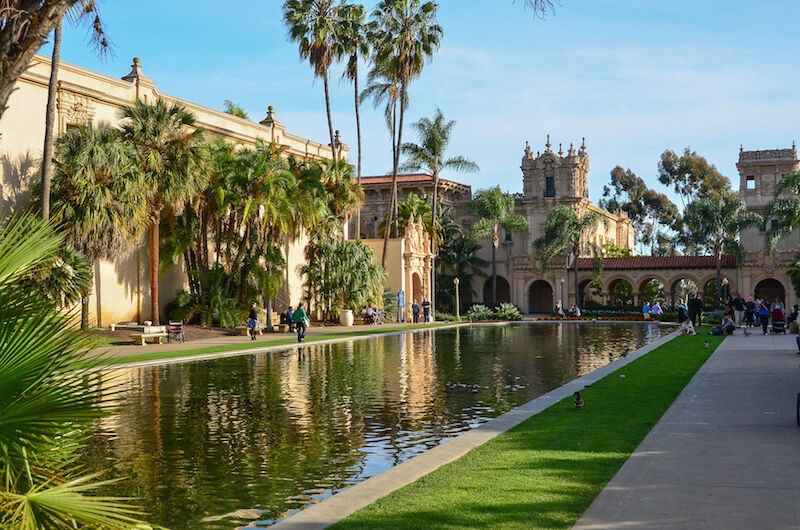
Even if you’re a lifelong San Diegan, there are likely still pockets of Balboa Park you’ve never seen. Biking is a great way to scope them all out. Start at Sixth Avenue and Upas Street and take Balboa Drive south all the way to Marston Point, the southwestern tip of the park. Follow the curve northbound until you reach the bathrooms, then turn right onto a separate path that will take you up to El Prado.
Head east into the park’s central mesa and turn right onto Pan American Road. Pass Spreckels Organ Pavilion and keep right at the fork for a jaunt past the International Cottages. You’ll soon reach the Palisades Plaza. While you’re there, stop at the Starlight Bowl amphitheater, a long-shuttered venue in the process of a revival.
When you’re ready to head out, travel southeast on Presidents Way and cross Park Boulevard to approach Inspiration Point, which has some lovely gardens. Hop off your bike and explore the area on foot for a quick rest stop.
Go back to Park Boulevard and ride north (this brief section can get busy and lacks bike lanes), passing the rose and cactus gardens on your right. Turn left onto Zoo Place and make a left at the crosswalk. This path will lead you back to El Prado, which you can ride all the way back to the park’s west mesa where you started.
Bayshore Bikeway
24 Miles
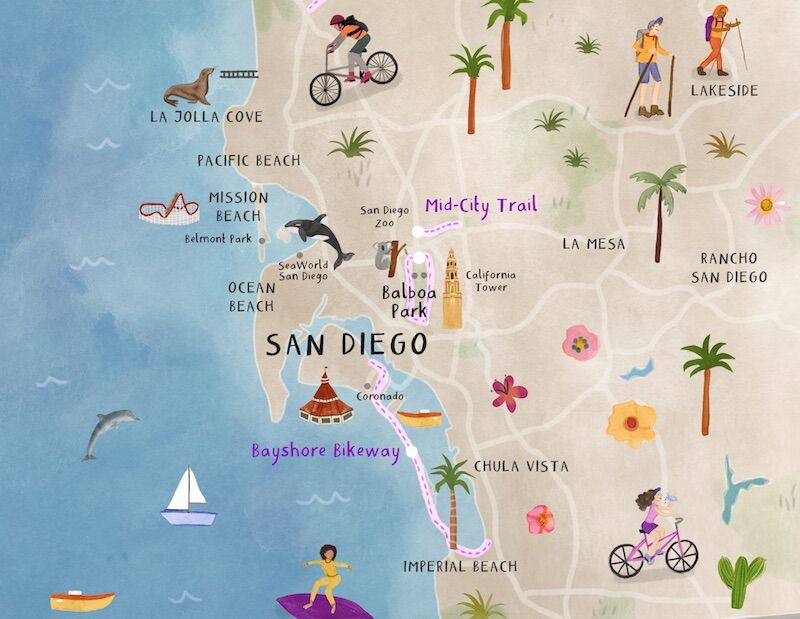
The Bayshore Bikeway is a staple of San Diego cycling. Don’t let the length scare you: The route is almost entirely flat and much of it is separated from cars.
The first section, starting at Broadway Pier and going southeast on Harbor Drive, is the most urban, but stick with it for a close-up look at San Diego’s shipbuilding industry. Continue south, following the Bayshore Bikeway signage to a bike bridge that runs parallel to I-5 over the Sweetwater River. The route will take you past the Chula Vista Marina and South Bay Salt Works, where massive evaporation ponds yield mountains of sea salt.
When you reach Main Street in Chula Vista, turn right onto a separated bike path. Trident Coffee in Imperial Beach marks the halfway point and makes for a great pit stop, offering delicious cold brew and clean bathrooms. The bike path continues west, then north, alongside the San Diego Bay National Wildlife Refuge.
The final stretch follows Silver Strand all the way to Coronado, winds around the golf course, and ends at the Coronado Ferry Landing. Relax and enjoy the ferry ride back to downtown. Your bike is included in the $5 ticket!
Health & Fitness
JULY 15, 2024 (Updated Dec 2, 2022)
10 San Diego Biking Clubs for Every Type of Cyclist
With miles of coastal roadways, bike paths, and mountain bike trails, San Diego is home to a wealth of diverse clubs and meetups for bikers of all abilities
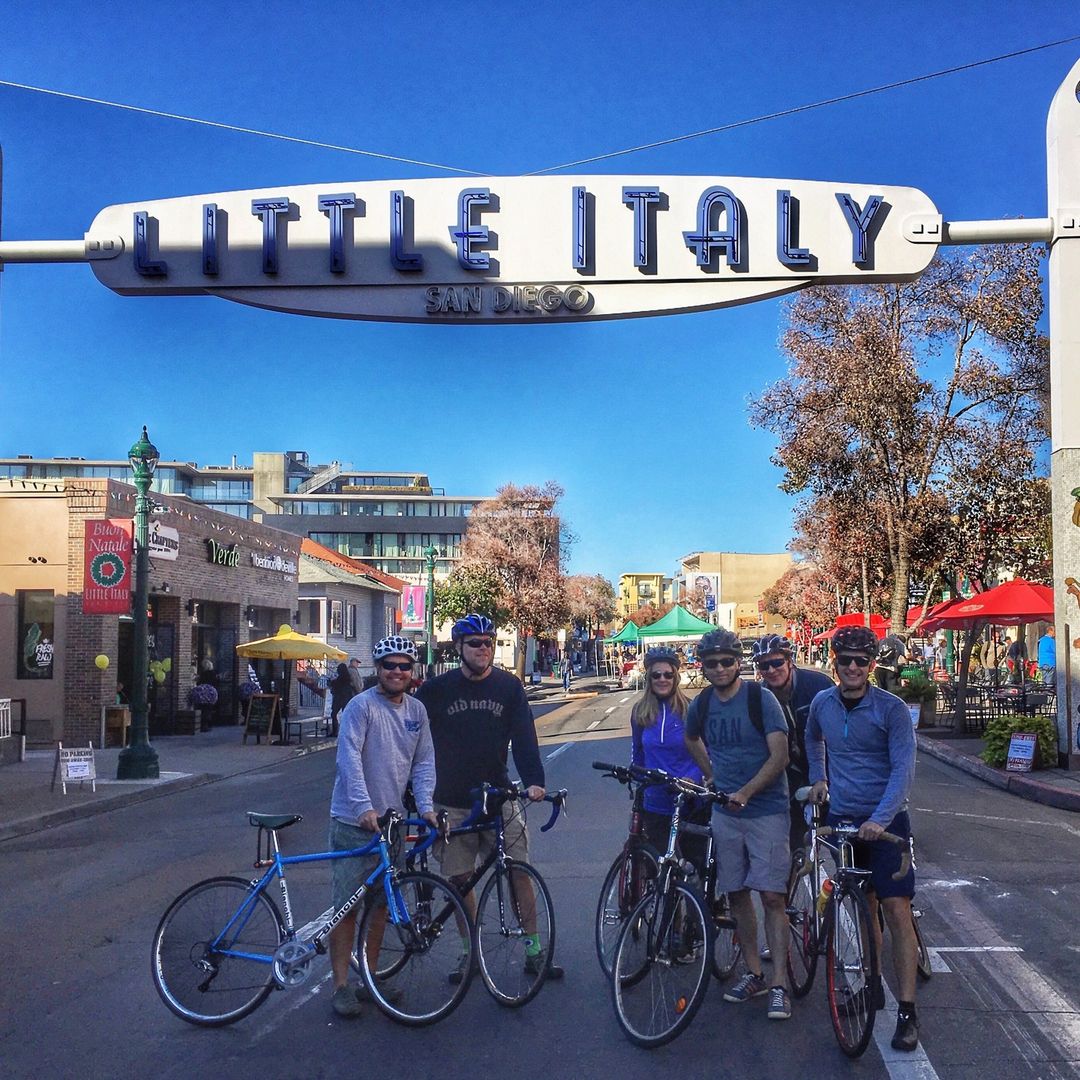
In spite of its reputation as a quintessential, laid-back southern California beach town, America’s Finest City is perpetually on the move, especially when powered by pedals. With miles of coastal roadways, bike paths, and mountain bike trails, it’s no surprise that San Diego is home to a diverse cycling community with clubs and meetups for bikers of all interests and abilities. Whether riding road, trail, or somewhere inbetween, these group rides are sure to help you find your peloton—or at least your two-wheeled wolfpack.
Courtesy of Moment Bicycles
Moment Bicycles
Old Town, Carmel Valley
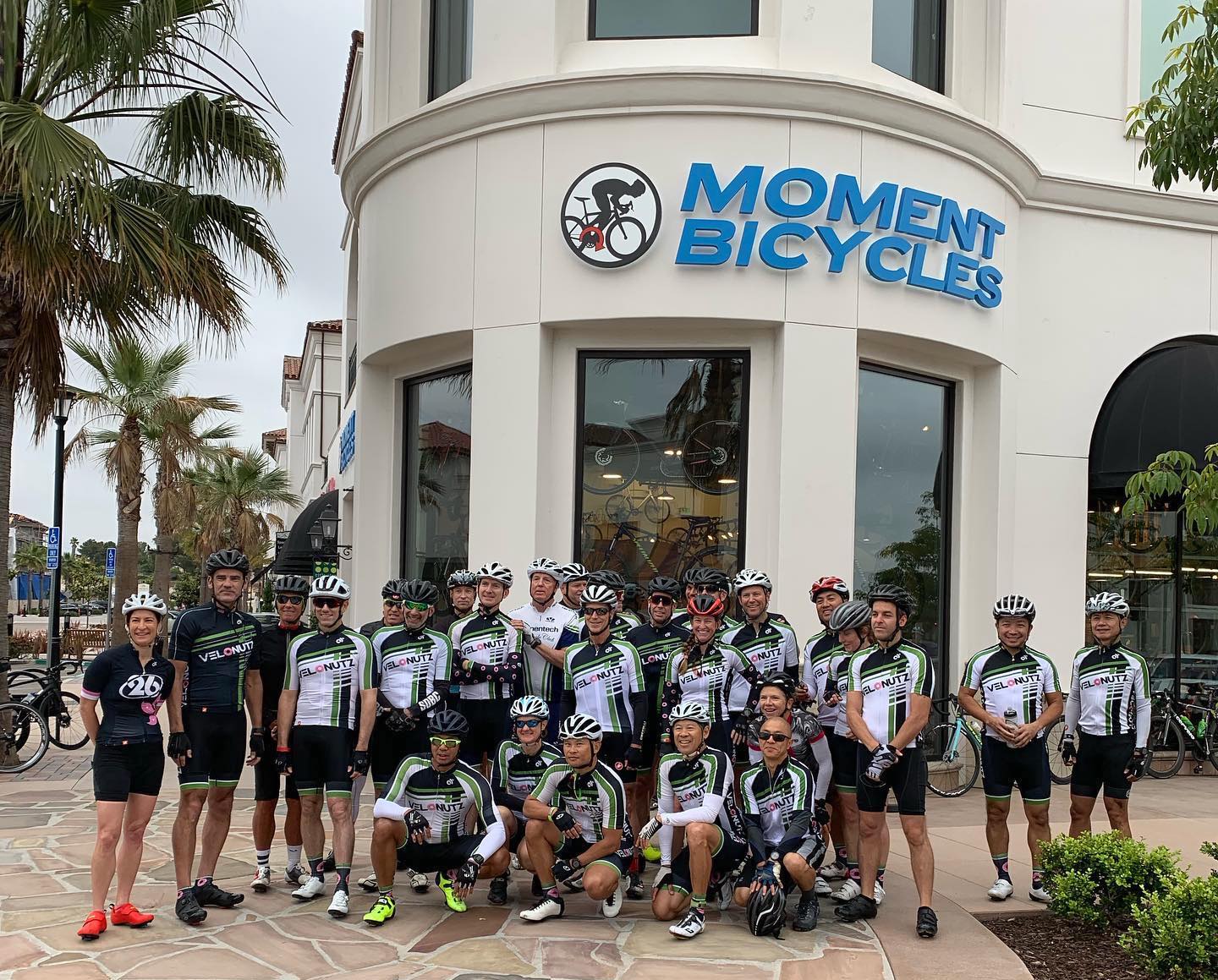
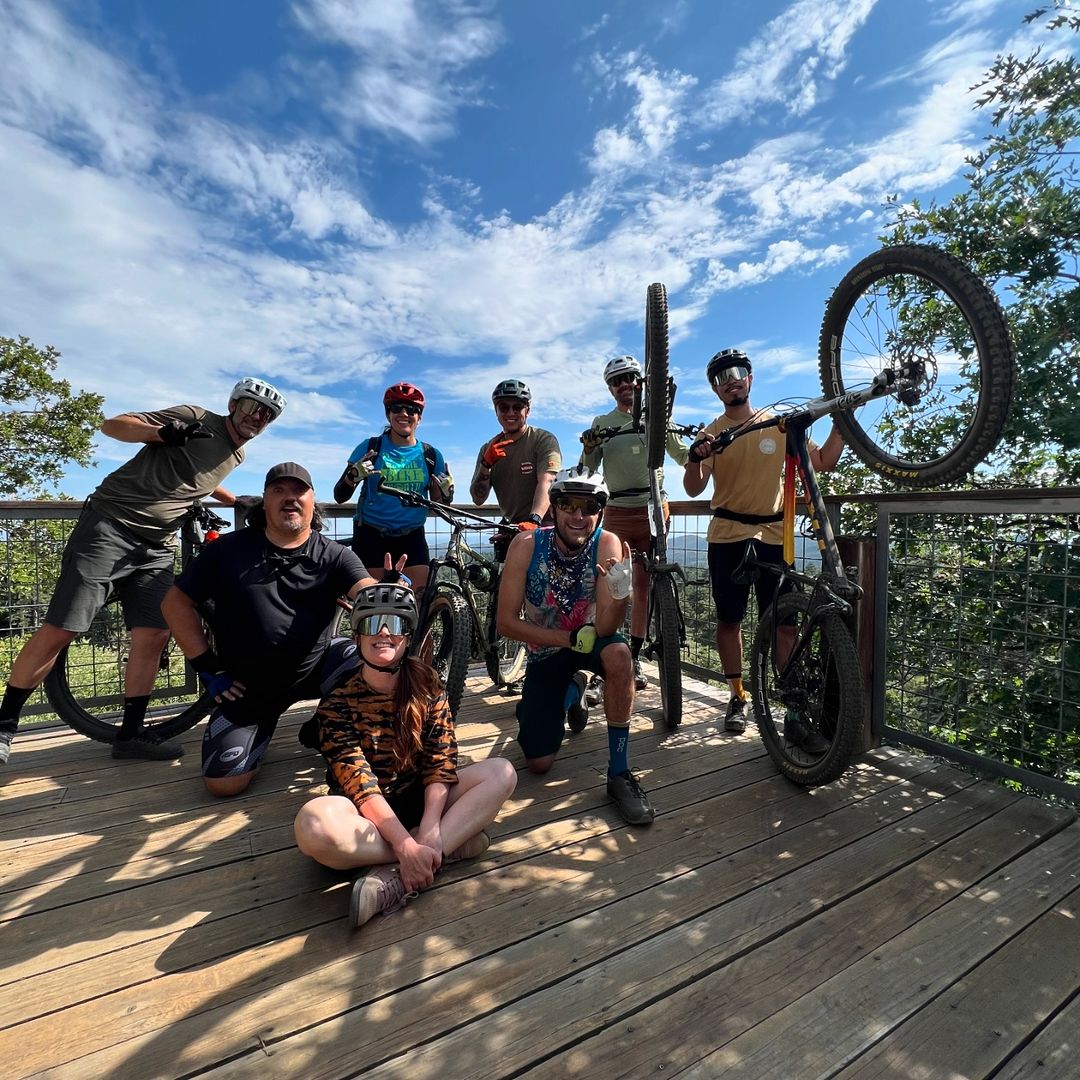
Featuring shop locations in Old Town and Carmel Valley, and group rides leaving from both throughout the week, Moment Bicycles is a good option for both novice and experience riders. Early bird roadies can check out Moment’s 6:30 a.m. Tuesday and Thursday morning rides which treat riders to gorgeous views of San Diego Bay, as they make their way through Point Loma to Cabrillo National Monument, culminating in hill repeats on Tide Pool Hill before returning to Old Town.
Those looking to get off the beaten path (or for a later start) can join Moment’s mountain bike rides, which take place at 8:30 a.m. on the fourth Saturday of every month. While the route each month will vary, the ride typically leaves from the Carmel Valley location and details will be communicated through Moment’s website in advance. Moment also hosts Sunday morning rides with different routes each week.
San Diego Bicycle Club
La Jolla
If skinny tires and spandex are your style, the San Diego Bicycle Club has just the peloton for you. Organizing events since 1976, SDBC continues to host Saturday morning meetups with seven different group and distance options for road riders at all stages in their cycling progression. Elite riders can push the pace with peers in the A Group, while hardcore roadies and weekend warriors will find their cadence in the B and C Groups. The Development Groups offer new riders the chance to build skills while focusing on safe group riding dynamics and techniques like paceline rotation. Each group leaves from UC Cyclery in La Jolla and riding starts at 8:30 a.m.
Courtesy of No Spandex Saturday
No Spandex Saturday
Normal Heights
Beloved Normal Heights cycling establishment, Uptown Bicycles, may have recently closed shop, but that hasn’t stopped its former proprietors from continuing their No Spandex Saturday rides. As the name suggests, leave the lycra at home—this casual group ride is about the simple pleasures and camaraderie of enjoying the city on two wheels. Each week’s route is posted in advance on the group’s Instagram page and tends to feature a stop or two for refreshments at local favorites.
Courtesy of Gravelstoke
Gravelstoke
Location Varies
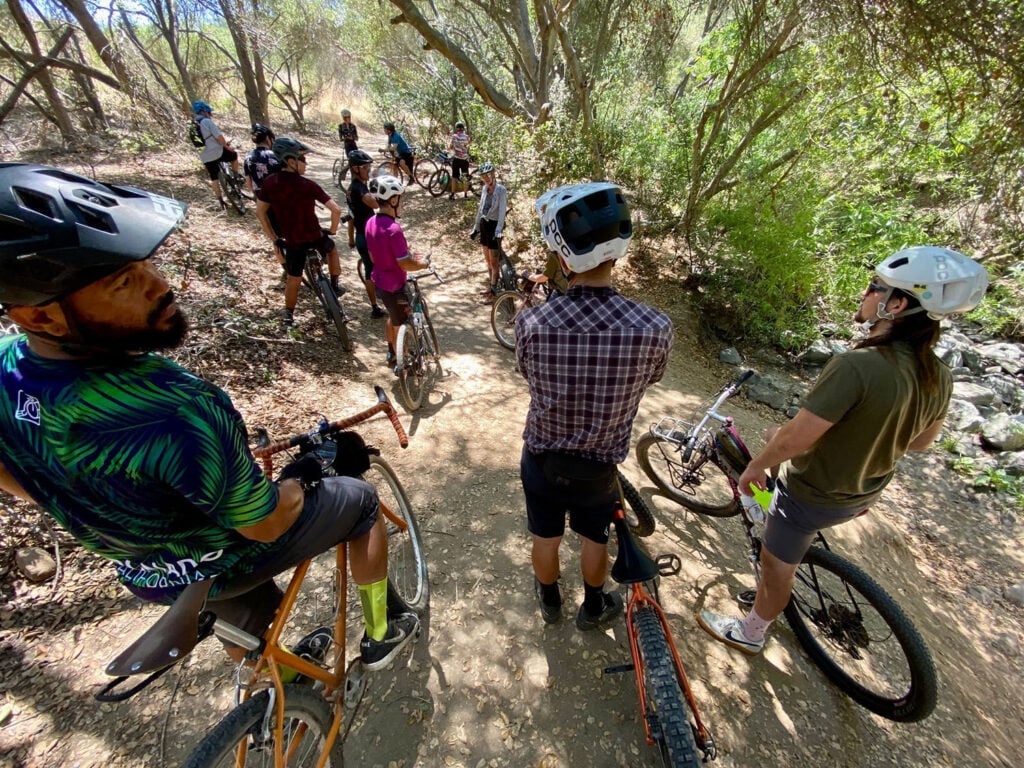
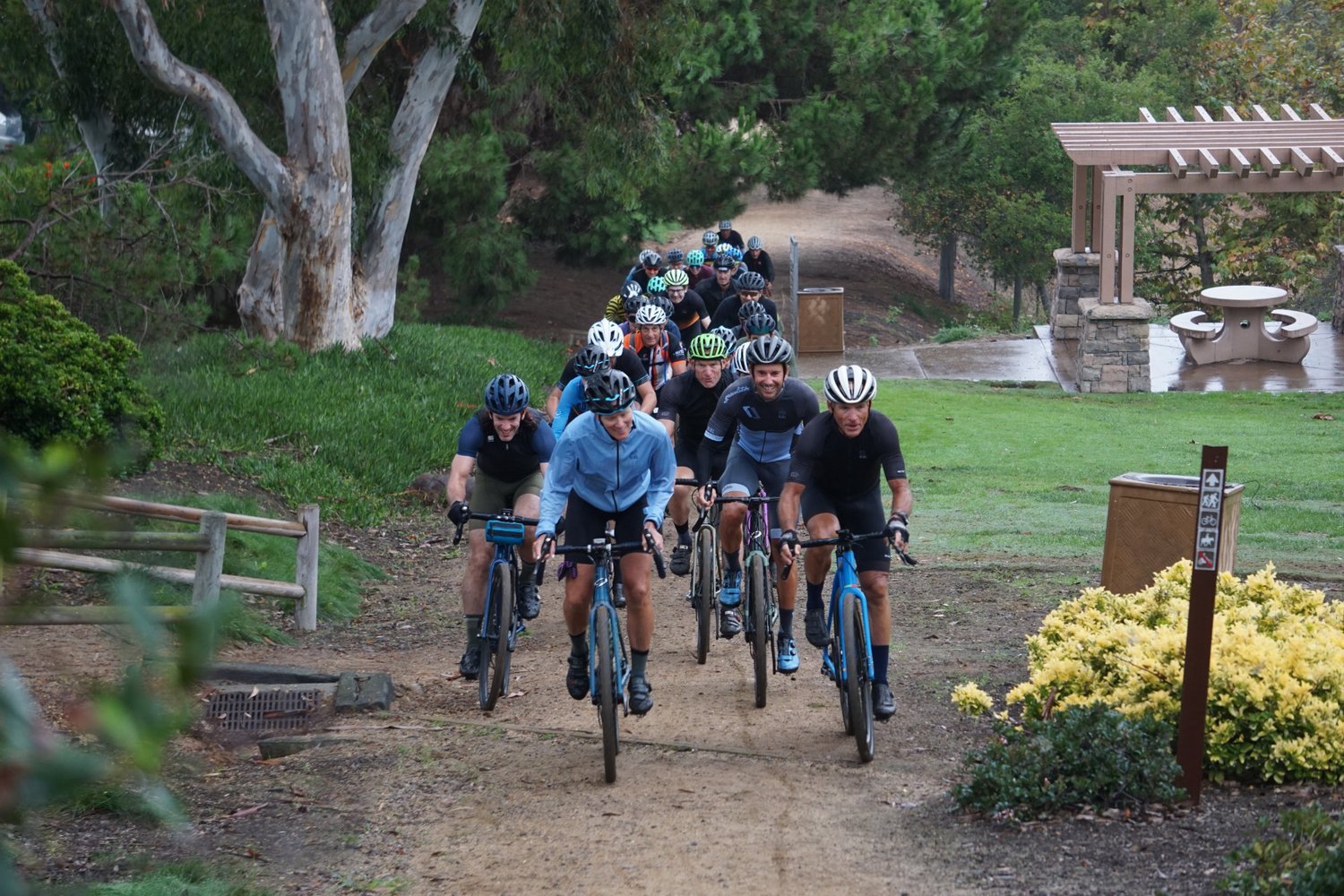
There’s enough asphalt in San Diego to keep even the most tenacious spinner satisfied, but sometimes the greatest thrills in life require taking the road less pedaled, which is where Gravelstoke comes in. An online hub for gravel riders, racers, bikepackers, and anyone else who enjoys adventure on two wheels, Gravelstoke hosts gravel rides and events on a monthly basis. Routes and locations are posted in advance on Gravelstoke’s event calendar and feature a mix of gravel, trail, and road riding conditions.
Courtesy of San Diego Bicycle Club
Fiesta Island Tracklocross
Fiesta Island
It’s often said that the simplest things in life are the best, and the best things in life are free—so why not apply that to biking, too? With no entry fees, no race numbers, and no registration, the Fiesta Island Tracklocross Association’s monthly Saturday race series has everything you want, and nothing you don’t. Starting at 9:30 a.m. the first Saturday of every month, a bike and the willingness to pedal for glory are all that is required to enter. Any type of bicycle is allowed, however “tracklocross” bikes—hybrid track/cyclocross bikes—are encouraged.
Courtesy of Adams Avenue Bicycles
Adams Avenue Bicycles
North Park/Florida Canyon/Various
Adams Avenue Bicycles hosts multiple rides that are certain to keep even the heartiest velo fanatics busy. Drop bar banshees, gravel grinders and mountain mashers will all find something to suit their styles throughout the month. Roadie watt watchers can spin until their heart’s content each week on the Monday Smackdown road rides. Leaving from Adams Avenue Bicycles at 6:45 p.m., this ride is all about showing up and throwing down over the course of 26.88 miles before returning to the shop.
Mountain bikers and gravel riders seeking a midweek session will appreciate the DirTNR rides occurring each Tuesday night during the velodrome racing season. Riders link up at the velodrome at 5:15 p.m. before rolling out for a casual hour-long ride through Florida Canyon, returning to the velodrome in time to catch some track racing action.
Those who want to take their riding further afield will enjoy the monthly Sunday Field Trips, typically scheduled for the second Sunday of each month. Each trip will explore a different part of the county with locations and routes shared ahead of time on their website.
Awarewolf Full Moon Bike Ride
Location Varies
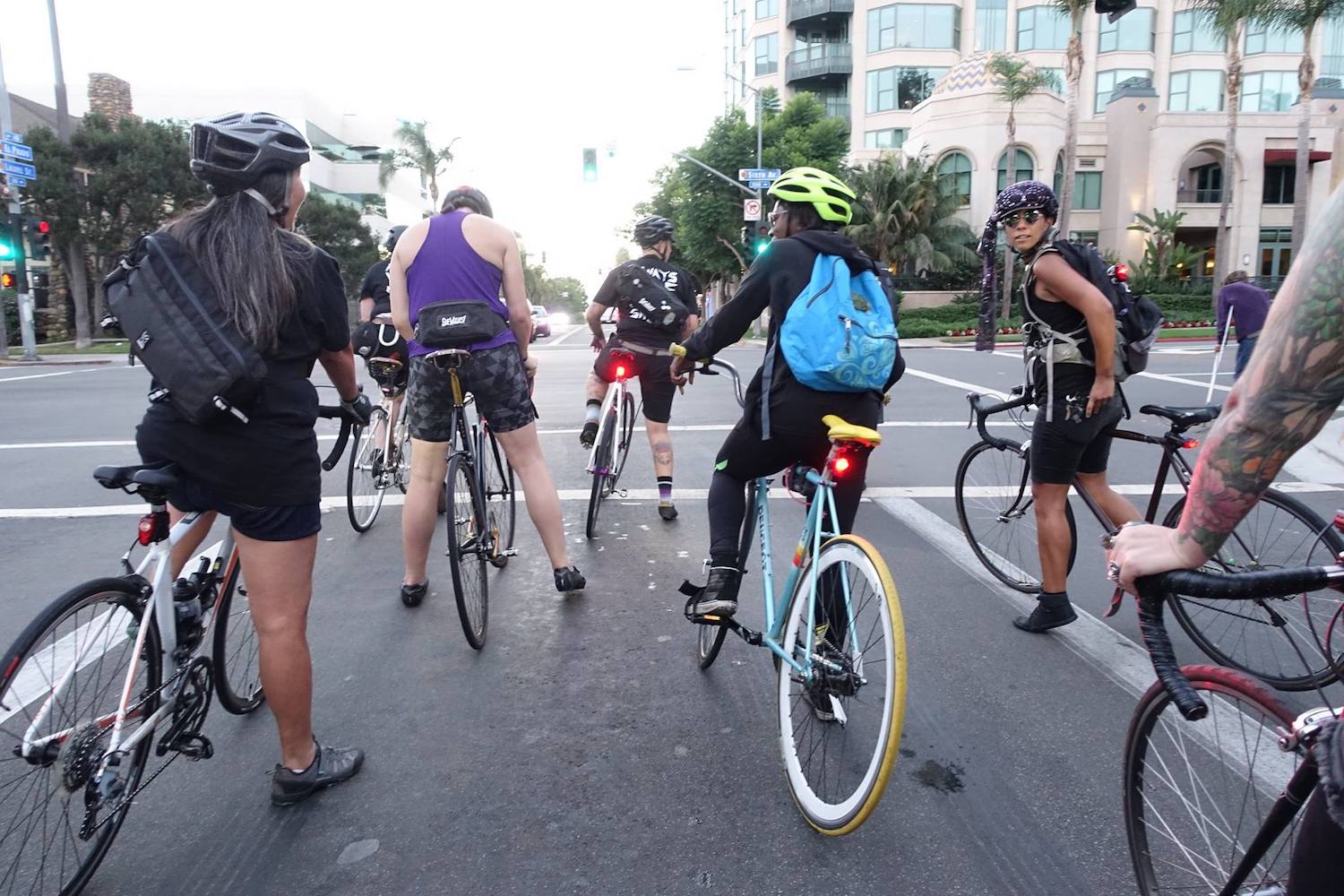
With the tagline, “We’re a pack. Not a mass,” Awarewolf is a collection of cyclists led by Charlie Sears and Ricardo Juarez, with the aim of increasing bicycling participation, safety and, of course, awareness, especially between riders and drivers in San Diego. In keeping with this mission, Awarewolf hosts a monthly Full Moon Bike Ride open to riders of all styles, from casual cruisers to fixed gear fanatics. The time, location and routes vary month-to-month and are posted in advance on Awarewolf’s website, but one thing is certain: when the Awarewolves are out, even the moon cycles.
Courtesy of SheWolves
SheWolves
Balboa Park
The Awarewolves aren’t the only pack of pedalers in town; the SheWolves bring their own lycanthropic flair to biking. A cycling club for women, trans, femme, and gender nonconforming riders, the SheWolves focus on fostering inclusion and allyship in the San Diego cycling scene. Thursday night group rides leave from the Bea Evenson Fountain in Balboa Park at 7:15 p.m. and end at a different bar or brewery for post-ride libations each week.
Courtesy of Rouleur Brewing
Rouleur Brewing Social Ride
North Park
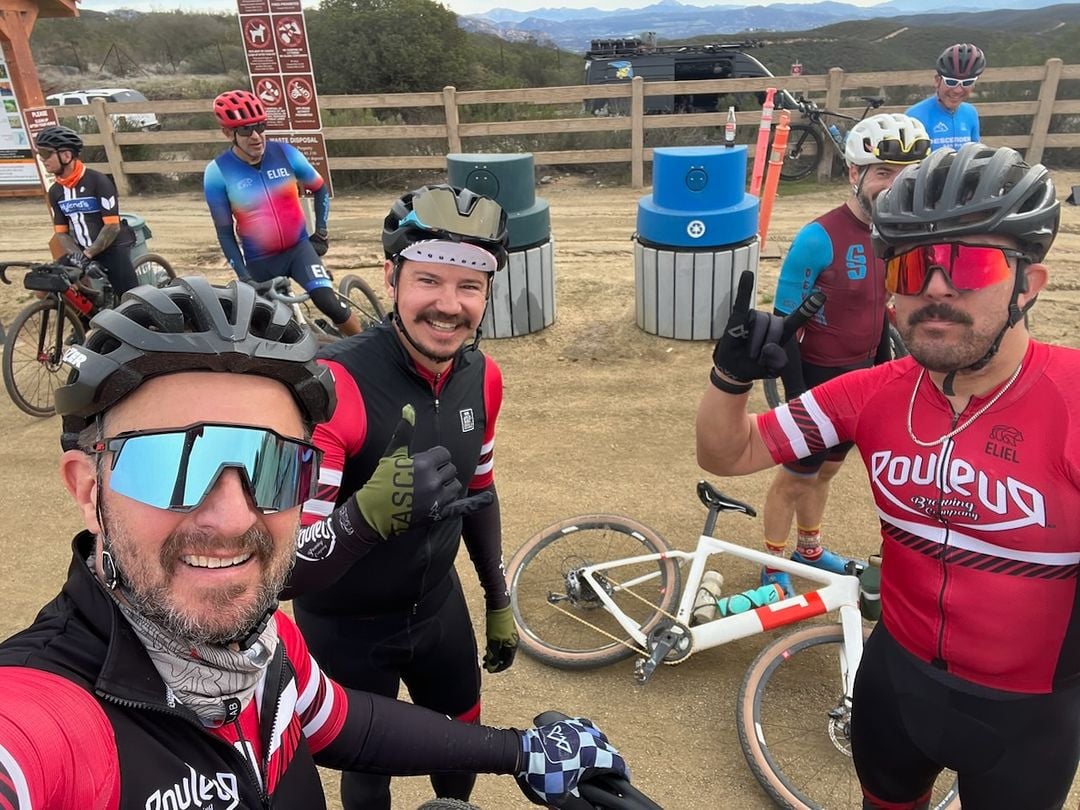
Given its connections to cycling (its name is a French term for “having wheels,” and was later adopted by racers), it’s no surprise that North County beer staple and bike themed brewery, Rouleur, hosts a social ride every Thursday night from its North Park tap room. The ride begins at 6:00 p.m. and follows a 17-mile route, ending back at Rouleur for beer and refreshments.
Courtesy of San Diego County Bicycle Coalition
Bonus: San Diego Bike Coalition
Various Locations
The San Diego Bike Coalition does essential advocacy work to ensure the region’s bicycling culture continues to grow and thrive by championing projects to improve cycling infrastructure, access to bike lanes, and policies that benefit riders. While the Bike Coalition doesn’t host a dedicated weekly ride, they do publish a robust monthly calendar of biking events in the area, ranging from local races to classes on safe riding skills and bicycle maintenance.
On Florida Drive, which bisects Balboa Park, but not extending beyond Park Boulevard on the west side and Pershing Drive on the east, there is a spider web of trails in Florida Canyon. If you’re willing to explore it, you can connect upwards of seven miles of trails, depending on how you link them up. Since there’s no set route, use any available stretch of dirt pathway to get in around an hour of fairly strenuous riding.
Park in the parking lots by the Morley Field baseball and softball fields. To start, ride in the direction of the tennis courts and on toward the dog park, skirting its edge and diving into the trail on the far left corner, which is the southwest side of the dog area. The immediate cobble-filled downhill will get you loosened up a bit.
Photo Credit: James Murren
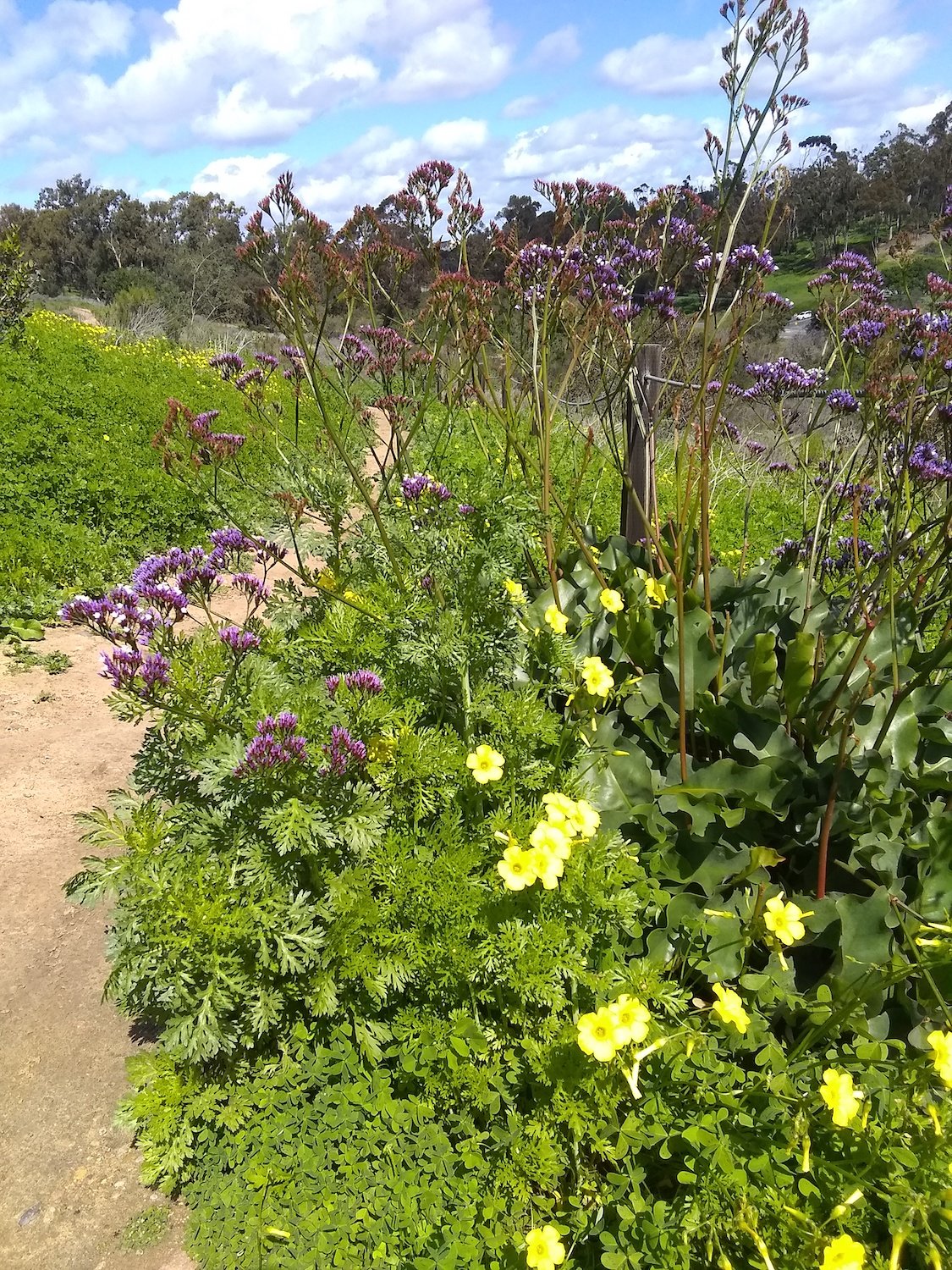
Stay straight, never making any hard turns. The trail will twist and turn as you pass turnoffs, but stay the course. If you do, about a mile later you will end up down at the intersection of Pershing Dr., 26th St., and Florida Drive. Staying on the dirt, look to your left and note the single track that climbs up alongside Pershing Dr. Take it. Enjoy the wildflowers if they’re poppin’.
It is about a half-mile climb up a tight and fairly narrow single track. Back down at the three-way intersection, go right, back in the direction that you came. As you work your way back through, at about the half-mile mark, turn left and cross over Florida Dr. The crossover occurs slightly beyond Zoo Place ahead of the trail entrance. It’s a little past Zoo Place, going north, on the west side.
Again, dive in and get ready for cobbles. Follow the trail as it bends to the right. At this point, there is a main trail going north, but you’ll see other trails jumping off as you go. I tend to stay low and keep close to the stream. When I reach the north end, crossing over Morley Field Drive, I slowly pedal the Little Eden Trail. It’s very short but oh so beautiful with the big trees and shady canopies.
At this point, turn around and cross back over Morley Field Drive. Then go up the steep incline/hill to your right. Up top, it will come to a T intersection, at which point, go left. From here, go across the top.
Photo Credit: James Murren
From there, it’s a free-for-all as to what to do next. You can double up again and ride what you rode earlier. One typical route I do is after crossing Florida Drive at Zoo Place, I go north on the trail and take the immediate right-hand trail that climbs up and up. It’s a switchback that can be grueling, especially on a single-speed.
Up top, turn right and ride the dirt road, heading south. On a clear day, you can see the Coronado Bridge and distant Coronado Islands in Mexican waters. It’s a stunning view when there’s no marine layer or haze. From there, look around and wander your way back to wherever you started. There are other trails up top that drop down. You can’t really get lost.
James Murren is an award-winning adventure/travel writer, with nearly three decades of independent journalism experience. He's often having a good time in our local mountains, deserts and waters, when he's not teaching classes at SDSU.
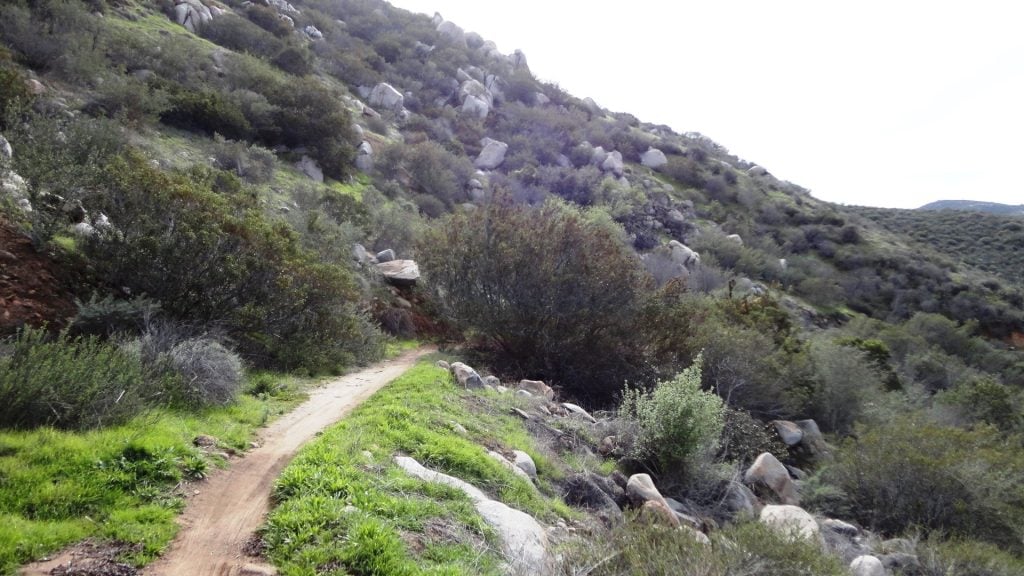
The Anderson Truck Trail (ATT) has been around for upwards of 80 years. Today, it is not a trail that you can actually drive a truck on from end-to-end. Technically, when mountain bikers, hikers, dog walkers and trail runners are on it today, they are actually using an unsanctioned trail. From top to bottom, there are various land use/title designations, including: United States Forest Service, Capitan Grande Reservation, San Diego River Park Foundation, and private property owners. Officially, there is no legal way to access the trail (but that does not prevent countless people from using it every day). I’m not saying you should go.
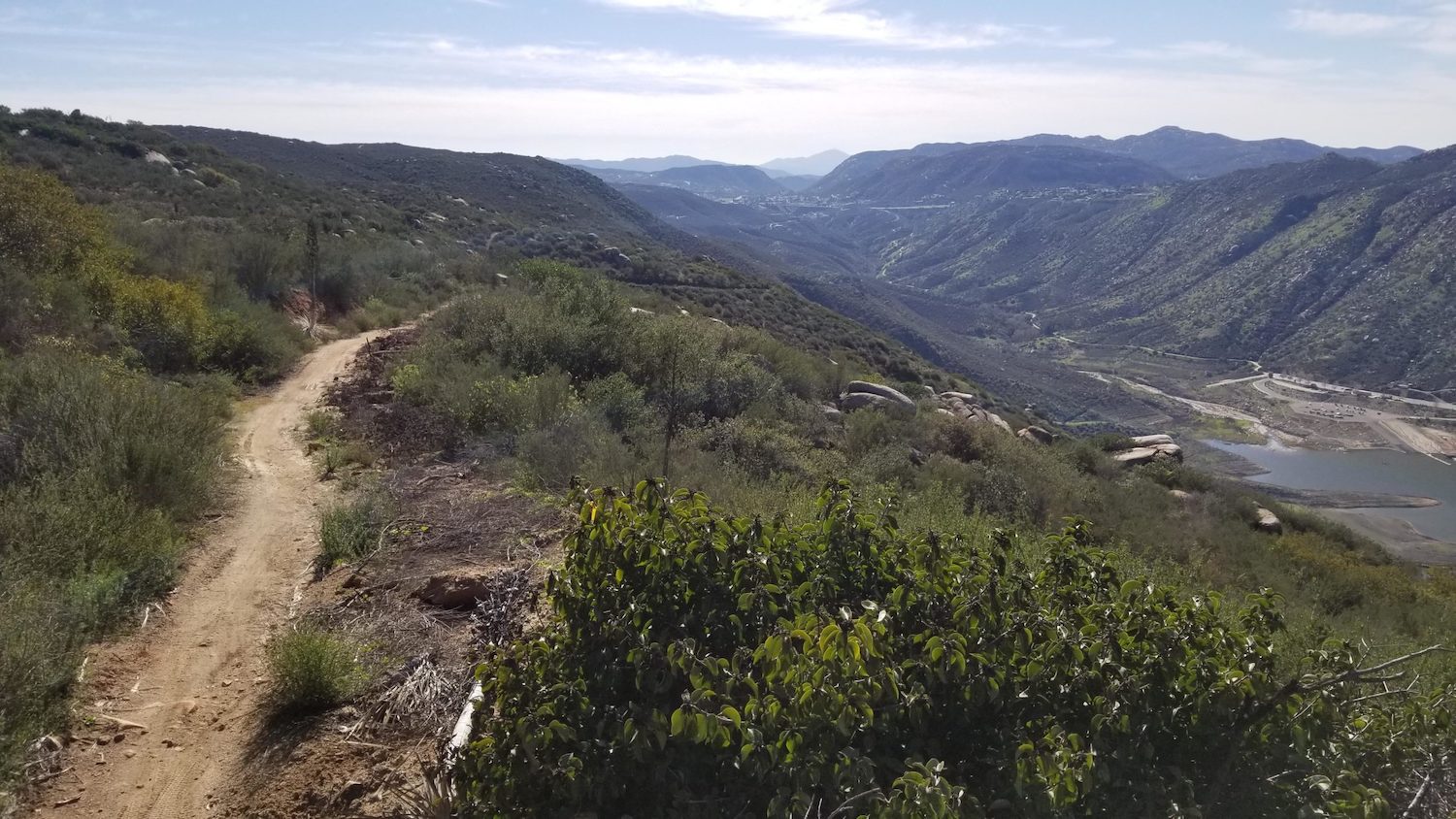
But if you did find yourself there, this is a trail riding experience that affords breathtaking views of the El Capitan Reservoir and surrounding foothills. The farther up you climb, the more rewarding the views. In late spring/summer, the rocky landscape becomes green and wildflowers pop. Winter’s rains course their way like lifeblood from the ground up through the trunks of oaks, the groves taking on a deeper green hue than the grasses.
Photo Credit: James Murren
To get started, some visitors park at the T intersection of Alpine Blvd. and Peutz Valley Rd. off of the I-8 near Alpine in a dirt parking area, or they simply park along the road below the 8 that runs overhead. They then pedal up Peutz Valley Rd. for about one mile, watching on their left for a single track entrance. They take it. They then descend at the outset a little ways, about a mile or so.
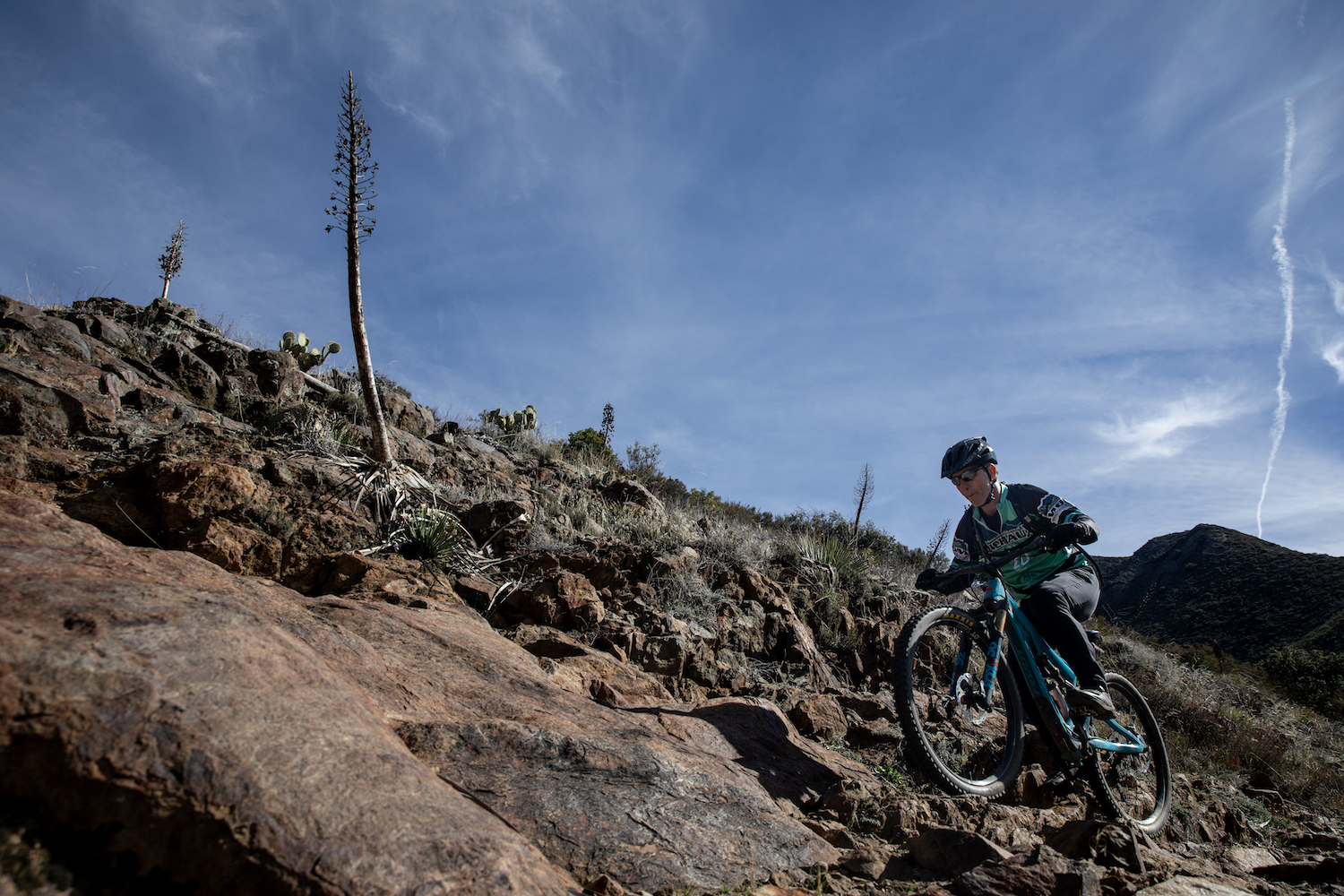
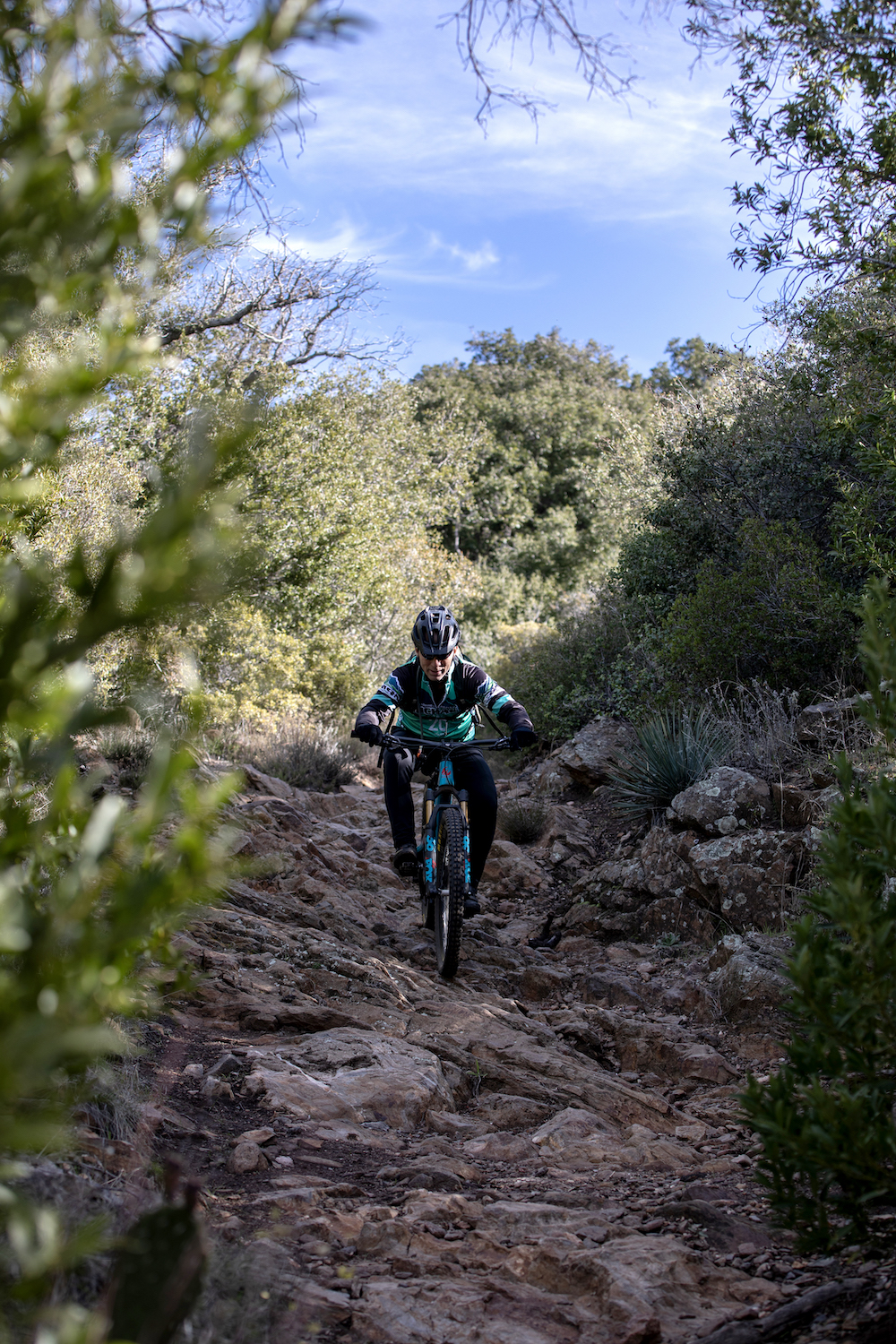
The trail has a cross-country-esque feel to it, meaning it dips and bends and has an uphill bump or two along the way. When it begins to noticeably climb, riders settle in for the relatively steep and long grind to the top, roughly three miles. With some chunk here and there, it is a perfect tech-lover’s training ground for boosting one’s ascending abilities.
Courtesy of Singletracks
The oak grove somewhere mid-way through the climb is a solid spot for a break to take in the views. At the summit, the trail opens up into what feels like a giant dirt parking lot. Again, the views. Not done? No problem.
The ATT continues, but riders will come upon a well-signed and fenced area when reaching the Capitan Grande Reservation. No continuing past that point. Riders here must turn around and head back in the direction they came up. Along the way, though, they can watch for unmarked single track to the sides of the ATT. If feeling adventurous, riders can take one, like those choose-your-own-adventure books of yesteryear.
Not feeling it? The descent on the original up hill trail is phenomenal. It’s fast, hair-raising, white-knuckle downhill glory at its best. One thing though: that little descent at the start of the ATT—after all the fun downhill ends—riders have to climb a little to get back out.
Photo Credit: James Murren
Riders who choose this trail should be respectful of locals by not parking at the trailhead. There is no legal parking there. Also, riders should not try to access Capitan Grande Reservation lands. Riders are not permitted to be there.
Anyone who is hungry after can take Alpine Blvd. into Alpine for about three miles. Order what sounds good at Tapatio’s and take it up the sidewalk to Mcilhenney Brewing Company. Order what sounds good there and then carry beer and Mexican food out back. Enjoy!
James Murren is an award-winning adventure/travel writer, with nearly three decades of independent journalism experience. He's often having a good time in our local mountains, deserts and waters, when he's not teaching classes at SDSU.
Today’s seniors are more connected than ever, with a renewed focus on retirement as a time of discovery and enriching experiences. The ultimate reward for a retirement well-earned is the wisdom to appreciate it all, and what better place to enjoy that unique perspective than Vi at La Jolla Village, in the heart of San Diego.
All-access pass to good living.
As a Continuing Care Retirement Community (CCRC), Vi provides access to a connected and fulfilling community while making it easy to plan for future care, should the need ever arise. With a care plan in place, residents enjoy greater financial predictability and long-term value, freeing them to focus on making the most out of retirement.
Resort-style amenities at the epicenter of a cultural hub like San Diego offer a retirement experience unlike any other. Paired with exceptional dining, spacious accommodations and dedicated staff, the best of maintenance-free living is all around. And with the introduction of Vista 360 Well-Being, Vi’s panoramic approach to wellness, there are more ways than ever for residents to access it all.
The harmony of mind, body and community.
Courtesy of Vi at La Jolla Village
The key to longevity is striking the right balance in maintaining an active lifestyle with an active mind in a fulfilling community. With newly renovated community spaces and restaurants, Vista brings a variety of opportunities for residents to elevate their well-being through Vi-exclusive “Signature Experiences.”
Vista Enrich takes an evidence-based approach to brain vitality, keeping residents at the forefront of cognitive health through exergaming (exercising + gaming), nutritional plans and informative workshops. It is also home to The Brain Vitality Studio, an innovative facility dedicated to cognitive fitness that has garnered national recognition.
Vista Discover invites residents into stimulating educational experiences, from chef-led cooking demos and guided wine tastings to lectures at local universities and intimate lectures following cultural outings.
While Vista Enrich focuses on brain health and Vista Discover engages residents intellectually, Vista Explore cultivates a sense of adventure through curated travel and local excursions. But broadening one’s horizons doesn’t always require a plane ticket. One recent event brought a taste of the world right to the community: an onsite “jazz cruise” featuring live music and global cuisine served at a series of themed “ports” all within the community’s own ballroom.
“Location, location, location”
Courtesy of Vi at La Jolla Village
One of the biggest perks of life at Vi at La Jolla Village is its proximity to just about everything. With easy access to transportation and local attractions just steps away, residents can explore and engage with their community at their own pace.
“There are trolley and bus stops within a 5-minute walk that will get you to the beach, UCSD Campus, medical appointments, downtown La Jolla or San Diego, et cetera. We rarely use our car,” said resident Tom Yager.
With the best of San Diego just steps away, residents don’t just live in the city, they live within reach of everything that makes it special.
The best of all worlds.
Courtesy of Vi at La Jolla Village
At Vi at La Jolla Village, retirement isn’t a chapter to slow down; it’s an invitation to discover more. Tailored community experiences created by Vista, paired with the vibrant pulse of San Diego just outside the door, mean that residents don’t have to choose between security and adventure, connection and independence. They get all of it.
This is what an all-access pass to good living looks like: the comforts of an elevated lifestyle, a community built for growth and a city made for discovery – all in one place.
To learn more about Vi at La Jolla Village or for details on available floor plans, visit ViatLaJollaVillage.com/SDM.
Up a mile in the bluebird sky of the Peninsular Ranges, I pedal away on my mountain bike from Penny Pines Trailhead, which sits off of Sunrise Highway, and go in the direction of the southern terminus of the Noble Canyon Trail, some ten miles away in Pine Valley.
It is a dandy of a trail, traveling through pine forest and mixed oaks before reaching the farthest edges of the Colorado Desert, a sub-desert of the greater Sonoran. Along the way, the traveler, whether on foot, horseback, or bike, descends through six eco-zones. During the winter, when rain and snow fall on the Lagunas, Noble Creek steadily—and sometimes heartily—flows through the canyon, a mountain-to-desert seasonal stream that fills the air with a refreshing and life-giving song.
Photo Credit: Ana Ramirez
The Peninsular Ranges are characterized by what some consider to be “sky islands,” meaning that their uppermost peaks reach more than 6,000 feet. The Noble Canyon Trail begins in a pine and oak “island,” then drops in elevation from its northernmost point to its southern end. However, trail traversers also ascend some uphill sections here and there, the first one less than a mile into the trek.
In the far viewshed to the north, snow-capped San Gorgonio glistens in its winter cloak. In the foreground and its environs, the nearby Cuyamaca Mountains sit quietly, peaks like sentinels watching over the land. Cresting out, I go down and around, the trail undulating like a flamenco dancer.
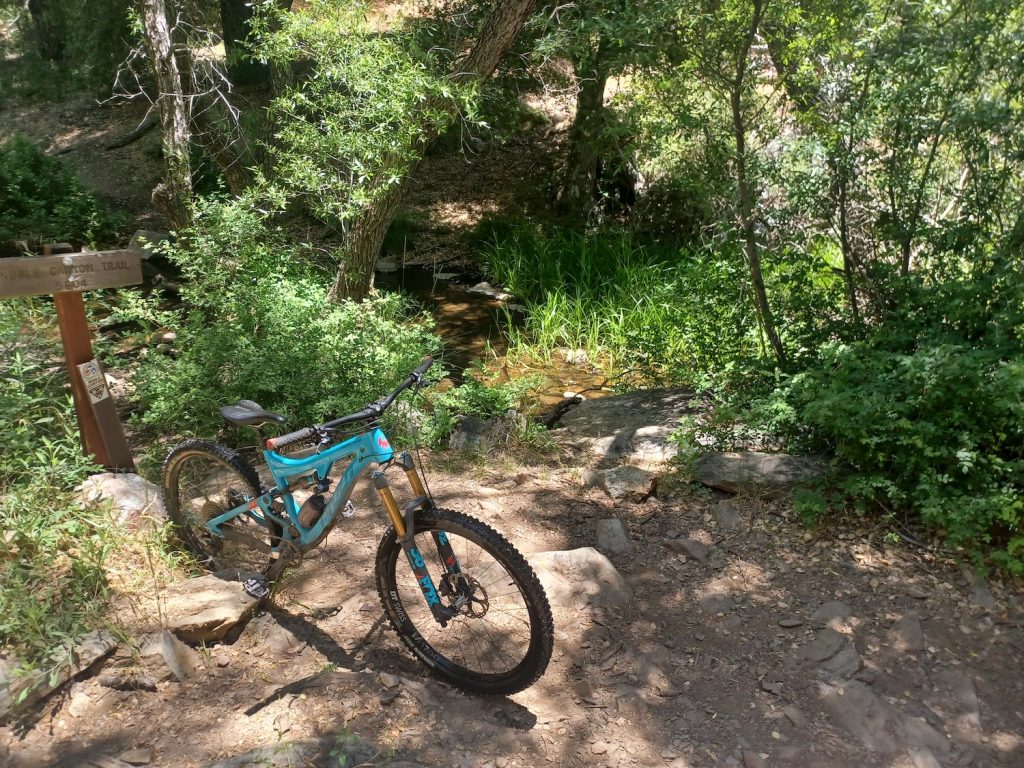
Further on, the trail plummets. The pines seem taller as they reach skyward from the darker forest floor, and the sound of water starts trickling in my ear. Not long after that, there it is: Noble Creek, a narrow ribbon running through the forest on its way to the desert. I cross over it a few times, trying not to get my shoes wet.
Photo Credit: Ana Ramirez
About midway down the trail, I arrive at the Tolkien Oak Forest (an affectionate nickname I’ve coined) waiting on the other side of one of the stream crossings. The ambient light is darker. The canopy of magnificent California Black Oaks is so thick that dappled light is all that hits the ground. I stay and quietly sit. This is my rehydration and snack spot, and it’s also where I refill my soul tank. To be here, in this moment, with these trees, is reason alone to make this 10-mile trek.
I continue, soul moderately quelled, knowing there’s more to discover still. Descending through more oaks with scattered pines that give way to desert chaparral and various cacti, I pedal methodically through the rock gardens, taking care not to crash and fall while still keeping pace. Soon, I arrive at the second place along Noble Canyon Trail that stops me in my tracks.
Photo Credit: Ana Ramirez
It feels as if I am biking through a keyhole, and, when I finally enter it, I unlock a door that opens to a stunning desert view with soaring ridgelines. Way down below, the stream is a silver snake winding its way through the hardscrabble landscape. Yuccas and beavertail cactus defy the odds, eons of evolution granting them the ability to thrive in an unforgiving landscape.
There’s no escape from the punishing sun. I pause, slathering some sunblock on my face and the back of my neck. The trail bends and meanders, ranging down and up and then down some more, with more rock gardens along the way. Decomposed granite dots the trail surface. When I reach the junction that requires me to turn left to stay on Noble Canyon Trail, I’m feeling a bit haggard, so I refuel with water and an apple, knowing a large sand trap is just around the way.
Photo Credit: Ana Ramirez
I pedal quickly past another creek up the slope to the other side, which leads me to another ethereal oak grove where the sun passes through the leaves, illuminating the canopy like a natural cathedral. I sit to take it in.
The next stretch is gradually uphill, a long couple of miles of slight incline that I call “the slog” on account of the endless sand. It’s a put-your-head-down-and-go section of trail.
Photo Credit: James Murren
Cresting out at the end of that slog, I carve my way along the trail as it passes downward through camel-colored boulders to my right and long views on my left. I continue to climb, eventually finding a manzanita forest, a gnarled, fragrant mess that always lures me in. I can never pass through without touching the trees’ silk-smooth bark.
Then, it’s all down-down-down to the parking lot, an exhilarating run. There are more oaks to admire and big rocks to navigate through, culminating in one final push, when the trail finally rolls like a soft magic carpet ride to its end point. I’m greeted by towering pines that whisper in the breeze, singing their own song.
James Murren is an award-winning adventure/travel writer, with nearly three decades of independent journalism experience. He's often having a good time in our local mountains, deserts and waters, when he's not teaching classes at SDSU.
Anza-Borrego Desert State Park is the largest state park in California, at some 600,000 acres and with more than 500 miles of desert roads that are open to bikes. November through April is the perfect season to explore the natural beauty along those roads.
Here are three Borrego roads to wander this late winter and early spring:
Photo Credit: James Murren
Mortero Canyon Road (8 Mi.)
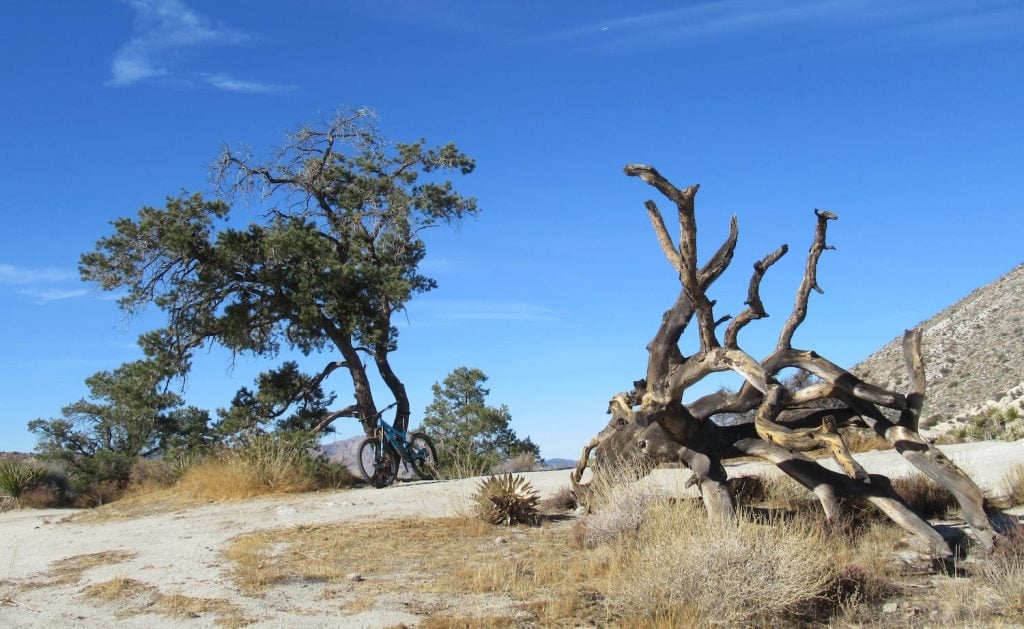
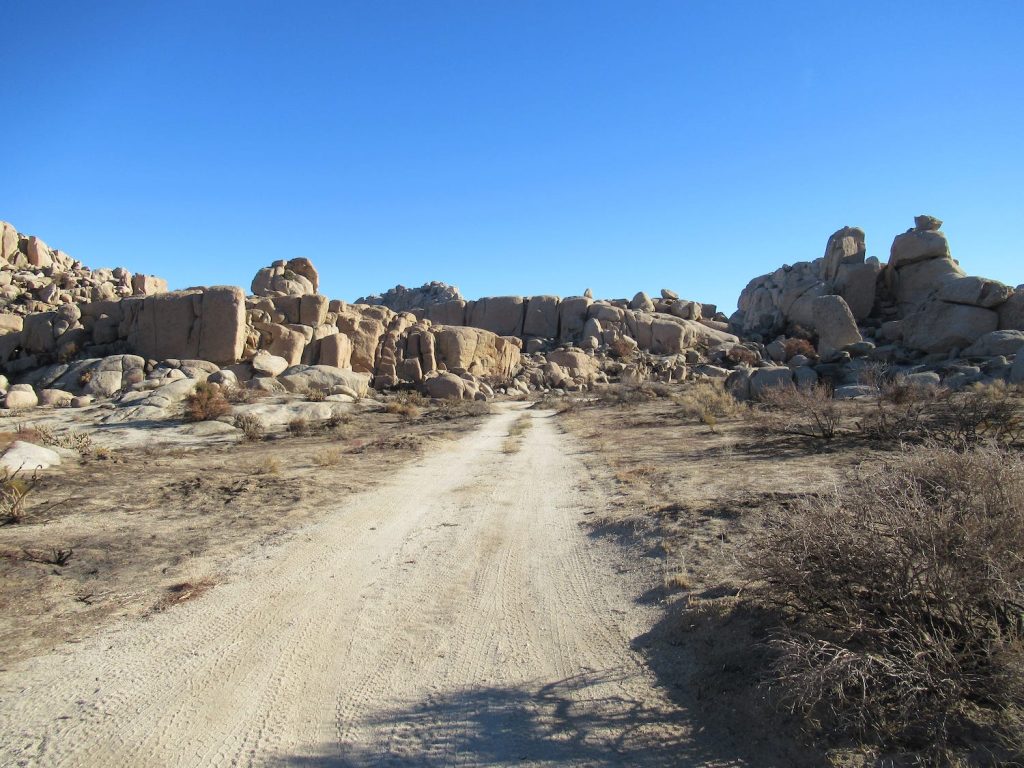
On the west side of the paved S2 road, 8.5 miles north of the Ocotillo exit on I-8, there is a parking area and kiosk off the side of the road that is notable with The Impossible Railroad information sign that is there. Park your vehicle and get set up for biking on what is Mortero Canyon Rd., the sandy/decomposed granite desert road that is right in front of you.
Pedal a little over four miles away from the paved S2 road, or, head west. Your destination is the Dos Cabezas Water Tower, a remnant of the bygone days of The Impossible Railroad. From the water tower, you can go south/left or north/right on unmarked desert roads to add on more miles and exploration.
Photo Credit: James Murren
Pinyon Mountain Road (14 Mi.)
Approximately 4.5 miles south of Route 78 on the paved S2 road sits the parking area for Pinyon Mountain Rd. It is on the left (east) side of the road when traveling south, a little past Stagecoach Trails, which is an RV Resort and campground, complete with a little general store for stocking up on food and drinks for desert wandering.
From the parking area after you saddle up, stay to the right at the first desert road intersection that is a little beyond where you parked. The desert road (Pinyon Mountain Rd.) will gradually ascend, making for a slow climb that takes upwards of an hour before you reach the top, amidst the scattered juniper trees. From there, it is classic cross-country riding on two-track.
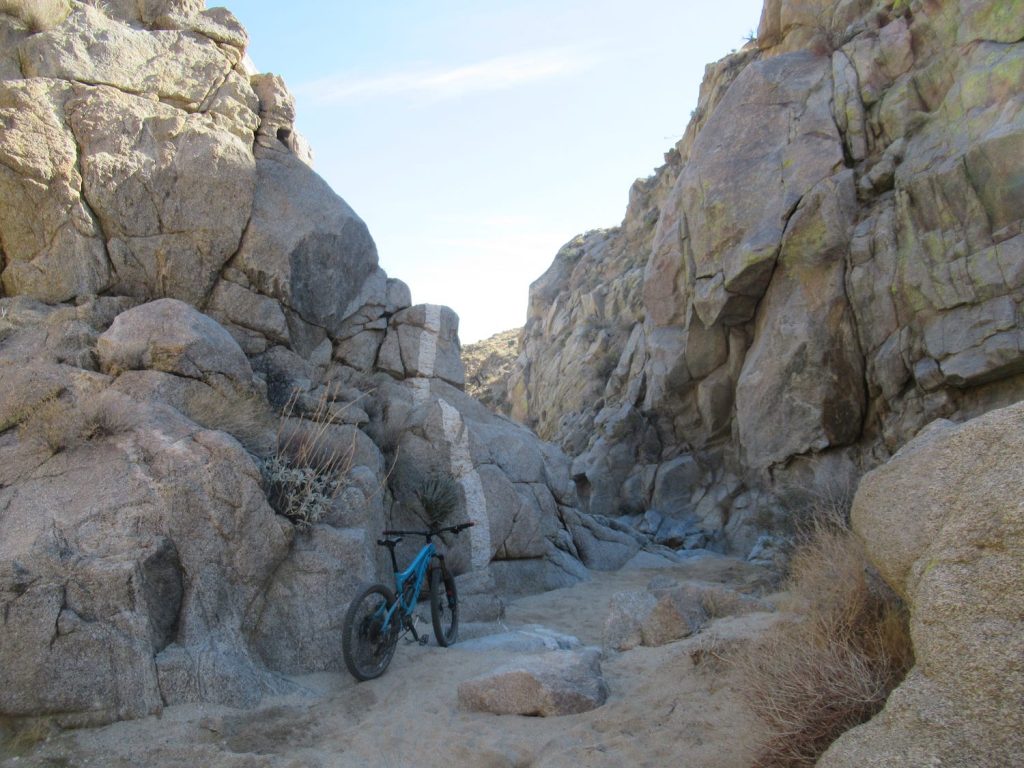
Continue straight for a few miles to reach “the squeeze.” It is a tight geologic formation that can be biked through, but it is quite technical. Hike-a-bike is also a good idea. After passing through the squeeze, continue straight another mile or so to the end of the road for a spectacular desert view. You cannot go farther, unless you have rappelling gear. Turn around and head back, or on the way back, explore side roads to see more slot canyons.
Photo Credit: James Murren
Valley of the Moon (14 Mi.)
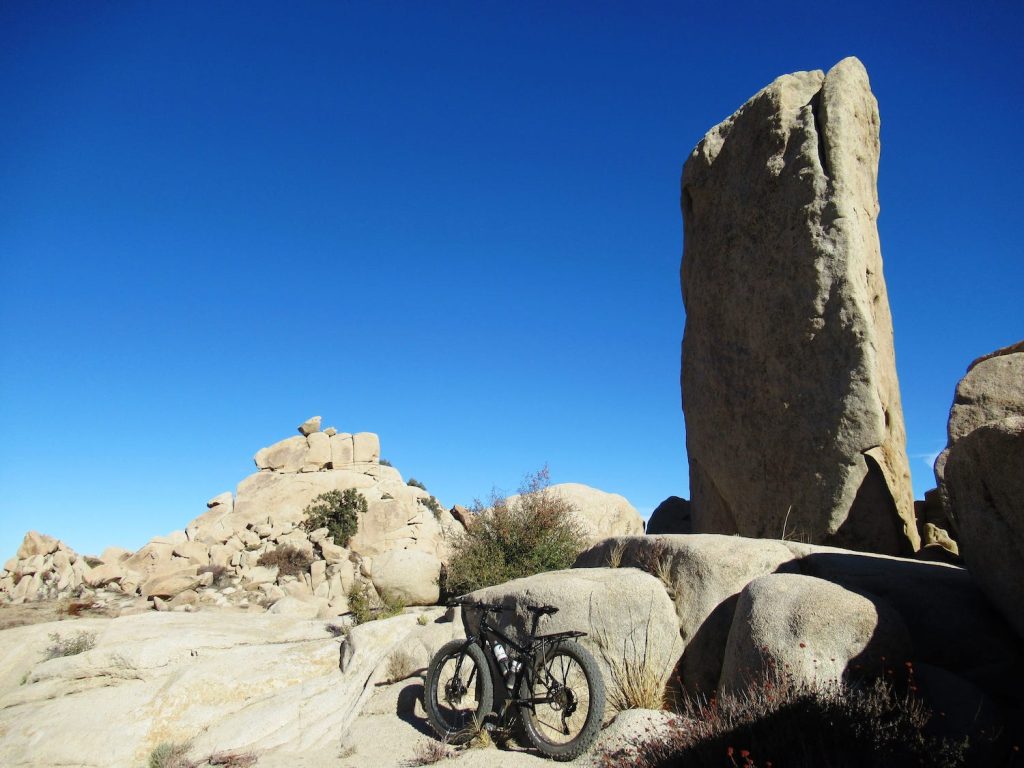
Take the In-Ko-Pah exit off the I-8, which is on the border of San Diego County and Imperial County. The large parking area for Valley of the Moon is obvious to see on the south side of the 8. With your back to the interstate, pedal over to the hard/paved road on your left and then prepare for a steep, strenuous and grueling climb to the top. It might take upwards of an hour to get up there, depending on your ability.
At the top there is an intersection and the roads are no longer paved. If you go right, you’ll climb some more before the desert road undulates up and down. Along the way, you’ll see the border wall between Mexico and the USA. I suggest going left at the intersection for wandering out into the desert in the direction of some boulder fields that are popular with rock climbers. There are several roads that shoot off from the main road that you are on, the entire area being a bowl, or a valley. Take your bearings when adventuring, reading the landscape and/or retracing your way back down to your vehicle.
Photo Credit: James Murren
Recommended Biking Gear for Anza-Borrego
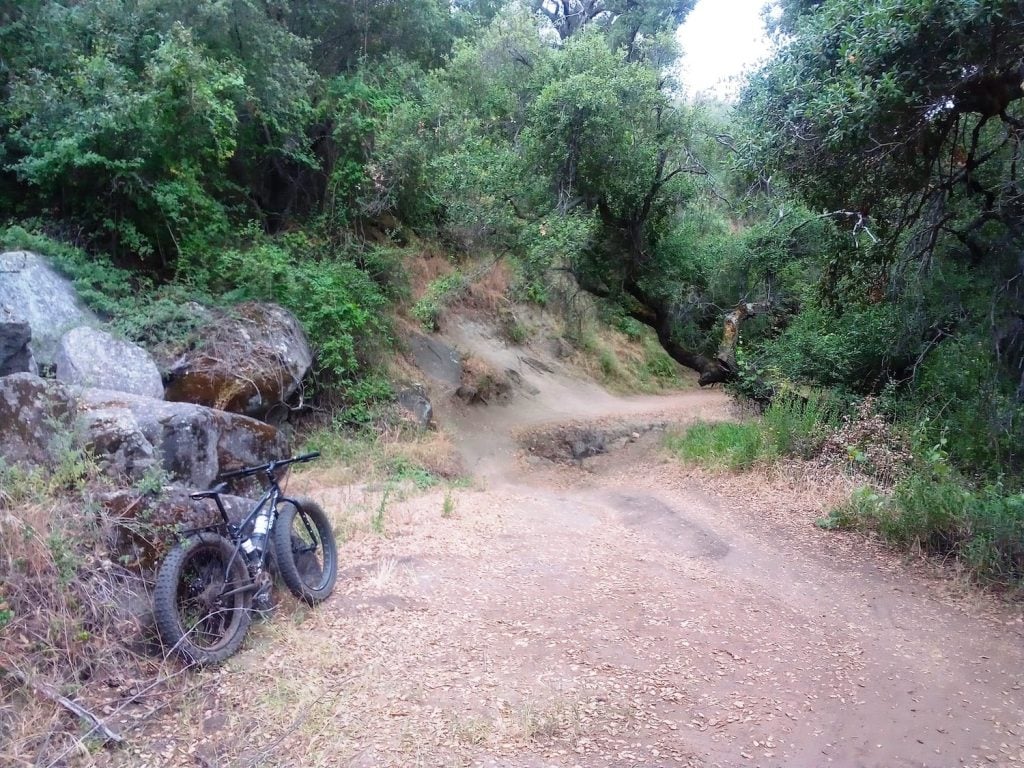
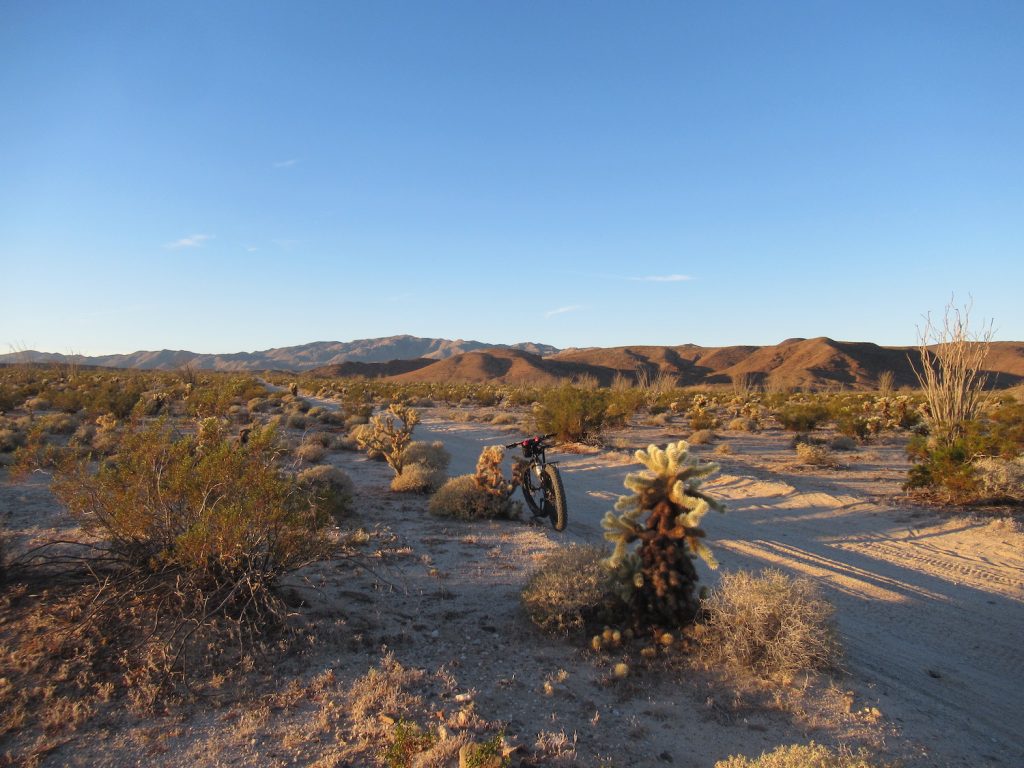
I have biked Borrego’s desert roads on a singlespeed 29er with 2.1 inch tires, a full-suspension mountain bike with 2.3 inch wide 27.5 tires, and with a fat bike that has 3.8 inch tires. The fatter the tires, the easier it is to pedal on the desert roads with deeper sand/decomposed granite.
Tips for Mountain Biking in Anza-Borrego
When the going gets deep, get to the sides of the roads where the surface will be harder and easier to pedal. Always pack more water than you think you’ll need. Three liters per person is a good minimum. Enjoy the wildflowers, cacti and if you’re lucky, the bighorn sheep.
James Murren is an award-winning adventure/travel writer, with nearly three decades of independent journalism experience. He's often having a good time in our local mountains, deserts and waters, when he's not teaching classes at SDSU.
Growing up, Laika Nur, MD, Scripps Clinic sports medicine specialist, loved watching beach volleyball when the Association of Volleyball Professionals tour came to her hometown of Chicago. A talented volleyball player herself, she remembers sitting in the stands all day, and once, even got a couple autographs. Years later, Dr. Nur was attending a professional event focused on women’s sports, and the discussion turned to a new professional women’s volleyball league. The general manager and coaching staff for San Diego’s team, the Mojo, happened to be in attendance, and Dr. Nur took the opportunity to ask them if they needed a team doctor. Flash forward to the Mojo’s inaugural 2024 season, when Dr. Nur officially became the team physician. Click here to read more about Dr. Nur and how she incorporates lessons she learned on the court into her practice.
For more nutrition, wellness, and healthy living tips, sign up for the San Diego Health newsletter here.