Featured articles
Food & Drink
Food & Drink
Food & Drink
Featured articles

Things to Do
Arts & Culture
Everything SD
Featured articles
Things to Do

Things to Do
Things to Do
Featured articles

podcast-ep

podcast-ep

podcast-ep
Featured articles
Food & Drink
Everything SD
Everything SD
Featured articles
Food & Drink
Things to Do
Arts & Culture
Ready to know more about San Diego?
SubscribeReady to know more about San Diego?
The offensive lineman illustrated for San Diego Magazine while playing for the Chargers—now, his paintings sell for millions
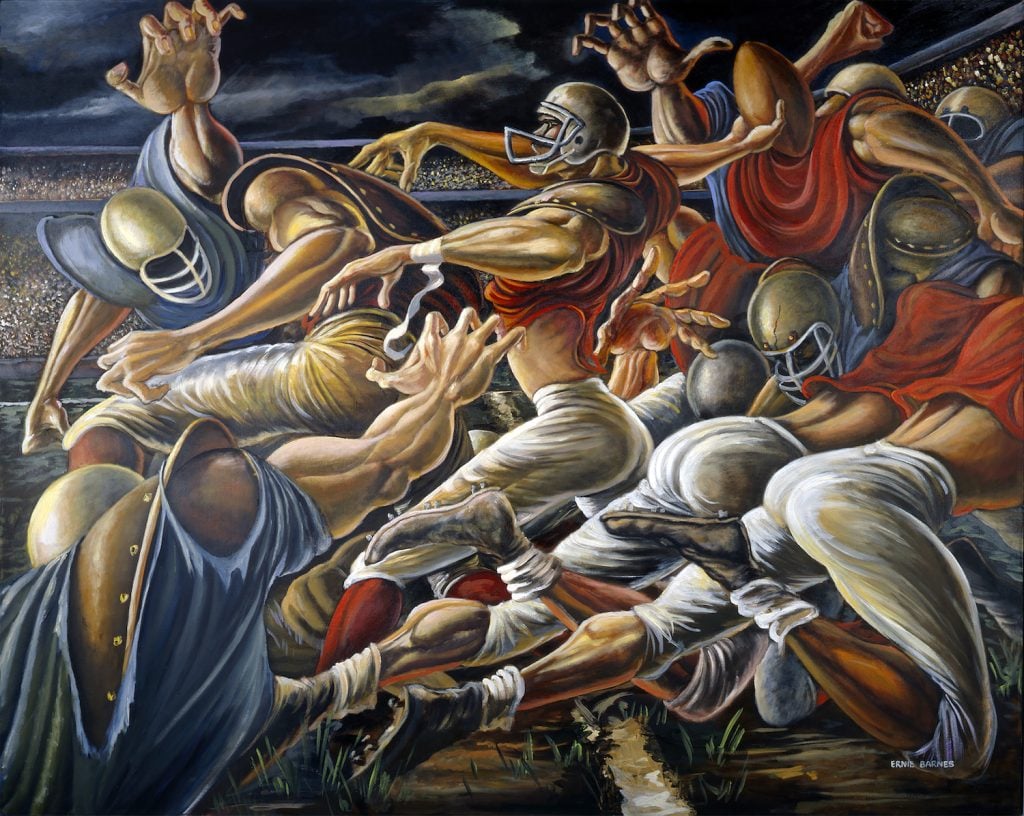
Artist and athlete Ernie Barnes painted what he saw, and what he saw was America through a rare lens. Drawing from a childhood in the Jim Crow South and time on our nation’s biggest playing fields, Barnes displayed his own particular cultural vantage on his canvases. Once you encounter his paintings—with their telltale elongated bodies, exaggerated movements, and forms alive with a musicality and quiet depth—his work becomes instantly recognizable.
“The curve of his figures, that visual rhythm—it’s distinct,” says Derrais Carter, a Barnes fan and associate professor of Africana Studies at UMass Boston. “There’s something uniquely American about his work.” Today, Barnes’ legacy echoes through galleries and auction houses around the world, his work fetching millions. But before achieving artistic acclaim, Barnes was a football player trying to make ends meet in San Diego. Our city—and this magazine—played a pivotal role in helping shape him into a man widely regarded as the first American professional athlete to become a professional artist.
Born in Durham, North Carolina in the summer of 1938, Ernest Barnes Jr. grew up on a dirt road in a segregated nation. Gentle-natured and self-described as chubby, Barnes was bullied as a child. But his artistic inclinations were present early, simmering on a back burner while his life—and his body—grew in the direction of pro sports. With more than two dozen scholarship offers following high school, Barnes decided to stay close to home, accepting a full ride to the all-Black North Carolina College at Durham (now North Carolina Central University), where he studied art. The 6-foot-3-inch, 250-pound Barnes was then drafted by the Baltimore Colts in 1959. Barnes later said it was in the trenches of the offensive line that he learned much about human movement.
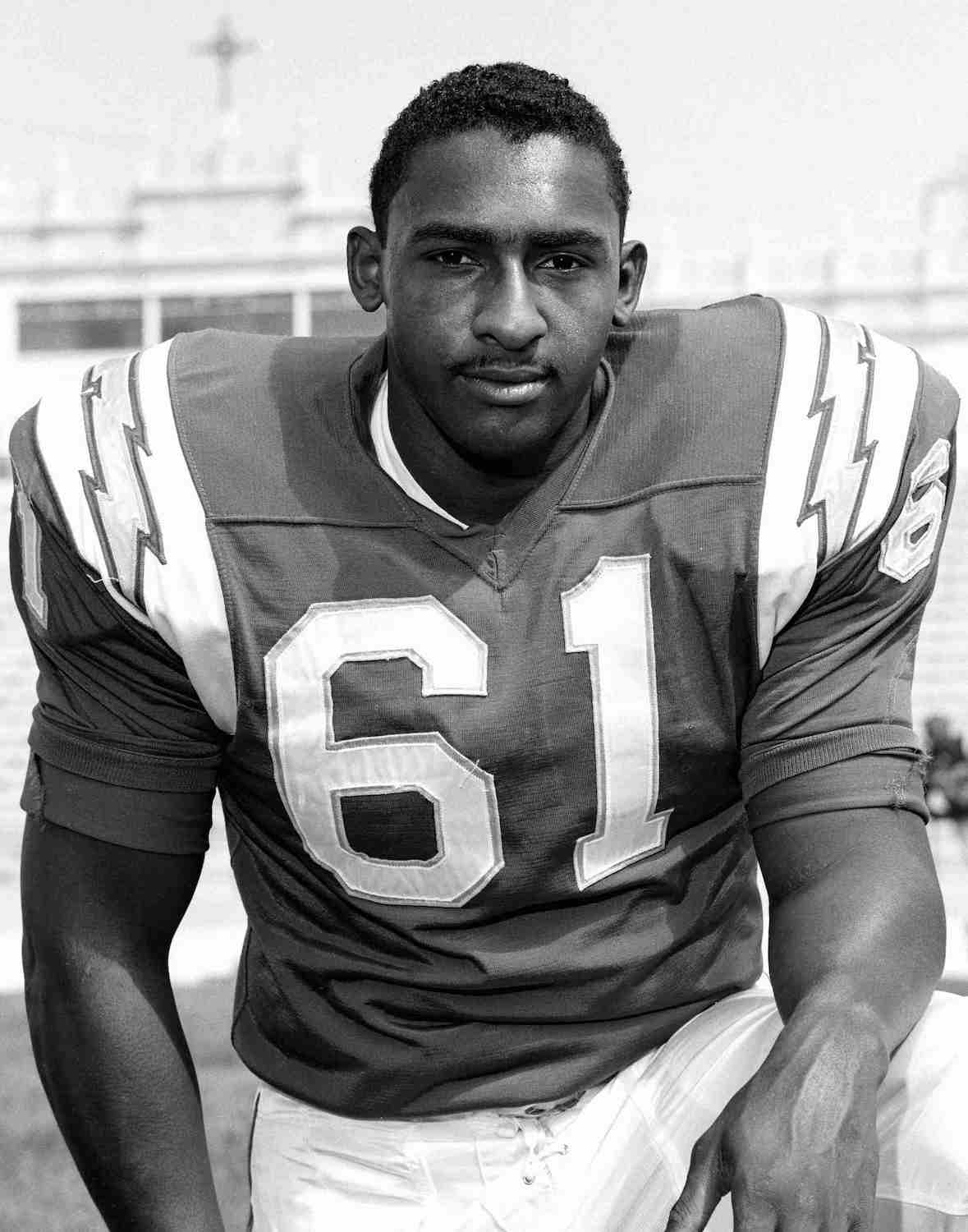
After a brief stint with the New York Titans, his connection to San Diego began taking shape when he accepted an offer from the Chargers in 1960, one year before the team moved from LA to Balboa Stadium.
“Even when he lived in LA, he loved going down to San Diego,” says Luz Rodriguez, Barnes’ longtime assistant and founder of the Ernie Barnes Legacy Project. “He really enjoyed the weather and the vibe, and whenever he talked about football, he preferred being a member of the Charger team.”
“For me, being a Charger satisfied my dreams about being a professional football player,” Barnes writes in his 1995 autobiography, From Pads to Palette. “It staked a deep claim in my emotional territory. It was a mark of my development.”
For Barnes, who found a lifelong friend in Chargers quarterback and later US congressman and vice presidential nominee Jack Kemp, San Diego wasn’t just a place to play football—it was a city of creative and personal exploration.
“When my father landed in San Diego, he said, ‘I’m home,’” Barnes’ daughter Deidre “DD” Barnes says. “He was very comfortable there. He loved the city.”
The family rented an apartment on Dream Street in southeast San Diego. Barnes set up a painting studio in a back bedroom where he could practice his craft when he wasn’t playing football.
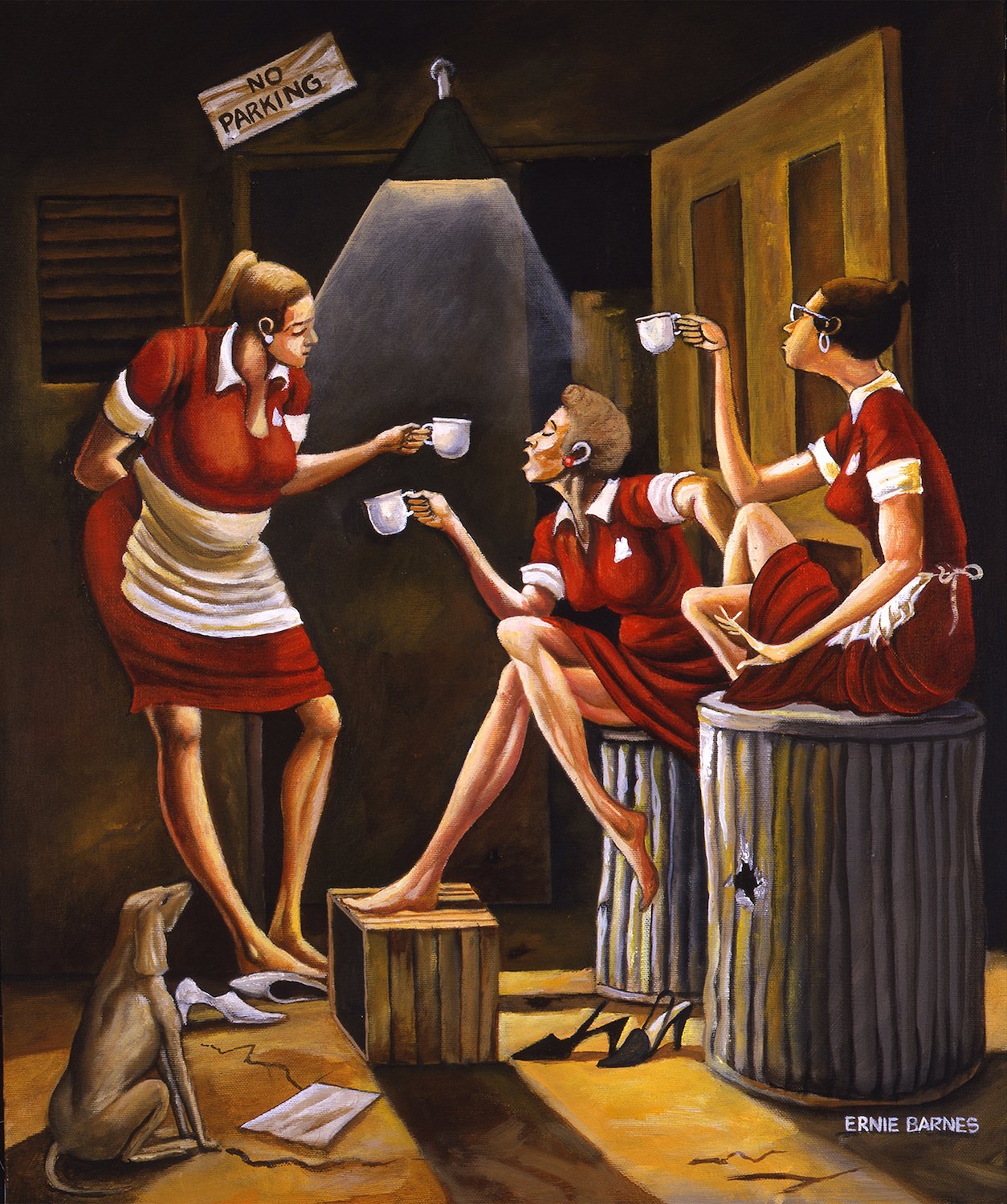
“When we were young, paintings were all around us,” DD Barnes says. “Looking back as an adult, I realize how much art was a part of his life. In our apartment, my father had easels and paint all over the place.”
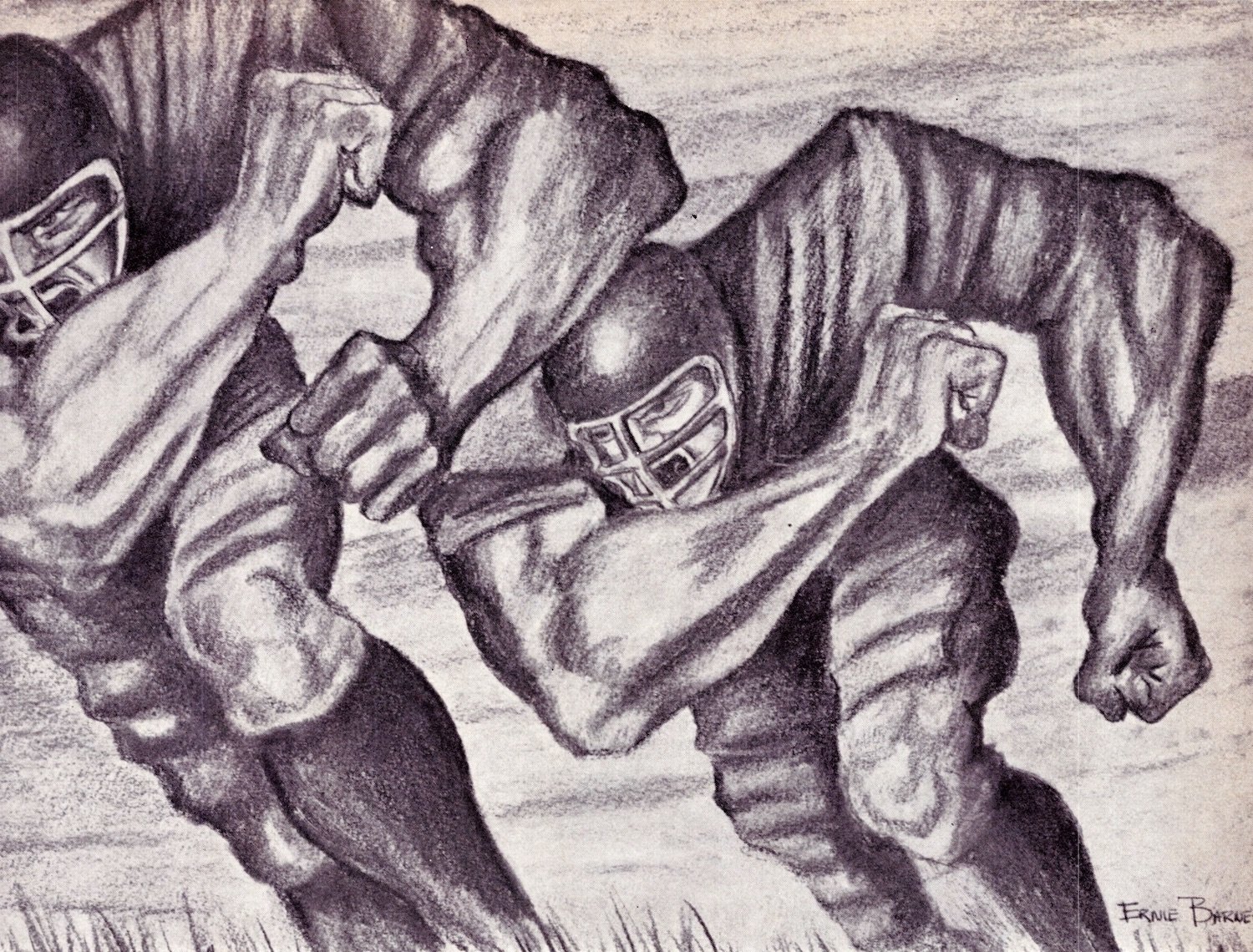
While suiting up for the Chargers, Barnes began moonlighting as a freelance illustrator for San Diego Magazine. This small step in his continued development as an artist came with a small paycheck compared to what was in his future.
“When he worked for San Diego Magazine, he was trying to raise money—football players weren’t paid much back then,” Rodriguez explains.
“My father made about $600 a month playing for the Chargers,” DD Barnes adds. “He was selling art whenever he could, and, in the off-season, he worked at the YMCA.”
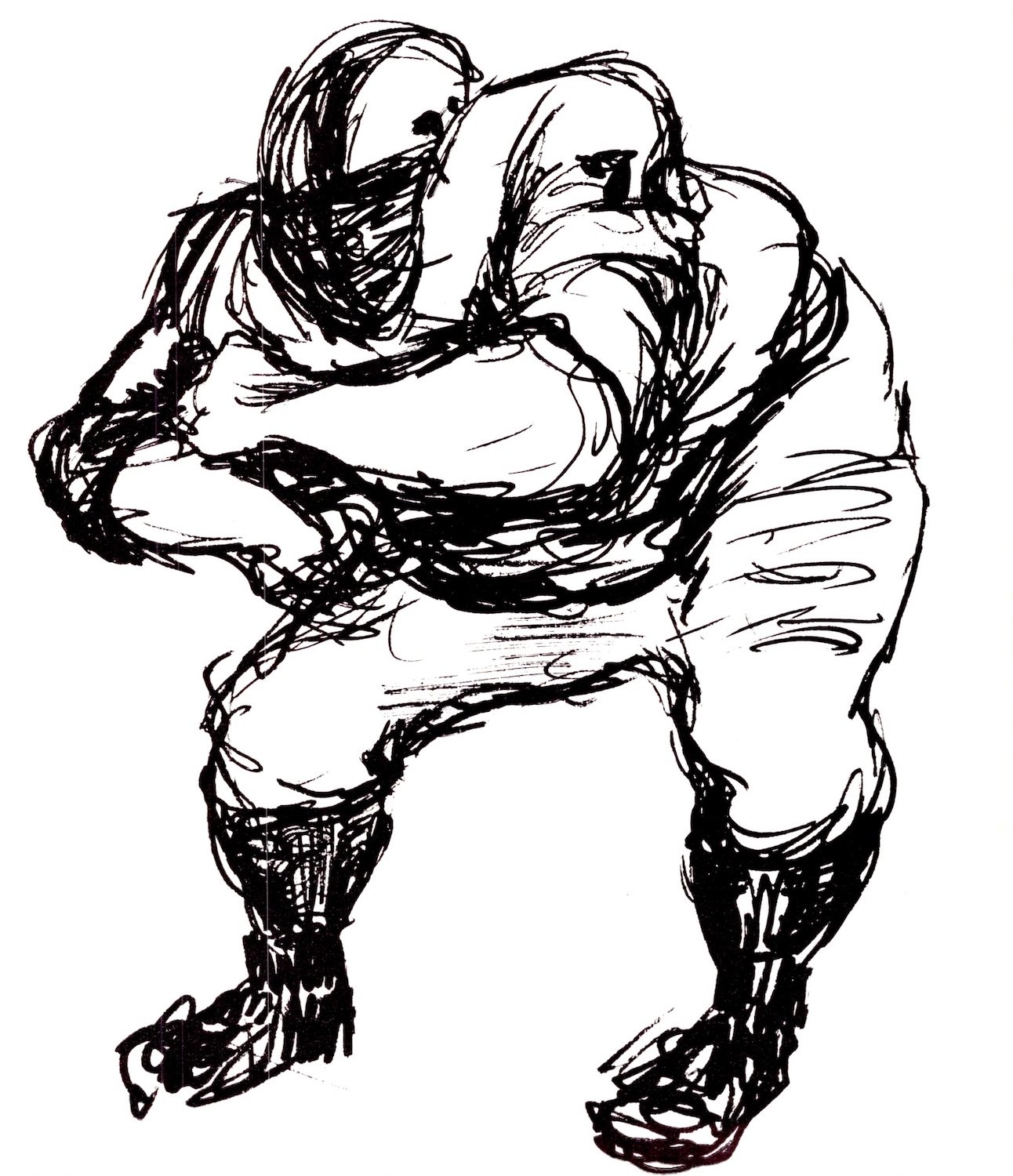
Shortly after his move to SD, Barnes met with Edwin Self, this magazine’s founder and then-editor. In his autobiography, Barnes describes Self challenging him to write and illustrate an article detailing his feelings towards the violence in pro football:
I was thrilled and eagerly began the assignment, working all day at a typewriter in the time-worn “hunt and peck” method. At the end of the first week, I presented my manuscript to Mr. Self. After reading it through, he said, “Right! I think you’re onto something, Ernie. Write it over.” I went at it again, only to be told, “It’s better, Ernie. Now do it again.” I really wanted so badly to give up, but something prevented me from hanging it up. After a series of meetings and the subsequent rewrites, Mr. Self finally said, “Ernie, we have a good article. Now illustrate it.” When “Pro Football Is Not Dirty . . . On Purpose” appeared in San Diego Magazine, I was proud. Really proud.
The article ran across four pages in August 1964. Barnes also illustrated a number of other SDM stories in the ’60s, including one by legendary SD muckraker Harold Keen.
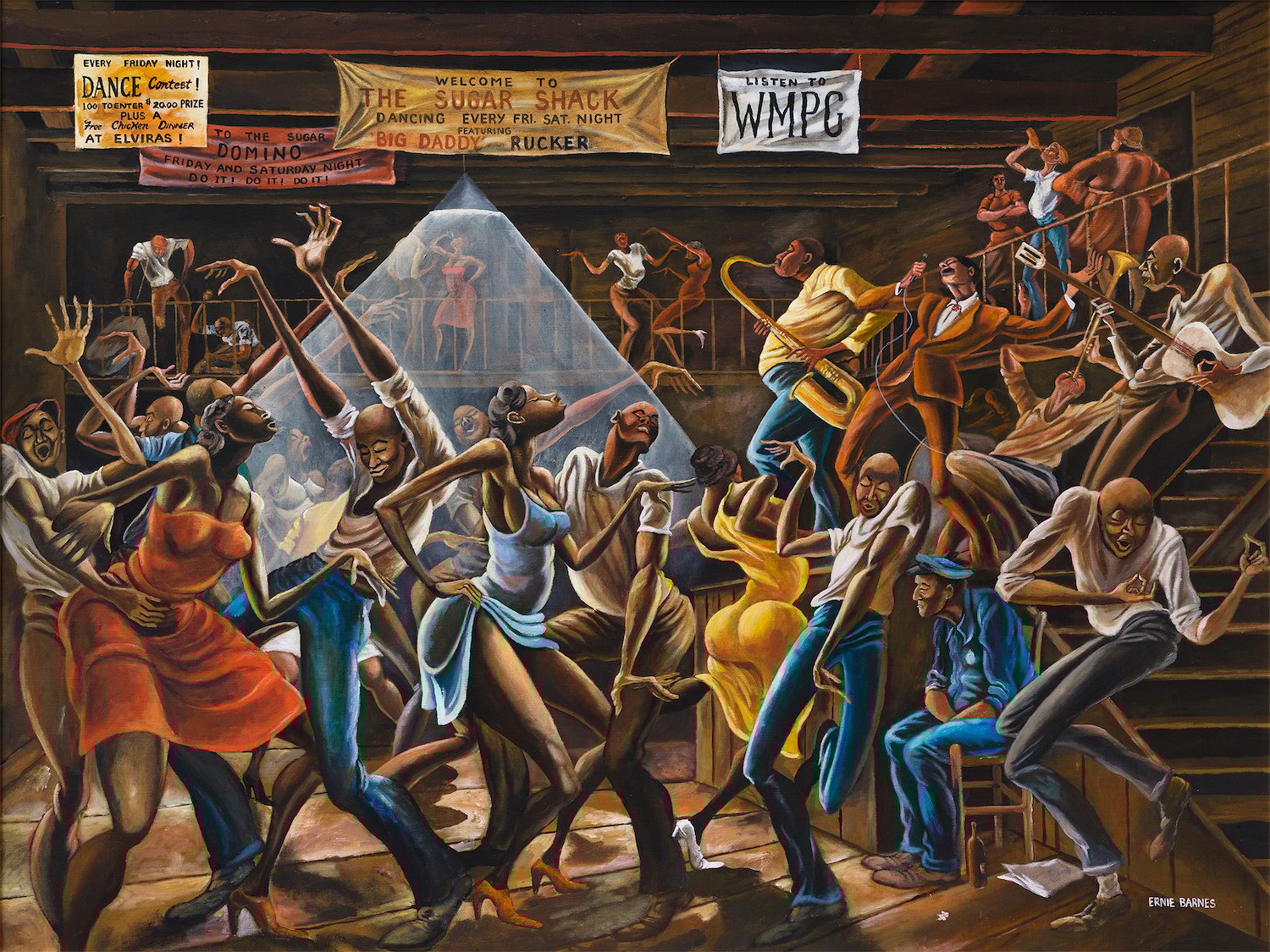
Today, when people talk about Ernie Barnes, they often start with The Sugar Shack—a 1970s depiction of a Black juke joint bursting with boogie and bliss that launched him into the crossroads of American culture. The painting was seen weekly in the credits of the popular ’70s CBS sitcom Good Times and was featured on the cover of Marvin Gaye’s 1976 album I Want You. Today, the original is owned by actor Eddie Murphy, who purchased it for $50,000 from the estate of Marvin Gaye after the singer’s death. It could, however, be worth 500 times that amount—a reproduction of The Sugar Shack done by Barnes sold at Christie’s in 2022 for more than $15 million.
Carter, who grew up seeing Barnes’ work on calendars and prints in countless living rooms, dorms, and dens, says The Sugar Shack holds a special place in his understanding of Barnes.
The piece captures what Carter calls “the joy of engagement,” a quality he says runs through all of Barnes’ art. “It feels so fun to have a relationship with a painting that is serious in its unseriousness,” Carter adds. “This is a painting you can kick it with, for real.”
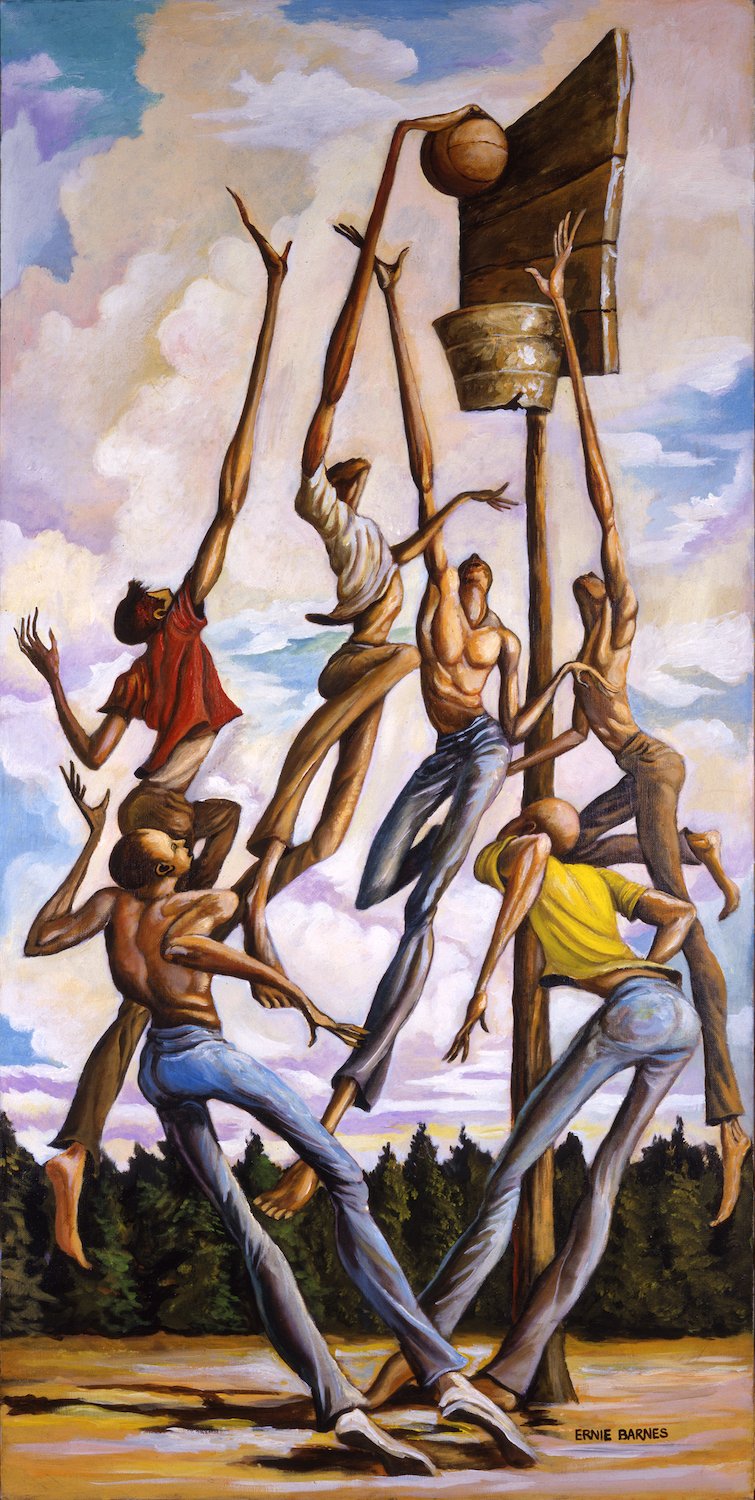
But Barnes’ legacy isn’t just about The Sugar Shack. Following his retirement from the football field, he was named the official artist of the American Football League and later the official sports artist of the 1984 LA Olympics. His work was featured on additional legendary album covers from Curtis Mayfield, B.B. King, the Crusaders, and Donald Byrd. He was a true working artist, a rare feat for any painter, much less a Black painter whose career began before the passage of the Civil Rights Act.
Barnes called his style neo-mannerism, a nod to Renaissance Italian painters, but his work is also frequently associated with the Ashcan school, which focused on scenes of everyday life, often in poorer urban areas of the US in the early 1900s.
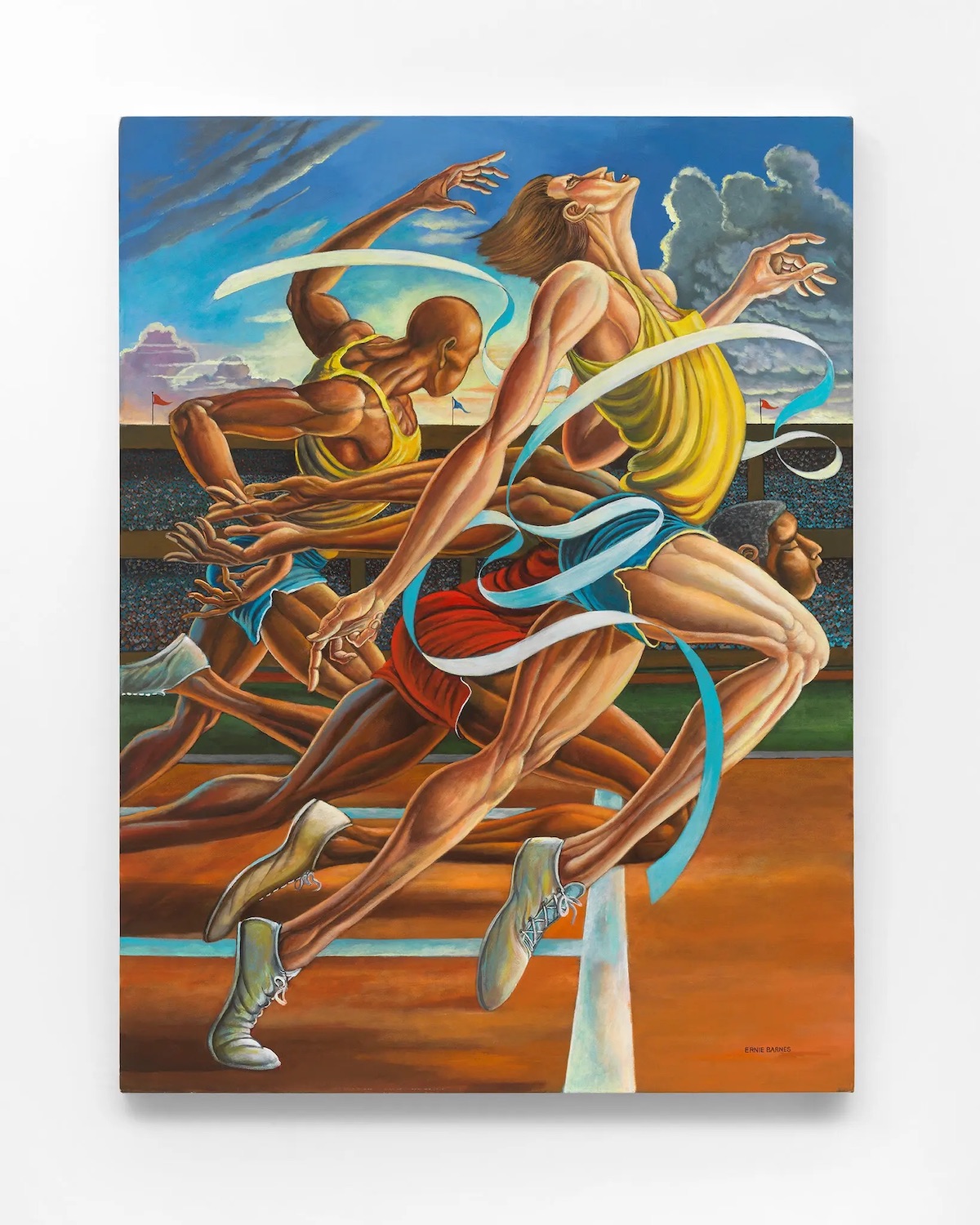
“His mentor [chairman of the art department at North Carolina College Ed Wilson] told him to slow down and pay attention to what’s right in front of him,” Carter explains. “To see a story even in something as simple as a shoe on the sidewalk.”
His approach gained him growing fame, even after his death in 2009.
“So many people know the work, even if they don’t know the artist,” Carter says. “The style is unforgettable, and it keeps finding ways to live on.”
Rodriguez echoes this sentiment, pointing to the enduring demand for Barnes’ paintings—as well as that record auction sale that introduced Barnes to a new audience.
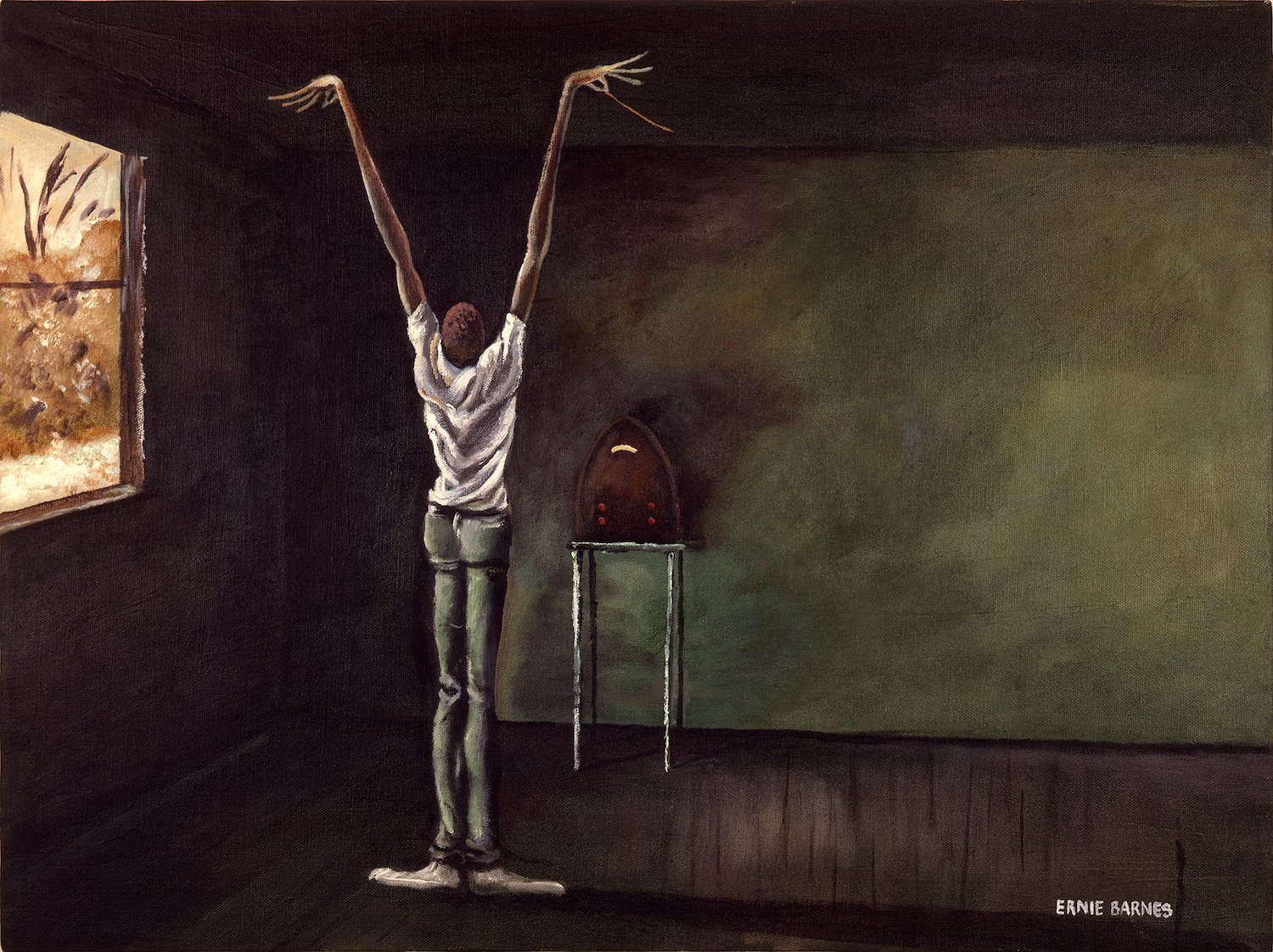
“The art world finally became aware of him,” Rodriguez says. “He had a base of loyal collectors and followers, and now it’s all coming together. There are always new collectors coming in—athletes, celebrities, and people who grew up with Ernie Barnes’ art.”
Former NBA player and current LA Clippers coach Tyronn Lue recently purchased a Barnes original.
“The piece I purchased immediately resonated with me because it was a picture of a woman which conjured up thoughts of my mother and aunts and grandmother,” Lue told SDM. “I plan on adding more Ernie Barnes to my collection. Several of his basketball pieces, especially those in rural settings, remind me of my background and where I came from.”
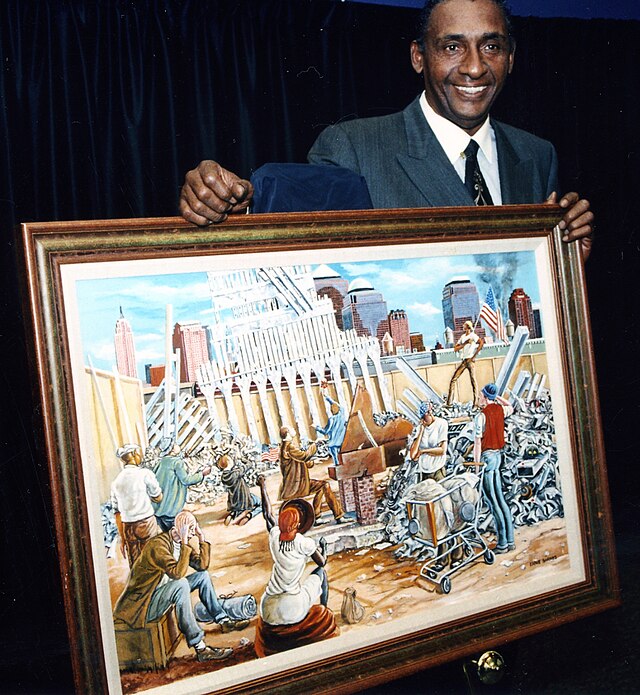
Barnes’ work can be found on permanent view at museums around the country. Here in California, a sample of his work is currently on display at the San Francisco Museum of Modern Art through February 18th.
But even as Barnes’ fame grows, San Diego remains an integral part of his story—a chapter that helped shape the man and the artist.
“San Diego was one of those places he always held in high regard because of the connections and the experiences he had there,” Rodriguez says.
Mateo Hoke is a journalist and author. His books include Six by Ten: Stories from Solitary, and Palestine Speaks: Narratives of Life Under Occupation.
From surprise revivals to changing dining habits, these are the shifts redefining the local culinary landscape
If absence makes hearts (and stomachs) grow fonder, then shuttered restaurants quickly become the hottest tickets in town—something a number of iconic institutions found out after taking very public hiatuses after historically long runs. For instance, following a lengthy (and extremely flip-floppy) closing process after 92 years in business, Las Cuatro Milpas reopened two blocks away in Mercado del Barrio. Similarly, Carlsbad butcher shop Tip Top Meats reopened in the same location (albeit a smaller space) after the death of founder Joachim “Big John” Haedrich in 2023. Finally, after a whopping decade out of business, Sami Ladeki and chef Alfie Szeprethy brought back Roppongi to its original Prospect Street space, where it was the talk of the town in the late ’90s. All came back under the same proprietors, so they weren’t third-party nostalgia-licensing deals. The algorithm may have ravaged our attention spans away from all but the newest and shiniest, but this proves there’s still hope for our collective prefrontal cortex.
Other local eateries honored their pasts by bringing in new perspectives. The Lion’s Share in Embarcadero, Milton’s Deli in Del Mar, Dudley’s Bakery in Santa Ysabel, and J-K’s Greek Cafe in La Mesa handed over the keys to new owners willing to take on a big task: maintain the soul of icons through particularly rough economic circumstances for restaurants, navigate big feelings from longtime regulars (who often don’t take kindly to change), and make some necessary changes to keep going for another few decades. Taking over a project in process can be a lot harder than starting from scratch. But building that feel-good nostalgia doesn’t happen overnight, so it sure helps to have a well-established playbook of success passed down from those who came before.

It wasn’t just restaurant groups from Los Angeles that decided to put down roots en masse, although San Diego saw plenty of LA transplants recently (Sugarfish, Mr. Charlie’s, For the Win, Katsuya Ko, Bacari). Global brands like Chef Fei, Zuma, and Pepper Lunch have locations of their own on the way, and upscale Canadian eatery Joey joined to the inescapable gravitational pull of Westfield UTC’s culinary cosmos for its first spot in America’s Finest City. Good to see the rest of the world is catching up with what we’ve been seeing the last few years—San Diego is a dining destination already on the rise.
Between the never-ending news cycle of doom and perimenopause brain fog, I’m at the stage in life where I’m more than happy to let someone else make a decision for me, especially when it comes to what’s for dinner. And based on the way a lot of menus look right now, I’m not alone. It seems like half the places I visit offer some version of a prix fixe, omakase, or tasting menu. Restaurants are embracing the curated experience to solve the problem of affordability (a fixed menu reduces food and labor costs, guarantees an acceptable check average, etc.) and critical thinking in one fell swoop. Omakase (meaning “I leave it up to you”) is far from a new concept in high-end Japanese sushi culture, but now that it’s popping up everywhere from coffee experiences to grab-and-go sushi and sandwiches, it’s gone from somewhat niche to nearly omnipresent.

The world got an up-close look at San Diego’s coffee industry when we hosted the premier specialty coffee expo World of Coffee for the first time this April. San Diego’s long and rich coffee history stretches back to the late 19th century. Things percolated fairly quietly for around a century before really picking up steam. Today, there are nearly 200 specialty roasters and cafes across the county, with many earning national accolades like the Good Food Award (Steady State Roasting, 2020; Bird Rock Coffee Roasters, 2023, 2021, 2019, 2017, 2016), Roaster of the Year by Roast Magazine (Mostra Coffee, 2020; Bird Rock Coffee Roasters, 2012), and the Specialty Coffee Association Coffee Design Award for packaging (Rikka Fika, 2026). Now that we’ve moved past the comically insufferable coffee snob era of the early 2000s, even java newbies can feel comfortable walking into pretty much any coffee shop in San Diego, asking questions, trying a few things, and feeling confident they’re going to get great service and a great beverage.
Beth Demmon is an award-winning writer and podcaster whose work regularly appears in national outlets and San Diego Magazine. Her first book, The Beer Lover's Guide to Cider, is now available. Find out more on bethdemmon.com.
See Rosalía in concert, stroll through Little Italy for Summer Sera, and dress up for Comic-Con
Summer has officially kicked off, and San Diego is celebrating the sunny season with a myriad of fun events. From San Diego Pride week and a fairytale performance at Civic Theatre to a Santigold concert and Comic-Con, there are dozens of opportunities to make memories worth adding to your scrapbook. Here are all the best things to do in San Diego this July:
Concerts & Festivals | Theater & Art Exhibits | More Fun Things to Do
Divine inspirations, operatic ballads, and symphonic pop production elevate Rosalía’s Lux to heavenly levels. Hear angelic vocals ascend—in up to 13 languages—during her performance at Pechanga Arena.
Enjoy a night of feel-good indie rock and sing-along anthems at the Cal Coast Credit Union Open Air Theatre courtesy of Young the Giant and special guest Cold War Kids.
Santigold collects genres like gold stars: musical accouterments that brighten her uniquely alternative sound. See her live in concert with dancehall producer Troy Baker Sound at Humphreys Concerts by the Bay.

Be the Civic Theatre’s guest for “Beauty and the Beast” and discover that a fairytale love sometimes lies beneath the surface.
Two male government workers pursue a secret romance amid the Lavender Scare in the San Diego Opera’s production of “Fellow Travelers” at the Balboa Theatre.
The deep blue sea is home to countless ecological treasures, including the remarkable marine organisms documented by Oriana Poindexter. Study her educational and experimental imagery at The Photographer’s Eye via Field Notes.
Audrey Hepburn. Marlon Brando. Salvador Dalí. What do these icons have in common? Each was the enigmatic focus of a Cecil Beaton portrait. Step inside Cecil Beaton’s Fashionable World, an alluring showcase of 20th-century style at San Diego Museum of Art.

The Little Italy Mercato will trade morning rays for golden-hour glow through its free Summer Sera, an expansion of the neighborhood’s farmers market with live music, artisanal finds, and a fetching amount of pet activities.
San Diego Pride week starts with a Dyke March and ends with the two-day “Pride Shines On” festival. The days in between? Run a 5K, march in the parade, visit the rainbow-lit St. Paul’s Episcopal Cathedral, and more.
Dress up for a Mediterranean-themed tea time at the Estancia La Jolla, a laid-back yet refined afternoon planned for the resort’s monthly Tea in the Garden series.
Nerd culture’s biggest gathering returns to the Convention Center. San Diego Comic-Con welcomes fans of everything from comic book cinema to ultra-rare collectibles for panels, exhibits, sneak peeks, and much more.
Ryan Hardison is a freelance arts and entertainment writer and recent graduate of San Diego State. When he's not staring at his laptop, he's likely eating an adobada burrito or getting sunburnt at the beach.
That's the question at the center of a new collaborative arts initiative launching this September, celebrating the artists, performers, designers, and makers shaping the region
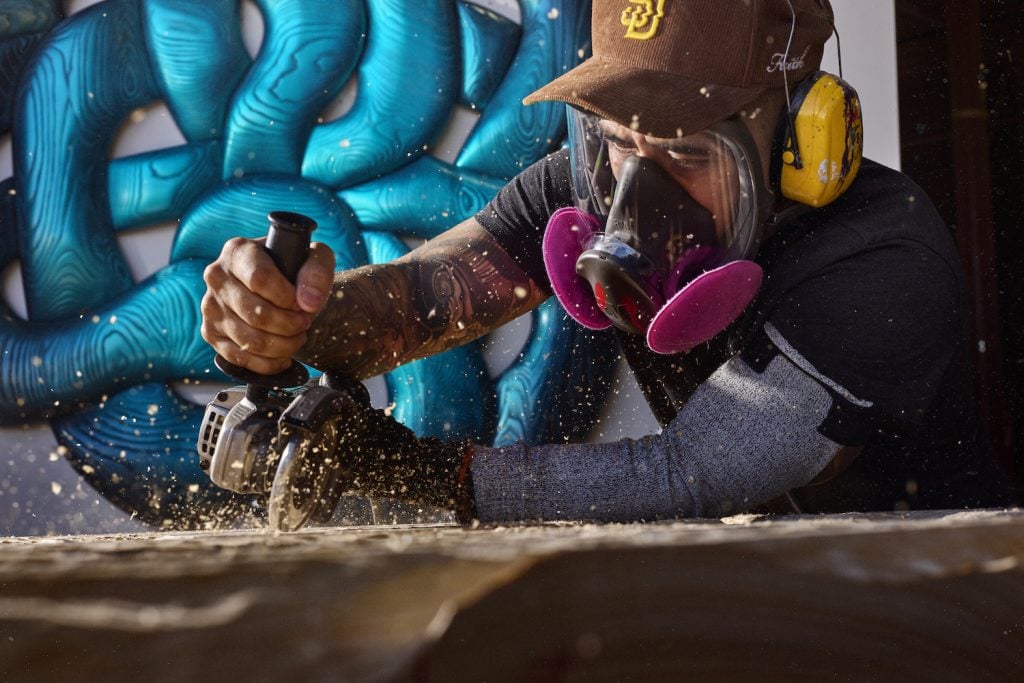
You may not know his name, but if you were one of the millions of people who traveled in and out of Terminal 2 at San Diego International Airport in 2024, you’ve seen his work. David Mont Virgen was born and raised in Tijuana. He earned a degree in international business and studied interior design in Madrid. In early 2020 during the global pandemic, he made one of life’s impactful pivots and decided to pursue art full time.
David works between San Diego and Tijuana, in the cross-border corridor that is, depending on who you ask, either one of the most complicated places to build a life or one of the most generative creative regions in the country. He makes minimalist work—paintings, sculpture, objects. To do minimalism well, you have to be very good, because there is nowhere to hide. That airport piece? It’s officially entered the permanent collection of the San Diego Museum of Art. David is very good.
While his work was gaining real traction in San Diego, his marriage ended. When that relationship dissolved, the legal and physical ground beneath his feet shook: The future of his citizenship was now in limbo. David looked at his options and chose yet another life pivot.
An accomplished working artist with a piece in a museum’s permanent collection enlisted in the U.S. Army, at a time when this country is at war. David describes this period of his life with grace, as “…an opportunity to choose myself and move forward with greater clarity and intention. For the love of self.”
That phrase, “For the Love of Self,” became the title of his show, which opened at the Guild Hotel in January 2026 with support from Oram Hotels and the Consulate General of Mexico in San Diego. Jennifer Findley of JFin Collective led the curation. Within weeks of the show’s debut, David shipped off to train with the army. It would be easy to read his enlistment as purely practical, and citizenship was part of his calculus, but he is precise about his reasons: He wants to continue building a future in this country and building a future for this country. Because service, he says, feels connected to art. “Both are rooted in the belief that we are responsible for contributing something larger than ourselves.”
David is one creator out of many whose story hasn’t yet been told, but whose path reflects the world we live in. The truth he represents is that the artists in this city are creating under increasingly challenging constraints even as their work actively shapes the world we move through—the places we gather, the neighborhoods we love and live in—whether we know their names or not.
It’s time their stories are told.
This fall, we’ll be publishing an ambitious arts and culture issue made possible by the support of two organizations who are underwriting an expanded freelance budget with one question at its center: Who makes San Diego, San Diego?
The Art & Design District—a Prebys-supported initiative to develop and shape a dedicated area of the city for creative work, led by Jonathan Glus—has joined as co-publisher of our September issue. SDFC Playmakers led by Sebastian Morúa, the MLS team’s program dedicated to showcasing San Diego’s creative community, has also joined as digital co-publisher for the next six months.
With their support, our freelance budget has tripled. In the spirit of radical transparency, and because our readers deserve to know how our work is funded, our typical monthly print freelance budget is about $6,000. That supports writing, photography, and design across more than 100 pages. Our monthly digital budget is $2,500.
With the support of our co-publishers, we’ve brought on Aaryn Belfer, one of San Diego’s most respected editorial voices, as the issue’s special editor. Alongside Troy Johnson, content chief; and Emma Veidt, editor; she is helping shape the editorial vision of the issue.
With an expanded team, we’ll soon bring on a digital producer and an additional art designer. We’ll produce an expansive portrait of the artists, makers, performers, and institutions defining this region’s creative life, commission original photography, and create a comprehensive fall arts and culture calendar. The issue will anchor a six-month editorial program that will extend across digital, social media, video, podcast, and newsletters through early next year.
We have been doing this for 78 years, and we have learned how to do it well with limited resources. But the conversation happening in San Diego right now—about the role arts and culture play in shaping a city and the role a city plays in shaping arts and culture—is one that demands more than what our standard monthly budget can produce. Until now.
This partnership model is new to us but the challenges that precede it are not new to media, particularly on the local level. And yet, this collaboration serves as real proof that civic organizations and local media can work together to document and preserve the story of a place and the people who make it, for the record.
David told me that San Diego gave him a sense of belonging. That he felt supported and encouraged to keep growing. Not because life got easier, but because he learned to trust himself through uncertainty.
Today, he’s somewhere in basic training. But he is still an artist and he will keep making work. The artists in this city are almost never just one thing. They are painters and soldiers, sculptors and teachers, dancers and mathematicians. David is a minimalist artist and a U.S. Army recruit. He is Tijuana and San Diego. He is, in the most literal sense, still becoming.
A great city knows its makers. I want San Diego to be that city.
September is on newsstands soon.
Stake Chophouse & Bar brings contemporary classics and old-school service to the heart of Coronado
Stake Chophouse & Bar isn’t your average steakhouse. Blue Bridge Hospitality’s Coronado outpost is a modern interpretation of a big-city steakhouse nestled in the heart of the small coastal community. The team at Stake has reimagined the whole steakhouse experience. By prioritizing a seasonal farm-to-table sourcing philosophy, a personalized guest experience, and unique service touches, like a formal steak presentation and a bespoke knife selection process, Stake distinguishes itself in a sea of steakhouses.
Exceptional steaks, including Wagyu from Japan, Australia, and the U.S., and fresh seafood flown in daily form the core of Stake’s culinary identity. The menu features a five-course omakase-style steak experience highlighting house favorites, plus an array of cuts, and classic steakhouse staples—think a wedge salad, baked potato, or pasta carbonara—refined for a contemporary palate without losing their traditional appeal. Stake focuses on seasonal sourcing from the region’s best family farms and specialty purveyors, and incorporates intentionally unexpected touches to create something truly unique.
“I challenge our chefs and myself to take it a step further in sourcing,” says Chef Ronnie Schwandt. “It’s important to us to highlight different farms, unique one-off farms—whether it’s cattle, strawberries, a local fisherman or from anywhere in the United States, we’re always trying to find that niche.”
Beyond the menu, Stake emphasizes outstanding service, says Vinny Spatafore, Director of Hospitality Operations. Staff maintains detailed notes, allowing them to remember guests by name, recall previous orders such as a favorite martini (also memorable for the customer since it’s served in an extra tall, distinctly-shaped glass), and celebrate special occasions like birthdays and anniversaries.
“When you have those points of topic that you remember about a guest, they appreciate that,” he says. “Our servers are really good with that—we have a couple servers who have been here since the beginning and they’ll remember somebody from years ago, their name, their kids’ names, where they live. I’m really thankful to have a great front of house staff.”
Award-winning wines, rare whiskeys, special events, and a complementary black car service that provides transportation for guests throughout Coronado add to Stake’s appeal.
Schwandt stresses that Stake offers more than a meal; they aim to give patrons something unforgettable.
“It starts when you walk up the stairs and are greeted by the hostess—that sets the tone for the night. Then you’re greeted by a server, who may know you by name, and can guide you through the menu and curate as they get to know you,” says Schwandt. “Most people leave kind of blown away; they leave feeling like they just had an experience. That’s the goal, right? Whether you’re serving smash burgers or high-end steak, you want somebody to leave thinking, Wow, that was awesome.”
We ask the city's best food photographers to choose their favorite pics and share their secrets to capturing a drool-worthy pic
Food is a notorious diva to photograph. The wrong lighting can make José Andrés’ paella look like a jaundiced grain bowl. You could be staring at the best sandwich of your life, but shoot it from above and—hey, congrats on that abandoned piece of lettuce bread. A cottage meme industry has been built around the hilariously bad photos on review sites that make Michelin-star food look like Michelin tires.
Especially in a visual modern media world, food culture depends on great photographers capturing the painstaking work in equally deserving ways. We asked four of San Diego’s top food photographers for their favorite shot from another year of documenting what we eat.

Getting this kind of shot takes a bit of yoga. Asana yourself into the corner, hold your breath, pray that a chef on the move doesn’t back into your light stand.
“You’re stepping into someone’s workspace during their busiest moments, so it’s a balance of being present to get the shot and being invisible to not slow anything down,” Kimberly Motos says.
The subject here is the Birdman sandwich from Chick & Hawk—hot fried chicken thigh, tangy slaw, kimchi comeback sauce, sweet and spicy pickles, potato brioche bun—getting a hearty dousing of its difference-maker seasoning. Motos captures the parts of the process that diners don’t usually see: the chaos behind something that looks so simple.

“I love this image because it feels like a moment you want to step into,” says Lucianna McIntosh. A warm, sunny day at The Fishery in PB with oysters, caviar, and martinis. Yes, please.
The little details—the glass sweating a little, the direct afternoon light creating stark shadows, the oyster glistening on the tray—are the main characters. Instead of trying to overly control the setup, McIntosh “followed the light and lines that draw you in more,” she says. “This was one of those moments where everything lined up on its own for a second. I love it when the shadows end up being just as important as the food itself.”

La Jolla native Eric Wolfinger—who won a James Beard Award for Tartine Bread, one of the most stunning bread books of all time—says he doesn’t have a signature style. His style is a conduit.
“I see my job is to translate the chef’s point of view into something you can feel,” he says.
For this shot, Fleurette chef Travis Swikard had one directive: cuisine du soleil (“cuisine of the sun”). With a spread of leeks vinaigrette, herb-roasted golden chicken, and beets, Wolfinger wanted to create a scene that felt straight out of the French Riviera, relaying the light, bright style of Swikard’s new spot.
Some bonus additions here: Extra lights—to add lots of warmth—and a clipping from an olive tree.

Timing and light are everything in food photography. In Lucien—La Jolla’s tasting-menu-only restaurant with moody ambiance—a single strobe flash creates the ideal spotlight.
Dee Sandoval says she uses the “natural, just-plated energy” of the dish to “create a portrait of moment and craft.” That’s why this Mostra Ghost Bear espresso ice cream—with San José dark chocolate mousse, soy-miso caramel, and koji shoyu chocolate sauce—looks like it might dissolve halfway to your mouth.
Emma Veidt is an editor at San Diego Magazine. She earned her bachelor's and master's degrees from the Missouri School of Journalism. She loves running, hiking, and rock climbing, but really, she mostly loves encounters with the street cats around North Park.
Dine at The Freedom Table, see Bob Dylan in concert, and explore local and national history through America 250
As summertime inches closer to the shores of San Diego, there are plenty of reasons to be ecstatic. For one thing, there’s the impending arrival of the summer solstice (Sunday), and three days before that, Del Mar’s own Summer Solstice will return for its yearly golden hour. There are also plenty of local Juneteenth events, such as Kinfolk Fest, the Cooper Family Foundation’s Juneteenth Celebration, and The Freedom Table, a new, food-centered event from the originators of Juneteenth San Marcos. We’re also less than three weeks away from America’s 250th anniversary, and the celebrations range from the San Diego History Center’s America 250: San Diego 1776-2026 to NASCAR’s weekend of racing at Naval Base Coronado.
Food & Drink | Concerts & Festivals | Theater & Art Exhibits | More Fun Things to Do

Cbar has planned a week’s worth of festivities to mark its first birthday, and everyone can get in on the fun. The 1-Year Anniversary Week celebrations continue with a special edition of the Sips & Shells craft series ($50) on Tuesday from 6-8:30 p.m., half-off pastries with any purchase of a barista drink (plus an anniversary summer wine flight) on Wednesday and a five-course winemaker dinner on Thursday from 6-9 p.m. ($130). Finally, the birthday bash will conclude with live music on Friday (Will Fedak) and Saturday (Cappo Kelley) from 6-9 p.m.
2917 State Street, Carlsbad
Little Italy’s annual food crawl has so many options that it warrants splitting into two evenings, each boasting a diverse lineup of 20 neighborhood vendors. During the Taste of Little Italy, taking place Tuesday and Wednesday from 4-8 p.m., attendees can make their way from the Piazza della Famiglia to nearby dining destinations for bites like esquites, sausage rolls, hot chicken tenders, and forkfuls of handmade pasta. Each night will also include live music and stops for drinks, desserts, and vegetarian items. Tickets are $71 per day.
Little Italy
As spring makes its golden transition into summer, welcome the new season with open arms and a big appetite during Del Mar Village’s marquee tasting event this Thursday from 5-8 p.m. With the Summer Solstice celebrating its 20th anniversary, this year’s iteration will include dozens of food and drink offerings from Del Mar Village vendors, soulful tunes from Christian Jules Taylor, live art by Sarah O’Connor, and wave-crashing views at Powerhouse Park. General admission (21+) is $157 and comes with unlimited tastings as well as a commemorative tasting glass, while VIP tickets are sold out; proceeds support the Del Mar Village Association.
1658 Coast Boulevard, Del Mar
After hosting the first-ever Juneteenth San Marcos festival in 2025, Lionel and Natalie Saulsberry have upped the ante with The Freedom Table, an elevated observance of community, culture, and the culinary arts. This Friday from 4-9 p.m. at TERI Campus of Life, guests can enjoy storytelling, art installations, live music, curated cocktails, and a chef-led dining experience, all in recognition of Juneteenth’s lasting importance. Ticket options include general admission ($261), plus two charitable ticket options: supporter ($313) and impact ($417), with a portion of sales going towards the youth nonprofit Achievement in Motion.
555 Deer Springs Road, San Marcos
In honor of NASCAR’s Coronado debut and Talladega Nights: The Ballad of Ricky Bobby, ARLO is throwing a Father’s Day brunch for the dads who want to go fast. This Sunday from 8 a.m. to 2 p.m., patrons can order from ARLO’s regular brunch menu, as well as a trio of holiday specials: the Dad’s Day Steak and Fries ($64), the Fit For a King Muffuletta Sandwich ($29), and the Big Daddy Brookie ($14). This shake and bake-approved meal will also include a DJ, cigar rollings, whiskey tastings and a Ricky Bobby costume contest. Reservations can be made online.
500 Hotel Circle North, Mission Valley
Ryan Hardison is a freelance arts and entertainment writer and recent graduate of San Diego State. When he's not staring at his laptop, he's likely eating an adobada burrito or getting sunburnt at the beach.
SeaWorld dazzles with a drone show, big-name entertainers, new animal adventures and more
Nights are heating up at SeaWorld San Diego. The quintessential summertime staple on Mission Bay is transforming into a destination for unforgettable day-to-night adventures, bringing back some of its most popular Summer Nights programming and introducing exciting new experiences sure to delight both kids and adults alike.

The 2026 Summer Day to Night at SeaWorld San Diego is the park’s most ambitious season yet. SeaWorld has planned a highly anticipated entertainment lineup that features nine weeks of throwback concerts featuring R&B and hip‑hop favorites from the ‘90s and early 2000s, including Jordin Sparks, Too $hort and Warren G, Ashanti, and an array of boy band heartthrobs performing together as part of the Pop 2000 Tour.
New this season is perhaps the park’s most visible update: a nightly drone show, Ocean of Dreams, which illuminates the sky with hundreds of synchronized sparklers. Drones form sea otters, sharks, dolphins, and a majestic orca that tell a breathtaking 12-minute story of marine life and underwater ecosystems. The show culminates with a spectacular electric neon finale celebrating hope, wonder, and ocean stewardship.
Nighttime visitors are also in store for animal adventures that fuse education with high-energy fun and the dreamy ambiance of nighttime. The park has launched two all-new animal presentations: Shamu’s Celebration: Light Up the Night and Dolphins: Touch the Sky. Shamu’s Celebration: Light Up the Night features vibrant lighting, music, and dynamic choreography that celebrates the power and beauty of killer whales. Dolphins: Touch the Sky showcases playful bottlenose dolphins and the special connection between humans and the natural world. And back by popular demand is fan-favorite Sea Lions Tonite. See the charming pinnipeds splash, play, and parody pop culture in this refreshed crowd-pleaser.

More must-sees: a newly reimagined Shark Encounter, one of the country’s more immersive exhibits highlighting 11 different species up close, SeaWorld’s beloved BMX Blast! stunt show, and high-seas escapade, Pirates Ahoy! The Battle for Mermaid Cove. And don’t miss the park’s all-new Deep Sea Disco, which encourages guests to dance the night away under the glow of the SkyTower, and vibrant closing time laser light display Laser Reef Summer Spectacular.
Amp up the nighttime vibe with local craft beers, curated cocktails, and nostalgic theme park treats with $1 beer all summer long. SeaWorld is the place for day to night summer fun. When the sun goes down, SeaWorld lights up, and inspires guests of all ages to embrace their inner whimsy and see why generations of San Diegans head to SeaWorld to make memories they’ll never forget.